LETTER XL.
Reading edition
From the Architect.
THE BREATH OF LIFE.
DEAR JOHN: No man ever built himself a house without getting out of patience before it was finished.
Among all the furnaces you have examined, a certain one is doubtless better for you than any other; when I find out which one, you shall be informed. Reliable testimony on the subject can only be given by some one who has tried different kinds in the same house under similar circumstances for a considerable time. As we never have two seasons alike, and do have about three new first-class furnaces every
The danger from cast-iron is in its weakness, not in its strength.
You speak of poison carbon. Carbonic acid is not poison. It is harmless as water,—just. It will choke you to death if you are immersed in it. Trying to breathe it in large quantities will strangle you. But we drink it with safety and pleasure, and may breathe a little of it, even
Let me digress here to answer another question. No, don't put your ventilating flues in the outer walls if you expect the air to rise
To return to the former point. When you can warm within a ventilating flue all the air passing through it more economically than you can warm the same quantity in the room from which it is taken, then you may admit the air to feed this same flue near the bottom and per
The foregoing refers to rooms heated on the furnace principle, where all that seems needful for complete ventilation is a sufficient outgoing of the air to cause a constant change. In theory, too, the warm air must cross the room to make its exit. Indeed, the plan of admitting it
If stoves or other local radiators are used, you must of course provide for the entrance of pure air as well as the exit of the impure. With two openings in the ceiling, the air will commonly ascend one and descend the other. Open fireplaces, whether for wood or coal, are in favor with those who have learned to love fresh air, besides being, for their cheerfulness, an unfailing antidote to melancholy, and other selfish, spiritual ills.
While warming our backs we may dispose of some adjacent matters. You can make a very pretty fireplace for wood of the common buff-colored fire-bricks, either alone or variegated with good common red bricks; a hearth of encaustic tile, pressed bricks, or even Portland cement. Let the hearth be a generous one, two and a half feet wide, and at least two feet longer than the width of the fireplace, if you mean it for actual use. You must not suppose
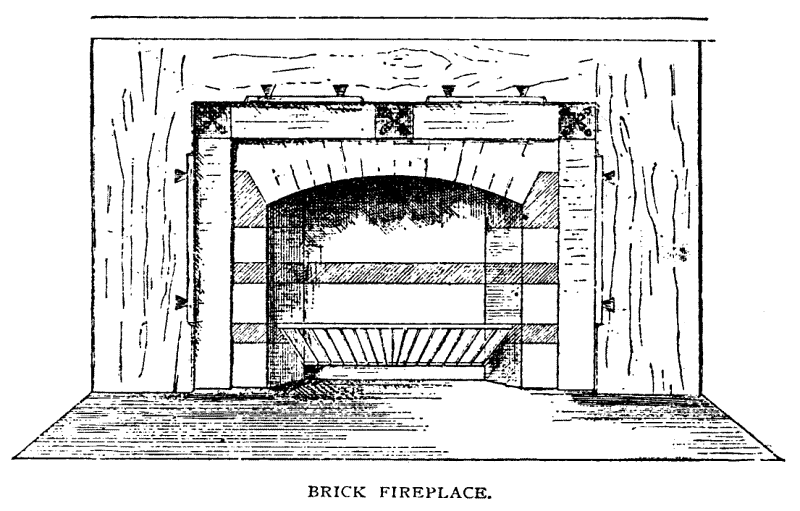
With a furnace your house becomes a lumber-kiln, and any wood that has not been tried as
When you have read all this about heating and ventilating two or three times over, these conclusions will begin to crystallize in your mind:—
Open fires give the surest ventilation and the best cheer.
If stoves are used for economy, fresh air must be systematically admitted.
If you begin to investigate you will discover a fearful amount of ignorance and indifference where you should find positive information, and the most discouraging obscurity or conflicting statements among those who profess to be wise in such matters.