LETTER XXIX.
Reading edition
From the Architect.
CONSISTENCY, COMFORT, AND CARPETS.
MY DEAR FRED: I don't despise the new fashions. I admire them—when they are good. Will you please try to understand that a thing of beauty is a joy forever? Whatever is born of truth, whether in art or religion, belongs to eternity; it never goes out of fashion. Will you also remember that modern styles, modes, fashions, inventions,—call them what you will,—are the mere average product of human thought and labor during a few years; the old that abides is drawn from the superlatively good of former countless genera
Certainly it is easier to say what to avoid than what to accept, for there's more of it. Broad is the road of error, and the faults and follies, vices and sins, that wrangle and riot therein, are thicker than crickets on a sandy road in October,—thicker and blacker. You may catch them all day and there'll be just as many left. But the devoted followers of truth you may count on your fingers and carry them home in your bosom. Besides, the right thing to do cannot be told in detail for another, since every man must manifest his own individuality as he must work out his own salvation. In the millennium I expect we shall find no two houses built or furnished alike.
Yes; there is an objection to cheap floors, carpets or not; and now I've gone through your last lot of interrogation-points backward, which brings me where I left off in the former letter.
You propose to carpet the floors and ask to have them made to fit the carpets. Would you also like the walls to fit the paper-hangings, and the windows the curtains? Do you know what kind of carpets you will use in each room; just how long and how wide they will be to half an inch; the width of the borders; how much they will stretch in putting down; how much "take up" in the making (you see I can use interrogation-points)? Do you
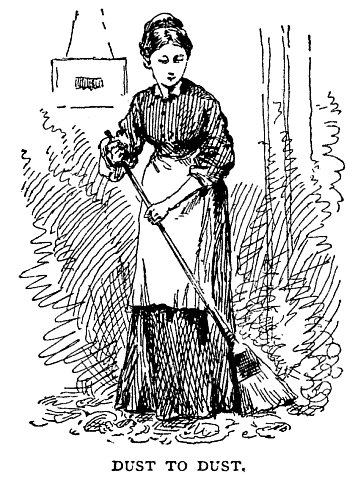
Concerning, the floors themselves,—leaving the yardstick out of the question,—even if they are covered by carpets six inches thick, it will not pay to lay poor ones. They should be double for solidity and warmth, well nailed for stiffness, seasoned for economy, and of good lumber for conscience' sake. Seasoned for economy, I say, since nothing is more destructive to carpets, especially to oil-cloth, than cracks in the floor underneath them. Yes,—one thing; the warped edges of the boards, that sometimes raise themselves,—that are almost sure to do so in spruce, which is never fit for floors, though often used. It's my conviction that spruce floor-boards, two inches thick and dust to corrupt and strangle, neither creaks nor cracks to annoy. It's a question among theologians whether the millennium will come "all at once and all o'er," or gradually. I think the millennial floors must be introduced gradually,—say around the edges,—for I do not suppose you or any one else in New England will give up the warm-feeling carpets altogether. And yet one who has seen a carpet of any sort taken and well shaken, after a six months' service, will hardly expect added health or comfort from its ministration. If your observation of this semiannual performance isn't sufficient, and you are curious to know how much noisome dirt and dust, how much woolly fibre and microscopic animal life, you respire,—how these poisonous particles fill your lungs with tubercles, your head with catarrh, dirty carpets. Doubtless they will be shaken and "whipped" (they deserve it) two or three times a year, and swept, maybe, every day. The shaking is very well, but though it seems neater to sweep them, yet for actual cleanliness of the whole room, carpet and all, I suppose it would be better at the end of six months if they were swept—not once! For whatever can be removed from a carpet by ordinary sweeping is comparatively clean and harmless,—that which sinks out of sight and remains is unclean and poisonous.
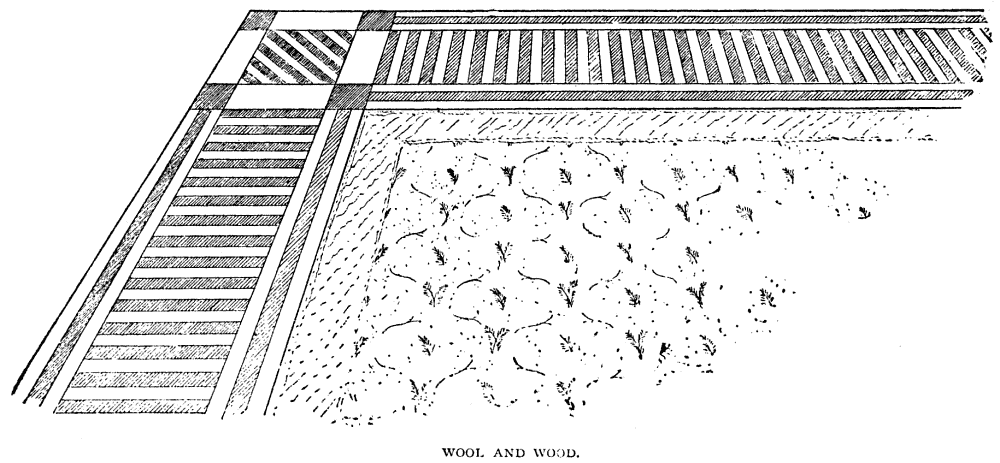
There are two ways of lessening the evil without exterminating the cause. One is to shut the room, never using or opening it, except for the spring and fall cleaning; the other is to
If you paint or paper the walls, as you will if they are plastered, keep this in mind: the trowel finishes them as far as use is concerned. Whatever is added is purely in the nature of ornament, and must be tried by the laws of decoration. If you enjoy seeing "a parrot, a poppy, and a shepherdess," bunches of blue roses, and impossible landscapes, spotted, at regular intervals, over the inner walls of the rooms, you will choose some large-figured paper. Perhaps, if the pattern is sufficiently distinct and gorgeous, you will think you need no other pictures; and
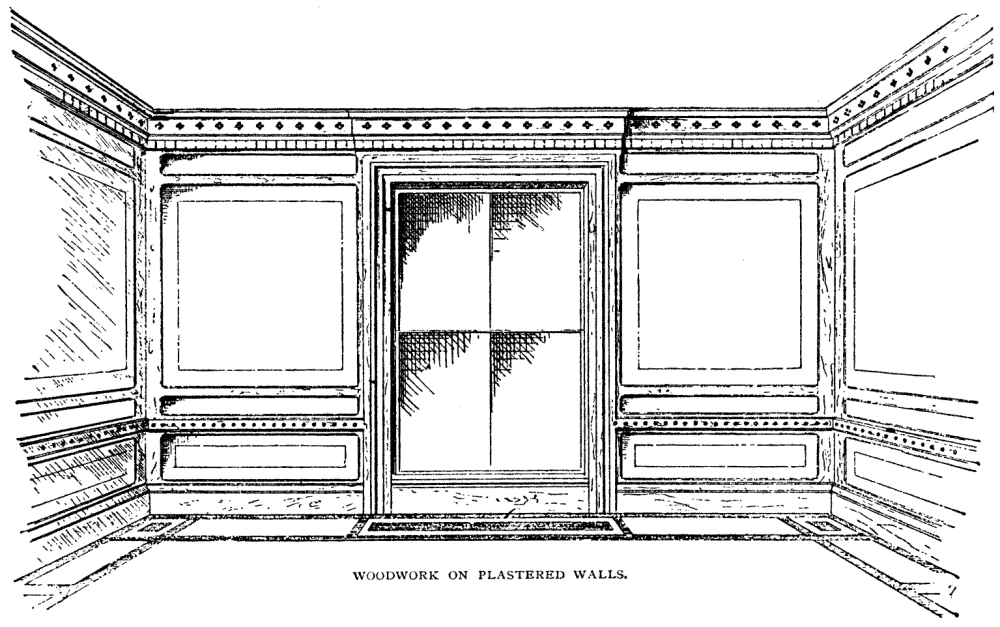
Wainscoting is always in order; it is a question of harmony, when and where to use it. What you have in mind is really an extended and ornamented base. Of course, it enriches the room, but it begins a work to which there is no limit. It should be supplemented by a corresponding wood cornice at the top of the room, and between the two as much decorative woodwork as you can afford; until "the walls
Some of your questions have led me a little way from the building toward the furnishing, but I've tried to dispose of them categorically, and am now ready for another lot.