Volume 2 — ZIONISM DURING THE WAR 1914‒1918 (continued 2)
Reading edition
The question became prominent with the outbreak of the war. The thought lay uppermost, that the work must be carried on here in England, that, if possible, it must be concentrated here. If this thought was evident to the Zionists of other countries, was it any wonder that it deeply stirred the English Zionists? Thus it happened that this thought found an excellent champion and representative in the person of Dr. Chaim Weizmann. He took counsel with his colleagues in England, and together with them began to consider the question of what was to be done in England, in order to make the political problem of Zionism a problem of the day. The idea that England was the most important centre, and offered the most promising prospect of success, was neither new nor the opinion of a single party; it had become rather the property of the whole Zionist Organization. But it was now something entirely different from what it used to be formerly. Formerly Zionism was an abstract idea; in spite of all Herzl’s great achievements, the problem remained merely a project. It is the political problem we are talking about, because the intellectual and practical labour of Zionists for Palestine had been a reality during the whole time of the Chovevé Zion and the Zionist movements. Now, however, political Zionism has also become a reality. If the war has taught us anything at all it surely is this, that nothing is more fatal than an attitude of indifference towards problems of international politics. The practical and intellectual members of the Zionist Organization, too, who used to look down upon politics, have changed their attitude towards them. Formerly, they may have been entirely or partially right—the intellectual were undoubtedly right in proclaiming that the spiritual in Zionism must be the soul of the whole movement, and the practical ones also were right in establishing the early colonies, and it is only a pity that more considerable progress was not made—but now all were agreed that, in consideration of the new possibilities, the movement must come into relation with the political forces, and the establishment of actual relations constituted a great many-sided and responsible work, which had to be carried out, at first in England, but also partly in other countries of the Entente.
One of the most distinguished representatives of the Zionist idea in this country is the Very Rev. Dr. Moses Gaster, the late Haham of the Spanish and Portuguese Jews’ congregations in England, who from early youth occupied a respected and influential position, in the time of Chovevé Zion as well as in Zionism, and devoted himself also with great zeal to the political question of Zionism. He also represented the view that a wide field for political efforts lay open here, and he freely gave his time and his eloquence in the service of the cause. In this direction he was very active, especially in the earlier stages.
The Very Rev. Dr. Joseph Herman Hertz, Chief Rabbi of the United Congregations of the British Empire, has evinced a sympathy with the Zionist Movement which at certain pregnant moments was equivalent to declaring himself at one with Zionism. His affiliation with the Zionist idea goes back to Chovevé-Zion days, and subsequently he became one of the founders of the “South African Zionist Federation.” The Spiritual Leader of British Jewry has ever been a sincere friend of the movement, and on various decisive occasions has championed the idea, defending it, explaining it, and encouraging it. In the new development, especially in the months preceding the “Declaration,” his help in connection therewith has been of far-reaching and lasting importance.
The inspiring spirit and the driving force, he who most successfully had made many distinguished non-Jewish personalities familiar with Zionism and who championed with all his energy and enthusiasm a Zionist political programme in England, was Dr. Chaim Weizmann. In the very earliest months of the war he began to collect the threads for the political work, to rouse the Zionist circles with which he was in touch, to revive old connections in non-Jewish circles and to form new ones, to prepare for negotiations—in a word, to open up the work that was destined later on to become a properly-organized programme. Herein he had the support of a group of enthusiastic and deeply sympathetic Zionists, and was strengthened and stimulated in his initiative by them. The first attempts to confer with the Government representatives about Zionism were made: the impressions were satisfactory. One foresaw that this contained the germs of promising possibilities. These impressions led to the conclusion that mere discussions alone were not sufficient, but rather that it was necessary to formulate plans. In order to formulate plans and in order to obtain authority from the Zionist Organization to submit these plans (for such appeared to be the next step) it would be necessary to establish a centre in London, and to obtain the necessary representative powers. It would also be necessary to write more about Zionism: to publish books, to undertake propagandist work—in another and more direct manner. The means were also considered to win over the non-Zionist, perhaps even the anti-Zionist, Jewish elements. All these aims were discussed, weighed, and elaborated by a small circle. It was not the whole of English Jewry, it was not even the then existing English Zionist Federation; it was really a circle of a few Zionists, mostly intellectuals who corresponded with Dr. Weizmann, and met and took counsel with him.
From that time forward the Zionist idea began to occupy the attention of the English Press. The question became topical, the old English traditions found new expression. Most people had no conception that they were speaking in the spirit of old traditions—for few knew of this remote chapter in ♦English history—but they did it unconsciously, which makes their action perhaps even more valuable. Many a journalist among the élite of the intellectuals not only gave assistance to the cause of Zionism in the Press, but went a step further, and helped vigorously in the political work. In connection with this matter the name of the doyen of English journalism, Mr. C. P. Scott, Editor of the Manchester Guardian, may be especially mentioned. Since the very beginning Mr. C. P. Scott has given the whole problem a very careful and sympathetic attention, and was an influential mediator between Zionists and leaders of British politics. He and Dr. Weizmann had conversations with some personalities, who strengthened them in their hopes that the ground was favourable for Zionism. Other Zionist workers in England also shared their view, and Dr. Gaster, too, in conjunction with Dr. Weizmann, had some important conversations with English leaders. The impressions which both had formed confirmed the hope that Zionism has a great future in England.
We can by this time, without committing any indiscretion, take this opportunity of mentioning one of the influential personalities who had given great and never-to-be forgotten services in the cause of the Zionist idea, that is the Rt. Hon. Herbert Samuel, late Home Secretary, who unites in himself the brilliant qualities of an English statesman with an enthusiastic attachment to Judaism, but had never yet taken an active part in essentially Jewish affairs. His wonderful energy, his distinguished talents and his patriotic zeal had for long been devoted to the services of the country, and both in the Asquith ministry and in Parliament he formed one of the most distinctive figures. Although he directed his activities exclusively to questions of Home administration, he turned his mind also from the commencement of the war to the great political problems of foreign politics, and when the opportunity was offered to become more acquainted with the Zionist idea, this idea won his sympathy, and he championed it with the full force of his convictions. It is sufficient to mention the words contained in his speech at the Demonstration of December 2nd at the London Opera House: “that he has stood for Zionism not only in the Cabinet, but also outside it.” These were modest words. As a matter of fact, he has not only stood for Zionism, but he has also done much to elucidate Zionist questions. He merits truly a page of honour in the history of Zionism.
For the sake of historical accuracy, other distinguished persons must be mentioned as well. We refer to some members of the famous House of Rothschild. Volumes could be written concerning what Baron Edmond de Rothschild has done for colonization in Palestine. Far removed from political activity and unwilling to play any official part in the Zionist Organization, devoted with love and attachment to his country, France, and at the same time inspired with the loftiest sentiments for Judaism, this Nestor of true philanthropy cherishes a love for the idea of regenerating Palestine that cannot be too highly valued. That he has made this ideal one of the most beautiful traditions of his family is shown by the fact that his son, James, has followed the example of his father. This stimulating and instructive example could not fail to influence the other branches of this great family also. The late Lord Rothschild of London, who stood at the head of organized English Jewry, was long regarded as an opponent of Zionism. But this opposition was not a matter of principle, it was simply determined by circumstances: the obstacles appeared to him insurmountable, and that was the only reason for his opposition. In view of the different circumstances caused by the war, he revised his former opinions, and shortly before his death he began to take an interest in Zionism. Following this lead, other members of this family also have taken up a favourable view towards Zionism, and this view grew to a complete alliance with the Zionist Organization on the part of the present Lord Rothschild.
In connection with this development, the very great services of Dr. Weizmann in this same direction must be mentioned. Shortly before the outbreak of war Dr. Weizmann had given much attention to the project of founding a University in Jerusalem. This project, which met with great approval, not only in Zionist circles but also elsewhere, brought him into closer relations with the House of Rothschild, and this did much to make the members of this family more closely acquainted with Zionism.
This was the position at the beginning of the war. The outlook was promising, and a sound start had been made. But all this was waiting for development, for deepening, for actualization. The English Zionist Federation, being a local organization, could neither speak in the name of the great masses of Zionists of the Entente countries nor could it undertake the great political labour of propaganda organization. Thus it happened that on the part of Dr. Weizmann, Dr. Gaster, and others, the invitation was sent forth to the main organization to delegate two of its representatives to London.
There was, however, still another matter which caused the coming of the delegates of the general Zionist Organization in London to appear necessary. Although the Organization remained uniform in its principles and aims, an actual collaboration of Zionists throughout the world in the pre-existing form had to be set aside for the time being. The greatest numbers of Zionists live in Russia: there exist the persons who are especially called to make Palestine their home, and there also the majority of the most distinguished Jewish nationalists and the leading spirits of a Hebrew culture are most strongly represented. The great Jewish community in America, which unites the intensity of national consciousness of Russian Jews with the fresh spirit of liberty of the New World, constitutes even more and more a reservoir, not only of powerful material resources, but also of great organizing motive-power, of influential initiative and endeavour, which are doubtless destined to play a decisive part in the solution of the Zionist problem. When, in addition to these facts, it is realized that the great resources for the colonization of Palestine have been contributed from Paris, by Baron Edmond de Rothschild, where also the headquarters of the Jewish Colonization Association are situated, which has the disposal of the millions of the late Baron de Hirsch, and which, if the issues in Palestine are favourable, is destined to develop its colonizing activities in this direction: when finally the fact is remembered that London is the centre of all financial institutions, then it will be easily understood that the whole situation has brought England to a place of first importance in the matter of Zionist activities, that it seemed a logical necessity that certain representatives of the Organization had to move their residence and their work hither, so as not only to maintain what already existed, but also to prepare systematically the conditions for the new and rich possibilities, together with the distinguished personal factors already at work here.
In conclusion, one more circumstance must be mentioned, the importance of which is also not to be under-rated. Though for a long time the Zionist Organization had endeavoured to make Zionism the cause of the entire Jewish people, the consciousness of the need for unity grew as the war progressed. It was very desirable that those Jews who did not consider themselves organized Zionists, should co-operate in the realization of many practical plans. All the peoples involved in the war had managed to create among their parties a so-called “Union Sacrée,” and to form a united front. Why should this be impossible to the Jews?
Soon after the outbreak of the war, the Zionist leaders in England had attempted to come to an understanding with those indifferent to their cause and with the so-called anti-Zionists, in order to render possible, without renouncing the principles of Zionism, collaboration in working out a practical scheme in Palestine.
All these motives led the leaders of English Zionism to request the general organization to delegate here two of their representatives—namely, Dr. Tschlenow of Moscow and the author, for the purpose of assisting in the important work to be done in this country. They arrived in London shortly before the end of the year 1914.
Space does not allow us to describe the work of these three years in detail; we must therefore confine our attention to the chief features. In the course of the first few months the work consisted in a searching test of the attempts in hand: this test yielded a perfect agreement and a verification of all reports made. In the early months of 1915 there were new conferences with many leading personalities, with favourable results. In March, 1915, Dr. Tschlenow, Dr. Weizmann, and the author went to Paris, after Dr. Weizmann had previously visited Paris again and again on Zionist business. Attention was then confined to Jewish circles, and so far as non-Jewish circles were concerned a certain general enquiry appeared to be necessary. At the same time, attempts were made through conferences with a group of leading Jewish personalities in London who stood aloof from Zionism, to bring about an understanding. The Zionist delegation which was in charge of these negotiations and this correspondence was composed of Dr. E. W. Tschlenow, Dr. Moses Gaster, Mr. Joseph Cowen, Mr. Herbert Bentwich, and the author. As an understanding just then appeared impossible, the negotiations were postponed until further notice. Dr. Tschlenow shortly afterwards left England, after a stay of five to six months, and returned to Russia. At the meeting of the Zionist Committee in Copenhagen and at the Zionist meetings that took place in Russia, Dr. Tschlenow was able to report that the political efforts in England had filled him with the best hopes. The Author remained in England and devoted himself, in addition to propaganda, to the political task in which Weizmann’s unwearied efforts became more and more important. The period 1915‒1916 was more one of preparation than one of execution: Zionism had to be strengthened from within, the societies in London and the Provinces had to be maintained, new societies had to be created, pamphlets and books had to be written and published; externally, the work consisted in finding new sympathisers, and in an enlightening propaganda wherever a proper opportunity offered itself. The correspondence with the Zionist leaders and organizations in Russia and America became more active and the relations ever closer. In London a number of talented young Zionist writers and workers had grouped themselves round the leaders; many books and many pamphlets which were published during this period had won great popularity for the Zionist writers and publicists who had already proved their worthiness, such as Major Norman Bentwich, who subsequently became the first Procureur-General of Palestine under the British occupation, and Messrs. Paul Goodman, Albert M. Hyamson, Samuel Landman, Harry Sacher, Leon Simon; new personalities joined them, as, for instance, Semmi Tolkowsky and others. The temporary stay in London of many prominent Zionists of Russia and Palestine, such as Boris Goldberg of Wilna, and recently the agriculturist, Jacob Ettinger, and the manager of the Anglo-Palestine Company, David Levontin, who both came over from Palestine, and the great intellectual influence exercised by Achad Haam, who freely gave his invaluable advice in every important question—all these have done very much to make London the real centre of Zionist work.
Towards the end of the year 1916 several months were spent in drafting outlines and projects for the purpose of drawing up a Zionist programme which should be as clear as possible and correspond with the present conditions, in which efforts Dr. Weizmann and the author were supported by a number of notable colleagues. Already in 1915 the work had commenced on the projects and memoranda, the drafting of which received many contributions from several members; and the work was continued from that time onwards. A committee, consisting of Dr. Gaster, Dr. Weizmann, Mr. Herbert Bentwich, Mr. Joseph Cowen, and the author, had towards the end of 1916 outlined a preliminary sketch of a programme which was afterwards discussed in a further committee. This programme was intended to serve as a foundation for the official representations which were then in view. At the same time, Dr. Weizmann was constantly occupied independently in preparing the ground for the coming official proposals, by conferences and propaganda; this he was able to do, thanks mostly to his personal connections, though he always acted in conjunction with the author.
The 7th of February, 1917, constitutes a turning-point in the history. Shortly before this date Lieut.-Colonel Sir Mark Sykes, Bart., M.P., had communicated with Dr. Weizmann and the author on the question of the treatment of the Zionist problem. Sir Mark Sykes, who is a distinguished authority on oriental matters and who had earlier given attention to the Arab question, was entrusted with the study of the Zionist problem. In conjunction with a representative of the French Government, M. Georges Picot, he had devoted great attention to the question, and both had had first conversations with Dr. Moses Gaster. At the commencement of the year 1917 Sir Mark Sykes entered into closer relations with Dr. Weizmann and the author, and the discussions held with the latter led to the meeting of February 7th, 1917, which marks the commencement of official negotiations. Besides Sir Mark Sykes, the following took part in this meeting: Lord Rothschild, Mr. Herbert Bentwich, Mr. Joseph Cowen, Dr. M. Gaster (at whose house the meeting took place), Mr. James de Rothschild, Mr. Harry Sacher, Right Hon. Herbert Samuel, M.P., Dr. Chaim Weizmann, and the author. The deliberations yielded a favourable result, and it was resolved to continue the work. For further regular consultations with Sir Mark Sykes and M. Georges Picot, the author was chosen. Discussions on questions connected with the Zionist programme took place. In consequence of these negotiations and of the great importance of the Zionist question to all the Governments of the Entente Powers, the author was called to Paris in March, 1917, by the French Government. On the 22nd of March he was received at the Ministry of Foreign Affairs in Paris, where he outlined the principles of the Zionist programme. He received the assurance that the French Government regarded the programme very favourably, and was authorized to inform the Zionist Organizations of Russia and America of this result by telegraph.
After a stay of one month in Paris, during which the author got into touch with the leading Jewish circles, he went to Rome, where he devoted himself to the same task. The conferences which he had with the leading Italian Jews led to the happy result that the programme laid before them by the author was accepted. With regard to the question of the Holy Places, it was considered advisable to enter into negotiations with the Vatican. The Author had conferences with the Cardinals (especially with Cardinal Gasparri), and on the 10th of May he was received in an audience by the Pope. These conferences led to a most satisfactory attitude on the part of the Vatican towards Zionism. Between the 12th and the 18th of May, the author, together with the President of the Jewish Community in Rome, Commendatore Sereni, was received several times at the Italian Consultà, and by the then Prime Minister Boselli, and he was assured that the Italian Government, in conjunction with the Allied Powers, would support the Zionist programme. He was authorized, just as in Paris, to telegraph this result to the Russian and American Zionist organizations.
Having returned to Paris, the author was received on May 28th by the then Prime Minister Ribot, and after that remained another month, during which various negotiations were conducted. He then received a document addressed to him, a statement from the French Government, the text of which, translated from the French original, runs as follows:—
“Paris, June 4, 1917.
“Sir,
“You were good enough to present the project to which you are devoting your efforts, which has for its object the development of Jewish colonization in Palestine. You consider that, circumstances permitting, and the independence of the Holy Places being safeguarded on the other hand, it would be a deed of justice and of reparation to assist, by the protection of the Allied Powers, in the renaissance of the Jewish nationality in that Land from which the people of Israel were exiled so many centuries ago.
“The French Government, which entered this present war to defend a people wrongfully attacked, and which continues the struggle to assure the victory of right over might, can but feel sympathy for your cause, the triumph of which is bound up with that of the Allies.
“I am happy to give you herewith such assurance.
“Please accept, Sir, the assurance of my most distinguished consideration.
“(Signed) Jules Cambon.
“M. N. Sokolow,
Hôtel Meurice, Paris.”
From this statement it is clearly seen:—
(1) that hereby the question of Zionism is recognized as one of those concerning small and persecuted nations;
(2) that the principle of the recognition of Jewish nationality and its historical right to Palestine is here accepted; and
(3) that the French Government is prepared to support this movement.
In the meantime, the Zionists in England—and especially their political leader, Dr. Weizmann—had continued the work with great zeal in this country. After his return, the author again took a share in this work. The great development which the political and propagandist work had in the interval made in England, led to the establishment of a larger consultative committee and to the opening of new offices,¹ and a year earlier Dr. Weizmann had been elected President of the English Zionist Federation, and this did much to bring new life into the Federation. Two periodicals were founded, the monthly Zionist Review, in London, and the weekly Palestine, published by the British Palestine Committee, Manchester, and Zionism reached a popularity such as it never previously had in this country.
¹ Zionist Organization, London Bureau, Empire House, 175 Piccadilly, W.
CONFERENCE OF ENGLISH ZIONIST FEDERATION IN 1917
A Special Conference of Delegates from the Constituent Societies was held in London on the 20th of May, 1917, with the President, Dr. Chaim Weizmann, in the chair. The Conference was called partly in consequence of the disturbing news that had been received from Palestine and partly in order that a communication on the political situation, as it affected the Jewish National Movement, might be made to the societies through their delegates. The Conference occupied the whole of the day and was very largely attended. It was opened by the Chairman with an address, in which he reviewed the situation. He said:—
“Grave and great events have taken place since we met last—events which will affect deeply the fate of Jewry all over the world. The first event of colossal magnitude was the Russian Revolution. By a miracle, in one night the chains and fetters which have enslaved a great nation of 150 to 160 millions for centuries have been broken, and a free Russia has emerged. It has become almost a current phrase in the Press that it was a ‘bloodless’ revolution, but those who know Russia, those who have lived in Russia, know very well that although the last act of the drama was comparatively bloodless, much blood has been poured out during many years, and it was this outpouring of blood which has prepared the dramatic developments which we witnessed two months ago. And we Jews know that in this stream of blood there was a considerable fraction—a very considerable fraction—of Jewish blood. It was common knowledge in the years 1905 and 1906 that there was not a single Jewish family in Russia which had not paid the toll in the form of a son or a daughter or a relative to the Moloch of Russian Tsardom. All those Jews who have bought so dearly freedom for themselves and for the rest of Jewry, will go down in history as heroes, as saints, and our hearty congratulations and wishes go out to all those who have fought for the Russian Revolution, and to those who are going to carry on the work under the new régime. It is clear that an event like this cannot pass without convulsions. It is marvellous that things should go in Russia as they do now, but it is equally clear that the fate of Jewry, the fate of the Zionist Movement, largely depends upon stable conditions in that part of the world, and it will be, I am sure, an honourable task for the Zionist Organization all over the world, and especially for our friends in Russia, to contribute as much as it is in their power to the stabilization of conditions in Russia. Some of us—some of our friends even, and especially some of our opponents—are very quick in drawing conclusions as to what will happen to the Zionist Movement after the Russian Revolution. Now, they say, the greatest stimulus for the Zionist Movement has been removed. Russian Jewry is free. They do not need any places of refuge somewhere outside Russia—somewhere in Palestine. Nothing can be more superficial, and nothing can be more wrong, than that. We have never built our Zionist Movement on the sufferings of our people in Russia or elsewhere. Those sufferings were never the cause of Zionism. The fundamental cause of Zionism was, and is, the ineradicable national striving of Jewry to have a home of its own—a national centre, a national home with a national Jewish life. And this remains now stronger than ever. A strong and free Russian Jewry will appreciate more than ever the strivings of the Zionist Organization. And truly we see it even now. Russian Jewry is formulating its national demands in a proud, open, free way, which may well serve as an example and an encouragement to the free Western communities of Jewry. You have all read of meetings which have taken place all over Russia—of a meeting which took place only recently in Moscow, and was attended by seven thousand Jews. Many Western Jews could learn from these meetings how a free and proud Jew ought to speak. We therefore look forward with confidence to the future of Zionism in Russia.
“Now what are our hopes? How do we think they will be realized? Of course, I do not propose to prophesy in this assembly, but I shall try to outline, as much as it is possible to do so, what are our plans, and how we think we shall be able to carry them out. And before I do so let me do away with one or two what I may perhaps call misunderstandings, or what may be called wrong phrases. One reads constantly in the Press and one hears from our friends, both Jewish and non-Jewish, that it is the endeavour of the Zionist Movement immediately to create a Jewish State in Palestine. Our American friends went further than that, and they have even determined the form of this State, by advocating a Jewish Republic. While heartily welcoming all these demonstrations as a genuine manifestation of the Jewish national will, we cannot consider them as safe statesmanship. Strong as the Zionist Movement may be, full of enthusiasm as the Zionists may be, at the present time, it must be obvious to everybody who stands in the midst of the work of the Zionist Organization, and it must be admitted honestly and truly, that the conditions are not yet ripe for the setting up of a State ad hoc. States must be built up slowly, gradually, systematically and patiently. We, therefore, say that while a creation of a Jewish Commonwealth in Palestine is our final ideal—an ideal for which the whole of the Zionist Organization is working—the way to achieve it lies through a series of intermediary stages. And one of those intermediary stages which I hope is going to come about as a result of this war, is that the fair country of Palestine will be protected by such a mighty and a just Power as Great Britain. Under the wing of this Power Jews will be able to develop, and to set up the administrative machinery which, while not interfering with the legitimate interests of the non-Jewish population, would enable us to carry out the Zionist scheme. I am entitled to state in this assembly that His Majesty’s Government is ready to support our plans.
“I would further like to add that the support of the British Government, when given, will be in conjunction and agreement with the Allied Powers. Our friend, chief, and leader, Mr. Sokolow, who, owing to important Zionist duties, is prevented from attending this meeting, has been both in France and in Italy, and from both these Governments he has received assurances of full sympathy and full support. One of the important problems to be considered in connection with the future settlement of Palestine is the delicate question of the Holy Places. I need hardly say, in this Jewish assembly, that we Jews will be meticulously and scrupulously careful to respect the sentiments of any religious group or sect in Palestine. It is not for us to discuss how this complicated question, which forms an important point in international relations, is going to be settled. We trust to the fairness and justice of the nations which are going to build up a better world after this catastrophe, that they will see to it that the arrangements made are fair and satisfactory to everyone. We have assurances from the highest Catholic circles that they will view with favour the establishment of a Jewish national home in Palestine, and from their religious point of view they see no objection to it, and no reason why we should not be good neighbours. And good neighbours I hope we shall be.
“Let us now turn our attention for a few minutes to the internal situation. Confident as we are of our final success, we cannot help feeling some disappointment at the fact that the whole of Jewry does not stand united at this present critical moment. Ladies and Gentlemen, it is not only a matter of regret, but it is a matter of deep humiliation to every Jew that we cannot stand united in this great hour. But it is not the fault of the Zionist Organization. It is, perhaps, not the fault of our opponents. It must be attributed to the conditions of our life in the Dispersion, which has caused in Jewry a cleavage difficult to bridge over even at a time like this. It is unfortunate that there still exists a small minority which disputes the very existence of the Jews as a nation. But there need be no misgivings on that account; for I have no hesitation in saying that if it comes to a plebiscite and a test, there can be no doubt on which side the majority of Jews will be found. And, ladies and gentlemen, I warn you that this test is bound to come—and come sooner, perhaps, than we think. You will have to show, and in this solemn hour I call upon you to prepare for it, that with all your heart and mind you stand united behind those leaders whom you have chosen to carry out, at this critical hour of the world’s history, this work. We do not want to give the world the spectacle of a war of brothers. We are surrounded by too many enemies to give ourselves this luxury. But we warn those who will force an open breach that they will find us prepared to stand up united in the defence of the cause which is sacred to us. We shall not allow anybody to interfere with the hard work that we are doing, and we say to all our opponents, ‘Hands off the Zionist Movement!’”
The statement was received with repeated applause, and aroused great enthusiasm among the delegates, both immediately after its delivery and also in the course of the discussion which ensued.
ZIONISM AND PUBLIC OPINION IN ENGLAND
All these signs of Zionist activity naturally could not avoid creating a certain opposition. The attempts to bring about agreement, made at the beginning of 1915, had led to nothing, and the Zionists, from their point of view, could not have thought ill of their opponents, if they had limited themselves to a discussion within Jewish circles. But the opposition went so far as to publish a document which reads as follows:—¹
¹ The Times, May 24, 1917.
“In view of the statements and discussions lately published in the newspapers relative to a projected Jewish resettlement in Palestine on a national basis, the Conjoint Foreign Committee of the Board of Deputies of British Jews and the Anglo-Jewish Association deem it necessary to place on record the views they hold on this important question.
“The Holy Land has necessarily a profound and undying interest for all Jews, as the cradle of their religion, the main theatre of Bible history, and the site of its sacred memorials. It is not, however, as a mere shrine or place of pilgrimage that they regard the country. Since the dawn of their political emancipation in Europe, the Jews have made the rehabilitation of the Jewish community in the Holy Land one of their chief cares, and they have always cherished the hope that the result of their labours would be the regeneration on Palestinian soil of a Jewish community, worthy of the great memories of their environment, and a source of spiritual inspiration to the whole of Jewry. Accordingly, the Conjoint Committee have welcomed with deep satisfaction the prospect of a rich fruition of this work, opened to them by the victorious progress of the British Army in Palestine.
“Anxious that on this question all sections and parties in Jewry should be united in a common effort, the committee intimated to the Zionist organizations as far back as the winter of 1914 their readiness to co-operate with them on the basis of the so-called ‘cultural’ policy which had been adopted at the last two Zionist Congresses in 1911 and 1913. This policy aimed primarily at making Palestine a Jewish spiritual centre by securing for the local Jews, and the colonists who might join them, such conditions of life as would best enable them to develop the Jewish genius on lines of its own. Larger political questions, not directly affecting the main purpose, were left to be solved as need and opportunity might render possible. Unfortunately, an agreement on these lines has not proved practicable, and the conjoint committee are consequently compelled to pursue their work alone. They are doing so on the basis of a formula adopted by them in March, 1916, in which they proposed to recommend to his Majesty’s Government the formal recognition of the high historic interest Palestine possesses for the Jewish community, and a public declaration that at the close of the war ‘the Jewish population will be secured in the enjoyment of civil and religious liberty, equal political rights with the rest of the population, reasonable facilities for immigration and colonization, and such municipal privileges in the towns and colonies inhabited by them as may be shown to be necessary.’
“That is still the policy of the conjoint committee.
“Meanwhile, the committee have learnt from the published statements of the Zionist leaders in this country that they now favour a much larger scheme of an essentially political character. Two points in this scheme appear to the committee to be open to grave objections on public grounds.
“The first is a claim that the Jewish settlements in Palestine shall be recognized as possessing a national character in a political sense. Were this claim of purely local import, it might well be left to settle itself in accordance with the general political exigencies of the reorganization of the country under a new sovereign power. The conjoint committee, indeed, would have no objections to urge against a local Jewish nationality establishing itself under such conditions. But the present claim is not of this limited scope. It is part and parcel of a wider Zionist theory, which regards all the Jewish communities of the world as constituting one homeless nationality, incapable of complete social and political identification with the nations among whom they dwell, and it is argued that for this homeless nationality a political centre and an always available homeland in Palestine are necessary. Against this theory the conjoint committee strongly and earnestly protest. Emancipated Jews in this country regard themselves primarily as a religious community, and they have always based their claims to political equality with their fellow-citizens of other creeds on this assumption and on its corollary—that they have no separate national aspirations in a political sense. They hold Judaism to be a religious system, with which their political status has no concern, and they maintain that, as citizens of the countries in which they live, they are fully and sincerely identified with the national spirit and interests of those countries. It follows that the establishment of a Jewish nationality in Palestine, founded on this theory of Jewish homelessness, must have the effect throughout the world of stamping the Jews as strangers in their native lands, and of undermining their hard-won position as citizens and nationals of those lands. Moreover, a Jewish political nationality, carried to its logical conclusion, must, in the present circumstances of the world, be an anachronism. The Jewish religion being the only certain test of a Jew, a Jewish nationality must be founded on, and limited by, the religion. It cannot be supposed for a moment that any section of Jews would aim at a commonwealth governed by religious tests, and limited in the matter of freedom of conscience; but can a religious nationality express itself politically in any other way? The only alternative would be a secular Jewish nationality, recruited on some loose and obscure principle of race and ethnographic peculiarity; but this would not be Jewish in any spiritual sense, and its establishment in Palestine would be a denial of all the ideals and hopes by which the revival of Jewish life in that country commends itself to the Jewish consciousness and Jewish sympathy. On these grounds the conjoint committee deprecate most earnestly the national proposals of the Zionists.
“The second point in the Zionist programme which has aroused the misgivings of the conjoint committee is the proposal to invest the Jewish settlers in Palestine with certain special rights in excess of those enjoyed by the rest of the population, these rights to be embodied in a Charter and administered by a Jewish Chartered Company. Whether it is desirable or not to confide any portion of the administration of Palestine to a Chartered Company need not be discussed, but it is certainly very undesirable that Jews should solicit or accept such a concession, on a basis of political privileges and economic preferences. Any such action would prove a veritable calamity for the whole Jewish people. In all the countries in which they live the principle of equal rights for all religious denominations is vital for them. Were they to set an example in Palestine of disregarding this principle they would convict themselves of having appealed to it for purely selfish motives. In the countries in which they are still struggling for equal rights they would find themselves hopelessly compromised, while in other countries, where those rights have been secured, they would have great difficulty in defending them. The proposal is the more inadmissible because the Jews are, and will probably long remain, a minority of the population of Palestine, and because it might involve them in the bitterest feuds with their neighbours of other races and religions, which would seriously retard their progress, and would find deplorable echoes throughout the Orient. Nor is the scheme necessary for the Zionists themselves. If the Jews prevail in a competition based on perfect equality of rights and opportunity they will establish their eventual preponderance in the land on a far sounder foundation than any that can be secured by privileges and monopolies.
“If the conjoint committee can be satisfied with regard to these points they will be prepared to co-operate in securing for the Zionist organization the united support of Jewry.
“(Signed) David L. Alexander,
President, Board of Deputies of British Jews.
“(Signed) Claude G. Montefiore,
President, Anglo-Jewish Association.
“London, May 17, 1917.”
On the day after the appearance of this Manifesto, The Times received more letters than it could make room to print from Jewish correspondents, “taking strong exception” to the statement of the Presidents. Mr. Elkan N. Adler at once resigned from the Conjoint Committee, and described the publication of the Manifesto as “inopportune, if not harmful, but he afterwards withdrew his resignation.” Mr. B. A. Fersht and Mr. S. Gilbert also resigned.
Mr. Gilbert did not resign from the Conjoint Committee, of which he was not a member. He resigned his membership of the Board of Deputies in order that the prospective president, Sir Stuart Samuel, might be elected in his place.
The Chief Rabbi, Dr. J. H. Hertz, wrote to The Times, expressing the following opinion:—
“I do not propose to advance any arguments contesting the extraordinary statement on Zionism and Palestine which you published on Thursday last, signed by Mr. D. L. Alexander, K.C., and Mr. Claude G. Montefiore. But, as Chief Rabbi of the United Hebrew Congregations of the British Empire, I cannot allow your readers to remain under the misconception that the said statement represents in the least the views held either by Anglo-Jewry as a whole or by the Jewries of the Oversea Dominions. Moreover, neither the Board of Deputies nor the Anglo-Jewish Association—on whose behalf their presidents signed the document in question—authorized its publication or had an opportunity of considering its contents.
“It is, indeed, grievously painful to me to write this in your influential columns. But I am impelled to do so in the interests of truth, and in justice to the communities of which I have the honour and privilege of being the spiritual head.”
Dr. M. Gaster, the Haham of the Spanish and Portuguese Jews’ congregations in England, declared:—
“A settlement of the Jewish problem will, no doubt, form part of the general settlement which is to secure to the world a permanent peace resting on ‘national liberty and international amity,’ as Lord Robert Cecil only yesterday declared in the House of Commons. The Jew also wants a permanent peace resting on the same foundations, and he can only find it by the realization of the Zionist programme, a national autonomous life in the Holy Land, publicly recognized and legally secured. It embraces, of course, the religious as well as political and economic life, indissolubly united in the Jewish national consciousness.”
Lord Rothschild replied to several of the objections to Zionism advanced by the two Presidents in a letter which stated:—
“In your issue of the 24th inst. appears a long letter signed on behalf of the Conjoint Committee by Messrs. Alexander and Montefiore and entitled ‘The Future of the Jews.’ As a sincere believer both in the justice and benefits likely to accrue from the Zionist cause and aspirations, I trust you will allow me to reply to this letter. I consider it most unfortunate that this controversy should be raised at the present time, and the members of the Zionist organization are the last people desirous of raising it. Our opponents, although a mere fraction of the Jewish opinion of the world, seek to interfere in the wishes and aspirations of by far the larger mass of the Jewish people. We Zionists cannot see how the establishment of an autonomous Jewish State under the ægis and protection of one of the Allied Powers can be considered for a moment to be in any way subversive to the position or loyalty of the very large part of the Jewish people who have identified themselves thoroughly with the citizenship of the countries in which they live. Our idea from the beginning has been to establish an autonomous centre, both spiritual and ethical, for all those members of the Jewish faith who felt drawn irresistibly to the ancient home of their faith and nationality in Palestine.
“In the letter you have published, the question also is raised of a chartered company. We Zionists have always felt that if Palestine is to be colonized by the Jews some machinery must be set up to receive the immigrants, settle them on the land, and to develop the land, and to be generally a directing agency. I can only again emphasize that we Zionists have no wish for privileges at the expense of other nationalities, but only desire to be allowed to work out our destinies side by side with other nationalities in an autonomous State under the suzerainty of one of the Allied Powers.”
Dr. Weizmann replied to two statements made by the anti-Zionists in a further letter which appeared in The Times:—
“I have no desire to ask for space in your columns to examine with what justification these two gentlemen and the school they speak for claim that they have always hoped and worked for a Jewish regeneration in Palestine. But I am anxious to correct two statements which might possibly generate serious misconception in the minds of those not well informed as to Zionism and Zionist projects.
“1. It may possibly be inconvenient to certain individual Jews that the Jews constitute a nationality. Whether the Jews do constitute a nationality is, however, not a matter to be decided by the convenience of this or that individual. It is strictly a question of fact. The fact that the Jews are a nationality is attested by the conviction of the overwhelming majority of Jews throughout all ages right to the present time, a conviction which has always been shared by non-Jews in all countries.
“2. The Zionists are not demanding in Palestine monopolies or exclusive privileges, nor are they asking that any part of Palestine should be administered by a chartered company to the detriment of others. It always was and remains a cardinal principle of Zionism as a democratic movement that all races and sects in Palestine should enjoy full justice and liberty, and Zionists are confident that the new suzerain whom they hope Palestine will acquire as a result of the war will, in its administration of the country, be guided by the same principle.
“In conclusion I should like to express my regret that there should be even two Jews who think it their duty to exert such influence as they may command against the realization of a hope which has sustained the Jewish nation through 2000 years of exile, persecution, and temptation.”
These letters of protest led to the publication of a leading article entitled “The Future of the Jews” in The Times of 29th May, which showed that this paper is firmly convinced of the justice of the Zionist cause. The article was of so much importance that it is quoted in full:—
“The important controversy which has sprung up in our columns upon the future of the Jews deserves careful and sympathetic attention. The war has given prominence to many questions that seemed formerly to be outside the range of practical politics. None of them is more interesting than that of the bearing of Zionism—that is to say, of the resettlement of a Jewish nationality in Palestine—upon the future of the Jewish people. In the statement which we published last Thursday from the Conjoint Committee of the Board of Deputies of British Jews and the Anglo-Jewish Association exception was taken to Zionist plans for the creation of a national Jewish community ‘in a political sense,’ and pointed arguments were directed against them. In the opinion of the Committee, such plans are ‘part and parcel of a wider Zionist theory which regards all the Jewish communities of the world as constituting one homeless nationality, incapable of complete social and political identification with the nations among whom they dwell.’ Against this theory the Committee ‘strongly and earnestly protest,’ on grounds which, in so far as they are set forth in the statement, are sufficiently clear. The Committee claim that they are fully alive to the special meaning of Palestine for the Jewish race. They are anxious that in Palestine the civil and religious liberties of Jews should be secured. But they affirm that ‘emancipated Jews’ in this country have no ‘separate national aspirations in a political sense.’ Such Jews regard themselves ‘primarily as a religious community,’ and have always ‘based their claims to political equality with their fellow-citizens of other creeds on this assumption.’ They fear lest the establishment of a Jewish nationality in Palestine stamp the Jews as strangers in their native lands and undermine ‘their hard-won position as citizens and nationals of those lands.’ The Committee proceed to argue that since ‘the Jewish religion’ is ‘the only certain test of a Jew, the Jewish nationality must be founded on, and limited by religion.’ It follows, they believe, that a Jewish nationality would be obliged to ‘express itself politically’ by religious intolerance, and would thus undermine the very principle which Jews have invoked to secure their emancipation. The Committee further insist that the bestowal by Charter of ‘certain special rights in excess of those enjoyed by the rest of the population’ would be a questionable boon to a Jewish community in Palestine, because in all the countries in which Jews live ‘the principle of equal rights for all religious denominations’ is vital to them.
“It seems to us that in attempting to define Jewish nationality in terms of religion the Committee come dangerously near to begging the question which they raise; and no question can be solved by begging it. As Dr. Weizmann, the President of the English Zionist Federation, observes in the letter which we published yesterday, it may possibly be inconvenient to certain individual Jews that the Jews do constitute a nationality. The question is one of fact, not of argument, and the fact that the Jews are a nationality ‘is attested by the conviction of the overwhelming majority of Jews throughout all ages.’ This conviction, he rightly says, ‘has always been shared by non-Jews in all countries.’ But more immediately important than this discussion of a point which cannot seriously be disputed is the denial by eminent and influential Jewish leaders like Lord Rothschild and the Chief Rabbi of the title of the Conjoint Committee to speak for British Jewry, or, indeed, for ‘the larger mass of the Jewish people.’ Lord Rothschild writes: ‘We Zionists cannot see how the establishment of an autonomous Jewish State, under the ægis and protection of one of the Allied Powers, can be considered for a moment to be in any way subversive of the position or loyalty of the very large part of the Jewish people who have identified themselves thoroughly with the citizenship of the countries in which they live.’ The Chief Rabbi insists that the statement of the Conjoint Committee does not represent in the least the views held ‘either by Anglo-Jewry as a whole or by the Jewries of the Oversea Dominions.’
“Authoritative declarations such as these dispose of the contention that Zionism is not representative of Jewish aspirations. We believe it in fact to embody the feelings of the great bulk of Jewry everywhere. The interest of the world outside Jewry is that these aspirations, in so far as they may be susceptible of realization, should be fairly faced on their merits. It is too often imagined that the Jewish question can be solved by the mere removal of all artificial restrictions upon Jewish activities. Even a superficial acquaintance with the conditions of life in the congested Jewish communities of Galicia and Russia suggests the inadequacy of that solution. The truth is that the Jewish question cannot be exhaustively defined either in terms of religion or of race. It has important social, economic, financial, and political sides. The importance of the Zionist movement—apart from its territorial aspect—is that it has fired with a new ideal millions of poverty-stricken Jews cooped up in the ghettoes of the Old World and the New. It has tended to make Jews proud of their race and to claim recognition, as Jews, in virtue of the eminent services rendered by Jewry to the religious development and civilization of mankind. Only an imaginative nervousness suggests that the realization of territorial Zionism, in some form, would cause Christendom to round on the Jews and say, ‘Now you have a land of your own, go to it!’ The Jews who feel themselves to be British, French, or American would, doubtless, tend to identify themselves more than ever with the lands of their political allegiance and to become more and more a solely religious community. The rapid changes of nationality that have been so noticeable among Jews in the past would become increasingly discredited. The international solidarity of Jews would undoubtedly persist—though, with a lessening of the danger of religious persecution, the leading Jews of all countries might feel freer to make a public stand against tendencies which sometimes bring the Jewish name into disrepute. We note with satisfaction the assurance of the Conjoint Committee that, if their specific misgivings can be removed, ‘they will be prepared to co-operate in securing for Zionist organizations the united support of Jewry.’ It is in this direction, we believe, that progress lies.”
On the 1st of June The Times contained a letter adding the names of the Anglo-Jews who supported the view taken by the Conjoint Presidents. The letter read as follows:—
“Sir,—As the representative character of the Jewish Conjoint Committee has been publicly challenged, we, being Jews of British birth and nationality, actively engaged in public work in the Anglo-Jewish community, desire to state that we approve of, and associate ourselves with, the statement on the Palestine question recently issued by the committee, and published in The Times of the 24th inst.
“Your obedient servants,
Swaythling Chas. S. Henry Matthew Nathan Lionel Abrahams¹ Isidore Spielmann Edward D. Stern Israel Abrahams Leonard L. Cohen Ernest L. Franklin Israel Gollancz Michael A. Green H. S. Q. Henriques Joshua M. Levy Laurie Magnus Edmund Sebag-Montefiore Arthur Reginald Moro Philip S. Waley Albert M. Woolf
“May 29th.”
¹ “Sir Lionel Abrahams signs subject to the opinion that, in view of the statement made by the President of the English Zionist Federation on May 20, a further attempt at co-operation between the Conjoint Committee and the Zionist organisations in the United Kingdom is now desirable.”
There were soon widespread signs that the congregations supposed to be represented by the Board of Deputies did not agree with the views expressed in the manifesto. Thus the seatholders of the New Synagogue, Stamford Hill, carried a motion calling upon their representatives at the Board of Deputies and the Conjoint Committee to resign. This was passed with only two dissentients. Synagogues in Manchester and Liverpool and the Committee of Deputies in Manchester, Yorkshire and Cheshire expressed regret at the action of the President of the Board of Deputies in “committing the Board to a policy for which the Board has given him no kind of authority.” The Belfast Congregation passed a similar resolution and also expressed confidence in Dr. Weizmann and the Zionist movement. Congregations in Birkenhead, Cardiff, Dublin, Edinburgh, Glasgow, Limerick, Merthyr Tydvil, Middlesbrough, Newcastle, Newport (Mon.), Swansea and Wallasey took similar action. In Leeds a meeting was held representative of all the Jewish congregations and organizations; in Manchester the Jewish representative Council condemned the action of the Conjoint Committee. Indeed, throughout the United Kingdom Synagogues, Friendly Societies, Jewish Charitable Organizations and nearly every kind of Jewish institution made a public protest against the Manifesto, and declared in favour of Zionism.
These widespread signs of dissatisfaction with the existing leadership of the body which had hitherto claimed to be the official spokesman for Jewish opinion in England, was destined to lead to a complete change of government in that body.
It is true that at the meeting of the Anglo-Jewish Association on June 3rd Dr. Gaster’s resolution of censure was not put to the vote. But on Sunday, 17th June, at a meeting of the Board of Deputies a resolution of censure on the Conjoint Committee, calling upon the representatives of the Board to resign from the Conjoint Committee, was carried by fifty-six votes to fifty-one. Mr. H. S. Q. Henriques, the Vice-President of the Board, spoke in defence of the Manifesto. In his speech he said the Conjoint Committee had on the 17th May granted permission to the Presidents to publish the statement when they thought it advisable to do so, but he had himself been surprised that they had published it so soon. Mr. Gilbert said that in October he had asked if any Manifesto then existed or was contemplated and had been told that the suggestion was “malicious and wicked.” Sir Philip Magnus, Bart., said he had heard of the Manifesto a week or so before Mr. Henriques. From these statements it becomes clear that the document was compiled by a few of those thoroughly Anglicized Jews who, themselves very comfortably off in England, and about equally ignorant of the main currents of life in that country and of the main currents of Jewish life anywhere, were in their complacent self-satisfaction of opinion that they expressed the views of English Jews, when in reality they did not in the slightest degree represent the views of the overwhelming majority.
In consequence of the vote of censure, the Honorary Officers, Mr. David L. Alexander, K.C., the President; Mr. H. S. Q. Henriques, M.A., B.C.L., the Vice-President; and Mr. Joshua M. Levy, the Treasurer, resigned.
The Board of Deputies later attempted to restore the irresponsible power of a non-elective and unrepresentative committee having power to speak for the Jews of England. This new Conjoint Committee was to consist of the Foreign Committees of the two bodies, the Board of Deputies and Anglo-Jewish Association, meeting together to deal with Foreign affairs affecting the Jews. “Except in matters of routine or urgency,” the parent bodies have to be consulted before any action is taken. The question of Zionism was declared outside the province of the Joint Committee unless specially delegated to such Committee by both parent bodies. This scheme was adopted at a meeting of the Board of Deputies held on January 20th, 1918.
Meantime the question of a general manifesto in favour of Zionist aims, not only by organized adherents of the movement but by the Anglo-Jewish Community generally, having become of urgent importance, the Council of the English Zionist Federation issued an appeal to Jewish organizations throughout the country to convene meetings in order to pass resolutions in the following terms:—
“(1) That this meeting being unanimously in favour of the reconstruction of Palestine as the National Home of the Jewish People, trusts that His Majesty’s Government will use its best endeavours for the achievement of this object.
“(2) That this Mass Meeting pledges itself to support the Zionist leaders in their efforts towards the realization of the Zionist aims.”
These resolutions were adopted at large meetings in London, at the Queen’s Hall, Monnickendam Rooms, at the Marcus Samuel Hall, New Synagogue, and in Bethnal Green, and at important meetings in Birmingham, Cardiff, Leeds, Hull, Manchester, Swansea, Merthyr Tydvil and Bradford.
The following is the list, so far as we have been able to ascertain, of Synagogues and Institutions, which are known to have adopted these or similar resolutions.
Manchester. The Communal Council (representing 15,000 Jews, members of Synagogues, Trade Unions and Friendly Societies), the Lancashire and Yorkshire and Cheshire members of the Board of Deputies of British Jews, a special meeting of representatives of Synagogues at the opening of the Kovna Synagogue; the following Synagogues: Rydal Mount Hebrew Congregation, Kahal Chassidim, Beth Jacob, United Synagogue and Beth Hamedrash and New Synagogue; the following Friendly Societies: Grand Council of the Order of Ancient Maccabeans, Achei Brith and Shield of Abraham (Frances Annie Frankenburg, King Edward the Seventh, Nathan Laski, and Dr. Herzl Lodges), Independent Order of Achei Brith, Order of Ancient Maccabeans (Modin No. 24, Don Isaac ♦Abrabanel No. 11, ♠Rechoboth No. 29, Mount Horeb No. 9, Mount Lebanon No. 3, and Mattathias No. 14 Beacons), the Maccabean Club, the Order Shield of David (Broughton Lodge), and the Manchester and Salford Jewish Grocers’ Association; and the following Zionist Societies: Manchester Zionist Association, Poale Zion, and Manchester Daughters of Zion.
Leeds. The Leeds Jewish Representative Council (representing all Synagogues, Trade Unions, Friendly Societies, and other Jewish organizations); the following Friendly Societies: Grand Order of Israel (Grosenburg Lodge No. 90 and Dr. Dembo Lodge No. 47), the Pride of Israel Independent Friendly Society, the Order of Ancient Maccabeans (Massodah Beacon and Mount Sinai No. 13 Beacon), and the Independent Order of B’nei Brith (Abraham Frais Lodge No. 35); the Leeds Jewish National Fund Commission, the Leeds Jewish Workmen’s Burial Society, the Leeds Banner of Zion, and the Leeds Young Shomerim; and the following Zionist Societies: Agudas Hazionim, Ladies’ Zionist League, Ladies’ Association, and a Mass Meeting convened by the Joint Zionist Committee.
Liverpool. The following Synagogues: Central Synagogue (Islington), Shaw Street, Nusach Ari, (Great Russell Street), Devon Street, Acheinu B’nei Yisroel, Old Hebrew Congregation (Princess Road), Beth Hamedrash Ayen Jacov, Wallasey Hebrew Congregation, and Fountain Road Hebrew Congregation; the following Friendly Societies and Trade Unions: Order of Ancient Maccabeans (Mount Nebo Erez Yisrael No. 28 and Mount Hermon Beacons), the Amalgamated Orders of Achei Brith and Shield of Abraham (Deborah Lodge No. 70, Dr. Max Nordau Lodge No. 13, and The Very Rev. Dr. Joseph H. Hertz Lodge No. 76), the Grand Order of Israel (Rev. S. Friedeberg Lodge No. 80), the Order of the Shield of David (Max Clapper Lodge No. 44), the Herzl Hebrew Friendly Tontine Society, the London Hebrew Tontine Society, the Montefiore Hebrew Tontine Friendly Society, the Order Shield of David Tontine Society (Joseph Morris Lodge No. 28), the Hebrew Brotherhood Tontine Society, the Brothers of Israel Tontine Society, the Hebrew Somech Noflim Society, the Liverpool Travellers’ Friendly Society, the Jewish Students of Liverpool University, the International Society of Philology, Science and Fine Arts (Liverpool Branch), the Hebrew Higher Grade National League, the Talmudical College, the Jewish Literary Society, the Tailors’ Employees’ Association, the National Amalgamated Furnishing Trades Association, the United Garment Workers’ Trade Union, the Anglo-Jewish Association (Liverpool Branch), the Wholesale Furniture Manufacturers’ Association, the Ladies’ Bikur Cholim Society, the Committee of the Association of Old Boys of the Liverpool Hebrew Schools; and the following Zionist Societies: Liverpool Young Men’s Zionist Association, Liverpool Zionist Central Council, Agudas Zion Society, Liverpool Junior Zionist Association, and Liverpool Ladies’ Zionist Association.
Glasgow. The Jewish Representative Council (representing all Glasgow Jewish Institutions, Synagogues, etc.); the following Synagogues: Chevra Kadisha, Garnet Hill, Beth Hamedrash, Langside Road, Machzikei Hadath, Beth Jacob, Queen’s Park Hebrew Congregation, and South Portland Street; the following Friendly Societies and Trade Unions: Baron Günzburg Lodge, Lord Rothschild Lodge, Montefiore Lodge, Michael Simon Lodge, Dr. Hermann Adler Lodge, King David Lodge, Rev. E. P. Phillips Lodge, Odessa Lodge, Lady Rothschild Lodge No. 67, Order of Ancient Maccabeans (Leo Pinsker Beacon No. 12, and Judas Maccabeus Beacon No. 15), Grand Order of Israel (Dr. Herzl Lodge No. 12), and the Independent Friendly Society; and the following Societies: Jewish Young Men’s Institute, Master Tailors’ Federation, Jewish National Institute (Elgin Street), Hebrew Burial Society, B’nei Zion, Young Girls’ Zionist League, Daughters of Zion, and Queen’s Park Zionist and Literary Society.
Birmingham. The following Friendly Societies: Order of Ancient Maccabeans (Theodor Herzl Beacon), Order of Achei Brith and Shield of Abraham (Isaac Joseph Lodge), Lodge, Lord Swaythling Lodge, Rachel Mendlesohn (Rev. J. Fink Lodge and Rev. G. J. Emanuel Lodge). Grand Order of Israel (Loyal Independent Lodge, Rev. A. Cohen Lodge, and David Davis Lodge).
Bristol. Mass Meeting of Bristol Jews, Oct. 21st.
Cardiff. Mass Meeting of Jewish Community Oct. 21st, 1917; Order of Ancient Maccabeans (Cardiff Branch).
Swansea. Mass Meeting, Oct. 15th (representing Synagogues, Friendly Societies and Zionist Societies), Swansea Hebrew Congregation, Swansea Junior Zionist and Literary Society.
Pontypridd. Mass Meeting of Jewish Community, 21st Oct.
Newport. Mass Meeting of Jewish Community, 21st Oct., 1917.
Merthyr Tydvil. Mass Meeting.
Durham. Zionist Society.
Maidenhead. Hebrew Congregation.
Birkenhead. Hebrew Congregation.
Bolton. Jewish Community, meeting 19th Oct., 1917.
Blackpool. Hebrew Congregation and Belisha Lodge.
Stockport. Jewish Tailors’ Union.
Sunderland. Mass Meeting of Sunderland Community, 21st Oct., 1917.
Grimsby. Hebrew Congregation, and Order of Ancient Maccabeans (Mount Zeisim Beacon No. 7).
Hull. Mass Meeting of Jews of Hull, Oct. 14th, 1917.
Bradford. Zionist Society, Order of Ancient Maccabeans (Jehuda Halevi Beacon No. 30).
Newcastle-on-Tyne. Mass Meeting of all Jewish organizations, Oct. 21st, Ancient Order of Maccabeans (Mount Gilead Beacon), Grand Order of Israel (Duke of Northumberland Lodge No. 14).
Edinburgh. Mass Meeting of Edinburgh Jews, 21st Oct., Order of Ancient Maccabeans (Mount Moriah Beacon).
Sheffield. Mass Meeting of Sheffield Jews, 18th Oct., representing Sheffield Hebrew Congregation, Central Synagogue, Talmud Torah, Board of Guardians, Polish Refugees Fund, Chevra Kadisha, Master Tailors’ Union, B’nei Brith, Grand Order of Israel, Order of Ancient Maccabeans (Levison Lodge), Sheffield Junior Zionist Association, and Worksop Jewish Community.
Nottingham. Mass Meeting, 21st Oct., representing Nottingham Hebrew Congregation, Palestine Association, Order of Ancient Maccabeans (Mount Ephraim Beacon), Independent Order B’nei Brith (Jacob Lasker Lodge), Grand Order of Israel (David Snapper Lodge), United Garment Workers of Great Britain (Nottingham Branch).
Belfast. Belfast Synagogue.
Dublin. Mass Meeting of Dublin Jewry, 21st Oct.; Independent Order of B’nei Brith (King Solomon Lodge No. 17); Order of Ancient Maccabeans (Mount Carmel Beacon No. 10); Agudas Hazionim; and Dublin Daughters of Zion.
The Times, on Oct. 23rd, noticed these demonstrations of sympathy with Zionism under the heading, “Palestine for the Jews: British support of the proposal”; and on Oct. 26th, in an editorial strongly urged on the Government the necessity of making an announcement of its policy in favour of Zionism.
The anti-Zionist views of the representatives of a small section of English Jewry were not only in opposition to Jewish public opinion, but even more in striking contrast with non-Jewish opinion, as revealed by the press of the United Kingdom.
The Westminster Gazette, in its issue of August 26th, 1916, published an article on “Zionism,” in the course of which the writer emphasized that:—
“All they ask for is for a home for the Jewish people—not for all the Jews of the world, but only for the nucleus of the Jewish people, and above all, for their special type of civilization, for Judaism. They have no desire to dispossess any other people. They point to a land, to the land which is historically theirs, which to-day is lying vacant for want of a people to rejuvenate it. There, they say, Judaism will find that freedom which is unattainable elsewhere: at their hands the land which has languished for centuries can again be restored to the circle of bountiful regions, and become as of old, a granary for other nations.”
Lord Cromer, writing in the Spectator on August 12th, 1916, said:—
“What is it that Zionists want? The idea that they wish the Jews of all races to be congregated together in Palestine may at once be dismissed as absurd. Nothing of the sort is proposed. Neither do they want to establish a mere colony in the sense in which that term is usually employed. Zionism stands for a national revival.”
The New Statesman, on July 8th, 1916, dealt editorially with “The Meaning of Zionism”:—
“The creation of an autonomous Jewish State in Palestine, or elsewhere—though only in Palestine is there any prospect of such a State—and its successful progress and development would raise the status of the entire Jewish people and restore self-respect to Jewry as a nation. It would thus be a large part of the solution of the Jewish question.”
The Nation, in the course of a leading article, on June 2nd, 1917, on “What is a Jew?”, considered Zionism as the new force, and said:—
“An assimilated Judaism has little to give to the world, save the individual talents of its adherents. Zionism, on the contrary, is a vivid, positive, picturesque element in the world, a distinctive tradition which adds something to the common stock. We hope to see it recognized, preferably under international institutions in Palestine, but we look askance at proposals to make it subservient to British ends of Empire and strategy.
“But the problem is far wider than Palestine. Zionism is really a challenge to the tolerance of Europe for the modern idea of nationality as culture. If that idea has vitality, the Zionism of the future will be recognized and accepted not merely in Jerusalem but in Warsaw and Vienna, in Paris and in London. If the West expects Austria and Russia to make terms with their many nationalities, it must in its turn hold out a welcome to Jewish nationalism.”
In New Europe, on April 12th, 1917, a writer dealt with the problem of the Jews:—
“Whatever claim the Jews may make, it is clear that autonomous Jewry in Palestine must have an adequate guarantee of existence, whether by international pledge or by the protectorate of a Great Power.”
The same periodical, in its issue of April 19th, had a long article on “Great Britain, Palestine, and the Jews.” The writer gives his reasons for stating that a British Palestine must be a Jewish Palestine, the home of a restored Jewish people, the spiritual centre of the whole Jewish race. He shows what the Jew has already done in Palestine, and concludes:—
“Under a beneficent rule a Jewish Palestine would attract wealth and talent and labour from every Jewish community of the globe, and the progress of Palestine would be much more rapid still. Compared with its past Palestine is an empty land, to which only the Jews can restore its ancient property and glory.”
The New Europe devoted the first pages of its issue of September 27th, 1917, to an article on “Jewry’s Stake in the War.” The writer in speaking of Zionism, said:—
“The value of Zionism is, that it tends to bring the intense pride of the Jew in his own race, and in its all but unrivalled contribution to civilization, into harmony with its public bearing.
“... The existence of a Jewish State would certainly react and react healthily upon the position of Jews who might elect to remain in the Dispersion. The Zionists would fain make of the Jewish name a clear title of honour.”
The Weekly Dispatch of April 1st, 1917, in a leading article on “The New Crusade,” said:—
“If any more romantic prospect than the spectacle of the British Standard flying above the temples and mosques of Jerusalem can be visualized, it is the restoration by Britain, which has always befriended the Jew, of the Jewish polity which fell to pieces in the reign of Hadrian.
“But sentiment must be based on practical considerations. To develop Palestine needs a skilled agricultural race. The dreamers of the Ghetto, yearning for the return of Zion, point to the Jewish farmers of Canada, America, and the Argentine in proof that the instinct of a pastoral people of Biblical time still survives in its sons.”
According to The Sunday Chronicle, in an article, April 15th, 1917, on “British Policy in Palestine—A British Hebrew Necessity”:—
“There is no other race in the whole world who can do these services for us in Palestine but the Jews themselves. In the Zionist Movement, which has caught up within itself some of the best brains and the warmest hearts among the younger generation of Jews, we have the motive force which will make the extension of the British Empire into Palestine, otherwise a disagreeable necessity, a source of pride and a pillar of strength. A source of pride; for after all, if we are fighting for oppressed and homeless nationalities in this war, there is none which has been so horribly oppressed in the past or for so many hundred years without a home of its own as the Jews.
“A pillar of strength; for the fact that the Jews are not only of one nation but of all, will give to the power which is sovereign of its capital Jerusalem a tremendous pull in the councils of the world.”
The Times Literary Supplement of August 16th, 1917, had an article, “After Many Years,” which sketched the history of the Jews in Palestine, and went on to say that:—
“The Palestinian Jew during the past decade has shown a certain capacity for self-government, and has successfully assumed many of the functions of administration which the neglect of Ottoman Mutessarifs had left unperformed. Under the influence of a renovated system of education, imparted in Hebrew, he was rapidly forgetting his German leanings or his Russian or Rumanian traditions, and was becoming a farmer of his own soil. If this process can be resumed and its scope widened after the war, Palestine may slowly grow from a State with the status say of the Anglo-Egyptian Sudan—and develop into an autonomous protected State, with its own native sovereign and administration and forming part of the Empire in just the same way as do many States which are in full control of their internal liberties.”
Common Sense, March 10th, 1917, dealt with the Jewish claim to Palestine, and declared that:—
“If, when we make peace, we are to make a just and lasting peace, the terms of the compact must run along the lines of nationality. In such a settlement the Jewish claim cannot be avoided, and we may hope that, as a consequence of the gentle pressure now being applied, the British Government will regard it as a duty to obtain a Hebraic Palestine as one of the terms of peace.”
The Manchester Guardian, in an article on June 25th, 1915, on “Jews and the War,” described the suffering of the Jews scattered amongst the nations, and defines Zionism as follows:—
“Zionism is, from one point of view, the effort of the Jewish spirit to establish a firm ground for its own continuance and development in a changed world, which threatens by degrees to overwhelm it. Such a movement was bound to come so soon as danger threatened a race-life so tough and enduring, and a spirit so distinctive and powerful, and it is, like other spiritual things, essentially independent of material means. But for the early realization of its immediate purpose material means are necessary, and the future of Palestine thus becomes for the Zionist a matter of pressing and capital importance.”
The Manchester Guardian, in a leading article on “The Future of Palestine,” in its issue of October 1st, 1917, asks:—
“How can we as champions of the cause of nationality, refuse our sympathy to the attempt to end age-long exile of the Jewish people from their political home in Palestine?”
The Liverpool Courier of April 24th, 1917, in a leading article, “Rebuilding Zion,” said:—
“A British Palestine must be a Jewish Palestine.... Given the protection of the British flag, and the self-governing system of the British Empire, Palestine might soon become a new and living Zion. Such a consummation would be a triumph of the British spirit. It would be a worthy object to strive for in the great war, for it would fulfil a deep national aspiration among a disinherited people of extraordinary genius, and to that extent would add to the number and the weight of the blows we should deliver against anti-national Prussianism.”
The Liverpool Courier of June 15th, 1917, on “The Future of Palestine”:—
“The Jews could make Palestine once more a land flowing with milk and honey. The country has enormous economic possibilities.
“... It must be the business of the Allies, in pursuance of their policy of liberation, to restore to Palestine its liberties, and to provide a centre of nationhood for the Jewish race.”
In a leading article on “The Land of Promise,” The Liverpool Courier—October 19th, 1917—again dealt with the Jewish claims to Palestine, and says:—
“We may be as certain of a loyal Anglo-Jewry with a Jewish Homeland reconstituted, as we are to-day. Britain has always taken kindly to the idea of the Jewish Resettlement, and the moment seems now at hand when an ideal—cherished both by Britain and by Jewry—is not unlikely to find realization.”
The Glasgow Herald, May 29th, 1917, in an article on “Zion Re-edified,” dealt fully with the anti-Zionist manifesto, and said of the Zionists:—
“They are looking forward now not to a re-edified Zion which the breath of a Turkish Sultan could tumble into ruin, but to the establishment of a Jewish State, under the suzerainty of some strong Christian power.
“Jews in every land have felt that what has been the dream of long ages of exile and persecution may at last become a reality on which their eyes shall gaze.”
The Yorkshire Post, April 12th, 1917, gave the history of “Jewish Colonization in Palestine,” and concluded that:—
“Thus there is some foundation for the claim that in the settlement after the war provision should be made for the unhampered continuance and extension of the colonization of Palestine by the Jews; and should that develop in process of time into the establishment of a Jewish nation there, it will be a result by no means inconsistent with the ideals for which Great Britain and her Allies are fighting.”
The Contemporary Review of June, 1917, had a short note on the “Jewish Claim to Palestine”:—
“Evidently the principle of nationality is itself considered sacred; it is an asset to the world, and it carries its rights, moral rights, which are none the less rights, if they cannot be enforced by the sword.
“The cynic might, perhaps, find more justification had Israel ever forgotten or waived his claim to the Holy Land; but a continuous chain of aspiration and prayer, and even of political activity, binds him to the soil from which he was driven early in the Christian Era.”
The Review of Reviews, September, 1916, thus defined Zionism:—
“Zionism means a complete Jewish, spiritual and national, rebirth in the ancient land—a re-settling of Jews in their own ancient home. To the idealist it is much more even, it is love for the Land of the Shekinah and the Holy Spirit, a mystic rapture of the whole Jewish soul in the quest of rediscovering the ‘Fountain of Living Waters.’
“To this end it is necessary for the Jewish people to have a home in Palestine secured by public laws.”
The military correspondent of The Daily Chronicle on March 30th, 1917, discussed the question of what should be done with Palestine when liberated, and came to the conclusion that:—
“There can be little doubt that we should revive the Jewish Palestine of old, and allow the Jews to realize their dream of Zion in their homeland. All the Jews will not return to Palestine, but many will do so. The new Jewish State, under British or French ægis, would become the spiritual and cultural centre of Jewry throughout the world. The Jews would at least have a homeland and a nationality of their own. The national dream that has sustained them for a score of centuries and more will have been fulfilled.”
In a leading article in the same issue on “The Victory in Palestine” we read:—
“The project for constituting a Zionist State there under British protection has a great deal to commend it. The restoration to Judaism of what must always be the ideal focus of its persistent national and spiritual life would be a noble addition to the programme for emancipating small nations.”
The Daily News, in a leading article, on October 17th, on the “War and the Jews,” dealt with the claim of Zionists in all lands to be a nation, and the desire to see the land of their fathers restored to them. The article concluded:—
“In a word, we are not sure that Zionism would not prove the solution of the obstinate problem of this wandering race that has perplexed the world for so many centuries. Whatever the decision of the Allies in regard to Palestine, it can hardly fail to improve the conditions and enlarge the liberty of life in Palestine, and if the Jews in large numbers choose to take advantage of the fact, the object of Zionism will in due time be accomplished, and the Jewish nation will live again under its own vine and fig-tree. When that happens, the Jewish problem that afflicts the rest of the world will tend to disappear.”
CO-ORDINATION OF ZIONISTS’ REPORTS
The months August‒November, 1917, were an exceedingly busy time for Zionists in England. They had to defend themselves against the attacks made against them not only in manifestoes, but also behind the scenes. They had to continue the pourparlers and to endeavour to obtain some acceptance of their principle. Dr. Weizmann and the author were actively and energetically assisted in their endeavours not only by a group of representative Zionists of England, but also by a considerable number of Zionists abroad. They were helped, above all, by American Zionists. Between London, New York, and Washington there was constant communication, either by telegraph, or by personal visit, and as a result there was perfect unity among the Zionists of both hemispheres. The strength of conviction, the enthusiasm, the spirit of sacrifice, the enterprise, and the industry and energy of American Zionists, displayed by them in the last few years deserve more than a page of honour in the history of Zionism; they deserve a volume to themselves. The statesmanship, the genius for organization, and the beneficent personal influence of the Honourable Louis D. Brandeis, Justice of the Supreme Court, has raised, strengthened, and secured in every direction the position of American Zionism not only in America, but also has increased its prestige and dignity abroad. His well-weighed counsel, his great experience, his calm judgment, which unites deep democratic principles with the sense of responsibility of a national leader, were an important factor in the conduct of Zionist politics. In this matter he was supported by a number of zealous, expert and devoted fellow-thinkers. The older American Zionists, who had maintained for many years a Zionist Organization with great trouble and exemplary steadfastness, were now, since the outbreak of the war, considerably strengthened by a number of Zionist leaders from Europe. At the head of the latter—who, in the meantime, have become thoroughly Americanised—stood Dr. Shmaria Levin, a member of the “Inner Action Committee”; who, in addition to his distinguished services as a publicist and propagandist, in which directions he displayed a vigour scarcely ever equalled and certainly excelled by no one, also freely gave his knowledge and advice in the discussion of political questions. To this group, enlarged by the leaders newly arrived from Europe, was added another most valuable group, of strongly Zionist feeling, coming from Palestine. After the enforced exile of a number of distinguished pioneers of colonization and of national Hebrew culture from Palestine, many of them went to America to dedicate themselves there to the work of propaganda. Dr. Ben-zion Mossinsohn, Mr. Israel Belkind and Mr. Menachem Mendel Scheinkin—to mention only the best known—have worked zealously in America for the popularizing of the Palestine idea. The oratorical skill of Mossinsohn was most valuable. A number of distinguished workers belonging to the Poale-Zionist Federation also made their headquarters in America, where at the same time the orthodox Zionists of the Mizrachi Federation had made noteworthy progress in the organizing of their forces and in the winning of new members, especially through the efforts of Mr. Belkind. The Jewish Press in America, a popular actor of most widespread dimensions, devoted its main attention to Zionism. With very few exceptions the organs of different opinions vied in the publication of Zionist views and in the promoting of the national Jewish idea, in which matter the non-Jewish Press from time to time gave energetic assistance. The publication of Hebrew literature and press-matter, which previously was too little in evidence in America, was stimulated by the Hebrew authors and journalists recently arrived from Russia and Palestine, who founded new Hebrew weeklies (Ha’toren, Haibri) and established houses for the publication of Hebrew books. The pioneer and veteran leader of the idea of the renaissance of the Hebrew language as the everyday speech in Palestine, namely, Elieser Ben Jehuda of Jerusalem, found supporters and friends in America, who made it possible for him to establish his residence during the war in New York, and there to continue his life-work, the compilation of a great Hebrew dictionary. The rise of the national idea found striking expression in the agitation for the holding of a Jewish-American Congress, an idea which was violently opposed by the anti-Zionists, but was carried by an overwhelming majority. Nationality and democracy—these were the battle-cries of the supporters of the Congress, which carried away the Jewish-American masses with irresistible force.
The separate Zionist federations “Mizrachi” (containing Orthodox Jews) and “Poale Zion” (containing Socialists) have naturally been sorely affected by the war, which greatly impeded their work. They, too, however, have been able to keep up the contact between the various sections of their federations and continue their activities. The “Mizrachi” has been particularly active in America. The central office of the “Poale Zion” has been transferred to the Hague, though its main activities have been carried on in America. In close co-operation with the office of the Federation, the “Jewish Labour Correspondence Bureau” has issued bulletins giving information about Palestine, and the conditions of Jews in various countries, with special reference to labour questions and the needs of the Jewish wage-earner.
This was the milieu in which the political work of the London Zionist centre found great sympathy and ready assistance. The circle grew constantly, new elements joined the older experienced ones: the worthy Elisha Lewin-Epstein, who gave himself entirely to relief work and who for this purpose undertook the most difficult journeys during the course of the war, never lost sight of his leading idea, namely, Zionism. Mr. Nathan Straus, who but a few years ago took up the Palestine scheme, placed himself in the front rank of the promoters of Zionism; Rabbi Stephen S. Wise, one of the most popular of American orators, who many years previously had attended the Zionist Congress as delegate and afterwards left the Movement, returned with renewed strength to labour in the work of propaganda and in the development of the organization with those well-tried fighters, Dr. Harry Friedenwald, Professor Israel Friedlænder, Miss Henrietta Szold, Professor Richard Gottheil, Mr. Jacob de Haas, Mr. Louis Lipsky, and many others. It was a great pleasure to welcome into the Zionist camp a galaxy of new forces of great influence, such for example as Judge Julian W. Mack and Professor Felix Frankfurter. In synagogues and workshops, in the universities and in the clubs of the Associations for Mutual Assistance—everywhere Jewish national life began to throb more strongly than ever. The sphere of Zionism seemed to grow day by day: the great expansion which the Zionist university movement of young men, the “Menorah,” had shown, pointed to a great future national development.
Every idea born in London was tested by the Zionist Organization in America, and every suggestion from America received the most careful attention in London. Many Zionist representatives came from America to London, and others visited America. The negotiations in political circles in England and France were known in America, every success was welcomed there with enthusiasm, and often, also, received further support. Every opportunity was there taken advantage of to hold discussions, not only with the representatives of the Government and the political parties, but also with distinguished statesmen who were staying in America as visitors. The visit of Mr. Balfour, British Foreign Secretary, gave an opportunity to the prominent Canadian Zionist leader, Mr. Clarence de Sola, for a most encouraging conversation, in the course of which the noble intentions of the British Government were expressed. Similar interviews took place on various other occasions. The real work, of course, could only be carried on in London; but it must be observed that the interest, the goodwill, and the helpful efforts on the part of the Zionist organizations in the United States, Russia, Canada, and other countries, have been of considerable value.
In September, 1917, Dr. Tschlenow again came to London, attracted by the importance of the Zionist affairs which were in negotiation. After more than two years of absence, although in uninterrupted contact with London, the work was too advanced, and his health too poor to allow him to be so active as he was at the beginning. But he participated with his advice and influence, and he lived to experience some great moments.
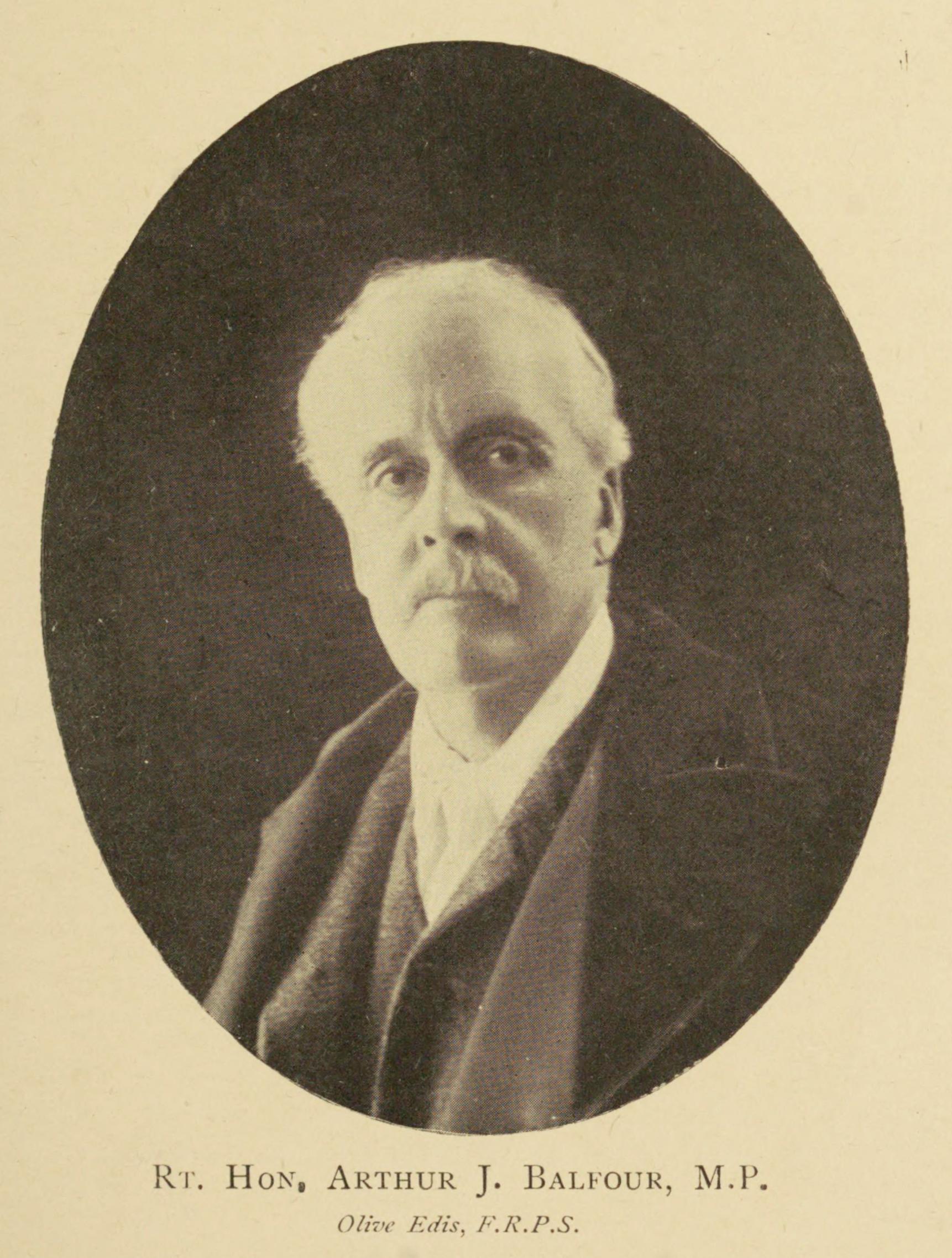
Rt. Hon. Arthur J. Balfour, M.P.
Olive Edis, F.R.P.S.
THE BRITISH DECLARATION AND ITS RECEPTION
November 2nd, 1917, marks the end of a chapter in Zionist history: it is Declaration Day.
The following are the terms of the letter to Lord Rothschild in which Mr. A. J. Balfour, Secretary of State for Foreign Affairs, declared the sympathy of the British Government with Zionist aspirations and its favourable attitude towards the establishment in Palestine of a national home for the Jewish people:—
“Foreign Office,
“November 2, 1917.
“Dear Lord Rothschild,—I have much pleasure in conveying to you on behalf of His Majesty’s Government the following declaration of sympathy with Jewish Zionist aspirations, which has been submitted to and approved by the Cabinet:
“‘His Majesty’s Government view with favour the establishment in Palestine of a national home for the Jewish people, and will use their best endeavours to facilitate the achievement of this object, it being clearly understood that nothing shall be done which may prejudice the civil and religious rights of existing non-Jewish communities in Palestine or the rights and political status enjoyed by Jews in any other country.’
“I should be grateful if you would bring this declaration to the knowledge of the Zionist Federation.
“Yours sincerely,
“(Signed) Arthur James Balfour.”
It was at once clear that a great moment in the history of the Jewish people had arrived through this Declaration. Our ancient home has again arisen for civilization. For nineteen centuries it has been made a desert, for nineteen centuries the Jewish people deprived of their own land sought everywhere a place where they could have freedom of the spirit and room for their work, and generation after generation prayed and dreamt of the return to Zion. Generation after generation drew from this source strength to live and to struggle. Now the dreams of our ancestors are becoming reality. The testament of Herzl was approaching fulfilment. The British Government has spoken in solemn terms to the Jews of the world. The time has arrived to create anew a Jewish homeland on the ashes of the past, to rebuild a national centre and to proceed to work in freedom in a free Jewish land.
Mid storm and fire the people and the land seemed to be born again. The great events of the time of Zerubbabel (fl. 536 b.c.e.) Ezra and Nehemiah repeated themselves. The Third Temple of Jewish freedom is rising before us. The first stones were laid long ago by our heroic pioneers in hard struggle against obstacles without number. They created the first nests of culture in Palestine. With their blood and work they have shown the world that the Jewish people has not only historical claims on the land of its ancestors, but also priority in actual fact in the work of its rebirth. These leader heroes, the fathers of political Zionism, bravely proclaimed to the whole world the right of the nation to a free life in the homeland, and organized productive work in Palestine.
Great new horizons of free national constructive work are revealed before our eyes. The fate of the Jewish land depends not only on the powerful protection of Governments, but first and foremost on the steadfastness and capacity for sacrifice of the Jewish people itself. Zerubbabel’s call to the Jews of the Diaspora was heard once more—to return to the ancient land, to grasp the ploughshare and the hammer, and to forge their own destiny.
The Press was without exception most sympathetic.
“Epoch-making is perhaps not too strong a term to apply to Mr. Balfour’s letter to Lord Rothschild. At any time a formal endorsement of Zionism by a Great Power would command attention if couched in such terms. But at the present moment, when Gaza and Beersheba have fallen to British armies and the distant thunder of our guns is heard in Jerusalem itself, the declaration has a significance that cannot be mistaken.
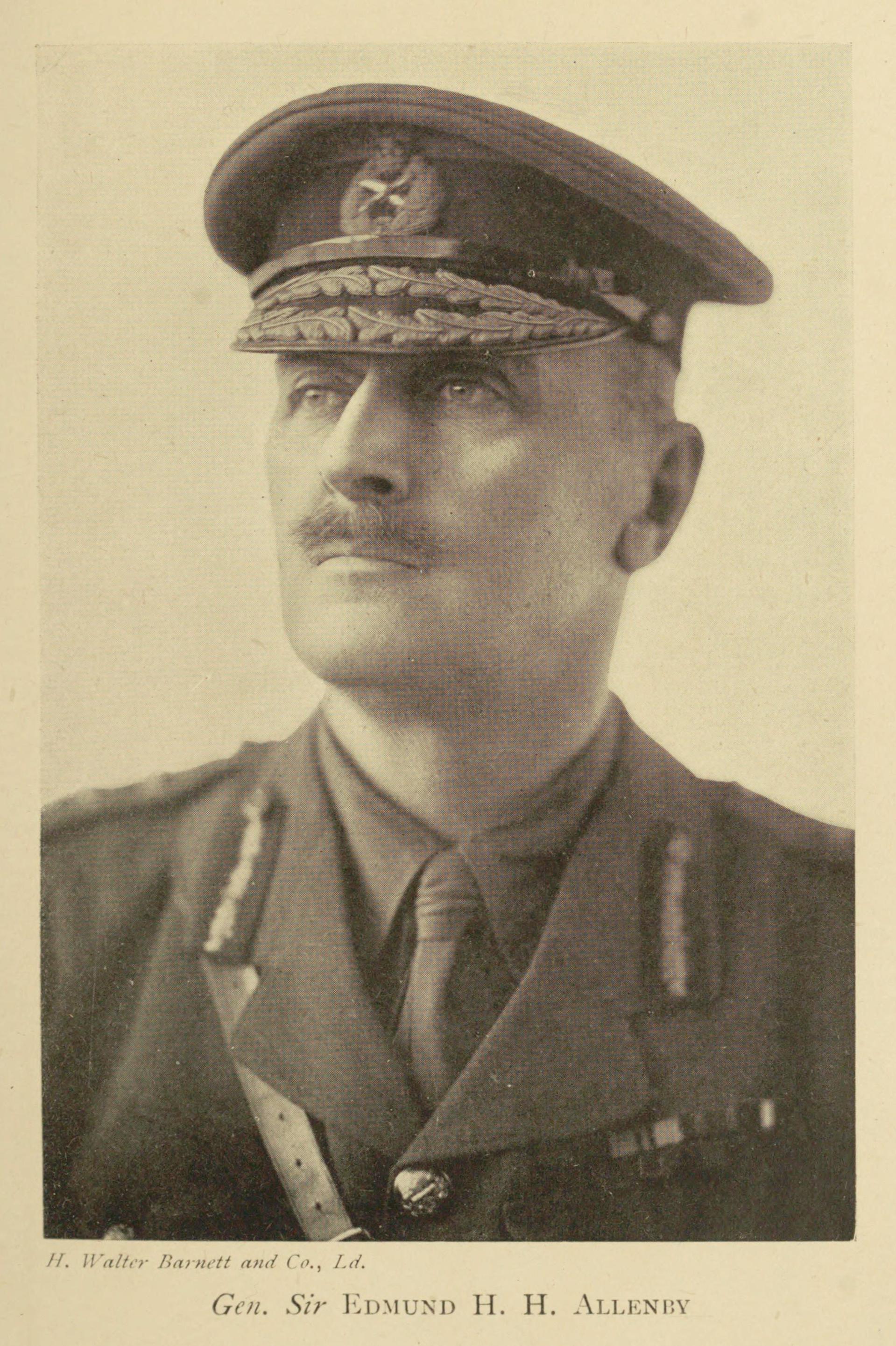
H. Walter Barnett and Co., Ld.
Gen. Sir Edmund H. H. Allenby
“From the Jewish point of view such a restoration opens the door of wonderful possibilities; the hopes that have never been lost during eighteen centuries of the dispersion will return within the region of fact and accomplishment. Scarcely less important should be the consequences for Europe.... The family of nations would be enriched by the return of one of its oldest and most gifted members to a regular and normal place within the circle.” (Daily Chronicle, Nov. 9th.)
“... In deciding to give the Zionists their chance, the British Government have done a bold thing and a wise thing; and as an honestly inspired and intelligent disinterestedness is sounder policy than the most crafty selfishness, they have incidentally struck in this dark hour a very heavy blow for the cause for which the free peoples of the world are fighting. Considered merely as a gesture, what is there in the war to compare in effectiveness to this decision?... The promise of the restoration of Palestine will count for more in the judgment of the world than all the desolation wrought by the German legions among the nations whom they have trodden under foot.” (Daily News, Nov. 10th.)