Volume 2 — APPENDICES
Reading edition
B. M.: British Museum Library.
I. S.: Israel Solomons’ Collection.
I.
The Prophets and the Idea of a National Restoration
The first prophet who has left any definite revelation concerning the Dispersion of the Jews and their ultimate restoration in Palestine was Moses, our Law-giver.
“And I will bring the land into desolation; and your enemies that dwell therein shall be astonished at it.” (Leviticus xxvi. 32.)
“And you will I scatter among the nations, and I will draw out the sword after you; and your land shall be a desolation, and your cities shall be a waste.” (Ibid. 33.)
“And yet for all that, when they are in the land of their enemies, I will not reject them, neither will I abhor them, to destroy them utterly, and to break My covenant with them; for I am the Lord their God.” (Ibid. 44.)
“But I will for their sakes remember the covenant of their ancestors, whom I brought forth out of the land of Egypt in the sight of the nations, that I might be their God: I am the Lord.” (Ibid. 45.)
Here we have a promise not to abhor or utterly destroy the Jewish people, but to remember the covenant which God made with their ancestors. We find the purport of this covenant in an early chapter of the Pentateuch:—
“And the Lord said unto Abram, ... ‘Lift up now thine eyes, and look from the place where thou art, northward and southward and eastward and westward;’” (Genesis xiii. 14.)
“for all the land which thou seest, to thee will I give it, and to thy seed for ever:” (Ibid. 15.)
It is impossible to understand how it can be said that this covenant will be remembered, if the Jewish people is to continue dispersed, and is to be for ever excluded from the land here spoken of. As to the return from Babylonian captivity, that will not answer the intention of the covenant at all. For to restore a small part of the Jewish people to its own land for a few centuries, and afterwards disperse it among all nations for many times as long, without any hope of return, cannot be the meaning of giving that land to the seed of Abram for ever.
Again we read:—
“And the Lord shall scatter you among the peoples,...” (Deuteronomy iv. 27.)
“But from thence ye will seek the Lord thy God; and thou shalt find Him, if thou search after Him with all thy heart and with all thy soul.” (Ibid. 29.)
“In thy distress, when all these things are come upon thee, in the end of days, thou wilt return to the Lord thy God, and hearken unto His voice;” (Ibid. 30.)
“for the Lord thy God is a merciful God; He will not fail thee, neither destroy thee, nor forget the covenant of thy fathers which He swore unto them.” (Ibid. 31.)
This prophecy refers to the thirteenth chapter of Genesis, as is shown by this thirty-first verse; and confirms again the return to the Holy Land, and its possession for ever:—
“And it shall come to pass, when all these things are come upon thee, the blessing and the curse, which I have set before thee, and thou shalt bethink thyself among all the nations, whither the Lord thy God hath driven thee,” (Deuteronomy xxx. 1.)
“and shalt return unto the Lord thy God, and hearken to His voice according to all that I command thee this day, thou and thy children, with all thy heart, and with all thy soul;” (Ibid. 2.)
“that then the Lord thy God will turn thy captivity, and have compassion upon thee, and will return and gather thee from all the peoples, whither the Lord thy God hath scattered thee.” (Ibid. 3.)
“If any of thine that are dispersed be in the uttermost parts of heaven, from thence will the Lord thy God gather thee, and from thence will He fetch thee.” (Ibid. 4.)
“And the Lord thy God will bring thee into the land which thy fathers possessed, and thou shalt possess it; and He will do thee good, and multiply thee above thy fathers.” (Ibid. 5.)
Amongst the “things which should come upon them,” which are described at large in the twenty-eighth and twenty-ninth chapters of Deuteronomy, it is particularly said:—
“And the Lord shall scatter thee among all peoples, from the one end of the earth even unto the other end of the earth;...” (Ibid. xxviii. 64.)
But observe that subsequently we are told:—
“And the Lord thy God will bring thee into the land which thy fathers possessed, and thou shalt possess it; and He will do thee good, and multiply thee above thy fathers.” (Ibid. xxx. 5.)
which promises do not appear to have been fulfilled during the time of the Babylonian captivity, or after the return from Babylon.
Here we have in plain words, simple and clear, the fundamental idea of Moses: the Jewish national future and the possession of the land for ever. This cannot be explained away by sophistry. In vain some Jews declare: We are not nationalist Jews, we are religious Jews! What is the Jewish religion if the Bible is not accepted as an Inspired Revelation? It is strange and sadly amusing that some Jews, adherents of the monotheistic principle, describe themselves as Germans, Magyars, and so on, “of the persuasion of Moses.” If this is not blasphemy, it is irony. The real Moses, the Moses of the Pentateuch, brands Dispersion as a curse, and his whole religious conception, with all the laws, ceremonies, feasts, etc., is built up on the basis of the covenant with the ancestors, a covenant immovable and unalterable. No matter whether Jews call themselves religious or nationalist: the Jewish religion cannot be separated from nationalism, unless another Bible is invented.
Judaism, or the Jewish religion, is based first upon the teaching of Moses, and next upon that of the prophets, and it is a favourite claim of the modern school of Jewish reform that their Judaism is “Prophetic Judaism,” in opposition to the Judaism of orthodox Jews, who lay particular stress upon the Talmud. But what do the prophets teach?
The next revelation in chronological order after the inspired predictions of Moses, is that of Joel the son of Pethuel, who began to prophesy to the Kingdom of Judah about eight hundred years before the civil era:—
“Then was the Lord jealous for His land,
And had pity on His people.” (Joel ii. 18.)
“And the Lord answered and said unto His people:
Behold, I will send you corn, and wine, and oil,
And ye shall be satisfied therewith;
And I will no more make you a reproach among the nations;” (Ibid. 19.)
“For, behold, in those days, and in that time,
When I shall bring back the captivity of Judah and Jerusalem,” (Ibid. iv. 1.)
“So shall ye know that I am the Lord your God,
Dwelling in Zion My holy mountain;
Then shall Jerusalem be holy,...” (Ibid. 17.)
“But Judah shall be inhabited for ever,
And Jerusalem from generation to generation.” (Ibid. 20.)
Amos, who was among the herdmen of Tekoa, lived in the days of Jeroboam, the son of Joash, King of Israel, and prophesied to the Kingdom of Israel from eight hundred and eight, to seven hundred and eighty-three years before the civil era:—
“And I will turn the captivity of My people Israel,
And they shall build the waste cities, and inhabit them;...” (Amos ix. 14.)
“And I will plant them upon their land,
And they shall no more be plucked up
Out of their land which I have given them,
Saith the Lord thy God.” (Ibid. 15.)
Hosea, the son of Beeri, prophesied to the Kingdom of Israel, in the days of the same Jeroboam from about seven hundred and eighty-five, to seven hundred and twenty-five years before the civil era:—
“For the children of Israel shall sit solitary many days without king, and without prince,...” (Hosea iii. 4.)
“afterward shall the children of Israel return, and seek the Lord their God, and David their king;...” (Ibid. 5.)
This prophecy, being given to the Kingdom of Israel in particular, cannot be applied to the return of Judah from Babylon.
Isaiah the son of Amoz (The First Isaiah) was the foremost of the four who are called the greater prophets. He lived in the time of Uzziah, Jotham, Ahaz and Hezekiah, Kings of Judah, and prophesied about seven hundred and sixty, to six hundred and ninety-eight years before the civil era:—
“And it shall come to pass in that day,
That the Lord will set His hand again the second time
To recover the remnant of His people,
That shall remain from Assyria, and from Egypt,
And from Pathros, and from Cush, and from Elam,
And from Shinar, and from Hamath, and from the islands of the sea.” (Isaiah xi. 11.)
“And he will set up an ensign for the nations,
And will assemble the dispersed of Israel,
And gather together the scattered of Judah
From the four corners of the earth.” (Ibid. 12.)
“The envy also of Ephraim shall depart,
And they that harass Judah shall be cut off;
Ephraim shall not envy Judah,
And Judah shall not vex Ephraim.” (Ibid. 13.)
This prophecy, alone, is sufficiently definite with regard to a second restoration of Israel, as appears from the eleventh verse, even if there were no other to be found.
As to the second Isaiah, his prophecies may be called the “Song of Songs” of the restoration of Israel:—
“Lift up thine eyes round about, and see:
They all are gathered together, and come to thee;
Thy sons come from far,
And thy daughters are borne on the side.” (Isaiah lx. 4.)
“Who are these that fly as a cloud,
And as the doves to their cotes?” (Ibid. 8.)
“Surely the isles shall wait for Me,
And the ships of Tarshish first,
To bring thy sons from far,
Their silver and their gold with them,
For the name of the Lord thy God,
And for the Holy One of Israel, because He hath glorified thee.” (Ibid. 9.)
“For as the new heavens and the new earth, which I will make, shall remain before Me, said the Lord, so shall your seed and your name remain.” (Ibid. lxvi. 22.)
Micah the Morashtite prophesied in the days of Jotham, Ahaz and Hezekiah, kings of Judah, about 750 years before the civil era:—
“I will surely assemble, O Jacob, all of thee;
I will surely gather the remnant of Israel;...” (Micah ii. 12.)
“In that day, saith the Lord, will I assemble her that halteth,
And I will gather her that is driven away,
And her that I have afflicted;” (Ibid. iv. 6.)
“And I will make her that halted a remnant,
And her that was cast far off a mighty nation;
And the Lord shall reign over them in Mount Zion from thenceforth even for ever.” (Ibid. 7.)
“Thou wilt show faithfulness to Jacob, mercy to Abraham,
As Thou hast sworn unto our fathers from the days of old.” (Ibid. vii. 20.)
Here we again meet the covenant of Truth and Mercy sworn unto Abraham, that the land Abraham then stood upon should be given to him and to his seed for ever.
Zephaniah, the son of Cushi, the son of Gedaliah, the son of Amariah, the son of Hezekiah, prophesied in the days of Josiah, the son of Amon, king of Judah, about six hundred and thirty years before the ♦civil era:—
“At that time will I bring you in,
And at that time will I gather you;
For I will make you to be a name and a praise
Among all the peoples of the earth,
When I turn your captivity before your eyes,
Saith the Lord.” (Zephaniah iii. 20.)
Jeremiah the son of Hilkiah, of the priests that were in Anathoth, in the land of Benjamin, also prophesied in the days of Josiah, about six hundred and twenty-nine to five hundred and eighty-eight years before the civil era:—
“In those days the house of Judah shall walk with the house of Israel, and they shall come together out of the land of the north to the land that I have given for an inheritance unto your fathers.” (Jeremiah iii. 18.)
“In his days Judah shall be saved,
And Israel shall dwell safely;...” (Ibid. xxiii. 6.)
“Thus saith the Lord,
Who giveth the sun for a light by day,
And the ordinances of the moon and of the stars for a light by night,
Who stirreth up the sea, that the waves thereof roar,
The Lord of hosts is His name:” (Ibid. xxxi. 35.)
“If these ordinances depart from before Me,
Saith the Lord,
Then the seed of Israel also shall cease
From being a nation before Me for ever.” (Ibid. 36.)
“Considerest thou not what this people have spoken, saying: The two families which the Lord did choose, He hath cast them off? and they contemn My people, that they should be no more a nation before them.” (Ibid. xxxiii. 24.)
“Thus saith the Lord: If My covenant be not with day and night, if I have not appointed the ordinances of heaven and earth;” (Ibid. 25.)
“then will I also cast away the seed of Jacob, and of David My servant,...” (Ibid. 26.)
“But fear not thou, O Jacob My servant,
Neither be dismayed, O Israel;
For, lo, I will save thee from afar,
And thy seed from the land of their captivity;
And Jacob shall again be quiet and at ease,
And none shall make him afraid.” (Ibid. xlvi. 27.)
Ezekiel the Priest, the son of Buzi, prophesied in the land of the Chaldeans by the river Cebar, about five hundred and ninety-five, to five hundred and seventy-four years before the civil era. In the thirty-sixth chapter he describes the restoration of Judah and Israel in words so plain and clear that nobody could possibly mistake them, and in the next chapter, by the wonderful vision of dry bones reviving, he shows that, however unpromising the state of Israel may seem, while they are dispersed through the world, yet will God most certainly effect the reunion of the tribes which is here foretold:—
“Moreover I will make a covenant of peace with them—it shall be an everlasting covenant with them; and I will establish them, and multiply them, and will set My sanctuary in the midst of them for ever.” (Ibid. xxxvii. 26.)
Chapters thirty-eight and thirty-nine give a most circumstantial description of the return, which excluded the possibility of an allegorical explanation.
Obadiah prophesied about five hundred and eighty-seven years before the civil era:—
“But in Mount Zion there shall be those that escape,
And it shall be holy;
And the house of Jacob shall possess their possessions.” (Obadiah i. 17.)
“And the captivity of this host of the children of Israel,
That are among the Canaanites, even unto Zarephath,
And the captivity of Jerusalem, that is in Sepharad,
Shall possess the cities of the South.” (Ibid. 20.)
Zechariah, the son of Berechiah, the son of Iddo, prophesied about five hundred and twenty years before the civil era, to those that had returned from captivity. He had the idea of a great future restoration.
“And it shall come to pass that, as ye were a curse among the nations, O house of Judah and house of Israel, so will I save you, and ye shall be a blessing; fear not, but let your hands be strong.” (Zechariah viii. 13.)
“I will bring them back also out of the land of Egypt,
And gather them out of Assyria;
And I will bring them into the land of Gilead and Lebanon,
And place shall not suffice them.” (Ibid. x. 10.)
Malachi prophesied about four hundred and twenty years before the civil era:—
“And all nations shall call you happy;
For ye shall be a delightsome land,
Saith the Lord of hosts.” (Malachi iii. 12.)
“Behold, I will send you
Elijah the prophet
Before the coming
Of the great and terrible day of the Lord.” (Ibid. 23.)
Daniel’s (Belteshazzar) prophecies from about five hundred and thirty-four, to five hundred and seven years before the civil era relate not only to the affairs of Judah and Israel, but also to the various monarchies and kingdoms that are to arise successively in the world. In the following verses he foretells the national future of his own people:—
“And in the days of those kings shall the God of heaven set up a kingdom, which shall never be destroyed; nor shall the kingdom be left to another people; ..., but it shall stand for ever.” (Daniel ii. 44.)
“And the kingdom and the dominion, and the greatness of the kingdoms under the whole heaven, shall be given to the people of the saints of the Most High; their kingdom is an everlasting kingdom, and all dominions shall serve and obey them.” (Ibid. vii. 27.)
“... and there shall be a time of trouble, such as never was seen since there was a nation even to that same time; and at that time thy people shall be delivered,...” (Ibid. xii. 1.)
These predictions undoubtedly signify that the Children of Israel shall enjoy a kingdom and dominion under the whole heaven, i.e. upon the earth, which shall never be destroyed, nor shall the kingdom be left to another people.¹
¹ The most notable Talmudic and Rabbinical passages referring to the future of the Jewish nation are: Talm. Bab. Berachoth 28b, 34b; Shabb. 118a; Menahoth 45a; Baba Mezia 3a; Eduyoth VIII. 7; Kiddushin 71a; Gen. Rabba LXXXV. 2; Hagigah 14a; Sanhedrin 38b; 98a, 99a, 110b, 111a; Erubin 43b; Cant. Rabba VII. 10; Sifri on Deut. 1: 1; Baba Bathra 76a. For the views of the Gaon Saadia ben Joseph (892‒942) see Guttman, Religionsphilosophie des Saadia, Göttingen, 1882, p. 236; for Hai ben Sherira Gaon (939‒1038) see Taam Zekenim, Frankfort on the Main, 1854, pp. 58‒61; for Abraham ben Chiya Albargeloni Ha’nasi (called Abraham Judæus and Savasorda) (1065‒1136) see Hegion Ha’nefesh, Leipzig, 1860, p. 40 ff.; for Judah Halevi, see his Poems and Kuzari in Cassel’s edition, Leipzig, 1869, ii. 36‒44, pp. 143‒7, p. iv. 23; pt. i. 115; for Maimonides, see Hilchoth Melachim in his Yad Ha’chazakah, Chs. XI. XII. and Hilchoth Teshubah, Ch. IX. 2; for Nachmanides, see his Comment. to Gen. 2: 3, and to Exodus 17: 9; for ♦Abrabanel, his books Yeshuat Meshicho, Mashmia Yeshuah, Maeyenai Ha’yeshua, and Klausner: Die Messianischen Vorstellungen ... Berlin, 1904, and also Greenstone: The Messiah Idea in Jewish History, Philadelphia, 1906.
II.
Rev. Paul Knell (1615‒64), Israel and England Paralleled
Israel | And | England | ♦Paralleled, | In a Sermon preached before | the honourable society of Grayes-|Inne, upon Sunday in the | afternoon, Aprill 16. 1648. |
By Paul Knell, Master in Arts of Clare-Hall | in Cambridge. | Sometimes Chaplaine to a Regiment of Curiasiers | in his Majesties Army.
London, | Printed in the Yeare 1648.¹
(4to. 2 ll. + 20 pp.) [B. M.]
¹ It was re-issued thirty-three years later:—
... London, Printed in the year 1648. And now Reprinted for a Caution to all those that are given to Change.
Sold by Randal Tayler and Robert Stephens, by Stationers-Hall, near Ludgate. 1681.
4to. 2 ll. + 16 pp. [I. S.]
pp. 16‒17. “... first, we may compare with Israel for a fruitfull scituation, being neither under the torrid nor the frozen Zone, neither burned away with parching heat, nor benummed away with pinching cold, but seated in a temperate climate & fertile soile; our folds are full of sheep, our vallies stand so thick with corne that we may laugh & sing. God hath also fenced us about, like the Israelites in the red sea, with a wall of water, the waters are as a wall unto us, on our right hand, & on our left,... And now, England, what doth thy Lord thy God require of thee, but to fear the Lord thy God, to walk in all his waies, and to love him, and to serve the Lord thy God with all thy heart, and with all thy soule? But here God may as justly complaine of us as he did of Israel,...”
III.
Matthew Arnold on Righteousness in the Old Testament
Matthew Arnold, in his Literature and Dogma, insists that righteousness is in a special manner the object of Bible religion. The word “righteousness” is a master word in the Old Testament. What would England have been were it not for the importance which Jeshurun, the upright, attached to the thought and practice of righteousness? She might have been eminent in law, in arts and sciences borrowed from the Romans and the Greeks, but she would have been addicted to idolatry and the gratification of the senses, and would have borne the doom of destruction within herself. He draws a vivid imaginary picture of the authorities of one of the English great Universities, the vice-Chancellor, beadles, masters, scholars, and all, nay, their very professor of moral philosophy, going in procession to worship at the shrine of Aphrodite.
“If it had not been for Israel,” he continues, “and the stern check which Israel put upon the glorification and divinization of this natural bend of mankind.... And as long as the world lasts, all who want to make progress in righteousness will come to Israel for inspiration, as to the people who have had the sense for righteousness most glowing and strongest; and in hearing and reading the words Israel has uttered for us, carers for conduct will find a glow and a force they would find nowhere else. As well imagine a man with a sense for sculpture not cultivating it by the help of the remains of Greek art, or a man with a sense for poetry not cultivating it by the help of Homer and Shakespeare, as a man with a sense for conduct not cultivating it by the help of the Bible.”¹
¹ Literature and Dogma ... By Matthew Arnold ... London ... 1873 ... pp. 26, 36‒37 and 56.
IV.
“Esperança de Israel,” by Manasseh Ben-Israel
מקוה ישראל | Esto es, | Esperança | De Israel. |
Obra con suma curiosidad conpuesta | por | Menasseh Ben Israel | Theologo, y Philosopho Hebreo. |
Trata del admirable esparzimiento de los diez | Tribus, y su infalible reduccion con los de | mas, a la patria: con muchos puntos, | y Historias curiosas, y declara-|cion de varias Prophecias, | por el Author rectamen-|te interpretadas. |
Dirigido a los señores Parnassim del K.K. | de Talmvd Tora. | En Amsterdam. | En la Imprension de | Semvel Ben Israel Soeiro.¹ | Año. 5410. |
(sm. 8º. 7 ll. + 126 pp.)² [I. S.]
¹ The surname “Ben Israel Soeiro” used by the printer, a son of the author, is a combination of those of his paternal grandparents Joseph Ben-Israel and Rachel Soeiro, who had been marranos. Joseph, a victim of the Inquisition, on returning to the Jewish fold, it may be surmised, discarded his gothic patronymic and appropriately assumed that of Ben-Israel. Their son, the author, married Rachel, a great-granddaughter of the famous Bible exegete and statesman Don Isaac Abrabanel, who claimed Davidic descent. In an age when יחוס. was highly prized, we consequently find that in the following year, when Samuel printed his father’s Nishmath Chayyim, his surname has become “Abrabanel Soeiro,” and in the Latin addition, “Ben Israel Abrabanel Sueiro.” He was born in Amsterdam in 1625. He accompanied his maternal uncle, David Abrabanel [Manuel Martinez Dormido], to England, on behalf of his father, arriving here on 1st Sep., 1654, to open up negotiations with Cromwell concerning the admission of their co-religionists to this country. It was decided that the presence of Manasseh was incumbent, and a pass to Holland, dated 16 May, 1655, was granted to Samuel, to fetch his father. They arrived in the following October, and resided here close on two years. On Sunday, the second day of Rosh Hashanah, 5418 [8 Sep., 1657, N.S.: 29 Aug. O.S.], at the early age of thirty-two, Samuel went to his Eternal rest. He had conjured his father that he would take his body to Amsterdam, where he was born, for burial. Manasseh was then in a precarious state of health, and on arriving at Middleburg in Zealand, where Ephraim Abrabanel, the maternal uncle of the deceased, resided, he was unable to continue the journey. The interment took place at the local Beth Haim, and the Rev. Isidore Harris, M.A., a few years ago discovered the tombstone³ in the third carera, which has the following inscription:—
Sᴬ. | Do Doctor Semvel | Fº Do Haham Menasseh | Ben Israel | Faleceo em 2 Tisri | 5418. |
Manasseh’s illness was mortal. His son Joseph had died at the age of twenty about eight or nine years before, and the premature death of his last surviving son hastened his end. A few weeks later, on the 11 Kislev (20 Nov.), he passed away in the house of his brother-in-law, but fifty-three years old. He was interred at the Sephardi Beth Haim at Oudekerk, Amsterdam.
² Another issue, with a similar collation, but apparently from other type, was printed in the same year. [I. S.]
It appeared again during the last quarter of the nineteenth century under the following title:—
Origen De Los Americanos. מקוה ישראל. Esto Es Esperanza De Israel ... Reimpresion ... Del Libro De Menasseh Ben Israel ... Publicado En Amsterdam 5410 (1650) ... y la biografia del autor, Por Santiago Perez Junquera.
Madrid.—1881....
8º. xxxvi. pp. + 8 ll. + 126 pp. + 3 ll. in printed wrapper as issued. [I. S.]
³ Transactions of the Jewish Historical Society of England, vol. vii., 1911‒1914 ... Edinburgh and London, 1915 ... p. 127: “A Dutch Burial-Ground and its English Connections.” By the Rev. Isidore Harris, M.A.
V.
“Spes Israelis,” by Manasseh Ben-Israel
מקוה ישראל | Hoc est, | Spes | Israelis. |
Authore | Menasseh Ben Israel | Theologo & Philosopho Hebræo. Amstelodami. | Anno 1650. |
(sm. 8º. 6 ll. + 111 pp.) [I. S.]
sig. [A2] Svpremo Angliæ Consessvs Parlamento, ejusdemque Reipublicæ Status Consilio Honorando, Salutem, ac felicitatem omnem, a Deo apprecatur Menasseh Ben Israel.¹
¹ This translation was probably the work of the author. Bound up with this copy is a folded engraving of the author by Salom Italia.
VI.
“Hope of Israel—Ten Tribes ... in America—מקוה ישראל De Hoop Van Israel,” by Manasseh Ben-Israel
The | Hope of Israel: |
Written | By Menasseh Ben Israel, | an Hebrew Divine, and Philosopher. |
Newly extant, and Printed in | Amsterdam, and Dedicated by the | Author to the High Court, the | Parliament of England, and | to the | Councell of State. |
Translated into English, and | published by Authority. |
In this Treatise is shewed the place where the ten | Tribes at this present are, proved, partly by | the strange relation of one Antony Monte-|zinus, a Jew, of what befell him as he tra-|velled over the Mountaines Cordillære, with | divers other particulars about the restoration of | the Jewes, and the time when. |
Printed at London by R. I. for Hannah Allen, | at the Crown in Popes-head | Alley, 1650. |
(sm. 8º. 7 ll. + 90 pp.) [I. S.]
sig. A3. “To the Parliament, the Supream Court of England, and to the right Honourable the Councell of State, Menasseh Ben Israell, prayes God to give health, and all Happinesse.” But the original edition in Spanish is dedicated “A los Muy Nobles, Prudentes, y Magnificos Señores, Deputados y Parnassim deste K.K. de Talmud Tora.” ... Amsterdā. a 13 de Sebat. An. 5410.
In this first English version the name of the translator does not appear on the title page, nor does “The Translator to the Reader” bear any signature; but “Moses Wall” does appear on the title pages of two issues of a second edition which appeared in 1651 and 1652. (4to. 5 ll. + 62 pp.) [B. M.]
It was published again under the following title:—
“Accounts Of The Ten Tribes of Israel Being In America; Originally Published By R. Manasseh Ben Israel.
With Observations Thereon, And Extracts From Sacred And Profane, Ancient And Modern History, Confirming The Same; And Their Return From Thence About The Time Of The Return Of The Jews.”
By Robert Ingram, A.M. Vicar of Wormingford and Boxted, Essex.
Colchester: Printed And Sold By W. Keymer; Sold Also By G. G. J. And J. Robinson, Pater-Noster-Row, London, 1792. [Price One Shilling.]
(8º. 56 pp.) [I. S.]
There are several Hebrew versions, the first translation appearing in 1698.
מקוה ישראל חברו ... החכם השלם׃ ... מנשה בן ישראל זצ״ל בלשון גוי הולנדי״אה׃ ¹ועתה נעתק ללשון הקודש ע״י ... ר״ אליקים בהר״ר יעקב ש״ץ זצ״ל חזן בק״ק אמשטרדם׃ ... נדפס באמשטרדם ... בשנת [תנח] לפ״ק ... בדפוס קאשמן עמריך.
(16mo. סו (66) ll.)¹ [I. S.]
¹ It was composed in Spanish in 1650 and did not appear in Dutch until 1666.
De | Hoop | Van Israël. |
Een Werck met groote naukeurigheyt | beschreven: |
Door | Menasseh Ben Israël | Hebreeuws Godtgeleerde en | Wijsbegeer. |
Waer in hy handelt van de wonderlijcke | verstroyinge der 10 Stammen, en hare ge-|wisse herstellinge met de twee Stammen Juda | en Benjamin in’t Vaderlandt. Met veele aen-|wijsingen, naukeurige vertellingen, en verkla-|ringen van verscheyde Prophetien. |
Met meer als 90 Beschrijvers bevestight: |
Met een verantwoordingh voor de | Eedele Volcken der Jooden. | Den 2. Druck¹ van veel Letter-mis stellingen gesuyvert. | t’Amsterdam, | Voor Jozua Rex, Boeck-binder, | op de Cingel, recht over de Appelen-marrickt, | in’t Jaer 1666. |
(12mo. 6 ll. + 124 pp. [De Hoop Van Israel.])² [I. S.]
¹ A third edition was published in the same year, with the following addition:—
De Reysen van R. Benjamin Jonasz Tudelens, In de drie Deelen der Werelt, als Europa, Asia, en Afrika: ... In’t Nederduyt overgeschreven door Jan Bara.... 117 pp. [B. M.]
² Bound up with this copy is a folded engraving of the Author by Salom Italia.
It has also been translated into Yiddish.
VII.
The Humble Addresses of Manasseh Ben-Israel
To | His Highnesse | The | Lord Protector | Of The | Common-Wealth Of | England, Scotland, and Ireland.
The Humble Addresses | Of | Menasseh Ben Israel, a Divine, and | Doctor of Physick, in behalfe | of the Jewish Nation. |
(4to. 4 ll. + 26 pp.)¹ [I. S.]
¹ This was probably printed in Amsterdam, in anticipation of his visit to England.
A second issue from another press, and in which the collation varies (4 ll. + 23 pp. [I. S.]) may have been printed in London, as at the end it has the following addition:—
“Which is the close of Rabbi Menesse Ben-Israel, a Divine, and Doctor in Physick, in the Strand over against the New-Exchange in London.”
The British Museum copy of the 23 pp. edition has the following date in manuscript on the title page: “November 5, 1655.”
VIII.
“Vindiciæ Judæorum,” by Manasseh Ben-Israel
Vindiciæ | Judæorum, | Or A | Letter | In Answer to certain Questions propounded by | a Noble and Learned Gentleman, touching | the reproaches cast on the Nation of the | Jevves; wherein all objections are | candidly, and yet fully cleared. |
By Rabbi Menasseh Ben Israel a Divine | and a Physician. |
Printed by R. D. in the year 1656. |
(4to. 1 l. + 41 pp.)¹ [I. S.]
¹ In 1743 it was reprinted in octavo form (2 ll. + 67 pp. [I. S.]). It was translated into German either by Dr. Marcus Herz (1747‒1803) or by his wife, the celebrated Henrietta Herz (1764‒1847), and published in 1782, with an introduction by Moses Mendelssohn (1729‒1786) (sm. 8º. LII. + 64 pp. [I. S.]). It has also appeared in Hebrew [I. S.], Polish [I. S.], French and Italian.
IX.
Enseña A Pecadores
Libro | Yntitulado | Enseña | A | Pecadores |
Que contiene diferentes | obras, mediante las qua-|lespide el hombre | piedad à su | Criador. |
En casa y acosta | de David de castro Tartaz. |
En Amsterdam | Anno 5426. |
(12mo. 88 + ח (= 8) (8) pp.) [B. M.]
Page 2. “Prologo.... Aviendo pues el Señor hecho merced al mundo en traer a luz las obras divinas del H. Ribi Esayah, su memoria sea para benedicion, las quales son llenas de doctrinas y modos de encaminar al hombre a la salvacion....”
pp. 61‒79. “Conficion Muy Copiosa Maravillosa y llena de divinos conceptos y misterios, hecha por el divino Theologo y excellentissimo Sabio, Ribi Yshac Askenazi de Loria, Traduzida de Hebrico, en lengua castellana, por el doctissimo Haham Menasseh ben Ysrael; el Anno 5383. la qual se puede dezir estando el hombre enfermo o de ajuno o en qual quiera tiempo.”
pp. 80‒88. Vidvy Penitencial ... Auctor Selomoh De Oliuera.
וידוי כפרה ... שלמה די אוליוירה יצ״ו התחלתו ערב ר״ח אדר ראשון. בשנת מגיני אל אלהים מושיע ישרי לב׃ א‒ה .pp
תושלבע׃
X.
“De Termino Vitæ—of the Term of Life,” by Manasseh Ben-Israel
צרור החיים | Menasseh | Ben Israel, | De | Termino | Vitæ: | Libri Tres. |
Quibus veterum Rabbi-|norum, ac recentium do-|ctorum, de hac con-|troversia sententia | explicatur. |
Amstelodami. Typis & sumpti-|bus authoris An. 1639. |
(12mo. 8 ll. + 237 pp. + 25 ll.)¹ [I. S.]
¹ Sixty years later it was translated into English:—
Of The | Term | Of | Life. | viz. | Whether it is fix’d or alterable; |
With the Sense of the Jewish Doctors, | both Ancient and Modern, touching | Predestination and Free-Will. |
Also an Explication of several obscure | Passages and Prophecies in the Old Testa-|ment; together with some remarkable Cu-|stoms observ’d by the Jews. |
Written in Latin by the Famous Menasseh | Ben-Israel the Jew and now Translated | into English, By Tho. Pocock, M.A. |
To which are added, the Author’s Life, never be-|fore Publish’d; and a Catalogue of his Works. |
London Printed, and Sold by J. Nutt, near | Stationers-Hall, and by the Booksellers of Lon-|don and Westminster, 1699. |
(sm. 8º. 6 ll. + XVI. + 116 pp.) [I. S.]
sig. A2. “To Colthorp Parker, Esq.;”
De Termino Vitæ; | Or The | Term | Of | Life. | Viz. | Whether it is fix’d or alterable; |
With the Sense of the Jewish Doctors, | both Ancient and Modern, touching | Predestination and Free-Will. |
Also an Explication of several obscure Passages and | Prophecies in the Old Testament; together with | some remarkable Customs observed by the Jews. |
Written in Latin by the Famous Menasseh | Ben-Israel the Jew, and now Translated into English. |
To which are added, the Author’s Life, never be-|fore Publish’d; and a Catalogue of his Works. |
London, Printed for W. Whitwood at the Rose | and Crown in Little-Brittain. 1700. | (sm. 8º 6 ll. + xvi. + 116 pp. + l. [catalogue]). [I. S.]
sig. A2. “To Colthrop Parker, Esq.;”
Of The | Term | Of | Life, | Viz.: | Whether it is fix’d or alterable; | With the Sense of the Jewish Doctors, | both Ancient and Modern, touching Pre-|destination and Free-Will. |
Also an Explication of several obscure | Passages and Prophecies in the Old Testa-|ment; together with some remarkable | Customs observed by the Jews. |
Written in Latin by the Famous Menasseh | Ben-Israel the Jew, and now Transla-|ted into English, By Tho. Pocock, A.M. | Rector of Danbury in Essex, and Chaplain to his | Grace the Duke of Bedford. |
To which are added, the Author’s Life, by the Translator; and a Catalogue of his Works. |
London, Printed for Tho. Baker at the | Bible and Rose in Ludgate-street. 1709. | (sm. 8º. 8 ll. + xxiv. + 117 pp. + 1 l.) [I. S.]
sig. A2. “To Christopher Tilson, Esq.; Of The Treasury.”
XI.
“נשמת חיים—De Immortalitate Animæ,” by Manasseh Ben-Israel
ספר נשמת חיים על ענין הנשמה ... מנשה בן ישראל ... פה ק״ק אמשטרדם נדפס בדפוס בן המחבר שמואל אברבנאל סואירו בשנת [תיב] לפ״ק׃
(4to. 8 + קעד (174) + 2 ll.) [I. S.]
Some editions, which are excessively rare, have this Latin addition:—
נשמת חיים | Menasseh Ben Israel | Libri Quatuor | De | Immortalitate Animæ. |
In quibus multæ insignes & ju-|cundæ quæstiones ventilantur, | uti videre est, ex argu-|mento operis. |
Amstelodami, | Apud Autoris filium | Samuel Ben Israel Abrabanel Sueiro. |
Anno ϲlͻ. ͻlϲ. LI. |
(8 ll.) [I. S.]
sig. A2. (Epistola Dedicatoria) Ferdinando III. Augustissº. Romanorum Imperatori....
Sig. A4². Augustissimi Imperatoris Servus humillimus Menasseh Ben Israel.
Amstelodami Calendis Decembris Anno ϲlͻ. lͻϲ. LI.
XII.
“Rights of the Kingdom,” by John Sadler
Rights of the Kingdom; | Or, | Customs of our Ancestours:... With an Ocasionall Discourse of Great Changes yet | expected in the World. |
London, | Printed by Richard Bishop. 1649.|¹
(4to. 4 ll. + Aa‒Mm + f‒z + a‒c in fours.) [I. S.]
sig. G4. “How they are Now, I need not say, although I might also beare them witnesse, that They are yet Zealous in Their Way. nor doe they wholly want, ingenuous able men. of whom I cannot but with Honour, mention Him, that hath so much obliged the world, by his learned Writings; Rab Menasseh Ben Israel: a very learned, Civill Man, and a Lover of our Nation.
“The more I think upon the Great Change, now comming on Them, and All the World; the more I would be Just and Mercifull to Them, to All.”
¹ It was republished thirty-three years later anonymously, as was the first issue. London: Printed for J. Kidgell. 1682. 4to. 4 ll. + 319 pp. [B. M.]
XIII.
“Nova Solyma,” edited by Rev. Walter Begley
Nova Solyma The Ideal City; Or Jerusalem Regained
An Anonymous Romance Written In The Time Of Charles I.
Now first Drawn From Obscurity, And Attributed To The Illustrious John Milton.¹
With Introduction, Translation, Literary Essays And A Bibliography
By The Rev. Walter Begley
vol. i., ii.
London John Murray, Albemarle Street. 1902.
(p. 4). “The book was first presented to the public in small octavo form with this title page:
Novæ | Solymæ | Libri Sex. | Londini Typis Joannis Legati.| MDCXLVIII. |
¹ The author was Samuel Gott (1613‒1671), see “The Authorship of Nova Solyma,” by Stephen K. Jones (1910), and B.M. Catalogue.
“The book contained three hundred and ninety-two pages, of which the last contained the errata and the printer’s short notice to the reader. There was no preface or introduction of any kind, and no notes. The only printed extra was this Latin motto in the middle of the blank page facing the title:
‘Cujus opus, studio cur tantum quaeris inani?’
‘Qui legis, et frueris, feceris esse tuum.’
which I turn thus:
(p. 5). “‘Whose is the book?’ do you ask. ‘Why start such a bootless enquiry?
If you but read and enjoy, you will have made it your own.’” (pp. 5‒6). “... The next year the same book was published again—an evident attempt to utilise the unsold remainder, as there was no difference whatever, except a new title page with the old fly-leaf motto included in it and a page at the end containing the autocriticon. In the only copy I have seen, [St. John’s College, Cambridge], the title page runs as follows:
Novæ Solymæ Libri Sex; sive Institutio Christiani.
1. De Pueritia.
2. De Creatione Mundi.
3. De Juventute.
4. De Peccato.
5. De Virili Aetate.
6. De Redemptione Hominis.
Cujus opus, studio cur tantum quaeris inani?
Qui legis, et frueris, feceris esse tuum.
Londini: Typis Johannis Legati, et venundantur per Thomam Underhill sub signo Biblii in vico Anglice dicto Woodstreet. MDCXLIX.”
Here we have the very useful addition that it was published by Thomas Underhill, of Wood Street.
(preface pp. vii‒viii). “... That such a wide-reaching, learned, and varied work should have been allowed to remain unappreciated and utterly ignored for more than two hundred and fifty years is certainly a very surprising literary fact....
“The critics seem to have been both blind and deaf. They gave no encouraging praise, and no disheartening condemnation. They simply took no notice. And so this great work of seventeenth-century art vanished from the sight of men. A few copies were put away in college libraries, where they rested for years undisturbed and dust-covered in their original positions, and have so continued to rest for two centuries and a half, lost to the world.”
(p. 18). “There is a spirit of pure, lofty, and unselfish morality evident throughout all the various scenes of this interesting and unaffected book. It shows us the brightest, strongest elements of God-fearing Puritanism;...” “Here are the lyric songs from ‘the law and prophets,’ Abraham’s meditation on the Mount Moriah, Cain’s lamentations for Abel, David’s lament for Saul and Jonathan, and many a noble ode from the Psalms and short epics from Job....” “Here Truth and Justice and the Fear of God are all placed on the high pedestals they so well deserve; and there is withal a kindly insistence everywhere on those great teachings which tend to make life more abounding in hope, more perfect in self-restraint and more lifted-up in spirit.”
All these ideas are Hebrew, and characteristically Biblical. But the most curious fact, from our point of view, is that this work contains a description of the Ideal State on Mount Zion. Of course, the tendency is thoroughly Christian, but it is that kind of Christianity which is inspired by the Old Testament and by a sentiment of love for the old Jewish nation and the Holy Land. This book is the poetical expression of the Restoration ideas of the seventeenth century. It begins with a description of the springtime in New Jerusalem, “the city with twelve gates” (Ezekiel xlviii. 31), and “a virgin who held in her right hand a golden rod, and in her left the two tables of the Law.” The tourist-visitors, “two Englishmen and the third a Sicilian,” are told that “it is the anniversary of the founding of the city and the virgin you saw represented Zion, or, as they say, the Daughter of Zion.” “They” evidently refers to the Jews.
Strangers are received with remarkable hospitality (as in Herzl’s Altneuland).
(p. 86). “But Jacob, for that was the old man’s name, urged him all the more, ‘Come, come,’ said he, ‘it is a national duty with us to treat strangers with kindness, not unmindful that we too, long ago, were strangers in Egypt, and since then for a long time strangers and wanderers among all the nations of the earth. But now we call none aliens from Israel....’”
(p. 88). “We are now very close on the fiftieth year since our long and widely-scattered nation was restored to its present wonderful prosperity.” The old Jew then explains the system of education adopted in the new country, a system of physical development and moral integrity.
Joseph, who is one of the tourists and the hero of the romance, indulges in songs of Zion.
(pp. 175‒6) “O sacred top of Solyma,
How lovely is thy place
Where stands the city of our King
Where faithful saints rejoice and sing
O mercy, love and grace!
“For there our greater Temple stands
With greater glory blest
And there redeemed from alien lands,
Brought back at last by God’s own hands,
His Israel finds her rest.”
Here the translator remarks:
(p. 177) note i.: “How many sighs and prayers have gone up from the dispersed children of Zion in Russian Poland, in Galicia, in Roumania and by the old broken wall of Jerusalem in these latter days! What longing for this ‘antepast of Heaven’ that Joseph here speaks of! What passionate desire for that time, when the children of Zion should no longer have to sing ‘the Lord’s song in a strange land’! Is this century to see the Zionists in possession again of their Holy City—their longed-for Salem, the ‘Vision,’ the ‘Foundation,’ the ‘Inheritance’ of Peace, as expositors have variously entitled it? Who can say? From a practical point of view the prospect somehow fails to charm; but when I view it in theory, it seems as if the justice of the world as well as the justice of the Eternal One would be nobly consummated by such a termination to an earthly pilgrimage of nigh two thousand years.”
The anonymous author proceeds to describe the old-new home, and the people, new-born in benevolence, piety and purity, with their national distinctiveness, and the two tables of the Law. Thus, with all his honest and deep Christian convictions and belief in the final triumph of his religious ideas, he recognizes the right of the Jewish nation to have their country and to remain faithful to their traditions. This strange romance, after all sorts of philosophical reflections and sketches of various adventures in Sicily and elsewhere, comes back to Zion to sing the songs of the Old Testament in Latin verse in a way which shows that the author had the rhythm and atmosphere of Biblical poetry to perfection, and also that his views were much more in harmony with the notions of that time than with modern conceptions. The whole work is inspired by great enthusiasm for Israel’s glory, and abounds with sympathy and admiration for the Jewish nation.
Begley, who was a man of profound knowledge and an authority on matters of composition and style, ascribes this work to Milton. If this view be accepted, then to this poet’s glory must be added a further claim to immortality, because he was the first poet who expounded—from a Christian point of view—the idea of Israel’s Restoration in the form of a poetical romance. But from our point of view it does not matter whether Milton was the author, or another poet; the fact remains that this remarkable work is English and appeared in England in 1648.
XIV.
“Prædamitæ—Men Before Adam,” by Isaac de La Peyrère¹
¹ Account of Peyreyra, Author of “Præadamitæ,” “Rappel des Juifs,” &c. Translated from “Lettres Choisies de M. [Richard] Simon, (1638‒1721) ou l’on trouve un grand nombre de Faits et Anecdotes de Literature. Rotterdam 1702.”
(Gentleman’s Magazine, vol. lxxxii., November, 1812, pp. 432‒434; and vol. lxxxiii., June, 1813, pp. 614‒616.)
Another of his famous works, also published anonymously, was:—
Præadamitæ. | Sive | Exercitatio | super Versibus duodecimo, decimotertio, & | decimoquarto, capitis quinti Epistolæ | D. Pauli ad Romanos. | Qvibvs Indvcvntvr | Primi Homines ante Adamum | conditi. |
Anno Salvtis, | M.DC.LV. |
(4to. 22 ll. + 297 + 8 pp. [Synagogis Ivdæorvm Vniversis.]) [I. S.]
In the following year it was translated into English:—
Men before Adam. | Or | A Discourse upon the twelfth, | thirteenth, and fourteenth Verses | of the Fifth Chapter of the Epistle | of the Apostle Paul to the | Romans. |
By which are prov’d, | That the first Men were crea-|ted before Adam. |
London, | Printed in the Year, 1656. |
(8º. 8 ll. + 61 pp. + 9 pp. + 35 ll.) [I. S.]
The End of the first Part (No more published)
sig. A.4. “To all the Synagogues to the Jews, dispersed over the face of the Earth.”
sig. M.8. “Terræ Sanctæ Delineatio” (A map of the Holy Land).¹
¹ In another issue in the same year the eight preliminary leaves are from another press. [I. S.]
XV.
Isaac Vossius
Isaac Vossius was born at Leyden in Holland, one of the sons of the renowned scholar Gerard John Vossius by his second wife Elizabeth, daughter of Francis du Jon (Junius) (1545‒1602), French theologian and philologist. All the sons were precocious scholars, but Isaac was undoubtedly the most eminent.... He was invited by Queen Christina of Sweden, one of the most erudite women of her time, to come and shed the lustre of his learning upon Stockholm. He arrived towards the end of 1649, was appointed a Court Chamberlain, and taught the Queen Greek. In 1650 he sold her his father’s library for twenty thousand florins, with the stipulation that he received five thousand florins yearly with board and residence for its superintendence. In 1652 owing to certain differences he left Sweden. In 1655 Manasseh Ben Israel dedicated to him:—
אבן יקרה | Piedra Gloriosa | O | De La | Estatua | De | Nebuchadnesar. |
Con muchas y diversas authoridades | de la S.S. y antiguos sabios. | Compuesto por el Hacham | Menasseh Ben Israel. | Amsterdam An. 5415. |
(12mo. 6 ll. + 259 pp. + 3 ll. + 4 etchings at pp. 5, 87, 160, 180.) [I. S.]
“All muy noble y doctissimo Señor Isaco Vossio, Gentil hombre de la camara de su Magestad, La Reyna de Svedia.
Muy noble y doctissimo Señor, ... Intimo amigo y afficionado servidor de V. M.,
Menasseh ben Ysrael.
Amsterdam 25. de Abril, An. 5415.”
In a list of Manasseh’s works at the end of the volume, it is catalogued “Piedra preciosa; o de la Estatua de Nebuchadnesar, donde se sexpone lo mas essencial del libro de Daniel.” It was for this small volume that Rembrandt designed and etched four illustrations.¹
¹ Rembrandt’s etchings for the Piedra Gloriosa, by [Dr.] I[srael] A[brahams] [M.A.], with facsimiles, Jewish Chronicle, 13 July, 1906, pp. 39‒40: The second series of illustrations for the Piedra Gloriosa of Manasseh Ben Israel, by Israel Solomons, ibid., July 27, p. 31.
Vossius was created D.C.L. at Oxford in 1670, and installed to a prebend in the royal chapel at Windsor in 1673, which was presented to him by Charles II. (1630‒1685), and died at Windsor 21 Feb., 1688. He had accumulated the finest private library in the world, including 762 manuscripts. It was sold at Leyden in 1710 for thirty-six thousand florins. A large number of original letters of Vossius are preserved at the Bodleian Library, Oxford.
XVI.
“Doomes-Day”
Doomes-Day: | Or, | The great Day of the Lord’s Iudgement, | proved by Scripture; and two other Prophecies, | the one pointing at the yeare 1640. the other at this | present yeare 1647. to be even now neer at hand.
With | The gathering together of the Jews in great Bodies | under Josias Catzius (in Illyria, Bithinia, and Cappadocia) | for the conquering of the Holy Land. | ...
London, | Printed for W. Ley. 1647
(4to. 1 l. + 6 pp.) [I. S.]
(p. 2) “... even those people the Jewes, according to certaine and credible information, are at this time [* Under Josias Catzius, and according to Letters from beyond the Seas, they are numerous, and shew themselves in great bodies in Illyria, Bethinia and Cappadocia.] assembling themselves together into one body from out of all countreys, whereinto they have been driven with a resolution to regaine the holy land once more out of the hand of the Ottaman:”¹
¹ Notes and Queries, 10. S. IV., pp. 10 & 77, JOSIAS CATZIUS.
XVII.
“Restauration of all Israel and Judah”
A Paper, shewing that the great Conversion and Restauration of all Israel and Judah will be fulfilled at Christs second comming; and that the New Jerusalem, called Jehovah Shamma, described by Ezekiel, chap. 40. to the end of the Book, is most probably then to be set up, and is referred to the same time, &c., May 1. 1674.
(4to. 8 ll.) [I. S.]
XVIII.
“Apology for the Honorable Nation of the Jews—Apologia por la noble nacion de los Ivdios—Verantwoordinge voor de edele Volcken der Jooden,” by Edward Nicholas
An | Apology | For The | Honorable Nation | Of The | Jews, | And all the Sons of | Israel.
Written by Edward Nicholas, Gent. | ...
London, Printed by John Field, 1648. |
(4to. 15 pp.)¹ [I. S.]
¹ This tract is alluded to in the concluding paragraph of Manasseh Ben Israel’s “Humble Addresses,” but the author has not yet been identified. He was at one time thought to be Sir Edward Nicholas (1593‒1669), Secretary of State to Charles I. and II., and it has even been stated that “Edward Nicholas” was a pseudonym of Manasseh himself. (See Jewish Chronicle, 9 Feb., 1906. “Edward Nicholas,” by Israel Solomons.)
A Spanish translation was also published here:—
Apologia | Por | La noble nacion de los | Ivdios | y hijos de | Israel. |
Escrita en Ingles | Por | Eduardo Nicholas. |
E impresa en casa de Juan Field, en | Londres, |
Año ϲlͻ ϲlϲ XLIX. |
(sm. 8º. 8 ll.) [I. S.]
Some years later a Dutch version was issued (Published together with “De Hoop Van Israël” of Manasseh Ben Israel).
Verantwoordinge, | Voor | De Edele Volcken der | Jooden, |
En Kinderen van | Israel. |
In het Engels beschreven | Door | Eduardo Nicolas. |
In’t Nederduyts overgeschreven | en gedruckt. |
t’Amsterdam, | Voor Jozua Rex, Bœck-binder, | op de Cingel, recht over de Appelen-marreckt | in’t Jaer 1666. |
(12mo. 1 l. + 26 pp. + 1 l.) [I. S.]
XIX.
“A Word for the Armie,” by Hugh Peters
“A word for the | Armie. | And two words to the | Kingdome. | To | Cleare the One, | And cure the Other. |
Forced in much plainesse and bre-|vity from their faithfull Servant, | Hugh Peters. | ....
London, | Printed by M. Simmons for Giles Calvert at the black | Spread-Eagle at the West end of Pauls, 1647. |
(4to. 14 pp.) [I. S.]
sig. B2. “IOLY. That Merchants may have all the manner of encouragement, the law of Merchants set up, and strangers, even Jewes admitted to trade, and live with us, that it may not be said we pray for their conversion, with whom we will not converse, wee being all but strangers on the Earth.”
XX.
Isaac da Fonseca Aboab
He was the son of David Aboab and Isabel da Fonseca. To distinguish him from his contemporary Isaac de Matatiah Aboab, he is generally alluded to as “Fonseca Aboab.” He was born at Castrodagre, Portugal, and brought to Amsterdam as a child, where he became a pupil of Haham Isaac (ob. 1622) de Abraham Uziel. In 1623 he was the Haham of the Nevé Shalom, the second synagogue established in Amsterdam. In 1642 he emigrated to Pernambuco (Recife) in Brazil, where he was Haham until he returned to Amsterdam in 1654. (In 1640 Manasseh himself had intended going out to Brazil to join his brother Ephraim Soeiro¹ in business.) During Aboab’s Rabbinate there was war between the Dutch and Portuguese for possession of the colony, which he describes in Hebrew verse, still in manuscript. He was the first Rabbi and the first Hebrew Author in the New World. It has been alleged, that in his declining years he was a secret votary of Sabbatai Zebi. He was a great-grandson of the last Gaon of Castile, the Isaac Aboab (1433‒1493) who wrote a super-commentary to Nachmanides’ commentary on the Pentateuch, printed in Constantinople in 1525. Rabbi Abraham de Samuel Zacuto, the author of the Juchasin, was one of his pupils, and on his death delivered the funeral oration.
¹ Ephraim had evidently discarded his surname of “Ben-Israel” for “Soeiro,” that of his maternal grandfather, who probably left no male issue. In such cases, it was customary among Sephardi Jews for the second son of the eldest daughter to use his mother’s maiden surname exclusively, or add it to his own patronymic.
XXI.
Dr. Abraham Zacutus Lusitanus
He was one of the most eminent physicians of his time and the author of many valuable works in connection with his profession. He was a native of Lisbon and of marrano origin. In the year 1625, when Philip (1605‒1665) IV. of Spain (1621‒1665) and Portugal (1621‒1640) banished the Jews from the latter kingdom, Zacutus escaped to Amsterdam from the clutches of the Holy Office. Here he was initiated into the Abrahamic covenant and lived as an exemplary Jew. He was one of the “Aprovaciones” of the first volume of the Conciliador “Sapientissimo Viro, Domino Menasseh Ben Israel, sacrorum librorum eruditissimo interpreti, Salvtem.... Amstelodami dié ultim. Mensis August. Anno. 1632.
Te summé colit, & observat,
Doctor Zacutus Lusitanus.”
Among his clientele he numbered the Elector Palatine Frederick V. (1596‒1632), King of Bohemia (1619‒1620), and his consort Elizabeth Stuart (1596‒1662), eldest daughter of James (1566‒1625) I., King of England (1603‒1625). They were the parents of Sophia (1630‒1714), Electress of Hanover, the mother of George (1660‒1727) I. (1714‒1727).
His great-grandfather was Abraham [Diogo Rodriguez] (1450?‒post 1510) de Samuel de Abraham Zacut, the astronomer, mathematician and historian.
In 1473, while a professor in the University of his native town, Salamanca, he wrote his world-famous: ביאור לוחות׃ [B. M.] (Astronomical Tables), and here he became acquainted with Christopher Columbus (1446?‒1506).
His pupil Joseph Vecinho (Vizino) [Diego Mendes], physician to João II., the Great (1455‒1495), King of Portugal (1481‒1495), translated the work into Latin. It was printed by a Jew, Samuel D’Ortas, at Leiria in 1496, and entitled “Almanach Perpetuum.” Dr. Vecinho presented a copy to Columbus, which he always carried with him and consulted on his voyages, deriving invaluable help from it.
It was this very book that he used to predict the eclipse of the moon, which so terrified the Indians in Jamaica that they became obedient to him, and furnished his party food. After his death it was found in his library. On the margins are calculations in his penmanship, which were doubtless made to verify those of Zacuth.¹
¹ The Authentic Letters of Columbus. By William Eleroy Curtis, ... Chicago, ... 1895, pp. 115‒116.
On the exile from Spain, 2 August, 1492, the author went to Lisbon, where he was appointed astronomer and historiographer to João II. He was of material assistance to the great navigator Vasco da Gama (1460?‒1524), in preparation of his voyage to India. The ships were provided with Zacuto’s newly perfected iron astrolabes, which hitherto had been of wood. He was highly esteemed by da Gama, who took leave of him on the 8 July, 1497, in the presence of his entire crew.
Portugal also expelled the Jews, so he fled with his son Samuel to Tunis, and here in 1504 he wrote his famous ספר יוחסין which is a chronological history of the Jews from the Creation up to 1500.
It was first printed in Constantinople in 1566 [B. M.], and an issue edited by Herschell Filipowski (1817‒1872) was published in London in 1857, some copies of which were printed on vellum [B. M.]. Tunis being invaded by Spain he emigrated to Turkey, where he died some time after 1510.
XXII.
Jacob Judah Aryeh d̅e Leon
Haham Jacob Judah Aryeh de Leon [Templo] of marrano origin, was born in Hamburgh in 1603. Here for some years he was teacher in Hebrew and Rabbinics to the Kahal Kadosh de Talmud Torah. Subsequently he was appointed Haham of Middelburgh in Holland, where in 1642 he published tracts in Spanish¹ and Dutch,² describing a model he had constructed of Solomon’s Temple. Shortly after he settled in Amsterdam and resumed his tutorial profession, and it was here that a French version³ of the tract was published, and seven years later a Hebrew edition appeared,⁴ translated by the Author from his original Spanish. Versions in German,⁵ Latin,⁶ and Ladino⁷ have also been issued at various times. In anticipation of his visit to London to exhibit his model before Charles II. (1630‒1685) and his Court, he prepared an essay in English, which was printed and published in Amsterdam,⁸ describing the model of Solomon’s Temple, and also that of the Tabernacle of Moses, of which he had also constructed a model. It was again on view here in the years 1759 and 1760.⁹ In 1778 it was in the possession of a Mr. M. P. Decastro, who claimed to be a near relation of Haham de Leon. He exhibited the model here, and translated and published the essay describing it,¹⁰ which he tells us was “First printed in Hebrew and Spanish.”¹¹
¹ Retrato Del Templo De Selomo.... Compuesto, por Iaacob Ievda Leon Hebreo, vezino de Middelburgo, en la Provincia de Zelanda.
En el Año de 5402 ala creacion del Mundo.
En Middelbvrgo, En Casa de la Biuda y Heredeos de Symon Moulert Imprimidor de los Estados de Zelanda. M.DC.XLII.
(4to. 4 ll. + 48 pp. [Bodleian.])
² Afbeeldinghe Vanden Tempel Salomonis, ... Door Iaacob Iehvda Leon Ebreo.
Tot Middelburgh, By de Weduwe ende Erfsgenamen van Symon Moulert, Ordinaris Drucker vande Ed: Mog: Heeren Staten van Zeelandt. Anno 1642.
(4to. 4 ll. + 49 pp. + folded etching “El Templo de Selomoh,” etc. etc. [B. M.])
Reissued at Amsterdam in 1644. [I. S.]
A fourth edition published at Amsterdam in 1669 [Bodleian].
³ Portraict dv Temple de Salomon, ... Composé par Iacob Iuda Leon Hebreu, habitant de Middelbourg en la Province de Zelande.
L’an de la creation du Monde 5403.
A Amsterdam, Imprimé chez Jean Frederick Stam, à l’Esperance,
ͻlͻ. lͻ. c. xliii. (4to. 6 ll. + 88 pp. [I. S.])
⁴ ספר תבנית היכל ... חברו בלשון לעז וגם העתיקו ללשון הקדש החכם ... כמהרר יעקב יהודה ארי ... נדפס פה אמשטרדם שנת ה׳ בהיכל קֹדֹשׂוֹ ה׳ בשמים כסאו לפ״ק ...
(4ᵗᵒ 2 + לח ll. [i.s])
Two hundred and ten years later, it was reissued at Warsaw with an “approbation” of Samuel Mohilewer, the great Zionist, who at the time was Chief Rabbi of Suwalk.
⁵ Traktat des Jak. Jeh. Leonis von dem Tempel Salomonis. Aus dem Holländischen ausgefertigt: Hannover, 1665, 8º.
(Bibliotheca Judaica.... Julius Fürst ... Leipzig ... 1849, p. 232.)
⁶ Jacobi Jehvdæ Leonis De Templo Hierosolymitano, ... ex Ebræo Latinè recensiti à Johanne Savberto ... Helmæstadt Impressit Jacobvs Mvllervs ϲlͻ. lͻ ϲ. lxv.
(4to. Eng. Frontis. [Augustus ... Dux Brunovicensis et Lunæburgensis ... Conr. Buno fec.] + Eng. Title-page + A‒D in fours [c⁴: Jacobi Yehudæ Leonis Hebræi. Conr. Buno fec.] + ): (in fours + 211 pp. [incorrectly numbered 203 pp.] + at p. 35 folio folded sheet with Latin text + folio folded sheet of Temple plans + engraving of model of Solomon’s Temple, Palace and Fort Antonio, with explanatory details in Dutch + at p. 94, engraving of the “Priestly garments” + at p. 168, engraving of Holy Vessels, Candelabrum, etc. + at p. 179, engraving of “Ark of Testimony.” [I. S.])
It was reissued at Altdorph in 1674. [I. S.]
⁷ ליב׳רו די לה פ׳ורמה די איל פאלאסייו-לייאמאדו לשון הקדש תבנית היכל ... הרב יעקב יאודה אריה זצוק״ל תח״מ אדונינו המלך שולטן עבדול עז״ז סאן יר״ה שאלוניקו אין ד״ 5636 איסתאמפאריאה די קופת עץ החיים יב״ץ׃
(8º. 120 pp. [B. M.])
⁸ A Relation | Of the most memorable thinges | In The Tabernacle | of Moses, | And The | Temple of Salomon, |
According to Text of Scripture. |
By Jacob Jehudah Leon, Hebr. |
Author of the Model of Salomon’s Temple. |
At Amsterdam, | Printed by Peter Messchaert, in the Stoof-steech, 1675. |
(4to. 4 ll. + 27 pp.) [I. S.]
⁹ Ahiman Rezon, Or a help to all that are or would be Free and Accepted Masons, ... the Second Edition. By Lau Dermott. Secretary.... London, 1764. (8º. Eng. Frontis. + xxxvi. + 224 pp. [Quatuor Coronati Lodge library]) p. xxxiv.
¹⁰ An Accurate Description Of the Grand and Glorious Temple of Solomon. In which are briefly Explain’d,
I. The Form of that Fabric.
II. The Vessels and Instruments belonging thereto.
III. The King’s Palace.
IV. Fort Antonio, built for the Defence of the Temple.
First printed in Hebrew and Spanish at Middleburgh, By that celebrated Architect, Jacob Juda Lyon, In The Year MDCXLII.
Translated by M. P. Decastro, (Proprietor of the said Model, and a near Relation to the Author.)
London: Printed for the above Proprietor, by W. Bailey, Wellclose-Square. M.DCC.LXXVIII.
(8º. Eng. Frontis. [Jacobi Yehudæ Leonis Hebræi ... Salom Italia Sculpsit] + 2 ll. + iii. pp. + 1 l. [etchings of “Temple,” “Cherubim”] + 48 pp.) [I. S.]
See “Jacob Jehudah Leon (Templo), by Israel Solomons,” Jewish Chronicle, 30 Oct., 1903.
¹¹ The tract was first printed in Spanish and Dutch in 1642, and not until 1650 did it appear in Hebrew.
Leon Templo,¹ as our Haham is at times referred to, is supposed to have invented “The Arms of yᵉ most Ancient & Honorable Fraternity, of Free and Accepted Masons.” The original drawing was seen by Laurence Dermott (1720‒1791) when he saw the model of the Temple in 1759‒1760.² He also wrote on the “Cherubim” and on the “Ark of the Testimony.” In 1671 he issued the Psalms in Hebrew, with a Spanish paraphrase and notes. This was his last published work, in the preface of which he tells us that although he was then sixty-seven years of age, he completed the work in seven months, at times that he could spare from his tutorial duties. Four works in manuscript are still unpublished. After his death, among his sketches were found over two hundred designs to illustrate and elucidate Biblical and Rabbinical passages. These his son Haham Solomon Raphael (ob. 1733 circa) de Leon Templo presented to Willem Surenhuis, who had them engraved for his edition of the Mishna.³
¹ Templo was assumed as a surname by his descendants.
² Ahiman Rezon, ibid.
³ Mischna sive Totius Hebræorum Juris, Rituum, Antiquitatum, ac Legum Oralium Systema, ... Guilielmus Surenhusius.... Amstelædami, ... [1698‒1703] (vi. vols. fol.)
Biographers do not seem to know when and where he died. David Franco Mendes (1713‒1792) tells us that after his London visit he returned to Amsterdam, and although he gives a transcription of his epitaph, consisting of eight lines of Hebrew laudatory verse, no date is mentioned.¹ Dr. M. Kayserling suggests that he died after 1675, that is after his London visit.² There is, however, good authority to surmise that he died in London during his visit.
¹תולדות החכם מחו׳ יעקב יהודה ליאון זצ״ל by חפשי (Franco) המאסף חדש סיון תקמה .pp .רצז-שא
² Jewish Encyclopedia, 1904, vol. viii. p. 1.
XXIII.
Thesouro Dos Dinim
Thesovro Dos Dinim.... Composto por. Menasseh Ben Israel. Estampado em casa de Eliahu Aboab. An. 5405.
(8º. 16 ll. (one blank) + 625 pp. [in four sections])
*2 Muy Nobres, Magnificos, e Prudentes Senhores, Parnassim deste Kaal Kados de Talmud Torah.... o Sʳ David Abarbanel Dormido, Parnas da Sedaká, e Talmud Tora.... Menasseh ben Israel.
Amsterdam 15 de Hiyar, An. 5405. [B. M.]
Thesovro Dos Dinim ultima parte ... Economica ... Por Menasseh Ben Israel.
Amsterdā, na officina de Ioseph ben Israel seu filho.¹ 5407.
8º 8 ll. (one blank) + 210 pp. + 4 ll.
A2.... Dedicatoria. Aos muy nobres, Magnificos e Prudētes Senhores, os Senhores Abrahā e Ishak Israel Pereyra....
A3. Este sen intimo, e affeiçoado amigo,
o Hahā, Menasseh ben Israel
Amsterdam 12 de Tamuz, An. 5407. [B. M.]
¹ The author, in his Nishmath Chayyim, 1651, folio 103, bewails the premature death of his son Joseph, the printer of this book. He was, he tells us, a keen Talmudist, and had a perfect knowledge of four languages. He had sent him on a voyage for the first time, and on returning to Amsterdam from Dantzig was shipwrecked. On his second journey the following year to Poland, on nearing Lublin, he died, being at the time about twenty years of age.
The two parts of Thesouro dos Dinim were subsequently reissued in one volume:—
Amsterdam Anno 5470 (8º. 4 + 201 + 2 ll.)¹ [I. S.]
¹ This second issue is rarer than the first: 5470 is a misprint for 5407.
XXIV.
“Rettung der Juden,” by Manasseh Ben-Israel
Manasseh Ben Israel Rettung der Juden Aus dem Englischen übersetzt.
Nebst einer Vorrede von Moses Mendelssohn.
Als ein Anhang zu des Hrn. Kriegsraths Dohm Abhandlung: Ueber die bürgerliche Verbesserung der Juden....
Berlin und Stettin bey Friedrich Nicolai. 1782.
(8º. lii. + 64 pp.) [I. S.]
XXV.
Newes from Rome.
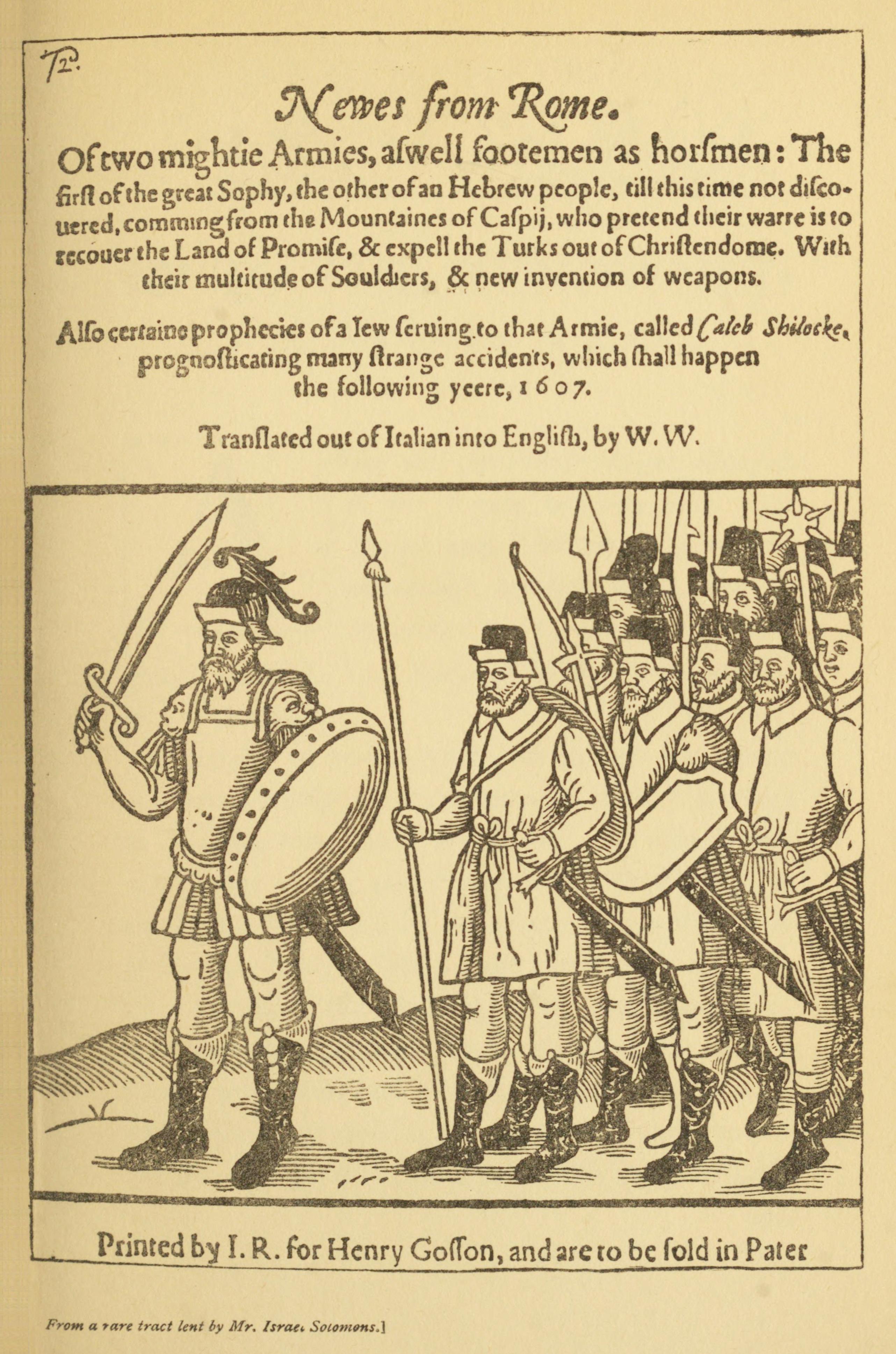
Newes from Rome.
Printed by I. R. for Henry Gosson, and are to be sold in Pater
From a rare tract lent by Mr. Israel Solomons.
Of two mightie Armies, aswell footemen as horsmen: The first of the great Sophy, the other of an Hebrew people, till this time not discouered, comming from the Mountaines of Caspij, who pretend their warre is to recouer the Land of Promise, & expell the Turks out of Christendome. With their multitude of Souldiers, & new invention of weapons.
Also certaine prophecies of a Iew seruing to that Armie, Caleb Shilocke, prognosticating many strange accidents, which shall happen the following yeere, 1607.
Translated out of Italian into English, by W. W.

❧ TO THE RENOWNED
Lord, Don Mathias de Rensie, of Venice.
AFTER the particuler thinges alleaged in my former writings vnto your Lordshippe, I thought it good and conuenient by this my Letter, to aduertise your Lordship, of certaine great, horrible, and fearefull things that hapned in this quarter.
Purposing to certifie your Lordship of the pompe and great triumph at the presenting of the Captaines of the Sea, vnto the great Turke: the miserie and vnhappines of the poore prisoners: the discorde & contention that came by the sonne of the Vice Roy of Naples, being prisoner: the threatnings made to the Christians: the receiuing of the Ambassadors of the Soffy: the pompes, tryumphes, and entertainments made vnto them, and yet dissembled enough, with mocking one the other at their departing: the presents giuen: the going of the great Turke a hunting and all other thinges written at large, as your Lordship shall vnderstand.
But now your Lordship shall vnderstand at thys time, the greatest, the most wonderfull, and most strange thing that euer was heard of. The which partly hath so troubled the great Turke, and all the rest, that they haue left of all other affayres, to prouide for the perrill and danger that at this time hangeth ouer theyr heads.
Your Lordships to vse,
Signior Valesco.
Newes from Rome ⁂
The newes are come that the king of Hungarie maketh a great Army, which shall haue for his ayde the gallies of Buda, and of many other Princes of Christendome. And they say moreouer, that the king of Bohemia will helpe therein, and that the most part of Christian Princes will come and ayde him in this enterprise against the Turke, except the Signorie of Venice, which medleth nothing at all in it. These reporters of newes affirme, that there shal come aboue a hundred gallies, besides other Barks, ships, & Hulkes without number, which is occasion that they hasten the warre the more. Notwithstanding, men esteeme not so much hereof, as of the war that is made beyond the Mountaines, as you shall understand not without wondering at it. The Tartars make friendes upon the greater Sea, & haue made a league & friendship with the great Turke, requiring ayde, for they are molested with war by the great Emperour of Muscouia, & prince of Sagodie, of Pogore, of Smelengie, of Drossy, of Gazam, of Virgolosam, of Tartarie, of Cham, and of diuers other people and regions lying toward the South: they say that this Emperor or Duke hath two Armies, and is called Iohn Dwatillo, a young man, of the age of xxiiii. yeeres, noble and valiant, and a Christian, after the institution of the Greekes, and presumeth that by reason of his blood, the Empire of Constantinople doth belong to him, And these two Armies are about two hundred thousand horse.
They were not wont in time past to be so strong, nor so feared of the Turks, for they had not the use of artillarie in the warre: but nowe they haue meruailous great preparation in theyr warre. Hee hath in wages certaine Dutch Captaines, and about tenne thousand Maister gunners, and is meruailously well furnished with harquebushes, and artillery, and because men understand that hee hath so vanquisht the Tartarians, and brought thē to such a state, that they cannot much more resist him, and that if the saide Muscouite should be maisters ouer the Tartars, they should consequently be Rulers of the great sea, & the way should bee open and easie for them to come, not onely to Constantinople, but also to driue the Turke out of Europe: and because that the saide great Turke is assured of this enterprise and commotion of the Greekes: he hath cōcluded and determined, to send to the said Tartars a good assistance of fifteene thousand fighting men, and also for this purpose, hee hath sent to the sea ten Gallies to passe them ouer.
Men make mention and doubt of Mondaccio which is a great Prince and Ruler, and able to make foure score, or a hundred thousand horse: and yet men are uncertaine whose part he will take, because hee is tributarie unto the great Turke.
There is newes also from Affrica, that the king of Bugien, the king Tramece, the king of Tunis, the children of Serif. The Lord of Murocho, and of Gran, with the Arabians and other, haue taken in hand to driue and expulse the turke wholy out of Affrica, & to endomage him as much as they may. Men know not yet in what place they will war, but we shall know it shortly. The newes also is, that the Soffie is in Campe with a great Armie, and hath the Medes to helpe him, which border upon the Caspian Sea, and of one side neighbour to the Hircans, called at this day Correxans and Zecatans, with whom he hath made a league and peace. There are on his side also the Ibeians and Albians, and also the people of Melibar, which harbor upō the Indians, and likewise with the king of Bosphorus, all beeing people meruailous swift and nimble. In this so mightie an host and armie, is also Bascet the sonne of the great Turke, by meanes whereof, all in those parts is in great trouble, as well as heere. It seemeth that the Ienissaries bring him the lot of Turkie, as Baduget, Zermonia, Alepo, and all the Regions lying neere to the Soffi is reuolted, all the which particularities shall be understoode more at large.
This newes is great, and hath made the great turke to muse enough upon it, but aboue all these meruelous and dreadfull newes which are hapned, there is yet chaunced another, which hath greatly feared & abashed all men, which although it seemeth to be incredible, yet upon my credit it is most true, and that is, that a people heretofore unknowne, mighty, swift, and meruelous nimble, hath taken weapon in hand, to the disaduantage and losse of the house of Ottoman. They say that Alexander the great did in time past driue beyond the mountaine Caspe nine tribes and a halfe of the Hebrewes which worshipped the Calfe & Serpent of gold, and draue them away, that neuer since there was no newes of them, neither knewe any man if they were in the worlde or not: because the Sea of sand, or the sandie sea, by a certaine inconuenience of sand Grauel or Beche, swelled & rose so high, that it utterly tooke from them the way into this our Region. But now by the meane of the newe Nauigation that yᵉ Hollanders haue made, they are arriued in their country, and haue espied out all their dooings: and after yᵗ the said Hollanders had instructed and taught them in the science and knowledge of artillery, and gun=pouder for Harquebushes and dags, whereunto they are meruelous apt and ready, they are become in all thinges perfit. After this they egged them forward to take weapon in hand, and passe the saide mountaine by Land. And because the sandy sea did hinder their passage, it appeareth yᵗ some Duchman or Italian, which yet men knowe not, but notwithstanding some great Astrologian or Cosmographer taught them the way, making some hill plaine with fire, whereby they might easilie passe, which is a thing of great wonder.
These people haue two mighty great armies, and infinite store of victualls, by reason of the fruitfulnesse of theyr country, they are also well prouided of all manner of preparation for war, & cunning in the practise of theyr weapons. They say they will come & recouer the land of Promise, towards the which the first army is already very neere, to the great terror and dread of euery man which hath either seene or heard of them. The spyes which haue been sent out by the great turke to discry them, doe affirme, that beside a hundred and two armies, there followe an infinite number of people, as well footmen as horsemen, and theyr first armie is already arriued upon the limmits of Turkie, putting all to fire and sword. Theyr language is bastard Hebrew: & because men speake much of it heere, I will not forget to speake also something thereof woorthy to be noted, and well understoode: The Hebrewes of Constantinople say, that they haue certaine prophesies, among the which one maketh mention, that from the foure parts of the world, shall rise a people, and come into Gog and Magog, and then shall appeare (as they perswade themselues) their Messias in might and power, and then they shall haue dominion and rule in the world, whereof they secretly reioyce, & are wonderous glad. They say moreouer, that there is a prophecie grauen in a piller set at Podromo which saith thus: A mightie Prince shall rise, whose beginning shall be of small reputation, who by his Issue shal war of such force and strength (with the helpe of God) that he shall bring to nothing, the empire and rule of Ottoman, and shal be the right possessour and inheritor of the Empire of Constantinople, & they beleeue all that it shall be this Emperor and duke of Muscouia, which is alreadie in great estimation among the Greeks.
The Turks haue a prophecie, which they sing often, and weepe bitterlie the while, for it betokeneth and denounceth unto them, their utter ruine and destruction. And although it seeme strange, to say that the Turkes haue prophecies, it is no meruaile: for Balam was a false Prophet: the Sybilles also prophecied and were Pagans. For all these causes the great Turke hath forbidden wine & will that all men goe fiue times in a day to the Moschea, and pray to God for theyr health and saftie. And so hee prepareth three great armies, one against the Muscouites another against the Soffie, and the third for to goe against the Hebrewes of the Mountaines of Caspij. Within these fewe dayes you shall haue other newes, wherefore thus making an end, I commend me unto your good Lordship: from Rome, the first day of June, 1606. Your faithfull and trustie seruant, Signior Valesco.
The description of the first Armie, conducted
by Zoroam a Iew, Captaine generall of the Armies.
First of all a Jew, of verie great stature, of a fleshlie colour, more red then otherwise, with broad eyes, called Zoroam, is Captaine generall of all the Armies, hee leadeth under his Ensigne twelue thousand horse, and twenty thousand footmen. The horsemen are armed after a light sort, but very good Harnes, almost after our fashion: they carrie Launces of long Reedes, very hard and light, yet so sharpe pointed, that they passe thorowe a thing with incredible lightnesse: they carrie also shields or targets of bone, and in steede of swords, they use certaine Courtilaxes.
They are apparrelled with the colour of their Ensigne, and all clothed with silke: the foote-men carrie Pikes of the same sort, with Helmet and Habergin: their Ensigne is of blacke silke and blew, with a dog following a Hart, or Bucke, and a saying written in it, which is in our language thus: Either quick or dead.
2. Of the Armie of Don Phares.
There is one called Phares, which is an Earle, yong and valiant, not regarding this present life: this man hath under his commaund fifteene hundred horsemen armed lightly, onely on the fore-part and head-peece: yet this Armour is so well tempered and wrought, that it keepeth out a Launce and Harquebush shot.
This manner of arming themselues, is to the intent they may neuer turne their backe to runne awaie: they have also fierce and light horses: there are eighteene thousand footemen, apparrelled with a kinde of sodden leather, made of the skinne of a certaine beast, so that no pike nor harquebush can pearse it. These men are beastlie people, & will neuer flie for any thing, they are very obedient and subiect unto their Prince, and their ordinarie apparell is silke. The Ensigne that they beare, is a falcon pecking or billing with another bird, with a sentence that saith, Either thine or mine shall breake.
3. Of the Marquesse of Galair.
There is a Marquesse of Galair called Goes, this man leadeth fifteen hūdred men of armes, which be all exceeding well armed & stout, strong, and rebust men: their horses are moriskes, the greatest, the strongest, the fairest, and the best that bee in the world: there are also seuenteene thousand souldiers, very wel appointed with Launce and harquebush: theyr Ensigne or armes is a redde field, with a maid clothed in greene, holding a Lion in her hand, with these words I hope to subdue a greater thing.
4. Of the Duke of Falach.
There is a Duke of Falach, called Obeth, who hath under his conduct xx. thousand footemen, armed with a certaine mettall like yron, but it is light and hard, they have many good swords, launces, and other force, harquebushes, and wiflers: their Ensigne or armes, is a mermaid in a blacke field, and the deuise thus, My singing shall not cease untill the end.
The description of the Armie conducted by Captaine Nauison.
There is a captaine called Nauison, which hath under him xx. thousand men, appointed and armed with the skin of a serpent, most hard & stiffe, they haue Axes, pollaxes, pikes, harquebushes, and other kind of weapons: their Ensigne or armes, is a white snaile in a blacke fielde, with a deuise about it, By little and little, men goe very farre.
Of the tribe of Simeon there is a Prince of Arsay, whose name is not yet knowne, but they say he is a deuill, great, grosse, & thicke beyond measure, with a flat nose, and both he and his men are of the stature of Giants: he leadeth with him xx. thousand footemen, almost all Alfiers, which are also so swift & nimble that they will take horses running: they make a meruailous noise, such as no people use: their Ensigne is an Lute in a blacke field, and haue for their posy, Such is my government.
6. Of the Duke of Barsalda.
There is a duke of Barsalda, and he is the conducter of xiii. thousand footmen, which are all Harquebushers, & carry no fire matches, but strike it with a stone: they are apparrelled & armed with such a hard kind of leather, and so enchaunted, that no yron weapon in the world is able to perse it thorow. They bee also very swift and light: their Ensigne or armes, is a dry tree in a blew field, and their deuise thus, I hope to spread, and be greene againe.
7. Of the Armie of the Duke Passill.
There is a duke of Passill called Abia, he hath under his conduct a thousand footmen, very cruell, hauing all kind of weapons to push or pricke far off, and to strike nigh, but farre different from ours, they are very expert in artificiall fire, and make the greatest and most dreadfull thinges withall yᵗ a man can imagin: they do it either by arte or enchauntment, so that it seemeth that it raigneth fire upon their enemies, and yet notwithstanding hurteth not themselves at all, by reason they are apparalled with a certaine Serpents skin which preserueth them. Their Ensigne is a Cat holding a Rat in her paw in a blacke fielde, and theyr posie thus, Euen so hapneth it to him that is not gouerned.
8. Of the Army conducted by the Earle of Albary.
There is an Erle of Albary called Orut, which hath under his gouernaunce a thousand horse-men with Crosse-bowes, some of them weare certaine light armour of a kind of hard mettall, with Rapyers and daggers after theyr manner, they fight alwayes running and their horses are so swift that it is wonderfull. This man also hath xx. thousand horses barbed with very fine leather. Some carry pikes & Partisans, & such like weapons. Their Ensigne or armes is a man in chaines, in a field parted halfe with greene and purple, and this deuise withall, My chaines shall bind another man.
9. Of the Marquesse of Vorio.
There is a Marques of Vorio called Manasses, who hath under his conduct xvii. thousand footemen, armed with a very hard & strong leather, which men beleeue to be enchaunted, because that no weapon nor harquebush is able to perse it thorowe, yet it is as light as Linnen cloth, and a thing very fayre to see to. These now haue all sorts of weapons that an Armie may haue: and they are deuided and set in a very faire, comely, and decent order: their Ensigne is an old man in a chariot, in a blacke field, saying thus, After a long iourney, I shall be happy.
Caleb Shilock his prophesie, for the yeere, 1607.
Be it knowne unto all men, that in the yeere 1607, when as the Moone is in the watrie signe, the world is like to bee in great danger: for a learned Jew, named Caleb Shilock, doth write, that in the foresaid yeere, the Sun shall be couered with the Dragon in the morning, from fiue of the clocke untill nine, and will appeare like fire: therefore it is not good that any man doe behold the same, for by beholding thereof he may lose his sight.
Secondly, there shall come in the same yeere a meruailous great flood of water, to the great terror and amasement of many people.
Thirdly, there shall arise a meruailous great wind, and for feare thereof many people shall be consumed, or distraughted of their wits.
Fourthlie the same yeere, about the month of May, will arise another wonderfull great flood, and so great as no man hath seene since Noyes flood, which wil continue three daies and three nights, whereby many Citties and Townes which standeth uppon sandie ground will be in great danger.
Fiftly, Infidels and Hereticks, through great feare and dread, will flie, and gather together, and asmuch as in them lies, make war against Christian princes.
Sixtlie, in the same yeere after the great waters be past, about the end of the yeere will be very great and fearefull Sicknesses: so that many people are like to die by the infection of strange diseases.
Seauenthly, there will be throughout the Worlde great trouble and contention about matters of Religion, and wonderfull strange newes unto all people, as concerning the same.
Eightly, the Turke with his God Mahomet shall be in danger to lose his Septer, through the great change and alteration in his Regiment, by reason of famine and warres, so that the most part of his people will rather seeke reliefe from the Christian, then from him.
Ninthlie, there will also arise great Earth=quakes, whereby diuers goodly buildings & high houses, are like to be ouerthrowne and ruinated.
Lastlie, there will be great remoouings of the earth in diuers places, so that for feare thereof, many people will be in a strange amazement and terror.
These punishments are prognosticated by this learned Jew, to fall uppon the whole world by reason of sinne, wherefore it behooueth all Christian to amend their euill liues, and to pray earnestly unto God to with=hold these calamities from us, and to conuart our harts wholy to him, whereby we may find fauour in our time of neede, through Jesus Christ our Lord. Amen.
FINIS.
COLLATION
A‒B in fours; Black letter, with the exception of title-page and introductory leaf: Lowndes, p. 2749 notes “Valesco, S. Jewes Prophecy, &c. Halliwell, May, 1856, imprint cut into £10‒5‒0: No other copy known.” This is now in the British Museum, the fore edge of which is badly cropped, the name “Shilocke” on the title-page being cut down to “Shilo.” As in this copy, the imprint is cut off after “Pater,” but there is just visible the top edge of the next line, which may be “noster rowe at the signe of the Sunne,” but no indication of a date. These are the only two copies known of this remarkable tract. To students of Shakespeare, it is of considerable interest. James Orchard Halliwell-Phillips, formerly Halliwell (1820‒1889), the great Shakespearean scholar, in his introduction to the Merchant of Venice (Halliwell’s Shakespeare, vol. v., p. 277: London, 1853) maintains that the name of the predominant character of the play suggested itself to the author, from this tract. [Notes and Queries, 10s. ix. 269. April 4, 1908.]
XXVI.
“The World’s Great Restauration,” by Sir Henry Finch
The | Worlds | Great Restavration. | Or | The Calling Of | The Ievves, and (with them) | of all the Nations and King-|domes of the earth, to the faith | of Christ. |
Published by William Gouge, B. of D. and | Preacher of Gods Word in Black-fryers. London. |
London | Printed by Edvvard Griffin for | William Bladen, and are to be sold at his Shop | neare the great North dore of Pauls, at the signe | of the Bible. 1621. |
(4to. 7 ll. + 234 pp. + 1 l.) [I. S.]
This work has a second title page:—
“The Calling of the Ievves. | A | Present | To Ivdah And | The Children Of | Israel that ioyned with him, | and to Ioseph (the valiant tribe | of Ephraim) and all the | house of Israel that | ioyned with him. |
The Lord giue them grace, that they | may returne and seeke Iehovah | their God, and David their | King, in these latter dayes. | There is prefixed an Epistle vnto them, | written for their sake in the Hebrue tongue,¹ | and translated into English. |
Published by William Gouge, B. of D. and | Preacher of Gods word in Blackefryers. London. |
London | Printed by Edward Griffin for | William Bladen, and are to be sold at his Shop | neare the great North dore of Pauls, at the signe | of the Bible. 1621.” |
¹ The Hebrew epistle referred to is a translation by the author of a section of this title page. It is printed by itself on one of the preliminary leaves in somewhat archaic characters, and reads as follows:—
מזרה ישראל יקבצנו׃ᵃ
מנחה היאᵇ ליהודה ולבני ישראל חבריו וליוסף אשר ביד אפרים וכל בית ישראל הבריוᶜ׃ ימציאם אלהים חןᵈ וישבו ובקשו את יהוה אלהיהם ואת דויד מלכם באחרית הימיםᵉ
עמוס חּ גּ אדני יהוהᶠ דבר מי לא ינבא
ᵃ Jeremiah xxxi. 10. b Genesis xxxii. 19. ᶜ Ezekiel xxxvii. 16. ᵈ Proverbs iii. 4. ᵉ Hosea iii. 5. ᶠ Amos iii. 8.
The British Museum, and the Mocatta Library, in University College, have copies, without the first title page (The Worlds Great Restauration) and Gouge’s preliminary leaf “To the Reader.” Probably issued in this state after the incarceration of Finch and Gouge.
XXVII.
“The World’s Great Restauration” (continued).
Contemporary reference to the book is to be found in letters from the Rev. Joseph Mead (Mede) (1586‒1638), the eminent biblical scholar, to Sir Martin Stuteville.
(B. M. Add. 4176: 121, 123‒6.)
Christ’s College Cambr. March 31. 1621.
Sr.
“... Sʳ Henry Finch was last week examined before the High Commission about the book I wrote of, but wonderful privately. He gave up his answer in writing, ch⁄w was sent to the King, & expected from him what should be his censure....”
Christ’s College, Apr. 7 [1621]
Sr
... I have seen Sʳ Henry Finch’s The World’s Great restauration, or Calling of the Jews, & with them of all the Nations of the Earth, to the Faith of Xᵗ. I cannot see but for the main of the discourse I might assent unto him. God forgive me, if it be a sin; but I have thought so many a day. But the thing, which troubles His Majesty, is this point, which I will write out for you verbatim; “The Jews & all Israel shall return to their land & antient Seats, conquer their foes, have their Soil more fruitfull than ever. They shall erect a glorious Church in the Land of Judah it self & bear rule far and near.” ... We need not be afraid to aver and maintain, that one day they shall come to Jerusalem again; be Kings & chief Monarchs of the Earth; sway & govern all, for the glory of Xᵗ; that shall shine amongst them. And that is it Lactantius saith Lib. 7. Cap. 15. “The Romans name I will speak it, because it must one day be shall be taken from the Earth, & the Empire shall return to Asia. And again shall the East bear dominion & the West be in subjection.” In another place Ashur & Egypt, all these large & vast Countries, the whole tract of the East & South, shall be converted to Christ; the chief Sway & sovreignty remaining with the Jews. All nations shall honour them.
Some say, the King says, he shall be a pure King, & he is so auld that he cannot tell how to do his homage at Jerusalem.
This with my best respect,
Yours ever,
Joseph Mead.¹
¹ This letter has been transcribed, somewhat inaccurately in “The Court and Times of James the First;” ... [Robert Folkestone Williams.] ... London: ... 1848. Vol. ii., pp. 250‒251. It is also to be found in (Notes & Queries, 2nd S. xi. 127., Feb. 16, 1861) “Modern Apocryphal Apocalypse,” by Moses Margoliouth, LL.D., PH.D.
Calendar of State Papers, Domestic Series, James I. 1619‒1623.... Edited by Mary Anne Everett Green.... London ... 1851.
p. 247 April 18? (1621).
96. Petition of Sir Hen. Finch to the King. Disclaims the opinion which His Majesty thinks is asserted in his book; is sorry for having written so unadvisedly; begs liberty and restoration to favour.
p. 248 April 18, 1621 London:
Chamberlain [to Carleton.]
97. ... Serjeant Finch is committed for his book on the conversion of the Jews.
XXVIII.
Philip Ferdinandus
The Jew referred to was Philip Ferdinandus (1555?‒1598), a native of Poland. He was converted to Roman Catholicism, but afterwards became a Protestant. He taught Hebrew at Oxford, and subsequently at Cambridge (D.N.B.).
His only publication is entitled:—
Hæc sunt verba Dei, etc. |
Praecepta In Monte Sinai | data Iudæis sunt 613, quorum 365 negativa, & 248 af-|firmativa, collecta per Pharisæum Magistrum Abraha-|mum filium Kattani, & impressa in Bibliis Bomber-|giensibus, anno à mundo creato 5288 Vene-|tiis, ab Authore VOX DEI appellata: |
translata in linguam Latinam per Phi-|lippum Ferdinandum Polonum. |
His accesserunt nonnulla quæ sequens pa-|gina indicabit. |
Lex Dei integra est, Psal. 19. |
Aperi oculos meos, vt videam mirabilia legis tuæ. |
Vocem audivistis, et similtudinem non vidistis, | præter vocem. Deut. 4. 12. |