Volume 2 — APPENDICES (continued 4)
Reading edition
Berthold Feiwel, born in Brunn, Moravia, was a member of the Vienna Kadima, but did most of his work in Berlin. A young man of exceptional attainments, he early attracted the notice of Herzl, and was for some time editor of the Welt, for which work he was particularly well qualified. But the work of leader-writing did not satisfy the poetic and æsthetic side of his nature, and he turned to literature. The promise of his early writings, with their beauty and originality, is amply fulfilled in the literary activity which he subsequently developed in the Almanach and in other publications of the Jüdischer Verlag, which was founded by him and his friends. His poems, as well as his excellent translations of Rosenfeld and other works, have won him a lasting reputation. He has also taken an active part in the work of the Zionist Organization, and was a member of the Actions Committee. He was editor of the Welt for the second time in the years 1906‒9, and has written many pamphlets.
The brothers Isaac and Boris Goldberg hold a specially distinguished place both in Russian Zionism and in the movement at large. Isaac Goldberg has made himself indispensable to all Zionist institutions, and has attained the highest repute in the Zionist Organization, and in Palestine. Boris Goldberg is a very influential member of the Actions Committee, with a thorough knowledge of all matters concerning Zionism and Palestine, and an important contributor to the Zionist press. He was a member of the Zionist Commission of Inquiry which visited Palestine five years ago.
J. Grazowski has written popular and useful books on general Jewish history, and has collaborated in a Hebrew dictionary. He is now in the service of the Anglo-Palestine Company at Jaffa.
Mordecai (Marcus) ben Hillel Ha’cohen was even in his early youth an excellent, versatile contributor to the Hebrew and Russian Press. Possessed of great vivacity and a humorous and enthusiastic disposition, an enlivening speaker, with the national idea deeply at heart, he has worked for Zionism, Hebrew and the national idea with considerable success. His writings in Ha’melitz, Ha’zefirah, Razswiet, and other papers and reviews, as well as his own pamphlets, the description of his journey to Palestine, and his reminiscences, written in a brilliant style, have won him a well-merited popularity. After working several years in the Chovevé Zion movement, and in the Zionist Organization, he settled in Palestine, where he is active as one of the most popular leaders of the Tel-Aviv community, and is particularly engaged in educational, communal and literary work.
Dr. William Herzberg (1827‒97), a highly educated writer and communal worker, who, though not writing in Hebrew, greatly influenced the movement, and his work was translated into Hebrew. He wrote the famous book, Judische Familienpapiere (1875‒6). This book made a stir in the Jewish scholastic world. Zacharias Frankel welcomed the book as a modern Kusari. It was only after some time that the identity of the author was discovered, for it was published under the nom de plume of Gustav Meinhardt. Perez Smolenskin was much inspired by the nationalist spirit of this phenomenal literary production, and translated the most important parts of it in the Haschachar (he had made it a rule not to publish any translation, but in this case departed from the rule). Herzberg intended to obtain a professorship in a German University, but, finding that this was impossible for a Jew, he contented himself with a professorship in the Gymnasium. He passed his probationary year in the Gymnasium of his native town, Stettin, but, when his final appointment was recommended by the Head Master, who was much impressed by the fine scholarship of the young teacher, the Minister of Education confirmed it cordially, on the supposition, however, that the candidate had embraced Christianity, as a Jew could not be appointed Professor in a Gymnasium. In 1877 he was induced by his friend, Professor Grätz, to accept the post of Director of the Agricultural School, Mikveh Israel, near Jaffa. Dr. Herzberg remained one year in this position and then accepted the Headmastership at the Von Laemel School at Jerusalem.
Isaac M. Hirschensohn, born in Russia, has rendered great services to the progress of the Jews in Palestine as a publisher, bibliophile and Talmudist. He advocates rabbinical ideas, in harmony with the national principle.
Dr. N. Katzenelsohn, of Libau, Russia, holds an important place in the history of Zionist organization. After having joined the Organization at one of the first Congresses, he soon became a prominent member, particularly in the domain of financial affairs and institutions. One of the devoted friends of Herzl, he accompanied him on his visit to Russia in 1903, and took part in some of his political efforts there. In 1905 he was appointed President of the Board of Directors of the Jewish Colonial Trust, and regularly gave his reports of the activities of this Institution, as well as of those of the A.P.C. at the Zionist Congresses. He visited Palestine in 1907, and particularly investigated the financial and economic situation of the country. He also accompanied Wolffsohn in the same year to Constantinople on a political mission. Dr. Katzenelsohn was a member of the First Russian Duma, and was for many years very active in the work of the I.C.A. for the emigration of the Russian Jews, a question on which he also submitted reports to the Zionist Congresses.
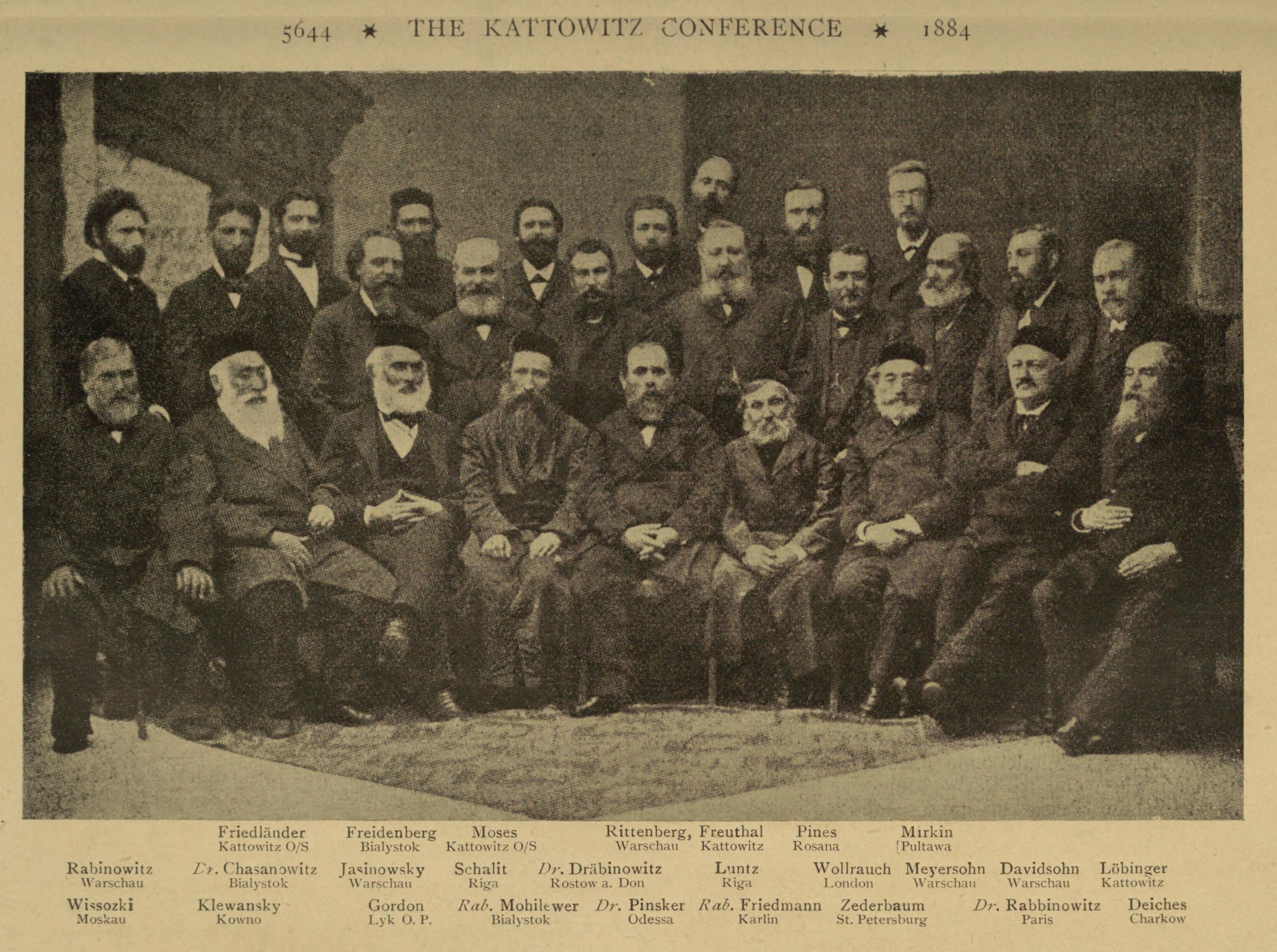
5644 * THE KATTOWITZ CONFERENCE * 1884
Dr. Jacob Kohan-Bernstein, of Kishinew, was one of the earliest of the Chovevé Zion. His speeches and appeals when he was in charge of the so-called “Post-Centre” were most effective in kindling Zionist enthusiasm. As a member of the Actions Committee he has occupied a high position in the movement.
The late Abraham Moses Luncz (1854‒1918), born in Russia, lived since his early youth in Palestine. He rendered great services to the exploration of the Holy Land from the historical, geographical and physiographical standpoint, by means of his guide-books for Palestine, his Palestine annuals, and his Jerusalem almanac.
Joseph Lurie was born in Russia, and became a prominent nationalist at the Berlin University. He settled later in Warsaw, where he was engaged in educational work, and afterwards edited a Zionist Yiddish weekly paper, published by the Achiasaf. After the suspension of this paper he lived for about two years in St. Petersburg, where he was assistant editor of the Fraind. Thence he went to Palestine, and became a teacher at the Jaffa Gymnasium. Some time afterwards he was elected President of the Union of Teachers (Agudath Ha’morim) of Palestine. He has not, however, given up his journalistic work. His articles on Palestine are unequalled for clearness of exposition and logical argument.
Rabbi Samuel Mohilever (1827‒1903), of Bialystok, wrote many appeals in favour of the Chovevé Zion movement. He was a lifelong adherent of the national cause, helped to promote colonization, and gave his unqualified adherence to the new Zionism. Even in very advanced age he was still a fighter in the forefront, travelling, preaching, collecting funds and generously spending his own means. At the outbreak of the pogroms in 1881, he took the Jewish refugees to Lemberg. Here he became acquainted with Sir Samuel Montagu (afterwards Lord Swaythling) and Laurence Oliphant, and he sought to win the former for the Palestinian colonization movement. On his return to Russia he called a conference at Warsaw and formed a Chovevé Zion Society. In the same year he undertook a journey to Paris to obtain, through the Grand Rabbin Zadoc Kahn and M. Erlanger, Baron Edmond de Rothschild’s support for the colonization movement. Returning again to Russia, he went on a propaganda tour, agitating in several towns in favour of Palestinian colonization. In 1885 he presided at the Kattowitz Conference. In 1890 he journeyed to the Palestinian colonies and witnessed the founding of the colony of Rechoboth.
Leo Motzkin was born in Russia and educated in Berlin. His intellectual versatility made him a leading personality in student circles and Jewish societies, particularly in the Zionist Organization. He soon attracted attention at the Congresses, and was delegated to proceed to Palestine and inquire into the condition of the colonies, on which he prepared a report. As a member of the Actions Committee, he took part in 1914 in a Commission consisting of Zionists appointed to inquire into the state of affairs in Palestine. He has also written valuable books and pamphlets on the Russo-Jewish problem.
Isaac Nissenbaum, born in Russia, lives in Warsaw, where he was one of the sub-editors of Ha’zefirah and a lecturer at the Zionist Synagogue. Though not a Rabbi, he belongs by virtue of his education, associations and the nature of his occupation to the Rabbinical world. A learned Talmudist, a powerful preacher and a prolific Hebrew writer, he has a worthy record in all these spheres.
Alfred Nossig, scientist, artist and journalist, was one of the first, perhaps the first in Galicia, to publish pamphlets in Polish in defence of Jewish nationalism. He has pursued a line of his own in Zionism, and from the point of view of the Zionist Organization his activities have often been open to criticism. But he deserves recognition, both as a man of letters and as a strenuous advocate of Palestinian colonization.
Daniel Pasmanik is a Russian Zionist who has done much propaganda work and proved himself a writer and journalist of extraordinary capability. His book Die Seele Israels (written in Russian and translated into German) is a noteworthy contribution to Zionist thought.
Jehiel Michael Pines (1842‒1912), born and educated in Russia, a Hebrew writer and Talmudist, was elected delegate to a conference held in London by the Association Mazkereth Mosheh for the establishment of charitable institutions in Palestine in commemoration of the name of Sir Moses Montefiore; in 1878 he was sent to Jerusalem to establish and organize such institutions. Thenceforward he lived in Palestine, working for the welfare of the Jewish community and interesting himself in the organization of Jewish colonies. In his Hebrew book, Yalde Ruchi, and particularly in Part I., Rib Ami (Mainz, 1872), he expounded the Jewish national idea. He was a contributor to all Hebrew periodical publications, especially to those in Palestine.
Samuel Poznanski pursued his studies at Berlin, and was already, as a young man, a rising representative of the Hebrew Revival. Having graduated, he returned to Poland, where he is now the Rabbi and Preacher of the Great Synagogue at Warsaw. His achievements in the field of Jewish scholarship are great and universally recognized. He has written many valuable books and treatises, all of which are the result of careful observation and patient study, and are distinguished by depth of thought. A devoted Hebraist, he contributes to Hebrew literature and the Press, and as a communal worker he has succeeded in counteracting destructive assimilationist tendencies by the advocacy of a sound traditional nationalism.
Rabbi Samuel Jacob Rabbinowitch, of Sopotkin (now in Liverpool), was first a Chovev Zion and early joined the Zionist Organization. His calm piety and gentle nature won him the hearts of all Zionists. He was for several years a member of the Zionist Actions Committee. He contributed a number of articles to Ha’melitz, which later were published under the title Ha’dat Weha’leumit (Warsaw, 1900). He has also written talmudic works.
Rabbi Isaac Jacob Reines (1839‒1915) was a great talmudic authority, author of halachic works, in which he taught the rigid application of logic to the solution of talmudic problems, and founder and principal of a modern Yeshivah (Rabbinical College) in Lida. He was an ardent Chovev Zion, and joined the Zionist movement, in which he became one of the most prominent workers, orators and propagandists. He occupied a high and influential position in orthodox Zionism, and was the founder of the orthodox Zionist section, Misrachi.
Rabbi Pinchas Rosowski, a great talmudic scholar and prominent Hebraist, was an enthusiastic Chovev Zion, and later a member of the Zionist Organization. He wrote articles inspired by the nationalist idea.
Jacob Saphir (1822‒86), a Russian Jew, who settled in Palestine, was not directly connected with the new colonization. He was commissioned by the Jewish community of Jerusalem to undertake a journey through the southern countries, in order to collect alms for the poor Palestinian Jews. In 1854 he made a second tour, visiting Yemen, British India, Egypt and Australia. The result of this journey was his Hebrew book Eben Saphir (vol. i., Lyck, 1866; Mayence, 1874), in which work he gave the history and a vivid description of the Jews in the above-mentioned countries. There is in his book a touch of Haskalah (Enlightenment) and even of national sentiment.
His grandson, Elie Saphir, who died a few years ago, was a conspicuous figure among the pioneers of the new colonization by virtue of his great knowledge, especially of the Arabic language and literature, and the laws and customs of the country. A man of keen judgment, he occupied the position of assistant-manager of the Anglo-Palestine Company at Jaffa. The leaders of financial and agricultural institutions were always eager to consult and confide in him. But he was essentially a scholar. His Hebrew writings, and particularly his last work Ha’arez—a physiographic and scientific examination of the conditions of Palestine—are of great value.
M. Smilanski, of Rechoboth, has one of the longest and best records of work in Hebrew literature. His writings on Palestinian colonization are as sound as his literary sketches are instructive.
A. Tannenbaum, of St. Petersburg, was an ardent Chovev Zion and an excellent Hebraist. Of his Hebrew writings, his study on “The Architecture of the Synagogues” (in the first volume of Knesseth Israel) is of enduring merit. This group strongly supported the local Chovevé Zion Society, which was of considerable importance. At that period Rosenfeld undertook with great courage and determination the propaganda in the first Razsweet, which, however, had to be suspended after a period of brilliant journalistic exploits in troublesome and stormy times (in the eighties), in which period the two years of that organization happened to fall. Later on, the late Salomon Grazenberg, a medical man of great knowledge and an ardent Zionist, whose articles were characterized by soundness of argument, took up the same work in a new Russian weekly paper, entitled Boudoushtshnost, which managed to exist a little longer.
Vladimir Temkin was one of the most important and, undoubtedly, the most popular champion of the Bilu. An idealist, an enthusiast, an attractive personality and a powerful speaker, he possessed a special gift for propaganda, and became one of the chief organizers of colonization in Palestine. He belonged to the Zionist Organization from its inception, was a prominent Congress representative and member of the Actions Committee, and is to-day one of the leading Zionists.
Davis Trietsch has not always found the appreciation he deserved. He has been frequently drawn into controversies and misunderstood owing to the support he has given to schemes which appeared to be impracticable and fantastic, but in ordinary circumstances would not have given rise to opposition. But he is a man of varied experience and untiring activity, and his advice has often been very useful. He lived for a couple of years in Palestine, where he grappled with many forms of industrial work; he has written books, pamphlets and articles, and is an indefatigable advocate of the idea of colonization. He has given a considerable impetus to the study of Palestine and to many practical ideas.
Semion Weissenberg worked hard with Berman and Temkin in the St. Petersburg Students’ Palestinophile Association, took part in the Odessa Chovevé Zion meetings, and later entered the Zionist Organization, of which he is a prominent member. His bent lies in the direction of work in connection with the Jewish problem in Russia.
David Yellin (1858), a son-in-law of J. M. Pines, is one of the most eminent Hebraists and educationists in Palestine. The Zionist idea captured him early in life and grew upon him during his many-sided literary and educational career. He has written the best text-books of the Hebrew language, based on the principle of the modern method Ibrith B’ibrith (Hebrew in Hebrew), and has thus helped to make Hebrew a living language. He has been teacher and principal of several Hebrew schools and of the seminary for the training of teachers. He has many connections in England, and is on the Montefiore foundations in Palestine.
In St. Petersburg Zionism has now gained a strong footing, owing to the steady efforts of the distinguished, devoted and indefatigable member of the Actions Committee, Israel Rosoff, Michael Aleinikow, the able and gifted Abraham Idelsohn, A. J. Rapaport, as well as of the very able and devoted workers S. S. Babkow, W. Grossmann, A. Goldstein, S. J. Janovski, A. Seidemann, M. Sachs, and others. As far as Nationalism is concerned the learned and talented historian, Shimon Dubnow, and the group of his followers, are undoubtedly most faithful adherents to this idea, and the same may unhesitatingly be also said of N. M. Friedmann, M. Ch. Bomesch and E. R. Gurevitch, the members of the Duma, and many other leading St. Petersburg Jews. The old Zionist leader, Gregor Belkovsky, a man of high standing in the Zionist Organization, who has already been mentioned, has for many years been very active, his influence being still as great as ever.
The number of the Chovevé Zion societies increased. They watched each other’s activities and emulated each other in brotherly devotion. The University groups were influenced by the literature and the press, as well as by the old leaders; and the old leaders were in their turn again stimulated by the ardour of the younger men. To return to the older Chovevé Zion societies and later Zionist societies, a few of the most important should be mentioned, as, for instance, the Odessa Group (or the Official Society), under the leadership of Pinsker, Achad Ha’am, M. L. Lilienblum, A. Grünberg (who was for some years President of the Society), Ch. Tschernowitz, L. Lewinski, Rawnitzki, S. N. Barbasch, A. E. Lubarski, Frankfeld, J. Klausner, M. Scheinkin, Ben Ami Rabinowitsch, and at a later period, Ussischkin, Bialik, S. A. Benzion-Guttmann, M. Kleinmann, Ch. Grinberg, and others. The Bialystok Group, with Rabbi Samuel Mohilewer, Dr. Chasanowitsch (who deserves an honoured place as a zealous pioneer of Nationalism and a great worker for the Hebrew revival in Palestine, and for his noble, almost life-long efforts for the purpose of establishing his Hebrew library, “Baith Neeman,” in Jerusalem) and Nissenbaum was of great importance during the lifetime of Rabbi Mohilewer and retained a great practical influence later, especially in consequence of the fact that the Bialystok Chovevé Zion themselves took a prominent part in various colonization schemes. The Warsaw Group had a principal leader in Isidore Jasinowski, a man of great sincerity, enthusiasm and love for the cause. An ardent Chovev Zion, he afterwards joined the Zionist movement, and, till the Territorialist split, remained devoted to the cause. The most energetic workers there were Schefer-Rubinoscitsch; J. M. Meyersohn; Eleasar Kaplan, who died recently and was an able and enterprising Nationalist, a most zealous worker, to whom great praise is due in connection with the Achiasaf and other Hebrew literary enterprises; W. Gluskin (one of the most notable workers and leaders), who joined with L. Kaplan in the foundation of the Achiasaf and Ha-Zofe, undertook afterwards the Directorship of the Palestine Wine Company, “Karmel,” and settled in Rishon L’Zion, in Palestine, where he is now one of the leaders of the new colonization); Stawski; Mates Cohn; Dr. Bychowski; Samuel Luria; Dr. T. Hindes (who lived some years in Palestine, and takes a useful part in the propaganda); M. M. Pros; M. Feldstein (the well-known Chovev Zion and supporter of the literary movement, a prominent member and representative of Zionist institutions); J. Lewite; Jacob Braude; Rafalkes; Ginzburg; Friedland; L. Davidsohn; and others.
All these important workers were afterwards active in the Zionist Organization. The development of Zionism gave a new impetus to the Palestine propaganda and to the national movement. The University movement, though most vigorous in other parts of the Russian Empire, had only few adherents in Poland. It is worthy of note that Dr. Zamenhof, the inventor of Esperanto, was, during a certain period of his university career, a Jewish Nationalist of great zest, and a contributor to Rosenfeld’s Razsweet. Meierowitz, the old Bilu pioneer, as well as the pioneer Freimann, came from Warsaw; Mekler, Elie Margulies, Manson (who died young) were the most prominent Chovevé Zion among the Warsaw students in the eighties. Only with the new Zionist Organization a strong movement of a local character came into being with adherents who were natives of the country, and this resulted in the production of literature and a Press in the native tongue. In this respect, the activity of the late Jan Kirszrot was very helpful. A great idealist, an honestly and deeply convinced Zionist, who had been brought to the cause out of assimilated surroundings, a worker of the most generous impulses, and a writer par excellence in the Polish language (like many other young Zionists of assimilated education he had acquired the knowledge of Hebrew), he worked side by side with the gifted and devoted Isaac Grunbaum, who became in later years a prominent leader, a publicist of excellent abilities and a worker of great intellectual integrity; also with the zealous Nahum Syrkin, whose significant activities extended over a large sphere, with the remarkable, energetic, indefatigable worker Leon Lewite, with the keen, persistent and conscientious Zelig Weizmann, the graceful and judicious S. Seidemann, the sound and forceful Isaac Gruenbaum, the talented and consistent Hartglass (for a certain period), the keen and learned Shimon Rundstein, the intellectual and devoted Julian Kaliski, and a number of other young writers and organizers—in connection with older Zionists and men of letters, and together with the general Zionist Organization, particularly with the younger and more progressive element. They had founded a Nationalist group “Safroth,” issued a Zionist weekly in Polish (Prgyszlose), and published a very interesting miscellany in that language. Kirszrot’s life of devotion to the highest ideals and his brilliantly youthful career were unhappily cut short by the hand of death.
But the University nationalist Jewish movement had begun. A change was in process, the extensive scope of which was scarcely noticed by the representatives of Assimilation, to whom it seemed that the small group of students and intellectuals consisted merely of visionaries and dreamers. Yet there obtained in this apparently insignificant group a vitality which was destined to become a powerful factor in the life of Polish Jewry. The evolution of this young movement was the result of the whole Zionist movement, the rapid growth of Jewish cultural life, of Jewish education, of the Jewish literature and press, of which all Warsaw had become a very important centre. At that period we see already the influential Zionist leaders busy with great Zionist work. Zionism, the Hebrew Revival, national education, the defence of Jewish interests and of the national principle in communal affairs, now engaged the attention and support of the generous, experienced, and beloved Abraham Podliszewski, of the acute and energetic H. Farbstein, of the thorough and dignified Dr. Poznanski, of the calm and pacific Dr. Mintz, of the strong, vigilant and inflexible Isaac Gruenbaum, the devoted and popular Nissenbaum, Dr. Klumel, Olschwanger, M. I. Freid, Dr. Hindes, Horodischtsch, Dunajewski, Dr. Gottlieb, Zabludowski, the educational worker and excellent Hebraist S. L. Gordon, and of many others. In this camp we meet again all the Chovevé Zion of bygone days.The same development took place at Lodz, where the able, eloquent Dr. Jelski, Dr. Silberstrom and others had long been at work, and where afterwards a strong Zionist group, with the esteemed and influential Dr. M. Braude as guide and leader, was doing most useful work. In Minsk we find working in the Chovevé Zion movement Joshua Syrkin, the man of faith and energy, whose mind is well stored with treasures of Hebrew literature, and here we also meet with the zealous Neifach, the late Rabbi Chaneles, and the eminently able Wilbuschewitsch family. We come again across them later in Zionism together with the active Zionist workers Kaplan, Churgin, Berger and others. In Pinsk at the Chovevé Zion period, Eisenberg, Rosenbaum, Hiller, Naiditsch, Pinchas Breymar, J. Breyman, L. Berger, Maslanski were the leaders. The aged Reb Dowidel (Friedmann), the great Talmudist, pious and saintly, supported the Movement and took part in the Kattowitz Conference. Among them we can trace Naiditsch, now of the Actions Committee; Eisenberg, the great authority on colonization—in Rechoboth, Palestine; Maslanski, the powerful preacher at New York; Weizmann, a member of the Inner Actions Committee, and S. Rosenbaum, the lawyer, the member of the First Duma, and Lithuanian statesman, who proved his worth during many years as member of the Actions Committee, as legal adviser, as representative of several Zionist institutions, as a great worker in the Organization, and as a defender of Zionism in Russia. In Wilna, the late S. J. Finn, and his son the late Dr. Finn, Joseph Gurland, Ch. L. Markon, Triwusch, Gordon (who settled later on in Palestine), Miriam Zalkind, who founded the Society of the “Daughters of Zion”; Lewanda, Fischel Pines, who attended the Kattowitz Conference; Ben-jakob, Isaac Goldberg, Boris Goldberg, Neuschul and others very early took an interest in the Chovevé Zion movement. In the Zionist Organization, Wilna at a certain period was the centre of activity, from the point of view of organization, propaganda and press. Ben-jakob did good work for the Jewish Colonial Trust, Neuschul is a thorough and devoted Nationalist. Among those in Wilna who succeeded in rising to the height of national importance, doing at the same time great national work of a general character, and useful, indispensable local work in Russia, belong the two excellent and distinguished Zionists: Isaac and Boris Goldberg.
The influence of these Russian and Polish enthusiasts soon spread further. Mention has already been made of the Kadimah of the Vienna University and of Nathan Birnbaum, one of its leaders. Others of its prominent members were: Dr. N. T. Schnierer, the physician, scholar and editor, who was a highly respected member of the First Zionist Actions Committee; the gifted brothers Marmorek, supporters of Herzl and his political Zionism; Schalit, who represented the sympathetic, real Viennese type; the very capable and devoted Werner, who became later one of the secretaries of Herzl and editor of the Welt; the well-known polemical journalist, S. R. Landau; the reserved and learned Berkovitsch; the energetic and faithful Alkalai of Serbia, who has been a member of the Actions Committee since the inception of the Zionist Organization;¹ the devoted worker, M. Moscowitz of Roumania, who was a member of the Actions Committee (he recently died in Palestine, where he was physician of the colony Rechoboth); the enthusiast, Caleff of Bulgaria; Erwin Rosenberger, and many others from different countries.
¹ It is noteworthy that Zionism is an old tradition of the Alkalai family. Rabbi Jehouda Alkalai (died in 1878) was a precursor of political Zionism which he expounded in his Goral L’Adonai (Vienna, 1857; Amsterdam, 1858; Warsaw, 1903). He was the author of Minchath Yehouda (Vienna, 1843) in honour of the Montefiore and Cremieux mission, 1840. He addressed also a special appeal to the English Jews in favour of Zionism and wrote further series of other Zionist pamphlets in Hebrew. There were also other members of the Alkalai family who were closely connected with Palestine and devoted to the idea of its colonization by the Jewish people.
The similarity of their views on Jews and Judaism brought them more and more closely together, and they soon agreed that the fundamental views of the higher-educated Jews of the time were in need of a change, and that a vigorous attack against the theory of assimilation prevailing among Western European Jews would have to take place. They clearly realized that the lever ought to be applied to the academical youth, not only because those circles were nearest to them, but because in their midst the assimilation theory had found most adherents. The assumption seemed justified that the academical youth once converted would propagate the national Jewish idea with all the fire of its enthusiasm and authority among the largest strata of the population. These few young men soon obtained a small addition of courageous fellow-combatants, and a phalanx was at once formed which undertook the foundation of an academic Jewish national union. Their aspirations met with powerful support and advancement from a man whose name shines in golden letters in the history of Jewish literature—Perez Smolenskin. A profound judge of the human soul, an even more thorough investigator of the Jewish national psyche, he at the same time wielded in a masterly way the language of the prophets. He had fought for years in numerous writings, and particularly in his monthly publication Hashahar, against the dissolving tendencies and for the nationalization of Judaism with all the brilliancy of his mind and all the sharpness of his caustic satire. How welcome to him must have been the small band of Jewish university students who undertook to carry his ideas into practical life and to make them the common property of the Jewish academical youth. Until his death Smolenskin was to them a kind and wise leader. Among many other obligations, the Union owes him its name.
At the beginning of the summer term of 1882 there appeared for the first time upon the notice-board of the Vienna University an appeal of a Jewish national society, addressed to the corporation of Jewish students. The sensation produced by this appeal was extraordinary. The Christian students shook their heads incredulously, while most Jewish students poured out upon the innovators a flood of scorn and ridicule. And not only the students but the middle-classes, the official representatives of Judaism, opposed the Kadimah most mercilessly. It was a contest of all against a few. But the few went on, calm and undismayed; engrossed by the magnitude of the idea for which they fought, they unswervingly pursued their aim. The Kadimaner propagated the Jewish national ideal by innumerable lectures, meetings and publications. Their number increased constantly, and by and by a specific Jewish national student life developed at Vienna University, which began to throb with increased intensity when the Kadimah, compelled by the conditions of the Vienna University, was transformed into a fighting, “duel-bound” association. People may hold different opinions about duelling at most Western European Universities, but one thing must be admitted, namely, that it has had a favourable influence upon the physical development of the Jewish young manhood, and that the duelling Jewish student corporation gained the esteem of its Christian colleagues. Partly through this transformation and partly through the growing propagation of the national ideal among the Jewish students, the number of Jewish national academical unions was gradually increased. One association after another came into existence: “Unitas,” “Ivria,” “Gamala,” “Libanonia,” “Hasmonäa,” and others; so that there exists at the present day, at nearly every university at which Jewish students study, a Jewish national student association.
Old Assimilants looked upon this movement at first as a farce. Certainly no one at that time anticipated that the mainsprings of new life perceptible in many different places would soon become a powerful source of cleansing and reviving Judaism. As the preparatory work for creating a clearer conception of things was at first confined to groups of such young men, most opponents looked upon it as a pastime only fit for young, inexperienced schoolboys. Meanwhile, the movement continued to make rapid progress. At the end of the eighties there existed an important association in Berlin, which was at first somewhat theoretical in character, but very soon afterwards became a sister society of the Vienna Association, taking also the name of Kadima. In this organization we come across a great number of workers whose names are inseparably bound up with the history of the Zionist Organization and with Jewish national literature in all languages.
The large number of young men who have been associated with the Jewish National Students’ Association at Berlin would make a list too long for detailed enumeration. But the following must specially be mentioned:—
Shemaryah Levin was born in Russia. He is an enthusiastic nationalist, a good Hebrew scholar, and as an exceptionally effective speaker he attained considerable popularity already as a young student. He lectured on Hebrew literature and attracted much attention. Having graduated, he returned to Russia, and was Rabbi in Grodno. Later, he lived for some time in Warsaw, where he devoted himself to Hebrew literary work in connection with Achiasaf, and possessing great mastery over the Hebrew language, he wrote books and pamphlets of great value. Since then he has contributed to numerous Hebrew reviews. Some time afterwards he was Rabbi in Ekaterinoslaw and Wilna, and was elected a member of the first Russian Duma, where he distinguished himself as a most able speaker and worker. Then he left Russia and settled abroad. Already as a youth he was most active in the Chovevé Zion movement; later he took a prominent part in the Zionist Organization, and is now a member of its Small Actions Committee and one of the most influential leaders. An excellent orator, closely attached to Palestine, where he has lived for a considerable time, a plodding worker, he has for some years been busily engaged in propaganda work in Europe and America.
Victor Jacobsohn was born in Russia, and brought up from his infancy in an intensely assimilated (Russianized) environment. His father was a judge at Simferopol, but the son became irresistibly drawn towards Jewish nationalism. He was much influenced by the Berlin Students’ Group. An accomplished young man, of splendid literary taste, a lover of fine art, thoroughly impressed with the righteousness of the national cause, he soon became one of the leaders among the students. After having graduated, he returned to Russia, where he took a large and active share in the Chovevé Zion movement, and took up the Zionist Movement from the time of its inauguration. He was very soon elected member of the Actions Committee, but, apart from his work for the Organization as a whole, he was, when still in Russia, a steady and successful local worker. He then moved to the East, living in Palestine and in Constantinople, where he devoted himself entirely to Zionist work, both financial and political. Being a business man as well as a man of letters, a political thinker as well as an able financier, he has become one of the most influential Zionist leaders. He is a member of the Small Actions Committee.
Chaim Weizmann, who was born in Russia, was already in his boyhood very active in the young Chovevé Zion movement. During his studies at the Charlottenburg Polytechnic he took a leading part in the Berlin Jewish National Students’ Association. Of amiable and genial disposition, a pleasant and persuasive speaker, inseparably bound up with the deep national affection and humour of the Jewish home in Russia, young Weizmann soon gained great popularity among his fellow-students. Later he came into great and well-merited prominence at the Zionist Congresses and Conferences. With Feiwel, Buber and others he was most active in the Students’ propaganda, and during his visits to Russia took a prominent part in the propaganda there. Having graduated, he went to Switzerland, and was soon appointed Lecturer of Chemistry at the Geneva University, where he became the central figure of the West Zionist Group. About that time he, with Feiwel, Buber and others, conceived the idea of a Jewish University. At the Basle Congress in 1901 the Actions Committee had included the question of the establishment of a Palestine University in their programme, and Herzl took steps to obtain a concession for the University from the Turkish Government; but, in consequence of the pressure of other problems, this project was lost sight of for some years. The movement in favour of this idea, however, continued to develop, and its inception as well as its popularity is due to Weizmann more than to any other Zionist. The general Zionist activity of Weizmann grew from one Congress to another. He was elected member of the Actions Committee and of several important Zionist institutions. He has been living in England for some years now, occupying a chair in the faculty of chemistry at the Manchester University and taking a leading part in the English Zionist Federation. (The new University Scheme, and Weizmann’s activity in this direction, are described elsewhere.)
Leo Motzkin, Berthold Feiwel, Martin Buber and Joseph Lurie, also prominent in this circle, have already been mentioned.
In the Berlin group we also come across Isidor Eliaschew, a refined critic of great artistic culture, an important contributor to Jewish literature—mostly in Yiddish. His talents and information are of the most varied character, for he is the author of charmingly written essays, studies, monographs and sketches extending over a wide sphere of thought. He occupied a leading position in the radical wing of Zionism and among the literary workers of the Renaissance. We also come across Soskin, a clear-minded, enterprising and practical Zionist, a young man of wonderful foresight and an agricultural engineer of renown; further, Berman, whose studies were concentrated on colonizing work. Both of them went to Palestine later, and supervised colonization work there, acquiring in that way much valuable information and experience, which they recorded in various instructive books. We also find there Nachman Syrkin, the radical propagandist, the leader of the Zionist-Socialists; the able and cautious Estermann; Elie Davidsohn, who took a prominent part in discussing the open controversy between the various sections; Wilenski, an active and enthusiastic worker of considerable influence, first abroad and later in Russia; Mirkin, powerful, energetic and highly respected; Meschorer, determined and broad-minded, who, though not identifying himself with the Organization, worked hard in Warsaw when first the propaganda for securing capital for the Jewish Colonial Trust was set on foot, and died recently; Grigory Wilbuschewitsch, one of the family of energetic enthusiasts for and in Palestine; Salkind of Minsk; Kunin, a loyal and devoted worker; Pevsner, who worked zealously; and—last, but not least—Ch. D. Gurevitsch, the excellent Hebrew writer and essayist, novelist and publicist, a contributor to the Hebrew and Yiddish Press, a learned economist who was particularly interested in introducing his economic programme into Zionism, who expounded the idea in a lecture he delivered at a Conference of Russian Zionists held at Minsk in 1902. Then there were also Davis Trietsch and Ephraim Lilien, who have already been mentioned.
In course of time the movement spread steadily and systematically. Similar associations were soon founded in Heidelberg, Munich, Leipzig, Königsberg, Breslau, Berne, Zurich, Geneva, Lauzanno, Montpellier and Galicia.
The Jewish University students, particularly those hailing from Russia, pursued their studies at different universities, often passing from one to another. We, therefore, find some of them changing their places and activities in the Movement. For this reason it is impossible to follow a precisely geographical or chronological course.
At Heidelberg, Joseph Klausner and Saul Tschernichewski were already active before the First Zionist Congress took place. Loeb Jaffe of Grodno, who combined idealism with practical astuteness, wrote emotional Zionist poetry, and at the same time did organization work perhaps more than any other Jewish student who happened to be at Heidelberg. Later he became a great Zionist worker, organizer, editor and member of the Actions Committee in Russia. Gurland of Wilna, Eliasberg of Pinsk, Feitlowitsch, J. Melnik, Blumenfeld and others were the pioneers of the Zionist idea who had rallied around Professor Herman Schapiro, that venerable and cherished veteran, who, aided by his devoted wife, made his home a rendezvous of the local Zionist group. In Munich, the intellectual and kind-hearted brothers Strauss, members of an old noble Jewish family, worked together with G. Halpern, who during his University career had already distinguished himself by his great talents, and who was a good economist, a journalist of great skill, and a devoted Zionist worker. At a later period he was elected member of the Actions Committee. Lew, Izkovitsch, Abramowitsch and Nemzer may be mentioned among others. The last-named had greatly endeared himself to his fellow-students by his sincerity and warm-heartedness. He died very young, in Riga (1906), in a tragic way, a martyr’s death. At Leipzig there was also Loeb Jaffe, working with the devoted Kunin, who became in the last few years one of the pioneer workers in Palestine, as manager of Medjdel; and also Gurland, the engineering student at Mitwreida, as well as others.
It is interesting to glance back upon the various stages of propaganda in order to discover how the Russian Jews influenced their brethren abroad, how Zionism infused new life into the older Chovevé Zion movement, and how the present important representatives of new Zionism gradually appeared upon the scene and took up so strong a position.
A little society for the support of Palestine colonization was already in existence in Berlin as recently as 1871, but there seems to be little on record about it. At the beginning of the eighties there was a venerable, orthodox Rabbi, Dr. Israel Hildesheimer, assisted by his son Hirsch, together with some other members, notably the philanthropist S. Lachmann, Willy Bambus, a devoted Zionist, who travelled in Palestine, and has published many pamphlets and articles, and in connection with a Chovevé Zion of Russia, M. Turow, took an important part in the Chovevé Zion movement, and the late Moses of Kattowitz. We read already, in Dr. Rülf’s appeal of 1882: “Do not divide us; take us to places where we can live together, remain together, and work together as a united community, arranged like any other human society, where we may be Jews, without being interfered with” (this circular was issued in English by Haim Guedalla), and that is a trumpet-call of Zionism. Rülf, the Rabbi of Memel, was a man of genius and thoroughness, who was well known for his talent as an author of philosophical works, a theologian, preacher, and above all a noble character: he afterwards took part in the Zionist Movement and in the Congress. In 1884, a society for the support of a Jewish colonization in Palestine, called “Esra,” was founded in Berlin. In Cologne a Chovevé Zion group was established through the efforts of David Wolffsohn, Dr. M. Bodenheimer, Rubensohn and others. The Jewish National Students’ Association, consisting first almost exclusively of foreigners, gradually attracted the best elements of the local Jewish youth. One of the first and foremost was H. Löwe, a young man of great enthusiasm and energy, of vigorous eloquence, who travelled in Palestine and appeared at the First Congress as a delegate from Jaffa.
Arthur Friedemann, an able student, a member of an old and honoured family; Gronemann, the son of a respected Rabbi, a brilliant student and an excellent Jew; Klee, a keen propagandist and attractive speaker; Jungmann, a humorous, attractive and talented writer; Hantke, who distinguished himself by profound honesty of purpose and love of detail, and as a highly gifted, indefatigable and successful organizer; Jeremias, a faithful adherent to the movement (he died recently); Elias and Israel Auerbach, who possessed, besides their noble Jewish national aspirations, the most excellent literary gifts; Zlozisti, a fine writer and a poet full of wit and humour; Kalmus, a quiet, steady and enthusiastic Zionist worker; Sandler, an eminently able young scholar; Kollenscher, a strong political Zionist; Chamitzer, a faithful and zealous adherent of the Organization; the late Pell, an eminent propagandist and organizer; Leszynski, a quiet, persistent and conscientious member of the party; Witkowsky, an intelligent and active supporter; Oscar Levy; Emil Cohn, an eminently able theologian; Goldberg, a determined worker in the Organization; Edelstem; A. Wiener, a wholehearted, ardent worker; and at a later period, Gideon Heymann, a young man of burning zeal and considerable attainments; Blumenfeld, a propagandist of great eloquence and literary talents; Brunn, Hildesheimer and other medical men, steady workers, who devoted themselves to medical work in Palestine; Salomon, the brothers Treidel, Biram, a studious and very clever pedagogical worker, who recently was engaged together with Tachauer in Haifa, Löwenberg in Jerusalem, and others in national educational work; Richard Lichtheim, a gifted adherent to the cause; Rosenblüth, an able worker; Weinberg; Goitein (the latter died recently), who assisted in the work of the Palestinian Office, and many others—all of them took part in the University movement.
We find most of them joining in later years the Zionist Organization, which was in course of time supported by a representation of the older generation. Otto Warburg, botanist, author and professor, was an active member of the “Esra” for a long time. He then joined the Zionist Organization, and placed his great scientific knowledge at the service of the Movement, especially for the purpose of colonization work. Simple-minded, of high integrity and unassuming, he worked with a quiet determination and an intense love of Palestine. He edited Palästina, Altneuland, founded the Palestine Land Development Company, was elected member of the Small Actions Committee and succeeded David Wolffsohn in 1911. Hantke, so devout in national aspirations and with such great capacity for organization, and an exceptional record of local work for some years, entered the Small Actions Committee at the same time. Dr. Bodenheimer, one of the oldest and most prominent Zionists, was an excellent practical worker in the management of the Jewish National Fund. Dr. Oppenheimer, the famous economist, gave a great impetus to co-operative work in Palestine. Dr. Ruppin, a man of great learning, high intelligence, wonderful energy, and an exceptionally active administrator, had the largest share in the management of practical work in Palestine, and a considerable record of literary work in connection with the problems of colonization. And in the work of organization Julius Simon proved an eminent worker; likewise Dr. Moses, an experienced Zionist; H. Schachtel, indefatigable in important work; Hermann Struck; Wagner, a splendid worker, the well-known painter and Zionist worker of high religious sentiment, and Dr. Frank, the leader of the “Misrachi.”
A similar development took place in all other countries. The revival among the Jewish students at the Swiss universities commenced in the eighties, and there again we come across many who in later years have achieved leading positions in literature, in the Zionist Organization, or in educational and practical work in Palestine. Among the names of note at the Bern University we may mention: Mossensohn, Bogratschow, Jacob Rabinovitscz, Metman-Cohn, Jochelmann, Aron Michael, Boruchow, Isaac, Loeb Boruchowitsch, J. Becker, Chissin, Glikson, Rabin, Salkind, Melamed, Klazkin, Bernstein, Seleger, Robinsohn, Marschak, Meir Pines and many others; in Geneva: Weizmann, Harari, M. and Mme. Aberson, Grunblatt, Stupnitzki, and later Daniel Pasmanik, Ben Ami Rabinowitsch, and others; in Zurich: David Farbstein, Felix Pinkus, Mlle. Reines (later Mme. Davidsohn); in Basle: Ezekiel Wortsmann—and many others.
Switzerland, the favourite place of students and political international workers, became of course a great centre of intellectual Zionist activity. The circumstance that the First Zionist Congress, as well as most of the following ones, took place in Switzerland, contributed much to the importance of this centre. The number of Jewish students from Eastern Europe, particularly owing to the great facilities with regard to university studies in Switzerland at that time in comparison with other countries, has for some time been very considerable. The pressure occasioned by the exceptional restrictions, which interfered with Jewish education in Russia, caused a steady increase in this number, while, as a natural and psychological effect, the baseness and injustice of the restrictions awakened in the Jewish young men a consciousness of their real position and of the necessity for a radical solution. It was there that the battles were fought between the young, enthusiastic champions of the different movements: Socialists, Bundists and various schools of Zionism, conservative, radical, political, practical, etc.
All the aforementioned pioneers could be found at work at those different periods, and afterwards. To mention only a few of them, Weizmann’s activities had considerably developed when in Geneva; Mossensohn, a man of striking individuality and an orator of renown, was a most active propagandist, thoroughly nationalist; he became afterwards professor and subsequently director of the Hebrew Gymnasium at Jaffa; Metman-Cohn and Bogratschow, both widely read and fine scholars, also Marschak and Harari did much to cause a great revival of Hebrew in Palestine; Rabin is a pedagogical worker who did good work in Palestine and Russia; A. U. Boruchow, pre-eminent among Zionist intellectuals, took a conspicuous part in the Poale-Zion movement; Chissin distinguished himself in practical work in Palestine; Klazkin, Boruchowitsch, Melamed and Bernstein are well-known Hebrew writers, most gifted and very active, and regarded as important in the Zionist Movement; Aberson was well known as a smart disputant and propagandist; Stupnitzki is a thoughtful Yiddish publicist; J. Becker, who really belongs to the Berlin group, has for many years been most actively engaged in the Movement, he has been editor of the Welt and has published many reports of the Congresses; in the same direction, and of a similar character, was the activity of Pinkus; Jochelman joined, after years of useful and honest Zionist work, the Territorialist movement, of which he is one of the leaders; Wortsmann is an arduous Zionist writer of inexhaustible energy. David Farbstein of Warsaw was one of the most prominent pioneers. A very learned and discreet lawyer, with a mind stored with useful information, and a good Hebrew scholar, he was highly appreciated at the First Congress, and was able to give valuable legal advice in matters appertaining to financial questions. Daniel Pasmanik developed considerable activity at a later epoch and devoted himself with exceptional sincerity to propaganda work; as a writer and journalist of extraordinary capabilities and of great vivacity, he became an invaluable contributor to the Zionist press, particularly in Russia. Lastly, we must mention the Montpellier group, with its leaders: Mohilewer, Kalwaryjski, Buchmil, Mlle. Imas (later Mme. Buchmil), Einhorn, Katzmann, Miss Ginsberg (later Mme. Krause), and others.
Old Zionists will remember what a significant impression the appearance of the Montpellier delegates created at the First Congress. Later experiences confirmed this favourable impression. Kalwaryjski is now successfully engaged as manager of the Rothschild Colonies in Upper Galilee, in Palestine; Mohilewer, the grandson of Rabbi Samuel Mohilewer, worthily upholds the traditions of his family, and occupies the post of a capable communal Rabbi in Bialystok; Buchmil is engaged in propaganda; Katzmann did good work in America, where he lives; and Einhorn, an excellent agricultural engineer and a fine Hebraist, has written a very useful book on this subject.
In Galicia, the Movement can be traced back to the early eighties, and it was closely connected with the Vienna Kadima. Some of the Galicians belonged to different groups in Germany, Switzerland and other countries. In later years the Universities of Lemberg and Cracow became great centres of the Jewish national movement. Ruben Bierer belonged to the founders of the Kadima, also Birnbaum, who is a Galician. Practically most of the Vienna Kadima students were Galicians, and also a certain number of the Berlin Kadima. To the most distinguished Zionist leaders belongs Mordecai Braude of Lemberg, who graduated at Freiburg, was Rabbi at Stanislau, and only missed by a small minority being elected to the Austrian Diet. He is now Rabbi and Preacher at the Great Synagogue in Lodz, Poland. A man of learning and high character, he showed immense capacity for Zionist work, as also in his rabbinical career.
Stand, Korkis, Zipper, Rabbi Schmelkes, Malz, Schiller (living in Palestine), Thon, Wahrhaftig, Hausmann, Waschitz, Emil Reich, Silbermann, Kornhäuser, Reis, Waldmann, Schorr, Zimmermann, Samuel Rapaport, Balaban and many others—now important Zionist workers—were mostly influenced by the University movement. Stand has a fine record as a brilliant Zionist and politician. He, with Mahler, Straucher and the late Gabel, formed a Jewish National Club, composed of members of the Austrian Parliament. As a political speaker he always strove to spread the truth concerning the Jewish situation in all its purity and strength. Alfred Nossig, mentioned already in another connection, also came from Galicia.
Although Zionism played an important part in Western Europe, Russia has yet always been the most important centre of Zionist propaganda. The penetration of Zionism into University circles began, naturally enough, in that country, where Jewish life is so real, where the knowledge of the Hebrew language and of the national past is so widely diffused, and where the persecutions have always been so strongly felt. There were several centres of the movement; but, while one of those centres was considered the foremost as far as national aspirations were concerned, and others in other directions, there was one that seemed the most prominent from the beginning, and which seemed destined to rank far above the others, namely, Charkow.
A Chovevé Zion group was founded at Charkow in 1882, which was the Bilu—mostly composed of University students. Israel Belkind, the most zealous, true-hearted and indefatigable worker, was one of the first leaders; this group was in connection with another Chovevé Zion Society, which was at that time already in existence in Krementhsug, of which David Levontin (now Managing Director of the Anglo-Palestine Company), one of the first Chovevé Zion of Russia, and one of the first pioneers in Palestine, was the President. The latter Society was in touch with David Gordon in Lyck, and with some other societies which were already in existence in various parts of Russia. They were also in touch with Jehiel Brill, the editor of the Ha-Lebanon, and with M. Pines of Rishnoi. The banker Karassik in Charkow was the Treasurer of the Bilu Society. Joseph Feinberg, an intellectual communal worker and a good linguist, who had graduated in chemistry in Switzerland, was at the time in touch with Dr. Mandelstamm, in Kiew, who was greatly interested in the movement. The Bilu Society sent twenty propagandists all over Russia, with the result that 525 members joined. The central office was in Charkow. The Society eventually came into touch with Dr. N. Adler, Sir Moses Montefiore and Laurence Oliphant. An office was opened in Odessa and another in Constantinople, where an Appeal was issued (see Appendix LXXIX., “The Manifesto of the Bilu (1882)”). After a meeting in January, 1882, Levontin and Feinberg were sent to Palestine for the purpose of purchasing land. The negotiations with Oliphant, who was at that time in Constantinople, having fallen through, the representatives of the Bilu addressed themselves directly to the Ottoman Government, and were received by the Grand Vezir. And Levontin and Feinberg, having found some suitable plots of land in the South of Palestine, negotiated with the Bedouins for the purchase of them.
In June, 1882 (the 7th of Tammus), the first Bilu party, consisting of fourteen persons (among whom was one girl, Debora, the sister of Israel Belkind, now the wife of Dr. Chissin), and later joined by further six persons, arrived in Palestine. Grave difficulties arose, however, in connection with the formalities for the purchase of the land. Meanwhile, a number of new pioneers had arrived also from Roumania.
In Roumania, in 1882, the Zion Society at Galatz had voted ten thousand francs towards the project of the colonization of Palestine. At Jassy a committee, comprised of the most influential members of the Jewish community, was formed to collect subscriptions for the same object. The Palestine Colonization Society at Berlad sent a delegate to the Holy Land to confer with the Governor on the question as to the purchase of land. The office of the Central Committee of the Society for Promoting Jewish Emigration from Roumania (preferably to Palestine) was in Galatz, under the control of M. Samuel Pineles. The President was (in 1882) M. Isaac Löbel, and M. Abeles at Galatz, M. Neuschotz at Jassy, M. Marco Schein, L. Goldberg, Dr. L. Lippe, M. Mattes and M. Weinberg. Dr. Moses Gaster, at that time a young but influential man, strongly supported the movement. On the 4th May, 1882, a general meeting was held at Jassy concerning the Palestine Colonization Scheme. Laurence Oliphant was the central figure of this assembly, and power of attorney was given him by the Committee to negotiate on their behalf at Constantinople. It was also resolved to send a commission to Palestine to purchase land (E. Cohn, Helman, Denirerman). At that period there were forty-nine Palestinian societies in Roumania. A new Society was founded: “The Advanced Guard” (“Chaluzei Yessod Ha-Maala”) (see Appendix XCI.: “The Advanced Guard”), with David Levontin as President, F. M. Halsoferes, Treasurer, A. N. Hillel, A. Lande, S. Sogrisebas of Roumania, as members, and later on S. A. Schulman as Secretary.
At this period Mr. Moore was the British Consul at Jerusalem, and M. Hayman Amzulak, a respected Jaffa citizen, was British Consular Agent at Jaffa. The Chovevé Zion expected great help from England. M. Amzulak, who was himself a Jew, took a keen interest in the movement and, evidently encouraged by Mr. Moore, went to Constantinople for the purpose of helping to surmount the difficulties. Unfortunately, the war in Egypt had just broken out, and owing to the strained diplomatic relations between Britain and Turkey in consequence of the occupation of Egypt, the moment did not prove opportune for the intentions of M. Amzulak and Laurence Oliphant. It looked as if in that way nothing could be done. At last 3300 Dunan were bought at Rishon, but new funds were much needed. M. Amzulak was elected Honorary President of the “Advanced Guard,” and appeals were sent to England. Meanwhile new groups, which despatched their envoys to several countries, were formed. In April, 1882, M. Hirsch Braun and M. Isaac Temkin of Elizabethgrad, Russia, proceeded to Vienna, Paris and London on behalf of 150 families of Elizabethgrad, comprising nine hundred persons in all, who had raised a fund of thirty thousand roubles for the purpose of migrating to Palestine. But this plan and similar schemes were still in an undeveloped stage, while the Bilu business, which had already been started, was really pressing. The Company wanted a loan of thirty thousand francs. In 1883 M. Feinberg was delegated to go abroad to get this loan. He went first to Vienna, where the Chovevé Zion Society (called “Ahirath Zion”), with Perez Smolenskin, Dr. Schnirer and Kremenezky was already in existence. M. Feinberg was introduced to various committees which promised contributions, provided the Paris Chovevé Zion would head the list. M. Feinberg went to Paris holding letters of introduction from the former teacher, Professor Herman Schapiro, to M. Zadoc Cahn, the Grand Rabbin of France, and was well received by the French rabbi, who got him in touch with M. Michel Erlanger. In that way he was introduced to the Alliance Israélite, and to Baron Edmond de Rothschild, and succeeded in getting the required loan.
This was practically the first colonization experiment of Jewish immigrants. The die was cast. The nucleus of colonization by immigrants had been formed. This pioneer group naturally could not remain very long in that place, because it was badly suited for that purpose. There were no means, skill, method, or experience. Great privation was endured. The little group soon found itself in a deplorable condition; some of them, overwhelmed by hardships, anxiety, disappointment and despair, had to leave; but the “survival of the fittest” prevailed. Some went to Mikveh Israel, where they worked as farm labourers, others to Katra, twenty-five miles south-west of Jaffa, where M. Pines had bought some three hundred Dunam of land for them. But the fact remains that these students and idealists were the first in the field as Palestinian colonizers. The present writer had the moral satisfaction to meet survivors of these pioneers in Palestine six years ago: the old-experienced settlers, M. Tschernow in Rishon L’Zion and M. Leibowitz in Katra, and Israel Belkind, the most enthusiastic worker—all three veterans of the struggle for the survival on the land.
But all these difficulties only stimulated the efforts of other new pioneers. The Bilu stirred up the enthusiasm of all noble-minded Jewish students at the Russian Universities.
(2) Modern Hebrew Literature
The necessarily brief outline in the text may be supplemented by some account of the principal figures in Hebrew literature during the last generation. The names are in alphabetical order.
Ben-Avigdor (Schalkowitsch, 1866), born in Warsaw, was Secretary of the Bnei Mosheh, for some years assistant manager of the Publication Society, Achiasaf, and founded in 1897 the new Publication Company, Tushiah, which has published hundreds of new Hebrew books, particularly in the domain of education. His idea was to create a popular Hebrew literature, and he has greatly stimulated Hebrew writing and Hebrew education. He is himself a successful and prolific Hebrew novelist.
S. Benzion (Gutman), born in Russia, has done important literary and pedagogical work in Odessa, and during the last few years in Palestine. He is one of the best Hebrew writers of our time; his stories are remarkable for beauty, charm and vividness of language. He has contributed to many Hebrew reviews and newspapers, and has co-operated in the publication of Achiasaf, Tushiah, and Moriah, chiefly in the domain of pedagogical literature. He was also editor of the excellent review Moledeth at Jaffa. A selection of his sketches and tales was published not long ago.
M. J. Berditchevski is an original stylist and a prose-poet of great sensibility and mystic beauty, distinguished especially for his gift of allegory. His mode of thought is original, sometimes eccentric, but always spiritual.
Simon Bernfeld, born in Galicia, and graduated in Germany. He is one of the most prolific and distinguished of Hebrew writers. During the last years of David Gordon’s life he was a regular contributor to Ha’magid, and after Gordon’s death was for a time editor of that paper. At that time he ardently supported Jewish nationalism and the Chovevé Zion. After a couple of years as Chief Rabbi at Belgrade he returned to Germany and devoted himself entirely to literary and journalistic work, mostly in Hebrew. He has been a regular contributor to the Hebrew press all over the world. He has written also a large number of books on history and the philosophy of religion, and many biographies. His vast erudition and his popular style have won him a prominent place in Hebrew literature.
Reuben Brainin, born in Russia, has lived in Vienna and in Berlin, and is now in the United States. He is a critic, essayist and publicist. His contributions to the Hebrew press, as well as his biographies of Mapu, Smolenskin and others, have won him a high place in this domain of letters. His style is fresh and easy, and distinguished by correctness and taste. He edited Mimisrach Umimaarav, and has written novels and treatises of great literary value. He was one of the pioneers of the national movement in Vienna, and was in the closest connection with the Kadima and Herzl.
R. A. Broides, born in Russia, belonged to the old Wilna school. He had a pure and pleasant Hebrew style, and wrote some novels of value. He contributed to Ha’shachar, and was afterwards sub-editor of Gottlober’s Ha’boker Or in Lemberg. He worked for the Zionist movement in Galicia and Vienna, and wrote several articles for the propaganda of Zionism. He died in Vienna in 1902.
M. M. Dolitzky, born in Bialystok, Russia, lived for many years in America. He was a contributor to Ha’shachar and Ha’melitz, and wrote several novels and essays, as well as poems full of Zionist enthusiasm. Critics may differ as to the exact literary value of his poems, but there is no doubt as to their depth of feeling and beautiful Biblical style.
Drujanow, born in Russia, active in Odessa, in Palestine and in Wilna, belongs to the most prominent representatives of “cultural” Zionism. He was Secretary of the Chovevé Zion in Odessa, lived a few years in Palestine and acquired a high and well-deserved literary reputation as editor of Ha’olam. A conscientious publicist, of consistent and independent judgment, with an admirable mastery of the Hebrew language, he is an intellectual worker in the best sense of the term. Besides his work as a publicist, he has written some excellent essays.
Mordecai Ehrenpreis, born in Galicia, graduated in Germany, was Rabbi in Esseg, Austria, then Chief Rabbi in Sofia, Bulgaria, and is now Chief Rabbi in Stockholm. He is a Hebrew nationalist of genius and experience, many-sided, with international associations and wide knowledge. He belonged to the Nationalist Students’ Association in Berlin, and has been in the Zionist Organization since the first Congress, at which he played a prominent part. He represents the intellectual and spiritual side of the movement. A man of clear judgment and of strong character, he is very active in important work connected with the international Jewish problem. In Hebrew literature he is one of the best critics and essayists. He writes excellent Hebrew, and has sound literary judgment.
Eleasar Eisenstadt, born in Russia, was Rabbi at Rostow, and is now official and communal Rabbi at St. Petersburg. As a student at Berlin, where he graduated, he was one of the most enthusiastic of the young nationalists. Endowed with a keen perception, and intimately acquainted with the life of the Russian Ghetto, he is a master of anecdote, and has turned his gift to account in a series of Hebrew tales. A many-sided and energetic communal worker, particularly interested in Jewish education (in which he was formerly engaged at St. Petersburg), he enjoys a wide popularity.
Zalman Epstein, of Odessa, now in Warsaw, who belonged to the Achad Ha’am circle, and was Secretary of the Chovevé Zion in Odessa, is an ardent nationalist and a zealous worker for the Jewish revival. He contributed during several years to Ha’melitz and other Hebrew periodicals. His productions are distinguished by a vivid, nervous style, and by a deep earnestness of conviction. An acute controversialist, with a strong predilection for traditional ideas, he has written several articles against the extravagances of modernism.
A. S. Friedberg (Har Shalom), born in Grodno, lived in St. Petersburg and in Warsaw. He was one of the most popular Hebrew writers of his time. He wrote with ease and elegance and was at one time considered the successor of Mapu, particularly for his translation of Grace Aguilar’s Vale of Cedars—into Hebrew, Emek Ha’arazim. He possessed a wonderful Hebrew style, and had the closest acquaintance with current Jewish affairs. A convinced and enthusiastic nationalist, he was a member of the editorial staff of Ha’melitz, afterwards of Ha’zefirah, and of the first volume of the Hebrew Encyclopædia, and became ultimately one of the principal writers of the Achiasaf, for which he wrote a series of popular books.
S. I. Fuchs, born in Russia, graduated in Switzerland, and was a scholar of great versatility and deep learning. As a student he belonged to several nationalist students’ associations and was distinguished by his earnestness and high moral sense. His treatises dealing with Jewish historical and literary topics are of enduring value. He was one of the assistant editors of Ha’magid and had a considerable share in the propaganda of Zionism.
S. J. Hurwitz, born in Russia, a Hebrew writer of marked individuality. A learned Talmudist, with considerable erudition in ancient, mediæval and modern literature, a keen, inquiring and independent thinker, he pursued “Jewish science” and historical studies in a way which often brought him into collision with established and accepted traditions. He contributed to several reviews, and edited his own review, He’atid. He is a devoted champion of the Hebrew revival.
Wolf Javitz, born in Warsaw, scholar and writer, is a master of the Hebrew language, in the knowledge of which he has few equals. A student of extraordinary assiduity, he has amassed a vast fund of erudition, which is revealed in the writings of his later years. An enthusiastic nationalist and Chovev Zion, and at the same time an upholder of strict traditional principles, he is the most eloquent interpreter of the national idea in the spirit of traditional Judaism. He lived for several years in Palestine, and has written several books. Many years ago he began writing a complete History of the Jews, of which several volumes—works of great learning—have already appeared.
Isaac Kaminer, born in Russia, was a physician and a prolific contributor to the Hebrew press. His essays, causeries and parodies are distinguished by skill and “temperament.” His poems are full of fight and an honest zeal for the Jewish national cause. He had an original and entirely free metrical and rhythmical system. A selection of his works appeared posthumously in Odessa (1907), with an introduction by Achad Ha’am.
Aaron Kaminka, born in Russia, studied abroad, mostly in Paris. He contributed regularly to Ha’melitz, Ha’zefirah, and several reviews. He also translated classical poems and wrote original verses. He took a considerable share in the Chovevé Zion movement, preaching with great zeal the spiritual progress of the nation, and emphasizing the importance of a living Hebrew language. He was then appointed Rabbi in Slavonia, afterwards at Prague. He joined the Zionist movement, but left it through a difference of opinion. He has since become Secretary of the Israelitische Allianz at Vienna, for which he has travelled much. He has published records of his travels, as well as a selection of his Hebrew poems.
Dr. J. C. Katzenelsohn (1848‒1917) (Buki ben Yogli) wrote essays and short stories which are literary jewels. His scientific works in Hebrew are unequalled for learning and mastery of style.
A. S. Kerschberg, of Bialystok, Russia, is a Hebrew scholar and writer of great ability. He has contributed to Ha’zefirah and Ha’shiloach, and has written treatises dealing with talmudical matters. An ardent nationalist, he has been connected with the Chovevé Zion movement since it began. He has lived in Palestine and has published his observations and experiences in an interesting pamphlet.
Joseph Klausner, born in Odessa, a graduate of Heidelberg, is one of the most prominent disciples of Achad Ha’am, whom he succeeded in the editorship of Ha’shiloach. A devoted Chovev Zion and a keen Hebraist, he commenced Hebrew journalistic work in his earliest youth. At Heidelberg and elsewhere he assisted in the formation of the Nationalist Students’ Association, in which he took a leading part. He has done valuable work in the field of Biblical and historical studies. He was for many years lecturer at the Rabbinical College in Odessa. Palestinian nationalism and culture based upon Hebrew tradition are the guiding principles of his numerous publicistic writings. He is a pioneer of Palestinian Hebrew education. The impressions of his last visit to Palestine are given in his Olam Mithhaveh (A World in Evolution).
L. Levinski, born in Russia, lived during the most important period of his life in Odessa, where he was a prominent member of the Chovevé Zion, of the editorial staff of Ha’shiloach, of the Moriah, of the Zionist Synagogue Javneh, and other institutions. His quaint felicity of style, continual flow of wit, and easy, vivacious narrative won him a great reputation as a satirist. He contributed to the Hebrew press feuilletons and reviews of current events, and also wrote some pamphlets of value. A selection of his works has been published since his death by the Moriah.
Mordecai Zevi Mane was born in the village of Radoshkevitsch, in Russia. He studied at the Academy of Arts in St. Petersburg, and won distinction as a gifted painter, a Hebrew poet, and an excellent writer in prose. He contributed to He’assif and Knesseth Israel. Though he may not rank among the Olympians, he produced in his modest way many a Zionist poem of enduring worth. He died young, and a collection of his works appeared posthumously (Warsaw, 1907).
David Neumark, of Galicia, studied at Berlin, and was one of the most original and prominent figures in nationalistic students’ circles. After having graduated, he was appointed Rabbi at Rakowitz, Austria, where he officiated for a few years. He entered the Zionist Organization and became a loyal and zealous worker, with a strong inclination towards “cultural” Zionism. He soon devoted himself to philosophy, and, besides his History of Jewish Philosophy, first written in German, he contributed a series of philosophical articles, written in an elaborate and exact style, to Ha’shiloach. He also wrote other essays of value. Later he was appointed Professor at the Cincinnati Hebrew Union College, where he has pursued his educational and literary activity.
Saul Pinchas Rabinowitsch (Schefer) (1875‒1911) won a very prominent place among the distinguished pioneers of Zionism in Russia, as well as among the ablest and most popular Hebrew writers and publicists. He devoted many years of his life to the propaganda of the Chovevé Zion movement, and was for many years Secretary of the Warsaw Chovevé Zion. He was an ardent and active Zionist from the very beginning of the Zionist Organization. In close connection with Rabbi Mohilever, Leo Pinsker and Alexander Zederbaum, he often travelled on important missions, maintaining a world-wide correspondence with hundreds of Jewish leaders and writers, and occupied principally with Chovevé Zion affairs, but also with Russian-Jewish affairs generally, particularly during the period of the pogroms. He was a zealous and devoted Jewish national worker, was assistant editor of the Ha’zefirah, 1857‒80, contributor to several Hebrew and other newspapers, editor of the year-book Knesseth Israel, one of the editors of the first volume of the Hebrew Encyclopædia Ha-Eschkol, and author of many monographs and biographies. His greatest work was the Hebrew translation of Graetz’ History of the Jews (with many valuable original additions of Harkavy and of other scholars, as well as of his own).
J. Ch. Rawnitzki, born in Russia, author and educationist, whose activity has lain mostly in Odessa, has for many years been engaged in Hebrew literary work of a nationalist character in the Chovevé Zion movement. He edited Ha’pardes, contributed to several reviews, and is one of the principal editors and authors working for the Moriah in Odessa.
A. J. Slutzki, born and living in Russia, was an able and shrewd Zionist publicist. He contributed to Ha’melitz under J. L. Gordon, and actively assisted the Chovevé Zion propaganda.¹
¹ He was killed, together with his wife, in a pogrom which took place at Novograd Sieversk in 1918.
O. Taviev, born in Russia, lives in Moscow. He is one of the most prominent Hebrew journalists, authors and educationists. He is one of the originators of the modern Hebrew style. For several years he contributed regularly to Ha’melitz and other Hebrew papers and reviews. He has written causeries and critical essays in an easy and pleasant style, and has also translated some works of belles lettres. His principal services, however, lie in the domain of pedagogy.
Joshua Thon, born in Galicia, now Rabbi and preacher at the temple of the Jewish Congregation at Cracow, took an active part in the Students’ national movement as a student in Berlin, where he graduated, and distinguished himself by great learning and strength of character. A convinced Zionist and an enthusiastic champion of Hebrew, he entered the Zionist Organization, of which, owing to his oratorical powers and personal influence, he is one of the most active leaders. Besides his numerous writings in Polish and in German, he is a Hebrew writer of value, and his essays, mostly published in Ha’shiloach, exhibit a considerable critical faculty.
Chaim Tschernowitz, born in Russia, had a thorough talmudic education, was Rabbi in Odessa, then studied at a German University and graduated in Switzerland. His contributions to Ha’shiloach, under the nom de plume, Rav Zaair (A young Rabbi), attracted attention by the broadminded views and comprehensiveness of historical sense in dealing with religious and ritual matters which they disclosed. He has also written historical and talmudic sketches. He was for several years Principal of the Odessa Rabbinical College. He is in the closest touch with the Chovevé Zion movement, and is one of the leaders of those nationalistic Rabbis who unite faithfulness to the old traditions with a modern spirit of science and critical inquiry.
Hillel Zeitlin, born in Russia, active in Wilna, and more recently in Warsaw, was one of the editors of the Wilna Ha’zman, to which he contributed valuable essays and articles. A Talmudist of erudition, an authority on Chassidism, a semi-mystic enthusiast endowed with a poetical imagination, a master of the Hebrew language and of the forms and methods of modern literature, he achieves a degree of pathos and beauty unsurpassed in modern Hebrew literature. He joined the Zionist movement, but afterwards identified himself with Territorialism. In recent years he has gone over to the Yiddish press, of which he is one of the most gifted and influential writers.
Other Hebrew writers worthy of mention are Joshua Steinberg, from a scientific point of view one of the most important of the Hebraists of Russia; Bendetsohn, who exceeded Mapu in biblical purity of language in the form of an idealistic prose; Moses Reichersohn; Mordecai Wohlmann; T. E. Epstein; A. B. Gottlober, the popular poet, superficial yet clear and graceful; Eleazer Ha-Cohen Zweifel, the sweet Midrash-like moralist, homiletical critic and essayist; the wonderful modern novelists Feuerstein, Jehuda Steinberg, Berschadski and Grassin; Eleasar Atlas the sharp-witted critic, M. A. Schatzkes, who notwithstanding his loquacity had a rich style and some good ideas, and his other protagonist in the same field of Agada-explanation; Jehouda Schereschewski, distinguished by his concentrated calm—and their followers; Weissberg; Dubzevitch; Edelman (“Adulami”); Maskileison; the learned and thoughtful Joseph Rosenthal; the serious scholars Jacob Bachrach; A. I. Bruck; David Kahane; Salomon Mandelkern, the industrious scholar and skilled poet who translated Byron’s Hebrew Melodies with masterly skill; Slominsky; Lichtenfeld; Lipkin; Medalie; Barasch; Y. Margulies; Hirsch Rabinovitch; and Sosnitz, who introduced natural science into Hebrew literature; J. L. Kantor; Proser; Silberman; J. Kohn Zedek; Werber; Frumkin; Fischer; Ch. L. Markom; Joseph Brill, masters of journalistic style—all these writers and many, many others were the precursors of the revival of Hebrew. In this connection, special mention must be made of some of the living writers who, though not showing any special nationalistic or Zionist tendency, have greatly contributed to the enrichment and development of the Hebrew language and literature.
Great attention and acknowledgment are due to David Fischmann, the charming poet, the brilliant causeur and essayist, the wonderful critic who deals in a witty way with the most serious questions, the translator of many works of science and fiction; to the old Hebrew novelist and poet, Nathan Samuely, whose poetry is replete with sweetness and harmony; to the greatest of Jewish historians, bibliographers and critics of world-wide fame, Dr. Abraham Harkavy; the learned Israelsohn; the able Abraham Cahan; the Talmudist, N. A. Getzow; the learned and thoughtful Heller; the ingenious scholar and mathematician, Ch. J. Bornstein (who translated Hamlet into Hebrew); the bibliographer, Wiener; the orientalist, Isaac Marcon; the studious T. Ratner, magid; the old writer of lyric impulse, I. L. Levin (Jehabel), a poet and publicist of merit; the critic and essayist, A. J. Paperna, one of the last representatives of the old school; the able journalist and talmudical critic, Benzion Katz; the talented modern novelists: Brenner, Schofman, Berkowitsch, Kaabak; Sneur, the young poet of vigour and ardour, noble spirit and bold fancy, who refreshed Hebrew poetry by a new stream of modern fiction; and Isaac Katzenelsohn, Ben Schimon, Heftmen, Pinski and others, who gave us sunny thoughts and beautiful pictures, in which delicacy of taste is accompanied by versatile and roaming fancy. Shalom Asch, the greatest in the coterie of the artists of the Polish Ghetto, gave us some of his tales in Hebrew; the gifted Abraham Reisin, a master of Yiddish, and the talented Numberg, who masters the Hebrew language, and who besides writing essays and tales of value in Hebrew worked hard and successfully in Hebrew journalism, have contributed very much to the modernization of Hebrew literature. And, as regards the two greatest stars of the Yiddish literature, “J. L. Peretz” and S. Rabinowitsch (“Scholom Aleicham”), whose loss we so deeply lament, and whose undying names belong to the chief glories of our literature of the present age, it is well known that both of them were partly Hebrew poets and writers of considerable genius.
Finally, there are Ben Ami Rabinowitzch (Mark Jakovlevitch), born in Russia, lived in Odessa, and now in Geneva, Switzerland, who is one of the best writers of fiction on Jewish life in Russia. His writings breathe a noble passion of love for the Jewish people, his observations are those of a high-minded man and an artist, and are full of national, noble emotion. He joined the Zionist movement from its very beginning.
Vladimir Jabotinski, born in Odessa, studied in Russia, in Italy and in Austria, and graduated at Petrograd, is a brilliant journalist and an orator of great eloquence and power. He is a contributor to great Russian newspapers, and has established a reputation as correspondent and an essayist of admirable skill. He worked with great devotion and success in the Zionist propaganda. Having acquired a sound knowledge of Hebrew, he translated Bialik’s poems into Russian, and wrote also some articles in Hebrew.
It will also be interesting to mention that the famous Russian-Jewish writer of the last generation, Lewanda, who was one of the representative writers of the period of enlightenment, during his successful literary career adhered in the last years of his life to the national idea, and supported the Chovevé Zion movement.
It is impossible to enumerate all the literary and educational representatives of the National Revival in Palestine; but a few names of note, in addition to those which have already been mentioned, cannot be omitted.
Israel Belkind has given proof of considerable literary ability in a series of pamphlets dealing with Palestine. J. Menuchas, who was born and is still living in Jerusalem, is a prominent contributor to the Hebrew press, as well as an excellent teacher. Ahroni, the zoologian, a scholar of renown, is pursuing his idealistic, scientific work at Rechoboth. Isaac Epstein now lives in Switzerland, but he is in spirit and style decidedly a Palestinian. He lived for years in seclusion, in a rustic tent among the hills of Upper Galilee, and wrote his work by the light of heaven. He remained faithful, as few priests have ever remained to their calling, a priest of the Hebrew language, which was revealed to him in all its beauty. M. Scheinkin, the devoted and popular worker, is a prolific publicist. Freimann, the old settler of Rishon, writes excellent books. Aronovitz, with his contributors, made the Ha-Poel Ha-Zaiv one of the best Hebrew weeklies which have ever existed; the Ha-Omer and the Moledet, splendid magazines, had a real Palestinian charm. (Of the last-mentioned the excellent essayist, pedagogical writer and poet, Fischmann, was recently the editor.) The numerous and various writings of Ben-Zion Guttman have been added to in Palestine; the “Waad Ha-Lashon” (Committee for the Language) at Jerusalem, with Yellin, Ben Yehouda, Zouts, Dr. Mazie and others, has done good work. Nearly all the specialists in agriculture and in medicine write in Hebrew; and Brenner, the most modern belles-lettres writer in Jerusalem.
On the other hand, the new Hebrew schools brought into the country a host of intellectual workers: Metman-Cohn, Bogratschow, Turow, Mossinsohn, Alexander Rabinowitsch, Lurie, Zutta, Segal, Schiller, Ladyshewski, Marschak, Biram, Tachower, Rosenstein, Ziphroni, Feldmann, Mowschensohn, Ozerkowsky, Jehieli, Papper. Others added merely their young modern efforts to the brilliant abilities of a Yellin or of that admirable type of a national educator represented by Vilkomitsch at Yessod Ha-Maaleh. All these pioneers are inspired Zionists, and they are paving the way for a great Revival.
In addition to these writers, the following prominent Hebrew journalists may be mentioned:—
Abraham Loudvipol, a writer of great ability and strength of conviction, who became editor of the Ha’zofeh; Moses Kleinmann, a shrewd journalist, and a publicist of sound judgment; Samuel Tschernowitz (the brother of Chaim Tschernowitz), a journalist of a high order, who worked with great success for Ha’zefirah and Ha’zman; Nahum Syrkin, a wholehearted Zionist, an orator and a publicist of keen observation, and an eloquent exponent of the national idea, author of hundreds of articles, sketches, causeries and speeches¹; N. J. Frenk, a moderate and consistent publicist of wide experience, who takes a leading part in the work of Ha’zefirah; and S. Jatzkan, at present editor of the Haint, formerly a contributor to Ha’melitz and Ha’zefirah, a zealous journalist and fighter: and among those of the older generation, M. Braunstein of Roumania (“Mibaschan”), master of a flowery and elaborate biblical style, author of many pedagogical books, but best known by his innumerable contributions to the Hebrew press; Lazar, the able editor of Ha’mitzpeh in Cracow; M. M. Pross of Warsaw, a judicious writer of causeries and criticisms in the old style; Ch. Z. Zagorodzki of Warsaw, a polished Hebrew stylist, author of several fine sketches, for many years one of the principal collaborators of Ha’zefirah; Shimón Volkov, a talmudical parodist with a peculiar style of his own; Dr. Berkowitz, of Vienna, a Jewish scholar and an excellent Hebrew writer, who was at one time Hebrew Secretary of the Vienna Zionist Organization and a regular contributor to Ha’zefirah; M. Rabinsohn, author of several sketches and translator for Ha’zman and Ha’zefirah; Z. Prilutzki, an old Chovevé Zion writer and worker. These and many others have perhaps done more to make Zionism popular by their everyday work as journalists than many authors of books.
¹ He died in 1918 at Kiew.
Other contributors to modern Hebrew journalism are: Leon Rabinowitsch, who was editor of Ha-Melitz in Petrograd after Zederbaum; S. Rosenfeld, who afterwards came into prominence as a Yiddish publicist; J. E. Triwusch of Wilna; Samuel Leib Zitron of Wilna; the late Hirsch Neimanowitsch and M. Weber of Warsaw; E. Goldin of Lodz; J. D. Berkowitsch, now in New York; P. Lachover of Warsaw; Hermoni of Palestine; and E. D. Finkel of Warsaw. To the new Hebrew pedagogical literature: Ch. D. Tawiow of Riga, Salomon Berman, P. Kantorowitz, A. Libuschitzki of Warsaw, P. Berkman of Lodz, and the two great Yiddish poets Simon Frug of Odessa and Jehoasch of New York have played important parts in the awakening of the national feeling.
LXXVI.
Note upon the Alliance Israélite Universelle and the Anglo-Jewish Association
In considering the relationship of the Alliance Israélite Universelle and the Anglo-Jewish Association to the Jewish National Movement, regard should be had to the foundation period of these institutions, when not only were those associated with their establishment men of Jewish Nationalist sympathies, but their activities were met by similar criticism to that which has confronted the Zionist leaders of recent years. Time has brought about a change in the personnel of the leadership of the Alliance and the Anglo-Jewish Association, but it is useful to bear in mind that this change is simply personal and that there is nothing changed in principle in the organizations which should prevent them being expressive of that nationalist spirit, characteristic of their earlier days. M. Charles Netter, Dr. Abraham Benisch, Dr. Albert Löwy and Mr. Baron Louis Benas, J.P. (M. Netter, one of the founders of the Alliance, Dr. Benisch, Dr. Löwy and Mr. Benas, associated with the establishment of the Anglo-Jewish Association) were all men of Jewish Nationalist sympathies. M. Netter is permanently identified with the foundation of the Mikveh Israel Agricultural School near Jaffa, the foster-mother of the Jewish Colonies of Palestine. Dr. Benisch, to whom the suggestion of an Anglo-Jewish Association on the lines of the Alliance Israélite was made by Mr. Benas, who had established in Liverpool the first branch of the Alliance in England in 1867, enthusiastically took up the idea and became the organizer of the English institution founded three years later. The formation of the first English branch of the Alliance at Liverpool called forth in 1868 at the end of its first year’s work the highest appreciation of M. Crémieux. Dr. Benisch had in his student days inaugurated with Dr. Löwy and Professor Steinschneider a Zionistic movement, and in the foundation of the Anglo-Jewish Association the two former saw the possibilities of the realization of many of the hopes and aspirations of their youth. Mr. Benas, Dr. Benisch and Dr. Löwy were active propagandists on behalf of the Association. Mr. Benas and Dr. Löwy were members of the International Palestine Committee which was formed in 1878 on the recommendation of the Palestine Section of the International Jewish Conference held that year in Paris, and of which section Mr. Benas was one of the two English representatives, the other being the Rev. S. Jacobs. The Palestine Section undertook to institute an examination of the general condition of the Jews in the East and especially of the Jews in Palestine with a view of effecting such improvements as might be needful, that country being known to several members who had visited it at various times. This section had the advantage of being attended by delegates from both Europe and America. This section of the Conference resolved “That the Alliance be requested to bring about the formation of a special commission on Palestine. This Committee is to be composed of persons of every country who take an interest in the welfare of brother Israelites and in the prosperity of the Holy Land.” On its formation, the Committee was entrusted with the establishment of new schools and particularly the control of the Institution Mikveh Israel. The report significantly added, “in entrusting the control of this Agricultural School to the Committee, with the view of further aiding in the development of that Institution, the Alliance would obtain a solid basis for its civilizing action” (Anglo-Jewish Association, 8th Annual Report, pp. 30, 36). In 1885 Mr. Benas and the late Chief Rabbi, Dr. Hermann Adler, visited Palestine together. En route they had an interview with Baron Edmond de Rothschild in Paris, at whose request materials were collected for a report of the condition of Jewry in the Ancient Jewish Homeland. The late Chief Rabbi gave an oral account of the educational institutions in Palestine to the Executive Committee of the Association. Mr. Benas’ “Report of his Travels in the East” was published as an Appendix to the Fourteenth Annual Report of the Association. The Report, which drew from the historian Graetz a most appreciative letter to the author, disclosing Graetz’ strong Zionistic sympathies, is not only valuable as one of the few historical documents in English giving a contemporary account of the early renascence of Jewish life in Palestine by a Jewish writer, but because of its accurate forecasting of the conditions of future development, the revival of Hebrew as a living language being particularly noted. The following are extracts from the report:—
“Jaffa. Jaffa was reached on April 26th, and I at once, in company with Dr. Adler, visited the Mikveh Israel or Agricultural School. The director, Monsieur Hirsch, happened to be absent at Aleppo, but we were received by the sub-director, M. Haim.
The whole neighbourhood of Jaffa is most charming, full of the choicest exotics, whilst palms, citrons, and oranges luxuriate everywhere. The vines are in splendid condition. Everything seems to flower there in profusion, even wild roses and poppies in the cornfields, whilst the fig takes the place of our bushes and thickets. There are some charming properties about Jaffa.
As far as a model farm and beautifully cultivated garden is concerned, the Mikveh Israel holds its own with any institution of its kind, I would almost say, in Europe, and is a perpetual monument of the efforts of the late Mons. Netter.
There are 240 hectares, mostly under cultivation. They produced excellent wine, which, I am informed, is sold at a good profit. They have oranges, lemons, and various other fruit trees, besides cereals. The technical instructor, M. Klotz, an Alsatian, told me that there is considerable promise for the estate. There are now thirty-five pupils in the school, one of whom is a Moslem. They have a carpenter’s shop, where three boys are at constant work. They have thirty cows—ten giving a full supply of milk; they have eight calves, two horses and ten mules to assist the agricultural operations, and a good supply of water and a complete system of irrigation.
Everything in the establishment is thoroughly well kept. We were shown through the dormitories, and found twelve slept in each room, but the chambers were tolerably large.
Jerusalem. I arrived at Jerusalem on the night of the 27th April. The first thing that strikes the visitor is the fact that Jerusalem is a Jewish city. The Jewish population has so steadily increased as to tower head and shoulders above all others; this can best be noticed on a Sabbath, when almost all the streets and bazaars are silent. The native born Jewish population are in physique superior to their European co-religionists; they are taller, more dignified, and are decidedly of a handsome type. I am indebted for my statistics to M. Nissim Behar and the banker, M. H. Valero, both of these estimable gentlemen being natives of Jerusalem. The total population of Jerusalem is about 35,000. There are conflicting accounts as to the Jewish population; some put it at 20,000, others at 18,000.
There are two Jerusalems, the one within the walls of the city, the other outside the Jaffa Gate, which has sprung into existence during the last five or six years, and inhabited almost exclusively by Jews. I am undervaluing rather than exaggerating when I state that the villas and residences outside the city are quite equal in neatness and in their inviting aspect to some of the best parts of the Cheshire side of the Mersey, which they much resemble.
The Asiatic Jews are wealthy, and have mostly emigrated from the neighbourhood of Batoum, Poti and Tiflis. Their residences might almost be described as attaining a degree of positive comfort. They are a large community, and are quite independent in their means; they have their own rabbi, and give considerable assistance, when required, to their more indigent co-religionists. These Jews are scrupulously clean in their habits, are above the average height, and their flowing robes of spotless white cashmere betoken at once their manners. Credit must also be given to the Montefiore Testimonial Fund Buildings, which, if small, are decidedly clean and well kept, especially those tenanted by the Sephardi Jews—a great number of tenements having been built through the aid afforded by this fund. There are also the buildings of the Meah Shearim, a kind of building society, who have erected a large square block of tenements, which compare favourably with artisans’ dwellings in Lancashire cities.
The Judah Touro houses outside the city walls are fairly well kept, but, of course, the more modern houses have the advantage of superior construction. The defects in earlier constructions have here been carefully avoided.
The Yemen Jews are very poor; they present a most peculiar ethnological type. They have a very dark complexion, almost of a deeper shade than that of the Arabs; they have beautifully chiselled features, lustrous eyes, are most simple in their piety and devotion to the Holy City. They still retain their manuscript prayer books, which Dr. Adler states are most interesting. I saw a Yemen woman with her child working in the heat of the sun at what, in Lancashire, would be termed navvy’s work, and at the close of the day saw the clerk of the works give her sixty centimes as her daily wages. They were in terrible distress at first and slept in caverns, but, thanks to the exertions of Mr. Marcus Adler, who raised a fund in England, they are building cottages on the hillside upon which they work themselves, and owing to their thrifty habits and aptitude for labour, it is to be hoped that their worst difficulties are passed, and that they will attain some degree of independence. There are two sets of tenements being built for them, the one by the London Committee and the other by the help of the Society called Ezrath Nedachim. I may add, the Yemen Jews, both male and female, dress exactly like the native Arabs, from whom they are hardly distinguishable.