Chapter XLIII · (continued 2)
Reading edition
In America we have accomplished wonders, and yet we demand more; and shall continue to demand until we are equal in the state, in the church, and in the home. Twenty years ago woman entered our courts of law only as a criminal to be tried; now she enters as an advocate to plead the cause of justice, and invoke the spirit of mercy. Twenty years ago woman entered the sick room only as the poorly-paid nurse; now she is the trusted medical adviser, friend and counsellor. To-day she is in many respects the peer of man, to-morrow she will be in all respects his acknowledged equal. [Great and continued applause.]
Who can measure the influence this congress may have on woman's advancement toward that perfect equality which justice and humanity demand. Women of France and of the world, be of good cheer, and continue to agitate for the right, for in the elevation of woman lies the progress of the world. [Deafening applause, and cries of hear, hear.]
A letter to the Chicago Times commenting upon the above address says:
Mrs. Jones being indisposed, was replaced momentarily by her daughter, a beautiful young lady of about sixteen summers, who read the opening address of her mother; her rich voice pronouncing with such distinctness and beauty, the earnest words, translated into French, won all hearts, and gave to the opening of the congress such a prestige as it would otherwise never have had. After its close, Miss Jones regained her seat amidst the hearty congratulations of the throng assembled in that great hall, and I was proud of our little American. Her beauty and courage, coupled with her extreme youth, were the principal topics discussed during the day by outsiders. I was thankful that our nation was so well represented at the very first meeting, and the Parisian journals were all loud in their praise of Mrs. Jones' welcoming address, as well as the charming apparition of her young and accomplished daughter.
As indicating the numerous lines along which woman's aroused energies have found expression, we would call attention to the Art Union of central Illinois. It is composed of nine societies, "The Historical," and "The Palladium," of Bloomington; the art class at Decatur; "Art Society," of Lincoln; "Art Association," of Jacksonville; "Art Society," of Peoria; "Art Society," of Springfield, and "Art Club," of Champagne. Mrs. Lavilla Wyatt Latham, wife of Col. Robert G. Latham, of Lincoln, was the originator of the Art Union. Their spacious home, built with large piazzas in true southern style, is a museum of curiosities. Its library, cabinet, pictures, and statuary, make it a most attractive harbor of rest to the wandering band of lecturers, especially as the cultivated host and hostess are in warm sympathy with all reform movements. Mr. Latham was a warm friend of Abraham Lincoln, and entertained him many times under his roof.
The Woman's Journal of March 24, 1877, said:
Seventy women of Illinois, appointed by the Woman's State Temperance Union, went to the legislature, bearing a petition signed by 7,000 persons, asking that no licenses to sell liquor be granted, which are not asked for by a majority of the citizens of the place.
Mr. Sherman moved a suspension of the rules to admit of the presentation of the petition.
Mr. Merritt objected, but, by a decided vote, the rules were suspended, and the petition was received and read.
Mr. Sherman moved that Mrs. Prof. S. M. D. Fry of Wesleyan University of Bloomington, be invited to address the House upon the subject of the petition.
Mr. Herrington objected to the obtrusion of such trifling matter upon the House, which had business to do. It was well enough to let the petition be received, but he wanted nobody to be allowed to interfere with the business of the House. Referring to some forty or fifty ladies of the Union who had been admitted to the floor of the House, he wanted to know by what authority persons not entitled to the privilege of the floor had been admitted. He insisted on his prerogative as a member, and asked that the floor and lobbies be cleared of all persons not entitled to the privilege of the House.
According to the Chicago Tribune, this speech of Herrington created a slight sensation, among the ladies especially, but Mr. Herrington's demand was ignored, and a recess of thirty minutes was taken to allow Mrs. Fry to address the House in support of the petition, which she did in a speech put in very telling phrases. At its conclusion, some of the members opposed to temperance legislation, signalized their ill-breeding, to say the least, by derisive yells for Mr. Herrington and others to answer Mrs. Fry. Presently the hall was resonant with yells and cheers, converting it into a a very babel, and the hubbub was kept up until, at the expiration of the half-hour recess, Speaker Shaw called "order" and the House immediately adjourned.
If any body of men bearing a petition of 7,000 voting men, had gone to the same legislature, and by courtesy been admitted to speak for their petition, no member would have dared to insult them. It is because they had no recognized political rights that these women were insulted. Claim your right, ladies, to be equal members of the legislature, then you can enact temperance laws, and have an unquestioned right "to the privilege of the floor."
In 1879, under the lead of their president, Frances E. Willard, the women of Illinois rolled up a mammoth petition of 180,000, asking the right to vote on the question of license. This prayer, like that of the 7,000, met the fate of all attempts of disfranchised classes to influence legislation. Following this repulse, in some ten or fifteen of the smaller cities of the State, boards of common council were prevailed upon to pass ordinances giving the women the right to vote on the question. Without an exception, the result was overwhelming majorities for "No License." In the cities where officers were elected at the same time, almost without exception, the majority of them were in favor of license, while in those in which the old board of officers held over, no licenses were granted, until the new board elected only by the votes of the men of the city, was installed. Dr. Alice B. Stockham, in her report at the Washington convention of 1885, said:
After the city ordinance of Keithsburg allowed women to vote, the hardest work was to convert the women themselves. Committees were appointed who visited from house to house to persuade women to go to the polls for the suppression of the rule of liquor. On the morning of election they met in a church for conference and prayer. At 10 o'clock forty brave women marched to the polls and cast their first ballot for home protection. Carriages were running to and fro all day to bring the invalid and the aged. For once they were induced to leave the making of ruffles and crazy quilts, to give their silent voice for the suppression of vice. Three weeks later not a woman could be found in the town opposed to suffrage, and for one year not a glass of liquor could be bought in Keithsburg.
Under the act of 1872, the women of Illinois thought their right to pursue every avocation, except the military, secure. But in 1880, a judicial decision proved the contrary. We quote from the National Citizen:
In June, 1879, the Circuit Court of Union County, Judge John Dougherty presiding, appointed Helen A. Schuchardt, resident of the county, to the office of Master in Chancery. Mrs. Schuchardt gave bond with security approved by the court, taking and subscribing the required oath of office. Since that day, she has been the acting Master of Chancery of that county, taking proofs, making judicial rules, and performing the other various duties incident to such office. At the last term of the court the State attorney, at the instance of Mr. Frank Hall, relator, filed an information in the nature of a quo warranto charging that Mrs. Schuchardt had usurped and was unlawfully holding and exercising the office. Mrs. Schuchardt filed pleas setting forth the order of the court appointing her, her bonds with the order of approval, and the oath of office filed by her. To these pleas a general demurrer was interposed and argued.
The questions presented by the demurrer were: First—Is the defendant eligible to this office, she being neither a practicing nor a learned lawyer? Second—Is the defendant eligible to this office, she being a female? The court dismissed the first question on the ground that the statute does not require admission to the bar as a qualification. Of the eleven Masters in Chancery in that Judicial Circuit, it was shown that only five had been admitted to the bar. As to the second objection, i. e., that Mrs. Schuchardt was a female (!) it was decided that the common law never contemplated the admittance of a woman to the office of Master in Chancery, and that doubtless it was the first instance in which a woman had been admitted to the office. It was also decided that the act of March 22, 1872, did not make women eligible to this office; Master in Chancery—for woman—did not mean "occupation, profession, or employment," and that "persons do not select an office, but are selected for the office."
Judge Harker, in delivering this opinion, said: "It is due to Mrs. Schuchardt to say in conclusion, that while I am constrained to sustain this demurrer and hold that under the law she cannot retain this office, there is not one of the Masters in Chancery in the four counties where I preside, who has been more faithful or attentive in the discharge of his duties, and none who has exhibited higher qualifications to discharge well those duties. And it is my sincere hope that at its next session the legislature will make this office accessible to females."
One of the most influential local associations has been that of Chicago, or Cook county.[371] From 1870 to 1876 Mrs. Jane Graham Jones was its president, as well as the leading spirit in the State Society.[372] She was the one to plan and execute the attacks upon the board of education, the common council, and the legislature, holding many meetings in Chicago, and at Springfield, the seat of government. Another flourishing association is that of Moline. We give the following from its secretary:
In May, 1877, Mrs. Eunice G. Sayles, and Mrs. Julia Mills Dunn, secured Mrs. Stanton to give a lecture on woman suffrage in Moline, and at a reception given to her by Mrs. Sayles, a society with 22 members was organized, which has held meetings regularly since that time, with the reading of papers on topics previously arranged by the president. It is a matter of pride that not a failure has ever occurred, each member always cheerfully performing the duty assigned her. An evening reception is held annually to celebrate the organization of the society, to which two hundred or more guests are invited, each member being entitled to bring several outside of her own family. The meetings have been valuable, not only in promoting friendly relations between the members, but also in the mental stimulus they have afforded. Much of the success of this society is due to the literary culture and earnestness of Mrs. Anne M. J. Dow, who was our president for three years. We have sustained a great loss in the death of Mrs. Sarah D. Nourse, who for thirty-five years was an earnest friend of all reforms.
Soon after its organization, our society became auxiliary to the National Association. We have circulated petitions and forwarded them to Springfield and Washington, where they have met the fate common to all prayers of the disfranchised; we have circulated tracts, placed on file in the public reading room all the suffrage journals, and secured the best lecturers on the question. We are organizing an afternoon reading society, to have read aloud "The History of Woman Suffrage," and shall soon place it on the shelves of the public library of the village. While we cannot point to any wonderful revolution in public sentiment because of our work, we are nevertheless full of courage, and under the leadership of our State president, Elizabeth Boynton Harbert, we shall go forward in faith and good works, hoping for the end of woman's political slavery.[373]
In concluding this meager record of the methods of earnest men and women of Illinois in their brave work for liberty, we are painfully conscious of a vast aggregate of personal toil and self sacrifice which can never be reported. We write of petitions presented to State and National legislative assemblies, but it is impossible to record the personal sacrifice and moral heroism of the women who went from house to house in the cities and villages, or traveled long distances across the broad prairies to secure the signatures. Only those who have carried a petition from door to door can know the fatigue and humiliation of spirit it involves. Though these earnest women ask only the influence of the names of persons to help on our reform, they are often treated with less courtesy than the dreaded book-agent and peddler.
Watseka, Ill.
I send you petitions, the one circulated by me has 270 names—the other by Clara L. Peters, 139.[374] We are interested heart and soul in the movement, and our efforts here have made many friends for the cause. Have been an ardent worker since I was a child, and well remember that grand hero of moral reforms, Samuel J. May of Syracuse, N. Y., at a Woman's Temperance Convention held in Rochester in 1852, when I was eight years old.
Viola Hawks Archibald.[375]
The following letter from Mary L. Davis, gives some idea of the toils of circulating petitions:
Davis, Stephenson Co., Ill., May 28, 1877.
Editor Ballot-Box:—The question of suffrage for woman has been thoroughly discussed in our society, and last week I started out with my petition. I could work but a short time each day, but I systematically canvassed our beautiful little village, taking it by streets, and although I have been over but a small portion, I have ninety signatures. I met with but little opposition, and with kind wishes in abundance; with some amusing, some provoking, some pathetic, and some disgusting phases of human nature—with very agreeable disappointments, and very disagreeable ones. Very often some person would say to me, there is no use in calling at such a house; the man will not, and the woman dare not, sign. I went to such a place last week, was met with all the courtesy one could ask. The man looked over the petition thoughtfully, affixed his own name, and asked his wife if she did not wish to do so, and called in a beautiful sister who was out playing ball with the children, telling her as it was for the especial benefit of women, she ought to sign it too. I write these things to encourage our young girls, who will take up the work. Take every house, ask every person; "No," will not hurt or kill you. Be prepared to meet every argument that can possibly be advanced. The one which I meet oftenest, is that woman cannot fight, and therefore she shall not vote; and strange to relate, it is almost always advanced by a person who was never a soldier, through physical disability, cowardice, or over or under age.
The shortest "No," without the slightest shadow of courtesy, was shot from the lips of a man who is doing business on capital furnished by his wife, and who lives in a house purchased with his wife's money. Graceful return for her devotion, wasn't it? I suppose he prefers to keep her in her present state of serfdom, as, if she should ever find out that she was of any importance in the world, except as his housekeeper, cook, washerwoman, and waiter-in-general, she might possibly inquire into the stewardship of her lord and master. And it seemed to me if that ever came to pass, a man who could say "no" so cavalierly, without even a "thank you, ma'am," or, "you're quite welcome," both could and would manage to make surroundings rather disagreeable to the party of the second part. So far no person who has thought much, read much, or suffered much, has refused to sign, and in the few hours which I have devoted to the work, three grandmothers nearly ninety years of age, wished to have their names recorded on the right side of the question, and in two of those instances the grandmother, daughter, and grandfather affixed their signatures, one after another.[376]
We have been permitted to copy the following private letter from A.J. Grover to Mrs. Elizabeth Cady Stanton, who is now at her home in Tenafly, N. J., busily at work with Miss Anthony and Mrs. Gage on the second volume of the "History of Woman Suffrage." The first volume should be on the center-table of every family in the land as a complete text-book on the woman suffrage question, which is to be one of the great issues, social and political, in the coming years. These three women have grown old and won their crowns of white hair in the cause of not only their sex, but of mankind:
Chicago, November 29, 1881.
My Dear Friend: You represent a movement of more importance to mankind than any that ever before claimed attention in the whole history of the race, viz.: the freedom of one-half of it. You have enforced this claim by half a century of heroic discussion—of persistent, unanswerable logic and appeal against the theory and practice of all nations, against all governments, codes and creeds. You proclaimed fifty years ago the novel doctrine that woman by nature is, and by law and usage should be, the absolute equal of man. A claim so self-evident should only have to be stated to be recognized by all civilized nations; and yet to this hour the highest civilization, equally with the lowest, is built on the slavery of woman. In the darkest corners of the earth and on the sunlit heights of civilization, the mothers of the race are by law, religion and custom doomed to degradation. And if the seal of their bondage is never to be broken, they themselves as well as the lords and masters they serve, are equally unconscious of the servitude. No religion, no civil government, has ever taught or recognized any other condition for woman than that of subjection. Against the accumulated precedents of all the ages, you and your noble coädjutors have rebelled in the face of derision for fifty long, weary years. Was ever such sublime womanly heroism and self-sacrifice before known? Was ever such worth of culture, such wealth of womanhood, laid on the altar of country and humanity? And all this comparatively unrecognized and unrewarded. Where is the boasted chivalry of the English-speaking nations? It is a virtue we boast of, but do not possess. It never, in fact, had any real existence based on genuine respect for woman. It is a bitter sarcasm in the mouth of an American male citizen. A few men like Theodore Parker, Joshua R. Giddings, William Lloyd Garrison, Wendell Phillips, Gerrit Smith, Samuel J. May and Parker Pillsbury have measurably redeemed this nation, recognizing your claim for woman as self-evidently just and righteous, and coöperating with you in maintaining it. There are only a score or two of such men in a generation with sufficient chivalry or perception of justice to publicly claim for women the rights they themselves possess.
Science has demonstrated that men to be manly must be well born, must have noble mothers. How can a mother give birth to a noble soul while herself a slave? How can she impart a free spirit when her own is servile? A stream cannot rise higher than its fountain.
We have thought to bring about a high order of civilization by freeing our sons, while chaining our daughters, by sending sons to college and daughters to menial service for a mere pittance as wages, or selling them in marriage to the highest bidder—by robbing them on the very threshold of life of all noble ambition. By the degradation of our women we take from the inherited qualities of the race as much as is added by culture. We take from the metal before casting as much as we restore by polish afterwards, and thus we curse and stultify both sexes.
The law and religion of man can be no better than man himself. If religion, law, justice and social order are to improve, man must first be improved. Religion and law are effects, not causes. They are fruits, not the tree—the products of the human mind. If these are to be improved, mankind must first be improved. This will be impossible until freedom and culture shall become the inalienable rights of woman. It would be a thousand times better, if either must be a slave to the other, that man should be a slave to woman. The History of Woman Suffrage, on which you are engaged, if the second volume shall prove equal to the first, will be the richest legacy this age will bequeath to the future. It is a revelation from God, in which, if men believe, they shall be saved. Religion itself, without this great salvation, will continue to remain little else than "a wretched record of inspired crime" against woman. Woman must be free! Protection as an underling from man, savage or civilized, she in reality never had and never will have. Protection she does not want. What she needs is equal rights, when she can protect herself—rights of person, rights of labor, rights of property, rights of culture, rights of leisure, rights to participate in the making and administering of the laws. Give her equality in exchange for protection; give her her earnings in exchange for support; give her justice in exchange for charity. Let man trust woman as woman trusts man, with entire liberty of action, and she will show the world that liberty is her highest good.
In conclusion, let me confess that I read your first volume with a feeling of inexpressible shame and mortification for my sex.
A.J. Grover.
Yours faithfully,
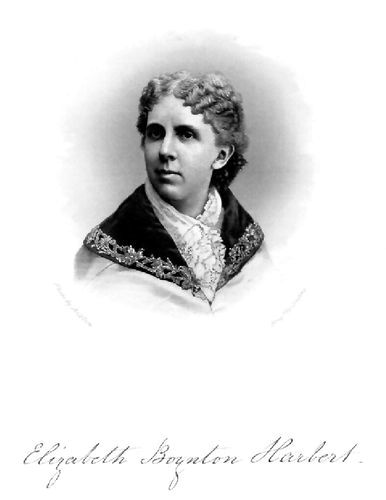
Mrs. Boynton Harbert, to whom we are indebted for this chapter, has from girlhood been an enthusiastic advocate of the rights of women. Growing up in Crawfordsville, Indiana, under the very shadow of a collegiate institution into which girls were not permitted to enter, she early learned the humiliation of sex. After vain attempts to slip the bolts riveted with precedent and prejudice that barred the daughters of the State outside, she tried with pen and voice to rouse those whose stronger hands could open wide the doors to the justice of her appeals. Her youthful peäns to liberty in prose and verse early found their way into our Eastern journals, and later in arguments before conventions and legislative assemblies in Illinois, Iowa and other Western States. As editor for seven years of the "Woman's Kingdom" in the Chicago Inter-Ocean—one of the most popular journals in the nation—she has exerted a widespread influence over the lives of women, bringing new hope and ambition into many prairie homes. As editor-in-chief of the New Era, in which she is free to utter her deepest convictions; as wife and mother, with life's multiplied experiences, a wider outlook now opens before her, with added wisdom for the responsibilities involved in public life. In all her endeavors she has been nobly sustained by her husband, Mr. William Harbert, a successful lawyer, many years in practice in Chicago, whose clear judgment and generous sympathies have made his services invaluable in the reform movements of the day.