Chapter XXIX · (continued 2)
Reading edition
The Declaration of Independence recognized human rights as its basis. Constitutions should also be general in character. But in opposition to this principle the party in power for the last twenty years has perverted the Constitution of the United States by the introduction of the word "male" three times, thereby limiting the application of its guarantees to a special class. It should be your pride and your duty to restore the constitution to its original basis by the adoption of a sixteenth amendment, securing to women the right of suffrage; and thus establish the equality of all United States citizens before the law.
Not for the first time do we make of you these demands. At your nominating convention in New York, in 1868, Susan B. Anthony appeared before you, asking recognition of woman's inherent natural rights. At your convention of 1872, in Baltimore, Isabella Beecher Hooker and Susan B. Anthony made a similar appeal. In 1876, at St. Louis, Phœbe W. Couzins and Virginia L. Minor presented our claims. Now, in 1880, our delegates are present here from the Middle States, from the West and from the South. The women of the South are rapidly uniting in their demand for political recognition, as they have been the most deeply humiliated by a recognition of the political rights of their former slaves.
To secure to 20,000,000 of women the rights of citizenship is to base your party on the eternal principles of justice; it is to make yourselves the party of the future; it is to do away with a more extended slavery than that of 4,000,000 of blacks; it is to secure political freedom to half the nation; it is to establish on this continent the democratic theory of the equal rights of the people.
In furtherance of this demand we ask you to adopt the following resolution:
Whereas, Believing in the self-evident truth that all persons are created with certain inalienable rights, and that for the protection of these rights governments are instituted, deriving their just powers from the consent of the governed; therefore,
Resolved, That the Democratic party pledges itself to use all its powers to secure to the women of the nation protection in the exercise of their right of suffrage.
On behalf of the National Woman Suffrage Association.
Matilda Joslyn Gage, Chairman Executive Committee.
That the women however, in the campaign of 1880, received the best treatment at the hands of the National Prohibition party is shown by the following invitation received at the Bloomington convention:
To the National Woman Suffrage Association of the United States:
The woman suffragists are respectfully invited to meet with and participate in the proceedings of the National Prohibition Convention to be held at Cleveland, Ohio, June, 1880.
James Black, Chairman of National Committee.
Per J. W. Haggard.
A letter was received from Mr. Black urging the acceptance of the invitation. Accordingly Miss Phœbe Couzins was sent as a delegate from the association. The Prohibition party in its eleventh plank said:
We also demand that women having privileges as citizens in other respects, shall be clothed with the ballot for their own protection, and as a rightful means for a proper settlement of the liquor question.
After attending all these nominating conventions, some of the delegates[67] went to Wisconsin where the State and National Associations held a joint convention, in the Opera House at Milwaukee, June 4, 5. Madam Anneke gave the address of welcome.[68] Fresh from the exciting scenes of the presidential conventions, the speakers were unusually earnest and aggressive. The resolutions discussed at the Indianapolis convention were considered and adopted. Carl Doerflinger read a greeting in behalf of the German Radicals of the city. Letters were read from prominent persons, expressing their interest in the movement.[69] Dr. Laura Ross Wolcott made all the arrangements and contributed largely to the expenses of the convention. The roll of delegates shows that the State, at least, was well represented.[70]
Thus through the terrible heat of June this band of earnest women held successive conventions in Bloomington, Ill., Grand Rapids, Mich., Lafayette and Terre Haute, Ind. They were most hospitably entertained, and immense audiences greeted them at every point. Mrs. Cordelia Briggs took the entire responsibility of the social and financial interests of the convention at Grand Rapids, which continued for three days with increasing enthusiasm to the close. Mrs. Helen M. Gougar made the arrangements for Lafayette which were in every way successful.
After the holding of these conventions, delegations from the National Association called on the nominees of the two great parties to ascertain their opinions and proposed action, if any, on the question of woman suffrage. Mrs. Blake, and other ladies representing the New York city society, called on General Hancock at his residence and were most courteously received. In the course of a long conversation in which it was evident that he had given some thought to the question, he said he would not veto a District of Columbia Woman Suffrage bill, provided such a bill should pass congress, thereby putting himself upon better record than Horace Greely the year of his candidacy, who not only expressed himself as opposed to woman suffrage, but also declared that, if elected, he would veto such a bill provided it passed congress.
Miss Anthony visited James A. Garfield at his home in Mentor, Ohio. He was very cordial, and listened with respect to her presentation of the question. Although from time to time in congress he had uniformly voted with our friends, yet he expressed serious doubts as to the wisdom of pressing this measure during the pending presidential campaign.
As it was deemed desirable to get some expression on paper from the candidates the following letter, written on official paper, was addressed to the Republican and Democratic nominees:
Rochester, N. Y., August 17, 1880.
Hon. James A. Garfield: Dear Sir: As vice-president-at-large of the National Woman Suffrage Association, I am instructed to ask you, if, in the event of your election, you, as President of the United States, would recommend to congress, in your message to that body, the submission to the several legislatures of a sixteenth amendment to the national constitution, prohibiting the disfranchisement of United States citizens on account of sex. What we wish to ascertain is whether you, as president, would use your official influence to secure to the women of the several States a national guarantee of their right to a voice in the government on the same terms with men. Neither platform makes any pledge to secure political equality to women—hence we are waiting and hoping that one candidate or the other, or both, will declare favorably, and thereby make it possible for women, with self-respect, to work for the success of one or the other or both nominees. Hoping for a prompt and explicit statement, I am, sir, very respectfully yours,
Susan B. Anthony.
To this General Hancock vouchsafed no reply, while General Garfield responded as follows:
Mentor, O., August 25, 1880.
Dear Miss Anthony: Your letter of the 17th inst. came duly to hand. I take the liberty of asking your personal advice before I answer your official letter. I assume that all the traditions and impulses of your life lead you to believe that the Republican party has been and is more nearly in the line of liberty than its antagonist the Democratic party; and I know you desire to advance the cause of woman. Now, in view of the fact that the Republican convention has not discussed your question, do you not think it would be a violation of the trust they have reposed in me, to speak, "as their nominee"—and add to the present contest an issue that they have not authorized? Again, if I answer your question on the ground of my own private opinion, I shall be compelled to say, that while I am open to the freest discussion and fairest consideration of your question, I have not yet reached the conclusion that it would be best for woman and for the country that she should have the suffrage. I may reach it; but whatever time may do to me, that fruit is not yet ripe on my tree. I ask you, therefore, for the sake of your own question, do you think it wise to pick my apples now? Please answer me in the frankness of personal friendship. With kind regards, I am very truly yours,
James A. Garfield.
Miss Susan B. Anthony, Rochester, N. Y.
Rochester, N. Y., September 9, 1880.
Hon. James A. Garfield: Dear Sir: Yours of the 25th ult. has waited all these days that I might consider and carefully reply.
First. The Republican party did run well for a season in the "line of liberty"; but since 1870, its congressional enactments, majority reports, Supreme Court decisions, and now its presidential platform, show a retrograde movement—not only for women, but for colored men—limiting the power of the national government in the protection of United States citizens against the injustice of the States, until what we gained by the sword is lost by political surrenders. And we need nothing but a Democratic administration to demonstrate to all Israel and the sun the fact, the sad fact, that all is lost by the Republican party, and not to be lost by the Democratic party. I mean, of course, the one vital point of national supremacy in the protection of United States citizens in the enjoyment of their right to vote, and the punishment of States or individuals thereof, for depriving citizens of the exercise of that right. The first and fatal mistake was in ceding to the States the right to "abridge or deny" the suffrage to foreign-born men in Rhode Island, and all women throughout the nation, in direct violation of the principle of national supremacy. And from that time, inch by inch, point by point has been surrendered, until it is only in name that the Republican party is the party of national supremacy. Grant did not protect the negro's ballot in 1876—Hayes cannot in 1880—nor could Garfield in 1884—for the "sceptre has departed from Judah."
Second. For the candidate of a party to add to the discussions of the contest an issue unauthorized or unnoted in its platform, when that issue was one vital to its very life, would, it seems to me, be the grandest act imaginable. And, for doing that very thing, with regard to the protection of the negroes of the South, you are to-day receiving more praise from the best men of the party, than for any and all of your utterances inside the line of the platform. And I know, if you had in your letter of acceptance, or in your New York speech, declared yourself in favor of "perfect equality of rights for women, civil and political," you would have touched an electric spark that would have fired the heart of the women of the entire nation, and made the triumph of the Republican party more grand and glorious than any it has ever seen.
Third. As to picking fruit before it is ripe! Allow me to remind you that very much fruit is never picked; some gets nipped in the blossom; some gets worm-eaten and falls to the ground; some rots on the trees before it ripens; some, too slow in ripening, gets bitten by the early frosts of autumn; while some rich, rare, ripe apples hang unpicked, frozen and worthless on the leafless trees of winter! Really, Mr. Garfield, if, after passing through the war of the rebellion and sixteen years in congress;—if, after seeing, and hearing, and repeating, that no class ever got justice and equality of chances from any government except it had the power—the ballot—to clutch them for itself;—if, after all your opportunities for growth and development, you cannot yet see the truth of the great principle of individual self-government;—if you have only reached the idea of class-government, and that, too, of the most hateful and cruel form—bounded by sex—there must be some radical defect in the ethics of the party of which you are the chosen leader.
No matter which party administers the government, women will continue to get only subordinate positions and half-pay, not because of the party's or the president's lack of chivalric regard for woman, but because, in the nature of things, it is impossible for any government to protect a disfranchised class in equality of chances. Women, to get justice, must have political freedom. But pardon this long trespass upon your time and patience, and please bear in mind that it is not for the many good things the Republican party and its nominee have done in extending the area of liberty, that I criticise them, but because they have failed to place the women of the nation on the plane of political equality with men. I do not ask you to go beyond your convictions, but I do most earnestly beg you to look at this question from the stand-point of woman—alone, without father, brother, husband, son—battling for bread! It is to help the millions of these unfortunate ones that I plead for the ballot in the hands of all women. With great respect for your frank and candid talk with one of the disfranchised, I am very sincerely yours,
Susan B. Anthony.
As Mr. Garfield was the only presidential nominee of either of the great parties who deigned a reply to the National Association, we have given his letter an honored place in our history, and desire to pay this tribute to his memory, that while not fully endorsing our claims for political equality he earnestly advocated for woman all possible advantages of education, equal rights in the trades and professions, and equal laws for the protection of her civil rights.
The Thirteenth Annual Washington Convention assembled in Lincoln Hall, January 18, 1881. The first session was devoted to memorial services in honor of Lucretia Mott. A programme[71] for the occasion was extensively circulated, and the response in character and numbers was such an audience as had seldom before crowded that hall. The spacious auditorium was brilliant with sunlight and the gay dresses, red shawls and flowers of the ladies of the fashionable classes. Mrs. Hayes with several of her guests from the White House occupied front seats. The stage was crowded with members of the association, Mrs. Mott's personal friends and wives of members of congress. The decorations which had seldom been surpassed in point of beauty and tastefulness of arrangement, formed a fitting setting for this notable assemblage of women. The background was a mass of colors, formed by the graceful draping of national flags, here and there a streamer of old gold with heavy fringe to give variety, while in the center was a national shield surmounted by two flags. On each side flags draped and festooned, falling at the front of the stage with the folds of the rich maroon curtains. Graceful ferns and foliage plants had been arranged, while on a table stood a large harp formed of beautiful red and white flowers.[72] At the other end was a stand of hot-house flowers, while in the center, resting on a background of maroon drapery, was a large crayon picture of Lucretia Mott. Above the picture a snow-white dove held in its beak sprays of smilax, trailing down on either side, and below was a sheaf of ripened wheat, typical of the life that had ended. The occasion which had brought the ladies together, the placid features of that kind and well-remembered face, had a solemnizing effect upon all, and quietly the vast audience passed into the hall. The late-comers finding all the seats occupied stood in the rear and sat in the aisles.
Presently Miss Couzins, stepping to the front of the stage said gently, "In accordance with the custom of Mrs. Mott and the time-honored practice of the Quakers, I ask you to unite in an invocation to the Spirit." She bowed her head. The audience followed her example. For several minutes the solemn stillness of devotion pervaded the hall. When Miss Couzins had taken her seat the quartette choir of St. Augustine's church (colored) which was seated on the platform, sang sweetly an appropriate selection, after which Mrs. Stanton delivered the eulogy,[73] holding the rapt attention of her audience over an hour. At the close Frederick Douglass said:
He had listened with interest to the fine analysis of the life and services of Lucretia Mott. He was almost unwilling to have his voice heard after what had been said. He was there to show by his presence his profound respect and earnest love for Lucretia Mott. He recognized none whose services in behalf of his race were equal to hers. Her silence even in that cause was more than the speech of others. He had no words for this occasion.
Robert Purvis at the request of a number of colored citizens of Washington, presented a beautiful floral harp to Mr. Davis, the son-in-law of Lucretia Mott, the only representative of her family present. He paid a tender tribute to the noble woman whose life-long friendship he had enjoyed. Mr. Davis having a seat on the platform, received the gift with evident emotion, and returning thanks, he said:
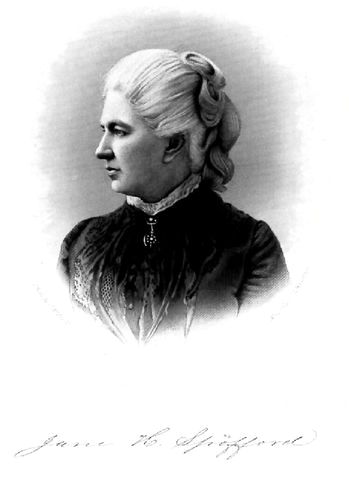
He would follow the example of Mrs. Mott who seldom kept a gift long, and present these rare flowers to Mrs. Spofford, the treasurer of the Association.
Miss Anthony said: The highest tribute she could pay, was, that during the past thirty years she had always felt sure she was right when she had the approval of Lucretia Mott. Next to that of her own conscience she most valued the approval of her sainted friend. And it was now a great satisfaction that in all the differences of opinion as to principles and methods in our movement, Mrs. Mott had stood firmly with the National Association, of which she was to the day of her death the honored and revered vice-president.
Mrs. Sewall, after speaking of the many admirable qualities of Mrs. Mott, said:
In looking around this magnificent audience I cannot help asking myself the question, Where are the young girls? They should be here. It is the birthright of every girl to know the life and deeds of every noble woman. I think Lucretia Mott was as much above the average woman as Abraham Lincoln above the average man.
Miss Couzins closed with a few graceful words. She expressed her pleasure in meeting so magnificent an audience, and thought the whole occasion was a beautiful tribute to one of America's best and noblest women. She hoped the mothers present would carry away the impressions they had received and teach their daughters to hold the name of Lucretia Mott ever in grateful remembrance. The choir sang "Nearer, My God, to Thee." The entire audience arose and joined in the singing, after which they slowly dispersed, feeling that it had indeed been a pentacostal occasion.
An able paper from Alexander Dumas, on "Woman Suffrage as a means of Moral Improvement and Prevention of Crime,"[74] was translated for this meeting by Thomas Mott, the only son of James and Lucretia Mott. This convention continued two days, with the usual number of able speakers.[75] It was announced at the last session that an effort would be made by Senator McDonald, next day, to call up a resolution providing for the appointment of a standing committee for women; accordingly the ladies' gallery in the Senate was well filled with delegates.
From the Congressional Record, January 20, 1881:
Mr. McDonald: On February 16, 1880, I submitted a resolution providing for the appointment of a committee of nine senators, whose duty it shall be to receive, consider and report upon all petitions, memorials, resolutions and bills relating to the rights of women of the United States, said committee to be called "Committee on the Rights of Women." It is on the calendar, and I ask for its present consideration.
The Vice-president (Mr. Wheeler of New York): The senator from Indiana calls up for consideration a resolution on the calendar, which will be reported.
The chief clerk read the resolution, as follows:
Resolved, That a committee of nine senators be appointed by the Senate, whose duty it shall be to receive, consider and report upon all petitions, memorials, resolutions and bills relating to the rights of women of the United States, said committee to be called the Committee on the Rights of Women.
The Vice-president: The question is, Will the Senate agree to the resolution?
Mr. McDonald: Mr. President, it seems to me that the time has arrived when the rights of the class of citizens named in the resolution should have some hearing in the national legislature. We have standing committees upon almost every other subject, but none to which this class of citizens can resort. When their memorials come in they are sometimes sent to the Committee on the Judiciary, sometimes to the Committee on Privileges and Elections, and sometimes to other committees. The consequence is that they pass around from committee to committee and never receive any consideration. In the organization and growth of the Senate a number of standing committees have been from time to time created and continued from congress to congress, until many of them have but very little duty now to perform. It seems to me to be very appropriate to consider this question now, and provide some place in the capitol, some room of the Senate, some branch of the government, where this class of applicants can have a full and fair hearing, and have such measures as may be desired to secure to them such rights brought fairly and properly before the country. I hope there will be no opposition to the resolution but that it will be adopted by unanimous consent.
Mr. Conkling: Does the senator from Indiana wish to raise a permanent committee on this subject to take its place and remain on the list of permanent committees?
Mr. McDonald: That is precisely what I propose to do.
Mr. Conkling: Mr. President, I was in hopes that the honorable senator from Indiana, knowing how sincere and earnest he is in this regard, intended that an end should be made soon of this subject; that the prayer of these petitioners should be granted and the whole right established; but now it seems that he wishes to create a perpetual committee, so that it is to go on interminably, from which I infer that he intends that never shall these prayers be granted. I suggest to the senator from Indiana that, if he be in earnest, if he wishes to crown with success this great and beneficent movement, he should raise a special committee, which committee would understand that it was to achieve and conclude its purpose, and this presently, and not postpone indefinitely in the vast forever the realization of this hope. I trust, therefore, that the senator from Indiana will make this a special committee, and will let that special committee understand that before the sun goes down on the last day of this session it is to take final, serious, intelligent action, for which it is to be responsible, whether that action be one way or the other.[76]
Mr. McDonald: The senator from New York misapprehends one purpose of this committee. I certainly have no desire that the rights of this class of our citizens should be deferred to that far-distant future to which he has made reference, nor would this committee so place them. If it be authorized by the Senate, it will be the duty of the committee to receive all petitions, memorials, resolutions and bills relating to the rights of women, not merely presented now but those presented at any future time. It is simply to provide a place where one-half the people of the United States may have a tribunal in this body before which they can have their cases considered. I apprehend that these rights are never to be ended. I do not suppose that the time will ever come in the history of the human race when there will not be rights of women to be considered and passed upon. Therefore, to make this merely a special committee would not accomplish the purpose I had in view. While it would of course give a committee that would receive and hear such petitions as are now presented and consider such bills as should now be brought forward, it would be better to have a committee from term to term, where these same plaints could be heard, the same petitions presented, the same bills considered, and where new rights, whatever they might be, can be discussed and acted upon. Therefore I cannot accept the suggestion of the senator from New York to make this a special committee.
Mr. Davis of West Virginia: I think it a bad idea to raise an extra committee. I move that the resolution be referred to the Committee on Rules, I think it ought to go there. That is where the rules generally require all such resolutions to be referred.
The Vice-president: The question is on the motion of the senator from Virginia, that the resolution be referred to the Committee on Rules.
Which was agreed to by a vote of 26 yeas to 23 nays.[77]
Amid all the pleasure of political excitement the social amenities were not forgotten. A brilliant reception[78] and supper were given to the delegates by Mrs. Spofford at the Riggs House. During the evening Mrs. Stanton presented the beautiful life-size photograph of Lucretia Mott which had adorned the platform at the convention, to Howard University, and read the following letter from Edward M. Davis:
Mrs. Elizabeth Cady Stanton—Dear Madam: As an expression of my gratitude to the colored people of the District for their beautiful floral tribute to the memory of my dear mother, I desire in the name of her children to present to Howard University the photograph of Lucretia Mott which adorned the platform during the convention. It is a fitting gift to an institution that so well illustrates her principles in opening its doors to all youth without regard to sex or color. With sincere regret that I cannot be present this evening at the reception, I am gratefully yours,
Edward M. Davis.
In receiving the beautiful gift, Dr. Patton, president of the institution, made a graceful response.
In the spring of 1881, the National Association held a series of conventions through New England, beginning with the May anniversary in Boston, of which we give the following description from the Hartford Courant:
Among the many anniversaries in Boston the last week in May, one of the most enthusiastic was that of the National Woman Suffrage Association, held in Tremont Temple. The weather was cool and fair and the audience fine throughout, and never was there a better array of speakers at one time on any platform. The number of thoughtful, cultured young women appearing in these conventions, is one of the hopeful features for the success of this movement. The selection of speakers for this occasion had been made at the Washington convention in January, and different topics assigned to each that the same phases of the question might not be treated over and over again.
Mrs. Harriet Hansom Robinson (wife of "Warrington," so long the able correspondent of the Springfield Republican), who with her daughter made the arrangements for our reception, gave the address of welcome, to which the president, Mrs. Stanton, replied. Rev. Frederic Hinckley of Providence, spoke on "Unity of Principle in Variety of Method," and showed that while differing on minor points the various woman suffrage associations were all working to one grand end. Anna Garlin Spencer made a few remarks on "The Character of Reformers." Rev. Olympia Brown gave an exceptionally brilliant speech a full hour in length on "Universal Suffrage"; Harriette Robinson Shattuck's theme was "Believing and Doing"; Lillie Devereux Blake's, "Demand for Liberty"; Matilda Joslyn Gage's, "Centralization"; Belva A. Lockwood's, "Woman and the Law". Mary F. Eastman followed showing that woman's path was blocked at every turn, in the professions as well as the trades and the whole world of work; Isabella Beecher Hooker gave an able argument on the "Constitutional Right of Women to Vote"; Martha McLellan Brown spoke equally well on the "Ethics of Sex"; Mrs. Elizabeth Avery Meriwether of Tennessee, gave a most amusing commentary on the spirit of the old common law, cuffing Blackstone and Coke with merciless sarcasm. Mrs. Elizabeth L. Saxon of Louisiana spoke with great effect on "Woman's Intellectual Powers as Developed by the Ballot." These two Southern ladies are alike able, witty and pathetic in their appeals for justice to woman. Mrs. May Wright Sewall's essay on "Domestic Legislation," showing how large a share of the bills passed every year directly effect home life, was very suggestive to those who in answer to our demand for political power, say "Woman's sphere is home," as if the home were beyond the control and influence of the State. Beside all these thoroughly prepared addresses, Susan B Anthony, Dr. Clemence Lozier, Dr. Caroline Winslow, ex-Secretary Lee of Wyoming, spoke briefly on various points suggested by the several speakers.
The white-haired and venerable philosopher, A. Bronson Alcott, was very cordially received, after being presented in complimentary terms by the president. Mr. Alcott paid a glowing tribute to the intellectual worth of woman, spoke of the divinity of her character, and termed her the inspiration font from which his own philosophical ideas had been drawn. Not until the women of our nation have been granted every privilege would the liberty of our republic be assured.[79] The well-known Francis W. Bird of Walpole, who has long wielded in the politics of the Bay State, the same power Thurlow Weed did for forty years in New York, being invited to the platform, expressed his entire sympathy with the demand for suffrage, notwithstanding the common opinion held by the leading men of Massachusetts, that the women themselves did not ask it. He recommended State rather than national action.
Rev. Ada C. Bowles of Cambridge, and Rev. Olympia Brown, of Racine, Wis., opened the various sessions with prayer—striking evidence of the growing self-assertion of the sex, and the rapid progress of events towards the full recognition of the fact that woman's hour has come. Touching deeper and tenderer chords in the human soul than words could reach, the inspiring strains of the celebrated organist, Mr. Ryder, rose ever and anon, now soft and plaintive, now full and commanding, mingled in stirring harmony with prayer and speech. And as loving friends had covered the platform with rare and fragrant flowers, the æsthetic taste of the most fastidious artist might have found abundant gratification in the grouping and whole effect of the assemblage in that grand temple. Thus through six prolonged sessions the interest was not only kept up but intensified from day to day.
The National Association was received right royally in Boston. On arriving they found invitations waiting to visit Governor Long at the State House, Mayor Prince at the City Hall, the great establishment of Jordan, Marsh & Co., and the Reformatory Prison for Women at Sherborn. Invitations to take part were extended to woman suffrage speakers in many of the conventions of that anniversary week. Among those who spoke from other platforms, were Matilda Joslyn Gage, Ellen H. Sheldon, Caroline B. Winslow, M. D., editor of The Alpha, and Rev. Olympia Brown. The president of the association, Mrs. Elizabeth Cady Stanton, received many invitations to speak at various points, but had time only for the "Moral Education," "Heredity," and "Free Religious" associations. Her engagement at Parker Memorial Hall, prevented her from accepting the governor's invitation, but Isabella Beecher Hooker and Susan B Anthony led the way to the State house and introduced the delegates from the East, the West, the North and the South, to the honored executive head of the State, who had declared himself, publicly, in favor of woman suffrage. The ceremony of hand-shaking over, and some hundred women being ranged in a double circle about the desk, Mrs. Hooker stepped forward, saying:
Speak a word to us, Governor Long, we need help. Stand here, please, face to face with these earnest women and tell us where help is to come from.
The Governor responded, and then introduced his secretary, who conducted the ladies through the building.
Mrs. Hooker said: Permit me, sir, to thank you for this unlooked-for and unusual courtesy in the name of our president who should be here to speak for herself and for us, and in the name of these loyal women who ask only that the right of the people to govern themselves shall be maintained. In this great courtesy extended us by good old Massachusetts as citizens of this republic unitedly protesting against being taxed without representation, and governed without our consent, we see the beginning of the end—the end of our wearisome warfare—a warfare which though bloodless, has cost more than blood, by as much as soul-suffering exceeds that of mere flesh. I see as did Stephen of old, a celestial form close to that of the Son of Man, and her name is Liberty—always a woman—and she bids us go on—go on—even unto the end.
Miss Anthony standing close to the governor, said in low, pathetic tones:
Yes, we are tired. Sir, we are weary with our work. For forty years some of us have carried this burden, and now, if we might lay it down at the feet of honorable men, such as you, how happy we should be.
The next day Mayor Prince, though suffering from a late severe attack of rheumatism, cordially welcomed the delegates in his room at the City Hall, and chatting familiarly with those who had been at the Cincinnati convention and witnessed his great courtesy, some one remarked that from that time Miss Anthony had proclaimed him the prince among men, and Mrs. Stanton immediately suggested that if the party with which he was identified were wise in their day and generation they would accept his leadership, even to the acknowledgement of the full citizenship of this republic, and thus secure not only their gratitude but their enthusiastic support in the next presidential election. Having compassion upon his Honor because of his manifest physical disability, the ladies soon withdrew and went directly to the house of Jordan, Marsh & Co., where were assembled in a large hall at the top of the building such a crowd of handsome, happy, young girls as one seldom sees in this work-a-day world; that well-known Boston firm within the last six months having fitted up a large recreation room for the use of their employés at the noon hour. Half a hundred girls were merrily dancing to the music of a piano, but ceased in order to listen to words of cheer from Mrs. Lockwood, Mrs. Hooker and Mrs. Sewall. At the close of their remarks Mr. Jordan brought forward a reluctant young girl who could give us, if she would, a charming recitation from "That Lass o' Lowrie's," in return for our kindness in coming to them. And after saying in a whisper to one who kindly urged compliance to this unexpected call, that this had been such a busy day she feared her dress was not all right, her face became unconscious of self in a moment, and with true dramatic instinct, she gave page after page of that wonderful story of the descent into the mine and the recognition there of one whom she loved, precisely as you would desire to hear it were the scene put upon the stage with all the accessories of scenery and companion actors.
From Jordan, Marsh & Co.'s a large delegation proceeded to visit the Reformatory Prison at Sherborn which was established three or four years ago. The board of directors, consisting of three women and two men, has charge of all the prisons of the State. Mrs. Johnson, one of the directors, a noble, benevolent woman, interested in the great charities of Boston, was designated by Governor Long—through whose desire the Association visited the prison—to do the honors and accompany the party from Boston. The officers, matron and physician of the Sherborn prison, are all women. Dr. Mosher, the superintendent, formerly the physician, is a fair, noble-looking woman about thirty-five years of age. She has her own separate house connected with the building. The present physician, a delicate, cultured woman, with sympathy for her suffering charges, is a recent graduate of Ann Arbor.
The entire work is done by the women sent there for restraint, and the prison is nearly self-supporting; it is expected that within another year it will be entirely so. Laundry work is done for the city of Boston, shirts are manufactured, mittens knit, etc. The manufacturing machinery will be increased the coming year. The graded system of reward has been found successful in the development of better traits. It has four divisions, and through it the inmates are enabled to work up by good behavior toward more pleasant surroundings, better clothes and food and greater liberty. From the last grade they reach the freedom of being bound out; of seventy-eight thus bound during the past year but seven were returned. The whole prison, chapel, school-room, dining-room, etc., possesses a sweet, clean, pure atmosphere. The rooms are light, well-ventilated, vines trailing in the windows from which glimpses of green trees and blue sky can be seen.
Added to all the other courtesies, there came the invitation to a few of the representatives of the movement to dine with the Bird Club at the Parker House, in the same cozy room where these astute politicians have held their councils for so many years, and whose walls have echoed to the brave words of many of New England's greatest sons. The only woman who had ever been thus honored before was Mrs. Stanton, who, "escorted by Warrington," dined with these honorable gentlemen in 1871. On this occasion Susan B. Anthony and Harriet H. Robinson accompanied her. Around the table sat several well-known reformers and distinguished members of the press and bar. There was Elizur Wright whose name is a household word in many homes as translator of La Fontaine's fables for the children. Beside him sat the well-known Parker Pillsbury and his nephew, a promising young lawyer in Boston. At one end of the table sat Mr. Bird with Mrs. Stanton on his right and Miss Anthony on his left. At the other end sat Frank Sanborn with Mrs. Robinson (wife of "Warrington") on his right. On either side sat Judge Adam Thayer of Worcester, Charles Field, Williard Phillips of Salem, Colonel Henry Walker of Boston, Mr. Ernst of the Boston Advertiser, and Judge Henry Fox of Taunton. The condition of Russia and the Conkling imbroglio in New York; the new version of the Testament and the reason why German Liberals, transplanted to this soil, immediately become conservative and exclusive, were all considered. Carl Schurz, with his narrow ideas of woman's sphere and education, was mentioned by way of example. In reply to the question how the Suffrage Association felt in regard to Conkling's reëlection. Mrs. Robinson said:
That the leaders, who are students of politics were unitedly against him. Their only hope is in the destruction of the Republican party, which is too old and corrupt to take up any new reform.
Frank Sanborn, fresh from the perusal of the New Testament, asked if women could find any special consolation in the Revised Version regarding everlasting punishment. Mrs. Stanton replied:
Certainly, as we are supposed to have brought "original sin" into the world with its fearful forebodings of eternal punishment, any modification of Hades in fact or name, for the men of the race, the innocent victims of our disobedience, fills us with satisfaction.
From the club the ladies hastened to the beautiful residence of Mrs. Fenno Tudor, fronting Boston Common, where hundreds of friends had already gathered to do honor to the noble woman so ready to identify herself with the unpopular reforms of her day. Among the many beautiful works of art, a chief attraction was the picture of the grand-mother of Parnell, the Irish agitator, by Gilbert Stuart. The house was fragrant with flowers, and the unassuming manners of Mrs. Tudor, as she moved about among her guests, reflected the glory of our American institutions in giving the world a generation of common-sense women who do not plume themselves on any adventitous circumstances of wealth or position, but bow in respect to morality and intelligence wherever they find it. At the close of the evening Mrs. Stanton presented Mrs. Tudor with the "History of Woman Suffrage" which she received with evident pleasure and returned her sincere thanks.
At the close of the anniversary week in Boston, successful meetings were held in various cities,[80] beginning at Providence, where Dr. Wm. F. Channing made the arrangements. These conventions were the first that the National Association ever held in the New England States, presenting the national plan of woman's enfranchisement through a sixteenth amendment to the United States Constitution.