Chapter XXVIII · (continued 2)
Reading edition
As the laws now are, a woman who can vote, hold office, be tried by a jury of her own peers—yea, and sit on the bench as justice of the peace in the territory of Wyoming, may be reduced to a political pariah in the State of New York. A woman who can vote and hold office on the school board, and act as county superintendent in Kansas and Minnesota, is denied these rights in passing into Pennsylvania. A woman who can be a member of the school board in Maine, Wisconsin, Iowa, and California, loses all these privileges in New Jersey, Maryland, and Delaware. When representatives from the territories are sent to congress by the votes of women, it is time to have some national recognition of this class of citizens.
This demand of national protection for national citizens is fated to grow stronger every day. The government of the United States, as the constitution is now interpreted, is powerless to give a just equivalent for the supreme allegiance it claims. One sound democratic principle fully recognized and carried to its logical results in our government, declaring all citizens equal before the law, would soon chase away the metaphysical mists and fogs that cloud our political views in so many directions. When congress is asked to put the name of God in the constitution, and thereby pledge the nation to some theological faith in which some United States citizens may not believe and thus subject a certain class to political ostracism and social persecution, it is asked not to protect but to oppress the citizens of the several States in their most sacred rights—to think, reason, and decide all questions of religion and conscience for themselves, without fear or favor from the government. Popular sentiment and church persecution is all that an advanced thinker in science and religion should be called on to combat. The State should rather throw its shield of protection around those uttering liberal, progressive ideas; for the nation has the same interest in every new thought as it has in the invention of new machinery to lighten labor, in the discovery of wells of oil, or mines of coal, copper, iron, silver or gold. As in the laboratory of nature new forms of beauty are forever revealing themselves, so in the world of thought a higher outlook gives a clearer vision of the heights man in freedom shall yet attain. The day is past for persecuting the philosophers of the physical sciences. But what a holocaust of martyrs bigotry is still making of those bearing the richest treasures of thought, in religion and social ethics, in their efforts to roll off the mountains of superstition that have so long darkened the human mind!
The numerous demands by the people for national protection in many rights not specified in the constitution, prove that the people have outgrown the compact that satisfied the fathers, and the more it is expounded and understood the more clearly its monarchical features can be traced to its English origin. And it is not at all surprising that, with no chart or compass for a republic, our fathers, with all their educational prejudices in favor of the mother country, with her literature and systems of jurisprudence, should have also adopted her ideas of government, and in drawing up their national compact engrafted the new republic on the old constitutional monarchy, a union whose incompatibility has involved their sons in continued discussion as to the true meaning of the instrument. A recent writer says:
The Constitution of the United States is the result of a fourfold compromise: First—Of unity with individual interests; of national sovereignty with the so-called sovereignty of States; Second—Of the republic with monarchy; Third—Of freedom with slavery; Fourth—Of democracy with aristocracy.
It is founded, therefore, on the fourfold combination of principles perfectly incompatible and eternally excluding each other; founded for the purpose of equally preserving these principles in spite of their incompatibility, and of carrying out their practical results—in other words, for the purpose of making an impossible thing possible. And a century of discussion has not yet made the constitution understood. It has no settled interpretation. Being a series of compromises, it can be expounded in favor of many directly opposite principles.
A distinguished American statesman remarked that the war of the rebellion was waged "to expound the constitution." It is a pertinent question now, shall all other contradictory principles be retained in the constitution until they, too, are expounded by civil war? On what theory is it less dangerous to defraud twenty million women of their inalienable rights than four million negroes? Is not the same principle involved in both cases? We ask congress to pass a sixteenth amendment, not only for woman's protection, but for the safety of the nation. Our people are filled with unrest to-day because there is no fair understanding of the basis of individual rights, nor the legitimate power of the national government. The Republican party took the ground during the war that congress had the right to establish a national currency in every State; that it had the right to emancipate and enfranchise the slaves; to change their political status in one-half the States of the union; to pass a civil rights bill, securing to the freedman a place in the schools, colleges, trades, professions, hotels, and all public conveyances for travel. And they maintained their right to do all these as the best measures for peace, though compelled by war.
And now, when congress is asked to extend the same protection to the women of the nation, we are told they have not the power, and we are remanded to the States. They say the emancipation of the slave was a war measure, a military necessity; that his enfranchisement was a political necessity. We might with propriety ask if the present condition of the nation, with its political outlook, its election frauds daily reported, the corrupt action of men in official position, governors, judges, and boards of canvassers, has not brought us to a moral necessity where some new element is needed in government. But, alas! when women appeal to congress for the protection of their natural rights of person and property, they send us for redress to the courts, and the courts remand us to the States. You did not trust the Southern freedman to the arbitrary will of courts and States! Why send your mothers, wives and daughters to the unwashed, unlettered, unthinking masses that carry popular elections?
We are told by one class of philosophers that the growing tendency to increase national power and authority is leading to a dangerous centralization; that the safety of the republic rests in local self-government. Says the editor of the Boston Index:
What is local self-government? Briefly, that without any interference from without, every citizen should manage his own personal affairs in his own way, according to his own pleasure; that every town should manage its own town affairs in the same manner and under the same restriction; every county its own county affairs, every State its own State affairs. But the independent exercise of this autonomy, by personal and corporate individuals, has one fundamental condition, viz.: the maintenance of all these individualities intact, each in its own sphere of action, with its rights uninfringed and its freedom uncurtailed in that sphere, yet each also preserving its just relation to all the rest in an all comprehensive social organization. Every citizen would thus stand, as it were, in the center of several concentric and enlarging circles of relationship to his kind; he would have duties and rights in each relation, not only as an individual but also as a member of town, county, State and national organization. His local self-government will be at his highest possible point of realization, when in each of these relations his individual duties are discharged and his rights maintained.
On the other hand, what is centralization?
It is such a disorganization of this well-balanced, harmonious and natural system as shall result in the absorption of all substantial power by a central authority, to the destruction of the autonomy of the various individualities above mentioned; such as was produced, for instance, when the municipia of the Roman empire lost their corporate independence and melted into the vast imperial despotism which prepared the way for the collapse of society under the blows of Northern barbarism. Such a centralization must inevitably be produced by decay of that stubborn stickling for rights, out of which local self-government has always grown. That is, if individual rights in the citizen, the town, the county, the State, shall not be vindicated as beyond all price, and defended with the utmost jealousy, at whatever cost, the spirit of liberty must have already died out, and the dreary process of centralization be already far advanced. It will thus be evident that the preservation of individual rights is the only possible preventative of centralization, and that free society has no interest to be compared for an instant in importance with that of preserving these individual rights. No nation is free in which this is not the paramount concern. Woe to America when her sons and her daughters begin to sneer at rights! Just so long as the citizens are protected individually in their rights, the towns and counties and States cannot be stripped; but if the former lose all love for their own liberties as equal units of society, the latter will become the empty shells of creatures long perished. The nation as such, therefore, if it would be itself free and non-centralized, must find its own supreme interest in the protection of its individual citizens in the fullest possible enjoyment of their equal rights and liberties.
As this question of woman's enfranchisement is one of national safety, we ask you to remember that we are citizens of the United States, and, as such, claim the protection of the national flag in the exercise of our national rights, in every latitude and longitude, on sea, land, at home as well as abroad; against the tyranny of States, as well as against foreign aggressions. Local authorities may regulate the exercise of these rights; they may settle all minor questions of property, but the inalienable personal rights of citizenship should be declared by the constitution, interpreted by the Supreme Court, protected by congress and enforced by the arm of the executive. It is nonsense to talk of State rights until the graver question of personal liberties is first understood and adjusted. President Hayes, in reply to an address of welcome at Charlottesville, Va., September 25, 1877, said:
Equality under the laws for all citizens is the corner-stone of the structure of the restored harmony from which the ancient friendship is to rise. In this pathway I am going, the pathway where your illustrious men led—your Jefferson, your Madison, your Monroe, your Washington.
If, in this statement, President Hayes is thoroughly sincere, then he will not hesitate to approve emphatically the principle of national protection for national citizens. He will see that the protection of all the national citizens in all their rights, civil, political, and religious—not by the muskets of United States troops, but by the peaceable authority of United States courts—is not a principle that applies to a single section of the country, but to all sections alike; he will see that the incorporation of such a principle in the constitution cannot be regarded as a measure of force imposed upon the vanquished, since it would be law alike to the vanquished and the victor. In short, he will see that there is no other sufficient guarantee of that equality of all citizens, which he well declares to be the "corner-stone of the structure of restored harmony." The Boston Journal of July 19, said:
There are cases where it seems as if the constitution should empower the federal government to step in and protect the citizen in the State, when the local authorities are in league with the assassins; but, as it now reads, no such provision exists.
That the constitution does not make such provision is not the fault of the president; it must be attributed to the leading Republicans who had it in their power once to change the constitution so as to give the most ample powers to the general government. When Attorney-General Devens was charged last May with negligence in not prosecuting the parties accused of the Mountain Meadow massacre, his defense was, that this horrible crime was not against the United States, but against the territory of Utah. Yet, it was a great company of industrious, honest, unoffending United States citizens who were foully and brutally murdered in cold blood. When Chief-Justice Waite gave his charge to the jury in the Ellentown conspiracy cases, at Charleston, S. C., June 1, 1877, he said:
That a number of citizens of the United States have been killed, there can be no question; but that is not enough to enable the government of the United States to interfere for their protection. Under the constitution that duty belongs to the State alone. But when an unlawful combination is made to interfere with any of the rights of natural citizenship secured to citizens of the United States by the national constitution, then an offense is committed against the laws of the United States, and it is not only the right but the absolute duty of the national government to interfere and afford the citizens that protection which every good government is bound to give.
General Hawley, in an address before a college last spring, said:
Why, it is asked, does our government permit outrages in a State which it would exert all its authority to redress, even at the risk of war, if they were perpetrated under a foreign government? Are the rights of American citizens more sacred on the soil of Great Britain or France than on the soil of one of our own States? Not at all. But the government of the United States is clothed with power to act with imperial sovereignty in the one case, while in the other its authority is limited to the degree of utter impotency, in certain circumstances. The State sovereignty excludes the Federal over most matters of dealing between man and man, and if the State laws are properly enforced there is not likely to be any ground of complaint, but if they are not, the federal government, if not specially called on according to the terms of the constitution, is helpless. Citizen A.B., grievously wronged, beaten, robbed, lynched within a hair's breadth of death, may apply in vain to any and all prosecuting officers of the State. The forms of law that might give him redress are all there; the prosecuting officers, judges, and sheriffs, that might act, are there; but, under an oppressive and tyrannical public sentiment, they refuse to move. In such an exigency the government of the United States can do no more than the government of any neighboring State; that is, unless the State concerned calls for aid, or unless the offense rises to the dignity of insurrection or rebellion. The reason is, that the framers of our governmental system left to the several States the sole guardianship of the personal and relative private rights of the people.
Such is the imperfect development of our own nationality in this respect that we have really no right as yet to call ourselves a nation in the true sense of the word, nor shall we have while this state of things continues. Thousands have begun to feel this keenly, of which a few illustrations may suffice. A communication to the New York Tribune, June 9, signed "Merchant," said:
Before getting into a quarrel and perhaps war with Mexico about the treatment of our flag and citizens, would it not be as well, think you, for the government to try and make the flag a protection to the citizens on our own soil?
That is what it has never been since the foundation of our government in a large portion of our common country. The kind of government the people of this country expect and intend to have—State rights or no State rights, no matter how much blood and treasure it may cost—is a government to protect the humblest citizen in the exercise of all his rights.
When the rebellion of the South against the government began, one of the most noted secessionists of Baltimore asked one of the regular army officers what the government expected to gain by making war on the South. "Well," the officer replied, laying his hand on the cannon by which he was standing, "we intend to use these until it is as safe for a Northern man to express his political opinions in the South, as it is for a Southern man to express his in the North." Senator Blaine, at a banquet in Trenton, N. J., July 2, declared that a "government which did not offer protection to every citizen in every State had no right to demand allegiance." Ex-Senator Wade, of Ohio, in a letter to the Washington National Republican of July 16, said of the president's policy:
I greatly fear this policy, under cover of what is called local self-government, is but an ignominious surrender of the principles of nationality for which our armies fought and for which thousands upon thousands of our brave men died, and without which the war was a failure and our boasted government a myth.
Behind the slavery of the colored race was the principle of State rights. Their emancipation and enfranchisement were important, not only as a vindication of our great republican idea of individual rights, but as the first blow in favor of national unity—of a consistent, homogeneous government. As all our difficulties, State and national, are finally referred to the constitution, it is of vital importance that that instrument should not be susceptible of a different interpretation from every possible standpoint. It is folly to spend another century in expounding the equivocal language of the constitution. If under that instrument, supposed to be the Magna Charta of American liberties, all United States citizens do not stand equal before the law, it should without further delay be so amended as in plain, unmistakable language to declare what are the rights, privileges, and immunities that belong to citizens of a republic.
There is no reason why the people of to-day should be governed by the laws and constitutions of men long since dead and buried. Surely those who understand the vital issues of this hour are better able to legislate for the living present than those who governed a hundred years ago. If the nineteenth century is to be governed by the opinions of the eighteenth, and the twentieth by the nineteenth, the world will always be governed by dead men....
The cry of centralization could have little significance if the constitution were so amended as to protect all United States citizens in their inalienable rights. That national supremacy that holds individual freedom and equality more sacred than State rights and secures representation to all classes of people, is a very different form of centralization from that in which all the forces of society are centered in a single arm. But the recognition of the principle of national supremacy, as declared in the fourteenth and fifteenth amendments, has been practically nullified and the results of the war surrendered, by remanding woman to the States for the protection of her civil and political rights. The Supreme Court decisions and the congressional reports on this point are in direct conflict with the idea of national unity, and the principle of States rights involved in this discussion must in time remand all United States citizens alike to State authority for the protection of those rights declared to inhere in the people at the foundation of the government.
You may listen to our demands, gentlemen, with dull ears, and smile incredulously at the idea of danger to our institutions from continued violation of the civil and political rights of women, but the question of what citizens shall enjoy the rights of suffrage involves our national existence; for, if the constitutional rights of the humblest citizen may be invaded with impunity, laws interpreted on the side of injustice, judicial decisions based not on reason, sound argument, nor the spirit and letter of our declarations and theories of government, but on the customs of society and what dead men are supposed to have thought, not what they said—what will the rights of the ruling powers even be in the future with a people educated into such modes of thought and action? The treatment of every individual in a community—in our courts, prisons, asylums, of every class of petitioners before congress—strengthens or undermines the foundations of that temple of liberty whose corner-stones were laid one century ago with bleeding hands and anxious hearts, with the hardships, privations, and sacrifices of a seven years' war. He who is able from the conflicts of the present to forecast the future events, cannot but contemplate with anxiety the fate of this republic, unless our constitution be at once subjected to a thorough emendation, making it more comprehensively democratic.
A review of the history of our nation during the century will show the American people that all the obstacles that have impeded their political, moral and material progress from the dominion of slavery down to the present epidemic of political corruptions, are directly and indirectly traceable to the federal constitution as their source and support. Hence the necessity of prompt and appropriate amendments. Nothing that is incorrect in principle can ever be productive of beneficial results, and no custom or authority is able to alter or overrule this inviolate law of development. The catch-phrases of politicians, such as "organic development," "the logic of events," and "things will regulate themselves," have deceived the thoughtless long enough. There is just one road to safety, and that is to understand the law governing the situation and to bring the nation in line with it. Grave political problems are solved in two ways—by a wise forethought, and reformation; or by general dissatisfaction, resistance, and revolution.
In closing, let me remind you, gentlemen, that woman has not been a heedless spectator of all the great events of the century, nor a dull listener to the grand debates on human freedom and equality. She has learned the lesson of self-sacrifice, self-discipline, and self-government in the same school with the heroes of American liberty.[29]
Matilda Joslyn Gage, of New York, corresponding secretary of the association, said: Mr. Chairman and Gentlemen of the Committee—You have heard the general argument for woman from Mrs. Stanton, but there are women here from all parts of the Union, and each one feels that she must say a word to show how united we stand. It is because we have respect for law that we come before you to-day. We recognize the fact that in good law lies the security of all our rights, but as woman has been denied the constructive rights of the declaration and constitution, she is obliged to ask for a direct recognition in the adoption of a sixteenth amendment.
The first principle of liberty is division of power. In the country of the czar or the sultan there is no liberty of thought or action. In limited monarchies power is somewhat divided, and we find larger liberty and a broader civilization. Coming to the United States we find a still greater division of power, a still more extended liberty—civil, religious, political. No nation in the world is as respected as our own; no title so proud as that of American citizen; it carries with it abroad a protection as large as did that of Rome two thousand years ago. But as proud as is this name of American citizen, it brings with it only shame and humiliation to one-half of the nation. Woman has no part nor lot in the matter. The pride of citizenship is not for her, for woman is still a political slave. While the form of our government seems to include the whole people, one-half of them are denied a right to participate in its benefits, are denied the right of self-government. Woman equally with man has natural rights; woman equally with man is a responsible being.
It is said women are not fit for freedom. Well, then, secure us freedom and make us fit for it. Macaulay said many politicians of his time were in the habit of laying it down as a self-evident proposition that no people were fit to be free till they were in a condition to use their freedom; "but," said Macaulay, "this maxim is worthy of the fool in the old story, who resolved not to go into the water till he had learned to swim. If men [or women] are to wait for liberty till they become good and wise in slavery, they may indeed wait forever."
There has been much talk about precedent. Many women in this country vote upon school questions, and in England at all municipal elections. I wish to call your attention a little further back, to the time that the Saxons first established free government in England. Women, as well as men, took part in the Witenagemote, the great national council of our Saxon ancestors in England. When Whightred, king of Kent, in the seventh century, assembled the national legislature at Baghamstead to enact a new code of laws, the queen, abbesses, and many ladies of quality signed the decrees. Also, at Beaconsfield, the abbesses took part in the council. In the reign of Henry III. four women took seats in parliament, and in the reign of Edward I. ten ladies were called to parliament and helped to govern Great Britain. Also, in 1252, Henry left his Queen Elinor as keeper of the great seal, or lord chancellor, while he went abroad. She sat in the Aula Regia, the highest court of the kingdom, holding the highest judicial power in great Britain. Not only among our forefathers in Britain do we find that women took part in government, but, going back to the Roman Empire, we find the Emperor Heliogabalus introducing his mother into the senate, and giving her a seat near the consuls. He also established a senate of women, which met on the Collis Quirinalis. When Aurelian was emperor he favored the representation of women, and determined to revive this senate, which in lapse of time had fallen to decay. Plutarch mentions that women sat and deliberated in councils, and on questions of peace and war. Hence we have precedents extending very far back into history.
It is sometimes said that women do not desire freedom. But I tell you the desire for freedom lives in every heart. It may be hidden as the water of the never-freezing, rapid-flowing river Neva is hidden. In the winter the ice from Lake Lagoda floats down till it is met by the ice setting up from the sea, when they unite and form a compact mass over it. Men stand upon it, sledges run over it, splendid palaces are built upon it; but beneath all the Neva still rapidly flows, itself unfrozen. The presence of these women before you shows their desire for freedom. They have come from the North, from the South, from the East, from the West, and from the far Pacific slope, demanding freedom for themselves and for all women.
Our demands are often met by the most intolerable tyranny. The Albany Law Journal, one of the most influential legal journals of the great State of New York, had the assurance a few years ago to tell Miss Anthony and myself if we were not suited with "our laws" we could leave the country. What laws did they mean? Men's laws. If we were not suited with these men's laws, made by them to protect themselves, we could leave the country. We were advised to expatriate ourselves, to banish ourselves. But we shall not do it. It is our country, and we shall stay here and change the laws. We shall secure their amendment, so that under them there shall be exact and permanent political equality between men and women. Change is not only a law of life; it is an essential proof of the existence of life. This country has attained its greatness by ever enlarging the bounds of freedom.
In our hearts we feel that there is a word sweeter than mother, home, or heaven. That word is liberty. We ask it of you now. We say to you, secure to us this liberty—the same liberty you have yourselves. In doing this you will not render yourselves poor, but will make us rich indeed.
Mrs. Stewart of Delaware, in illustrating the folly of adverse arguments based on woman's ignorance of political affairs, gave an amusing account of her colored man servant the first time he voted. He had been full of bright anticipations of the coming election day, and when it dawned at last, he asked if he could be spared from his work an hour or so, to vote. "Certainly, Jo," said she, "by all means; go to the polls and do your duty as a citizen." Elated with his new-found dignity, Jo ran down the road, and with a light heart and shining face deposited his vote. On his return Mrs. Stewart questioned him as to his success at the polls. "Well," said he, "first one man nabbed me and gave me the tickets he said I ought to vote, and then another man did the same. I said yes to both and put the tickets in my pocket. I had no use for those Republican or Democratic bits of paper." "Well, Jo," said Mrs. Stewart, "what did you do?" "Why I took that piece of paper that I paid $2.50 for and put it in the box. I knew that was worth something." "Alas! Jo," said his mistress, "you voted your tax receipt, so your first vote has counted nothing." Do you think, gentlemen, said Mrs. Stewart, that such women as attend our conventions, and speak from our platform, could make so ludicrous a blunder? I think not.
The Rev. Olympia Brown, a delegate from Connecticut, addressed the committee as follows: Gentlemen of the Committee—I would not intrude upon your time and exhaust your patience by any further hearing upon this subject if it were not that men are continually saying to us that we do not want the ballot; that it is only a handful of women that have ever asked for it; and I think by our coming up from these different States, from Delaware, from Oregon, from Missouri, from Connecticut, from New Hampshire, and giving our testimony, we shall convince you that it is not a few merely, but that it is a general demand from the women in all the different States of the Union; and if we come here with stammering tongues, causing you to laugh by the very absurdity of the manner in which we advocate our opinions, it will only convince you that it is not a few "gifted" women, but the rank and file of the women of our country unaccustomed to such proceedings as these, who come here to tell you that we all desire the right of suffrage. Nor shall our mistakes and inability to advocate our cause in an effective manner be an argument against us, because it is not the province of voters to conduct meetings in Washington. It is rather their province to stay at home and quietly read the proceeding of members of congress, and if they find these proceedings correct, to vote to return them another year. So that our very mistakes shall argue for us and not against us.
In the ages past the right of citizenship meant the right to enjoy or possess or attain all those civil and political rights that are enjoyed by any other citizen. But here we have a class who can bear the burdens and punishments of citizens, but cannot enjoy their privileges and rights. But even the meanest may petition, and so we come with our thousands of petitions, asking you to protect us against the unjust discriminations imposed by State laws. Nor do we find that there is any conflict between the duties of the national government and the functions of the State. The United States government has to do with general interests, but everything that is special, has to do with sectional interests, belongs to the State. Said Charles Sumner:
The State exercises its proper functions when it makes local laws, promotes local charities, and by its local knowledge brings the guardianship of government to the homes of its citizens; but the State transcends its proper functions when in any manner it interferes with those equal rights recorded in the Declaration of Independence.
The State is local, the United States is universal. And, says Charles Sumner, "What can be more universal than the rights of man?" I would add, "What can be more universal than the rights of woman?" extending further than the rights of man, because woman is the heaven-appointed guardian of the home; because woman by her influence and in her office as an educator makes the character of man; because women are to be found wherever men are to be found, as their mothers bringing them into the world, watching them, teaching them, guiding them into manhood. Wherever there is a home, wherever there is a human interest, there is to be felt the interest of women, and so this cause is the most universal of any cause under the sun; and, therefore, it has a claim upon the general government. Therefore we come petitioning that you will protect us in our rights, by aiding us in the passage of the sixteenth amendment, which will make the constitution plain in our favor, or by such actions as will enable us to cast our ballots at the polls without being interfered with by State authorities. And we hope you will do this at no distant day. I hope you will not send my sister, the honorable lady from Delaware, to the boy, Jo, to ask him to define her position in the republic. I hope you will not bid any of these women at home to ask ignorant men whether they may be allowed to discharge their obligations as citizens in the matter of suffrage. I hope you will not put your wives and mothers in the power of men who have never given a half hour's consideration to the subject of government, and who are wholly unfit to exercise their judgment as to whether women should have the right of suffrage.
I will not insult your common sense by bringing up the old arguments as to whether we have the right to vote. I believe every man of you knows we have that right—that our right to vote is based upon the same authority as yours. I believe every man understands that, according to the declaration and the constitution, women should be allowed to exercise the right of suffrage, and therefore it is not necessary for me to do more than bear my testimony from the State of Connecticut, and tell you that the women from the rank and file, the law-abiding women, desire the ballot; not only that they desire it, but they mean to have it. And to accomplish this result I need not remind you that they will work year in and year out, that they will besiege members of congress everywhere, and that they will come here year after year asking you to protect them in their rights and to see that justice is done in the republic. Therefore, for your own peace, we hope you will not keep us waiting a long time. The fact that some States have made, temporarily, some good laws, does not weaken our demand upon you for the protection which the ballot gives to every citizen. Our interests are still uncared for, and we do not wish to be thus sent from pillar to post to get our rights. We wish to take our stand as citizens of the United States, as we have been declared to be by the Supreme Court, and we wish to be protected in the rights of citizenship. We hope the day is at hand when our prayers will be heard by you. Let us have at an early day in the Congressional Record, a report of the proceedings of this committee, and the action of the Senate in favor of woman's right to vote.
Brief remarks were also made by Mrs. Lawrence of Massachusetts, Mary A. Thompson, M. D., of Oregon, Mary Powers Filley of New Hampshire, Mrs. Blake of New York, Mrs. Hooker of Connecticut, and Sara Andrews Spencer of Washington.
At the close of these two day's hearings before the Committee on Privileges and Elections,[30] Senator Hoar of Massachusetts, offered, and the committee adopted the following complimentary resolution:
Resolved, That the arguments upon the very important questions discussed before the committee have been presented with propriety, dignity and ability, and that the committee will consider the same on Tuesday next, at 10 a.m.
The Washington Evening Star of January 11, 1876, said:
The woman suffrage question will be a great political issue some day. A movement in the direction of alleged rights by a body of American citizens cannot be forever checked, even though its progress may for many years be very gradual. Now that the advocates of suffrage for woman have become convinced that the thirteenth, fourteenth and fifteenth amendments are not sufficiently explicit to make woman's right to vote unquestioned, and that a sixteenth amendment is necessary to effect the practical exercise of the right, the millennial period that they look for is to all intents and purposes indefinitely postponed, for constitutional amendments are not passed in a day. But there are so many sound arguments to be advanced in favor of woman suffrage that it cannot fail in time to be weighed as a matter of policy, after it shall have been overwhelmingly conceded as a matter of right. And it is noticeable that the arguments of the opponents are coming more and more to be based on expediency, and hardly attempt to answer the claim that as American citizens women are entitled to the right. If the whole body of American women desired the practical exercise of this right, it is hard to see what valid opposition to their claims could be made. All this however does not amend the constitution. Woman suffrage must become a matter of policy for a political party before it can be realized. Congress does not pass revolutionary measures on abstract considerations of right. This question is of a nature to become a living political issue after it has been sufficiently ridiculed.
On Saturday evening, January 12, a reception was given to the delegates to the convention by Hon. Alexander H. Stephens of Georgia, at the National Hotel. The suite of rooms so long occupied by this liberal representative of the South, was thus opened to unwonted guests—women asking for the same rights gained at the point of the sword by his former slaves! Seated in his wheel-chair, from which he had so often been carried by a faithful attendant to his place in the House of Representatives, he cordially welcomed the ladies as they gathered about him, assuring them of his interest in this question and promising his aid.
For the first time Miss Julia Smith of anti-tax fame, of Glastonbury, Connecticut, was present at a Washington convention. She was the recipient of much social attention. A reception was tendered her by Mrs. Spofford of the Riggs House, giving people an opportunity to meet this heroic woman of eighty-three, who, with her younger sister Abby, had year after year suffered the sale of their fine Jersey cows and beautiful meadow lands, rather than pay taxes while unrepresented. Many women, notable in art, science and literature, and men high in political station were present on this occasion. All crowded about Miss Smith, as, supported by Mrs. Hooker, in response to a call for a speech, particularly in regard to the Gladstonbury cows, as famous as herself, she said:
There are but two of our cows left at present, Taxey and Votey. It is something a little peculiar that Taxey is very obtrusive; why, I can scarcely step out of doors without being confronted by her, while Votey is quiet and shy, but she is growing more docile and domesticated every day, and it is my opinion that in a very short time, wherever you find Taxey there Votey will be also.
At the close of Miss Smith's remarks, Abby Hutchinson Patton sang "Auld Lang Syne" in a very effective manner; one or two readings followed, a few modern ballads were sung, and thus closed the first of the many delightful receptions given by Mr. and Mrs. Spofford to the officers and members of the National Association.
Mrs. Hooker spent several weeks at the Riggs House, holding frequent woman suffrage conversazioni in its elegant parlors; also speaking upon the question at receptions given in her honor by the wives of members of congress, or residents of Washington.[31]
During the week of the convention, public attention was called to a scarcely known Anti-Woman Suffrage Society, formed in 1871, of which Mrs. General Sherman, Mrs. Admiral Dahlgren and Mrs. Almira Lincoln Phelps were officers, by the publication of an undelivered letter from Mrs. Phelps to Mrs. Hooker:
To the Editor of the Post:
The following was written nearly seven years since, but was never sent to Mrs. Hooker. The letter chanced to appear among old papers, and as there is a meeting of women suffragists, with Mrs. Hooker present, and, moreover, as they have mentioned the names of Mrs. Dahlgren and Mrs. General Sherman, opposers, I am willing to bear my share of the opposition, as I acted as corresponding secretary to the Anti-Suffrage Society, which was formed under the auspices of these ladies.
Mrs. Dahlgren.
Eutaw Place, Baltimore, January, 30, 1871.
To Mrs. Beecher Hooker:
Dear Madam—Hoping you will receive kindly what I am about to write, I will proceed without apologies. I have confidence in your nobleness of soul, and that you know enough of me to believe in my devotion to the best interests of woman. I can scarcely realize that you are giving your name and influence to a cause, which, with some good but, as I think, misguided women, numbers among its advocates others with loose morals. * * * We are, my dear madam, as I suppose, related through our common ancester Thomas Hooker. * * * Your husband, I believe, stands in the same relation to that good and noble man. Perhaps he may think with you on this woman suffrage question, but it does seem to me that a wife honoring her husband would not wish to join in such a crusade as is now going on to put woman on an equality with the rabble at the "hustings." If we could with propriety petition the Almighty to change the condition of the sexes and let men take a turn in bearing children and in suffering the physical ailments peculiar to women, which render them unfit for certain positions and business, why, in this case, if we really wish to be men, and thought God would change the established order, we might make our petition; but why ask congress to make us men? Circumstances drew me from the quiet of domestic life while I was yet young; but success in labors which involved publicity, and which may have been of advantage to society, was never considered as an equivalent to my own heart for the loss of such retirement. In the name of my sainted sister, Emma Willard, and of my friend Lydia Sigourney, and I think I might say in the name of the women of the past generation, who have been prominent as writers and educators (the exception may be made of Mary Wollstonecraft, Frances Wright, and a few licentious French writers) in our own country and in Europe, let me urge the high-souled and honorable of our sex to turn their energies into that channel which will enable them to act for the true interests of their sex.
Almira Lincoln Phelps.
Yours respectfully,
To which Mrs. Hooker, through The Post, replied:
Washington, January 15, 1878.
Mrs. Dahlgren—Dear Madam: Permit me to thank you for the opportunity to exonerate myself and the women of the suffrage movement all over the United States from the charge of favoring immorality in any form. I did not know before that Mrs. Phelps, whom I have always held in highest esteem as an educator and as one of the most advanced thinkers of her day, had so misconceived the drift of our movement; and you will pardon me, dear madam, for saying that it is hardly possible that Mrs. Sherman and yourself, in your opposition to it, can have been influenced by any apprehension that the women suffragists of the United States would, if entrusted with legislative power, proceed to use it for the desecration of their own sex, and the pollution of the souls of their husbands, brothers and sons. But having been publicly accused through your instrumentality of sympathy with the licentious practices of men, I shall take the liberty to send you a dozen copies of a little book entitled, "Womanhood; its Sanctities and Fidelities," which I published in 1874 for the specific purpose of bringing to the notice of American women the wonderful work being done across the water in the suppression of "State Patronage of Vice." * * * It is with a deep sense of gratitude to God that I am able to say that, according to my knowledge and belief, every woman in our movement, whether officer or private, is in sympathy with the spirit of this little book. I know of no inharmony here, however we may differ upon minor points of expediency as to the best methods of working for the political advancement of woman. And further, it is the deep conviction of us all that the chief stumbling-block in the way of our obtaining the use of the ballot, is the apprehension among men of low degree that they will surely be limited in their base and brutal and sensual indulgencies when women are armed with equal political power.
As to my husband, to whose ancestry Mrs. Phelps so kindly alludes, permit me to say that he is not only descended from Thomas Hooker, the beloved first pastor of the old Centre Church in Hartford, and founder of the State of Connecticut, but further back his lineage takes root in one of England's most honored names, Richard Hooker, surnamed "The Judicious"; and I have been accustomed to say that, however it may be as to learning and position, the characteristic of judiciousness has not departed from the American stock. I will only add that Mr. Hooker is treasurer of our State suffrage association, and has spoken on the platform with me as president, whenever his professional duties would permit, and that he is the author of a tract on "The Bible and Woman Suffrage." Our society has printed several thousand copies of this tract, and the London National Women's Suffrage Society has reprinted it with words of high commendation for distribution in Great Britain. * * * And now, dear madam, thanking you once more for this most unexpected and most grateful opportunity for correcting misapprehensions that others may have entertained as well as Mrs. Phelps in regard to the design and tendencies of our movement, may I not ask that you will kindly read and consider the papers I shall take the liberty to send you, and hand them to your co-workers at your convenience?
That we all, as women who love our country and our kind, may be led to honor each other in our personal relations, while we work each in her respective way for that higher order of manhood and womanhood that alone can exalt our nation to the ideal of the fathers and mothers of the early republic, and preserve us an honored place among the peoples of the earth, is the prayer of
Isabella Beecher Hooker.
Yours sincerely,
Evidently left without even the name of Mrs. Sherman or the Anti-Suffrage Society to sustain her, Mrs. Dahlgren memorialized the Senate Committee on Privileges and Elections against the submission of the sixteenth amendment:
To the Honorable Committee on Privileges and Elections:
Gentlemen—Allow me, in courtesy, as a petitioner, to present one or two considerations regarding a sixteenth amendment, by which it is proposed to confer the right of suffrage upon the women of the United States. I ask this favor also in the interests of the masses of silent women, whose silence does not give consent, but who, in most modest earnestness, deprecate having the political life forced upon them.
This grave question is not one of simple expediency or the reverse; it might properly be held, were this the case, as a legitimate subject for agitation. Our reasons of dissent to this dangerous inroad upon all precedent, lie deeper and strike higher. They are based upon that which in all Christian nations must be recognized as the higher law, the fundamental law upon which Christian society in its very construction must rest; and that law, as defined by the Almighty, is immutable. Through it the women of this Christian land, as mothers, wives, sisters, daughters, have distinct duties to perform of the most complex order, yet of the very highest and most sacred nature.
If in addition to all these responsibilities, others, appertaining to the domain assigned to men, are allotted to us, we shall be made the victims of an oppression not intended by a kind and wise Providence, and from which the refining influences of Christian civilization have emancipated us. We have but to look at the condition of our Indian sister, upon whose bended back the heavy pack is laid by her lord and master; who treads in subjection the beaten pathway of equal rights, and compare her situation with our own, to thank the God of Christian nations who has placed us above that plane, where right is might, and might is tyranny. We cannot without prayer and protest see our cherished privileges endangered, and have granted us only in exchange the so-called equal rights. We need more, and we claim, through our physical weakness and your courtesy as Christian gentlemen, that protection which we need for the proper discharge of those sacred and inalienable functions and rights conferred upon us by God. To these the vote, which is not a natural right (otherwise why not confer it upon idiots, lunatics, and adult boys) would be adverse.
When women ask for a distinct political life, a separate vote, they forget or they willfully ignore the higher law, whose logic may be thus condensed: Marriage is a sacred unity. The family, through it, is the foundation of the State. Each family is represented by its head, just as the State ultimately finds the same unity, through a series of representations. Out of this come peace, concord, proper representation, and adjustment—union.
The new doctrine, which is illusive, may be thus defined: Marriage is a mere compact, and means diversity. Each family, therefore, must have a separate individual representation, out of which arises diversity or division, and discord is the corner-stone of the State.
Gentlemen, we cannot displace the corner-stone without destruction to the edifice itself! The subject is so vast, has so many side issues, that a volume might as readily be laid before your honorable committee as these few words hastily written with an aching woman's heart. Personally, if any woman in this vast land has a grievance by not having a vote, I may claim that grievance to be mine. With father, brother, husband, son, taken away by death, I stand utterly alone, with minor children to educate and considerable property interests to guard. But I would deem it unpatriotic to ask for a general law which must prove disastrous to my country, in order to meet that exceptional position in which, by the adorable will of God, I am placed. I prefer, indeed, to trust to that moral influence over men which intelligence never fails to exercise, and which is really more potent in the management of business affairs than the direct vote. In this I am doubtless as old-fashioned as were our grandmothers, who assisted to mold this vast republic. They knew that the greatest good for the greatest number was the only safe legislative law, and that to it all exceptional cases must submit.
Gentlemen, in conclusion, a sophism in legislation is not a mere abstraction; it must speedily bear fruit in material results of the most disastrous nature, and I implore your honorable committee, in behalf of our common country, not to open a Pandora's box by way of experiment from whence so much evil must issue, and which once opened may never again be closed.
Madeleine Vinton Dahlgren.
Very respectfully,
Mrs. Dahlgren was ably reviewed by Virginia L. Minor of St. Louis, and the Toledo Woman Suffrage Association. Mrs. Minor said:
In assuming to speak for the "silent masses" of women, Mrs. Dahlgren declares that silence does not give consent; very inconsequently forgetting, that if it does not on one side of the question, it may not on the other, and that she may no more represent them than do we.
The Toledo society, through its president Mrs. Rose L. Segur, said:
We agree with you that this grave question is not one of expediency. It is simply one of right and justice, and therefore a most legitimate subject for agitation. As a moral force woman must have a voice in the government, or partial and unjust legislation is the result from which arise the evils consequent upon a government based upon the enslavement of half its citizens.
To this Mrs. Dahlgren replied briefly, charging the ladies with incapacity to comprehend her.
The week following the convention a hearing was granted by the House Judiciary Committee to Dr. Mary Walker of Washington, Mary A. Tillotson of New Jersey and Mrs. N. Cromwell of Arkansas, urging a report in favor of woman's enfranchisement. On January 28, the House sub-committee on territories granted a hearing to Dr. Mary Walker and Sara Andrews Spencer, in opposition to the bill proposing the disfranchisement of the women of Utah as a means of suppressing polygamy.
On January 30 the House Judiciary Committee granted Mrs. Hooker a hearing. Of the eleven members of the committee nearly all were present.[32] The room and all the corridors leading to it were crowded with men and women eager to hear Mrs. Hooker's speech. At the close of the two hours occupied in its delivery, Chairman Knott thanked her in the name of the committee for her able argument.
Immediately after this hearing Mr. Frye of Maine, in presenting in the House of Representatives the petitions of 30,000 persons asking the right of women to vote upon the question of temperance, referred in a very complimentary manner to Mrs. Hooker's argument, to which he had just listened. Upon this prayer a hearing was granted to the president and ex-president of the Woman's Christian Temperance Union, Frances E. Willard and Annie E. Wittenmyer.
Hon. George F. Hoar of Massachusetts, February 4, presented in the Senate the 120 petitions with their 6,261 signatures, which, by special request of its officers, had been returned to the headquarters of the American Association, in Boston. In her appeal to the friends to circulate the petitions, both State and national, Lucy Stone, chairman of its executive committee, said:
The American Suffrage Association has always recommended petitions to congress for a sixteenth amendment. But it recognizes the far greater importance of petitioning the State legislatures. First—Because suffrage is a subject referred by the constitution to the voters of each State. Second—Because we cannot expect a congress composed solely of representatives of States which deny suffrage to women, to submit an amendment which their own States have not yet approved. Just so it would have been impossible to secure the submission of negro suffrage by a congress composed solely of representatives from States which restricted suffrage to white men. While therefore we advise our friends to circulate both petitions together for signature, we urge them to give special prominence to those which apply to their own State legislatures, and to see that these are presented and urged by competent speakers next winter.
By request of a large number of the senators,[33] the Committee on Privileges and Elections granted a special hearing to Mrs. Hooker on Washington's birthday—February 22, 1878. It being understood that the wives of the senators were bringing all the forces of fashionable society to bear in aid of Mrs. Dahlgren's protest against the pending sixteenth amendment, the officers of the National Association issued cards of invitation asking their presence at this hearing. We copy from the Washington Post:
The conflicting rumors as to who would be admitted to hear Mrs. Hooker's argument before the Senate Committee on Privileges and Elections, led to the assembling of large numbers of women in various places about the capitol yesterday morning. At 11 o'clock the doors were opened and the committee-room at once filled.[34] Mrs. Hooker, with the fervor and eloquence of her family, reviewed all the popular arguments against woman suffrage. She said she once believed that twenty years was little time enough for a foreigner to live in this country before he could cast a ballot. She understands the spirit of our institutions better now. If disfranchisement meant annihilation, there might be safety in disfranchising the poor, the ignorant, the vicious. But it does not. It means danger to everything we hold dear.
The corner-stone of this republic is God's own doctrine of liberty and responsibility. Liberty is the steam, responsibility the brakes, and election-day, the safety-valve. The foreigner comes to this country expecting to find it a paradise. He finds, indeed, a ladder reaching to the skies, but resting upon the earth, and he is at the bottom round. But on one day in the year he is as good as the richest man in the land. He can make the banker stand in the line behind him until he votes, and if he has wrongs he learns how to right them. If he has mistaken ideas of liberty, he is instructed what freedom means.
Wire-pulling politicians may well fear to have women enfranchised. There are too many of them, and they have had too much experience in looking after the details of their households to be easily duped by the tricks of politicians. You can't keep women away from primary meetings as you do intelligent men. Women know that every corner in the house must be inspected if the house is to be clean. Fathers and brothers want women to vote so that they can have a decent place for a primary meeting, a decent place to vote in and a decent man to vote for.
The Indian question would have been peacefully and righteously settled long ago without any standing army, if Lucretia Mott could have led in the councils of the nation, and the millions spent in fighting the Indians might have been used in kindergartens for the poor, to some lasting benefit. Down with the army, down with appropriation bills to repair the consequences of wrong-doing, when women vote. Millions more of women would ask for this if it were not for the cruelty and abuse men have heaped upon the advocates of woman suffrage. Men have made it a terrible martyrdom for women even to ask for their rights, and then say to us, "convert the women." No, no, men have put up the bars. They must take them down. Mrs. Hooker reviewed the Chinese question, the labor question, the subjects of compulsory education, reformation, police regulations, the social evil, and many other topics upon which men vainly attempt to legislate without the loving wisdom of mothers, sisters and daughters. The senators most interested in the argument were observed to be those previously most unfriendly to woman suffrage.
It was during this winter that Marilla M. Ricker of New Hampshire, then studying criminal law in Washington and already having quite an extensive practice, applied to the commissioners of the District of Columbia for an appointment as notary public. The question of the eligibility of woman to the office was referred to the district-attorney, Hon. Albert G. Riddle, formerly a member of congress from Ohio, and at that time one of the most prominent criminal and civil lawyers before the bar. Mr. Riddle's reply was an able and exhaustive argument, clearly showing there was no law to prevent women from holding the office. But notwithstanding this opinion from their own attorney, the commissioners rejected Mrs. Ricker's application.[35]
Bills to prohibit the Supreme Court from denying the admission of lawyers on the ground of sex had been introduced at each session of congress during the past four years. The House bill No. 1,077, entitled "A bill to relieve certain disabilities of women," was this year championed by Hon. John M. Glover of Missouri, and passed by a vote of 169 ayes to 87 nays. In the Senate, Hon. George F. Edmunds of Vermont, chairman of the Judiciary Committee reported adversely. While the question was pending, Mrs. Lockwood addressed a brief to the Senate, ably refuting the assertion of the Court that it was contrary to English precedent:
To the Honorable, the Senate of the United States:
The provisions of this bill are so stringent, that to the ordinary mind it would seem that the conditions are hard enough for the applicant to have well earned the honor of the preferment, without making sex a disability. The fourteenth amendment to the constitution declares that:
All persons born or naturalized in the United States and subject to the jurisdiction thereof, are citizens of the United States and of the State wherein they reside. No State shall make or enforce any law which shall abridge the privileges or immunities of citizens of the United States. Nor shall any State deprive any person of life, liberty or property without due process of law, nor deny to any person within its jurisdiction the equal protection of the laws.
To deny the right asked in this bill would be to deny to women citizens the rights guaranteed in the Declaration of Independence to be self-evident and inalienable, "life, liberty and the pursuit of happiness"; a denial of one of the fundamental rights of a portion of the citizens of the commonwealth to acquire property in the most honorable profession of the law, thereby perpetuating an invidious distinction between male and female citizens equally amenable to the law, and having an equal interest in all of the institutions created and perpetuated by this government. The articles of confederation declare that:
The free inhabitants of each of these States—paupers and fugitives from justice excepted—shall be entitled to all privileges and immunities of free citizens in the several States.
Article 4 of the constitution says:
Full faith and credit shall be given in each State to the public acts, records, and judicial proceedings of every other State.
Illinois, Michigan, Minnesota, Missouri, North Carolina, Wyoming, Utah, and the District of Columbia admit women to the bar. What then? Shall the second coördinate branch of the government, the judiciary, refuse to grant what it will not permit the States to deny, the privileges and immunities of citizens, and say to women-attorneys when they have followed their cases through the State courts to that tribunal beyond which there is no appeal, "You cannot come in here we are too holy," or in the words of the learned chancellor declare that:
By the uniform practice of the court from its organization to the present time, and by a fair construction of its rules, none but men are admitted to practice before it as attorneys and counselors. This is in accordance with immemorial usage in England, and the law and practice in all the States until within a recent period, and the court does not feel called upon to make a change until such a change is required by statute, or a more extended practice in the highest courts of the States.
With all due respect for this opinion, we beg leave to quote the rule for admission to the bar of that court as laid down in the rule book:
Rule No. 2.—Attorneys: It shall be requisite to the admission of attorneys or counselors to practice in this court, that they shall have been such for three years past in the Supreme Courts of the States to which they respectively belong, and that their private and professional character shall appear to be fair.
There is nothing in this rule or in the oath which follows it, either express or implied, which confines the membership of the bar of the United States Supreme Court to the male sex. Had any such term been included therein it would virtually be nullified by the first paragraph of the United States Revised Statutes, ratified by the forty-third congress, June 20, 1875, in which occur the following words:
In determining the meaning of the Revised Statutes, or of any act or resolution of congress passed subsequent to February 25, 1871, words importing the singular number may extend and be applied to several persons or things; words importing the masculine gender may be applied to females, etc., etc.
Now, as to "immemorial usage in England." The executive branch of that government has been vested in an honored and honorable woman for the past forty years. Is it to be supposed if this distinguished lady or any one of her accomplished daughters should ask to be heard at the bar of the Court of the Queen's Bench, the practice of which the United States Supreme Court has set up as its model, that she would be refused?
Blackstone recounts that Ann, Countess of Pembroke, held the office of sheriff of Westmoreland and exercised its duties in person. At the assizes at Appleby she sat with the judges on the bench. (See Coke on Lit., p. 326.) The Scotch sheriff is properly a judge, and by the statute 20, Geo., ii, c. 43, he must be a lawyer of three years standing.
Eleanor, Queen of Henry III. of England, in the year 1253, was appointed lady-keeper of the great seal, or the supreme chancellor of England, and sat in the Aula Regia, or King's Court. She in turn appointed Kilkenny, arch-deacon of Coventry, as the sealer of writs and common-law instruments, but the more important matters she executed in person.
Queen Elizabeth held the great seal at three several times during her remarkable reign. After the death of Lord-keeper Bacon she presided for two months in the Aula Regia.
It is claimed that "admission to the bar constitutes an office." Every woman postmaster, pension agent and notary public throughout the land is a bonded officer of the government. The Western States have elected women as school superintendents and appointed them as enrolling and engrossing clerks in their several legislatures, and as State librarians. Of what use are our seminaries and colleges for women if after they have passed through the curriculum of the schools there is for them no preferment, and no emolument; no application of the knowledge of the arts and sciences acquired, and no recognition of the excellence attained?
But this country, now in the second year of the second century of her history, is no longer in her leading strings, that she should look to Mother England for a precedent to do justice to the daughters of the land. She had to make a precedent when the first male lawyer was admitted to the bar of the United States Supreme Court. Ah! this country is one that has not hesitated when the necessity has arisen to make precedents and write them in blood. There was no precedent for this free republican government and the war of the rebellion; no precedent for the emancipation of the slave; no precedent for the labor strikes of last summer. The more extended practice, and the more extended public opinion referred to by the learned chancellor have already been accomplished. Ah! that very opinion, telegraphed throughout the land by the associated press, brought back the response of the people as on the wings of the wind asking you for that special act now so nearly consummated, which shall open this professional door to women.
Belva A. Lockwood, Attorney and Solicitor.
Washington, D. C., March 7, 1878.
Mrs. Lockwood's bill, with Senator Edmond's adverse report, was reached on the Senate calendar April 22, 1878, and provoked a spirited discussion. Hon. A. A. Sargent, made a gallant fight in favor of the bill, introducing the following amendment:
No person shall be excluded from practicing as an attorney and counselor at law in any court of the United States on account of sex.
Mr. Sargent: Mr. President, the best evidence that members of the legal profession have no jealousy against the admission of women to the bar who have the proper learning, is shown by this document which I hold in my hand, signed by one hundred and fifty-five lawyers of the District of Columbia, embracing the most eminent men in the ranks of that profession. That there is no jealousy or consideration of impropriety on the part of the various States is shown by the fact that the legislatures of many of the States have recently admitted women to the bar; and my own State, California, has passed such a law within the last week or two; Illinois has done the same thing; so have Michigan, Minnesota, Missouri and North Carolina; and Wyoming, Utah and the District of Columbia among the territories have also done it. There is no reason in principle why women should not be admitted to this profession or the profession of medicine, provided they have the learning to enable them to be useful in those professions, and useful to themselves. Where is the propriety in opening our colleges, our higher institutions of learning, or any institutions of learning, to women, and then when they have acquired in the race with men the cultivation for higher employment, to shut them out? There certainly is none. We should either restrict the laws allowing the liberal education of women, or, we should allow them to exercise the talents which are cultivated at the public expense in such departments of enterprise and knowledge as will be useful to society and will enable them to gain a living. The tendency is in this direction. I believe the time has passed to consider it a ridiculous thing for women to appear upon the lecture platform or in the pulpit, for women to attend to the treatment of diseases as physicians and nurses, to engage in any literary employment, or appear at the bar. Some excellent women in the United States are now practicing at the bar, acceptably received before courts and juries; and when they have conducted their cases to a successful issue or an unsuccessful one in any court below, why should the United States courts to which an appeal may be taken and where their adversaries of the male sex may follow the case up, why should these courts be closed to these women? * * *
Mr. Garland: I should like to ask the senator from California if the courts of the United States cannot admit them upon their own motion anyhow?
Mr. Sargent: I think there is nothing in the law prohibiting it, but the Supreme Court of the United States recently in passing upon the question of the admission of a certain lady, said that until some legislation took place they did not like to depart from the precedent set in England, or until there was more general practice among the States. The learned chief-justice, perhaps, did not sufficiently reflect when he stated that there were no English precedents. The fact is that Elizabeth herself sat in the Aula Regia and administered the law, and in both Scotland and England women have fulfilled the function of judges. The instances are not numerous but they are well established in history. I myself have had my attention called to the fact that in the various States the women are now admitted by special legislation to the bar. I do not think there is anything in the law, properly considered, that would debar a woman from coming into this profession. I think the Supreme Court should not have required further legislation, but it seems to have done so, and that makes the necessity for the amendment which I have now offered.
The chairman of the committee in reporting this bill back from the Judiciary Committee said that the bill as it passed the House of Representatives gave privileges to women which men did not enjoy; that is to say, the Supreme Court can by a change of rule require further qualification of men, whereas in regard to women, if this provision were put into the statute, the Supreme Court could not rule them out even though it may be necessary in its judgment to get a higher standard of qualifications than its present rules prescribe. Although I observe that my time is up, I ask indulgence for a moment or two longer. As this is a question of some interest and women cannot appear here to speak for themselves, I hope I may be allowed to speak for them a moment. Now, there is something in the objection stated by the chairman of the Committee on the Judiciary—that is to say, the bill would take the rule of the Supreme Court and put it in the statute and apply it to women, thereby conferring exceptional privileges; but that is not my intention at all, and therefore I have proposed that women shall not be excluded from practicing law, if they are otherwise qualified, on account of sex, and that is the provision which I want to send back to the Judiciary Committee.
Mr. Garland: I wish to ask one question of the senator from California. Suppose the court should exclude women, but not on account of sex, then what is their remedy?
Mr. Sargent: I do not see any pretense that the court could exclude them on except on account of sex.
Mr. Garland: If I recollect the rule of the Supreme Court in regard to the admission of practitioners (and I had to appear there twice to present my claim before I could carry on my profession in that court), I do not think any legislation is necessary to aid them by giving them any more access to that court than they have at present under the rules of the Supreme Court.
Mr. Sargent: I believe if the laws now existing were properly construed (of course I speak with all deference to the Supreme Court, but I express the opinion) they would be admitted, but unfortunately the court does not take that view of it, and it will wait for legislation. I purpose that the legislation shall follow. If there is anything in principle why this privilege should not be granted to women who are otherwise qualified, then let the bill be defeated on that ground; but I say there is no difference in principle whatever, not the slightest. There is no reason because a citizen of the United States is a woman that she should be deprived of her rights as a citizen, and these are rights of a citizen. She has the same right to life, liberty and the pursuit of happiness and employment, commensurate with her capacities, as a man has; and, as to the question of capacity, the history of the world shows from Queen Elizabeth and Queen Isabella down to Madame Dudevant and Mrs. Stowe, that capacity is not a question of sex.
Mr. McDonald: I have simply to say, Mr. President, that a number of States and territories have authorized the admission of women to the legal profession, and they have become members of the bar of the highest courts of judicature. It may very frequently occur, and has in some instances I believe really occurred, that cases in which they have been thus employed have been brought to the Supreme Court of the United States. To have the door closed against them when the cause is brought here, not by them, or when in the prosecution of the suits of their clients they find it necessary to come here, seems to me entirely unjust. I therefore favor the bill with the amendment. The proposed amendment is perhaps better because it does away with any tendency to discrimination in regard to the admissibility of women to practice in the Supreme Court.
The Presiding Officer: The senator from California moves that the bill be recommitted to the Committee on Judiciary.
Mr. Sargent: I have the promise of the chairman of the committee that the bill will soon be reported back, and therefore I am willing that it go to the committee, and I make the motion that it be recommitted. [The motion was agreed to.]
Mr. Sargent: I ask that the amendment which I propose be printed.
The Presiding Officer: The order to print will be made.
Mary Clemmer, the gifted correspondent of the New York Independent, learning that Senator Wadleigh was about to report adversely upon the sixteenth amendment, wrote the following private letter, which, as a record of her own sentiments on the question, she gave to Miss Anthony for publication in this history:
Hon. Bainbridge Wadleigh—Dear Sir: The more I think of it the more I regret that, as chairman of the Committee on Privileges and Elections, you regard with less favor the enfranchisement of women than did your distinguished predecessor, Senator Morton. At this moment, when your committee is discussing that subject, I sigh for the large outlook, the just mind, the unselfish decision of that great legislator. You were his friend, you respected his intellect, you believed in his integrity, you sit in his seat. You are to prepare the report that he would prepare were he still upon the earth. May I ask you to bring to that labor as fair a spirit, as unprejudiced an outlook, as just a decision as he would have done?
I ask this not as a partisan of woman's rights, but as a lover of the human race. In this faint dawn of woman's day, I discern not woman's development of freedom merely, but the promise of that higher, finer, purer civilization which is to redeem the world, the lack of which makes men tyrants and women slaves. You cannot be unconscious of the fact that a new race of women is born into the world, who, while they lack no womanly attribute, are the peers of any man in intellect and aspiration. It will be impossible long to deny to such women that equality before the law granted to the lowest creature that crawls, if he happens to be a man; denied to the highest creature that asks it, if she happens to be a woman.
On what authority, save that of the gross regality of physical strength, do you deny to a thoughtful, educated, tax-paying person the common rights of citizenship because she is a woman? I am a property-owner, the head of a household. By what right do you assume to define and curtail for me my prerogatives as a citizen, while as a tax-payer you make not the slightest distinction between me and a man? Leave to my own perception what is proper for me as a lady, to my own discretion what is wise for me as a woman, to my own conscience what is my duty to my race and to my God. Leave to unerring nature to protect the subtle boundaries which define the distinctive life and action of the sexes, while you as a legislator do everything in your power to secure to every creature of God an equal chance to make the best and most of himself.
If American men could say as Huxley says, "I scorn to lay a single obstacle in the way of those whom nature from the beginning has so heavily burdened," the sexes would cease to war, men and women would reign together, the equal companions, friends, helpers, and lovers that nature intended they should be. But what is love, tenderness, protection, even, unless rooted in justice? Tyranny and servitude, that is all. Brute supremacy, spiritual slavery. By what authority do you say that the country is not prepared for a more enlightened franchise, for political equality, if six women citizens, earnest, eloquent, long-suffering, come to you and demand both? No words can express my regret if to the minority report I see appended only the honored name of George F. Hoar of Massachusetts.
Mary Clemmer.
Your friend,
In response to all these arguments, appeals and petitions, Senator Wadleigh, from the Committee on Privileges and Elections, presented the following adverse report, June 14, 1878:
The Committee on Privileges and Elections, to whom was referred the Resolution (S. Res. 12) proposing an Amendment to the Constitution of the United States, and certain Petitions for and Remonstrances against the same, make the following Report:
This proposed amendment forbids the United States, or any State to deny or abridge the right to vote on account of sex. If adopted, it will make several millions of female voters, totally inexperienced in political affairs, quite generally dependent upon the other sex, all incapable of performing military duty and without the power to enforce the laws which their numerical strength may enable them to make, and comparatively very few of whom wish to assume the irksome and responsible political duties which this measure thrusts upon them. An experiment so novel, a change so great, should only be made slowly and in response to a general public demand, of the existence of which there is no evidence before your committee.
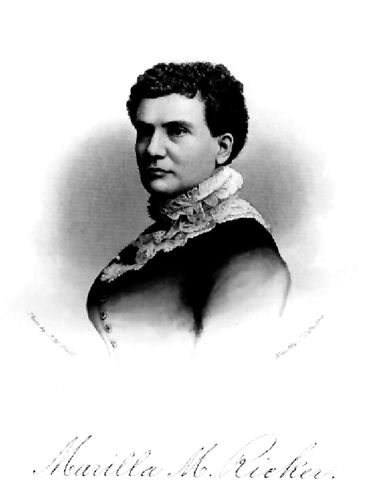
Petitions from various parts of the country, containing by estimate about 30,000 names, have been presented to congress asking for this legislation. They were procured through the efforts of woman suffrage societies, thoroughly organized, with active and zealous managers. The ease with which signatures may be procured to any petition is well known. The small number of petitioners, when compared with that of the intelligent women in the country, is striking evidence that there exists among them no general desire to take up the heavy burden of governing, which so many men seek to evade. It would be unjust, unwise and impolitic to impose that burden on the great mass of women throughout the country who do not wish for it, to gratify the comparatively few who do.
It has been strongly urged that without the right of suffrage, women are, and will be, subjected to great oppression and injustice.
But every one who has examined the subject at all knows that, without female suffrage, legislation for years has improved and is still improving the condition of woman. The disabilities imposed upon her by the common law have, one by one, been swept away, until in most of the States she has the full right to her property and all, or nearly all, the rights which can be granted without impairing or destroying the marriage relation. These changes have been wrought by the spirit of the age, and are not, generally at least, the result of any agitation by women in their own behalf.
Nor can women justly complain of any partiality in the administration of justice. They have the sympathy of judges and particularly of juries to an extent which would warrant loud complaint on the part of their adversaries of the sterner sex. Their appeals to legislatures against injustice are never unheeded, and there is no doubt that when any considerable part of the women of any State really wish for the right to vote, it will be granted without the intervention of congress.
Any State may grant the right of suffrage to women. Some of them have done so to a limited extent, and perhaps with good results. It is evident that in some States public opinion is much more strongly in favor of it than it is in others. Your committee regard it as unwise and inexpedient to enable three-fourths in number of the States, through an amendment to the national constitution, to force woman suffrage upon the other fourth in which the public opinion of both sexes may be strongly adverse to such a change.
For these reasons, your committee report back said resolution with a recommendation that it be indefinitely postponed.
This adverse report was all the more disappointing because Mr. Wadleigh, as Mrs. Clemmer's letter states, filled the place of Hon. Oliver P. Morton of Indiana, one of the most steadfast friends of woman suffrage, who, at the last session of congress, had asked as a special favor the reference of our petitions to the Committee on Privileges and Elections, of which he was chairman, that they might receive proper attention and that he might report favorably upon them. In the discussion on the Pembina bill in 1874, Senator Morton made an earnest speech in favor of woman's enfranchisement. In his premature death our cause lost one of its bravest champions.
Senator Wadleigh's report called forth severe criticism; notably from the New Northwest of Oregon, the Woman's Journal of Boston, the Inter-Ocean of Chicago, the Evening Telegram and the National Citizen of New York. We quote from the latter:
The report is not a statesman-like answer based upon fundamental principles, but a mere politician's dodge—a species of dust-throwing quite in vogue in Washington. "Several millions of voters totally inexperienced in political affairs"! They would have about as much experience as the fathers in 1776, as the negroes in 1870, as the Irish, English, Italians, Norwegians, Danes, French, Germans, Portuguese, Scotch, Russians, Turks, Mexicans, Hungarians, Swedes and Indians, who form a good part of the voting population of this country. Did Mr. Wadleigh never hear of Agnes C. Jencks—the woman who has stirred up politics to its deepest depth; who has shaken the seat of President Hayes; who has set in motion the whole machinery of government, and who, when brought to the witness stand has for hours successfully baffled such wily politicians as Ben Butler and McMahon;—a woman who thwarts alike Republican and Democrat, and at her own will puts the brakes on all this turmoil of her own raising? Does Senator Wadleigh know nothing of that woman's "experience in politics"?
"Quite dependent upon the other sex." It used to be said the negroes were "quite dependent" upon their masters, that it would really be an abuse of the poor things to set them free, but when free and controlling the results of their own labor, it was found the masters had been the ones "quite dependent," and thousands of them who before the war rolled in luxury, have since been in the depths of poverty—some of them even dependent upon the bounty of their former slaves. When men cease to rob women of their earnings they will find them generally, as thousands now are, capable of self-care.[36]
"Military duty." When women hold the ballot there will not be quite as much military duty to be done. They will then have a voice and a vote in the matter, and the men will no longer be able to throw the country into a war to gratify spite or ambition, tearing from woman's arms her nearest and dearest. All men do not like "military duty." "The key to that horrible enigma, German socialism, is antagonism to the military system," and nations are shaken with fear because of it. But when there is necessity for military duty, women will be found in line. The person who planned the Tennessee campaign, in which the Northern armies secured their first victories, was a woman, Anna Ella Carroll. Gen. Grant acted upon her plan, and was successful. She was endorsed by President Lincoln, Seward, Stanton, Wade, Scott, and all the nation's leaders in its hour of peril, and yet congress has not granted her the pension which for ten years her friends have demanded. Mr. Wadleigh holds his seat in the United States Senate to-day, because of the "military duty" done by this woman.
"About 30,000 names," to petitions. There have been 70,000 sent in during the present session of congress, for a sixteenth amendment, besides hundreds of individual petitions from women asking for the removal of their own political disabilities. Men in this country are occasionally disfranchised for crime, and sometimes pray for the removal of their political disabilities. Nine such disfranchised men had the right of voting restored to them during the last session of congress. But not a single one of the five hundred women who individually asked to have their political disabilities removed, was even so much as noticed by an adverse report, Mr. Wadleigh knows it would make no difference if 300,000 women petitioned. But whether women ask for the ballot or not has nothing to do with the question. Self-government is the natural right of every individual, and because woman possesses this natural right, she should be secured in its exercise.
Mr. Wadleigh says, "nor can woman justly complain of any partiality in the administration of justice." Let us examine: A few years ago a married man in Washington, in official position, forced a confession from his wife at the mouth of a pistol, and shot his rival dead. Upon trial he was triumphantly acquitted and afterwards sent abroad as foreign minister. A few months ago a married woman in Georgia, who had been taunted by her rival with boasts of having gained her husband's love, found this rival dancing with him. She drew a knife and killed the woman on the spot. She was tried, convicted, and, although nursing one infant, and again about to become a mother, was sentenced to be hanged by the neck till she was 'dead, dead, dead.' There is Mr. Wadleigh's equal administration of justice between man and woman! There is "the sympathy of judges and juries." There is the "extent which would warrant loud complaint on the part of their adversaries of the sterner sex." And this woman escaped the gallows not because of "the sympathy of the judge" or "jury," but because her own sex took the matter up, and from every part of the country sent petitions by the hundreds to Governor Colquitt of Georgia, asking her pardon. That pardon came in the shape of ten years' imprisonment;—ten years in a cell for a woman, the mother of a nursing and an unborn infant, while for General Sickles the mission to Madrid with high honors and a fat salary.
Messrs. Wadleigh of New Hampshire, McMillan of Minnesota, Ingalls of Kansas, Saulsbury of Delaware, Merrimon of North Carolina and Hill of Georgia, all senators of the United States, are the committee that report it "inexpedient" to secure equal rights to the women of the United States. But we are not discouraged; we are not disheartened; all the Wadleighs in the Senate, all the committees of both Houses, the whole congress of the United States against us, would not lessen our faith, nor our efforts. We know we are right; we know we shall be successful; we know the day is not far distant, when this government and the world will acknowledge the exact and permanent political equality of man and woman, and we know that until that hour comes woman will be oppressed, degraded; a slave, without a single right that man feels himself bound to respect. Work then, women, for your own freedom. Let the early morning see you busy, and dusky evening find you planning how you may become free.
But the most severe judgment upon Mr. Wadleigh's action came from his own constituents, who, at the close of the forty-fifth congress excused his further presence in the United States Senate, sending in his stead the Hon. Henry W. Blair, a valiant champion of national protection for national citizens.[37]
In April, 1878, Mrs. Williams transferred the Ballot-Box to Mrs. Gage, who removed it to Syracuse, New York, and changed its name to the National Citizen. In her prospectus Mrs. Gage said:
The National Citizen will advocate the principle that suffrage is the citizen's right, and should be protected by national law, and that, while States may regulate the suffrage, they should have no power to abolish it. Its especial object will be to secure national protection to women in the exercise of their right to vote; it will oppose class legislation of whatever form. It will support no political party until one arises which is based upon the exact equality of man and woman.
As the first step towards becoming well is to know you are ill, one of the principal aims of the National Citizen will be to make those women discontented who are now content; to waken them to self-respect and a desire to use the talents they possess; to educate their consciences aright; to quicken their sense of duty; to destroy morbid beliefs, and fit them for their high responsibilities as citizens of a republic. The National Citizen has no faith in that old theory that "a woman once lost is lost forever," neither does it believe in the assertion that "a woman who sins, sinks to depths of wickedness lower than man can reach." On the contrary it believes there is a future for the most abandoned, if only the kindly hand of love and sympathy be extended to rescue them from the degradation into which they have fallen. The National Citizen will endeavor to keep its readers informed of the progress of women in foreign countries, and will, as far as possible, revolutionize this country, striving to make it live up to its own fundamental principles and become in reality what it is but in name—a genuine republic.
Instead of holding its usual May anniversary in New York city, the National Association decided to meet in Rochester to celebrate the close of the third decade of organized agitation in the United States, and issued the following call:
The National Association will hold a convention in Rochester, N. Y., July 19, 1878. This will be the thirtieth anniversary of the first woman's rights convention, held July 19, 1848, in the Wesleyan church at Seneca Falls, N. Y., and adjourned to meet, August 2, in Rochester. Some who took part in that convention have passed away, but many others, including both Mrs. Mott and Mrs. Stanton, are still living. This convention will take the place of the usual May anniversary, and will be largely devoted to reminiscences. Friends are cordially invited to be present.
Clemence S. Lozier, M. D., President.
Susan B. Anthony, Chairman Executive Committee.
The meeting was held in the Unitarian church on Fitzhugh street, occupied by the same society that had opened its doors in 1848; and Amy Post, one of the leading spirits of the first convention, still living in Rochester and in her seventy-seventh year, assisted in the arrangements. Rochester, known as "The Flower City," contributed of its beauty to the adornment of the church. It was crowded at the first session. Representatives from a large number of States were present,[38] and there was a pleasant interchange of greetings between those whose homes were far apart, but who were friends and co-workers in this great reform. The reunion was more like the meeting of near and dear relatives than of strangers whose only bond was work in a common cause. Such are the compensations which help to sustain reformers while they battle ignorance and prejudice in order to secure justice. In the absence of the president, Dr. Clemence S. Lozier, Mrs. Stanton took the chair and said: