Front matter
Reading edition
Here are the definitions of some uncommon words. capitation Numbering or assessing by the head. Poll tax. Fee or payment of a uniform amount for each person. cumberer Hindrance. imperatively Absolutely necessary; unavoidable; commanding. justiciable Capable of being settled by law or by the action of a court: munificent Very generous. [End Transcriber's Notes]
HISTORY OF THE UNITED STATES
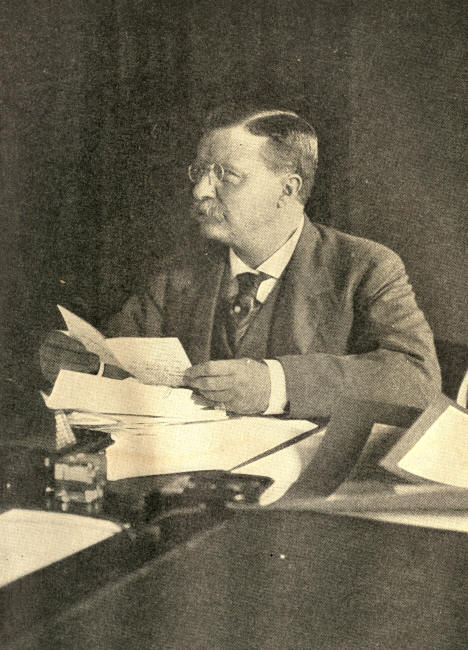
Copyright, 1907, by Clinedinst. Washington, D. C.
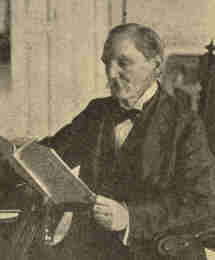
Theodore Roosevelt
At his desk in the executive offices of the White House during his term
as president.
HISTORY OF THE UNITED STATES
FROM THE EARLIEST DISCOVERY OF AMERICA
TO THE PRESENT TIME
BY
E. BENJAMIN ANDREWS
CHANCELLOR OF THE UNIVERSITY OF NEBRASKA
FORMERLY PRESIDENT OF BROWN UNIVERSITY
With 650 Illustrations and Maps
VOLUME VI.
NEW YORK
CHARLES SCRIBNER'S SONS
1912
COPYRIGHT, 1912, BY
CHARLES SCRIBNER'S SONS
CONTENTS
CHAPTER I. THE RISE OF THEODORE ROOSEVELT
Career of Theodore Roosevelt.
Characteristics.
Temper and Method.
Administration.
Reciprocity.
Trusts.
Industrial Confederations.
Railway, Steel and Steamship Combinations.
Ship Subsidy Bill.
Beef Trust.
Steel Strike of 1901.
Anthracite Coal Strike of 1902.
President Roosevelt Calls Conference for Its Settlement.
CHAPTER II. ROOSEVELT'S FIRST ADMINISTRATION
His Fine Equipment for the Office of President.
A Remarkable Cabinet.
Mr. Root's Work for Cuba and the Philippines.
For the Army.
The Diplomacy of John Hay.
Department of Commerce and Labor Created.
The Panama Canal Achievement.
Recognition of Panama.
The Galveston Flood.
Plan of City Government.
Cuba an Independent Republic.
The Philippines under United States Rule.
The Baltimore Fire.
The St. Louis Exposition.
CHAPTER III. PRESIDENTIAL ELECTION OF 1904
President Roosevelt Renominated.
Nominations of the Democratic Convention.
Of the Conventions of the Populist, Socialist and Prohibitionist Parties.
Character of the Campaign.
Charges Made against the Republicans.
President Roosevelt's Reply to Judge Parker's Statements.
Results of the Election.
CHAPTER IV. AMERICA AND THE CHINESE OPEN DOOR
Aggressive Policy of President Roosevelt.
Secretary Hay Continued in Office.
William H. Taft Made Secretary of War.
Trade of America and European Nations with China.
Secretary Hay's Request for Equal Trade Rights in China for All Nations.
The Boxer Rebellion.
Portion of China's Indemnity Cancelled by Congress.
Chinese Students in America.
Russia's Influence in China.
New Commercial Treaty between United States and China.
Opening of Manchurian Ports to All Nations.
Secretary Hay and Chinese Neutrality during the Russo-Japanese War.
Effects of too Strict Interpretation of Chinese Exclusion Act.
President Roosevelt's Instructions to Immigration Officials.
CHAPTER V. INTERNATIONAL ARBITRATION.
Progress Made in Settlement of International Difficulties by Arbitration.
First Meeting of the Hague Peace Conference.
Work of the Conference.
Chief Features of a Permanent International Court of Arbitration.
Advantages of Such Court.
Convened for the First Time in 1901.
The Pious Fund Case.
The Venezuela Case.
Mr. Carnegie's Gift for a "Palace of Peace."
The Building.
Peace Congresses Held in the United States in 1904.
Resolutions Adopted.
The Nations Invited by President Roosevelt to a Second Hague Conference.
Work of Second Conference.
Number of Treaties Concluded between the Nations.
CHAPTER VI. THE UNITED STATES AND LATIN-AMERICA
Interest in South American Republics.
Meeting of Pan-American Congress in Washington.
In City of Mexico.
Comparison of Foreign Commerce of South American States with European
Countries and with the United States.
Progress of South American States.
The Third Pan-American Congress, at Rio Janeiro Bureau of Pan-American
Republics Founded.
New Interpretation of the Monroe Doctrine.
The Santo Domingo Situation.
Its Adjustment by President Roosevelt.
CHAPTER VII. CONSERVATION OF NATURAL RESOURCES
Waste of Nation's Resources.
Establishment of a Division of Forestry.
Mariposa Forest Reservation.
Preservation of Niagara Falls.
Inland Waterways Commission Appointed by President Roosevelt.
Conference on Conservation Held at the White House.
Resolutions Adopted.
First National Conservation Commission.
The National Conservation Association Formed.
First North American Conservation Congress, called by President
Roosevelt.
Irrigation and the Reclamation Act.
The Roosevelt Dam.
The Shoshone Dam.
The Truckee-Carson Canal.
Proceeds from Sales of Public Lands.
Reclamation of the Swamp Lands.
The Mississippi Basin.
The Lakes to the Gulf Deep Waterways Association.
Projects Submitted by the Inland Waterways Commission.
Appropriation for Enlargement of Erie Canal.
CHAPTER VIII. DEVELOPMENT OF THE NEW SOUTH
Splendid Natural Gifts of the South.
Its Water Power Facilities.
Wealth of Minerals and Forests, Coal and Iron.
Waste of Forest Lands.
Wonderful Economic Advancement.
Mr. Rockefeller's Gift.
Cotton Production.
Improved Methods of Agriculture.
Roads.
Methods of Financing the Plantation System.
Cultivation of Hay and Corn.
Stock-Raising.
The New Social Life.
Bright Prospect for the Future.
CHAPTER IX. PRESIDENT ROOSEVELT'S SECOND ADMINISTRATION
Exposition at Portland, Oregon, Commemorating Lewis and Clark Expedition.
Interstate Commerce Commission.
Provisions of Interstate Commerce Laws.
Pure Food and Drugs Law.
Investigation of Meat-Packing Methods.
The Earthquake in San Francisco.
Relief Fund.
Rebuilding of the City.
CHAPTER X. THE FINANCIAL PANIC OF 1907
Popular Explanations of Its Cause.
The Real Causes.
Insolvency of Knickerbocker Trust Company.
Lack of Confidence in Financial Institutions.
Aid from the United States Treasury's Surplus Fund.
Enormous Amounts Paid Out to Depositors.
Radical Steps Taken by Bankers.
"Emergency Currency" Issued.
Strengthening of the New York Stock Exchange.
Gold from Foreign Countries.
Sale of Panama Bonds and Notes.
Confidence Restored.
Discussions Concerning Financial System.
The Aldrich-Vreeland Act.
CHAPTER XI. IMMIGRATION AND EMIGRATION
Great Increase in Immigration.
Change in Its Character.
Gain in Percentage from Southern Europe over that from Northern Europe.
Reasons Why These Foreigners Emigrate to America.
The Immigration Act of 1907.
And Its Effect.
The Emigration of Italians.
Slavs in the United States.
The Jews.
The Question of Oriental Immigration.
Dangers of Increasing Immigration.
Foreign Colonies in Chicago and Other Cities.
Increase in Criminality.
The Chief Problem.
Emigration of United States Farmers to Canada.
CHAPTER XII. NOTABLE SUPREME COURT DECISIONS
The Northern Securities Company Case.
The Alonzo Bailey Case.
Case of Loewe vs. Lawler, or the Danbury Hatters Case.
The Standard Oil Case.
The Case of the American Tobacco Company.
CHAPTER XIII. PRESIDENT ROOSEVELT'S SECOND ADMINISTRATION, CONTINUED
President Roosevelt's Advocacy of a Larger and More Efficient Navy.
Rear-Admiral Evans's Effective Work.
Cruise of the Atlantic Fleet.
Unusual Honors Tendered by Brazil and Other Countries Visited by the
Fleet.
Purchase and Settlement of Oklahoma Territory.
Indian System of Government.
Oklahoma and Indian Territory Admitted to the Union.
Exclusion of Japanese Students in San Francisco and President
Roosevelt's Prompt Action.
Child-Labor in the United States.
The Beveridge-Parsons Bill.
New Uses of Electricity.
Wireless Telegraphy, Air-Ships and Submarine Boats.
Business and Political Reforms.
Advances in Educational Work.
Notable Gifts of Mr. Carnegie and Mr. Rockefeller.
CHAPTER XIV. THE PRESIDENTIAL CAMPAIGN OF 1908
The Republican Convention.
William H. Taft Nominated for President.
Other Candidates for Nomination.
James S. Sherman Nominated for Vice-President.
The Democratic Convention.
And Its Nominations.
Platforms of Both Parties.
The Socialist Convention and Platform.
Convention of the Prohibition Party and Its Platform.
Lack of Campaign "Issues."
Personal Fitness of the Candidates.
Fear of the Power of Great Corporations.
Efficiency of President Roosevelt's Administration.
Results of the Election.
CHAPTER XV. THE ADMINISTRATION OF PRESIDENT TAFT
Inauguration of President Taft.
His Cabinet.
Increase of Salaries of Principal Executive Officers.
Alaska-Yukon-Pacific Exposition.
Alaskan Products.
Hudson-Fulton Celebration.
Arctic Exploration.
Commander Peary's Expedition.
Dr. Cook's Claims.
State Constitutions of Arizona and New Mexico Formed.
President Taft's Disapproval of Them.
New Mexico Admitted to the Union.
Population and Products of Arizona.
Of New Mexico.
The Aeroplane.
Tests and Records Made by Aviators.
The Federal Publicity Law.
President Taft's Recommendation Concerning Classified Service.
His Advance Position on International Arbitration.
CHAPTER XVI. THE THIRTEENTH CENSUS, 1910
Permanent Census Bureau Established.
Work of the Enumerators.
Special Attention Given to Character of Questions.
Enormous Labor of Tabulation and Classification.
Cost of Census.
Population of United States and Territorial Possessions.
Comparisons of Population with That of Previous Decade.
Rapid Growth of Cities.
Westward Advance of Centre of Population.
Emigration to Canada.
Congressional Reapportionment.
Farms of the United States.
Value of Foreign Commerce.
Of Exports.
CHAPTER XVII. THE PROGRESSIVE MOVEMENT
Government by the People.
Attitude Toward Senator La Follette, the First Progressive.
Number of Progressives in Senate.
Laws Annulled by Courts.
National Progressive Republican League Formed.
Its Platform.
The "Initiative."
The "Referendum."
The "Recall."
Tariff Revision.
The Payne-Aldrich Bill Passed.
Criticism of the Cotton Schedule.
Of the Wool Schedule.
The "Maximum and Minimum" Clause.
Democratic Revision of the Tariff.
Farmers' Free List Bill.
Reciprocity with Canada.
President Taft and the Progressive Movement.
APPENDIX:
I. CONSTITUTION OF THE UNITED STATES OF AMERICA
II. ARTICLES OF CONFEDERATION
III. THE DECLARATION OF INDEPENDENCE
IV. PRESIDENTS OF THE UNITED STATES
V. STATES ADMITTED INTO THE UNION
VI. AREA OF THE UNITED STATES
VII. POPULATION OF CONTINENTAL UNITED STATES BY DECADES, 1790--1910
VIII. APPROXIMATE POPULATION UNDER THE AMERICAN FLAG, 1910.
IX. POPULATION OF THE UNITED STATES, 1910, 1900, 1890
X. NUMBER OF MEMBERS IN THE HOUSE OF REPRESENTATIVES AFTER EACH APPORTIONMENT
XI. POPULATION LIVING IN URBAN AND RURAL TERRITORY 1890-1900.
XII. TWENTY-FIVE LARGEST CITIES FROM 1880 to 1910.
LIST OF ILLUSTRATIONS
THEODORE ROOSEVELT AT HIS DESK IN THE EXECUTIVE
OFFICES OF THE WHITE HOUSE DURING HIS TERM AS
PRESIDENT. (Copyright, 1907, Clinedinst, Washington).
THEODORE ROOSEVELT.
(From a copyrighted photograph by Pach Bros., New York).
THEODORE ROOSEVELT, AS LIEUT.-COLONEL OF THE "ROUGH RIDERS."
COLLIS P. HUNTINGTON.
JAMES J. HILL. (Copyright, 1902, by Pach Bros., N. Y.).
E. H. HARRIMAN.
JOHN W. GATES.
ANDREW CARNEGIE. (Copyright, 1902, by Rockwood, N. Y.).
J. PIERPONT MORGAN. (Copyright, 1901, by Pach Bros., N. Y.).
COL. CLEMENTS. GEN. GOBIN COMMANDING TROOPS SENT TO SHENANDOAH IN THE
COAL STRIKE OF 1902.
COAL STRIKE AT SHENANDOAH, PA., 1902. A STRIKERS' PICKET.
THE COAL STRIKE ARBITRATORS CHOSEN BY THE PRESIDENT. (Copyright, 1902,
by George Grantham Bain).
JOHN HAY, SECRETARY OF STATE. (Copyright, 1904, by Pach Bros., N. Y.).
ELIHU ROOT, SECRETARY OF WAR. (Copyright, 1903, by Clinedinst,
Washington).
GEORGE B. CORTELYOU, SECRETARY OF THE DEPARTMENT OF COMMERCE AND LABOR.
(Photograph by Rice).
THE ISTHMIAN CANAL COMMISSION, TAKEN MARCH 22,1904.
THE AMERICAN ISTHMUS, SHOWING ROUTES INVESTIGATED FOR A SHIP-CANAL.
M. BUNAU-VARILLA, MINISTER FROM PANAMA. (Photograph by Clinedinst).
GREAT HEAPS OF WRECKAGE PILED HIGH BY THE GALVESTON DISASTER.
(Copyright, 1900, by Underwood & Underwood, N. Y.).
THE BOULEVARD AND SEA-WALL, GALVESTON. BUILT AFTER THE FLOOD.
(Photograph by H. H. Morris).
TOMASO ESTRADA Y PALMA, FIRST PRESIDENT OF CUBA, IN THE PALACE, HAVANA.
(Copyright, 1902, by Underwood & Underwood, N. Y.).
LOWERING THE STARS AND STRIPES ON THE PALACE, MAY 20, 1902, FOR THE FLAG
OF THE CUBAN REPUBLIC. (Copyright, 1901, by Underwood & Underwood).
GOV. WILLIAM H. TAFT.
THE BALTIMORE FIRE. (Lombard and Calvert Streets, showing Continental
and Equitable Buildings).
THE BALTIMORE FIRE. (Hopkins Place and German Street, looking east).
OPENING DAY AT THE LOUISIANA PURCHASE EXPOSITION. PRESIDENT D. K.
FRANCIS DELIVERING THE OPENING ADDRESS. (Copyright, 1904, by William H.
Rau, Philadelphia).
THE LOUISIANA PURCHASE EXPOSITION. THE VARIED INDUSTRIES BUILDING.
CHARLES W. FAIRBANKS, VICE-PRESIDENT OF THE UNITED STATES.
THE REPUBLICAN CONVENTION AT CHICAGO, 1904.
WILLIAM R. HEARST.
THE DEMOCRATIC CONVENTION AT ST. LOUIS, 1904.
ALTON B. PARKER.
INAUGURATION OF PRESIDENT ROOSEVELT, MARCH 4, 1905. (Photograph by
Clinedinst, Washington, D. C.).
COUNT VON WALDERSEE, ESCORTED BY OFFICERS OF THE ALLIED ARMIES BETWEEN
LINES OF U. S. TROOPS TOWARD THE SACRED GATE, PEKING. (Copyright by
Underwood & Underwood, N, Y.).
AMERICAN FLAG RAISED OVER BATTERED REMNANTS OF SOUTH GATE IMMEDIATELY
AFTER CITY'S CAPTURE. BATTLE OF TIEN-TSIN CHINA. (Copyright, 1901, by
Underwood & Underwood).
ARRIVAL OF CHINAMEN AT MALONE, N. Y., FROM CANADA, ACCOMPANIED BY
OFFICIALS.
THE HOUSE IN THE WOODS, THE HAGUE, HOLLAND, WHERE THE FIRST PEACE
CONFERENCE WAS HELD.
PRESIDENT CASTRO OF VENEZUELA.
THE NEW PEACE PALACE, THE HAGUE, HOLLAND.
RUSSIAN AND JAPANESE PEACE ENVOYS IN SESSION AT PORTSMOUTH, N. H.
BUILDING WHERE THE SECOND PEACE CONFERENCE WAS HELD, THE HAGUE, HOLLAND.
FIRST SESSION OF THE SECOND PEACE CONFERENCE, THE HAGUE, HOLLAND.
FEDERAL PALACE, WHERE THE SECOND PAN-AMERICAN CONGRESS WAS HELD IN THE
CITY OF MEXICO. (Courtesy of the Pan-American Union).
MONROE PALACE, WHERE THE THIRD PAN-AMERICAN CONFERENCE WAS HELD IN RIO
DE JANEIRO. (Courtesy of the Pan-American Union).
ARRIVAL OF SECRETARY ROOT AT RIO DE JANEIRO. (Courtesy of the
Pan-American Union).
THE BUREAU OF THE PAN-AMERICAN REPUBLICS. (Photograph by Clinedinst).
GRIZZLY GIANT, MARIPOSA GROVE, CALIFORNIA, WITH A SQUAD OF CAVALRY AT
ITS BASE.
BIG TREE "WAWONA," SHOWING THE RELATIVE SIZE OF OTHER CONIFERS COMPARED
WITH BIG TREES. MARIPOSA GROVE.
THE PRESIDENT, GOVERNORS, AND OTHER LEADING MEN AT THE NATIONAL
RESOURCES CONFERENCE, AT THE WHITE HOUSE, MAY 13 TO 15, 1908. (Copyright
by Underwood & Underwood).
GIFFORD PINCHOT, PRESIDENT OF THE CONSERVATION COMMISSION.
ROOSEVELT DAM FROM THE ROAD.
SHOSHONE DAM, WYOMING. HIGHEST DAM IN THE WORLD. HEIGHT, 328.4 FEET.
SHOSHONE PROJECT. WYOMING PARK WAGON ROAD, SHOWING WONDERFUL TUNNELLING
WORK ON THE NEW WAGON ROAD FROM CODY, WYO., TO THE NATIONAL PARK VIA THE
SHOSHONE DAM. (Photograph by Clinedinst).
TRUCKEE-CARSON RECLAMATION PROJECT. DIVERSION DAM AND GATES AT HEADING
OF MAIN CANAL.
INLAND WATERWAYS COMMISSION.
THE PORT OF NEW ORLEANS. (Copyright, 1900, by Detroit Photographic Co.).
JAMES WILSON, SECRETARY OF AGRICULTURE.
A FIELD OF COTTON.
BALES OF COTTON READY FOR SHIPMENT. COTTON-PRESS YARD, NEW ORLEANS.
LOADING COTTON ON THE LEVEE, NEW ORLEANS.
THE PRICE-CAMPBELL COTTON-PICKING MACHINE, WHICH DOES THE WORK OF FIFTY
PERSONS.
THE LEWIS AND CLARK EXPOSITION, PORTLAND, ORE. GENERAL VIEW ACROSS THE
LAGOON.
THE LEWIS AND CLARK EXPOSITION, PORTLAND, ORE. THE GOVERNMENT BUILDINGS
ACROSS THE LAGOON.
DR. HARVEY W. WILEY, MANY YEARS CHIEF OF THE U. S. BUREAU OF CHEMISTRY.
(Copyright by Clinedinst, Washington).
U. S. GOVERNMENT INSPECTION OF A PACKING-HOUSE.
EARTHQUAKE AT SAN FRANCISCO, APRIL 18, 1906. UPHEAVAL OF SIDEWALK AT
EIGHTEENTH AND CAPP STREETS.
BURNING OF SAN FRANCISCO FOLLOWING THE EARTHQUAKE.
SHOWING DESTRUCTION OF BUILDINGS AFTER THE EARTHQUAKE AND FIRE IN SAN
FRANCISCO.
REFUGEES IN GOLDEN GATE PARK, SAN FRANCISCO.
THE JAMESTOWN EXPOSITION--MANUFACTURES AND LIBERAL ARTS BUILDING--FROM
THE AUDITORIUM. (Copyright by Underwood & Underwood, N. Y.).
THE PANIC OF 1907. RUN ON THE KNICKERBOCKER TRUST COMPANY, 34TH STREET
AND FIFTH AVENUE.
THE PANIC OF 1907. UPTOWN BRANCH OF THE KNICKERBOCKER TRUST COMPANY,
125TH STREET.
THE PANIC OF 1907. RUN ON THE COLONIAL TRUST COMPANY. LINE OF DEPOSITORS
IN ANN STREET WAITING THEIR TURN.
THE PANIC OF 1907. RUN ON THE LINCOLN TRUST COMPANY, FIFTH AVENUE
ENTRANCE.
THE PANIC OF 1907. WALL STREET, IN FRONT OF THE SUB-TREASURY BUILDING,
WHEN THE RUN ON THE TRUST COMPANY OF AMERICA WAS AT ITS HEIGHT.
THE PANIC OF 1907. RUN ON THE STATE BANK, GRAND STREET, NEW YORK.
EMIGRANTS BOUND FOR AMERICA.
ENTRANCE TO EMIGRANT STATION OR "MODEL TOWN" IN HAMBURG. BUILT FOR
EMIGRANTS WAITING TO SAIL.
ONE OF SEVERAL CHURCHES BUILT FOR EMIGRANTS OF VARIOUS FAITHS IN THE
STATION OR "MODEL TOWN" OF THE HAMBURG-AMERICAN COMPANY, FOR USE WHILE
WAITING TO SAIL.
U. S. IMMIGRANT STATION, ELLIS ISLAND, N. Y.
GROUPS OF IMMIGRANTS UPON THEIR ARRIVAL AT ELLIS ISLAND.
GROUP OF COSSACK IMMIGRANTS CONSIDERED DESIRABLE AND QUALIFIED TO ENTER.
SWEDISH IMMIGRANT FAMILY CONSIDERED DESIRABLE AND QUALIFIED TO ENTER.
JUSTICES OF THE UNITED STATES SUPREME COURT WHO ACTED UPON THE CASES OF
THE STANDARD OIL AND AMERICAN TOBACCO COMPANIES. (Copyright by
Clinedinst, Washington).
CHIEF JUSTICE MELVILLE W. FULLER. (Photograph copyright by Clinedinst,
Washington).
REAR-ADMIRAL ROBLEY D. EVANS. (Copyright, 1908, by Harris & Ewing).
THE ATLANTIC FLEET STARTING ON ITS JOURNEY ROUND THE WORLD, DECEMBER,
1907. (Copyright, 1907, by Underwood & Underwood).
REAR-ADMIRAL CHARLES S. SPERRY.
COTTON-MILL OPERATIVES SO SMALL THAT IN ORDER TO REACH THEIR WORK THEY
HAVE TO STAND UPON THE MACHINERY.
THE SPINNING-ROOM OVERSEER AND HIS FLOCK IN A MISSISSIPPI COTTON-MILL.
ELECTRIC TRAIN, LONG ISLAND R. R.
GUGLIELMO MARCONI AND HIS WIRELESS TELEGRAPH.
MARCONI TRANSATLANTIC STATION AT SOUTH WELLFLEET, CAPE COD, MASS.
THE "ARROW" GETTING UNDER WAY. (Courtesy of Scientific American).
BALDWIN'S AIRSHIP "ARROW" AT A HEIGHT OF 600 FEET OVER THE EXPOSITION
PALACES, ST. LOUIS, OCTOBER 25, 1904.
CARNEGIE FREE PUBLIC LIBRARIES.
JOSEPH G. CANNON. (Copyright by Clinedinst, Washington).
JAMES S. SHERMAN, NOMINATED FOR VICE-PRESIDENT. (Photograph by C. M.
Bell, Washington).
WILLIAM H. TAFT ON HIS TRIP, STUMPING FOR THE NOMINATION.
MR. TAFT FORMALLY ACCEPTING THE REPUBLICAN NOMINATION FOR THE
PRESIDENCY, ON THE VERANDA OF THE RESIDENCE OF HIS BROTHER, MR. CHARLES
P. TAFT, OF CINCINNATI, OHIO. (Copyright, 1908, by Young & Carl,
Cincinnati, Ohio).
PRESIDENT WILLIAM H. TAFT AND GOVERNOR HUGHES ON THE REVIEWING STAND AT
THE INAUGURATION, MARCH 4,1909. (Copyright by Clinedinst, Washington).
PRESIDENT TAFT AND CABINET, 1909. (Copyright, 1909, by Brown Bros., N.
Y.).
THE ALASKA-YUKON-PACIFIC EXPOSITION, SEATTLE. THE PALACE OF FINE ARTS.
THE HUDSON-FULTON CELEBRATION. THE CLERMONT PROCEEDING UP THE HUDSON
RIVER UNDER HER OWN STEAM.
COMMANDER PEARY'S SHIP, THE ROOSEVELT.
COMMANDER ROBERT E. PEARY, AND THREE OF HIS ESKIMO DOGS, ON THE
ROOSEVELT.
DR. F. A. COOK ON HIS ARRIVAL IN NEW YORK, SEPTEMBER 21, 1909.
(Photograph by Brown Bros., N. Y.).
PRESIDENT TAFT SIGNING THE PROCLAMATION MAKING ARIZONA THE FORTY-EIGHTH
STATE OF THE UNION, AT THE WHITE HOUSE, FEBRUARY 14, 1912. (Copyright by
Clinedinst, Washington).
PRESIDENT TAFT SIGNING THE PROCLAMATION MAKING NEW MEXICO A STATE,
JANUARY 6, 1912. (Photograph, copyright, by Clinedinst, Washington).
CHARLES K. HAMILTON RACING AN AUTOMOBILE ON THE BEACH AT GALVESTON,
TEXAS. (From a photograph by H. H. Morris).
WILBUR AND ORVILLE WRIGHT, AND THE LATE KING EDWARD OF ENGLAND.
(Photograph by Brown Bros., N. Y.).
WILBUR WRIGHT IN HIS AEROPLANE AT PAU, FRANCE, WITH KING ALFONSO OF
SPAIN.
HARRY K. ATWOOD WITH LIEUT. FICKLE FLYING OVER GOVERNOR'S ISLAND, N. Y.,
AFTER COMPLETING HIS LIGHT FROM ST. LOUIS TO NEW YORK.
E. DANA DURAND, DIRECTOR OF THE CENSUS. (Copyright by Clinedinst,
Washington).
CENTRE OF POPULATION AT EACH CENSUS.
ROBERT M. LA FOLLETTE. (Copyright by Harris & Ewing, Washington).
ALBERT J. BEVERIDGE, SENATOR FROM INDIANA. (Copyright by Clinedinst,
Washington).
SENATOR NELSON W. ALDRICH. (Photograph by Clinedinst, Washington).
PERIOD VII
PROBLEMS OF THE NEW CENTURY
1902-1912
CHAPTER I
THE RISE OF THEODORE ROOSEVELT
[1900]
Theodore Roosevelt was born in New York City, October 27, 1858. He was
graduated from Harvard in 1880. At the age of twenty-three he entered
the New York State Assembly, where he served six years with great
credit. Two years he was a "cowboy" in Dakota. He was United States
Civil Service Commissioner and President of the New York City Police
Board. In 1897 he became Assistant Secretary of the Navy, holding this
position long enough to indite the despatch which took Dewey to Manila.
He then raised the first United States Volunteer Cavalry, commonly
spoken of as "Rough Riders," and went to Cuba as their
lieutenant-colonel. Gallantry at Las Guasimas made him their colonel,
the first colonel, Leonard Wood, having received a brigadier-general's
commission. Returning from the war, Colonel Roosevelt found himself, as
by a magic metamorphosis, Governor of his State, fighting civic battles
against growing corporate abuses. He urged compulsory publicity for the
affairs of monopolistic combinations, and was prominently instrumental
in the enactment of the New York Franchise Tax Law.
The party managers in the 1900 convention hoped by making him
Vice-President to remove him from competition for the presidency in
1904. But the most unexpected of the many swift transitions in his
career foiled their calculations and brought him in a moment to the
summit of a citizen's ambition.
The new chief magistrate was no less honest, fearless, or
public-spirited than the recent one; it only remained to be seen whether
he were not less astute and cautious. Coming to the office as he did, he
was absolutely unfettered, which, in one of so frank a temperament,
might prove a danger. He was more popular with the people than with
politicians. Though highly educated and used to the best associations,
he was more approachable than any of his predecessors. At a public
dinner which he attended, one round of cheers was given him as "the
President of the United States" another as "Roosevelt," and a third as
"Teddy." Had McKinley been in his place a corresponding variation would
have been unthinkable.
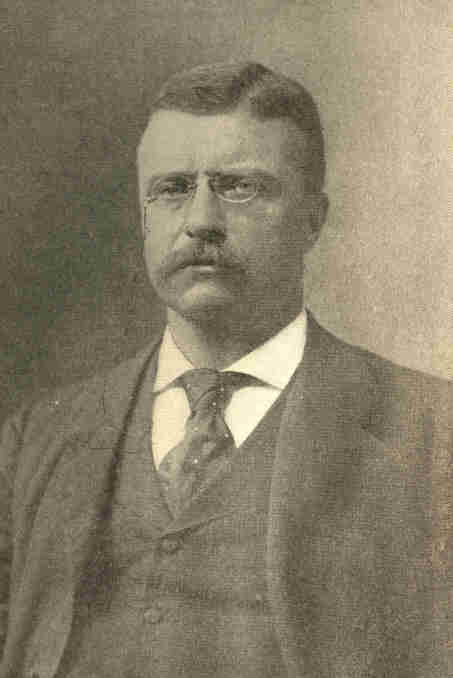
From a copyrighted photograph by Pach Bros., N. Y.
Theodore Roosevelt.
President Roosevelt's temper and method were in pointed contrast to
McKinley's. Whereas McKinley seemed simply to hold the tiller, availing
himself of currents that to the eye deviously, yet easily and
inevitably, bore him to his objective, Roosevelt strenuously plied the
oar, recking little of cross currents or head winds, if, indeed, he did
not delight in them. Chauncey Depew aptly styled McKinley "a Western man
with Eastern ideas." Roosevelt, "an Eastern man with Western ideas."
This aspect of the new President's character gave him hold on both West
and East. Roosevelt was the first President since William Henry Harrison
to bring to his office the vigor and freshness of the frontier, as he
was, anomalously, the first city-born or wealthy-born incumbent.
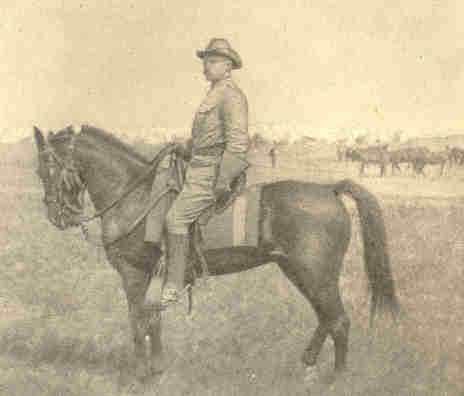
Theodore Roosevelt, as Lieut.-Colonel of the "Rough Riders."
[1901]
The members of President McKinley's cabinet were invited to retain their
portfolios, which they agreed to do. At the time, Roosevelt was reputed
to be the foremost civil service reformer in the country. Politicians
were soon made aware that the President regarded fitness for office as
the first test. Unfortunately during the presidency of McKinley, some
8000 offices had been taken out of the competitive lists. During
Roosevelt's first term, however, the list of offices placed under the
merit system was greatly extended. Within the twenty-one years from the
enactment of the first national civil service reform law wonders had
been accomplished in that more than one-half of the 300,000 offices in
the executive civil service were placed in the classified competitive
service.
President Roosevelt stood for liberal reciprocity with Cuba, urging
this, at first, with results disastrous to party harmony. He was
vindicated by public opinion, but learned wisdom. Though believed to be
favorable to a decided easing of custom-house levies, his administration
soon frankly avowed itself unable to proceed further than high-
protectionists would follow. The evidence of his tariff convictions won
him strong support in the West, which was prepared to go greater lengths
than he. In the congressional campaign of 1902, ex-Speaker Henderson, of
Iowa, a stanch protectionist, withdrew from public life, as was
supposed, rather than misrepresent himself by acceding to tariff reform
or his constituents by opposing it.
Mr. Roosevelt signalized his accession by an effort to make the federal
anti-trust law something more than a cumberer of the statute-book. His
inaugural message and innumerable addresses of his boldly handled the
whole trust evil and called for the regulation of capitalistic
combinations in the interest of the public.
Appreciation of the President's attitude on these matters may be
assisted by some notice of the then threatening vigor and universality
of the movement toward industrial combination. Mr. Beck, Assistant
Attorney-General of the United States, declared in 1892:
"Excessive capitalization of corporations, dishonest management by their
executive officers, the destruction of the rights of the minority, the
theft of public utilities, the subordination of public interests to
private gain, the debauchery of our local legislatures and executive
officers, and the corruption of the elective franchise, have resulted
from the facility afforded by the law to corporations to concentrate the
control of colossal wealth in the hands of a few men . . . . The
question presses ever more importunately for decision whether these
marvellous aggregations of capital can be subordinated to the very laws
which created them."
Legislation in many States, the enactment of the Sherman anti-trust law
by Congress, and the decision of the Supreme Court in the Trans-Missouri
case rendered insecure trust agreements of the old type, in which
constituent corporations surrendered the control of their affairs to
trustees. But the current merely shifted to a different channel, the
trust proper giving way to the giant corporation having the same aims,
methods, and efficiency, while, as more legal, it was less vulnerable.
In the railway world, "community of interest" assumed the place of
pooling agreements. The Union Pacific acquired large holdings from
Collis P. Huntington's estate and controlled the Southern Pacific. The
power behind the Southern Railway got control of nearly all the other
Southern railways, including the Atlantic Coast Line, the Plant System,
and at last even the Louisville and Nashville. The New York Central
dominated the other Vanderbilt roads. The Pennsylvania secured decisive
amounts of Baltimore and Ohio stock, as well as weighty interests in the
Chesapeake and Ohio and the Norfolk and Western, and so on.
[1902]
Collis P. Huntington.
Great banking establishments, foremost among them the house of J. P.
Morgan & Co., took to financing these schemes. Morgan re-organized the
Northern Pacific, and it would forthwith have pooled issues with the
Great Northern but for opposition by the State of Minnesota. James J.
Hill was master of the Great Northern, and confidence existed between
him and Morgan.
They wished a secure outlet for the products of the Northwest, also
access to Chicago over a line of their own. After a survey of the field
the promoters selected as the most available for the latter office the
Chicago, Burlington and Quincy. Purchase of shares in this corporation
was quietly begun. Soon the Burlington road was apparently in hand.
Prices rose.
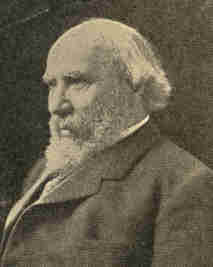
Copyright. 1902. by Pach Bros., N. Y.
James J. Hill.
The Union Pacific control perceived in the aggression of the two
northern lines a menace to its northwestern and Pacific coast
connections. The Union Pacific leader, E. H. Harriman, resorted to an
unexpected coup. He attempted to purchase the Northern Pacific,
Burlington and all. A mysterious demand, set Northern Pacific shares
soaring. The stock reached $1,000 a share and none was obtainable. Panic
arose; bankers and brokers faced ruin.
The two sides now declared a truce. The Northern Securities Company was
created, with a capital approaching a billion dollars, to take over the
Burlington, Northern Pacific, and Great Northern stocks.
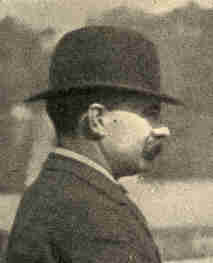
E. H. Harriman.
The States of Minnesota and Washington, unable in their own courts to
thwart this plan, sought the intervention of the United States Supreme
Court. Their suit was vain till the Administration came to the rescue.
At the instance of the Attorney-General, an injunction issued from the
high court named forbidding the Securities Company to receive the
control of the roads, and the holders of the railroad stocks involved to
give it over. It was observed, however, that at the very time of the
above proceedings the Southern Railways' power obtained control of the
Louisville and Nashville without jar or judicial obstruction.
While general, the process of confederation was specially conspicuous in
the iron and steel trade. In rapid succession the National Steel
Company, the American Sheet Steel Company, and the American Tin Plate
Company were each made up of numerous smaller plants. Each of these
corporations, with a capital from $12,000,000 to $40,000,000, owned the
mines, the ships, and the railways for hauling its products, the mills
for manufacturing, and the agencies for sale. Through the efforts of
John W. Gates numerous wire and nail works were combined into the
American Steel and Wire Company. The Federal Steel Company, the American
Bridge Company, the Republic Iron and Steel Company, huge and complete,
were dictators each in its field.
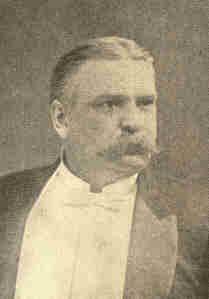
John W. Gates.
The Carnegie Steel Company long remained independent. Determined not to
enter a "combine," Andrew Carnegie sought to fortify his position. He
obtained a fleet of ships upon the lakes, purchased mines, undertook to
construct tube works at Conneaut, Ohio, and planned for railroads. A
battle of the giants, with loss and possible ruin for one side or the
other, impended. Carnegie was finally willing to sell. Hence, the United
States Steel Corporation capitalized for a billion dollars. Carnegie and
his partners were said to receive about $300,000,000 in bonds of the new
corporation, while the other trusts and the promoters absorbed the stock
for their properties and services. The underwriting syndicate probably
realized $25,000,000.
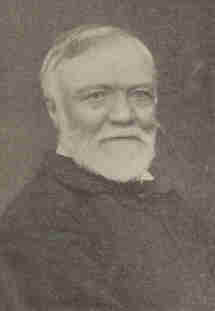
Copyright. 1902, by Rockwood. N. Y.
Andrew Carnegie.
The trust creators extended their operations abroad. In 1901 J. Pierpont
Morgan and associates acquired the Leyland line of Atlantic
steamships. British nerves had not recovered tone when a steamship
combination, embracing not only American and British but also German
lines and ship-building firms at Belfast and on the Clyde was announced.
Of the great Atlantic companies, only the Cunard line remained
independent. Parliamentary and ministerial assurances of governmental
attention only emphasized the strength of the association.
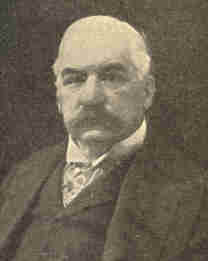
Copyright, 1901. by Pach Bros., N. Y:
J. Pierpont Morgan.
One effect of this organization at home was to place the Ship Subsidy
Bill, which passed the Senate in 1901, for the time, at least, on the
table. The sentiment of the country, especially of the Middle West,
would not permit the payment of public money to a concern commercially
able to defy Britannia on the sea.
The Yankee Peril confronted Londoners when they saw American capital
securing control of their proposed underground transit system. At their
tables they beheld the output of food trusts. One of these, the
so-called Beef Trust, called down upon itself in 1902 domestic as well
as foreign anathema.
The failure of the corn crop in 1900, together with a scarcity of
cattle, tended to raise the price of beef. In 1902 outcry became
emphatic. Advance in meat values drew forcibly to view the control held
by six slaughtering concerns acting in unison.
The President ordered an investigation, and, as a result, proceedings
under the Sherman Act to restrain the great packers from continuing
their alleged combination. A temporary injunction was granted. The slow
machinery of chancery bade fair to work out a decree, but long before it
was on record, alert spirits among the packing firms evolved a new plan
not obnoxious to decrees, but effective for union.
If the public suffered from these phalanxed industries while they ran
smoothly, it endured peculiar evils from the periodical conflicts
between the capital and the labor engaged in them.
The Steel Strike of 1901 was a conflict over the unionizing of certain
hitherto non-union plants of the United States Steel Corporation. It
resulted in defeat for the strikers and in the disunionizing of plants.
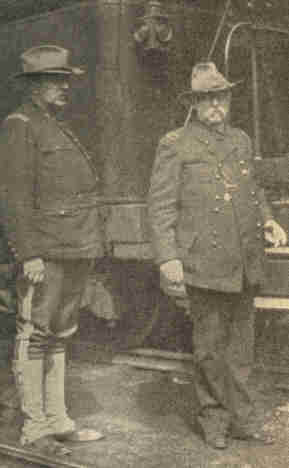
Col. Clements. Gen. Gobin, commanding troops
sent to Shenandoah in the coal strike of 1902.
This strike had no such consequences for the consuming public as
attended the anthracite coal strike of 1902, which was more bitterly
fought in that it was a conflict over wages. The standard of living had
been lowered in one of the coal-fields by the introduction of cheap
foreign labor. Now the same process threatened the other coal-field.
A strike ordered by the United Mine Workers began May 12, 1902, when one
hundred and forty-seven thousand miners went out. Though the record was
marred at places, they behaved well and retained to a large degree
public sympathy. When the price of anthracite rose from about $5 a ton
to $28 and $30, the parts of the country using hard coal were threatened
with a fuel famine and had begun to realize it. For the five months
ending October 12th, the strike was estimated to have cost over
$126,000,000. The operators stubbornly refused to arbitrate or to
recognize the union, and the miners, with equal constancy, held their
ranks intact.
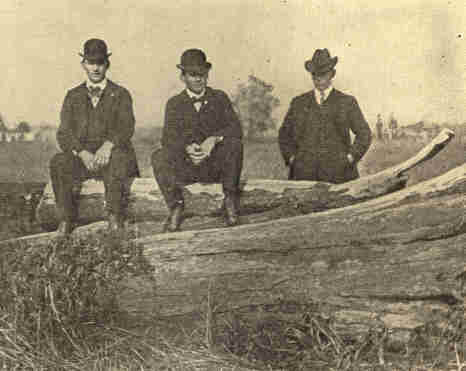
Coal strike at Shenandoah, Pa., 1902. A strikers' picket.
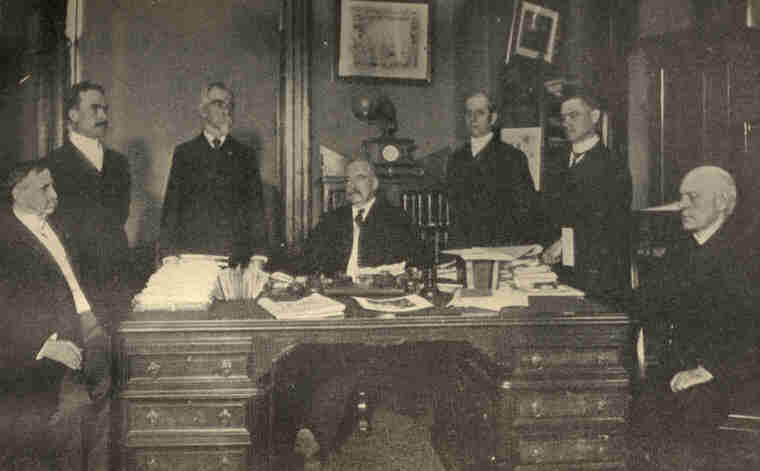
Copyright, 1902, by George Grantham Bain.
The coal strike arbitrators chosen by the President. Carroll D. Wright,
Recorder; T. H. Watkins, General J. M. Wilson, Judge Gray, Presiding
Officer; E, W. Parker, E. E. Clark. and Bishop Spalding.
The problem of protecting the public pressed for solution as never
before. The only suggestion at first discussed was arbitration. Enforced
arbitration could not be effected in the absence of contract without
infringing the workingman's right to labor or to decline to do so; in
other words, without reducing him, in case of adverse decision by
arbitration, to a condition of involuntary servitude. It looked as
though no solution would be reached unless State or nation should
condemn and acquire ample portions of the mining lands to be worked
under its own auspices and in a just manner. This course was suggested,
but nearly all deemed it dangerously radical; nor was it as yet likely
to be adopted by Congress or by the Pennsylvania legislature, should
these powers be called to deal with the problem.
On October 3 President Roosevelt called the coal operators and President
Mitchell of the United Mine Workers to a conference at the White House,
urging them to agree. His effort, at first seeming unsuccessful, was
much criticised, but very few failed to praise it when, a few days
later, it was found to have succeeded completely. An able and impartial
commission, satisfactory to both sides, was appointed by the President
to act as arbitrator, both miners and operators agreeing to abide its
decrees. The miners, the four hundred thousand women and children
dependent on them, the poor beginning to suffer from cold, indeed the
whole nation, including, no doubt, the operators, felt relief.
"How much better," said the young President, once, addressing a
fashionable assembly, "boldly to attempt remedying a bad situation than
to sit quietly in one's retreat, sigh, and think how good it would be if
the situation could be remedied!"
CHAPTER II
ROOSEVELT'S FIRST ADMINISTRATION, 1901-1905
[1902]
The sentiment noted at the end of the last chapter seemed to be the
motive of Mr. Roosevelt's public life. Not only was he better informed
on the whole than almost any President who had sat in the chair before,
but he was a good lawyer, familiar with national and general history and
awake to all contemporary doings, questions, and interests south, west,
east, and abroad. He was also more a man of action and affairs than any
of his predecessors. He had, in a very high degree, alertness, energy,
courage, initiative, dispatch. Physically as well as mentally vigorous,
he read much, heard all who could usefully inform him, apprehended
easily, decided quickly, and toiled like Hercules. He was just and
catholic in spirit, appreciating whatever was good in any section of the
country or class of people. He respected precedent but was not its
slave. Rather than walk always in ruts with never a jolt, he preferred
some risks of tumbling over hummocks. Few public men of any age or
country have more fully met Aristotle's test of a statesman: "ability to
see facts as they exist and to do the things needing to be done."
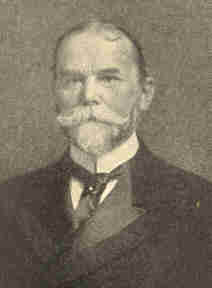
Copyright. l904. by Pach Bros., N. Y.
John Hay, Secretary of State. [Died July 1, 1905.]
He had able aids; pre-eminent among these were John Hay, Secretary of
State, and Elihu Root, Secretary of War. Each was, to say the least,
the peer of his greatest predecessors in his office. It was mainly to
Mr. Root that we were indebted for starting the Cubans prosperously as
an independent nation. His service for the Philippines so far as it went
was not less distinguished; and he effected vitally important
reorganization and reform in the war office.
A well co-ordinated plan was developed whereby army officers were given
advanced training in the various branches of military science as in the
European countries. Neither the President nor Secretary Root advocated a
large standing army, but they both strove to bring the army "to the very
highest point of efficiency of any army in the civilized world." The
ability of Secretary Root to inaugurate reforms in a department which
when he became its head was overridden by tradition, was well expressed
by President Roosevelt as follows: "Elihu Root is the ablest man I have
known in our governmental service. I will go further. He is the greatest
man that has appeared in the public life of any country, in any
position, on either side of the ocean in my time."
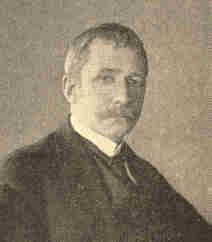
Copyright. 1903. by Clinedinst, Washington.
Elihu Root, Secretary of War.
[Secretary of State, July 1905.]
Under Secretary Hay our State Department attained unprecedented
prestige, due in part to the higher position among the nations now
accorded us. This result itself Mr. Hay had done much to achieve; and he
passed hardly a month in his office without making some further addition
to the renown and influence of his country. If the United States
has--which may be doubted--raised up diplomatists with Mr. Hay's mastery
of international law and practice and his art and skill in conducting
delicate negotiations, we have probably never had his equal in
diplomatic initiative, or in the thorough preparation and presentation
of cases. He did not meet occasions merely but made them, not
arbitrarily but for the world's good. Settling the Alaskan boundary
favorably to the United States at every point save one, crumbling with
the single stroke of his Pauncefote treaty that Clayton-Bulwer rock on
which Evarts, Blaine, and Frelinghuysen in turn had tried dynamite in
vain, were deeds seldom matched in statecraft.
By an act of Congress, in 1903, a new member was added to the
President's cabinet in the person of the Secretary of the Department of
Commerce and Labor. George B. Cortelyou was the first man appointed to
that office. Two bureaus, those of corporations and of manufactures,
were created for the department. The other bureaus, such as the Bureau
of Statistics, Bureau of Standards of Weights and Measures and Coast and
Geodetic Survey, were transferred from the other departments. The place
of this new department was defined by the President in the following:
"to aid in strengthening our domestic and foreign markets, in perfecting
our transportation facilities, in building up our merchant marine, in
preventing the entrance of undesirable immigrants, in improving
commercial and industrial conditions, and in bringing together on common
ground those necessary partners in industrial progress--capital and
labor."
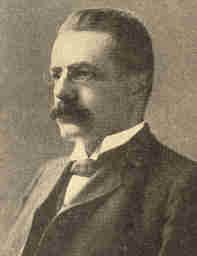
Photograph by Rice.
George B. Cortelyou,
Secretary of the Department of Commerce and Labor.
Among the problems engaging President Roosevelt none was of wider
interest than the construction of an Atlantic-Pacific canal. A
commission of nine, Rear-Admiral Walker its head, had been set by
President McKinley to find the best route. It began investigation in
the summer of 1899, visiting Paris to examine the claims of the French
Panama Company, and also Nicaragua and Panama. It surveyed, platted,
took borings, and made a minute and valuable report upon the work which
each of the proposed canals would require.
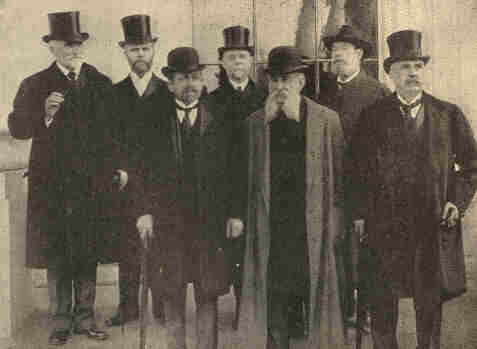
The Isthmian Canal Commission, taken March 22, 1904.
1. Col. Frank J. Hecker. 2. William Barclay Parsons. 3. Wm. H. Burr.
4. C. E. Grunsky. 5. Ad. J. G. Walker. 6. B. M. Harrod. 7. Gen. Geo. W. Davis.
The most practicable routes were Nicaragua and Panama. The Nicaragua way
was between three and four times the longer--183 miles to 49; 38 hours
from ocean to ocean as against 12. The Panama way was straighter, had
less elevation at its summit, and required fewer locks. Congress finally
decided to construct a high level lock-canal. The cost of keeping up and
operating a Panama canal was estimated at six-tenths that of one across
Nicaragua. Harbor expenses and facilities would be nearly the same for
both lines. The time required for construction, probably nine or ten
years, would be a trifle the less at Nicaragua. Control works, to keep
always the proper depth of water in the canal, could be more easily
maintained at Panama.
Panama political and commercial complications were serious. The isthmus
was Colombia territory, and, since October, 1899, a civil war had been
raging in that republic. Its financial condition was desperate. Two
hundred million inconvertible paper pesos had depreciated to the value
of two cents each in gold, yet were legal tender for all obligations. In
such a country, especially as war was in progress, the only government
able to maintain itself was despotic. Civil troubles were intensified by
dissension between Catholics and Protestants. Revolution accompanied any
change in administration.
Under Ferdinand de Lesseps, creator of the Suez Canal, the French
company had performed extensive excavations at Panama. The New Panama
Canal Company of France held certain concessions from the Colombian
government. The value of its assets was $109,000,000 at most. If we dug
at Nicaragua these would be worth little. Besides, a Nicaragua canal
completed, some $6,000,000 of stock owned by the French company in the
Panama railroad would dwindle in value.
The validity of the French company's rights was questioned. Its
agreement to work some each year had not been kept. Its charter was to
expire in October, 1904, but, for 5,000,000 francs, the Colombia
President granted a six-year extension. Even with this the French
franchise would revert to Colombia in 1910. Colombia wished delay. The
United States transcontinental railroads did not want a canal, as it
would divert from them heavy, bulky, and imperishable freight. They
therefore joined Colombia in seeking delay, playing off the Nicaragua
plan against the Panama, hoping to defeat both.
Late in 1901, newspapers in the United States began urging the purchase
from Colombia of a land belt across the isthmus to be United States
territory. Our Senate, December 16, 1901, by a vote of 72 to 6, ratified
the Hay-Pauncefote treaty with Great Britain, in which it was agreed
that we should build a canal, allowing all other nations to use it.
Meantime, spite of the fact that the Walker commission had recommended
Nicaragua route, public sentiment began to favor Panama. Even the Walker
commission changed to this view.
The Spooner act of Congress, approved June 28, 1902, authorized the
President to build an isthmian canal. The Panama properties and
franchises were to be bought if he could get good title and also obtain
the fee of a right of way from Colombia; otherwise he must pierce
Nicaragua. The act provided for all necessary funds. The French
company's claims were investigated, pronounced valid, and in due time
acquired by the United States.
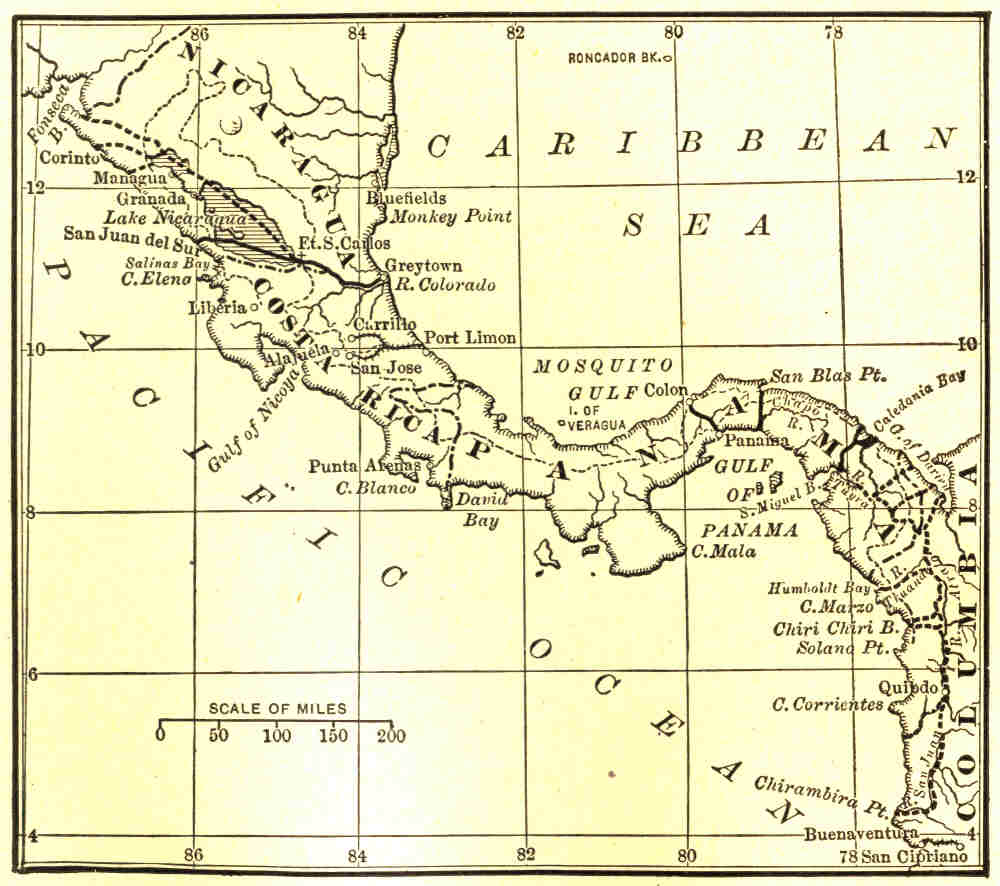
The American Isthmus, showing routes investigated for a ship-canal.
Solid Lines--Routes investigated by the Isthmian Canal Commission.
Dashed Lines--Routes investigated by others.
Effort to secure from Colombia the required territorial rights was made
in the proposed Hay-Herran treaty, ratified by our Senate, 73 against 5,
March 17, 1903, under which we were to pay Colombia, besides an annual
rental $10,000,000 for the lease of a belt six miles wide from sea to
sea. August 17, 1903, the Colombian Senate rejected this treaty, and,
October 18, the government of that country proposed another, involving
the payment by us of $25,000,000 instead of $10,000,000. If we offered
this, would not the price rise to $30,000,000 or more?
Papers in the United States argued for a revolution in Panama. The
isthmus, it was urged, was in time nearer to Washington than to Bogota.
All Panama interests centred in the canal. Should Nicaragua get the
canal, Colon and Panama would be deserted. Both places owed their peace
to the presence of our navy. On the principle that treaties concerning
territory run with the territory, ignoring changes of sovereignty, our
time-honored obligation to keep peace on the isthmus, bound us, if
Panama set up for herself, to protect her even against Colombia. England
would concur. English ships would use the canal more than ours. Great
Britain, risking and spending nothing, would gain incalculably. France,
too, would acquiesce. The Frenchmen got some $40,000,000 if the canal
crossed Panama but lost everything if it passed to Nicaragua. Other
European nations wished the canal built and felt that now was the
accepted time. Latin-American States alone showed sympathy with
Colombia.
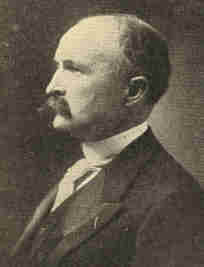
Photograph by Clinedinst.
M. Bunau-Varilla, Minister from Panama.
Revolution took place. On the afternoon of November 3, 1903, the Panama
city council declared that city independent of Colombia. Colon followed.
A provisional Panama government was organized. November 6 we recognized
Panama as an independent State. November 7 she appointed M.
Bunau-Varilla her diplomatic agent at Washington. November 13 he was, as
such, formally received by President Roosevelt. November 18 Secretary
Hay and M. Bunau-Varilla signed a treaty whose first article read: "The
United States guarantees and will maintain the independence of the
Republic of Panama." Articles II and III gave us, in effect, sovereignty
over a ten-mile wide canal zone between the oceans. This treaty was
ratified by Panama December 2, and by our Senate February 23, 1904.
November 16, 1903, Colombia protested to Great Britain against our
action, and, November 28, offered us a canal concession free if we would
permit her to subjugate Panama.
Both at home and abroad the administration was charged with sharp
practice for its Panama coup, and the case made out by critics was prima
facie strong--less, indeed, on its legal than on its ethical and
prudential side. We had allowed ourselves to profit by Colombia's
distress, encouraged secession in federal republics like our own, and
rendered ourselves and our Monroe doctrine objects of dread throughout
Central and South America. Still, Colombia had been so stiff and greedy
and the settlement was in the main so happy, that censure soon subsided.
All the powerful nations speedily followed our example and recognized
Panama's independence.
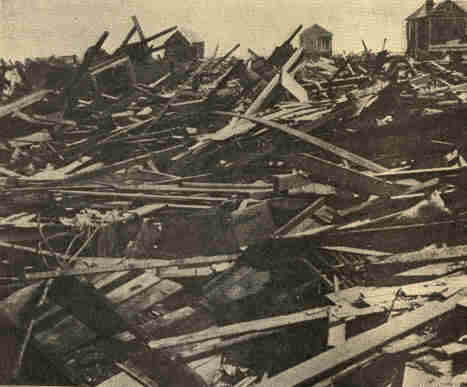
Copyright, 1900. by Underwood & Underwood, N. Y:
Great heaps of wreckage piled high by the Galveston disaster.
In September, 1900, the city of Galveston was visited by one of the
greatest disasters known in American history. A fierce storm swept the
waters of the gulf over the island on which Galveston is situated,
destroying property aggregating many millions of dollars and causing the
loss of 6,000 lives out of the total population of 37,000. For a time it
seemed that the site of the city would have to be abandoned, for the
highest land on which buildings stood was but a few feet above the
highest waves. It was determined, however, to build a stone wall three
miles in length which should be massive enough to protect the city from
any similar attack. Its top, which is five feet thick, is three feet
above the highest point reached by the water. The bottom of the wall is
sixteen feet thick. This wall, which is built concave toward the gulf,
is protected by earth and stone filled in for two hundred feet, thus
providing a driveway thirty feet wide with walks on either side,
beautified with trees and shrubs.
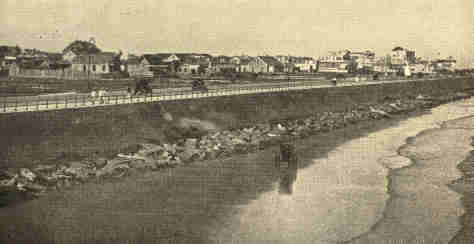
Photograph by H. H. Morris.
The boulevard and sea-wall, Galveston. Built after the flood.
The management of public affairs during the rebuilding of the city was
entrusted to a committee of experts. So efficiently and economically was
the administration of the government, that the Galveston Plan, commonly
spoken of as the Commission Plan, soon became a model for municipal
organization. A modification of this plan was soon put into operation at
Des Moines, Iowa. This plan consists of government by five salaried
persons, one of them acting as mayor. This body performs both
legislative and executive duties, each member being in charge of a
department of the city government. The arguments in favor of this type
of government are: (1) Responsibility is easily located; (2) a few men
receive such salaries that they may be expected to give their whole time
to the duties of their offices; (3) more civic interest will be aroused.
All officers are subject to removal at any time by vote of a certain
proportion of the people.
The Cuban government was organized in the spring of 1902. On May 20 of
that year, Governor-General Wood for the United States turned over the
government house at Havana to President Tomaso Estrada y Palma.
The ceremonies attending the transfer were impressive. A letter from
President Roosevelt addressed to the President and the Congress of the
Republic of Cuba was handed to President Palma. This declared the
occupation of Cuba by the United States to be at an end and tendered the
sincere friendship and good wishes of this country. At noon General Wood
hauled down the American flag, which had floated above the Governor's
palace at Havana, and assisted General Gomez in raising to the breeze
the red triangle with central silver star and three blue and two white
stripes constituting the flag of the new republic. All of the foreign
ships in the harbor likewise ran up the Cuban flag in honor of the
occasion. Forty-five shots, one for each State in the Union, were fired
as the stars and stripes were lowered from Morro Castle and the other
fortresses. The American troops saluted the new emblem, fired twenty-one
guns in honor of the new nation, and then embarked for the United
States. Thus was kept to the letter--a noble example of public
faith--the promise we made when invading Cuba, that we would not acquire
territory.
Copyright, 1902, by Underwood &Underwood, N.Y.
Tomaso Estrada y Palma,
First President of Cuba, in the palace, Havana.
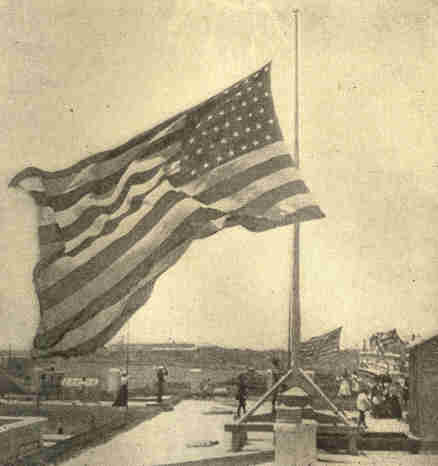
Copyright. 1902, by Underwood & Underwood.
Lowering the Stars and Stripes on the palace,
May 20, 1902, for the flag of the Cuban Republic.
Those who prophesied a short life for the new republic and a reign of
fraud and corruption were mistaken. During the first year economy became
the rule in the administration of all branches of the public service,
the government was self supporting, and a balance accumulated in the
treasury. Moreover, the reforms inaugurated by Americans continued. Some
3,400 teachers were employed in the island and 120,000 pupils were in
constant attendance upon the schools. In all parts of the island the
effects of American rule were visible. Ten million dollars had been
expended in sanitation reforms and the cleansing of Havana and the other
cities. Industrial schools for orphan boys and girls were begun and
hospitals and asylums for the sick, helpless, and insane were
reestablished. By 1901 a railroad, with branch lines, was constructed
between Santiago and Havana, thus giving the whole island excellent
transportation facilities.
Cuba could not gain prosperity at a bound. Whereas the island should,
under natural conditions, have had $30,000,000 to $40,000,000 due her
from foreign countries in 1902, she was $50,000,000 in debt. Her
manufactures were insignificant. It was estimated that, in the year
named, $80,000,000 of American money was invested in Cuba. The main
enterprises were railroads, sugar and tobacco plantations, mines, and
fruit farms.
Free commercial intercourse with Spain no longer existing, Cuban sugar
and tobacco producers sought markets in the United States, leading to
the "reciprocity" conflict touched upon in Chapter XIII, Vol. V. During
1902 a reciprocity treaty was negotiated and promptly ratified in Cuba.
Our Senate amended it and returned it to Cuba for reconsideration.
Brought hither again, it was passed by our Senate in December, 1903.
President Roosevelt signed it December 17, declaring its provisions
effective in ten days.
The Philippine Commission (Chapter XV, Vol. V), four Americans and three
islanders, at first enacted laws by the authority of the President as
Commander-in-Chief. After the Congressional Act of July 1, 1902, the
formula ran: "By authority of the United States be it enacted by the
Philippine Commission." The government was pronouncedly civil both in
nature and in spirit, the natives being gradually placated, and only an
occasional outbreak demanding the presence of troops. Schools were
established, the English language and American ideas of government and
business introduced. No promise of Philippine independence was given,
yet the tenor of our whole policy toward the Filipinos, of official
utterances and of public sentiment relating to them, was to the effect
that we should never look upon any of the islands as a crown colony.
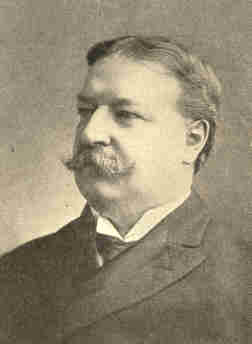
Gov. William H. Taft
[Secretary of War, 1905.]
The same interests that forbade Cuban reciprocity opposed tariff
concessions to the Philippines. A 25 per cent reduction from the Dingley
rates was the best that Congress would grant, though the commission
besought one of at least 75 per cent. For a time our behavior in this
too much resembled English and Spanish dealings with colonies centuries
ago. The United States acquired from the Philippine religious orders
422,337 acres of land, three-fifths of it highly cultivated and thickly
inhabited, for $7,239,000. In all, the government owned about 61,000,000
out of the perhaps 70,000,000 acres of land in the islands. Of the
government lands, 40,000,000 acres were forest.
The law of July 1, 1902, to supplement the commission, provided for a
native assembly of not more than 100 members or less than 50, with
annual sessions of 90 days. Municipal autonomy was allowed and became
common. An efficient constabulary was established, also a Philippine
mint and coinage system on a gold basis. Careful exploitation of the
agricultural, mineral, and other resources of the islands was provided
for, as well as an increasing number of public improvements in the
interest of order, health, and cleanliness. To promote investment in the
Philippine public works, 4 per cent bonds were issued, guaranteed by the
United States.
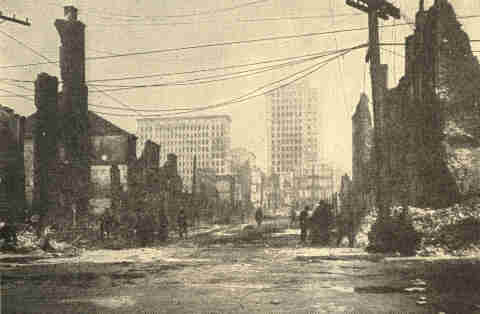
The Baltimore fire.
Lombard and Calvert Streets, Showing Continental and Equitable Buildings.
[1904]
Preparatory to forming the Philippine Assembly the commission took a
census of the islands. In 1905 the population returned from 342 islands
was 7,635,426. Of this number only about 9 per cent were wild tribes,
though more than half the entire population could neither read nor write
in any language. Of the 370,000 pupils in the newly established schools,
or double the number in attendance two years previously, one in nine on
the average had some understanding of English. Twelve thousand adults
were in the night schools, chiefly engaged in acquiring the English
language.
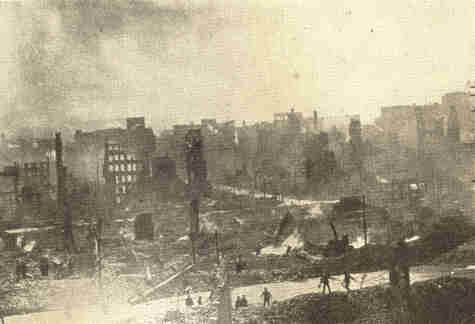
The Baltimore fire.
Hopkins Place and German Street, looking east.
In February, 1904, a fire broke out in the heart of the city of
Baltimore. Some 1,337 structures were either entirely destroyed or
rendered unfit for occupancy. The loss in buildings and other property
destroyed was about $75,000,000. With a few exceptions, the financial
district of the city was burned. For a time it was feared that the
losses would be so great that restoration could not be made, but new
plans were projected which included broader streets and better
buildings. Instead of a decrease in the number of business concerns,
there was an increase through the entrance of firms from the outside.
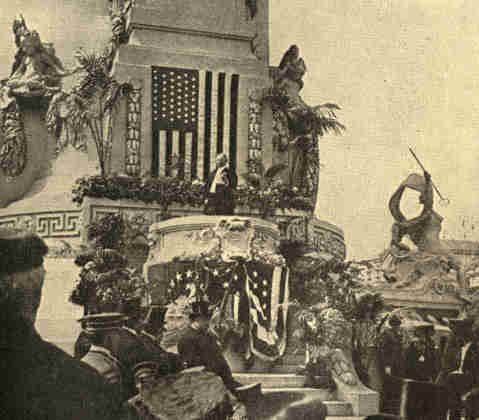
Copyright, 1904. William H. Rau, Philadelphia.
Opening Day at the Louisiana Purchase Exposition.
President D. K. Francis delivering the opening address.
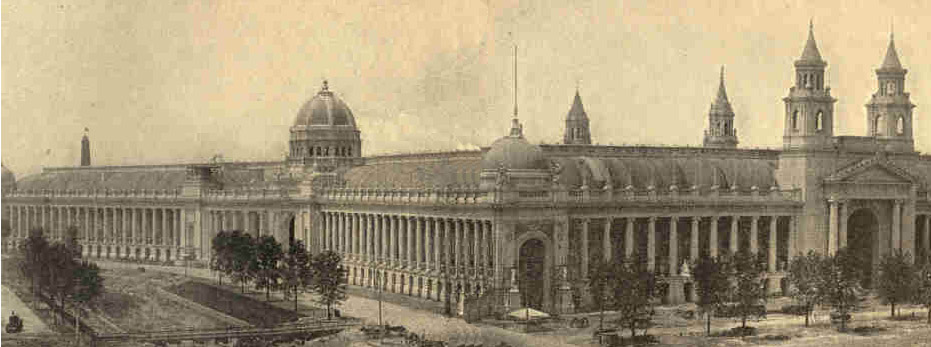
The Varied Industries Building.
THE LOUISIANA PURCHASE EXPOSITION.
The Louisiana Purchase Exposition at St. Louis was opened April 30,
1904, and continued for seven months. It commemorated the acquisition of
the Louisiana territory which was consummated April 30, 1803, marking
one of the greatest events in American history. Out of this area had
been carved thirteen States and two territories wherein over 17,000,000
people were making their homes.
The design for the exposition represented the work of ten of the most
distinguished architects of the country. The buildings, grouped in
perfect taste, mostly of noble style, had 128 acres of floor space, far
beyond that at the disposal of any preceding fair. The grounds also were
unprecedentedly ample and beautifully diversified, containing about
1,200 acres. The total attendance, 18,741,073, fell short of that at
Chicago in 1893 by over 8,000,000.
The general plan of the exposition was intended to symbolize the history
of the Louisiana territory representing the successive occupants of the
soil--the wild animals; the Indians; the discoverers; the explorers;
the hunters; the trappers, and the pioneers. The aim was to make it one
vast educational object lesson. To that end there were extensive
exhibits from thirty States and from the chief cities of work done in
the primary and secondary schools and in the universities and colleges
of the country. This feature culminated in the International Congress of
Arts and Sciences. Over 100 of the leading scholars from England,
France, Germany, Holland, Italy, Japan, the United States, and a number
of other countries made addresses and took part in the various
discussions. All the fields of human knowledge were represented by these
specialists.
One feature of this exposition was unique: it represented to an
unprecedented extent processes in lieu of products or in addition to
them. Every day at almost every point something was literally doing,
going on. Machinery whizzed, mines were operated, artists were at work,
experts showed their craft; Indians, Filipinos, the blind, deaf, and
dumb were taught.
CHAPTER III
PRESIDENTIAL ELECTION OF 1904
[1904]
The Republican convention met at Chicago, June 21, and on June 23
nominated Theodore Roosevelt for President. President Roosevelt's
nomination was a certainty from the beginning. This action was demanded
by the rank and file of Republicans, for his achievements were popular.
Among the problems which he had helped to solve were those growing out
of the war with Spain; settlement of the anthracite coal strike;
creation of the Department of Commerce and Labor; and the investigation
and prosecution of dishonesty in the post-office department.
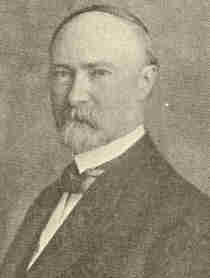
Charles W. Fairbanks,
Vice-President of the United States.
Plans for the convention had all been matured in advance with the
exception of the selection of a candidate for Vice-President. By the
time the convention assembled the opinion was general that for
geographical reasons some one from Indiana should be named for this
office. Charles Warren Fairbanks, a leading lawyer in Indianapolis, who
was serving his second term in the United States Senate, was nominated
without any real opposition. He had served as a member of the Joint High
Commission to adjust international questions of moment between the
United States and Great Britain. Grover Cleveland and William Jennings
Bryan had declared they would not be candidates for the presidency and
the Democratic party was in a dilemma. Both the conservative and the
radical elements of the party declared they would write the platform and
name the candidates. Alton Brooks Parker, Chief Judge of the Court of
Appeals of New York, who was supported by Grover Cleveland, came
gradually into prominence as the candidate of the conservatives and
William Randolph Hearst of the radicals.
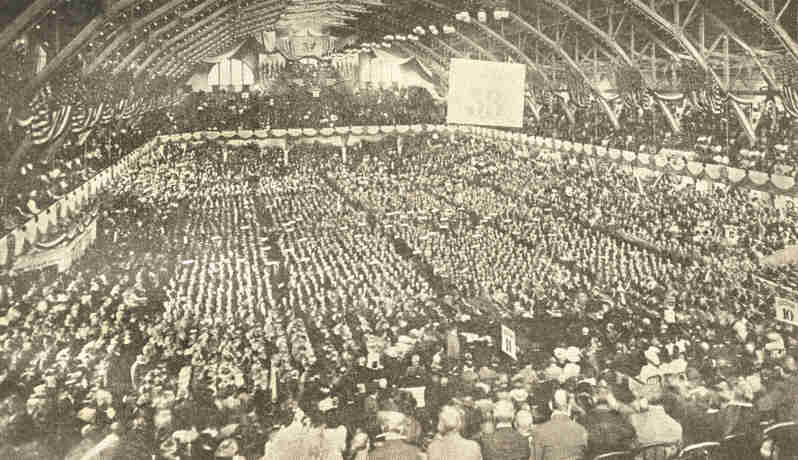
The Republican convention at Chicago, 1904.
The chief contest came in the Democratic convention of New York. There
Judge Parker was supported by David B. Hill, ex-United States senator,
and August Belmont, a New York banker. In consequence it was declared by
the opposition that Judge Parker was the candidate of the trusts, Wall
Street magnates, and a class of politicians of which Hill was the type.
This view was taken by Bryan. In spite of the opposition of Tammany
leaders and the Hearst faction, twice as many Parker as Hearst delegates
were chosen.
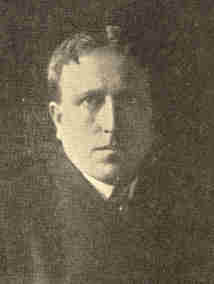
William R. Hearst.
In the convention, which met at St. Louis, July 9, Judge Parker received
658 votes for President on the first ballot, Hearst received 200, and
there were a few scattering votes. The requisite two-thirds came to
Parker before the result of the ballot was announced. Henry G. Davis, of
West Virginia, was named for the office of Vice-President.
He had served two terms in the United States Senate, had declined the
office of Post-Master General under President Cleveland, was very
wealthy, and noted for his philanthropy.
Bryan demanded that the platform should be silent on the question of the
money standard, but Parker declined the nomination unless it should be
understood that he would maintain the gold standard, and his declaration
was endorsed by the convention.
There were no distinguishing issues between the two leading parties. The
money question had disappeared and both parties were outspoken in their
declarations against trusts and combinations of capital.
The Populist party, in a convention made up of delegates from one-half
the States, nominated Thomas E. Watson, of Georgia, and Thomas H.
Tubbles, of Nebraska, for President and Vice-President, respectively.
There were two Socialist conventions: one, that of the Social Democratic
party, nominated Eugene V. Debs, of Indiana, for President, and the
Socialist Labor party named Charles H. Corregan, of New York, for the
same office. The nominees of the Prohibitionist party were Silas C.
Swallow, of Pennsylvania, for President, and George W. Carroll, of
Texas, for Vice-President.
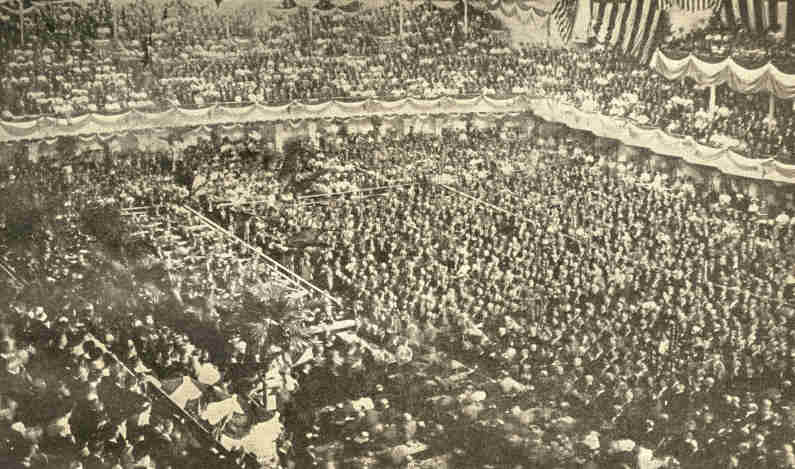
The Democratic convention at St. Louis, 1904.
The campaign was noteworthy on account of the apathy which was very
general. Heated discussions so characteristic of previous political
contests were seldom heard, and arguments were addressed to the
intelligence of voters rather than to passion and prejudice.
It has been called a reading rather than a speaking campaign. The
leading Republican document was a pamphlet containing two notable
addresses. One of these was delivered by John Hay at Jackson, Mich., on
the occasion of the celebration of the semi-centennial of the founding
of the Republican party. He attributed to that party the success in the
conduct of public affairs since 1860, and praised President Roosevelt as
a man and great administrator. The other speech was similar in content,
and was delivered by Elihu Root as temporary chairman of the Republican
convention.
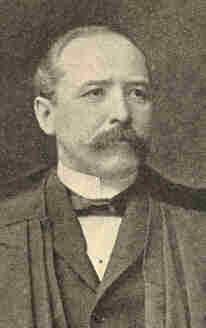
Alton B. Parker.
Toward the close of the campaign, the charge was made that the
Republicans were endeavoring to win through a wholesale purchase of
votes. It was asserted that George B. Cortelyou, manager of the
campaign, having obtained secrets of the conduct of some of the great
corporations, was using that knowledge to force them to contribute to
the Republican fund. A second charge proclaimed that the administration
had changed its attitude toward certain corporations and that the
magnates of Wall Street, having decided to elect Roosevelt, were
contributing generously to the Republican campaign fund. Shortly before
the day for the election, Judge Parker in a series of speeches announced
his belief in these reports. President Roosevelt declared that no proof
for the statements could be produced, and ended as follows: "The
statements made by Mr. Parker are unqualifiedly and atrociously false.
As Mr. Cortelyou has said to me more than once during this campaign, if
elected I shall go into the presidency unhampered by any pledge,
promise, or understanding of any kind, sort or description, save my
promise, made openly to the American people, that so far as in my power
lies I shall see to it that every man has a square deal, no less and no
more." In his reply, Judge Parker reiterated the charge, but gave no
concrete instances of money having been obtained from corporations.
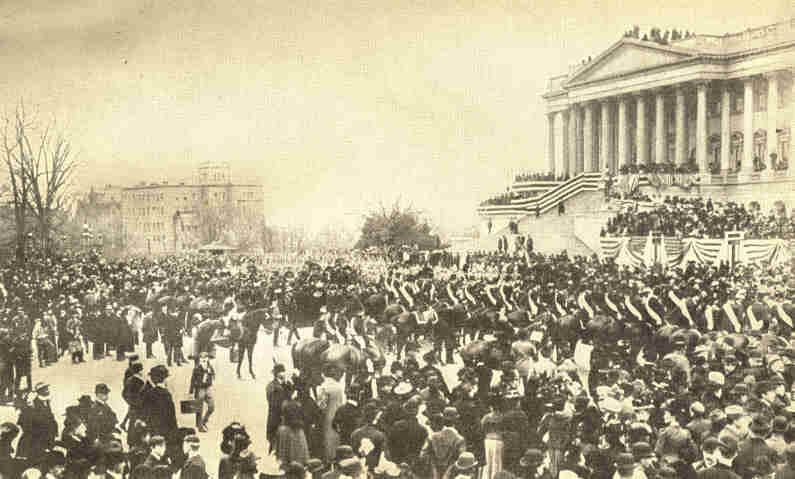
Photograph by Clinedinst, Washington, D. C.
Inauguration of President Roosevelt, March 4. 1905.
Out of a total vote of 13,544,705, Roosevelt received 7,630,893 votes,
or 2,524,244 more than his leading competitor. His majority was
1,717,081. Debs received 397,308 votes; Swallow, 258,039; Watson,
114,306; Corregan, 32,516. Thirty-three States gave Roosevelt majorities
and twelve Southern States returned majorities for Parker. In the
electoral college Roosevelt received 336 votes and Parker 140. A
surprising feature of the election was the large number of independent
votes cast, as shown by the fact that Minnesota, Massachusetts,
Missouri, and Montana, while giving majorities for the Republican
candidates, elected Democratic governors, and in several other States a
similar tendency was manifest in the divergence between the vote for the
national candidates and local candidates.
CHAPTER IV
AMERICA AND THE CHINESE OPEN DOOR
[1905]
The aggressive policy of President Roosevelt continued throughout the
four years succeeding March 4, 1905, when he again took the oath of
office as President. In his suggested reforms he continued to be a real
leader of the people. John Hay, who for seven years had so efficiently
performed his duties as Secretary of State, was continued in that
office. William H. Taft, after his return from the Philippine Islands,
where he had held the office of first civil governor, succeeded Elihu
Root as Secretary of War.
The United States, having become a world power after the war with Spain,
assumed leadership in the adjustment of Chinese problems. At the close
of the century American manufacturers had built up in China a market for
their cotton goods which they desired to extend. At the same time strife
arose among some of the European nations for trade advantages in that
empire. Great Britain, France, Germany, Russia, and Italy were demanding
for their citizens concessions, leases, franchises, and special trade
privileges in various parts of that country. Gradually, spheres of
influence covering certain regions were acquired and it seemed probable
that China would be partitioned among the European Powers as Africa had
been in the previous decade. This would be a blow to American export
trade. Now the acquisition of the Philippine Islands gave us a vantage
point from which we could consistently exert influence in Oriental
affairs. In September, 1899, John Hay addressed a note to the European
Powers interested, asking recognition of the policy of the "open door,"
which means that no power should exclude the citizens of other nations
from equal trade rights, within its sphere of influence, in China.
Without winning complete acceptance from all the nations, the justice of
this policy was, in the main, approved.
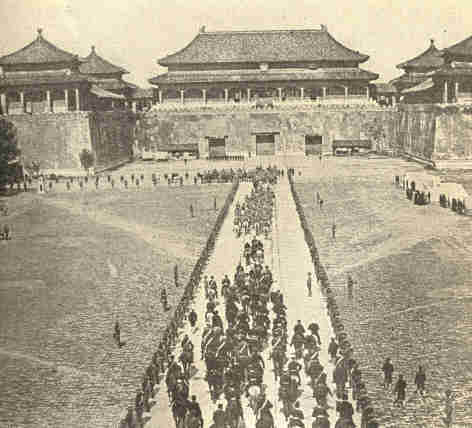
Copyright by Underwood & Underwood, N.Y.
Count Von Waldersee escorted by officers of the allied armies
between lines of U. S. troops toward the Sacred Gate, Peking.
During the following year came the Boxer Rebellion in which there were
massacres of Europeans and Americans. When the foreign legations were
besieged in Peking, United States troops took part in the expedition
which marched to their relief. Seizure of Chinese territory, as
indemnity, might have followed, but Secretary Hay brought the influence
of this country to bear in securing guarantees of the territorial
integrity of China and equal trade rights in its ports.
Friendly relations between the Chinese Empire and the United States were
still further strengthened by the liberal attitude of our government
relative to the indemnity growing out of the Boxer uprising. The total
amount which China had obligated itself to pay the governments,
societies, and private individuals was $333,000,000. Of this sum,
$24,400,778 was allotted to the United States. As a mark of friendship
for China, Congress upon the recommendation of President Roosevelt,
1907, cancelled the obligation of China to pay that part of the
stipulated indemnity in excess of $11,655,492, or an amount adequate to
cover the actual amount of the claims. This generous conduct prompted
the Chinese government to devote the funds thus remitted to the sending
of Chinese students to this country for their education. About one
hundred of these students have entered our schools and colleges each
year since 1907. American institutions will, as a consequence, have a
great influence on the progressive development of China.
For some time Russia had been extending her influence over the Chinese
tributary province of Manchuria. In 1903 negotiations for a new
commercial treaty were begun between China and the United States. There
were numerous delays on account of an agreement relative to opening the
Manchurian ports. For a time it seemed probable that the American demand
that her trading rights should be restored in Manchuria would bring on
serious complications with Russia. Upon the completion of the treaty,
however, the request was renewed and China acquiesced by opening the
ports of Mukden and Ta Tung Kao to the ships of all nations. At the same
time Russia agreed that she would in no way oppose this action.
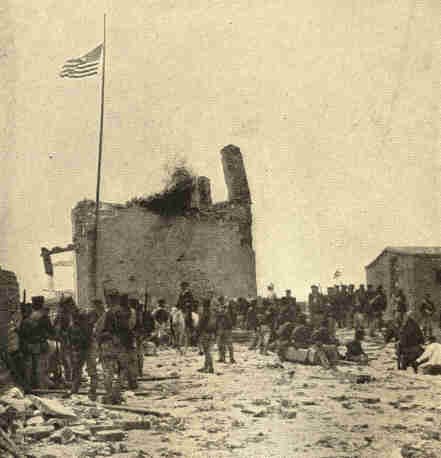
Copyright 1901, by Underwood & Underwood.
American flag raised over battered remnants of South Gate
immediately after city's capture. Battle of Tien-Tsin, China.
At the outbreak of the war between Japan and Russia, in 1904, Secretary
Hay took another step toward maintaining the administrative entity of
the Chinese Empire. At the suggestion of Germany he addressed a note to
the powers which had taken part in the treaty of Peking, asking them to
pledge themselves to limit the area of the war; keep China from becoming
involved, and use their best endeavors to prevent the violation of
Chinese interests by either belligerent, provided China should maintain
absolute neutrality. These proposals were agreed to by the signatory
nations, and both Russia and Japan promised to respect Chinese
neutrality.
Meantime a new national spirit had been developing rapidly in China and
a greater sensitiveness was manifest toward the treatment of Chinese
outside the empire. The strict interpretation of the Chinese Exclusion
act had caused many Chinese entering the ports of the United States
unwarranted hardships. A crisis was reached in 1905.
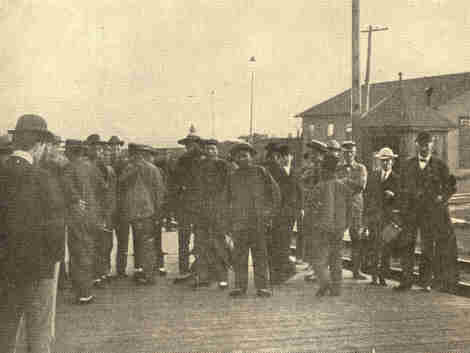
Arrival of Chinamen at Malone, N. Y.,
from Canada, accompanied by officials.
According to the rules adopted by the Secretary of Commerce and Labor,
neither the immigration acts nor the Chinese exclusion acts apply to a
Chinese person born in the United States. Under the laws, all Chinese
laborers, both skilled and unskilled, are prohibited from entering the
United States, but this prohibition does not extend to merchants,
teachers, students, and travellers who are to be granted all the rights,
privileges, and exemptions accorded the citizens of any other nation. In
spite of these rulings, Ju Toy, who claimed to have been born in the
United States, was deported. Three Chinamen, with their sister, who had
been studying in the English schools came to Boston. Notwithstanding
they had a letter from Mr. Choate, former United States ambassador to
Great Britain, they were not allowed to land with other passengers, and
were otherwise humiliated by the formalities to which they were
subjected. Men of influence throughout the Chinese Empire were aroused
and a circular was issued, in May, 1905, which was widely disseminated
in the chief cities, calling for agreement not to buy any more American
goods. Newspapers urged students to leave schools where American
teachers were employed or American text-books or supplies were used. At
this juncture President Roosevelt was appealed to by the American
members of the Chinese Educational Association. Acting with his
accustomed vigor, he issued instructions to the Secretary of Commerce
and Labor to send a letter to all immigration officials, instructing
them that "any discourtesy shown to Chinese persons by any officials of
the Government will be the cause for immediate dismissal from the
service." In his message to Congress he declared that it was Chinese
laborers alone who are undesirable, and that other Chinamen--students,
professional men, merchants--should be encouraged to come to the United
States. "We have no right," he wrote, "to claim the open door in China
unless we do equity to the Chinese."
CHAPTER V
INTERNATIONAL ARBITRATION
[1903-1905]
Great progress was made during the nineteenth century toward the
settlement of differences between nations through arbitration. The
United States was a party to 50 out of the total number of 120
arbitration treaties. Questions settled in this manner, such as
boundary, damages inflicted by war or civil disturbances and injuries to
commerce, would formerly have led to war. Twenty of these cases have
been between the United States and Great Britain, and a settlement was
effected when, at times, it seemed as if war could not be averted.
The work of the Hague Peace Conference, which met May 18, 1899,
constituted a fitting close to the efforts which were put forth during
the century to bring about conciliation through arbitration. The
conference assembled in response to an invitation issued by the Czar of
Russia "on behalf of disarmament and the permanent peace of the world."
One hundred and ten delegates were present, representing twenty-six
different powers of which the United States was one. The delegates were
divided into three commissions, each having separate subjects for
consideration.
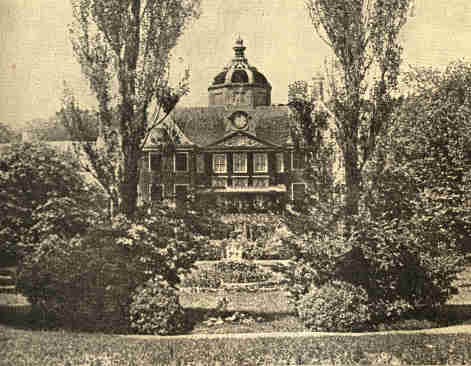
The House in the Woods, The Hague, Holland,
where the first Peace Conference was held.
The first commission adopted unanimously the resolution that "the
limitation of the military charges which so oppress the world is
greatly to be desired," but agreed that this could not now be
accomplished through an international compact.
In the second commission a revision of the Declaration of Brussels
concerning the rules of war was made. It was agreed by the entire
conference that a new convention for this purpose should be called, and
that the protection offered by the Red Cross, as agreed upon in the
Geneva convention, should also be extended to naval warfare.
The proposition expressing the desire that international conflicts might
in the future be settled through arbitration was considered by the third
commission. Said ex-President Harrison: "The greatest achievement of the
Hague conference was the establishment of an absolutely impartial
judicial tribunal." Some of the chief features of this permanent court
of arbitration were as follows:
(1) Each nation which agreed to the plan was to appoint, within three
months, four persons of recognized competency in international law, who
were to serve for six years as members of the International Court;
(2) an International Bureau was established at The Hague for the purpose
of carrying on all intercourse between the signatory powers relative to
the meetings of the court and to serve also as the recording office, for
the court;
(3) nations in dispute may select from the list of names appointed as
above, and submitted to them by the bureau, those persons whom they
desire to act as arbitrators;
(4) the meetings of the court are to be held at The Hague unless some
other place is stipulated by the nations in the controversy.
The permanent International Court of Arbitration was declared to be
organized and ready for operation by April, 1901. At that time there
were seventy-two judges appointed by twenty-two of the signatory powers,
It is readily seen that the advantages of such a court are that
unprejudiced arbitrators are selected, rules of procedure are defined,
and decisions rendered are more liable to be accepted in future cases
and thus a code of law will be formed. So many cases have been submitted
to this tribunal that it has been said that a government which will not
now try arbitration before resorting to arms is no longer considered
respectable. This court was convened for the first time May 18, 1901.
The first case coming before the tribunal--the Pious Fund Case--was
presented by the United States and Mexico, September 15, 1902. Up to
1846 the Mexican government had paid annual interest on some property
administered by it but belonging to the Catholic church. Part of it was
situated in what is now California. After 1848, when this California
estate came under United States jurisdiction, Mexico refused to pay that
part of the church outside of Mexico its share. This difference between
our Government and Mexico the Hague Tribunal took up.
Agreeably to chapter 3, title 4, of the agreement, each party named two
arbitrators, and the latter, acting together, an umpire. In case of an
equality of votes a third power, designated by agreement of the parties,
was to select the umpire. The arbitrators chosen were M. de Martens, of
the Orthodox Greek church; Sir Edward Fry, an English Protestant; M.
Asser, a Jew, and M. Savornin-Loman, a Dutch Protestant. Decision was
reached within the prescribed thirty days and announced October 14,
1902. It favored the United States contention, giving its proportion of
the Mexican payments to the Catholic church in California.
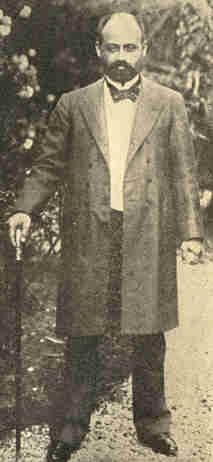
President Castro of Venezuela.
A second case, involving issues of war and peace, arose from the action
of Great Britain and Germany against Venezuela in the winter of
1902-1903. Subjects of these as well as of other powers had claims
against Venezuela. That country was in financial straits and its
creditors pressed. December 9, 1902, British and German war-ships sunk
or seized some Venezuelan vessels; next day they landed marines at La
Guayra, who took possession of the custom house; the 14th they bombarded
and demolished a fort at Puerto Cabello. Through the good offices of the
United States the matter of debts was referred to the Hague Tribunal.
The German claims were decided by two representatives of Germany and two
of Venezuela, or, if they disagreed, by an umpire whom the United States
selected. So with the other claims. The tribunal fixed the order in
which Venezuela should pay the different countries, and the United
States was charged with overseeing the payments, a percentage of
Venezuelan customs receipts being reserved for that purpose.
In 1903 Andrew Carnegie donated $1,500,000 for the purpose of erecting a
"palace of peace," the permanent head-quarters of this court. The deed
of trust states: "The establishment of a permanent Court of Arbitration
by the treaty of the 29th of July, 1899, is the most important step
forward, of a world-wide humanitarian character, that has ever been
taken by the joint powers, as it must ultimately banish war, and
further, being of opinion that the cause of peace will greatly benefit
by the erection of a court house and library for the permanent Court of
Arbitration," etc.
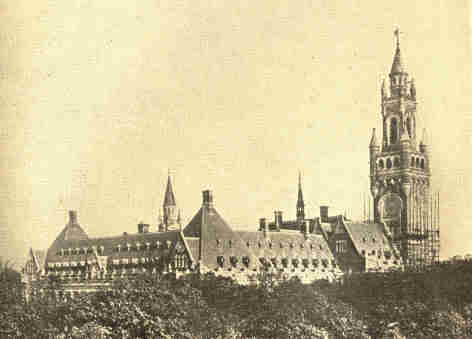
The new Peace Palace, The Hague, Holland.
The site of this building, which will be ready for occupancy in 1912, is
near The Hague. Its exterior will resemble some of the old city walls to
be seen in Holland. The various governments which were parties to the
treaty have contributed materials for the completion of the interior and
objects of art for decoration. The United States presented a large
marble group of statuary called "Peace Through Justice."
Two notable congresses were held in the United States during the year
1904, for the purpose of promoting the peace of the world. The
Inter-Parliamentary Union held a meeting, the twelfth in its history, in
connection with the World's Fair at St. Louis. This organization was
founded at Paris in 1888 by thirty members of the French Chamber of
Deputies and ten members of the British Parliament, for the purpose of
promoting the cause of peace and arbitration. Scoffed at from the
beginning, the Union continued to grow until it included parliamentary
delegates from every European country having a constitutional form of
government.
The meeting of the Union at St. Louis was the first to be held in the
United States, for this country took no part in the organization until
1903. Russia and Turkey, having no parliaments, are not represented in
the meetings of the Union. It is a noteworthy fact however that the Czar
sent an official representative to the meeting in 1896 and that it was
due to his report of that meeting, more than to any other cause, that
the Czar invited the nations to send representatives to The Hague in
1898.
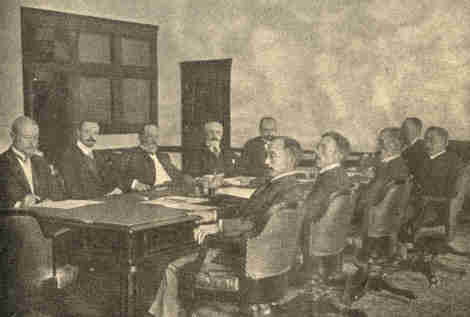
Russian and Japanese Peace Envoys in session at Portsmouth, N. H.
In the congress at St. Louis, representatives from the deliberative
bodies of fifteen nations were present. Among these delegates were some
of the well-known public men from Great Britain, France, Germany,
Austria, Italy, Belgium, The Netherlands, the United States, and various
other countries. They were practical men and not dreamers.
Two important resolutions resulted from the gathering. One of these
called upon the powers to intervene and put an end to the war between
Russia and Japan. The other invited the President of the United States
to call a second peace congress, similar to the Hague conference. The
resolution, addressed to President Roosevelt, stated that there were a
number of questions left unsettled from the first Hague conference and
that new problems had arisen since that time which demanded
readjustment, such as the use of wireless telegraphy in the time of war.
On October 3 of the same year an international peace congress was held
in Boston. Numerous congresses of this nature have been held from time
to time since the meeting of the first one in London in 1843. Since the
year 1888, when a congress was held in Paris, an international peace
congress has met each year with the exception of 1895, the year of the
Boer war, and in 1898 and 1899, on account of the Spanish-American war.
The first of these congresses in America was held in conjunction with
the Columbian Exposition at Chicago, 1893. There were in attendance at
Boston distinguished statesmen, clergymen, scholars, and professional
men, and a number of noted women, representing the many peace and
arbitration societies in Great Britain, Germany, Austria, and numerous
other countries.
On the Sunday before the opening of the congress, special services were
held in many of the Boston churches and the peace movement was discussed
by distinguished preachers from Europe and America. In the deliberative
sessions, which were held in Faneuil Hall, the Old South Meeting House,
and other places, the first session being opened by an address by
Secretary of State John Hay, the following topics, among others, were
discussed: the work and influence of the Hague Tribunal; the reduction
of the armaments of the nations; education and the peace sentiment. But
here, as in every previous congress, the two topics to receive primary
consideration have been arbitration and disarmament. At all times there
has been the urgent appeal to the nations to abandon the brutality and
injustice of war and to adopt the humane and just methods of peace.
In response to the resolution adopted at St. Louis, President Roosevelt,
on October 20, 1904, invited the nations which had taken part in the
first Hague conference to another conference at the same place. But in
his message to Congress of that year he defined very clearly his own
position, condemning in no uncertain terms the thought of peace at any
price. "There are kinds of peace," he said, "which are highly
undesirable, which are in the long run as destructive as any war. The
peace of tyrannous terror, the peace of craven weakness, the peace of
injustice--all these should be shunned as we shun unrighteous war."
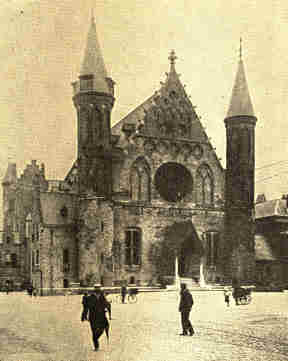
Building where the second Peace Conference
was held, The Hague, Holland.
Favorable replies to the invitation sent by President Roosevelt were
received from all the nations. Russia, then in the midst of war with
Japan, while approving, stipulated that the conference should not be
called until the end of that war. When peace was restored, in the summer
of 1905, Emperor Nicholas II issued an invitation to fifty-three nations
to send representatives to such a conference. For the first time, nearly
every independent nation on the globe was represented among the
delegates in an international gathering of this nature. It met at The
Hague during the summer of 1907.
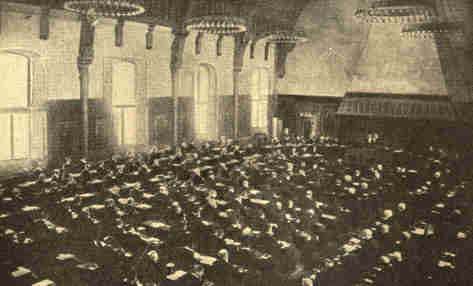
First session of the second Peace Conference, The Hague, Holland.
Delegates from the United States were instructed to favor obligatory
arbitration; the establishment of a permanent court of arbitration; the
prohibition of force in the collection of contract debts; immunity from
seizure of private property at sea; a clearer definition of the rights
of neutrals, and the limitation of armaments.
While belief was reasserted by the conference that there should be the
obligatory arbitration of all questions relating to treaties and
international problems of a legal nature, the principle was not adopted,
although thirty-two nations of the forty-five represented favored it.
The resolution adopted, which provided for the collection of contract
debts, is as follows: "In order to avoid between nations armed conflicts
of a purely pecuniary origin arising from contractual debts claimed of
the government of one country by the government of another country to be
due to its nationals, the signatory powers agree not to have recourse to
armed force for the collection of such contractual debts. However, this
stipulation shall not be applicable when the debtor State refuses or
leaves unanswered an offer to arbitrate; or, in case of acceptance,
makes it impossible to formulate the terms of submission; or, after
arbitration, fails to comply with the award rendered."
Provision was made for an international prize court, to which appeal
might be made from the prize courts of the belligerent powers. The
declaration was adopted prohibiting the throwing of projectiles and
explosives from balloons.
Before the end of the year 1908, one hundred and thirty-five arbitration
treaties had been concluded. The United States was a party to twelve of
these. Most of the treaties bind the signatory powers to submit to the
Hague Tribunal all differences in so far as they do not affect "the
independence, the honor, the vital interests, or the exercise of
sovereignty of the contracting countries, and provided it has been
impossible to obtain an amicable solution by means of direct diplomatic
negotiations or by any other method of conciliation."
CHAPTER VI
THE UNITED STATES AND LATIN AMERICA
[1905-1906]
Looking toward the completion of the Panama Canal, there has been a
revival of interest on the part of the United States in the republics of
South America. From the time of the promulgation of the Monroe Doctrine,
there has been a distant friendship on our part for these nations. The
plan inaugurated by James G. Blaine when Secretary of State is much
better understood to-day than in his time. In 1881, with the desire of
emphasizing the leadership of the United States in the western
hemisphere, he proposed a congress of all the American nations. Nothing
came of the proposal at the time, but in 1888 Congress passed a
resolution providing for such an international conference. The meeting
was in Washington the following year, and Secretary Blaine, as chairman,
exercised great influence. While the direct results of the meeting were
not great--principally a declaration in favor of the arbitration of all
disputes among these nations--the indirect benefits were considerable.
In 1901 a second Pan-American congress was held in the city of Mexico.
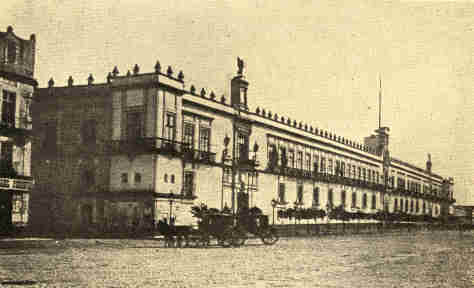
Courtesy of the Pan-American Union.
Federal Palace, where the second Pan-American
Congress was held in the City of Mexico.
In the meantime the trade with these countries has been largely
monopolized by England, France, and Germany. During the year 1905, the
total exports and imports of the Latin-American countries amounted to
$2,000,000,000. Of this foreign trade the United States bought 35 per
cent of the exports and sold to these countries only 27 per cent of
their imports, producing an unfavorable balance of trade amounting to
$200,000,000. Of the goods imported from this country, over one-fourth
went to Mexico and Cuba. In that year Brazil bought from the United
States only 11 per cent of its imports. Argentina, with a larger foreign
trade than either Japan or China, bought only 14 per cent of its imports
from the United States. With the exception of Mexico, the foreign
commerce of the Latin-American states with European countries has
increased more rapidly than with the United States. Various reasons have
been given for this situation. The sensitive South American resents the
air of superiority assumed toward them by the people of the United
States. In our newspapers there is a seeming disregard for the real
evidences of their national development. Revolutions and boundary
disputes have been exaggerated. In general, citizens of the United
States have no comprehension of the advancement of these countries
within recent times and appreciate but slightly that their economic
future is as fully assured as our own. Argentina constitutes an
excellent example of this progress. This country has an area of
1,135,840 square miles. Splendid rivers water the immense plains. The
chief of these, the Parana, which flows 2,000 miles through the country,
carries a volume of water to the sea one and one-half times that of the
Mississippi, and is capable of floating ships having a draught of 18
feet for 600 miles into the interior. Buenos Ayres, with a population of
1,000,000, in 1906 had a volume of foreign trade amounting to
$562,000,000, constituting it the twelfth port in the world. In 1905
over 10,000,000 acres of land were cultivated in Argentina, an increase
of fourfold within fifteen years. The cereals, cotton, fruits, and meats
produced amounted to $350,000,000.
That the volume of trade between this country and the South American
states has been so small has been due also to the fact that so few
vessels flying the stars and stripes are engaged in this trade.
According to the report of Secretary Root, in 1906, there were in the
harbor of Rio Janeiro the previous year, 1,785 ships flying the flag of
Great Britain; 657 the flag of Germany; 349 the French; 142 the
Norwegian, and 7 sailing vessels (two of them in distress) the flag of
the United States. The bulk of goods from this country to South America
goes by the way of European ports and on foreign ships.
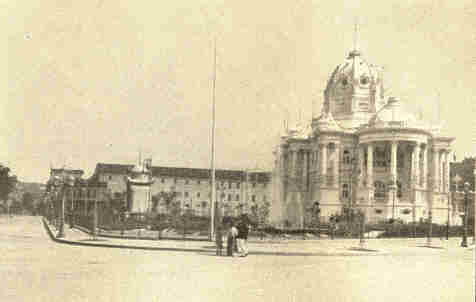
Courtesy of the Pan-American Union.
Monroe Palace, where the third Pan-American
Conference was held in Rio de Janeiro.
July 4, 1906, the third Pan-American conference was opened at Rio
Janeiro. Among the leading questions discussed were: (1) the right of
creditor nations to enforce by war on the debtor nations contractual
obligations, or the right to use gun-boats as collection agents; and (2)
those relating to commercial intercourse. Besides the regular delegates
from the United States, Elihu Root, Secretary of State, was present at
the opening session. His address at this meeting, together with his
visit to the leading cities, served to inaugurate a new understanding
between these countries and the United States. The true American policy
was set forth by Secretary Root in the following toast: "May the
independence, the freedom, and the rights of the least and weakest be
ever respected equally with the rights of the strongest, and may we all
do our share toward the building up of a sound and enlightened public
opinion of the Americas which shall everywhere, upon both continents,
mightily promote the reign of peace, of order, and of justice in every
American republic." He went as Ambassador Extraordinary representing the
President of the United States. In order to emphasize his official
position, he travelled on an American war-ship. His addresses made in
the various cities were intended to be an official declaration from the
government of the United States, and that position was outlined in his
formal address before the congress. "We wish for no victories," he said,
"but those of peace; for no territory except our own; for no sovereignty
except the sovereignty over ourselves. We deem the independence and
equal rights of the smallest and weakest member of the family of nations
entitled to as much respect as those of the greatest empire, and we deem
the observance of that respect the chief guaranty of the weak against
the oppression of the strong. We neither claim nor desire any rights or
privileges or powers that we do not freely concede to every American
republic. We wish to increase our prosperity, to expand our trade, to
grow in wealth, in wisdom, and in spirit, but our conception of the true
way to accomplish this is not to pull down others and profit by their
ruin, but to help all friends to a common prosperity and a common
growth, that we may all become greater and stronger together."
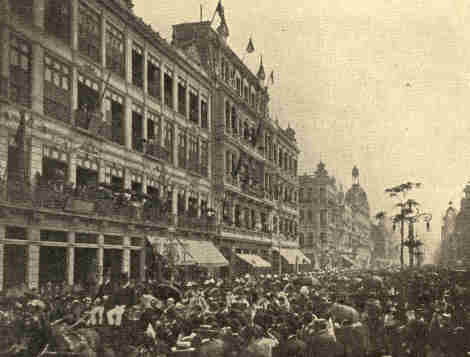
Courtesy of the Pan-American Union.
Arrival of Secretary Root at Rio de Janeiro.
The International Bureau of American Republics was founded as a result
of the first Pan-American conference. The original plans of the
founders were not carried out owing to a lack of interest on the part of
the Department of State as well as in the foreign offices of the South
American countries. Secretary Root determined to make this bureau an
efficient agency for bringing about better relations between the two
continents. He defined the main purpose to be not only to build up trade
and commerce among all American nations, but to promote more friendly
relations, a better understanding of each other, and the general
prosperity and well-being of all the countries of the American
continents. Through gifts from Andrew Carnegie and contributions from
the different South American states a splendid modern building, costing
$1,000,000, was erected in Washington, 1908, as the home of the Bureau
of the Pan-American Republics. Besides other enterprises, the Bureau
publishes a monthly periodical which contains information on the
commerce, new enterprises, and general development of each republic.
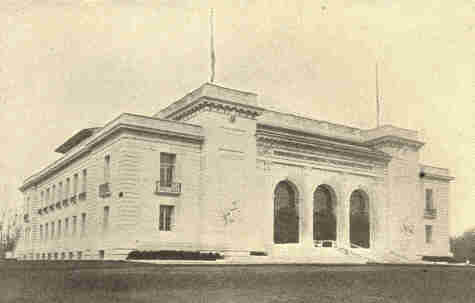
Photograph by Clinedinst.
The Bureau of the Pan-American Republics.
With these new relationships came a new interpretation of the Monroe
Doctrine. At various times European nations have engaged in
controversies with South American states over the payment of debts due
the citizens of the former. The question has then arisen, to what extent
shall the United States permit the use of force against the debtor
nations? The wider application of the Monroe Doctrine under President
Cleveland looking toward the maintenance of the rights of the weaker
American nations, has been followed by recognition of our obligation to
secure the performance of duties by those nations. Said President
Roosevelt (1905): "We cannot permanently adhere to the Monroe Doctrine
unless we succeed in making it evident, in the first place, that we do
not intend to treat it in any shape or way as an excuse for
aggrandizement on our part at the expense of the republics to the south
of us; second, that we do not intend to permit it to be used by any of
these republics as a shield to protect that republic from the
consequences of its own misdeeds against foreign nations; third, that
inasmuch as by this doctrine we prevent other nations from interfering
on this side of the water, we shall ourselves in good faith try to help
those of our sister republics, which need such help, upward toward peace
and order."
The immediate cause for this statement by President Roosevelt was the
problem confronting our government on account of the bankrupt condition
of the Republic of Santo Domingo. Debts had accumulated for over thirty
years until by the beginning of 1905 they amounted to more than
$32,000,000. Each successive ruler became a more reckless borrower and
new loans were secured upon harsher terms.
Finally affairs were brought to a crisis on account of the pressure on
the part of the French and Italian governments for the payment of the
claims of their citizens. The republic was on the verge of dissolution
when President Roosevelt intervened. European governments were
satisfied, for it signified the payment of their claims. An agreement
was signed by representatives of the government of Santo Domingo and of
the United States whereby the United States was to undertake the task of
collecting and apportioning the revenues of Santo Domingo. The
stipulation was made that no plan of annexation, purchase, or permanent
control on the part of the United States should ensue. Agents were to be
appointed by the United States who should take charge of the
customhouses. Forty-five per cent of the total receipts were to be used
in carrying on the affairs of the republic and the balance was to go to
pay the indebtedness. In his message, February, 1905, President
Roosevelt, pressing upon the Senate the urgent need for the ratification
of this agreement, said: "The state of things in Santo Domingo has
become hopeless unless the United States or some other strong government
shall interpose to bring order out of chaos. . . . If the United States
declines to take action and other foreign governments resort to action
to secure payment of their claims, the latter would be entitled,
according to the decision of the Hague Tribunal in the Venezuela cases,
to the preferential payment of their claims; and this would absorb all
the Dominican revenues and would be a virtual sacrifice of American
claims and interests in the island. If, moreover, any such action should
be taken by them, the only method to enable the payment of their claims
would be to take possession of the custom-houses, and, considering the
state of the Dominican finances, this would mean a definite and very
possibly permanent occupation of Dominican territory, for no period
could be set to the time which would be necessarily required for the
payment of their obligations and unliquidated claims." The Senate, in
special session, shirked responsibility and refused either to ratify or
reject the treaty.
With the revolutionists on the island growing stronger and the European
Powers becoming more insistent, President Roosevelt, disregarding the
attitude of the Senate, appointed an American as receiver of customs.
The move proved immediately successful. The insurrection died out, trade
revived, smuggling ceased, and the people were infused with a new
spirit. There was also a remarkable increase in the customs receipts,
those of 1906 showing an increase of 44 per cent over the receipts of
1905 and 72 per cent over those of 1904. Although only 45 per cent of
the revenues collected were turned over to the Dominican government,
this sum was almost double the amount which they had received when they
had control of the collection themselves.
After two years of discussion, the treaty was ratified by the Senate,
February 25, 1907, and by the Dominican Congress, May 3. The terms were
practically those which had been carried out by order of President
Roosevelt. The United States, in a sense, became the trustee of Santo
Domingo, and thus established a new relation between this country and