Front matter (continued 3)
Reading edition
new and larger uses. Power was transmitted to greater distances. Niagara
Falls was made to produce an electric current employed leagues away.
Electric railways, radiating from cities, converted farms and sand-lots
into suburban real estate quickly and easily accessible from the great
centres. Telephone service was extended far into country parts, and,
with the rural free delivery of mail, brought farmers into quick and
inexpensive communication with the outside world, robbing the farm of
what was once both its chief attraction and its greatest
inconvenience--isolation.
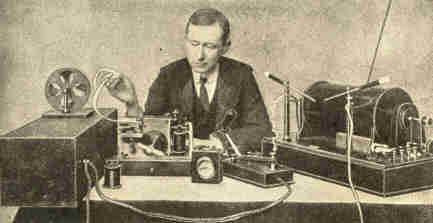
Guglielmo Marconi and his wireless telegraph.
German experiments developed an electric surface car with a speed of two
miles a minute. Wireless telegraphy came into use. By means of high
masts rigged, with wires diverging to the earth somewhat like the frame
of a partly opened umbrella, it was found possible under favorable
atmospheric conditions to telegraph hundreds of miles through the air.
The most notable use of this invention was to communicate between ships
and the shore or between ships at sea, a particularly desirable facility
in fog, storm, or darkness, when other signals were useless.
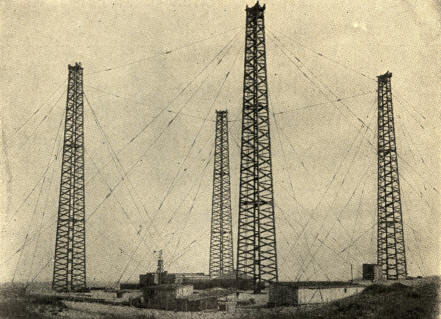
Marconi Transatlantic Station at South Wellfleet, Cape Cod, Mass.
Electricity and the gasolene engine were applied to bicycles, vehicles,
and boats, often generating sufficient power to run a small factory.
Bicycles somewhat passed from vogue, but automobiles became fashionable,
partly for rapid transit, partly for work formerly consigned to heavy
teams. Auto-carriages capable of railway speed, varying indefinitely in
style and in cost, might be seen upon the smoother roads about cities
all the way from Maine to California. They exerted great influence in
inducing communities to macadamize roads, for which the passing of the
stage-coach and the spread of railroads had diminished the demand.
Courtesy of Scientific American.
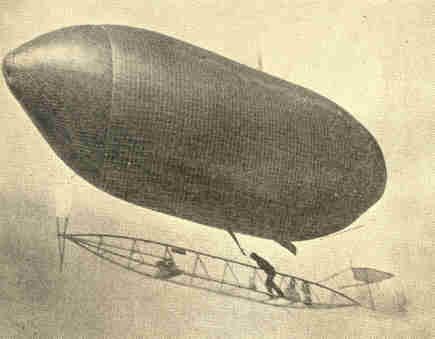
The "Arrow" getting under way.
Effort with flying machines was incessant but only partially successful.
No air-ship had thus far been devised which could undertake a definite
voyage of length with any certainty of reaching its destination. The
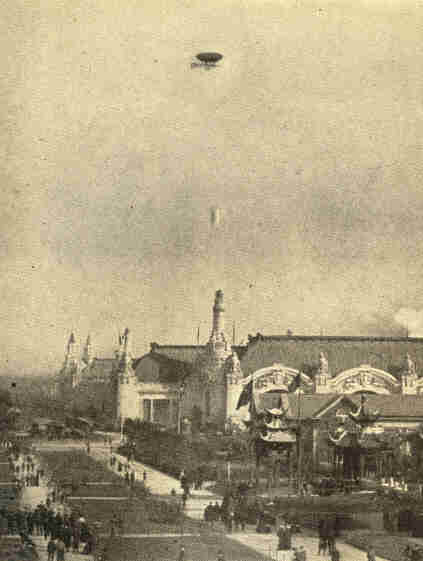
best feat yet was that of the air-ship Arrow, which, October 25, 1904,
at St. Louis, made a ten-mile trip. On the other hand, the development
of boats able to carry life for hours beneath the surface of the sea
added a new form of attack and defence against the well-nigh
impenetrable sides and enormously powerful guns of modern naval ships.
About 1890 the use of the Australian ballot system became general, and
thus the purchase of votes became more difficult. But this reform did
not eliminate the evils of machine politics. State laws were extended to
the control of party affairs, with severer punishments for corrupt
practices, the control of lobbying, and the requirement of publicity for
campaign expenses. In a few States the primary election system was put
into operation. Public officers won popular approval in numerous States
and cities by their activity in revealing "graft" and by their fearless
enforcement of the law.
These reforms were made possible by the increase of independent voting
in State and city politics. Politicians must reckon, as never before,
with the demand of the average citizen for honesty in public service.
The influence of corporations in governmental affairs received a check,
and there came to be a growing demand for the more complete control of
public utilities, and for the public ownership of them in cities.
Courtesy of Scientific American
Baldwin's airship "Arrow" at a height of 600 feet over
the Exposition Palaces, St. Louis, October 25, 1904.
The prominence of the moral element in the business and political
reforms mentioned above characterizes this as an era of "awakened civic
conscience." Both moral and economic considerations may be seen in the
protest against the excessive use of alcoholic liquors that has resulted
in the prohibition of liquor selling in a number of States and parts of
States, especially in the South. Educationally, the period showed
increased attention to the industrial and practical aspects of school
work. Courses in manual training came to be regarded as necessary for
the complete development of mind and body. Physical education received
greater attention. The establishment of public libraries, aided by the
munificent gifts of Andrew Carnegie, was rapid.
Millions of dollars, also, were contributed to the cause of education
and research. Among the most notable of these gifts were those by Mr.
Carnegie for the establishment of the Carnegie Institution and the
Carnegie Foundation, and the contribution to the General Education Board
by John D. Rockefeller. In 1902 the Carnegie Institution at Washington
was established by a gift of $10,000,000 by Andrew Carnegie. This sum he
afterward increased to $25,000,000. The work of the institution is to
carry on scientific study and research. Material is being collected for
the economic history of the United States, and students of American
history have been aided by the catalogues showing the location of
documentary and other source material. While the head-quarters of the
Institution is in Washington, important departments are located
elsewhere throughout the country. There is a laboratory at Tucson,
Arizona, for the study of desert plant life; a biological laboratory at
Cold Spring Harbor, Long Island; a marine biological laboratory at
Tortugas, off the Florida coast, and an astronomical observatory at
Mount Wilson, California.
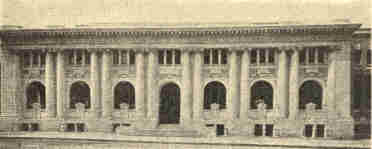
Atlanta, Ga.
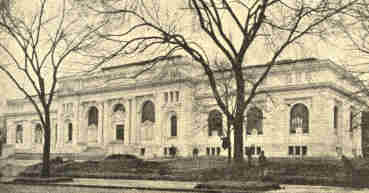
Washington, D. C.
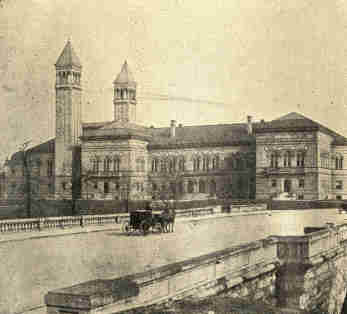
Pittsburgh, Pa.
CARNEGIE FREE PUBLIC LIBRARIES.
May 6, 1905, the announcement was made of a gift of $10,000,000 for the
purpose of providing retiring pensions for the teachers of colleges,
universities, and technical schools in the United States, Canada, and
Newfoundland. In making the gift Mr. Carnegie wrote: "I hope this fund
may do much for the cause of higher education and to remove a source of
deep and constant anxiety to the poorest paid and yet one of the highest
of all professions." The fund was to be applied without regard to age,
sex, creed, or color. Sectarian institutions, so-called, or those which
require a majority of their trustees, officers, faculty, or students to
belong to a specified sect, or which impose any theological test
whatever, were excluded by the terms of the gift. Universities supported
by State taxation were at first excluded, but a supplementary gift by
Mr. Carnegie of $5,000,000, in 1908, extended the privileges of the
foundation to these universities.
In February, 1907, John D. Rockefeller increased the money at the
disposal of the General Education Board by a gift of $32,000,000. This
fund, which had been originally established by him, amounting to
$11,000,000, had been used chiefly for the improvement of education in
the South. Common schools were aided, high-schools established, and
instruction in agriculture fostered. The additional sum was to be
devoted to lending assistance to certain selected colleges, with the
stipulation that the college was to raise three times the amount of
money granted it by the Board.
CHAPTER XIV
THE PRESIDENTIAL CAMPAIGN OF 1908
[1908]
In spite of the oft-repeated statement made by President Roosevelt that
he would not be a candidate for nomination on the Republican national
ticket in 1908, the party leaders seemed to fear a stampede in the
Chicago convention. Plans had been laid carefully by the party leaders
to prevent this possibility, and when William H. Taft, of Ohio, received
the nomination on the first ballot, delegates and spectators gave vent
to their feelings by prolonged applause. Out of a total of 980 ballots
cast Mr. Taft received 702. As Secretary of War in President Roosevelt's
cabinet he had been chosen by the President to succeed him, for it was
believed that through training and sympathy he was best fitted to carry
out the policies of the administration.
Other candidates for nomination had appeared during the summer and each
had a following of more or less strength. Senator La Follette, of
Wisconsin; Governor Hughes, of New York, and Speaker Cannon, of
Illinois, each received some support in the convention. Throughout the
land no surprise was occasioned, however, by the nomination of Mr. Taft.
Apparently the nomination of James S. Sherman, of New York, for the
office of Vice-President was the result of political expediency; he was
a good organization man; he had enjoyed considerable experience in
public affairs and had been a member of Congress for twenty years.
Moreover, the fact that he came from New York made it a wise move,
politically, to give him a place on the ticket.
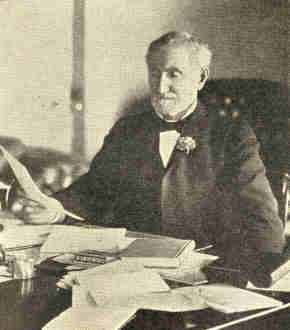
Copyright by Clinedinst, Washington.
Joseph G. Cannon.
To outside observers the convention was a harmonious one, ready and
anxious to adopt and indorse the Roosevelt policies and to accord a most
hearty support to the candidate who best represented these policies. The
platform which was drawn up was a strong political document which not
only stated the Republican policies clearly but was also a piece of
campaign literature of some note from the stand-point of literary worth.
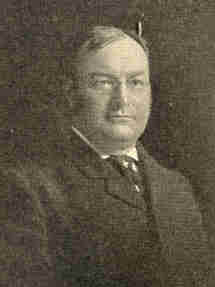
Photograph by C. M. Ball, Washington.
James S. Sherman, nominated for Vice-President.
Throughout the months preceding the assembling of the Democratic
convention, in Denver, there was some uncertainty as to who would
control it. Governor Folk, of Missouri, had been much in the public eye
through his war on graft and on account of his successful administration
of the gubernatorial office. Judge Gray, of Delaware, who had served his
State in the United States Senate and had acquired an enviable
reputation as a justice of the United States Circuit Court, was also a
strong candidate. Judson Harmon, of Ohio, Attorney-General under
President Cleveland, and Governor Johnson, of Minnesota, had numerous
supporters.
When the voting began in the convention the result was not long in
doubt. William Jennings Bryan was for the third time accorded the honor
of leading the Democratic party. On the first ballot Mr. Bryan received
892-1/2 votes; Judge Gray, his chief opponent, received 59-1/2. The
cheers which followed the announcement of the vote showed that two
defeats had not dampened the loyalty of the Western Democrats. Mr. Kern,
of Indiana, was nominated by acclamation for the Vice-Presidency. The
committee on the formation of the platform seemed to have some
difficulty in determining the final form of some of the planks.
Both parties in their platforms favored tariff revision. The Republican
party declared for the protective system and reciprocity and promised a
special session of Congress to treat the whole tariff question. The
Democratic party adhered to the old principle of "tariff for revenue"
and pledged itself to return to that basis as soon as practicable.
Furthermore, it pledged itself to bring about immediately such
reductions as would put trust-controlled products upon the free list and
to lower the duties on the necessaries of life, particularly upon those
which were sold more cheaply abroad than at home. Lumber was to go on
the free list. Any deficiency in the revenues which might arise from
this policy was to be made up through the medium of an income tax.
Both platforms declared for reform in the currency laws, but neither one
advanced any plan for revision. The Democratic platform condemned as
criminal the large expenditures of the recent administration, but showed
some inconsistency by favoring such policies as a large navy, generous
pensions, large expenditures for the improvement of rivers and harbors
which would necessitate the expenditure of great sums.
The regulation of railways and corporations was demanded by both
parties. The difference between the demands lay in the means to be
employed. The Democratic platform declared for State control of this
question as well as that relating to the conservation of our natural
resources. The Republicans took the stand that both questions should be
solved by the Federal Government.
In treating the problem of the alien races the Republican document
referred to the negro race by name, demanded equal justice for all men,
and condemned the devices used by some States for disfranchising the
negro. Nothing was said concerning Chinese and Japanese immigration. The
Democratic platform was silent on the negro question and declared
against the admission of Orientals into our country.
Arbitration was favored by the Republicans, but was not mentioned in the
opposition platform. On the Philippine question there was a division.
The Republicans favored a gradual development of home-rule; the
Democrats for early independence under an American protectorate.
Three things in the Democratic platform are worthy of note: (I) The
demand for a federal law compelling publicity of campaign contributions;
(2) the election of senators by direct vote, and (3) the adoption of
such parliamentary rules as would make the House of Representatives a
deliberative body.
The Socialist convention, which assembled in Chicago, nominated Eugene
V. Debs for President and Ben Hanford for Vice-President.
Two tendencies of political thought were displayed in the Socialist
platform as framed by the committee. First, a tendency away from
individual ownership of productive property and the individual
administration of industry, and toward the collective ownership of
productive property and the collective administration of industry. This
was illustrated by the demands made for the collective ownership of all
railways, steamship lines, and other means of transportation, as well as
telephones, telegraphs, etc. It was further evidenced by the demand that
the public domain be made to include mines, quarries, oil wells,
water-power, reclaimed and reforested lands. The second tendency was
away from a form of government of checks and balances toward one by the
unrestrained majority. This was shown by the demands for the abolition
of (I) the Senate, (2) the veto power of the President, (3) the power of
the Supreme Court to pass on the constitutionality of legislation.
Industrial demands were made. There should be a more effective
inspection of workshops and factories; there should be no employment of
children under sixteen years of age; interstate transportation of the
products of child labor or convict labor should be forbidden; compulsory
insurance against unemployment, illness, accidents, old age, and death
should be adopted.
Among the political reforms demanded were inheritance and income taxes,
equal suffrage for men and women, the initiative and referendum,
proportional representation, and the right of recall. The Federal
Constitution was to be amended by majority vote. Judges were to be
elected for short terms.
The nominees of the Prohibition party were Eugene W. Chapin, of
Illinois, for President, and Aaron S. Watkins, of Ohio, for
Vice-President. In the platform framed there were the usual declarations
against the liquor traffic, but there were also planks demanding
reforms. The election of senators by direct vote; the passage of
inheritance and income taxes; the establishment of postal savings banks;
the guaranty of bank deposits; the creation of a permanent tariff
commission; the conservation of natural resources; an equitable and
constitutional employers' liability act, and legislation basing suffrage
only upon intelligence and ability to read and write the English
language, were the chief planks. Beyond any doubt this platform--the
shortest of all--shows that the men who constructed it were not
dreamers. It is possible that the delegates may have been looked upon as
visionaries, for there were few among them who could be called
"practical politicians," but, as one writer of note has said, the
delegates were "typical of that class of society on which the nation
ever depends in a great crisis, the sort from which all moral movements
spring. . . ."
It has often been said that the excitement of presidential campaigns is
detrimental to the nation. This could hardly be said of the campaign of
1908. To produce political excitement there must be debatable questions
termed, by the politicians as "issues." Just what the issues were in the
campaign few people could determine. There were no issues which involved
foreign affairs. The Democratic party did not criticise the sending of
the fleet around the world, the administration's policy in Cuba, the
policy concerning the Panama Canal, nor even the policy pursued in the
Philippines. As regards military and naval matters, pensions to
veterans, the development of internal waterways, the conservation of
resources, etc., there were no issues simply because the people had
practically the same views about them. Consequently issues had to be
made, and, generally speaking, the Republican leaders appealed to the
people along the lines of the personal fitness of the candidates.
It was pointed out that President Roosevelt had indicated his Secretary
of War as the best man to carry out the policy inaugurated by the
administration of subduing and controlling influential law-breakers. The
chief officer of the government has vested in himself powers of wide
range--the appointment of the judiciary, the superintendence of the
administration of the business affairs of the nation, the guidance of
our international affairs. Therefore the President must be a keen judge
of men capable of distinguishing the honest, efficient servant of the
nation from the self-seeking politician; he must resist political
pressure; he must be national in his patriotism and breadth of vision;
he must know our foreign relations intimately, that the continuity of
policies may not be broken and the efficiency of our foreign service
weakened thereby. He must have the capacity to work long hours, with
skill, care, and rapidity. In short, the chief executive must be a man
who is fit mentally and physically.
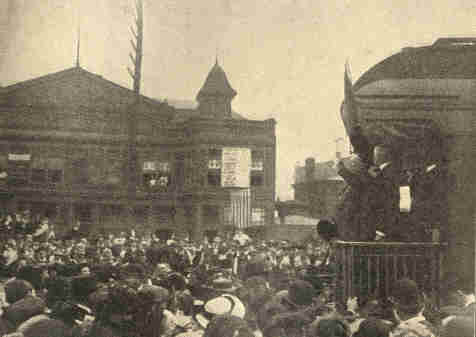
William H. Taft on his trip, stumping for the nomination.
Some of these essential qualities the candidates of the two great
parties possessed in a high degree. They were honest and sincere; they
were familiar with the desires and needs of the various sections of the
nation; they were national in the breadth of their policies. But they
were different in temperament, equipment, and experience, and upon this
difference the Republican leaders made their appeal to the voters.
The Democratic nominee was essentially an orator--he swayed the masses
by his denunciation of the perils which threatened the nation through
the concentration of wealth which had gone on under the Republican rule.
His opponents admitted that a man of his stamp was invaluable to the
American people, but they contended that his place was in the editor's
chair, in the pulpit, or upon the lecture platform, not as the chief
executive of the nation. Furthermore, it was said that this great orator
had views on political, social, and economic questions which bordered on
the visionary, and that any man who had openly supported free silver,
anti-imperialism, or even the guaranty of bank deposits, could not be
safely trusted with the guidance of the nation's destinies.
The Republican candidate had none of the qualifications of an orator; he
was rather a teacher. He did not cater to the desires of his audience;
he struck at the abuses most prevalent in the section where he spoke. It
was his business to point out weaknesses; to find remedies for them; to
educate, not sway, his audiences. His mind was constructive; his
training had been along the lines of constructive political thought; he
had proven his ability by his organization of a civil government for the
Philippines and by his solution of the vexed question of Cuba. So it was
argued that the best test of his ability and guaranty of efficiency was
the work he had already done.
The campaign was lacking in life and enthusiasm simply because there
were no clearly defined issues. The candidates went through the usual
performances of "swinging around the political circuit." Mr. Taft was
accorded a warm welcome on his trip, for the people wished to get
acquainted with President Roosevelt's choice as much as to hear him
discuss the Republican policies. Mr. Bryan, who conducted a great
speaking campaign, confined his attention to advocating the bank
guaranty plan and to attacking the evils of private monopoly. Political
enthusiasm was at a low ebb. Few people took matters seriously and the
campaign was aptly characterized as the "Era of No Feeling."
The vote cast for presidential electors was primarily an expression of
popular confidence in the Roosevelt administration. For nearly half a
century the situation in the nation had been becoming more and more a
source of anxiety to the thinking men of the land. Our economic
development had taken place so rapidly that the great aggregations of
capital and the great corporations had gotten beyond control and had
shown dangerous tendencies toward lawlessness and political corruption.
The feeling that the great corporations were not only beyond the control
of law but even controlled the government in the interests of a few, led
to a belief that the government was passing out of the hands of the
people, and that the function of our republican government was being
arrested. The radical and the agitator were getting the ear of the
nation, for the faith of the nation was shaken. Then came President
Roosevelt to take up a task of greatest difficulty, and for nearly eight
years, amidst the applause of the plain people, he administered the
affairs of the nation firmly, honestly, and with efficiency. The
Republican convention in Chicago by its nomination of Mr. Taft had put
the stamp of its approval upon the Roosevelt administration, and turned
to appeal to the voters.
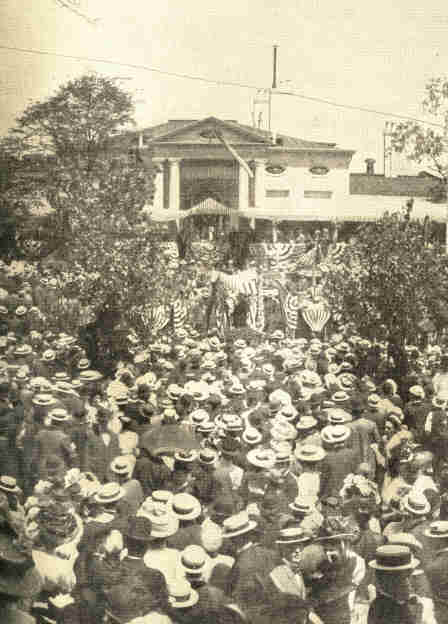
Copyright, 1908, by Young & Carl, Cincinnati, Ohio.
Mr. Taft formally accepting the Republican nomination for the
Presidency, on the veranda of the residence of his brother, Mr. Charles
P. Taft, of Cincinnati, Ohio.
In round numbers Taft received 7,680,000 votes and Bryan 6,410,000. The
electoral vote stood 321 for the Republican candidate and 162 for the
Democratic candidate. Thirty States elected Republican presidential
electors; eighteen elected Democratic electors. With the exception of
Nebraska, Nevada, and Colorado, which together contributed sixteen
electoral votes, all the States carried by the Democratic nominee were
Southern States. The nation had approved the Roosevelt policy, but the
great popular vote for Mr. Bryan showed clearly the loyalty of millions
of voters. These men believed that their leader stood for the plain
people--for the unprivileged. There were many who had feared Mr. Bryan's
policies in 1896, who voted for him in 1908 because they believed that
twelve years of public life and the study of national problems had
changed and bettered his ideals.
Some Republican writers professed to believe that the popular vote
indicated that a majority of people adhered to the policy of protection.
To others it appeared that the voters were willing to accept the
protective policy with a promise for honest tariff revision in order to
obtain a continuation of the Roosevelt policies.
The popular vote is interesting mainly for what it showed concerning the
changed strength of the small parties, During the period 1904 to 1908
the drift had evidently been away from them. The Socialist vote was
nearly as large in 1908 as in 1904, which was a consolation to
Socialists, for they had held the ground gained by the heavy vote in
1904. The Prohibition vote fell off about ten per cent from that polled
in 1904 and the Independence party polled only 82,000 votes.
In the House of Representatives the Sixty-first Congress had 219
Republicans and 172 Democrats; the Senate 60 Republicans and 32
Democrats.
CHAPTER XV
THE ADMINISTRATION OF PRESIDENT TAFT
[1909]
On March 4, 1909, the date of the inaugural ceremonies, Washington was
visited by a heavy snow-storm, and Mr. Taft, departing from the custom
of delivering his inaugural address at the east end of the Capitol,
spoke in the Senate chamber. Many trains bearing visitors to Washington,
from various parts of' the country, were blockaded, This condition
served to emphasize the call, many times made, for the transfer of the
date of these services to April 30, the day on which President
Washington took the oath of office.
President Taft's inaugural address was wise and temperate and
satisfactory to the country at large. He asserted that the most
important feature of his administration would be the maintenance and
enforcement of the reforms inaugurated by President Roosevelt. He
justified appropriations, as his predecessor had done, for maintaining a
suitable army and navy; advocated the conservation of our natural
resources, the establishment of postal savings banks, and direct lines
of steamers between North and South America.
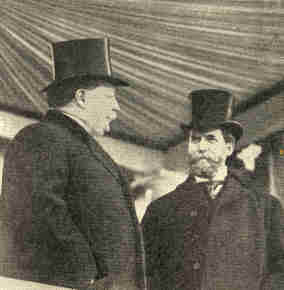
Copyright by Clinedinst, Washington.
President William H. Taft and Governor Hughes
on the reviewing stand at the inauguration, March 4,1909.
The cabinet was made up of men largely gathered from private life, a
majority of them being comparatively unknown to the public. Philander C.
Knox was United States senator from Pennsylvania when he was appointed
Secretary of State. He had served as Attorney-General in President
McKinley's cabinet. Franklin MacVeagh, of Illinois, who was made
Secretary of the Treasury, had been prominent as a merchant in Chicago
and active in public affairs. Mr. MacVeagh and Jacob M. Dickinson, who
became Secretary of War, were both members of the Democratic party. By
inviting Democrats to become members of his political family, President
Taft desired to give recognition to the fact that he had been elected by
Democratic votes and had received substantial support in parts of the
South. Mr. Dickinson was also from Chicago. The Secretary of the Navy,
George von L. Meyer, of Massachusetts, had served as ambassador to
Russia, and later as Postmaster-General during Mr. Roosevelt's
administration. Frank H. Hitchcock, of Ohio, who was made
Postmaster-General, had served as First Assistant Postmaster-General.
George W. Wickersham, an attorney of good standing in New York City, was
appointed Attorney-General. Richard A. Ballinger, of Seattle, who had
been Commissioner of the General Land Office, 1907-1909, was appointed
Secretary of the Interior. James Wilson, of Iowa, who had served as
Secretary of Agriculture since 1897, was continued in that office.
Charles Nagel, a noted lawyer of St. Louis, was made Secretary of
Commerce and Labor.
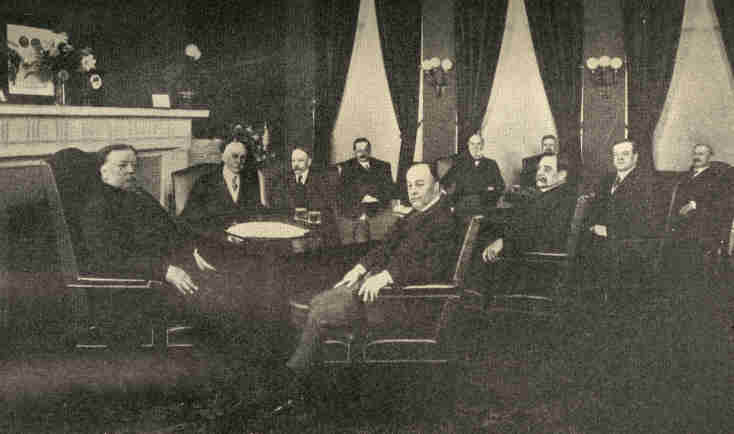
Copyright, 1909, by Brown Bros., N. Y. Reading from left to right:
President Taft, Franklin MacVeagh, Sec'y of the Treasury. George W.
Wickersham, Attorney-General. George von L. Meyer, Sec'y of the Navy,
Philander C. Knox, Sec'y of State, James Wilson, Sec'y of Agriculture.
Charles Nagel, Sec'y of Commerce and Labor( above). Jacob M. Dickinson,
Sec'y of War (below). Frank H. Hitchcock, postmaster-General. Richard A.
Ballinger, Sec'y of the Interior. President Taft and Cabinet, 1909.
With the beginning of the new administration the President's salary was
increased to $75,000 a year; that of the Vice-President to $12,000; and
members of the cabinet to $12,000.
From June 1 to October 15 there was held at Seattle the
Alaska-Yukon-Pacific Exposition. The rapid growth of Seattle has been
due in no small degree to the fostering of trade with Alaska. The
exhibits served to demonstrate the wisdom of the purchase of the
territory, which at that time was characterized as Seward's "folly."
Alaska has for some years been recognized as a country of wealth and
opportunity. The gold output each year is more than three times the sum
paid Russia for the territory. About one-fifth of the gold produced in
the United States comes from Alaskan mines. Products amounting to
$33,500,000 were shipped to the States from Alaska during the year 1907,
and the return trade for that year amounted to $19,500,000. The value of
the fishery products is five-sevenths as great as the output of the gold
mines. Alaskan coal-fields are estimated to be even richer than her gold
deposits. Other productions of the territory are silver, tin, lead,
quicksilver, graphite, marble, lumber, grains, vegetables, and fruits.
The purpose of the exposition was declared to be "to exploit the
resources and potentialities of the Alaskan and Yukon territories; to
make known and foster the vast importance of the trade of the Pacific
Ocean and of the countries bordering thereon, and to demonstrate the
marvellous progress of Western America." The energy and determination of
the men of the new Northwest was well shown in the preparation made for
the exposition. No financial assistance was asked from the federal
government. The necessary $10,000,000 were contributed almost entirely
in Seattle and the State of Washington. One million dollars were
expended by Seattle, as a preparatory step, on her municipal
improvements.
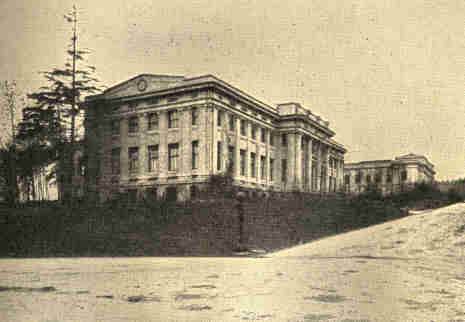
The Alaska-Yukon-Pacific Exposition, Seattle.
The Palace of Fine Arts.
The site of the exposition was the campus of the State University,
between Lakes Washington and Union. From the grounds, notable for their
natural beauty, were visible in the distance Mount Rainier, the loftiest
peak in the United States, the snow-covered Olympics to the west, and
the Cascade range to the east.
Three permanent buildings were erected by the State of Washington with
the understanding that they were afterward to be used by the university.
Most of the structures followed the French Renaissance design. In the
forestry building, which was 320 feet long and 140 feet broad, and built
of logs in the rough, there were displayed the timber resources of
Alaska and the Northwest. An out-door farm illustrated the agricultural
resources of the region. The Japanese exhibit was second only in
interest to that of Alaska. The exposition served to demonstrate, as it
was intended to do, the possibilities for the investment of capital in
the Northwest and the opportunities for those seeking new homes.
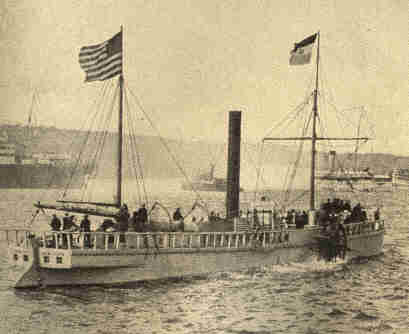
The Hudson-Fulton Celebration.
The Clermont proceeding up the Hudson River under her own steam.
Beginning with September 25 and continuing throughout the first week of
October, there was a notable celebration in New York City, and in other
cities on the Hudson, commemorative of the discovery of that river by
Henry Hudson three centuries before and the trip up the river by Robert
Fulton's steamboat in 1807. The leading feature of the pageant was the
assembling in the harbor of the largest fleet of international character
ever brought together at one time, and the cruise up the Hudson as far
as Newburg of eighty war vessels selected from the navies of the United
States, Great Britain, Germany, France, and other powers. These huge
vessels were in striking contrast to the two small ones which were given
the place of honor in the pageant, the replicas of the Half Moon and
the Clermont. The land parades were likewise spectacular in their
effects.
In October, 1909, Commander Robert E. Peary and Dr. Frederick A. Cook,
two American travellers, returned to the United States, both making
claims to having discovered the north pole. The accomplishment of this
task, which had baffled so many arctic explorers, was hailed as a
triumph throughout the civilized world. Ardent supporters of each of
these men began to champion the right of their favorite to the great
honor. It was shown that Commander Peary had for twenty-three years been
engaged in arctic exploration. His first voyage was made to Greenland in
1886, and in his numerous expeditions to the frozen north since that
time he had secured much scientific data relating to the glaciology,
geology, and ethnology of those regions.
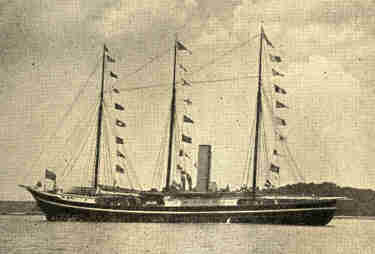
Commander Peary's ship, The Roosevelt.
When Commander Peary left the Roosevelt, the ship which bore him as far
north as navigation permitted, on February 22, 1909, his expedition
consisted of 8 white men, 59 Eskimos, 140 dogs, and 23 sledges, with the
necessary equipment for arctic travel. Upon returning to the United
States after overcoming the many dangers incident to such exploration,
he submitted his records to the National Geographical Society. A
committee of that body, after passing upon these documents, declared
unanimously that it was their opinion that Peary had reached the north
pole, April 6, 1909. This report further commended him for his
organization and management of this expedition and for his contributions
to scientific knowledge.
Before his return to America, Dr. Cook had been hailed as the discoverer
of the north pole by European scientists, especially those of Denmark,
who accepted his story of the accomplishment of this task in April,
1908, one year earlier than the date of Peary's discovery. Many honors
were conferred upon him when he reached Copenhagen, September 4, 1909.
He was met by the Crown Prince of Denmark and the American minister, and
by explorers, professors, and scientists from various European
countries. He was greatly honored also upon his return to New York City.
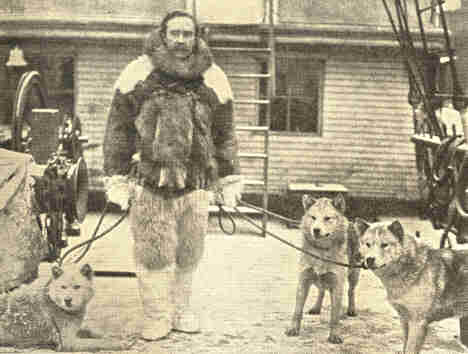
Commander Robert E. Peary, and three
of his Eskimo dogs, on The Roosevelt.
Commander Peary declared that the claims made by Dr. Cook were without
foundation. His decision was based on the evidence given by two Eskimos
who had accompanied Dr. Cook, and who asserted that the party went only
a two days' journey north from Cape Hubbard and were never beyond the
land ice. Further evidence of deception by Dr. Cook was set forth by
Edward M. Barrill, who had accompanied him on his ascent of Mount
McKinley in 1906. This guide declared that Dr. Cook had not reached the
summit of that mountain as claimed, but that the records had been
falsified. Later, a commission was appointed by the University of
Copenhagen to examine the notes and memoranda submitted to them by Dr.
Cook. After a careful examination of these documents, the commission
reported that they found no evidence sufficient to warrant the belief
that Dr. Cook actually reached the north pole.
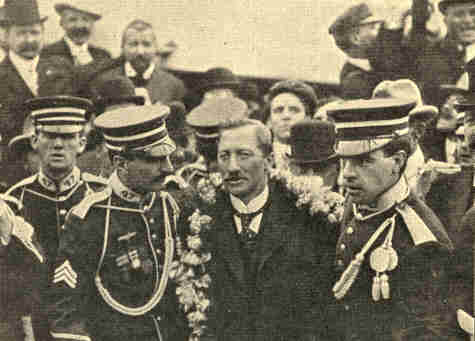
Photograph by Brown Bros., N.Y.
Dr. F. A. Cook on his arrival in
New York, September 21, 1909.
By vote of Congress, June 20, 1910, the territories of Arizona and New
Mexico were granted permission to form State constitutions. The
constitutions which were framed in their conventions and passed by
majorities of the people contained some unusual provisions. The Arizona
constitution included the initiative, referendum, and recall of all
elective officers, including judges. The New Mexico constitution
contains a referendum clause, but the clause providing for initiative
was rejected.
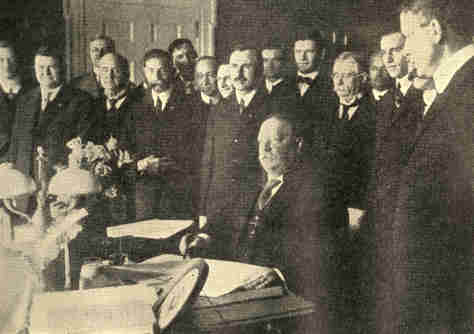
Copyright by Clinedinst, Washington.
President Taft signing the proclamation making
Arizona the forty-eighth State of the Union,
at the White House, February 14, 1912.
The constitution of Arizona was attacked in Congress and opposed by
President Taft on account of the provision for the recall of judges. The
chief objection to the constitution of New Mexico was the unsatisfactory
method provided for its amendment. This constitution, however, was
approved by President Taft and by the House of Representatives, but the
Senate failed to take any action. In August, 1911, the President vetoed
a joint resolution to admit the territories of New Mexico and Arizona as
States into the Union. He stated his attitude as follows: "The
resolution admits both territories to statehood with their constitutions
on condition that at the time of the election of State officers New
Mexico shall submit to its electors an amendment to its new constitution
altering and modifying its provisions for future amendments, and on the
further condition that Arizona shall submit to its electors at the time
of the election of its State officers a proposed amendment to its
constitution by which judicial officers shall be excepted from the
section permitting a recall of all elective officers. If I sign this
joint resolution, I do not see how I can escape responsibility for the
judicial recall of the Arizona constitution. The joint resolution admits
Arizona with the judicial recall, but requires the submission of the
question of its wisdom to the voters. In other words, the resolution
approves the admission of Arizona with the judicial recall, unless the
voters themselves repudiate it. . . . This provision of the Arizona
constitution in its application to county and State judges seems to me
pernicious in its effect, so destructive of independence in the
judiciary, so likely to subject the rights of the individual to the
possible tyranny of a popular majority, and therefore to be so injurious
to the cause of free government that I must disapprove a constitution
containing it."
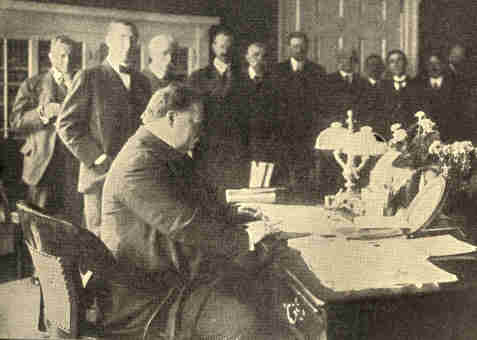
Photograph, Copyright, by Clinedinst. Washington.
President Taft signing the proclamation making New Mexico a State,
January 6, 1912.
January 6, 1912, New Mexico, having complied with all conditions, was
formally admitted into the Union as the forty-seventh State.
Arizona, having an area of 113,000 square miles, was organized as a
territory in 1863 and appeared in the federal census reports for the
first time in 1870 with a population of 9,658. From 1870 to 1890 its
growth in population was rapid, increasing a little more than four times
during the decade 1870-1880 and doubling during the succeeding ten
years. The population in 1900 was 122,931 and in 1910 it was 204,354.
During the last decade, therefore, the increase in population has been
66.2 per cent, while the percentage of increase in the United States as
a whole has been only 21 per cent. According to the thirteenth census,
Arizona contained eight cities with an aggregate population of 58,414.
The largest cities were Tucson, with a population of 13,193, and Phoenix
with 11,134.
Arizona produces more copper than any other State in the Union. Of the
total copper ore mined in the United States (1909) 27.7 per cent was
from Arizona. There are also good mines of gold and silver. Coal-mining,
marble-quarrying, lumbering, raising cattle, sheep, and ostriches are
also important industries in Arizona. Through the efforts of the
Reclamation service in completing the Roosevelt Dam and a dam at Parker,
and by the use of pumps, it is estimated that 1,000,000 acres of fertile
land will become available for cultivation. Other large areas are also
susceptible of irrigation.
In 1850 the territory of New Mexico was organized and in 1863 it was
reduced to its present limits with an area of 122,000 square miles. The
population of New Mexico in 1900 was 195,310 and in 1910 was 327,301 an
increase of 67.6 per cent. Albuquerque, with a population of 11,020, and
Rosewell with 6,172 were the two largest cities. Like Arizona, New
Mexico possesses great wealth in mines and forests, but the foundation
for her future industrial progress lies in her farms. In 1910 New Mexico
possessed 500,000 acres of irrigated land. It was estimated that
3,000,000 acres more were amenable to artificial watering and the
government is expending millions of dollars on projects which will
fertilize vast areas of this land.
During the year 1911 the world was astounded at the unparalleled
exhibitions of the possibilities of the aeroplane. The dream of
centuries had been realized, and American genius was responsible for the
achievement. In 1896, a model machine which had been constructed under
the direction of Professor Langley, secretary of the Smithsonian
Institution, driven by a one horse-power steam-engine, made three
flights of a mile each near Washington. Congress appropriated $50,000
for the construction of a complete machine, but after two unsuccessful
attempts to fly, with an operator, the project was abandoned.
Wilbur Wright and his brother Orville, bicycle manufacturers of Dayton,
Ohio, did not share in the general ridicule which followed this failure,
and after three years of experimentation demonstrated that the
principles upon which Professor Langley had constructed his machine
were, in the main, sound. The first successful flight of a few seconds
by one of their machines weighing 750 pounds was made in 1903. Two years
afterward a flight of 24 miles was made at the rate of 38 miles an hour.
Other successful experiments followed, and the claim of the Wrights to
be considered the inventors of the first successful man-carrying flying
machine was established. French inventors at about the same time were
carrying on successful experiments with machines similarly constructed.
September 16, 1908, Wilbur Wright, at Le Mans, France, demonstrated that
his machine could remain in the air for over an hour and at the same
time fly across country at a high speed. In that year, also, Orville
Wright, in a government test at Fort Myer, Virginia, not only made
flights lasting over an hour, but carried a companion with him. During
July, 1909, a French aviator, Bleriot, flew across the English Channel,
a distance of 32 miles. That year, also, Orville Wright ascended to the
height of 1,600 feet; with a passenger, made a record flight of 1 hour,
12 minutes and 36 seconds; and flew across country with a companion for
10 miles at the rate of 42 miles an hour. Thus it was shown that a
machine had at last been constructed which would not only fly, but would
remain in the air at the will of its pilot and subject to his guidance.
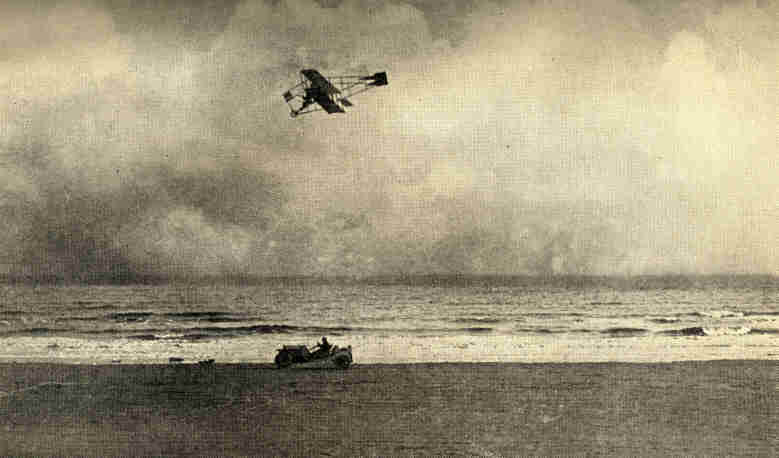
From a photograph by H. H. Morris.
Charles K. Hamilton racing an automobile on the beach at Galveston, Texas.
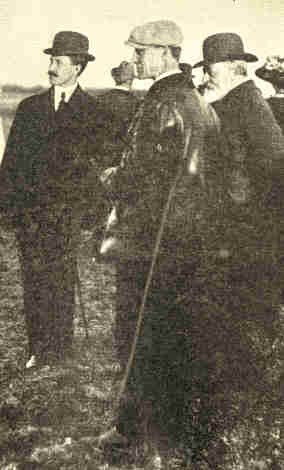
Photograph by Brown Bros., N.Y.
Wilbur and Orville Wright, and the late King Edward of England.
[1911]
In the aviation meet at Los Angeles, January 10, 1910, Louis Paulhan, a
Frenchman, established the record of 4,000 feet for height and Glenn H.
Curtiss with a passenger set a new world's record of 55 miles.
Shortly afterward Curtiss demonstrated for the first time that it was
possible for an aeroplane, especially constructed, to rise from the
surface of water, make a flight in the air, return to the
starting-point, and again alight on the water.
The great possibilities as well as the dangers connected with aviation
were brought out in the meet at Chicago during August, 1911, where two
aviators lost their lives. C. P. Rodgers, in a Wright machine, remained
in the air twenty-six and one-half hours out of the possible thirty-one
and one-half hours. Lincoln Beachey set a new world's record by
ascending 11,642 feet. This record was again surpassed within a month by
Ronald G. Garros, a French aviator, who ascended 13,943 feet.
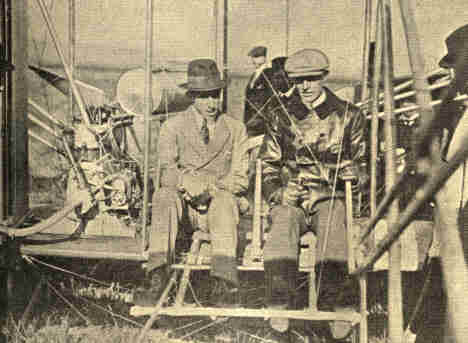
Wilbur Wright in his aeroplane at Pau, France, with King Alfonso of Spain.
Harry K. Atwood flew from St. Louis to Chicago in one day, a distance of
315 miles. He continued his flight to New York, and in eleven days
reached that city. He had travelled 1,265 miles in the actual flying
time of 28 hours. C. P. Rodgers eclipsed all records for long-distance
aeroplane flying by crossing the continent from Sheepshead Bay, New
York, to Pasadena, Cal., a distance of 4,231 miles. He accomplished this
feat in the total time of 49 days, September 17 to November 5, 1911. His
actual flying time was 82 hours.
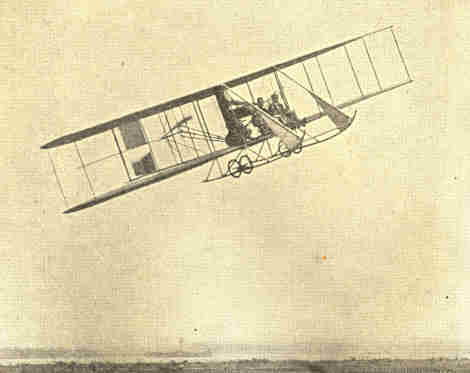
Harry K. Atwood with Lieut. Fickle flying over Governor's Island, N. Y.,
after completing his flight from St. Louis to New York.
These flights served to demonstrate that the permanent triumphs of
aeronautics are to be won by steadiness and efficiency and not by
recklessness.
Among the significant legislation of the Sixty-second Congress, the
passing of the "publicity law," August, 1911, is deserving of especial
commendation. The Democratic platform, 1908, demanded publicity of
campaign contributions, and Mr. Bryan announced that no funds would be
received from corporations. According to a New York statute, all
campaign receipts and expenditures must be filed. The Republican
campaign committee agreed to apply this law in the presidential contest.
According to the federal Publicity law no candidate for member of the
House of Representatives may spend more than $5,000 in his campaign for
nomination or election, and no candidate for United States senator may
spend, legally, more than $10,000 in his campaign. Candidates are
prohibited from making promises of office or other promises in order to
obtain votes, and no candidate for senator may aid in the election of
members of the legislature that is to fill a senatorial vacancy. At the
time, two United States senators were under indictment for the purchase
of their seats, and one of them acknowledged that he had expended nearly
$100,000 in his primary campaign.
In partial fulfilment of the declaration that his policy was to bring
about legislation for the benefit of the whole country, President Taft
in his message to Congress, December, 1911, asked that the appointment
of local federal officers throughout the country should be placed under
the classified service. "I wish," he wrote, "to renew again my
recommendation that all the local officers throughout the country,
including collectors of internal revenue, collectors of customs,
postmasters of all four classes, immigration commissioners, and marshals
should be by law carried into the classified service, the necessity for
confirmation by the Senate be removed, and the President and the others,
whose time is now taken up in distributing this patronage, under the
custom that has prevailed since the beginning of the Government in
accordance with the recommendation of the senators and congressmen of
the majority party, should be relieved from this burden. I am confident
that such a change would greatly reduce the cost of administering the
government and that it would add greatly to its efficiency. It would
take away the power to use the patronage of the government for political
purposes."
President Taft took an advance position also in his advocacy of the
substitution of the appeal to reason for the appeal to force in the
settlement of all international difficulties. The treaties of
arbitration which were agreed upon during the summer of 1911 between
Secretary Knox and the representatives of Great Britain and France
illustrate the general type of treaty which the President hoped would be
negotiated with other nations. Heretofore, the treaties to which the
United States has been a party have accepted as suitable for arbitration
all questions save those which concerned "vital interests and national
honor." It was a great step forward, therefore, when the agreement was
reached between the powers that all disputes that are justiciable and
cannot be settled by diplomacy are to be submitted to arbitration.
In case of a difference on whether the dispute were justiciable or not,
it was to be submitted to a commission of inquiry for decision. If the
commission found it was justiciable the question in dispute must be
submitted to arbitration. Should the commission find it was not
justiciable there would still exist the possibility of war. But either
nation has the power to delay the findings a year during which time
diplomatic action may be resumed. The arguments against the ratification
of these facts in the Senate were based on the plea that they provided
for compulsory arbitration and thus tended to deprive the Senate of its
constitutional prerogative. The wording was so greatly modified in the
Senate that the form of treaty which was finally ratified differed but
little from the arbitration treaties of 1908.
CHAPTER XVI
THE THIRTEENTH CENSUS, 1910
[1910-1911]
After many years of urging on the part of statisticians and public men,
Congress, in 1902, passed a bill which was signed by the President
providing for a permanent census bureau connected with the Department of
Commerce and Labor. This bureau, as shown in the taking of the
thirteenth census, serves to promote both efficiency and economy in the
collection of statistics associated with the census work. Heretofore the
Director of the Census had enormous patronage at his disposal which he
farmed out among congressmen and other political leaders.
E. Dana Durand, a trained statistician of wide experience, was appointed
Director of the Census. He announced that so far as possible the 65,000
enumerators would be selected under civil service rules and for
supervisors of the census he selected men on the basis of their special
fitness for the work. President Taft was in complete agreement with this
programme and insisted that local enumerators were to be appointed for
the purpose of getting the work properly done and not to assist any
would-be dispensers of local patronage.
On April 15 the enumerators began their work of gathering statistics.
The usual inquiries were made on population, mortality, agriculture,
manufactures, etc. Prior to April 15, an advance schedule was sent to
practically every farmer in the country, and he was asked to fill it out
before the coming of the enumerator. Similarly, in the cities, the
enumerators distributed advance population schedules which the head of
the family was requested to fill out before the official visit of the
enumerator. In taking the thirteenth census, greater attention was given
than ever before to perfecting the schedules and weighing each question
with regard to its precise significance and scientific value. To that
end a group of trained investigators, familiar with the various topics
which the census would cover, spent several months on a preliminary
study of the character of these questions. In addition to the
nationality of each person as determined by the mother tongue of the
foreign-born inhabitants, additional inquiries were made relative to the
industry in which each person was employed and whether the person was
out of work on April 15.
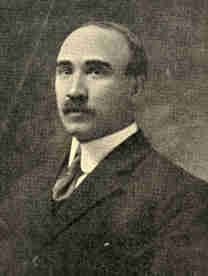
Copyright by Clinedinst. Washington.
E. Dana Durand, Director of the Census.
Population schedules in the cities and large towns were required to be
completed within two weeks and in the rural districts within thirty
days. The enormous labor of tabulating and classifying these answers was
then begun by the 3,500 clerks in the Census Office at Washington. Much
of this labor was performed by machines each capable of making 25,000
tabulations a day. Results of the first tabulation of the population in
the cities were made known about June 1 and the count of the principal
cities was completed by April 15. During September the population of the
entire country was made known. Within two years the leading facts in the
census were compiled and published as special bulletins. The entire cost
of the census was about $13,000,000.
The total population of the United States, including our territorial
possessions and dependencies, was found to be about 101,000,000, thus
for the first time passing the hundred million mark. The population of
the United States proper was 91,972,266; of Alaska, 64,356; Porto Rico,
1,118,012; Hawaii, 191,909; Guam and Samoa, 15,100; the Philippine
Islands about 7,700,000. These numbers indicate an increase in the
population of continental United States of 21 per cent in the decade, or
a slightly larger growth than the 20.7 per cent made during the
preceding ten years.
One of the striking facts brought out in the census is the absolute
decline in the percentage of population compared with the previous
decade in a number of the States of the East, South, and Middle West,
and an increase of this percentage in the other States, especially among
those of the Rocky Mountains and the Pacific Coast. The percentage of
total increase of population in Alabama was 16.9 and the increase,
according to the twelfth census, was 20.8; in Illinois, 16.9 as against
26 for the preceding census; Indiana, 7.3 against 14.8; Kentucky, 6.6
against 15.5; Massachusetts, 20 against 25.3; Minnesota, 18.5 against
33.7; Texas, 27.8 against 36.4; Montana, 54.5 against 70. Iowa showed an
actual loss of three-tenths per cent of her inhabitants, while according
to the preceding census there was a gain of 16.7 per cent in that State.
In the following States the gains in percentages were as follows: North
Dakota, 80.8 against 67.1 for 1900; South Dakota, 45.4 and 15.2; Kansas,
15 and 3; Nebraska, 11.8 and 0.3; Colorado, 48 and 30.6; Oklahoma,
109.7; Utah, 34.9 and 31.3; Nevada, 93.4 and 10.6; Idaho, 101.3 and
82.7; Washington, 120.4 and 45; Oregon, 62.7 and 30.2, and California,
60.1 and 22.4.
In numerical advance, New York, Pennsylvania, California, Texas, and
Illinois led. The increase in New York was nearly 2,000,000, in
Pennsylvania over 1,000,000, and in the other three States nearly
900,000 each.
Another notable fact brought out by the thirteenth census was that the
growth of the cities was greater than during the preceding ten years.
The rate of growth of the medium-sized cities was more rapid than that
of the large cities. This was not the case during the preceding decade.
Of the total population of continental United States, 46.3 per cent were
urban. That is, 42,623,383 of the inhabitants resided in cities and
towns having a population of 2,500 or more. The same territory in 1900
and 1890, similarly classified as urban, contained 40.5 and 36.1 per
cent, respectively, of the total population of the country. In all but
two States, Montana and Wyoming, the urban population has increased
faster than the rural population. The increase, since 1900, in the
population living in urban territory was 11,035,841 or 34.9 per cent,
while the increase in population living in rural territory during the
same period was 4,941,850 or 11.1 per cent. For the United States as a
whole, therefore, the rate of increase for the population of urban areas
was three times that for the population living in rural territory. In
the States of the east north-central division, including Ohio, Indiana,
Illinois, Michigan, Wisconsin, the urban gain was 31.2 per cent, but
there was a decrease in rural population of 0.2 per cent. The urban
increase of Illinois was 31.2 per cent, but the rural territory of the
State showed a loss of 7.5 per cent. The rural loss in Indiana was 5.5
per cent, and in Ohio 1.3 per cent. Michigan's rural gain was 2 per cent
and Wisconsin's 5.7. per cent. There were fourteen States in which more
than one-half of the population in 1910 were living in urban territory.
Among these States were Massachusetts, Rhode Island, and Connecticut
with nine-tenths of their population urban; Illinois with 62 per cent,
and Ohio with 56 per cent.
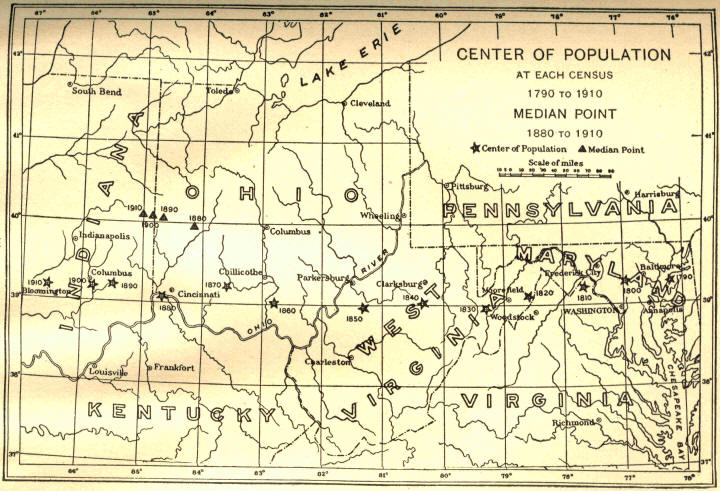
CENTER OF POPULATION AT EACH CENSUS 1790 TO 1910.
MEDIAN POINT 1880 TO 1910.
[Transcriber's Note: Location is within a few miles of latitude 39
degrees. The longitude is approximately: 1790, 76.2; 1800, 77.0; 1810,
77.6; 1820, 78.6; 1830, 79.3; 1840, 80.4; 1850, 81.3; 1860, 82.8; 1870
83.7; 1880, 84.7; 1890, 85.5; 1900, 85.8; 1910, 86.5 ]
The rapid growth of our industrial and manufacturing interests during
the past quarter of a century is shown by the fact that 22 per cent of
the people of the country are massed in cities of 100,000 inhabitants
and over. In the three largest cities alone--New York, Chicago, and
Philadelphia--there are almost one-tenth the population of the whole
country. There were five cities with populations between 500,000 and
1,000,000; eleven between 250,000 and 500,000; 31 between 100,000 and
250,000; 59 between 50,000 and 100,000; 120 between 25,000 and 50,000;
374 between 10,000 and 20,000; 629 between 5,000 and 10,000, and 1,173
between 2,500 and 5,000.
The thirteenth census revealed but slight change in the location of the
centre of population. In computing its position, no account of the
population of Alaska and of our insular possessions was taken into
consideration. It had moved west about 39 miles and northward
seven-tenths of a mile and was located at Bloomington in southern
Indiana. The westward movement from 1900 to 1910 was nearly three times
as great as from 1890 to 1900, but was less than that for any decade
between 1840 and 1890. This advance of the centre of population toward
the West was due to the increase in the population of the Pacific Coast
States. The large increase in the population of New York, Pennsylvania,
Illinois, and other States north of the thirty-ninth parallel served as
a balance to the increase in Texas, Oklahoma, and southern California.
During the past fifteen years there has been a steady migration from the
rural portions of the United States to the western provinces of Canada,
not less than 650,000 immigrants having crossed the border within that
period. Most of them have become naturalized Canadians. It has been
estimated that these immigrants took with them, on an average, $1,000.
According to the congressional reapportionment act following the twelfth
census, there were to be 386 members in the House of Representatives or
one representative to 194,182 of the population. The House of
Representatives actually contained 391 members after the admission of
Oklahoma. By the census of 1910, several States were entitled to
additional members, but in order that no State should be reduced in the
number of its representatives, the House of Representatives passed a
bill providing for an increase of 42 members. The new ratio of
representation would then be one representative to 211,877
inhabitants. Effort was made to prevent this increase, for it was argued
that the House had already become unwieldy, requiring great effort on
the part of members to make themselves heard. The bill failed to pass
the Senate at the regular session, but subsequently, at the special
session, it became a law. Party lines were closely drawn in the Senate,
for, on account of this increase, the Republicans would probably gain 32
new congressmen and the Democrats only 10. By this reapportionment the
northeastern part of the country and the extreme western and
southwestern portions gained in their representation. New York gained
six representatives; Pennsylvania, four; California and Oklahoma, three
each; Illinois, Massachusetts, Washington, and Texas each gained two,
and sixteen other States each gained one.
The number of farms, according to the thirteenth census, were 6,340,357
or an increase of about 10 per cent over the number reported in 1900.
There was an increase of 63,000,000 acres devoted to farming during the
decade. About 60 per cent of the farms of the country were operated by
their owners and two-thirds of these farms were free from mortgages. Two
million three hundred and forty-nine thousand two hundred and fifty-four
farms were worked by tenants and 57,398 were in charge of managers. The
tenant system was shown to be far more common in the South than at the
North or West. In the south central group of States, which includes a
large part of the cotton area, the tenants numbered 1,024,265 and the
owners 949,036. In the south Atlantic States there were 591,478 owners
and 118,678 tenants; in north Central States, 1,563,386 owners and
644,493 tenants, and in the Western States, 309,057 owners and 52,164
tenants.
Our foreign commerce for the year 1910 amounted in the aggregate to
about $3,500,000,000, or over $1,250,000,000 more than in 1900. Our
exports were valued at $2,000,000,000.
CHAPTER XVII
THE PROGRESSIVE MOVEMENT
[1911]
From time to time it has been charged that "government by the people"
has become fiction in our country. Little had been done to remedy this
condition until the opening of the last decade. Trouble then came for
the supporters of the regular political order, manifesting itself in
conventions and legislatures. Laws abolishing nominations by the
convention method were passed in some States; and publicity of campaign
expenses was insisted upon in others. The movement was widespread and
arose from various causes, but generally tended toward a single end--a
government according to popular will. The Western States have been the
centre of the more radical movement.
The Senate has always been considered as the stronghold of the most
conservative element in our country and has often been accused of being
the stronghold of privilege. It is interesting to note the success of
the progressive or insurgent movement in this body.
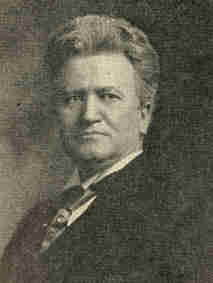
Copyright by Harris & Ewing,
Washington.
Robert M. La Follette.
The first progressive, Robert M. La Follette, of Wisconsin, appeared in
the United States Senate in 1905. He had done much, as governor, to gain
the confidence of the people of his own State, and he was sent to
Washington to carry his fight for reform into the national legislature.
Here his reception was not cordial. He was looked upon as a radical,
possibly a visionary reformer, but not exceedingly dangerous, for he was
alone. He stood alone until the election of 1908, when nine more
progressives took their seats; in 1910 the number jumped to sixteen.
Here a change came which probably caused the conservatives in the Senate
some worry. The tariff of 1909 had been passed by a Republican Congress.
The results of the elections of 1910 made it appear that the people were
not convinced that this act was an honest redemption of the Republican
campaign promises, for in the Senate which assembled in April, 1911,
there were twenty-nine thorough-going progressives and five other
members who were more progressive than conservative in their views. They
represented twenty-five States. Six of the thirty-four came from the
South; three came from the East, and the remaining twenty-five from the
West. Of the conservatives only eighteen came from the West.
The same changes may be found in the House of Representatives. These
changes are not so important as the change which must come in the
sentiment of the federal judiciary. From 1901 to 1909 the Executive was
in the control of the progressives and the President was able to get
some important laws passed by a reactionary Congress, but in some
instances the courts annulled these laws.
The appointment of justices of the district courts of the United States
is to a degree influenced by the senators in the district in which the
appointment is to be made. When these senators are conservative it is
natural that the candidates recommended by them should be conservative
and should entertain no legal theories interfering with the exalted
position of property rights. Should the various States be represented by
progressives, different recommendations will naturally follow and
probably an interpretation of the Constitution which will accord a new
standing to personal rights.
In the early part of 1911 the movement crystallized into a regular
political organization which called itself The National Progressive
Republican League, with the following platform:
(1) direct primaries; (2) popular election of delegates to the national
convention; (3) election of senators by direct vote of the people; (4)
initiative, referendum, and recall; (5) an effective corrupt practices
act.
These points were not new; most of them are incorporated into the body
of law of the State of Oregon. Most progressive Democrats as well as
Republicans seem willing to support these principles. In almost every
State the movement for the direct primaries has met studied opposition.
The "practical politician" or the professional politician seems to hate
to see the old convention system of nominations go. There are many who
object to the election of senators by direct vote, claiming that the
people are not capable of choosing wisely in such cases. The direct
election of delegates to the national conventions is no more than the
prerogative now exercised by the voter when he casts his vote for the
presidential electors. To his mind it means that he is voting for the
candidates themselves. In the vote for delegates to the conventions the
voter is accorded the right to express his preference for men to be
candidates. The corrupt practices plank deserves commendation. It cannot
be made too strong, for every attempt to do away with the irregular,
vicious methods used is a step toward good government.
The plank which arouses the greatest opposition is that which
incorporates the initiative, referendum, and recall. All three are
devices to make the machinery of popular government more directly
respondent to the popular will. The "initiative" is a process by which
laws are proposed on the petition of a certain specified number of
voters for action either by the legislature or by the direct vote of the
people through a referendum. The "referendum" allows a popular vote upon
acts passed by the legislature--that is, a bill passed by the
legislature may not become a law unless sanctioned by a popular vote, if
a vote is called for by a specified number of voters. The "recall" gives
the voters an opportunity to relieve a man of his office if by a regular
vote it is demonstrated that such an officer has not performed the
duties of his office to the satisfaction of his constituents. These
expedients are still in the experimental stage, and it is doubtful
whether they are so fraught with danger as their opponents seem to
believe or so efficacious as their adherents insist. Much of their
success depends upon the cases to which they are applied and upon the
popular interest displayed. The Oregon experiments apparently have been
very successful.
The question of the "recall" is a serious one. In some
municipalities--Los Angeles, for example--it has operated well. How it
will work in the national government, where it will affect the
judiciary, is a problem. The veto of the Statehood Bill (Arizona and New
Mexico) on account of the presence of the "recall" for judges in the
constitution of Arizona shows that President Taft is a stout opponent.
It seems well that any such step should be taken with extreme caution.
The progressive senators were active in their opposition to the
Payne-Aldrich Tariff Bill of 1909. For a period of twelve years there
had been no tariff legislation. The great industrial changes which went
on during that time made a revision of the Dingley Tariff imperative.
Although there has been a constant demand for revision, the tariff
played no part in the campaigns of 1900 and 1904. The demand has become
insistent, however, during recent years, and may be attributed in part
to the increased cost of living. This demand, made chiefly by the
wage-earners and salaried men, has been seconded from another quarter.
The attitude of foreign nations toward our goods has made it
increasingly difficult for American manufacturers to dispose of their
surplus. Wages have risen; the price of raw material is higher, and both
affect the manufacturer. Foreign nations have refused to accept our high
tariffs without retaliation, and this has made the manufacturer insist
that Congress revise the objectionable Dingley act.
The agitation took definite form during the session of 1907-8 when the
National Manufacturers' Association undertook to secure legislation
designed to create a tariff commission composed of experts whose
business it should be to ascertain the facts concerning the condition of
manufacturers and the necessity of a new tariff. Pursuant to this the
Beveridge Tariff Commission Bill was introduced into the Senate, but the
leaders of both houses--Cannon, Aldrich, Payne, and others--said bluntly
that it was bad politics to take the question up just before a
presidential campaign, and nothing was done. The demand grew more
insistent, and the wary leaders learned in time that it would be good
politics at least to declare for tariff revision, and this was done by
Chairman Payne of the Ways and Means committee of the House. Just when
the revision would come was not stated--some time after election,
provided the nation would return the Republicans to power.
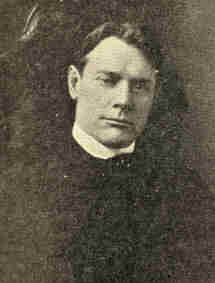
Copyright by Clinedinst. Washington.
Albert J. Beveridge. Senator from Indiana.
When the session closed Chairman Payne set on foot a series of
investigations ostensibly to gain information to be used in the coming
revision. It is possible that this was also an attempt to end the
criticism aimed at the leaders who had opposed the appointment of a
commission. Both the Democratic and Republican platforms of 1908
promised tariff revision, but of course in different ways. The
Republican leaders said the policy of the party would be to fix the
duties at a point which would not only offset the higher cost of
production in this country, but would also guarantee to the
manufacturers a fair profit. The election put the conservatives of the
Republican party in control of all branches of the government, and when
the principal committees of both houses of Congress fell under the
control of men fully committed to the dogma of protection, the chance
for a revision downward seemed slight. A special session was called soon
after President Taft's inauguration, and the Payne Bill, which it was
claimed aimed to decrease duties and increase the revenue, passed the
House by a vote of 217 to 161.
The Finance Committee of the Senate, to which the bill was referred when
it reached the Senate, instead of reporting it, reported a substitute
measure--the Aldrich Bill. This the House refused to accept and the
usual conference committee was organized, out of which committee came
the compromise Payne-Aldrich Bill, destined to become law through the
President's signature, August 5, 1909.
The debate in the Senate was a noteworthy one. The progressive senators
of the Middle West, led by Dolliver, of Iowa, and La Follette, of
Wisconsin, fought the measure sturdily, but with little success.
"Jokers" slipped in here and there, and more than one critic has charged
that the Senate was less solicitous for the rights of the consumers than
for the rights of the "interests."
Several schedules have come in for the most severe kind of criticism. In
the cotton schedule the increased rates laid upon certain classes of
cotton goods seem to have been imposed for the benefit of New England
manufacturers. These rates affect articles used by every person in the
United States. Most of these articles are manufactured from raw material
produced in America, and the cost of manufacturing the staple articles
is but slightly higher than in any of the important competing countries.
The average rate imposed by the Dingley Tariff, according to the Bureau
of Statistics, was 38 per cent on cotton cloth and similar rates on
other cotton goods. Since 1897 the "infant industries" have grown, and
some have in recent years declared dividends of 66 per cent per annum.
The Payne-Aldrich Bill increased the average rate on cotton goods from
44.84 per cent in the Dingley Tariff to 50.62 per cent. The increases
are not so much on the high-priced goods as on the cheaper grades.
In the case of the wool schedule the object of criticism has been the
discrimination against the carded woollen industry, which produces the
poor man's cloth, in favor of the worsted industry. This is due to the
imposition of a uniform duty of eleven cents per pound on raw, unwashed
wool, by which the cheaper woollens are taxed as high as 500 per cent,
and frequently amounts to less than 25 per cent on the finer grades.
Based on this system of duties is a graded scale in which the rates rise
in an inverse ratio with the value of the goods. Some duties have been
lowered, but the change has been slight. The schedule remains nearly the
same, but the burden has been shifted.
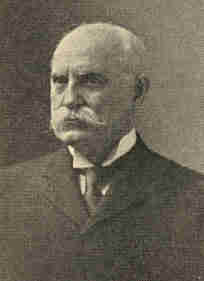
Photograph by Clinedinst, Washington.
Senator Nelson W. Aldrich.
There are reductions--more, numerically, than increases--but the
reductions are effectively modified by shifted classifications.
One thinker of note has termed the "maximum and minimum" clause as "the
highest practical joke of the whole bill." Little has been said of this
clause except in connection with the "minimum." It must be remembered
that there is also a "maximum," and it does not augur well for the
consumer. Suppose a foreign nation discriminates against our goods; we,
acting on the "maximum" theory, discriminate against theirs, and the
result is that the consumer pays the value of the article plus the
amount of the tariff of discrimination, since it has ever been true that
the limit in price is the top of the tariff wall.
A noteworthy feature of the bill is the provision for the formation of a
Tariff Board, composed of experts, who shall conduct investigations with
the view of evolving a scientific tariff. The board has little power
save that of advising the President in the application of the "maximum
and minimum" clause.
That the tariff has not been deemed an honest redemption of Republican
campaign pledges is shown by the recent elections. In the Sixty-first
Congress there were 219 Republicans in the House of Representatives and
172 Democrats; to the Sixty-second Congress there were returned 162
Republicans and 228 Democrats.
The Democrats at once began a revision of the tariff. Allied with the
progressives in the Senate, revisions of the wool and cotton schedules
were brought about. The Farmers' Free List Bill, which admitted free of
duty agricultural implements, sewing-machines, boots, shoes, fence wire,
and other things useful to farmers, was passed as an offset to the
Reciprocity Bill which was deemed by some to be disadvantageous to them.
The President vetoed all of these measures upon the ground that, since
the Tariff Board was to make its report within a very short time, it
would be wiser to defer action on the tariff until the report could be
used.
The Reciprocity Bill, which met the approval of the President, provided
that our markets should be free to Canada's leading agricultural
products, live-stock, fish, lumber, etc. Print paper and wood pulp were
also to be admitted as soon as the Canadian provincial governments
should withdraw the restrictions upon the exportation of these products.
The duties on some other products--iron ore, for example--were to be
reduced. Canada was asked to admit free our agricultural products,
live-stock, etc., and to reduce the duties on coal, agricultural
implements, and some other manufactured goods. The September elections
in Canada, however, showed that the reciprocity treaty was not
acceptable, for the Conservative party, which was strongly opposed to
the plan, gained a decisive victory. The act as passed by Congress still
remains law in the United States, and stands as a constant invitation to
our Canadian neighbors to join us in developing commercial relations on
the western continent.
What effect will this Progressive movement have upon party organization?
As matters stand at present there are in reality four parties within the
bonds of the two old parties--(1) the Conservative Republicans of the
East; (2) the Conservative Democrats of the South; (3) the Progressive
Republicans of the West; (4) the Progressive Democrats of the West. Out
of this tangle it appears that either a new party will be formed by the
combination of the Progressives of both old parties, or this Progressive
movement must gain control of one or the other of these parties. Should
the former happen, we may see the peculiar alliance of New England and
the South.
President Taft, it is maintained by many of his supporters, is himself a
Progressive, and they point to his attitude toward the great questions
of the hour. He urged, they say, reciprocity with Canada; called for
revision of the tariff in the light of facts and scientific tests;
proclaimed unlimited arbitration; advocated the conservation of our
natural resources, income taxation, extension of civil service reform,
employers' liability, and economy in the administration of governmental
affairs.
In answer it is asserted that President Taft declared the Payne-Aldrich
tariff law to be the best ever passed upon the subject, and that his
advisers and supporters in all of the congressional contests over vital
measures were the senators and representatives known as reactionaries or
standpatters.
[1912]
President Taft himself, a few months before the convening of the
Republican convention called to meet in Chicago, June 16, 1912, stated
his honesty of intention in the following words: "I am very grateful for
the honors the people have given me. I do not affect to deny the
satisfaction I should feel if, after casting up the totals pro and con
and striking a balance, they should decide that my first term had been
fruitful enough of good to warrant their enlisting me for another. Any
man would be proud of such a verdict. But I have not been willing, nor
shall I be, to purchase it at the sacrifice of my freedom to do my duty
as I see it. My happiness is not dependent on holding any office, and I
shall go back to private life with no heartburnings if the people,
after an unprejudiced review of my administration, conclude that some
one else can serve them to their greater advantage."
One thing is certain: the idea of government by the people has come into
our national politics to stay. It now controls one-third of the votes in
the Senate and has affected the laws of two-thirds of the States. The
end sought is good government responsible to popular rule. Through this
rule justice for all is sought; equality of opportunity in political and
industrial life; the safeguarding of the interests and well-being of
all; and through this rule an honest attempt is being made to establish
a government which will render the best service for the community,
guaranteeing to each individual all his rights, but no more than his
rights.
APPENDIX
I
CONSTITUTION OF THE UNITED STATES OF AMERICA
We the people of the United States, in order to form a more perfect
union, establish justice, insure domestic tranquillity, provide for the
common defense, promote the general welfare, and secure the blessings of
liberty to ourselves and our posterity, do ordain and establish this
CONSTITUTION for the United States of America.
ARTICLE I
SECTION 1. All legislative powers herein granted shall be vested in a
Congress of the United States, which shall consist of a Senate and a
House of Representatives.
SECT. II. 1. The House of Representatives shall be composed of members
chosen every second year by the people of the several States, and the
electors in each State shall have the qualifications requisite for
electors of the most numerous branch of the State Legislature.
2. No person shall be a Representative who shall not have attained to
the age of twenty-five years, and been seven years a citizen of the
United States, and who shall not, when elected, be an inhabitant of that
State in which he shall be chosen.
3. Representatives and direct taxes shall be apportioned among the
several States which may be included within this Union, according to
their respective numbers, which shall be determined by adding to the
whole number of free persons, including those bound to service for a
term of years, and excluding Indians not taxed, three fifths of all
other persons. The actual enumeration shall be made within three years
after the first meeting of the Congress of the United States, and within
every subsequent term of ten years, in such manner as they shall by law
direct. The number of Representatives shall not exceed one for every
thirty thousand, but each State shall have at least one representative;
and until such enumeration shall be made, the State of New Hampshire
shall be entitled to choose three, Massachusetts eight, Rhode Island and
Providence Plantations one, Connecticut five, New York six, New Jersey
four, Pennsylvania eight, Delaware one, Maryland six, Virginia ten,
North Carolina five, South Carolina five, and Georgia three.
4. When vacancies happen in the representation from any State, the
Executive authority thereof shall issue writs of election to fill such
vacancies.
5. The House of Representatives shall choose their Speaker and other
officers; and shall have the sole power of impeachment.
SECT. III. 1. The Senate of the United States shall be composed of two
Senators from each State, chosen by the legislature thereof, for six
years; and each Senator shall have one vote.
2. Immediately after they shall be assembled in consequence of the first
election, they shall be divided as equally as may be into three classes.
The seats of the Senators of the first class shall be vacated at the
expiration of the second year, of the second class at the expiration of
the fourth year, and of the third class at the expiration of the sixth
year, so that one third may be chosen every second year; and if
vacancies happen by resignation or otherwise, during the recess of the
legislature of any State, the Executive thereof may make temporary
appointments until the next meeting of the legislature, which shall then
fill such vacancies.
3. No person shall be a Senator who shall not have attained to the age
of thirty years, and been nine years a citizen of the United States, and
who shall not, when elected, be an inhabitant of that State for which he
shall be chosen.
4. The Vice-President of the United States shall be President of the
Senate, but shall have no vote, unless they be equally divided.
5. The Senate shall choose their other officers, and also a President
pro tempore, in the absence of the Vice-President, or when he shall
exercise the office of President of the United States.
6. The Senate shall have the sole power to try all impeachments. When
sitting for that purpose, they shall be on oath or affirmation. When the
President of the United States is tried, the Chief Justice shall
preside: and no person shall be convicted without the concurrence of two
thirds of the members present.
7. Judgment in cases of impeachment shall not extend further than to
removal from office, and disqualification to hold and enjoy any office
of honor, trust or profit under the United States: but the party
convicted shall nevertheless be liable and subject to indictment, trial,
judgment and punishment, according to law.
SECT. IV. 1. The times, places and manner of holding elections for
Senators and Representatives shall be prescribed in each State by the
legislature thereof; but the Congress may at any time by law make or
alter such regulations, except as to the places of choosing Senators.
2. The Congress shall assemble at least once in every year, and such
meeting shall be on the first Monday in December, unless they shall by
law appoint a different day.
SECT. V. 1. Each house shall be the judge of the elections, returns and
qualifications of its own members, and a majority of each shall
constitute a quorum to do business; but a smaller number may adjourn
from day to day, and may be authorized to compel the attendance of
absent members, in such manner, and under such penalties, as each house
may provide.
2. Each house may determine the rules of its proceedings, punish its
members for disorderly behavior, and with the concurrence of two thirds,
expel a member.
3. Each house shall keep a journal of its proceedings, and from time to
time publish the same, excepting such parts as may in their judgment
require secrecy; and the yeas and nays of the members of either house on
any question shall, at the desire of one fifth of those present, be
entered on the journal.
4. Neither house, during the session of Congress, shall, without the
consent of the other, adjourn for more than three days, nor to any other
place than that in which the two houses shall be sitting.
SECT. VI. 1. The Senators and Representatives shall receive a
compensation for their services, to be ascertained by law and paid out
of the treasury of the United States. They shall, in all cases except
treason, felony and breach of the peace, be privileged from arrest
during their attendance at the session of their respective houses, and
in going to and returning from the same; and for any speech or debate in
either house, they shall not be questioned in any other place.
2. No Senator or Representative shall, during the time for which he was
elected, be appointed to any civil office under the authority of the
United States, which shall have been created, or the emoluments whereof
shall have been increased, during such time; and no person holding any
office under the United States shall be a member of either house during
his continuance in office.
SECT. VII. 1. All bills for raising revenue shall originate in the House
of Representatives; but the Senate may propose or concur with amendments
as on other bills.
2. Every bill which shall have passed the House of Representatives and
the Senate, shall, before it become a law, be presented to the President
of the United States; if he approve he shall sign, it, but if not he
shall return it with his objections to that house in which it shall have
originated, who shall enter the objections at large on their journal,
and proceed to reconsider it. If after such reconsideration two thirds
of that house shall agree to pass the bill, it shall be sent, together
with the objections, to the other house, by which it shall likewise be
reconsidered, and, if approved by two thirds of that house, It shall
become a law. But in all such cases the votes of both houses shall be
determined by yeas and nays, and the names of the persons voting for and
against the bill shall be entered on the journal of each house
respectively. If any bill shall not be returned by the President within
ten days (Sundays excepted) after it shall have been presented to him,
the same shall be a law, in like manner as if he had signed it, unless
the Congress by their adjournment prevent its return, in which case it
shall not be a law.
3. Every order, resolution, or vote to which the concurrence of the
Senate and House of Representatives may be necessary (except on a
question of adjournment) shall be presented to the President of the
United States; and before the same shall take effect, shall be approved
by him, or being disapproved by him, shall be repassed by two thirds of
the Senate and House of Representatives, according to the rules and
limitations prescribed in the case of a bill.
SECT. VIII. The Congress shall have power
1. To lay and collect taxes, duties, imposts, and excises, to pay the
debts and provide for the common defense and general welfare of the
United States; but all duties, imposts and excises shall be uniform
throughout the United States;
2. To borrow money on the credit of the United States;
3. To regulate commerce with foreign nations, and among the several
States, and with the Indian tribes;
4. To establish an uniform rule of naturalization, and uniform laws on
the subject of bankruptcies throughout the United States;
5. To coin money, regulate the value thereof, and of foreign coin, and
fix the standard of weights and measures;
6. To provide for the punishment of counterfeiting the securities and
current coin of the United States;
7. To establish post offices and post roads;
8. To promote the progress of science and useful arts by securing for
limited times to authors and inventors the exclusive right to their
respective writings and discoveries;
9. To constitute tribunals inferior to the Supreme Court;
10. To define and punish piracies and felonies committed on the high
seas and offences against the law of nations;
11. To declare war, grant letters of marque and reprisal, and make rules
concerning captures on land and water;
12. To raise and support armies, but no appropriation of money to that
use shall be for a longer term than two years;
13. To provide and maintain a navy;
14. To make rules for the government and regulation of the land and
naval forces;
15. To provide for calling forth the militia to execute the laws of the
Union, suppress insurrections, and repel invasions;
16. To provide for organizing, arming and disciplining the militia, and
for governing such part of them as may be employed in the service of the
United States, reserving to the States respectively the appointment of
the officers, and the authority of training the militia according to the
discipline prescribed by Congress;
17. To exercise exclusive legislation in all cases whatsoever, over such
district (not exceeding ten miles square) as may, by cession of
particular States, and the acceptance of Congress, become the seat of
government of the United States, and to exercise like authority over all
places purchased by the consent of the legislature of the State, in
which the same shall be, for the erection of forts, magazines, arsenals,
dockyards, and other needful buildings;
--and
18. To make all laws which shall be necessary and proper for carrying
into execution the foregoing powers, and all other powers vested by this
Constitution in the government of the United States, or in any
department or office thereof.
SECT. IX. 1. The migration or importation of such persons as any of the
States now existing shall think proper to admit shall not be prohibited
by the Congress prior to the year one thousand eight hundred and eight;
but a tax or duty may be imposed on such importation, not exceeding ten
dollars for each person.
2. The privilege of the writ of habeas corpus shall not be suspended,
unless when in cases of rebellion or invasion the public safety may
require it.
3. No bill of attainder or ex post facto law shall be passed.
4. No capitation, or other direct, tax shall be laid, unless in
proportion to the census or enumeration herein before directed to be
taken.
5. No tax or duty shall be laid on articles exported from any State.
6. No preference shall be given by any regulation of commerce or revenue
to the ports of one State over those of another: nor shall vessels bound
to, or from, one State, be obliged to enter, clear, or pay duties in
another.
7. No money shall be drawn from the treasury, but in consequence of
appropriations made by law; and a regular statement and account of the
receipts and expenditures of all public money shall be published from
time to time.
8. No title of nobility shall be granted by the United States: and no
person holding any office of profit or trust under them, shall, without
the consent of the Congress, accept of any present, emolument, office,
or title, of any kind whatever, from any king, prince, or foreign state.
SECT. X. 1. No State shall enter into any treaty, alliance, or
confederation; grant letters of marque and reprisal; coin money; emit
bills of credit; make anything but gold and silver coin a tender in
payment of debts; pass any bill of attainder, ex post facto law, or law
impairing the obligation of contracts, or grant any title of nobility.
2. No State shall, without the consent of the Congress, lay any imposts
or duties on imports or exports, except what may be absolutely necessary
for executing its inspection laws: and the net produce of all duties and
imposts, laid by any State on imports or exports, shall be for the use
of the treasury of the United States; and all such laws shall be subject
to the revision and control of the Congress.
3. No State shall, without the consent of Congress, lay any duty of
tonnage, keep troops, or ships of war in time of peace, enter into any
agreement or compact with another State, or with a foreign power, or
engage in war, unless actually invaded, or in such imminent danger as
will not admit of delay.
ARTICLE II
SECTION 1. 1. The executive power shall be vested in a President of the
United States of America. He shall hold his office during the term of
four years, and together with the Vice-President, chosen for the same
term, be elected as follows:
2. Each State shall appoint, in such manner as the legislature thereof
may direct, a number of electors, equal to the whole number of Senators
and Representatives to which the State may be entitled in the Congress;
but no Senator or Representative, or person holding an office of trust
or profit under the United States, shall be appointed an elector.
[The electors shall meet in their respective States, and vote by ballot
for two persons, of whom one at least shall not be an inhabitant of the
same State with themselves. And they shall make a list of all the
persons voted for, and of the number of votes for each; which list they
shall sign and certify, and transmit sealed to the seat of government of
the United States, directed to the President of the Senate. The
President of the Senate shall, in the presence of the Senate and House
of Representatives, open all the certificates, and the votes shall then
be counted. The person having the greatest number of votes shall be the
President, if such number be a majority of the whole number of electors
appointed; and if there be more than one who have such majority, and
have an equal number of votes, then the House of Representatives shall
immediately choose by ballot one of them for President; and if no person
have a majority, then from the five highest on the list the said house
shall in like manner choose the President. But in choosing the President
the votes shall be taken by States, the representation from each State
having one vote; a quorum for this purpose shall consist of a member or
members from two thirds of the States, and a majority of all the States
shall be necessary to a choice. In every case, after the choice of the
President, the person having the greatest number of votes of the
electors shall be the Vice-President. But if there should remain two or
more who have equal votes, the Senate shall choose from them by ballot
the Vice-President.]
3. The Congress may determine the time of choosing the electors, and the
day on which they shall give their votes; which day shall be the same
throughout the United States.
4. No person except a natural born citizen, or a citizen of the United
States, at the time of the adoption of this Constitution, shall be
eligible to the office of President; neither shall any person be
eligible to that office who shall not have attained to the age of
thirty-five years, and been fourteen years a resident within the United
States.
5. In case of the removal of the President from office or of his death,
resignation, or inability to discharge the powers and duties of the said
office, the same shall devolve on the Vice-President, and the Congress
may by law provide for the case of removal, death, resignation, or
inability, both of the President and Vice-President, declaring what
officer shall then act as President, and such officer shall act
accordingly, until the disability be removed, or a President shall be
elected.
6. The President shall, at stated times, receive for his services, a
compensation, which shall neither be increased nor diminished during the
period for which he shall have been elected, and he shall not receive
within that period any other emolument from the United States, or any of
them.
7. Before he enter on the execution of his office, he shall take the
following oath or affirmation:--"I do solemnly swear (or affirm) that I
will faithfully execute the office of President of the United States,
and will, to the best of my ability, preserve, protect and defend the
Constitution of the United States."
SECT. II. 1. The President shall be commander in chief of the army and
navy of the United States, and of the militia of the several states,
when called into the actual service of the United States; he may require
the opinion, in writing, of the principal officer in each of the
executive departments, upon any subject relating to the duties of their
respective offices, and he shall have power to grant reprieves and
pardons for offences against the United States, except in cases of
impeachment.
2. He shall have power, by and with the advice and consent of the
Senate, to make treaties, provided two thirds of the Senators present
concur; and he shall nominate, and by and with the advice and consent of
the Senate, shall appoint ambassadors, other public ministers and
consuls, judges of the Supreme Court, and all other officers of the
United States, whose appointments are not herein otherwise provided for,
and which be established by law: but the Congress may by law vest the
appointment of such inferior officers, as they think proper, in the
President alone, in the courts of law, or in the heads of departments.
3. The President shall have power to fill up all vacancies that may
happen during the recess of the Senate, by granting commissions which
shall expire at the end of their next session.
SECT. III. He shall from time to time give to the Congress information
of the state of the Union, and recommend to their consideration such
measures as he shall judge necessary and expedient; he may, on
extraordinary occasions, convene both houses, or either of them, and in
case of disagreement between them, with respect to the time of
adjournment, he may adjourn them to such time as he shall think proper;
he shall receive ambassadors and other public ministers; he shall take
care that the laws be faithfully executed, and shall commission all the
officers of the United States. \
SECT. IV. The President, Vice-President and all civil officers of the
United States, shall be removed from office on impeachment for, and
conviction of, treason, bribery, or other high crimes and misdemeanors.
ARTICLE III
SECTION I. The judicial power of the United States, shall be vested in
one Supreme Court, and in such inferior courts as Congress may from time