Front matter (continued 2)
Reading edition
the smaller republics of the western hemisphere.
CHAPTER VII
CONSERVATION OF NATURAL RESOURCES
[1906]
Toward the close of the nineteenth century, attention was called to the
fact by scientific men that the methods employed in the use of our soil,
mines, forests, and water supply were extremely wasteful. During the
previous decades the resources of the country were regarded as
inexhaustible. As stated by President Roosevelt in 1907: "Hitherto as a
nation we have tended to live with an eye single to the present, and
have permitted the reckless waste and destruction of much of our
national wealth." At the same time the call came for the conservation of
our natural resources.
The destruction of the forests first attracted attention. The first
national reservation of forests was made in 1891, and in 1898 a marked
advance was made by the establishment of a division of Forestry in the
Department of Agriculture. Gifford Pinchot, as chief of the division,
called attention of the people to the interdependence of the forests and
the waterways.
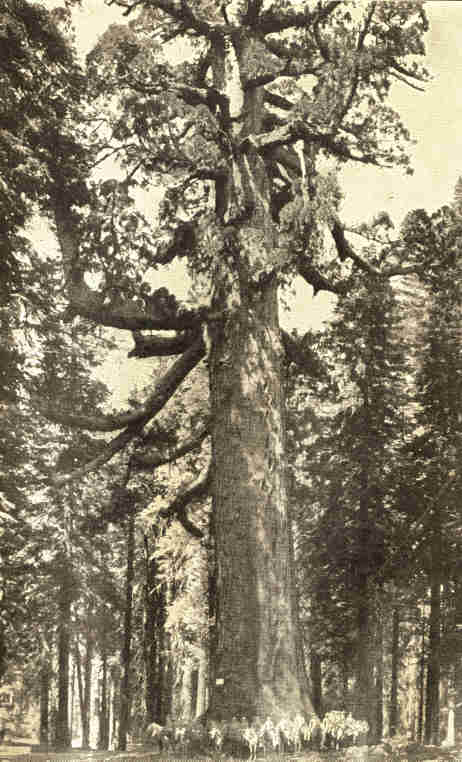
Grizzly Giant, Mariposa Grove, California, with a squad of cavalry at
its base.
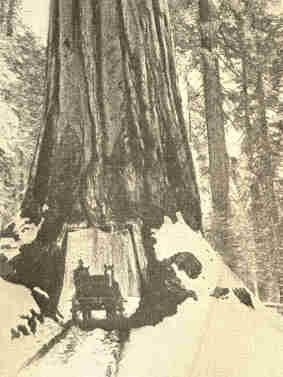
Big tree "Wanona," showing the relative size of other conifers compared
with big trees. Mariposa Grove.
In 1906, after long effort, the famous Mariposa Grove of large trees in
California was made a national reservation. During the same year a bill
was passed by Congress providing for the preservation of Niagara Falls.
Public opinion had been aroused by the campaign of the American Civic
Association. Power companies had multiplied so rapidly that it seemed
the whole volume of water was about to be used for commercial purposes
and that the most famous object of natural scenery in the United States
would be destroyed.
In response to appeals from the people of the interior, President
Roosevelt, March 14, 1907, appointed the Inland Waterways Commission. In
his letter which created the commission he said: "The time has come for
merging local projects and uses of the inland waters in a comprehensive
plan designed for the benefit of the entire country. . . . I ask that
the Inland Waterways Commission shall consider the relations of the
streams to the use of all the great permanent natural resources and
their conservation for the making and maintenance of prosperous homes."
This commission while carrying on its investigations discussed the
general policy of conservation and suggested to the President the
calling of a convention for the purpose of discussing the conservation
of the nation's resources. Thus originated the celebrated White House
conference of May 13-15, 1908. The opening session presented an
impressive scene, for there were assembled in the east room of the White
House, upon the invitation of the President, the Vice-President, seven
members of the cabinet, all of the justices of the Supreme Court, most
of the representatives and senators, thirty-four governors of States
together with their advisers, and representatives of the governors of
the remaining States, governors of the Territories, representatives of
sixty-eight national societies, and numerous special guests.
The opening address of President Roosevelt was a notable effort. "This
conference," he said, "on the conservation of natural resources is in
effect a meeting of the representatives of all the people of the United
States called to consider the weightiest problem now before the nation.
. . . We have become great in a material sense because of the lavish use
of our resources, and we have just reason to be proud of our growth. But
the time has come to inquire seriously what will happen when our forests
are gone; when the coal, the iron, the oil, and the gas are exhausted;
when the soils shall have been still further impoverished and washed
into the streams, polluting the rivers, denuding the fields, and
obstructing navigation. These questions do not relate only to the next
century or the next generation. One distinguishing characteristic of
really civilized men is foresight; we have to, as a nation, exercise
foresight for this nation in the future, and if we do not exercise that
foresight, dark will be the future!"
During the meeting numerous addresses were made on the conservation of
the minerals, of the soils, of the forests, and of the waters of the
country. In his address on the conservation of ores and related
minerals, Andrew Carnegie declared that during the three-fourths of a
century from 1820 to 1895 nearly 4,000,000,000 tons of coal were mined
by methods so wasteful that 6,000,000,000 tons were either destroyed or
allowed to remain in the ground forever inaccessible. From 1896 to 1906
as much coal was produced as during the preceding seventy-five years.
During this decade 3,000,000,000 tons were destroyed or left in the
ground beyond reach for future use. Basing his statements on the
investigations of scientists, he showed that at the present rate of
increase in production the available coal of the country would be
exhausted in two hundred years and the workable iron ore within a
century.
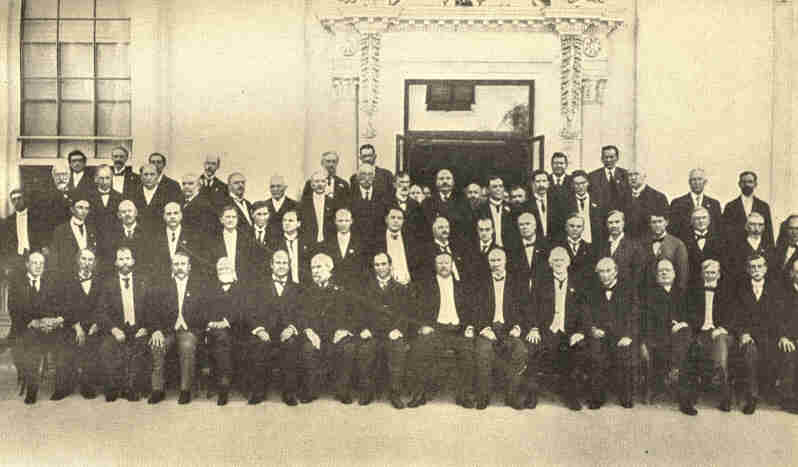
Copyright by Underwood and Underwood.
The President, Governors, and other leading
men at the National Resources Conference,
at the White House, May 13 to 15, 1908.
Similarly, James J. Hill demonstrated that the forests of this country
are fast disappearing and that from three to four times as much timber
was consumed each year as forest growth restored. His statements
regarding the tremendous soil waste in our farming methods were likewise
astounding. Resolutions were adopted covering the entire subject of
conservation as shown in one of them as follows: "We agree that the land
should be so used that erosion and soil-wash shall cease; that there
should be reclamation of arid and semi-arid regions by means of
irrigation, and of swamps and overflowed regions by means of drainage;
that the waters should be so conserved and used as to promote
navigation, to enable the arid regions to be reclaimed by irrigation,
and to develop power in the interests of the people; that the forests
which regulate our rivers, support our industries, and promote the
fertility and productiveness of the soil should be preserved and
perpetuated; that the minerals found so abundantly beneath the surface
should be so used as to prolong their utility; that the beauty,
healthfulness, and habitability of our country should be preserved and
increased; that the sources of national wealth exist for the benefit of
the people, and that monopoly thereof should not be tolerated." It was
recommended that the States should establish conservation commissions to
co-operate with one another and with a similar national commission.
On June 8, 1908, the first national conservation commission was created
by President Roosevelt. Its forty-nine members were men well known in
politics, in the industries, and scientific work. Gifford Pinchot was
chairman of this commission which submitted its first report at a
conference in Washington, December 8-10, 1908. The delegates consisted
of governors and other representatives from the States and from national
organizations. This report was received with favor and it was
recommended that the work of the commission should be continued.
Congress declined to make the necessary appropriation of $25,000 for
this purpose, although it was strongly endorsed by the President.
In 1901 the National Conservation Association was formed, a voluntary
organization of public and scientific men. The purpose of this
association is to carry on the movement for conservation in every State.
Within seven months after the White House conference, forty-one State
conservation commissions were created and fifty-one conservation
commissions representing national organizations were formed.
President Roosevelt carried the movement still farther in calling the
first North American conservation congress. Representatives to this
conference met in Washington, February 18, 1909. They came from Canada,
Newfoundland, and Mexico as well as the United States. Broad general
principles of conservation applicable to the North American continent
were adopted.
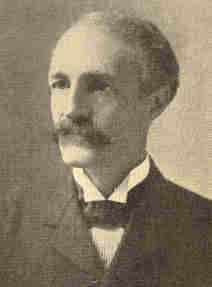
Gifford Pinchot, President
of the Conservation Commission.
The movement was materially strengthened also through the withdrawal of
large areas of the public domain from private entry. Thus 148,000,000
acres of forests and 80,000,000 acres of coal land were withdrawn during
President Roosevelt's administrations.
Directly connected with the problems of conservation are those of
irrigation. The so-called arid regions constitute two-fifths of the
area of the United States, or some 1,200,000 square miles. Of this vast
region, it has been estimated that about one-tenth can be irrigated to
advantage. By the end of the year 1908, some 13,000,000 acres had been
reclaimed, or nearly one-third of the total amount suitable for
irrigation purposes. This has brought about the rapid growth of cities
and a substantial industrial advance in the former arid regions of the
far West. The most notable impulse to this movement was made in 1902
when Congress passed a law, the Reclamation act, providing that the
proceeds from the sales of public lands in thirteen States and three
Territories should be expended by the National Government in the
construction of irrigation works.
The total receipts from the sales of these lands amounted to $28,000,000
by the end of the year 1905, and twenty-three projects, dams,
reservoirs, or canals were in different stages of construction. The most
important of these undertakings were the Roosevelt Dam, the Shoshone
Dam, and the Truckee-Carson Canal.
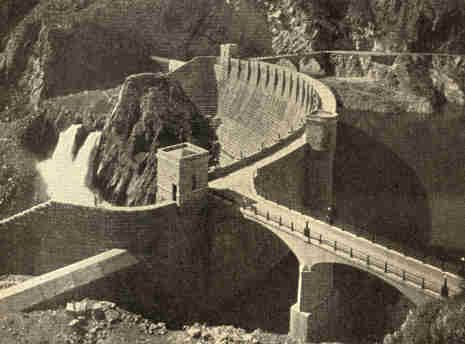
Built by the U. S. Reclamation Service.
Roosevelt Dam from the road.
The Roosevelt Dam is the chief work of construction in what is called
the Salt River project. By the completion of this work at least 200,000
acres in the vicinity of Phoenix, Arizona, were reclaimed. This dam is
284 feet high, 1,080 feet long on the crest, and 165 feet thick at the
base. The resulting reservoir with a storage area of 16,320 acres will
be the largest artificially formed lake in the world. It forms a body
of water 25 miles long, almost 2 miles broad, and with a maximum depth
of 220 feet. The main canals are 119 miles in length and the lateral
canals 208 miles. Not only will this structure insure a supply of water
in the Salt River valley where, in recent years, orchards and other
products have perished, but it will prevent the floods which have
devastated that region from time to time. Water-power amounting to
25,000 horse-power has been developed by the construction. This power
is used in part for pumping, and another area, estimated at 40,000
acres, outside the territory covered by the canals has been reclaimed.
The power is also used for lighting, for manufacturing, and for mining.
It was seen that the Shoshone River, in northwestern Wyoming, during the
season of melting snows, carried away more waste water than would be
adequate to reclaim many thousands of acres in the arid regions of the
lower altitudes. Two million two hundred and fifty thousand dollars were
allotted for the construction of the Shoshone Dam which will form a
reservoir of water sufficient to irrigate 75,000 acres of land 50 miles
farther down the river.
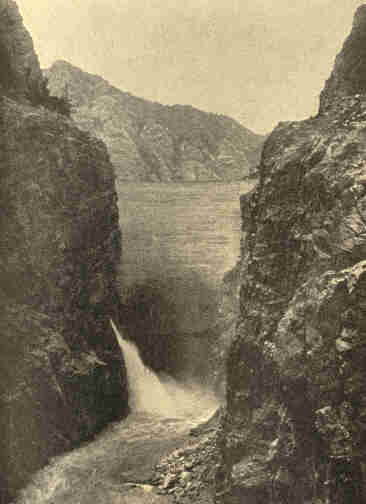
Shoshone Dam, Wyoming.
Highest dam in the world. Height 328.4 feet.
The Truckee-Carson project provides for the irrigation of 150,000 acres
in western Nevada. The water of the Truckee River, which flows out of
Lake Tahoe, is distributed by canals having an aggregate length of 670
miles. The main canal was opened in 1905.
By the close of the year 1906, over $39,000,000 had been allotted for
works under actual construction, and this amount had increased to
$119,500,000 within four years. It has been estimated that the land thus
reclaimed will alone be worth $240,000,000. The additional cost of a
project is assessed against the land. When the land is sold, the money
received is used for the development of new irrigation areas.
Another significant plan outlined by the irrigation congress in its
meeting, 1911, provided for bringing about the complete reclamation of
all swamp and overflowed land. The swampland area of the United States
exceeds 74,500,000 acres, or an amount greater than the area of the
Philippine Islands by 1,000,000 acres.
The Mississippi basin has been called the heart and soul of the
prosperity of the United States. Two-fifths of the area of the country,
comprising one-half the population, is tributary to the Mississippi
system, which has over 20,000 miles of navigable waters. This valley
produces three-fourths of our foreign exports. The network of railroads
covering this territory has for a number of years furnished altogether
inadequate transportation facilities, and conditions have grown steadily
worse. Traffic experts throughout the United States have been advising
river improvement as a means of relieving the congestion of freight.
This situation has led to a revival of interest in the deep waterway
from the Lakes to the Gulf which has been talked and written about for
nearly three-quarters of a century.
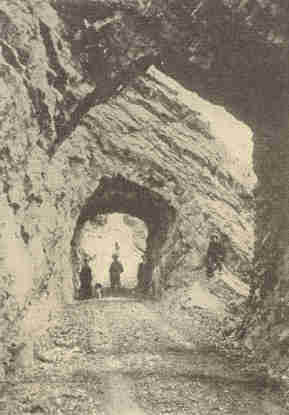
Photograph by Clinedinst.
Shoshone Project. Wyoming Park wagon road,
showing wonderful tunnelling work on the new
wagon road from Cody, Wyo., to the
National Park via the Shoshone Dam.
[1907]
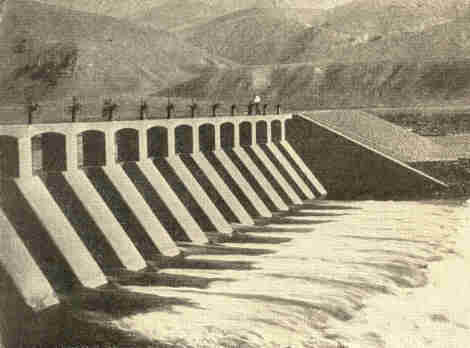
Truckee-Carson reclamation project.
Diversion dam and gates at heading of main canal.
Concerted action was not taken until 1907, when the Lakes to the Gulf
Deep Waterways Association was formed at St. Louis, having for its
object the deepening of the water-way between Lake Michigan and the
Gulf. The proposal to construct a canal by the way of the Illinois River
to the Mississippi, large enough to carry ships, was declared feasible
by government engineers and a route was surveyed. President Roosevelt
endorsed the scheme. In his message to Congress, December 3, 1907, he
said: "From the Great Lakes to the mouth of the Mississippi there should
be a deep water-way, with deep water-ways leading from it to the East
and the West. Such a water-way would practically mean the extension of
our coast line into the very heart of our country. It would be of
incalculable benefit to our people. If begun at once it can be carried
through in time appreciably to relieve the congestion of our great
freight-carrying lines of railroad. The work should be systematically
and continuously carried forward in accordance with some well-conceived
plan . . . . Moreover, the development of our water-ways involves many
other important water problems, all of which should be considered as
part of the same general scheme."
He appointed an Inland Waterways Commission which was to outline a
comprehensive scheme of development along the various lines indicated.
Their leading recommendation had to do with the proposal for a deep
water-way from Chicago to New Orleans. The completion of the drainage
canal by the city of Chicago, at a cost of $55,000,000, really created a
deep waterway for forty miles along the intended route. It was reported
to Congress by a special board of surveyors that the continuation of
such a water-way to St. Louis would cost $31,000,000.
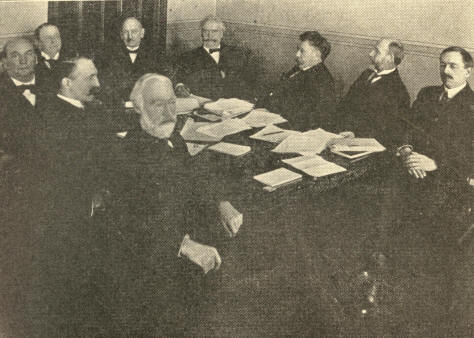
Inland Waterways Commission.
The legislature of Illinois, following the recommendation of Governor
Charles S. Deneen, submitted to the people an amendment of the
constitution which would enable the State to assume a bonded
indebtedness of $20,000,000 for the purpose of constructing a deep
waterway from Chicago to St. Louis. The measure was approved by popular
vote November 3, 1907. Thereupon, the State Senate passed a bill
providing for the construction of the canal. This failed in the House.
It was again introduced into the legislature, 1910, but failed to pass.
Among the other important projects submitted by the Inland Waterways
Commission are the following: To connect the Great Lakes with the ocean
by a twenty-foot channel by the way of the Erie Canal and the Hudson
River, an inner channel extending from New England to Florida; to
connect the Columbia River with Puget Sound and deepen the Sacramento
and the San Joaquin Rivers, so as to bring commerce by water to
Sacramento and other interior California cities.
With the hope that New York City might again come into a mastery of the
trade with the West, as at the time when the Erie Canal was first
completed and because of the inability of the railroads to meet the
demands of traffic, the legislature of New York, in 1903, appropriated
$100,000,000 for the enlargement of that waterway and the two branch
canals, the Oswego and Champlain. The proposed uniform depth is twelve
feet and it is otherwise to be large enough for boats of a thousand ton
cargo or four times the capacity of boats now on the canal.
CHAPTER VIII
DEVELOPMENT OF THE NEW SOUTH
[1904]
The term New South signifies the transition which has taken place
through energy applied to the opportunities which that section of the
United States offers. The South has natural gifts which in themselves
will make it a marvel of wealth. The coast line measures 3,000 miles and
already the ports of New Orleans and Galveston are among the most
important on our seaboard. In 1898 the imports along the Gulf amounted
to $13,000,000, and in 1908 they amounted to $59,350,000. In 1898 the
exports were valued at $202,000,000; in 1908 they were valued at nearly
$400,000,000. The completion of the Panama Canal will certainly increase
the importance of the Southern seaboard cities.
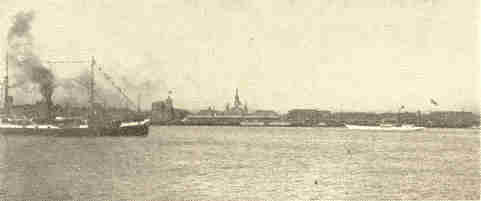
Copyright, 1900, by Detroit Photographic Co,
The port of New Orleans.
There are in the United States navigable streams amounting to 26,410
miles and of these the South has 18,215 miles. Mr. Wilson, Secretary of
Agriculture, has estimated that the waterpower facilities of the South
equal 5,000,000 horse-power for the six high-water months--five times
the amount New England has. By a system of reservoirs this supply could
be doubled. Roughly speaking, the country can be divided into three
water-power districts: (1) the wholly undeveloped district which lies
about Birmingham, Alabama, the centre of the great iron and coal
district of the South; (2) a well-exploited district along the
Chattahoochee, extending from Atlanta to Columbus, Georgia; (3) a
district which lies in the favored agricultural region of northern South
Carolina and southern North Carolina. Here about one-third of the easily
available power has been developed. To-day New England, poor in raw
materials and having an area of only 66,000 square miles, manufactures
as much as does the whole South which is rich in raw materials and has
an area of 1,000,000 square miles. It is hardly necessary to make
forecasts--possibly it is wiser to ask what can possibly hinder the
development of this favored section.
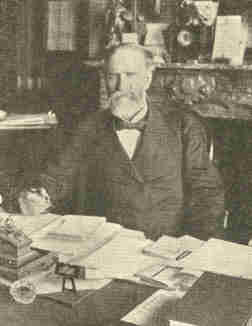
James Wilson, Secretary of Agriculture.
In minerals and forests the South is equally rich. The coal supply,
according to the report of the National Conservation Commission, amounts
to 611,748,000,000 tons and the riches in iron in the southern
Appalachian district are equally enormous. Forty-one per cent of the
remaining forest area is in the same country. Unless a system of
conservation is put into operation, however, these vast timber resources
will pass away, for the forests are being used at a rate of more than
three and one-half times the annual growth. Private interests own
125,000,000 acres in the South and practically none of the timber is
being handled with the idea of conservation. There are no "State
forests"; neither are there adequate laws for the prevention of forest
fires.
The economic advancement of the South during the past thirty years has
been wonderful. The tide of migration within our country no longer moves
Westward as much as Southward and in its wake has followed a flood of
capital. The increase of population and capital is necessary to the
industrial growth of the South, and in spite of the recent influx the
scarcity of laborers remains a serious problem, the solution of which is
absolutely necessary for the development of the manufacturing industries
as well as agriculture. Immigrants of good standing are constantly
sought by the States, and to cope with the problem some individuals have
been guilty of operating a system of peonage. Lack of efficiency in the
laborers makes the problem still more perplexing. Scientific
investigations conducted with the aim of discovering the causes for this
general inefficiency have led to the conclusion that the eradication of
the mosquito and hook-worm will add greatly to the ability of the
wage-earners. A systematic campaign in this direction has been made
possible through the recent gift of Mr. Rockefeller.
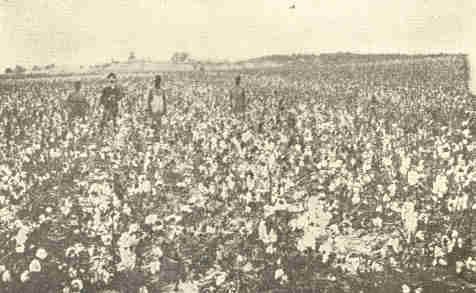
A field of cotton.
The South has always been largely an agricultural section, with the
production of cotton as the leading interest. In 1909 the yield was
about 13,500,000 bales from about 32,000,000 acres. In value the crop
equals about twice the annual output of all the gold mines in the world.
The 8,000,000 bales which are exported annually represent an income to
the United States of about $400,000,000. The problem which has called
for the most attention is that the average output per acre has been
decreasing for years. During the past few years the white farmers have
taken active steps to remedy this weakness. Agricultural experiment
stations have conducted investigations and the agricultural press has
interpreted these results to the actual farmers and has conducted a
systematic agitation for an agricultural revolution. Associations have
been formed for the purpose of studying conditions and introducing
improved methods in preparing the soil and rotating crops. More of the
food supply of the South is to be raised at home; better homes and farm
buildings are being erected, and better machinery is being used. The
invention of a mechanical cotton picker, which has been accomplished,
should reduce materially the cost of handling the crop.
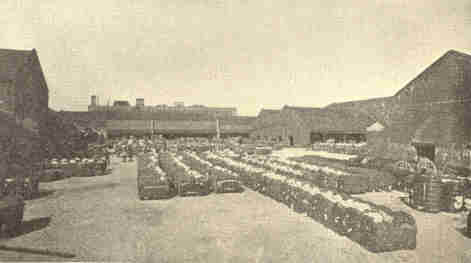
Bales of cotton ready for shipment.
Cotton-press yard, New Orleans.
Closely connected with this is the problem of roads. Where railroads are
scarce good wagon roads are all the more necessary. In the South
(excluding Kentucky, Arkansas, and Oklahoma) there are 500,000 miles of
public roads serving a population of over 20,000,000 people. In 1908
there were only 17,700 miles of improved road. To help along this work
good roads associations have been formed in the various States.
The old methods of financing the plantation system are passing. The
planters are breaking away from the credit system which has kept them as
borrowers and debtors and, as a result, they have money for investments
elsewhere. The great problems connected with cotton culture are the
labor supply and proper conservation of the soil. These solved, the
friends of the South confidently believe that thirty times as much
cotton could be produced as is produced at present. When one learns that
only 145,200,000 acres out of 612,000,000 are now under cultivation, the
claim does not seem extravagant.
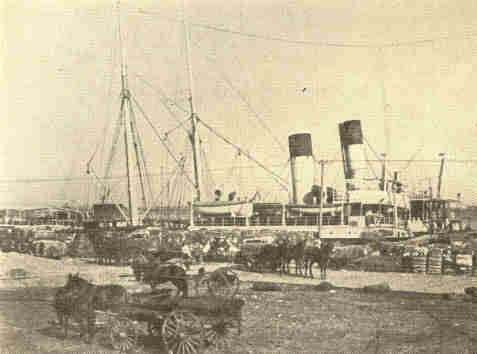
Loading cotton on the levee, New Orleans.
Southern farmers have learned that other products besides cotton pay
well. Less than twenty years ago practically no hay was raised for sale
in the Gulf States. The red clover and timothy which the planter thought
could only be raised in the North are now cultivated in the South. Iowa,
the greatest hay-growing State in the Union, has for the past ten years
averaged 1.58 tons per acre at an average value of $5.45 per ton.
Mississippi during the same time has averaged 1.62 tons to the acre
valued at over $10 a ton. Alfalfa has been found to be excellent feed
for stock and the yield, which averages from four to eight tons per
acre, sells for from $10 to $18 a ton. Corn is being cultivated now and
it is not uncommon to find yields of 100 bushels to the acre and under
the most favorable circumstances even twice that much has been raised on
a single acre. The prevailing high prices make the corn crop
particularly valuable.
Stock-raising, which has never been indulged in to any extent, now gives
excellent returns. The mules which are used so extensively in the South
are being raised at home instead of being brought from the North. Beef
animals and hogs are increasing in numbers and are being bred more
carefully. The great variety of food crops which ripen in rotation make
the cost of hog-raising very little--possibly two cents a pound will
cover the cost of raising, butchering, and packing. Sheep flourish in
the pine regions where they are remarkably free from diseases. They
range all the year, needing little attention.
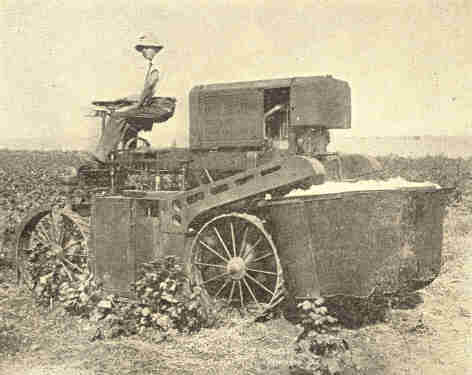
The Price-Campbell cotton-picking machine,
which does the work of fifty persons.
This shift in agricultural pursuits has been due in a measure to the
appearance of the boll-weevil which wrought havoc with the cotton crop
for some years. It is possible that the change has been decidedly
beneficial when one notes that the value of products in 1899 was
$705,000,000 and in 1909 about $1,430,000,000.
Agriculture is not the only interest of the New South. Northern capital
has worked wonders along industrial lines. Some communities have changed
entirely from agriculture to manufacturing. South Carolina is now second
among the States in the manufacture of cotton; North Carolina is third,
and Georgia is not far behind. In Alabama Southern tobacco is
manufactured. The steel and iron industries, the furniture industry, the
cottonseed-oil industry, and others are constantly becoming more
important. The effects of this industrial revolution are far reaching.
Social lines are shifting; a new society based upon business success and
wealth seems to be supplanting or at least breaking in upon the
aristocracy of the ante-bellum South, based upon family and public
service. The ideal of success is changing and the ambitious young man
now goes into business, manufacturing, or engineering as often as into
the profession of law and politics. The laboring class has changed also.
Years ago this class lived on farms and raised raw materials: now it
lives in the cities and fashions raw materials. The same social results
are found here as elsewhere, but on account of the conservatism and
personal independence of the Southern laborer, who is only a generation
removed from the soil, these results are not in evidence so soon. In the
manufacturing districts there is the political unrest characteristic of
the North. Labor unions develop here and Socialism has some adherents.
This tends to break the political solidarity of the section and it is
possible that in the not distant future the "Solid South" may pass away.
The South is enthusiastic; it is alert to its opportunities and it is
planning with hope for the future. Through practical education wonders
may be worked, and upon this practical education for the rising
generation the South bases its hopes. The new generation will make
greater strides in the utilization of the great natural gifts than the
old one has. The race problem will be solved in time, and the solution
must come through the efforts of the Southern people, for the best
classes now believe that the South can prosper best when all the people,
colored as well as white, are brought to the highest standard of their
efficiency.
CHAPTER IX
PRESIDENT ROOSEVELT'S SECOND TERM
[1905-1907]
On June 1, 1905, an exposition was opened at Portland, Oregon, in
commemoration of the Lewis and Clark expedition (1804-1805). Four
hundred acres of ground adjoining the principal residence district,
overlooking the Willamette River, were set aside for this purpose. There
were extensive exhibits by the United States, Great Britain, Canada,
Holland, Italy, China, and other European and Asiatic countries. The
fair was, in general, the expression of the life and history of the
Pacific Northwest and the direct relationship between that region and
the Orient. Many national congresses were held in conjunction with it,
such as the American Medical Association, National Good Roads
Association, and the National Conference of Charities and Correction.
The different interstate commerce acts, beginning with that of 1887 and
including the railroad rate bill of 1906, constitute a system of control
established by the Federal Government over persons and corporations
engaged in interstate or foreign commerce; this includes the carrying of
persons and property by either rail or water. Pipe lines, telephone,
telegraph, express, and sleeping-car companies are also brought under
the same provisions. The administration of these laws was vested in the
Interstate Commerce Commission consisting of seven members.
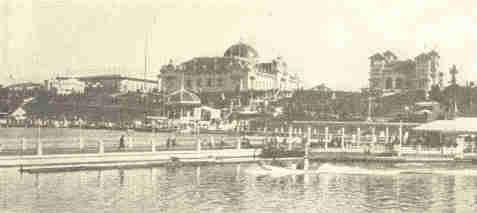
The Lewis and Clark Exposition, Portland, Ore.
General view across the Lagoon.
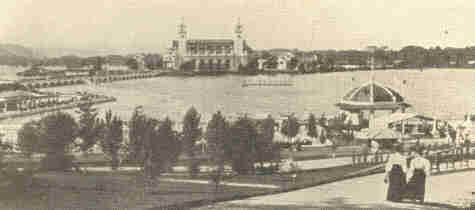
The Lewis and Clark Exposition, Portland, Ore.
The Government Buildings across the Lagoon.
The important provisions of these laws may be summarized as follows:
1. All charges must be just and reasonable. The commission was given
power to fix maximum rates after investigation of a complaint by either
party to a dispute over rates.
2. Pooling agreements were prohibited.
3. It was made unlawful to make discriminations by giving to any
particular person, corporation, or locality an unreasonable advantage
over others. Granting of passes was prohibited to other than railroad
employees, and granting of rebates was forbidden.
4. By the "long or short haul" clause it was made unlawful for a common
carrier to charge more for the transportation of passengers, or the same
kind of freight, over a shorter than a longer distance; provided the
transportation was under substantially similar circumstances and
conditions over the same line and in the same direction.
5. All rates were required to be published and posted where they might
be consulted by any person.
6. Railroad companies were forbidden to engage in other lines of business.
7. Companies engaged in interstate commerce must have a uniform system of
accounting.
8. They are required to make reports to the Interstate Commerce
Commission regularly.
This commission was also empowered to receive complaints, hear
testimony, make orders correcting abuses, or investigate conditions
without previous complaint. It was given the power to suspend the
proposed increase of rates until their justice had been determined. Any
person objecting to an order of the commission was empowered to appeal
to the "Commerce Court," which was created, being made up of five
circuit court Justices.
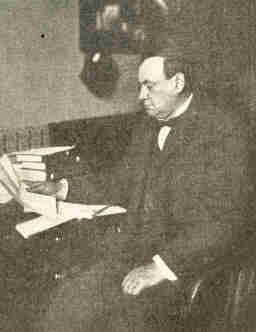
Copyright by Clinedinst, Washington.
Dr. Harvey W. Wiley, many years
Chief of the U. S. Bureau of Chemistry.
Nearly all of the States have passed laws relating to the purity of
goods sold to the public. Investigation showed, however, that twenty per
cent of the articles of food in common use were adulterated. This led to
the passing of a far-reaching measure by Congress, 1906, known as the
Pure Food and Drugs law. It provides against the manufacture and sale of
adulterated or misbranded foods, drugs, medicines, or liquors in the
District of Columbia, the Territories, and the insular possessions of
the United States, and prohibits the shipment of such goods from one
State to another or to a foreign country. To the Department of
Agriculture was given the power to enforce the law. Thus the public is
protected against adulterated foods and medicines and dishonest and
misleading labels, and honest manufacturers are protected against
fraudulent competition.
For a number of years some of the European countries condemned American
packing-house products. Abuses in the processes of preparing preserved
meats were brought vividly before Americans by Upton Sinclair in his
novel "The Jungle." The Department of Agriculture took up the problem
and a special investigation was ordered by President Roosevelt. The
report showed the need for more rigid inspection, and the agitation
throughout the country forced the House of Representatives, 1906,
somewhat reluctantly, to adopt the President's recommendation for a
thorough inspection, by government agents, of all processes and methods
used in the meat packing-houses.
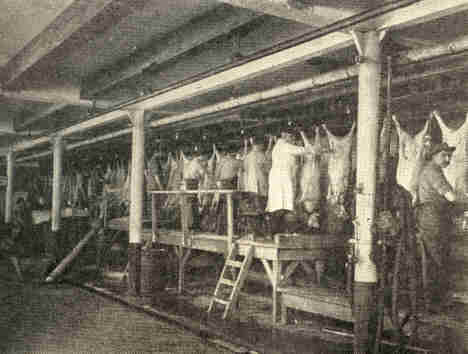
U. S. Government inspection of a packing-house.
Inspector's assistant attaching a "Retained" tag to carcass marked by
inspector on the heading bench. Carcasses so marked are left intact
until they reach the retaining-room.
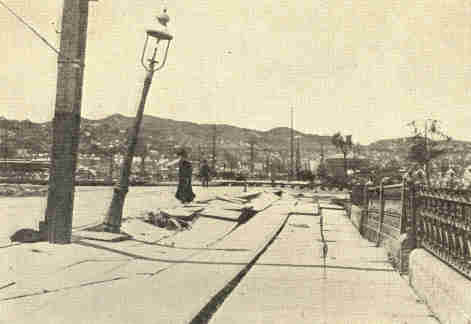
Earthquake at San Francisco, April 18, 1906.
Upheaval of sidewalk at Eighteenth and Capp Streets.
Early in the morning of April 18, 1906, San Francisco was visited by one
of the most dreadful disasters of modern times. An earthquake shock
destroyed many of the important buildings in the business part of the
city. Other cities and towns along the coast and in the Santa Clara
Valley suffered greatly and a number of the buildings of Leland Stanford
University, thirty miles south of San Francisco, were demolished. Ninety
per cent of the loss in San Francisco was due to the conflagration which
raged for two days. Fires broke out owing to the crossing of electric
wires. The water-mains were old and poorly laid and the force of the
earthquake had burst them. Firemen and soldiers fought the advance of
the flames by destroying buildings with dynamite. Not until an area
three miles in length and two miles in breadth, including all the
business and the thickly settled residential sections, had been burned
over was the advance of the flames stopped. The estimated loss of life
was 1,000, and property valued at $300,000,000 was destroyed. Among the
irreparable losses were several libraries, the collections of the
California Academy of Sciences, and many works of art. The noted
Bancroft Library with its collection of manuscripts was saved.
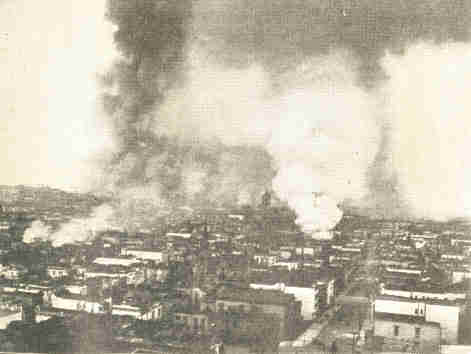
Burning of San Francisco following the earthquake.
Showing destruction of buildings after the
earthquake and fire in San Francisco.
A quarter of a million people were rendered homeless and were without
food and the means of earning a livelihood. The sympathy of the world
was aroused and offers of relief came from all quarters. Two million
five hundred thousand dollars was voted by Congress, and the total
relief fund amounted to $20,000,000. There was little suffering for lack
of food and water, owing to the co-operation of representatives of the
Red Cross Association, a citizens' committee, and the United States army
in distributing supplies.
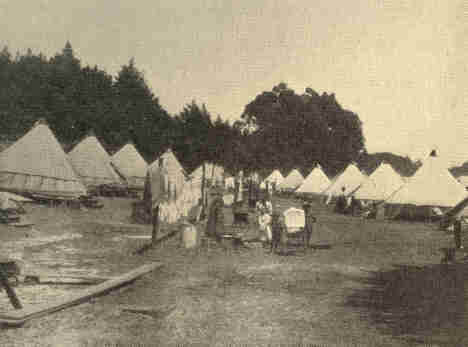
Refugees in Golden Gate Park, San Francisco.
One hundred thousand persons were sheltered in tents in Golden Gate
Park. The courage and hopefulness of the people did not desert them, and
the rebuilding of the city was immediately begun. At the end of a year
one-half of the burned area had been rebuilt. The old frame and low
brick structures were replaced by modern buildings of steel and
re-enforced concrete, for this type had survived the earthquake shock.
After two years, a new San Francisco, more beautiful and more
substantial, had risen on the site of the old.
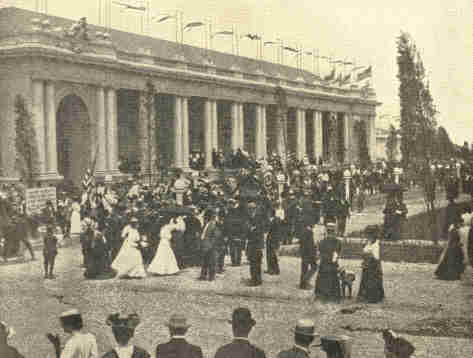
Copyright by Underwood & Underwood, N.Y.
The Jamestown Exposition--Manufactures and
Liberal Arts Building from the Auditorium.
On April 26, 1907, the Jamestown Exposition was opened. It was in
commemoration of the first English settlement in America. The southern
shore of Hampton Roads, forty miles southeast of old Jamestown, was
selected as the site for the buildings. The historic idea was uppermost
in the exposition. The colonial type of construction was dominant and
good taste and moderation were notable in the arrangement of the grounds
and exhibits. Industrial and commercial progress were emphasized. The
United States had a special exhibit to illustrate the work of the
different departments. In the harbor, one of the finest in the world,
was the greatest international naval display ever witnessed. Every
variety of war-vessel in existence was on exhibition besides commercial
and passenger boats from the great ports of the world.
CHAPTER X
THE FINANCIAL PANIC OF 1907
[1907]
Popular opinion ascribed three reasons for the panic of 1907. The first
of these was the attitude of the President toward certain great
corporations. It is true that his attacks bared some of the most deeply
rooted evils which have always been at the bottom of our
panics--dishonesty in the administration of great aggregations of
capital. Great were the lamentations and doleful the predictions of what
would happen should the President not change his policy of enforcing the
laws. The railway opponents of the President were sure the panic came
from the Hepburn Bill, which was passed early in 1906. If this had been
dangerous to the welfare of the railroads it is reasonable to assume
that foreign capital would have been withdrawn from American railways
and that American capitalists interested in railroads would have
attempted to avert financial ruin by disposing of their holdings.
Neither situation developed, for the European investors increased their
holdings and American capitalists continued to plan still greater
investments in railways.
The second general explanation was found in the unsound and reckless
banking in New York City. The dangers arising from trust companies had
been known for several years. It came to be believed that the deposits
in these trust companies were being misused by the bank officers for the
promotion of various speculating schemes. The disclosures which came
with the investigation of the insurance companies fixed these beliefs
more firmly in the minds of the people, and the first break in
confidence precipitated runs on the New York banks.
The third explanation was that the panic was due to the defects in our
American currency system.
These were the popular explanations, but there were deep-seated causes
which had worked to bring about the existing conditions. The crisis was
world-wide and was felt most in the countries where there was a gold
standard. In 1890 the world's supply of gold available for monetary use
was hardly $4,000,000,000; in 1907 it was more than $7,000,000,000.
Along with this went a rapid rise in the average price of commodities in
gold-standard countries. Bank deposits in the United States in 1907 were
three times as great as they were in 1897. Amidst all this prosperity
there were forces which were bound to bring a reaction and among the
most important of these was the demand for capital for conversion into
fixed forms. Ready capital was also lessened relatively by the great
losses experienced as a result of the Spanish-American War, the Boer
War, the Japanese-Russian War, the San Francisco earthquake, and the
Baltimore fire. These losses, which amounted to $3,000,000,000, came at
a time when the world was just entering upon a period of great
industrial activity and needed all its capital. Much capital was
absorbed in the construction of railroads, industrial plants,
development of foreign industries, etc. These conditions brought about a
tightening of money rates in Europe and American financial centres;
consequently rates of interest went up. Commercial paper which brought
three to three and one-half per cent in New York in 1897 brought seven
per cent in 1907.
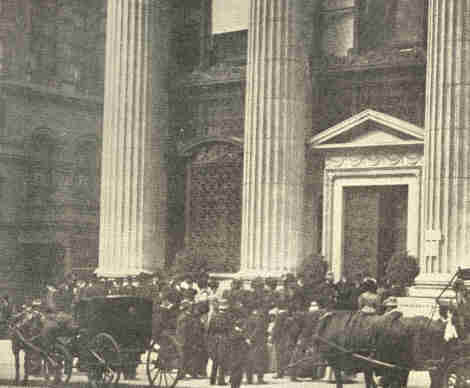
The panic of 1907. Run on the Knickerbocker Trust Company,
34th Street and Fifth Avenue.
Closely allied to this movement was the increase in the number of
securities issued by industrial concerns. A few resourceful men, in
order to do away with the evils of unrestricted competition, devised a
remedy in the form of mergers. Others of less capacity but greater
daring saw opportunities for money-making, and a craze for mergers and
for the incorporation of private enterprises swept over the country. By
1907 there were at least $38,500,000,000 worth of securities in
existence. The natural result was speculation. When investors began to
fear the soundness of the securities a collapse of credit was due.
The rapid development of trust companies had its effect. The cash
reserves held by these companies were small; their investments were not
always conservative and the depositors were often suspicious. This free
expansion of business with little or no reference to cash reserve or
capital gave rise to another cause for the panic, which was not a matter
of money. It was a matter of what was in men's minds. There was a period
of "muckraking" in which leaders financial and political were severely
critcised. Whether or not this criticism was justified by the exposition
of the frauds of the insurance companies and the questionable dealings
of some other corporations need not be discussed. The criticism created
an attitude of mind throughout the nation, and the first weakening of a
bank brought on the deluge.
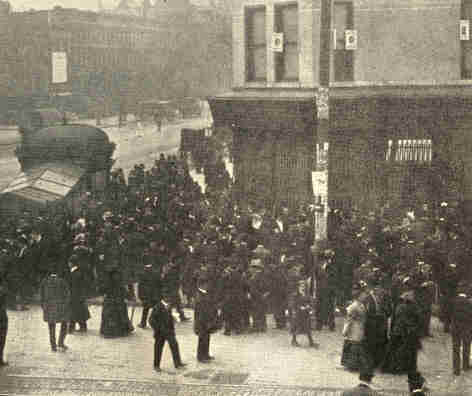
The panic of 1907. Uptown branch of the
Knickerbocker Trust Company, 125th Street.
To the ordinary observer the panic of 1907 will date from October 22,
when the Knickerbocker Trust Company of New York closed its doors.
Earlier in the month the Mercantile National Bank had gotten into
difficulties and had appealed to the clearing-house committee for aid,
which was given. Soon it was noted that the Knickerbocker Trust Company
was in a precarious condition, and the directors, following the example
of the other bank, appealed to the same committee. The investigation of
the committee showed the company insolvent and aid was refused. When the
facts became known, a run on the bank began and it was compelled to
close its doors. The lack of confidence in other financial institutions
was soon shown by similar runs.
No bank could stand the strain unaided. Now the Federal Government
stepped in and Secretary of the Treasury Cortelyou came in person to New
York and deposited $40,000,000 of the surplus from the United States
Treasury to be used for the aid of beleaguered institutions. For more
than a week the crowds of depositors sought their money. The lines were
not broken at night until the police hit upon the plan of giving to each
individual a ticket denoting his place in the line. The Trust Company of
America alone paid $34,000,000 across its counters and still crowds
thronged the streets. At length the enormous reserve of the Treasury was
exhausted and it became necessary to delay and deliberately to make slow
payments. Through loans made by other banks the Trust Company of America
and the Lincoln Trust Company, which had endured the hardest sieges,
were saved and now the panic entered its second stage.
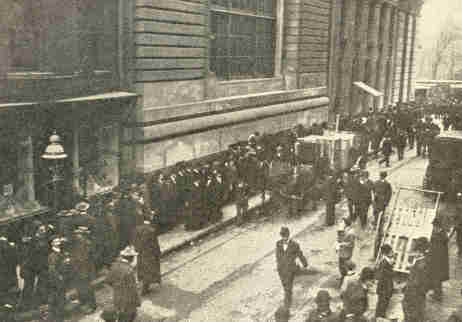
The panic of 1907. Run on the Colonial Trust Company.
Line of depositors in Ann Street waiting their turn.
The country was thoroughly aroused, and to avoid a nation-wide raid upon
banking houses the bankers took radical steps. The first measure
resorted to was the enforcement of the rule requiring savings-bank
depositors, at the option of the institution, to give sixty days' notice
before withdrawing deposits. The second expedient was one which had been
resorted to during former years of financial unsteadiness. "Emergency
currency" was issued. This currency took various forms. (1) The
clearing-house loan certificates issued in denominations ranging from
$500 to $20,000, used for settling inter-bank balances; (2)
clearing-house certificates in currency dimensions to be used by banks
in paying their customers; (3) clearing-house checks which took the form
of checks drawn upon particular banks and signed by the manager of the
clearing-house; (4) cashier's checks (in opposition to the National Bank
act) secured by approved collateral; (5) New York drafts which were
cashier's checks drawn against actual balances in New York banks; (6)
negotiable certificates of deposit, and (7) pay checks payable to bearer
drawn by bank customers upon their banks in currency denominations.
These were guaranteed by the firm which issued them.
Other devices were used to aid the banks and to block the spread of the
panic by limiting cash payments by the banks. The governors of Nevada,
Oregon, and California declared legal holidays continuously for several
weeks, thereby allowing the banks to remain closed. In some places the
size of withdrawals was limited to $10 or $25 daily.
The panic was felt to a great degree on the New York Stock Exchange
because the banks refused to make loans, but this stringency was
relieved by a bankers' pool, headed by J. P. Morgan, which loaned
$25,000,000 at the prevailing rate of interest. With the strengthening
of the Stock Exchange another stage of the panic passed.
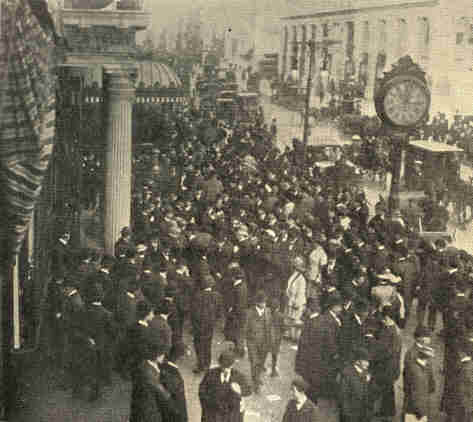
The panic of 1907. Run on the Lincoln
Trust Company, Fifth Avenue entrance.
In spite of the use of the surplus of the Treasury the banks showed a
loss of $50,000,000 in actual cash during the five weeks of the panic.
Now demands were made on foreign countries for gold. The Bank of England
made no move to block the great withdrawals of gold except to raise the
official discount to seven per cent. The flow of gold did much to stay
the ebb of confidence.
Some contended for an issue of paper money and after a long discussion
by the officials of the Treasury, it was decided to sell $50,000,000
worth of Panama two per cent bonds and $100,000,000 worth of three per
cent notes in the hope of calling from its hiding-place the money which
was being hoarded. The result of the venture was not satisfactory and
the loan operations soon ceased.
Gradually financial affairs righted themselves. The emergency currency
was redeemed, the runs on banks ceased, confidence slowly returned, and
business picked up, although by the middle of 1908 the volume was
scarcely half of what it had been a year before. The number of bank
failures had been comparatively small. Only twenty-one banks were
obliged to suspend payment, while in 1893 the number was 160.
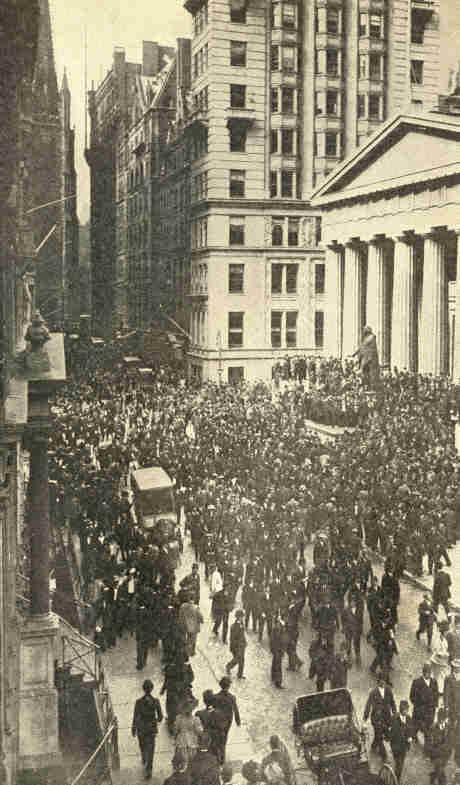
The panic of 1907. Wall Street, in front of the Sub-Treasury Building,
when the run on the Trust Company of America was at its height.
Naturally there was much discussion concerning the defects of our
financial system, of the needs of elastic currency, of a central bank,
etc., when the Sixtieth Congress met in December, 1907. Several bills
were offered for the establishment of a central bank; some for the issue
of a special currency by the government; others for the legalization of
certificates and currency created by clearing-house associations. The
aversion of the people to the centralization of the banking business in
the hands of a few of the great money powers made the establishment of a
central bank out of the question.
The bills which were discussed at any length were the Fowler Bill, the
Vreeland Bill, and the Aldrich Bill. The first was discarded, although
it had merits, and the two branches of Congress were unable to agree
upon either of the others. The result was a compromise measure which
became the Aldrich-Vreeland Act.
The important provisions of this act are as follows: (1) Ten or more
national banking associations, each with an unimpaired capital and
surplus of not less than twenty per cent and an aggregate capital and
surplus of not less than $5,000,000, may form national currency
associations. These associations are to have power to render available,
for the basis of additional circulation, "any securities, including
commercial paper, held by a national banking association."
(2) To obtain this additional circulation, any bank belonging to a
national currency association having circulating notes outstanding
secured by United States bonds to an amount not less than forty per cent
of its capital stock, and having the required unimpaired capital and
surplus, may deposit approved securities with the currency association
and be empowered by the Secretary of the Treasury to issue additional
circulating notes to an amount not to exceed seventy-five per cent of
the cash value of the securities. If the securities are State or
municipal bonds the issue must not exceed ninety per cent of the market
value of the bonds.
(3) The banks and assets of all banks belonging to the currency
association are liable to the United States for the redemption of this
additional currency, and the association may at any time require that
additional securities be deposited. All banks are held liable to make
good the securities of any bank in the association.
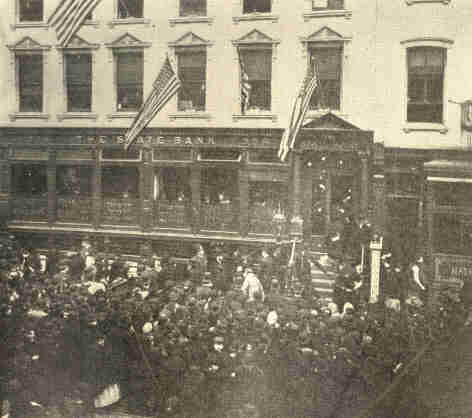
The panic of 1907, Run on the State Bank,
Grand Street, New York.
(4) The total amount of circulating notes outstanding for any bank shall
not at any time exceed the amount of its unimpaired capital and surplus,
neither shall the amount of such notes in the United States exceed
$500,000,000 at any time. The amount issued in each State shall bear the
same relation to the total amount issued in the United States as the
unimpaired capital and surplus of the banks of that State bear to the
unimpaired capital and surplus of the banks of the United States.
(5) The tax on circulating notes secured by United States bonds bearing
two per cent or less shall be one-half of one per cent; if secured by
United States bonds bearing more than two per cent, the tax shall be one
per cent. If the securities are other than United States bonds, the tax
shall be at a rate of five per cent per annum for the first month and
afterward an additional tax of one per cent per annum for each month
until a tax of ten per cent per annum is reached.
(6) The redemption of the notes may take place by the banks depositing
with the Treasurer of the United States lawful money to replace the
securities deposited.
(7) The formation of a national monetary commission to inquire into and
report to Congress necessary or desirable changes in the banking and
currency laws was provided for.
CHAPTER XI
IMMIGRATION AND EMIGRATION
[1907]
Since the organization of our government nearly 29,000,000 foreigners
have come to the United States. The flow of immigration first assumed
large proportions during the decade 1831-1840 and since that time one
wave after another has reached our shores. The last one, and the one
which has caused the greatest alarm, gathered force about 1897 and
reached its full tide in the first decade of the twentieth century, when
over 8,000,000 aliens landed at our ports.
During this period (1820-1910) the character of immigration has changed.
Prior to 1880 the greater part of it came from northern Europe, but
since that time the number has constantly fallen off, and the flow from
southern Europe has greatly increased. During the decade 1871-1880
Austria-Hungary, Italy, and Russia sent only 181,000 of 2,262,000 aliens
who landed in the United States--about eight per cent. During the decade
1901-1910, 8,130,000 immigrants came to our shores, and of these
5,800,000, or over 70 per cent, were from these three countries. In 1901
Austria-Hungary sent, 113,400; in 1907 about 338,500, but owing to the
passage of the immigration law in 1907 the number fell abruptly, but by
1910 had again increased to 260,000. The same is true of Italy. In 1901
about 136,000 came; in 1907 nearly 286,000, and in 1910 about 215,500.
Russia sent 85,000 in 1901, some 260,000 in 1907, and 187,000 in 1910.
The numbers from northern Europe do not approach these. The immigration
from the British Isles does not reach the 100,000 mark; from Germany
only 30,000 come yearly.
Causes for this influx are varied. Many come desirous of owning homes, a
pleasure out of reach in their home country on account of high prices.
Free institutions attract others. A land which offers free schools to
all regardless of race or creed, religious freedom, and the opportunity
to play some part in the political life of the state is naturally
attractive. Some come to escape military service, others with the idea
of making money and returning to their native land. Density of
population and the accompanying excessive competition in the struggle
for existence also play a part.
Hundreds of letters telling of the general prosperity in America and
contrasting this with the condition at home, do their work with the
disheartened peasants. It is said that half of our immigrants come on
tickets paid for by friends in America. The large employers of labor,
and even the States themselves, are constantly calling for laborers.
Ours is a huge, half-developed country, and the development of our
resources, particularly the coal and iron industries, the cotton; rice,
cane, and tobacco industries, and the railways demands thousands of
helpers.
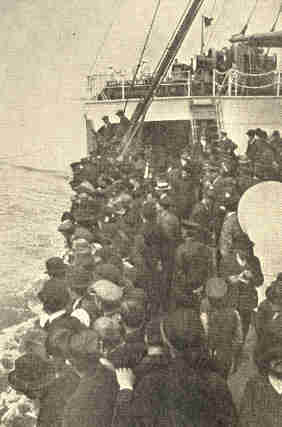
Emigrants bound for America.
The steamship companies which have found an extremely profitable
business in the transportation of immigrants have used various means to
increase the numbers. Agents are said to be in all European countries
soliciting trade. Associations for the assistance of poor emigrants have
been formed in various European cities--this is especially true among
the Jews who, by means of societies such as the "Hebrew Shelter" of
London, have aided thousands of Roumanian and Russian Jews on their way
to America.
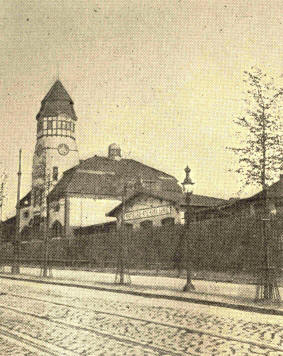
Entrance to Emigrant Station or "model town" in Hamburg.
Built for emigrants waiting to sail.
Although most of the European countries have placed restrictions upon
emigration, these restrictions unfortunately do not retard the
emigration of the undesirable classes. As a result America was called
upon early to legislate on this problem. The first act was in 1819 and
was aimed to regulate the transportation of immigrants. The laws of
1875, 1882, 1891, 1893, and 1903 dealt with the class of immigrants to
be admitted. The acts did not accomplish the end for which they were
framed, and the question was taken up again by Congress which, after a
lengthy discussion, passed the act of 1907. No great change in policy
was effected by this law which, for the most part, only revised the
wording of the old laws and modified the methods of regulation. The head
tax of two dollars, hitherto levied on each alien, was doubled but was
made inapplicable to immigrants from our insular possessions or to
aliens who had resided for a year either in the British possessions in
North America, or in Cuba or Mexico. All aliens suffering from
tuberculosis or loathsome diseases or those who were "mentally or
physically defective, such mental or physical defect being of a nature
which may affect the ability . . . to earn a living," were excluded.
Children under sixteen unaccompanied by a parent were excluded.
Steamship companies were placed under additional restrictions to insure
against their violation of the act. Should an immigrant within a period
of three years be found to have entered the country contrary to the
terms of the act, he was to be deported and the transportation company
responsible for his coming would be held liable for the expense of his
deportation.
The effect of the new law can be seen in the immigration statistics--the
number of immigrants for the year 1908 is but little more than half as
great as the number for 1907. The chief decrease was in the stream from
southern Europe. This decrease cannot be attributed entirely to the act
of 1907, but must be accounted for in part by the panic of 1907.
Observations extending over a long period of years have disclosed the
fact that the ebb and flow of the tide of immigration is closely
attached to the periods of economic prosperity and depression.
When the races of northern Europe contributed the greater part of our
immigrants there was a general feeling that this was a decided advantage
to us. The people were readily assimilated into our population and were
in general intelligent, industrious citizens who soon acquired a
patriotic love for America and its institutions. The serious problems
came with the increased number of southern Europeans.
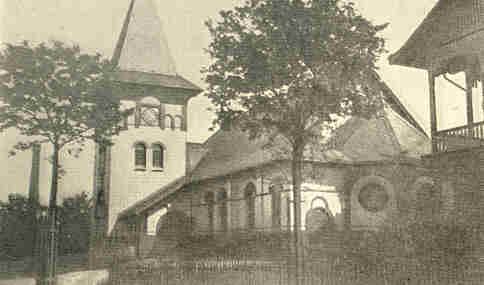
One of several churches built for emigrants of various
faiths in the station or "model town" of the
Hamburg-American Company, for use while waiting to sail.
For years Italians emigrated to South America, particularly to Brazil
and the Argentine Republic, where the climate, race customs, and
language were more to their liking than in the north. A diminution of
prosperity there has turned part of the tide northward. About eighty per
cent of our Italians come from southern Italy, a fact explained by the
difference between the industrial conditions in the northern and
southern parts of the peninsula. In the south agriculture is the only
industry, and it frequently suffers from climatic conditions, the
resulting losses bearing heavily upon the population. Conditions are
aggravated by an unequal division of taxes between the north and the
south. Often the only alternative to starvation is emigration. During
the past decade 2,000,000 Italians have come to us and, according to
estimates, about two-thirds of them have settled in the cities of the
Northern States, a condition detrimental to the foreign and our social
organization alike. These Italians, peasants and experts in fruit
culture by training, become day laborers, thus losing their greatest
productive power. The Italian who keeps away from the city finds his lot
more agreeable. Wherever they have settled as farmers they have been
uniformly successful. The person who knows only the Italian of the
tenements has little sympathy for him, in spite of the fact that many of
this race have proved themselves to be quiet, sober, and useful
citizens.
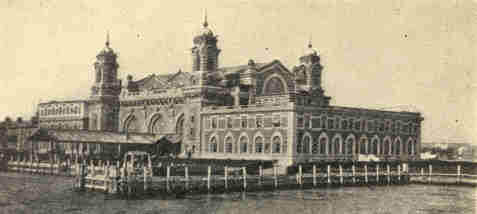
Exterior view of main building.
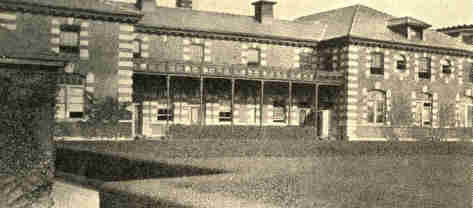
Restaurant. Immigrants dining-room and detention quarters.
Detained immigrants are fed here at the expense of the steamship companies.
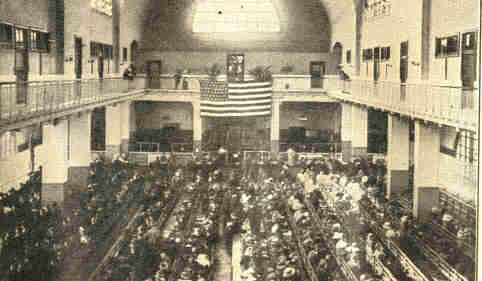
Here all immigrants must present themselves upon arrival for their
first inspection under the law--sometimes as many as 5,000 a day.
U. S. IMMIGRANT STATION, ELLIS ISLAND, N. Y.
The Slavic immigration since 1880 has been mainly from the more
primitive districts out of touch with the civilization of western
Europe. These people have come, not as settlers, but as laborers in the
mines, factories, and foundries, planning to remain here for a time,
earn as much as possible, and return to their native land.
In 1899 statistics began to be compiled by means of which the race and
nationality of aliens might be determined. From 1899 to 1907 about
seventy-two per cent of the Slavic immigration came from
Austria-Hungary. Since 1900 at least 100,000 aliens from this country
have come to the United States each year; in 1905, 1906, and 1910 the
number exceeded 250,000 each year, and in 1907 it was 340,000. In this
crowd came Bohemians, Poles, Slovaks, Ruthenians, Slovenians, Croatians,
Bulgarians, Servians, Montenegrins, and other allied peoples. They are
distributed over various parts of the land. Pennsylvania, on account of
its mines, gathers by far the greatest number--in 1906 there were about
500,000 Slavs in the State; New York had nearly 200,000, and Illinois
about 134,000. The Bohemians and Poles seem inclined to farm, but in the
main the Slav laborers have busied themselves in the coal, coke, iron,
and steel industries. Very seldom do the Slavs take to petty street
traffic, as do the Jews and Italians, but prefer the harder and better
paid work in the mines and foundries.
The Russians make the smallest Slavic group in America. Although many
Russians are reported among the immigrants, only about five per cent are
native born Russians, the rest being Jews, Poles, Finns, and
Lithuanians.
About one-eighth of our European immigrants are Jews. By the law of 1769
the Jews in Russia are compelled to live within certain territorial
limits known as the Jewish Pale, and about ninety-four per cent comply
with the regulation. The law of 1882 has further restricted the places
of residence, for Jews are now prohibited from buying or renting lands
outside the limits of the cities or incorporated towns. Their
educational advantages are limited by law; few are admitted to the bar
and few to the other learned professions. To these disabilities the
Russian government has added the terror of persecution, which will
explain why 150,000 Jews come to America each year. In all there are
1,250,000 here.
"ALIEN PASSENGERS" AND IMMIGRANTS ENTERING THE UNITED STATES FROM
EUROPEAN COUNTRIES, 1820-1910
Last Permanent Residence 1820-30 1831-30 1841-50 1851-60 1861-70 1871-80 1881-90 1891-1900 1901-1910 Total
Austria-Hungary 7,800 72,969 353,717 597,047 2,145,266 3,176,801
Belgium 27 22 5,074 4,738 6,734 7,221 20,177 20,062 41,635 105,690
Denmark 169 1,063 539 3,749 17,094 31,771 88,132 52,670 65,285 260,472
France 8,497 45,575 77,262 76,358 35,984 72,206 50,464 36,006 73,379 475,731
Germany 6,761 152,454 434,626 951,667 787,468 718,182 1,452,970 543,922 341,498 5,389,548
Greece 15,996 167,519 183,515
Italy 408 2,253 1,870 9,231 11,728 55,759 307,309 655,694 2,045,877 3,090,129
Netherlands 1,078 1,412 8,251 10,789 9,102 16,541 53,701 31,816 48,262 180,952
Norway, Sweden 91 1,201 13,903 20,931 109,298 211,245 568,362 95,264 190,505 1,691,013
Sweden 230,679 249,534
Russia 91 646 656 1,621 4,536 52,254 265,088 593,703 1,597,306 2,515,901
Spain, Portugal 2,622 2,954 2,759 10,353 8,493 9,893 6,535 6,723 27,935 170,426
Portugal 23,010 69,149
Switzerland 3,226 4,821 4,644 25,011 23,286 28,293 81,988 33,149 34,922 239,340
England 22,167 73,143 263,332 385,643 568,128 460,479 657,488 271,094 388,017 3,089,491
Scotland 2,912 2,667 3,712 38,331 38,768 87,564 149,869 60,053 120,469 504,345
Ireland 50,724 207,381 780,719 914,119 435,778 436,871 655,482 403,496 339,065 4,223,635
Wales 11,186 17,464 28,650
Europe; unspecified 43 96 155 116 210 656 10,318 4,370 1,719
Total 98,816 495,688 1,597,502 2,452,657 2,064,407 2,261,904 4,721,602 3,703,061 8,136,016 25,531,653
Immigrants from British North America and other countries 2,535,810
Estimated number of immigrants prior to October 1, 1819 250,000
[Transcriber's note: Norway/Sweden and Spain/Portugal are combined totals in
columns where only one value is given.]
TOTAL NUMBER OF IMMIGRANTS, 1891 TO 1910
Sex Age
Year Ending June 30 Total Number Male Female Under 14 14 to 45 45 and Over
1891 560,319 354,059 296,200 95,879 405,843 58,597
1892 623,084 385,781 237,303 89,167 491,839 42,078
1893 502,917 315,845 187,072 57,392 419,701 25,824
1894 314,467 186,247 128,220 41,755 258,162 14,550
1895 279,948 159,924 120,024 33,289 233,543 13,116
1896 343,267 212,466 130,801 52,741 254,519 36,007
1897 230,832 135,107 95,725 38,627 165,181 27,024
1898 229,299 135,775 93,524 38,267 164,905 26,127
1899 311,715 195,277 116,438 43,983 248,187 19,545
1900 448,572 304,148 144,424 54,624 370,382 23,566
1901 487,918 331,055 156,863 62,562 396,516 28,840
1902 648,743 466,369 182,374 74,063 539,254 35,426
1903 857,046 613,146 243,900 102,431 714,053 40,562
1904 812,870 549,100 263,770 109,150 657,155 46,565
1905 1,026,499 724,914 301,585 114,668 855,419 56,412
1906 1,100,735 764,463 336,272 136,273 913,955 50,507
1907 1,285,349 927,976 355,373 138,344 1,100,771 46,234
1908 782,870 506,912 275,958 112,148 630,671 40,051
1909 751,786 519,969 231,817 88,393 624,876 38,517
1910 1,041.570 736,038 305,532 120,509 868,310 52,751
Year Debarred from Landing Returned Within One Year Returned Within Three Years Able to Read but not Wruite [See note 1] Unable to read or Write [See note 1]
1892 2,164 637
1893 1,053 577 59,582 61,038
1894 2,389 417 16,784 41,614
1895 2,394 189 2,612 42,302
1896 2,799 238 5,066 78,130
1897 1,617 263 1,572 43,008
1898 3,030 199 1,416 43,057
1899 3,798 263 1,022 60,446
1900 4,246 356 2,097 93,576
1901 3,516 363 3,058 117,587
1902 4,974 465 2,917 162,188
1903 8,769 547 3,341 185,667
1904 7,994 300 473 3,953 168,903
1905 11,879 98 747 8,209 230,882
1906 12,371 61 615 4,755 265,068
1907 13,064 70 925 5,829 337,573
1908 10,902 114 1,955 2,310 172,293
1909 10,411 58 2,066 2,431 191,049
1910 24,270 23 2,672 4,571 253,569
Note 1: Prior to 1895 the figures are for persons over 16 years; from
1895 to 1910 for persons 14 years of age and over.
The question of Oriental immigration has caused much comment in our
Pacific Coast States for several years. Before 1900 the total number of
Japanese coming to America seldom reached 1,500 a year. Since that time
about 12,000 have come each year, except in 1903 when 20,000 came and
1907 when the number reached 30,000. Seventy per cent of this number,
however, went to Hawaii. Over-population and economic depression in
their native land have caused this exodus. Most of these immigrants are
laborers--skilful, energetic and efficient--who apparently desire to
become citizens. Among the better classes are many who have attained
eminence in various lines of work in our country. In scientific
investigation the names of Takamine, Noguchi, Yatsu, Takami, Asakawa,
and Iyenaga are well known. The names of those who have been more than
ordinarily successful in business would make a long list. The most
serious objections to the Japanese arise in the coast States where these
immigrants have raised a serious labor problem. The people of these
commonwealths also fear a race problem which in gravity will rival the
one in the Southern States. It is claimed that even now, when the number
of Orientals is small, the enforcement of law is exceedingly difficult
in the Chinese quarters, while the control of the Japanese is next to
impossible since they do not congregate in certain sections of the
cities as do the Chinese. It is claimed that the 2,000,000 whites who
live on the Pacific Coast will be swamped and lose control of the
government if this Oriental immigration is not entirely prohibited. The
Chinese do not cause so much anxiety. Since the passage of the exclusion
act thirty years ago, few have come to the United States--scarcely more
than 2,000 a year. As laborers they are efficient, patient, and honest
in keeping labor contracts.
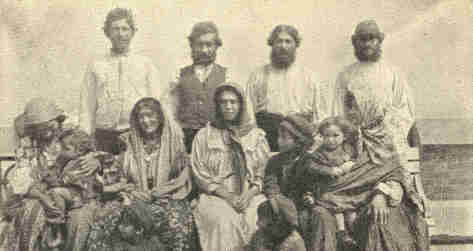
Gypsies excluded and deported as undesirable.
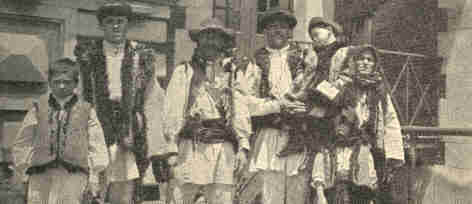
Ruthenian shepherds from Austria, bound out West for farmers.
Considered desirable and qualified to enter.
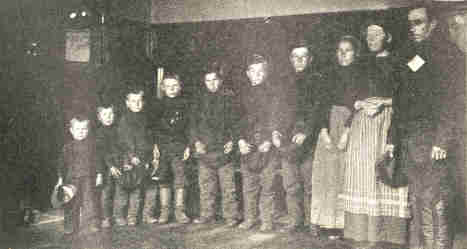
A German family of ten considered desirable and qualified to enter.
GROUPS OF IMMIGRANTS UPON THEIR ARRIVAL AT ELLIS ISLAND
These swarms of foreigners who come to us each year are causing
uneasiness in the minds of the thinking people. Can our foreign
population be growing more rapidly than our power to assimilate it? Is
this element as dangerous to our civilization as we think? Has
criminality increased as a result of increased immigration? Has this
element increased labor agitations during the past decade? Some contend
that we are rapidly approaching the limit of our power of assimilation
and that we are in constant danger of losing the traits which we call
American. The immigrants from southern Europe are in too many cases
deficient in education. This lack of education may or may not prove a
danger. So far it seems to have been the rule that in the second
generation these foreigners have shown themselves extremely anxious to
take advantage of the opportunities offered by our free schools.
One of the most serious charges made against the Americanized foreigner
has been that through him there has developed in our political system a
strain of corruption which endangers our institutions. Political
corruption did not come with the immigrants: it was known in all its
forms years ago. This much can be said, however: the worst class of
foreign-born citizens has ever proved to be a support of corrupt
political bosses. Our city governments have been notoriously corrupt and
the cities harbor the great masses of foreigners. The high cost of
living in the cities and the relatively low wages force the aliens into
poor and crowded quarters which tend to weaken them physically and
degrade them morally and socially. Among the Italians of the cities
there appears to be a vicious element composed of social parasites who
found gambling dens, organize schemes of black-mail, and are the agents
of the dreaded Black Hand. It is the class which furnishes aids for the
lowest political bosses and furnishes the bad reputation for the
Italians.
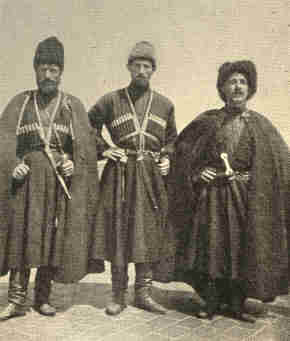
Group of Cossack immigrants considered desirable and qualified to enter.
An investigation of the nationalities in the city of Chicago has been
made by Professor Ripley, of Harvard. The results illustrate the
wonderful dimensions of the problem which the cities confront in the
assimilation of the foreign element. In the case of Chicago, were the
foreigners (those not American beyond the third generation) to be
eliminated, the population would dwindle from 2,000,000 to about 100,00.
In this city fourteen languages are spoken by groups of not less than
10,000 persons each. Newspapers are regularly published in ten different
languages and church services conducted in twenty different tongues.
Measured by the size of its foreign colonies, Chicago is the second
Bohemian city in the world, the third Swedish, the fourth Polish, and
the fifth German. There is one large factory employing over 4,000 people
representing twenty-four nationalities. Here the rules of the
establishment are printed in eight languages. So it is with the other
cities. New York, for example, has a larger Italian population than
Rome, and is the greatest Jewish city, for there are in the city some
800,000 Jews. In all eighty per cent of the population of New York are
foreigners or the children of foreigners. In Boston the per cent reaches
seventy and in Milwaukee about eighty-six.
The charge that criminality has increased rapidly with the increased
immigration from southern Europe seems to be substantiated by
statistics. From 1904 to 1908 the number of aliens charged with
committing grave crimes nearly doubled. While this fact will not prove
the point, it suggests thought on the question.
It has been truthfully said that the fundamental problem in this
question of immigration is most frequently overlooked. Back of the
statistics of illiteracy, pauperism, criminality, and the economic value
of immigrants lies another one of great proportions. What has been the
effect upon our native stock? What has been the expense, to our native
stock, of this increase of population and wealth through immigration?
The decreasing birth rate of our native population some contend is due
to the industrial competition caused by the foreign element. If this be
true, the foreigners have supplanted not supplemented the American, and
the question arises, how long can the assimilation go on before we lose
our American characteristics?
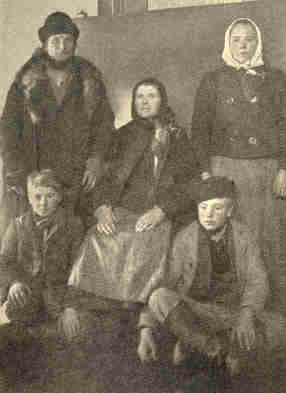
Swedish immigrant family considered desirable and qualified to enter.
The number of Europeans who return to their native lands after living a
time in the United States is comparatively small and the loss is not
great. The emigration of our farmers to Canada is a more serious thing.
Since 1897 the Dominion Government has fostered high-class immigration.
Canadian agencies have been established in many of our Western cities
with the avowed object of attracting farmers to the Provinces. The
Canadian Pacific Railway Company has taken up the pioneering business.
It sells the land, builds the home and the necessary buildings, breaks
the fields, plants the first crop, and hands over to the prospective
settler a farm under cultivation. In return the railway demands
high-class immigrants and, to insure this, no settler can take
possession of a railway farm unless he can show $2,000 in his own right.
Between 1897 and the close of 1910 Canada gained by immigration nearly
2,000,000 inhabitants. Of these, 630,000 were from the United States,
and it is estimated that those who went from the United States during
the past five years took with them $267,000,000 in cash and settlers'
effects. The end of the movement has not come, for the railway companies
have now gone into the reclamation of arid lands. Since 1908 over
1,000,000 acres of arid land in Alberta have been placed under
irrigation, and the work of reclaiming another equally large section has
begun. The American farmers who are taking advantage of this opportunity
form a class which we cannot afford to lose.
CHAPTER XII
NOTABLE SUPREME COURT DECISIONS
[1907]
The Northern Securities Company is a corporation, formed under the laws
of New Jersey, for the purpose of obtaining control of a majority of the
stock of the Northern Pacific Railroad and part of the stock of the
Great Northern Railroad. These roads, which parallel each other from
Lake Superior to the Pacific, have been held by the courts, in the case
of Pearsall vs. the Great Northern Railway, to be competing lines.
The organizers of the Northern Securities Company contended that their
ultimate purpose in organizing the company was to control the two
railway systems not for the purpose of suppressing competition, but to
create and develop a volume of trade among the States of the Northwest
and between the Orient and the United States by establishing and
maintaining a permanent schedule of cheap transportation rates.
When the company had completed its organization and the full
significance of the organization was known, the State of Minnesota
instituted proceedings against the company in the State courts. Later
the case was transferred to the federal Circuit Court and eventually
carried to the Supreme Court of the United States, where the contentions
of the State were overruled.
In March, 1902, a suit was instituted by the United States in the
Circuit Court of the eighth federal district. The judges who sat upon
the case decided unanimously that the acquisition of the stock of the
Northern Pacific and the Great Northern Railways by the Securities
Company was a combination for the restraint of trade among the States,
and therefore a violation of the Sherman act. A decree was issued by the
court prohibiting the company from acquiring any more of the stock of
these roads and from exercising any control over either of the roads in
question.
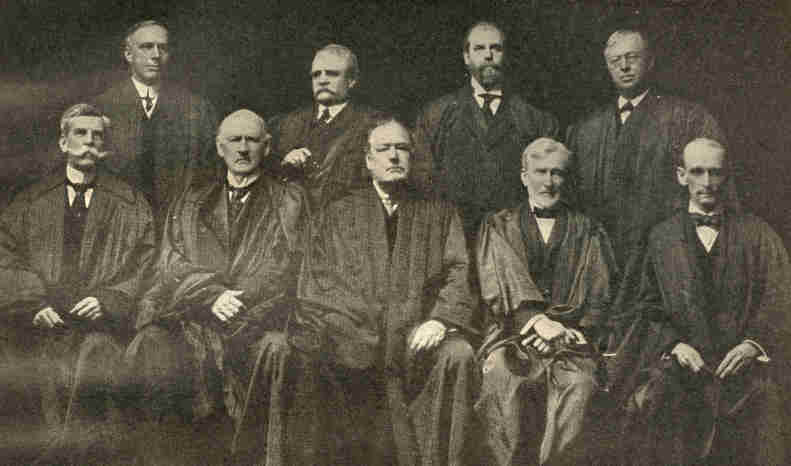
Copyright by Clinedinst. Washington.
W. Van Devanter. H. H. Lurton. C. E. Hughes. J. R. Lamar.
O. W. Holmes. J. M. Harlan. E. D. White. J. E. McKenna. W. R. Day.
Justices of the United States Supreme Court who acted upon the cases of
the Standard Oil and American Tobacco Companies.
The case was carried to the Supreme Court which by a vote of five to
four, affirmed the decree of the lower court. In the majority opinion
the court took the position that the mere acquisition by the Securities
Company of the stock of the two roads was in itself a combination for
the restraint of trade. The power to do things made unlawful by the
Sherman act had been acquired and this in effect violated that act.
Another point was made clear by the court. The defendants had vigorously
denied that the power of Congress over interstate commerce was extended
to the regulation of railway corporations organized under State laws, by
reason of these corporations engaging in interstate commerce. The court
declared that while this was not the intention of the Government, the
Government was acting within its rights when it took steps, not
prohibited under the Constitution, for protecting the freedom of
interstate commerce. Furthermore, it was held that no State corporation
could stand in the way of the enforcement of the national will by
extending its authority into other States. In substance the court denied
the right of any State to endow a corporation of its creation with power
to restrain interstate commerce.
The contention of the defendants, that the Sherman law was intended to
prohibit only those restraints which are unreasonable at common law, was
dismissed on the ground that this question had been passed upon by the
lower court in other cases.
The dissenting opinions were two in number and were written by Justice
White and Justice Holmes.
Several conclusions of importance may be drawn from the court's
decision.
1. That Congress may forbid transactions of purchase and sale when such
transactions confer on an individual or group of individuals the power
to destroy competition.
2. No State can create corporations and confer upon them power to
interfere with interstate commerce.
3. The Sherman law is not to be interpreted as forbidding the reasonable
restraints of trade which are not objectionable at common law.
The Bailey case is one of importance by reason of the fact that the
decision handed down by the Supreme Court was an effective blow against
the "peonage system," which is an evasion of the constitutional
prohibition of slavery. The Alabama law provides, in effect, that the
mere act of quitting work on the part of a contract laborer is
conclusive evidence that he is guilty of the crime of defrauding his
employer.
Alonzo Bailey was engaged by a corporation to do farm work and signed a
contract for a year, the wages being $12 a month. The company, to bind
the contract, paid Bailey $15 down and it was agreed that thereafter he
should be paid at the rate of $10.75 a month. After working a month and
a few days he left. Instead of suing him for a breach of contract and
recovery of damages, the company caused the arrest of Bailey on the
charge of an attempt to defraud. No direct evidence could be produced
that this was his intention, but the law expressly authorized the jury
to find him guilty of fraud, on the ground that he quitted work. The
accused was not allowed to testify as to his unexpressed intention. His
opportunity to escape prison was to pay back the $15 or to work out the
sum. In case neither was done, he was to be fined double the amount paid
at the time of making the contract or go to work at hard labor.
The attorneys for Bailey, wishing to test the constitutionality of the
Alabama law, carried the case to the Supreme Court of the United States.
The constitutionality of the law was called into question on the
following grounds: (1) That it violated the prohibition against
involuntary service; (2) it denied the plaintiff in error the right of
due process of law; (3) that by laying a burden on the employee and no
equivalent burden on the employer, the law denied to the plaintiff the
constitutional right of equal protection of the laws.
The decision of the court was not unanimous. Justices Holmes and Lurton
upheld the Alabama law, but the majority, in an opinion written by
Justice Hughes, declared the law in conflict with the Thirteenth
Amendment, which prohibits slavery or involuntary servitude, except as a
punishment for crime.
The significance of the decision is this--slavery has been outlawed by
our highest court, and one more legal barrier to the progress of the
black man has been removed.
The case of Loewe vs. Lawler, probably better known to the public as the
Danbury Hatters case, was decided by the Supreme Court in February,
1908, Chief Justice Fuller rendering the decision. The action was
brought originally in the United States Circuit Court for the District
of Connecticut and, after passing through the Circuit Court of Appeals,
reached the Supreme Court late in 1907.
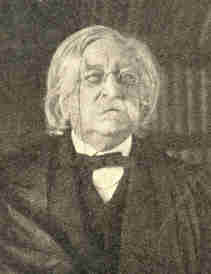
Photograph copyright by Clinedinst, Washington.
Chief Justice Melville W. Fuller.
The plaintiffs, who were manufacturers of hats, complained that the
defendants--members of the United Hatters of North America, an
organization which was a part of the American Federation of Labor--were
"engaged in a combined scheme and effort to force all manufacturers of
fur hats in the United States, including the plaintiffs, against their
will and their previous policy of carrying on their business, to
organize their workmen . . . into an organization of the said
combination known as The United Hatters of North America, or, as the
defendants and their confederates term it, to unionize their shops, with
the intent thereby to control the employment of labor in, and the
operation of, said factories . . . and to carry out such scheme, effort
and purpose by restraining and destroying the interstate trade and
commerce of such manufacturers by means of intimidation of, and threats
made to such manufacturers and their customers in the several States, of
boycotting them, their product and their customers . . . until . . . the
said manufacturers should yield to the demand to unionize their
factories."
These methods had been successfully employed before, as is evidenced by
the fact that seventy of the eighty-two manufacturers of fur hats had
been compelled to accept the conditions set forth by the American
Federation of Labor. The boycott against the Danbury, manufacturers
began in July, 1902, and was widened to include the wholesalers who
handled the goods of the Danbury concern, the dealers who bought from
the wholesalers, and customers who bought from these dealers. Notices to
this effect were printed in the official organs of the American
Federation of Labor and the United Hatters of North America. To make the
feeling against the manufacturers more intense, statements were
published to the effect that they were practising an unfair, un-American
policy in discriminating against competent union men in favor of the
cheap unskilled foreign labor.
The counsel for the defence argued that no case could be set up under
the Sherman act, since the defendants were not engaged in interstate
commerce, implying that a combination of laborers was not a violation of
the act. The court held that an action could be maintained in this case
and that the combination as it existed was "in restraint of trade" in
the sense designated by the act of 1890. The significance of the
decision lies in the fact that the Supreme Court made no distinctions
between classes. Records of Congress show that efforts were made to
exempt, by legislation, organizations of farmers and laborers from the
operation of the act and that their efforts failed. Therefore the court
held that every contract, combination, or conspiracy in restraint of
trade was illegal and cited a former decision (The United States vs.
Workingmen's Amalgamated Council) to show that the law interdicted
combinations of workingmen as well as capital.
The Sherman act was passed by Congress in 1890. It was entitled "An Act
to Protect Trade and Commerce against Unlawful Restraints and
Monopolies." Since its passage various cases falling under it have been
decided, but until the decisions in the Standard Oil Company and the
American Tobacco Company cases the extent and intent of this act have
not been understood.
In the Standard Oil case the question involved was this: Was the Sherman
act violated by the existence and conduct of this corporation, which
owned or controlled some eighty corporations originally in competition?
The control had been acquired for the purpose of monopolizing the sale
and distribution of petroleum products in the United States, and had
been acquired by various means of combination with the intent either by
fair or unfair methods "to drive others from the field and to exclude
them from their right to trade." The proof was that, to destroy
competitors, prices had been temporarily reduced in various localities,
spies had been used on competitors' business, bogus independent
companies operated, and rebates given and taken.
In the case of the American Tobacco Company, there were more than one
hundred formerly competing companies united under the control of a
single organization and the market in nearly all tobacco products was
monopolized. This domination was secured "by methods devised in order to
monopolize the trade by driving competitors out of business."
In each case the court found the defendants guilty on the grounds that
the agreements and the conduct of the defendants indicated a purpose to
destroy competitors and monopolize trade in certain articles. The
desired result was accomplished by wrongful means which injured the
public as well as the competitors.
The facts in neither case required the consideration of the question as
to whether the Sherman act prohibited every unification of formerly
competing properties and every restraint of trade, reasonable or
unreasonable but, owing to the uncertainty of the public concerning the
meaning of the law, the court stated definitely the meaning and scope of
the act. From appearances the Supreme Court has practically amended the
Sherman act by limiting its application to "unreasonable" restraints of
trade. The significance of the decisions lies here rather than in the
fact that both companies were compelled to dissolve. The best legal
authorities believe that the new interpretation of "reasonableness" and
"unreasonableness" of restraint of trade has increased rather than
decreased the effectiveness of the law, inasmuch as the meaning has
always been obscure. The new policy is a notification to combinations of
capital that to exist without prosecution they must not resort to any
unfair, oppressive, or illegal methods to control competition or crush
competitors.
CHAPTER XIII
PRESIDENT ROOSEVELT'S SECOND TERM--CONTINUED
[1907]
While President Roosevelt advocated peace, he believed that the best
means to preserve peace was suitable preparation for war. In his message
to Congress, 1904, he said; "There is no more patriotic duty before us
as a people than to keep the navy adequate to the needs of this
country's position. Our voice is now potent for peace, and is so potent
because we are not afraid of war. But our protestations would neither
receive nor deserve the slightest attention if we were impotent to make
them good." At all times he urged a larger and more efficient navy. For
years, before he became Assistant Secretary of the Navy, he had been a
student of naval affairs. He found that there was no programme for
building ships as in the European countries, and that there was general
unpreparedness for war.
Before the war with Spain, the American navy was so inferior that it was
excluded from any table of the principal navies of the world. Had the
United States possessed a few more battleships at that time, it is
probable that war would not have occurred. Spanish authorities had been
told by naval experts that their navy was superior to ours.
Profiting by that experience, plans for a larger navy were projected. By
the close of the year 1907 there were about 300 vessels in the navy
manned by 35,377 men. In comparative strength it ranked second only to
that of Great Britain. Not only was there an increase in the number of
vessels but there was great improvement in marksmanship and in the
handling of ships. In the battle of Santiago it has been estimated that
about five per cent of the shells struck the enemy. During the year 1902
Rear-Admiral Robley D. Evans introduced regular and frequent target
practice. So effective was this work that in 1908, at ranges twice as
great as at Santiago, gunners throughout the fleet averaged sixty per
cent and one vessel scored eighty per cent. Rapidity of fire also was
increased nearly fourfold.
It was the custom to send the fleet each winter to the Caribbean Sea for
manoeuvres, which lasted about four months. In December, 1907, the
Atlantic fleet, comprising sixteen battle-ships and a flotilla of
torpedo-boats, began a cruise around the world. President Roosevelt
steadily adhered to the plan in the face of the most extravagant
denunciation on the part of those who declared that it could be
considered only as a menace toward Japan. Naval experts claimed,
however, that the experience to be gained by this cruise, such as
practice in handling ships in all kinds of weather, the renewal of
stores and coal, and the meeting of other problems incident to actual
warfare, justified the experiment.
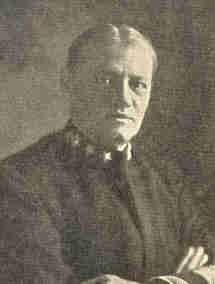
Copyright. 1908. by Harris & Ewing.
Rear-Admiral Robley D. Evans.
Under command of Rear-Admiral Evans the fleet reached Rio Janeiro on
January 12. Unusual honors were tendered the men by the Brazilian
government and people. The day of their arrival was made a national
festival. In reply to the friendly greeting from the Brazilian
government President Roosevelt wrote: "The war-ships on this cruise
exist for no other purpose than to protect peace against possible
aggression. As between the United States and Brazil these ships are not
men-of-war, but messengers of friendship and good-will." There were
similar manifestations on the part of Argentina, Chile, and Peru. The
visit of the fleet to these countries was regarded as a compliment. They
were permitted to see something of the strength of the republic at the
north and learned that the Monroe Doctrine might be enforced, if need
be, by a navy of the first rank. Notable ceremonies attended the arrival
of the fleet at Honolulu, Auckland, Sydney, Melbourne, and Manila. A
despatch to a London paper said: "It is beyond question that the United
States is no longer a Western but a cosmic power. America is now a force
in the world, speaking with authoritative accent, and wielding a
dominant influence such as ought to belong to her vast wealth,
prosperity, and importance."
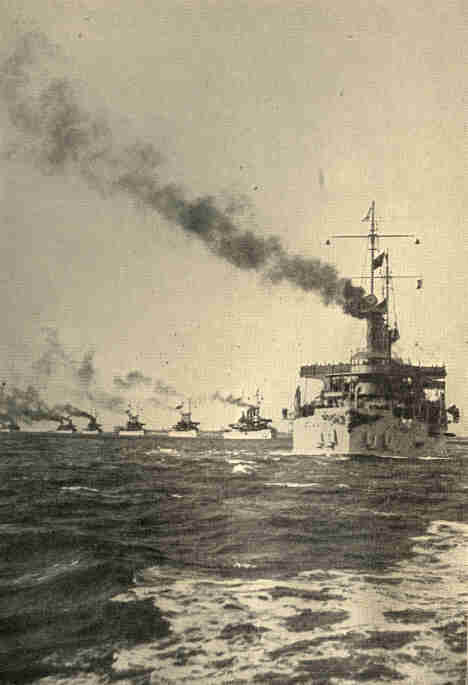
Copyright, 1907. by Underwood & Underwood.
The Atlantic fleet starting on its journey round the world, December, 1907.
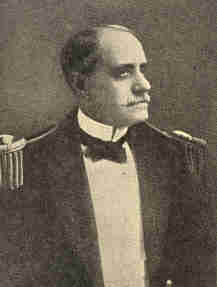
Rear-Admiral Charles S. Sperry.
At Auckland Rear-Admiral Evans, who had spent forty-eight years in the
navy, having reached the age limit of sixty-two years, was succeeded in
command by Rear-Admiral Sperry. Unusual honors were accorded the fleet
by Japan. Each American warship was escorted into the harbor of Yokohama
by a Japanese vessel of the same class and many other evidences of
friendship were manifest during their visit. The fleet then proceeded to
China, through the Suez Canal and the Strait of Gibraltar, and at the
end of one year and sixty-eight days, after covering 45,000 miles,
dropped anchor in Hampton Roads. The accomplishment of this feat,
without precedent in naval annals, still farther contributed to the
establishment of the prestige of the United States as a great world
power.
In 1889 the government of the United States purchased from the Indians a
large irregular tract of land not then occupied by them and erected it
into a separate territory under the name of Oklahoma. When it was opened
for settlement, April 22, 1889, a horde of settlers who had been waiting
on the borders rushed in to take possession of the lands. Cities and
towns sprang up as if by magic. The loose system of government exercised
by the five civilized tribes became steadily more ineffective when the
Indian Territory was thus brought into contact with white settlers. By
1893 affairs had become so confused that Congress decided to take steps
toward the ultimate admission of the territory into the Union as a
State. A committee of the Senate reported that the system of government
exercised by the Indians cannot be continued, that it is not only
non-American but it is radically wrong, and a change is imperatively
demanded in the interest of the Indians and the whites alike, and such
change cannot be much longer delayed, and that there can be no
modification of the system. It cannot be reformed; it must be abandoned
and a better one substituted.
Gradually the five tribes--Cherokee, Choctaw, Creek, Chickasaw, and
Seminole--were shorn of their governmental powers. Lands were allotted
in severalty, certain coal, oil, and asphalt lands being reserved. A
public school system was established and maintained by general taxation.
In his message to Congress, 1905, President Roosevelt recommended the
immediate admission of Oklahoma and Indian Territory as one State and
Arizona and New Mexico as another. A statehood bill embodying this
recommendation was passed by the House, but was amended in the Senate so
as to strike out the provision relative to the admission of New Mexico
and Arizona. Opposition to the admission of the last two territories as
one State came principally from the great mining companies of Arizona
supported by the railroad corporations. They were in practical control
of the territory with hundreds of millions of dollars in property. They
were fearful of the loss of control and an increase of taxation under
such a combination. Finally an act was passed by Congress, in 1906,
enabling the people of Oklahoma and Indian Territory to form a
constitution and State government and be admitted into the Union. The
enabling act provided that all male persons over the age of twenty-one
years who were citizens of the United States or who were members of any
Indian nation or tribe in said Oklahoma and Indian Territory, and who
had resided within the limits of said proposed State for at least six
months next preceding the election, should be entitled to vote for
delegate or serve as delegates in a constitutional convention. A number
of Indians were delegates in this convention. The constitution, which
was adopted by the voters, September 17, 1907, was greatly criticised on
account of its radicalism. The new State, the forty-seventh, was
formally proclaimed by the President in 1908. It has an area of 70,000
square miles. In 1900 the population was 800,000 which was increased to
1,500,000 by the date of admission. The wonderful climate and fertile
soil together with the energy of its population have continued to
attract thousands of immigrants each year.
The exclusion of Japanese students from the public schools of San
Francisco, 1906, seemed for a time to augur grave results. One-half of
the ninety Japanese who were in attendance upon these schools were above
sixteen years of age and were taught in the classes with little
children. The order of the San Francisco school board excluding the
Japanese was in harmony with the California law which permitted local
school boards to segregate Mongolians in schools apart from those for
white children. But this order nullified our treaty with Japan which
provided that the subjects of that nation should be granted the same
personal rights when in this country that our own citizens enjoy.
President Roosevelt acted with promptness and decision. His attitude was
shown in his message to Congress, December, 1907, in which he said: "To
shut them out from the public schools is a wicked absurdity . . . .
Throughout Japan Americans are well treated and any failure on the part
of Americans at home to treat the Japanese with a like courtesy and
consideration is by just so much a confession of inferiority in our
civilization . . . . I ask fair treatment for the Japanese as I would
ask fair treatment for Germans or Englishmen, Frenchmen, Russians, or
Italians .... In the matter now before me, affecting the Japanese,
everything that is in my power to do will be done, and all of the
forces, military and civil, of the United States which I may lawfully
employ will be so employed."
But the problem was not settled, for early in the year 1909
anti-Japanese resolutions were brought before the legislatures of
California, Nevada, Oregon, and two or three other Pacific States. The
bills before the legislature of California provided:
1. For the segregation of Japanese and other Orientals in residential
quarters at the option of municipalities.
2. That aliens should not own land in California.
3. That aliens should not become directors in California corporations.
4. For separate schools for Japanese students.
On February 8, President Roosevelt sent a telegram to the Speaker of the
California assembly giving the Government's views on the pending bills.
"The policy agreed to by both governments," he said, "aims at mutuality
of obligation and behavior. In accordance with it the purpose is that
the Japanese shall come here exactly as Americans go to Japan, which is
in effect that travellers, students, persons engaged in international
business, men who sojourn for pleasure or study, and the like, shall
have the freest access from one country to the other, and shall be sure
of the best treatment, but that there shall be no settlement in mass by
the people of either country in the other." While there is nothing in
the Constitution or laws to prevent the President from urging a State
legislature to vote for or against certain pending bills, such a course
is unusual. It had become a national question, however, and the
President's energy in handling the problem is worthy of praise.
According to the census of 1900, there were over 700,000 children under
sixteen years of age at work in the mills, mines, factories, and
sweat-shops of the United States. Nearly all of the States had
child-labor laws, but they were ordinarily poorly enforced and no State
was wholly free from the blight of this child slavery. While fourteen
years was the minimum in most of the States, a few permitted the
employment of children of ten years of age. In the majority of cases
there was no legal closing hour after which children might not be
employed.
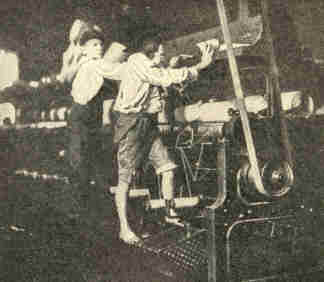
Cotton-mill operatives so small that in order to reach
their work they have to stand upon the machinery.
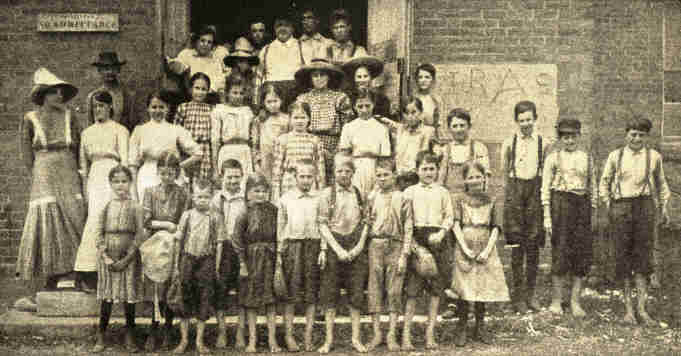
The spinning-room overseer and his flock in a Mississippi cotton-mill.
The subject was given national prominence through the Beveridge-Parsons
Bill introduced into the Senate, December, 1907, marking an epoch in the
history of federal legislation. This bill proposed to exclude from
interstate commerce all products of mines and factories which employ
children under the age of fourteen. The bill was not, however, brought
up for discussion. The leading arguments of its opponents were as
follows: (1) That the question was local only; (2) there was no reason
to believe that federal would be better than State administration; (3)
that it was limited in effect since it could not prevent children being
employed in the manufacture of goods to be sold within a State. A bill
passed both houses and was signed by the President, authorizing the
Secretary of Commerce and Labor "to investigate and report on the
industrial, social, moral, educational, and physical conditions of woman
and child workers of the United States, wherever employed, with special
reference to their age, hours of labor, term of employment, health,
illiteracy, sanitary and other conditions surrounding their occupation,
and the means employed for the protection of their health, persons, and
morals." An appropriation of $150,000 was made with which to carry on
this investigation. Among the demands of the National Child Labor
Committee have been a shorter day's work for children between the ages
of fourteen and sixteen, health certificates for factory employment in
dangerous trades, and the regulation of children in street trades.
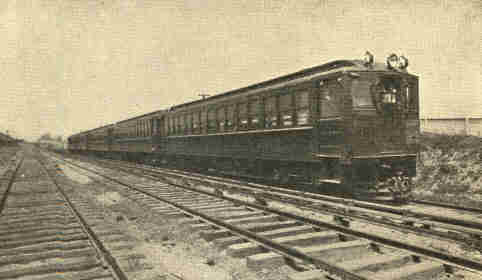
Electric train, Long Island R. R.
The period of Mr. Roosevelt's administrations was notable on account of
advances made in various other directions. Electricity was applied to