HISTORY OF MERCHANT SHIPPING AND ANCIENT COMMERCE.
Reading edition
BY W. S. LINDSAY.
IN FOUR VOLUMES.
VOL. IV.
With numerous Illustrations.
LONDON: SAMPSON LOW, MARSTON, LOW, AND SEARLE. CROWN BUILDINGS, 188 FLEET STREET. 1876.
[All Rights reserved.]
LONDON: PRINTED BY WILLIAM CLOWES AND SONS, STAMFORD STREET AND CHARING CROSS.
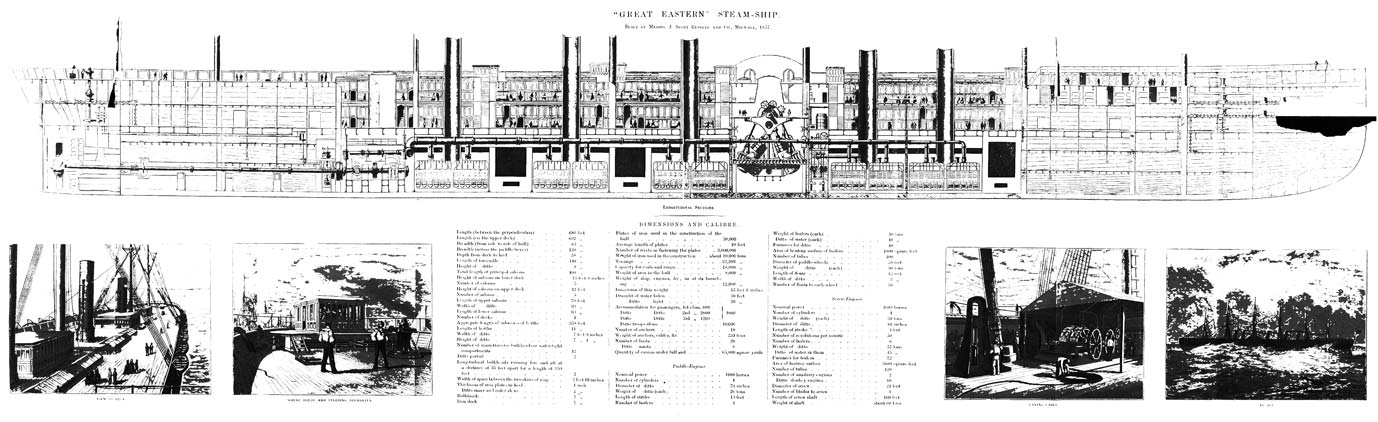
“GREAT EASTERN” STEAM-SHIP. BUILT BY MESSRS. J. SCOTT RUSSELL AND CO., MILWALL, 1857.
VIEW OF DECK.
WHEEL HOUSE AND STEERING APPARATUS.
LAYING CABLE.
AT SEA.
Large Image
Longitudinal Sections.
DIMENSIONS AND CALIBRE.
Length (between the perpendiculars) 680 feet
Length (on the upper deck) 692 ”
Breadth (from side to side of hull) 83 ”
Breadth (across the paddle-boxes) 120 ”
Depth from deck to keel 58 ”
Length of forecastle 140 ”
Height of forecastle 8 ”
Total length of principal saloons 400 ”
Height of saloons on lower deck 13 feet 8 inches
Number of saloons 5
Height of saloons on upper deck 12 feet
Number of saloons 5
Length of upper saloons 70 feet
Width of upper saloons 30 ”
Length of lower saloons 60 ”
Number of decks 4
Aggregate length of saloons and berths 350 feet
Length of berths 14 ”
Width of berths 7 feet 8 inches
Height of berths 7 feet 4 inches
Number of main traverse bulkheads or water-tight compartments 12
Ditto partial 7
Longitudinal bulkheads running fore and aft at a distance of 35 feet apart for a length of 350 feet 2
Width of space between the two skins of ship 2 feet 10 inches
Thickness of iron plates in keel 1 inch
Ditto inner and outer skins ¾ ”
Bulk heads ½ ”
Iron deck ½ ”
Plates of iron used in the construction of the hull 30,000
Average length of plates 10 feet
Number of rivets in fastening the plates 3,000,000
Weight of iron used in the construction about 10,000 tons
Tonnage 22,500 ”
Capacity for coals and cargo 18,000 ”
Weight of iron in the hull 8,000 ”
Weight of ship, engines, &c., as at its launching 12,000 ”
Immersion of this weight 15 feet 6 inches
Draught of water laden 30 feet
Draught of water light 20 ”
Accommodation for passengers, 1st class, 800 4000
Accommodation for passengers, 2nd class, 2000
Accommodation for passengers, 3rd class, 1200
Accommodation for troops alone 10,000
Number of anchors 10
Weight of anchors, cables, &c. 253 tons
Number of boats 20
Number of masts 6
Quantity of canvas under full sail 65,000 square yards
Paddle-Engines.
Nominal power 1,000 horses
Number of cylinders 4
Diameter of cylinders 74 inches
Weight of cylinders (each) 26 tons
Length of stroke 14 feet
Number of boilers 4
Weight of boilers (each) 50 tons
Weight of water (each) 40 ”
Furnaces for boilers 40
Area of heating surface of boilers 4800 square feet
Number of tubes 400
Diameter of paddle-wheels 58 feet
Weight of paddle-wheels (each) 90 tons
Length of floats 13 feet
Width of floats 3 ”
Number of floats to each wheel 30
Screw-Engines.
Nominal power 1600 horses
Number of cylinders 4
Weight of cylinders (each) 30 tons
Diameter of cylinders 84 inches
Length of stroke 4 feet
Number of revolutions per minute 50
Number of boilers 6
Weight of boilers 57 tons
Weight of water in them 45 ”
Furnaces for boilers 72
Area of heating surface 5000 square feet
Number of tubes 420
Number of auxiliary engines 2
Number of donkey engines 10
Diameter of screw 24 feet
Number of blades to screw 4
Length of screw shaft 160 feet
Weight of shaft about 60 tons