Volume 2 — CHAPTER I—THE POLITICAL CONSTITUTION OF EGYPT (continued 2)
M. L. McClure translation
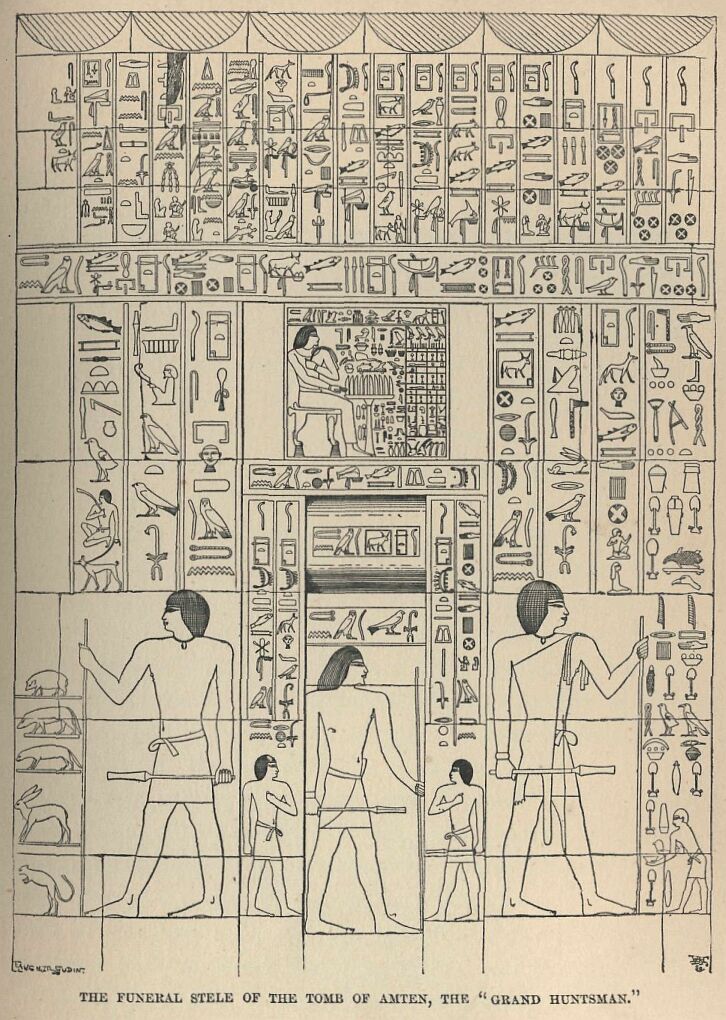
He obliged the taxpayer not only to deliver the exact number of measures prescribed as his quota, but also compelled him to deliver good measure in each case; a dishonest crier, on the contrary, could easily favour cheating, provided that he shared in the spoil. Amten was at once “crier” and “taxer of the colonists” to the civil administrator of the Xoïte nome: he announced the names of the peasants and the payments they made, then estimated the amount of the local tax which each, according to his income, had to pay. He distinguished himself so pre-eminently in these delicate duties, that the civil administrator of Xoïs made him one of his subordinates. He became “Chief of the Ushers,” afterwards “Master Crier,” then “Director of all the King’s flax” in the Xoïfce nome—an office which entailed on him the supervision of the culture, cutting, and general preparation of flax for the manufacture which was carried on in Pharaoh’s own domain. It was one of the highest offices in the Provincial Administration, and Amten must have congratulated himself on his appointment.
From that moment his career became a great one, and he advanced quickly. Up to that time he had been confined in offices; he now left them to perform more active service. The Pharaohs, extremely jealous of their own authority, usually avoided placing at the head of the nomes in their domain, a single ruler, who would have appeared too much like a prince; they preferred having in each centre of civil administration, governors of the town or province, as well as military commanders who were jealous of one another, supervised one another, counterbalanced one another, and did not remain long enough in office to become dangerous. Amten held all these posts successively in most of the nomes situated in the centre or to the west of the Delta. His first appointment was to the government of the village of Pidosû, an unimportant post in itself, but one which entitled him to a staff of office, and in consequence procured for him one of the greatest indulgences of vanity that an Egyptian could enjoy. The staff was, in fact, a symbol of command which only the nobles, and the officials associated with the nobility, could carry without transgressing custom; the assumption of it, as that of the sword with us, showed every one that the bearer was a member of a privileged class.
Drawn by Faucher-Gudin, from Lepsius, Denkm., ii. 120 a; the original is in the Berlin Museum.
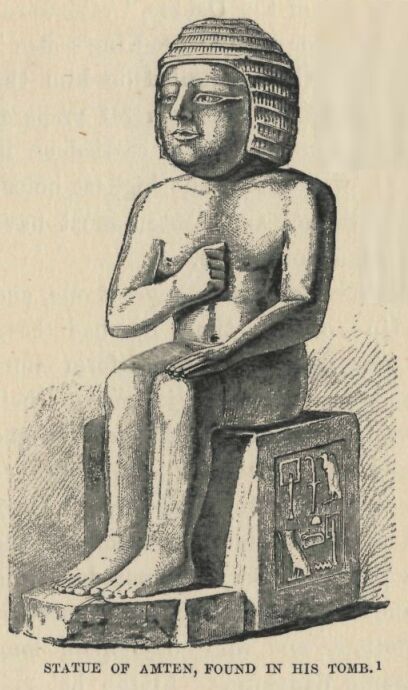
Amten was no sooner ennobled, than his functions began to expand; villages were rapidly added to villages, then towns to towns, including such an important one as Bûto, and finally the nomes of the Harpoon, of the Bull, of the Silurus, the western half of the Saïte nome, the nome of the Haunch, and a part of the Fayûm came within his jurisdiction. The western half of the Saïte nome, where he long resided, corresponded with what was called later the Libyan nome. It reached nearly from the apex of the Delta to the sea, and was bounded on one side by the Canopic branch of the Nile, on the other by the Libyan range; a part of the desert as well as the Oases fell under its rule. It included among its population, as did many of the provinces of Upper Egypt, regiments composed of nomad hunters, who were compelled to pay their tribute in living or dead game. Amten was metamorphosed into Chief Huntsman, scoured the mountains with his men, and thereupon became one of the most important personages in the defence of the country. The Pharaohs had built fortified stations, and had from time to time constructed walls at certain points where the roads entered the valley—at Syene, at Coptos, and at the entrance to the Wady Tûmilât. Amten having been proclaimed “Primate of the Western Gate,” that is, governor of the Libyan marches, undertook to protect the frontier against the wandering Bedouin from the other side of Lake Mareotis. His duties as Chief Huntsman had been the best preparation he could have had for this arduous task. They had forced him to make incessant expeditions among the mountains, to explore the gorges and ravines, to be acquainted with the routes marked out by wells which the marauders were obliged to follow in their incursions, and the pathways and passes by which they could descend into the plain of the Delta; in running the game to earth, he had gained all the knowledge needful for repulsing the enemy. Such a combination of capabilities made Amten the most important noble in this part of Egypt. When old age at last prevented him from leading an active life, he accepted, by way of a pension, the governorship of the nome of the Haunch: with civil authority, military command, local priestly functions, and honorary distinctions, he lacked only one thing to make him the equal of the nobles of ancient family, and that was permission to bequeath without restriction his towns and offices to his children.
His private fortune was not as great as we might be led to think. He inherited from his father only one estate, but had acquired twelve others in the nomes of the Delta whither his successive appointments had led him—namely, in the Saïte, Xoïte, and Letopolite nomes. He received subsequently, as a reward for his services, two hundred portions of cultivated land, with numerous peasants, both male and female, and an income of one hundred loaves daily, a first charge upon the funeral provision of Queen Hâpûnimâit. He took advantage of this windfall to endow his family suitably. His only son was already provided for, thanks to the munificence of Pharaoh; he had begun his administrative career by holding the same post of scribe, in addition to the office of provision registrar, which his father had held, and over and above these he received by royal grant, four portions of cornland with their population and stock. Amten gave twelve portions to his other children and fifty to his mother Nibsonît, by means of which she lived comfortably in her old age, and left an annuity for maintaining worship at her tomb. He built upon the remainder of the land a magnificent villa, of which he has considerately left us the description. The boundary wall formed a square of 350 feet on each face, and consequently contained a superficies of 122,500 square feet. The well-built dwelling-house, completely furnished with all the necessities of life, was surrounded by ornamental and fruit-bearing trees,—the common palm, the nebbek, fig trees, and acacias; several ponds, neatly bordered with greenery, afforded a habitat for aquatic birds; trellised vines, according to custom, ran in front of the house, and two plots of ground, planted with vines in full bearing, amply supplied the owner with wine every year.
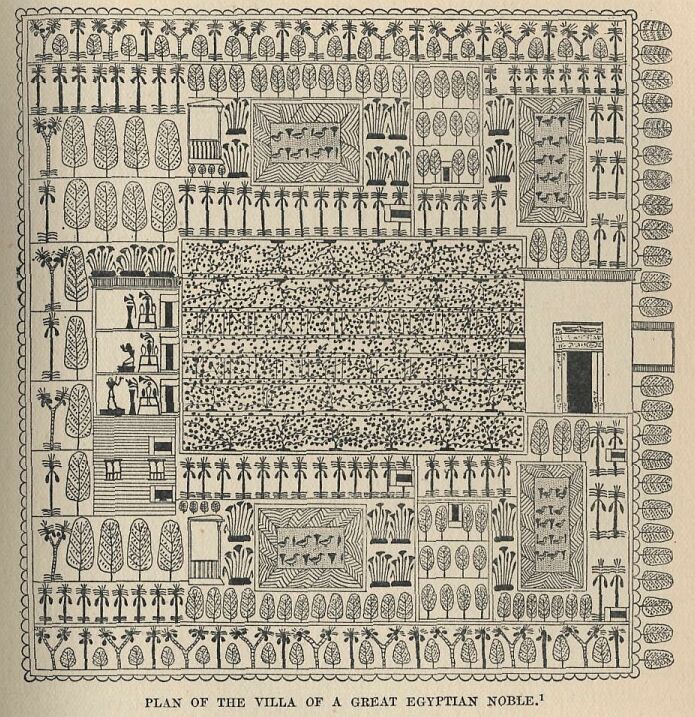
This plan is taken from a Theban tomb of the XVIIIth dynasty; but it corresponds exactly with the description which Amten has left us of his villa.
It was there, doubtless, that Amten ended his days in peace and quietude of mind. The tableland whereon the Sphinx has watched for so many centuries was then crowned by no pyramids, but mastabas of fine white stone rose here and there from out of the sand: that in which the mummy of Amten was to be enclosed was situated not far from the modern village of Abûsîr, on the confines of the nome of the Haunch, and almost in sight of the mansion in which his declining years were spent.*
* The site of Amten’s manorial mansion is nowhere mentioned in the inscriptions; but the custom of the Egyptians to construct their tombs as near as possible to the places where they resided, leads me to consider it as almost certain that we ought to look for its site in the Memphite plain, in the vicinity of the town of Abûsîr, but in a northern direction, so as to keep within the territory of the Letopolite nome, where Amten governed in the name of the king.
The number of persons of obscure origin, who in this manner had risen in a few years to the highest honours, and died governors of provinces or ministers of Pharaoh, must have been considerable. Their descendants followed in their fathers’ footsteps, until the day came when royal favour or an advantageous marriage secured them the possession of an hereditary fief, and transformed the son or grandson of a prosperous scribe into a feudal lord. It was from people of this class, and from the children of the Pharaoh, that the nobility was mostly recruited. In the Delta, where the authority of the Pharaoh was almost everywhere directly felt, the power of the nobility was weakened and much curtailed; in Middle Egypt it gained ground, and became stronger and stronger in proportion as one advanced southward. The nobles held the principalities of the Gazelle, of the Hare, of the Serpent Mountain, of Akhmîm, of Thinis, of Qasr-es-Sayad, of El-Kab, of Aswan, and doubtless others of which we shall some day discover the monuments.
Drawn by Faucher-Gudin, from a photograph by Gayet.
They accepted without difficulty the fiction according to which Pharaoh claimed to be absolute master of the soil, and ceded to his subjects only the usufruct of their fiefs; but apart from the admission of the principle, each lord proclaimed himself sovereign in his own domain, and exercised in it, on a small scale, complete royal authority.
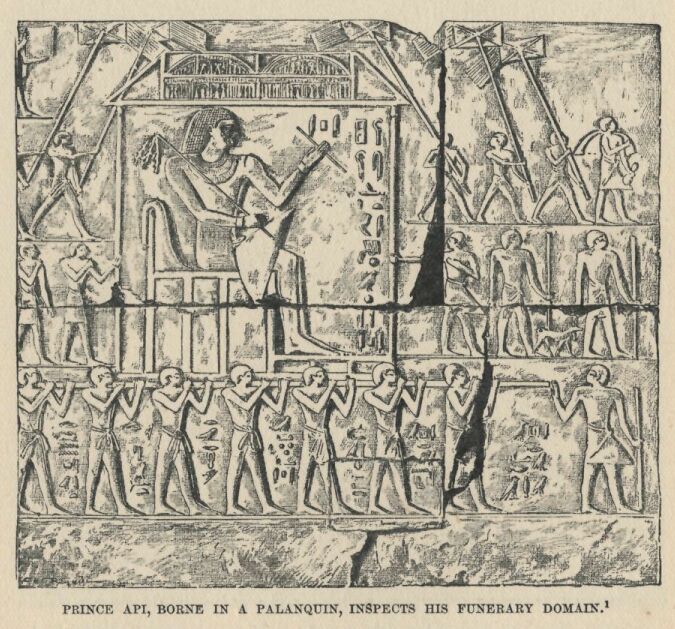
Drawn by Faucher-Gudin, from a photograph by Emil Brugsch- Bey. The tomb of Api was discovered at Saqqâra in 1884. It had been pulled down in ancient times, and a new tomb built on its ruins, about the time of the XIIth dynasty; all that remains of it is now in the museum at Gîzeh.
Everything within the limits of this petty state belonged to him—woods, canals, fields, even the desert-sand: after the example of the Pharaoh, he farmed a part himself, and let out the remainder, either in farms or as fiefs, to those of his followers who had gained his confidence or his friendship. After the example of Pharaoh, also, he was a priest, and exercised priestly functions in relation to all the gods—that is, not of all Egypt, but of all the deities of the nome. He was an administrator of civil and criminal law, received the complaints of his vassals and serfs at the gate of his palace, and against his decisions there was no appeal. He kept up a flotilla, and raised on his estate a small army, of which he was commander-in-chief by hereditary right. He inhabited a fortified mansion, situated sometimes within the capital of the principality itself, sometimes in its neighbourhood, and in which the arrangements of the royal city were reproduced on a smaller scale.
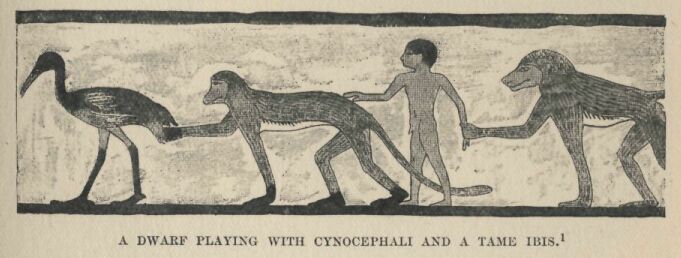
Drawn by Faucher-Gudin, from a chromolithograph in Flinders Petrie’s Medûm, pl. xxiv.
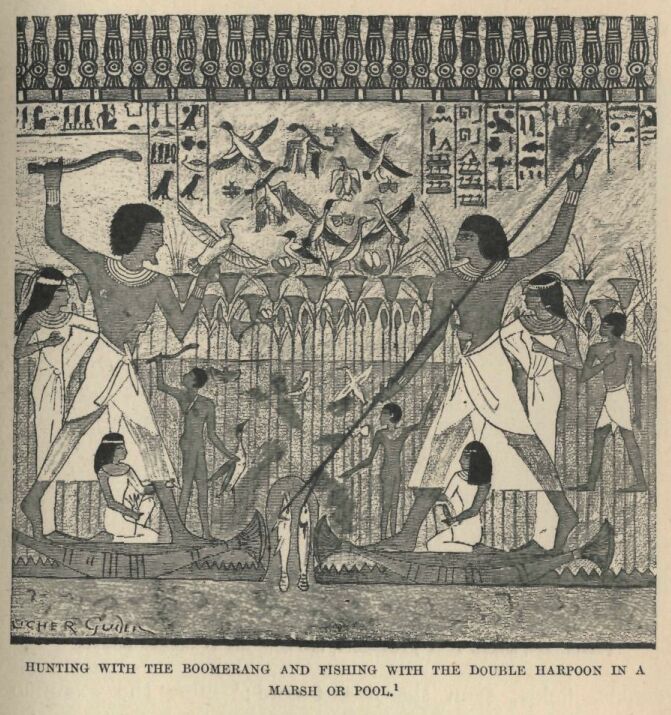
Side by side with the reception halls was the harem, where the legitimate wife, often a princess of solar rank, played the rôle of queen, surrounded by concubines, dancers, and slaves. The offices of the various departments were crowded into the enclosure, with their directors, governors, scribes of all ranks, custodians, and workmen, who bore the same titles as the corresponding employés in the departments of the State: their White Storehouse, their Gold Storehouse, their Granary, were at times called the Double White Storehouse, the Double Gold Storehouse, the Double Granary, as were those of the Pharaoh. Amusements at the court of the vassal did not differ from those at that of the sovereign: hunting in the desert and the marshes, fishing, inspection of agricultural works, military exercises, games, songs, dancing, doubtless the recital of long stories, and exhibitions of magic, even down to the contortions of the court buffoon and the grimaces of the dwarfs.
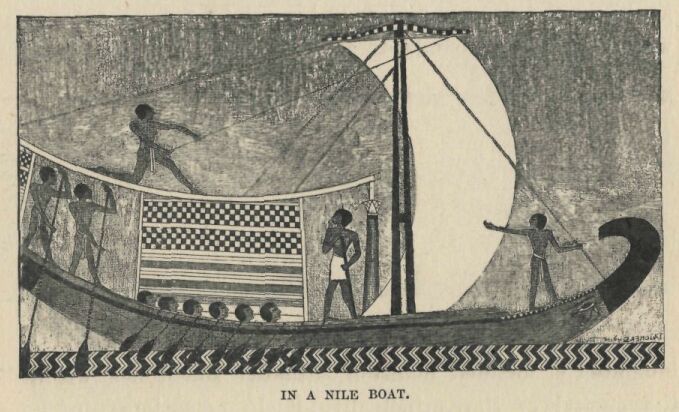
It amused the prince to see one of these wretched favourites leading to him by the paw a cynocephalus larger than himself, while a mischievous monkey slyly pulled a tame and stately ibis by the tail. From time to time the great lord proceeded to inspect his domain: on these occasions he travelled in a kind of sedan chair, supported by two mules yoked together; or he was borne in a palanquin by some thirty men, while fanned by large flabella; or possibly he went up the Nile and the canals in his beautiful painted barge. The life of the Egyptian lords may be aptly described as in every respect an exact reproduction of the life of the Pharaoh on a smaller scale.
Inheritance in a direct or indirect line was the rule, but in every case of transmission the new lord had to receive the investiture of the sovereign either by letter or in person. The duties enforced by the feudal state do not appear to have been onerous. In the first place, there was the regular payment of a tribute, proportionate to the extent and resources of the fief. In the next place, there was military service: the vassal agreed to supply, when called upon, a fixed number of armed men, whom he himself commanded, unless he could offer a reasonable excuse such as illness or senile incapacity.*
* Prince Amoni, of the Gazelle nome, led a body of four hundred men and another body of six hundred, levied in his principality, into Ethiopia under these conditions; the first that he served in the royal army, was as a substitute for his father, who had grown too old. Similarly, under the XVIIIth dynasty, Âhmosis of El-Kab commanded the war-ship, the Calf, in place of his father. The Uni inscription furnishes us with an instance of a general levy of the feudal contingents in the time of the VIth dynasty (1. 14, et seq.).
Attendance at court was not obligatory: we notice, however, many nobles about the person of Pharaoh, and there are numerous examples of princes, with whose lives we are familiar, filling offices which appear to have demanded at least a temporary residence in the palace, as, for instance, the charge of the royal wardrobe. When the king travelled, the great vassals were compelled to entertain him and his suite, and to escort him to the frontier of their domain. On the occasion of such visits, the king would often take away with him one of their sons to be brought up with his own children: an act which they on their part considered a great honour, while the king on his had a guarantee of their fidelity in the person of these hostages. Such of these young people as returned to their fathers’ roof when their education was finished, were usually most loyal to the reigning dynasty. They often brought back with them some maiden born in the purple, who consented to share their little provincial sovereignty, while in exchange one or more of their sisters entered the harem of the Pharaoh. Marriages made and marred in their turn the fortunes of the great feudal houses. Whether she were a princess or not, each woman received as her dowry a portion of territory, and enlarged by that amount her husband’s little state; but the property she brought might, in a few years, be taken by her daughters as portions and enrich other houses. The fief seldom could bear up against such dismemberment; it fell away piecemeal, and by the third or fourth generation had disappeared. Sometimes, however, it gained more than it lost in this matrimonial game, and extended its borders till they encroached on neighbouring nomes or else completely absorbed them. There were always in the course of each reign several great principalities formed, or in the process of formation, whose chiefs might be said to hold in their hands the destinies of the country. Pharaoh himself was obliged to treat them with deference, and he purchased their allegiance by renewed and ever-increasing concessions.
Their ambition was never satisfied; when they were loaded with favours, and did not venture to ask for more for themselves, they impudently demanded them for such of their children as they thought were poorly provided for. Their eldest son “knew not the high favours which came from the king. Other princes were his privy counsellers, his chosen friends, or foremost among his friends!” he had no share in all this. Pharaoh took good care not to reject a petition presented so humbly: he proceeded to lavish appointments, titles, and estates on the son in question; if necessity required it, he would even seek out a wife for him, who might give him, together with her hand, a property equal to that of his father. The majority of these great vassals secretly aspired to the crown: they frequently had reason to believe that they had some right to it, either through their mother or one of their ancestors. Had they combined against the reigning house, they could easily have gained the upper hand, but their mutual jealousies prevented this, and the overthrow of a dynasty to which they owed so much would, for the most part, have profited them but little: as soon as one of them revolted, the remainder took arms in Pharaoh’s defence, led his armies and fought his battles. If at times their ambition and greed harassed their suzerain, at least their power was at his service, and their self-interested allegiance was often the means of delaying the downfall of his house.
Two things were specially needful both for them and for Pharaoh in order to maintain or increase their authority—the protection of the gods, and a military organization which enabled them to mobilize the whole of their forces at the first signal. The celestial world was the faithful image of our own; it had its empires and its feudal organization, the arrangement of which corresponded to that of the terrestrial world. The gods who inhabited it were dependent upon the gifts of mortals, and the resources of each individual deity, and consequently his power, depended on the wealth and number of his worshippers; anything influencing one had an immediate effect on the other. The gods dispensed happiness, health, and vigour;* to those who made them large offerings and instituted pious foundations, they lent their own weapons, and inspired them with needful strength to overcome their enemies. They even came down to assist in battle, and every great encounter of armies involved an invisible struggle among the immortals. The gods of the side which was victorious shared with it in the triumph, and received a tithe of the spoil as the price of their help; the gods of the vanquished were so much the poorer, their priests and their statues were reduced to slavery, and the destruction of their people entailed their own downfall.
* I may here remind my readers of the numberless bas-reliefs and stelae on which the king is represented as making an offering to a god, who replies in some such formula as the following: “I give thee health and strength;” or, “I give thee joy and life for millions of years.”
It was, therefore, to the special interest of every one in Egypt, from the Pharaoh to the humblest of his vassals, to maintain the good will and power of the gods, so that their protection might be effectively ensured in the hour of danger. Pains were taken to embellish their temples with obelisks, colossi, altars, and bas-reliefs; new buildings were added to the old; the parts threatened with ruin were restored or entirely rebuilt; daily gifts were brought of every kind—animals which were sacrificed on the spot, bread, flowers, fruit, drinks, as well as perfumes, stuffs, vases, jewels, bricks or bars of gold, silver, lapis-lazuli, which were all heaped up in the treasury within the recesses of the crypts.* If a dignitary of high rank wished to perpetuate the remembrance of his honours or his services, and at the same time to procure for his double the benefit of endless prayers and sacrifices, he placed “by special permission” ** a statue of himself on a votive stele in the part of the temple reserved for this purpose,—in a courtyard, chamber, encircling passage, as at Karnak,*** or on the staircase of Osiris as in that leading up to the terrace in the sanctuary of Abydos; he then sealed a formal agreement with the priests, by which the latter engaged to perform a service in his name, in front of this commemorative monument, a stated number of times in the year, on the days fixed by universal observance or by local custom.
* See the “Poem of Pentaûîrît” for the grounds on which Ramses II. bases his imperative appeal to Araon for help: “Have I not made thee numerous offerings? I have filled thy temple with my prisoners. I have built thee an everlasting temple, and have not spared my wealth in endowing it for thee; I lay the whole world under contribution in order to stock thy domain.... I have built thee whole pylons in stone, and have myself reared the flagstaffs which adorn them; I have brought thee obelisks from Elephantine.” ** The majority of the votive statues were lodged in a temple “by special favour of a king “—em HOSÎtû nti KUÎr sûton—as a recompense for services rendered. Some only of the stelae bear an inscription to the above effect, no authorization from the king was required for the consecration of a stele in a temple. *** It was in the encircling passage of the limestone temple built by the kings of the XIIth dynasty, and now completely destroyed, that all the Karnak votive statues were discovered. Some of them still rest on the stone ledge on which they were placed by the priests of the god at the moment of consecration.
For this purpose he assigned to them annuities in kind, charges on his patrimonial estates, or in some cases, if he were a great lord, on the revenues of his fief,—such as a fixed quantity of loaves and drinks for each of the celebrants, a fourth part of the sacrificial victim, a garment, frequently also lands with their cattle, serfs, existing buildings, farming implements and produce, along with the conditions of service with which the lands were burdened. These gifts to the god—“notir hotpûû”—were, it appears, effected by agreements analogous to those dealing with property in mortmain in modern Egypt; in each nome they constituted, in addition to the original temporalities of the temple, a considerable domain, constantly enlarged by fresh endowments. The gods had no daughters for whom to provide, nor sons among whom to divide their inheritance; all that fell to them remained theirs for ever, and in the contracts were inserted imprecations threatening with terrible ills, in this world and the next, those who should abstract the smallest portion from them. Such menaces did not always prevent the king or the lords from laying hands on the temple revenues: had this not been the case, Egypt would soon have become a sacerdotal country from one end to the other. Even when reduced by periodic usurpations, the domain of the gods formed, at all periods, about one-third of the whole country.*
* The tradition handed down by Diodorus tells us that the goddess Isis assigned a third of the country to the priests; the whole of Egypt is said to have been divided into three equal parts, the first of which belonged to the priests, the second to the kings, and the third to the warrior class. When we read, in the great Harris Papyrus, the list of the property possessed by the temple of the Theban Amon alone, all over Egypt, under Ramses III., we can readily believe that the tradition of the Greek epoch in no way exaggerated matters.
Its administration was not vested in a single body of Priests, representing the whole of Egypt and recruited or ruled everywhere in the same fashion. There were as many bodies of priests as there were temples, and every temple preserved its independent constitution with which the clergy of the neighbouring temples had nothing to do: the only master they acknowledged was the lord of the territory on which the temple was built, either Pharaoh or one of his nobles. The tradition which made Pharaoh the head of the different worships in Egypt* prevailed everywhere, but Pharaoh soared too far above this world to confine himself to the functions of any one particular order of priests: he officiated before all the gods without being specially the minister of any, and only exerted his supremacy in order to make appointments to important sacerdotal posts in his domain.**
* The only exception to this rule was in the case of the Theban kings of the XXIst dynasty, and even here the exception is more apparent than real. As a matter of fact, these kings, Hrihor and Pinozmû, began by being high priests of Amon before ascending the throne; they were pontiffs who became Pharaohs, not Pharaohs who created themselves pontiffs. Possibly we ought to place Smonkharî of the XIVth dynasty in the same category, if, as Brugsch assures us, his name, Mîr-mâshâù, is identical with the title of the high priest of Osiris at Mendes, thus proving that he was pontiff of Osiris in that town before he became king. ** Among other instances, we have that of the king of the XXIst Tanite dynasty, who appointed Mankhopirrî, high priest of the Theban Amon, and that of the last king of the same dynasty, Psûsennes IL, who conferred the same office on prince Aûpûti, son of Sheshonqû. The king’s right of nomination harmonized very well with the hereditary transmission of the priestly office through members of the same family, as we shall have occasion to show later on.
He reserved the high priesthood of the Memphite Phtah and that of Râ of Heliopolis either for the princes of his own family or more often for his most faithful servants; they were the docile instruments of his will, through whom he exerted the influence of the gods, and disposed of their property without having the trouble of administrating it. The feudal lords, less removed from mortal affairs than the Pharaoh, did not disdain to combine the priesthood of the temples dependent on them with the general supervision of the different worships practised on their lands. The princes of the Gazelle nome, for instance, bore the title of “Directors of the Prophets of all the Gods,” but were, correctly speaking, prophets of Horus, of Khnûmû master of Haoîrît, and of Pakhît mistress of the Speos-Artemidos. The religious suzerainty of such princes was the complement of their civil and military power, and their ordinary income was augmented by some portion at least of the revenues which the lands in mortmain furnished annually. The subordinate sacerdotal functions were filled by professional priests whose status varied according to the gods they served and the provinces in which they were located. Although between the mere priest and the chief prophet there were a number of grades to which the majority never attained, still the temples attracted many people from divers sources, who, once established in this calling of life, not only never left it, but never rested until they had introduced into it the members of their families. The offices they filled were not necessarily hereditary, but the children, born and bred in the shelter of the sanctuary, almost always succeeded to the positions of their fathers, and certain families thus continuing in the same occupation for generations, at last came to be established as a sort of sacerdotal nobility.*
* We possess the coffins of the priests of the Theban Montû for nearly thirty generations, viz. from the XXVth dynasty to the time of the Ptolemies. The inscriptions give us their genealogies, as well as their intermarriages, and show us that they belonged almost exclusively to two or three important families who intermarried with one another or took their wives from the families of the priests of Amon.
The sacrifices supplied them with daily meat and drink; the temple buildings provided them with their lodging, and its revenues furnished them with a salary proportionate to their position. They were exempted from the ordinary taxes, from military service, and from forced labour; it is not surprising, therefore, that those who were not actually members of the priestly families strove to have at least a share in their advantages. The servitors, the workmen and the employés who congregated about them and constituted the temple corporation, the scribes attached to the administration of the domains, and to the receipt of offerings, shared de facto if not de jure in the immunity of the priesthood; as a body they formed a separate religious society, side by side, but distinct from, the civil population, and freed from most of the burdens which weighed so heavily on the latter.
The soldiers were far from possessing the wealth and influence of the clergy. Military service in Egypt was not universally compulsory, but rather the profession and privilege of a special class of whose origin but little is known. Perhaps originally it comprised only the descendants of the conquering race, but in historic times it was not exclusively confined to the latter, and recruits were raised everywhere among the fellahs,* the Bedouin of the neighbourhood, the negroes,** the Nubians,*** and even from among the prisoners of war, or adventurers from beyond the sea.****
* This is shown, inter alia, by the real or supposititious letters in which the master-scribe endeavours to deter his pupil from adopting a military career, recommending that of a scribe in preference. ** Uni, under Papi I., recruited his army from among the inhabitants of the whole of Egypt, from Elephantine to Letopolis at the mouth of the Delta, and as far as the Mediterranean, from among the Bedouin of Libya and of the Isthmus, and even from the six negro races of Nubia (Inscription d’Ouni, 11. 14-19). *** The Nubian tribe of the Mâzaiû, afterwards known as the Libyan tribe of the Mâshaûasha, furnished troops to the Egyptian kings and princes for centuries; indeed, the Mâzaiû formed such an integral part of the Egyptian armies that their name came to be used in Coptic as a synonym for soldier, under the form “matoï.” **** Later on we shall come across the Shardana of the Royal Guard under Ramses II. (E. de Rougé, Extrait d’un mémoire sur les attaques, p. 5); later still, the Ionians, Carians, and Greek mercenaries will be found to play a decisive part in the history of the Saïte dynasties.
This motley collection of foreign mercenaries composed ordinarily the body-guard of the king or of his barons, the permanent nucleus round which in times of war the levies of native recruits were rallied. Every Egyptian soldier received from the chief to whom he was attached, a holding of land for the maintenance of himself and his family. In the fifth century B.C. twelve aruræ of arable land was estimated as ample pay for each man,* and tradition attributes to the fabulous Sesostris the law which fixed the pay at this rate. The soldiers were not taxed, and were exempt from forced labour during the time that they were away from home on active service; with this exception they were liable to the same charges as the rest of the population. Many among them possessed no other income, and lived the precarious life of the fellah,—tilling, reaping, drawing water, and pasturing their cattle,—in the interval between two musters. Others possessed of private fortunes let their holdings out at a moderate rental, which formed an addition to their patrimonial income.**
* Herodotus, ii. 168. The arura being equal to 27.82 ares [an are = 100 square metres], the military fief contained 27*82 x 12 = 333.84 ares. [The “arura,” according to F. L. Griffith, was a square of 100 Egyptian cubits, making about 3/5 of an acre, or 2600 square metres.—Trs.] The chifliks created by Mohammed-Ali, with a view to bringing the abandoned districts into cultivation, allotted to each labourer who offered to reclaim it, a plot of land varying from one to three feddans, i.e. from 4200.83 square metres to 12602.49 square metres, according to the nature of the soil and the necessities of each family. The military fiefs of ancient Egypt were, therefore, nearly three times as great in extent as these abadiyehs, which were considered, in modern Egypt, sufficient to supply the wants of a whole family of peasants; they must, therefore, have secured not merely a bare subsistence, but ample provision for their proprietors. ** Diodorus Siculus says in so many words (i. 74) that “the farmers spent their life in cultivating lands which had been let to them at a moderate rent by the king, by the priests, and by the warriors.”
Lest they should forget the conditions upon which they possessed this military holding, and should regard themselves as absolute masters of it, they were seldom left long in possession of the same place: Herodotus asserts that their allotments were taken away-yearly and replaced by others of equal extent. It is difficult to say if this law of perpetual change was always in force; at any rate, it did not prevent the soldiers from forming themselves in time into a kind of aristocracy, which even kings and barons of highest rank could not ignore. They were enrolled in special registers, with the indication of the holding which was temporarily assigned to them. A military scribe kept this register in every royal nome or principality.
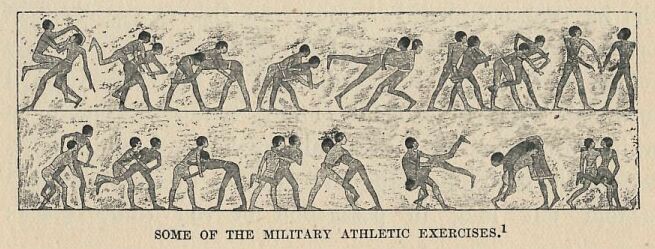
Drawn by Faucher-Gudin, from a scene in the tomb of Amoni- Amenemhâît at Beni-Hasan.
He superintended the redistribution of the lands, the registration of privileges, and in addition to his administrative functions, he had in time of war the command of the troops furnished by his own district; in which case he was assisted by a “lieutenant,” who as opportunity offered acted as his substitute in the office or on the battle-field. Military service was not hereditary, but its advantages, however trifling they may appear to us, seemed in the eyes of the fellahs so great, that for the most part those who were engaged in it had their children also enrolled. While still young the latter were taken to the barracks, where they were taught not only the use of the bow, the battle-axe, the mace, the lance, and the shield, but were all instructed in such exercises as rendered the body supple, and prepared them for manoeuvring, regimental marching, running, jumping, and wrestling either with closed or open hand. They prepared themselves for battle by a regular war-dance, pirouetting, leaping, and brandishing their bows and quivers in the air. Their training being finished, they were incorporated into local companies, and invested with their privileges. When they were required for service, part or the whole of the class was mustered; arms kept in the arsenal were distributed among them, and they were conveyed in boats to the scene of action. The Egyptians were not martial by temperament; they became soldiers rather from interest than inclination.
The power of Pharaoh and his barons rested entirely upon these two classes, the priests and the soldiers; the remainder, the commonalty and the peasantry, were, in their hands, merely an inert mass, to be taxed and subjected to forced labour at will. The slaves were probably regarded as of little importance; the bulk of the people consisted of free families who were at liberty to dispose of themselves and their goods. Every fellah and townsman in the service of the king, or of one of his great nobles, could leave his work and his village when he pleased, could pass from the domain in which he was born into a different one, and could traverse the country from one end to the other, as the Egyptians of to-day still do.
His absence entailed neither loss of goods, nor persecution of the relatives he left behind, and he himself had punishment to fear only when he left the Nile Valley without permission, to reside for some time in a foreign land.* But although this independence and liberty were in accordance with the laws and customs of the land, yet they gave rise to inconveniences from which it was difficult to escape in practical life. Every Egyptian, the King excepted, was obliged, in order to get on in life, to depend on one more powerful than himself, whom he called his master. The feudal lord was proud to recognize Pharaoh as his master, and he himself was master of the soldiers and priests in his own petty state.
* The treaty between Ramses and the Prince of Khiti contains a formal extradition clause in reference to Egyptians or Hittites, who had quitted their native country, of course without the permission of their sovereign. The two contracting parties expressly stipulate that persons extradited on one side or the other shall not be punished for having emigrated, that their property is not to be confiscated, nor are their families to be held responsible for their flight. From this clause it follows that in ordinary times unauthorized emigration brought upon the culprit corporal punishment and the confiscation of his goods, as well as various penalties on his family. The way in which Sinûhît makes excuses for his flight, the fact of his asking pardon before returning to Egypt, the very terms of the letter in which the king recalls him and assures him of impunity, show us that the laws against emigration were in full force under the XIIth dynasty. ** The expressions which bear witness to this fact are very numerous: Miri nîbûf = “He who loves his master;” Aqû hâîti ni nîbûf = “He who enters into the heart of his master,” etc. They recur so frequently in the texts in the case of persons of all ranks, that it was thought no importance ought to be attached to them. But the constant repetition of the word NIB, “master,” shows that we must alter this view, and give these phrases their full meaning.
From the top to the bottom of the social scale every free man acknowledged a master, who secured to him justice and protection in exchange for his obedience and fealty. The moment an Egyptian tried to withdraw himself from this subjection, the peace of his life was at an end; he became a man without a master, and therefore without a recognized protector.*
* The expression, “a man without a master,” occurs several times in the Berlin Papyrus, No. ii. For instance, the peasant who is the hero of the story, says of the lord Mirûitensi, that he is “the rudder of heaven, the guide of the earth, the balance which carries the offerings, the buttress of tottering walls, the support of that which falls, the great master who takes whoever is without a master to lavish on him the goods of his house, a jug of beer and three loaves” each day.
Any one might stop him on the way, steal his cattle, merchandise, or property on the most trivial pretext, and if he attempted to protest, might beat him with almost certain impunity.
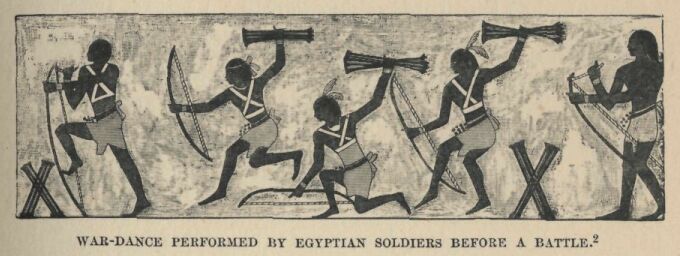
Drawn by Faucher-Gudin, from the tomb of Khîti at Beni- Hasan. These are soldiers of the nome of Gazelle.
The only resource of the victim was to sit at the gate of the palace, waiting to appeal for justice till the lord or the king should appear. If by chance, after many rebuffs, his humble petition were granted, it was only the beginning of fresh troubles. Even if the justice of the cause were indisputable, the fact that he was a man without home or master inspired his judges with an obstinate mistrust, and delayed the satisfaction of his claims. In vain he followed his judges with his complaints and flatteries, chanting their virtues in every key: “Thou art the father of the unfortunate, the husband of the widow, the brother of the orphan, the clothing of the motherless: enable me to proclaim thy name as a law throughout the land. Good lord, guide without caprice, great without littleness, thou who destroyest falsehood and causest truth to be, come at the words of my mouth; I speak, listen and do justice. O generous one, generous of the generous, destroy the cause of my trouble; here I am, uplift me; judge me, for behold me a suppliant before thee.” If he were an eloquent speaker and the judge were inclined to listen, he was willingly heard, but his cause made no progress, and delays, counted on by his adversary, effected his ruin. The religious law, no doubt, prescribed equitable treatment for all devotees of Osiris, and condemned the slightest departure from justice as one of the gravest sins, even in the case of a great noble, or in that of the king himself; but how could impartiality be shown when the one was the recognized protector, the “master” of the culprit, while the plaintiff was a vagabond, attached to no one, “a man without a master”!
The population of the towns included many privileged persons other than the soldiers, priests, or those engaged in the service of the temples. Those employed in royal or feudal administration, from the “superintendent of the storehouse” to the humblest scribe, though perhaps not entirely exempt from forced labour, had but a small part of it to bear.* These employés constituted a middle class of several grades, and enjoyed a fixed income and regular employment: they were fairly well educated, very self-satisfied, and always ready to declare loudly their superiority over any who were obliged to gain their living by manual labour. Each class of workmen recognized one or more chiefs,—the shoemakers, their master-shoemakers, the masons, their master-masons, the blacksmiths, their master-blacksmiths,—who looked after their interests and represented them before the local authorities.**
* This is a fair inference from the indirect testimony of the Letters: the writer, in enumerating the liabilities of the various professions, implies by contrast that the scribe (i.e. the employé in general) is not subject to them, or is subject to a less onerous share of them than others. The beginning and end of the instructions of Khîti would in themselves be sufficient to show us the advantages which the middle classes under the XIIth dynasty believed they could derive from adopting the profession of scribe. ** The stelæ of Abydos are very useful to those who desire to study the populations of a small town. They give us the names of the head-men of trades of all kinds; the head-mason Didiû, the master-mason Aa, the master-shoemaker Kahikhonti, the head-smiths Ûsirtasen-Ûati, Hotpû, Hot-pûrekhsû.
It was said among the Greeks, that even robbers were united in a corporation like the others, and maintained an accredited superior as their representative with the police, to discuss the somewhat delicate questions which the practice of their trade gave occasion to. When the members of the association had stolen any object of value, it was to this superior that the person robbed resorted, in order to regain possession of it: it was he who fixed the amount required for its redemption, and returned it without fail, upon the payment of this sum. Most of the workmen who formed a state corporation, lodged, or at least all of them had their stalls, in the same quarter or street, under the direction of their chief. Besides the poll and the house tax, they were subject to a special toll, a trade licence which they paid in products of their commerce or industry.*
* The registers (for the most part unpublished), which are contained in European museums show us that fishermen paid in fish, gardeners in flowers and vegetables, etc., the taxes or tribute which they owed to their lords. In the great inscription of Abydos the weavers attached to the temple of Seti I. are stated to have paid their tribute in stuffs.
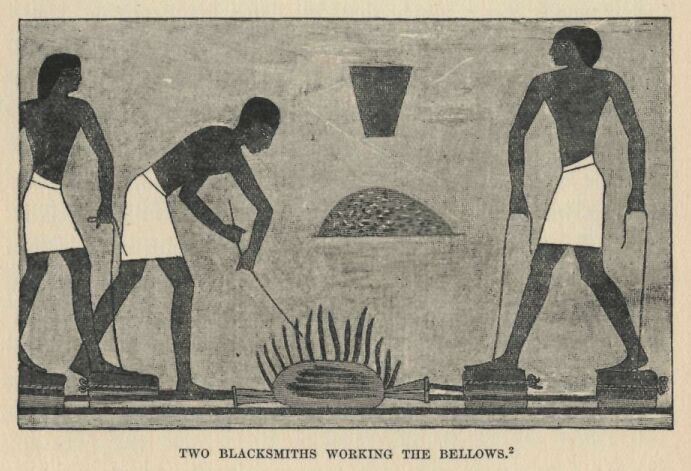
Drawn by Faucher-Gudin, from Rosellini, Monumenti Civili, pl. 2 a.
Their lot was a hard one, if we are to believe the description which ancient writers have handed down to us: “I have never seen a blacksmith on an embassy—nor a smelter sent on a mission—but what I have seen is the metal worker at his toil,—at the mouth of the furnace of his forge,—his fingers as rugged as the crocodile,—and stinking more than fish-spawn.—The artisan of any kind who handles the chisel,—does not employ so much movement as he who handles the hoe;*
* The literal translation would be, “The artisan of all kinds who handles the chisel is more motionless than he who handles the hoe.” Both here, and in several other passages of this little satiric poem, I have been obliged to paraphrase the text in order to render it intelligible to the modern reader.
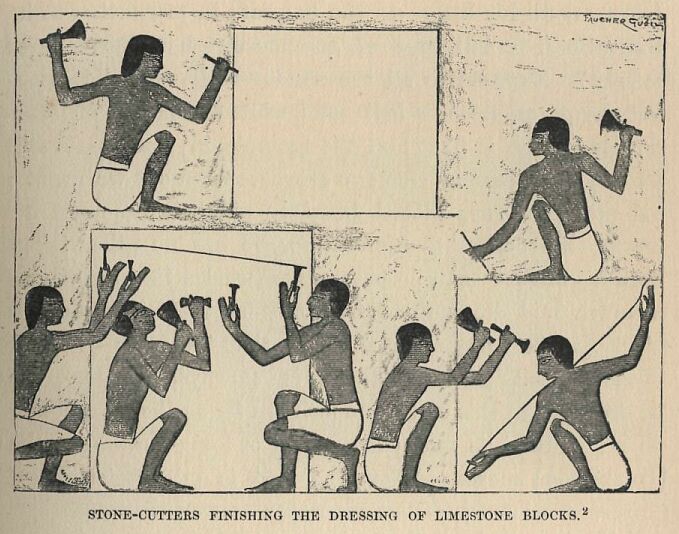
Drawn by Faucher-Gudin, from Rosellini, Monumenti civili, pl. xlviii. 2.
—but for him his fields are the timber, his business is the metal,—and at night when the other is free,—he, he works with his hands over and above what he has already done,—for at night, he works at home by the lamp.—The stone-cutter who seeks his living by working in all kinds of durable stone,—when at last he has earned something—and his two arms are worn out, he stops;—but if at sunrise he remain sitting,—his legs are tied to his back.* —The barber who shaves until the evening,—when he falls to and eats, it is without sitting down** —while running from street to street to seek custom;—if he is constant [at work] his two arms fill his belly—as the bee eats in proportion to its toil.—Shall I tell thee of the mason—how he endures misery?—Exposed to all the winds—while he builds without any garment but a belt—and while the bunch of lotus-flowers [which is fixed] on the [completed] houses—is still far out of his reach,***
* This is an allusion to the cruel manner in which the Egyptians were accustomed to bind their prisoners, as it were in a bundle, with the legs bent backward along the back and attached to the arms. The working-day commenced then, as now, at sunrise, and lasted till sunset, with a short interval of one or two hours at midday for the workmen’s dinner and siesta. ** Literally, “He places himself on his elbow.” The metaphor seems to me to be taken from the practice of the trade itself: the barber keeps his elbow raised when shaving and lowers it when he is eating. *** This passage is conjecturally translated. I suppose the Egyptian masons had a custom analogous to that of our own, and attached a bunch of lotus to the highest part of a building they had just finished: nothing, however, has come to light to confirm this conjecture.
—his two arms are worn out with work; his provisions are placed higgledy piggledy amongst his refuse,—he consumes himself, for he has no other bread than his fingers—and he becomes wearied all at once.—He is much and dreadfully exhausted—for there is [always] a block [to be dragged] in this or that building,—a block of ten cubits by six,—there is [always] a block [to be dragged] in this or that month [as far as the] scaffolding poles [to which is fixed] the bunch of lotus-flowers on the [completed] houses.—When the work is quite finished,—if he has bread, he returns home,—and his children have been beaten unmercifully [during his absence].—The weaver within doors is worse off there than a woman;—squatting, his knees against his chest,—he does not breathe.—If during the day he slackens weaving,—he is bound fast as the lotuses of the lake;—and it is by giving bread to the doorkeeper, that the latter permits him to see the light.
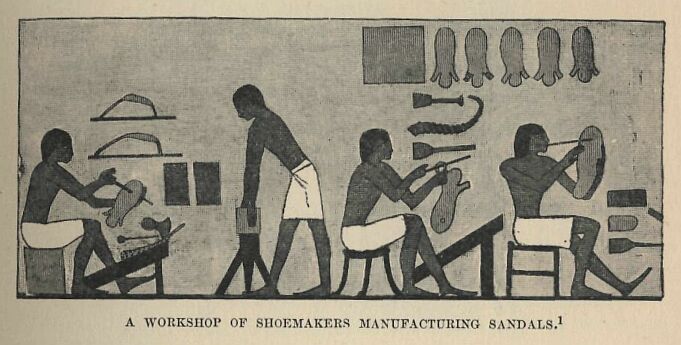
Drawn by Faucher-Gudin, from Champollion’s Monuments de l’Êypte et de la Nubie. This Picture belongs to the XVIIIth dynasty; but the sandals in it are, however, quite like those to be seen on more ancient monuments.
The dyer, his fingers reeking—and their smell is that of fish-spawn;—his two eyes are oppressed with fatigue,—his hand does not stop,—and, as he spends his time in cutting out rags—he has a hatred of garments.—The shoemaker is very unfortunate;—he moans ceaselessly,—his health is the health of the spawning fish,—and he gnaws the leather.—The baker makes dough,—subjects the loaves to the fire;—while his head is inside the oven,—his son holds him by the legs;—if he slips from the hands of his son,—he falls there into the flames.” These are the miseries inherent to the trades themselves: the levying of the tax added to the catalogue a long sequel of vexations and annoyances, which were renewed several times in the year at regular intervals.
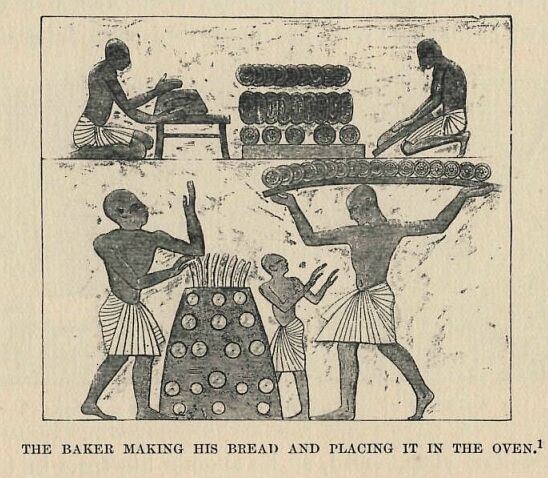
Drawn by Faucher-Gudin, from the painted picture in one of the small antechambers of the tomb of Ramses III., at Bab- el-Molûk.
Even at the present day, the fellah does not pay his contributions except under protest and by compulsion, but the determination not to meet obligations except beneath the stick, was proverbial from ancient times: whoever paid his dues before he had received a merciless beating would be overwhelmed with reproaches by his family, and jeered at without pity by his neighbours. The time when the tax fell due, came upon the nomes as a terrible crisis which affected the whole population. For several days there was nothing to be heard but protestations, threats, beating, cries of pain from the tax-payers, and piercing lamentations from women and children. The performance over, calm was re-established, and the good people, binding up their wounds, resumed their round of daily life until the next tax-gathering.
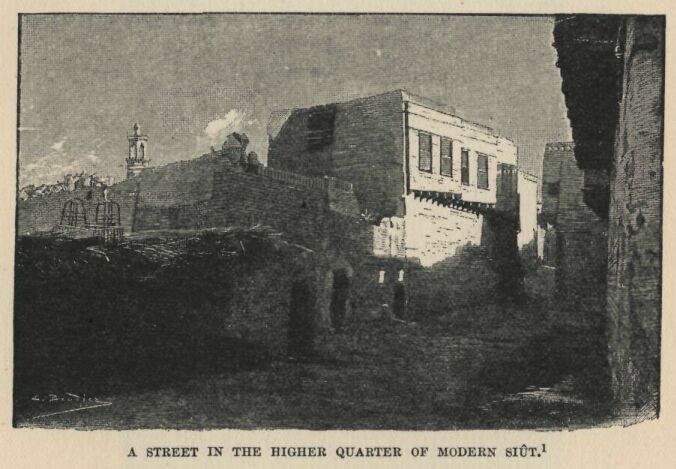
The towns of this period presented nearly the same confined and mysterious appearance as those of the present day.*
* I have had occasion to make “soundings” or excavations at various points in very ancient towns and villages, at Thebes, Abydos and Mataniyeh, and I give here a résumé of my observations. Professor Petrie has brought to light and regularly explored several cities of the XIIth and XVIIIth dynasties, situated at the entrance to the Fayûm. I have borrowed many points in my description from the various works which he has published on the subject, Kahun, Gurob and Hawara, 1890; and Illahun, Kahun and Gurob, 1891.
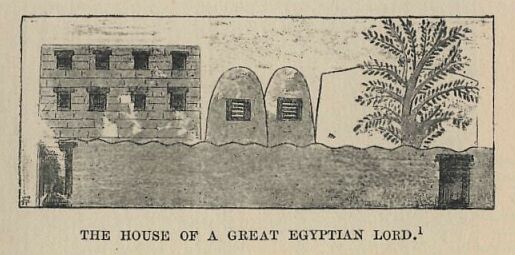
Drawn by Faucher-Gudin, from a water-colour by Boussac, Le Tombeau d’Anna in the Mémoires de la Mission Française. The house was situated at Thebes, and belonged to the XVIIIth dynasty. The remains of the houses brought to light by Mariette at Abydos belong to the same type, and date back to the XIIth dynasty. By means of these, Mariette was enabled to reconstruct an ancient Egyptian house at the Paris Exhibition of 1877. The picture of the tomb of Anna reproduces in most respects, we may therefore assume, the appearance of a nobleman’s dwelling at all periods. At the side of the main building we see two corn granaries with conical roofs, and a great storehouse for provisions.
They were grouped around one or more temples, each of which was surrounded by its own brick enclosing wall, with its enormous gateways: the gods dwelt there in real castles, or, if this word appears too ambitious, redouts, in which the population could take refuge in cases of sudden attack, and where they could be in safety.
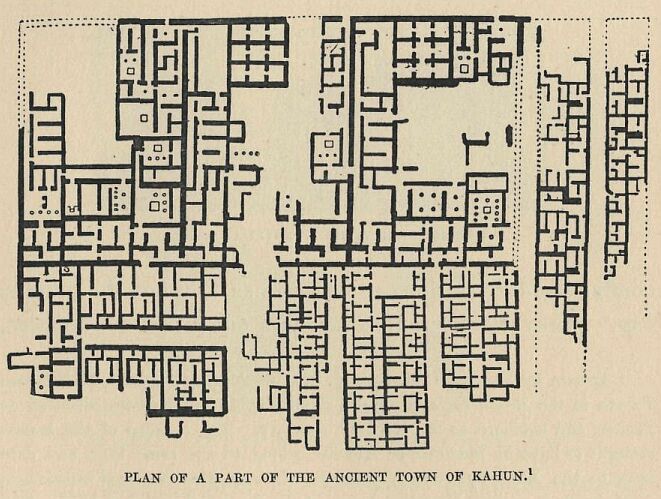
From a plan made and published by Professor Flinders Petrie, Illahun, Kahun and Gurob, pl. xiv.
The towns, which had all been built at one period by some king or prince, were on a tolerably regular ground plan; the streets were paved and fairly wide; they crossed each other at right angles, and were bordered with buildings on the same line of frontage. The cities of ancient origin, which had increased with the chance growth of centuries, presented a totally different aspect.
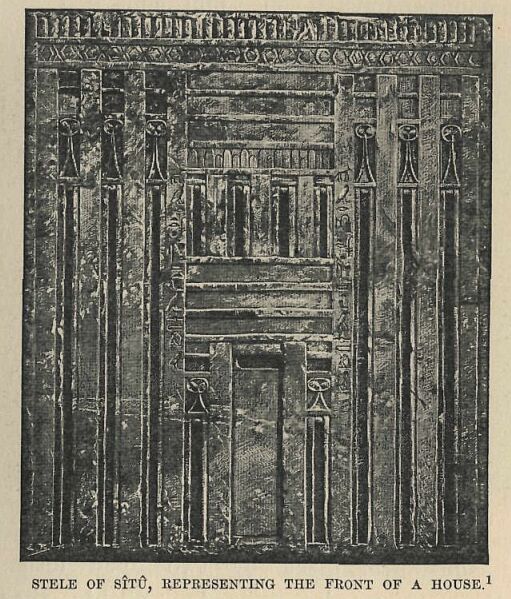
Drawn by Boudier, from a photograph by Emil Brugsch-Bey. The monument is the stele of Sîtû (IVth dynasty), in the Gîzeh Museum.
A network of lanes and blind alleys, narrow, dark, damp, and badly built, spread itself out between the houses, apparently at random: here and there was an arm of a canal, all but dried up, or a muddy pool where the cattle came to drink, and from which the women fetched the water for their households; then followed an open space of irregular shape, shaded by acacias or sycamores, where the country-folk of the suburbs held their market on certain days, twice or thrice a month; then came waste ground covered with filth and refuse, over which the dogs of the neighbourhood fought with hawks and vultures. The residence of the prince or royal governor, and the houses of rich private persons, covered a considerable area, and generally presented to the street a long extent of bare walls, crenellated like those of a fortress: the only ornament admitted on them consisted of angular grooves, each surmounted by two open lotus flowers having their stems intertwined.
Drawn by Boudier, from a photograph, taken in 1884, by Emil Brugsch-Bey.
Within these walls domestic life was entirely secluded, and as it were confined to its own resources; the pleasure of watching passers-by was sacrificed to the advantage of not being seen from outside. The entrance alone denoted at times the importance of the great man who concealed himself within the enclosure. Two or three steps led up to the door, which sometimes had a columned portico, ornamented with statues, lending an air of importance to the building. The houses of the citizens were small, and built of brick; they contained, however, some half-dozen rooms, either vaulted, or having flat roofs, and communicating with each other usually by arched doorways.
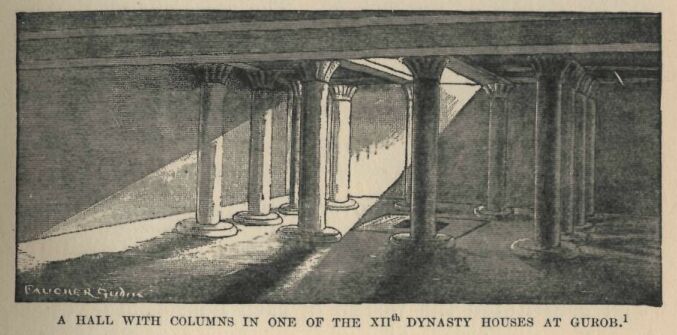
Drawn by Faucher-Gudin, from a sketch by Professor Petrie, Elahun, Kahun and Gurob, pl. xvi. 3.
A few houses boasted of two or three stories; all possessed a terrace, on which the Egyptians of old, like those of to-day, passed most of their time, attending to household cares or gossiping with their neighbours over the party wall or across the street. The hearth was hollowed out in the ground, usually against a wall, and the smoke escaped through a hole in the ceiling: they made their fires of sticks, wood charcoal, and the dung of oxen and asses. In the houses of the rich we meet with state apartments, lighted in the centre by a square opening, and supported by rows of wooden columns; the shafts, which were octagonal, measured ten inches in diameter, and were fixed into flat circular stone bases.
Drawn by Faucher-Gudin, from a head-rest in my possession obtained at Gebelên (XIth dynasty)
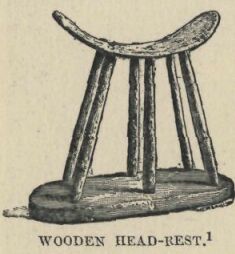
Drawn by Faucher-Gudin, from a sketch by Petrie,
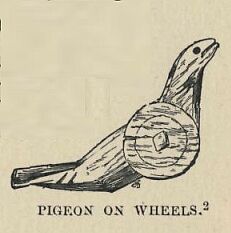
The family crowded themselves together into two or three rooms in winter, and slept on the roof in the open air in summer, in spite of risk from affections of the stomach and eyes; the remainder of the dwelling was used for stables or warehouses. The store-chambers were often built in pairs; they were of brick, carefully limewashed internally, and usually assumed the form of an elongated cone, in imitation of the Government storehouses. For the valuables which constituted the wealth of each household—wedges of gold or silver, precious stones, ornaments for men or women—there were places of concealment, in which the possessors attempted to hide them from robbers or from the tax-collectors. But the latter, accustomed to the craft of the citizens, evinced a peculiar aptitude for ferreting out the hoard: they tapped the walls, lifted and pierced the roofs, dug down into the soil below the foundations, and often brought to light, not only the treasure of the owner, but all the surroundings of the grave and human corruption. It was actually the custom, among the lower and middle classes, to bury in the middle of the house children who had died at the breast. The little body was placed in an old tool or linen box, without any attempt at embalming, and its favourite playthings and amulets were buried with it: two or three infants are often found occupying the same coffin. The playthings were of an artless but very varied character; dolls of limestone, enamelled pottery or wood, with movable arms and wigs of artificial hair; pigs, crocodiles, ducks, and pigeons on wheels, pottery boats, miniature sets of household furniture, skin balls filled with hay, marbles, and stone bowls. However, strange it may appear, we have to fancy the small boys of ancient Egypt as playing at bowls like ours, or impudently whipping their tops along the streets without respect for the legs of the passers-by.
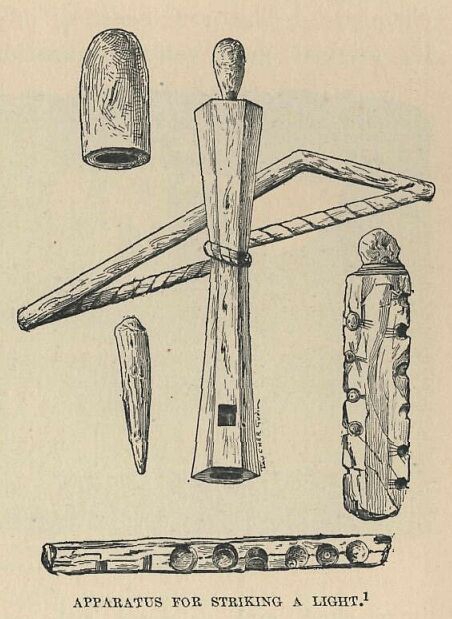
Drawn by Faucher-Gudin, from a sketch published in Fl. Petrie, Illahun, Kdhun and Gurob, pl. vii. The bow is represented in the centre; on the left, at the top, is the nut; below it the fire-stick, which was attached to the end of the stock; at the bottom and right, two pieces of wood with round carbonized holes, which took fire from the friction of the rapidly rotating stick.
Some care was employed upon the decoration of the chambers. The rough-casting of mud often preserves its original grey colour; sometimes, however, it was limewashed, and coloured red or yellow, or decorated with pictures of jars, provisions, and the interiors as well as the exteriors of houses.
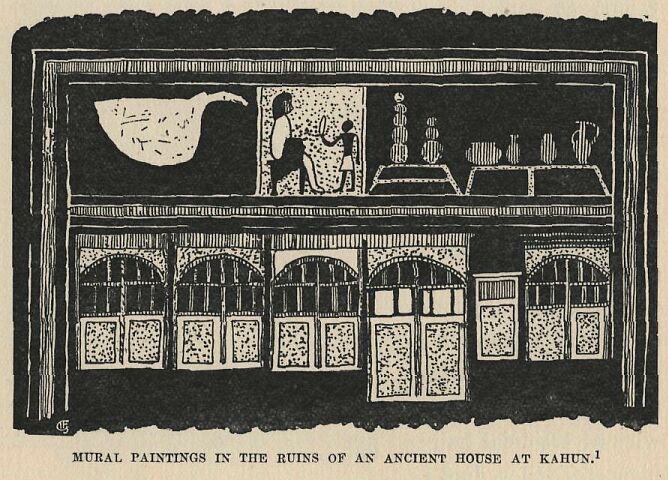
Drawn by Faucher-Gudin, from the facsimile in Petrie’s Illahun, Kahun and Gurob, pl. xvi. 6.
The bed was not on legs, but consisted of a low framework, like the “angarebs” of the modern Nubians, or of mats which were folded up in the daytime, but upon which they lay in their clothes during the night, the head being supported by a head-rest of pottery, limestone, or wood: the remaining articles of furniture consisted of one or two roughly hewn seats of stone, a few lion-legged chairs or stools, boxes and trunks of varying sizes for linen and implements, kohl, or perfume, pots of ababaster or porcelain, and lastly, the fire-stick with the bow by which it was set in motion, and some roughly made pots and pans of clay or bronze.
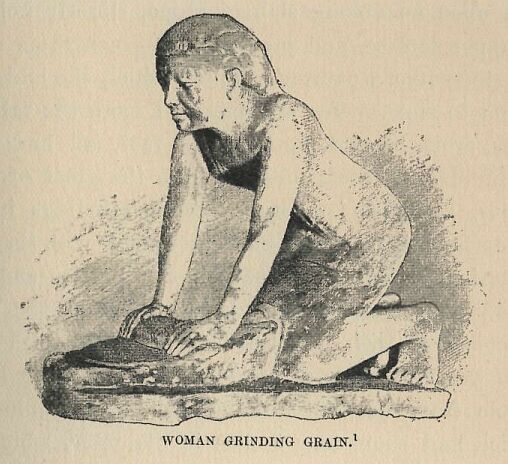
Drawn by Boudier, from a photograph by Béchard (cf. Mariette, Alburn photographique du Musée de Boulaq, pl. 20; Maspero, Guide du Visiteur, P- 220, Nos. 1012, 1013).
Men rarely entered their houses except to eat and sleep; their employments or handicrafts were such as to require them for the most part to work out-of-doors. The middle-class families owned, almost always, one or two slaves—either purchased or born in the house—who did all the hard work: they looked after the cattle, watched over the children, acted as cooks, and fetched water from the nearest pool or well. Among the poor the drudgery of the household fell entirely upon the woman. She spun, wove, cut out and mended garments, fetched fresh water and provisions, cooked the dinner, and made the daily bread. She spread some handfuls of grain upon an oblong slab of stone, slightly hollowed on its upper surface, and proceeded to crush them with a smaller stone like a painter’s muller, which she moistened from time to time. For an hour and more she laboured with her arms, shoulders, loins, in fact, all her body; but an indifferent result followed from the great exertion. The flour, made to undergo several grindings in this rustic mortar, was coarse, uneven, mixed with bran, or whole grains, which had escaped the pestle, and contaminated with dust and abraded particles of the stone. She kneaded it with a little water, blended with it, as a sort of yeast, a piece of stale dough of the day before, and made from the mass round cakes, about half an inch thick and some four inches in diameter, which she placed upon a flat flint, covering them with hot ashes. The bread, imperfectly raised, often badly cooked, borrowed, from the organic fuel under which it was buried, a special odour, and a taste to which strangers did not readily accustom themselves. The impurities which it contained were sufficient in the long run to ruin the strongest teeth; eating it was an action of grinding rather than chewing, and old men were not unfrequently met with whose teeth had been gradually worn away to the level of the gums, like those of an aged ass or ox.*
* The description of the woman grinding grain and kneading dough is founded on statues in the Gîzeh Museum. All the European museums possess numerous specimens of the bread in question, and the effect which it produces in the long run on the teeth of those who habitually used it as an article of diet, has been observed in mummies of the most important personages.
Movement and animation were not lacking at certain hours of the day, particularly during the morning, in the markets and in the neighbourhood of the temples and government buildings: there was but little traffic anywhere else; the streets were silent, and the town dull and sleepy. It woke up completely only three or four times a year, at seasons of solemn assemblies “of heaven and earth:” the houses were then opened and their inhabitants streamed forth, the lively crowd thronging the squares and crossways. To begin with, there was New Year’s Day, quickly followed by the Festival of the Bead, the “Ûagaît.” On the night of the 17th of Thot, the priests kindled before the statues in the sanctuaries and sepulchral chapels, the fire for the use of the gods and doubles during the twelve ensuing months. Almost at the same moment the whole country was lit up from one end to the other: there was scarcely a family, however poor, who did not place in front of their door a new lamp in which burned an oil saturated with salt, and who did not spend the whole night in feasting and gossiping.*
* The night of the 17th Thot—which, according to our computation, would be the night of the 16th to the 17th —was, as may be seen from the Great Inscription of Siût, appointed for the ceremony of “lighting the fire” before the statues of the dead and of the gods. As at the “Feast of Lamps”
The festivals of the living gods attracted considerable crowds, who came not only from the nearest nomes, but also from great distances in caravans and in boats laden with merchandise, for religious sentiment did not exclude commercial interests, and the pilgrimage ended in a fair.
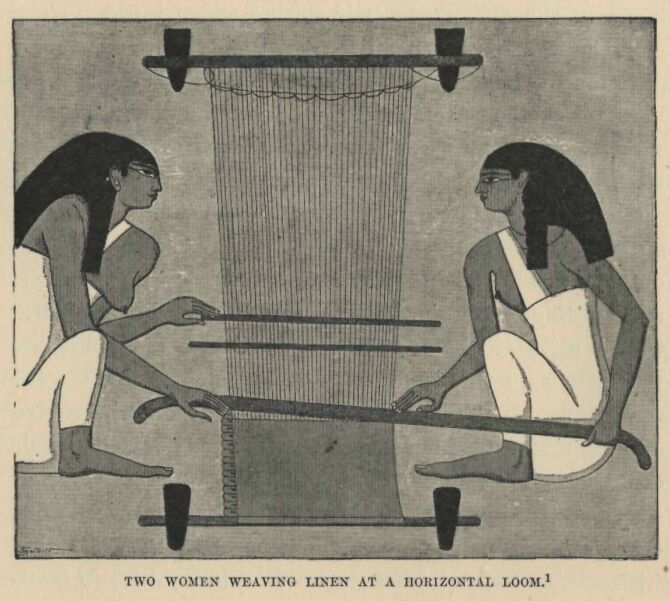
Drawn by Faucher-Gudin, from a picture on the tomb of Khnûm- hotpû at Beni-Hasan. This is the loom which was reconstructed in 1889 for the Paris Exhibition, and which is now to be seen in the galleries of the Trocadero.
For several days the people occupied mentioned by Herodotus, the religious ceremony was accompanied by a general illumination which lasted all the night; the object of this, probably, was to facilitate the visit which the souls of the dead were supposed to pay at this time to the family residence themselves solely in prayers, sacrifices, and processions, in which the faithful, clad in white, with palms in their hands, chanted hymns as they escorted the priests on their way. “The gods of heaven exclaim ‘Ah! ah! ‘in satisfaction, the inhabitants of the earth are full of gladness, the Hâthors beat their tabors, the great ladies wave their mystic whips, all those who are gathered together in the town are drunk with wine and crowned with flowers; the tradespeople of the place walk joyously about, their heads scented with perfumed oils, all the children rejoice in honour of the goddess, from the rising to the setting of the sun.” *
* The people of Dendera crudely enough called this the “Feast of Drunkenness.” From what we know of the earlier epochs, we are justified in making this description a general one, and in applying it, as I have done here, to the festivals of other towns besides Dendera.
Drawn by Faucher-Gudin, after a sketch by Rosellini
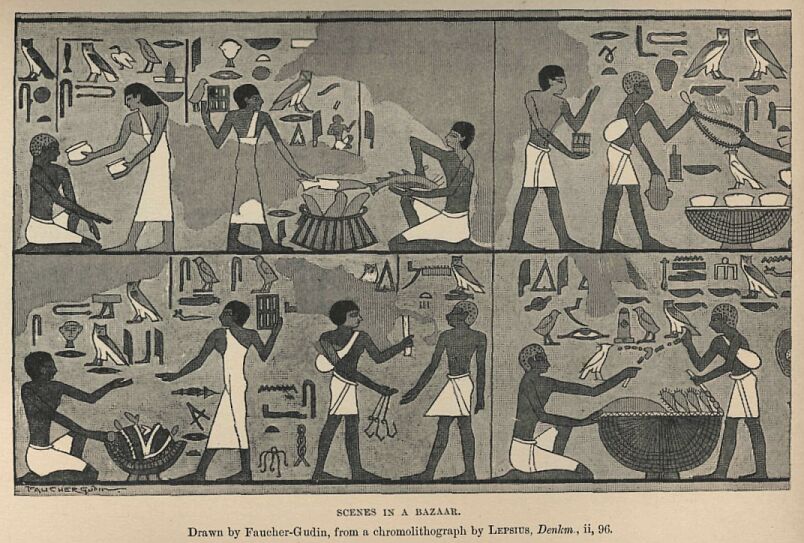
The nights were as noisy as the days: for a few hours, they made up energetically for long months of torpor and monotonous existence. The god having re-entered the temple and the pilgrims taken their departure, the regular routine was resumed and dragged on its tedious course, interrupted only by the weekly market. At an early hour on that day, the peasant folk came in from the surrounding country in an interminable stream, and installed themselves in some open space, reserved from time immemorial for their use. The sheep, geese, goats, and large-horned cattle were grouped in the centre, awaiting purchasers. Market-gardeners, fishermen, fowlers and gazelle-hunters, potters, and small tradesmen, squatted on the roadsides or against the houses, and offered their wares for the inspection of their customers, heaped up in reed baskets, or piled on low round tables: vegetables and fruits, loaves or cakes baked during the night, meat either raw or cooked in various ways, stuffs, perfumes, ornaments,—all the necessities and luxuries of daily life. It was a good opportunity for the workpeople, as well as for the townsfolk, to lay in a store of provisions at a cheaper rate than from the ordinary shops; and they took advantage of it, each according to his means.
Business was mostly carried on by barter. The purchasers brought with them some product of their toil—a new tool, a pair of shoes, a reed mat, pots of unguents or cordials; often, too, rows of cowries and a small box full of rings, each weighing a “tabnû,” made of copper, silver, or even gold, all destined to be bartered for such things as they needed. When it came to be a question of some large animal or of objects of considerable value, the discussions which arose were keen and stormy: it was necessary to be agreed not only as to the amount, but as to the nature of the payment to be made, and to draw up a sort of invoice, or in fact an inventory, in which beds, sticks, honey, oil, pick-axes, and garments, all figure as equivalents for a bull or a she-ass. Smaller retail bargains did not demand so many or such complicated calculations. Two townsfolk stop for a moment in front of a fellah who offers onions and corn in a basket for sale. The first appears to possess no other circulating medium than two necklaces made of glass beads or many-coloured enamelled terra-cotta; the other flourishes about a circular fan with a wooden handle, and one of those triangular contrivances used by cooks for blowing up the fire. “Here is a fine necklace which will suit you,” cries the former, “it is just what you are wanting;” while the other breaks in with: “Here is a fan and a ventilator.” The fellah, however, does not let himself be disconcerted by this double attack, and proceeding methodically, he takes one of the necklaces to examine it at his leisure: “Give it to me to look at, that I may fix the price.” The one asks too much, the other offers too little; after many concessions, they at last come to an agreement, and settle on the number of onions or the quantity of grain which corresponds exactly with the value of the necklace or the fan. A little further on, a customer wishes to get some perfumes in exchange for a pair of sandals, and conscientiously praises his wares: “Here,” says he, “is a strong pair of shoes.” But the merchant has no wish to be shod just then, and demands a row of cowries for his little pots: “You have merely to take a few drops of this to see how delicious it is,” he urges in a persuasive tone. A seated customer has two jars thrust under his nose by a woman—they probably contain some kind of unguent: “Here is something which smells good enough to tempt you.” Behind this group two men are discussing the relative merits of a bracelet and a bundle of fish-hooks; a woman, with a small box in her hand, is having an argument with a merchant selling necklaces; another woman seeks to obtain a reduction in the price of a fish which is being scraped in front of her. Exchanging commodities for metal necessitated two or three operations not required in ordinary barter. The rings or thin bent strips of metal which formed the “tabnû” and its multiples,* did not always contain the regulation amount of gold or silver, and were often of light weight.
* The rings of gold in the Museum at Leyden, which were used as a basis of exchange, are made on the Chaldæo-Babylonian pattern, and belong to the Asiatic system.
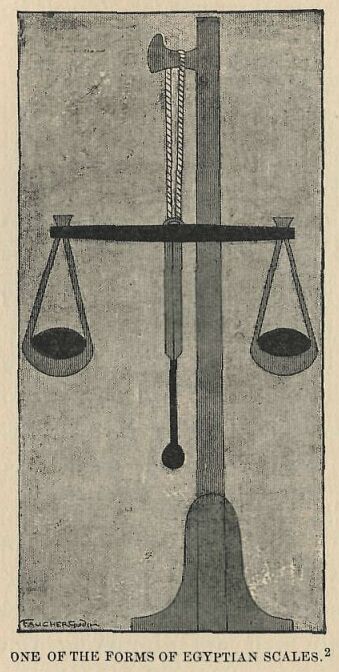
They had to be weighed at every fresh transaction in order to estimate their true value, and the interested parties never missed this excellent opportunity for a heated discussion: after having declared for a quarter of an hour that the scales were out of order, that the weighing had been carelessly performed, and that it should be done over again, they at last came to terms, exhausted with wrangling, and then went their way fairly satisfied with one another.* It sometimes happened that a clever and unscrupulous dealer would alloy the rings, and mix with the precious metal as much of a baser sort as would be possible without danger of detection. The honest merchant who thought he was receiving in payment for some article, say eight tabnû of fine gold, and who had handed to him eight tabnû of some alloy resembling gold, but containing one-third of silver, lost in a single transaction, without suspecting it, almost one-third of his goods. The fear of such counterfeits was instrumental in restraining the use of tabnû for a long time among the people, and restricted the buying and selling in the markets to exchange in natural products or manufactured objects.
* The weighing of rings is often represented on the monuments from the XVIIIth dynasty onwards. I am not acquainted with any instance of this on the bas-reliefs of the Ancient Empire. The giving of false weight is alluded to in the paragraph in the “Negative Confession,” in which the dead man declares that he has not interfered with the beam of the scales (cf. vol. i. p. 271) civili, pl. lii. 1. As to the construction of the Egyptian scales, and the working of their various parts, see Flinders Petrie’s remarks in A Season in Egypt, P- 42, and the drawings which he has brought together on pl. xx. of the same work.
We must, perhaps, agree with Fr. Lenormant, in his conclusion that the only kind of national metal of exchange in use in Egypt was a copper wire or plate bent thus [—]. this being the sign invariably used in the hieroglyphics in writing the word tàbnû.
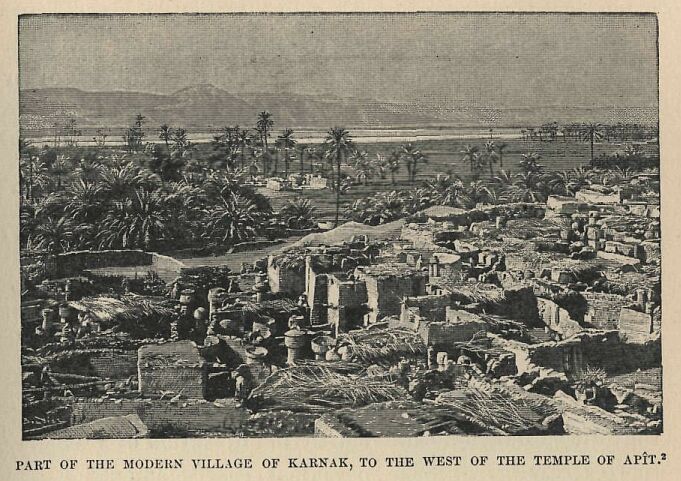
The present rural population of Egypt scarcely ever live in isolated and scattered farms; they are almost all concentrated in hamlets and villages of considerable extent, divided into quarters often at some distance from each other. The same state of things existed in ancient times, and those who would realize what a village in the past was like, have only to visit any one of the modern market towns scattered at intervals along the valley of the Nile:—half a dozen fairly built houses, inhabited by the principal people of the place; groups of brick or clay cottages thatched with durra stalks, so low that a man standing upright almost touches the roof with his head; courtyards filled with tall circular mud-built sheds, in which the corn and durra for the household is carefully stored, and wherever we turn, pigeons, ducks, geese, and animals all living higgledly-piggledly with the family. The majority of the peasantry were of the lower class, but they were not everywhere subjected to the same degree of servitude. The slaves, properly so called, came from other countries; they had been bought from foreign merchants, or they had been seized in a raid and had lost their liberty by the fortune of war.* Their master removed them from place to place, sold them, used them as he pleased, pursued them if they succeeded in escaping, and had the right of recapturing them as soon as he received information of their whereabouts. They worked for him under his overseer’s orders, receiving no regular wages, and with no hope of recovering their liberty.**
* The first allusion to prisoners of war brought back to Egypt, is found in the biography of Uni. The method in which they were distributed among the officers and soldiers is indicated in several inscriptions of the New Empire, in that of Ahmosis Pannekhabît, in that of Ahmosis si-Abîna, where one of the inscriptions contains a list of slaves, some of whom are foreigners, in that of Amenemhabi. We may form some idea of the number of slaves in Egypt from the fact that in thirty years Ramses III. presented 113,433 of them to the temples alone. The “Directors of the Royal Slaves,” at all periods, occupied an important position at the court of the Pharaohs. ** A scene reproduced by Lepsius shows us, about the time of the VIth dynasty, the harvest gathered by the “royal slaves” in concert with the tenants of the dead man. One of the petty princes defeated by the Ethiopian Piônkhi Miamûn proclaims himself to be “one of the royal slaves who pay tribute in kind to the royal treasury.” Amten repeatedly mentions slaves of this kind, “sûtiû.”
Many chose concubines from their own class, or intermarried with the natives and had families: at the end of two or three generations their descendants became assimilated with the indigenous race, and were neither more nor less than actual serfs attached to the soil, who were made over or exchanged with it.* The landed proprietors, lords, kings, or gods, accommodated this population either in the outbuildings belonging to their residences, or in villages built for the purpose, where everything belonged to them, both houses and people.
* This is the status of serfs, or mirîtiû, as shown in the texts of every period. They are mentioned along with the fields or cattle attached to a temple or belonging to a noble. Ramses II. granted to the temple of Abydos “an appanage in cultivated lands, in serfs (mirîtiû), in cattle.” The scribe Anna sees in his tomb “stalls of bulls, of oxen, of calves, of milch cows, as well as serfs, in the mortmain of Amon.” Ptolemy I. returned to the temple at Bûto “the domains, the boroughs, the serfs, the tillage, the water supply, the cattle, the geese, the flocks, all the things” which Xerxes had taken away from Kabbisha. The expression passed into the language, as a word used to express the condition of a subject race: “I cause,” said Thûtmosis III., “Egypt to be a sovereign (hirît) to whom all the earth is a slave” (mirîtû).
Drawn by Boudier, from a photograph by Beato, taken in 1886.
The condition of the free agricultural labourer was in many respects analogous to that of the modern fellah. Some of them possessed no other property than a mud cabin, just large enough for a man and his wife, and hired themselves out by the day or the year as farm servants. Others were emboldened to lease land from the lord or from a soldier in the neighbourhood. The most fortunate acquired some domain of which they were supposed to receive only the product, the freehold of the property remaining primarily in the hands of the Pharaoh, and secondarily in that of lay or religious feudatories who held it of the sovereign: they could, moreover, bequeath, give, or sell these lands and buy fresh ones without any opposition. They paid, besides the capitation tax, a ground rent proportionate to the extent of their property, and to the kind of land of which it consisted.*
* The capitation tax, the ground rent, and the house duty of the time of the Ptolemies, already existed under the rule of the native Pharaohs. Brugsch has shown that these taxes are mentioned in an inscription of the time of Ameuôthes III.
It was not without reason that all the ancients attributed the invention of geometry to the Egyptians. The perpetual encroachments of the Nile and the displacements it occasioned, the facility with which it effaced the boundaries of the fields, and in one summer modified the whole face of a nome, had forced them from early times to measure with the greatest exactitude the ground to which they owed their sustenance. The territory belonging to each town and nome was subjected to repeated surveys made and co-ordinated by the Royal Administration, thus enabling Pharaoh to know the exact area of his estates. The unit of measurement was the arura; that is to say, a square of a hundred cubits, comprising in round numbers twenty-eight ares.* A considerable staff of scribes and surveyors was continually occupied in verifying the old measurements or in making fresh ones, and in recording in the State registers any changes which might have taken place.** Each estate had its boundaries marked out by a line of stelas which frequently bore the name of the tenant at the time, and the date when the landmarks were last fixed.***
* [One “are” equals 100 square metres.—Tr.] ** We learn from the expressions employed in the great inscription of Beni-Hasan (11. 13—58, 131-148) that the cadastral survey had existed from the very earliest times; there are references in it to previous surveys. We find a surveying scene on the tomb of Zosirkerîsonbû at Thebes, under the XVIIIth dynasty. Two persons are measuring a field of wheat by means of a cord; a third notes down the result of their work. *** The great inscription of Beni-Hasan tells us of the stelæ which bounded the principality of the Gazelle on the North and South, and of those in the plain which marked the northern boundary of the nome of the Jackal; we also possess three other stelo which were used by Amenôthes IV. to indicate the extreme limits of his new city of Khûtniaton. In addition to the above stele, we also know of two others belonging to the XIIth dynasty which marked the boundaries of a private estate, and which are reproduced, one on plate 106, the other in the text of Monuments divers, p. 30; also the stele of Bûhani under Thûtmosis IV.
Drawn by Faucher-Gudin, from a photograph given by Mariette, Monuments divers, pl. 47 a.
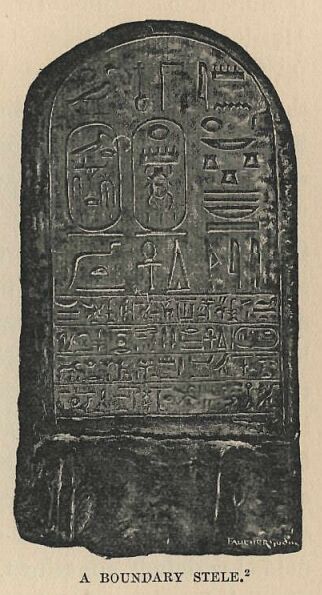
Once set up, the stele received a name which gave it, as it were, a living and independent personality. It sometimes recorded the nature of the soil, its situation, or some characteristic which made it remarkable—the “Lake of the South,” the “Eastern Meadow,” the “Green Island,” the “Fisher’s Pool,” the “Willow Plot,” the “Vineyard,” the “Vine Arbour,” the “Sycamore;” sometimes also it bore the name of the first master or the Pharaoh under whom it had been erected—the “Nurse-Phtahhotpû,” the “Verdure-Kheops,” the “Meadow-Didifrî,” the “Abundance-Sahûri,” “Khafri-Great-among-the Doubles.” Once given, the name clung to it for centuries, and neither sales, nor redistributions, nor revolutions, nor changes of dynasty, could cause it to be forgotten. The officers of the survey inscribed it in their books, together with the name of the proprietor, those of the owners of adjoining lands, and the area and nature of the ground. They noted down, to within a few cubits, the extent of the sand, marshland, pools, canals, groups of palms, gardens or orchards, vineyards and cornfields,* which it contained.
* See in the great inscription of Beni-Hasan the passage in which are enumerated at full length, in a legal document, the constituent parts of the principality of the Gazelle, “its watercourses, its fields, its trees, its sands, from the river to the mountain of the West” (11. 46-53).
The cornland in its turn was divided into several classes, according to whether it was regularly inundated, or situated above the highest rise of the water, and consequently dependent on a more or less costly system of artificial irrigation. All this was so much information of which the scribes took advantage in regulating the assessment of the land-tax.
Everything tends to make us believe that this tax represented one-tenth of the gross produce, but the amount of the latter varied. It depended on the annual rise of the Nile, and it followed the course of it with almost mathematical exactitude: if there were too much or too little water, it was immediately lessened, and might even be reduced to nothing in extreme cases. The king in his capital and the great lords in their fiefs had set up nilo-meters, by means of which, in the critical weeks, the height of the rising or subsiding flood was taken daily. Messengers carried the news of it over the country: the people, kept regularly informed of what was happening, soon knew what kind of season to expect, and they could calculate to within very little what they would have to pay. In theory, the collecting of the tax was based on the actual amount of land covered by the water, and the produce of it was constantly varying. In practice it was regulated by taking the average of preceding years, and deducting from that a fixed sum, which was never departed from except in extraordinary circumstances.*
* We know that this was so, in so far as the Roman period is concerned, from a passage in the edict of Tiberius Alexander. The practice was such a natural one, that I have no hesitation in tracing it back to the time of the Ancient Empire; repeatedly condemned as a piece of bad administration, it reappeared continually. At Beni-Hasan, the nomarch Amoni boasts that, “when there had been abundant Niles, and the owners of wheat and barley crops had thriven, he had not increased the rate of the land-tax,” which seems to indicate that, so far as he was concerned, he had fixed the tax to pay his dues without difficulty.
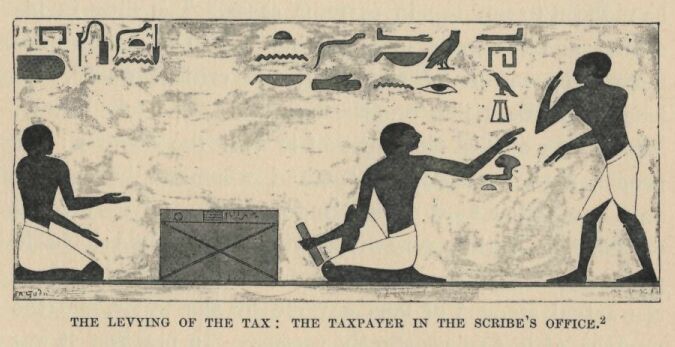
Drawn by Faucher-Gudin, from a picture at Beni-Hasan. This picture and those which follow it represent a census in the principality of the Gazelle under the XIIth dynasty as well as the collection of a tax.
The year would have to be a very bad one before the authorities would lower the ordinary rate: the State in ancient times was not more willing to deduct anything from its revenue than the modern State would be.*
* The two decrees of Rosetta and of Canopus, however, mention reductions granted by the Ptolemies after an insufficient rise of the Nile.
The payment of taxes was exacted in wheat, durra, beans, and field produce, which were stored in the granaries of the nome. It would seem that the previous deduction of one-tenth of the gross amount of the harvest could not be a heavy burden, and that the wretched fellah ought to have been in a position on land at a permanent figure, based on the average of good and bad harvests.
It was not so, however, and the same writers who have given us such a lamentable picture of the condition of the workmen in the towns, have painted for us in even darker colours the miseries which overwhelmed the country people. “Dost thou not recall the picture of the farmer, when the tenth of his grain is levied? Worms have destroyed half of the wheat, and the hippopotami have eaten the rest; there are swarms of rats in the fields, the grasshoppers alight there, the cattle devour, the little birds pilfer, and if the farmer lose sight for an instant of what remains upon the ground, it is carried off by robbers;* the thongs, moreover, which bind the iron and the hoe are worn out, and the team has died at the plough. It is then that the scribe steps out of the boat at the landing-place to levy the tithe, and there come the keepers of the doors of the granary with cudgels and the negroes with ribs of palm-leaves, who come crying: ‘Come now, corn!’ There is none, and they throw the cultivator full length upon the ground; bound, dragged to the canal, they fling him in head first;** his wife is bound with him, his children are put into chains; the neighbours, in the mean time, leave him and fly to save their grain.”
* This last danger survives even to the present day. During part of the year the fellahîn spend the night in their fields; if they did not see to it, their neighbours would not hesitate to come and cut their wheat before the harvest, or root up their vegetables while still immature. ** The same kind of torture is mentioned in the decree of Harmhabi, in which the lawless soldiery are represented as “running from house to house, dealing blows right and left with their sticks, ducking the fellahîn head downwards in the water, and not leaving one of them with a whole skin.” This treatment was still resorted to in Egypt not long ago, in order to extract money from those taxpayers whom beatings had failed to bring to reason.
One might be tempted to declare that the picture is too dark a one to be true, did one not know from other sources of the brutal ways of filling the treasury which Egypt has retained even to the present day. In the same way as in the town, the stick facilitated the operations of the tax-collector in the country: it quickly opened the granaries of the rich, it revealed resources to the poor of which he had been ignorant, and it only failed in the case of those who had really nothing to give. Those who were insolvent were not let off even when they had been more than half killed: they and their families were sent to prison, and they had to work out in forced labour the amount which they had failed to pay in current merchandise.*
* This is evident from a passage in the Sallier Papyrus n° I, quoted above, in which we see the taxpayer in fetters, dragged out to clean the canals, his whole family, wife and children, accompanying him in bonds.
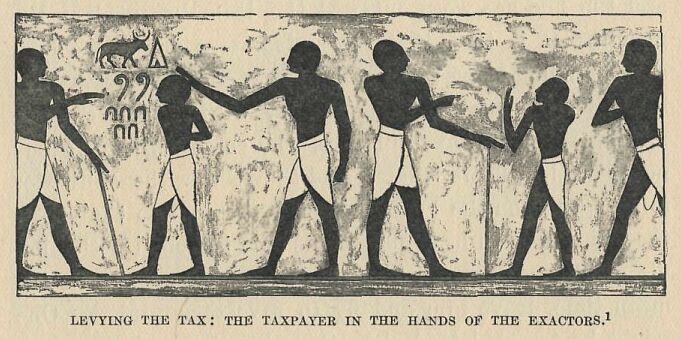
Drawn by Faucher-Gudin, from a picture on the tomb of Khîti at Beni-Hasan (cf. Champollion, Monuments de l’Egypte, pl. cccxc. 4; Rosellini, Monumenti civili, pl. cxxiv. b).
The collection of the taxes was usually terminated by a rapid revision of the survey. The scribe once more recorded the dimensions and character of the domain lands in order to determine afresh the amount of the tax which should be imposed upon them. It often happened, indeed, that, owing to some freak of the Nile, a tract of ground which had been fertile enough the preceding year would be buried under a gravel bed, or transformed into a marsh. The owners who thus suffered were allowed an equivalent deduction; as for the farmers, no deductions of the burden were permitted in their case, but a tract equalling in value that of the part they had lost was granted to them out of the royal or seignorial domain, and their property was thus made up to its original worth.
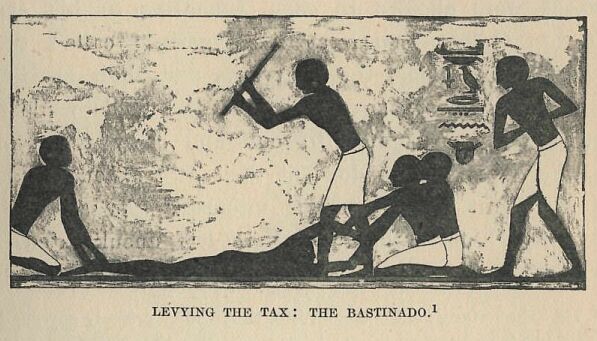
Drawn by Faucher-Gudin, from a picture on the tomb of Khîti at Beni-Hasan.
What the collection of the taxes had begun was almost always brought to a climax by the corvées. However numerous the royal and seignorial slaves might have been, they were insufficient for the cultivation of all the lands of the domains, and a part of Egypt must always have lain fallow, had not the number of workers been augmented by the addition of those who were in the position of freemen.
This excess of cultivable land was subdivided into portions of equal dimensions, which were distributed among the inhabitants of neighbouring villages by the officers of a “regent” nominated for that purpose. Those dispensed from agricultural service were—the destitute, soldiers on service and their families, certain employés of the public works, and servitors of the temple;* all other country-folk without exception had to submit to it, and one or more portions were allotted to each, according to his capabilities.** Orders issued at fixed periods called them together, themselves, their servants and their beasts of burden, to dig, sow, keep watch in the fields while the harvest was proceeding, to cut and carry the crops, the whole work being done at their own expense and to the detriment of their own interests.***
* That the scribes, i.e. the employés of the royal or princely government, were exempt from enforced labour, is manifest from the contrast drawn by the letter-writers of the Sallier and Anastasi Papyri between themselves and the peasants, or persons belonging to other professions who were liable to it. The circular of Dorion defines the classes of soldiers who were either temporarily or permanently exempt under the Greek kings. ** Several fragments of the Turin papyri contain memoranda of enforced labour performed on behalf of the temples, and of lists of persons liable to be called on for such labour. *** All these details are set forth in the Ptolemaic period, in the letter to Dorion which refers to a royal edict. As Signor Lumbroso has well remarked, the Ptolemies merely copied exactly the misdeeds of the old native governments. Indeed, we come across frequent allusions to the enforced labour of men and beasts in inscriptions of the Middle Empire at Beni-Hasan or at Siût; many of the pictures on the Memphite tombs show bands of such labourers at work in the fields of the great landowners or of the king.
ENLARGE TO FULL SIZE
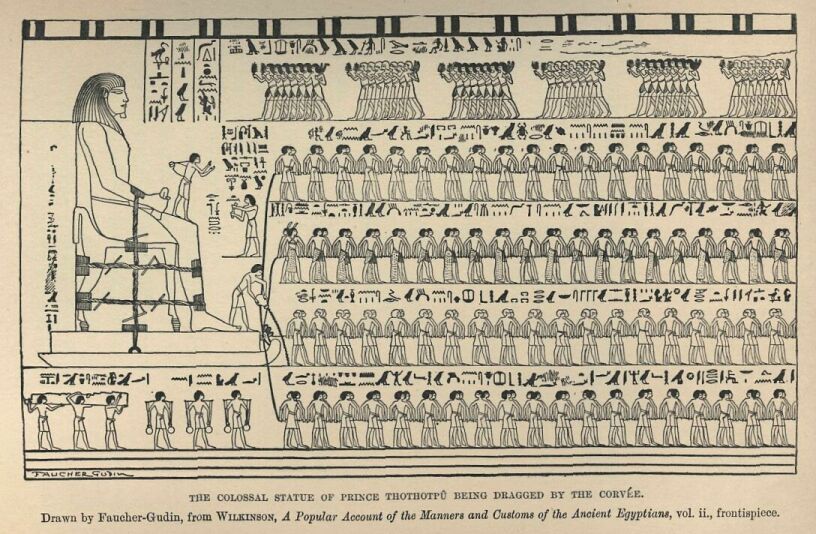
As a sort of indemnity, a few allotments were left uncultivated for their benefit; to these they sent their flocks after the subsidence of the inundation, for the pasturage on them was so rich that the sheep were doubly productive in wool and offspring. This was a mere apology for a wage: the forced labour for the irrigation brought them no compensation. The dykes which separate the basins, and the network of canals for distributing the water and irrigating the land, demand continual attention: every year some need strengthening, others re-excavating or cleaning out. The men employed in this work pass whole days standing in the water, scraping up the mud with both hands in order to fill the baskets of platted leaves, which boys and girls lift on to their heads and carry to the top of the bank: the semi-liquid contents ooze through the basket, trickle over their faces and soon coat their bodies with a black shining mess, disgusting even to look at. Sheikhs preside over the work, and urge it on with abuse and blows. When the gangs of workmen had toiled all day, with only an interval of two hours about noon for a siesta and a meagre pittance of food, the poor wretches slept on the spot, in the open air, huddled one against another and but ill protected by their rags from the chilly nights. The task was so hard a one, that malefactors, bankrupts, and prisoners of war were condemned to it; it wore out so many hands that the free peasantry were scarcely ever exempt. Having returned to their homes, they were not called until the next year to any established or periodic corvée, but many an irregular one came and surprised them in the midst of their work, and forced them to abandon all else to attend to the affairs of king or lord. Was a new chamber to be added to some neighbouring temple, were materials wanted to strengthen or rebuild some piece of wall which had been undermined by the inundation, orders were issued to the engineers to go and fetch a stated quantity of limestone or sandstone, and the peasants were commanded to assemble at the nearest quarry to cut the blocks from it, and if needful to ship and convey them to their destination. Or perhaps the sovereign had caused a gigantic statue of himself to be carved, and a few hundred men were requisitioned to haul it to the place where he wished it to be set up. The undertaking ended in a gala, and doubtless in a distribution of food and drink: the unfortunate creatures who had been got together to execute the work could not always have felt fitly compensated for the precious time they had lost, by one day of drunkenness and rejoicing.
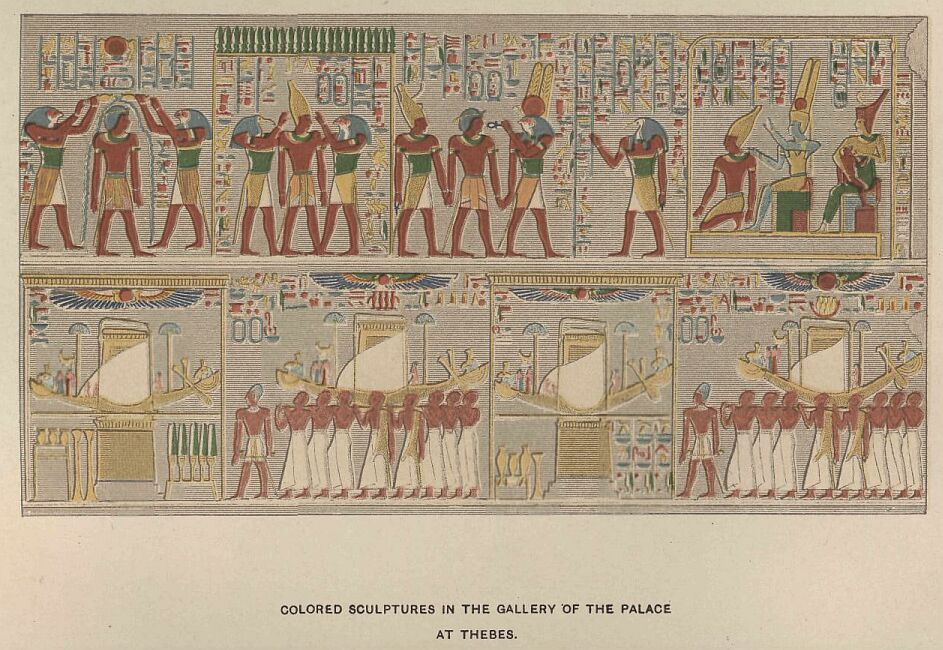
We may ask if all these corvées were equally legal? Even if some of them were illegal, the peasant on whom they fell could not have found the means to escape from them, nor could he have demanded legal reparation for the injury which they caused him. Justice, in Egypt and in the whole Oriental world, necessarily emanates from political authority, and is only one branch of the administration amongst others, in the hands of the lord and his representatives. Professional magistrates were unknown—men brought up to the study of law, whose duty it was to ensure the observance of it, apart from any other calling—but the same men who commanded armies, offered sacrifices, and assessed or received taxes, investigated the disputes of ordinary citizens, or settled the differences which arose between them and the representatives of the lords or of the Pharaoh. In every town and village, those who held by birth or favour the position of governor were ex-officio invested with the right of administering justice. For a certain number of days in the month, they sat at the gate of the town or of the building which served as their residence, and all those in the town or neighbourhood possessed of any title, position, or property, the superior priesthood of the temples, scribes who had advanced or grown old in office, those in command of the militia or the police, the heads of divisions or corporations, the “qonbîtiû,” the “people of the angle,” might if they thought fit take their place beside them, and help them to decide ordinary lawsuits. The police were mostly recruited from foreigners and negroes, or Bedouin belonging to the Nubian tribe of the Mâzaiû. The litigants appeared at the tribunal, and waited under the superintendence of the police until their turn came to speak: the majority of the questions were decided in a few minutes by a judgment by which there was no appeal; only the more serious cases necessitated a cross-examination and prolonged discussion. All else was carried on before this patriarchal jury as in our own courts of justice, except that the inevitable stick too often elucidated the truth and cut short discussions: the depositions of the witnesses, the speeches on both sides, the examination of the documents, could not proceed without the frequent taking of oaths “by the life of the king” or “by the favour of the gods,” in which the truth often suffered severely. Penalties were varied somewhat—the bastinado, imprisonment, additional days of work for the corvée, and, for grave offences, forced labour in the Ethiopian mines, the loss of nose and ears, and finally, death by strangulation, by beheading,* by empalement, and at the stake.