Volume 2 — CHAPTER II—THE MEMPHITE EMPIRE
M. L. McClure translation
The royal pyramid builders: Kheops, Khephren, Mykerinos—Memphite literature and art—Extension of Egypt towards the South, and the conquest of Nubia by the Pharaohs.
At that time “the Majesty of King Huni died, and the Majesty of King Snofrûi arose to be a sovereign benefactor over this whole earth.” All that we know of him is contained in one sentence: he fought against the nomads of Sinai, constructed fortresses to protect the eastern frontier of the Delta, and made for himself a tomb in the form of a pyramid.
The almost uninhabited country which connects Africa with Asia is flanked towards the south by two chains of hills which unite at right angles, and together form the so-called Gebel et-Tîh. This country is a tableland, gently inclined from south to north, bare, sombre, covered with flint-shingle, and siliceous rocks, and breaking out at frequent intervals into long low chalky hills, seamed with wadys, the largest of which—that of El-Arish—having drained all the others into itself, opens into the Mediterranean halfway between Pelusiam and Gaza. Torrents of rain are not infrequent in winter and spring, but the small quantity of water which they furnish is quickly evaporated, and barely keeps alive the meagre vegetation in the bottom of the valleys. Sometimes, after months of absolute drought, a tempest breaks over the more elevated parts of the desert.*
* In chap. viii. of the Account of the Survey, pp. 226- 228, Mr. Holland describes a sudden rainstorm or “sell” on December 3, 1867, which drowned thirty persons, destroyed droves of camels and asses, flocks of sheep and goats, and swept away, in the Wady Feîrân, a thousand palm trees and a grove of tamarisks, two miles in length. Towards 4.30 in the afternoon, a few drops of rain began to fall, but the storm did not break till 5 p.m. At 5.15 it was at its height, and it was not over till 9.30. The torrent, which at 8 p.m. was 10 feet deep, and was about 1000 feet in width, was, at 6 a.m. the next day, reduced to a small streamlet.
The wind rises suddenly in squall-like blasts; thick clouds, borne one knows not whence, are riven by lightning to the incessant accompaniment of thunder; it would seem as if the heavens had broken up and were crashing down upon the mountains. In a few moments streams of muddy water rushing down the ravines, through the gulleys and along the slightest depressions, hurry to the low grounds, and meeting there in a foaming concourse, follow the fall of the land; a few minutes later, and the space between one hillside and the other is occupied by a deep river, flowing with terrible velocity and irresistible force. At the end of eight or ten hours the air becomes clear, the wind falls, the rain ceases; the hastily formed river dwindles, and for lack of supply is exhausted; the inundation comes to an end almost as quickly as it began. In a short time nothing remains of it but some shallow pools scattered in the hollows, or here and there small streamlets which rapidly dry up. The flood, however, accelerated by its acquired velocity, continues to descend towards the sea. The devastated flanks of the hills, their torn and corroded bases, the accumulated masses of shingle left by the eddies, the long lines of rocks and sand, mark its route and bear evidence everywhere of its power. The inhabitants, taught by experience, avoid a sojourn in places where tempests have once occurred. It is in vain that the sky is serene above them and the sun shines overhead; they always fear that at the moment in which danger seems least likely to threaten them, the torrent, taking its origin some twenty leagues off, may be on its headlong way to surprise them. And, indeed, it comes so suddenly and so violently that nothing in its course can escape it: men and beasts, before there is time to fly, often even before they are aware of its approach, are swept away and pitilessly destroyed. The Egyptians applied to the entire country the characteristic epithet of To-Shûît, the land of Emptiness, the land of Aridity.
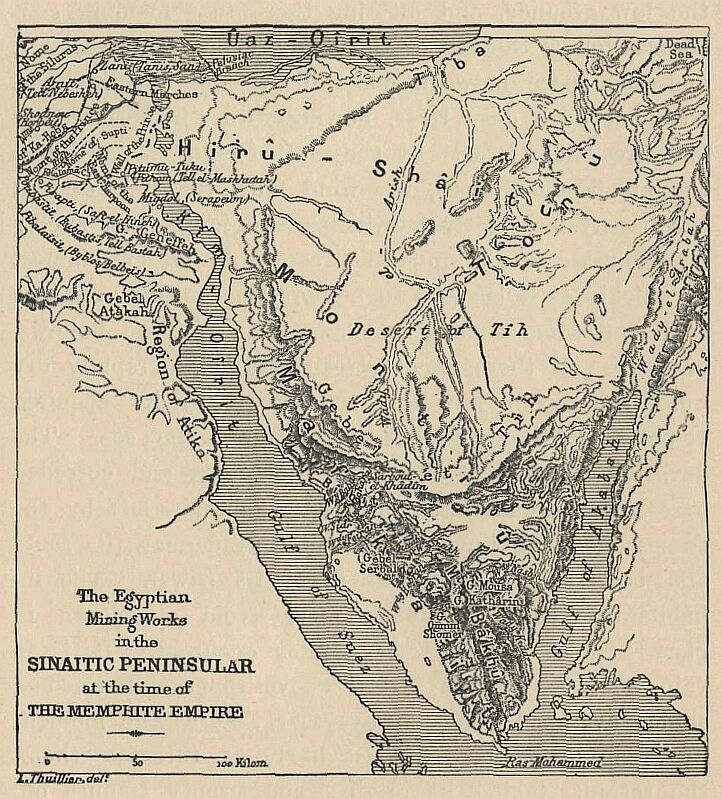
They divided it into various districts—the upper and lower Tonû, Aia, Kadûma. They called its inhabitants Hirû-Shâîtû, the lords of the Sands; Nomiû-Shâîtû, the rovers of the Sands; and they associated them with the Amu—that is to say, with a race which we recognize as Semitic. The type of these barbarians, indeed, reminds one of the Semitic massive head, aquiline nose, retreating forehead, long beard, thick and not infrequently crisp hair. They went barefoot, and the monuments represent them as girt with a short kilt, though they also wore the abayah. Their arms were those commonly used by the Egyptians—the bow, lance, club, knife, battle-axe, and shield. They possessed great flocks of goats or sheep, but the horse and camel were unknown to them, as well as to their African neighbours. They lived chiefly upon the milk of their flocks, and the fruit of the date-palm. A section of them tilled the soil: settled around springs or wells, they managed by industrious labour to cultivate moderately sized but fertile fields, flourishing orchards, groups of palms, fig and olive trees, and vines. In spite of all this their resources were insufficient, and their position would have been precarious if they had not been able to supplement their stock of provisions from Egypt or Southern Syria. They bartered at the frontier markets their honey, wool, gums, manna, and small quantities of charcoal, for the products of local manufacture, but especially for wheat, or the cereals of which they stood in need. The sight of the riches gathered together in the eastern plain, from Tanis to Bubastis, excited their pillaging instincts, and awoke in them an irrepressible covetousness. The Egyptian annals make mention of their incursions at the very commencement of history, and they maintained that even the gods had to take steps to protect themselves from them. The Gulf of Suez and the mountainous rampart of Gebel Geneffeh in the south, and the marshes of Pelusium on the north, protected almost completely the eastern boundary of the Delta; but the Wady Tumilât laid open the heart of the country to the invaders. The Pharaohs of the divine dynasties in the first place, and then those of the human dynasties, had fortified this natural opening, some say by a continuous wall, others by a line of military posts, flanked on the one side by the waters of the gulf.*
* The existence of the wall, or of the line of military posts, is of very ancient date, for the name Kîm-Oîrît is already followed by the hieroglyph of the wall, or by that of a fortified enclosure in the texts of the Pyramids.
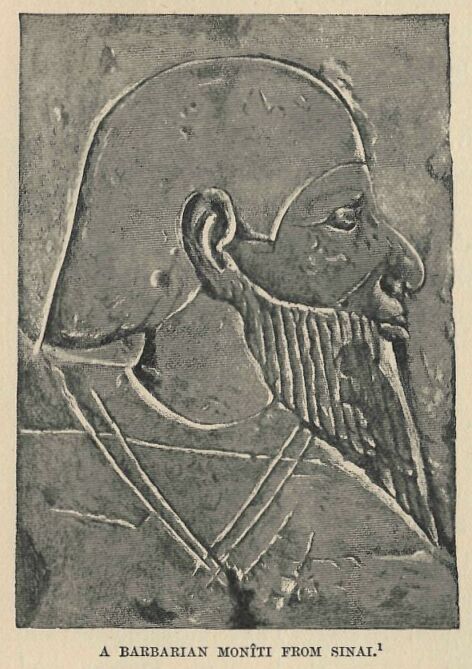
Drawn by Faucher-Gudin, from a photograph by Petrie. The original is of the time of Nectanebo, and is at Karnak; I have chosen it for reproduction in preference to the heads of the time of the Ancient Empire, which are more injured, and of which this is only the traditional copy.
Snofrûi restored or constructed several castles in this district, which perpetuated his name for a long time after his death. These had the square or rectangular form of the towers, whose ruins are still to be seen on the banks of the Nile. Standing night and day upon the battlements, the sentinels kept a strict look-out over the desert, ready to give alarm at the slightest suspicious movement.
Drawn by Faucher-Gudin, from the vignette by E. H. Palmer, The Desert of the Exodus, p. 317. The expression Kîm-Oîrît, “the very black,” is applied to the northern part of the Red Sea, in contradistinction to Ûaz-Oîrît, Uazît-Oîrît, “the very green,” the Mediterranean; a town, probably built at a short distance from the village of Maghfâr, had taken its name from the gulf on which it was situated, and was also called Kîm- Oîrît.
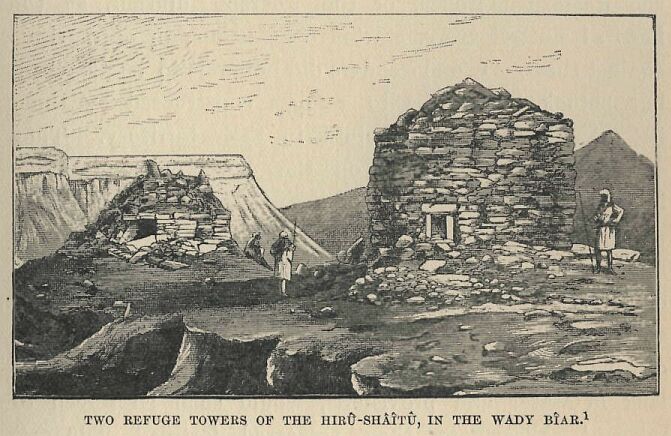
The marauders took advantage of any inequality in the ground to approach unperceived, and they were often successful in getting through the lines; they scattered themselves over the country, surprised a village or two, bore off such women and children as they could lay their hands on, took possession of herds of animals, and, without carrying their depredations further, hastened to regain their solitudes before information of their exploits could have reached the garrison. If their expeditions became numerous, the general of the Eastern Marches, or the Pharaoh himself, at the head of a small army, started on a campaign of reprisals against them. The marauders did not wait to be attacked, but betook themselves to refuges constructed by them beforehand at certain points in their territory. They erected here and there, on the crest of some steep hill, or at the confluence of several wadys, stone towers put together without mortar, and rounded at the top like so many beehives, in unequal groups of three, ten, or thirty; here they massed themselves as well as they could, and defended the position with the greatest obstinacy, in the hope that their assailants, from the lack of water and provisions, would soon be forced to retreat.*
* The members of the English Commission do not hesitate to attribute the construction of these towers to the remotest antiquity; the Bedouin call them “namûs,” plur. “nawamîs,” mosquito-houses, and they say that the children of Israel built them as a shelter during the night from mosquitos at the time of the Exodus. The resemblance of these buildings to the “Talayôt” of the Balearic Isles, and to the Scotch beehive-shaped houses, has struck all travellers.
Elsewhere they possessed fortified “duars,” where not only their families but also their herds could find a refuge—circular or oval enclosures, surrounded by low walls of massive rough stones crowned by a thick rampart made of branches of acacia interlaced with thorny bushes, the tents or huts being ranged behind, while in the centre was an empty space for the cattle. These primitive fortresses were strong enough to overawe nomads; regular troops made short work of them. The Egyptians took them by assault, overturned them, cut down the fruit trees, burned the crops, and retreated in security, after having destroyed everything in their march. Each of their campaigns, which hardly lasted more than a few days, secured the tranquillity of the frontier for some years.*
* The inscription of Uni (11. 22-32) furnishes us with the invariable type of the Egyptian campaigns against the Hirû- Shâîtû: the bas-reliefs of Karnak might serve to illustrate it, as they represent the great raid led by Seti I. into the territory of the Shaûsûs and their allies, between the frontier of Egypt and the town of Hebron.
Drawn by Boudier, from the water-colour drawing published by Lepsius, Denhn., i. 7, No. 2.
Plan made by Thuillier, from the sketch by Brugscii, Wanderung nach den Tiirhis Minen, p. 70.
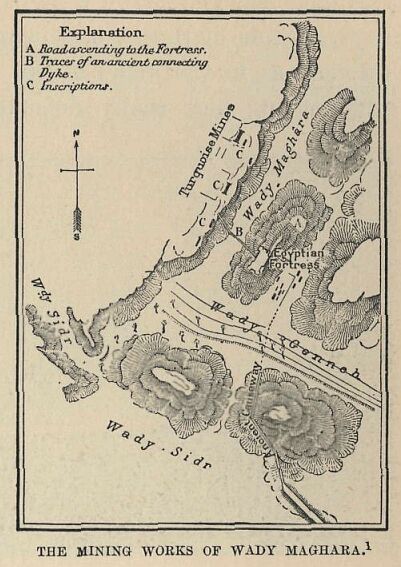
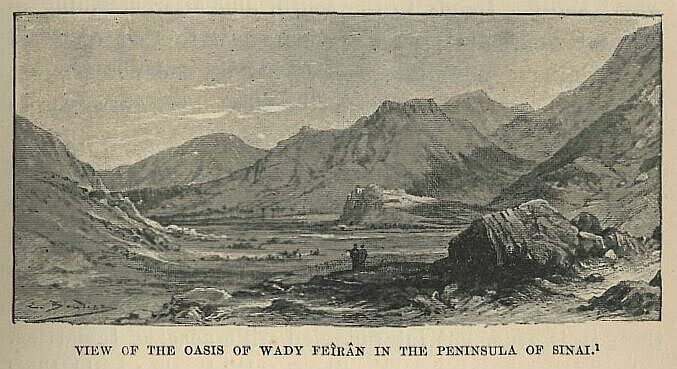
To the south of Gebel et-Tîh, and cut off from it almost completely by a moat of wadys, a triangular group of mountains known as Sinai thrusts a wedge-shaped spur into the Red Sea, forcing back its waters to the right and left into two narrow gulfs, that of Akabah and that of Suez. Gebel Katherin stands up from the centre and overlooks the whole peninsula. A sinuous chain detaches itself from it and ends at Gebel Serbâl, at some distance to the northwest; another trends to the south, and after attaining in Gebel Umm-Shomer an elevation equal to that of Gebel Katherin, gradually diminishes in height, and plunges into the sea at Ras-Mohammed. A complicated system of gorges and valleys—Wady Nasb, Wady Kidd, Wady Hebrân, Wady Baba—furrows the country and holds it as in a network of unequal meshes. Wady Feîrân contains the most fertile oasis in the peninsula. A never-failing stream waters it for about two or three miles of its length; quite a little forest of palms enlivens both banks—somewhat meagre and thin, it is true, but intermingled with acacias, tamarisks, nabecas, carob trees, and willows. Birds sing amid their branches, sheep wander in the pastures, while the huts of the inhabitants peep out at intervals from among the trees. Valleys and plains, even in some places the slopes of the hills, are sparsely covered with those delicate aromatic herbs which affect a stony soil. Their life is a perpetual struggle against the sun: scorched, dried up, to all appearance dead, and so friable that they crumble to pieces in the fingers when one attempts to gather them, the spring rains annually infuse into them new life, and bestow upon them, almost before one’s eyes, a green and perfumed youth of some days’ duration. The summits of the hills remain always naked, and no vegetation softens the ruggedness of their outlines, or the glare of their colouring. The core of the peninsula is hewn, as it were, out of a block of granite, in which white, rose-colour, brown, or black predominate, according to the quantities of felspar, quartz, or oxides of iron which the rocks contain. Towards the north, the masses of sandstone which join on to Gebel et-Tîh assume all possible shades of red and grey, from a delicate lilac neutral tint to dark purple. The tones of colour, although placed crudely side by side, present nothing jarring nor offensive to the eye; the sun floods all, and blends them in his light. The Sinaitic peninsula is at intervals swept, like the desert to the east of Egypt, by terrible tempests, which denude its mountains and transform its wadys into so many ephemeral torrents. The Monîtû who frequented this region from the dawn of history did not differ much from the “Lords of the Sands;” they were of the same type, had the same costume, the same arms, the same nomadic instincts, and in districts where the soil permitted it, made similar brief efforts to cultivate it. They worshipped a god and a goddess whom the Egyptians identified with Horus and Hâthor; one of these appeared to represent the light, perhaps the sun, the other the heavens. They had discovered at an early period in the sides of the hills rich metalliferous veins, and strata, bearing precious stones; from these they learned to extract iron, oxides of copper and manganese, and turquoises, which they exported to the Delta. The fame of their riches, carried to the banks of the Nile, excited the cupidity of the Pharaohs; expeditions started from different points of the valley, swept down upon the peninsula, and established themselves by main force in the midst of the districts where the mines lay. These were situated to the north-west, in the region of sandstone, between the western branch of Gebel et-Tîh and the Gulf of Suez. They were collectively called Mafkaît, the country of turquoises, a fact which accounts for the application of the local epithet, lady of Mafkaît, to Hâthor. The earliest district explored, that which the Egyptians first attacked, was separated from the coast by a narrow plain and a single range of hills: the produce of the mines could be thence transported to the sea in a few hours without difficulty. Pharaoh’s labourers called this region the district of Baîfc, the mine par excellence, or of Bebît, the country of grottoes, from the numerous tunnels which their predecessors had made there: the name Wady Maghara, Valley of the Cavern, by which the site is now designated, is simply an Arabic translation of the old Egyptian word.
The Monîtû did not accept this usurpation of their rights without a struggle, and the Egyptians who came to work among them had either to purchase their forbearance by a tribute, or to hold themselves always in readiness to repulse the assaults of the Monîtû by force of arms. Zosiri had already taken steps to ensure the safety of the turquoise-seekers at their work; Snofrûi was not, therefore, the first Pharaoh who passed that way, but none of his predecessors had left so many traces of his presence as he did in this out-of-the-way corner of the empire. There may still be seen, on the north-west slope of the Wady Maghara, the bas-relief which one of his lieutenants engraved there in memory of a victory gained over the Monîtû. A Bedouin sheikh fallen on his knees prays for mercy with suppliant gesture, but Pharaoh has already seized him by his long hair, and brandishes above his head a white stone mace to fell him with a single blow.
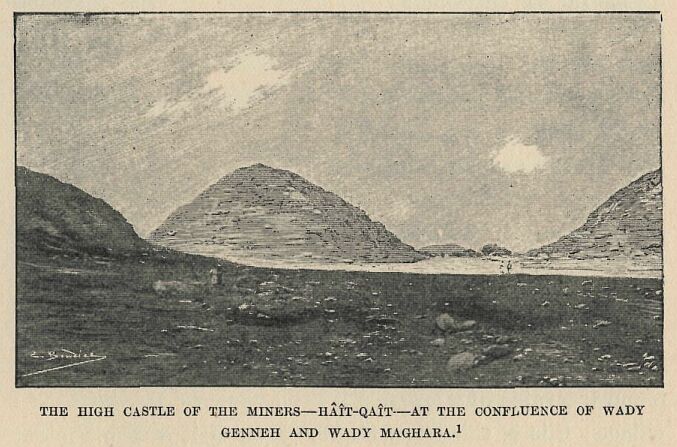
The workmen, partly recruited from the country itself, partly despatched from the banks of the Nile, dwelt in an entrenched camp upon an isolated peak at the confluence of Wady Genneh and Wady Maghara. A zigzag pathway on its smoothest slope ends, about seventeen feet below the summit, at the extremity of a small and slightly inclined tableland, upon which are found the ruins of a large village; this is the High Castle—Hâît-Qaît of the ancient inscriptions. Two hundred habitations can still be made out here, some round, some rectangular, constructed of sandstone blocks without mortar, and not larger than the huts of the fellahîn: in former times a flat roof of wicker-work and puddled clay extended over each. The entrance was not so much a door as a narrow opening, through which a fat man would find it difficult to pass; the interior consisted of a single chamber, except in the case of the chief of the works, whose dwelling contained two.
Drawn by Boudier, from the photograph published in the Ordnance Survey of the Peninsula of Sinai, Photographs, vol. ii. pls. 59, 60.
A rough stone bench from two to two and a half feet high surrounds the plateau on which the village stands; a cheval défrise made of thorny brushwood probably completed the defence, as in the duars of the desert. The position was very strong and easily defended. Watchmen scattered over the neighbouring summits kept an outlook over the distant plain and the defiles of the mountains. Whenever the cries of these sentinels announced the approach of the foe, the workmen immediately deserted the mine and took refuge in their citadel, which a handful of resolute men could successfully hold, as long as hunger and thirst did not enter into the question. As the ordinary springs and wells would not have been sufficient to supply the needs of the colony, they had transformed the bottom of the valley into an artificial lake. A dam thrown across it prevented the escape of the waters, which filled the reservoir more or less completely according to the season. It never became empty, and several species of shellfish flourished in it—among others, a kind of large mussel which the inhabitants generally used as food, which with dates, milk, oil, coarse bread, a few vegetables, and from time to time a fowl or a joint of meat, made up their scanty fare. Other things were of the same primitive character. The tools found in the village are all of flint: knives, scrapers, saws, hammers, and heads of lances and arrows. A few vases brought from Egypt are distinguished by the fineness of the material and the purity of the design; but the pottery in common use was made on the spot from coarse clay without care, and regardless of beauty. As for jewellery, the villagers had beads of glass or blue enamel, and necklaces of strung cowrie-shells. In the mines, as in their own houses, the workmen employed stone tools only, with handles of wood, or of plaited willow twigs, but their chisels or hammers were more than sufficient to cut the yellow sandstone, coarse-grained and very friable as it was, in the midst of which they worked.*
* E. H. Palmer, however, from his observations, is of opinion that the work in the tunnels of the mines was executed entirely by means of bronze chisels and tools; the flint implements serving only to incise the scenes which cover the surfaces of the rocks.
The tunnels running straight into the mountain were low and wide, and were supported at intervals by pillars of sandstone left in situ. These tunnels led into chambers of various sizes, whence they followed the lead of the veins of precious mineral. The turquoise sparkled on every side—on the ceiling and on the walls—and the miners, profiting by the slightest fissures, cut round it, and then with forcible blows detached the blocks, and reduced them to small fragments, which they crushed, and carefully sifted so as not to lose a particle of the gem. The oxides of copper and of manganese which they met with here and elsewhere in moderate quantities, were used in the manufacture of those beautiful blue enamels of various shades which the Egyptians esteemed so highly. The few hundreds of men of which the permanent population was composed, provided for the daily exigencies of industry and commerce. Royal inspectors arrived from time to time to examine into their condition, to rekindle their zeal, and to collect the product of their toil. When Pharaoh had need of a greater quantity than usual of minerals or turquoises, he sent thither one of his officers, with a select body of carriers, mining experts, and stone-dressers. Sometimes as many as two or three thousand men poured suddenly into the peninsula, and remained there one or two months; the work went briskly forward, and advantage was taken of the occasion to extract and transport to Egypt beautiful blocks of diorite, serpentine or granite, to be afterwards manufactured there into sarcophagi or statues. Engraved stelæ, to be seen on the sides of the mountains, recorded the names of the principal chiefs, the different bodies of handicraftsmen who had participated in the campaign, the name of the sovereign who had ordered it and often the year of his reign.
It was not one tomb only which Snofrui had caused to be built, but two. He called them “Khâ,” the Rising, the place where the dead Pharaoh, identified with the sun, is raised above the world for ever. One of these was probably situated near Dahshur; the other, the “Khâ rîsi,” the Southern Rising, appears to be identical with the monument of Mêdûm.
Drawn by Faucher-Gudin, from the plans of Flinders Petrie, Medum, pl. ii.
The pyramid, like the mastaba,* represents a tumulus with four sides, in which the earthwork is replaced by a structure of stone or brick. It indicates the place in which lies a prince, chief, or person of rank in his tribe or province. It was built on a base of varying area, and was raised to a greater or less elevation according to the fortune of the deceased or of his family.**
* No satisfactory etymon for the word pyramid, has as yet been proposed: the least far-fetched is that put forward by Cantor-Eisenlohr, according to which pyramid is the Greek form, irupauç, of the compound term “piri-m-ûisi,” which in Egyptian mathematical phraseology designates the salient angle, the ridge or height of the pyramid. ** The brick pyramids of Abydos were all built for private persons. The word “mirit,” which designates a pyramid in the texts, is elsewhere applied to the tombs of nobles and commoners as well as to those of kings.
The fashion of burying in a pyramid was not adopted in the environs of Memphis until tolerably late times, and the Pharaohs of the primitive dynasties were interred, as their subjects were, in sepulchral chambers of mastabas. Zosiri was the only exception, if the step-pyramid of Saqqâra, as is probable, served for his tomb.*
* It is difficult to admit that a pyramid of considerable dimensions could have disappeared without leaving any traces behind, especially when we see the enormous masses of masonry which still mark the sites of those which have been most injured; besides, the inscriptions connect none of the predecessors of Snofrûi with a pyramid, unless it be Zosiri. The step-pyramid of Saqqâra, which is attributed to the latter, belongs to the same type as that of Mêdûm; so does also the pyramid of Rigah, whose occupant is unknown. If we admit that this last-mentioned pyramid served as a tomb to some intermediate Pharaoh between Zosiri and Snofrûi—for instance, Hûni—the use of pyramids would be merely exceptional for sovereigns anterior to the IVth dynasty.
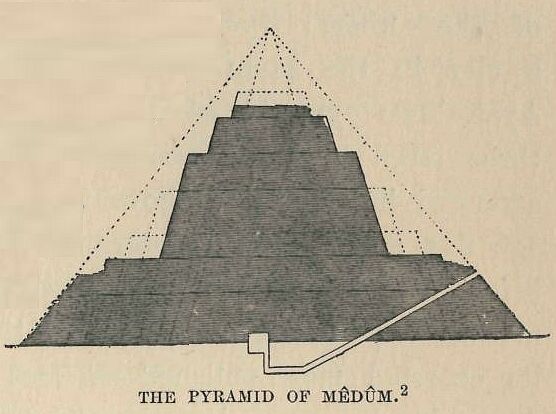
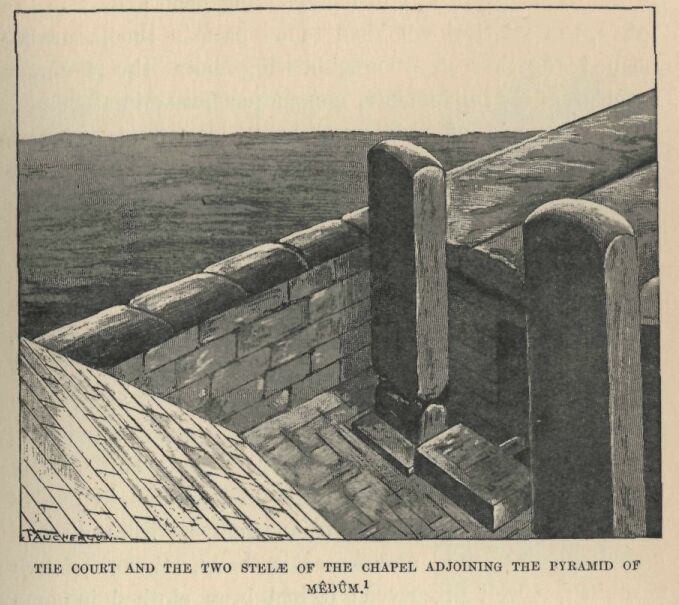
The motive which determined Snofrûi’s choice of Mêdûm as a site, is unknown to us: perhaps he dwelt in that city of Heracleopolis, which in course of time frequently became the favourite residence of the kings; perhaps he improvised for himself a city in the plain between El-Wastah and Kafr el-Ayat. His pyramid, at the present time, is composed of three large unequal cubes with slightly inclined sides, arranged in steps one above the other. Some centuries ago five could be still determined, and in ancient times, before ruin had set in, as many as seven. Each block marked a progressive increase of the total mass, and bad its external face polished—a fact which we can still determine by examining the slabs one behind another; a facing of large blocks, of which many of the courses still exist towards the base, covered the whole, at one angle from the apex to the foot, and brought it into conformity with the type of the classic pyramid. The passage had its orifice in the middle of the north face about sixty feèt above the ground: it is five feet high, and dips at a tolerably steep angle through the solid masonry. At a depth of a hundred and ninety-seven feet it becomes level, without increasing in aperture, runs for forty feet on this plane, traversing two low and narrow chambers, then making a sharp turn it ascends perpendicularly until it reaches the floor of the vault. The latter is hewn out of the mountain rock, and is small, rough, and devoid of ornament: the ceiling appears to be in three heavy horizontal courses of masonry, which project one beyond the other corbel-wise, and give the impression of a sort of acutely pointed arch. Snofrûi slept there for ages; then robbers found a way to him, despoiled and broke up his mummy, scattered the fragments of his coffin upon the ground, and carried off the stone sarcophagus. The apparatus of beams and cords of which they made use for the descent, hung in their place above the mouth of the shaft until ten years ago. The rifling of the tomb took place at a remote date, for from the XXth dynasty onwards the curious were accustomed to penetrate into the passage: two scribes have scrawled their names in ink on the back of the framework in which the stone cover was originally inserted. The sepulchral chapel was built a little in front of the east face; it consisted of two small-sized rooms with bare surfaces, a court whose walls abutted on the pyramid, and in the court, facing the door, a massive table of offerings flanked by two large stelo without inscriptions, as if the death of the king had put a stop to the decoration before the period determined on by the architects. It was still accessible to any one during the XVIIIth dynasty, and people came there to render homage to the memory of Snofrûi or his wife Mirisônkhû. Visitors recorded in ink on the walls their enthusiastic, but stereotyped impressions: they compared the “Castle of Snofrûi” with the firmament, “when the sun arises in it; the heaven rains incense there and pours out perfumes on the roof.” Ramses II., who had little respect for the works of his predecessors, demolished a part of the pyramid in order to procure cheaply the materials necessary for the buildings which he restored to Heracleopolis. His workmen threw down the waste stone and mortar beneath the place where they were working, without troubling themselves as to what might be beneath; the court became choked up, the sand borne by the wind gradually invaded the chambers, the chapel disappeared, and remained buried for more than three thousand years.
The officers of Snofrûi, his servants, and the people of his city wished, according to custom, to rest beside him, and thus to form a court for him in the other world as they had done in this. The menials were buried in roughly made trenches, frequently in the ground merely, without coffins or sarcophagi. The body was not laid out its whole length on its back in the attitude of repose: it more frequently rested on its left side, the head to the north, the face to the east, the legs bent, the right arm brought up against the breast, the left following the outline of the chest and legs.*
* W. Fl. Petrie, Medum, pp. 21, 22. Many of these mummies were mutilated, some lacking a leg, others an arm or a hand; these were probably workmen who had fallen victims to an accident during the building of the pyramid. In the majority of cases the detached limb had been carefully placed with the body, doubtless in order that the double might find it in the other world, and complete himself when he pleased for the exigencies of his new existence.
The people who were interred in a posture so different from that with which we are familiar in the case of ordinary mummies, belonged to a foreign race, who had retained in the treatment of their dead the customs of their native country.
Drawn by Faucher-Gudin, from a sketch by Fl. Petrie, Ten Years’ Digging in Egypt, p. 141.
The Pharaohs often peopled their royal cities with prisoners of war, captured on the field of battle, or picked up in an expedition through an enemy’s country. Snofrûi peopled his city with men from the Libyan tribes living on the borders of the Western desert or Monîtû captives.*
* Petrie thinks that the people who were interred in a contracted position belonged to the aboriginal race of the valley, reduced to a condition of servitude by a race who had come from Asia, and who had established the kingdom of Egypt. The latter were represented by the mummies disposed at full length (Medum, p. 21).
Drawn by Boudier, from a photograph taken by Éinil Brugsch-Bey.
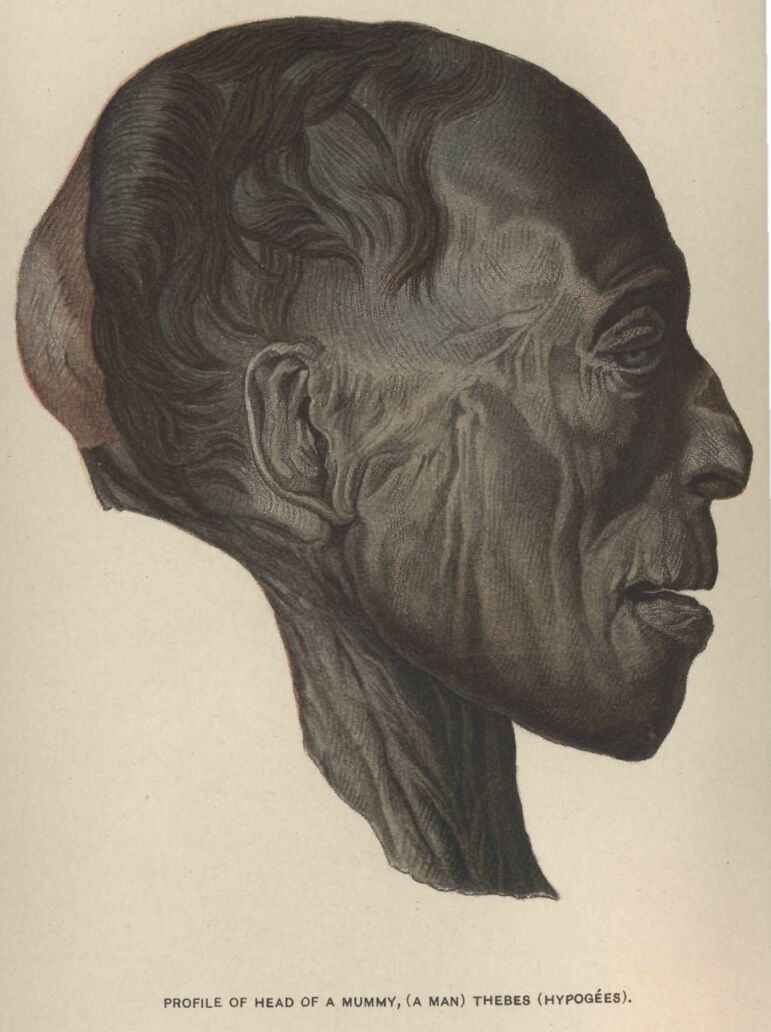
The body having been placed in the grave, the relatives who had taken part in the mourning heaped together in a neighbouring hole the funerary furniture, flint implements, copper needles, miniature pots and pans made of rough and badly burned clay, bread, dates, and eatables in dishes wrapped up in linen. The nobles ranged their mastabas in a single line to the north of the pyramid; these form fine-looking masses of considerable size, but they are for the most part unfinished and empty. Snofrûi having disappeared from the scene, Kheops who succeeded him forsook the place, and his courtiers, abandoning their unfinished tombs, went off to construct for themselves others around that of the new king. We rarely find at Mêdûm finished and occupied sepulchres except that of individuals who had died before or shortly after Snofrûi. The mummy of Eânofir, found in one of them, shows how far the Egyptians had carried the art of embalming at this period. His body, though much shrunken, is well preserved: it had been clothed in some fine stuff, then covered over with a layer of resin, which a clever sculptor had modelled in such a manner as to present an image resembling the deceased; it was then rolled in three or four folds of thin and almost transparent gauze.
Of these tombs the most important belonged to the Prince Nofirmâît and his wife Atiti: it is decorated with bas-reliefs of a peculiar composition; the figures have been cut in outline in the limestone, and the hollows thus made are filled in with a mosaic of tinted pastes which show the moulding and colour of the parts. Everywhere else the ordinary methods of sculpture have been employed, the bas-reliefs being enhanced by brilliant colouring in a simple and delicate manner.
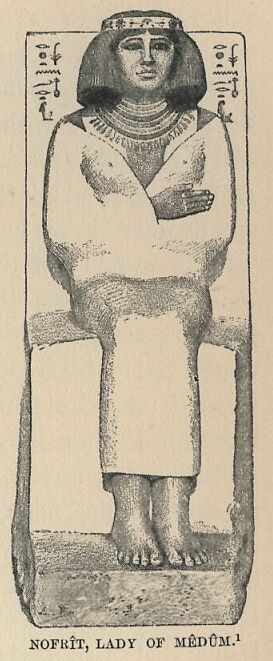
The figures of men and animals are portrayed with a vivacity of manner which is astonishing; and the other objects, even the hieroglyphs, are rendered with an accuracy which does not neglect the smallest detail. The statues of Eâhotpû and of the lady Nofrît, discovered in a half-ruined mastaba, have fortunately reached us without having suffered the least damage, almost without losing anything of their original freshness; they are to be seen in the Gîzeh Museum just as they were when they left the hands of the workman. Eâhotpû was the son of a king, perhaps of Snofrûi: but in spite of his high origin, I find something humble and retiring in his physiognomy. Nofrît, on the contrary, has an imposing appearance: an indescribable air of resolution and command invests her whole person, and the sculptor has cleverly given expression to it. She is represented in a robe with a pointed opening in the front: the shoulders, the bosom, the waist, and hips, are shown under the material of the dress with a purity and delicate grace which one does not always find in more modern works of art. The wig, secured on the forehead by a richly embroidered band, frames with its somewhat heavy masses the firm and rather plump face: the eyes are living, the nostrils breathe, the mouth smiles and is about to speak. The art of Egypt has at times been as fully inspired; it has never been more so than on the day in which it produced the statue of Nofrît.
The worship of Snofrûi was perpetuated from century to century. After the fall of the Memphite empire it passed through periods of intermittence, during which it ceased to be observed, or was observed only in an irregular way; it reappeared under the Ptolemies for the last time before becoming extinct for ever. Snofrûi was probably, therefore, one of the most popular kings of the good old times; but his fame, however great it may have been among the Egyptians, has been eclipsed in our eyes by that of the Pharaohs who immediately followed him—Kheops, Khephren, and Mykerinos. Not that we are really better acquainted with their history. All we know of them is made up of two or three series of facts, always the same, which the contemporaneous monuments teach us concerning these rulers. Khnûmû-Khûfûi,* abbreviated into Khûfûi, the Kheops** of the Greeks, was probably the son of Snofrûi.***
* The existence of the two cartouches Khûfûi and Khnûmû- Khûfûi on the same monuments has caused much embarrassment to Egyptologists: the majority have been inclined to see here two different kings, the second of whom, according to M. Robiou, would have been the person who bore the pre-nomen of Dadûfri. Khnûmû-Khûfûi signifies “the god Khnûmû protects me.” ** Kheops is the usual form, borrowed from the account of Herodotus; Diodorus writes Khembes or Khemmes, Eratosthenes Saôphis, and Manetho Souphis. *** The story in the “Westcar” papyrus speaks of Snofrûi as father of Khûfûi; but this is a title of honour, and proves nothing. The few records which we have of this period give one, however, the impression that Kheops was the son of Snofrûi, and, in spite of the hesitation of de Rougé, this affiliation is adopted by the majority of modern historians.
[175.jpg alabaster statue of kheops]
Drawn by Boudier, from a photograph by Émil Brugsch-Bey.
He reigned twenty-three years, and successfully defended the mines of the Sinaitic peninsula against the Bedouin; he may still be seen on the face of the rocks in the Wady Maghara sacrificing his Asiatic prisoners, now before the jackal Anubis, now before the ibis-headed Thot. The gods reaped advantage from his activity and riches; he restored the temple of Hâ-thor at Den-dera, embellished that of Bubastis, built a stone sanctuary to the Isis of the Sphinx, and consecrated there gold, silver, bronze, and wooden statues of Horus, Nephthys, Selkît, Phtah, Sokhît, Osiris, Thot, and Hâpis. Scores of other Pharaohs had done as much or more, on whom no one bestowed a thought a century after their death, and Kheops would have succumbed to the same indifference had he not forcibly attracted the continuous attention of posterity by the immensity of his tomb.*
* All the details relating to the Isis of the Sphinx are furnished by a stele of the daughter of Kheops, discovered in the little temple of the XXIst dynasty, situated to the west of the Great Pyramid, and preserved in the Gîzeh Museum. It was not a work entirely of the XXIst dynasty, as Mr. Petrie asserts, but the inscription, barely readable, engraved on the face of the plinth, indicates that it was remade by a king of the Saïte period, perhaps by Sabaco, in order to replace an ancient stele of the same import which had fallen into decay.
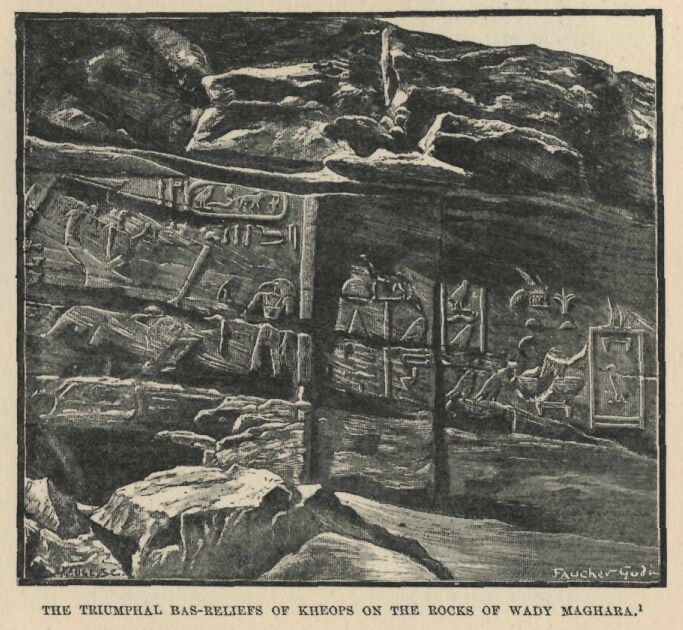
Drawn by Faucher-Gudin, from a photograph published in the Ordnance Survey, Photographs, vol. iii. pl. 5. On the left stands the Pharaoh, and knocks down a Monîti before the Ibis-headed Thot; upon the right the picture is destroyed, and we see the royal titles only, without figures. The statue bears no cartouche, and considerations purely artistic cause me to attribute it to Kheops: it may equally well represent Dadûfrî, the successor of Kheops, or Shopsiskaf, who followed Mykerinos.
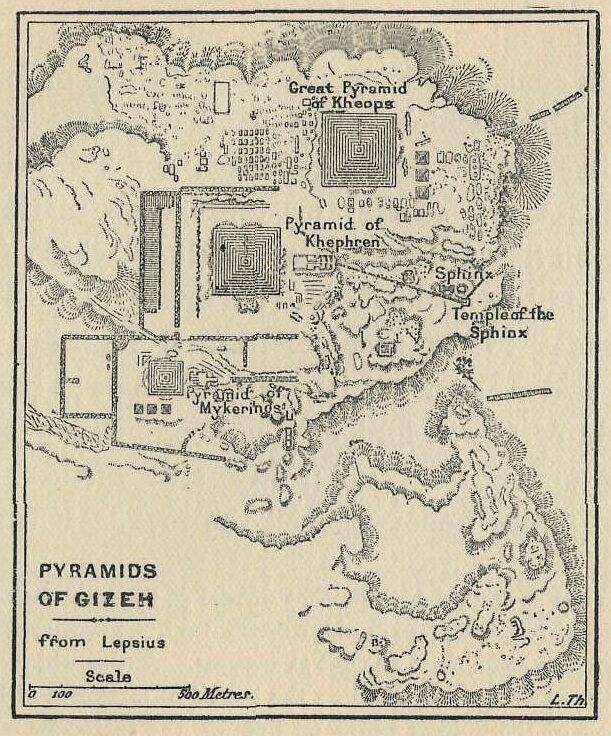
The Egyptians of the Theban period were compelled to form their opinions of the Pharaohs of the Memphite dynasties in the same way as we do, less by the positive evidence of their acts than by the size and number of their monuments: they measured the magnificence of Kheops by the dimensions of his pyramid, and all nations having followed this example, Kheops has continued to be one of the three or four names of former times which sound familiar to our ears. The hills of Gîzeh in his time terminated in a bare wind-swept table-land. A few solitary mastabas were scattered here and there on its surface, similar to those whose ruins still crown the hill of Dahshur.* The Sphinx, buried even in ancient times to its shoulders, raised its head half-way down the eastern slope, at its southern angle;** beside him*** the temple of Osiris, lord of the Necropolis, was fast disappearing under the sand; and still further back old abandoned tombs honey-combed the rock.****
* No one has noticed, I believe, that several of the mastabas constructed under Kheops, around the pyramid, contain in the masonry fragments of stone belonging to some more ancient structures. Those which I saw bore carvings of the same style as those on the beautiful mastabas of Dahshur. ** The stele of the Sphinx bears, on line 13, the cartouche of Khephren in the middle of a blank. We have here, I believe, an indication of the clearing of the Sphinx effected under this prince, consequently an almost certain proof that the Sphinx was already buried in sand in the time of Kheops and his predecessors. *** Mariette identifies the temple which he discovered to the south of the Sphinx with that of Osiris, lord of the Necropolis, which is mentioned in the inscription of the daughter of Kheops. This temple is so placed that it must have been sanded up at the same time as the Sphinx; I believe, therefore, that the restoration effected by Kheops, according to the inscription, was merely a clearing away of the sand from the Sphinx analogous to that accomplished by Khephren. **** These sepulchral chambers are not decorated in the majority of instances. The careful scrutiny to which I subjected them in 1885-86 causes me to believe that many of them must be almost contemporaneous with the Sphinx; that is to say, that they had been hollowed out and occupied a considerable time before the period of the IVth dynasty.
Kheops chose a site for his Pyramid on the northern edge of the plateau, whence a view of the city of the White Wall, and at the same time of the holy city of Heliopolis, could be obtained.
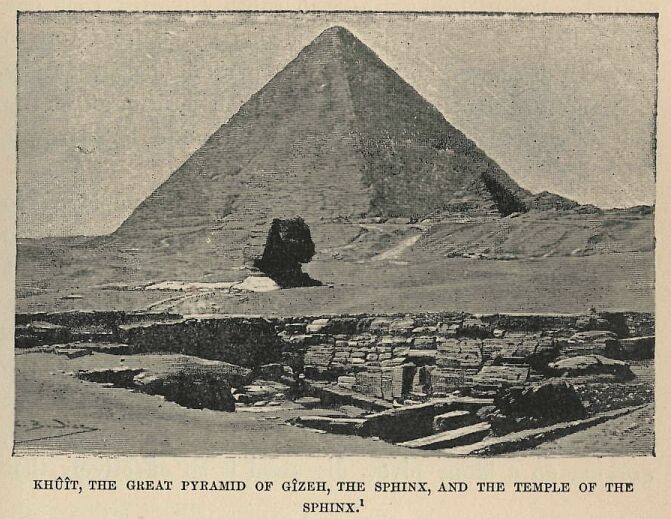
Drawn by Boudier, from a photograph by Émil Brugsch-Bey. The temple of the Sphinx is in the foreground, covered with sand up to the top of the walls. The second of the little pyramids below the large one is that whose construction is attributed to Honîtsonû, the daughter of Kheops, and with regard to which the dragomans of the Saite period told such strange stories to Herodotus.
A small mound which commanded this prospect was roughly squared, and incorporated into the masonry; the rest of the site was levelled to receive the first course of stones. The pyramid when completed had a height of 476 feet on a base 764 feet square; but the decaying influence of time has reduced these dimensions to 450 and 730 feet respectively. It possessed, up to the Arab conquest, its polished facing, coloured by age, and so subtily jointed that one would have said that it was a single slab from top to bottom.* The work of facing the pyramid began at the top; that of the point was first placed in position, then the courses were successively covered until the bottom was reached.**
* The blocks which still exist are of white limestone. Letronne, after having asserted in his youth (Recherches sur Dicuil, p. 107), on the authority of a fragment attributed to Philo of Byzantium, that the facing was formed of polychromatic zones of granite, of green breccia and other different kinds of stone, renounced this view owing to the evidence of Vyse. Perrot and Chipiez have revived it, with some hesitation. ** Herodotus, ii. 125, the word “point” should not be taken literally. The Great Pyramid terminated, like its neighbour, in a platform, of which each side measured nine English feet (six cubits, according to Diodorus Siculus, i. 63), and which has become larger in the process of time, especially since the destruction of the facing. The summit viewed from below must have appeared as a sharp point. “Having regard to the size of the monument, a platform of three metres square would have been a more pointed extremity than that which terminates the obelisks” (Letronne).
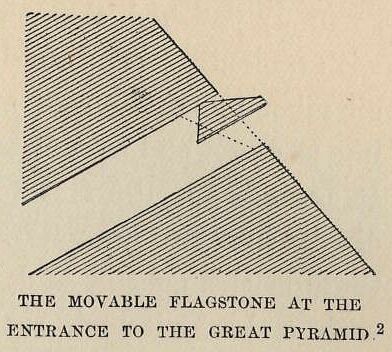
In the interior every device had been employed to conceal the exact position of the sarcophagus, and to discourage the excavators whom chance or persistent search might have put upon the right track. Their first difficulty would be to discover the entrance under the limestone casing. It lay hidden almost in the middle of the northern face, on the level of the eighteenth course, at about forty-five feet above the ground. A movable flagstone, working on a stone pivot, disguised it so effectively that no one except the priests and custodians could have distinguished this stone from its neighbours. When it was tilted up, a yawning passage was revealed,* three and a half feet in height, with a breadth of four feet.
* Strabo expressly states that in his time the subterranean parts of the Great Pyramid were accessible: “It has on its side, at a moderate elevation, a stone which can be moved, [—Greek phrase—]”. “When it has been lifted up, a tortuous passage is seen which leads to the tomb.” The meaning of Strabo’s statement had not been mastered until Mr. Petrie showed, what we may still see, at the entrance of one of the pyramids of Dahshur, arrangements which bore witness to the existence of a movable stone mounted on a pivot to serve as a door. It was a method of closing of the same kind as that described by Strabo, perhaps after he had seen it himself, or had heard of it from the guides, and like that which Mr. Petrie had reinstated, with much probability, at the entrance of the Great Pyramid.
Drawn by Faucher-Gudin, from Petrie’s The Pyramids and Temples of Gîzeh, pl. xi.
The passage is an inclined plane, extending partly through the masonry and partly through the solid rock for a distance of 318 feet; it passes through an unfinished chamber and ends in a cul-de-sac 59 feet further on. The blocks are so nicely adjusted, and the surface so finely polished, that the joints can be determined only with difficulty. The corridor which leads to the sepulchral chamber meets the roof at an angle of 120° to the descending passage, and at a distance of 62 feet from the entrance. It ascends for 108 feet to a wide landing-place, where it divides into two branches. One of these penetrates straight towards the centre, and terminates in a granite chamber with a high-pitched roof. This is called, but without reason, the “Chamber of the Queen.” The other passage continues to ascend, but its form and appearance are altered. It now becomes a gallery 148 feet long and some 28 feet high, constructed of beautiful Mokattam stone. The lower courses are placed perpendicularly one on the top of the other; each of the upper courses projects above the one beneath, and the last two, which support the ceiling, are only about 1 foot 8 inches distant from each other. The small horizontal passage which separates the upper landing from the sarcophagus chamber itself, presents features imperfectly explained. It is intersected almost in the middle by a kind of depressed hall, whose walls are channelled at equal intervals on each side by four longitudinal grooves. The first of these still supports a fine flagstone of granite which seems to hang 3 feet 7 inches above the ground, and the three others were probably intended to receive similar slabs. The latter is a kind of rectangular granite box, with a flat roof, 19 feet 10 inches high, 1 foot 5 inches deep, and 17 feet broad. No figures or hieroglyphs are to be seen, but merely a mutilated granite sarcophagus without a cover. Such were the precautions taken against man: the result witnessed to their efficacy, for the pyramid preserved its contents intact for more than four thousand years.* But a more serious danger threatened them in the great weight of the materials above. In order to prevent the vault from being crushed under the burden of the hundred metres of limestone which surmounted it, they arranged above it five low chambers placed exactly one above the other in order to relieve the superincumbent stress. The highest of these was protected by a pointed roof consisting of enormous blocks made to lean against each other at the top: this ingenious device served to transfer the perpendicular thrust almost entirely to the lateral faces of the blocks. Although an earthquake has to some extent dislocated the mass of masonry, not one of the stones which encase the chamber of the king has been crushed, not one has yielded by a hair’s-breadth, since the day when the workmen fixed it in its place.
* Professor Petrie thinks that the pyramids of Gîzeh were rifled, and the mummies which they contained destroyed during the long civil wars which raged in the interval between the VIth and XIIth dynasties. If this be true, it will be necessary to admit that the kings of one of the subsequent dynasties must have restored what had been damaged, for the workmen of the Caliph Al-Mamoun brought from the sepulchral chamber of the “Horizon” “a stone trough, in which lay a stone statue in human form, enclosing a man who had on his breast a golden pectoral, adorned with precious stones, and a sword of inestimable value, and on his head a carbuncle of the size of an egg, brilliant as the sun, having characters which no man can read.” All the Arab authors, whose accounts have been collected by Jomard, relate in general the same story; one can easily recognize from this description the sarcophagus still in its place, a stone case in human shape, and the mummy of Kheops loaded with jewels and arms, like the body of Queen Âhhotpû I.
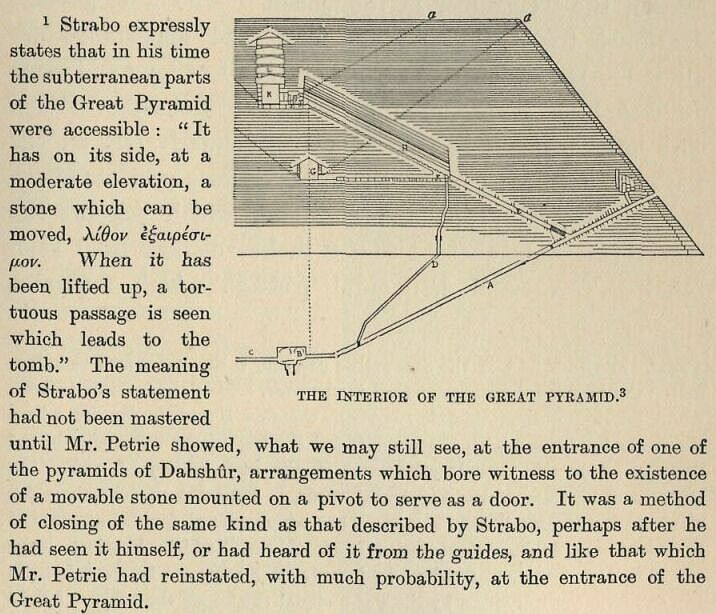
Drawn by Faucher-Gudin, from pl. ix., Petrie, The Pyramids and Temples of Gîzeh. A is the descending passage, B the unfinished chamber, and C the horizontal passage pierced in the rock. D is the narrow passage which provides a communication between chamber B and the landing where the roads divide, and with the passage FG leading to the “Chamber of the Queen.” E is the ascending passage, H the high gallery, I and J the chamber of barriers, K the sepulchral vault, L indicates the chambers for relieving the stress; finally, a, are vents which served for the aeration of the chambers during construction, and through which libations were introduced on certain feast-days in honour of Kheops. The draughtsman has endeavoured to render, by lines of unequal thickness, the varying height of the courses of masonry; the facing, which is now wanting, has been reinstated, and the broken line behind it indicates the visible ending of the courses which now form the northern face of the pyramid.
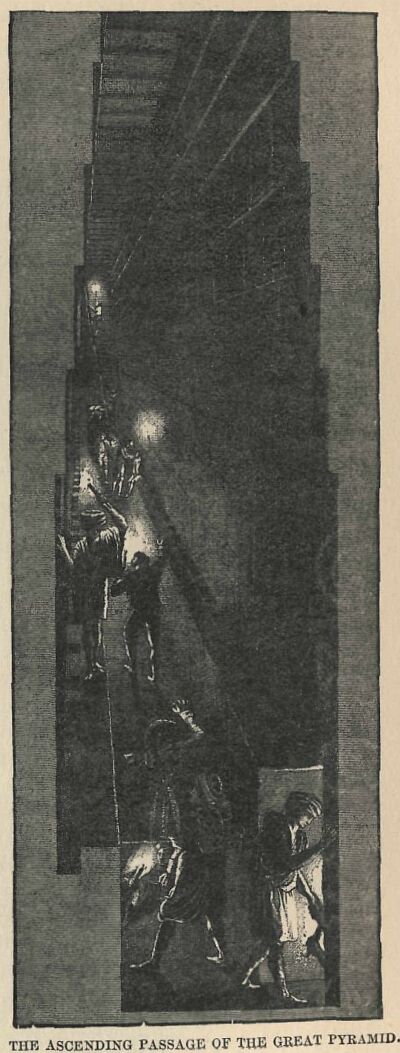
Facsimile by Boudier of a drawing published in the Description de l’Egypte, Ant., vol. v. pl. xiii. 2.
Four barriers in all were thus interposed between the external world and the vault.*
* This appears to me to follow from the analogous arrangements which I met with in the pyramid of Saqqâra. Mr. Petrie refuses to recognize here a barrier chamber (cf. the notes which he has appended to the English translation of my Archéologie égyptienne, p. 327, note 27,) but he confesses that the arrangement of the grooves and of the flagstone is still an enigma to him. Perhaps only one of the four intended barriers was inserted in its place—that which still remains.
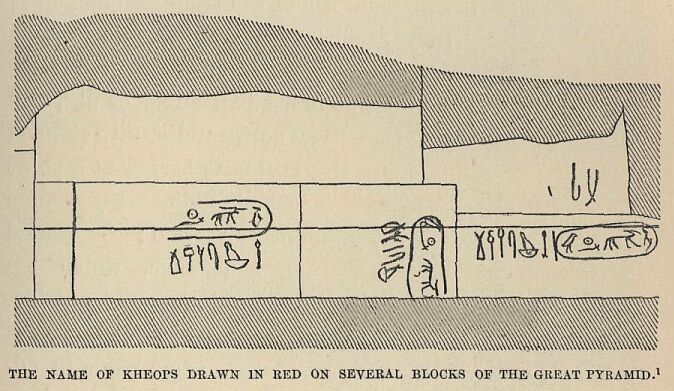
The Great Pyramid was called Khûît, the “Horizon” in which Khûfûî had to be swallowed up, as his father the Sun was engulfed every evening in the horizon of the west. It contained only the chambers of the deceased, without a word of inscription, and we should not know to whom it belonged, if the masons, during its construction, had not daubed here and there in red paint among their private marks the name of the king, and the dates of his reign.*
* The workmen often drew on the stones the cartouches of the Pharaoh under whose reign they had been taken from the quarry, with the exact date of their extraction; the inscribed blocks of the pyramid of Kheops bear, among others, a date of the year XVI.
Worship was rendered to this Pharaoh in a temple constructed a little in front of the eastern side of the pyramid, but of which nothing remains but a mass of ruins. Pharaoh had no need to wait until he was mummified before he became a god; religious rites in his honour were established on his accession; and many of the individuals who made up his court attached themselves to his double long before his double had become disembodied. They served him faithfully during their life, to repose finally in his shadow in the little pyramids and mastabas which clustered around him. Of Dadûfri, his immediate successor, we can probably say that he reigned eight years;* but Khephren, the next son who succeeded to the throne,** erected temples and a gigantic pyramid, like his father.
* According to the arrangement proposed by E. de Rougé for the fragments of the Turin Canon. E. de Rougé reads the name Râ-tot-ef, and proposes to identify it with the Ratoises of the lists of Manetho, which the copyists had erroneously put out of its proper place. This identification has been generally accepted. Analogy compels us to read Dadûfrî, like Khâfrî, Menkaurî, in which case the hypothesis of de Rougé falls to the ground. The worship of Dadûfrî was renewed towards the Saite period, together with that of Kheops and Khephren, according to some tradition which connected his reign with that of these two kings. On the general scheme of the Manethonian history of these times, see Maspero, Notes sur quelques points de Grammaire et d’Histoire dans le Recueil de Travaux, vol. xvii. pp. 122-138. ** The Westcar Papyrus considers Khâfri to be the son of Khûfû; this falls in with information given us, in this respect, by Diodorus Siculus. The form which this historian assigns—I do not know on what authority—to the name of the king, Khabryies, is nearer the original than the Khephren of Herodotus.
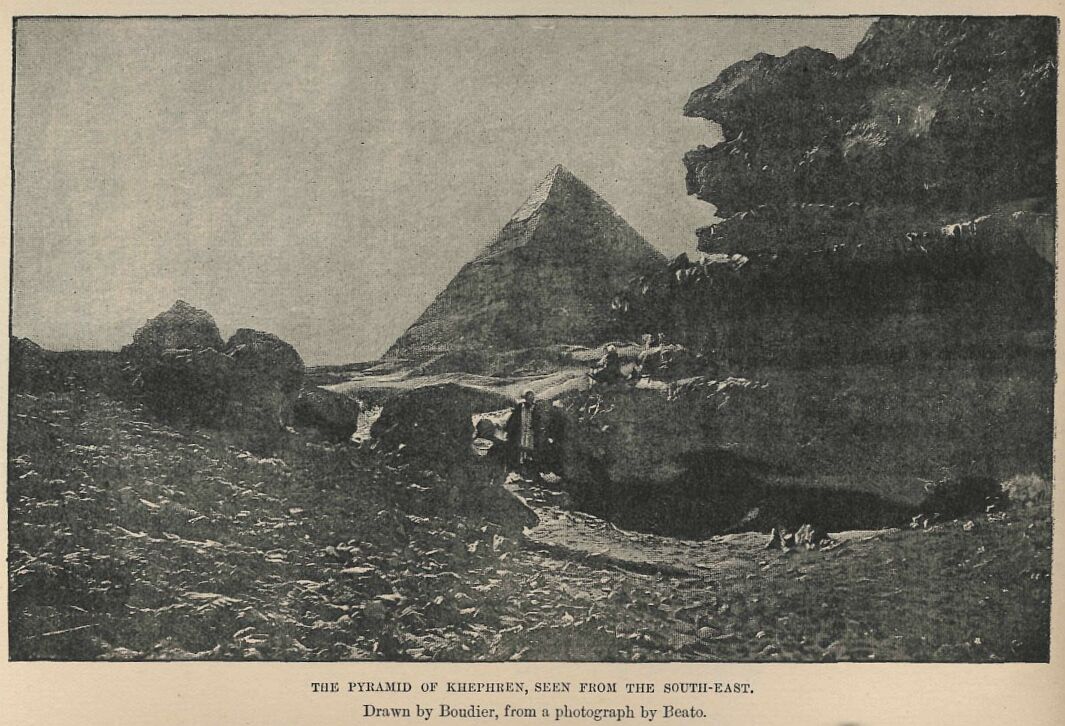
He placed it some 394 feet to the south-west of that of Kheops; and called it Ûîrû, the Great. It is, however, smaller than its neighbour, and attains a height of only 443 feet, but at a distance the difference in height disappears, and many travellers have thus been led to attribute the same elevation to the two. The facing, of which about one-fourth exists from the summit downwards, is of nummulite limestone, compact, hard, and more homogeneous than that of the courses, with rusty patches here and there due to masses of a reddish lichen, but grey elsewhere, and with a low polish which, at a distance, reflects the sun’s rays. Thick walls of unwrought stone enclose the monument on three sides, and there may be seen behind the west front, in an oblong enclosure, a row of stone sheds hastily constructed of limestone and Nile mud.
Facsimile by Faucher-Gudin of the sketch in Lepsius, Denkm., ii., 1 c.
Here the labourers employed on the works came every evening to huddle together, and the refuse of their occupation still encumbers the ruins of their dwellings, potsherds, chips of various kinds of hard stone which they had been cutting, granite, alabaster, diorite, fragments of statues broken in the process of sculpture, and blocks of smooth granite ready for use. The chapel commands a view of the eastern face of the pyramid, and communicated by a paved causeway with the temple of the Sphinx, to which it must have borne a striking resemblance.* The plan of it can be still clearly traced on the ground, and the rubbish cannot be disturbed without bringing to light portions of statues, vases, and tables of offerings, some of them covered with hieroglyphs, like the mace-head of white stone which belonged in its day to Khephren himself.
* The connection of the temple of the Sphinx with that of the second pyramid was discovered in December, 1880, during the last diggings of Mariette. I ought to say that the whole of that part of the building into which the passage leads shows traces of having been hastily executed, and at a time long after the construction of the rest of the edifice; it is possible that the present condition of the place does not date back further than the time of the Antonines, when the Sphinx was cleared for the last time in ancient days.
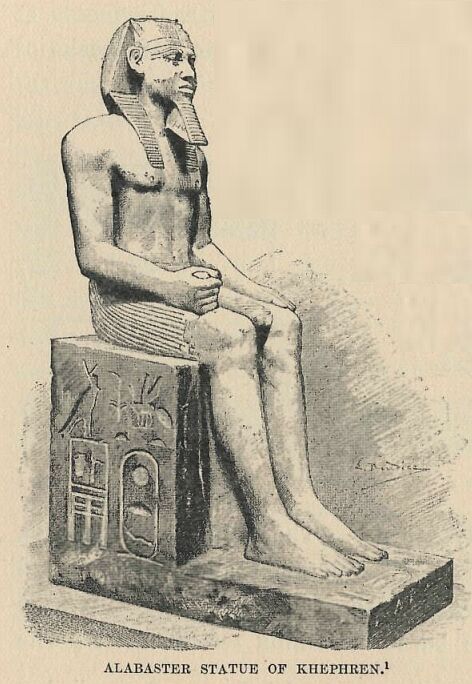
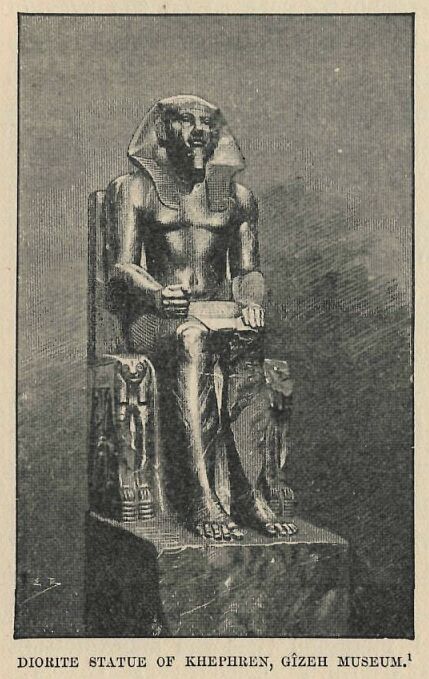
Drawn by Boudier, from a photograph by Emil Brugsch-Bey. See on p. 199 the carefully executed drawing of the best preserved among the diorite statues which the Gîzeh Museum now possesses of this Pharaoh.
The internal arrangements of the pyramid are of the simplest character; they consist of a granite-built passage carefully concealed in the north face, running at first at an angle of 25°, and then horizontally, until stopped by a granite barrier at a point which indicates a change of direction; a second passage, which begins on the outside, at a distance of some yards in advance of the base of the pyramid, and proceeds, after passing through an unfinished chamber, to rejoin the first; finally, a chamber hollowed in the rock, but surmounted by a pointed roof of fine limestone slabs.
The sarcophagus was of granite, and, like that of Kheops, bore neither the name of a king nor the representation of a god. The cover was fitted so firmly to the trough that the Arabs could not succeed in detaching it when they rifled the tomb in the year 1200 of our era; they were, therefore, compelled to break through one of the sides with a hammer before they could reach the coffin and take from it the mummy of the Pharaoh.*
* The second pyramid was opened to Europeans in 1816 by Belzoni. The exact date of the entrance of the Arabs is given us by an inscription, written in ink, on one of the walls of the sarcophagus chamber: “Mohammed Ahmed Effendi, the quarryman, opened it; Othman Effendi was present, as well as the King Ali Mohammed, at the beginning and at the closing.” The King Ali Mohammed was the son and successor of Saladin.
Of Khephren’s sons, Menkaûrî (Mykerinos), who was his successor, could scarcely dream of excelling his father and grandfather;* his pyramid, the Supreme—Hirû** —barely attained an elevation of 216 feet, and was exceeded in height by those which were built at a later date.*** Up to one-fourth of its height it was faced with syenite, and the remainder, up to the summit, with limestone.****
* Classical tradition makes Mykerinos the son of Kheops. Egyptian tradition regards him as the son of Khephren, and with this agrees a passage in the Westcar Papyrus, in which a magician prophesies that after Kheops his son (Khâfrî) will yet reign, then the son of the latter (Menkaûrî), then a prince of another family. ** An inscription, unfortunately much mutilated, from the tomb of Tabhûni, gives an account of the construction of the pyramid, and of the transport of the sarcophagus. *** Professor Petrie reckons the exact height of the pyramid at 2564 ±15 or 2580 ± 2 inches; that is to say, 214 or 215 feet in round numbers. **** According to Herodotus, the casing of granite extended to half the height. Diodorus states that it did not go beyond the fifteenth course. Professor Petrie discovered that there were actually sixteen lower courses in red granite.
For lack of time, doubtless, the dressing of the granite was not completed, but the limestone received all the polish it was capable of taking. The enclosing wall was extended to the north so as to meet, and become one with, that of the second pyramid. The temple was connected with the plain by a long and almost straight causeway, which ran for the greater part of its course* upon an embankment raised above the neighbouring ground. This temple was in fair condition in the early years of the eighteenth century,** and so much of it as has escaped the ravages of the Mameluks, bears witness to the scrupulous care and refined art employed in its construction.
* This causeway should not be confounded, as is frequently done, with that which may be seen at some distance to the east in the plain: the latter led to limestone quarries in the mountain to the south of the plateau on which the pyramids stand. These quarries were worked in very ancient times. ** Benoit de Maillet visited this temple between 1692 and 1708. “It is almost square in form. There are to be found inside four pillars which doubtless supported a vaulted roof covering the altar of the idol, and one moved around these pillars as in an ambulatory. These stones were cased with granitic marble. I found some pieces still unbroken which had been attached to the stones with mastic. I believe that the exterior as well as the interior of the temple was cased with this marble” (Le Mascrier, Description de l’Egypte, 1735, pp. 223, 224).
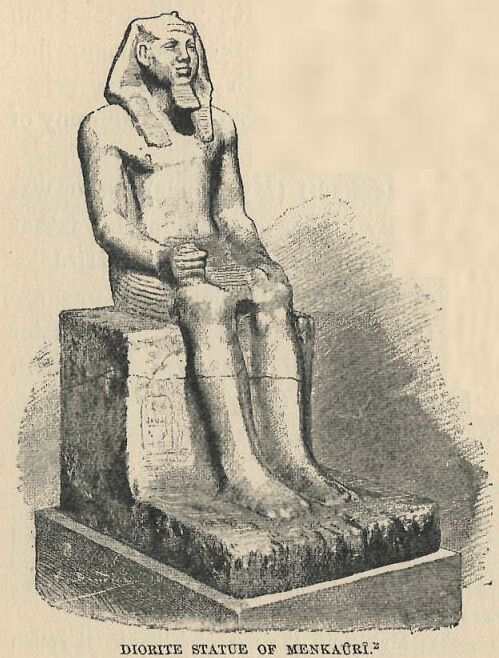
Drawn by Boudier, from a photograph, by Emil Brugsch-Bey, of a statue preserved in the Museum of Gîzeh.
Coming from the plain, we first meet with an immense halting-place measuring 100 feet by 46 feet, and afterwards enter a large court with an egress on each side: beyond this we can distinguish the ground-plan only of five chambers, the central one, which is in continuation with the hall, terminating at a distance of some 42 feet from the pyramid, exactly opposite the middle point of the eastern face. The whole mass of the building covers a rectangular area 184 feet long by a little over 177 feet broad. Its walls, like those of the temple of the Sphinx, contained a core of lime-stone 7 feet 10 inches thick, of which the blocks have been so ingeniously put together as to suggest the idea that the whole is cut out of the rock. This core was covered with a casing of granite and alabaster, of which the remains preserve no trace of hieroglyphs or of wall scenes: the founder had caused his name to be inscribed on the statues, which received, on his behalf, the offerings, and also on the northern face of the pyramid, where it was still shown to the curious towards the first century of our era. The arrangement of the interior of the pyramid is somewhat complicated, and bears witness to changes brought unexpectedly about in the course of construction. The original central mass probably did not exceed 180 feet in breadth at the base, with a vertical height of 154 feet. It contained a sloping passage cut into the hill itself, and an oblong low-roofed cell devoid of ornament. The main bulk of the work had been already completed, and the casing not yet begun, when it was decided to alter the proportions of the whole.
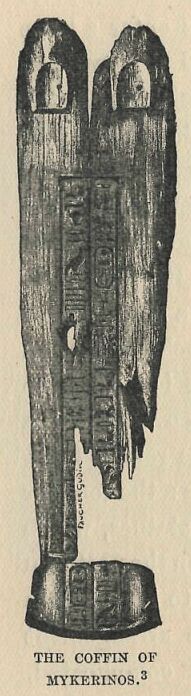
Drawn by Faucher-Gudin. The coffin is in the British Museum. The drawing of it was published by Vyse, by Birch-Lenormant, and by Lepsius. Herr Sethe has recently revived an ancient hypothesis, according to which it had been reworked in the Saite period, and he has added to archaeological considerations, up to that time alone brought to bear upon the question, new philological facts.
Mykerinos was not, it appears, the eldest son and appointed heir of Khephren; while still a mere prince he was preparing for himself a pyramid similar to those which lie near the “Horizon,” when the deaths of his father and brother called him to the throne. What was sufficient for him as a child, was no longer suitable for him as a Pharaoh; the mass of the structure was increased to its present dimensions, and a new inclined passage was effected in it, at the end of which a hall panelled with granite gave access to a kind of antechamber.* The latter communicated by a horizontal corridor with the first vault, which was deepened for the occasion; the old entrance, now no longer of use, was roughly filled up.**
* Vyse discovered here fragments of a granite sarcophagus, perhaps that of the queen; the legends which Herodotus (ii. 134, 135), and several Greek authors after him, tell concerning this, show clearly that an ancient tradition assumed the existence of a female mummy in the third pyramid alongside of that of the founder Mykerinos. ** Vyse has noticed, in regard to the details of the structure, that the passage now filled up is the only one driven from the outside to the interior; all the others were made from the inside to the outside, and consequently at a period when this passage, being the only means of penetrating into the interior of the monument, had not yet received its present dimensions.
Mykerinos did not find his last resting-place in this upper level of the interior of the pyramid: a narrow passage, hidden behind the slabbing of the second chamber, descended into a secret crypt, lined with granite and covered with a barrel-vaulted roof. The sarcophagus was a single block of blue-black basalt, polished, and carved into the form of a house, with a façade having three doors and three openings in the form of windows, the whole framed in a rounded moulding and surmounted by a projecting cornice such as we are accustomed to see on the temples.*
* It was lost off the coast of Spain in the vessel which was bringing it to England. We have only the drawing remaining which was made at the time of its discovery, and published by Vyse. M. Borchardt has attempted to show that it was reworked under the XXVIth Saite dynasty as well as the wooden coffin of the king.
The mummy-case of cedar-wood had a man’s head, and was shaped to the form of the human body; it was neither painted nor gilt, but an inscription in two columns, cut on its front, contained the name of the Pharaoh, and a prayer on his behalf: “Osiris, King of the two Egypts, Menkaûrî, living eternally, given birth to by heaven, conceived by Nûît, flesh of Sibii, thy mother Nûît has spread herself out over thee in her name of ‘Mystery of the Heavens,’ and she has granted that thou shouldest be a god, and that thou shouldest repulse thine enemies, O King of the two Egypts, Menkaûrî, living eternally.” The Arabs opened the mummy to see if it contained any precious jewels, but found within it only some leaves of gold, probably a mask or a pectoral covered with hieroglyphs. When Vyse reopened the vault in 1837, the bones lay scattered about in confusion on the dusty floor, mingled with bundles of dirty rags and wrappings of yellowish woollen cloth.
The worship of the three great pyramid-building kings continued in Memphis down to the time of the Greeks and Romans. Their statues, in granite, limestone, and alabaster, were preserved also in the buildings annexed to the temple of Phtah, where visitors could contemplate these Pharaohs as they were when alive.
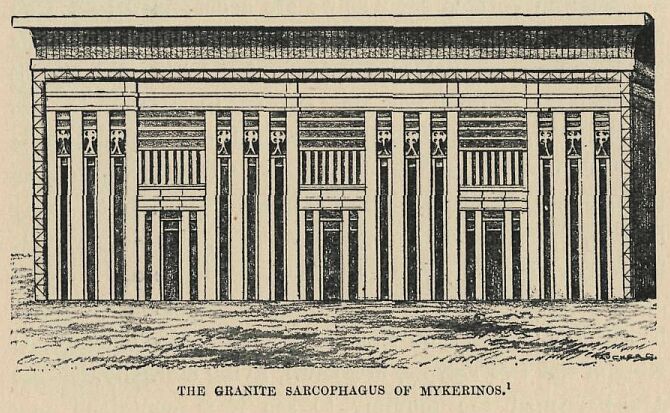
Drawn by Faucher-Gudin, from a chromolithograph in Prisse D’Avennes, Histoire de l’Art Égyptien.
Those of Khephren show us the king at different ages, when young, mature, or already in his decadence. They are in most cases cut out of a breccia of green diorite, with long irregular yellowish veins, and of such hardness that it is difficult to determine the tool with which they were worked. The Pharaoh sits squarely on his royal throne, his hands on his lap, his body firm and upright, and his head thrown back with a look of self-satisfaction. A sparrow-hawk perched on the back of his seat covers his head with its wings—an image of the god Horus protecting his son. The modelling of the torso and legs of the largest of these statues, the dignity of its pose, and the animation of its expression, make of it a unique work of art which may be compared with the most perfect products of antiquity. Even if the cartouches which tell us the name of the king had been hammered away and the insignia of his rank destroyed, we should still be able to determine the Pharaoh by his bearing: his whole appearance indicates a man accustomed from his infancy to feel himself invested with limitless authority. Mykerinos stands out less impassive and haughty: he does not appear so far removed from humanity as his predecessor, and the expression of his countenance agrees, somewhat singularly, with the account of his piety and good nature preserved by the legends. The Egyptians of the Theban dynasties, when comparing the two great pyramids with the third, imagined that the disproportion in their size corresponded with a difference of character between their royal occupants. Accustomed as they were from infancy to gigantic structures, they did not experience before “the Horizon” and “the Great” the feeling of wonder and awe which impresses the beholder of to-day. They were not the less apt on this account to estimate the amount of labour and effort required to complete them from top to bottom. This labour seemed to them to surpass the most excessive corvée which a just ruler had a right to impose upon his subjects, and the reputation of Kheops and Khephren suffered much in consequence. They were accused of sacrilege, of cruelty, and profligacy.
Drawn by Boudier, from a photograph by Émil Brugsch-Bey. It is one of the most complete statues found by Mariette in the temple of the Sphinx.
It was urged against them that they had arrested the whole life of their people for more than a century for the erection of their tombs. Kheops began by closing the temples and by prohibiting the offering of sacrifices: he then compelled all the Egyptians to work for him. To some he assigned the task of dragging the blocks from the quarries of the Arabian chain to the Nile: once shipped, the duty was incumbent on others of transporting them as far as the Libyan chain. A hundred thousand men worked at a time, and were relieved every three months.*
* Professor Petrie thinks that this detail rests upon an authentic tradition. The inundation, he says, lasts three months, during which the mass of the people have nothing to do; it was during these three months that Kheops raised the 100,000 men to work at the transport of the stone. The explanation is very ingenious, but it is not supported by the text: Herodotus does not relate that 100,000 men were called by the corvée for three months every year; but from three months to three months, possibly four times a year, bodies of 100,000 men relieved each other at the work. The figures which he quotes are well-known legendary numbers, and we must leave the responsibility for them to the popular imagination (Wiedemann, Herodots Zweites Buck, p. 465).
The period of the people’s suffering was divided as follows: ten years in making the causeway along which the blocks were dragged—a work, in my opinion, very little less onerous than that of erecting the pyramid, for its length was five stadia, its breadth ten orgyio, its greatest height eight, and it was made of cut stone and covered with figures.* Ten years, therefore, were consumed in constructing this causeway and the subterranean chambers hollowed out in the hill.... As for the pyramid itself, twenty years were employed in the making of it.... There are recorded on it, in Egyptian characters, the value of the sums paid in turnips, onions, and garlic, for the labourers attached to the works; if I remember aright, the interpreter who deciphered the inscription told me that the total amounted to sixteen hundred talents of silver. If this were the case, how much must have been expended for iron to make tools, and for provisions and clothing for the workmen?**
* Diodorus Siculus declares that there were no causeways to be seen in his time. The remains of one of them appear to have been discovered and restored by Vyse. ** Herodotus, ii. 124, 125. The inscriptions which were read upon the pyramids were the graffiti of visitors, some of them carefully executed. The figures which were shown to Herodotus represented, according to the dragoman, the value of the sums expended for vegetables for the workmen; we ought, probably, to regard them as the thousands which, in many of the votive temples, served to mark the quantities of different things presented to the god, that they might be transmitted to the deceased.
The whole resources of the royal treasure were not sufficient for such necessaries: a tradition represents Kheops as at the end of his means, and as selling his daughter to any one that offered, in order to procure money.* Another legend, less disrespectful to the royal dignity and to paternal authority, assures us that he repented in his old age, and that he wrote a sacred book much esteemed by the devout.**
* Herodotus, ii. 126. She had profited by what she received to build a pyramid for herself in the neighbourhood of the great one—the middle one of the three small pyramids: it would appear in fact, that this pyramid contained the mummy of a daughter of Kheops, Honîtsonû. ** Manetho, Unger’s edition, p. 91. The ascription of a book to Kheops, or rather the account of the discovery of a “sacred book” under Kheops, is quite in conformity with Egyptian ideas. The British Museum possesses two books, which were thus discovered under this king; the one, a medical treatise, in a temple at Coptos; the other comes from Tanis. Among the works on alchemy published by M. Berthelot, there are two small treatises ascribed to Sophé, possibly Souphis or Kheops: they are of the same kind as the book mentioned by Manetho, and which Syncellus says was bought in Egypt.
Khephren had imitated, and thus shared with, him, the hatred of posterity. The Egyptians avoided naming these wretches: their work was attributed to a shepherd called Philitis, who in ancient times pastured his flocks in the mountain; and even those who did not refuse to them the glory of having built the most enormous sepulchres in the world, related that they had not the satisfaction of reposing in them after their death. The people, exasperated at the tyranny to which they had been subject, swore that they would tear the bodies of these Pharaohs from their tombs, and scatter their fragments to the winds: they had to be buried in crypts so securely placed that no one has succeeded in finding them.
Like the two older pyramids, “the Supreme” had its anecdotal history, in which the Egyptians gave free rein to their imagination. We know that its plan had been rearranged in the course of building, that it contained two sepulchral chambers, two sarcophagi, and two mummies: these modifications, it was said, belonged to two distinct reigns; for Mykerinos had left his tomb unfinished, and a woman had finished it at a later date—according to some, Nitokris, the last queen of the VIth dynasty; according to others, Rhodopis, the Ionian who was the mistress of Psammetichus I. or of Ainasis.*
* Zoega had already recognized that the Rhodopis of the Greeks was no other than the Nitokris of Manetho, and his opinion was adopted and developed by Bunsen. The legend of Rhodopis was completed by the additional ascription to the ancient Egyptian queen of the character of a courtesan: this repugnant trait seems to have been borrowed from the same class of legends as that which concerned itself with the daughter of Kheops and her pyramid. The narrative thus developed was in a similar manner confounded with another popular story, in which occurs the episode of the slipper, so well known from the tale of Cinderella. Herodotus connects Rhodopis with his Amasis, Ælian with King Psammetichus of the XXVIth dynasty.
The beauty and richness of the granite casing dazzled all eyes, and induced many visitors to prefer the least of the pyramids to its two imposing sisters; its comparatively small size is excused on the ground that its founder had returned to that moderation and piety which ought to characterize a good king. “The actions of his father were not pleasing to him; he reopened the temples and sent the people, reduced to the extreme of misery, back to their religious observances and their occupations; finally, he administered justice more equitably than all other kings. On this head he is praised above those who have at any time reigned in Egypt: for not only did he administer good justice, but if any one complained of his decision he gratified him with some present in order to appease his wrath.” There was one point, however, which excited the anxiety of many in a country where the mystic virtue of numbers was an article of faith: in order that the laws of celestial arithmetic should be observed in the construction of the pyramids, it was necessary that three of them should be of the same size. The anomaly of a third pyramid out of proportion to the two others could be explained only on the hypothesis that Mykerinos, having broken with paternal usage, had ignorantly infringed a decree of destiny—a deed for which he was mercilessly punished. He first lost his only daughter; a short time after he learned from an oracle that he had only six more years to remain upon the earth. He enclosed the corpse of his child in a hollow wooden heifer, which he sent to Sais, where it was honoured with divine worship.*
* Herodotus, ii. 129-133. The manner in which Herodotus describes the cow which was shown to him in the temple of Sais, proves that he was dealing with Nit, in animal form, Mihî-ûîrît, the great celestial heifer who had given birth to the Sun. How the people could have attached to this statue the legend of a daughter of Mykerinos is now difficult to understand. The idea of a mummy or a corpse shut up in a statue, or in a coffin, was familiar to the Egyptians: two of the queens interred at Déir el-Baharî, Nofritari Ahhotpû II., were found hidden in the centre of immense Osirian figures of wood, covered with stuccoed fabric. Egyptian tradition supposed that the bodies of the gods rested upon the earth. The cow Mîhî-ûîrît might, therefore, be bodily enclosed in a sarcophagus in the form of a heifer, just as the mummified gazelle of Déîr el-Baharî is enclosed in a sarcophagus of gazelle form; it is even possible that the statue shown to Herodotus really contained what was thought to be a mummy of the goddess.
“He then communicated his reproaches to the god, complaining that his father and his uncle, after having closed the temples, forgotten the gods and oppressed mankind, had enjoyed a long life, while he, devout as he was, was so soon about to perish. The oracle answered that it was for this very reason that his days were shortened, for he had not done that which he ought to have done. Egypt had to suffer for a hundred and fifty years, and the two kings his predecessors had known this, while he had not. On receiving this answer, Mykerinos, feeling himself condemned, manufactured a number of lamps, lit them every evening at dusk, began to drink and to lead a life of jollity, without ceasing for a moment night and day, wandering by the lakes and in the woods wherever he thought to find an occasion of pleasure. He had planned this in order to convince the oracle of having spoken falsely, and to live twelve years, the nights counting as so many days.” Legend places after him Asychis or Sasychis, a later builder of pyramids, but of a different kind. The latter preferred brick as a building material, except in one place, where he introduced a stone bearing the following inscription: “Do not despise me on account of the stone pyramids: I surpass them as much as Zeus the other gods. Because, a pole being plunged into a lake and the clay which stuck to it being collected, the brick out of which I was constructed was moulded from it.” The virtues of Asychis and Mykerinos helped to counteract the bad impression which Kheops and Khephren had left behind them. Among the five legislators of Egypt Asychis stood out as one of the best. He regulated, to minute details, the ceremonies of worship. He invented geometry and the art of observing the heavens.*
* Diodorus, i. 94. It seems probable that Diodorus had received knowledge from some Alexandrian writer, now lost, of traditions concerning the legislative acts of Shashanqû I. of the XXIInd dynasty; but the name of the king, commonly written Sesonkhis, had been corrupted by the dragoman into Sasykhis.
He put forth a law on lending, in which he authorized the borrower to pledge in forfeit the mummy of his father, while the creditor had the right of treating as his own the tomb of the debtor: so that if the debt was not met, the latter could not obtain a last resting-place for himself or his family either in his paternal or any other tomb.
History knows nothing either of this judicious sovereign or of many other Pharaohs of the same type, which the dragomans of the Greek period assiduously enforced upon the respectful attention of travellers. It merely affirms that the example given by Kheops, Khephren, and Mykerinos were by no means lost in later times. From the beginning of the IVth to the end of the XIVth dynasty—during more than fifteen hundred years—the construction of pyramids was a common State affair, provided for by the administration, secured by special services. Not only did the Pharaohs build them for themselves, but the princes and princesses belonging to the family of the Pharaohs constructed theirs, each one according to his resources; three of these secondary mausoleums are ranged opposite the eastern side of “the Horizon,” three opposite the southern face of “the Supreme,” and everywhere else—near Abousir, at Saqqâra, at Dahshur or in the Fayûm—the majority of the royal pyramids attracted around them a more or less numerous cortège of pyramids of princely foundation often debased in shape and faulty in proportion. The materials for them were brought from the Arabian chain. A spur of the latter, projecting in a straight line towards the Nile, as far as the village of Troiû, is nothing but a mass of the finest and whitest limestone. The Egyptians had quarries here from the earliest times. By cutting off the stone in every direction, they lowered the point of this spur for a depth of some hundreds of metres. The appearance of these quarries is almost as astonishing as that of the monuments made out of their material. The extraction of the stone was carried on with a skill and regularity which denoted ages of experience. The tunnels were so made as to exhaust the finest and whitest seams without waste, and the chambers were of an enormous extent; the walls were dressed, the pillars and roofs neatly finished, the passages and doorways made of a regular width, so that the whole presented more the appearance of a subterranean temple than of a place for the extraction of building materials.*
* The description of the quarries of Turah, as they were at the beginning of the century, was somewhat briefly given by Jomard, afterwards more completely by Perring. During the last thirty years the Cairo masons have destroyed the greater part of the ancient remains formerly existing in this district, and have completely changed the appearance of the place.
Hastily written graffiti, in red and black ink, preserve the names of workmen, overseers, and engineers, who had laboured here at certain dates, calculations of pay or rations, diagrams of interesting details, as well as capitals and shafts of columns, which were shaped out on the spot to reduce their weight for transport. Here and there true official stelas are to be found set apart in a suitable place, recording that after a long interruption such or such an illustrious sovereign had resumed the excavations, and opened fresh chambers. Alabaster was met with not far from here in the Wady Gerrauî. The Pharaohs of very early times established a regular colony here, in the very middle of the desert, to cut the material into small blocks for transport: a strongly built dam, thrown across the valley, served to store up the winter and spring rains, and formed a pond whence the workers could always supply themselves with water. Kheops and his successors drew their alabaster from Hâtnûbû, in the neighbourhood of Hermopolis, their granite from Syene, their diorite and other hard rocks, the favourite material for their sarcophagi, from the volcanic valleys which separate the Nile from the Red Sea—especially from the Wady Hammamât. As these were the only materials of which the quantity required could not be determined in advance, and which had to be brought from a distance, every king was accustomed to send the principal persons of his court to the quarries of Upper Egypt, and the rapidity with which they brought back the stone constituted a high claim on the favour of their master. If the building was to be of brick, the bricks were made on the spot, in the plain at the foot of the hills. If it was to be a limestone structure, the neighbouring parts of the plateau furnished the rough material in abundance. For the construction of chambers and for casing walls, the rose granite of Elephantine and the limestone of Troiu were commonly employed, but they were spared the labour of procuring these specially for the occasion. The city of the White Wall had always at hand a supply of them in its stores, and they might be drawn upon freely for public buildings, and consequently for the royal tomb. The blocks chosen from this reserve, and conveyed in boats close under the mountain-side, were drawn up slightly inclined causeways by oxen to the place selected by the architect.
The internal arrangements, the length of the passages and the height of the pyramids, varied much: the least of them had a height of some thirty-three feet merely. As it is difficult to determine the motives which influenced the Pharaohs in building them of different sizes, some writers have thought that the mass of each increased in proportion to the time bestowed upon its construction—that is to say, to the length of each reign. As soon as a prince mounted the throne, he would probably begin by roughly sketching out a pyramid sufficiently capacious to contain the essential elements of the tomb; he would then, from year to year, have added fresh layers to the original nucleus, until the day of his death put an end for ever to the growth of the monument.*
* This was the theory formulated by Lepsius, after the researches made by himself, and the work done by Erbkam, and the majority of Egyptologists adopted it, and still maintain it. It was vigorously attacked by Perrot-Chipiez and by Petrie; it was afterwards revived, with amendments, by Borchardt whose conclusions have been accepted by Ed. Meyer. The examinations which I have had the opportunity of bestowing on the pyramids of Saqqâra, Abusir, Dahshur, Rîgah, and Lisht have shown me that the theory is not applicable to any of these monuments.
This hypothesis is not borne out by facts: such a small pyramid as that of Saqqâra belonged to a Pharaoh who reigned thirty years, while “the Horizon” of Gîzeh is the work of Kheops, whose rule lasted only twenty-three years.
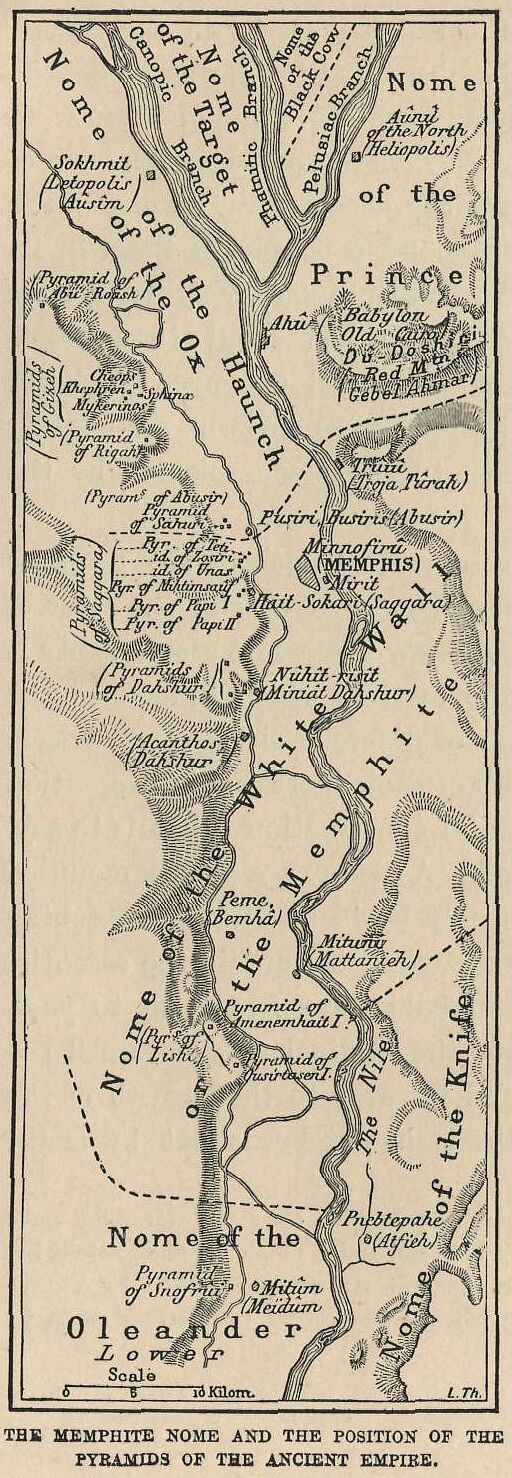
The plan of each pyramid was arranged once for all by the architect, according to the instructions he had received, and the resources at his command. Once set on foot, the work was continued until its completion, without addition or diminution, unless something unforeseen occurred. The pyramids, like the mastabas, ought to present their faces to the four cardinal points; but owing to unskilfulness or negligence, the majority of them are not very accurately orientated, and several of them vary sensibly from the true north. The great pyramid of Saqqâra does not describe a perfect square at its base, but is an oblong rectangle, with its longest sides east and west; it is stepped—that is to say, the six sloping sided cubes of which it is composed are placed upon one another so as to form a series of treads and risers, the former being about two yards wide and the latter of unequal heights. The highest of the stone pyramids of Dahshur makes at its lower part an angle of 54° 41’ with the horizon, but at half its height the angle becomes suddenly more acute and is reduced to 42° 59’. It reminds one of a mastaba with a sort of huge attic on the top. Each of these monuments had its enclosing wall, its chapel and its college of priests, who performed there for ages sacred rites in honour of the deceased prince, while its property in mortmain was administered by the chief of the “priests of the double.” Each one received a name, such as “the Fresh,” “the Beautiful,” “the Divine in its places,” which conferred upon it a personality and, as it were, a living soul. These pyramids formed to the west of the White Wall a long serrated line whose extremities were lost towards the south and north in the distant horizon: Pharaoh could see them from the terraces of his palace, from the gardens of his villa, and from every point in the plain in which he might reside between Heliopolis and Mêdûm—as a constant reminder of the lot which awaited him in spite of his divine origin. The people, awed and inspired by the number of them, and by the variety of their form and appearance, were accustomed to tell stories of them to one another, in which the supernatural played a predominant part. They were able to estimate within a few ounces the heaps of gold and silver, the jewels and precious stones, which adorned the royal mummies or rilled the sepulchral chambers: they were acquainted with every precaution taken by the architects to ensure the safety of all these riches from robbers, and were convinced that magic had added to such safeguards the more effective protection of talismans and genii. There was no pyramid so insignificant that it had not its mysterious protectors, associated with some amulet—in most cases with a statue, animated by the double of the founder. The Arabs of to-day are still well acquainted with these protectors, and possess a traditional respect for them. The great pyramid concealed a black and white image, seated on a throne and invested with the kingly sceptre. He who looked upon the statue “heard a terrible noise proceeding from it which almost caused his heart to stop beating, and he who had heard this noise would die.” An image of rose-coloured granite watched over the pyramid of Khephren, standing upright, a sceptre in its hand and the urous on its brow, “which serpent threw himself upon him who approached it, coiled itself around his neck, and killed him.” A sorcerer had invested these protectors of the ancient Pharaohs with their powers, but another equally potent magician could elude their vigilance, paralyze their energies, if not for ever, at least for a sufficient length of time to ferret out the treasure and rifle the mummy. The cupidity of the fellahîn, highly inflamed by the stories which they were accustomed to hear, gained the mastery over their terror, and emboldened them to risk their lives in these well-guarded tombs. How many pyramids had been already rifled at the beginning of the second Theban empire!
The IVth dynasty became extinct in the person of Shop-siskaf, the successor and probably the son of Mykerinos.* The learned of the time of Ramses II. regarded the family which replaced this dynasty as merely a secondary branch of the line of Snofrûi, raised to power by the capricious laws which settled hereditary questions.**
* The series of kings beginning with Mykerinos was drawn up for the first time in an accurate manner by E. de Rougé, recherches sur les Monu-mails qu’on peut attribuer aux six premières dynasties, pp. 66-84, M. de Rouge’s results have been since adopted by all Egyptologists. The table of the IVTH dynasty, restored as far as possible with the approximate dates, is subjoined:—
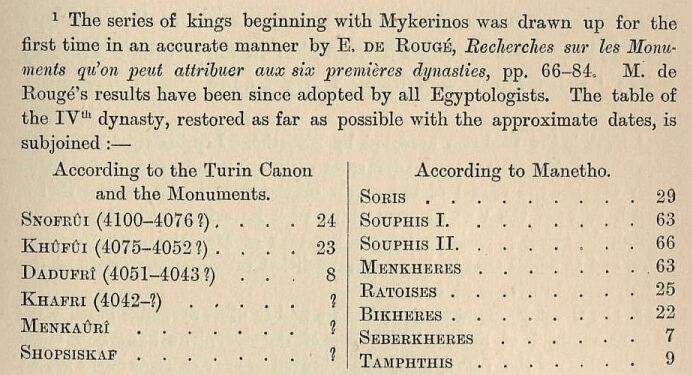
** The fragments of the royal Turin Papyrus exhibit, in fact, no separation between the kings which Manetho attributes to the IVth dynasty and those which he ascribes to the Vth, which seems to show that the Egyptian annalist considered them all as belonging to one and the same family of Pharaohs.
Nothing on the contemporary monuments, it is true, gives indication of a violent change attended by civil war, or resulting from a revolution at court: the construction and decoration of the tombs continued without interruption and without indication of haste, the sons-in-law of Shopsiskaf and of Mykerinos, their daughters and grandchildren, possess under the new kings, the same favour, the same property, the same privileges, which they had enjoyed previously. It was stated, however, in the time of the Ptolemies, that the Vth dynasty had no connection with the IVth; it was regarded at Memphis as an intruder, and it was asserted that it came from Elephantine.* The tradition was a very old one, and its influence is betrayed in a popular story, which was current at Thebes in the first years of the New Empire. Kheops, while in search of the mysterious books of Thot in order to transcribe from them the text for his sepulchral chamber,** had asked the magician Didi to be good enough to procure them for him; but the latter refused the perilous task imposed upon him.
* Such is the tradition accepted by Manetho. Lepsius thinks that the copyists of Manetho were under some distracting influence, which made them transfer the record of the origin of the VIth dynasty to the Vth: it must have been the VIth dynasty which took its origin from Elephantine. I think the safest plan is to respect the text of Manetho until we know more, and to admit that he knew of a tradition ascribing the origin of the Vth dynasty to Elephantine. ** The Great Pyramid is mute, but we find in other pyramids inscriptions of some hundreds of lines. The author of the story, who knew how much certain kings of the VIth dynasty had laboured to have extracts of the sacred books engraved within their tombs, fancied, no doubt, that his Kheops had done the like, but had not succeeded in procuring the texts in question, probably on account of the impiety ascribed to him by the legends. It was one of the methods of explaining the absence of any religious or funereal inscription in the Great Pyramid.
“‘Sire, my lord, it is not I who shall bring them to thee.’ His Majesty asks: ‘Who, then, will bring them to me?’ Didi replies, ‘It is the eldest of the three children who are in the womb of Rudîtdidît who will bring them to thee.’ His Majesty says: ‘By the love of Râ! what is this that thou tellest me; and who is she, this Rudîtdidît?’ Didi says to him: ‘She is the wife of a priest of Râ, lord of Sakhîbû. She carries in her womb three children of Râ, lord of Sakhîbû, and the god has promised to her that they shall fulfil this beneficent office in this whole earth,* and that the eldest shall be the high priest at Heliopolis.” His Majesty, his heart was troubled at it, but Didi says to him: “‘What are these thoughts, sire, my lord? Is it because of these three children? Then I say to thee: ‘Thy son, his son, then one of these.’”** The good King Kheops doubtless tried to lay his hands upon this threatening trio at the moment of their birth; but Râ had anticipated this, and saved his offspring. When the time for their birth drew near, the Majesty of Râ, lord of Sakhîbû, gave orders to Isis, Nephthys, Maskhonît, Hiquît,*** and Khnûmû: “Come, make haste and run to deliver Budîtdidît of these three children which she carries in her womb to fulfil that beneficent office in this whole earth, and they will build you temples, they will furnish your altars with offerings, they will supply your tables with libations, and they will increase your mortmain possessions.”