Volume 2 — CHAPTER II—THE MEMPHITE EMPIRE (continued 2)
M. L. McClure translation
* This kind of circumlocution is employed on several occasions in the old texts to designate royalty. It was contrary to etiquette to mention directly, in common speech, the Pharaoh, or anything belonging to his functions or his family. Cf. pp. 28, 29 of this History. ** This phrase is couched in oracular form, as befitting the reply of a magician. It appears to have been intended to reassure the king in affirming that the advent of the three sons of Râ would not be immediate: his son, then a son of this son, would succeed him before destiny would be accomplished, and one of these divine children succeed to the throne in his turn. The author of the story took no notice of Dadufrî or Shopsiskaf, of whose reigns little was known in his time. *** Hiquît as the frog-goddess, or with a frog’s head, was one of the mid-wives who is present at the birth of the sun every morning. Her presence is, therefore, natural in the case of the spouse about to give birth to royal sons of the sun.
The goddesses disguised themselves as dancers and itinerant musicians: Khnûmû assumed the character of servant to this band of nautch-girls and filled the bag with provisions, and they all then proceeded together to knock at the door of the house in which Budîtdidît was awaiting her delivery. The earthly husband Baûsîr, unconscious of the honour that the gods had in store for him, introduced them to the presence of his wife, and immediately three male children were brought into the world one after the other. Isis named them, Maskhonît predicted for them their royal fortune, while Khnûmû. infused into their limbs vigour and health; the eldest was called Ûsirkaf, the second Sahûrî, the third Kakiû. Kaûsîr was anxious to discharge his obligation to these unknown persons, and proposed to do so in wheat, as if they were ordinary mortals: they had accepted it without compunction, and were already on their way to the firmament, when Isis recalled them to a sense of their dignity, and commanded them to store the honorarium bestowed upon them in one of the chambers of the house, where henceforth prodigies of the strangest character never ceased to manifest themselves. Every time one entered the place a murmur was heard of singing, music, and dancing, while acclamations such as those with which kings are wont to be received gave sure presage of the destiny which awaited the newly born. The manuscript is mutilated, and we do not know how the prediction was fulfilled. If we may trust the romance, the three first princes of the Vth dynasty were brothers, and of priestly descent, but our experience of similar stories does not encourage us to take this one very seriously: did not such tales affirm that Kheops and Khephren were brothers also?
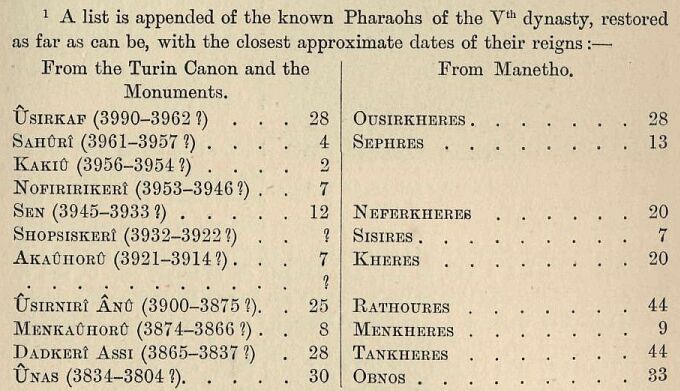
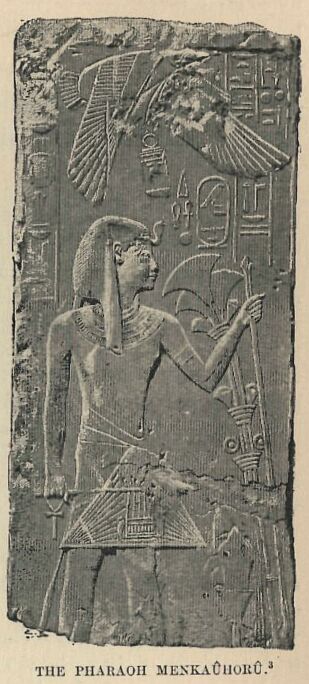
The Vth dynasty manifested itself in every respect as the sequel and complement of the IVth.* It reckons nine Pharaohs after the three which tradition made sons of the god Râ himself and of Rudîtdidîfc. They reigned for a century and a half; the majority of them have left monuments, and the last four, at least, Ûsirnirî Ânû, Menkaû-horû, Dadkerî Assi, and Unas, appear to have ruled gloriously. They all built pyramids,** they repaired temples and founded cities.***
* A list is appended of the known Pharaohs of the Vth dynasty, restored as far as can be, with the closest approximate dates of their reigns:—
** It is pretty generally admitted, but without convincing proofs, that the pyramids of Abûsîr served as tombs for the Pharaohs in the Vth dynasty, one for Sahûrî, another to Ûsirnirî Anû, although Wiedemann considers that the truncated pyramid of Dahshur was the tomb of this king. I am inclined to think that one of the pyramids of Saqqâra was constructed by Assi; the pyramid of Unas was opened in 1881, and the results made known by Maspero, Études de Mythologie et d’Archéologie, vol. i. p. 150, et seq., and Recueil de Travaux, vols. iv. and v. The names of the majority of the pyramids are known to us from the monuments: that of Ûsirkaf was called “Ûâbisîtu”; that of Sahûrî, “Khâbi”; that of Nofiririkerî, “Bi”; that of Anû, “Min-isûîtû”; that of Menkaûhorû, “Nûtirisûîtû”; that of Assi, “Nutir”; that of Unas, “Nofir-isûîtû.” *** Pa Sahûrî, near Esneh, for instance, was built by Sahûrî. The modern name of the village of Sahoura still preserves, on the same spot, without the inhabitants suspecting it, the name of the ancient Pharaoh.
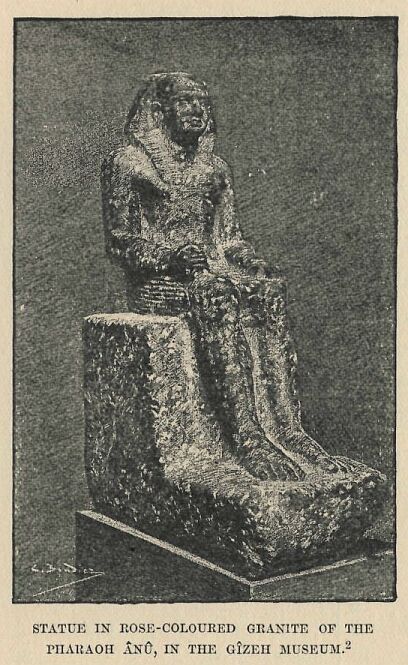
Drawn by Boudier, from a photograph by Emil Brugsch-Bey.
The Bedouin of the Sinaitic peninsula gave them much to do. Sahûrî brought these nomads to reason, and perpetuated the memory of his victories by a stele, engraved on the face of one of the rocks in the Wady Magharah; Anû obtained some successes over them, and Assi repulsed them in the fourth year of his reign. On the whole, they maintained Egypt in the position of prosperity and splendour to which their predecessors had raised it.
In one respect they even increased it. Egypt was not so far isolated from the rest of the world as to prevent her inhabitants from knowing, either by personal contact or by hearsay, at least some of the peoples dwelling outside Africa, to the north and east.
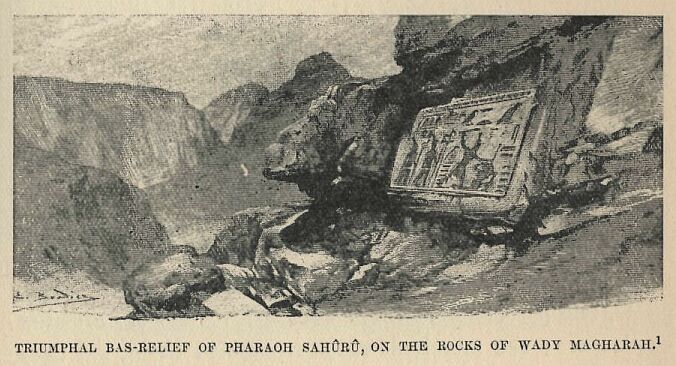
Drawn by Boudier, from the water-colour published in Lepsius, Denhn., i. pl. 8, No. 2
They knew that beyond the “Very Green,” almost at the foot of the mountains behind which the sun travelled during the night, stretched fertile islands or countries and nations without number, some barbarous or semi-barbarous, others as civilized as they were themselves. They cared but little by what names they were known, but called them all by a common epithet, the Peoples beyond the Seas, “Haûi-nîbû.” If they travelled in person to collect the riches which were offered to them by these peoples in exchange for the products of the Nile, the Egyptians could not have been the unadventurous and home-loving people we have imagined. They willingly left their own towns in pursuit of fortune or adventure, and the sea did not inspire them with fear or religious horror. The ships which they launched upon it were built on the model of the Nile boats, and only differed from the latter in details which would now pass unnoticed. The hull, which was built on a curved keel, was narrow, had a sharp stem and stern, was decked from end to end, low forward and much raised aft, and had a long deck cabin: the steering apparatus consisted of one or two large stout oars, each supported on a forked post and managed by a steersman. It had one mast, sometimes composed of a single tree, sometimes formed of a group of smaller masts planted at a slight distance from each other, but united at the top by strong ligatures and strengthened at intervals by crosspieces which made it look like a ladder; its single sail was bent sometimes to one yard, sometimes to two; while its complement consisted of some fifty men, oarsmen, sailors, pilots, and passengers. Such were the vessels for cruising or pleasure; the merchant ships resembled them, but they were of heavier build, of greater tonnage, and had a higher freeboard. They had no hold; the merchandise had to remain piled up on deck, leaving only just enough room for the working of the vessel. They nevertheless succeeded in making lengthy voyages, and in transporting troops into the enemy’s territory from the mouths of the Nile to the southern coast of Syria. Inveterate prejudice alone could prevent us from admitting that the Egyptians of the Memphite period went to the ports of Asia and to the Haûi-nîbû by sea. Some, at all events, of the wood required for building* and for joiner’s work of a civil or funereal character, such as pine, cypress or cedar, was brought from the forests of Lebanon or those of Amanus.
* Cedar-wood must have been continually imported into Egypt. It is mentioned in the Pyramid texts; in the tomb of Ti, and in the other tombs of Saqqâra or Gîzeh, workmen are represented making furniture of it. Chips of wood from the coffins of the VIth dynasty, detached in ancient times and found in several mastabas at Saqqâra, have been pronounced to be, some cedar of Lebanon, others a species of pine which still grows in Cilicia and in the north of Syria.
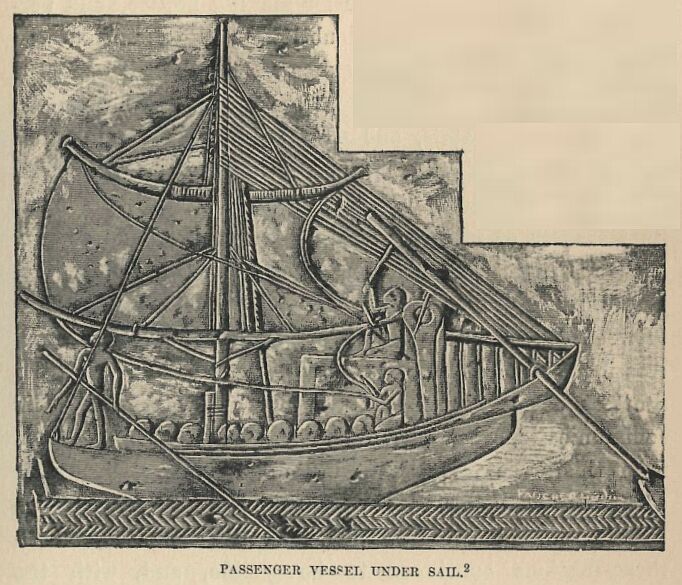
Drawn by Faucher-Gudin, from a photograph by Emil Brugsch- Bey; the picture is taken from one of the walls of the tomb of Api, discovered at Saqqâra, and now preserved in the Gîzeh Museum (VIth dynasty). The man standing at the bow is the fore-pilot, whose duty it is to take soundings of the channel, and to indicate the direction of the vessel to the pilot aft, who works the rudder-oars.
Beads of amber are still found near Abydos in the tombs of the oldest necropolis, and we may well ask how many hands they had passed through before reaching the banks of the Nile from the shores of the Baltic.* The tin used to alloy copper for making bronze,** and perhaps bronze itself, entered doubtless by the same route as the amber.
* I have picked up in the tombs of the VIth dynasty at Kom- es-Sultan, and in the part of the necropolis of Abydos containing the tombs of the XIth and XIIth dynasties, a number of amber beads, most of which were very small. Mariette, who had found some on the same site, and who had placed them in the Boulaq Museum, mistook them for corroded yellow or brown glass beads. The electric properties which they still possess have established their identity. ** I may recall the fact that the analysis of some objects discovered at Mèdûm by Professor Petrie proved that they were made of bronze, and contained 9.l per cent, of tin; the Egyptians, therefore, used bronze from the IVth dynasty downwards, side by side with pure copper.
The tribes of unknown race who then peopled the coasts of the Ægean Sea, were amongst the latest to receive these metals, and they transmitted them either directly to the Egyptians or Asiatic intermediaries, who carried them to the Nile Valley. Asia Minor had, moreover, its treasures of metal as well as those of wood—copper, lead, and iron, which certain tribes of miners and smiths, had worked from the earliest times. Caravans plied between Egypt and the lands of Chaldæan civilization, crossing Syria and Mesopotamia, perhaps even by the shortest desert route, as far as Ur and Babylon. The communications between nation and nation were frequent from this time forward, and very productive, but their existence and importance are matters of inference, as we have no direct evidence of them. The relations with these nations continued to be pacific, and, with the exception of Sinai, Pharaoh had no desire to leave the Nile Valley and take long journeys to pillage or subjugate countries from whence came so much treasure. The desert and the sea which protected Egypt on the north and east from Asiatic cupidity, protected Asia with equal security from the greed of Egypt.
On the other hand, towards the south, the Nile afforded an easy means of access to those who wished to penetrate into the heart of Africa. The Egyptians had, at the outset, possessed only the northern extremity of the valley, from the sea to the narrow pass of Silsileh; they had then advanced as far as the first cataract, and Syene for some time marked the extreme limit of their empire. At what period did they cross this second frontier and resume their march southwards, as if again to seek the cradle of their race? They had approached nearer and nearer to the great bend described by the river near the present village of Korosko,* but the territory thus conquered had, under the Vth dynasty, not as yet either name or separate organization: it was a dependency of the fiefdom of Elephantine, and was under the immediate authority of its princes.
* This appears to follow from a passage in the inscription of Uni. This minister was raising troops and exacting wood for building among the desert tribes whose territories adjoined at this part of the valley: the manner in which the requisitions were effected shows that it was not a question of a new exaction, but a familiar operation, and consequently that the peoples mentioned had been under regular treaty obligations to the Egyptians, at least for some time previously.
Those natives who dwelt on the banks of the river appear to have offered but a slight resistance to the invaders: the desert tribes proved more difficult to conquer. The Nile divided them into two distinct bodies. On the right side, the confederation of the Uaûaiu spread in the direction of the Bed Sea, from the district around Ombos to the neighbourhood of Korosko, in the valleys now occupied by the Ababdehs: it was bounded on the south by the Mâzaiû tribes, from whom our contemporary Mâazeh have probably descended. The Amamiu were settled on the left bank opposite to the Mâzaiû, and the country of Iritît lay facing the territory of the Uaûaiu. None of these barbarous peoples were subject to Egypt, but they all acknowledged its suzerainty,—a somewhat dubious one, indeed, analogous to that exercised over their descendants by the Khedives of to-day. The desert does not furnish them with the means of subsistence: the scanty pasturages of their wadys support a few flocks of sheep and asses, and still fewer oxen, but the patches of cultivation which they attempt in the neighbourhood of springs, yield only a poor produce of vegetables or dourah. They would literally die of starvation were they not able to have access to the banks of the Nile for provisions. On the other hand, it is a great temptation to them to fall unawares on villages or isolated habitations on the outskirts of the fertile lands, and to carry off cattle, grain, and male and female slaves; they would almost always have time to reach the mountains again with their spoil and to protect themselves there from pursuit, before even the news of the attack could reach the nearest police station. Under treaties concluded with the authorities of the country, they are permitted to descend into the plain in order to exchange peaceably for corn and dourah, the acacia-wood of their forests, the charcoal that they make, gums, game, skins of animals, and the gold and precious stones which they get from their mines: they agree in return to refrain from any act of plunder, and to constitute a desert police, provided that they receive a regular pay.
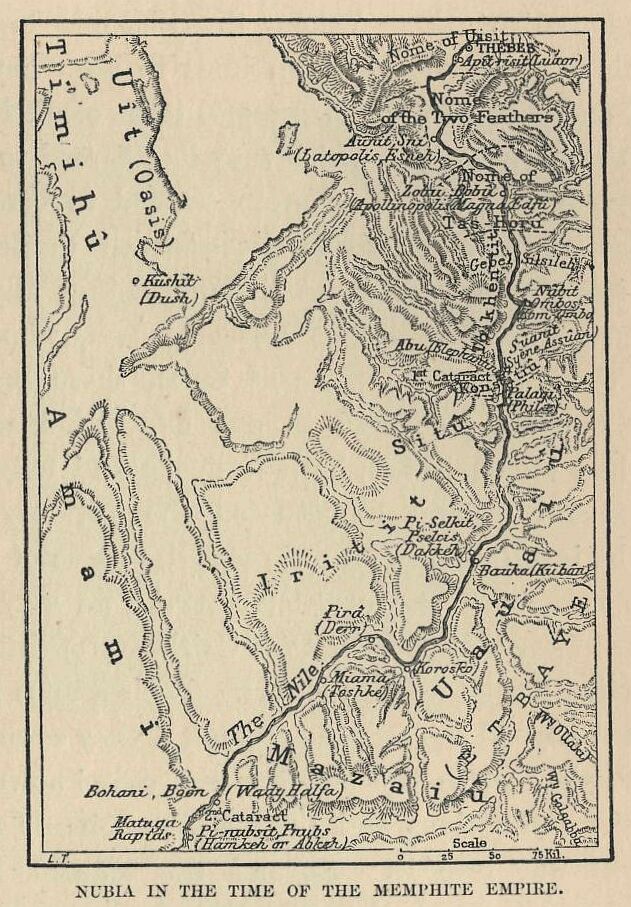
The same arrangement existed in ancient times. The tribes hired themselves out to Pharaoh. They brought him beams of “sont” at the first demand, when he was in need of materials to build a fleet beyond the first cataract. They provided him with bands of men ready armed, when a campaign against the Libyans or the Asiatic tribes forced him to seek recruits for his armies: the Mâzaiû entered the Egyptian service in such numbers, that their name served to designate the soldiery in general, just as in Cairo porters and night watchmen are all called Berberines. Among these people respect for their oath of fealty yielded sometimes to their natural disposition, and they allowed themselves to be carried away to plunder the principalities which they had agreed to defend: the colonists in Nubia were often obliged to complain of their exactions. When these exceeded all limits, and it became impossible to wink at their misdoings any longer, light-armed troops were sent against them, who quickly brought them to reason. As at Sinai, these were easy victories. They recovered in one expedition what the Ûaûaiû had stolen in ten, both in flocks and fellahîn, and the successful general perpetuated the memory of his exploits by inscribing, as he returned, the name of Pharaoh on some rock at Syene or Elephantine: we may surmise that it was after this fashion that Usirkaf, Nofiririkerî, and Unas carried on the wars in Nubia. Their armies probably never went beyond the second cataract, if they even reached so far: further south the country was only known by the accounts of the natives or by the few merchants who had made their way into it. Beyond the Mâzaiû, but still between the Nile and the Red Sea, lay the country of Pûanît, rich in ivory, ebony, gold, metals, gums, and sweet-smelling resins. When some Egyptian, bolder than his fellows, ventured to travel thither, he could choose one of several routes for approaching it by land or sea. The navigation of the Red Sea was, indeed, far more frequent than is usually believed, and the same kind of vessels in which the Egyptians coasted along the Mediterranean, conveyed them, by following the coast of Africa, as far as the Straits of Bab-el-Mandeb. They preferred, however, to reach it by land, and they returned with caravans of heavily laden asses and slaves.
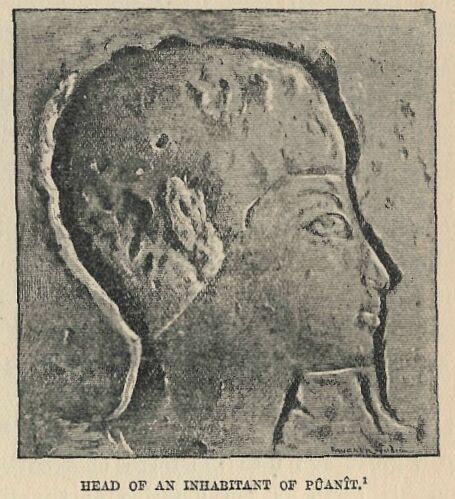
Drawn by Faucher-Gudin, from a photograph by Professor Petrie. This head was taken from the bas-relief at Karnak, on which the Pharaoh Harmhabi of the XVIIIth dynasty recorded his victories over the peoples of the south of Egypt.
All that lay beyond Pûanît was held to be a fabulous region, a kind of intermediate boundary land between the world of men and that of the gods, the “Island of the Double,” “Land of the Shades,” where the living came into close contact with the souls of the departed. It was inhabited by the Dangas, tribes of half-savage dwarfs, whose grotesque faces and wild gestures reminded the Egyptians of the god Bîsû (Bes). The chances of war or trade brought some of them from time to time to Pûanît, or among the Amamiû: the merchant who succeeded in acquiring and bringing them to Egypt had his fortune made. Pharaoh valued the Dangas highly, and was anxious to have some of them at any price among the dwarfs with whom he loved to be surrounded; none knew better than they the dance of the god—that to which Bîsû unrestrainedly gave way in his merry moments. Towards the end of his reign Assi procured one which a certain Biûrdidi had purchased in Pûanît. Was this the first which had made its appearance at court, or had others preceded it in the good graces of the Pharaohs? His wildness and activity, and the extraordinary positions which he assumed, made a lively impression upon the courtiers of the time, and nearly a century later there were still reminiscences of him.
A great official born in the time of Shopsiskaf, and living on to a great age into the reign of Nofiririkerî, is described on his tomb as the “Scribe of the House of Books.” This simple designation, occurring incidentally among two higher titles, would have been sufficient in itself to indicate the extraordinary development which Egyptian civilization had attained at this time. The “House of Books” was doubtless, in the first place, a depository of official documents, such as the registers of the survey and taxes, the correspondence between the court and the provincial governors or feudal lords, deeds of gift to temples or individuals, and all kinds of papers required in the administration of the State. It contained I also, however, literary works, many of which even at this early date were already old, prayers drawn up during the first dynasties, devout poetry belonging to times prior to the misty personage called Mini—hymns to the gods of light, formulas of black magic, collections of mystical works, such as the “Book of the Dead” * and the “Ritual of the Tomb;” scientific treatises on medicine, geometry, mathematics, and astronomy; manuals of practical morals; and lastly, romances, or those marvellous stories which preceded the romance among Oriental peoples.
* The “Book of the Dead” must have existed from prehistoric times, certain chapters excepted, whose relatively modern origin has been indicated by those who ascribe the editing of the work to the time of the first human dynasties.
All these, if we had them, would form “a library much more precious to us than that of Alexandria;” unfortunately up to the present we have been able to collect only insignificant remains of such rich stores. In the tombs have been found here and there fragments of popular songs. The pyramids have furnished almost intact a ritual of the dead which is distinguished by its verbosity, its numerous pious platitudes, and obscure allusions to things of the other world; but, among all this trash, are certain portions full of movement and savage vigour, in which poetic glow and religious emotion reveal their presence in a mass of mythological phraseology. In the Berlin Papyrus we may read the end of a philosophic dialogue between an Egyptian and his soul, in which the latter applies himself to show that death has nothing terrifying to man. “I say to myself every day: As is the convalescence of a sick person, who goes to the court after his affliction, such is death.... I say to myself every day: As is the inhaling of the scent of a perfume, as a seat under the protection of an outstretched curtain, on that day, such is death.... I say to myself every day: As the inhaling of the odour of a garden of flowers, as a seat upon the mountain of the Country of Intoxication, such is death.... I say to myself every day: As a road which passes over the flood of inundation, as a man who goes as a soldier whom nothing resists, such is death.... I say to myself every day: As the clearing again of the sky, as a man who goes out to catch birds with a net, and suddenly finds himself in an unknown district, such is death.” Another papyrus, presented by Prisse d’Avennes to the Bibliothèque Nationale, Paris, contains the only complete work of their primitive wisdom which has come down to us. It was certainly transcribed before the XVIIIth dynasty, and contains the works of two classic writers, one of whom is assumed to have lived under the IIIrd and the other under the Vth dynasty; it is not without reason, therefore, that it has been called “the oldest book in the world.” The first leaves are wanting, and the portion preserved has, towards its end, the beginning of a moral treatise attributed to Qaqimnî, a contemporary of Hûni. Then followed a work now lost: one of the ancient possessors of the papyrus having effaced it with the view of substituting for it another piece, which was never transcribed.
The last fifteen pages are occupied by a kind of pamphlet, which has had a considerable reputation, under the name of the “Proverbs of Phtahhotpû.”
This Phtahhotpû, a king’s son, flourished under Menkaûhorû and Assi: his tomb is still to be seen in the necropolis of Saqqâra. He had sufficient reputation to permit the ascription to him, without violence to probability, of the editing of a collection of political and moral maxims which indicate a profound knowledge of the court and of men generally. It is supposed that he presented himself, in his declining years, before the Pharaoh Assi, exhibited to him the piteous state to which old age had reduced him, and asked authority to hand down for the benefit of posterity the treasures of wisdom which he had stored up in his long career. The nomarch Phtahhotpû says: “‘Sire, my lord, when age is at that point, and decrepitude has arrived, debility comes and a second infancy, upon which misery falls heavily every day: the eyes become smaller, the ears narrower, strength is worn out while the heart continues to beat; the mouth is silent and speaks no more; the heart becomes darkened and no longer remembers yesterday; the bones become painful, everything which was good becomes bad, taste vanishes entirely; old age renders a man miserable in every respect, for his nostrils close up, and he breathes no longer, whether he rises up or sits down. If the humble servant who is in thy presence receives an order to enter on a discourse befitting an old man, then I will tell to thee the language of those who know the history of the past, of those who have heard the gods; for if thou conductest thyself like them, discontent shall disappear from among men, and the two lands shall work for thee!’ The majesty of this god says: ‘Instruct me in the language of old times, for it will work a wonder for the children of the nobles; whosoever enters and understands it, his heart weighs carefully what it says, and it does not produce satiety.’” We must not expect to find in this work any great profundity of thought. Clever analyses, subtle discussions, metaphysical abstractions, were not in fashion in the time of Phtahhotpû. Actual facts were preferred to speculative fancies: man himself was the subject of observation, his passions, his habits, his temptations and his defects, not for the purpose of constructing a system therefrom, but in the hope of reforming the imperfections of his nature and of pointing out to him the road to fortune. Phtahhotpû, therefore, does not show much invention or make deductions. He writes down his reflections just as they occur to him, without formulating them or drawing any conclusion from them as a whole. Knowledge is indispensable to getting on in the world; hence he recommends knowledge. Gentleness to subordinates is politic, and shows good education; hence he praises gentleness. He mingles advice throughout on the behaviour to be observed in the various circumstances of life, on being introduced into the presence of a haughty and choleric man, on entering society, on the occasion of dining with a dignitary, on being married. “If thou art wise, thou wilt go up into thine house, and love thy wife at home; thou wilt give her abundance of food, thou wilt clothe her back with garments; all that covers her limbs, her perfumes, is the joy of her life; as long as thou lookest to this, she is as a profitable field to her master.” To analyse such a work in detail is impossible: it is still more impossible to translate the whole of it. The nature of the subject, the strangeness of certain precepts, the character of the style, all tend to disconcert the reader and to mislead him in his interpretations. From the very earliest times ethics has been considered as a healthy and praiseworthy subject in itself, but so hackneyed was it, that a change in the mode of expressing it could alone give it freshness. Phtahhotpû is a victim to the exigencies of the style he adopted. Others before him had given utterance to the truths he wished to convey: he was obliged to clothe them in a startling and interesting form to arrest the attention of his readers. In some places he has expressed his thought with such subtlety, that the meaning is lost in the jingle of the words. The art of the Memphite dynasties has suffered as much as the literature from the hand of time, but in the case of the former the fragments are at least numerous and accessible to all. The kings of this period erected temples in their cities, and, not to speak of the chapel of the Sphinx, we find in the remains still existing of these buildings chambers of granite, alabaster and limestone, covered with religious scenes like those of more recent periods, although in some cases the walls are left bare. Their public buildings have all, or nearly all, perished; breaches have been made in them by invading armies or by civil wars, and they have been altered, enlarged, and restored scores of times in the course of ages; but the tombs of the old kings remain, and afford proof of the skill and perseverance exhibited by the architects in devising and carrying out their plans. Many of the mastabas occurring at intervals between Gîzeh and Mêdûm have, indeed, been hastily and carelessly built, as if by those who were anxious to get them finished, or who had an eye to economy; we may observe in all of them neglect and imperfection,—all the trade-tricks which an unscrupulous jerry-builder then, as now, could be guilty of, in order to keep down the net cost and satisfy the natural parsimony of his patrons without lessening his own profits.* Where, however, the master-mason has not been hampered by being forced to work hastily or cheaply, he displays his conscientiousness, and the choice of materials, the regularity of the courses, and the homogeneousness of the building leave nothing to be desired; the blocks are adjusted with such precision that the joints are almost invisible, and the mortar between them has been spread with such a skilful hand that there is scarcely an appreciable difference in its uniform thickness.**
* The similarity of the materials and technicalities of construction and decoration seem to me to prove that the majority of the tombs were built by a small number of contractors or corporations, lay or ecclesiastical, both at Memphis, under the Ancient, as well as at Thebes, under the New Empire. ** Speaking of the Great Pyramid and of its casing, Professor Petrie says: “Though the stones were brought as close as [—] inch, or, in fact, into contact, and the mean opening of the joint was but [—] inch, yet the builders managed to fill the joint with cement, despite the great area of it, and the weight of the stone to be moved—some 16 tons. To merely place such stones in exact contact at the sides would be careful work; but to do so with cement in the joint seems almost impossible.”
The long low flat mass which the finished tomb presented to the eye is wanting in grace, but it has the characteristics of strength and indestructibility well suited to an “eternal house.” The façade, however, was not wanting in a certain graceful severity: the play of light and shade distributed over its surface by the stelæ, niches, and deep-set doorways, varied its aspect in the course of the day, without lessening the impression of its majesty and serenity which nothing could disturb. The pyramids themselves are not, as we might imagine, the coarse and ill-considered reproduction of a mathematical figure disproportionately enlarged. The architect who made an estimate for that of Kheops, must have carefully thought out the relative value of the elements contained in the problem which had to be solved—the vertical height of the summit, the length of the sides on the ground line, the angle of pitch, the inclination of the lateral faces to one another—before he discovered the exact proportions and the arrangement of lines which render his monument a true work of art, and not merely a costly and mechanical arrangement of stones.*
* Cf. Borchardt’s article, Wie wurden die Boschungen der Pyramiden bestimmt? in which the author—an architect by profession as well as an Egyptologist—interprets the theories and problems of the Rhind mathematical Papyrus in a new manner, comparing the result with his own calculations, made from measurements of pyramids still standing, and in which he shows, by an examination of the diagrams discovered on the wall of a mastaba at Mêdûm, that the Egyptian contractors of the Memphite period were, at that early date, applying the rules and methods of procedure which we find set forth in the Papyri of Theban times.
The impressions which he desired to excite, have been felt by all who came after him when brought face to face with the pyramids. From a great distance they appear like mountain-peaks, breaking the monotony of the Libyan horizon; as we approach them they apparently decrease in size, and seem to be merely unimportant inequalities of ground on the surface of the plain. It is not till we reach their bases that we guess their enormous size. The lower courses then stretch seemingly into infinity to right and left, while the summit soars up out of our sight into the sky. “The effect is gained by majesty and simplicity of form, in the contrast and disproportion between the stature of man and the immensity of his handiwork: the eye fails to take it in; it is even difficult for the mind to grasp it. We see, we may touch hundreds of courses formed of blocks, two hundred cubic feet in size,... and thousands of others scarcely less in bulk, and wo are at a loss to know what force has moved, transported, and raised so great a number of colossal stones, how many men were needed for the work, what amount of time was required for it, what machinery they used; and in proportion to our inability to answer these questions, we increasingly admire the power which regarded such obstacles as trifles.”
We are not acquainted with the names of any of the men who conceived these prodigious works. The inscriptions mention in detail the princes, nobles, and scribes who presided over all the works undertaken by the sovereign, but they have never deigned to record the name of a single architect.*
* The title “mir kaûtû nîbû nîti sûton,” frequently met with under the Ancient Empire, does not designate the architects, as many Egyptologists have thought: it signifies “director of all the king’s works,” and is applicable to irrigation, dykes and canals, mines and quarries, and all branches of an engineer’s profession, as well as to those of the architect’s. The “directors of all the king’s works ” were dignitaries deputed by Pharaoh to take the necessary measurements for the building of temples, for dredging canals, for quarrying stone and minerals; they were administrators, and not professionals possessing the technical knowledge of an architect or engineer.
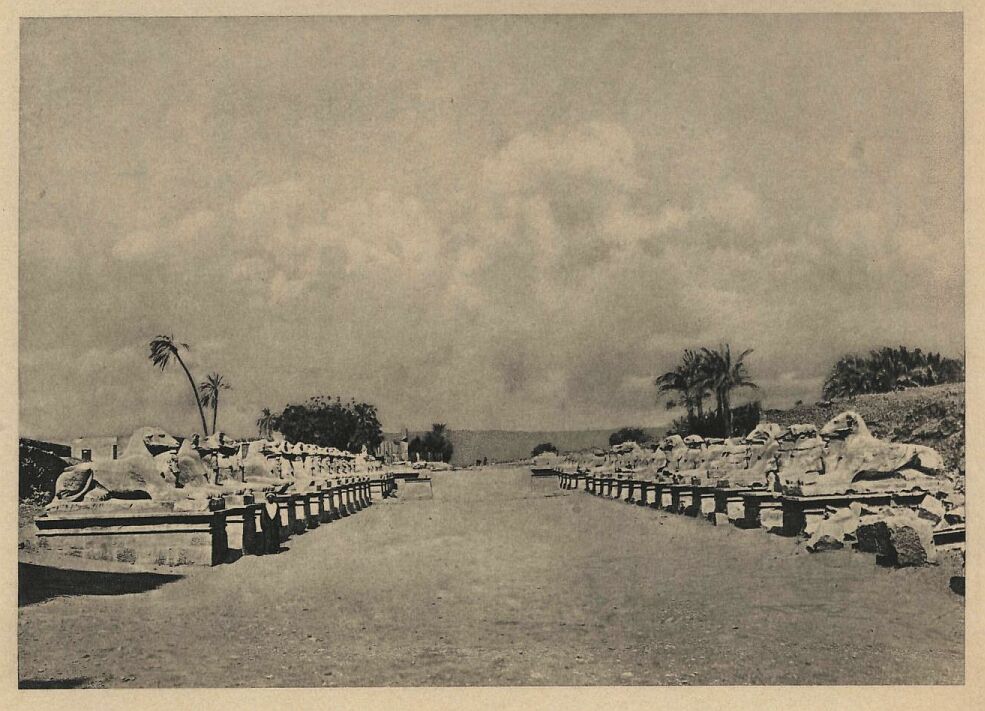

Drawn by Boudier, from a photograph by Emil Brugsch-Bey. The original is now in the Gîzeh Museum.
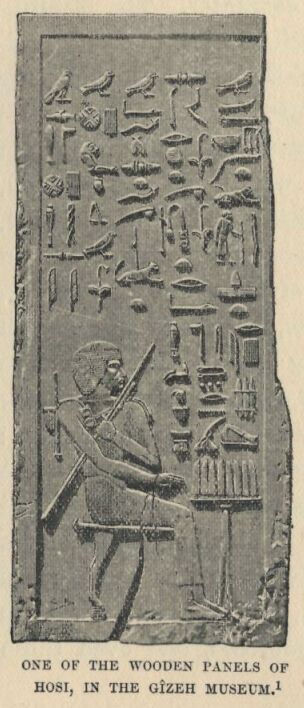
They were people of humble extraction, living hard lives under fear of the stick, and their ordinary assistants, the draughtsmen, painters, and sculptors, were no better off than themselves; they were looked upon as mechanics of the same social status as the neighbouring shoemaker or carpenter. The majority of them were, in fact, clever mechanical workers of varying capability, accustomed to chisel out a bas-relief or set a statue firmly on its legs, in accordance with invariable rules which they transmitted unaltered from one generation to another: some were found among them, however, who displayed unmistakable genius in their art, and who, rising above the general mediocrity, produced masterpieces. Their equipment of tools was very simple—iron picks with wooden handles, mallets of wood, small hammers, and a bow for boring holes. The sycamore and acacia furnished them with a material of a delicate grain and soft texture, which they used to good advantage: Egyptian art has left us nothing which, in purity of Hue and delicacy of modelling, surpasses the panels of the tomb of Hosi, with their seated or standing male figures and their vigorously cut hieroglyphs in the same relief as the picture. Egypt possesses, however, but few trees of suitable fibre for sculptural purposes, and even those which were fitted for this use were too small and stunted to furnish blocks of any considerable size. The sculptor, therefore, turned by preference to the soft white limestone of Turah.
He quickly detached the general form of his statue from the mass of stone, fixed the limits of its contour by means of dimension guides applied horizontally from top to bottom, and then cut away the angles projecting beyond the guides, and softened off the outline till he made his modelling correct. This simple and regular method of procedure was not suited to hard stone: the latter had to be first chiselled, but when by dint of patience the rough hewing had reached the desired stage, the work of completion was not entrusted to metal tools. Stone hatchets were used for smoothing off the superficial roughnesses, and it was assiduously polished to efface the various tool-marks left upon its surface. The statues did not present that variety of gesture, expression, and attitude which we aim at to-day. They were, above all things, the accessories of a temple or tomb, and their appearance reflects the particular ideas entertained with regard to their nature. The artists did not seek to embody in them the ideal type of male or female beauty: they were representatives made to perpetuate the existence of the model.
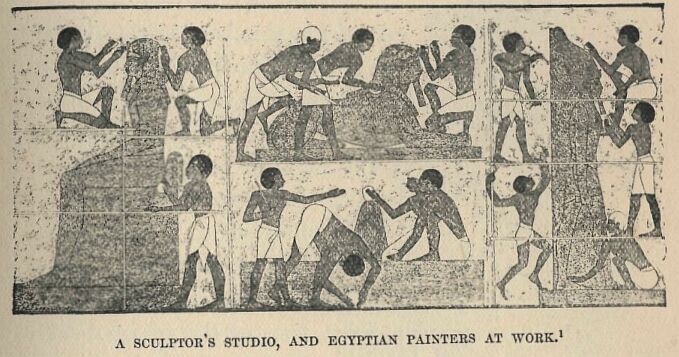
Drawn by Faucher-Gudin, from a chromolithograph by Prisse d’Avennes, Histoire de l’Art Égyptien. The original is in the tomb of Rakhmirî, who lived at Thebes under the XVIIIth dynasty. The methods which were used did not differ from those employed by the sculptors and painters of the Memphite period more than two thousand years previously.
Drawn by Boudier, from a photograph by Emil Brugsch-Bey. The original is now in the Gîzeh Museum.
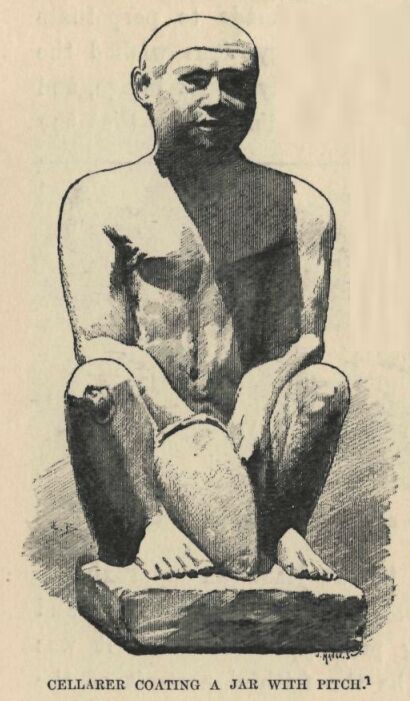
The Egyptians wished the double to be able to adapt itself easily to its image, and in order to compass that end, it was imperative that the stone presentment should be at least an approximate likeness, and should reproduce the proportions and peculiarities of the living prototype for whom it was meant. The head had to be the faithful portrait of the individual: it was enough for the body to be, so to speak, an average one, showing him at his fullest development and in the complete enjoyment of his physical powers. The men were always represented in their maturity, the women never lost the rounded breast and slight hips of their girlhood, but a dwarf always preserved his congenital ugliness, for his salvation in the other world demanded that it should be so. Had he been given normal stature, the double, accustomed to the deformity of his members in this world, would have been unable to accommodate himself to an upright carriage, and would not have been in a fit condition to resume his course of life.
The particular pose of the statue was dependent on the social position of the person. The king, the nobleman, and the master are always standing or sitting: it was in these postures they received the homage of their vassals or relatives. The wife shares her husband’s seat, stands upright beside him, or crouches at his feet as in daily life. The son, if his statue was ordered while he was a child, wears the dress of childhood; if he had arrived to manhood, he is represented in the dress and with the attitude suited to his calling. Slaves grind the grain, cellarers coat their amphoræ with pitch, bakers knead their dough, mourners make lamentation and tear their hair. The exigencies of rank clung to the Egyptians in temple and tomb, wherever their statues were placed, and left the sculptor who represented them scarcely any liberty. He might be allowed to vary the details and arrange the accessories to his taste; he might alter nothing in the attitude or the general likeness without compromising the end and aim of his work. The statues of the Memphite period may be counted at the present day by hundreds.
Some are in the heavy and barbaric style which has caused them to be mistaken for primaeval monuments: as, for instance, the statues of Sapi and his wife, now in the Louvre, which are attributed to the beginning of the IIIrd dynasty or even earlier. Groups exactly resembling these in appearance are often found in the tombs of the Vth and VIth dynasties, which according to this reckoning would be still older than that of Sapi: they were productions of an inferior studio, and their supposed archaism is merely the want of skill of an ignorant sculptor. The majority of the remaining statues are not characterized either by glaring faults or by striking merits: they constitute an array of honest good-natured folk, without much individuality of character and no originality. They may be easily divided into five or six groups, each having a style in common, and all apparently having been executed on the lines of a few chosen models; the sculptors who worked for the mastaba contractors were distributed among a very few studios, in which a traditional routine was observed for centuries. They did not always wait for orders, but, like our modern tombstone-makers, kept by them a tolerable assortment of half-finished statues, from which the purchaser could choose according to his taste. The hands, feet, and bust lacked only the colouring and final polish, but the head was merely rough-hewn, and there were no indications of dress; when the future occupant of the tomb or his family had made their choice, a few hours of work were sufficient to transform the rough sketch into a portrait, such as it was, of the deceased they desired to commemorate, and to arrange his garment according to the latest fashion. If, however, the relatives or the sovereign* declined to be satisfied with these commonplace images, and demanded a less conventional treatment of body for the double of him whom they had lost, there were always some among the assistants to be found capable of entering into their wishes, and of seizing the lifelike expression of limbs and features.
* It must not be forgotten that the statues were often, like the tomb itself, given by the king to the man whose services he desired to reward. His burying-place then bore the formulary, “By the favour of the king,” as I have mentioned previously.
Drawn by Boudier, from a photograph by Béchard.
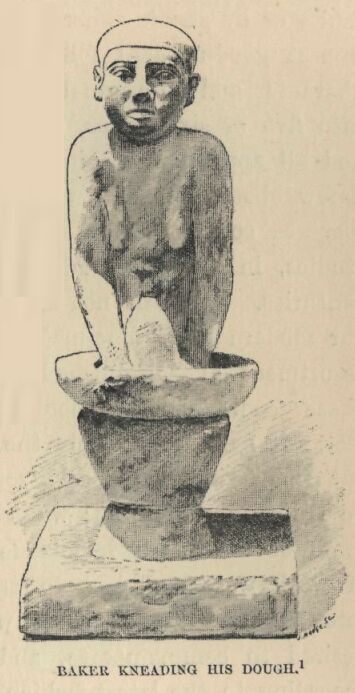
Drawn by Boudier, from a photograph by Émil Brugsch-Bey.
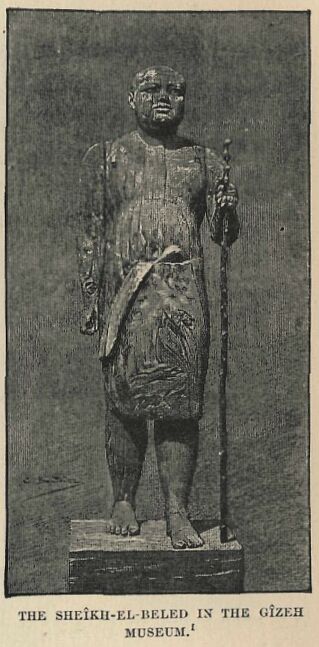
We possess at the present day, scattered about in museums, some score of statues of this period, examples of consummate art,—the Khephrens, the Kheops, the Anû, the Nofrît, the Râhotpû I have already mentioned, the “Sheîkh-el-Beled” and his wife, the sitting scribe of the Louvre and that of Gîzeh, and the kneeling scribe. Kaâpirû, the “Sheîkh-el-Beled,” was probably one of the directors of the corvée employed to build the Great Pyramid.* He seems to be coming forward to meet the beholder, with an acacia staff in his hand. He has the head and shoulders of a bull, and a common cast of countenance, whose vulgarity is not wanting in energy. The large, widely open eye has, by a trick of the sculptor, an almost uncanny reality about it.
* It was discovered by Mariette at Saqqâra. “The head, torso, arms, and even the staff, were intact; but the pedestal and legs were hopelessly decayed, and the statue was only kept upright by the sand which surrounded it.” The staff has since been broken, and is replaced by a more recent one exactly like it. In order to set up the figure, Mariette was obliged to supply new feet, which retain the colour of the fresh wood. By a curious coincidence, Kaâpirû was an exact portrait of one of the “Sheikhs el-Beled,” or mayors of the village of Saqqâra: the Arab workmen, always quick to see a likeness, immediately called it the “Sheikh el-Beled,” and the name has been retained ever since.
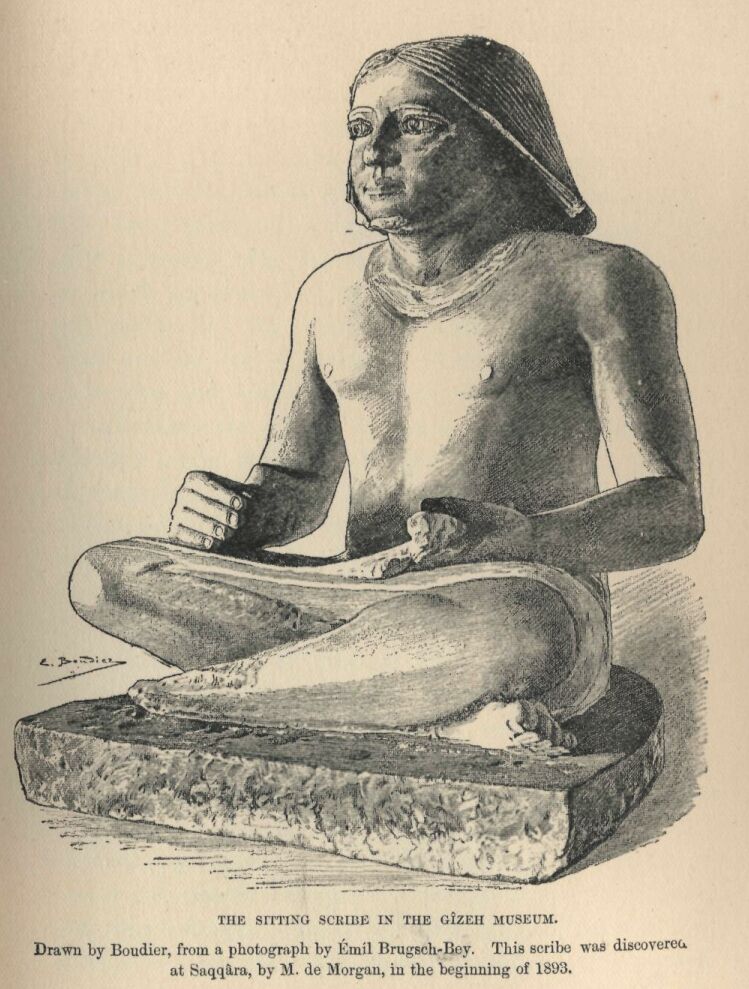
Drawn by Boudier, from a photograph by Émil Brugsch-Bey. This scribe was discovered at Saqqâra, by M. de Morgan, in the beginning of 1893.
Drawn by Faucher-Gudin, from a photograph by Émil Brugsch-Bey.
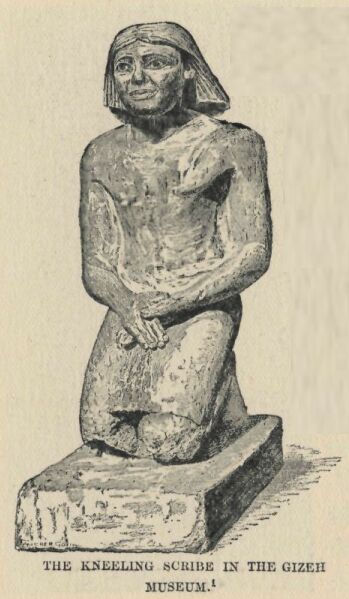
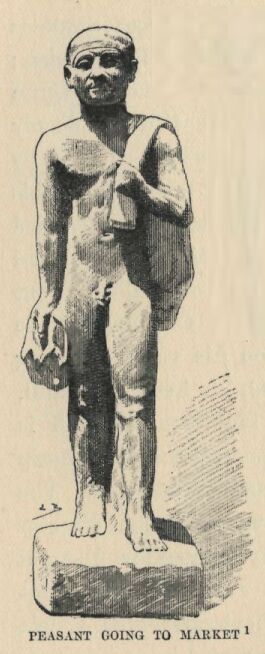
The socket which holds it has been hollowed out and filled with an arrangement of black and white enamel; a rim of bronze marks the outline of the lids, while a little silver peg, inserted at the back of the pupil, reflects the light and gives the effect of the sparkle of a living glance. The statue, which is short in height, is of wood, and one would be inclined to think that the relative plasticity of the material counts for something in the boldness of the execution, were it not that though the sitting scribe of the Louvre is of limestone, the sculptor has not shown less freedom in its composition. We recognize in this figure one of those somewhat flabby and heavy subordinate officials of whom so many examples are to be seen in Oriental courts. He is squatting cross-legged on the pedestal, pen in hand, with the outstretched leaf of papyrus conveniently placed on the right: he waits, after an interval of six thousand years, until Pharaoh or his vizier deigns to resume the interrupted dictation. His colleague at the Gîzeh Museum awakens in us no less wonder at his vigour and self-possession; but, being younger, he exhibits a fuller and firmer figure with a smooth skin, contrasting strongly with the deeply wrinkled appearance of the other, aggravated as it is by his flabbiness. The “kneeling scribe” preserves in his pose and on his countenance that stamp of resigned indecision and monotonous gentleness which is impressed upon subordinate officials by the influence of a life spent entirely under the fear of the stick. Banofir, on the contrary, is a noble lord looking upon his vassals passing in file before him: his mien is proud, his head disdainful, and he has that air of haughty indifférence which is befitting a favourite of the Pharaoh, possessor of generously bestowed sinecures, and lord of a score of domains. The same haughtiness of attitude distinguishes the director of the granaries, Nofir. We rarely encounter a small statue so expressive of vigour and energy. Sometimes there may be found among these short-garmented people an individual wrapped and almost smothered in an immense abayah; or a naked man, representing a peasant on his way to market, his bag on his left shoulder, slightly bent under the weight, carrying his sandals in his other hand, lest they should be worn out too quickly in walking. Everywhere we observe the traits of character distinctive of the individual and his position, rendered with a scrupulous fidelity: nothing is omitted, no detail of the characteristics of the model is suppressed. Idealisation we must not expect, but we have here an intelligent and sometimes too realistic fidelity. Portraits have been conceived among other peoples and in other periods in a different way: they have never been better executed.
Drawn by Boudier, from a photograph by Béchard. The original is at Gizeh. Vth dynasty.
The decoration of the sepulchres provided employment for scores of draughtsmen, sculptors, and painters, whose business it was to multiply in these tombs scenes of everyday life which were indispensable to the happiness or comfort of the double. The walls are sometimes decorated with isolated pictures only, each one of which represents a distinct operation; more frequently we find traced upon them a single subject whose episodes are superimposed one upon the other from the ground to the ceiling, and represent an Egyptian panorama from the Nile to the desert. In the lower portion, boats pass to and fro, and collide with each other, while the boatmen come to blows with their boat-hooks within sight of hippopotami and crocodiles. In the upper portions we see a band of slaves engaged in fowling among the thickets of the river-bank, or in the making of small boats, the manufacture of ropes, the scraping and salting of fish. Under the cornice, hunters and dogs drive the gazelle across the undulating plains of the desert. Every row represents one of the features of the country; but the artist, instead of arranging the pictures in perspective, separated them and depicted them one above the other.
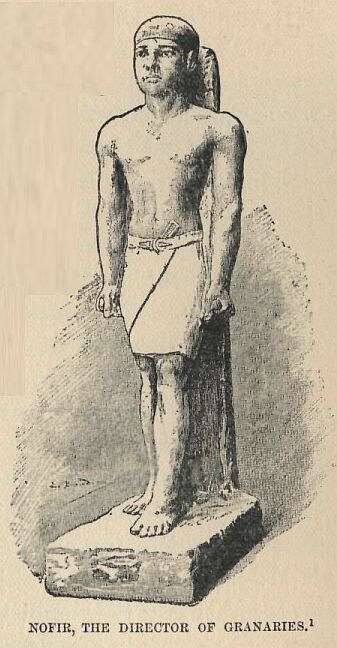
Drawn by Boudier, from a photograph by Émil Brugsch-Bey. original is in the Gîzeh Museum.—Vth dynasty.
Drawn by Boudier, from a photograph by Bouriant. The original is in private possession.
The groups are repeated in one tomb after another; they are always the same, but sometimes they are reduced to two or three individuals, sometimes increased in number, spread out and crowded with figures and inscriptions. Each chief draughtsman had his book of subjects and texts, which he combined in various ways, at one time bringing them close together, at another duplicating or extending them according to the means put at his disposal or the space he had to cover. The same men, the same animals, the same features of the landscape, the same accessories, appear everywhere: it is industrial and mechanical art at its highest. The whole is, however, harmonious, agreeable to the eye, and instructive. The conventionalisms of the drawing as well as those of the composition are very different from ours. Whether it is man or beast, the subject is invariably presented in outline by the brush, or by the graving tool in sharp relief upon the background; but the animals are represented in action, with their usual gait, movement, and play of limbs distinguishing each species. The slow and measured walk of the ox, the short step, meditative ears, and ironical mouth of the ass, the calm strength of the lion at rest, the grimaces of the monkeys, the slender gracefulness of the gazelle and antelope, are invariably presented with a consummate skill in drawing and expression. The human figure is the least perfect: every one is acquainted with those strange figures, whose heads in profile, with the eye drawn in full face, are attached to a torso seen from the front and supported by limbs in profile. These are truly anatomical monsters, and yet the appearance they present to us is neither laughable nor grotesque. The defective limbs are so deftly connected with those which are normal, that the whole becomes natural: the correct and fictitious lines are so ingeniously blent together that they seem to rise necessarily from each other. The actors in these dramas are constructed in such a paradoxical fashion that they could not exist in this world of ours; they live notwithstanding, in spite of the ordinary laws of physiology, and to any one who will take the trouble to regard them without prejudice, their strangeness will add a charm which is lacking in works more conformable to nature. A layer of colour spread over the whole heightens and completes them. This colouring is never quite true to nature nor yet entirely false. It approaches reality as far as possible, but without pretending to copy it in a servile way. The water is always a uniform blue, or broken up by black zigzag lines; the skin of the men is invariably brown, that of the women pale yellow.
The shade befitting each being or object was taught in the workshops, and once the receipt for it was drawn up, it was never varied in application. The effect produced by these conventional colours, however, was neither discordant nor jarring. The most brilliant colours were placed alongside each other with extreme audacity, but with a perfect knowledge of their mutual relations and combined effect. They do not jar with, or exaggerate, or kill each other: they enhance each other’s value, and by their contact give rise to half-shades which harmonize with them. The sepulchral chapels, in cases where their decoration had been completed, and where they have reached us intact, appear to us as chambers hung with beautifully luminous and interesting tapestry, in which rest ought to be pleasant during the heat of the day to the soul which dwells within them, and to the friends who come there to hold intercourse with the dead.
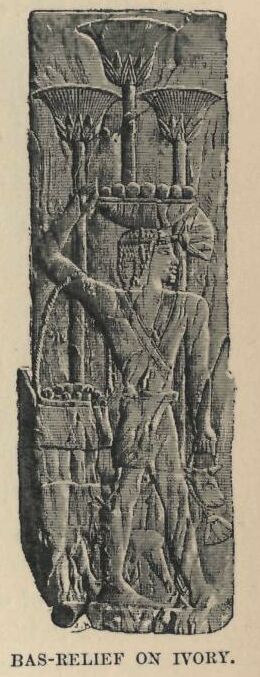
The decoration of palaces and houses was not less sumptuous than that of the sepulchres, but it has been so completely destroyed that we should find it difficult to form an idea of the furniture of the living if we did not see it frequently depicted in the abode of the double. The great armchairs, folding seats, footstools, and beds of carved wood, painted and inlaid, the vases of hard stone, metal, or enamelled ware, the necklaces, bracelets, and ornaments on the walls, even the common pottery of which we find the remains in the neighbourhood of the pyramids, are generally distinguished by an elegance and grace reflecting credit on the workmanship and taste of the makers.* The squares of ivory which they applied to their linen-chests and their jewel-cases often contained actual bas-reliefs in miniature of as bold workmanship and as skilful execution as the most beautiful pictures in the tombs: on these, moreover, were scenes of private life—dancing or processions bringing offerings and animals.**
* The study of the alabaster and diorite vases found near the pyramids has furnished Petrie with very ingenious views on the methods among the Egyptians of working hard stone. Examples of stone toilet or sacrificial bottles are not unfrequent in our museums: I may mention those in the Louvre which bear the cartouches of Dadkerî Assi (No. 343), of Papi I., and of Papi II., the son of Papi I.; not that they are to be reckoned among the finest, but because the cartouches fix the date of their manufacture. They came from the pyramids of these sovereigns, opened by the Arabs at the beginning of this century: the vase of the VIth dynasty, which is in the Museum at Florence, was brought from Abydos. ** M. Grébaut bought at the Great Pyramids, in 1887, a series of these ivory sculptures of the Ancient Empire. They are now at the Gîzeh Museum. Others belonging to the same find are dispersed among private collections: one of them is reproduced on p. 249 of this History.
Drawn by Faucher-Gudin, from a photograph by Bochard.
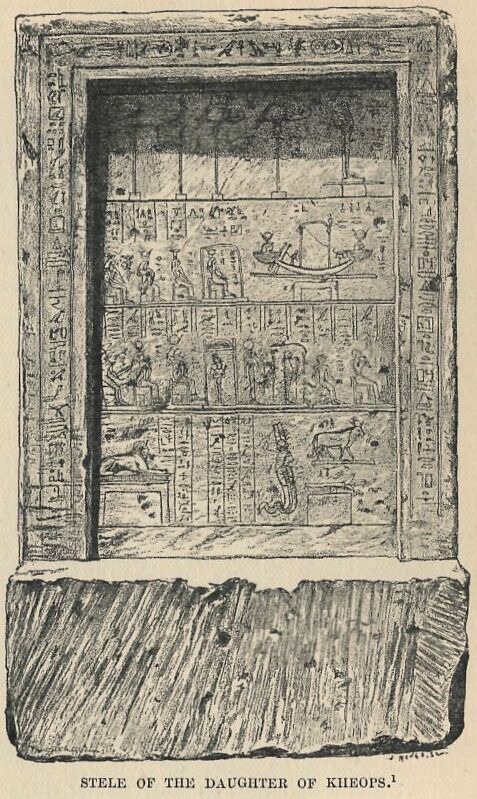
One would like to possess some of those copper and golden statues which the Pharaoh Kheops consecrated to Isis in honour of his daughter: only the representation of them upon a stele has come down to us; and the fragments of sceptres or other objects which too rarely have reached us, have unfortunately no artistic value.
A taste for pretty things was common, at least among the upper classes, including not only those about the court, but also those in the most distant nomes of Egypt. The provincial lords, like the courtiers of the palace, took a pride in collecting around them in the other world everything of the finest that the art of the architect, sculptor, and painter could conceive and execute. Their mansions as well as their temples have disappeared, but we find, here and there on the sides of the hills, the sepulchres which they had prepared for themselves in rivalry with those of the courtiers or the members of the reigning family. They turned the valley into a vast series of catacombs, so that wherever we look the horizon is bounded by a row of historic tombs. Thanks to their rock-cut sepulchres, we are beginning to know the Nomarchs of the Gazelle and the Hare, those of the Serpent-Mountain, of Akhmîm, Thinis, Qasr-es-Sayad, and Aswan,—all the scions, in fact, of that feudal government which preceded the royal sovereignty on the banks of the Nile, and of which royalty was never able to entirely disembarrass itself. The Pharaohs of the IVth dynasty had kept them in such check that we can hardly find any indications during their reigns of the existence of these great barons; the heads of the Pharaonic administration were not recruited from among the latter, but from the family and domestic circle of the sovereign. It was in the time of the kings of the Vth dynasty, it would appear, that the barons again entered into favour and gradually gained the upper hand; we find them in increasing numbers about Anû, Menkaûhorû, and Assi. Did Unas, who was the last ruler of the dynasty of Elephantine, die without issue, or were his children prevented from succeeding him by force? The Egyptian annals of the time of the Ramessides bring the direct line of Menés to an end with this king. A new line of Memphite origin begins after him.
It is almost certain that the transmission of power was not accomplished without contention, and that there were many claimants to the crown. One of the latter, Imhotpû, whose legitimacy was always disputed, has left hardly any traces of his accession to power,* but Ati established himself firmly on the throne for a year at least:** he pushed on actively the construction of his pyramid, and sent to the valley of Hammamât for the stone of his sarcophagus.
* The monuments furnish proof that their contemporaries considered these ephemeral rulers as so many illegitimate pretenders. Phtahshopsîsû and his son Sabû-Abibi, who exercised important functions at the court, mention only Unas and Teti III.; Uni, who took office under Teti III., mentions after this king only Papi I. and Mihtimsaûf I. The official succession was, therefore, regulated at this epoch in the same way as we afterwards find it in the table of Saqqâra, Unas, Teti III., Papi I., Mihtimsaûf I., and in the Royal Canon of Turin, without the intercalation of any other king. ** Brugsch, in his Histoire d’Egypte, pp. 44, 45, had identified this king with the first Metesouphis of Manetho: E. de Rougé prefers to transfer him to one of the two Memphite series after the VIth dynasty, and his opinion has been adopted by Wiedemann. The position occupied by his inscription among those of Hamraamât has decided me in placing him at the end of the Vth or beginning of the VIth dynasty: this E. Meyer has also done.
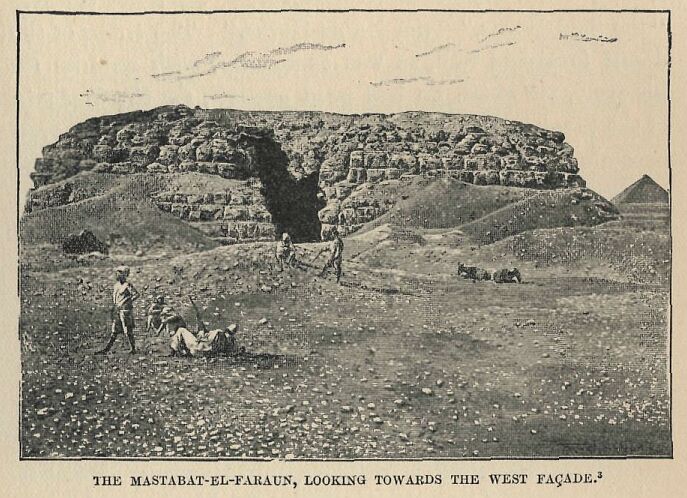
We know not whether revolution or sudden death put an end to his activity: the “Mastabat-el-Faraun” of Saqqâra, in which he hoped to rest, never exceeded the height which it has at present.* His name was, however, inscribed in certain official lists,** and a tradition of the Greek period maintained that he had been assassinated by his guards.*** Teti III. was the actual founder of the VIth dynasty,**** historians representing him as having been the immediate successor of Unas.
* Ati is known only from the Hammamât, inscription dated in the first year of his reign. He was identified by Brugsch with the Othoes of Manetho, and this identification has been generally adopted. M. de Rougé is inclined to attribute to him as prænomen the cartouche Usirkeri, which is given in the Table of Abydos between those of Teti III. and Papi I. Mariette prefers to recognize in Urikeri an independent Pharaoh of short reign. Several blocks of the Mastabat-el- Faraun at Saqqâra contain the cartouche of Unas, a fact which induced Mariette to regard this as the tomb of the Pharaoh. The excavations of 1881 showed that Unas was entombed elsewhere, and the indications are in favour of attributing the mastaba to Ati. We know, indeed, the pyramids of Teti III., of the two Papis, and of Metesouphis I.; Ati is the only prince of this period with whose tomb we are unacquainted. It is thus by elimination, and not by direct evidence, that the identification has been arrived at: Ati may have drawn upon the workshops of his predecessor Unas, which fact would explain the presence on these blocks of the cartouche of the latter. ** Upon that of Abydos, if we agree with E. de Rougé that the cartouche Usirkeri contains his prænomen; upon that from which Manetho borrowed, if we admit his identification with Othoes. *** Manetho (Unger’s edition, p. 101), where the form of the name is Othoes. **** He is called Teti Menephtah, with the cartouche prænomen of Seti I., on a monument of the early part of the XIXth dynasty, in the Museum at Marseilles: we see him in his pyramid represented as standing. This pyramid was opened in 1881, and its chambers are covered with long funerary inscriptions. It is a work of the time of Seti I., and not a contemporary production of the time of Menkaûhorû.
He lived long enough to build at Saqqâra a pyramid whose internal chambers are covered with inscriptions,* and his son succeeded him without opposition. Papi I. reigned at least twenty years.**
* The true pronunciation of this name would be Pipi, and of the one before it Titi. The two other Tetis are Teti I. of the Ist dynasty, and Zosir-Teti, or Teti II., of the IIIrd. ** From fragment 59 of the Royal Canon of Turin, An inscription in the quarries of Hât-nûbû bears the date of the year 24: if it has been correctly copied, the reign must have been four years at least longer than the chronologists of the time of the Ramessides thought.
Drawn by Faucher-Gudin, from a photograph by Béchard.
He manifested his activity in all corners of his empire, in the nomes of the Said as well as in those of the Delta, and his authority extended beyond the frontiers by which the power of his immediate predecessors had been limited. He owned sufficient territory south of Elephantine to regard Nubia as a new kingdom added to those which constituted ancient Egypt: we therefore see him entitled in his preamble “the triple Golden Horus,” “the triple Conqueror-Horus,” “the Delta-Horus,” “the Said-Horus,” “the Nubia-Horus.” The tribes of the desert furnished him, as was customary, with recruits for his army, for which he had need enough, for the Bedouin of the Sinaitic Peninsula were on the move, and were even becoming dangerous. Papi, aided by Uni, his prime minister, undertook against them a series of campaigns, in which he reduced them to a state of helplessness, and extended the sovereignty of Egypt for the time over regions hitherto unconquered.
Uni began his career under Teti.* At first a simple page in the palace,** he succeeded in obtaining a post in the administration of the treasury, and afterwards that of inspector of the woods of the royal domain.***
* The beginning of the first line is wanting, and I have restored it from other inscriptions of the same kind: “I was born under Unas.” Uni could not have been born before Unas; the first office that he filled under Teti III. was while he was a child or youth, while the reign of Unas lasted thirty years. ** Literally, “crown-bearer.” This was a title applied probably to children who served the king in his private apartments, and who wore crowns of natural flowers on their heads: the crown was doubtless of the same form as those which we see upon the brows of women on several tombs of the Memphite epoch. *** The word “Khoniti” probably indicates lands with plantations of palms or acacias, the thinly wooded forests of Egypt, and also of the vines which belonged to the personal domain of the Pharaoh.
Drawn by Boudier, from a photograph by Faucher-Gudin. Original in the Louvre
Papi took him into his friendship at the beginning of his reign, and conferred upon him the title of “friend,” and the office of head of the cabinet, in which position he acquitted himself with credit. Alone, without other help than that of a subordinate scribe, he transacted all the business and drew up all the documents connected with the harem and the privy council. He obtained an ample reward for his services. Pharaoh granted to him, as a proof of his complete satisfaction, the furniture of a tomb in choice white limestone; one of the officials of the necropolis was sent to obtain from the quarries at Troiû the blocks required, and brought back with him a sarcophagus and its lid, a door-shaped stele with its setting and a table of offerings. He affirms with much self-satisfaction that never before had such a thing happened to any one; moreover, he adds, “my wisdom charmed his Majesty, my zeal pleased him, and his Majesty’s heart was delighted with me.” All this is pure hyperbole, but no one was surprised at it in Egypt; etiquette required that a faithful subject should declare the favours of his sovereign to be something new and unprecedented, even when they presented nothing extraordinary or out of the common. Gifts of sepulchral furniture were of frequent occurrence, and we know of more than one instance of them previous to the VIth dynasty—for example, the case of the physician Sokhît-niônkhû, whose tomb still exists at Saqqâra, and whom Pharaoh Sahurî rewarded by presenting him with a monumental stele in stone from Turah. Henceforth Uni could face without apprehension the future which awaited him in the other world; at the same time, he continued to make his way no less quickly in this, and was soon afterwards promoted to the rank of “sole friend” and superintendent of the irrigated lands of the king. The “sole friends” were closely attached to the person of their master. In all ceremonies, their appointed place was immediately behind him, a place of the highest honour and trust, for those who occupied it literally held his life in their hands. They made all the arrangements for his processions and journeys, and saw that the proper ceremonial was everywhere observed, and that no accident was allowed to interrupt the progress of his train. Lastly, they had to take care that none of the nobles ever departed from the precise position to which his birth or office entitled him. This was a task which required a great deal of tact, for questions of precedence gave rise to nearly as many heart-burnings in Egypt as in modern courts. Uni acquitted himself so dexterously, that he was called upon to act in a still more delicate capacity. Queen Amîtsi was the king’s chief consort. Whether she had dabbled in some intrigue of the palace, or had been guilty of unfaithfulness in act or in intention, or had been mixed up in one of those feminine dramas which so frequently disturb the peace of harems, we do not know. At any rate, Papi considered it necessary to proceed against her, and appointed Uni to judge the case. Aided only by his secretary, he drew up the indictment and decided the action so discreetly, that to this day we do not know of what crime Amîtsi was accused or how the matter ended. Uni felt great pride at having been preferred before all others for this affair, and not without reason, “for,” says he, “my duties were to superintend the royal forests, and never before me had a man in my position been initiated into the secrets of the Royal Harem; but his Majesty initiated me into them because my wisdom pleased his Majesty more than that of any other of his lieges, more than that of any other of his mamelukes, more than that of any other of his servants.” These antecedents did not seem calculated to mark out Uni as a future minister of war; but in the East, when a man has given proofs of his ability in one branch of administration, there is a tendency to consider him equally well fitted for service in any of the others, and the fiat of a prince transforms the clever scribe of to-day into the general of to-morrow. No one is surprised, not even the person promoted; he accepts his new duties without flinching, and frequently distinguishes himself as much in their performance as though he had been bred to them from his youth up. When Papi had resolved to give a lesson to the Bedouin of Sinai, he at once thought of Uni, his “sole friend,” who had so skilfully conducted the case of Queen Amîtsi. The expedition was not one of those which could be brought to a successful issue by the troops of the frontier nomes; it required a considerable force, and the whole military organization of the country had to be brought into play. “His Majesty raised troops to the number of several myriads, in the whole of the south from Elephantine to the nome of the Haunch, in the Delta, in the two halves of the valley, in each fort of the forts of the desert, in the land of Iritît, among the blacks of the land of Maza, among the blacks of the land of Amamît, among the blacks of the land of Ûaûait, among the blacks of the land of Kaaû, among the blacks of To-Tamû, and his Majesty sent me at the head of this army. It is true, there were chiefs there, there were mamelukes of the king there, there were sole friends of the Great House there, there were princes and governors of castles from the south and from the north, ‘gilded friends,’ directors of the prophets from the south and the north, directors of districts at the head of troops from the south and the north, of castles and towns that each one ruled, and also blacks from the regions which I have mentioned, but it was I who gave them their orders—although my post was only that of superintendent of the irrigated lands of Pharaoh,—so much so that every one of them obeyed me like the others.” It was not without much difficulty that he brought this motley crowd into order, equipped them, and supplied them with rations. At length he succeeded in arranging everything satisfactorily; by dint of patience and perseverance, “each one took his biscuit and sandals for the march, and each one of them took bread from the towns, and each one of them took goats from the peasants.” He collected his forces on the frontier of the Delta, in the “Isle of the North,” between the “Gate of Imhotpû” and the “Tell of Horû nib-mâît,” and set out into the desert. He advanced, probably by Gebel Magharah and Gebel Helal, as far as Wady-el-Arîsh, into the rich and populous country which lay between the southern slopes of Gebel Tîh and the south of the Dead Sea: once there he acted with all the rigour permitted by the articles of war, and paid back with interest the ill usage which the Bedouin had inflicted on Egypt. “This army came in peace, it completely destroyed the country of the Lords of the Sands. This army came in peace, it pulverized the country of the Lords of the Sands. This army came in peace, it demolished their ‘douars.’ This army came in peace, it cut down their fig trees and their vines. This army came in peace, it burnt the houses of all their people. This army came in peace, it slaughtered their troops to the numbers of many myriads. This army came in peace, it brought back great numbers of their people as living captives, for which thing his Majesty praised me more than for aught else.” * As a matter of fact, these poor wretches were sent off as soon as taken to the quarries or to the dockyards, thus relieving the king from the necessity of imposing compulsory labour too frequently on his Egyptian subjects.
* The locality of the tribes against which Uni waged war can, I think, be fixed by certain details of the campaign, especially the mention of the oval or circular enclosures “ûanît” within which they entrenched themselves. These enclosures, or ndars, correspond to the nadami which are mentioned by travellers in these regions, and which are singularly characteristic. The “Lords of the Sands” mentioned by Uni occupied the naûami country, i.e. the Negeb regions situated on the edge of the desert of Tih, round about Aîn-Qadis, and beyond it as far as Akabah and the Dead Sea. Assuming this hypothesis to be correct, the route followed by Uni must have been the same as that which was discovered and described nearly twenty years ago, by Holland.
Plan drawn up by Thuillier, from the Map of the Commission d’Egypte.
“His Majesty sent me five times to lead this army in order to penetrate into the country of the Lords of the Sands, on each occasion of their revolt against this army, and I bore myself so well that his Majesty praised me beyond everything.” The Bedouin at length submitted, but the neighbouring tribes to the north of them, who had no doubt assisted them, threatened to dispute with Egypt the possession of the territory which it had just conquered. As these tribes had a seaboard on the Mediterranean, Uni decided to attack them by sea, and got together a fleet in which he embarked his army. The troops landed on the coast of the district of Tiba, to the north of the country of the Lords of the Sands, thereupon “they set out. I went, I smote all the barbarians, and I killed all those of them who resisted.” On his return, Uni obtained the most distinguished marks of favour that a subject could receive, the right to carry a staff and to wear his sandals in the palace in the presence of Pharaoh.
These wars had occupied the latter part of the reign; the last of them took place very shortly before the death of the sovereign. The domestic administration of Papi I. seems to have been as successful in its results, as was his activity abroad. He successfully worked the mines of Sinai, caused them to be regularly inspected, and obtained an unusual quantity of minerals from them; the expedition he sent thither, in the eighteenth year of his reign, left behind it a bas-relief in which are recorded the victories of Uni over the barbarians and the grants of territory made to the goddess Hâthor. Work was carried on uninterruptedly at the quarries of Hatnûbû and Kohanû; building operations were carried on at Memphis, where the pyramid was in course of erection, at Abydos, whither the oracle of Osiris was already attracting large numbers of pilgrims, at Tanis, at Bubastis, and at Heliopolis. The temple of Dendera was falling into ruins; it was restored on the lines I of the original plans which were accidentally discovered, and this piety displayed towards one of the most honoured deities was rewarded, as it deserved to be, by the insertion of the title of “son of Hâthor” in the royal cartouche. The vassals rivalled their sovereign in activity, and built new towns on all sides to serve them as residences, more than one of which was named after the Pharaoh. The death of Papi I. did nothing to interrupt this movement; the elder of his two sons by his second wife, Mirirî-ônkhnas, succeeded him without opposition. Mirnirî Mihtimsaûf I. (Metesouphis) was almost a child when he ascended the throne. The recently conquered Bedouin gave him no trouble; the memory of their reverses was still too recent to encourage them to take advantage of his minority and renew hostilities. Uni, moreover, was at hand, ready to recommence his campaigns at the slightest provocation. Metesouphis had retained him in all his offices, and had even entrusted him with new duties. “Pharaoh appointed me governor-general of Upper Egypt, from Elephantine in the south to Letopolis in the north, because my wisdom was pleasing to his Majesty, because my zeal was pleasing to his Majesty, because the heart of his Majesty was satisfied with me.... When I was in my place I was above all his vassals, all his mamelukes, and all his servants, for never had so great a dignity been previously conferred upon a mere subject. I fulfilled to the satisfaction of the king my office as superintendent of the South, so satisfactorily, that it was granted to me to be second in rank to him, accomplishing all the duties of a superintendent of works, judging all the cases which the royal administration had to judge in the south of Egypt as second judge, to render judgment at all hours determined by the royal administration in this south of Egypt as second judge, transacting as a governor all the business there was to do in this south of Egypt.” The honour of fetching the hard stone blocks intended for the king’s pyramid fell to him by right: he proceeded to the quarries of Abhaît, opposite Sehel, to select the granite for the royal sarcophagus and its cover, and to those of Hatnûbû for the alabaster for the table of offerings. The transport of the table was a matter of considerable difficulty, for the Nile was low, and the stone of colossal size: Uni constructed on the spot a raft to carry it, and brought it promptly to Saqqâra in spite of the sandbanks which obstruct navigation when the river is low.*
* Prof. Petrie has tried to prove from the passage which relates to the transport, that the date of the reign of Papi I. must have been within sixty years of 3240 B.C.; this date I believe to be at least four centuries too late. It is, perhaps, to this voyage of Uni that the inscription of the Vth year of Metesouphis I. refers, given by Blackden-Frazer in A Collection of Hieratic Graffiti from the Alabaster Quarry of Rat-nub, pl. xv. 2.
This was not the limit of his enterprise: the Pharaohs had not as yet a fleet in Nubia, and even if they had had, the condition of the channel was such as to prevent it from making the passage of the cataract. He demanded acacia-wood from the tribes of the desert, the peoples of Iritit and Uaûaît, and from the Mâzaiû, laid down his ships on the stocks, built three galleys and two large lighters in a single year; during this time the river-side labourers had cleared five channels through which the flotilla passed and made its way to Memphis with its ballast of granite. This was Uni’s last exploit; he died shortly afterwards, and was buried in the cemetery at Abydos, in the sarcophagus which had been given him by Papi I.
Was it solely to obtain materials for building the pyramid that he had re-established communication by water between Egypt and Nubia? The Egyptians were gaining ground in the south every day, and under their rule the town of Elephantine was fast becoming a depot for trade with the Soudan.*
* The growing importance of Elephantine is shown by the dimensions of the tombs which its princes had built for themselves, as well as by the number of graffiti commemorating the visits of princes and functionaries, and still remaining at the present day.
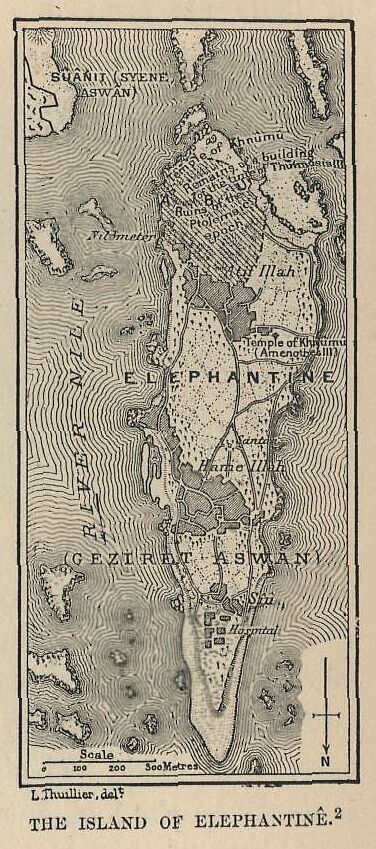
The town occupied only the smaller half of a long narrow island, which was composed of detached masses of granite, formed gradually into a compact whole by accumulations of sand, and over which the Nile, from time immemorial, had deposited a thick coating of its mud. It is now shaded by acacias, mulberry trees, date trees, and dôm palms, growing in some places in lines along the pathways, in others distributed in groups among the fields. Half a dozen saqiyehs, ranged in a line along the river-bank, raise water day and night, with scarcely any cessation of their monotonous creaking. The inhabitants do not allow a foot of their narrow domain to lie idle; they have cultivated wherever it is possible small plots of durra and barley, bersim and beds of vegetables.
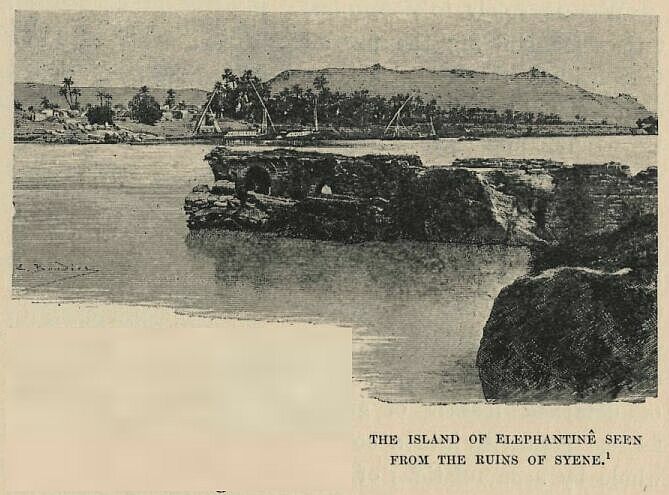
Drawn by Boudier, from a photograph by Beato. In the foreground are the ruins of the Roman mole built of brick, which protected the entrance to the harbour of Syene; in the distance is the Libyan range, surmounted by the ruins of several mosques and of a Coptic monastery. Cf. the woodcut on p. 275 of the present work.
A few scattered buffaloes and cows graze in corners, while fowls and pigeons without number roam about in flocks on the look-out for what they can pick up. It is a world in miniature, tranquil and pleasant, where life is passed without effort, in a perpetually clear atmosphere and in the shade of trees which never lose their leaf. The ancient city was crowded into the southern extremity, on a high plateau of granite beyond the reach of inundations. Its ruins, occupying a space half a mile in circumference, are heaped around a shattered temple of Khnûrnû, of which the most ancient parts do not date back beyond the sixteenth century before our era.
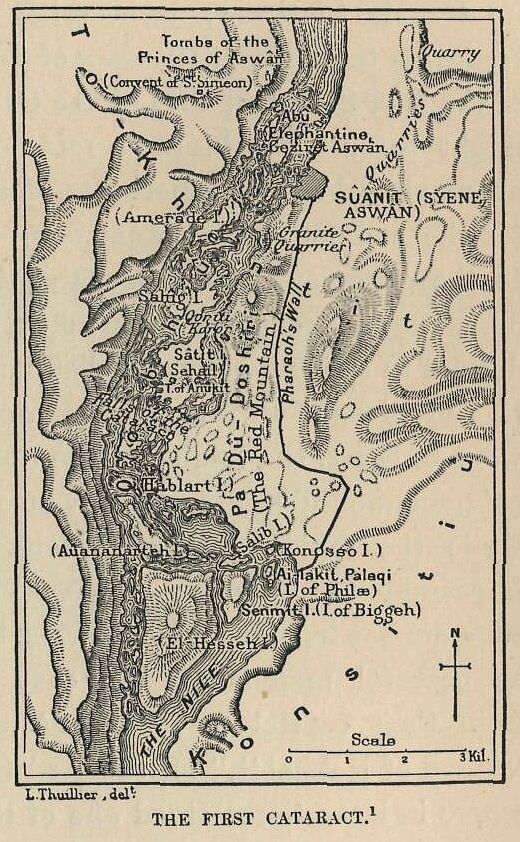
Map by Thuillier, from La Description de l’Egypte, Ant., vol. i. pl. 30, 1. I have added the ancient names in those cases where it has been possible to identify them with the modern localities.
It was surrounded with walls, and a fortress of sun-dried brick perched upon a neighbouring island to the south-west, gave it complete com-mand over the passages of the cataract. An arm of the river ninety yards wide separated it from Sûanît, whose closely built habitations were ranged along the steep bank, and formed, as it were, a suburb. Marshy pasturages occupied the modern site of Syene; beyond these were gardens, vines, furnishing wine celebrated throughout the whole of Egypt, and a forest of date palms running towards the north along the banks of the stream. The princes of the nome of Nubia encamped here, so to speak, as frontier-posts of civilization, and maintained frequent but variable relations with the people of the desert. It gave the former no trouble to throw, as occasion demanded it, bodies of troops on the right or left sides of the valley, in the direction of the Red Sea or in that of the Oasis; however little they might carry away in their raids—of oxen, slaves, wood, charcoal, gold dust, amethysts, cornelian or green felspar for the manufacture of ornaments—it was always so much to the good, and the treasury of the prince profited by it. They never went very far in their expeditions: if they desired to strike a blow at a distance, to reach, for example, those regions of Pûanît of whose riches the barbarians were wont to boast, the aridity of the district around the second cataract would arrest the advance of their foot-soldiers, while the rapids of Wady Haifa would offer an almost impassable barrier to their ships. In such distant operations they did not have recourse to arms, but disguised themselves as peaceful merchants. An easy road led almost direct from their capital to Ras Banât, which they called the “Head of Nekhabît,” on the Red Sea; arrived at the spot where in later times stood one of the numerous Berenices, and having quickly put together a boat from the wood of the neighbouring forest, they made voyages along the coast, as far as the Sinaitic peninsula and the Hirû-Shâîtû on the north, as well as to the land of Pûânît itself on the south. The small size of these improvised vessels rendered such expeditions dangerous, while it limited their gain; they preferred, therefore, for the most part the land journey.
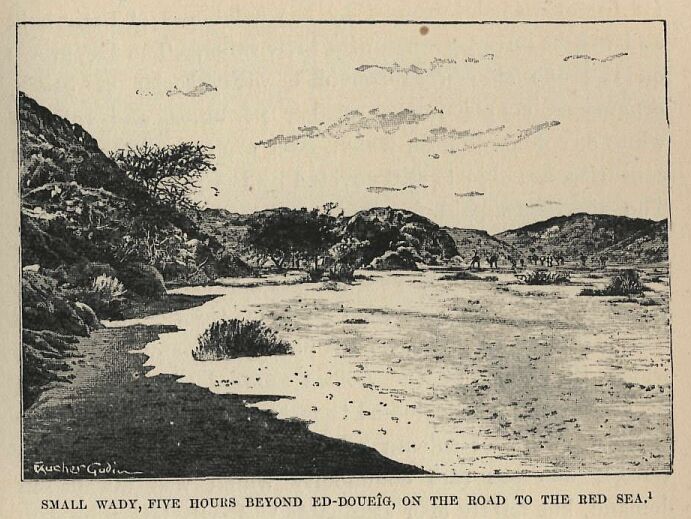
Drawn by Faucher-Gudin, from a photograph by Golénischeff.
It was fatiguing and interminable: donkeys—the only beast of burden they were acquainted with, or, at least, employed—could make but short stages, and they spent months upon months in passing through countries which a caravan of camels would now traverse in a few weeks.*
* The History of the Peasant, in the Berlin Papyri Nos. ii. and iv., affords us a good example of the use made of pack-asses; the hero was on his way across the desert, from the “Wady Natrûn” to Henasieh, with a quantity of merchandise which he intended to sell, when an unscrupulous artisan, under cover of a plausible pretext, stole his train of pack- asses and their loads. Hirkhûf brought back with him a caravan of three hundred asses from one of his journeys; cf. p. 278 of the present work.
The roads upon which they ventured were those which, owing to the necessity for the frequent watering of the donkeys and the impossibility of carrying with them adequate supplies of water, were marked out at frequent intervals by wells and springs, and were therefore necessarily of a tortuous and devious character. Their choice of objects for barter was determined by the smallness of their bulk and weight in comparison with their value. The Egyptians on the one side were provided with stocks of beads, ornaments, coarse cutlery, strong perfumes, and rolls of white or coloured cloth, which, after the lapse of thirty-five centuries, are objects still coveted by the peoples of Africa. The aborigines paid for these articles of small value, in gold, either in dust or in bars, in ostrich feathers, lions’ and leopards’ skins, elephants’ tusks, cowrie shells, billets of ebony, incense, and gum arabic. Considerable value was attached to cynocephali and green monkeys, with which the kings or the nobles amused themselves, and which they were accustomed to fasten to the legs of their chairs on days of solemn reception; but the dwarf, the Danga, was the rare commodity which was always in demand, but hardly ever attainable.*
* Domichen, Geographische Inschriften, vol. i. xxxi. 1. 1, where the dwarfs and pigmies who came to the court of the king, in the period of the Ptolemies, to serve in his household, are mentioned. Various races of diminutive stature, which have since been driven down to the upper basin of the Congo, formerly extended further northward, and dwelt between Darfûr and the marshes of Bahr-el-Ghazâl. As to the Danga, cf. what has been said on p. 226 of the present work.
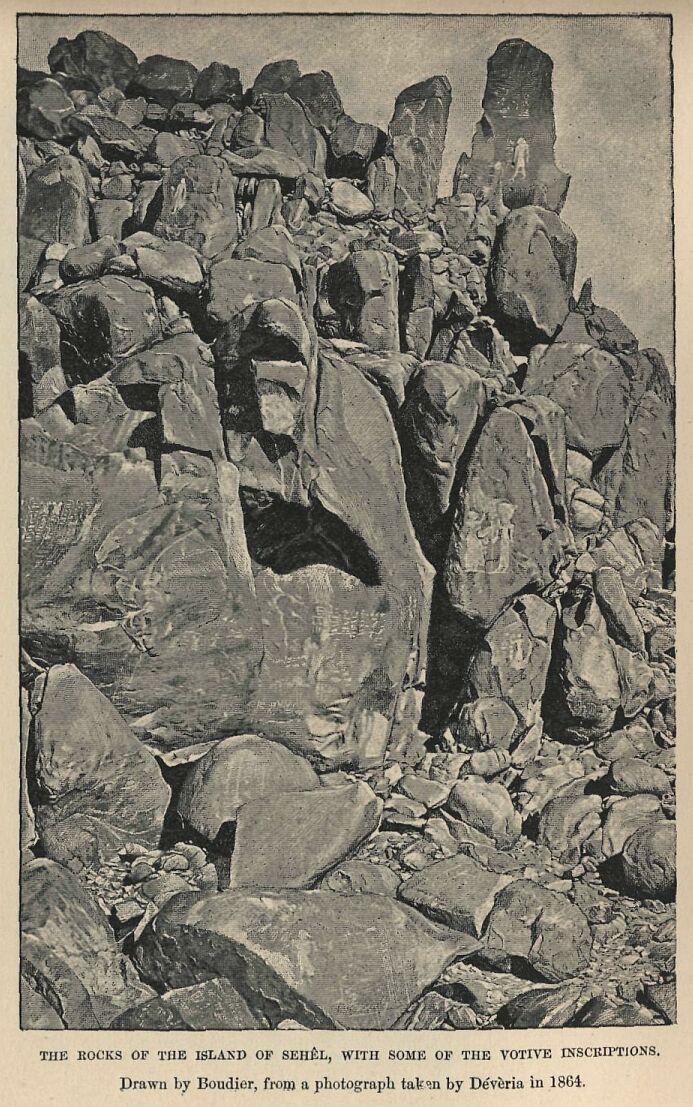
Drawn by Boudier, from a photograph taken by Dévèria in 1864.
Partly by commerce, and partly by pillage, the lords of Elephantine became rapidly wealthy, and began to play an important part among the nobles of the Said: they were soon obliged to take serious precautions against the cupidity which their wealth excited among the tribes of Konusît. They entrenched themselves behind a wall of sun-dried brick, some seven and a half miles long, of which the ruins are still an object of wonder to the traveller. It was flanked towards the north by the ramparts of Syene, and followed pretty regularly the lower course of the valley to its abutment at the port of Mahatta opposite Philas: guards distributed along it, kept an eye upon the mountain, and uttered a call to arms, when the enemy came within sight. Behind this bulwark the population felt quite at ease, and could work without fear at the granite quarries on behalf of the Pharaoh, or pursue in security their callings of fishermen and sailors. The inhabitants of the village of Satît and of the neighbouring islands claimed from earliest times the privilege of piloting the ships which went up and down the rapids, and of keeping clear the passages which were used for navigation. They worked under the protection of their goddesses Anûkît and Satît: travellers of position were accustomed to sacrifice in the temple of the goddesses at Sehêl, and to cut on the rock votive inscriptions in their honour, in gratitude for the prosperous voyage accorded to them. We meet their scrawls on every side, at the entrance and exit of the cataract, and on the small islands where they moored their boats at nightfall during the four or five days required for the passage; the bank of the stream between Elephantine and Philæ is, as it were, an immense visitors’ book, in which every generation of Ancient Egypt has in turn inscribed itself. The markets and streets of the twin cities must have presented at that time the same motley blending of types and costumes which we might have found some years back in the bazaars of modern Syene. Nubians, negroes of the Soudan, perhaps people from Southern Arabia, jostled there with Libyans and Egyptians of the Delta. What the princes did to make the sojourn of strangers agreeable, what temples they consecrated to their god Khnûmû and his companions, in gratitude for the good things he had bestowed upon them, we have no means of knowing up to the present. Elephantine and Syene have preserved for us nothing of their ancient edifices; but the tombs which they have left tell us their history. They honeycomb in long lines the sides of the steep hill which looks down upon the whole extent of the left bank of the Nile opposite the narrow channel of the port of Aswan. A rude flight of stone steps led from the bank to the level of the sepulchres. The mummy having been carried slowly on the shoulders of the bearers to the platform, was deposited for a moment at the entrance cf the chapel. The decoration of the latter was rather meagre, and was distinguished neither by the delicacy of its execution nor by the variety of the subjects. More care was bestowed upon the exterior, and upon the walls on each side of the door, which could be seen from the river or from the streets of Elephantine. An inscription borders the recess, and boasts to every visitor of the character of the occupant: the portrait of the deceased, and sometimes that of his son, stand to the right and left: the scenes devoted to the offerings come next, when an artist of sufficient skill could be found to engrave them.
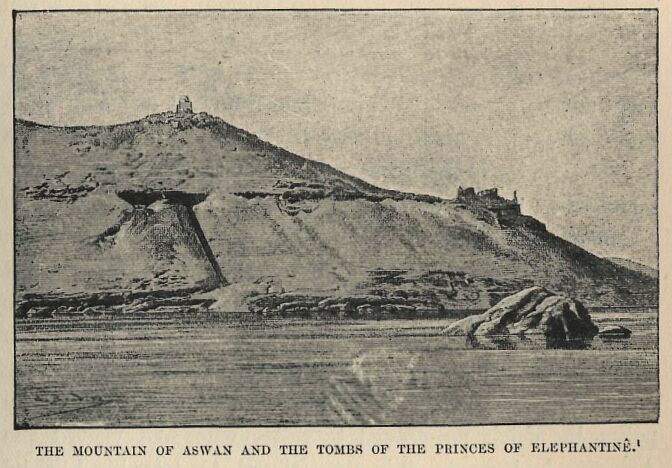
Drawn by Boudier, from a photograph by Insinger. The entrance to the tombs are halfway up; the long trench, cutting the side of the mountain obliquely, shelters the still existing steps which led to the tombs of Pharaonic times. On the sky-line may be noted the ruins of several mosques and Coptic monasteries.
The expeditions of the lords of Elephantine, crowned as they frequently were with success, soon attracted the attention of the Pharaohs: Metesouphis deigned to receive in person at the cataract the homage of the chiefs of Ûaûaît and Iritît and of the Màzaiû during the early days of the fifth year of his reign.*
* The words used in the inscription, “The king himself went and returned, ascending the mountain to see what there was on the mountain,” prove that Metesouphis inspected the quarries in person. Another inscription, discovered in 1893, gives the year V. as the date of his journey to Elephantine, and adds that he had negotiations with the heads of the four great Nubian races.
The most celebrated caravan guide at this time was Hirkhûf, own cousin to Mikhû, Prince of Elephantine. He had entered upon office under the auspices of his father Iri, “the sole friend.” A king whose name he does not mention, but who was perhaps Unas, more probably Papi I., despatched them both to the country of the Amamît. The voyage occupied seven months, and was extraordinarily successful: the sovereign, encouraged by this unexpected good fortune, resolved to send out a fresh expedition. Hirkhûf had the sole command of it; he made his way through Iritît, explored the districts of Satir and Darros, and retraced his steps after an absence of eight months. He brought back with him a quantity of valuable commodities, “the like of which no one had ever previously brought back.” He was not inclined to regain his country by the ordinary route: he pushed boldly into the narrow wadys which furrow the territory of the people of Iritît, and emerged upon the region of Situ, in the neighbourhood of the cataract, by paths in which no official traveller who had visited the Amamît had up to this time dared to travel. A third expedition which started out a few years later brought him into regions still less frequented. It set out by the Oasis route, proceeded towards the Amamît, and found the country in an uproar. The sheikhs had convoked their tribes, and were making preparations to attack the Timihû “towards the west corner of the heaven,” in that region where stand the pillars which support the iron firmament at the setting sun. The Timihû were probably Berbers by race and language. Their tribes, coming from beyond the Sahara, wandered across the frightful solitudes which bound the Nile Valley on the west. The Egyptians had constantly to keep a sharp look out for them, and to take precautions against their incursions; having for a long time acted only on the defensive, they at length took the offensive, and decided, not without religious misgivings, to pursue them to their retreats. As the inhabitants of Mendes and of Busiris had relegated the abode of their departed to the recesses of the impenetrable marshes of the Delta, so those of Siût and Thinis had at first believed that the souls of the deceased sought a home beyond the sands: the good jackal Anubis acted as their guide, through the gorge of the Cleft or through the gate of the Oven, to the green islands scattered over the desert, where the blessed dwelt in peace at a convenient distance from their native cities and their tombs. They constituted, as we know, a singular folk, those uiti whose members dwelt in coffins, and who had put on the swaddling clothes of the dead; the Egyptians called the Oasis which they had colonised, the land of the shrouded, or of mummies, ûît, and the name continued to designate it long after the advance of geographical knowledge had removed this paradise further towards the west. The Oases fell one after the other into the hands of frontier princes—that of Bahnesa coming under the dominion of the lord of Oxyrrhynchus, that of Dakhel under the lords of Thinis. The Nubians of Amamît had relations, probably, with the Timihû, who owned the Oasis of Dush—a prolongation of that of Dakhel, on the parallel of Elephantine. Hirkhûf accompanied the expedition to the Amamît, succeeded in establishing peace among the rival tribes, and persuaded them “to worship all the gods of Pharaoh:” he afterwards reconciled the Iritît, Amamît, and Ûaûaît, who lived in a state of perpetual hostility to each other, explored their valleys, and collected from them such quantities of incense, ebony, ivory, and skins that three hundred asses were required for their transport.
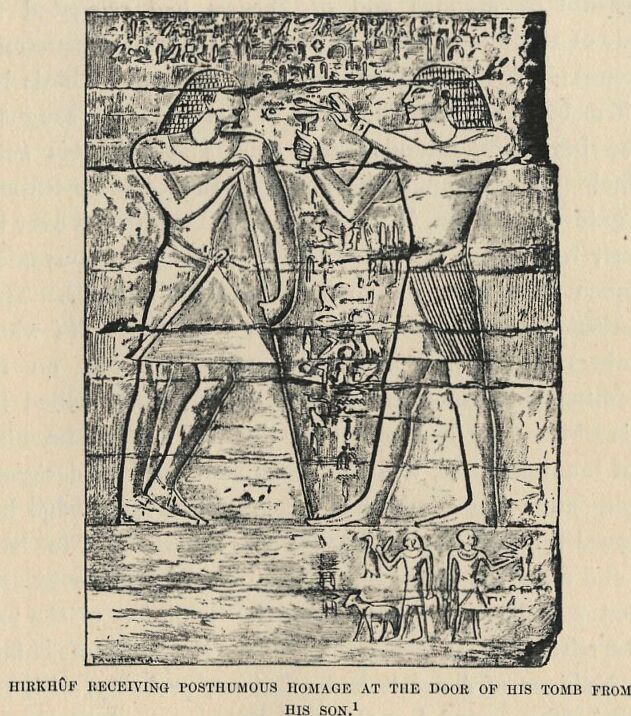
Drawn by Faucher-Gudin, from a photograph, taken in 1892, by Alexander Gayet.
He was even fortunate enough to acquire a Danga from the land of ghosts, resembling the one brought from Pûanît by Biûrdidi in the reign of Assi eighty years before. Metesouphis, in the mean time, had died, and his young brother and successor, Papi II., had already been a year upon the throne. The new king, delighted to possess a dwarf who could perform “the dance of the god,” addressed a rescript to Hirkhuf to express his satisfaction; at the same time he sent him a special messenger, Uni, a distant relative to Papi I.‘s minister, who was to invite him to come and give an account of his expedition. The boat in which the explorer embarked to go down to Memphis, also brought the Danga, and from that moment the latter became the most important personage of the party. For him all the royal officials, lords, and sacerdotal colleges hastened to prepare provisions and means of conveyance; his health was of greater importance than that of his protector, and he was anxiously watched lest he should escape. “When he is with thee in the boat, let there be cautious persons about him, lest he should fall into the water; when he rests during the night, let careful people sleep beside him, in case of his escaping quickly in the night-time. For my Majesty desires to see this dwarf more than all the treasures which are being imported from the land of Pûanît.” Hirkhûf, on his return to Elephantine, engraved the royal letter and the detailed account of his journeys to the lands of the south, on the façade of his tomb.