Volume 2 — CHAPTER III—THE FIRST THEBAN EMPIRE
M. L. McClure translation
The two Heracleopolitan dynasties and the XIIth dynasty—The conquest of Ethiopia, and the making of Greater Egypt by the Theban kings.
The principality of the Oleander—Nârû—was bounded on the north by the Memphite nome; the frontier ran from the left bank of the Nile to the Libyan range, from the neighbourhood of Riqqah to that of Mêdûm. The principality comprised the territory lying between the Nile and the Bahr Yûsûf, from the above-mentioned two villages to the Harabshent Canal—a district known to Greek geographers as the island of Heracleopolis;—it moreover included the whole basin of the Fâyûm, on the west of the valley. In very early times it had been divided into three parts: the Upper Oleander—Nârû Khonîti—the Lower Oleander—Nârû Pahûi—and the lake land—To-shît; and these divisions, united usually under the supremacy of one chief, formed a kind of small state, of which Heracleopolis was always the capital. The soil was fertile, well watered, and well tilled, but the revenues from this district, confined between the two arms of the river, were small in comparison with the wealth which their ruler derived from his hands on the other side of the mountain range. The Fayûm is approached by a narrow and winding gorge, more than six miles in length—a depression of natural formation, deepened by the hand of man to allow a free passage to the waters of the Nile. The canal which conveys them leaves the Bahr Yûsûf at a point a little to the north of Heracleopolis, carries them in a swift stream through the gorge in the Libyan chain, and emerges into an immense amphitheatre, whose highest side is parallel to the Nile valley, and whose terraced slopes descend abruptly to about a hundred feet below the level of the Mediterranean. Two great arms separate themselves from this canal to the right and left—the Wady Tamieh and the Wady Nazleh; they wind at first along the foot of the hills, and then again approaching each other, empty themselves into a great crescent or horn-shaped lake, lying east and west—the Moeris of Strabo, the Birket-Kerun of the Arabs. A third branch penetrates the space enclosed by the other two, passes the town of Shodû, and is then subdivided into numerous canals and ditches, whose ramifications appear on the map as a network resembling the reticulations of a skeleton leaf. The lake formerly extended beyond its present limits, and submerged districts from which it has since withdrawn.*
* Most of the specialists who have latterly investigated the Fayûm have greatly exaggerated the extent of the Birket- Kerûn in historic times. Prof. Petrie states that it covered the whole of the present province throughout the time of the Memphite kings, and that it was not until the reign of Amenemhâît I. that even a very small portion was drained. Major Brown adopts this theory, and considers that it was under Amenemhâît III. that the great lake of the Fayûm was transformed into a kind of artificial reservoir, which was the Mceris of Herodotus. The city of Shodû, Shadû, Shadît— the capital of the Fayûm—and its god Sovkû are mentioned even in the Pyramid texts: and the eastern district of the Fayûm is named in the inscription of Amten, under the IIIrd dynasty.
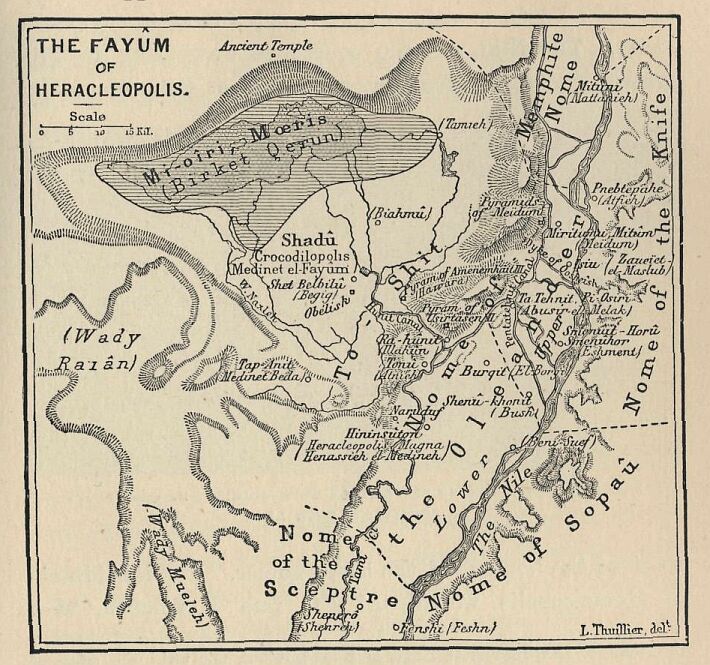
In years when the inundation was excessive, the surplus waters were discharged into the lake; when, however, there was a low Nile, the storage which had not been absorbed by the soil was poured back into the valley by the same channels, and carried down by the Bahr-Yûsûf to augment the inundation of the Western Delta.
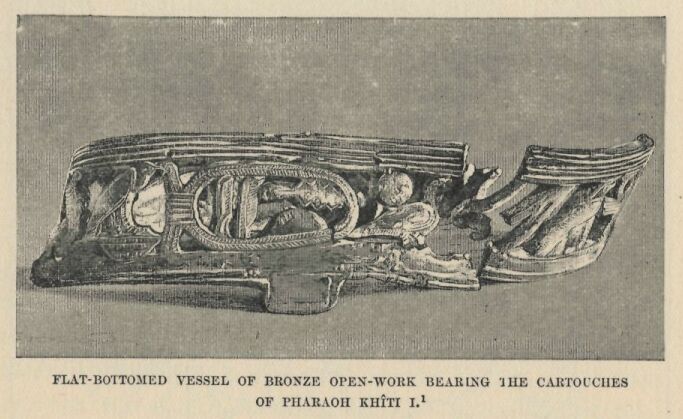
Drawn by Faucher-Gudin, from the original in the Louvre Museum.
The Nile was the source of everything in this principality, and hence they were gods of the waters who received the homage of the three nomes. The inhabitants of Heracleopolis worshipped the ram Harshafîtû, with whom they associated Osiris of Narûdûf as god of the dead; the people of the Upper Oleander adored a second ram, Khnûmû of Hâsmonîtû, and the whole Fayûm was devoted to the cult of Sovkû the crocodile. Attracted by the fertility of the soil, the Pharaohs of the older dynasties had from time to time taken up their residence in Heracleopolis or its neighbourhood, and one of them—Snofrûi—had built his pyramid at Mêdûm, close to the frontier of the nome. In proportion as the power of the Memphites declined, the princes of the Oleander grew more vigorous and enterprising; and when the Memphite kings passed away, these princes succeeded their former masters and sat “upon the throne of Horus.”
The founder of the IXth dynasty was perhaps Khîti I., Miribrî, the Akhthoës of the Greeks. He ruled over all Egypt, and his name has been found on rocks at the first cataract. A story dating from the time of the Ramessides mentions his wars against the Bedouin of the regions east of the Delta; and what Manetho relates of his death is merely a romance, in which the author, having painted him as a sacrilegious tyrant like Kheops and Khephren, states that he was dragged down under the water and there devoured by a crocodile or hippopotamus, the appointed avengers of the offended gods. His successors seem to have reigned ingloriously for more than a century. Their deeds are unknown to history, but it was under the reign of one of them—Nibkaûrî—that a travelling fellah, having been robbed of his earnings by an artisan, is said to have journeyed to Heracleopolis to demand justice from the governor, or to charm him by the eloquence of his pleadings and the variety of his metaphors. It would, of course, be idle to look for the record of any historic event in this story; the common people, moreover, do not long remember the names of unimportant princes, and the tenacity with which the Egyptians treasured the memories of several kings of the Heracleopolitan line amply proves that, whether by their good or evil qualities, they had at least made a lasting impression upon the popular imagination.
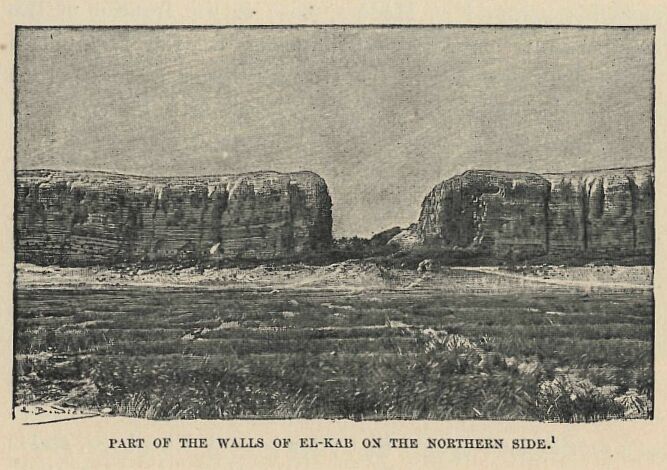
Drawn by Boudier, from a photograph by Grébaut. The illustration shows a breach where the gate stood, and the curves of the brickwork courses can clearly be traced both to the right and the left of the opening.
The history of this period, as far as we can discern it through the mists of the past, appears to be one confused struggle: from north to south war raged without intermission; the Pharaohs fought against their rebel vassals, the nobles fought among themselves, and—what scarcely amounted to warfare—there were the raids on all sides of pillaging bands, who, although too feeble to constitute any serious danger to large cities, were strong enough either in numbers or discipline to render the country districts uninhabitable, and to destroy national prosperity. The banks of the Nile already bristled with citadels, where the monarchs lived and kept watch over the lands subject to their authority: other fortresses were established wherever any commanding site—such as a narrow part of the river, or the mouth of a defile leading into the desert—presented itself. All were constructed on the same plan, varied only by the sizes of the areas enclosed, and the different thickness of the outer walls. The outline of their ground-plan formed a parallelogram, whose enclosure wall was often divided into vertical panels easily distinguished by the different arrangements of the building material. At El-Kab and other places the courses of crude brick are slightly concave, somewhat resembling a wide inverted arch whose outer curve rests on the ground. In other places there was a regular alternation of lengths of curved courses, with those in which the courses were strictly horizontal. The object of this method of structure is still unknown, but it is thought that such building offers better resistance to shocks of earthquake. The most ancient fortress at Abydos, whose ruins now lie beneath the mound of Kom-es-Sultân, was built in this way. Tombs having encroached upon it by the time of the VIth dynasty, it was shortly afterwards replaced by another and similar fort, situate rather more than a hundred yards to the south-east; the latter is still one of the best-preserved specimens of military architecture dating from the times immediately preceding the first Theban empire.*
* My first opinion was that the second fortress had been built towards the time of the XVIIIth dynasty at the earliest, perhaps even under the XXth. Further consideration of the details of its construction and decoration now leads me to attribute it to the period between the VIth and XIIth dynasties.
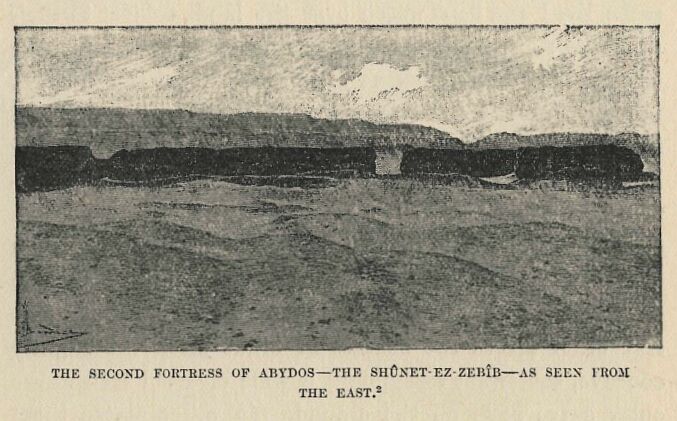
Drawn by Boudier, from a photograph by Emil Brugsch-Bey. Modern Arabs call it Shûnet-ez-Zébïb, the storehouse of raisins.
The exterior is unbroken by towers or projections of any kind, and consists of four sides, the two longer of which are parallel to each other and measure 143 yards from east to west: the two shorter sides, which are also parallel, measure 85 yards from north to south. The outer wall is solid, built in horizontal courses, with a slight batter, and decorated by vertical grooves, which at all hours of the day diversify the surface with an incessant play of light and shade. When perfect it can hardly have been less than 40 feet in height. The walk round the ramparts was crowned by a slight, low parapet, with rounded battlements, and was reached by narrow staircases carefully constructed in the thickness of the walls. A battlemented covering wall, about five and a half yards high, encircled the building at a distance of some four feet. The fortress itself was entered by two gates, and posterns placed at various points between them provided for sorties of the garrison. The principal entrance was concealed in a thick block of building at the southern extremity of the east front. The corresponding entrance in the covering wall was a narrow opening closed by massive wooden doors; behind it was a small place d’armes, at the further end of which was a second gate, as narrow as the first, and leading into an oblong court hemmed in between the outer rampart and two bastions projecting at right angles from it; and lastly, there was a gate purposely placed at the furthest and least obvious corner of the court. Such a fortress was strong enough to resist any modes of attack then at the disposal of the best-equipped armies, which knew but three ways of taking a place by force, viz. scaling, sapping, and breaking open the gates. The height of the walls effectually prevented scaling. The pioneers were kept at a distance by the brave, but if a breach were made in that, the small flanking galleries fixed outside the battlements enabled the besieged to overwhelm the enemy with stones and javelins as they approached, and to make the work of sapping almost impossible. Should the first gate of the fortress yield to the assault, the attacking party would be crowded together in the courtyard as in a pit, few being able to enter together; they would at once be constrained to attack the second gate under a shower of missiles, and did they succeed in carrying that also, it was at the cost of enormous sacrifice. The peoples of the Nile Valley knew nothing of the swing battering-ram, and no representation of the hand-worked battering-ram has ever been found in any of their wall-paintings or sculptures; they forced their way into a stronghold by breaking down its gates with their axes, or by setting fire to its doors.
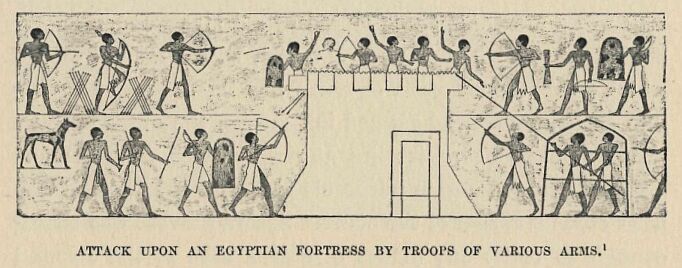
Drawn by Faucher-Gudin, from a scene in the tomb of Amoni- Amenemhâît at Beni-Hasan.
While the sappers were hard at work, the archers endeavoured, by the accuracy of their aim, to clear the enemy from the curtain, while soldiers sheltered behind movable mantelets tried to break down the defences and dismantle the flanking galleries with huge metal-tipped lances. In dealing with a resolute garrison none of these methods proved successful; nothing but close siege, starvation, or treachery could overcome its resistance.
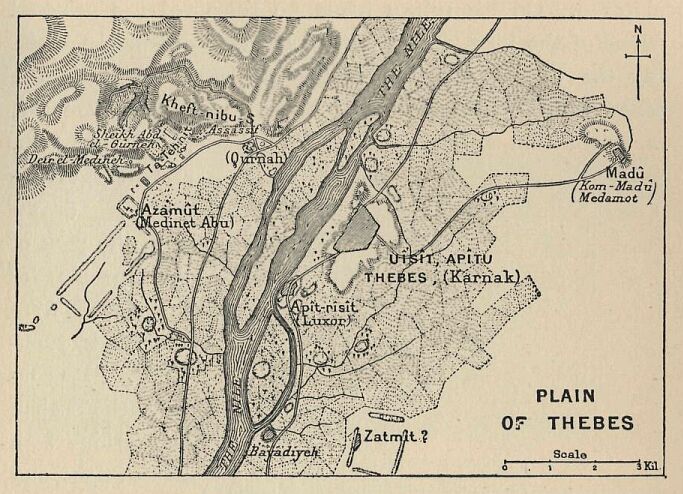
The equipment of Egyptian troops was lacking in uniformity, and men armed with slings, or bows and arrows, lances, wooden swords, clubs, stone or metal axes, all fought side by side. The head was protected by a padded cap, and the body by shields, which were small for light infantry, but of great width for soldiers of the line. The issue of a battle depended upon a succession of single combats between foes armed with the same weapons; the lancers alone seem to have charged in line behind their huge bucklers. As a rule, the wounds were trifling, and the great skill with which the shields were used made the risk of injury to any vital part very slight. Sometimes, however, a lance might be driven home into a man’s chest, or a vigorously wielded sword or club might fracture a combatant’s skull and stretch him unconscious on the ground. With the exception of those thus wounded and incapacitated for flight, very few prisoners were taken, and the name given to them, “Those struck down alive”—sokirûonkhû—sufficiently indicates the method of their capture. The troops were recruited partly from the domains of military fiefs, partly from tribes of the desert or Nubia, and by their aid the feudal princes maintained the virtual independence which they had acquired for themselves under the last kings of the Memphite line. Here and there, at Hermopolis, Shit, and Thebes, they founded actual dynasties, closely connected with the Pharaonic dynasty, and even occasionally on an equality with it, though they assumed neither the crown nor the double cartouche. Thebes was admirably adapted for becoming the capital of an important state. It rose on the right bank of the Nile, at the northern end of the curve made by the river towards Hermonthis, and in the midst of one of the most fertile plains of Egypt. Exactly opposite to it, the Libyan range throws out a precipitous spur broken up by ravines and arid amphitheatres, and separated from the river-bank by a mere strip of cultivated ground which could be easily defended. A troop of armed men stationed on this neck of land could command the navigable arm of the Nile, intercept trade with Nubia at their pleasure, and completely bar the valley to any army attempting to pass without having first obtained authority to do so. The advantages of this site do not seem to have been appreciated during the Memphite period, when the political life of Upper Egypt was but feeble. Elephantine, El-Kab, and Koptos were at that period the principal cities of the country. Elephantine particularly, owing to its trade with the Soudan, and its constant communication with the peoples bordering the Red Sea, was daily increasing in importance. Hermonthis, the Aûnû of the South, occupied much the same position, from a religious point of view, as was held in the Delta by Heliopolis, the Aûnû of the North, and its god Montû, a form of the Solar Horus, disputed the supremacy with Mînû, of Koptos. Thebes long continued to be merely an insignificant village of the Uisit nome and a dependency of Hermonthis. It was only towards the end of the VIIIth dynasty that Thebes began to realize its power, after the triumph of feudalism over the crown had culminated in the downfall of the Memphite kings.
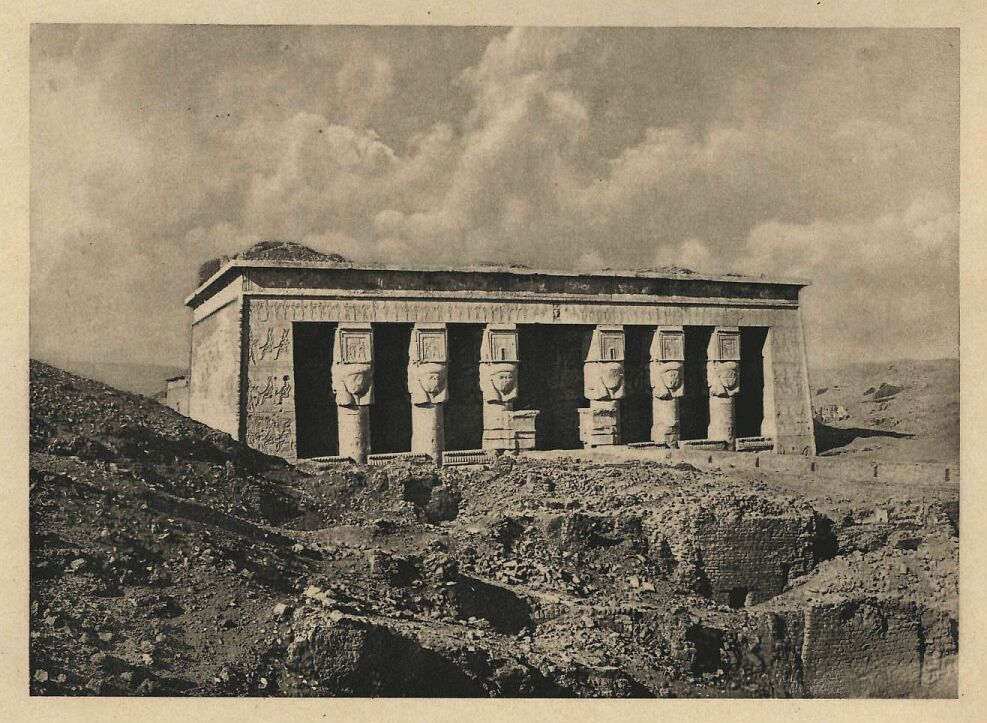

A family which, to judge from the fact that its members affected the name of Monthotpû, originally came from Hermonthis, settled in Thebes and made that town the capital of a small principality, which rapidly enlarged its borders at the expense of the neighbouring nomes. All the towns and cities of the plain, Mâdûfc, Hfûîfc, Zorît, Hermonthis, and towards the south, Aphroditopolis Parva, at the gorge of the Two Mountains (Gebelên) which formed the frontier of the fief of El-Kab, Kûsît towards the north, Denderah, and Hû, all fell into the hands of the Theban princes and enormously increased their territory. After the lapse of a very few years, their supremacy was accepted more or less willingly by the adjacent principalities of El-Kab, Elephantine, Koptos, Qasr-es-Sayad, Thinis, and Ekhmîm. Antûf, the founder of the family, claimed no other title than that of Lord of Thebes, and still submitted to the suzerainty of the Heracleopolitan kings. His successors considered themselves strong enough to cast off this allegiance, if not to usurp all the insignia of royalty, including the uraeus and the cartouche. Monthotpû I., Antûf II., and Antûf III. must have occupied a somewhat remarkable position among the great lords of the south, since their successors credited them with the possession of a unique preamble. It is true that the historians of a later date did not venture to place them on a par with the kings who were actually independent; they enclosed their names in the cartouche without giving them a prenomen; but, at the same time, they invested them with a title not met with elsewhere, that of the first Horus—Horû tapi. They exercised considerable power from the outset. It extended over Southern Egypt, over Nubia, and over the valleys lying between the Nile and the Red Sea.* The origin of the family was somewhat obscure, but in support of their ambitious projects, they did not fail to invoke the memory of pretended alliances between their ancestors and daughters of the solar race; they boasted of their descent from the Papis, from Usirnirî Anû, Sahûri, and Snofrûi, and claimed that the antiquity of their titles did away with the more recent rights of their rivals.
The revolt of the Theban princes put an end to the IXth dynasty, and, although supported by the feudal powers of Central and Northern Egypt, and more especially by the lords of the Terebinth nome, who viewed the sudden prosperity of the Thebans with a very evil eye, the Xth dynasty did not succeed in bringing them back to their allegiance.**
* In the “Hall of Ancestors” the title of “Horus” is attributed to several Antûfs and Monthotpûs bearing the cartouche. This was probably the compiler’s ingenious device for marking the subordinate position of these personages as compared with that of the Heracleopolitan Pharaohs, who alone among their contemporaries had a right to be placed on such official lists, even when those lists were compiled under the great Theban dynasties. The place in the XIth dynasty of princes bearing the title of “Horus” was first determined by E. de Rougé. ** The history of the house of Thebes was restored at the same time as that of the Heracleopolitan dynasties, by Maspero, in the Revue Critique, 1889, vol. ii. p. 220. The difficulty arising from the number of the Theban kings according to Manetho, considered in connection with the forty-three years which made the total duration of the dynasty, has been solved by Barucchi, Discord critici sojpra la Cronologia Egizia, pp. 131-134. These forty-three years represent the length of time that the Theban dynasty reigned alone, and which are ascribed to it in the Royal Canon; but the number of its kings includes, besides the recognized Pharaohs of the line, those princes who were contemporary with the Heracleopolitan rulers and are officially reckoned as forming the Xth dynasty.
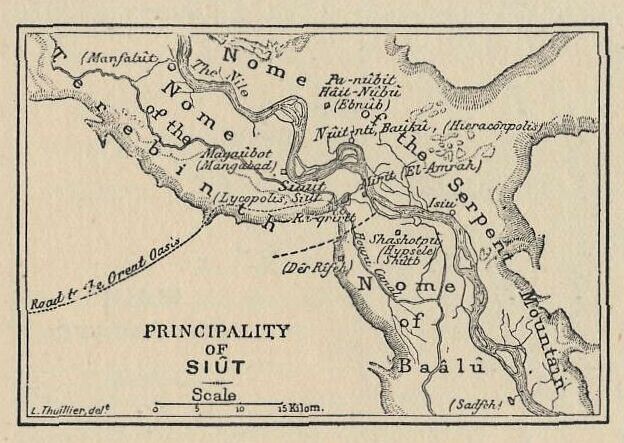
The family which held the fief of Siût when the war broke out, had ruled there for three generations. Its first appearance on the scene of history coincided with the accession of Akhthoës, and its elevation was probably the reward of services rendered by its chief to the head of the Heracleopolitan family.*
* By ascribing to the princes of Siut an average reign equal to that of the Pharaohs, and admitting with Lepsius that the IXth dynasty consisted of four or five kings, the accession of the first of these princes would practically coincide with the reign of Akhthoës. The name of Khîti, borne by two members of this little local dynasty, may have been given in memory of the Pharaoh Khiti Miribrî; there was also a second Khîti among the Heracleopolitan sovereigns, and one of the Khîtis of Siut may have been his contemporary. The family claimed a long descent, and said of itself that it was “an ancient litter”; but the higher rank and power of “prince” —hiqû—it owed to Khîti I. [Miribri?—Ed.] or some other king of the Heracleo-politian line.
From this time downwards, the title of “ruler”—hiqû—which the Pharaohs themselves sometimes condescended to take, was hereditary in the family, who grew in favour from year to year. Khiti I., the fourth of this line of princes, was brought up in the palace of Heracleopolis, and had learned to swim with the royal children. On his return home he remained the personal friend of the king, and governed his domains wisely, clearing the canals, fostering agriculture, and lightening the taxes without neglecting the army. His heavy infantry, recruited from among the flower of the people of the north, and his light infantry, drawn from the pick of the people of the south, were counted by thousands. He resisted the Theban pretensions with all his might, and his son Tefabi followed in his footsteps. “The first time,” said he, “that my foot-soldiers fought against the nomes of the south which were gathered together from Elephantine in the south to Gau on the north, I conquered those nomes, I drove them towards the southern frontier, I overran the left bank of the Nile in all directions. When I came to a town I threw down its walls, I seized its chief, I imprisoned him at the port (landing-place) until he paid me ransom. As soon as I had finished with the left bank, and there were no longer found any who dared resist, I passed to the right bank; like a swift hare I set full sail for another chief.... I sailed by the north wind as by the east, by the south as by the west, and him whose ship I boarded I vanquished utterly; he was cast into the water, his boats fled to shore, his soldiers were as bulls on whom falleth the lion; I compassed his city from end to end, I seized his goods, I cast them into the fire.” Thanks to his energy and courage, he “extinguished the rebellion by the counsel and according to the tactics of the jackal Uapûaîtû, god of Siût.”
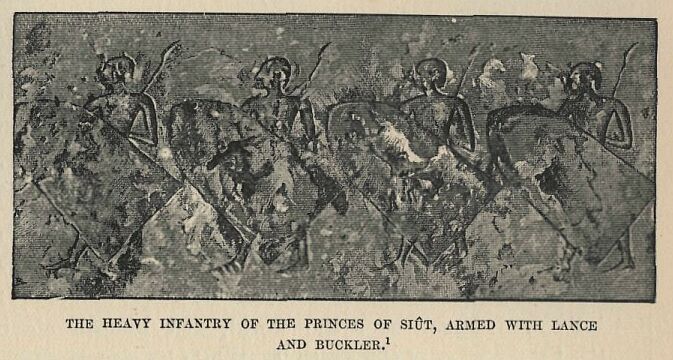
Drawn by Boudier, from a photograph by Insinger, taken in 1882. The scene forms part of the decoration of one of the walls of the tomb of Khîti III.
From that time “no district of the desert was safe from his terrors,” and he “carried flame at his pleasure among the nomes of the south.” Even while bringing desolation to his foes, he sought to repair the ills which the invasion had brought upon his own subjects. He administered such strict justice that evil-doers disappeared as though by magic. “When night came, he who slept on the roads blessed me, because he was as safe as in his own house; for the fear which was shed abroad by my soldiers protected him; and the cattle in the fields were as safe there as in the stable; the thief had become an abomination to the god, and he no longer oppressed the serf, so that the latter ceased to complain, and paid the exact dues of his land for love of me.” In the time of Khîti II., the son of Tefabi, the Heracleopolitans were still masters of Northern Egypt, but their authority was even then menaced by the turbulence of their own vassals, and Heracleopolis itself drove out the Pharaoh Mirikarî, who was obliged to take refuge in Siût with that Kkîti whom he called his father. Khîti gathered together such an extensive fleet that it encumbered the Nile from Shashhotpû to Gebel-Abufodah, from one end of the principality of the Terebinth to the other. Vainly did the rebels unite with the Thebans; Khîti “sowed terror over the world, and himself alone chastised the nomes of the south.” While he was descending the river to restore the king to his capital, “the sky grew serene, and the whole country rallied to him; the commanders of the south and the archons of Heracleopolis, their legs tremble beneath them when the royal urous, ruler of the world, comes to suppress crime; the earth trembles, the South takes ship and flies, all men flee in dismay, the towns surrender, for fear takes hold on their members.” Mirikarî’s return was a triumphal progress: “when he came to Heracleopolis the people ran forth to meet him, rejoicing in their lord; women and men together, old men as well as children.” But fortune soon changed. Beaten again and again, the Thebans still returned to the attack; at length they triumphed, after a struggle of nearly two hundred years, and brought the two rival divisions of Egypt under their rule.
Drawn by Faucher-Gudin, from the original, now in the Museum of the Louvre.**
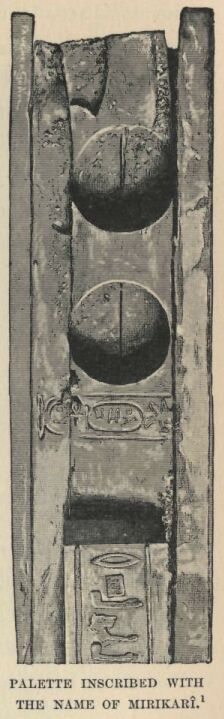
** The palette is of wood, and bears the name of a contemporary personage; the outlines of the hieroglyphs are inlaid with silver wire. It was probably found in the necropolis of Meîr, a little to the north of Siût. The sepulchral pyramid of the Pharaoh Mirikarî is mentioned on a coffin in the Berlin Museum.
The few glimpses to be obtained of the early history of the first Theban dynasty give the impression of an energetic and intelligent race. Confined to the most thinly populated, that is, the least fertile part of the valley, and engaged on the north in a ceaseless warfare which exhausted their resources, they still found time for building both at Thebes and in the most distant parts of their dominions. If their power made but little progress southwards, at least it did not recede, and that part of Nubia lying between Aswan and the neighbourhood of Korosko remained in their possession. The tribes of the desert, the Amamiû, the Mâzaiû, and the Uaûaiû often disturbed the husbandmen by their sudden raids; yet, having pillaged a district, they did not take possession of it as conquerors, but hastily returned to their mountains. The Theban princes kept them in check by repeated counter-raids, and renewed the old treaties with them. The inhabitants of the Great Oasis in the west, and the migratory peoples of the Land of the Gods, recognized the Theban suzerainty on the traditional terms.
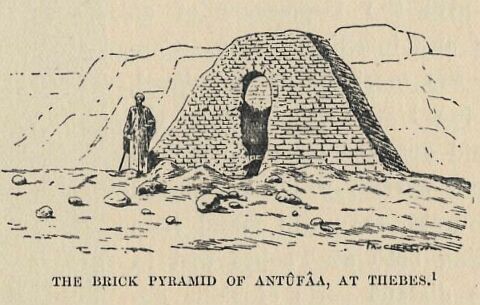
Drawn by Faucher-Gudin, from a sketch by Prisse d’Avennes. This pyramid is now completely destroyed.
As in the times of Uni, the barbarians made up the complement of the army with soldiers who were more inured to hardships and more accustomed to the use of arms than the ordinary fellahîn; and several obscure Pharaohs—such as Monthotpû I. and Antûf III.—owed their boasted victories over Libyans and Asiatics* to the energy of their mercenaries.
* The cartouches of Antûfâa, inscribed on the rocks of Elephantine, are the record of a visit which this prince paid to Syenê, probably on his return from some raid; many similar inscriptions of Pharaohs of the XIIth dynasty were inscribed in analogous circumstances. Nûbkhopirrî Antûf boasted of having worsted the Amû and the negroes. On one of the rocks of the island of Konosso, Monthotpû Nibhotpûrî sculptured a scene of offerings in which the gods are represented as granting him victory over all peoples. Among the ruins of the temple which he built at Gebelên, is a scene in which he is presenting files of prisoners from different countries to the Theban gods.
But the kings of the XIth dynasty were careful not to wander too far from the valley of the Nile. Egypt presented a sufficiently wide field for their activity, and they exerted themselves to the utmost to remedy the evils from which the country had suffered for hundreds of years. They repaired the forts, restored or enlarged the temples, and evidences of their building are found at Koptos, Gebelên, El-Kab, and Abydos. Thebes itself has been too often overthrown since that time for any traces of the work of the XIth dynasty kings in the temple of Amon to be distinguishable; but her necropolis is still full of their “eternal homes,” stretching in lines across the plain, opposite Karnak, at Drah abû’l-Neggah, and on the northern slopes of the valley of Deir-el-Baharî. Some were excavated in the mountain-side, and presented a square façade of dressed stone, surmounted by a pointed roof in the shape of a pyramid. Others were true pyramids, sometimes having a pair of obelisks in front of them, as well as a temple. None of them attained to the dimensions of the Memphite tombs; for, with only its own resources at command, the kingdom of the south could not build monuments to compete with those whose construction had taxed the united efforts of all Egypt, but it used a crude black brick, made without grit or straw, where the Egyptians of the north had preferred more costly stone. These inexpensive pyramids were built on a rectangular base not more than six and a half feet high; and the whole erection, which was simply faced with whitewashed stucco, never exceeded thirty-three feet in height. The sepulchral chamber was generally in the centre; in shape it resembled an oven, its roof being “vaulted” by the overlapping of the courses. Often also it was constructed partly in the base, and partly in the foundations below the base, the empty space above it being intended merely to lighten the weight of the masonry. There was not always an external chapel attached to these tombs, but a stele placed on the substructure, or fixed in one of the outer faces, marked the spot to which offerings were to be brought for the dead; sometimes, however, there was the addition of a square vestibule in front of the tomb, and here, on prescribed days, the memorial ceremonies took place. The statues of the double were rude and clumsy, the coffins heavy and massive, and the figures with which they were decorated inelegant and out of proportion, while the stelæ are very rudely cut. From the time of the VIth dynasty the lords of the Saïd had been reduced to employing workmen from Memphis to adorn their monuments; but the rivalry between the Thebans and the Heracleopolitans, which set the two divisions of Egypt against each other in constant hostility, obliged the Antufs to entrust the execution of their orders to the local schools of sculptors and painters. It is difficult to realize the degree of rudeness to which the unskilled workmen who made certain of the Akhmîtn and Gebelên sarcophagi must have sunk; and even at Thebes itself, or at Abydos, the execution of both bas-reliefs and hieroglyphs shows minute carefulness rather than any real skill or artistic feeling. Failing to attain to the beautiful, the Egyptians endeavoured to produce the sumptuous. Expeditions to the Wady Ham marnât to fetch blocks of granite for sarcophagi become more and more frequent, and wells were sunk from point to point along the road leading from Koptos to the mountains. Sometimes these expeditions were made the occasion for pushing on as far as the port of Saû and embarking on the Eed Sea. A hastily constructed boat cruised along by the shore, and gum, incense, gold, and the precious stones of the country were brought from the land of the Troglodytes. On the return of the convoy with its block of stone, and various packages of merchandise, there was no lack of scribes to recount the dangers of the campaign in exaggerated language, or to congratulate the reigning Pharaoh on having sown abroad the fame and terror of his name in the countries of the gods, and as far as the land of Pûanît.
The final overthrow of the Heracleopolitan dynasty, and the union of the two kingdoms under the rule of the Theban house, are supposed to have been the work of that Monthotpû whose throne-name was Nibkhrôûrî; his, at any rate, was the name which the Egyptians of Kamesside times inscribed in the royal lists as that of the founder and most illustrious representative of the XIth dynasty. The monuments commemorate his victories over the Uaûaiû and the barbarous inhabitants of Nubia. Even after he had conquered the Delta he still continued to reside in Thebes; there he built his pyramid, and there divine honours were paid him from the day after his decease. A scene carved on the rocks north of Silsileh represents him as standing before his son Antûf; he is of gigantic stature, and one of his wives stands behind him.*
* Brugsch makes him out to be a descendant of Amenemhâît, the prince of Thebes who lived under Monthotpu Nibtûirî, and who went to bring the stone for that Pharaoh’s sarcophagus from the Wady Hammamât. He had previously supposed him to be this prince himself. Either of these hypotheses becomes probable, according as Nibtûirî is supposed to have lived before or after Nibkhrôûrî.
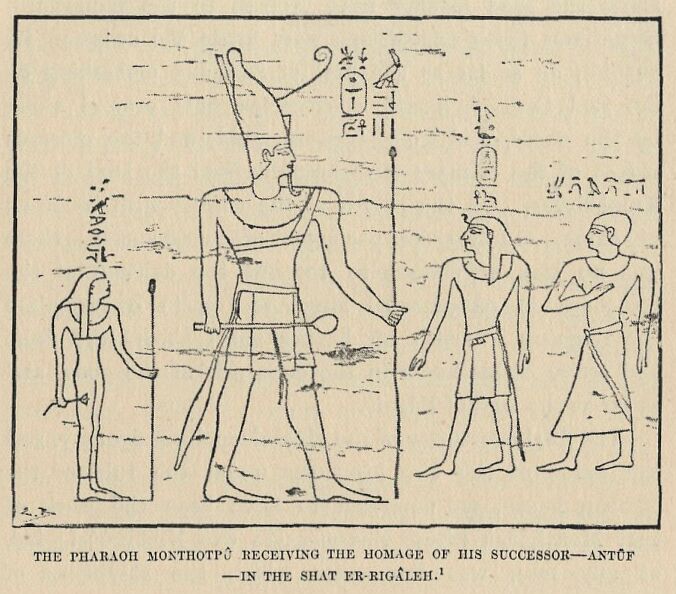
Drawn by Boudier, from a sketch by Petrie, Ten Years’ Digging in Egypt, p. 74, No. 2.
Three or four kings followed him in rapid succession; the least insignificant among them appearing to have been a Monthotpii Nibtouiri. Nothing but the prenomen—Sonkherî—is known of the last of these latter princes, who was also the only one of them ever entered on the official lists. In their hands the sovereignty remained unchanged from what it had been almost uninterruptedly since the end of the VIth dynasty. They solemnly proclaimed their supremacy, and their names were inscribed at the head of public documents; but their power scarcely extended beyond the limits of their family domain, and the feudal chiefs never concerned themselves about the sovereign except when he evinced the power or will to oppose them, allowing him the mere semblance of supremacy over the greater part of Europe. Such a state of affairs could only be reformed by revolution. Amenemhâît I., the leader of the new dynasty, was of the Theban race; whether he had any claim to the throne, or by what means he had secured the stability of his rule, we do not know. Whether he had usurped the crown or whether he had inherited it legitimately, he showed himself worthy of the rank to which fortune had raised him, and the nobility saw in him a new incarnation of that type of kingship long known to them by tradition only, namely, that of a Pharaoh convinced of his own divinity and determined to assert it. He inspected the valley from one end to another, principality by principality, nome by nome, “crushing crime, and arising like Tûmû himself; restoring that which he found in ruins, settling the bounds of the towns, and establishing for each its frontiers.” The civil wars had disorganized everything; no one knew what ground belonged to the different nomes, what taxes were due from them, nor how questions of irrigation could be equitably decided. Amenemhâît set up again the boundary stelae, and restored its dependencies to each nome: “He divided the waters among them according to that which was in the cadastral surveys of former times.” Hostile nobles, or those whose allegiance was doubtful, lost the whole or part of their fiefs; those who had welcomed the new order of things received accessions of territory as the reward of their zeal and devotion. Depositions and substitutions of princes had begun already in the time of the XIth dynasty. Antûf V., for instance, finding the lord of Koptos too lukewarm, had had him removed and promptly replaced. The fief of Siût accrued to a branch of the family which was less warlike, and above all less devoted to the old dynasty than that of Khîti had been. Part of the nome of the Gazelle was added to the dominions of Nûhri, prince of the Hare nome; the eastern part of the same nome, with Monaît-Khûfûi as capital, was granted to his father-in-law, Khnûmhotpû I. Expeditions against the Ûaûaiû, the Mâzaiû, and the nomads of Libya and Arabia delivered the fellahîn from their ruinous raids and ensured to the Egyptians safety from foreign attack. Amenemhâît had, moreover, the wit to recognize that Thebes was not the most suitable place of residence for the lord of all Egypt; it lay too far to the south, was thinly populated, ill-built, without monuments, without prestige, and almost without history. He gave it into the hands of one of his relations to govern in his name, and proceeded to establish himself in the heart of the country, in imitation of the glorious Pharaohs from whom he claimed to be descended. But the ancient royal cities of Kheops and his children had ceased to exist; Memphis, like Thebes, was now a provincial town, and its associations were with the VIth and VIIIth dynasties only. Amenemhâît took up his abode a little to the south of Dahshur, in the palace of Titoûi, which he enlarged and made the seat of his government. Conscious of being in the hands of a strong ruler, Egypt breathed freely after centuries of distress, and her sovereign might in all sincerity congratulate himself on having restored peace to his country. “I caused the mourner to mourn no longer, and his lamentation was no longer heard,—perpetual fighting was no longer witnessed,—while before my coming they fought together as bulls unmindful of yesterday,—and no man’s welfare was assured, whether he was ignorant or learned.”—“I tilled the land as far as Elephantine,—I spread joy throughout the country, unto the marshes of the Delta.—At my prayer the Nile granted the inundation to the fields:—no man was an hungered under me, no man was athirst under me,—for everywhere men acted according to my commands, and all that I said was a fresh cause of love.”
In the court of Amenemhâît, as about all Oriental sovereigns, there were doubtless men whose vanity or interests suffered by this revival of the royal authority; men who had found it to their profit to intervene between Pharaoh and his subjects, and who were thwarted in their intrigues or exactions by the presence of a prince determined on keeping the government in his own hands.
These men devised plots against the new king, and he escaped with difficulty from their conspiracies. “It was after the evening meal, as night came on,—I gave myself up to pleasure for a time,—then I lay down upon the soft coverlets in my palace, I abandoned myself to repose,—and my heart began to be overtaken by slumber; when, lo! they gathered together in arms to revolt against me,—and I became weak as a serpent of the field.—Then I aroused myself to fight with my own hands,—and I found that I had but to strike the unresisting.—When I took a foe, weapon in hand, I make the wretch to turn and flee;—strength forsook him, even in the night; there were none who contended, and nothing vexatious was effected against me.” The conspirators were disconcerted by the promptness with which Amenemhâît had attacked them, and apparently the rebellion was suppressed on the same night in which it broke out. But the king was growing old, his son Usirtasen was very young, and the nobles were bestirring themselves in prospect of a succession which they supposed to be at hand. The best means of putting a stop to their evil devices and of ensuring the future of the dynasty was for the king to appoint the heir-presumptive, and at once associate him with himself in the exercise of his sovereignty. In the XXth year of his reign, Amenemhâît solemnly conferred the titles and prerogatives of royalty upon his son Usirtasen: “I raised thee from the rank of a subject,—I granted thee the free use of thy arm that thou mightest be feared.—As for me, I apparelled myself in the fine stuffs of my palace until I appeared to the eye as the flowers of my garden,—and I perfumed myself with essences as freely as I pour forth the water from my cisterns.” Usirtasen naturally assumed the active duties of royalty as his share. “He is a hero who wrought with the sword, a mighty man of valour without peer: he beholds the barbarians, he rushes forward and falls upon their predatory hordes. He is the hurler of javelins who makes feeble the hands of the foe; those whom he strikes never more lift the lance. Terrible is he, shattering skulls with the blows of his war-mace, and none resisted him in his time. He is a swift runner who smites the fugitive with the sword, but none who run after him can overtake him. He is a heart alert for battle in his time. He is a lion who strikes with his claws, nor ever lets go his weapon. He is a heart girded in armour at the sight of the hosts, and who leaves nothing standing behind him. He is a valiant man rushing forward when he beholds the fight. He is a soldier rejoicing to fall upon the barbarians: he seizes his buckler, he leaps forward and kills without a second blow. None may escape his arrow; before he bends his bow the barbarians flee from his arms like dogs, for the great goddess has charged him to fight against all who know not her name, and whom he strikes he spares not; he leaves nothing alive.” The old Pharaoh “remained in the palace,” waiting until his son returned to announce the success of his enterprises, and contributing by his counsel to the prosperity of their common empire. Such was the reputation for wisdom which he thus acquired, that a writer who was almost his contemporary composed a treatise in his name, and in it the king was supposed to address posthumous instructions to his son on the art of governing. He appeared to his son in a dream, and thus admonished him: “Hearken unto my words!—Thou art king over the two worlds, prince over the three regions. Act still better than did thy predecessors.—Let there be harmony between thy subjects and thee,—lest they give themselves up to fear; keep not thyself apart in the midst of them; make not thy brother solely from the rich and noble, fill not thy heart with them alone; yet neither do thou admit to thy intimacy chance-comers whose place is unknown.” The king confirmed his counsels by examples taken from his own life, and from these we have learned some facts in his history. The little work was widely disseminated and soon became a classic; in the time of the XIXth dynasty it was still copied in schools and studied by young scribes as an exercise in style. Usirfcasen’s share in the sovereignty had so accustomed the Egyptians to consider this prince as the king de facto, that they had gradually come to write his name alone upon the monuments. When Amenemhâît died, after a reign of thirty years, Ûsirtasen was engaged in a war against the Libyans. Dreading an outbreak of popular feeling, or perhaps an attempted usurpation by one of the princes of the blood, the high officers of the crown kept Amenemhâît’s death secret, and despatched a messenger to the camp to recall the young king. He left his tent by night, unknown to the troops, returned to the capital before anything had transpired among the people, and thus the transition from the founder to his immediate successor—always a delicate crisis for a new dynasty—seemed to come about quite naturally. The precedent of co-regnancy having been established, it was scrupulously followed by most of the succeeding sovereigns. In the XIIIth year of his sovereignty, and after having reigned alone for thirty-two years, Ûsirtasen I. shared his throne with Amenemhâît II.; and thirty-two years later Amenemhâît II. acted in a similar way with regard to Ûsirtasen II. Amenemhâît III. and Amenemhâît IV. were long co-regnant. The only princes of this house in whose cases any evidence of co-regnancy is lacking are Ûsirtasen III., and the queen Sovknofriûrî, with whom the dynasty died out.
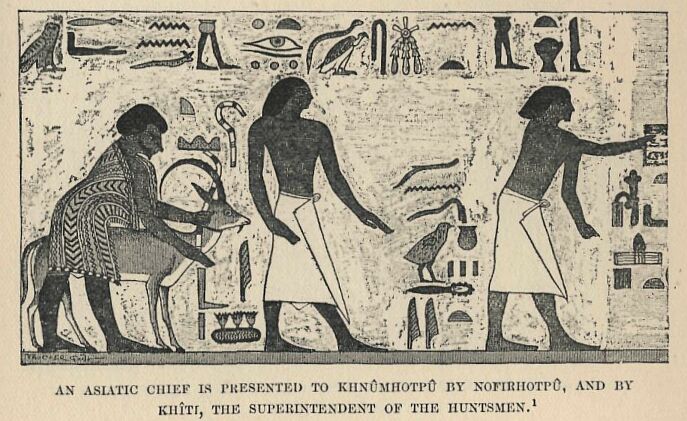
Drawn by Faucher-Gudin, from a chromolithograph in Lepsius, Denhm., ii. 133.
It lasted two hundred and thirteen years, one month, and twenty-seven days,* and its history can be ascertained with greater certainty and completeness than that of any-other dynasty which ruled over Egypt.
*This is its total duration, as given in the Turin papyrus. Several Egyptologists have thought that Manetho had, in his estimate, counted the years of each sovereign as consecutive, and have hence proposed to conclude that the dynasty only lasted 168 years (Brugscii), or 160 (Lieblein), or 194 (Ed. Meyer). It is simpler to admit that the compiler of the papyrus was not in error; we do not know the length of the reigns of Ûsirtasen II., Ûsirtasen III., and Amenemhâît III., and their unknown years may be considered as completing the tale of the two hundred and thirteen years.
We are doubtless far from having any adequate idea of its great achievements, for the biographies of its eight sovereigns, and the details of their interminable wars are very imperfectly known to us. The development of its foreign and domestic policy we can, however, follow without a break.
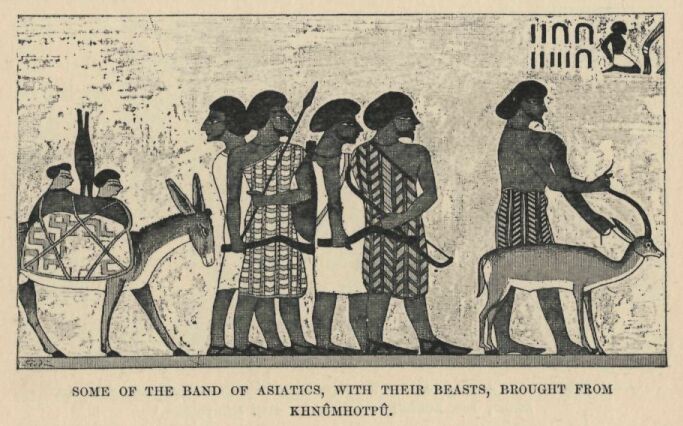
Asia had as little attraction for these kings as for their Memphite predecessors; they seem to have always had a certain dread of its warlike races, and to have merely contented themselves with repelling their attacks. Amenemhâît I. had completed the line of fortresses across the isthmus, and these were carefully maintained by his successors. The Pharaohs were not ambitious of holding direct sway over the tribes of the desert, and scrupulously avoided interfering with their affairs as long as the “Lords of the Sands” agreed to respect the Egyptian frontier. Commercial relations were none the less frequent and certain on this account.
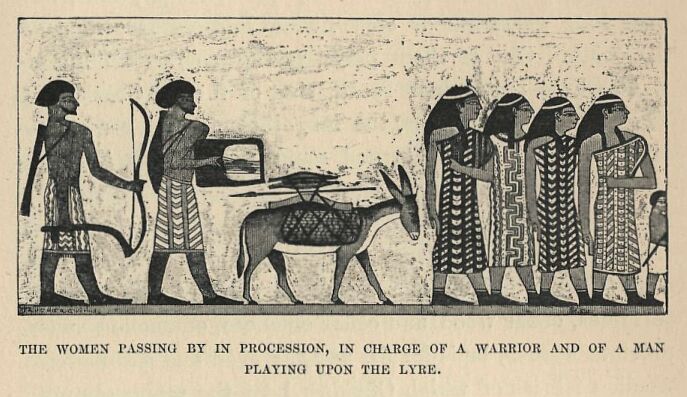
Dwellers by the streams of the Delta were accustomed to see the continuous arrival in their towns of isolated individuals or of whole bands driven from their homes by want or revolution, and begging for refuge under the shadow of Pharaoh’s throne, and of caravans offering the rarest products of the north and of the east for sale. A celebrated scene in one of the tombs of Beni-Hasan illustrates what usually took place. We do not know what drove the thirty-seven Asiatics, men, women, and children, to cross the Red Sea and the Arabian desert and hills in the VIth year of Usirtasen II.;* they had, however, suddenly appeared in the Gazelle nome, and were there received by Khîti, the superintendent of the huntsmen, who, as his duty was, brought them before the prince Khnûmhotpû.
* This bas-relief was first noticed and described by Champollion, who took the immigrants for Greeks of the archaic period. Others have wished to consider it as representing Abraham, the sons of Jacob, or at least a band of Jews entering into Egypt, and on the strength of this hypothesis it has often been reproduced.
The foreigners presented the prince with green eye-paint, antimony powder, and two live ibexes, to conciliate his favour; while he, to preserve the memory of their visit, had them represented in painting upon the walls of his tomb. The Asiatics carry bows and arrows, javelins, axes, and clubs, like the Egyptians, and wear long garments or close-fitting loin-cloths girded on the thigh. One of them plays, as he goes, on an instrument whose appearance recalls that of the old Greek lyre. The shape of their arms, the magnificence and good taste of the fringed and patterned stuffs with which they are clothed, the elegance of most of the objects which they have brought with them, testify to a high standard of civilisation, equal at least to that of Egypt. Asia had for some time provided the Pharaohs with slaves, certain perfumes, cedar wood and cedar essences, enamelled vases, precious stones, lapis-lazuli, and the dyed and embroidered woollen fabrics of which Chaldæa kept the monopoly until the time of the Komans. Merchants of the Delta braved the perils of wild beasts and of robbers lurking in every valley, while transporting beyond the isthmus products of Egyptian manufacture, such as fine linens, chased or cloisonné jewellery, glazed pottery, and glass paste or metal amulets. Adventurous spirits who found life dull on the banks of the Nile, men who had committed crimes, or who believed themselves suspected by their lords on political grounds, conspirators, deserters, and exiles were well received by the Asiatic tribes, and sometimes gained the favour of the sheikhs. In the time of the XIIth dynasty, Southern Syria, the country of the “Lords of the Sands,” and the kingdom of Kadûma were full of Egyptians whose eventful careers supplied the scribes and storytellers with the themes of many romances.
Sinûhît, the hero of one of these stories, was a son of Amenemhâît I., and had the misfortune involuntarily to overhear a state secret. He happened to be near the royal tent when news of his father’s sudden death was brought to Usirtasen. Fearing summary execution, he fled across the Delta north of Memphis, avoided the frontier-posts, and struck into the desert. “I pursued my way by night; at dawn I had reached Pûteni, and set out for the lake of Kîmoîrî. Then thirst fell upon me, and the death-rattle was in my throat, my throat cleaved together, and I said, ‘It is the taste of death!’ when suddenly I lifted up my heart and gathered my strength together: I heard the lowing of the herds. I perceived some Asiatics; their chief, who had been in Egypt, knew me; he gave me water, and caused milk to be boiled for me, and I went with him and joined his tribe.” But still Sinûhît did not feel himself in safety, and fled into Kadûma, to a prince who had provided an asylum for other Egyptian exiles, and where he “could hear men speak the language of Egypt.” Here he soon gained honours and fortune. “The chief preferred me before his children, giving me his eldest daughter in marriage, and he granted me that I should choose for myself the best of his land near the frontier of a neighbouring country. It is an excellent land, Aîa is its name. Figs are there and grapes; wine is more plentiful than water; honey abounds in it; numerous are its olives and all the produce of its trees; there are corn and flour without end, and cattle of all kinds. Great, indeed, was that which was bestowed upon me when the prince came to invest me, installing me as prince of a tribe in the best of his land. I had daily rations of bread and wine, day by day; cooked meat and roasted fowl, besides the mountain game which I took, or which was placed before me in addition to that which was brought me by my hunting dogs. Much butter was made for me, and milk prepared in every kind of way. There I passed many years, and the children which were born to me became strong men, each ruling his own tribe. When a messenger was going to the interior or returning from it, he turned aside from his way to come to me, for I did kindness to all: I gave water to the thirsty, I set again upon his way the traveller who had been stopped on it, I chastised the brigand. The Pitaîtiû, who went on distant campaigns to fight and repel the princes of foreign lands, I commanded them and they marched forth; for the prince of Tonû made me the general of his soldiers for long years. When I went forth to war, all countries towards which I set out trembled in their pastures by their wells. I seized their cattle, I took away their vassals and carried off their slaves, I slew the inhabitants, the land was at the mercy of my sword, of my bow, of my marches, of my well-conceived plans glorious to the heart of my prince. Thus, when he knew my valour, he loved me, making me chief among his children when he saw the strength of my arms.
“A valiant man of Tonu came to defy me in my tent; he was a hero beside whom there was none other, for he had overthrown all his adversaries. He said: ‘Let Sinûhît fight with me, for he has not yet conquered me!’ and he thought to seize my cattle and therewith to enrich his tribe. The prince talked of the matter with me. I said: ‘I know him not. Verily, I am not his brother. I keep myself far from his dwelling; have I ever opened his door, or crossed his enclosures? Doubtless he is some jealous fellow envious at seeing me, and who believes himself fated to rob me of my cats, my goats, my kine, and to fall on my bulls, my rams, and my oxen, to take them.... If he has indeed the courage to fight, let him declare the intention of his heart! Shall the god forget him whom he has heretofore favoured? This man who has challenged me to fight is as one of those who lie upon the funeral couch. I bent my bow, I took out my arrows, I loosened my poignard, I furbished my arms. At dawn all the land of Tonu ran forth; its tribes were gathered together, and all the foreign lands which were its dependencies, for they were impatient to see this duel. Each heart was on live coals because of me; men and women cried ‘Ah!’ for every heart was disquieted for my sake, and they said: ‘Is there, indeed, any valiant man who will stand up against him? Lo! the enemy has buckler, battle-axe, and an armful of javelins.’ When he had come forth and I appeared, I turned aside his shafts from me. When not one of them touched me, he fell upon me, and then I drew my bow against him. When my arrow pierced his neck, he cried out and fell to the earth upon his nose; I snatched his lance from him, I shouted my cry of victory upon his back. While the country people rejoiced, I made his vassals whom he had oppressed to give thanks to Montu. This prince, Ammiânshi, bestowed upon me all the possessions of the vanquished, and I took away his goods, I carried off his cattle. All that he had desired to do unto me that did I unto him; I took possession of all that was in his tent, I despoiled his dwelling; therewith was the abundance of my treasure and the number of my cattle increased.” In later times, in Arab romances such as that of Antar or that of Abû-Zeît, we find the incidents and customs described in this Egyptian tale; there we have the exile arriving at the court of a great sheikh whose daughter he ultimately marries, the challenge, the fight, and the raids of one people against another. Even in our own day things go on in much the same way. Seen from afar, these adventures have an air of poetry and of grandeur which fascinates the reader, and in imagination transports him into a world more heroic and more noble than our own. He who cares to preserve this impression would do well not to look too closely at the men and manners of the desert. Certainly the hero is brave, but he is still more brutal and treacherous; fighting is one object of his existence, but pillage is a far more important one. How, indeed, should it be otherwise? the soil is poor, life hard and precarious, and from remotest antiquity the conditions of that life have remained unchanged; apart from firearms and Islam, the Bedouin of to-day are the same as the Bedouin of the days of Sinûhît.
There are no known documents from which we can derive any certain information as to what became of the mining colonies in Sinai after the reign of Papi II. Unless entirely abandoned, they must have lingered on in comparative idleness; for the last of the Memphites, the Heracleopohtans, and the early Thebans were compelled to neglect them, nor was their active life resumed until the accession of the XIIth dynasty. The veins in the Wady Maghara were much exhausted, but a series of fortunate explorations revealed the existence of untouched deposits in the Sarbût-el-Khâdîm, north of the original workings. From the time of Amenemhâît II. these new veins were worked, and absorbed attention during several generations. Expeditions to the mines were sent out every three or four years, sometimes annually, under the command of such high functionaries as “Acquaintances of the King,” “Chief Lectors,” and Captains of the Archers. As each mine was rapidly worked out, the delegates of the Pharaohs were obliged to find new veins in order to meet industrial demands. The task was often arduous, and the commissioners generally took care to inform posterity very fully as to the anxieties which they had felt, the pains which they had taken, and the quantities of turquoise or of oxide of copper which they had brought into Egypt. Thus the Captain Haroëris tells us that, on arriving at Sarbût in the month Pha-menoth of an unknown year of Amenemhâît III., he made a bad beginning in his work of exploration. Wearied of fruitless efforts, the workmen were quite ready to desert him if he had not put a good face on the business and stoutly promised them the support of the local Hâthor.
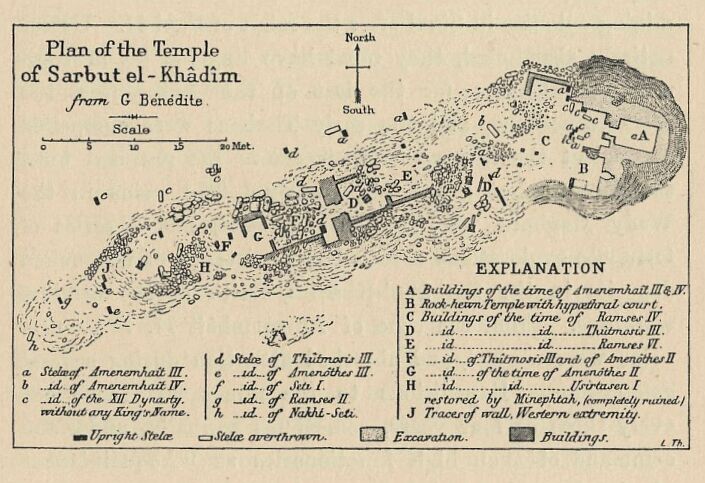
And, as a matter of fact, fortune did change. When he began to despair, “the desert burned like summer, the mountain was on fire, and the vein exhausted; one morning the overseer who was there questioned the miners, the skilled workers who were used to the mine, and they said: ‘There is turquoise for eternity in the mountain.’ At that very moment the vein appeared.” And, indeed, the wealth of the deposit which he found so completely indemnified Haroëris for his first disappointments, that in the month Pachons, three months after the opening of these workings, he had finished his task and prepared to leave the country, carrying his spoils with him. From time to time Pharaoh sent convoys of cattle and provisions—corn, sixteen oxen, thirty geese, fresh vegetables, live poultry—to his vassals at the mines.
Drawn by Boudier, from a photograph in the Ordnance Survey, Photo-graphs, vol. iii. pl. 8.
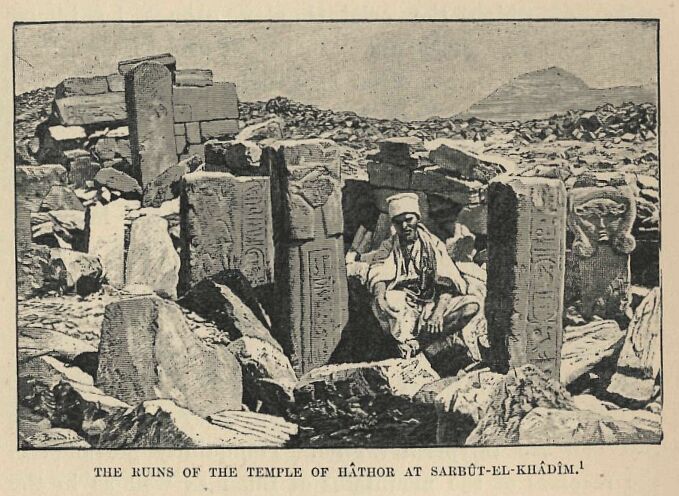
The mining population increased so fast that two chapels were built, dedicated to Hâthor, and served by volunteer priests. One of these chapels, presumably the oldest, consists of a single rock-cut chamber, upheld by one large square pillar, walls and pillar having been covered with finely sculptured scenes and inscriptions which are now almost effaced. The second chapel included a beautifully proportioned rectangular court, once entered by a portico supported on pillars with Hâthor-head capitals, and beyond the court a narrow building divided into many small irregular chambers. The edifice was altered and rebuilt, and half destroyed; it is now nothing by a confused heap of ruins, of which the original plan cannot be traced. Votive stehe of all shapes and sizes, in granite, sandstone, or limestone, were erected here and there at random in the two chambers and in the courts between the columns, and flush with the walls. Some are still in situ, others lie scattered in the midst of the ruins. Towards the middle of the reign of Amenemhâît III., the industrial demand for turquoise and for copper ore became so great that the mines of Sarbût-el-Khâdîm could no longer meet it, and those in the Wady Maghara were re-opened. The workings of both sets of mines were carried on with unabated vigour under Amenemhâîfc IV., and were still in full activity when the XIIIth dynasty succeeded the XIIth on the Egyptian throne. Tranquillity prevailed in the recesses of the mountains of Sinai as well as in the valley of the Nile, and a small garrison sufficed to keep watch over the Bedouin of the neighbourhood. Sometimes the latter ventured to attack the miners, and then fled in haste, carrying off their meagre booty; but they were vigorously pursued under the command of one of the officers on the spot, and generally caught and compelled to disgorge their plunder before they had reached the shelter of their “douars.” The old Memphite kings prided themselves on these armed pursuits as though they were real victories, and had them recorded in triumphal bas-reliefs; but under the XIIth dynasty they were treated as unimportant frontier incidents, almost beneath the notice of the Pharaoh, and the glory of them—such as it was—he left to his captains then in command of those districts.
Egypt had always kept up extensive commercial relations with certain northern countries lying beyond the Mediterranean. The reputation for wealth enjoyed by the Delta sometimes attracted bands of the Haiû-nîbû to come prowling in piratical excursions along its shores; but their expeditions seldom turned out successfully, and even if the adventurers escaped summary execution, they generally ended their days as slaves in the Fayûm, or in some village of the Said. At first their descendants preserved the customs, religion, manners, and industries of their distant home, and went on making rough pottery for daily use, which was decorated in a style recalling that of vases found in the most ancient tombs of the Ægean archipelago; but they were gradually assimilated to their surroundings, and their grandchildren became fellahîn like the rest, brought up from infancy in the customs and language of Egypt.
The relations with the tribes of the Libyan desert, the Tihûnû and the Timihû, were almost invariably peaceful; although occasional raids of one of their bands into Egyptian territory would provoke counter raids into the valleys in which they took refuge with their flocks and herds. Thus, in addition to the captive Haiû-nîbû, another heterogeneous element, soon to be lost in the mass of the Egyptian population, was supplied by detachments of Berber women and children.
The relations Egypt with her northern neighbours during the hundred years of the XIIth dynasty were chiefly commercial, but occasionally this peaceful intercourse was broken by sudden incursions or piratical expeditions which called for active measures of repression, and were the occasion of certain romantic episodes. The foreign policy of the Pharaohs in this connexion was to remain strictly on the defensive. Ethiopia attracted all their attention, and demanded all their strength. The same instinct which had impelled their predecessors to pass successively beyond Gebel-Silsileh and Elephantine now drove the XIIth dynasty beyond the second cataract, and even further. The nature of the valley compelled them to this course. From the Tacazze, or rather from the confluence of the two Niles down to the sea, the whole valley forms as it were a Greater Egypt; for although separated by the cataracts into different divisions, it is everywhere subject to the same physical conditions. In the course of centuries it has more than once been forcibly dismembered by the chances of war, but its various parts have always tended to reunite, and have coalesced at the first opportunity. The Amami, the Irittt, and the Sitiu, all those nations which wandered west of the river, and whom the Pharaohs of the VIth and subsequently of the XIth dynasty either enlisted into their service or else conquered, do not seem to have given much trouble to the successors of Amenemhâît I. The Ûaûaiû and the Mâzaiû were more turbulent, and it was necessary to subdue them in order to assure the tranquillity of the colonists scattered along the banks of the river from Philo to Korosko. They were worsted by Amenemhâît I. in several encounters.
Ûsirtasen I. made repeated campaigns against them, the earlier ones being undertaken in his father’s lifetime. Afterwards he pressed on, and straightway “raised his frontiers” at the rapids of Wady Haifa; and the country was henceforth the undisputed property of his successors. It was divided into nomes like Egypt itself; the Egyptian language succeeded in driving out the native dialects, and the local deities, including Didûn, the principal god, were associated or assimilated with the gods of Egypt. Khnûmû was the favourite deity of the northern nomes, doubtless because the first colonists were natives of Elephantine, and subjects of its princes. In the southern nomes, which had been annexed under the Theban kings and were peopled with Theban immigrants, the worship of Khnûmû was carried on side by side with the worship of Amon, or Amon-Ra, god of Thebes. In accordance with local affinities, now no longer intelligible, the other gods also were assigned smaller areas in the new territory—Thot at Pselcis and Pnûbsît, where a gigantic nabk tree was worshipped, Râ near Derr, and Horus at Miama and Baûka. The Pharaohs who had civilized the country here received divine honours while still alive. Ûsirtasen III. was placed in triads along with Didûn, Amon, and Khnûmû; temples were raised to him at Semneh, Shotaûi, and Doshkeh; and the anniversary of a decisive victory which he had gained over the barbarians was still celebrated on the 21st of Pachons, a thousand years afterwards, under Thutmosis III. The feudal system spread over the land lying between the two cataracts, where hereditary barons held their courts, trained their armies, built their castles, and excavated their superbly decorated tombs in the mountain-sides. The only difference between Nubian Egypt and Egypt proper lay in the greater heat and smaller wealth of the former, where the narrower, less fertile, and less well-watered land supported a smaller population and yielded less abundant revenues.
The Pharaoh kept the charge of the more important strategical points in his own hands. Strongholds placed at bends of the river and at the mouths of ravines leading into the desert, secured freedom of navigation, and kept off the pillaging nomads. The fortress of Derr [Kubbân?—Ed.], which was often rebuilt, dates in part at least from the early days of the conquest of Nubia. Its rectangular boundary—a dry brick wall—is only broken by easily filled up gaps, and with some repairs it would still resist an Ababdeh attack.*
* The most ancient bricks in the fortifications of Derr, easily distinguishable from those belonging to the later restorations, are identical in shape and size with those of the walls at Syene and El-Kab; and the wall at El-Kab was certainly built not later than the XIIth dynasty.
The most considerable Nubian works of the XIIth dynasty were in the three places from which the country can even now be most effectively commanded, namely, at the two cataracts, and in the districts extending from Derr to Dakkeh. Elephantine already possessed an entrenched camp which commanded the rapids and the land route from Syene to Philo. Usirtasen III. restored its great wall; he also cleared and widened the passage to Sériel, as did Papi I. to such good effect that easy and rapid communication between Thebes and the new towns was at all times practicable. Some little distance from Phihe he established a station for boats, and an emporium which he called Hirû Khâkerî—“the Ways of Khâkerî”—after his own throne name—Khâkerî.*
* The widening of the passage was effected in the VIIIth year of his reign, the same year in which he established the Egyptian frontier at Semneh. The other constructions are mentioned, but not very clearly, in a stele of the same year which came from Elephantine, and is now in the British Museum. The votive tablet, engraved in honour of Anûkît at Sehêl, in which the king boasts of having made for the goddess “the excellent channel [called] ‘the Ways of Khâkeûrî,’” probably refers to this widening and deepening of the passage in the VIIIth year.
Its exact site is unknown, but it appears to have completed on the south side the system of walls and redoubts which protected the cataract provinces against either surprise or regular attacks of the barbarians. Although of no appreciable use for the purposes of general security, the fortifications of Middle Nubia were of great importance in the eyes of the Pharaohs. They commanded the desert roads leading to the Eed Sea, and to Berber and Gebel Barkel on the Upper Nile. The most important fort occupied the site of the present village of Kuban, opposite Dakkeh, and commanded the entrance to the Wady Olaki, which leads to the richest gold deposits known to Ancient Egypt. The valleys which furrow the mountains of Etbai, the Wady Shauanîb, the Waddy Umm Teyur, Gebel Iswud, Gebel Umm Kabriteh, all have gold deposits of their own. The gold is found in nuggets and in pockets in white quartz, mixed with iron oxides and titanium, for which the ancients had no use. The method of mining practised from immemorial antiquity by the Uaûaiû of the neighbourhood was of the simplest, and traces of the workings may be seen all over the sides of the ravines. Tunnels followed the direction of the lodes to a depth of fifty-five to sixty-five yards; the masses of quartz procured from them were broken up in granite mortars, pounded small and afterwards reduced to a powder in querns, similar to those used for crushing grain; the residue was sifted on stone tables, and the finely ground parts afterwards washed in bowls of sycamore wood, until the gold dust had settled to the bottom.*
* The gold-mines and the method of working them under the Ptolemies have been described by Agatharchides; the processes employed were very ancient, and had hardly changed since the time of the first Pharaohs, as is shown by a comparison of the mining tools found in these districts with those which have been collected at Sinai, in the turquoise- mines of the Ancient Empire.
This was the Nubian gold which was brought into Egypt by nomad tribes, and for which the Egyptians themselves, from the time of the XIIth dynasty onwards, went to seek in the land which produced it. They made no attempt to establish permanent colonies for working the mines, as at Sinai; but a detachment of troops was despatched nearly every year to the spot to receive the amount of precious metal collected since their previous visit. The king Usirtasen would send at one time the prince of the nome of the Gazelle on such an expedition, with a contingent of four hundred men belonging to his fief; at another time, it would be the faithful Sihâthor who would triumphantly scour the country, obliging young and old to work with redoubled efforts for his master Amenemhâît II. On his return the envoy would boast of having brought back more gold than any of his predecessors, and of having crossed the desert without losing either a soldier or a baggage animal, not even a donkey.
Drawn by Boudier, from a photograph by Insinger, taken in 1881.
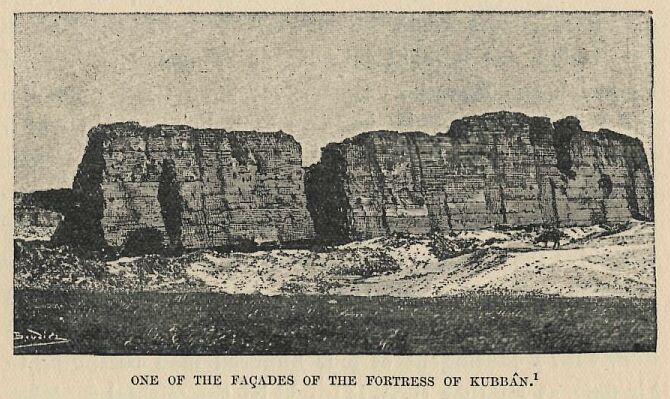
Sometimes a son of the reigning Pharaoh, even the heir-presumptive, would condescend to accompany the caravan. Amenemhâît III. repaired or rebuilt the fortress of Kubbân, the starting-place of the little army, and the spot to which it returned. It is a square enclosure measuring 328 feet on each side; the ramparts of crude brick are sloped slightly inwards, and are strengthened at intervals by bastions projecting from the external face of the wall. The river protected one side; the other three were defended by ditches communicating with the Nile. There were four entrances, one in the centre of each façade: that on the east, which faced the desert, and was exposed to the severest attacks, was flanked by a tower.
The cataract of Wady Haifa offered a natural barrier to invasion from the south. Even without fortification, the chain of granite rocks which crosses the valley at this spot would have been a sufficient obstacle to prevent any fleet which might attempt the passage from gaining access to northern Nubia.
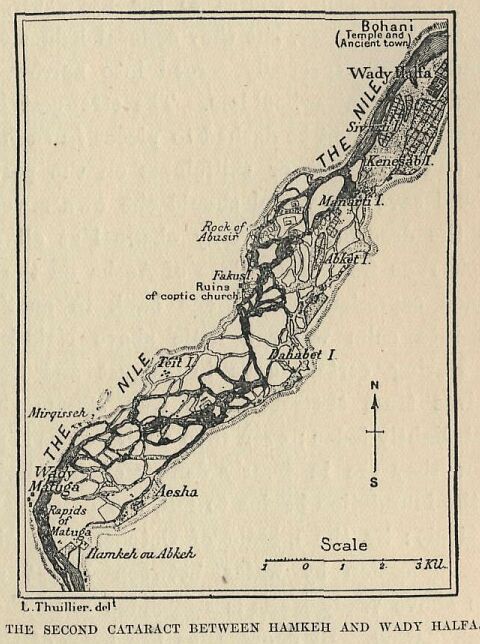
The Nile here has not the wild and imposing aspect which it assumes lower down, between Aswan and Philae. It is bordered by low and receding hills, devoid of any definite outline. Masses of bare black rock, here and there covered by scanty herbage, block the course of the river in some places in such profusion, that its entire bed seems to be taken up by them. For a distance of seventeen miles the main body of water is broken up into an infinitude of small channels in its width of two miles; several of the streams thus formed present, apparently, a tempting course to the navigator, so calm and safe do they appear, but they conceal ledges of hidden reefs, and are unexpectedly forced into narrow passages obstructed by granite boulders. The strongest built and best piloted boat must be dashed to pieces in such circumstances, and no effort or skilfulness on the part of the crew would save the vessel should the owner venture to attempt the descent. The only channel at all available for transit runs from the village of Aesha on the Arabian side, winds capriciously from one bank to another, and emerges into calm water a little above Nakhiet Wady Haifa. During certain days in August and September the natives trust themselves to this stream, but only with boats lightly laden; even then their escape is problematical, for they are in hourly danger of foundering. As soon as the inundation begins to fall, the passage becomes more difficult: by the middle of October it is given up, and communication by water between Egypt and the countries above Wady Haifa is suspended until the return of the inundation. By degrees, as the level of the water becomes lower, remains of wrecks jammed between the rocks, or embedded in sandbanks, emerge into view, as if to warn sailors and discourage them from an undertaking so fraught with perils. Usirtasen I. realized the importance of the position, and fortified its approaches.
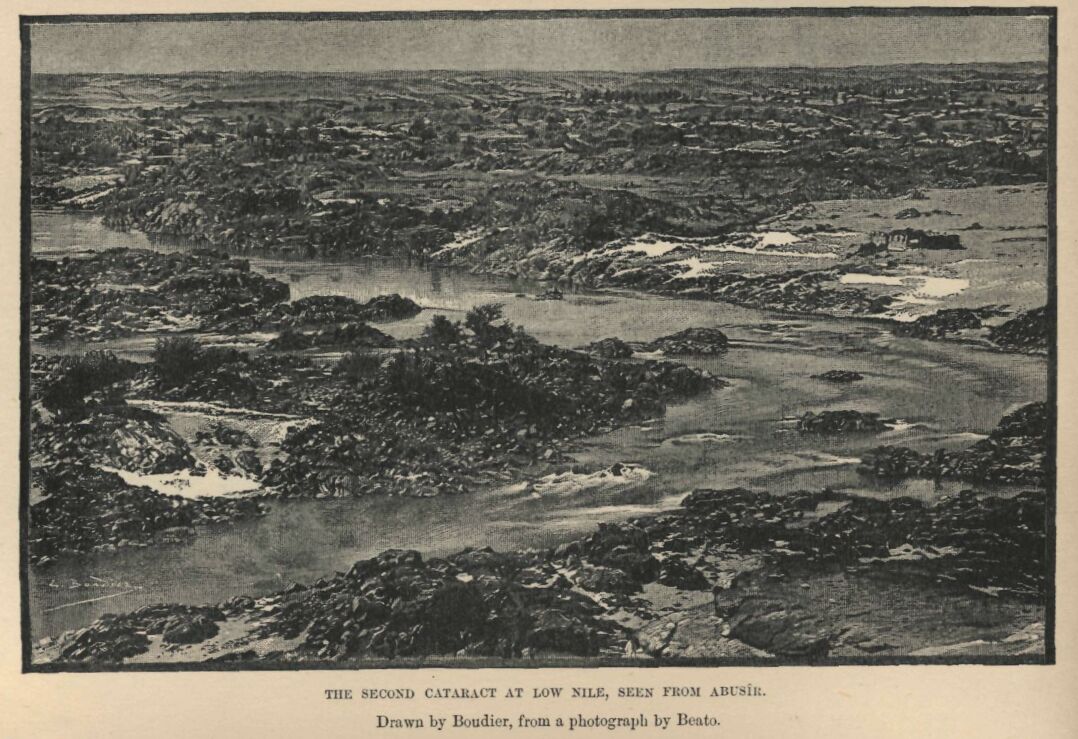
He selected the little Nubian town of Bohani, which lay exactly opposite to the present village of Wady Haifa, and transformed it into a strong frontier fortress. Besides the usual citadel, he built there a temple dedicated to the Theban god Amon and to the local Horus; he then set up a stele commemorating his victories over the peoples beyond the cataract.
Drawn by Faucher-Gudin, from a photograph of the original in the museum at Florence.
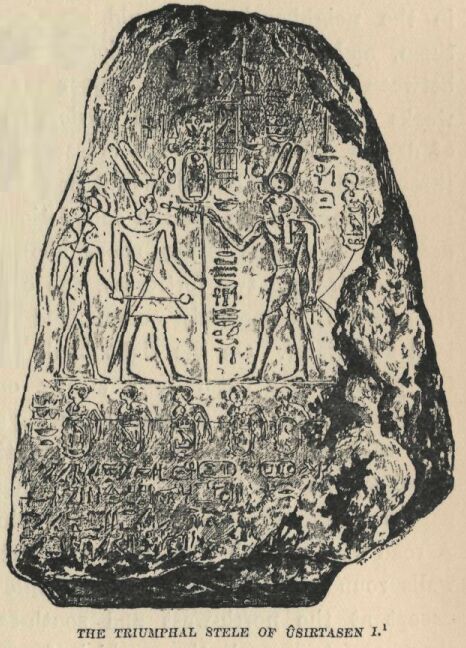
Ten of their principal chiefs had passed before Amon as prisoners, their arms tied behind their backs, and had been sacrificed at the foot of the altar by the sovereign himself: he represented them on the stele by enclosing their names in battlemented cartouches, each surmounted by the bust of a man bound by a long cord which is held by the conqueror.
Nearly a century later Ûsirtasen III. enlarged the fortress, and finding doubtless that it was not sufficiently strong to protect the passage of the cataract, he stationed outposts at various points, at Matûga, Fakus, and Kassa. They served as mooring-places where the vessels which went up and down stream with merchandise might be made fast to the bank at sunset. The bands of Bedouin, lurking in the neighbourhood, would have rejoiced to surprise them, and by their depredations to stop the commerce between the Said and the Upper Nile, during the few weeks in which it could be carried on with a minimum of danger. A narrow gorge crossed by a bed of granite, through which the Nile passes at Semneh, afforded another most favourable site for the completion of this system of defence. On cliffs rising sheer above the current, the king constructed two fortresses, one on each bank of the river, which completely commanded the approaches by land and water. On the right bank at Kummeh, where the position was naturally a strong one, the engineers described an irregular square, measuring about two hundred feet each side; two projecting bastions flanked the entrance, the one to the north covering the approaching pathways, the southern one commanding the river-bank. A road with a ditch runs at about thirteen feet from the walls round the building, closely following its contour, except at the north-west and south-east angles, where there are two projections which formed bastions. The town on the other bank, Samninû-Kharp-Khâkerî, occupied a less favourable position: its eastern flank was protected by a zone of rocks and by the river, but the three other sides were of easy approach. They were provided with ramparts which rose to the height of eighty-two feet above the plain, and were strengthened at unequal distances by enormous buttresses. These resembled towers without parapets, overlooking every part of the encircling road, and from them the defenders could take the attacking sappers in flank.
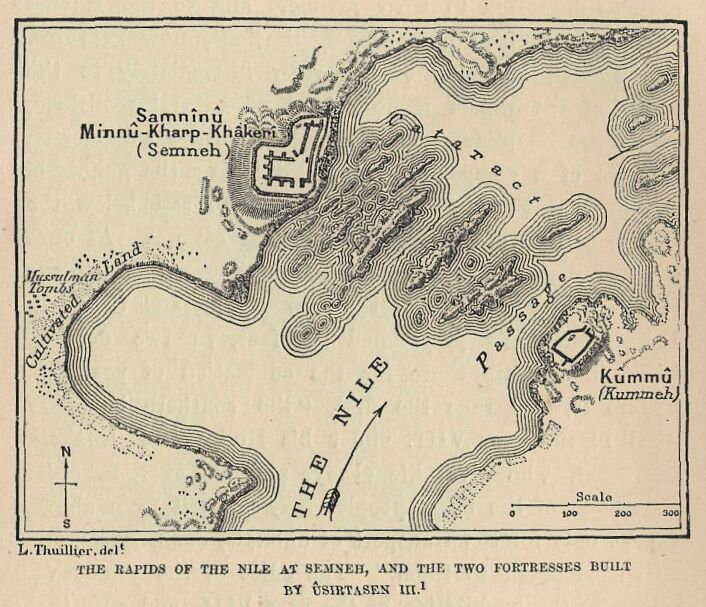
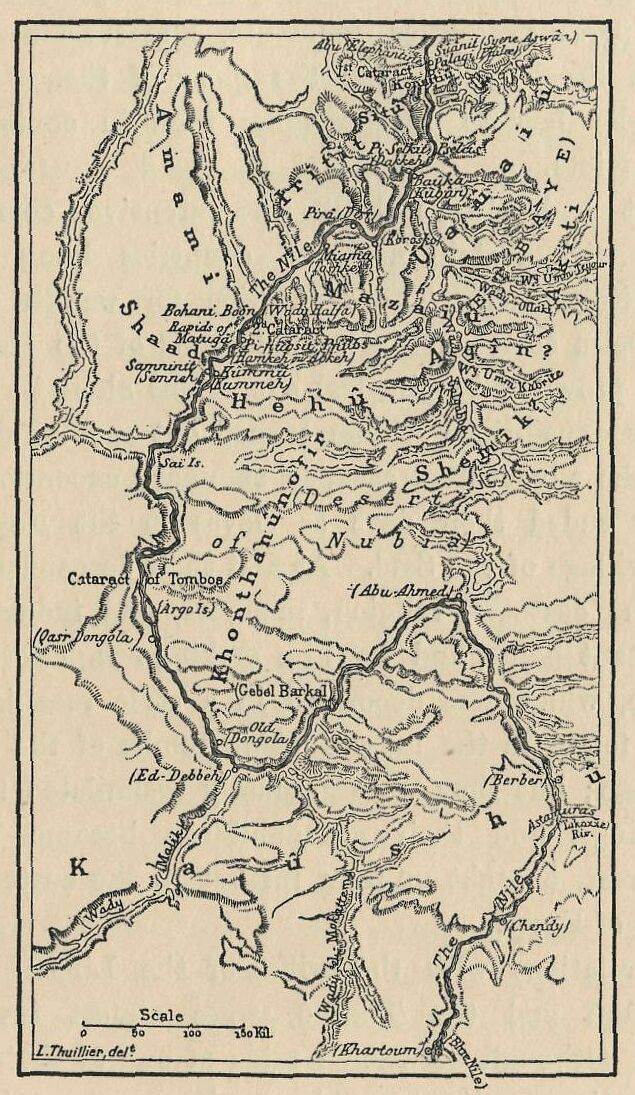
Map drawn up by Thuillier from the somewhat obsolete survey of Cailliaud
The intervals between them had been so calculated as to enable the archers to sweep the intervening space with their arrows. The main building is of crude brick, with beams laid horizontally between; the base of the external rampart is nearly vertical, while the upper part forms an angle of some seventy degrees with the horizon, making the scaling of it, if not impossible, at least very difficult. Each of the enclosing walls of the two fortresses surrounded a town complete in itself, with temples dedicated to their founders and to the Nubian deities, as well as numerous habitations, now in ruins. The sudden widening of the river immediately to the south of the rapids made a kind of natural roadstead, where the Egyptian squadron could lie without danger on the eve of a campaign against Ethiopia; the galiots of the negroes there awaited permission to sail below the rapids, and to enter Egypt with their cargoes. At once a military station and a river custom-house, Semneh was the necessary bulwark of the new Egypt, and Usirtasen III. emphatically proclaimed the fact, in two decrees, which he set up there for the edification of posterity. “Here is,” so runs the first, “the southern boundary fixed in the year VIII. under his Holiness of Khâkerî, Usirtasen, who gives life always and for ever, in order that none of the black peoples may cross it from above, except only for the transport of animals, oxen, goats, and sheep belonging to them.” The edict of the year XVI. reiterates the prohibition of the year VIII., and adds that “His Majesty caused his own statue to be erected at the landmarks which he himself had set up.” The beds of the first and second cataracts were then less worn away than they are now; they are therefore more efficacious in keeping back the water and forcing it to rise to a higher level above. The cataracts acted as indicators of the inundation, and if their daily rise and fall were studied, it was possible to announce to the dwellers on the banks lower down the river the progress and probable results of the flood.
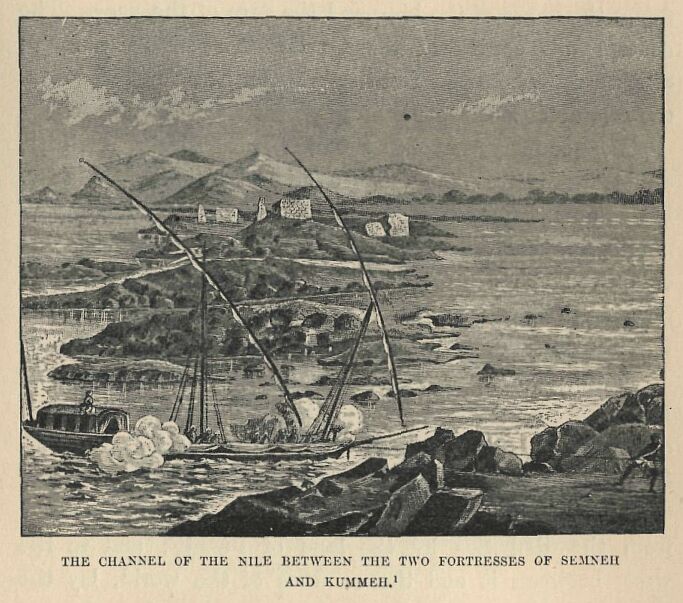
Reproduction by Faucher-Gudin of a sketch published by Cailliaud, Voyage à Méroe, Atlas, vol. ii. pl. xxx.
As long as the dominion of the Pharaohs reached no further than Philæ, observations of the Nile were always taken at the first cataract; and it was from Elephantine that Egypt received the news of the first appearance and progress of the inundation. Amenemhâît III. set up a new nilometer at the new frontier, and gave orders to his officers to observe the course of the flood. They obeyed him scrupulously, and every time that the inundation appeared to them to differ from the average of ordinary years, they marked its height on the rocks of Semneh and Kummeh, engraving side by side with the figure the name of the king and the date of the year. The custom was continued there under the XIIIth dynasty; afterwards, when the frontier was pushed further south, the nilometer accompanied it.
The country beyond Semneh was virgin territory, almost untouched and quite uninjured by previous wars. Its name now appears for the first time upon the monuments, in the form of Kaûshû—the humbled Kûsh. It comprised the districts situated to the south within the immense loop described by the river between Dongola and Khartoum, those vast plains intersected by the windings of the White and Blue Niles, known as the regions of Kordofan and Darfur; it was bounded by the mountains of Abyssinia, the marshes of Lake Nû, and all those semi-fabulous countries to which were relegated the “Isles of the Manes” and the “Lands of Spirits.” It was separated from the Red Sea by the land of Pûanît; and to the west, between it and the confines of the world, lay the Timihû. Scores of tribes, white, copper-coloured, and black, bearing strange names, wrangled over the possession of this vaguely defined territory; some of them were still savage or emerging from barbarism, while others had attained to a pitch of material civilization almost comparable with that of Egypt. The same diversity of types, the same instability and the same want of intelligence which characterized the tribes of those days, still distinguish the medley of peoples who now frequent the upper valley of the Nile. They led the same sort of animal life, guided by impulse, and disturbed, owing to the caprices of their petty chiefs, by bloody wars which often issued in slavery or in emigration to distant regions.
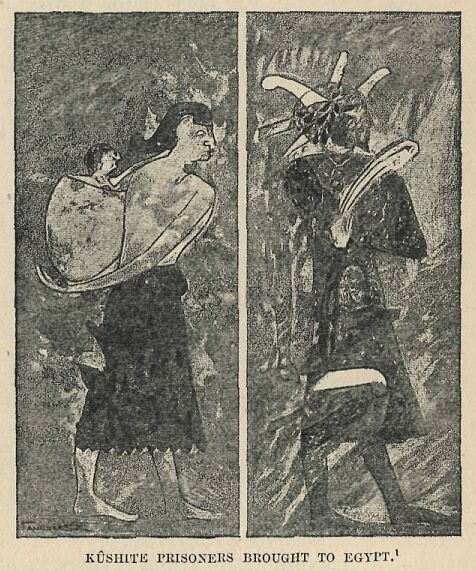
Drawn by Faucher-Guclin, from the water-colour drawing by Mr. Blackden.
With such shifting and unstable conditions, it would be difficult to build up a permanent State. From time to time some kinglet, more daring, cunning, tenacious, or better fitted to govern than the rest, extended his dominion over his neighbours, and advanced step by step, till he united immense tracts under his single rule. As by degrees his kingdom enlarged, he made no efforts to organize it on any regular system, to introduce any uniformity in the administration of its affairs, or to gain the adherence of its incongruous elements by just laws which would be equally for the good of all: when the massacres which accompanied his first victories were over, when he had incorporated into his own army what was left of the vanquished troops, when their children were led into servitude and he had filled his treasury with their spoil and his harem with their women, it never occurred to him that there was anything more to be done. If he had acted otherwise, it would not probably have been to his advantage. Both his former and present subjects were too divergent in language and origin, too widely separated by manners and customs, and too long in a state of hostility to each other, to draw together and to become easily welded into a single nation. As soon as the hand which held them together relaxed its hold for a moment, discord crept in everywhere, among individuals as well as among the tribes, and the empire of yesterday resolved itself into its original elements even more rapidly than it had been formed. The clash of arms which had inaugurated its brief existence died quickly away, the remembrance of its short-lived glory was lost after two or three generations in the horrors of a fresh invasion: its name vanished without leaving a trace behind. The occupation of Nubia brought Egypt into contact with this horde of incongruous peoples, and the contact soon entailed a struggle. It is futile for a civilized state to think of dwelling peacefully with any barbarous nation with which it is in close proximity. Should it decide to check its own advances, and impose limits upon itself which it shall not pass over, its moderation is mistaken for feebleness and impotence; the vanquished again take up the offensive, and either force the civilized power to retire, or compel it to cross its former boundary. The Pharaohs did not escape this inevitable consequence of conquest: their southern frontier advanced continually higher and higher up the Nile, without ever becoming fixed in a position sufficiently strong to defy the attacks of the Barbarians. Usirtasen I. had subdued the countries of Hahû, of Khonthanunofir, and Shaad, and had beaten in battle the Shemîk, the Khasa, the Sus, the Aqîn, the Anu, the Sabiri, and the people of Akîti and Makisa. Amenemhâît II., Usirtasen II., and Usirtasen III. never hesitated to “strike the humbled Kush” whenever the opportunity presented itself. The last-mentioned king in particular chastised them severely in his VIIIth, XIIth, XVIth, and XIXth years, and his victories made him so popular, that the Egyptians of the Greek period, identifying him with the Sesostris of Herodotus, attributed to him the possession of the universe. On the base of a colossal statue of rose granite which he erected in the temple of Tanis, we find preserved a list of the tribes which he conquered: the names of them appear to us most outlandish—Alaka, Matakaraû, Tûrasû, Pamaîka, Uarakî, Paramakâ—and we have no clue as to their position on the map. We know merely that they lived in the desert, on both sides of the Nile, in the latitude of Berber or thereabouts. Similar expeditions were sent after Ûsirtasen’s time, and Amenem-hâît III. regarded both banks of the Nile, between Semneh and Dongola, as forming part of the territory of Egypt proper. Little by little, and by the force of circumstances, the making of Greater Egypt was realized; she approached nearer and nearer towards the limit which had been prescribed for her by nature, to that point where the Nile receives its last tributaries, and where its peerless valley takes its origin in the convergence of many others.
The conquest of Nubia was on the whole an easy one, and so much personal advantage accrued from these wars, that the troops and generals entered on them without the least repugnance. A single fragment has come down to us which contains a detailed account of one of these campaigns, probably that conducted by Usirtasen III. in the XVIth year of his reign. The Pharaoh had received information that the tribes of the district of Hûâ, on the Tacazze, were harassing his vassals, and possibly also those Egyptians who were attracted by commerce to that neighbourhood. He resolved to set out and chastise them severely, and embarked with his fleet. It was an expedition almost entirely devoid of danger: the invaders landed only at favourable spots, carried off any of the inhabitants who came in their way, and seized on their cattle—on one occasion as many as a hundred and twenty-three oxen and eleven asses, on others less. Two small parties marched along the banks, and foraging to the right and left, drove the booty down to the river. The tactics of invasion have scarcely undergone any change in these countries; the account given by Cailliaud of the first conquest of Fazogl by Ismail-Pasha, in 1822, might well serve to complete the fragments of the inscription of Usirtasen III., and restore for us, almost in every detail, a faithful picture of the campaigns carried on in these regions by the kings of the XIIth dynasty. The people are hunted down in the same fashion; the country is similarly ravaged by a handful of well-armed, fairly disciplined men attacking naked and disconnected hordes, the young men are massacred after a short resistance or forced to escape into the woods, the women are carried off as slaves, the huts pillaged, villages burnt, whole tribes exterminated in a few hours. Sometimes a detachment, having imprudently ventured into some thorny thicket to attack a village perched on a rocky summit, would experience a reverse, and would with great difficulty regain the main body of troops, after having lost three-fourths of its men. In most cases there was no prolonged resistance, and the attacking party carried the place with the loss of merely two or three men killed or wounded. The spoil was never very considerable in any one locality, but its total amount increased as the raid was carried afield, and it soon became so bulky that the party had to stop and retrace their steps, in order to place it for safety in the nearest fortress. The booty consisted for the most part of herds of oxen and of cumbrous heaps of grain, as well as wood for building purposes. But it also comprised objects of small size but of great value, such as ivory, precious stones, and particularly gold. The natives collected the latter in the alluvial tracts watered by the Tacazze, the Blue Nile and its tributaries. The women were employed in searching for nuggets, which were often of considerable size; they enclosed them in little leather cases, and offered them to the merchants in exchange for products of Egyptian industry, or they handed them over to the goldsmiths to be made into bracelets, ear, nose, or finger rings, of fairly fine workmanship. Gold was found in combination with several other metals, from which they did not know how to separate it: the purest gold had a pale yellow tint, which was valued above all others, but electrum, that is to say, gold alloyed with silver in the proportion of eighty per cent., was also much in demand, while greyish-coloured gold, mixed with platinum, served for making common jewellery.*
* Cailliaud has briefly described the auriferous sand of the Qamâmyl, and the way in which it is worked: it is from him that I have borrowed the details given in the text. From analyses which I caused to be made at the Bûlaq Museum of Egyptian jewellery of the time of the XVIIIth dynasty, which had been broken and were without value, from an archeo- logical or artistic point of view, I have demonstrated the presence of the platinum and silver mentioned by Cailliaud as being found in the nuggets from the Blue Nile.
None of these expeditions produced any lasting results, and the Pharaohs established no colonies in any of these countries. Their Egyptian subjects could not have lived there for any length of time without deteriorating by intermarriage with the natives or from the effects of the climate; they would have degenerated into a half-bred race, having all the vices and none of the good qualities of the aborigines. The Pharaohs, therefore, continued their hostilities without further scruples, and only sought to gain as much as possible from their victories. They cared little if nothing remained after they had passed through some district, or if the passage of their armies was marked only by ruins. They seized upon everything which came across their path—men, chattels, or animals—and carried them back to Egypt; they recklessly destroyed everything for which they had no use, and made a desert of fertile districts which but yesterday had been covered with crops and studded with populous villages. The neighbouring inhabitants, realizing their incapacity to resist regular troops, endeavoured to buy off the invaders by yielding up all they possessed in the way of slaves, flocks, wood, or precious metals. The generals in command, however, had to reckon with the approaching low Nile, which forced them to beat a retreat; they were obliged to halt at the first appearance of it, and they turned homewards “in peace,” their only anxiety being to lose the smallest possible number of men or captured animals on their return journey.
As in earlier times, adventurous merchants penetrated into districts not reached by the troops, and prepared the way for conquest. The princes of Elephantine still sent caravans to distant parts, and one of them, Siranpîtû, who lived under Ûsirtasen I. and Amenemhâit II., recorded his explorations on his tomb, after the fashion of his ancestors: the king at several different times had sent him on expeditions to the Soudan, but the inscription in which he gives an account of them is so mutilated, that we cannot be sure which tribes he visited. We learn merely that he collected from them skins, ivory, ostrich feathers—everything, in fact, which Central Africa has furnished as articles of commerce from time immemorial. It was not, however, by land only that Egyptian merchants travelled to seek fortune in foreign countries: the Red Sea attracted them, and served as a quick route for reaching the land of Pûanît, whose treasures in perfumes and rarities of all kinds had formed the theme of ancient traditions and navigators’ tales. Relations with it had been infrequent, or had ceased altogether, during the wars of the Heracleo-politan period: on their renewal it was necessary to open up afresh routes which had been forgotten for centuries.
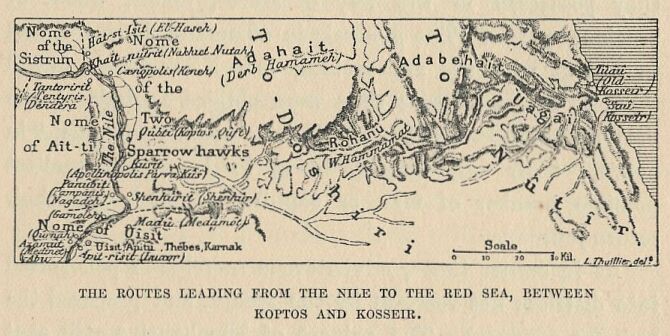
Traffic was confined almost entirely to two or three out of the many,—one which ran from Elephantine or from Nekhabît to the “Head of Nekhabît,” the Berenice of the Greeks; others which started from Thebes or Koptos, and struck the coast at the same place or at Saû, the present Kosseir. The latter, which was the shortest as well as the favourite route, passed through Wady Hammamât, from whence the Pharaohs drew the blocks of granite for their sarcophagi. The officers who were sent to quarry the stone often took advantage of the opportunity to visit the coast, and to penetrate as far as the Spice Regions. As early as the year VIII. of Sônkherî, the predecessor of Amenemhâît I., the “sole friend” Hûnû had been sent by this road, “in order to take the command of a squadron to Pûanît, and to collect a tribute of fresh incense from the princes of the desert.” He got together three thousand men, distributed to each one a goatskin bottle, a crook for carrying it, and ten loaves, and set out from Koptos with this little army. No water was met with on the way: Hûnû bored several wells and cisterns in the rock, one at a halting-place called Bait, two in the district of Adahaît, and finally one in the valleys of Adabehaît. Having reached the seaboard, he quickly constructed a great barge, freighted it with merchandise for barter, as well as with provisions, oxen, cows, and goats, and set sail for a cruise along the coast: it is not known how far he went, but he came back with a large cargo of all the products of the “Divine Land,” especially of incense. On his return, he struck off into the Uagai valley, and thence reached that of Rohanû, where he chose out splendid blocks of stone for a temple which the king was building: “Never had ‘Royal Cousin’ sent on an expedition done as much since the time of the god Râ!” Numbers of royal officers and adventurers followed in his footsteps, but no record of them has been preserved for us. Two or three names only have escaped oblivion—that of Khnûmhotpû, who in the first year of Ûsirtasen I. erected a stele in the Wady Gasûs in the very heart of the “Divine Land;” and that of Khentkhîtioîrû, who in the XXVIIIth year of Amenemhâît II. entered the haven of Saû after a fortunate cruise to Pûanît, without having lost a vessel or even a single man. Navigation is difficult in the Red Sea. The coast as a rule is precipitous, bristling with reefs and islets, and almost entirely without strand or haven. No river or stream runs into it; it is bordered by no fertile or wooded tract, but by high cliffs, half disintegrated by the burning sun, or by steep mountains, which appear sometimes a dull red, sometimes a dingy grey colour, according to the material—granite or sandstone—which predominates in their composition. The few tribes who inhabit this desolate region maintain a miserable existence by fishing and hunting: they were considered, during the Greek period, to be the most unfortunate of mortals, and if they appeared to be so to the mariners of the Ptolemies, doubtless they enjoyed the same reputation in the more remote time of the Pharaohs. A few fishing villages, however, are mentioned as scattered along the littoral; watering-places, at some distance apart, frequented on account of their wells of brackish water by the desert tribes: such were Nahasît, Tap-Nekhabît, Saû, and Tâû: these the Egyptian merchant-vessels used as victualling stations, and took away as cargo the products of the country—mother-of-pearl, amethysts, emeralds, a little lapis-lazuli, a little gold, gums, and sweet-smelling resins. If the weather was favourable, and the intake of merchandise had been scanty, the vessel, braving numerous risks of shipwreck, continued its course as far as the latitude of Sûakîn and Massowah, which was the beginning of Pûanît properly so called. Here riches poured down to the coast from the interior, and selection became a difficulty: it was hard to decide which would make the best cargo, ivory or ebony, panthers’ skins or rings of gold, myrrh, incense, or a score of other sweet-smelling gums. So many of these odoriferous resins were used for religious purposes, that it was always to the advantage of the merchant to procure as much of them as possible: incense, fresh or dried, was the staple and characteristic merchandise of the Red Sea, and the good people of Egypt pictured Pûanît as a land of perfumes, which attracted the sailor from afar by the delicious odours which were wafted from it.