Volume 2 — CHAPTER III—THE FIRST THEBAN EMPIRE (continued 2)
M. L. McClure translation
These voyages were dangerous and trying: popular imagination seized upon them and made material out of them for marvellous tales. The hero chosen was always a daring adventurer sent by his master to collect gold from the mines of Nubia; by sailing further and further up the river, he reached the mysterious sea which forms the southern boundary of the world. “I set sail in a vessel one hundred and fifty cubits long, forty wide, with one hundred and fifty of the best sailors in the land of Egypt, who had seen heaven and earth, and whose hearts were more resolute than those of lions. They had foretold that the wind would not be contrary, or that there would be even none at all; but a squall came upon us unexpectedly while we were in the open, and as we approached the land, the wind freshened and raised the waves to the height of eight cubits. As for me, I clung to a beam, but those who were on the vessel perished without one escaping. A wave of the sea cast me on to an island, after having spent three days alone with no other companion than my own heart. I slept there in the shade of a thicket; then I set my legs in motion in quest of something for my mouth.” The island produced a quantity of delicious fruit: he satisfied his hunger with it, lighted a fire to offer a sacrifice to the gods, and immediately, by the magical power of the sacred rites, the inhabitants, who up to this time had been invisible, were revealed to his eyes. “I heard a sound like that of thunder, which I at first took to be the noise of the flood-tide in the open sea; but the trees quivered, the earth trembled. I uncovered my face, and I perceived that it was a serpent which was approaching. He was thirty cubits in length, and his wattles exceeded two cubits; his body was incrusted with gold, and his colour appeared like that of real lapis. He raised himself before me and opened his mouth; while I prostrated myself before him, he said to me: ‘Who hath brought thee, who hath brought thee, little one, who hath brought thee? If thou dost not tell me immediately who brought thee to this island, I will cause thee to know thy littleness: either thou shalt faint like a woman, or thou shalt tell me something which I have not yet heard, and which I knew not before thee.’ Then he took me into his mouth and carried me to his dwelling-place, and put me down without hurting me; I was safe and sound, and nothing had been taken from me.” Our hero tells the serpent the story of his shipwreck, which moves him to pity and induces him to reciprocate his confidence. “Fear nothing, fear nothing, little one, let not thy countenance be sad! If thou hast come to me, it is the god who has spared thy life; it is he who has brought thee into this ‘Isle of the Double,’ where nothing is lacking, and which is filled with all good things. Here thou shalt pass one month after another till thou hast remained four months in this island, then shall come a vessel from thy country with mariners; thou canst depart with them to thy country, and thou shalt die in thy city. To converse rejoices the heart, he who enjoys conversation bears misfortune better; I will therefore relate to thee the history of this island.” The population consisted of seventy-five serpents, all of one family: it formerly comprised also a young girl, whom a succession of misfortunes had cast on the island, and who was killed by lightning. The hero, charmed with such good nature, overwhelmed the hospitable dragon with thanks, and promised to send him numerous presents on his return home. “I will slay asses for thee in sacrifice, I will pluck birds for thee, I will send to thee vessels filled with all the riches of Egypt, meet for a god, the friend of man in a distant country unknown to men.” The monster smiled, and replied that it was needless to think of sending presents to one who was the ruler of Pûanît; besides, “as soon as thou hast quitted this place, thou wilt never again see this island, for it will be changed into waves.”—“And then, when the vessel appeared, according as he had predicted to me, I went and perched upon a high tree and sought to distinguish those who manned it. I next ran to tell him the news, but I found that he was already informed of its arrival, and he said to me: ‘A pleasant journey home, little one; mayst thou behold thy children again, and may thy name be well spoken of in thy town; such are my wishes for thee!’ He added gifts to these obliging words. I placed all these on board the vessel which had come, and prostrating myself, I adored him. He said to me: ‘After two months thou shalt reach thy country, thou wilt press thy children to thy bosom, and thou shalt rest in thy sepulchre.’ After that I descended the shore to the vessel, and I hailed the sailors who were in it. I gave thanks on the shore to the master of the island, as well as to those who dwelt in it.” This might almost be an episode in the voyages of Sindbad the Sailor; except that the monsters which Sindbad met with in the course of his travels were not of such a kindly disposition as the Egyptian serpent: it did not occur to them to console the shipwrecked with the charm of a lengthy gossip, but they swallowed them with a healthy appetite. Putting aside entirely the marvellous element in the story, what strikes us is the frequency of the relations which it points to between Egypt and Pûanît. The appearance of an Egyptian vessel excites no astonishment on its coasts: the inhabitants have already seen many such, and at such regular intervals, that they are able to predict the exact date of their arrival. The distance between the two countries, it is true, was not considerable, and a voyage of two months was sufficient to accomplish it. While the new Egypt was expanding outwards in all directions, the old country did not cease to add to its riches. The two centuries during which the XIIth dynasty continued to rule were a period of profound peace; the monuments show us the country in full possession of all its resources and its arts, and its inhabitants both cheerful and contented. More than ever do the great lords and royal officers expatiate in their epitaphs upon the strict justice which they have rendered to their vassals and subordinates, upon the kindness which they have shown to the fellahîn, on the paternal solicitude with which, in the years of insufficient inundations or of bad harvests, they have striven to come forward and assist them, and upon the unheard-of disinterestedness which kept them from raising the taxes during the times of average Niles, or of unusual plenty. Gifts to the gods poured in from one end of the country to the other, and the great building works, which had been at a standstill since the end of the VIth dynasty, were recommenced simultaneously on all sides. There was much to be done in the way of repairing the ruins, of which the number had accumulated during the two preceding centuries. Not that the most audacious kings had ventured to lay their hands on the sanctuaries: they emptied the sacred treasuries, and partially confiscated their revenues, but when once their cupidity was satisfied, they respected the fabrics, and even went so far as to restore a few inscriptions, or, when needed, to replace a few stones. These magnificent buildings required careful supervision: in spite of their being constructed of the most durable materials—sand-stone, granite, limestone,—in spite of their enormous size, or of the strengthening of their foundations by a bed of sand and by three or four courses of carefully adjusted blocks to form a substructure, the Nile was ever threatening them, and secretly working at their destruction. Its waters, filtering through the soil, were perpetually in contact with the lower courses of these buildings, and kept the foundations of the walls and the bases of the columns constantly damp: the saltpetre which the waters had dissolved in their passage, crystallising on the limestone, would corrode and undermine everything, if precautions were not taken. When the inundation was over, the subsidence of the water which impregnated the subsoil caused in course of time settlements in the most solid foundations: the walls, disturbed by the unequal sinking of the ground, got out of the perpendicular and cracked; this shifting displaced the architraves which held the columns together, and the stone slabs which formed the roof. These disturbances, aggravated from year to year, were sufficient, if not at once remedied, to entail the fall of the portions attacked; in addition to this, the Nile, having threatened the part below with destruction, often hastened by direct attacks the work of ruin, which otherwise proceeded slowly. A breach in the embankments protecting the town or the temple allowed its waters to rush violently through, and thus to effect large gaps in the decaying walls, completing the overthrow of the columns and wrecking the entrance halls and secret chambers by the fall of the roofs. At the time when Egypt came under the rule of the XIIth dynasty there were but few cities which did not contain some ruined or dilapidated sanctuary. Amenemhâît I., although fully occupied in reducing the power of the feudal lords, restored; the temples as far as he was able, and his successors pushed forward the work vigorously for nearly two centuries.
The Delta profited greatly by this activity in building. The monuments there had suffered more than anywhere else: fated to bear the first shock of foreign invasion, and transformed into fortresses while the towns in which they were situated were besieged, they have been captured again and again by assault, broken down by attacking engines, and dismantled by all the conquerors of Egypt, from the Assyrians to the Arabs and the Turks. The fellahîn in their neighbourhood have for centuries come to them to obtain limestone to burn in their kilns, or to use them as a quarry for sandstone or granite for the doorways of their houses, or for the thresholds of their mosques. Not only have they been ruined, but the remains of their ruins have, as it were, melted away and almost entirely disappeared in the course of ages. And yet, wherever excavations have been made among these remains which have suffered such deplorable ill-treatment, colossi and inscriptions commemorating the Pharaohs of the XIIth dynasty have been brought to light. Amenemhâît I. founded a great temple at Tanis in honour of the gods of Memphis: the vestiges of the columns still scattered on all sides show that the main body of the building was of rose granite, and a statue of the same material has preserved for us a portrait of the king. He is seated, and wears the tall head-dress of Osiris. He has a large smiling face, thick lips, a short nose, and big staring eyes: the expression is one of benevolence and gentleness, rather than of the energy and firmness which one would expect in the founder of a dynasty. The kings who were his successors all considered it a privilege to embellish the temple and to place in it some memorial of their veneration for the god. Ûsirtasen I., following the example of his father, set up a statue of himself in the form of Osiris: he is sitting on his throne of grey granite, and his placid face unmistakably recalls that of Amenemhâît I. Amenemhâît II., Usirtasen II., and his wife Nofrît have also dedicated their images within the sanctuary.
Nofrît’s is of black granite: her head is almost eclipsed by the heavy Hâthor wig, consisting of two enormous tresses of hair which surround the cheeks, and lie with an outward curve upon the breast; her eyes, which were formerly inlaid, have fallen out, the bronze eyelids are lost, her arms have almost disappeared. What remains of her, however, gives us none the less the impression of a young and graceful woman, with a lithe and well-proportioned body, whose outlines are delicately modelled under the tight-fitting smock worn by Egyptian women; the small and rounded breasts curve outward between the extremities of her curls and the embroidered hem of her garment; and a pectoral bearing the name of her husband lies flat upon her chest, just below the column of her throat.
Drawn by Faucher-Gudin, from a photograph by Insinger.*
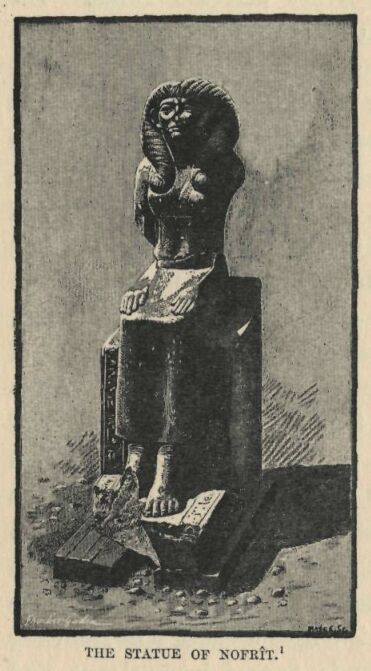
* In addition to the complete statue, the Museum at Gîzeh possesses a torso from the same source. I believe I can recognize another portrait of the same queen in a beautiful statue in black granite, which has been in the Museum at Marseilles since the beginning of the present century.
These various statues have all an evident artistic relationship to the beautiful granite figures of the Ancient Empire. The sculptors who executed them belonged to the same school as those who carved Khephren out of the solid diorite: there is the same facile use of the chisel, the same indifference to the difficulties presented by the material chosen, the same finish in the detail, the same knowledge of the human form. One is almost tempted to believe that Egyptian art remained unchanged all through those long centuries, and yet as soon as a statue of the early period is placed side by side with one of the XIIth dynasty, we immediately perceive something in the one which is lacking in the other. It is a difference in feeling, even if the technique remains unmodified. It was the man himself that the sculptors desired to represent in the older Pharaohs, and however haughty may be the countenance which we admire in the Khephren, it is the human element which predominates in him. The statues of Amenemhâît I. and his successors appear, on the contrary, to represent a superior race: at the time when these were produced, the Pharaoh had long been regarded as a god, and the divine nature in him had almost eliminated the human. Whether intentionally or otherwise, the sculptors idealized their model, and made him more and more resemble the type of the divinities. The head always appears to be a good likeness, but smoothed down and sometimes lacking in expression.
Not only are the marks of age rendered less apparent, and the features made to bear the stamp of perpetual youth, but the characteristics of the individual, such as the accentuation of the eyebrows, the protuberance of the cheek-bones, the projection of the under lip, are all softened down as if intentionally, and made to give way to a uniform expression of majestic tranquillity. One king only, Amenemhâît III., refused to go down to posterity thus effaced, and caused his portrait to be taken as he really was. He has certainly the round full face of Amenemhâît or of Usirtasen I., and there is an undeniable family likeness between him and his ancestors; but at the first glance we feel sure that the artist has not in any way flattered his model. The forehead is low and slightly retreating, narrow across the temples; his nose is aquiline, pronounced in form, and large at the tip; the thick lips are slightly closed; his mouth has a disdainful curve, and its corners are turned down as if to repress the inevitable smile common to most Egyptian statues; the chin is full and heavy, and turns up in front in spite of the weight of the false beard dependent from it; he has small narrow eyes, with full lids; his cheekbones are accentuated and projecting, the cheeks hollow, and the muscles about the nose and mouth strongly defined. The whole presents so strange an aspect, that for a long time statues of this type have been persistently looked upon as productions of an art which was only partially Egyptian. It is, indeed, possible that the Tanis sphinxes were turned out of workshops where the principles and practice of the sculptor’s art had previously undergone some Asiatic influence; the bushy mane which surrounds the face, and the lion’s ears emerging from it, are exclusively characteristic of the latter. The purely human statues in which we meet with the same type of countenance have no peculiarity of workmanship which could be attributed to the imitation of a foreign art. If the nameless masters to whom we owe their existence desired to bring about a reaction against the conventional technique of their contemporaries, they at least introduced no foreign innovations; the monuments of the Memphite period furnished them with all the models they could possibly wish for.
Bubastis had no less occasion than Tanis to boast of the generosity of the Theban Pharaohs. The temple of Bastît, which had been decorated by Kheops and Khephren, was still in existence: Amenemhâît I., Usirtasen I., and their immediate successors confined themselves to the restoration of several chambers, and to the erection of their own statues, but Usirtasen III. added to it a new structure which must have made it rival the finest monuments in Egypt. He believed, no doubt, that he was under particular obligations to the lioness goddess of the city, and attributed to her aid, for unknown reasons, some of his successes in Nubia; it would appear that it was with the spoil of a campaign against the country of the Hûâ that he endowed a part of the new sanctuary.*
* The fragment found by Naville formed part of an inscription engraved on a wall: the wars which it was customary to commemorate in a temple were always selected from those in which the whole or a part of the booty had been consecrated to the use of the local divinity.
Nothing now remains of it except fragments of the architraves and granite columns, which have been used over again by Pharaohs of a later period when restoring or altering the fabric.
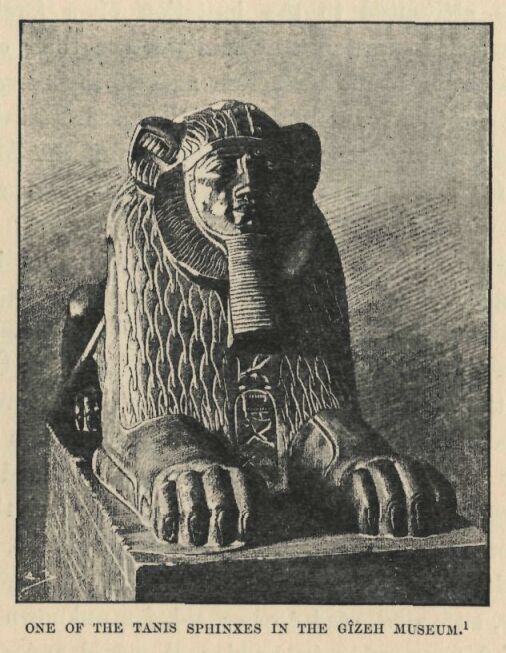
Drawn by Faucher-Gudin, from a photograph by Émil Brugsch- Bey, taken in 1881. The sphinx bears on its breast the cartouche of Psiûkhânû, a Tanite Pharaoh of the XXIst dynasty.
A few of the columns belong to the lotiform type. The shaft is composed of eight triangular stalks rising from a bunch of leaves, symmetrically arranged, and bound together at the top by a riband, twisted thrice round the bundle; the capital is formed by the union of the eight lotus buds, surmounted by a square member on which rests the architrave. Other columns have Hâthor-headed capitals, the heads being set back to back, and bearing the flat head-dress ornamented with the urous. The face of the goddess, which is somewhat flattened when seen closely on the eye-level, stands out and becomes more lifelike in proportion as the spectator recedes from it; the projection of the features has been calculated so as to produce the desired effect at the right height when seen from below. The district lying between Tanis and Bubastis is thickly studded with monuments built or embellished by the Amenemhâîts and Usirtasens: wherever the pickaxe is applied, whether at Fakus or Tell-Nebêsheh, remains of them are brought to light—statues, stelæ, tables of offerings, and fragments of dedicatory or historical inscriptions. While carrying on works in the temple of Phtah at Memphis, the attention of these Pharaohs was attracted to Heliopolis. The temple of Râ there was either insufficient for the exigencies of worship, or had been allowed to fall into decay. Usirtasen III. resolved, in the third year of his reign, to undertake its restoration. The occasion appears to have been celebrated as a festival by all Egypt, and the remembrance of it lasted long after the event: the somewhat detailed account of the ceremonies which then took place was copied out again at Thebes, towards the end of the XVIIIth dynasty. It describes the king mounting his throne at the meeting of his council, and receiving, as was customary, the eulogies of his “sole friends” and of the courtiers who surrounded him: “Here,” says he, addressing them, “has my Majesty ordained the works which shall recall my worthy and noble acts to posterity. I raise a monument, I establish lasting decrees in favour of Harmakhis, for he has brought me into the world to do as he did, to accomplish that which he decreed should be done; he has appointed me to guide this earth, he has known it, he has called it together and he has granted me his help; I have caused the Eye which is in him to become serene, in all things acting as he would have me to do, and I have sought out that which he had resolved should be known. I am a king by birth, a suzerain not of my own making; I have governed from childhood, petitions have been presented to me when I was in the egg, I have ruled over the ways of Anubis, and he raised me up to be master of the two halves of the world, from the time when I was a nursling; I had not yet escaped from the swaddling-bands when he enthroned me as master of men; creating me himself in the sight of mortals, he made me to find favour with the Dweller in the Palace, when I was a youth.... I came forth as Horus the eloquent, and I have instituted divine oblations; I accomplish the works in the palace of my father Atûmû, I supply his altar on earth with offerings, I lay the foundations of my palace in his neighbourhood, in order that the memorial of my goodness may remain in his dwelling; for this palace is my name, this lake is my monument, all that is famous or useful that I have made for the gods is eternity.” The great lords testified their approbation of the king’s piety; the latter summoned his chancellor and commanded him to draw up the deeds of gift and all the documents necessary for the carrying out of his wishes. “He arose, adorned with the royal circlet and with the double feather, followed by all his nobles; the chief lector of the divine book stretched the cord and fixed the stake in the ground.” *
* Stehn, Urkunde uber den Bau des Sonnentempels zu On, pl. i. 11. 13—15. The priest here performed with the king the more important of the ceremonies necessary in measuring the area of the temple, by “inserting the measuring stakes,” and marking out the four sides of the building with the cord.
This temple has ceased to exist; but one of the granite obelisks raised by Usirtasen I. on each side of the principal gateway is still standing. The whole of Heliopolis has disappeared: the site where it formerly stood is now marked only by a few almost imperceptible inequalities in the soil, some crumbling lengths of walls, and here and there some scattered blocks of limestone, containing a few lines of mutilated inscriptions which can with difficulty be deciphered; the obelisk has survived even the destruction of the ruins, and to all who understand its language it still speaks of the Pharaoh who erected it.
The undertaking and successful completion of so many great structures had necessitated a renewal of the working of the ancient quarries, and the opening of fresh ones. Amenemhâît I. sent Antuf, a great dignitary, chief of the prophets of Mînû and prince of Koptos, to the valley of Rohanû, to seek out fine granite for making the royal sarcophagi. Amenemhâît III. had, in the XLIIIrd year of his reign, been present at the opening of several fine veins of white limestone in the quarries of Turah, which probably furnished material for the buildings proceeding at Heliopolis and Memphis. Thebes had also its share of both limestone and granite, and Amon, whose sanctuary up to this time had only attained the modest proportions suited to a provincial god, at last possessed a temple which raised him to the rank of the highest feudal divinities. Amon’s career had begun under difficulties: he had been merely a vassal-god of Montû, lord of Hermonthis (the Aûnû of the south), who had granted to him the ownership of the village of Karnak only. The unforeseen good fortune of the Antufs was the occasion of his emerging from his obscurity: he did not dethrone Montû, but shared with him the homage of all the neighbouring villages—Luxor, Medamut, Bayadîyeh; and, on the other side of the Nile, Gurneh and Medînet-Habu. The accession of the XIIth dynasty completed his triumph, and made him the most powerful authority in Southern Egypt. He was an earth-god, a form of Mînû who reigned at Koptos, at Akhmîm and in the desert, but he soon became allied to the sun, and from thenceforth he assumed the name of Amon-Râ. The title of “sûton nûtîrû” which he added to it would alone have sufficed to prove the comparatively recent origin of his notoriety; as the latest arrival among the great gods, he employed, to express his sovereignty, this word “sûton,” king, which had designated the rulers of the valley ever since the union of the two Egypts under the shadowy Menés. Reigning at first alone, he became associated by marriage with a vague indefinite goddess, called Maût, or Mût, the “mother,” who never adopted any more distinctive name: the divine son who completed this triad was, in early times, Montû; but in later times a being of secondary rank, chosen from among the genii appointed to watch over the days of the month or the stars, was added, under the name of Khonsû. Amenemhâît laid the foundations of the temple, in which the cultus of Amon was carried on down to the latest times of paganism. The building was supported by polygonal columns of sixteen sides, some fragments of which are still existing.
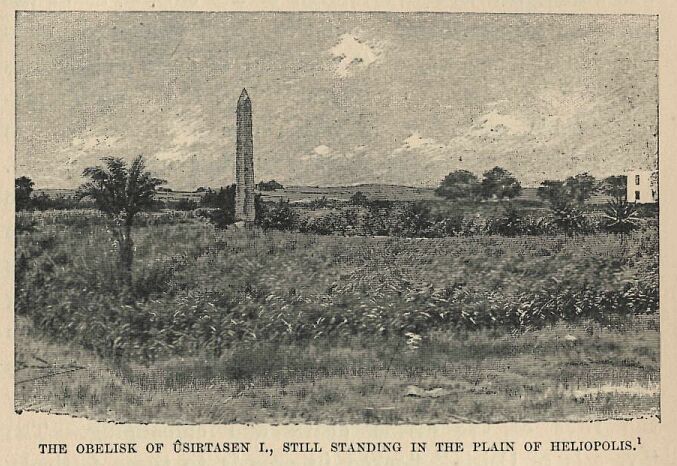
Drawn by Boudier, from a photograph by Insinger.
The temple was at first of only moderate dimensions, but it was built of the choicest sandstone and limestone, and decorated with exquisite bas-reliefs. Ûsirtasen I. enlarged it, and built a beautiful house for the high priest on the west side of the sacred lake. Luxor, Zorit, Edfu, Hierakonpolis, El-Kab, Elephantine, and Dendera,* shared between them the favour of the Pharaohs; the venerable town of Abydos became the object of their special predilection.
* Dümichen pointed out, in the masonry of the great eastern staircase of the present temple of Hâthor, a stone obtained from the earlier temple, which bears the name of Amenemhâît; another fragment, discovered and published by Mariette, shows that Amenemhâît I. is here again referred to. The buildings erected by this monarch at Dondera must have been on a somewhat large scale, if we may judge from the size of this last fragment, which is the lintel of a door.
Drawn by Faucher-Gudin, from a photograph by M. de Banville.
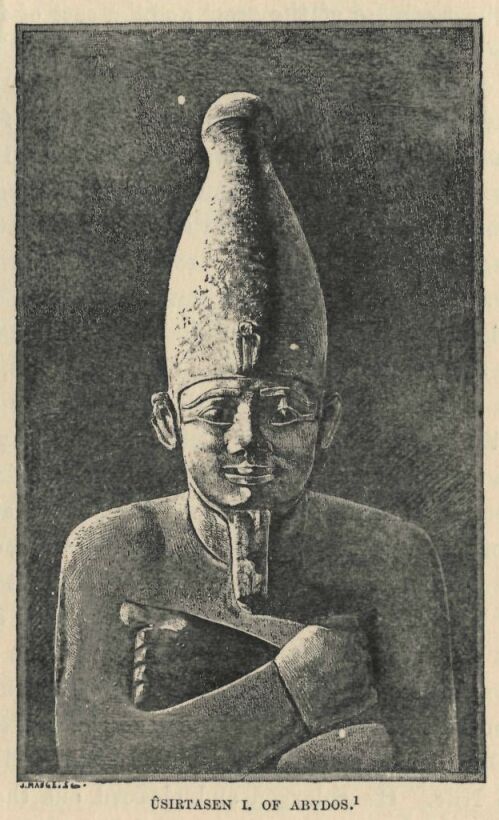
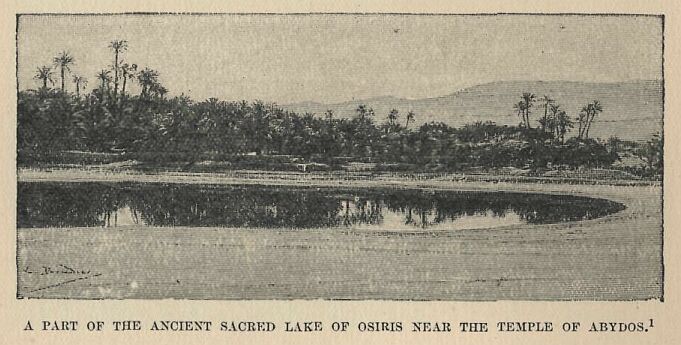
Its reputation for sanctity had been steadily growing from the time of the Papis: its god, Khontamentît, who was identified with Osiris, had obtained in the south a rank as high as that of the Mendesian Osiris in the north of Egypt. He was worshipped as the sovereign of the sovereigns of the dead—he who gathered around him and welcomed in his domains the majority of the faithful of other cults. His sepulchre, or, more correctly speaking, the chapel representing his sepulchre, in which one of his relics was preserved, was here, as elsewhere, built upon the roof. Access to it was gained by a staircase leading up on the left side of the sanctuary: on the days of the passion and resurrection of Osiris solemn processions of priests and devotees slowly mounted its steps, to the chanting of funeral hymns, and above, on the terrace, away from the world of the living, and with no other witnesses than the stars of heaven, the faithful celebrated mysteriously the rites of the divine death and embalming. The “vassals of Osiris” flocked in crowds to these festivals, and took a delight in visiting, at least once during their lifetime, the city whither their souls would proceed after death, in order to present themselves at the “Mouth of the Cleft,” there to embark in the “bari” of their divine master or in that of the Sun. They left behind them, “under the staircase of the great god,” a sort of fictitious tomb, near the representation of the tomb of Osiris, in the shape of a stele, which immortalized the memory of their piety, and which served as a kind of hostelry for their soul, when the latter should, in course of time, repair to this rallying-place of all Osirian souls. The concourse of pilgrims was a source of wealth to the population, the priestly coffers were filled, and every year the original temple was felt to be more and more inadequate to meet the requirements of worship. Usirtasen I. desired to come to the rescue: he despatched Monthotpû, one of his great vassals, to superintend the works. The ground-plan of the portico of white limestone which preceded the entrance court may still be distinguished; this portico was supported by square pillars, and, standing against the remains of these, we see the colossi of rose granite, crowned with the Osirian head-dress, and with their feet planted on the “Nine Bows,” the symbol of vanquished enemies. The best preserved of these figures represents the founder, but several others are likenesses of those of his successors who interested themselves in the temple. Monthotpû dug a well which was kept fully supplied by the infiltrations from the Nile. He enlarged and cleaned out the sacred lake upon which the priests launched the Holy Ark, on the nights of the great mysteries. The alluvial deposits of fifty centuries have not as yet wholly filled it up: it is still an irregularly shaped pond, which dries up in winter, but is again filled as soon as the inundation reaches the village of El-Kharbeh.
A few stones, corroded with saltpetre, mark here and there the lines of the landing stages, a thick grove of palms fringes its northern and southern banks, but to the west the prospect is open, and extends as far as the entrance to the gorge, through which the souls set forth in search of Paradise and the solar bark. Buffaloes now come to drink and wallow at midday where once floated the gilded “bari” of Osiris, and the murmur of bees from the neighbouring orchards alone breaks the silence of the spot which of old resounded with the rhythmical lamentations of the pilgrims.
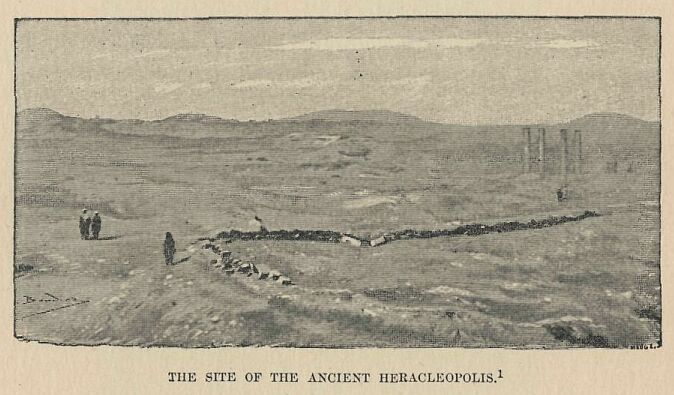
Heracleopolis the Great, the town preferred by the earlier Theban Pharaohs as their residence in times of peace, must have been one of those which they proceeded to decorate con amore with magnificent monuments.
Drawn by Boudier, from a photograph by Émil Brugsch-Bey, taken in 1884.
Unfortunately it has suffered more than any of the rest, and nothing of it is now to be seen but a few wretched remains of buildings of the Roman period, and the ruins of a barbaric colonnade on the site of a Byzantine basilica almost contemporary with the Arab conquest. Perhaps the enormous mounds which cover its site may still conceal the remains of its ancient temples. We can merely estimate their magnificence by casual allusions to them in the inscriptions.
Drawn by Boudier, from a photograph by Golénischeff
We know, for instance, that Usirtasen III. rebuilt the sanctuary of Harshâfîtû, and that he sent expeditions to the Wady Hammamât to quarry blocks of granite worthy of his god: but the work of this king and his successors has perished in the total ruin of the ancient town. Something at least has remained of what they did in that traditional dependency of Heracleopolis, the Fayum: the temple which they rebuilt to the god Sobkû in Shodît retained its celebrity down to the time of the Cæsars, not so much, perhaps, on account of the beauty of its architecture as for the unique character of the religious rites which took place there daily. The sacred lake contained a family of tame crocodiles, the image and incarnation of the god, whom the faithful fed with their offerings—cakes, fried fish, and drinks sweetened with honey. Advantage was taken of the moment when one of these creatures, wallowing on the bank, basked contentedly in the sun: two priests opened his jaws, and a third threw in the cakes, the fried morsels, and finally the liquid. The crocodile bore all this without even winking; he swallowed down his provender, plunged into the lake, and lazily reached the opposite bank, hoping to escape for a few moments from the oppressive liberality of his devotees.
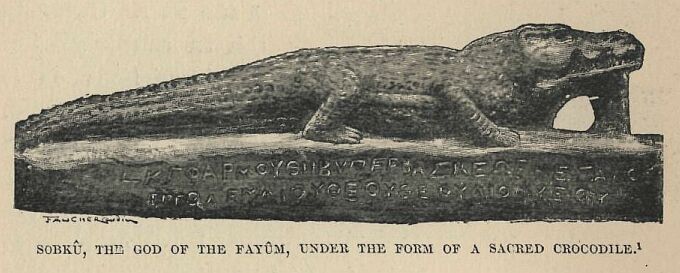
Drawn by Faucher-Gudin, from a photograph by Émil Brugsch- Bey, taken in 1885. The original in black granite is now in the Berlin Museum. It represents one of the sacred crocodiles mentioned by Strabo; we read on the base a Greek inscription in honour of Ptolemy Neos Dionysos, in which the name of the divine reptile “Petesûkhos, the great god,” is mentioned.
Drawn by Boudier, from a photograph by Golûnischeff.
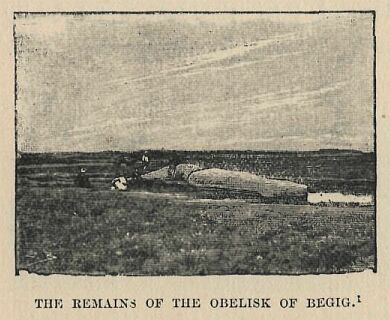
As soon, however, as another of these approached, he was again beset at his new post and stuffed in a similar manner. These animals were in their own way great dandies: rings of gold or enamelled terra-cotta were hung from their ears, and bracelets were soldered on to their front paws. The monuments of Shodît, if any still exist, are buried under the mounds of Medinet el-Fayûm, but in the neighbourhood we meet with more than one authentic relic of the XIIth dynasty. It was Usirtasen I. who erected that curious thin granite obelisk, with a circular top, whose fragments lie forgotten on the ground near the village of Begig: a sort of basin has been hollowed out around it, which fills during the inundation, so that the monument lies in a pool of muddy water during the greater part of the year. Owing to this treatment, most of the inscriptions on it have almost disappeared, though we can still make out a series of five scenes in which the king hands offerings to several divinities. Near to Biahmû there was an old temple which had become ruinous: Amenemhâît III. repaired it, and erected in front of it two of those colossal statues which the Egyptians were wont to place like sentinels at their gates, to ward off baleful influences and evil spirits.
The colossi at Biahmû were of red sandstone, and were seated on high limestone pedestals, placed at the end of a rectangular court; the temple walls hid the lower part of the pedestals, so that the colossi appeared to tower above a great platform which sloped gently away from them on all sides. Herodotus, who saw them from a distance at the time of the inundation, believed that they crowned the summits of two pyramids rising out of the middle of a lake. Near Illahun, Queen Sovkûnofriûri herself has left a few traces of her short reign.
The Fayum, by its fertility and pleasant climate, justified the preference which the Pharaohs of the XIIth dynasty bestowed upon it. On emerging from the gorges of Illahun, it opens out like a vast amphitheatre of cultivation, whose slopes descend towards the north till they reach the desolate waters of the Birket-Kerun.
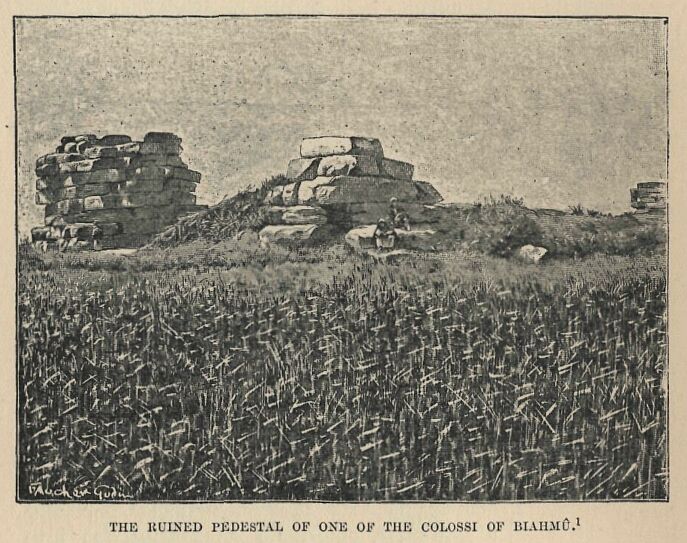
Drawn by Faucher-Gudin, after Major Brown.
On the right and left, the amphitheatre is isolated from the surrounding mountains by two deep ravines, filled with willows, tamarisks, mimosas, and thorny acacias. Upon the high ground, lands devoted to the culture of corn, durra, and flax, alternate with groves of palms and pomegranates, vineyards and gardens of olives, the latter being almost unknown elsewhere in Egypt.
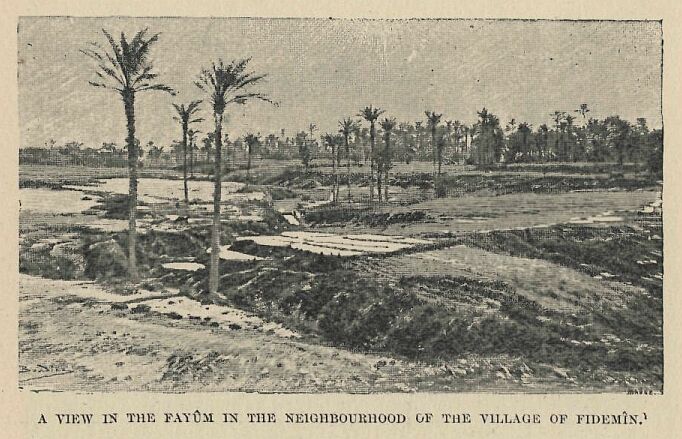
Drawn by Boudier, from a photograph by Golenischeff.
The slopes are covered with cultivated fields, irregularly terraced woods, and meadows enclosed by hedges, while lofty trees, clustered in some places and thinly scattered in others, rise in billowy masses of verdure one behind the other. Shodît [Shâdû] stood on a peninsula stretching out into a kind of natural reservoir, and was connected with the mainland by merely a narrow dyke; the water of the inundation flowed into this reservoir and was stored here during the autumn. Countless little rivulets escaped from it, not merely such canals and ditches as we meet with in the Nile Valley, but actual running brooks, coursing and babbling between the trees, spreading out here and there into pools of water, and in places forming little cascades like those of our own streams, but dwindling in volume as they proceeded, owing to constant drains made on them, until they were for the most part absorbed by the soil before finally reaching the lake.
Drawn by Faucher-Gudin, from a photograph by Major Brown.
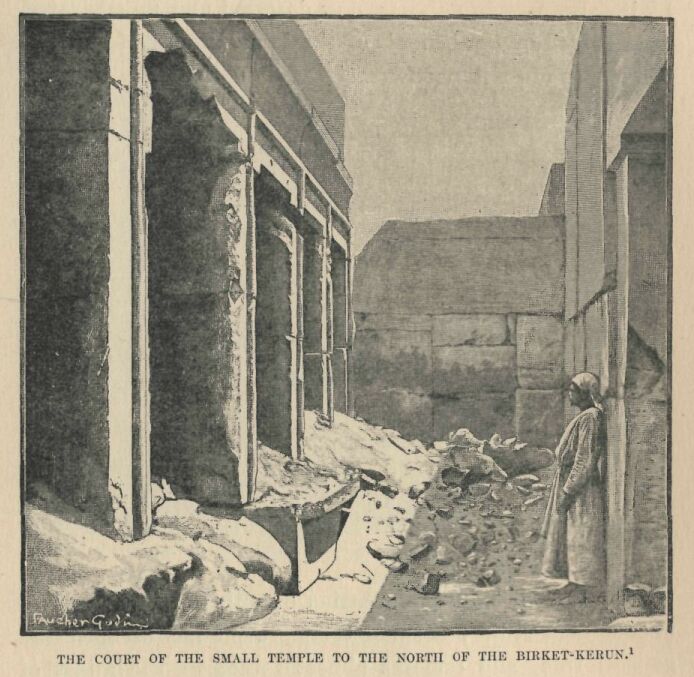
They brought down in their course part of the fertilizing earth accumulated by the inundation, and were thus instrumental in raising the level of the soil. The water of the Birkeh rose or fell according to the season of the year. It formerly occupied a much larger area than it does at present, and half of the surrounding districts was covered by it. Its northern shores, now deserted and uncultivated, then shared in the benefits of the inundation, and supplied the means of existence for a civilized population. In many places we still find the remains of villages, and walls of uncemented stone; a small temple even has escaped the general ruin, and remains almost intact in the midst of the desolation, as if to point out the furthest limit of Egyptian territory.
Drawn by Boudier, from a photograph by Golénischeff.
It bears no inscriptions, but the beauty of the materials of which it is composed, and the perfection of the work, lead us to attribute its construction to some prince of the XIIth dynasty. An ancient causeway runs from its entrance to what was probably at one time the original margin of the lake. The continual sinking of the level of the Birkeh has left this temple isolated on the edge of the Libyan plateau, and all life has retired from the surrounding district, and has concentrated itself on the southern shores of the lake.
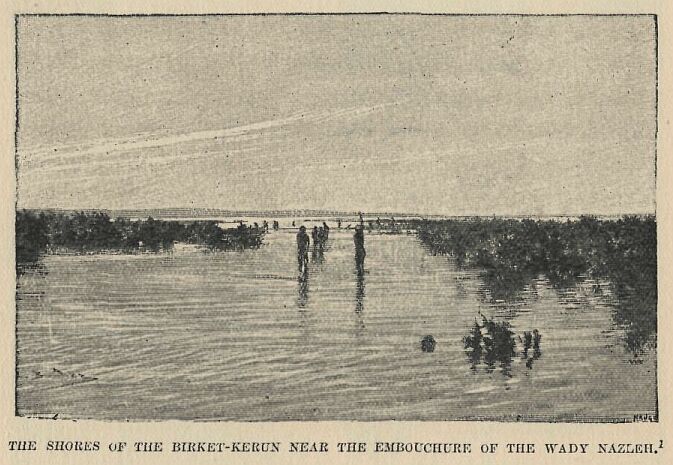
Drawn by Boudier, from a photograph by Emil Brugsch-Bey.
Here the banks are low and the bottom deepens almost imperceptibly. In winter the retreating waters leave exposed long patches of the shore, upon which a thin crust of snow-white salt is deposited, concealing the depths of mud and quicksands beneath. Immediately after the inundation, the lake regains in a few days the ground it had lost: it encroaches on the tamarisk bushes which fringe its banks, and the district is soon surrounded by a belt of marshy vegetation, affording cover for ducks, pelicans, wild geese, and a score of different kinds of birds which disport themselves there by the thousand. The Pharaohs, when tired of residing in cities, here found varied and refreshing scenery, an equable climate, gardens always gay with flowers, and in the thickets of the Kerun they could pursue their favourite pastimes of interminable fishing and of hunting with the boomerang.
They desired to repose after death among the scenes in which they had lived. Their tombs stretch from Heracleo-polis till they nearly meet the last pyramids of the Memphites: at Dahshur there are still two of them standing. The northern one is an immense erection of brick, placed in close proximity to the truncated pyramid, but nearer than it to the edge of the plateau, so as to overlook the valley. We might be tempted to believe that the Theban kings, in choosing a site immediately to the south of the spot where Papi II. slept in his glory, were prompted by the desire to renew the traditions of the older dynasties prior to those of the Heracleopolitans, and thus proclaim to all beholders the antiquity of their lineage. One of their residences was situated at no great distance, near Miniet Dahshur, the city of Titoui, the favourite residence of Amenemhâîfc I. It was here that those royal princesses, Nofirhonît, Sonît-Sonbît, Sîthâthor, and Monît, his sisters, wives, and daughters, whose tombs lie opposite the northern face of the pyramid, flourished side by side with Amenemhâît III.
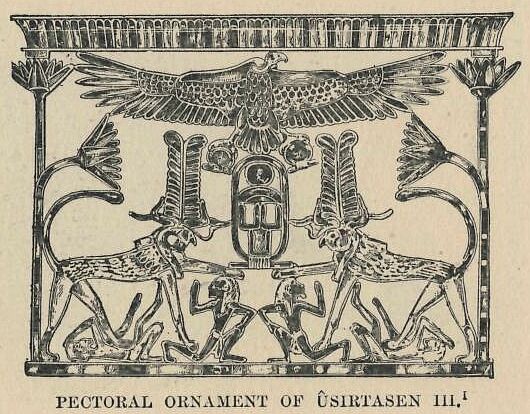
There, as of old in their harem, they slept side by side, and, in spite of robbers, their mummies have preserved the ornaments with which they were adorned, on the eve of burial, by the pious act of their lords. The art of the ancient jewellers, which we have hitherto known only from pictures on the walls of tombs or on the boards of coffins, is here exhibited in all its cunning. The ornaments comprise a wealth of gold gorgets, necklaces of agate beads or of enamelled lotus-flowers, cornelian, amethyst, and onyx scarabs. Pectorals of pierced gold-work, inlaid with flakes of vitreous paste or precious stones, bear the cartouches of Usirtasen III. and of Amenemhâît II., and every one of these gems of art reveals a perfection of taste and a skilfulness of handling which are perfectly wonderful.
Drawn by Faucher-Gudin, from a photograph by Émil Brugsch- Bey.
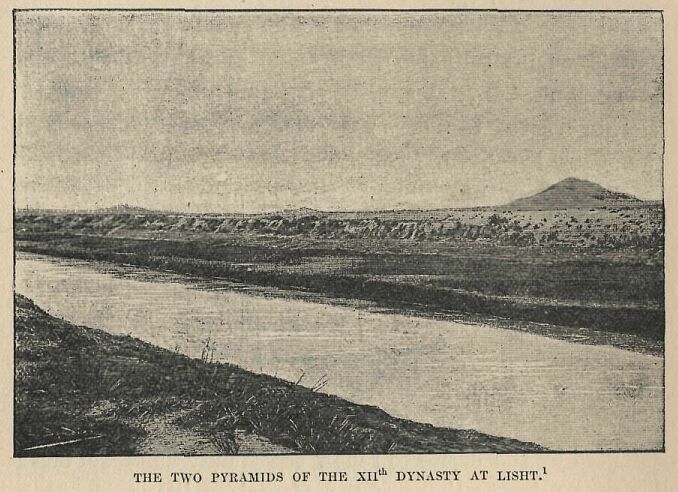
Their delicacy, and their freshness in spite of their antiquity, make it hard for us to realize that fifty centuries have elapsed since they were made. We are tempted to imagine that the royal ladies to whom they belonged must still be waiting within earshot, ready to reply to our summons as soon as we deign to call them; we may even anticipate the joy they will evince when these sumptuous ornaments are restored to them, and we need to glance at the worm-eaten coffins which contain their stiff and disfigured mummies to recall our imagination to the stern reality of fact. Two other pyramids, but in this case of stone, still exist further south, to the left of the village of Lisht: their casing, torn off by the fellahîn, has entirely disappeared, and from a distance they appear to be merely two mounds which break the desert horizon line, rather than two buildings raised by the hand of man.
Drawn by Faucher-Gudin, from a photograph by Golénischeff.
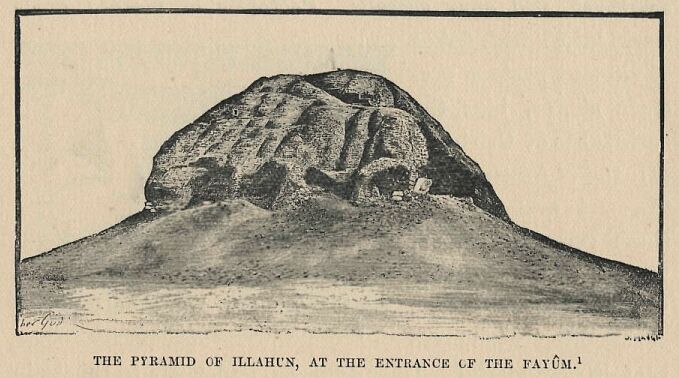
The sepulchral chambers, excavated at a great depth in the sand, are now filled with water which has infiltrated through the soil, and they have not as yet been sufficiently emptied to permit of an entrance being effected: one of them contained the body of Usirtasen I.; does Amenemhâît I. or Amenemhâît II. repose in the other? We know, at all events, that Usirtasen II. built for himself the pyramid of Illahun, and Amenemhâît III. that of Hawâra. “Hotpû,” the tomb of Usirtasen II., stood upon a rocky hill at a distance of some two thousand feet from the cultivated lands. To the east of it lay a temple, and close to the temple a town, Haît-Usirtasen-Hotpû—“the Castle of the Repose of Usirtasen”—which was inhabited by the workmen employed in building the pyramid, who resided there with their families. The remains of the temple consist of scarcely anything more than the enclosing wall, whose sides were originally faced with fine white limestone covered with hieroglyphs and sculptured scenes. It adjoined the wall of the town, and the neighbouring quarters are almost intact: the streets were straight, and crossed each other at right angles, while the houses on each side were so regularly built that a single policeman could keep his eye on each thoroughfare from one end to the other. The structures were of rough material hastily put together, and among the débris are to be found portions of older buildings, stehe, and fragments of statues. The town began to dwindle after the Pharaoh had taken possession of his sepulchre; it was abandoned during the XIIIth dynasty, and its ruins were entombed in the sand which the wind heaped over them. The city which Amenemhâît III. had connected with his tomb maintained, on the contrary, a long existence in the course of the centuries. The king’s last resting-place consisted of a large sarcophagus of quartzose sandstone, while his favourite consort, Nofriuphtah, reposed beside him in a smaller coffin. The sepulchral chapel was very large, and its arrangements were of a somewhat complicated character. It consisted of a considerable number of chambers, some tolerably large, and others of moderate dimensions, while all of them were difficult of access and plunged in perpetual darkness: this was the Egyptian Labyrinth, to which the Greeks, by a misconception, have given a world-wide renown. Amenemhâît III. or his architects had no intention of building such a childish structure as that in which classical tradition so fervently believed. He had richly endowed the attendant priests, and bestowed upon the cult of his double considerable revenues, and the chambers above mentioned were so many storehouses for the safekeeping of the treasure and provisions for the dead, and the arrangement of them was not more singular than that of ordinary storage depots. As his cult persisted for a long period, the temple was maintained in good condition during a considerable time: it had not, perhaps, been abandoned when the Greeks first visited it.*
* The identity of the ruins at Hawâra with the remains of the Labyrinth, admitted by Jomard-Caristie and by Lepsius, disputed by Vassali, has been definitely proved by Pétrie, who found remains of the buildings erected by Amenemhâît III. under the ruins of a village and some Græco-Roman tombs.
The other sovereigns of the XIIth dynasty must have been interred not far from the tombs of Amenemhâît III. and Usirtasen II.: they also had their pyramids, of which we may one day discover the site. The outline of these was almost the same as that of the Memphite pyramids, but the interior arrangements were different. As at Illahun and Dahshur, the mass of the work consisted of crude bricks of large size, between which fine sand was introduced to bind them solidly together, and the whole was covered with a facing of polished limestone. The passages and chambers are not arranged on the simple plan which we meet with in the pyramids of earlier date. Experience had taught the Pharaohs that neither granite walls nor the multiplication of barriers could preserve their mummies from profanation: no sooner was vigilance relaxed, either in the time of civil war or under a feeble administration, than robbers appeared on the scene, and boring passages through the masonry with the ingenuity of moles, they at length, after indefatigable patience, succeeded in reaching the sepulchral vault and despoiling the mummy of its valuables.
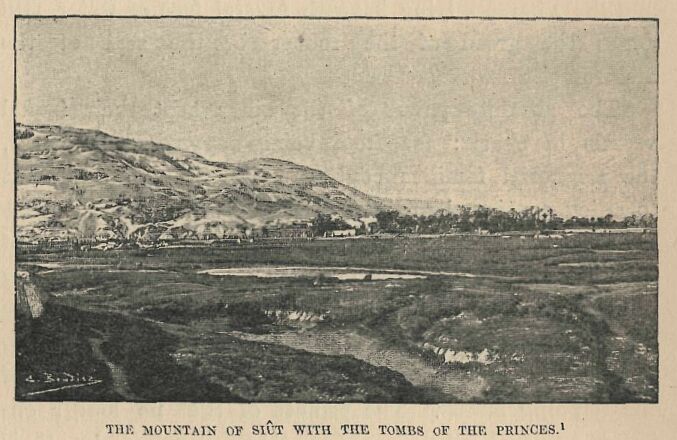
Drawn by Boudier, from a photograph by Émil Brugsch-Bey, taken in 1884.
With a view to further protection, the builders multiplied blind passages and chambers without apparent exit, but in which a portion of the ceiling was movable, and gave access to other equally mysterious rooms and corridors. Shafts sunk in the corners of the chambers and again carefully closed put the sacrilegious intruder on a false scent, for, after causing him a great loss of time and labour, they only led down to the solid rock. At the present day the water of the Nile fills the central chamber of the Hawâra pyramid and covers the sarcophagus; it is possible that this was foreseen, and that the builders counted on the infiltration as an additional obstacle to depredations from without.*
* Indeed, it should be noted that in the Græco-Roman period the presence of water in a certain number of the pyramids was a matter of common knowledge, and so frequently was it met with, that it was even supposed to exist in a pyramid into which water had never penetrated, viz. that of Kheops. Herodotus relates that, according to the testimony of the interpreters who acted as his guides, the waters of the Nile were carried to the sepulchral cavern of the Pharaoh by a subterranean channel, and shut it in on all sides, like an island.
The hardness of the cement, which fastens the lid of the stone coffin to the lower part, protects the body from damp, and the Pharaoh, lying beneath several feet of water, still defies the greed of the robber or the zeal of the archaeologist.
The absolute power of the kings kept their feudal vassals in check: far from being suppressed, however, the seignorial families continued not only to exist, but to enjoy continued prosperity. Everywhere, at Elephantine, Koptos, Thinis, in Aphroditopolis, and in most of the cities of the Said and of the Delta, there were ruling princes who were descended from the old feudal lords or even from Pharaohs of the Memphite period, and who were of equal, if not superior rank, to the members of the reigning family. The princes of Siut no longer en-joyed an authority equal to that exercised by their ancestors under the Heracleopolitan dynasties, but they still possessed considerable influence. One of them, Hapizaûfi I., excavated for himself, in the reign of Ûsirtasen I., nor far from the burying-place of Khîti and Tefabi, that beautiful tomb, which, though partially destroyed by Coptic monks or Arabs, still attracts visitors and excites their astonishment.
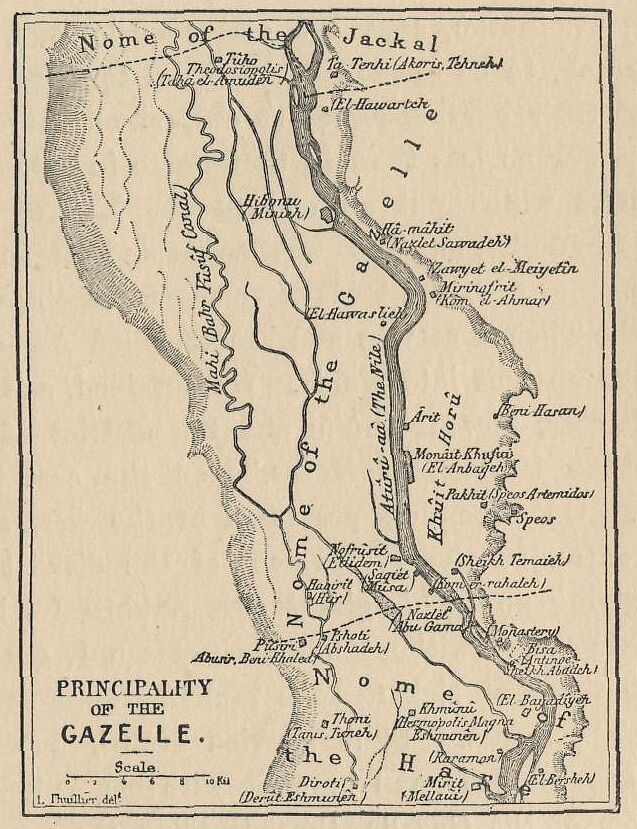
The lords of Shashotpu in the south, and those of Hermopolis in the north, had acquired to some extent the ascendency which their neighbours of Siût had lost. The Hermopolitan princes dated at least from the time of the VIth dynasty, and they had passed safely through the troublous times which followed the death of Papi II. A branch of their family possessed the nome of the Hare, while another governed that of the Gazelle. The lords of the nome of the Hare espoused the Theban cause, and were reckoned among the most faithful vassals of the sovereigns of the south: one of them, Thothotpû, caused a statue of himself, worthy of a Pharaoh, to be erected in his loyal town of Hermopolis, and their burying-places at el-Bersheh bear witness to their power no less than to their taste in art. During the troubles which put an end to the XIth dynasty, a certain Khnûmhotpû, who was connected in some unknown manner with the lords of the nome of the Gazelle, entered the Theban service and accompanied Amenemhâît I. on his campaigns into Nubia. He obtained, as a reward of faithfulness, Monâît-Khûfûi and the district of Khûît-Horû,—“the Horizon of Horus,”—on the east bank of the Nile. On becoming possessed of the western bank also, he entrusted the government of the district which he was giving up to his eldest son, Nakhîti I.; but, the latter having died without heirs, Usirtasen I. granted to Biqît, the sister of Nakhîti, the rank and prerogative of a reigning princess. Biqît married Nûhri, one of the princes of Hermopolis, and brought with her as her dowry the fiefdom of the Gazelle, thus doubling the possessions of her husband’s house. Khnûmhotpû II., the eldest of the children born of this union, was, while still young, appointed Governor of Monâît-Khûfuî, and this title appears to have become an appanage of his heir-apparent, just as the title of “Prince of Kaûshû” was, from the XIXth dynasty onwards, the special designation of the heir to the throne. The marriage of Khnûmhotpû II. with the youthful Khîti, the heiress of the nome of the Jackal, rendered him master of one of the most fertile provinces of Middle Egypt. The power of this family was further augmented under Nakhîti II., son of Khnûmhotpû II. and Khîti: Nakhîti, prince of the nome of the Jackal in right of his mother, and lord of that of the Gazelle after the death of his father, received from Usirtasen II. the administration of fifteen southern nomes, from Aphroditopolis to Thebes. This is all we know of his history, but it is probable that his descendants retained the same power and position for several generations. The career of these dignitaries depended greatly on the Pharaohs with whom they were contemporary: they accompanied the royal troops on their campaigns, and with the spoil which they collected on such occasions they built temples or erected tombs for themselves. The tombs of the princes of the nome of the Gazelle are disposed along the right bank of the Nile, and the most ancient are exactly opposite Minieh. It is at Zawyet el-Meiyetîn and at Kom-el-Ahmar, nearly facing Hibonu, their capital, that we find the burying-places of those who lived under the VIth dynasty. The custom of taking the dead across the Nile had existed for centuries, from the time when the Egyptians first cut their tombs in the eastern range; it still continues to the present day, and part of the population of Minieh are now buried, year after year, in the places which their remote ancestors had chosen as the site of their “eternal houses.” The cemetery lies peacefully in the centre of the sandy plain at the foot of the hills; a grove of palms, like a curtain drawn along the river-side, partially conceals it; a Coptic convent and a few Mahommedan hermits attract around them the tombs of their respective followers, Christian or Mussulman. The rock-hewn tombs of the XIIth dynasty succeed each other in one long irregular line along the cliffs of Beni-Hasan, and the traveller on the Nile sees their entrances continuously coming into sight and disappearing as he goes up or descends the river. These tombs are entered by a square aperture, varying in height and width according to the size of the chapel. Two only, those of Amoni-Amenemhâît and of Khnûm-hotpû II., have a columned façade, of which all the members—pillars, bases, entablatures—have been cut in the solid rock: the polygonal shafts of the façade look like a bad imitation of ancient Doric. Inclined planes or nights of steps, like those at Elephantine, formerly led from the plain up to the terrace. Only a few traces of these exist at the present day, and the visitor has to climb the sandy slope as best he can: wherever he enters, the walls present to his view inscriptions of immense extent, as well as civil, sepulchral, military, and historical scenes. These are not incised like those of the Memphite mastabas, but are painted in fresco on the stone itself. The technical skill here exhibited is not a whit behind that of the older periods, and the general conception of the subjects has not altered since the time of the pyramid-building kings. The object is always the same, namely, to ensure wealth to the double in the other world, and to enable him to preserve the same rank among the departed as he enjoyed among the living: hence sowing, reaping, cattle-rearing, the exercise of different trades, the preparation and bringing of offerings, are all represented with the same minuteness as formerly. But a new element has been added to the ancient themes.
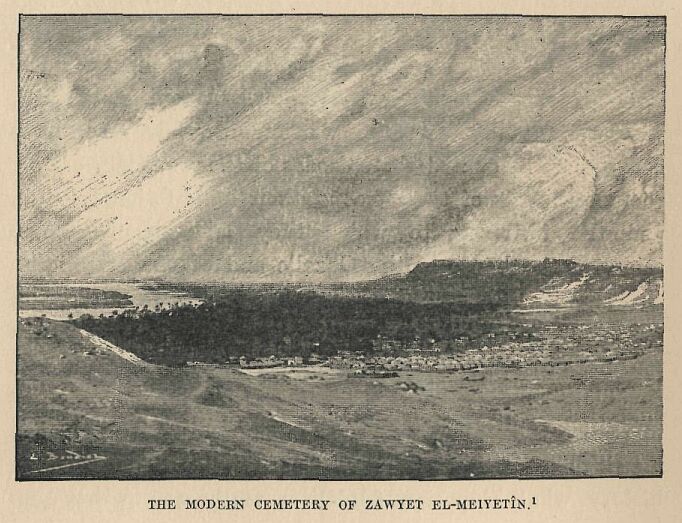
Drawn by Boudier, from a photograph by Insinger.
We know, and the experience of the past is continually reiterating the lesson, that the most careful precautions and the most conscientious observation of customs were not sufficient to perpetuate the worship of ancestors. The day was bound to come when not only the descendants of Khnûmhotpû, but a crowd of curious or indifferent strangers, would visit his tomb: he desired that they should know his genealogy, his private and public virtues, his famous deeds, his court titles and dignities, the extent of his wealth; and in order that no detail should be omitted, he relates all that he did, or he gives the representation of it upon the wall. In a long account of two hundred and twenty-two lines, he gives a résumé of his family history, introducing extracts from his archives, to show the favours received by his ancestors from the hands of their sovereigns. Amoni and Khîti, who were, it appears, the warriors of their race, have everywhere recounted the episodes of their military career, the movements of their troops, their hand-to-hand fights, and the fortresses to which they laid siege. These scions of the house of the Gazelle and of the Hare, who shared with Pharaoh himself the possession of the soil of Egypt, were no mere princely ciphers: they had a tenacious spirit, a warlike disposition, an insatiable desire for enlarging their borders, together with sufficient ability to realize their aims by court intrigues or advantageous marriage alliances. We can easily picture from their history what Egyptian feudalism really was, what were its component elements, what were the resources it had at its disposal, and we may well be astonished when we consider the power and tact which the Pharaohs must have displayed in keeping such vassals in check during two centuries.
Amenemhâît I. had abandoned Thebes as a residence in favour of Heracleopolis and Memphis, and had made it over to some personage who probably belonged to the royal household. The nome of Ûisît had relapsed into the condition of a simple fief, and if we are as yet unable to establish the series of the princes who there succeeded each other contemporaneously with the Pharaohs, we at least know that all those whose names have come down to us played an important part in the history of their times. Montûnsîsû, whose stele was engraved in the XXIVth year of Amenemhâît I., and who died in the joint reign of this Pharaoh and his son Usirtasen I., had taken his share in most of the wars conducted against neighbouring peoples,—the Anîtiû of Nubia, the Monîtû of Sinai, and the “Lords of the Sands:” he had dismantled their cities and razed their fortresses. The principality retained no doubt the same boundaries which it had acquired under the first Antûfs, but Thebes itself grew daily larger, and gained in importance in proportion as its frontiers extended southward. It had become, after the conquests of Usirtasen III., the very centre of the Egyptian world—a centre from which the power of the Pharaoh could equally well extend in a northerly direction towards the Sinaitic Peninsula and Libya, or towards the Red Sea and the “humiliated Kûsh” in the south. The influence of its lords increased accordingly: under Amenemhâît III. and Amenemhâît IV. they were perhaps the most powerful of the great vassals, and when the crown slipped from the grasp of the XIIth dynasty, it fell into the hands of one of these feudatories. It is not known how the transition was brought about which transferred the sovereignty from the elder to the younger branch of the family of Amenemhâît I. When Amenemhâît IV. died, his nearest heir was a woman, his sister Sovkûnofriûrî: she retained the supreme authority for not quite four years,* and then resigned her position to a certain Sovkhotpû.**
* She reigned exactly three years, ten months, and eighteen days, according to the fragments of the “Royal Canon of Turin” (Lepsius, Auswahl der wichtigten Urkunden, pl. v. col. vii. 1. 2). ** Sovkhotpû Khûtoûirî, according to the present published versions of the Turin Papyrus, an identification which led Lieblein (Recherches sur la Chronologie Égyptienne, pp. 102, 103) and Wiedemann to reject the generally accepted assumption that this first king of the XIIIth dynasty was Sovkhotpû Sakhemkhûtoûirî. Still, the way in which the monuments of Sovkhotpû Sakhemkhûtoûirî and his papyri are intermingled with the monuments of Amenemhâît III. at Semneh and in the Fayûm, show that it is difficult to separate him from this monarch. Moreover, an examination of the original Turin Papyrus shows that there is a tear before the word Khûtoûirî on the first cartouche, no indication of which appears in the facsimile, but which has, none the less, slightly damaged the initial solar disk and removed almost the whole of one sign. We are, therefore, inclined to believe that Sakhemkhûtoûirî was written instead of Khûtoûirî, and that, therefore, all the authorities are in the right, from their different points of view, and that the founder of the XIIIth dynasty was a Sakhemkhûtoûirî I., while the Savkhotpû Sakhemkhûtoûirî, who occupies the fifteenth place in the dynasty, was a Sakhemkhûtoûirî II.
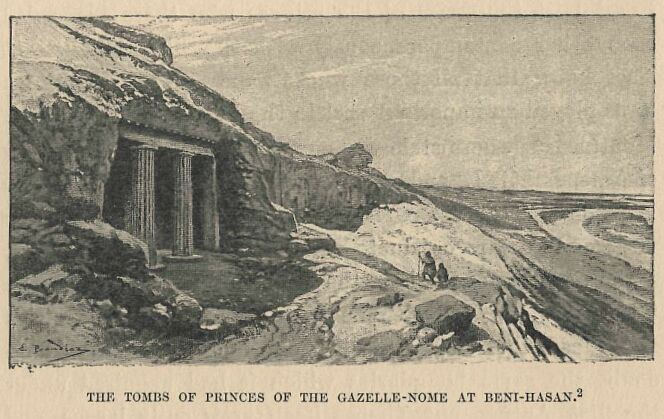
Drawn by Boudier, from a chromolithograph in Lepsius, Denkm., i. pl. 61. The first tomb on the left, of which the portico is shown, is that of Khnûmhotpû II.
Was there a revolution in the palace, or a popular rising, or a civil war? Did the queen become the wife of the new sovereign, and thus bring about the change without a struggle? Sovkhotpû was probably lord of Ûisît, and the dynasty which he founded is given by the native historians as of Theban origin. His accession entailed no change in the Egyptian constitution; it merely consolidated the Theban supremacy, and gave it a recognized position. Thebes became henceforth the head of the entire country: doubtless the kings did not at once forsake Heracleopolis and the Fayûm, but they made merely passing visits to these royal residences at considerable intervals, and after a few generations even these were given up. Most of these sovereigns resided and built their Pyramids at Thebes, and the administration of the kingdom became centralized there. The actual capital of a king was determined not so much by the locality from whence he ruled, as by the place where he reposed after death. Thebes was the virtual capital of Egypt from the moment that its masters fixed on it as their burying-place.
Uncertainty again shrouds the history of the country after Sovkhotpû I.: not that monuments are lacking or names of kings, but the records of the many Sovkhotpûs and Nonrhotpûs found in a dozen places in the valley, furnish as yet no authentic means of ascertaining in what order to classify them. The XIIIth dynasty contained, so it is said, sixty kings, who reigned for a period of over 453 years.*
* This is the number given in one of the lists of Manetho, in Muller-Didot, Fragmenta Historicorum Græcorum, vol. ii. p. 565. Lepsius’s theory, according to which the shepherds overran Egypt from the end of the XIIth dynasty and tolerated the existence of two vassal dynasties, the XIIIth and XIVth, was disputed and refuted by E. de Rougé as soon as it appeared; we find the theory again in the works of some contemporary Egyptologists, but the majority of those who continued to support it have since abandoned their position.
The succession did not always take place in the direct line from father to son: several times, when interrupted by default of male heirs, it was renewed without any disturbance, thanks to the transmission of royal rights to their children by princesses, even when their husbands did not belong to the reigning family. Monthotpû, the father of Sovkhotpu III., was an ordinary priest, and his name is constantly quoted by his son; but solar blood flowed in the veins of his mother, and procured for him the crown. The father of his successor, Nofirhotpû IL, did not belong to the reigning branch, or was only distantly connected with it, but his mother Kamâît was the daughter of Pharaoh, and that was sufficient to make her son of royal rank. With careful investigation, we should probably find traces of several revolutions which changed the legitimate order of succession without, however, entailing a change of dynasty. The Nofirhotpûs and Sovkhotpûs continued both at home and abroad the work so ably begun by the Amenemhâîts and the Usirtasens.
Drawn by Boudier, from a photograph by Ernest de Bergmann. From Dahshur, now at Gîzeh.
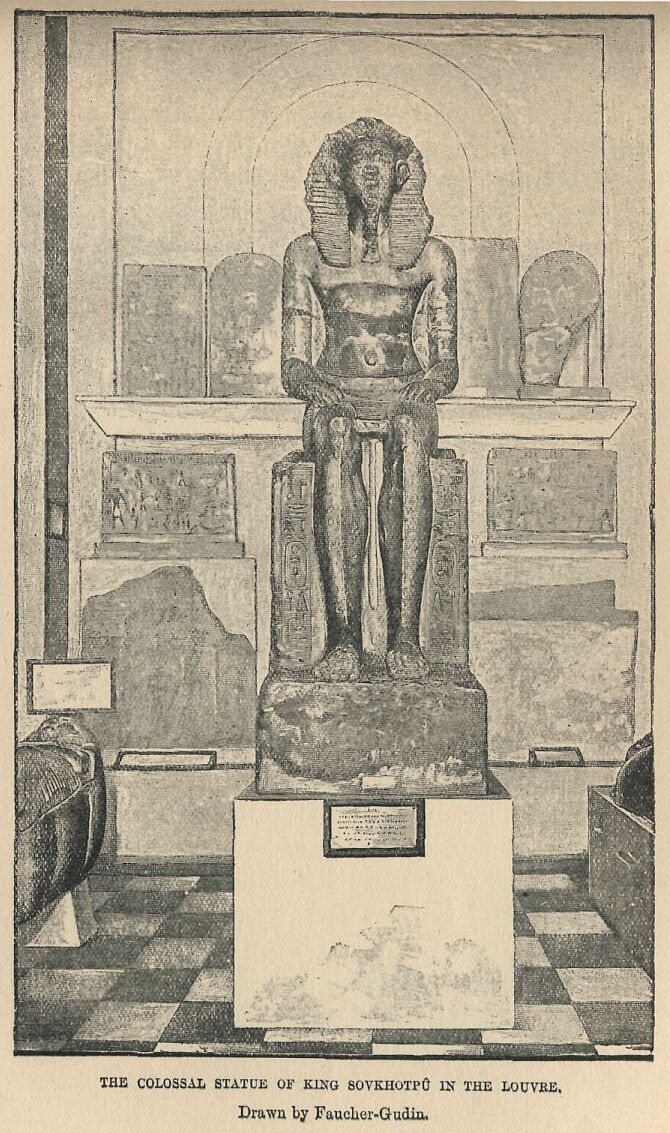
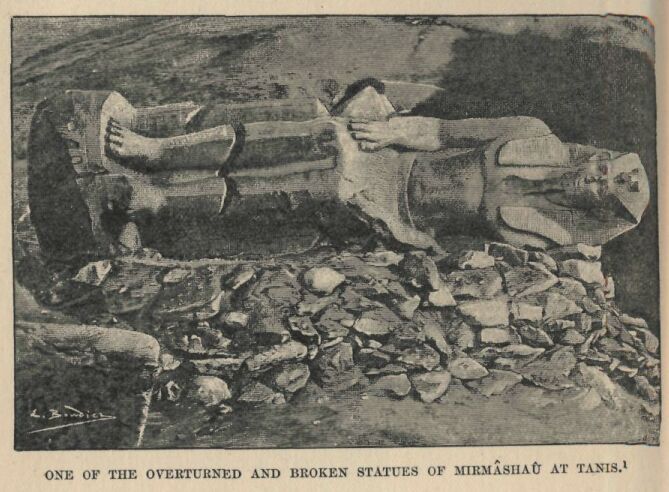
They devoted all their efforts to beautifying the principal towns of Egypt, and caused important works to be carried on in most of them—at Karnak, in the great temple of Amon, at Luxor, at Bubastis, at Tanis, at Tell-Mokhdam, and in the sanctuary of Abydos. At the latter place, Khâsoshûshrî Nofirhotpû restored to Khontamentit considerable possessions which the god had lost; Nozirri sent thither one of his officers to restore the edifice built by Usirtasen I.; Sovkûmsaûf II. dedicated his own statue in this temple, and private individuals, following the example set them by their sovereigns, vied with each other in their gifts of votive stehe. The pyramids of this period were of moderate size, and those princes who abandoned the custom of building them were content like Aûtûabrî I. Horû with a modest tomb, close to the gigantic pyramids of their ancestors. In style the statues of this epoch show a certain inferiority when compared with the beautiful work of the XIIth dynasty: the proportions of the human figure are not so good, the modelling of the limbs is not so vigorous, the rendering of the features lacks individuality; the sculptors exhibit a tendency, which had been growing since the time of the Usirtasens, to represent all their sitters with the same smiling, commonplace type of countenance. There are, however, among the statues of kings and private individuals which have come down to us, a few examples of really fine treatment. The colossal statue of Sovkhotpû IV., which is now in the Louvre side by side with an ordinary-sized figure of the same Pharaoh, must have had a good effect when placed at the entrance to the temple at Tanis: his chest is thrown well forward, his head is erect, and we feel impressed by that noble dignity which the Memphite sculptors knew how to give to the bearing and features of the diorite Khephren enthroned at Gîzeh. The sitting Mirmâshaû of Tanis lacks neither energy nor majesty, and the Sovkûmsaûf of Abydos, in spite of the roughness of its execution, decidedly holds its own among the other Pharaohs.
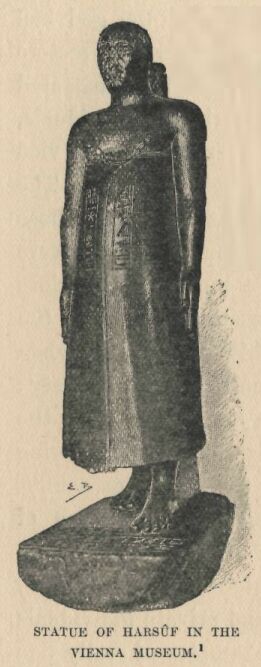
The statuettes found in the tombs, and the smaller objects discovered in the ruins, are neither less carefully nor less successfully treated. The little scribe at Gîzeh, in the attitude of walking, is a chef d’oeuvre of delicacy and grace, and might be attributed to one of the best schools of the XIIth dynasty, did not the inscriptions oblige us to relegate it to the Theban art of the XIIIth. The heavy and commonplace figure of the magnate now in the Vienna Museum is treated with a rather coarse realism, but exhibits nevertheless most skilful tooling. It is not exclusively at Thebes, or at Tanis, or in any of the other great cities of Egypt, that we meet with excellent examples of work, or that we can prove that flourishing schools of sculpture existed at this period; probably there is scarcely any small town which would not furnish us at the present day, if careful excavation were carried out, with some monument or object worthy of being placed in a museum. During the XIIIth dynasty both art and everything else in Egypt were fairly prosperous. Nothing attained a very high standard, but, on the other hand, nothing fell below a certain level of respectable mediocrity. Wealth exercised, however, an injurious influence upon artistic taste. The funerary statue, for instance, which Aûtûabrî I. Horû ordered for himself was of ebony, and seems to have been inlaid originally with gold, whereas Kheops and Khephren were content to have theirs of alabaster and diorite.
Drawn by Boudier, from the sketch by Lepsius; the head was “quite mutilated and separated from t he bust.”
During this dynasty we hear nothing of the inhabitants of the Sinaitic Peninsula to the east, or of the Libyans to the west: it was in the south, in Ethiopia, that the Pharaohs expended all their surplus energy. The most important of them, Sovkhotpu I., had continued to register the height of the Nile on the rocks of Semneh, but after his time we are unable to say where the Nilometer was moved to, nor, indeed, who displaced it. The middle basin of the river as far as Gebel-Barkal was soon incorporated with Egypt, and the population became quickly assimilated. The colonization of the larger islands of Say and Argo took place first, as their isolation protected them from sudden attacks: certain princes of the XIIIth dynasty built temples there, and erected their statues within them, just as they would have done in any of the most peaceful districts of the Said or the Delta. Argo is still at the present day one of the largest of these Nubian islands:* it is said to be 12 miles in length, and about 2 1/2 in width towards the middle.
* The description of Argo and its ruins is borrowed from Caillaud, Voyage à Méroé, vol. ii. pp. 1-7.
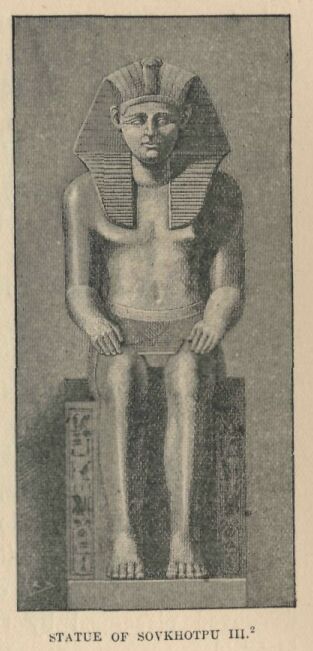
It is partly wooded, and vegetation grows there with tropical luxuriance; creeping plants climb from tree to tree, and form an almost impenetrable undergrowth, which swarms with game secure from the sportsman. A score of villages are dotted about in the clearings, and are surrounded by carefully cultivated fields, in which durra predominates. An unknown Pharaoh of the XIIIth dynasty built, near to the principal village, a temple of considerable size; it covered an area, whose limits may still easily be traced, of 174 feet wide by 292 long from east to west. The main body of the building was of sandstone, probably brought from the quarries of Tombos: it has been pitilessly destroyed piecemeal by the inhabitants, and only a few insignificant fragments, on which some lines of hieroglyphs may still be deciphered, remain in situ. A small statue of black granite of good workmanship is still standing in the midst of the ruins. It represents Sovkhotpû III. sitting, with his hands resting on his knees; the head, which has been mutilated, lies beside the body.
Drawn by Boudier, from the photograph in Rougé-Banville’s Album photographique de la Mission de M. de Bougé, No. 114.
The same king erected colossal statues of himself at Tanis, Bubastis, and at Thebes: he was undisputed master of the whole Nile Valley, from near the spot where the river receives its last tributary to where it empties itself into the sea. The making of Egypt was finally accomplished in his time, and if all its component parts were not as yet equally prosperous, the bond which connected them was strong enough to resist any attempt to break it, whether by civil discord within or invasions from without. The country was not free from revolutions, and if we have no authority for stating that they were the cause of the downfall of the XIIIth dynasty, the lists of Manetho at least show that after that event the centre of Egyptian power was again shifted. Thebes lost its supremacy, and the preponderating influence passed into the hands of sovereigns who were natives of the Delta. Xoïs, situated in the midst of the marshes, between the Phatnitic and Sebennytic branches of the Nile, was one of those very ancient cities which had played but an insignificant part in shaping the destinies of the country. By what combination of circumstances its princes succeeded in raising themselves to the throne of the Pharaohs, we know not: they numbered, so it was said, seventy-five kings, who reigned four hundred and eighty-four years, and whose mutilated names darken the pages of the Turin Papyrus. The majority of them did little more than appear upon the throne, some reigning three years, others two, others a year or scarcely more than a few months: far from being a regularly constituted line of sovereigns, they appear rather to have been a series of Pretenders, mutually jealous of and deposing one another.
The feudal lords who had been so powerful under the Usirtasens had lost none of their prestige under the Sovkhotpûs: and the rivalries of usurpers of this kind, who seized the crown without being strong enough to keep it, may perhaps explain the long sequence of shadowy Pharaohs with curtailed reigns who constitute the XIVth dynasty. They did not withdraw from Nubia, of that fact we are certain: but what did they achieve in the north and north-east of the empire? The nomad tribes were showing signs of restlessness on the frontier, the peoples of the Tigris and Euphrates were already pushing the vanguards of their armies into Central Syria. While Egypt had been bringing the valley of the Nile and the eastern corner of Africa into subjection, Chaldæa had imposed both her language and her laws upon the whole of that part of Western Asia which separated her from Egypt: the time was approaching when these two great civilized powers of the ancient world would meet each other face to face and come into fierce collision.
END OF VOL. II.