Volume 1 — CHAPTER I. INTRODUCTION. SPAIN AND CIVILIZATION AT THE BEGINNING OF THE SIXTEENTH CENTURY. (continued 2)
Reading edition
FEMALE CHASTITY.
Seldom has Spanish society been conspicuous for its high moral tone. Female chastity was an abstract quality, the property of the father or husband, rather than an inherent virtue for the safe-keeping of which the female possessor was responsible. The master of a household exercised sovereign authority therein, claiming even the power of life and death over the members of his family. He was addressed in the third person as 'your worship;' sons dare not cover their head, cross their legs, or even sit in his presence unless so directed; daughters were betrothed without their knowledge, and to men whom they had never seen; the selection of a husband rested entirely with the father, and the daughter had only to acquiesce. Female decorum and purity were placed under espionage. A dueña kept guard over the wife and daughter at home, and closely followed at their heels whenever they stepped into the street. Ladies, closely veiled, marched solemnly to church, preceded by a rodrigon, or squire, with cushion and prayer-book, and followed by a dueña. At service, her place was in front, and men took up their station behind her. Teach woman first that she is inferior, next that she is impotent; add to this intellectual inanity and implied moral unaccountability, and you have a creature ripe for wickedness.
This excess of caution defeated its own purpose. Women, left much alone within their cloister-like homes, waited not in vain for opportunity. The gay mistress could often too easily win over her attendant, and make of her dueña a go-between; yet if we may believe the record, infidelity was rare, and for two reasons. First, woman in her seclusion escaped many temptations; and secondly, a wholesome fear, the certainty that vengeance, swift and sure, would follow the offence, resulting in the death of one or both offenders, placed a curb on passion. Females of the lower classes, left alone to take care of their virtue as best they might, with faces open and actions free, were less given to transgression than their wealthier sisters.
Lewd women could not testify in criminal cases. Respectable women were permitted to testify, but the judge was obliged to wait on them at their homes, as they were not allowed to attend court. Learning to write was discouraged in females, as they could then have it in their power to scribble love-letters to their gallants. Queen Isabella did much to elevate and purify both religion and morals. The court of Enrique IV., her predecessor, has been described as but little better than a brothel, where "the queen, a daughter of Portugal, lived openly with her parasites and gallants, as the king did with his minions and mistresses." Maids of honor were trained courtesans, and the noblemen of the court occupied their time in illicit amours and love intrigues. From the king on his throne to his lowest subject, all who could afford it kept a mistress.
Ware states that within a century the widows of Madrid were "compelled to pass the whole first year of their mourning in a chamber entirely hung with black, where not a single ray of the sun could penetrate, seated on a little mattress with their legs always crossed. When this year was over, they retired to pass the second year in a chamber hung with grey." This savagism is paralleled by the Thlinkeets of Alaska, who at certain times confine women in a little kennel for six months, giving them one a size larger for the second six months; likewise by the Tacullies of New Caledonia, who make the widow carry the deceased husband's ashes upon her back in a bag for one or two years.
EUROPEAN SOCIETY IN GENERAL.
A glance at English and French society shows us, however, that the character of the Spanish women of this epoch compared favorably with that of their northern sisters. Though perhaps no chaster than the French, they were not street-brawlers like the English women. These latter, we are told, from whom the men would separate themselves in their debauches, would likewise assemble at the public house, drink their ale, talk loudly and lewdly, and gossip, swear, and fight. In a religious play of the period, representing the deluge, Noah, when ready to enter the ark, seeks his wife, and finds her carousing with her gossips at the public drink-house.
"Young ladies, even of great families," says Wright, "were brought up not only strictly but even tyrannically by their mothers, who kept them constantly at work, exacted from them almost slavish deference and respect, and even counted upon their earnings." A mother in those days was accounted a little severe who beat her daughter "once in the week, or twice, and sometimes twice a day," and "broke her head in two or three places," or still worse, permitted her to "speak with no man, whosoever come."
Witness the wooing of Matilda of Flanders by William the Conqueror. Having had the audacity to refuse him, the noble suitor entered her home, seized her long tresses, dragged her about the floor, struck her; then flinging her from him, he spurned her with his foot. Matilda at once accepted him, saying: "He must be a man of courage who dare beat me in my father's palace."
Pedro el Cruel, king of Castile and Leon, about the middle of the fourteenth century held good, and commanded, under heavy penalties, that no one of the laboring classes, man or woman, who was able to work, should be found begging. He fixed the day's wage of every class with the most punctilious exactitude. Shoemakers, tailors, armorers, and others who worked by the job, had a definite price attached to the making of every article. A shoe of such and such leather, made after such a fashion, with a double or single sole; a cloak, lined or unlined; a weapon of an ordinary, or of a superior temper and finish—each article in its fabrication was to cost just so much and no more.
It was an age of interference in the affairs of men, the strong against the weak. It was in these trade regulations, and in sumptuary laws, the superstition of political economy and social statics, that the science of ignorance culminated. It was then that learned men threw dust into the air, cast a cloud about their own intellect, and labored hard to inculcate the principles of nescience into the minds of men. In England the number of servants a nobleman might have was fixed by law, as was also costume, and the number of courses at dinner. Soup and two dishes legally constituted a Frenchman's dinner in 1340.
Ferdinand and Isabella were, perhaps, the most parentally inclined of all. No affair, religious, moral, political, judicial, economical, literary, industrial, mechanical, or mercantile could escape their attention. From the regulation and organization of the high councils, and of the civil and ecclesiastical tribunals, to the ordinances for the leather-dressers and cloth-shearers; from the decrees concerning the universities and the literary and scientific bodies, to the orders that prescribed the weight of horseshoes; from the general laws on commerce and navigation, to those which fixed the expenditure at weddings and baptisms, and the amount of wax to be burned at funerals; from the highest interests and rights of religion and of the throne, down to the most humble and mechanical industries—all were considered, legislated upon, and seen to by their Catholic Majesties, with infinite pains and vigilance. In 1510, thinking the colonists of Española too fond of ostentation and extravagance, Ferdinand issued a proclamation, forbidding them to wear rich silks, brocades, or gold or silver lace. Owners of vessels, in times of peace, were forced to engage at fixed prices in perilous voyages of discovery or commerce.
SUMPTUARY LAWS.
In England it appears that the dress of the men commanded the special attention of their rulers. Spaniards made men and women alike to feel the iron heel of sumptuary legislation; while the English, in laws of nearly coincident date, for the most part omitted the sex. By distinctive qualities, Edward IV., 1461-1483, regulated the dress of his people—from the royal cloth-of-gold down to the two-shillings-a-yard, and under, cloth of the laboring classes; but, if we may believe Sanford, he took care to exempt his women subjects from the provisions of this act, save only the wives of the two-shillings-a-yard boor, who might be expected to have other things to attend to.
The continental ladies, it appears, could flaunt it bravely upon occasion, at least in France and Flanders. For through these countries crusaded, in 1428, Thomas Conecte, a Carmelite friar, preaching against the evils of the age, or what he considered as such. Among these, dress held a place, and many other things not generally condemned at present. His manner of going to work was peculiar, and is pretty well described by Monstrelet.
In his audiences he always separated the men from the women by a cord, "for he had observed some sly doings between them while he was preaching." Having taken these wise precautions, he was accustomed earnestly to admonish his hearers "on the damnation of their souls and on pain of excommunication, to bring to him whatever backgammon-boards, chessboards, nine-pins, or other instruments for games of amusement they might possess." Right bitterly would he then attack the luxurious apparel of ladies of rank; especially the monstrous head-gear which was in fashion at that time; all of which bred trouble, as may readily be imagined, and produced no good results.
We see the same style of preaching indulged in by the Wesleys in England and Whitefield and others in America at different times, and ever with the same lack of practical results. The most costly jewelry, the finest apparel, grand houses and free living are as conspicuous among the followers of these self-sacrificing and conscientious men as among the members of any other church, or among those who are not members of any church. And if the pious Carmelite friar failed in his crusade against fine clothes, free living, and monstrous head-gear among the Spanish of the fifteenth century, so have more modern crusaders failed in similar attempts in later times.
This then was Spain and Spanish character, as nearly as I have been able to picture them in the short space allotted, at or prior to the dawn of the sixteenth century. We have found Spaniards the noblest race on earth at that time; their men brave, their women modest. Before them opened a career more brilliant than the world has ever seen before or since. To follow them in some parts of that career is the purpose of these volumes.
We have found these people after all not so very different from ourselves—more loyal than we, but more ignorant; more religious, but more superstitious; more daring, but more reckless; more enthusiastic, but more chimerical. They were endowed with the virtues and vices of their age, as we are with the virtues and vices of ours. They were sincere in their opinions, and honest in their efforts; but we have the advantage of them by four centuries of recorded experiences. Our knowledge, our advantages, are superior to theirs; do we make superior use of them? Spain lighted a hemisphere of dark waters, brought forth hidden islands and continents, and presented half a world to the other half. With all our boasted improvement, have we done more?
It is the custom of historical commentators to praise and to blame ad libitum. This is right if it be done judiciously. We should praise discreetly, and blame with steadiness. But there is really little to praise or to blame in history, and most of it that is done is simply praising or blaming the providence of progress. Would you blame the Spanish people for being ignorant, submissive, and cruel? They were as God and circumstances made them. Would you blame their king and princes for domineering them? They were as the people and circumstances made them. The people were indignant if their rulers did not impose upon them. Says Grenville, writing in his memoirs so late as 1818: "The Regent drives in the park every day in a tilbury, with his groom sitting by his side; grave men are shocked at this undignified practice."
Meanwhile, amidst the many so-called spirits which in this epoch hovered over man, the spirit of discovery was not the least potent. Curiosity, the mother of science, became the mother of new worlds; gave birth to continents, islands, and seas; gave form and boundary to earth. Over the sea, the mists of the Dark Age had rested with greater density even than on land. The aurora of progress now illumined the western horizon as of old it did the eastern. Hitherto the great ocean, beyond a few leagues from shore, was a mystery. As may be seen depicted on ancient charts, it was filled, in the imaginations of navigators, with formidable water-beasts and monsters, scarcely less terrible than those that Æneas saw as he entered the mouth of Hades:
"Multaque præterea variarum monstra ferarum: Centauri in foribus stabulant, Scyllæque biformes, et centumgeminus Briareus, ac belua Lernæ horrendum stridens, flammisque armata Chimæra, Gorgones Harpyiæque et forma tricorporis umbræ."
Ancient geographers affirmed that the heat of the torrid zone was intolerable, that men and ships entering it would shrivel. This belt of consuming heat presented an impenetrable barrier between the known and the unknown.
What wonder that intellect was stunted, civilization dwarfed, restricted as was human knowledge to the narrow grave-like walls of western Europe! No sooner were these ancient boundaries burst, and the black and dreadful fog-banks which lay upon primeval ocean pierced, than fancy, like a freed bird, bounded forth, swept the circumference of the earth, soared aloft amid the stars, and dared even to ask of religion a reason.
EUROPE AND AMERICA.
One glance westward. On either side of an unswept sea, a Sea of Darkness it was called by those that feared it, there rested at the opening of this history two fair continents, each unknown to the other. One was cultivated; its nations were well advanced in those arts and courtesies that spring from accumulated experiences; the other, for the most part, unmarred by man, lay revelling in primeval beauty, fresh as from the Creator's hand. The leaven of progress working in one, brought to its knowledge the existence of the other; the Sea of Darkness with its uncouth monsters was turned into a highway, and civilized Europe stood face to face with sylvan America. This world newly found was called the New World; though which is the new and which the old; which, if either, peopled the other, is yet undetermined. One in organism and in the nature human, the people of the two worlds were in color, customs, and sentiment several. The barbarous New World boasted its civilizations, while the civilized Old World disclosed its barbarisms; on Mexican and Peruvian highlands were nations of city-builders as far superior in culture to the islanders and coast-dwellers seen by Columbus, as were the European discoverers superior to the American highlanders. Of probable indigenous origin, this lesser civilization shows traces of high antiquity; even the ruder nations of the north leave far behind them absolute primevalism.
I do not say with some that in America were seen in certain directions marks of as high culture as any in Europe. There were no such marks. But this unquestionably is true; that, as in Europe, we here find that most inexplicable of phenomena, the evolution of civility; man's mental and spiritual necessities, like his physical wants, appear everywhere the same. The mind, like the body, craves nutriment, and the dimmed imprisoned soul a higher sympathy; hence we see men of every clime and color making for themselves gods, and contriving creeds which shall presently deliver them from their dilemma. The civilizations of America, unlike well-rooted saplings of Egypt, Greece, and Rome, were sensitive-plants which collapsed upon the first foreign touch, leaving only the blackness of darkness; hence it was the wild tribes, far more than the cultivated nations, that influenced the character of subsequent American societies.
In her civil and religious polities America was every whit as consistent as Europe. Neither was altogether perfect or wise; and we wonder at the blindness and stupidity of one as of the other. Although we could catch but a glimpse of the Americans before they vanished, yet we might see that intellect was not stationary, but growing, and that society was instinct with intelligent and progressional activity.
COMPARATIVE RELIGIONS.
In their religions the Americans paralleled the rest of mankind. Every religion derives its form and color from the mind of the worshippers, so that by their gods we may know them. From elevated natures emanate chaste and refined conceptions of the deity; from brutish natures coarse conceptions. Christianity is the highest and purest of all religions; but if we study the moral precepts of the foremost American nations, we shall see that in many respects they were not far behind, and were indeed in some instances in advance of Christianity. True, the Aztecs practised human sacrifice, with all its attendant horrors; but what were the religious wars, the expulsion of Jews, the slaughter of Infidels, the burning of heretics, but human sacrifice? Moreover, while we turn in horror from the sacrificial stone of the Aztecs, where the human victims were treated as gods and whence their souls were sent direct to Paradise, yet we find among them little of that most infamous of crimes—persecution for opinion's sake; nor yet do we read of their ingenuity being taxed for the contrivance of engines of the most excruciating torture, as we do in the history of Christianity. Tortures which, while killing the body, it was believed consigned the soul to eternal agonies.
There was little in the social or political systems of Europe of which the counterpart could not be found in America; indeed, the economical, social, and political condition of every civilization finds its counterpart in every other civilization; and there were institutions then existing in America at whose feet Europe might have sat with benefit.
AMERICAN ABORIGINALS.
Among the wilder tribes we find prevalent the patriarchal state, with its hundreds of languages and theologies; a slight advance from which are those associations of families banded for safety, thus presenting a state of society not unlike that of European feudalism. From this point, every quality and grade of government presents itself until full-blown monarchy is attained, where a sole sovereign becomes an emperor of nations with a state and severity equal to that of the most enlightened. The government of the Nashua nations, which was monarchical and nearly absolute, denotes no small progress from primordial patriarchy.
Like their cousins of Spain and England, the sovereigns of Mexico had their elaborate palaces, with magnificent surroundings, their country residence and their hunting-grounds, their botanical and zoological gardens, and their harems filled with the daughters of nobles, who deemed it an honor to see them thus royally defiled. There were aristocratic and knightly orders; nobles, plebeians, and slaves; pontiffs and priesthoods; land tenures and taxation; seminaries of learning, and systems of education, in which virtue was extolled and vice denounced; laws and law courts of various grades, and councils and tribunals of various kinds; military orders with drill, engineer corps, arms, and fortifications; commerce, caravans, markets, merchants, pedlers, and commercial fairs, with a credit system, and express and postal facilities.
They were not lacking in pleasures and amusements similar to those of the Europeans, such as feasts with professional jester, music, dancing; and after dinner the drama, national games, gymnastics, and gladiatorial combats. They were not without their intoxicating drink, delighting in drunkenness while denouncing it. Their medical faculty and systems of surgery they had, and their burial-men; also their literati, scholars, orators, and poets, with an arithmetical system, a calendar, a knowledge of astronomy, hieroglyphic books, chronological records, public libraries, and national archives.
The horoscope of infants was cast; the cross was lifted up; incense was burned; baptism and circumcision were practised. Whence arose these customs so like those of their fellow-men across the Atlantic, whom they had never seen or heard of?
The conquerors found all this when they entered the country. They examined with admiration the manufactures of gold, silver, copper, tin, and lead, wrought to exquisite patterns with surprising skill. They gazed with astonishment on huge architectural piles, on monumental remains speaking louder than words; on temples, causeways, fountains, aqueducts, and light-houses, surrounded as they were with statues and intricate and costly stone carvings. They found that the Americans made cloth, paper, pottery, and dyes, and were proficient in painting. Their mosaic feather-work was a marvel.
There are many points of interest, well worth examination, which I have not space here properly to mention. The interested reader, however, will find all material necessary to careful comparison in my Native Races of the Pacific States. He will there find described conditions of society analogous to feudalism and chivalry; he will find municipal governments, walled towns, and standing armies. There were legislative assemblies similar to that of the Cortes, and associations not unlike that of the Holy Brotherhood. To say that trial by combat sometimes occurred is affirming of them nothing complimentary; but upon the absence of some European institutions they were to be congratulated.
Although living lives of easy poverty, the wild tribes of America everywhere possessed dormant wealth enough to tempt the cupidity alike of the fierce Spaniard, the blithe Frenchman, and the sombre Englishman. Under a burning tropical sun, where neither meat nor clothing was essential to comfort, the land yielded gold, while in hyperborean forests where no precious metals were discovered the richest peltries abounded; so that no savage in all this northern continent was found so poor that grasping civilization could find nothing to rob him of.
When Europe undertook the mastery of America, she found the people, as a rule, ready to be friendly. Some at first were startled into the seizure of their arms, the first impulse of the wild man on meeting anything strange being to defend himself. But their fears were easily allayed, their confidence easily gained, and their pledges of good faith were usually to be depended upon.
COMPARATIVE CHARACTERISTICS.
The variations between them and their brethren across the Atlantic were less of kind than of quality. They were more children than wild beasts. Physically they were complete, but mentally they were not fully developed. Their minds were not so broad, nor so strong or subtle as those of white men. Their cunning partook more of brute instinct than of civilized artifice. There was mind-power enough, but it lacked shape and consistency. They were naturally no more blood-thirsty, or cruel, or superstitious than their conquerors, but their cruelty and superstitions were of coarser, cruder forms. The American aboriginal character has been greatly misconstrued, and is to-day but imperfectly understood.
The chief difference, or cause of difference, between the people of Europe and the more advanced nations of America, it seems to me, lay in the ignorance of some few things, apparently insignificant in themselves, yet mighty enough to revolutionize Christendom; such as the use of iron, gunpowder, and movable types. The absence of horses, and other of the more useful domestic animals, was also a disadvantage.
After reading of the Europeans of that day it is irony to call the Americans revengeful or cruel. Where is it possible to find more strongly developed those qualities which civilization most condemns than among civilized nations—the same, only refined? So blind are we to our own faults, so quick to see and condemn the faults of our weak and defenceless neighbor!
Catalogue crime and place the white beside the red. Seldom was the Indian treacherous until he had been deceived. The Indians tortured their prisoners; so did the white men, hunting them with bloodhounds, enslaving them, branding them with hot irons, beating and roasting them, making them work in the mines until death relieved them by thousands, butchering wives and children because the husband and father dared strike a blow in their defence. It is well to call them brutal in warfare when the white man so quickly adopts their most brutal customs; it is well to call them beasts of prey, when the white man crosses the ocean to prey upon those very beasts which he pretends to slur.
In speaking of the Indians, it has become the custom wilfully to misapply terms. If a tribe resist an injury, it is called an outbreak; if successful in war, it is a massacre; if successful in single combat, it is a murder. Thus soldiers speak to cover the disgrace of defeat, and thus reports are made by men who regard not decency in speaking of a savage, to say nothing of fairness. It is enough that we have exterminated this people, without attempting to malign them and exalt our own baseness. What should we do were a foreign power to come in ships to our shore and begin to slaughter our animals, to stake off our land and divide it among themselves? We should drive them away if we were able; but if we found them the stronger, we should employ every art to destroy them, and in so doing regard ourselves as patriots performing a sacred obligation. This is the Indians crime; and in so doing we call him cunning, revengeful, hateful, diabolical. But the white man brings him blankets, it may be said, brings him medicine, tells him of contrivances, teaches him civilization. These things are exactly what the savage does not want, and what he is much better off without. The white man's comforts kill him almost as quickly as do his cruelties; and the teachings of Christ's ministers are abhorrent if they are coupled with the examples of lecherous and murderous professors of Christianity.
These, however, were by no means all that white men gave the Indian. We might enumerate alcohol, small-pox, measles, syphilis, and a dozen other disgusting adjuncts of civilization of which the savage before knew nothing. Can savagism boast greater achievements? White men have killed fifty Indians where Indians have killed one white man, and this, notwithstanding that nine tenths of all injuries inflicted have been perpetrated by white invaders. A thousand Indian women have been outraged by men whose mothers had taught them the Lord's prayer, where one white woman has been injured by these benighted heathen. At any time in the history of America I would rather take my chances as a white woman among savages, than as an Indian woman among white people.
SIGNIFICATIONS OF PROGRESS.
Brethren by procreation, but by destiny foes, as we behold them there the so-called New and Old thus so strangely brought together, naturally enough we ask ourselves, Whence came the one, and whither tends the other? Whence came these dusky denizens of the forest, and for how many thousands of ages has the feeble light of their intelligence struggled with the darkness, dimly flickering, now gathering strength, now falling back into dense obscurity; how long and in what manner has the divine spark thus wrestled with its environment? And whither tends this fierce flame of human advancement which just now bursts its ancient boundaries, sweeps across the Sea of Darkness, absorbs all lesser lights, and dazzles and consumes a hemisphere of souls? More especially, when we look back toward what we are accustomed to call the beginning, and mark the steady advance of knowledge, the ever-increasing power of mind; when we consider the progress of even the last half century, and listen to the present din and clatter of improvement, do we raise our eyes to the future and ask, Whither tends all this? Whither tends with so rapidly accelerating swiftness this self-begetting of enlightenment, this massing of human acquirements; whither tends this perpetually increasing domination of the intellectual over the material? Within the past few thousand years we have seen our race emerge from barbarism, and notwithstanding the inherent tendency to evil ever present in our natures, we have seen mankind put on civilization and accept for their faith Christianity, the purest and highest type of religion. We have seen nations cease somewhat their hereditary growlings, and brutal blood-sheddings, and mingle as brethren; we have seen wavy grain supplant the tangled wildwood, gardens materialize from the mirage, and magnificent cities rise out of the rocky ground. Thus we have seen the whole earth placed under tribute, and this mysterious reasoning intelligence of ours elevating itself yet more and more above the instincts of the brute, and asserting its dominion over nature; belting the earth with an impatient energy, which now presses outward from every meridian, widening its domain as best it may toward the north and toward the south, building equatorial fires under polar icebergs. All this and more from the records of our race we have seen accomplished, and yet do see it; civilization working itself out in accordance with the eternal purposes of Omnipotence, unfolding under man's agency, yet independent of man's will; a subtile, extraneous, unifying energy, stimulated by agencies good not more than by agencies evil, yet always tending in its results to good rather than to evil; an influence beyond the reach or cognizance of man, working in and round persons and societies, turning and overturning, now clouding the sky with blackness and dropping disorder on floundering humanity, but only to be followed by a yet more fertilizing sunshine; laying waste and building up, building up by laying waste, civilizing as well by war and avarice as by good-will and sweet charity, civilizing as surely, if not as rapidly, with the world of humanity struggling against it, as with the same human world laboring for it.
Slowly rattles along the dim present, well-nigh buried in its own dust; it is only the past that is well-defined and clear to history.
Summary of Geographical Knowledge and Discovery from the Earliest Records to the Year 1540.
Before entering upon the narration of events composing this history, it seems to me important, in order as well properly to appreciate the foregoing Introduction as to gain from succeeding chapters something more than gratified curiosity, that an exposition of Early Voyages should be given,—acting powerfully as they did on evolving thought and material development, giving breadth and vigor to intellect, enthusiasm to enterprise, and in elevating and stimulating that commercial spirit which was eventually to depose kings, exalt the people, strip from science its superstitions, from religion its cabalistic forms, and by its associations, its negotiations, its adventurous daring, its wars, its alliances, and its humanizing polities, to break the barriers of ancient enmity and bring together in common brotherhood all the nations of the earth.
Therefore, I now propose to give a chronological statement of every authentic voyage of discovery made beyond the Mediterranean prior to 1540, while doubtful and disputed voyages will be discussed according to their relative importance. I shall notice, moreover, such books and charts relating to America as were produced during this period, with fac-similes of the more important maps, to illustrate, at different dates, the progress of discovery. It is my purpose, so far as possible, in the very limited space allowed, to state fairly the conclusions of the best writers on every important point.
One word as to the authorities consulted in the preparation of this Summary. Of books relating to America, published prior to 1540, there are in all about sixty-five; only twenty-five, however, contain original information; twenty-three are general cosmographical works with brief sections on America compiled from the original twenty-five; while seventeen merely mention the New World or its discoveries, and are therefore of no value in this connection. Of the forty-eight containing matter more or less important, there are over two hundred editions, the earliest of which only, in most instances, will be mentioned, and that without extensive bibliographical notes. These books and charts I notice in chronological order under dates of their successive appearance.
The subject of Early Voyages has been so frequently and so thoroughly discussed by able modern writers that it is unnecessary, and indeed impracticable in so condensed an essay, to refer to ancient authorities alone, and prove everything from the beginning. I shall therefore, besides the Spanish historians Peter Martyr, Oviedo, Las Casas, Gomara, Herrera, and the standard collections of Ramusio, Grynæus, Purchas, and Hakluyt, freely use the works of later writers according to their relative worth. And of these last mentioned I epitomize the following. Historia del Nuevo-Mundo, escribíala D. Juan Baut. Muñoz, tom. i.—all ever published—En Madrid, 1793, contains a clear well-written prologo, or essay, on the first three voyages of Columbus with minor mention of contemporary discoveries. An account is also given of the author's labors in beginning the large and invaluable collection of documents completed and published by Martin Fernandez de Navarrete, Coleccion de los Viages y Descubrimientos que hicieron por mar los Españoles desde fines del siglo XV., 5 vols. 4to, Madrid, 1825-37. This collection of Navarrete's is without doubt the most valuable work on the subject of early American voyages, and the foundation of all that followed; containing as it does the original Spanish, Latin, and Portuguese texts of the more important Spanish and Portuguese expeditions from 1393 to 1540—the Latin and Portuguese done into Spanish—together with over five hundred original documents from the Spanish archives, with extensive and generally impartial notes by the editor. For a biographical sketch of this author see chapter iii. of this volume. Washington Irving's Life and Voyages of Christopher Columbus and his Companions, published in London, 1828-31 (edition used, that of New York, 1869, 3 vols.), is an able and elegant abridged translation of Navarrete, and of La Historia de el Almirante D. Christoval Colon, by his son Fernando Colon, in Barcia, Historiadores Primitivos, tom. i., Madrid, 1749. Alexander von Humboldt's Examen critique de l'histoire de la Géographie du nouveau continent, et des progrès de l'astronomie nautique aux 15ème et 16ème Siècles, 5 vols. 8vo, Paris, 1836-9, is a most exhaustive digest of materials furnished by Navarrete and the older historians, illustrated with the results of the author's personal investigations. The work embraces two treatises; first, the causes which led to the discovery of America; second, facts relating to Columbus and Vespucci, with the dates of geographic discoveries. Humboldt's Abhandlung über die ältesten Karten, printed as an introduction to Ghillany, Geschichte des Seefahrers Ritter Martin Behaim, Nuremberg, 1853, of which I have only a manuscript English translation, is an essay as well on the naming of America as on early maps. Another important treatise is that of J. G. Kohl, Die beiden ältesten General-Karten von America, Weimar, 1860, of nearly two hundred large folio pages on the earliest manuscript and printed maps, two of the former, dated 1527 and 1529, accompanying the work, reproduced in chromo-lithographic fac-simile. The same author has produced other works on the subject, the most important being A History of the Discovery of the East Coast of North America, published in Collections of the Maine Historical Society, 2d series, vol. i., Portland, 1869. This contains reduced copies of twenty-three early maps, and is perhaps the most complete work existing, so far as the northern coasts are concerned, giving comparatively little attention to more southern voyages. Kunstmann, Die Entdeckung Amerikas, Munich, 1859, is a careful compilation of ninety-six imperial quarto pages, with copious notes and references, written to accompany a collection of thirteen large chromo-lithographic reproductions of manuscript maps preserved in the Academy of Sciences at Munich, and generally known as the Munich Atlas. Herr Kunstmann treats chiefly of the Atlantic islands, with special reference to the connection between the discoveries of Spaniards and Northmen. Major's Life of Prince Henry of Portugal, London, 1868, is the best authority for Portuguese voyages as well as for the revival of maritime enterprise in the fifteenth century. Stevens' Historical and Geographical Notes on the Earliest Discoveries in America, 1453-1530, New Haven, 1869, was written originally as an introduction to a book by the author's brother on his proposed interoceanic communication via Tehuantepec. It is a concise statement of the whole matter, presenting some of its phases in a practically new light. Varnhagen, Le Premier Voyage de Amerigo Vespucci, Vienna, 1869, must not be omitted as the chief support of a theory on Vespucci's voyages which nearly concerns the first discovery of our Pacific States territory proper. Rafn, Antiquitates Americanæ, Hafniæ, 1837, is the source of nearly all our knowledge of the discoveries of the Northmen in America in the tenth and following centuries; and De Costa, The Pre-Columbian Discovery of America, Albany, 1868, presents an English translation of the same Icelandic sagas in which the enterprises of the Northmen are recorded. The Cartografía Mexicana of Orozco y Berra, published by the Mexican Geographical Society, contains, as its title indicates, a mention of early maps in chronologic order; and the Mapoteca Colombiana of Urricœchea, London, 1860, is another important contribution of similar nature. There should be mentioned the excellent review given in the first volume of Bryant's History of the United States, which has appeared since this Summary was written; and I might present quite a list of papers read before the various learned societies of Europe and America on different topics connected with this subject in late years, none of them I believe materially affecting my conclusions.
The above form but a small portion of the works devoted wholly or in part to the subject, but they are believed to contain all the material necessary for even a more detailed statement than my purpose demands.
ADVENTURES OF THE ANCIENTS.
Of the voyages of the ancients, properly so called, that is, of such as preceded the fall of the Roman Empire at the end of the fourth century, I shall here say little. These maritime expeditions, confined for the most part to the Mediterranean, though extending for some distance along the coasts of the Indian and Atlantic oceans, with occasional voyages designedly or accidentally prolonged to more distant islands, and it may be continents, come down to us through antique histories, cosmographies, and poems, so mixed with vague hypothetical and mythological conceptions, that the most searching investigation is often unable to separate fact from fable. There are multitudes of classic and mediæval legends adopted by Tasso, Pulci, and other Italian poets, such, for example, as that which makes the Greek wanderer Ulysses the pioneer of western adventure, which in a sober treatise are scarcely worthy of mention. Turning to the dawn his vessel's poop, this son of Laertes, it is said, passed Gibraltar, the bound ordained by Hercules not to be overstepped by man, and, as Dante tells us, sailed for the Happy Isles of the unknown Atlantic, unrestrained by son, or father, or even Penelope's ever-weaving web of love.
A little journey was a wonderful exploit before the time of Christ—instance the immortal fame achieved by Hanno, the Carthaginian, in visiting the west coast of Africa, b. c. 570; by Herodotus, in making the excursion of Egypt and India, b. c. 464-456; by Pytheas, in his voyage to the British Isles, b. c. 340; by Nearchus, in descending the Indus, b. c. 326; by Eudoxus, in his attempt to sail round Africa, b. c. 130; by Cæsar, in undertaking the conquest of Gaul, b. c. 58; by Strabo, in penetrating Asia some thirty or forty years later. After the Christian era Pausanias, a Roman, in 175 wrote a guide-book of Greece; Fa Hian, a Chinese monk, went westward into India in the year 400 or thereabout; Cosmas Indicopleustes travelled in India a century and a half later and wrote a book to prove the world square, and the universe an oblong coffer; Arculphe wrote of the Holy Land about 650; an Englishman, Willibald, made the tour of southern Europe and Palestine, setting out from Southampton in 721; in 851 went Soliman from Persia to the China sea. So it has been said.
Indeed, the writings of Herodotus indicate that, over two thousand years before Dias and Vasco da Gama, Africa was circumnavigated by a fleet of Phœnician ships sent by Pharaoh Necho down the Red Sea with orders to return to Egypt by way of the Pillars of Hercules. A Persian, Sataspes, endeavored to accomplish the voyage from the other direction, but failed. Plato's island of Atlantis, founded by the god Neptune, was of great size, "larger than Asia and Libya together, and was situated over against the straits now called the Pillars of Hercules." The climate and soil were so good that fruits ripened twice every year. There were metals, with elephants and other animals in abundance. Upon a mountain was a beautiful city with gold and ivory palaces, having gardens and statues. Unfortunately in time the sea swallowed up this island, so that it could scarcely have been America.
THE PROPHECY OF QUETZALCOATL.
So far as these voyages and strange tales concern the possible knowledge of America by the ancients, I have already discussed them in my Native Races of the Pacific States. Therein is mentioned a theory which has found many advocates, and to which I will again briefly allude in this place. It is that at the beginning of the Christian era America was visited by the Apostle St Thomas. He was accompanied by a number of fellow-laborers in the ministry, who preached the gospel and planted the Christian religion in America. The theory is ably advocated in the excellent work of Rev. W. Gleeson, The History of the Catholic Church in California. The principal arguments advanced may be briefly stated as follows: First, that the whole tenor of Scripture teaching is in favor of the supposition that the gospel was preached to all the world from the beginning, rather than after the lapse of several centuries. Second, that at a date fixed by Mexican hieroglyphics as a little before the middle of the first century after Christ, a celebrated personage, certainly the most remarkable in Mexican mythology, came from the north. He is represented as a white man, with flowing beard, clad in a long white robe, adorned with red crosses, head uncovered, and a staff in his hand. This was the Quetzalcoatl, whom the Mexicans afterward worshipped, and whose return was so anxiously looked for by them. See Torquemada, Monarq. Ind. Third, that to him popular tradition ascribes the worship paid to the cross, the practice of confession, and in a word all the customs found on the arrival of the Spaniards to be nearly identical with those of the Christian religion. Veytia, Hist. Ant. de Mexico. Fourth, that the name Quetzalcoatl is synonymous with that of St Thomas. See Native Races, v. 26. Fifth, that Quetzalcoatl promised on his departure to return at some future day with his posterity and resume the possession of the empire, and that day was looked forward to with general confidence, Prescott's Conq. Mex., and that a general feeling prevailed at the time of Montezuma that the period of his return had arrived. Veytia, Hist. Ant. Mex. Sixth, that there were at the convent of Nijapa, in the province of Oajaca, hieroglyphs containing all the principal doctrines of the Christian religion, and the coming of the Apostle to the country. Id.
Sahagun, who wrote at the time of the conquest, speaks of the general belief in this prophecy, and assures us that on the arrival of the Spaniards they repeatedly offered them divine honors, believing that their god Quetzalcoatl had returned. Conq. Mex., i. chap. iii.
"It is then undeniably true," says Gleeson, Catholic Church in Cal., 185, "that a popular tradition existed in the country respecting a prophecy made by Quetzalcohuatl, in which was foretold the future arrival of whites on the coast; and this, while it proves the reality of the man, and his character as a teacher of religion, also proves the still more important and appreciable fact of his being a Christian, and of western origin; for, it was clearly set forth in the prophecy, that the persons who should come would be whites, and of the same religion as he. The time also seems to have been specified by the Apostle, if we are to judge by the expression that they were expecting him every day. And, indeed, Boturini assures us that the time mentioned in the Mexican hieroglyphics was that in which the Christians arrived. The year ce acatl was that foretold by Quetzalcohuatl, and in that year the Spaniards landed in the Country." On ancient voyages and cosmography see also Humboldt, Exam. Crit., tom. i. pp. 125-206.
It is the results of ancient voyages, the point of geographical knowledge attained by ancient civilization in its most advanced stage and by it bequeathed to the Dark Age, and not the voyages themselves, with which we have to do at present. This knowledge is found for the most part embodied in the system of Ptolemy, the Alexandrian geographer of the second century, whose works became the standard text-books, and holding their prominence for fourteen hundred years were not superseded as late as the sixteenth century, but were republished from time to time, with additions, setting forth the results of new discoveries. In this manner twenty-one editions appeared during the first half of that century. Nor was even Ptolemy the originator of this prolonged system. One hundred and fifty years before him was the Greek geographer Strabo, who gave descriptions of countries and peoples, fixing his localities usually by itinerary distances; and to this work of Strabo's, Ptolemy added a century and a half of progress, and determined his localities by astronomical observation. The work of Pomponius Mela, the Roman geographer who wrote probably somewhat later than Strabo, is regarded as no improvement on that of his predecessor.
Ptolemy's World was nearly all in the north temperate zone, embracing about fifty degrees of latitude and one hundred and twenty of longitude. The Fortunate Isles, now called the Canaries, were known to Ptolemy, and by him used as a western limit or first meridian. This, and as a nucleus of poetic myths, seem to have been their only use; as Muñoz says, Hist. del Nuevo Mundo, p. 30: "Fuera de este uso apenas aprovecharon sino para entretenir ociosas imaginaciones con fábulas de poetas." The eastern limit was vaguely located in the region beyond the Ganges; actually in about 100° east longitude. On the south were included the African coasts of the Mediterranean and Red Sea, with the southern coasts of Arabia and India proper—the term India being then applied indefinitely to all eastern lands, including even parts of Africa—thus fixing the southern bound at about 30° north latitude in the west, and 10° in the east. Northward the limit may be placed a little above 60°, within which falls the southern part of the Scandinavian peninsula, then supposed to be an island, and also the island of Thule, the location of which is disputed, some claiming it to have been Iceland, others the Faroe Islands, and others the Shetland Islands. But Ptolemy's latitudes were all some ten degrees too far north, while in his longitudes he went still further astray; since, reckoning from the Canaries as his first meridian, he made his last meridian 180°, when it should have been 120°, and thus by narrowing half the circumference of the globe some sixty degrees he made the world nearly one third less than it really is. Authorities differ, however, as to what were Ptolemy's ideas. But more of this hereafter. On the opposite page is a map in which the world as known in these times is left white, the shaded portions being the result of subsequent discoveries down to the last half of the fifteenth century. A map of Ptolemy's World, reduced to its true proportions, may be seen in Goselin, Recherches sur la géographie systématique et positive des anciens, tom. iv., Paris, 1813.
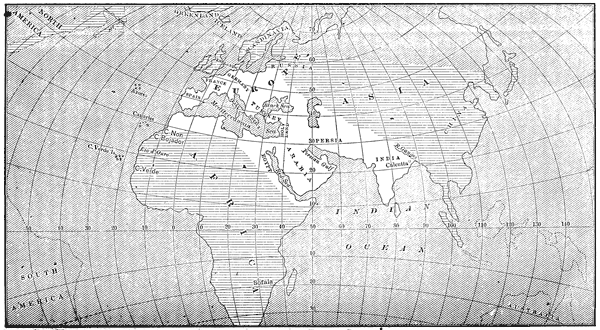
The World; the white part as known at the end of the Fourth Century, the lightly shaded portions as known at the end of the Fifteenth.
View larger image
Within these limits, then, geographical knowledge was confined at the end of the fourth century; limits not sharply defined, but indefinite and wavering according to ages, to the directions of conquest, and to distances from Mediterranean centres. Beyond these limits was a realm of darkness peopled by strange beings, creatures of poetic fancy or crude conjecture. Just as the wonder-land of Homer to contemporaneous eastern Greeks, was Italy, with its strange waters inhabited by very strange beasts, and Sicily, and neighboring isles, where were the Satyrs, and the gigantic one-eyed Cyclops eating milk and mutton and men, so to later teachers were the strange seas beyond. On the north was an impenetrable region of eternal ice; on the south, an equatorial zone of burning heat; a barrier of frost on the one side and of fire on the other, both equally uninhabitable to the European man, and cutting off all communication with possible habitable lands elsewhere. The burning zone, however, seems to have been a popular idea, rather than a part of the system taught by Ptolemy, who, indeed, held that Africa extended south-east and north-east toward the eastern parts of Asia, making of the Indian Ocean an immense gulf not connected with the Atlantic on the west. Strabo and other geographers who preceded Ptolemy gave Africa approximately its correct shape; traditions of its circumnavigation even were kept alive, in spite of Ptolemy's theory, influencing geographic thought not a little during the fifteenth century. Irving is of opinion, Columbus, vol. iii. p. 440, that modern authors consider the knowledge of the ancients concerning Africa much less extensive than has been generally supposed; but Major, Prince Henry, p. 89 et seq., accepts a circumnavigation of Africa in the seventh century b. c., and also Hanno's voyage far down the African coast, placing the date of the latter 570 b. c. Among the philosophers of western Europe no definite hypotheses appear to have been advanced as to the extent of land beyond the known region; as to the ideas of the Arabs and Buddhist priests concerning the matter it is difficult to determine. See Kohl's Hist. Discov., p. 149; Draper's Intellectual Development, p. 451, New York, 1872. Beyond the Fortunate Isles to the west stretched a Mare Tenebrosum, or Sea of Darkness, as early writers express it, separating the known western coast from the far unknown east. In this dark sea tradition planted islands at various points, reiterating the fact of their existence so often that names and locations were finally given them on maps, though the islands themselves have never yet been found. Except these fabulous islands, there was little thought of land between the coasts of Europe and Asia. Compare maps in this volume; also George Bancroft's History of the United States, vol. i. p. 6, Boston, 1870; D'Avesac, in Nouvelles Annales des Voyages, 1845, tom. cv. p. 293; tom. cvi. p. 47.
To sum up the geographical knowledge of the ancients, we have first, the sphericity of the earth surmised, although its size was vaguely conceived and underrated; secondly, the positive knowledge of Europeans limited to the unshaded portion of the map on page 73; thirdly, divers theories respecting the conformation of southern Africa; fourthly, a mare oceanum stretching westward to the unknown Asiatic shore, with hypothetical islands intervening, and expressed opinions that this sea was navigable, and that possibly India might be reached by sailing westward. These ideas, vague as they seem, were held only by the learned few; the world of the ignorant reached scarcely beyond the horizon of their actual experience. Not until long after its actual circumnavigation, in the sixteenth century, was the popular mind able to grasp the idea of the earth's sphericity.
We come now to mediæval times, when from the fifth to the fifteenth century the cosmographical as well as all other knowledge of the ancients lay well-nigh dormant; to the people a land of darkness as well as a sea, though in some few colleges and convents these things were thought of. "Ces ténèbres," says Humboldt, Exam. Crit., tom. i. p. 59, "s'étendaient sans doute sur les masses; mais, dans les couvens et les colléges quelques individus conservaient les traditions de l'antiquité." Upon this world of darkness light first broke from the far north, the voyages of the Scandinavians from the ninth to the twelfth centuries being the aurora borealis of maritime discovery. These Northmen, as in their expeditions Danes, Norwegians, and Swedes were indiscriminately called, by their warlike propensities made themselves known and feared along the shores of Europe at an early date; but their western discoveries were known only to themselves; at all events, no trace of distant voyages to the west are found in the records of their neighbors. It is only quite recently that the sagas of the Northmen were brought to the attention of European scholars; and when the Danish bishop, Müller, published his bibliography of the sagas, 3 vols., Copenhagen, 1817-1820, these narratives were held to be more fiction than fact. Even so late a writer as George Bancroft, History of the United States, vol. i. pp. 5, 6, says that the story of colonization by the Northmen "rests on narratives, mythological in form, and obscure in meaning; ancient, yet not contemporary," and that "no clear historic evidence establishes the natural probability that they accomplished the passage." Irving, Columbus, vol. iii. pp. 432-5, considers the matter "still to be wrapped in much doubt and obscurity." Both of these authors, however, seem to have considered only the evidence presented by Malte-Brun and Forster. Since their time proofs beyond question have established the authenticity of these voyages of the Northmen. The sagas on American discoveries are preserved in the archives at Copenhagen, with a collection of other historical data, reaching down to the fourteenth century, the date of their completion. It is true that they deal somewhat in the marvellous—they would not be authentic else, written at that time—but they contain tales no more wonderful or monstrous than the writings of more southern nations. See an account of the Copenhagen documents and the examination of their authenticity in De Costa's Pre-Columbian Discov. Am., pp. i-lx. Two nearly contemporary ecclesiastical histories—that of Adam of Bremen, 1073, and Ordericus Vitalis, about 1100—describe briefly the western lands of the Northmen. Further reference, Kunstmann, Entdeckung Am., p. 32; Rafn, Antiquitates Am., p. 337; Kohl's Hist. Discov., p. 76.
THE NORTHMEN AND THEIR SAGAS.
Vague notions were not wanting of communication with America before the time of the Northmen, but these, whatever they were, are now to us pure speculation and may be omitted here. Passing over a general movement by which before the middle of the ninth century the Northmen appear to have broken through their former bounds, and to have extended their plundering raids in all directions, taking possession of the Shetland and Faroe islands and even of the north of Britain, we come to the first definite adventure westward.
[a. d. 860-4.] Two bold men, Naddod and Gardar, in one of their coast-island cruises, were driven from their course to the north-west and discovered Iceland, called by one Snowland, and by the other Gardar Island. Kohl, Hist. Discov., p. 61, dates both voyages 860; Forster gives 861 to Naddod's; other authors place the former in the year 860, and the latter in 864.
[874.] Ingolf made a settlement in Iceland at a point still called by his name. Other immigrants followed, and a flourishing colony was founded. The Northmen found on the island Irish priests, who had come there at a time not definitely known, but who immediately abandoned the country to the new settlers. Within twenty years thereafter Iceland was fairly well inhabited. De Costa, Pre-Columbian Discov. Am., pp. xxii-iv., makes the date a. d. 875.
[876.] One Gunnbjörn, an Icelandic colonist, is reported to have seen accidentally, from a distance, the coast of Greenland. Kohl dates this voyage 877.
[982-6.] Eric the Red, banished from Iceland for murder in 982, sailed west, found land, remained there three years, and returned, naming the country Greenland to attract settlers. In 985, or 986, he sailed again with a larger force, this time founding a settlement to which other adventurers resorted. Of the first voyage Kohl makes no mention.
[983.] One of the sagas contains a report by an Irish merchant that one Are Marson was carried in a storm to Whiteman's Land "in the Western Ocean, opposite Vinland, six days' sail west of Ireland." Rafn thinks this may have been that part of America in the vicinity of Florida; others make it the Azores. There are also vague reports of later voyages to the same land by Björn Asbrandson in 999, and by Gudleif in 1027. In the present stage of investigation the proof is insufficient to establish an Irish pre-Scandinavian discovery of America.
[990.] In this year, or, as De Costa makes it, in 986, Biarne, sailing from Iceland in search of his father, who had previously gone to Greenland, was carried far to the south-west, to within sight of land, undoubtedly America, which he coasted north-east for several days and returned to Greenland. Three points particularly noticed on the new coast are conjectured by Kohl to have been Cape Cod, Nova Scotia, and Newfoundland.
[1000.] Leif, son of Eric the Red, sailed from Greenland south-west in search of the lands seen by Biarne, reached the same in reverse order, landing probably at Newfoundland, which he named Helluland (Stony Land); Nova Scotia, he called Markland (Woodland); and passing round Cape Cod, made a settlement, named after himself, Leifsbudir, at some point on Narragansett Bay. He called this country Vinland from the fact that vines were found there, and the name was afterwards applied to the whole region extending northward to Markland. In the spring of 1001 Leif returned to Greenland with a cargo of grapes and wood.
[1002-5.] Thorwald, another of Eric's sons, sailed with one vessel to Vinland, where Leif had landed, and lived there through the winter by fishing. Early in 1003 he explored the country westward in boats, and in the spring of 1004 doubled Cape Cod, naming it Kialarnes (Ship's Nose), and perished in a battle with the Skraellings, or Indians, at some point on the shore of Massachusetts Bay. His companions spent the winter at Leifsbudir and returned to Greenland in 1005.
[1008.] In the spring of 1008 Thorfinn Karlsefne sailed from Greenland with three vessels to Helluland—which name was applied not only to Newfoundland but to the region north of that point—and thence along the coast to Nova Scotia, and to Cape Cod. Here the party divided, Thorhall, the hunter, in attempting to explore northward, being driven by a storm to Ireland, while Thorfinn spent the winter farther south near Leifsbudir, where a son was born to him. After an unsuccessful search for Thorhall by one vessel, a third winter was spent in Vinland, and in 1011 Thorfinn returned to Greenland, leaving perhaps a small colony. De Costa, Pre-Columbian Discov. Am., pp. 48-76, makes the date of this voyage 1007-10.
[1012.] Helge, Finboge, and Eric's daughter Freydisa, who had before visited America with her husband, sailed to Vinland, and such as were not killed in the internal dissensions of the party returned to Greenland in 1013. The records of this expedition are very slight. De Costa's date is 1011-12.
[1035.] Adam of Bremen speaks of Frisian or German navigators who about the year 1035 landed on an island beyond Iceland, where the inhabitants were of great size, and were accompanied by fierce dogs—perhaps the Eskimos.
[1121.] After the expeditions that have been mentioned, concerning each of which the sagas contain one or more accounts, no farther regular reports have been preserved; but various voyages are briefly alluded to in different records, as though trips to the new regions of Vinland were no longer of sufficient rarity to be specially noticed. Such allusions refer to voyages made in 1121, 1285, 1288, 1289, 1290, and 1357. After 1357 no more is heard of the western lands. The settlements were gradually abandoned both in Vinland and Greenland, as the power of the Northmen declined, and so far as can be known, even their memory was buried in the unread records of former greatness. On Scandinavian discoveries, besides Rafn and De Costa, see Kunstmann, Entdeckung Am., p. 32; Kohl's Hist. Discov., pp. 61-85 and 478; Humboldt, Exam. Crit., tom. ii. pp. 88-128; Abstract of Rafn, in Journal Lond. Geog. Soc., 1838, vol. viii. pp. 114-29.
DECLINE OF SCANDINAVIAN DISCOVERY.
Thus after this play of northern lights upon the western horizon for four or five centuries, enterprise in that direction languished, and finally the Sea of Darkness lapsed into its primeval obscurity. Nevertheless the deeds of the Scandinavians must have become more or less known to other parts of Europe, for the spirit of uneasiness which sent these Northmen across their western waters sent them also—particularly the Danes—eastward in the Holy Crusades. It would be well for the student to examine the works of Adam of Bremen, and Ordericus Vitalis, who beside these pre-Columbian voyages describe also the Crusades. Moreover, Iceland had Catholic bishops and was therefore in communication with Rome, where the discoveries of the Northmen must have been known. Rafn, Antiquitates Am., pp. 283, 292, and De Costa, Pre-Columbian Discov. Am., pp. 106-109, give translations from Scandinavian archives of contemporaneous descriptions of the earth in which these New World discoveries of the Northmen are included. Sailing charts and maps of the new discoveries must have been drawn by the Northmen, for although none of them were preserved, yet in Torfæus, Grœnlandia antiqua, Hauniæ, 1706, made by Icelandic draughtsmen in the sixteenth and seventeenth centuries, and in Ptolemy's Geography, edition of 1482, is information of certain things contained in no other charts of the period extant, which must therefore have been partially compiled from Scandinavian sources.
It is not to be supposed that the Northmen imagined that they had found a new continent; very naturally to them Greenland, Helluland, Markland, and Vinland were but the western continuation of Europe. It is to this belief, as well as to the prevailing apathy and skepticism of the age concerning matters beyond the reach of positive knowledge, that the strange fact of the loss of all trace of these discoveries is due.
The exact results of these ancient expeditions, and their influence on the subsequent revival of maritime enterprise, form a difficult and as yet undecided point in the discussion of this subject. Kunstmann gives particular attention to this matter, and attaches more importance to northern voyages and their connection with later expeditions than most other authors; still it has not yet been proved that Prince Henry, Toscanelli, or Columbus in the fifteenth century had any knowledge of north-western discoveries.
[1096-1271.] The Crusades—as expeditions, but chiefly for their results—deserve a brief mention in this connection. When in the seventh century Palestine passed from Christian to Mahometan hands, in which possession it has remained with but temporary interruptions to the present time, Christian pilgrimages to the Holy City for a few centuries were allowed, and to some extent protected. By successive changes of dynasty, however, power was transferred from the Arab to the Turkish branch of the Mahometans, so that in the eleventh century Christian pilgrims were cruelly oppressed, and hindered from their pious visits to the tomb of Christ. Roused at first by the exhortations of Peter the Hermit, Italy, France, England, and Germany sent armies of the undisciplined and fanatical rabble to avenge the insults to their faith, and wrest the Holy City from the power of barbarian heretics. From the eleventh to the thirteenth century nine expeditions were undertaken eastward in the prosecution of this work. Jerusalem was several times taken and retaken, but finally the Crescent was successful in resisting the encroachments of the Cross, and the Crusades failed in their visionary purpose. Still the continued migration of vast multitudes, from different nations through strange and distant lands, contributed much to increase popular knowledge of the world, to arouse fresh interest in regions hitherto little known, and to excite curiosity respecting the countries still further to the east. Meanwhile, commerce received an impetus from the work of furnishing supplies to the crusaders; so that these expeditions are included by modern writers as prominent among the causes which led to the coming revival of civilization.
[1147.] During the twelfth century few maritime expeditions are reported deserving of notice. At some not very clearly defined date before 1147, eight Arabs, the Almagrurins, are said to have sailed thirty-five days south-west from Lisbon with the intention of exploring the Sea of Darkness. At the end of the thirty-five days they found and named an Isle of Sheep, and twelve days farther south reached another island peopled by red men. They are said to have found there a man who spoke Arabic. Upon the whole the claim to a discovery of any part of America in this voyage should be slight. If the voyage be authentic, the land reached was perhaps the Canary Islands; some say those of Cape Verde.
[1160-73.] Benjamin de Tudela, a Spanish Jew, travelled for thirteen years in India, bringing back considerable information respecting Chinese Tartary and the islands of the Indian Ocean. D. Benjamini, Itinerarium ex versione Montani, Antwerp, 1575; Itinerarium D. Benjaminis, Leyden, 1633; Travels of Benjamin, Son of Jonas, London, 1783.
[1170.] In this year is placed the reported voyage of Madoc, a Welsh prince, who, sailing to the west and north from Ireland, landed on an unknown shore. He afterward returned to this new country with ten ships with the intention of colonizing, but was never again heard of. This voyage rests on very slight authority, but has claimed importance by reason of reports, long believed, of the existence in various parts of America of Welsh-speaking Indian tribes. These reports, like scores of others referring the Americans to European relationships, proved groundless. To say the least, the voyage of Madoc must be considered doubtful. The most ancient Discouery of the West Indies by Madoc the sonne of Owen Guyneth, Prince of North-wales, in the yeere 1170; taken out of the history of Wales, in Hakluyt, vol. iii. p. 1.
[1246 et seq.] In the middle of the thirteenth century the desire to extend Christianity was encouraged by rumored conversions already made in the dominions of the Mogul, and especially by the report of a powerful Christian monarch, Prester John, who had reigned somewhere in the interior of Asia. This report led to the sending of several priests as missionaries to the far East. Carpini in 1246, and Ascelino in 1254, Italian Franciscans, penetrated to the region now known as Chinese Turkestan. About the same time, 1253 according to Hakluyt, Rubruquis, also a Franciscan, from Brabant, traversed the central Asiatic deserts. He was the first to present a definite idea of the position of Tartary and Cathay. A notice of his travels was given in the writings of Roger Bacon in 1267. Toward the end of this century Odorico, of the same order, visited Persia, India, and finally China, remaining three years in Peking. Viaggio del Beato Frate Odorico di Porto Maggiore del Frivli fatto nell'Anno MCCCXVIII (half a century later than above), in Ramusio, tom. ii., fol. 254. See also Hakluyt's Voy., vol. i. pp. 21-117; vol. ii. pp. 39, 53; Navarrete, Col. Viages, tom. i. pp. ix. x.
VENETIAN AND GENOESE EXPEDITIONS.
[1250-95.] Nicolo and Maffio Polo, Venetian brothers, left Venice in 1250 on a trading trip north-eastward. Passing north of the Caspian Sea, they spent three years at Bokhara, and afterward in 1265, proceeded to the court of Kublai Khan at Kemenfu in Chinese Tartary, whence they returned in 1269, intrusted with a mission to the Pope. In 1271 they again set out, taking with them Marco, son of Nicolo. They revisited the Tartar court, where they spent seventeen years, and returned by sea down the Chinese and Indian coasts to Ormuz in Persia and thence overland to Constantinople, reaching Venice in 1295. Marco seems to have been a great favorite at the eastern court, where he was intrusted with missions in all directions. By means of his own travels and by reports of the natives from all sections whom he met, he gained an extensive knowledge of China and adjoining countries, including the numerous islands of the coast, chief among which was Zipangu, or Japan. From his memoranda, he afterwards wrote in prison, a full account of his eastern travels, which was copied and widely circulated in manuscript. See Hakluyt Society, Divers Voyages, Introd., p. lii., London, 1850, for an account of printed editions of Polo's work. Its authenticity and general reliability are now admitted, though doubtless errors have been multiplied by copyists. This journey of Marco Polo was by far the most important, for revising geography, of any undertaken during the middle ages. From this time the coasts of Asia were laid down on maps and described with tolerable accuracy by cosmographers. De i Viaggi di Messer Marco Polo, Gentil 'hvomo Venetiano, in Ramusio, tom. ii. fol. 2-60; Marco Polo de Veniesia de le meravegliose cose del mondo, Venice, 1496; Marci Pauli veneti de regionibus orientalibus libri tres, Cologne, 1671.
The Venetians were the most enterprising navigators of the thirteenth and fourteenth centuries. They reached England at an early date,—Estancelin, Recherches, pp. 114-16, Paris, 1832—and not improbably extended their commercial operations still farther north, Iceland being at the time a flourishing republic with Catholic bishops. Kohl's Hist. Discov., pp. 92-4. No details however are preserved of any particular one of these voyages, nor of such as may have been directed toward Cape Non, the southern limit of oceanic navigation. Some time during this century a Moor, Ibn Fatimah, was driven by storms from Cape Non down past Cape Blanco, and his adventure was recorded in an Arabian geography.
[1291.] Doria and Vivaldi, Genoese, undertook a voyage down the African coast with a view of reaching India, and were last heard of at a place called Gozora. On this voyage, which rests on several authorities, has been founded a claim that the Italians preceded the Portuguese in passing Cape Bojador. Major, Prince Henry, pp. 99-110, concludes from an examination of all the documents that there are no grounds for this claim, although admitting the voyage and its purpose, in fact everything but its success. Gozora was probably Cape Non. Kohl regards this expedition as uncertain. One of the documents gives the date as 1281; from which circumstance Kohl and Humboldt erroneously make of it two voyages. D'Avesac, in Nouvelles Annales des Voyages, 1845, tom. cviii. p. 45, has the date 1285. Muñoz, Hist. Nuevo Mundo, pp. 30-1, speaks of Genoese expeditions and the rediscovery of the Canaries during this century.
[1306.] On a map made by the Venetian Sanuto in 1306, Africa is represented as surrounded by the sea, but there is no evidence that the geography of that region is derived from any actual observations. The map simply shows one of the two theories then held respecting the shape of southern Africa.
[1332 et seq.] Sir John Mandeville, an English physician, between 1332 and 1366, travelled in eastern parts, including the Holy Land, India, and China. On his return he wrote in three languages an account of his adventures, with descriptions of the countries visited. See Hakluyt Soc., Divers Voy., Introd. p. xliii. His work corroborates that of Marco Polo, and although full of exaggerations, and probably tampered with by copyists in respect to adventures and anecdotes, "yet," says Irving, "his accounts of the countries which he visited have been found far more veracious than had been imagined." Purchas, His Pilgrimes, vol. iii. pp. 128-38; Travels of Sir John Mandeville, London, 1725.
[1341 et seq.] As we have seen, the Canaries were known to the ancients, and made by Ptolemy the western limit of the world; but subsequently they were nearly forgotten until rediscovered and visited, perhaps several times, toward the middle of the fourteenth century, by the Portuguese. There is a definite account of one of these voyages. Two vessels were sent there by the King of Portugal in 1341, and nearly all the islands of the group visited, but no settlement was made. Before this, Luis de la Cerda represented to the Pope the existence of such islands, and received by a bull of lordship of them, with the title of Prince of Fortune. The king of Portugal claimed in 1345 to have sent out previous expeditions to the islands. The project of Cerda proved a failure and no colony was founded. Voyages to the Canaries became quite frequent before the end of the century. Galvano, Discoveries, London, 1862; and in Collection of Curious Voyages, London, 1812, p. 10; Muñoz, Hist. Nuevo Mundo, pp. 30-1; Kunstmann, Entdeckung Am., pp. 1-4. Major, Prince Henry, pp. 139-45, dates the bull 1334.
[1346.] In August, 1346, Jaime Ferrer, a Catalan navigator, sailed from Majorca in the Mediterranean to search down the African coast for the Rujaura, or River of Gold, and never was heard from. This is proved by a document in the Genoese archives, and by an inscription on a Catalan map of 1375. Major shows this to have been an expedition in search of an unknown or imaginary river of gold, whose supposed existence rested on ancient traditions that a branch of the Nile flowed into the Atlantic, and which belief was strengthened by the gold brought from Guinea by the Arabs. Humboldt understands this Rujaura to have been the Rio d'Ouro below Cape Bojador, an inlet named later by the Portuguese; and he also states that Ferrer actually reached that point; but of this there seems to be no evidence.
[1351 et seq.] The Azores appear to have been discovered by the Portuguese early in this half century, appearing on a map of 1351. There is however no account of the voyage by which this discovery was made, although there is a tradition of a Greek who was there cast away in 1370. On a Genoese map of the same date the Madeira group is shown, having probably been discovered by Portuguese ships under Genoese captains early in the fourteenth century.
[1364.] By Villault de Bellefond, Relation des costes d'Afrique, Paris, 1669, it is stated that the Dieppese in 1364 made a voyage round Cape Verde, and far beyond, establishing trading-posts, which were repeatedly visited in the following years. On this account, repeated by many writers—Estancelin, Recherches, p. 72; Humboldt, Exam. Crit., tom. i. p. 285—is founded the French claim of having preceded the Portuguese in passing Cape Bojador and occupying the gold coast. Major, Prince Henry, pp. 117-33, maintains by strong proofs that this voyage rests on no good authority, and that the French occupation of that coast is of much later date.
THE ZENI.
[1380.] Nicolo Zeno, a Venetian, sailing northward for England, was driven in a storm still farther north, and landed on some islands in possession of the Northmen, which he named Friesland, but which are supposed to have been the Faroe group. Kindly received by the people, he sent to Venice for his brother, and both spent there the rest of their lives, making frequent excursions to neighboring islands, and gaining a knowledge of other more distant lands known to the Northmen, including two countries called Drogeo and Estotiland, lying to the southward of Greenland, which countries the Frieslanders claimed once to have visited. Nicolo died in 1395, and Antonio in 1404, after writing an account of their adventures, which, with a chart, he sent to a third brother, Carlo. The manuscript was preserved by the family and first published under the title Dei Commentarii del viaggio in Persia, etc., Venezia, 1558. After passing the ordeal of criticism the work is generally accepted as a faithful report of actual occurrences, though embellished, like all writings of the time, with fable. Dello Scoprimento dell' Isola Frislanda Eslanda, en Grovelanda, et Icaria, in Ramusio, tom. ii. fol. 230-4; Hakluyt's Voy., vol. iii. pp. 121-8; Bos, Leben der See-Helden, pp. 523-7; Cancellieri, Notizie di Colombo, pp. 48-9; Lelewel, Géog. du moyen âge, tom. iii. pp. 74 et seq. Irving, however, Columbus, vol. iii. pp. 435-40, sees in this voyage only another of "the fables circulated shortly after the discovery of Columbus, to arrogate to other nations and individuals the credit of the achievement," while Zahrtmann, Remarks on the Voy. to the Northern Hemisphere, ascribed to the Zeni of Venice, in Journal of the Geog. Soc., vol. v. pp. 102-28, London, 1835, claims that the whole account is a fable.
The chart by the brothers Zeni, published with the manuscript, is of great importance as the first known map which shows any part of America. It contains internal evidences of its own authenticity, one of which is that Greenland is much better drawn than could have been done from other or extraneous sources even in 1558. I give from Kohl's fac-simile a copy of the map, omitting a few of the names.
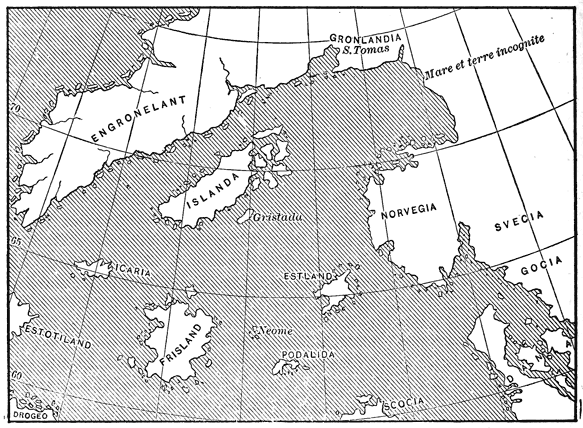
Zeno's Chart, Drawn about 1390.
View larger image
There can be little doubt that the countries marked Estotiland, Drogeo, and Icaria—possibly Nova Scotia, New England, and Newfoundland—owe their position on this chart to the actual knowledge of America, obtained either by a fishing-vessel wrecked there, as stated by the Zeni, or from a tradition preserved since the time of the Northmen. The lines of latitude and longitude were not on the original manuscript chart, but were added by the editors in 1558. Lelewel, Géog. du moyen âge, tom. iii. pp. 79-101, Bruxelles, 1852; Kohl's Hist. Discov., pp. 97-106.
At an unknown date, probably near the end of the thirteenth century, Robert Machin, an Englishman, eloped with a lady in his own vessel from Bristol. He steered for France, but was driven by a tempest to the island of Madeira, where both died. Some of the crew escaped to the African coast, where they were taken prisoners, but afterward were redeemed by the Spaniards, to whom one of them related the discovery of Madeira, his account leading to its rediscovery. Major concludes, "that henceforth the story of this accidental discovery of Madeira by Machin must be accepted as a reality," but the date cannot be fixed. That of 1344 often assigned to the voyage results from a misreading of Galvano. Beside Galvano, Discov., pp. 58-9, see Purchas, His Pilgrimes, vol. ii. p. 1672; The Voyage of Macham, an English man, wherein he first of any man discovered the Iland of Madera, in Hakluyt, vol. ii. pt. ii. p. 1; Curious and Ent. Voy., p. 13; Major's Prince Henry, p. 67; Kunstmann, Entdeckung Am., p. 4.
[1402.] At the beginning of the fifteenth century, Jean de Betancourt with a company of Norman adventurers conquered Lanzarote, one of the Canary Islands. He afterward became tributary to the crown of Castile, and by the aid of the Spanish government obtained possession of other islands of the group, establishing there a permanent colony. Muñoz, Hist. del Nuevo Mundo, pp. 30-33; Peter Martyr, dec. i. cap. i., gives the date 1405; Galvano, Discov., p. 60; Kunstmann, Entdeckung Am., p. 6; Pinkerton's Col. Voy., vol. xvi. pp. 808-15.
PRINCE HENRY OF PORTUGAL.
We enter now a new epoch in maritime discovery. Hitherto, if we exclude the voyages of the Northmen, there had been no attempt worthy the name of systematic ocean exploration. In the words of Major, "the pathways of the human race had been the mountain, the river, and the plain, the strait, the lake, the inland sea," but now a road is open through the trackless ocean, "a road replete with danger, but abundant in promise." Portugal, guided by the genius of Prince Henry the Navigator, was the first to shake off the lethargy which had so long rested on Europe. For some time past the Portuguese had been gradually eclipsing the Italians in maritime enterprise; but not until a prince leaves the pleasures of youth for the perils of the sea, throwing his life into the cause with all the ardor of a devotee, does ocean navigation become anything more than private commercial speculation, with now and then some slight aid from governments. True, others had undertaken the voyage round Africa, but Portugal was perhaps the first to make it. As D'Avesac remarks, Nouvelles Annales des Voy., 1846, tom. cx. p. 161: "Les Portugais ne s'y engagèrent point les premiers; mais seuls ils y persevérèrent, et les premiers ils atteignirent le but." Born in the year 1394, at a time when under his father, John, Portugal was already casting wistful glances over the Sea of Darkness, Prince Henry devoted his early life to geographical studies and his later life to discovery. Leaving the pomp and luxury of his father's court, he removed to the coast of Algarve, and from the dreary headland of Sagres let fly his imagination along the unknown shores of Africa. Drawing to him such young noblemen as were willing to share his labors, he established a school of navigation, giving special care to the study of cartography and mathematics. The geographical position of his native land was to the Portuguese, in regard to oceanic adventure, not unlike that of the Italians in regard to Mediterranean navigation. Several causes united to inspire this prince with so noble an ambition. He desired to promote geographical science; to test the theories and traditions of the day; to know the truth concerning the disputed question of the form and extent of southern Africa; to turn the flow of riches, the gold and spices and slaves of India, from Italy into his own country. Nor was this last stimulant lessened by the fact that of late, by reason of Mahometan encroachments on Christian dominions, the old avenues of eastern traffic via the Caspian Sea and Persian Gulf, or by the Red Sea and caravans across the deserts, were yearly becoming more insecure, and this too at a time when the taste for eastern luxuries was constantly increasing. Yet other incentives were Christian rivalry and Christian zeal. Spain had carried the cross to the Canaries; rumors kept coming in of Prester John and his Christian kingdom, now supposed to be in Africa instead of in Asia. Prince Henry moreover was grand master of the Order of Christ, and it behooved him to be stirring. Navarrete, Col. de Viages, tom. i. p. xxvi.; Muñoz, Hist. Nuevo Mundo, pp. 33-4.
[1415.] Prince Henry began his voyages along the coast of Africa about the year 1415, at which time João de Trasto was sent with vessels to the Canaries. It was Henry's custom to despatch an expedition almost every year, endeavoring each time to advance upon the last, and so finally attain the end of the mystery—whereat the nobles grumbled not a little about useless expense. Obviously progress southward at this rate was very slow, and many years elapsed before Cape Bojador was passed and unknown seas were entered. Major's Prince Henry, pp. 64-65.
[1416-28.] Meanwhile Pedro, Henry's brother, travelled extensively, journeying through the Holy Land, visiting Rome, Babylon, and even England. Fortunately he found at Venice a copy of Marco Polo's work, and brought it home to Prince Henry. Galvano's Discov., pp. 66-7; Kunstmann, Entdeckung Am., pp. 11, 12.
[1418.] Gonzalez and Vaz, who were sent this year by Prince Henry on the regular annual expedition, were driven from their course and rediscovered Porto Santo. Galvano, Discov., pp. 62-4; Kunstmann, Entdeckung Am., pp. 11, 12; Curious and Ent. Voy., pp. 14, 15.
[1419.] Nicolo di Conti, Venetian, spent twenty-five years in India, Mangi, and Java, returning in 1444, and confirming many of Polo's statements. Discorso sopra il Viaggio di Nicolo di Conti Venetiano, in Ramusio, tom. i. fol. 373. Twice in 1419, if we may credit Navarrete, Col. de Viages, tom. i. p. xxvi., did Prince Henry's ships pass seventy leagues beyond Cape Non.
[1420.] Gonzalez again embarks from Portugal intending to plant a colony, and guided by one Morales, a survivor of Machin's voyage, rediscovered Madeira. Navarrete, Col. de Viages, tom. i. pp. xxvi-vii.; Major's Prince Henry, pp. 73-7; Kunstmann, Entdeckung Am., p. 13; Galvano's Discov., pp. 63-4; Aa, Naaukeurige Versameling, tom. i. pt. ii. p. 16. On a certain map dated 1459 is a cape supposed to be Good Hope, with the statement that in 1420 an Indian junk had passed that point from the east; but for this no authority is given.
1431.] The Formigas and Santa María islands of the Azore group were this year discovered by Cabral. Kunstmann, Entdeckung Am., p. 15, makes the date August 15, 1432. For details of the discovery and settlement of all the eastern Atlantic islands, see idem, pp. 1-25.
[1434-6.] Gil Eannes, after an unsuccessful attempt in the preceding year, succeeded in 1434 in doubling Cape Bojador for the first time. Muñoz, Hist. Nuevo Mundo, p. 34, makes the date 1433, and Navarrete, Col. de Viages, tom. i. p. xxvii., 1423. In 1435 Eannes with Baldaya passed fifty leagues beyond the cape, and in 1436 Baldaya advanced to a point fifty leagues beyond the inlet since known as Rio d'Ouro.
THE SLAVE-TRADE.
[1441-8.] For several years after the successful doubling of Cape Bojador, no new attempt of importance is recorded, but in 1441 the voyages were renewed, and in the next eight years the exploration was pushed one hundred leagues below Cape Verde. Prior to 1446 fifty-one vessels had traded on the African coast, nearly one thousand slaves had been taken to Portugal, and the discoveries in the Azores had been greatly extended. By these explorations Prince Henry had exploded the theory of a burning zone impassable to man, and of stormy seas impeding all navigation; his belief that Africa might be circumnavigated was confirmed; and he had obtained from the pope a grant to the crown of Portugal of lands he might discover beyond Cape Bojador to the Indies inclusive.
[1455-6.] According to Ramusio, Viaggi, tom. i. p. 105, Alvise Cadamosto, a Venetian, the first of his countrymen as he claims to sail down the new coast, made a voyage for Prince Henry to the Gambia River below Cape Verde. This expedition derives its importance not from the limit reached, where others had preceded him, but from his numerous landing points, careful observations, and the detailed account published by the voyager himself in La Prima Navigazione, etc., Vicenza, 1507; also in Ramusio, Viaggi, tom. i. pp. 104-15. This explorer touched at Porto Santo, Madeira, the Canaries, Cape Blanco, Senegal, Budomel, Cape Verde, and the Gambia River.
[1457.] Cadamosto claims, La seconda navigazione, in Ramusio, Viaggi, tom. i. pp. 116-20, to have made a second voyage, during which he discovered the Cape Verde Islands; but Major, Prince Henry, pp. 278-88, shows that such a voyage was not made in that year, if at all.
[1460.] Diogo Gomez discovered the Cape Verde Islands, and their colonization was effected during the following years. Major, Prince Henry, pp. 288-99, publishes the original account for the first time in English. Prince Henry died in November of this year. Major's Prince Henry, p. 303; Kunstmann, Entdeckung Am., p. 19. Irving, Columbus, vol. i. p. 30, fixes this date 1473; and Galvano, Discov., p. 14, says 1463.
[1461.] The spirit of discovery and the thirst for African gold and slaves had become too strong to receive more than a temporary check in the death of its chief promoter. In the year following Prince Henry's death a fort was built on the African coast to protect the already extensive trade, and in 1461 or 1462 Pedro de Cintra reached a point in nearly 5° north, being over six hundred miles below the limit of Cadamosto's voyage. La Nauigation del Capitan Pietro di Sintra Portoghese, scritta per Meser Aluise da ca da Mosto, in Ramusio, tom. i. fol. 119.
[1469-89.] In 1469 Fernam Gomez rented the African trade from the king of Portugal for a term of five years, and during that time pushed his explorations under Santarem and Escobar to Cape St Catherine in 2° south, first crossing the equator in 1471. Under João II., who succeeded Alfonso V. in 1481, the traffic continued, and in 1489 Diogo Cam reached a point in 22°, over two hundred leagues below the Congo River, planting there a cross which is said to be yet standing. Martin Behaim, the mathematician and cosmographer, accompanied Cam on this voyage, and an error or interpolation in Schedel, Registrum, etc., Nuremberg, 1493, gave rise to the unfounded report that they sailed west and discovered America. Humboldt, Exam. Crit., tom. i. pp. 257, 283, 292, 309; Major's Prince Henry, pp. 325-38; Navarrete, Col. de Viages, tom. i. p. xl.; Harrisse, Bibliotheca Americana Vetustissima, p. 40; Galvano's Discov., pp. 74-6; Otto, in Am. Phil. Soc., vol. ii., 1786.
We enter now the Columbian epoch proper, to which, as we have seen, the enterprises of Prince Henry and the Portuguese were precursory. About 1484, Christopher Columbus having proposed a new scheme of reaching India by sailing west, the king of Portugal surreptitiously sent a vessel to test his theory, which, after searching unsuccessfully for land westward, returned to the Cape Verde Islands. Muñoz, Hist. Nuevo Mundo, pp. 53-4 et al. Columbus had resided in Portugal since 1470, and had made several trips in Portuguese ships down the African coast, in the course of which he is supposed to have first conceived his new project. Indignant at the conduct of the Portuguese king, Columbus left for Spain. Colon, Hist. del Almirante, in Barcia, Hist. Prim., tom. i. pp. 9-10; translation in Pinkerton's Col. Voy., vol. xii. pp. 1-16; and in Kerr's Col. Voy., vol. iii. pp. 1-242.
In 1486 Bartolomeu Dias sailed round Cape Good Hope and continued his voyage to Great Fish River on the south-east coast, from which point he was compelled to return on account of the murmurs of his men. The cape, now for the first time doubled by Europeans, was seen and named by him on his return. In 1487 King João sent two priests, Covilham and Payva, to travel in the East, in the hope of gathering more definite information respecting Prester John and his famous Christian kingdom. Prester John they did not find, but Covilham in his wanderings reached Sofala on the east coast of Africa in about 20° south latitude, being the first of his countrymen to sail on the Indian Ocean. At Sofala he learned the practicability of the voyage which Dias had actually accomplished a little before, and a message to that effect was immediately sent to the king. Major's Prince Henry, pp. 339-42; Navarrete, Col. de Viages, tom. i. p. xl-i; Humboldt, Exam. Crit., tom. i. pp. 230 et seq.; Galvano's Discov., pp. 77-8.
From this time to the great discovery of 1492, few expeditions remain to be mentioned. It must not be forgotten, however, that by this time trading voyages were of ordinary occurrence all along the eastern Atlantic coast and its adjoining islands from Scandinavia to Guinea. A lively commerce was carried on throughout this century between Bristol and Iceland, and in the words of Kunstmann, substantiated by older authorities, "a bull of Nicolas IV. to the bishops of Iceland, proves that the pope in 1448 was intimately acquainted with matters in Greenland." It seems incredible that during all this intercourse with northern lands, no knowledge of America was gained by southern maritime nations, yet so far as we know there exists no proof of such knowledge.
[1476.] John of Kolno, or Szkolny, is reported to have made a voyage in the service of the king of Denmark in 1476, and to have touched on the coast of Labrador. The report rests on the authority of Wytfliet, Descriptionis Ptolemaicæ augmentum, Lovanii, 1598, fol. 188, supported by a single sentence, "Tambien han ydo alla hombres de Noruega con el Piloto Iuan Scolno," in Gomara, Hist. Gen. de las Indias, Anvers, 1554, cap. xxxvii. fol. 31; by a similar sentence in Herrera, Hist. Gen., Madrid, 1601, dec. i. lib. vi. cap. xvi., in which the name is changed to Juan Seduco; and by the inscription, Jac Scolvus Groetland, on a country west of Greenland on a map made by Michael Lok in 1582, fac-simile in Hakluyt Soc., Divers Voy., p. 55. According to Kohl, Hist. Discov., pp. 114-15, this voyage is considered apocryphal by Danish and Norwegian writers. Lelewel, Géog. du moyen âge, p. 106, regards the voyage as authentic, and Kunstmann, Entdeckung Am., pp. 45-8, attaches to it great importance as the source of all the voyages to the north which followed. Humboldt, Exam. Crit., tom. ii. pp. 152-4, gives but little attention to the voyage, and confesses his inability to decide on its merits: "Je ne puis hasarder aucun jugement sur cette assertion de Wytfliet."
[1477.] In this year Columbus, whom we first find with the Portuguese traders on the African coast, sailed northward, probably with an English merchantman from Bristol, to a point one hundred leagues beyond Thule, in 73° north. Colon, Hist. del Almirante in Barcia, tom. i. p. 4; Muñoz, Hist. Nuevo Mundo, pp. 43-7; Humboldt, Exam. Crit., tom. i. p. 272. He probably visited Iceland, although he gives the latitude incorrectly, taking it very likely from ancient geography rather than his own observations.
[1482.] According to Kunstmann, the edition of Ptolemy this year, Ptolomæi Cosmographia, Ulmæ, 1482, lib. viii., contains a map that includes Greenland, and must have been compiled from northern sources.
[1488.] Desmarquets, Mémoires Chronologiques, etc., Dieppe, 1785, tom. i. pp. 92-8, states that one Cousin sailed from Dieppe early in 1488, stood off further from land than other voyagers had done, and after two months reached an unknown land and a great river, which he named the Maragnon. Was this the Marañon in South America? He then sailed south-eastward and discovered the southern point of Africa, returning to Dieppe in 1489. The discovery was kept secret, but Cousin made a second voyage round the cape and succeeded in reaching India. Major, besides pointing out some inconsistencies in this account, shows that M. Desmarquets "could commit himself to assertions of great moment which are demonstrably false." He is not good authority for so remarkable a discovery not elsewhere recorded.
THE COLUMBIAN EPOCH.
Before striking out with Columbus in his bold venture to the west, let us sum up what we have learned thus far and see where we stand. First, the geographical knowledge of the ancients was restricted to a parallelogram extending north-west and south-east from the Atlantic to the Indian ocean, comprising one hundred and twenty degrees east and west by fifty degrees north and south; circumscribe this knowledge with legendary stories and hypothetical and traditional beliefs concerning the regions beyond; then add a true theory of the earth's sphericity, though mistaken as to its size. This is all they knew, and this knowledge they committed to the Dark Age, during which time it was preserved, and, indeed, little by little enlarged, as we have seen. During the latter part of the fifteenth century, particularly, a powerful impulse had been given to discovery, especially toward the south; so that now the limits of the ancients were moved eastward at least forty degrees, to the eastern coasts and islands of Asia, chiefly by the travels of Marco Polo and Sir John Mandeville. Toward the south, the true form of Africa had been ascertained, and its coasts had been explored by the Portuguese, except a space of about fifteen degrees on the south-west. Northward the old limit had been advanced but slightly, but within this limit much information had been gained by actual navigation about regions only vaguely described by Ptolemy. Westward, in what was still a Sea of Darkness, great discoveries had been made by the Northmen, but their results were now practically lost; while toward the south, several important groups of islands had been added to the known world. See map on page 73, where the regions added during this period are lightly shaded. And now, within the old bound the world is much better known than at the beginning of the period, and many minor geographical errors of the ancients have been corrected by the Crusaders, and others who attempted on a smaller scale to extend the Catholic faith, as well as by commercial travellers in distant lands. Again, by the influx of Mahometans into Europe during five or six centuries, eastern luxuries had been introduced to an extent hitherto unknown, and had in fact become necessities in Christian courts, thus making the India trade the great field of commercial enterprise even by the tedious and uncertain overland routes where middle-men absorbed the profits, and rendering the opening of other and easier routes an object of primary importance. The almost exclusive possession of trade via the old routes by the Italians, furnished an additional motive to other European nations for explorations by sea. The art of printing, recently invented, facilitated the diffusion of learning, so that it was impossible for the world ever again to lapse into the old intellectual darkness. The astrolabe, the foundation of the modern quadrant, had been adapted by a meeting of cosmographers in Portugal to the observation of latitudes by the sun's altitude, and thus the chief obstacle to long sea-voyages was removed. The polarity of the magnet had long been known, but the practical adaptation of the magnetic needle to purposes of navigation occurred about the beginning of the fourteenth century. The mariner's compass, however, only attained its highest purpose toward the close of the fifteenth century, when the Sea of Darkness was traversed. But before this, the greatest impediments to ocean navigation had been overcome by voyages actually made through the aid of the new inventions. Beside the coasts brought to light by these voyages, they had done much to dispel the old superstitions of burning zones, impassable capes, and unnavigable seas.