BOSTON THE CITY OF CULTURE ★
Reading edition
Ask the people at your hotel to direct you to the nearest subway and ride to Park Street. As you leave the car at Park Street, you are in the oldest subway in the world, except, perhaps, the one in Budapest which always has disputed with Boston this particular claim. This subway was opened in Boston in September, 1897. Going up the stairs, you will emerge from the subway onto the famous Boston Common. Turn left, and you will have no trouble in finding the
State House
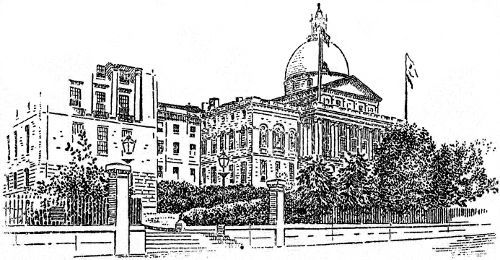
STATE HOUSE
Located on Beacon Street at the head of Park Street. The hill on which the State House stands was originally called Treamount, later this was changed to Sentry Hill when it was used as a lookout, and after the erection of the Beacon in 1634-1635, it received the name of Beacon Hill. The cornerstone of the “Bulfinch” front of the State House was laid on July 4, 1795, and the extension was 24 built in 1889 at a cost of four million dollars. The construction of the east and west wings was completed in 1916. The State House is decorated with statuary, historic paintings, battle flags and war relics. The House of Representatives contains the celebrated Cod Fish emblems. The gilded dome, lighted at night by four hundred and ninety-eight electric lights, makes a magnificent display. Open to the public on week days from 9 a. m. to 5 p. m., and on Saturday from 9 a. m. to 12 noon.
Leaving the State House, walk straight down Beacon Street with the Boston Common on your left. Cross Charles Street and enter the
Public Gardens
This is about one-half the size of the Common and contains an artificial pond of irregular shape, the beauty of which is enhanced by the graceful swan boats which glide over its surface. A monument commemorating the discovery of ether is erected at one side of the Gardens; thousands of men and women visit this shrine yearly. Proceed through this beautiful Shrine of Nature, coming out at Arlington Street and Newbury Street, on the corner of which stands the
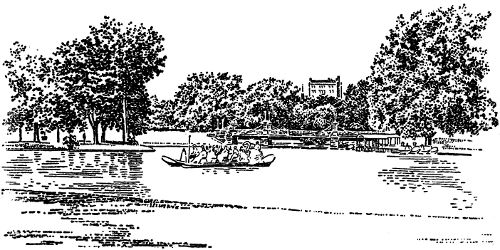
PUBLIC GARDENS
Ritz Carlton Hotel
This is one of Boston’s finest hotels, noted for its hospitality, excellent food and social events.
25
Continuing on down Newbury Street, we come to Berkeley Street, on the corner of which stands
Museum of Natural History
The building is full of New England economic, geological, and special mineral collections, mammals, birds, fishes, fossils, plants, marine invertebrates, and insects beautifully mounted. The building is open to the public free of charge daily from 9 a. m. to 4 p. m., and on Sundays from 1 to 4:30 p. m.
Leaving the Museum of Natural History, turn right at Boylston Street and proceed to
Copley Square
This is architecturally considered one of the finest municipal squares in the country, if not in the world. On your left is Boston’s famous
Trinity Church
The facade of this church is one of the richest examples of ecclesiastical architecture in the city. Mr. H. H. Richardson was the architect. Interior decorative work by John LaFarge. St. Gaudens’ statue of Phillips Brooks is on the Huntington Avenue side. In the cloister are stones from old St. Botolph’s Church in Boston, England. Bishop Brooks was rector of Trinity from 1869 to 1891.
To the left of the church and across St. James Avenue is the
Copley Plaza Hotel
It is and has been for twenty years New England’s distinctive society hotel. The main ballroom is decorated in the style of Louis XIV with marble bases and gray Sienna stone for walls. The Sheraton Room opening directly off the lobby is furnished in Italian Renaissance style. The main cafe contains the celebrated Merry-Go-Round bar, a unique attraction. Directly in front of you is the
Boston Public Library
Designed after the style of the Italian Renaissance by McKim, Meade & White, the interior of the building is of great beauty and visitors come from all parts of the world to admire it. Famous 26 murals by Pierre Cecile Puvis de Chavannes, Edwin Austin Abbey, and John Singer Sargent will hold you spellbound. Visitors are advised to purchase the handbook of the Boston Public Library, on the second floor, for thirty-five cents in order to remember the various art treasures.
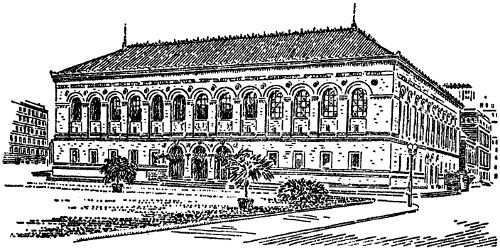
BOSTON PUBLIC LIBRARY
Leaving the Public Library, turning right on Huntington Avenue and proceeding past Mechanics Building, home of Boston Automobile Shows and other notable expositions, we continue on Huntington Avenue to Norway Street and turn right to the
Christian Science Church
Rising over the city’s roofs and spires is the great white dome of The First Church of Christ, Scientist, affectionately known as the “Mother Church.” In Boston, the Christian Science movement was founded, and its administrative center is there. The branch churches of Christ, Scientist, are to be found in almost every part of the civilized world.
The original edifice, completed and dedicated in 1895 with a seating capacity of 1,000 persons, soon became inadequate to accommodate those desiring to attend its services. Accordingly, in 1905 there was erected the extension, crowned by the majestic dome reaching to a height of two hundred and twenty-four feet above the street, having a diameter of eighty-two feet. The auditorium seats approximately five thousand. It required two years to 27 build and cost nearly two million dollars. It was dedicated in June, 1906, and like all Christian Science ventures, it was free of debt. No funerals, marriages or social entertainments add to its income. The church is built of Indiana limestone and New Hampshire granite, New Hampshire being the native state of Mary Baker Eddy, the discoverer and founder of Christian Science. The great organ is a notable instrument, its gilded pipes rising behind the quiet and dignified rostrum whereon stand the two desks for the readers who conduct the services. The general effect is one of breadth, spaciousness, and all pervading light. Within and without, the church demands attention and admiration as one of the largest and most impressive churches in the world.
Leaving the Christian Science Church, we go directly to Massachusetts Avenue, and turning left come to
Horticultural Hall
Here Boston holds most of its famous flower shows. Across the street is the home of
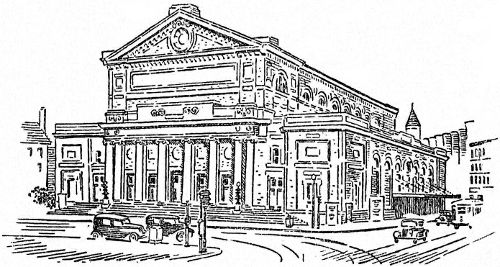
SYMPHONY HALL
The Boston Symphony Orchestra
The Boston Symphony Orchestra is something more than half a century old. More notable than the span of its years is its place in the growth of musical America. In 1881, the late Major Henry L. Higginson realized the first dream and aspiration of his life by 28 founding in Boston an orchestra of European standards, a phenomenon then unknown in America. The idea had come to him as a student in Vienna. It was an ambitious dream of an impecunious young man but after many years, having made his fortune as a banker, he was able to give the Boston Symphony Orchestra to the world. He engaged the finest musicians in Europe and brought to this country a succession of the greatest conductors of their time. He set a new precedent by exacting of the musicians entire devotion of their talent to the orchestra. He gave entire artistic freedom to the conductor. The wisdom of these policies soon showed as each conductor expended his genius to the cumulative improvement of an ensemble which soon had the world’s attention. The present director is the famous Dr. Serge Koussevitsky who began in 1924, and his term as conductor has extended far beyond any single term of the ten previous conductors. The long association of such an orchestra with such a leader is eloquently justified by the results. The great Russian conductor has brought new beauties to the Boston Symphony Orchestra, a fresh importance and distinction reflected in the greatly enlarged public. The festivals and special choral concerts, the broadened repertory, new and old, of the regular concerts and the quality of each performance are as indefinable as the genius which directs them. After you have viewed the auditorium and the huge organ, almost directly across the street on the corner of Gainsboro and Huntington Avenue, we find the famous
New England Conservatory of Music
The New England Conservatory of Music was founded in 1867. Hand in hand with the development of modern America, it soon reached a leading position among music schools in this country. Students from many parts of the world have come to this seat of musical learning and, again, have departed with a thorough technical and artistic training in their possession.
The school buildings are especially adapted for the many details of thorough musical instruction. There are three concert halls, with a total seating capacity of over 2,000; a large library, with many rare volumes; a fine concert organ and fourteen other organs for teaching and practice purposes; and, added to these, seventy-five class rooms and private studios.
29
A walk through the buildings confirms the impression that here is a veritable beehive of musical activity.
From the Conservatory of Music, we cross Huntington Avenue once more and continue about one block south, reaching the
Boston Opera House
Located on the corner of Opera Place, which was formerly called St. Stephen’s, for years it has been used for the Metropolitan Opera singers, as well as local opera. Leaving the Opera House, we again turn right on Huntington Avenue and proceed to the
Museum of Fine Arts
The Boston Museum of Fine Arts occupies the unique position of being one of the few museums in the world created and supported solely by private citizens. The Museum is well equipped with guides who are commissioned to explain to the visitors any part of the collection about which one wishes to know. In this little book, we cannot begin to describe the contents of the Museum of Fine Arts, but we hope you will discover its beauties for yourself.
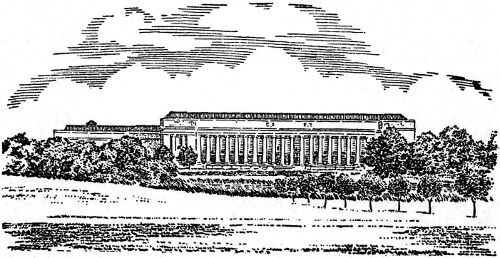
BOSTON MUSEUM OF FINE ARTS
After leaving the Museum of Fine Arts, we turn first to the left on Huntington Avenue, retracing our steps towards the Boston Opera House and then turn left on Forsythe Way to the Fenway, 30 turning left again and walking to the south end of the Fenway where we find the
Isabella Stewart Gardner Museum
Here is a marble palace, once the home of Mr. and Mrs. John Lowell Gardner, filled with rare treasures from all over the world. Catalogues may be purchased at the door for a small sum which will enable you to go through this beautiful museum which is open to the public on Tuesdays, Thursdays and Saturdays from 10 a. m. to 4 p. m., the charge of admission being twenty-five cents. On Sundays, the Museum is open from 1 to 4 p. m., admission free. It is closed on all national holidays and during the month of August.
Retracing our steps to Huntington Avenue and going to Ruggles Street, we find ourselves surrounded by colleges and schools. At our left on the corner of Ruggles Street and Huntington Avenue we find the Wentworth Institute. On our right we see Simmons College for Women, south of which, on the corner of Longwood Avenue, we find the Harvard Medical School. To the west of Simmons College, we see Emmanuel College.
If you board a Huntington Avenue car going east you can transfer at Park Street, and you will arrive back at your hotel regardless of what part of the city it is in.
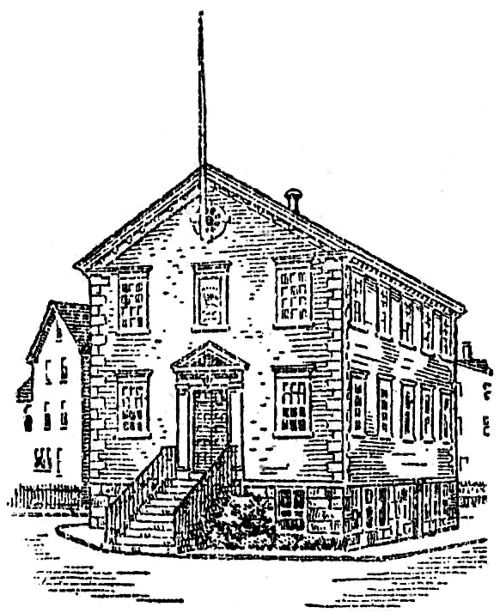
OLD TOWN HOUSE—MARBLEHEAD
31