A DAY’S AUTO TRIP ON THE SOUTH SHORE ★
Reading edition
Starting at the Providence Street side of the Hotel Statler, swing your car around the island and go straight out St. James Avenue to Huntington Avenue where you bear left and follow Huntington Avenue to Jamaicaway. Pass under the underpass and turn right at fantail bearing right to get on to Routes 1 and 3.
Jamaicaway
One of the many beautiful parkways for which Boston is noted. As you ride along you come to Moraine Street, on the corner of which is
“The House of the Shamrock”
affectionate name for the home of the Honorable James Michael Curley, three times mayor of Boston and later governor of Massachusetts. His life has been one of romance and reads like a page from Alger—a poor boy, who through his own efforts became governor of the Commonwealth.
We continue on Route 3 to the junction of Route 37 and turn right on to Granite Avenue, soon crossing the
Neponset River
It is a salt water river which rises and falls with the tides. A little further along on your left is
The Wollaston Golf Club
Considered one of Boston’s finest clubs although it offers little in scenic beauty. The course is well laid out and the hazards good.
39
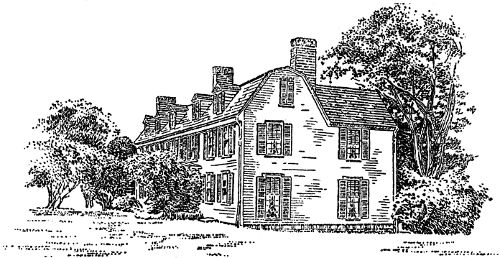
ADAMS MANSION
Follow Granite Avenue to East Milton. Turn left at Route 135. This is Adams Street. This street received its name from the two Presidents. Follow straight on this street until you come to
The Adams Mansion
Both John Adams and John Quincy Adams made this old mansion their home during the later years of their lives. John Adams celebrated the fiftieth anniversary of Independence Day on July 4, 1826 in this old house. Open 9 a. m. to 4 p. m., admission 25c.
Leaving this charming old place, continue on Adams Street to Hancock Street which you follow to the
First Parish Church
It was established in 1689. Both John Adams and John Quincy Adams are buried in this church. In order to go down to the crypt, it is necessary to get in touch with the janitor or sexton who is always willing to accommodate those desirous of visiting the final resting place of these two early Presidents.
Leaving the Church, follow Hancock Street to School Street and turn right. Follow the street car tracks along School Street, turning left at Franklin and continue to the
John Adams House
Here on October 19, 1735, John Adams, the second President of 40 the United States, was born. It is a most interesting house, having much of the old furniture, and is kept in good condition. Next door is the
John Quincy Adams House
Here on July 11, 1767, the sixth President of the United States was born. It is filled with antiques and evokes stirring memories. Historians are in both houses to answer questions. Both houses are open every day from 10 a. m. to 5 p. m. Admission 25c to each house.
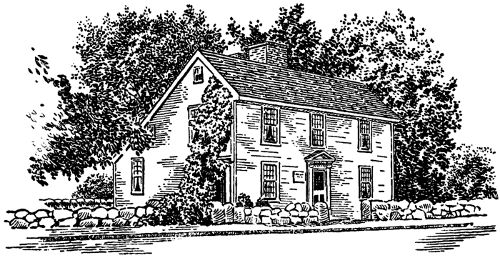
JOHN QUINCY ADAMS HOUSE
After you have visited these two historic houses, turn the car around and retrace your journey over Franklin to School Street, turning right and continue to Quincy Avenue where you again turn right and follow to Route 3. This route soon brings us to Weymouth Landing and then to
Weymouth
This town was noted in history for being the location of Arnold’s Tavern where the committee of safety met in the days of and before the Revolution. You pass the outskirts of Hingham, Duxbury, and soon come to the center of Kingston. You are now nearing Plymouth, whose historic doors are always open.
41
Plymouth
It is a city with thriving industries and all the pleasures to be found in New England’s summer resorts. If you wish to study the historic side, it would be wise for you to close your eyes to the modern side of this community and drive along Route 3 to Chilton Street where you turn left and then right again at the waterfront and continue to
Plymouth Rock
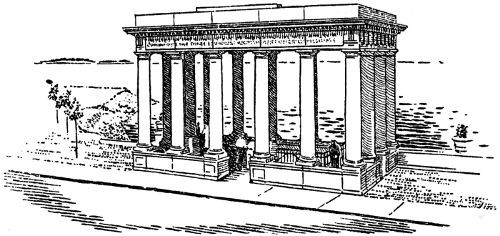
PLYMOUTH ROCK
The rock is located easily. A beautiful canopy of granite has been erected over the historic stone. To protect it from souvenir hunters, it was necessary to build a steel fence around it. To the stranger who does not know the true topography of Massachusetts but who recalls various poems and songs, it is always a surprise not to find a “stern and rock-bound coast.” Sand is in great abundance, the beaches and sand bluffs extending in all directions. Recalling your history, you can picture the Mayflower failing to weather the Cape, putting in to this safe but shallow harbor. Myles Standish had already explored and reported back at Provincetown, where the ship had anchored, “good water in the brook and timber on the hills for homes.” Winter was coming and it was 42 advisable to settle, and so these heroic people landed here. One hundred and two souls, according to history, had journeyed to this new country to find religious freedom for themselves. Turning from the rock, climb the stairway leading up the grassy bluff to
Cole’s Hill
This is where the Pilgrims buried their fast diminishing band in the dead of night so that the Indians lurking in the forests could not determine how many were left. It is a recorded fact that of the one hundred and two Pilgrims who landed, nearly one-half were buried during that first sad winter. The Indian monument standing near the sepulchre is of Massasoit, the great sachem of the Wampanoags. He was the friend of the Pilgrims and, in reality, their preserver for, without his kindness, they all would have perished. From Cole’s Hill, go directly left on Carver Street to
Leyden Street
Originally named First Street. Just to the left of the junction of Carver and Leyden Streets was the site of the first “Common House” raised in Plymouth. This interesting street has many markers on it telling the story of Goodman, Winslow, Brewster and Howland.
Walking straight up Leyden Street, crossing Main Street, we come to
The First Parish Church (Unitarian)
This was the church organization of the Pilgrims. The first church on this site was erected in 1683. The present church is the fifth to be built on this site and was completed and dedicated on Forefather’s Day 1899. On your right when facing the First Parish Church is
The Church of the Pilgrimage
This is the Congregational Church and was the result of a division over doctrinal matters in 1801. The present church was built in 1840. Proceed up the stone steps at the right of the First Parish Church and you will come to
43
Burial Hill
Here you will find all the interesting graves marked plainly with yellow signs—Governor Bradford, Edward Gray, Thomas Clark, John Howland, John Cotton and others. As we stand here amid these historic and humble hero dead, we read these significant words on the obelisk in memory of Governor William Bradford: “Do not basely relinquish what the Fathers with difficulty attained.”
You will have no trouble locating the site of the first fort where five cannons were placed after great difficulty in 1621. Also, the grave of General James Warren, soldier, patriot and scholar.
Leaving the graveyard, retrace your steps down Leyden Street to Main Street. Turn left and then right when you come to
Middle Street
This street was once known as King. Little remains of Colonial days except the street to remind us of old Plymouth. Turn left at Carver on to
North Street
You will find the Edward Winslow House built in 1754. He was very loyal to the Crown during the Revolution and so the house was confiscated. Going back to your car, get in and go toward the Cape on Water Street and soon after you pass Leyden Street, you come to
Town Brook
Here was the drinking water of the Pilgrims. In days of yore, it was full of alewives, which gave the Puritans fish at their very door. Even today, trout lurk in many a dark corner of the brook. In 1909 the town purchased the land here and established the beautiful Brewster Gardens. Continue on Water Street to Sandwich Street. Almost in front of you is
John Howland House
It was built in 1666 and is called the house of the last Mayflower Pilgrims in Plymouth. It was restored and put in complete repair 44 by the Howland descendants in 1909. You may drive in and visit, admission 25c. Open 10 a. m. to 5 p. m. A little way towards the Cape and you come to Winter Street. Turn left and find
The Old Harlow House
It is known better as the Kendall Holmes House after the last family to live there. It is extremely interesting. The architecture is simple and therein lies its beauty. The old stairways and open fireplaces all remain as they were built. The occupants have enjoyed and loved this old house and so during all these generations there has been no need to restore as loving hands have cared for it. Retrace your way towards Boston and on the corner of Chilton and Court Streets is
Pilgrim Hall
It was built in 1824 by the Pilgrim Society and rebuilt and enlarged in 1880. It is filled with many historic and antique articles. Park your car in the space provided a short way down Chilton Street that you may take your time visiting here. Open to the public daily, admission 25c.
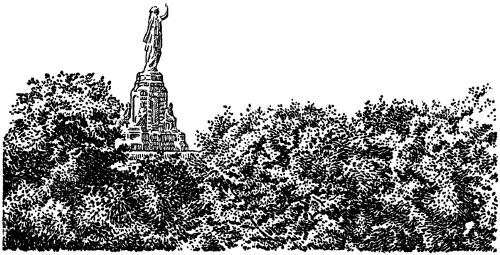
PILGRIM MONUMENT
45
After your visit here, drive your car across Court Street and up Clyfton Street, turning right on Allerton Street and you arrive at the
Pilgrim Monument
A national monument completed October, 1888, in honor of the Forefathers of Our Country. Total height eighty-one feet. When you have read the inscriptions and you have satisfied yourself regarding the humble beginning of this great country, drive down Cushman Street to Court, turn left and follow Route 3 to Kingston where on your right there is a sign marked “Duxbury-Marshfield.” Bear right on this road passing soon on your left the
Major John Bradford House
built in 1675. It is open to the public and contains many interesting things. Continue on this old road to
Duxbury
Here is easily found the Myles Standish Monument, also the site of Myles Standish’s old house. After your visit here, retrace your journey to the center of Duxbury, taking the right hand road to Route 3-A which follow to Alden Street, turning right for the
John Alden House
Alden built this house in 1653. It is a quaint old house and has all the charm of the old Colonial homes. From here go back to Route 3-A. Turn right and follow to a triple fork in the road with signs marked “Marshfield.” Take right hand fork called Careswell Street to
Governor Edward Winslow House
It was built in 1699. Contains many antiques. Everything is arranged to look as if it were still 1700. It is interesting to note that some of the old colonists lived in sumptuous style. Excellent 46 luncheons, teas and dinners are served here at moderate prices. The dining room is the old carriage house and the barn has been turned into a beautiful modern kitchen. The house is open June 1st to October 1st, admission 25c. Leaving here turn left on Webster Road and see the final home of Daniel Webster. His tomb may also be visited in the Winslow Cemetery close to the house.
Follow Webster Street to Route 3-A, which will bring you back to Route 3 over which you retrace your ride to Jamaicaway and Huntington Avenue, Route 9-C. Turn right and follow to St. James Avenue. Bear right to the Hotel Statler.
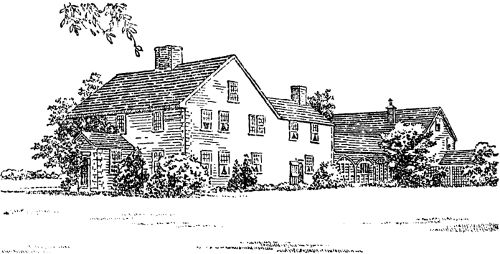
WINSLOW HOUSE—DUXBURY
47