A DAY’S AUTO TRIP THROUGH HISTORIC SUBURBAN BOSTON ★
Reading edition
The Start
Let us get into our automobile in front of the Hotel Statler on the Providence Street side. Swing left around the island and right at Arlington Street and again right at Boylston Street along which we drive to Charles Street, where we turn left. Proceed along Charles Street with the Boston Common on our right and the Public Gardens on our left and continue to the first rotary traffic circle where we swing around, by the AMOCO Service Station and cross the Longfellow Bridge (made famous by Longfellow’s poem “I stood on the bridge at midnight”). Arriving on the Cambridge shore, go sharp right and follow around to the right on to
Memorial Drive
This drive runs along the beautiful Charles River on which the Massachusetts Institute of Technology and Harvard University boat crews train. As we roll along the drive, we come to the famous Massachusetts Institute of Technology on our right. From this school have graduated many of our best technical men. On our left as we drive along, we see Harvard Bridge, the Tech Boat House and the Weld Boat House. Across the Charles, we see the Harvard Business School, while on our right we begin to pass the “houses” of Harvard College. Continuing along the drive to Mt. Auburn Street, we turn left. A short way down Mt. Auburn Street on our left we pass the Stillman Infirmary, maintained as a hospital for Harvard students, and the Cambridge Hospital. On the 15 river bank directly in the rear of this group of buildings is the supposed site of Leif Erickson’s old house built in the year 1001. Continue on Mt. Auburn Street two blocks to Coolidge Avenue and turn left. On our right is
Mt. Auburn Cemetery
Sometimes called “The Cemetery of Poets” for here are buried Henry Wadsworth Longfellow, James Russell Lowell, Oliver Wendell Holmes, Charles Sumner, Edward Everett, Louis Agassiz and Phillips Brooks. Run the car about one-tenth of a mile along the cemetery fence and stop. Through the fence one can see the beautiful tomb of Mary Baker Eddy, founder of the Christian Science Church. After admiring the beautiful setting, we turn our car about and travel back to Mt. Auburn Street, where we turn right and then left on Elmwood Avenue, on the corner of which stands
The James Russell Lowell House
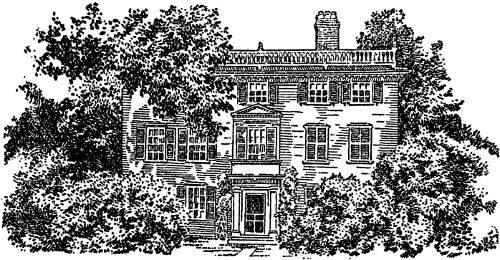
THE JAMES RUSSELL LOWELL HOUSE
Built in 1767. Used as a hospital during the Battle of Bunker Hill. Later Benedict Arnold used it as his headquarters for three weeks. James Russell Lowell was born here in 1819. Follow Elmwood Avenue to Brattle Street where we turn right. On our left we see 16 the Fayerweather House and the Nichols House, both built in 1660. Further down Brattle Street, we come to the Henry Wadsworth Longfellow House, built in 1759. Turning left at Mason Street we pass Radcliffe College. In 1894 the Society for the Collegiate Instruction of Women or more familiarly the “Harvard Annex” was incorporated as Radcliffe College. Named after Lady Moulson, née Ann Radcliffe, who was the first woman to make a gift of money to Harvard. We follow Mason Street to the
Cambridge Common
Directly in the center of the street we find the tablet which marks the spot where stood the famous elm under which Washington took command of the Army on July 3, 1775. The tree itself collapsed of old age in 1923. Turning right we come to
Christ Church
Built in 1761 by the Tories, it was used by the Provincial troops as a barracks during the siege of Boston and the lead pipe’s of the organ were melted for bullets. Washington attended services here New Year’s Eve 1775. We pass from the Church yard to the Old Burying Ground which contains the bodies of numerous Colonial people. At the edge of the cemetery we find an old granite milestone which bears the inscription “Boston 8 miles 1734.”
Entering our car we swing left around the Common following the traffic arrows and pass
Harvard University
This is the oldest and in many ways the most distinguished school of learning in the United States. Built in 1636. However, this priority is oftentimes disputed as William and Mary College in Virginia claims its date of charter to be 1617. In order to visit Harvard you should set aside a whole day. Secure a guide by applying to Room L in University Hall, and everything of interest will be included in this day’s adventure. Today let us continue by turning right on Kirkland Street, passing the Harvard Law School on our left and Memorial Hall on our right. Turn left at Oxford Street. That big building on your right is the University Museum. Here is located the Agassiz Museum of glass flowers, and 17 even if we must hurry, let us stop and view this unique collection. After our visit we continue to Everett Street where we turn left, passing the huge tennis courts on our left and continue to Massachusetts Avenue where we turn right.
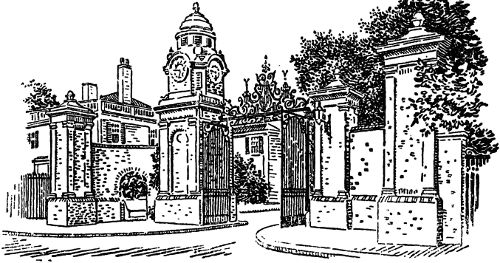
DUDLEY MEMORIAL GATEWAY—HARVARD
We are now on the famous course over which the British passed on their way to Lexington and Concord, April 18, 1775. We shall follow Massachusetts Avenue clear through to Concord. After passing through Cambridge and North Cambridge, the first town we come to is
Arlington
Here at the corner of Pleasant and Massachusetts Avenue occurred a minor skirmish when Colonists attacked a British Commissary. Next we come to Jason Street on which stands
The Jason Russell House
It was near this point that the first battle on the fateful day of April 19, 1775 was fought. Over half of the Colonists killed that day met their death here in a fearful hand to hand struggle with the British. This house is open to the public April to October, admission free, from 2 p. m. to 5 p. m.
18
We will continue on our way till we come to the Lexington Green. We park our car in front of
Buckman Tavern
In this historic tavern the Minute Men gathered and waited in the tap room for the British. We stand in front of the old bar and almost seem to hear the clank of the tankards. There are the old bullet moulds, the powder horns, the bullet holes left in the old door from stray shots of the British, the old bedrooms and furnishings which carry you back to those days when the Colonists fought for liberty. Admission to the tavern is free.
Leaving the Tavern, cross the street to the Green and view the statue erected in honor of the Minute Men. Next walk over to that big boulder and read the immortal command:
“Stand your ground. Don’t fire unless fired upon. But if they mean to have war Let it begin here.” Captain Parker
We now go back to the car and drive past the Green to Hancock Street. Turn right and drive to the
Hancock Clark House
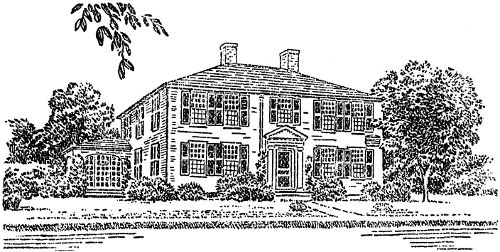
HARRINGTON HOUSE
Built in 1698 and enlarged in 1734. From 1698 to 1805 it was occupied 19 successively by Reverend John Hancock and Reverend Jonas Clark. Adams and Hancock were staying here the morning of April 19, 1775, when Paul Revere rode into town warning them that the British were coming. You will find the contents of the house most interesting. A historian is present to answer questions. Admission is free. House open 11 a. m. to 4 p. m.
Leaving the house turn the car around and drive back to Bedford Street. On the corner of Bedford Street and Elm Avenue stands the
Jonathan Harrington House
Jonathan Harrington was the first mortally wounded Minute Man. He made his way from the Green to the house, falling dead at his wife’s feet.
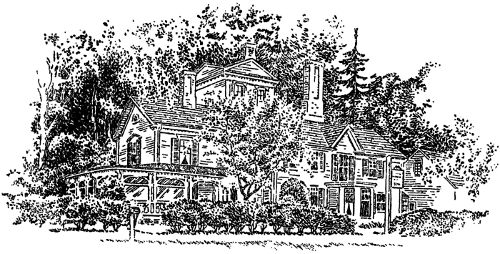
WAYSIDE
Passing by the house, we come to the old burial ground on our left. Turning right and following Massachusetts Avenue, we come to U. S. Route 2A, where you will see a marker on the right hand side of the road which reads as follows: “This bluff was used as a rallying point by the British April 19, 1775. After a sharp fight they retreated to Fiske Hill from which they were driven in great confusion.” We bear right here and continue. 8/10 of a mile from this point we come to two ice cream parlors, one on each side of the road. Drive in the right hand one. Here we find a monument telling the story of “The Capture of Paul Revere.” William Dawes, who also rode from Boston, escaped 20 the British, leaving Dr. Prescott alone to carry the news of the British advance. After being questioned, Revere returned home. As we approach Concord we come to
“The Wayside”
This was the only house ever owned by Nathaniel Hawthorne. It was also the girlhood home of Louisa M. Alcott and was later occupied by Margaret Sidney (Mrs. Daniel Lothrop), authoress of “Five Little Peppers.” It is interesting to know that three authors with no connection or relationship all occupied this house. Miss Margaret Lothrop, daughter of the authoress, now owns the house and will personally conduct you through it. Don’t fail to stop. You will live with Hawthorne, Alcott and Sidney under her guiding hand. Open 10 a. m. to 6 p. m., admission 25c. The next house on the right is the Louisa M. Alcott house. Drive on into Concord. Pass the Green and turn right at Monument Street. About one-half mile down this street, we come to the old Battle Field. Park your car in the space provided and walk through the Parkway to the
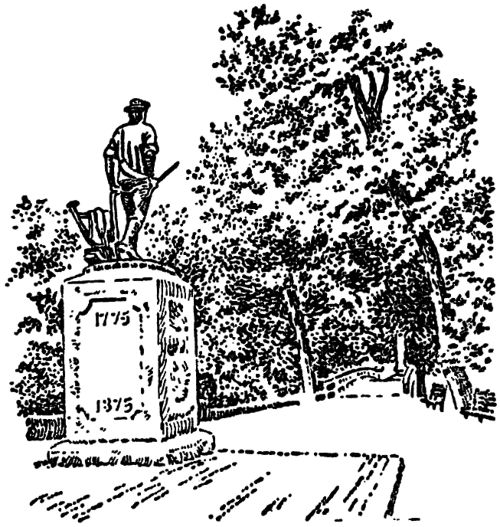
CONCORD BRIDGE
Concord Bridge
Here we see the grave of the unknown British soldiers and the Minute Man statue, erected to the heroes “who fired the shot heard round the world.” You will be impressed by the beautiful surroundings and the silence. When you have dreamed long enough, 21 get in the car, drive back to Concord Green, turn left on to Route 126. Follow 126 out of town. You will come to
Lake Walden
Here the great nature author, Thoreau, wrote many of his works. Continuing for about 7 miles on Route 126 to Wayland, we come to Route 20, the old Boston & Albany Post Road. We turn right and drive westward about 5½ miles through So. Sudbury till we reach a roadway on the right leading to
“The Wayside Inn”
Originally called Howe’s Tavern and later Red Horse Tavern, in 1863 it was named “The Wayside Inn.” It was here that Henry Wadsworth Longfellow wrote the “Tales of a Wayside Inn.” The house and grounds are now owned and maintained by Mr. Henry Ford. At the gatehouse you will find the stage coach used to bring General LaFayette to Boston for the laying of the cornerstone of Bunker Hill Monument in 1825.
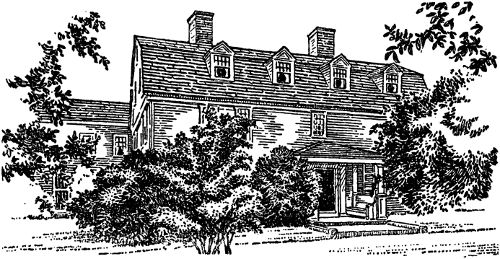
WAYSIDE INN
Register, step up to the bar and order your lunch, after which you may wander through the Inn until you are called by the host. After you have eaten in the dining room (built in 1800) walk out 22 through the gardens. You will find the old grist mill interesting and unique. Also, don’t fail to visit the Old School House spoken of in the famous poem “Mary Had a Little Lamb.”
After you have seen everything on this historic estate get back in the car and visit the old country store. Drive back to Boston over Route 20 to Commonwealth Avenue and Clarendon Street where you turn right crossing Newbury and Boylston Streets. Turning left at St. James Avenue will bring you back to the door of the Hotel Statler.
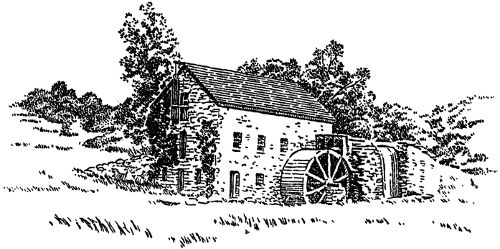
OLD MILL—SUDBURY
23