THE MARINE REGIMENTS.
Reading edition
CONTENTS
OF THE
RECORDS OF THE MARINE CORPS.
Year Page
Introduction.
1664 Formation of a Corps for Sea-service on commencement of war with Holland 1
—— Designated “The Admiral’s Maritime Regiment,” and commanded by the Duke of York, afterwards King James II. —
1672 Formation of additional Corps of Marines on renewal of hostilities with Holland 2
1689 The Admiral’s Maritime Regiment incorporated in the Second Foot Guards —
1702 Formation of six Regiments of Marines —
—— Six other Regiments of Infantry selected for Sea-service —
—— The Royal Warrant for forming the six Regiments of Marines, and for selecting six other Regiments for Sea-service 3
—— Other Regiments embarked, at different periods during the war, to serve as Marines on board the Fleet —
—— Rules and Instructions for the duties, pay, and clothing of the Marine forces 4
1702 Placed under the control of the Lord High Admiral, the Prince George of Denmark 4
—— Appointment of Brigadier-General W. Seymour, of the Fourth Foot, to superintend the details of the Marine Regiments 5
—— Uniform prescribed for the Marine forces —
—— Independent Companies of Marines formed for the fleet in the West Indies —
—— Services of the Marines on board the fleet in the Mediterranean —
1704 Proceeded in the fleet to Lisbon, to aid the cause of the Archduke Charles of Austria —
—— Proceeded against Barcelona, but afterwards withdrew, and re-embarked 6
—— Attack and Capture of Gibraltar —
—— Engagement of the British and French fleets in the Mediterranean 7
—— Siege of Gibraltar by the Spaniards and French 8
1705 The attempt to retake the fortress abandoned after a siege of seven months 9
—— The Marine Corps distributed in the several ships of war on the coast of Spain 10
—— Proceeded against Barcelona with the troops under the Earl of Peterborough —
—— Capture of Fort Montjuich by storm 11
—— Surrender of the garrison of Barcelona 12
1706 Siege of Barcelona by the French 13
—— The French raised the siege and retreated —
—— Capture of Carthagena —
—— Capture of Alicant 14
—— Surrender of Iviça —
—— Surrender of Majorca —
1707 Attack and siege of Toulon 15
—— The siege of Toulon raised —
1708 Surrender of Sardinia —
1708 Capture of the Island of Minorca 16
—— Decease of H. R. H. the Prince George of Denmark, Consort of Queen Anne, and Lord High Admiral of England —
1709 Capture of Anna-polis Royal, in Nova Scotia 17
—— Surrender of Alicant to the forces of Spain and France —
1710 Capture of the Isle of Cette 18
—— The Isle of Cette recaptured —
1711 Proceeded on an Expedition against Quebec, in Canada —
—— Failure of the expedition by storms and wreck in the River St. Lawrence 19
—— Decease of Joseph I., Emperor of Austria —
—— Election of Charles III. of Spain to be Emperor of Germany —
1712 Negotiations for general peace —
1713 Definitive treaty of peace at Utrecht on 31st March 20
—— Gibraltar, Minorca, and Nova Scotia ceded to Great Britain by the treaty of peace —
—— The Corps of Marines disbanded —
1714 Decease of Her Majesty Queen Anne on the 1st of August —
—— Accession of King George I. —
—— Attempts of the Son of the late King James II. to obtain the throne, defeated —
—— Augmentations made to the Army 21
—— Three of the late regiments of Marines, now the 30th, 31st, and 32nd, retained, and placed on the establishment of the infantry of the Line —
1739 War declared against Spain on the 23rd of October, 1739 —
—— Augmentation of the Land forces 22
1739 Formation of six regiments of Marines 22
—— Fleet of five ships, with a detachment of Marines, under Admiral Vernon, proceeded against Porto Bello —
1740 An additional regiment of Marines, of four battalions, formed at New York in North America, and Colonel Spotswood appointed Colonel-Commandant 23
—— The six regiments of Marines augmented from 700 to 1000 men each —
—— Augmentation of the four invalid companies of Marines —
—— Usefulness of Marine forces, as proved on former occasions, now generally admitted 24
—— Formation of four additional regiments of Marines, of 1000 men each —
—— Attack and capture of Fort Chagre 25
—— Fleet under Admiral Sir Chaloner Ogle, and troops, including the six Marine regiments under General Lord Cathcart, proceeded to the West Indies, for the purpose of attacking the Spanish possessions in South America —
—— Death of General Lord Cathcart at Dominica 26
—— Brigadier-General Wentworth succeeded to the military command of the expedition —
1741 The whole collected at Jamaica under Admiral Vernon —
—— Proceeded to the Grande Playa, to windward of the town of Carthagena —
—— Capture of forts St. Jago and St. Philip —
—— Capture of the castle of Bocca Chica 27
—— Capture of Fort St. Joseph —
—— Capture of the castle of Grande Castello —
—— Attack of St. Lazar by escalade —
1741 Repulse of the troops, and abandonment of the enterprise 28
—— The forts and castle of Carthagena demolished —
—— The expedition returned to Jamaica —
—— Another expedition proceeded to the island of Cuba 29
—— Returned to Jamaica after encountering much sickness and numerous casualties 30
1742 The island of Rattan, in the bay of Honduras, taken possession of, and placed in a state of defence 31
—— A detachment sent to the assistance of General Oglethorpe, in South Carolina, against the Spaniards 32
—— Recall of Admiral Vernon and General Wentworth —
—— The independent Companies at Jamaica (now the forty-ninth regiment) and the Marines on board of the fleet, completed with effective men; the remainder of the troops returned to England —
—— The command of the fleet in the West Indies devolved on Sir Chaloner Ogle —
1743 Another expedition proceeded to South America, under the command of Commodore Knowles of the Navy, with 400 men of the thirty-eighth regiment and 600 Marines 33
—— Sailed to Antigua, and proceeded to attack La Guira in Terra Firma —
—— Proceeded to Curaçao to refit —
—— Sailed again for Porto Cavallo —
—— Attack of Ponta Brava —
—— Returned to Jamaica 34
—— Declaration of war against France on 31st March, 1743 35
1744 Engagement of a party of Marines of the Essex ship-of-war in the Mediterranean 35
—— Active means adopted for completing the ten regiments of Marines —
1745 Expedition against Cape Breton 36
—— Capitulation of Louisburg and of the Island of Cape Breton —
1746 Complaints investigated respecting the settlement of accounts in the corps of Marines 37
—— Contemplated expedition against Quebec 38
—— Expedition proceeded against Port L’Orient —
—— Disembarked in Quimperlay Bay, and advanced against Plymeur —
—— Re-embarked and sailed for Quiberon —
—— Returned to England 39
1747 Royal Warrant issued on the 28th February, 1747, for placing the Marine Forces under the control of the Lords Commissioners of the Admiralty —
—— Renewed efforts of the King of France against the British possessions in North America, and in the East Indies 40
—— Victory over the French Fleet by Vice-Admiral Lord Anson and Rear-Admiral Sir Peter Warren, K.B., on the 3rd of May, 1747 41
—— Another victory over the French Fleet, by Commodore Fox, in June 1747 42
—— A further victory obtained on the 14th of October, 1747, by Admiral Sir Edward Hawke, over the French Fleet —
1748 A fleet proceeded under Admiral Boscawen, with Marines and other troops, to attack the Mauritius 43
—— Proceeded thence to the coast of Coromandel —
—— Disembarked and marched towards Pondicherry 44
1748 Obtained possession of Arian Coupan 44
—— Re-embarked after having demolished the fort of Arian Coupan —
—— Another expedition, under Rear-Admiral Knowles, proceeded against St. Jago in Cuba 45
—— Squadron returned to Jamaica —
—— The King of France expressed a desire for Peace —
—— Definitive treaty of Peace concluded at Aix-la-Chapelle on 18th October, 1748 46
—— The ten regiments of Marines disbanded in November, 1748 —
1755 Preparations for renewing war with France —
—— Re-formation of the present Corps of Marines —
—— Augmentations made in the Army and Navy —
—— Fifty Companies of Marines, formed in Three Divisions, raised under the control of the Lords Commissioners of the Admiralty —
—— An Act of Parliament for the regulation of the Marine Forces while doing duty on Shore —
1802 The Royal Authority granted for the Marine Forces to be styled “The Royal Marines” 47
1805 A Fourth Division formed at Woolwich by Order in Council dated 15th August 1805 —
1827 Presentation of Colours, on the part of His Majesty King George IV., by His Royal Highness the Duke of Clarence, then Lord High Admiral, and afterwards King William IV 48
PLATES.
Costume of Marines in 1742 to face page 1
Present Colours of the Royal Marines ” 48
CONTENTS OF THE APPENDIX TO THE MARINE CORPS.
Year Page
Authorities were granted by King William III. in 1694; by Queen Anne in 1713; and by King George I. in 1715, for deciding the Rank and Precedence of the Regiments of Infantry, and for giving Numeral Titles to the several Regiments, according to the dates of formation, or of being placed on the English establishment; as recommended by Boards of General Officers, at the several periods stated:—These regulations were confirmed by the Warrants of King George II., dated 1st July, 1751, and of King George III., dated 19th December, 1768 49
1660 The Regiments of Infantry, exclusive of the three regiments of Foot Guards, from the period of the Restoration of King Charles II., in 1660, to 1684, consisted of— The 1st, or the Royal Regiment. The 2nd, or the Queen’s Royal (First Tangier) Regiment. The 3rd, or the Holland Regiment. The 4th, (the Second Tangier) Regiment. —
1685 The 5th and 6th Regiments were formed in Holland, in the year 1674, and were brought to England on the requisition of King James II., in 1685,—from which period they were authorized to take rank in the English Army —
1685 The Regiments of Infantry formed during the reign of King James II., and placed on the establishment of the army, were:— From 7th Royal Fusiliers to 17th Regiment 49
1688 and During the reign of King William III.: From 18th Regiment to 27th Regiment —
1689 The 18th Royal Irish Regiment was formed in Ireland in 1684; and the 21st Royal North British Fusiliers in Scotland in 1678: They were placed on the English establishment, the 18th in 1688, and the 21st in 1689, from which periods their numerical rank took effect —
1702 Formed during the reign of Queen Anne: From 28th Regiment to 39th Regiment —
1717 Formed during the reign of King George I.: From 40th Regiment to 41st Regiment —
1739 Formed during the reign of King George II.: From 42nd Regiment to 70th Regiment 50
And The Marine Corps 52
1775 Formed during the reign of King George III.: From 71st. Regiment to 93rd Regiment 54
1793 The Scots Brigade brought from Holland 55
1800 The Rifle Brigade originally formed —
1824 Formed during the reign of King George IV.: From 94th Regiment to 99th Regiment —
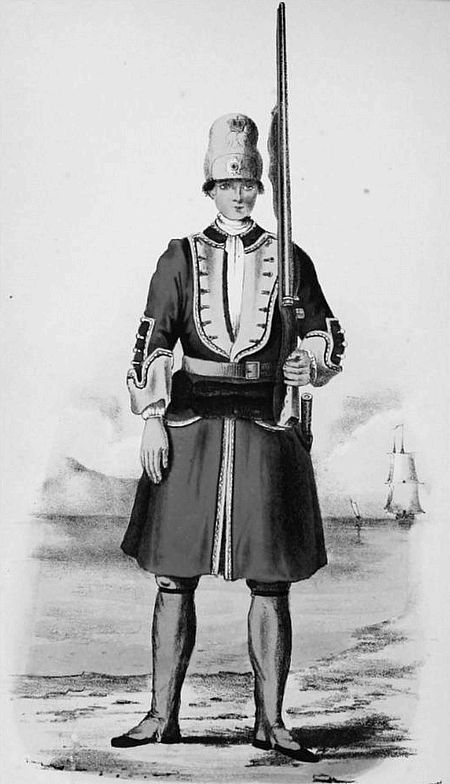
MARINES. 1742.