HISTORICAL RECORD (continued 3)
Reading edition
It having been subsequently ascertained, by scouts, that the enemy was strongly entrenched in great numbers round the village of Ferozeshah, the Commander-in-Chief determined to effect a junction with the troops at Ferozepore, and with the combined force to drive the Sikhs from their position. Accordingly at daylight on the 21st of December the army was formed in separate columns of attack, and marched in order of battle in the supposed direction of the enemy. Having proceeded about five miles, it was ascertained that the Sikhs had retired to their entrenched camp at Ferozeshah, about twelve miles from Moodkee.
The troops then fell into columns of route, and after a very fatiguing and circuitous march, rendered more so from no water being procurable on the road, they arrived about three o’clock P.M. in the neighbourhood of the enemy’s position, having, on the march, effected the desired junction with the division under Major-General Sir John Littler, consisting of five thousand men and twenty-one guns, which had moved from Ferozepore on the morning of the 21st of December: about a quarter of an hour was allowed for rest, and the plan of battle was then immediately arranged. The first division formed the reserve, and was drawn up in line, the THIRTY-FIRST being about the centre: here they remained about twenty minutes, during which time the round shot were passing through the ranks, killing and wounding several men.
The order was now given to advance to the support of the troops, who were hotly engaged and hard-pressed; the reserve moved forward in excellent order, though darkness was coming on, and very shortly became engaged and exposed to a heavy fire. The two lines were shortly reduced to one, the shattered remains of the reserve scarcely filling up the gaps formed in the first line by the deadly fire of the enemy, who nobly fought, and fell every man in his place; thus those two lines, which had so shortly before presented the regularity of a field-day, were now but one, standing surrounded by their dead and dying comrades, and the brave fellows of other European regiments could scarcely understand how they came to be fighting in the ranks of the THIRTY-FIRST. After a long and desperate contest, the Sikhs were driven from their guns, but not without severe loss on the part of the THIRTY-FIRST regiment, both in officers and men. Lieut. and Adjutant Bernard was killed on the spot, and Major Baldwin and Lieut. Pollard were mortally wounded; Lieut. Pilkington was struck by two shots, one passing through each ankle; and the horse of Major Spence was shot under him. On the death of Lieutenant and Adjutant Bernard, Lieutenant Robertson was appointed Adjutant, which appointment he held until the nomination of Lieutenant Bolton was received from the Horse Guards, he having been applied for by his father, Colonel Bolton, previously to the campaign. The camp of the Sikhs being now on fire in several places, mines and magazines exploding with terrific violence at short intervals, the enemy’s fire being silenced,—and their guns standing undefended,—the order was given to fall back a short distance and re-form, which was accordingly done; the troops bivouacked during the night in front of the Sikh camp, within reach of shot from their guns, which, having been left unspiked, were quickly reopened upon the exhausted troops, whose sufferings on that fearful night, from thirst and intense cold, will never be forgotten by those who endured them.
Towards morning the troops were formed in one line facing the enemy; the THIRTY-FIRST happened to be on the right of the whole. At the break of day, the British artillery opened on the enemy, who returned their fire, and after a short cannonading the infantry advanced to the attack: the THIRTY-FIRST moved steadily towards a battery of seven guns on the enemy’s extreme left, which kept up a continued fire of grape; it was, however, carried by the bayonet without a single check, and almost without a shot being fired by the assailants, though the loss of the THIRTY-FIRST was severe. Having killed all the enemy’s artillery-men who remained at their guns, the regiment, led by its brave commander, Major Spence, passed through the battery, and advanced steadily in an excellent line for about 300 yards, when it halted. The Governor-General and the Commander-in-Chief passed down the ranks amidst the cheers of the men; the line saluted them, dropping the regimental colours; and private William Ash, a grenadier, stood in front of his company displaying a colour taken from the enemy in the battery before mentioned.
THIRTY-FIRST REGIMENT
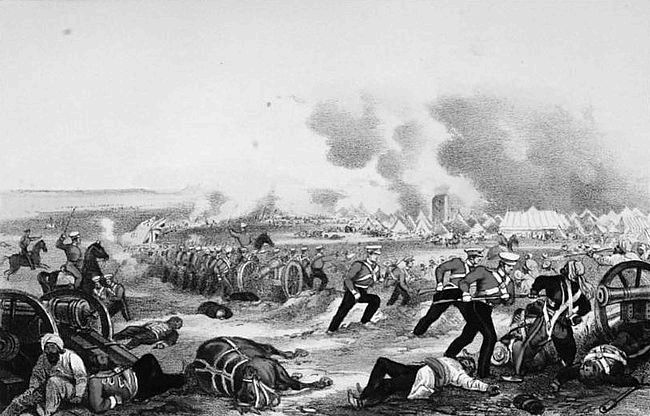
Madeley lith. 3 Wellington St Strand.
From a sketch by Major G. F. White, 31
st
Regiment
BATTLE OF FEROZESHAH.
(2
nd
DAY) 22
nd
DECEMBER, 1845.
For Cannon’s Military Records
The defeat of the enemy now appearing to be complete, the soldiers were allowed to go in search of water, the want of which was severely felt. In the course of half an hour the alarm was suddenly given, that the Sikhs were coming down in force; the troops were quickly placed in position, though there could be no regularity as regarded brigades, and on the near approach of the enemy’s horse, the THIRTY-FIRST formed square, the Governor-General and his Staff placing themselves in the centre: a terrific fire was now opened upon the devoted troops (whose artillery ammunition was expended) from the guns of Tej-Singh’s army advancing to the support of the already defeated Sikhs, and the tide of victory appeared about to turn, when Sir Henry Hardinge, glancing at the small but undismayed band around him, exclaimed “Thirty-first, remember Albuhera.” Line was, however, soon after re-formed, no decided attack being made by the enemy, who nevertheless kept up a galling and destructive fire from his guns. The THIRTY-FIRST suffered very considerably without the power of retaliation, but patiently maintained their position; at one time, when threatened by cavalry, forming an oblong square of four deep, one side of the square being composed of the twenty-ninth foot under Brigadier Taylor of that corps, the twenty-ninth forming four deep to the front, and the THIRTY-FIRST four deep to the rear, and in this position they remained for some time, ready to receive cavalry. The THIRTY-FIRST maintained their position upwards of three hours, when they were once more enabled to go in search of water by the sudden and precipitate retreat of the enemy. The water in the wells was, however, found to be in such a putrid state, as to be nearly useless, from the bodies of the dead having been thrown into them; and the ground in the neighbourhood was extremely dangerous, having been extensively mined.
The loss of the THIRTY-FIRST regiment at the battle of Ferozeshah, on the 21st and 22nd of December, amounted to two officers killed and six wounded.
Serjeants. Rank and File.
Killed, 2 57
Wounded, 4 92
The following officers were killed or wounded on this occasion:—
Killed. Wounded.
Lieut. Pollard. Major Baldwin, mortally.
Lieut. & Adj. Bernard. Lieut. T. Plasket, severely.
” A. Pilkington, ”
Ensign Paul, slightly.
” Hutton, ”
Captain Garvock, Major of Brigade, had his horse shot under him in the advance to charge the enemy’s batteries.
On the 21st of December, Lieutenant Bolton was appointed to carry orders from the Governor-General to Major-General Sir Henry Smith, and was transferred from the twenty-first Fusiliers to the THIRTY-FIRST regiment, to which he was appointed adjutant shortly afterwards.
Lieutenant Pollard, a promising officer, was wounded at Moodkee; but being a high-spirited young man, he would not remain behind, when his regiment went into action at Ferozeshah, although suffering from his wound, and advised to remain in his tent by the medical officers. He went into action on horseback; his wound being in the foot, he was unable to walk. At the desire of Sir Henry Smith he was employed as second adjutant to convey the orders of his commanding officer, Major Spence, who was so hoarse from a severe cold which he had caught at the battle of Moodkee, that he could not make himself sufficiently heard by the men; in the performance of this duty this gallant young officer nobly fell.
“The field after the retreat of the enemy was literally covered with dead,—they had abandoned large stores of grain, military stores, camp-equipage, and ammunition. The loss of the British army was very heavy; being opposed to a highly disciplined and organized army more than treble their number, with a field of artillery of battering calibre, admirably served, which kept up an incessant and destructive fire on the British troops: justifying the remark of an officer, who had been in all Napoleon’s great battles, that he never saw such devastation committed by artillery at any battle in Europe. What other army in the world would, under such circumstances, have, within thirty hours, stormed an entrenched camp, fought a general action, and sustained two considerable combats with the enemy? Within four days it dislodged from their positions 60,000 Sikh soldiers supported by 150 pieces of artillery, 108 of which the enemy acknowledged to have lost, and 91 of which fell into our hands.”
Another account of the action states:—
“The right wing was commanded by the Commander-in-Chief in person; the left by the Governor-General. As our troops deployed into line, and prepared for an advance, a tremendous fire from upwards of one hundred pieces of artillery, 40 of them of battering size, was opened by the enemy. The right wing, under Sir Hugh Gough, threw themselves with matchless gallantry on the guns, and wrested them from the enemy, when the storm of shot from the Sikh infantry behind became so fearful, that a portion only of the intrenchments could be carried, when darkness put an end to the conflict.
“Night had now closed in; the carnage had proved tremendous; our men thinned in numbers, harassed with forced marches, exhausted with fatigue, with little food and scarcely any water, and nothing whatever to cover them from the chill and heavy dew as the evening advanced, bivouacked amidst the dying and the dead, close under the intrenchments, and within reach of the shot of the enemy. All night long their artillery played upon us, and as the waning moon showed them our position, the cannon-shot ploughed up the ground right through, and amidst the wearied soldiers.
“Morning at length approached, and our troops were once more arrayed for the fight. With daylight came retribution and triumph to our arms. Our infantry was formed in line, supported on both flanks by the horse artillery. A masked battery now began to play on us with fearful effect; the heavy shot of the Sikhs dismounted our guns; nine of our tumbrils were blown up. A general charge was now determined on; amidst a terrific storm of shot and shell, the troops rushed on undismayed; the carnage was fearful: battery after battery was carried at the bayonet’s point; the camp was pierced with loaded mines, which exploded with fearful slaughter as we advanced. The village of Ferozeshah was stormed, and the enemy driven out of it at every point. When changing its front to the left, our force continued to sweep the camp, carrying everything before them.
“Undisturbed and unbroken by the fearful service in which they had been engaged, the troops drew up, when the camp was won, and halted to cheer their generals on the field they had just conquered, with the regularity of a parade. Seventy-three guns had now been taken; 20 more quickly fell into our hands. We had lost 37 European and 17 Native officers, with 630 non-commissioned officers and rank and file,—nearly 700 in all killed. Our casualties in killed and wounded amounted to 2415.”
The Commander-in-Chief in his despatch to the Governor-General, after the battle of Ferozeshah, bears the following testimony of his approbation of the gallant conduct of the army under his command on that glorious occasion. At the conclusion of the despatch General Sir Hugh Gough stated:—
“On the conclusion of such a narrative as I have given, it is surely superfluous in me to say, that I am, and shall be, to the last moment of my existence, proud of the army which I had the honor to command on the 21st and 22nd instant. To its gallant exertions I owe the satisfaction of seeing such a victory achieved, and the glory of having my own name associated with it.”
On receipt in London of the despatch of the Governor-General of India, announcing the victories of Moodkee and Ferozeshah, the thanks of both Houses of Parliament were voted unanimously to the Governor-General, the Right Honorable Lieutenant-General Sir Henry Hardinge,—to General Sir Hugh Gough, Bart., the Commander-in-Chief,—and to the several officers under their command,—for the eminent services rendered by them in the recent arduous and successful operations;—also to the non-commissioned officers and soldiers, European and Native, for the perseverance and fortitude maintained by them at Moodkee on the 18th of December, 1845, and for the daring valour with which they forced the enemy’s intrenchments at Ferozeshah on the 21st and 22nd of December, captured most of his guns, and finally compelled the Sikh army, of greatly superior numbers, to retire within their own frontiers.
The thanks of the Court of East India Directors were voted to the army of the Sutlej at the same time.
The Court of East India Directors confirmed the grant of a medal to all the officers and soldiers engaged in the battles of Moodkee and Ferozeshah, denoting that they served in this important campaign.
On the 21st, 22nd, and 23rd of December, the army bivouacked on the field of battle, having been, since the morning of the 20th, without tents, or any regular supply of food; and owing to the extreme heat by day, and intense cold by night, both officers and men had suffered much. On the 24th the troops changed their ground about four miles to Sultan Khan Walla, and three days afterwards the regimental baggage arrived.
At Sultan Khan Walla they remained seven days; the whole army was then moved to the banks of the Sutlej, not far from the fort of Hurreekee, where large camps were formed. For nearly a week after these terrible encounters, the Sikhs remained on the British side of the Sutlej, the army being unable to follow up its victory, as the troops, which were on their march to join, had not yet arrived; the heavy artillery, which was on the march from Cawnpore, was still very distant, and until the whole of the army was concentrated, it would be impossible to attack the enemy, who had again collected a formidable force of 70,000 men, with 110 pieces of ordnance, which were encamped on the opposite side of the river, and ready to oppose the British.
In the meantime the wounded officers and soldiers had been removed to the hospital at Ferozepore.
Lieut.-Colonel Byrne being prevented from resuming the command of the regiment by the severe wound he received at Moodkee, Major Spence continued to exercise the command during the arduous conflict of the 21st and 22nd of December at Ferozeshah, where he showed an example of bravery to his distinguished regiment. He was ably supported by every Officer and Man under his command. All nobly performed their duty on this well-contested field.
Colonel Bolton, being mortally wounded at Moodkee, died on the 4th January, 1846;[30] and the Commander-in-Chief promoted Major Spence, the senior major, to the Lieutenant-Colonelcy of the regiment.
Major Baldwin also died of the wounds received at Ferozeshah.[31] Captains Bulkeley and Young were promoted to the vacant majorities, a promotion which they justly merited for their gallant conduct at Moodkee, where both these officers were severely wounded.
Captain Willes, a meritorious and deserving officer, also died of the wounds received at Moodkee. The THIRTY-FIRST regiment, now greatly reduced in numbers from the heavy loss, both of officers and men, sustained in the late arduous conflicts, still preserved its spirit and energy, and was ready at a moment’s notice to be led on to future victories.
On the 30th of December, the Governor-General published a General Order, congratulating the Army on the recent victories, from which the following are extracts:
“The Governor-General again cordially congratulates His Excellency Sir Hugh Gough, G.C.B., on the great and important victories obtained by the army under his command.
“The Governor-General, in the name of the government and of the people of India, gratefully acknowledges the noble services rendered to the public by His Excellency the Commander-in-Chief, by all the General and other Officers, and by the Non-Commissioned Officers and Soldiers of the brave Indian army.
“The Governor-General’s thanks are due to all the infantry regiments of Her Majesty, and to the first European Light Infantry of the East India Company’s Service, all of which regiments distinguished themselves by the most devoted courage in braving the destructive fire of the enemy’s batteries, and valiantly capturing their guns.”
Thus ended the year 1845. The Sikhs, after having suffered two severe defeats, were preparing to renew the contest; they had made large additions to their army, and had again collected a formidable train of artillery.
1846
On the 16th of January, 1846, the first brigade, with a few guns and some Native cavalry, received sudden orders to march on the following morning in the direction of Loodiana, under the command of Major-General Sir Henry Smith; by a forced march on the 17th, the fort of Dhurrumkote was surprised, and the garrison, consisting of about three hundred men, laid down their arms, and were sent prisoners to head-quarters. On the 20th of the same month, this division was reinforced near the fort of Jugraon by the sixteenth lancers, the fifty-third foot, a detachment of recruits of the Queen’s regiments, and a troop of horse artillery.
The Major-General decided on attempting the relief of Loodiana, which was but slightly garrisoned, and was threatened by a large body of the enemy. Jugraon is distant from Loodiana about twenty-five miles, and the road (if road it can be called) is over a heavy and sandy soil. The troops were formed, and commenced their march about one o’clock on the morning of the 21st; about eleven A.M. the enemy was observed to be drawn up, parallel with the British line of march, in a strong position at Buddiwal, his front covered by a ridge of low sand-hills, bristling with forty pieces of artillery, which were so placed that it was necessary, in order to gain Loodiana, either to risk a battle to dislodge him from a strong position,—which, with troops fatigued by a long march, under a burning sun, and greatly inferior in numbers, would have been a hazardous proceeding,—or to march along the entire front of his position under a galling fire.
Major-General Sir Henry Smith, having a just confidence in the steadiness of his troops, chose the latter. The infantry, formed in open column of companies right in front (the grenadier company of the THIRTY-FIRST leading), and ready at any moment to form line, preceded by the artillery, and covered by the cavalry, marched at a distance of five hundred yards, along the front of this formidable line, receiving the fire of each battery as it bore upon them. The regiment formed line on the grenadier company.
On this occasion, and under the fire of forty guns, the THIRTY-FIRST received an order from Sir Henry Smith to change front to the rear on the centre, a movement which was rendered necessary by the manœuvres of the enemy, who had thrown forward his right in such a manner as to get into the rear of the British; this movement could not be attempted without the most perfect steadiness on the part of the men, and it was performed in such a manner as to call forth the praises of the Major-General. This was the first time this manœuvre was ever done under fire of the enemy; after which, the retirement of corps in line, covered by the sixteenth lancers, to relieve Loodiana (the object being to relieve that place), was beautifully executed.
The Sikh position being passed, and the enemy declining to follow, by three o’clock in the afternoon the troops arrived at Loodiana, thus effecting Sir Henry Smith’s object. In this affair the THIRTY-FIRST lost 21 men killed and wounded; and 19 men, who had, from the length and severity of the march, been unable to keep up with the column, were taken prisoners. The greatest part of the baggage belonging to the division was taken by the enemy.
On the 22nd and 23rd the troops were permitted to rest themselves after their late fatigues, and on the 24th the enemy retired to Aliwal, a village on the Sutlej. The British force moved to the ground lately occupied by them at Buddiwal, where it was reinforced by the second brigade of Sir Henry Smith’s division, consisting of Her Majesty’s fiftieth foot, and forty-eighth Native infantry, from head-quarters, with some cavalry and infantry from Loodiana.
On the 28th of January at daylight, Major-General Sir Henry Smith marched with his whole force to attack the enemy under Sirdar Runjoor Singh and the Rajah of Ladwa in their camps at Aliwal, but found him, on approaching it, drawn up in line of battle, with his left resting on the village. From information afterwards received, it appeared that the Sikhs were about to march upon Jugraon that very morning, for the purpose of getting between Sir Henry Smith’s force and the heavy guns coming up from Delhi under a very slender escort. The march having been previously conducted in column of brigades at deploying distance, each brigade deployed on its leading company, and thus formed one long line. The troops advanced on the enemy, distant about one mile and a half, and about ten A.M. the action was commenced by a heavy cannonade from the Sikh artillery, which was principally directed on the British centre. The village of Aliwal was filled with infantry, supported by cavalry in the rear, and further defended by two guns on its left, immediately opposite that part of the line occupied by the THIRTY-FIRST regiment. The village was carried, and the two guns were captured.
The line, being somewhat disordered in carrying the village, was quickly re-formed, and advanced in excellent order, carrying everything before it. The attack of the enemy by the left wing was equally successful. The line advanced, and made a steady and successful charge; the enemy, being everywhere beaten, gave way, and fled towards the river in the utmost confusion, leaving his camp and fifty-two pieces of artillery, as trophies in the hands of the victors. A standard was captured here by the THIRTY-FIRST regiment; also a gurry, or gong.[32]
The advance of the British force in order of battle is thus described by Major-General Sir Henry Smith in his despatch containing an account of the action:—
“As I neared the enemy, the ground became most favourable for troops to manœuvre, being open and hard grass-land. I ordered the cavalry to take ground to the right and left by brigades, thus displaying the heads of the infantry columns, and as they reached the high ground, I directed them to deploy into line. After deployment I observed the enemy’s left to outflank me; I therefore broke into open columns and took ground to my right; when I had gained sufficient ground, the troops wheeled into line: there was no dust; the sun shone brightly. These manœuvres were performed with the celerity and precision of the most correct field-day; the glistening of the bayonets and the swords of this order of battle was most imposing, and the line advanced. Scarcely had it moved forward 150 paces, when at ten o’clock the enemy opened a fierce cannonade from his whole line. At first his balls fell short, but quickly reached us. Thus upon him, and capable of better ascertaining his position, I was compelled to halt the line, though under fire, for a few moments, until I ascertained that by bringing up my right, and carrying the village of Aliwal, I could with great effect precipitate myself on his left and centre; I therefore quickly brought up Brigadier Godby’s brigade, and, with it and the first brigade under Brigadier Hicks, made a rapid and noble charge, carried the village and two guns of large calibre. The line I ordered to advance. Her Majesty’s THIRTY-FIRST regiment and the Native regiments contending for the front, the battle became general. * * * The battle was won; our troops advancing with the most perfect order to the common focus, the passage of the river. The enemy, completely hemmed in, were flying from our fire, and precipitating themselves in disordered masses into the ford and boats, in the utmost confusion and consternation. * * *
“Thus ended the Battle of Aliwal, one of the most glorious victories ever achieved in India. By the united efforts of Her Majesty’s and the Honorable Company’s troops, every gun the enemy had, fell into our hands: fifty-two guns are now in the Ordnance, two sunk in the bed of the Sutlej, and two spiked on the opposite bank, making a total of fifty-six pieces of cannon captured or destroyed!
“Having thus done justice, and justice alone, to the gallant troops his Excellency trusted to my command, I would gladly, if the limits of a despatch permitted me, do that justice to individuals all deserve. This cannot be; therefore I must confine myself to mention those officers whose continued services, experience, and standing placed them in conspicuous commands.”
After lauding the gallant service performed by the artillery, Sir Henry Smith proceeds to state in his official despatch:—
“To Brigadiers MacDowell and Stedman, commanding their gallant, brigades of cavalry, the fortune of the day is greatly indebted, and to all commanding officers of cavalry and infantry my warmest thanks are due; to Major Smyth, commanding the sixteenth lancers; to Lieut.-Colonel Spence, commanding Her Majesty’s THIRTY-FIRST foot; to Lieut.-Colonel Ryan, K.H., commanding Her Majesty’s fiftieth regiment; and to Lieut.-Colonel Phillips, commanding Her Majesty’s fifty-third foot.
“His Excellency the Commander-in-Chief having witnessed the glorious services of Her Majesty’s THIRTY-FIRST and fiftieth regiments, I have only to report upon Her Majesty’s fifty-third, a young regiment, but veterans in daring gallantry and regularity.
“To Captain Lugard (THIRTY-FIRST regiment) the Assistant-Adjutant-General of this force, I am deeply indebted, and the service still more so; a more cool, intrepid, and trustworthy officer cannot be brought forward.
“The brigadiers all speak in high terms of their majors of brigade, Captain O’Hanlan, of the second brigade, and Captain Garvock, of Her Majesty’s THIRTY-FIRST foot, of the first brigade.”
The loss of the THIRTY-FIRST regiment in this conflict was fortunately small: one officer, Lieut. Atty, slightly wounded, and fifteen men killed and wounded. The troops bivouacked for the night near the field of battle. The army remained at Aliwal five days, during which the following General Order was received from General Sir Hugh Gough, the Commander-in-Chief:—
“General Orders to the Army of the Sutlej.
“Head-Quarters, Camp, Nihalkee, “29th January, 1846.
“A glorious victory, with the capture of all the enemy’s guns, having been achieved by the force under Major-General Sir Henry Smith, K.C.B., the whole line will parade at eight o’clock this morning for the inspection of the Right Honorable the Governor-General and his Excellency the Commander-in-Chief, and a royal salute will be fired from the eighteen-pounder battery, and three cheers will be given by the line after the salute, in celebration of this triumphant event.”
The following extract is taken from the General Orders issued by the Governor-General, dated “Camp, Ferozepore, 2nd of February, 1846:”—
“Great praise is due to Brigadier Hicks, who, with Her Majesty’s THIRTY-FIRST regiment, the twenty-fourth and forty-seventh Native infantry, stormed the village of Aliwal, drove the enemy from it, and seized the guns by which it was defended.”
Extract of the despatch of the Governor-General of India to the Secret Committee, dated “Camp, Kanha Kutchwa, 19th of February, 1846:”—
“The immediate result of the victory of Aliwal was the evacuation by the Sikh garrisons of all the forts hitherto occupied by detachments of Lahore soldiers on this side of the river Sutlej, and the submission of the whole of the territory on the left bank of that river to the British government.
“The Sikh army remained in its intrenched position; and though, on the first intelligence of the victory of Aliwal, and at the sight of the numerous bodies which floated from the neighbourhood of that battle-field to the bridge of boats at Sobraon, the Sikhs seemed much shaken and disheartened,—yet after a few days, the Sikh troops seemed to be as confident as ever of being able to defy us in their intrenched position, and to prevent our passage of the river.
“The Commander-in-Chief was not in a state to take advantage of the enemy’s defeat at Aliwal, by an attack on his intrenched position at Sobraon, until the troops under Major-General Sir Henry Smith should have rejoined his Excellency’s camp, and the siege-train and ammunition should have arrived from Delhi. The first portion of the siege-train, with the reserved ammunition for 100 guns, reached the Commander-in-Chief’s camp on the 7th and 8th of February. On the latter day the brigades, which had been detached from the main army, rejoined the Commander-in-Chief.”
Notwithstanding the signal defeat in the battles of Moodkee, Ferozeshah, and Aliwal, and the loss of 143 pieces of artillery captured by the British in these actions, the enemy determined to persevere in his rash project of invading the British dominions. For this purpose he made extraordinary efforts; he had collected all his available troops, and assembled a large army on the left bank of the Sutlej, near the village of Sobraon. Here the Sikhs formed an intrenched camp, defended by 30,000 men with 70 pieces of artillery; this camp was supported by a large reserve on the opposite side of the river, the communication being preserved by a bridge of boats.
The THIRTY-FIRST regiment, under its distinguished and experienced leader, Major-General Sir Henry Smith, rejoined the head-quarter camp on the 8th of February, just in time for the crowning and decisive victory of Sobraon. The arrival of Sir Henry Smith’s force enabled the Commander-in-Chief to carry his plan of attacking the enemy into execution. Two days were allowed, that this division should rest after its fatigues.
The entrenched camp of the Sikhs was in a position judiciously chosen in a bend of the river, about five or six miles from the British camp. The defences of the enemy were constructed scientifically by European engineers.
On the morning of the 10th of February, some hours before daylight, the several divisions were silently formed in column of attack. Major-General Sir Henry Smith’s division was on the extreme right; it was formed into two lines; the first line consisted of the first brigade, to which the THIRTY-FIRST regiment belonged, under Lieut.-Colonel Spence: this line was supported by the second brigade at a short distance in the rear. When the day dawned, the first brigade found itself about three-quarters of a mile in front of the enemy’s works. The cannonading, which commenced a little after daylight, continued with little interruption, until about nine A.M. A stray shot was now and then sent at the regiment, but did no damage, when orders were given to the infantry to advance to the attack. The men, who had been lying down, instantly jumped up, formed line, and advanced.
The ground immediately in front of the enemy’s works was very irregular, which made it difficult for the men to keep their places. The enemy’s fire, which commenced at a distance of two or three hundred yards, grew gradually more and more heavy; and firing, as the Sikhs did, from behind lofty entrenchments at the assaulting party, who offered a fair mark as they scrambled up the ramparts, they shot down a number of the British troops, while the survivors, after in vain attempting to reach the top, the loose nature of the soil rendering the footing extremely insecure, were compelled to fall back on the advancing second brigade, who saw with indignation that the enemy were hacking the wounded.
The line was quickly re-formed and advanced a second time; the same determined resistance was again made: but the men, burning to revenge their comrades, would not be deterred. Here Lieut. Tritton, bearing the Queen’s colour, was shot through the head; and Ensign Jones,[33] who carried the regimental colour, was, nearly at the same time, mortally wounded; the regimental colour, falling to the ground, was seized by Serjeant Bernard M‘Cabe, who, rushing forward, crossed the ditch and planted it on the ramparts. The men cheering, scrambled into the works as best they could, and drove the enemy, who were beaten at all points, before them into the river, Lieut. Noel gallantly carrying the Queen’s colour in front of the regiment, the staff of which was shivered in his hand.
The attack having been everywhere successful, the slaughter of the Sikhs, as they crossed the river, was tremendous. Many casualties, however, in the THIRTY-FIRST regiment occurred within the enemy’s works. Lieutenant Timbrell was dangerously wounded by a grape-shot, which broke both his thighs, and Lieutenant Elmslie was also severely wounded by a musket-ball. Captain Garvock, Major of Brigade, and Lieutenant and Adjutant Bolton, were both severely wounded outside the works, where Lieutenants Gabbett and Law were also wounded. Thirty-five rank and file were killed, and 102 wounded.
Two stands of colours were captured by the regiment, making four stands altogether.
The first brigade, on this glorious occasion, was commanded by Lieutenant-Colonel Spence, whose horse was shot during the advance, and the sword in his hand bent nearly double by a grape-shot.
Captain White, the senior Captain, being left sick at Loodiana, from the effects of the sun on service, Captain Longworth commanded the regiment during the action. He was promoted for his gallant conduct to be major in the army; his horse was killed under him. Captains Garvock and Lugard were also promoted to be majors in the army on the same occasion.
The following account of the action is given in Captain Longworth’s despatch, dated 11th of February, 1846:—
“Camp, Attia, 11th February, 1846.
“Sir,
“I have the honor to state for the information of the Brigadier, that H. M.’s THIRTY-FIRST regiment, under my command, marched from Camp Tulwondee yesterday morning at four A.M., in quarter-distance column, right in front, being the leading regiment of the first brigade, first division. We advanced in this order till within about two miles of the enemy’s position, and then halted, formed line, and waited till daybreak, when we advanced some distance and halted till sunrise, and again advancing halted with our right resting on the Sutlej within range of the enemy’s guns; here we remained about two hours, when we were ordered to advance. This was no sooner discovered by the enemy than they opened upon us a most tremendous fire of round shot from the whole of the guns upon the left flank of their intrenched camp; shell, grape, canister, and a very heavy fire of musketry were showered upon us as we neared the fortifications: but in spite of this, I am proud to say, the regiment advanced steadily and in the best order till within thirty paces of the intrenched camp, when a most destructive fire from overpowering numbers forced us to retire to a short distance, for the purpose of re-forming, as we left a full third of the regiment upon the ground; and I feel convinced that had the regiment remained for five minutes longer in its exposed situation it must have been annihilated, as our fire was totally ineffectual against the enemy’s strongly fortified position, which completely protected them, until by a desperate charge, in conjunction with H. M.’s Fiftieth Regiment, we succeeded in penetrating the extremity of their works extending to the river, and thereby were enabled to bring our fire to bear upon their gunners, who with the most desperate courage turned their guns upon the portion of their own camp in our possession, and fought till bayoneted where they stood. Their infantry in masses now retiring, we followed them up, and, in concert with the other branches of the army, shot and bayoneted them into the river, where immense numbers were brought down by our fire. Shortly after the battle was over the regiment was ordered into camp.
“I beg to bring to your notice the gallant conduct of Serjeant M‘Cabe of the light company, who planted the regimental colour on the highest point of the enemy’s fortifications, and maintained his position under a most tremendous fire, the colour being completely riddled by the enemy’s shot;—he did this after the officer carrying the colour was shot.[34] I beg further to bring to your notice Private Williams of No. 7 company, and Private Biffin of the light company, who each took a colour from the enemy, one of which is supposed to have belonged to their artillery. I have much pleasure in expressing my high approbation of both officers and men under my command for their gallant conduct throughout the day. I regret to add that Lieutenant Law, my second in command, and Lieutenant and Adjutant Bolton, were both severely wounded.
“List of Officers who were present at the Battle of Sobraon.
Lieut.-Colonel Spence. Lieutenant Gabbett.
Captain Garvock. ” Timbrell.
” Longworth. ” Noel.
” Lugard. ” Paul.
Lieutenant Atty. ” Hutton.
” Law. ” Tritton.
” Robertson.
” Bolton (Adjutant). Ensign Jones.
” Elmslie. Quarter-Master Benison.”
On the 14th of February, 1846, the Governor-General published a General Order, dated from his camp at Kussoor, from which the following extracts are taken:—
“The Governor-General, having received from his Excellency the Commander-in-Chief the despatch annexed, announces to the army and to the people of India, for the fourth time during this campaign, a most important and memorable victory obtained by the army of the Sutlej over the Sikh forces at Sobraon, on the 10th instant.
“On that day the enemy’s strongly intrenched camp, defended by 35,000 men and 67 pieces of artillery, exclusive of heavy guns on the opposite bank of the river, was stormed by the British Army under the immediate command of His Excellency Sir Hugh Gough, and in two hours the Sikh forces were driven into the river with immense loss, 67 guns being captured by the victors.
“The Governor-General most cordially congratulates the Commander-in-Chief and the British Army on this exploit, one of the most daring ever achieved, by which in open day a triple line of breastworks, flanked by formidable redoubts, bristling with artillery, manned by thirty-two regular regiments of infantry, was assaulted, and carried by the forces under His Excellency’s command.
“This important operation was most judiciously preceded by a cannonade from the heavy howitzers and mortars, which had arrived from Delhi on the 8th of February, the same day on which the forces under Major-General Sir Henry Smith, which had been detached to Loodiana, and had gained the victory of Aliwal, rejoined the Commander-in-Chief’s camp.
“The British infantry, formed on the extreme left of the line, then advanced to the assault, and, in spite of every impediment, cleared the intrenchments and entered the enemy’s camp. Her Majesty’s tenth, fifty-third, and eightieth regiments, moving at a firm and steady pace, never fired a shot until they had passed the barriers opposed to them, a forbearance much to be commended, and most worthy of constant imitation, to which may be attributed the success of their first effort, and the small loss they sustained. The attack was crowned with the success it deserved!
“The same gallant efforts, attended by the same success, distinguished the attack on the enemy’s left, made by the first division, under the command of Major-General Sir Henry Smith, K.C.B., in which the troops nobly sustained their former reputation.
“These three divisions of infantry, concentrated within the enemy’s camp, drove the shattered forces into the river, with a loss which far exceeded that which the most experienced officers had ever witnessed.
“Thus terminated, in the brief space of two hours, this most remarkable conflict, in which the military combinations of the Commander-in-Chief were fully and ably carried into effect with His Excellency’s characteristic energy; the enemy’s select regiments of regular infantry have been dispersed, and a large portion destroyed, with the loss, since the campaign began, of 220 pieces of artillery taken in action. * * *
“The Governor-General, in the name of the Government and of the people of India, offers to His Excellency the Commander-in-Chief,—to the General Officers, and all the Officers and Troops under their command, his grateful and heartfelt acknowledgments for the services they have performed. * * *
“The Governor-General acknowledges the meritorious conduct of Brigadier Penny, and Lieut.-Colonel Spence,[35] commanding brigades in the first division.
“Her Majesty’s THIRTY-FIRST and fiftieth regiments greatly distinguished themselves, as well as the forty-second and forty-seventh native infantry, and the Nusseeree battalion.”
The despatch of the Commander-in-Chief, General Sir Hugh Gough, to the Governor-General, dated Camp, Kussoor, 13th of February, 1846, giving a detailed account of the battle of Sobraon, contained the following expressions of approbation and thanks:—
“I have now to make the attempt,—difficult, nay impracticable, though I deem it,—of expressing in adequate terms my sense of obligation to those who especially aided me by their talents and self-devotion in the hard-fought field of Sobraon.
“The major-generals of the divisions engaged deserve far more commendation than I am able, within the limits of a despatch, to bestow. * * *
“Brigadier Penny and Lieut.-Colonel Spence commanded the two brigades of Major-General Sir Henry Smith’s division, and overcame at their head the most formidable opposition. I beg to bring both in the most earnest manner to your notice. * * *
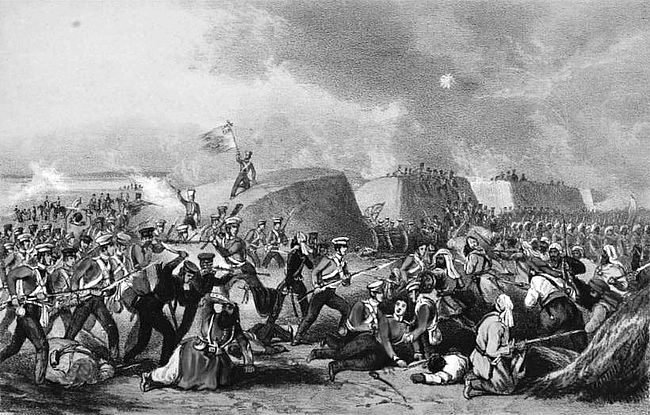
Madeley lith. 3 Wellington St Strand.
THE THIRTY-FIRST REGIMENT
BATTLE OF SOBRAON 10
th
FEB
y
1846
For Cannon’s Military Records
“The Sikhs, even when at particular points their intrenchments were mastered with the bayonet, strove to regain them by the fiercest conflict, sword in hand. Nor was it until the cavalry of the left, under Major-General Sir Joseph Thackwell, had moved forward and ridden through the openings in the intrenchments made by our sappers, in single file, and re-formed as they passed them; and the third light dragoons, whom no obstacle usually held formidable by horse appears to check, had, on this day, as at Ferozeshah, galloped over and cut down the obstinate defenders of batteries and field-works, and until the full weight of three divisions is of infantry, with every field-artillery gun which could be sent to their aid, had been cast into the scale, that victory finally declared for the British.
“The fire of the Sikhs first slackened and then nearly ceased, and the victors, then pressing them on every side, precipitated them in masses over their bridge and into the Sutlej, which a sudden rise of seven inches had rendered hardly fordable. In their efforts to reach the right bank through the deepened water, they suffered from our horse artillery a terrible carnage. Hundreds fell under this cannonade: hundreds upon hundreds were drowned in attempting the perilous passage. Their awful slaughter, confusion, and dismay were such as would have excited compassion in the hearts of their generous conquerors, if the Khalsa troops had not, in the earlier part of the action, sullied their gallantry by slaughtering and barbarously mangling every wounded soldier whom, in the vicissitudes of attack, the fortune of war left at their mercy.
“Sixty-seven pieces of cannon, upwards of two hundred camel-swivels (zumboorucks), numerous standards, and vast munitions of war, captured by our troops, are the pledges and trophies of our victory.
“The battle was over by eleven in the morning, and in the forenoon I caused our engineers to burn a part and to sink a part of the vaunted bridge of the Khalsa army, across which they had boastfully come once more to defy us, and to threaten India with ruin and devastation.
“The consequences of this great action have yet to be fully developed. It has at least, in God’s providence, once more expelled the Sikhs from our territory, and planted our standards on the soil of the Punjaub. After occupying their intrenched position for nearly a month, the Khalsa army had perhaps mistaken the caution which had induced us to wait for the necessary materiel, for timidity; but they must now deeply feel that the blow, which has fallen on them from the British arm, has only been the heavier for being long delayed.”
Lieut.-Colonel Spence, Captain Garvock (Major of Brigade), and Captain Lugard (Deputy Assistant Adjutant-General) of the THIRTY-FIRST, were specially mentioned in the above despatch.
At the close of a despatch dated Camp, Lahore, 22nd of February, 1846, the Governor-General added the following:—
“The soldiers of the army of the Sutlej have not only proved their superior prowess in battle, but have on every occasion, with subordination and patience, endured the fatigues and privations inseparable from a state of active operations in the field.
“The Governor-General has repeatedly expressed on his own part, and on that of the Government of India, admiration and gratitude for the important services which the army has rendered.
“The Governor-General is now pleased to resolve, as a testimony of the approbation of the Government of India of the bravery, discipline, and soldierlike bearing of the army of the Sutlej, that all the generals, officers, non-commissioned officers, and privates, shall receive a gratuity of twelve months’ batta.”
In writing the history of the part borne by a regiment in the brilliant victories of this glorious campaign, there are many traits of individual heroism which should not pass unrecorded. The modesty of true valour prevents officers, who have had an opportunity of distinguishing themselves, from announcing their own deeds, but the historian, who impartially records the service of a corps, can have no such scruples. No hesitation is therefore felt in giving a place in the records of the service of this distinguished corps to the following extract from the Calcutta Star, an Indian newspaper, which described the recent battles of the Sutlej:—
“Thirty-first Regiment.—This gallant old corps seems to have received more than its share of hard knocks, in the last four glorious battles it was engaged in. Lieut.-Colonel Spence who commanded in all four actions, seems to have had a charmed life, having escaped in a most astonishing way. He had two horses killed under him; balls through his cap and scabbard; his sword broken in his hand by grape-shot; and at Sobraon, a Sikh, who was lying apparently dead in the trenches, jumped up when he saw the Colonel’s head turned, and rushed at him to cut him down, which was only prevented by a private who called the Colonel’s attention to his danger, and afterwards bayoneted the Sikh, the Colonel’s sword having broken in the encounter.”
The glorious Victory of Sobraon was decisive: the invaders were repelled; their army, discomfited, retreated sullenly from the field; the whole of their artillery, their camp, warlike stores, and baggage fell into the hands of the victors; the enemy retired over their bridge, which, from the weight and pressure of the immense mass of the defeated troops passing over it, gave way; the Sikhs were precipitated into the water; the whole river was filled with the confused bodies of the flying enemy, the British artillery playing on them with round and grape-shot; the stream was choked up with the dead and dying: the carnage was frightful!
The enemy never attempted to rally. With the loss of his artillery, on which all his confidence was placed, his spirit was broken, and all his hopes of successfully resisting the British troops vanished: his pride was humbled: the last and final struggle was over; the battle was ended, and the power of the haughty and turbulent Sikhs received a blow on the sanguinary field of Sobraon from which it could not recover: the city of Lahore was at the mercy of the conquerors.
Preparations were now made for the advance of the British army into the Punjaub; the engineer department constructed a pontoon-bridge, and the whole British force, with its artillery, passed the Sutlej, and encamped on the opposite side, in the territory of the Sikhs: the enemy, disheartened and dismayed by their late defeats offered no opposition, retiring as the British army advanced. The distance from the river Sutlej to the capital of the Sikhs is less than fifty miles; the march to it was performed without opposition, and without difficulty: the power of the Sikhs was prostrate; their government sent chiefs of high rank as ambassadors to the British camp, to offer terms of submission to the Governor-General, suing for peace on whatever terms the conquerors might please to dictate.
Lieutenant Tritton died of his wounds on the evening of the battle, and early the next morning the regiment marched towards the bridge of boats, which was in progress at the nearest point on the Sutlej to Ferozepore; on this march it was joined by a detachment of sixty men under the command of Lieutenant M‘Kenzie, along with Assistant-Surgeon Massey, who had just arrived from Umballa, being part of an escort in charge of heavy guns, and an immense train of ammunition hackeries, which they had hoped to bring up in time for the last great battle, and were sadly disappointed to find it was all over;—such are the chances of war!! On the 12th the regiment was turned out at 10 o’clock P.M., and marching all night, crossed the river in native boats at sunrise, along with a large force under Sir Henry Smith, the band in the first boat playing “Garry-Owen,” and the men in high spirits at the prospect of entering the Punjaub.
This forced march was effected from a report having been sent to the Commander-in-Chief, that the Sikhs were about to oppose the crossing of the river, but no such demonstration took place. After halting some days at Kussoor, which is one march from the Sutlej, the army moved towards Lahore, marching at daylight every morning in order of battle, and every regiment in brigade keeping its own place through fields and jungles, forcing a way through every obstacle, and ready to form line at any moment. It was indeed a grand sight to see this splendid army on the morning of the 20th of February approaching the city of Lahore, over a boundless and perfectly open plain, on which it encamped about two miles from the city. On the 22nd the British Standard was hoisted on the citadel, and the event was announced to the army by the following General Orders of the Governor-General:—
General Orders by the Right Honorable the Governor-General of India.
“Camp, Lahore, 22nd February, 1846.
“The British army has this day occupied the gateway of the citadel of Lahore, the Badshahee Mosque, and the Huzzooree Bagh.
“The Army of the Sutlej has now brought its operations in the field to a close, by the dispersion of the Sikh army, and the military occupation of Lahore, preceded by a series of the most triumphant successes ever recorded in the military history of India.
“Compelled suddenly to assume the offensive by the unprovoked invasion of its territories, the British Army, under the command of its distinguished leader, has in sixty days defeated the Sikh forces in four general actions, has captured 220 pieces of field-artillery, and is now at the capital, dictating to the Lahore durbar the terms of a treaty, the conditions of which will tend to secure the British provinces from the repetition of a similar outrage.”
The decisive termination of the war in the Punjaub enabled the Governor-General and the Supreme Council to reduce the number of the Queen’s regular regiments in India. An order was accordingly issued for the return of the THIRTY-FIRST to Europe, but as it was desirable to retain all the efficient men who were willing to continue their services in India, the soldiers were permitted to volunteer into the other regiments serving in the Bengal Presidency.
A General Order was issued permitting the soldiers of the sixteenth lancers and the THIRTY-FIRST regiment to volunteer into other corps; the volunteering of the THIRTY-FIRST to commence on the 26th and to close on the 28th of February.
The regiment now mustered only 420 bayonets fit for duty out of 844 which left Umballa, and during these three days 103 men volunteered to other corps; at Umballa, on the 23rd, 24th, and 25th of March, it again volunteered 214 men; and at Chinsurah, on the 10th of July, 12 men, in all 329, who remained in India. Within the last few years, the regiment had gained a considerable accession to its strength by volunteers from corps leaving India: these men, whose object in volunteering was to remain in India, again availed themselves of the General Order granting them a bounty, of thirty rupees, and volunteered into other corps with which they had served during the late campaign.
After the authority for volunteering had taken effect the strength of the THIRTY-FIRST regiment was much reduced: all the young soldiers who were desirous of serving in India volunteered into other regiments. Several of the officers exchanged into corps remaining in India: Lieut.-Colonel Byrne into the fifty-third regiment; Major Young into the tenth; and Brevet Major Lugard into the twenty-ninth.
On the publication of the General Order for the return of the regiment to Europe,—the following Division Order was issued by Major-General Sir Henry Smith, K.C.B., commanding the first division:—
“Camp, Lahore, 3rd March, 1846.
“Comrades,—Officers and Soldiers of the gallant THIRTY-FIRST regiment,—you and I have been so associated in the recent conflicts, where your services have been distinguished, that I cannot lose you from under my command without an expression of the deepest regret; that regret is however mitigated, when I know that you are about to return to your native country, from which the regiment has been absent twenty-one years,—much diminished in numbers,—caused by your valiant conduct and recent glorious victories; but the former renown of your distinguished corps has acquired additional fame, by the valour of Lieut.-Colonel Spence, the officers, and soldiers; and the long list of triumphant victories now recorded on your colours, has been much increased by your services in India. Farewell, my gallant comrades, for the present; may every success, happiness, honor, and prosperity attend you, the gallant THIRTY-FIRST regiment, in peace, as it has so gloriously done in war! and, believe me, one of the most happy and proud recollections of my life will be that I have witnessed the indomitable valour of the corps.”
On the same occasion the following Brigade Orders were issued by Brigadier Monteath, who commanded the brigade in which the THIRTY-FIRST regiment served in the Cabool campaign:—
Brigade Orders by Brigadier Monteath, C.B.
“Camp, Lahore, 3rd March, 1846.
“Her Majesty’s THIRTY-FIRST regiment being now about to quit the army, Brigadier Monteath cannot allow it to depart without expressing the deep regret he feels at the approaching separation from those to whom he has been bound by so many ties of friendly feeling for their private good qualities, and high admiration for their public services. On a former occasion, when associated with them under the most difficult and trying circumstances, he had the gratification of recording, that the regiment had exhibited, in a high degree, the best qualities of the best British soldiers; and he has now the proud pleasure of telling them, that by their gallant conduct during the late sanguinary conflicts with the enemy, they have encircled themselves with every honor, nobly maintained the former character of the regiment, and placed its number amongst the foremost of those whose military achievements are most conspicuously engraved upon the records of their country; and he sincerely prays, on their arrival in England, that their beloved Sovereign may be induced to confer such marks of distinction upon the regiment as its gallant deeds so eminently deserve.
“Farewell, my gallant comrades; may every happiness and prosperity attend you. Your old Commander will ever remember you with pleasure, and watch your future progress with all the deep interest of your firmest friends.
“By order, (Signed) “G. A. Tytler, Brigade-Major.”
The Commander-in-Chief in India, having deemed it advisable to send home as many of the severely wounded men of the army as possible, before the beginning of the hot weather, gave orders for the boats to be prepared on the Sutlej to convey them to Bombay, and the command of this detachment was given by His Excellency to Lieutenant Robertson, of the THIRTY-FIRST regiment. It consisted of about 158 men of all the European corps lately engaged, and an escort of 63 duty men of the THIRTY-FIRST, making in all 221, 97 of which belonged to the regiment. The detachment sailed from Ferozepore on the 14th of March, 1846, and arrived safely at Bombay on the 27th of April, whence it embarked on board the ship ‘Herefordshire’ on the 14th of May, and landed at Gravesend on the 29th of September, 1846, being the first portion of the regiment that arrived in England.
On the 28th of February the officers of the THIRTY-FIRST regiment were specially invited to dinner by Lieut.-General Lord Hardinge, the Governor-General, and on the 3rd of March the same honor was conferred on them by General Lord Gough, the Commander-in-Chief in India.
The volunteering being completed, the volunteers were delivered over to their new corps. The regiment separated from the army with which it had gained such distinguished renown, and commenced its march on the 4th of March towards Ghurmuktesir Ghât, on the river Ganges, where boats were prepared for its conveyance to Calcutta. The regiment recrossed the river Sutlej on the 7th of March, and on the 20th reached Umballa.
The women, children, and baggage of the regiment, having been left at Umballa when the regiment proceeded on service, a halt was required to enable the officers to arrange their affairs and dispose of their property, and that of the deceased officers and men; the houses which the officers occupied being their own property and built by themselves, as they were the first to inhabit the station when it was formed into a new cantonment in 1843.
The regiment moved again on the 28th of March, and, passing through the station of Meerut, arrived at Ghurmuktesir Ghât, on the right bank of the Ganges, on the 13th of April.
The boats provided by the commissariat for the conveyance of the regiment to Calcutta being in readiness for the voyage, the wounded and sick men, women, and children were embarked with as little delay as possible. By the 16th of April the whole were embarked, and the fleet of boats sailed for the Presidency of Calcutta on the following day.
Lieut.-Colonel Spence, after having commanded the regiment in every action during this brilliant and glorious campaign,—at Moodkee on the 18th of December, Ferozeshah on the 21st and 22nd of December, 1845, Buddiwal on the 21st of January, Aliwal on the 28th, and on the 10th of February, 1846, at the crowning victory at Sobraon,—had now the satisfaction of embarking with it on board the boats appointed to convey it to the port of Calcutta, where the ships lay at anchor, which were engaged to carry the war-worn veterans of the THIRTY-FIRST regiment to their native country.
On the 3rd of April Her Majesty was pleased to appoint Lieut.-Colonel Byrne and Lieut.-Colonel Spence, of the THIRTY-FIRST regiment, to be Companions of the Most Honorable Military Order of the Bath, for their distinguished gallantry in the late actions on the Sutlej.
In consequence of the particularly gallant conduct of Serjeant Bernard M‘Cabe, Major-General Sir Henry Smith, in a letter dated 17th February, was pleased to recommend him for a commission, in the following terms:—“This intrepid non-commissioned officer, in the midst of a hand-to-hand conflict with the enemy, planted the colour of Her Majesty’s THIRTY-FIRST regiment upon one of the towers of the enemy’s intrenchments,—one of the most bold and daring acts of a gallant soldier I ever witnessed, and which, I now deliberately consider, tended much to shorten the struggle alluded to. This serjeant is a young man of excellent character, and, if I may be permitted to remind His Excellency the Commander-in-Chief of the promise made me almost in the heat of battle, it is,—‘This Serjeant shall be recommended for a commission.’ I can only add (which is unnecessary to the soldiers’ friend, Sir Hugh Gough) that, if he receives a commission, it will be as gratifying to me as was the gallant conduct I witnessed at the moment the colour-head was shot off, and the flag perforated with balls, as he triumphantly waved it in the air in the very midst of the enemy.”
This highly honorable testimony of the bravery of Serjeant M‘Cabe at the battle of Sobraon, was supported by the strong recommendation of General Lord Gough to His Grace the Commander-in-Chief, and Serjeant Bernard M‘Cabe was appointed by Her Majesty to an ensigncy in the Eighteenth, Royal Irish, regiment of foot, on the 8th of May, 1846.
The details of the campaign on the Sutlej afford abundant proofs of the skill and bravery of the troops: the highest praise is due, and has been rendered by their admiring and grateful countrymen, to the officers and soldiers by whose gallantry four battles were fought, and victories obtained, in sixty days, over an enemy who had most ample means of equipping and supplying his corps with all the matériel of war, and of choosing his own time and opportunity of commencing his perfidious attack.
The army of the Sikhs, at the commencement of this unprovoked aggression, is ascertained to have amounted to 60,000 men, and their artillery to 108 pieces of cannon, some of them being of large calibre.
The Anglo-Indian forces, which had been hastily collected to contend against this immense army, amounted only to about 20,000 men, a great proportion of which had marched one hundred and sixty miles, in order to arrive at the seat of war.
Under the most serious disadvantages, fatigues, and privations, the British troops, with the aid of their faithful allies, the Native corps, nobly contended with their Sikh adversaries, “who, in spite of their exceeding numbers and advantageous positions, were vanquished in every battle.”
In expressing admiration of the heroic conduct of the British troops in this short but decisive war, it is the duty of the nation to acknowledge, with gratitude, the wonderful interference of a Supreme Power, by whose all-wise decree the army of the Sikhs was destroyed and dispersed; and, notwithstanding its numbers, received a complete and signal overthrow, as a just but severe punishment for its faithless conduct and daring violation of every honorable and religious feeling.
When it is considered that with a disparity of force of three to one, independent of artillery, the Sikh army was discomfited, and the enemy was driven back to his capital to seek for safety and peace, the British Nation must be sensible that an over-ruling Power aided their cause, and gave strength where numbers were deficient; and that another signal instance of Divine favour and protection has been added to the numerous claims which demand the nation’s humble acknowledgment and gratitude.
The campaign on the Sutlej having terminated by the destruction of the Sikh army and the capture of the city of Lahore, a treaty of peace was entered into. The Sikh government requested that a force of 10,000 British troops might be left at their capital for the protection of the city and the maintenance of good order: this being complied with, arrangements were made for the return of the British army to the territories of the East India Company.
The glorious news of the Battle of Sobraon was received in London on the 1st of April, and was announced to the British public by a royal salute from the guns of the Tower and in St. James’s Park; and the royal standard was displayed at Buckingham Palace and at the Tower of London. The greatest sensation pervaded all ranks of society: no military event, with the exception of the Battle of Waterloo, excited such wonder and surprise, mingled with joy, that the cloud, which had hung over the fate of the British Empire in India, was completely dissipated by this last splendid and decisive victory, which effected the final overthrow of the power of the Sikhs, the destruction of their army, and the capture of their artillery, on the sanguinary field of Sobraon.
On the 2nd of April the Thanks of the House of Lords were proposed by the Earl of Ripon, and carried unanimously.
Extracts from Minutes of Proceedings of the House of Lords.—2nd April, 1846.
“That the Thanks of this House be given to Major-General Sir Henry George Smith, Knight Commander of the Most Honorable Military Order of the Bath, for his skilful and meritorious conduct when in command of the British troops employed against a large portion of the Sikh army, of greatly superior numbers, and for the signal valour and judgment displayed by him in the battle of the 28th of January, 1846, when the enemy’s force was totally defeated, and a new lustre added to the reputation of the British arms.
“That the Thanks of this House be given to the several officers, European and Native, under the command of Sir Henry Smith, for the distinguished services rendered by them at the battle of Aliwal.
“That this House doth highly approve of and commend the intrepidity and exemplary discipline displayed by the non-commissioned officers and private soldiers, European and Native, on the 28th of January, 1846, in their attack on the enemy’s position, by which the Sikhs were completely routed and driven in confusion across the Sutlej, with the loss of all their artillery and military equipment; and that the same be signified to them by the Commanders of the several corps, who are desired to thank them for their gallant behaviour.
“That in requesting the Governor-General of India to communicate these Resolutions to the several Officers referred to therein, this House desires to acknowledge the zeal and judgment evinced by the Right Honorable Lieut.-General Sir Henry Hardinge, Knight Grand Cross of the Order of the Bath, Governor-General of India, and also by General Sir Hugh Gough, Baronet, Knight Grand Cross of the Order of the Bath, Commander-in-Chief of the Forces in India, in supplying Major-General Sir Henry Smith with such reinforcements and military means as enabled him, under Divine Providence, to overcome all the obstacles thrown in his way by a brave and determined enemy.
“That the Thanks of this House be given to the Right Honorable Lieut.-General Sir Henry Hardinge, Knight Grand Cross of the Most Honorable Military Order of the Bath, Governor-General of India, for the judgment, energy, and ability with which the resources of the British Empire in India have been applied in repelling the unjust and unprovoked invasion of the British Territory by the Sikh Nation; and for the valour and indefatigable exertions which he displayed on the 10th of February, 1846, at the battle of Sobraon, when, by the blessing of Almighty God, which we desire most humbly to acknowledge, this hostile and treacherous invasion was successfully defeated.
“That the Thanks of this House be given to General Sir Hugh Gough, Baronet, Knight Grand Cross of the Most Honorable Military Order of the Bath, Commander-in-Chief of the Forces in India, for the signal ability and valour with which, upon the 10th of February, 1846, he directed and led the attack, when the enemy’s intrenchments were stormed, their artillery captured, their army defeated and scattered, and the Punjaub laid open to the advance of our victorious troops.
“That the Thanks of this House be given to Major-General Sir Henry George Smith, Knight Commander of the Most Honorable Military Order of the Bath; Major-General Walter Raleigh Gilbert; and Major-General Sir Joseph Thackwell, Knight Commander of the Most Honorable Military Order of the Bath; and to the other officers, European and Native, for the distinguished services rendered by them in the eminently successful operations at the battle of Sobraon.
“That this House doth highly approve of and commend the invincible intrepidity, perseverance, and steady discipline displayed by the non-commissioned officers and private soldiers, European and Native, on the 10th of February, 1846, by which the glory of the British arms has been successfully maintained against a determined and greatly superior force, and that the same be signified to them by the Commanders of the several corps, who are desired to thank them for their gallant behaviour.
“That the said Resolutions be transmitted by the Lord Chancellor to the Governor-General of India, and that he be requested to communicate the same to the several officers referred to therein.”
The House of Commons.
Votes of Thanks to the same effect were proposed by Sir Robert Peel in the House of Commons, and carried without a dissenting voice.
The East India Company.
On the same day, a Special General Court of the proprietors of stock was held at the East India House, for the purpose of passing a Vote of Thanks to Major-General Sir Henry Smith for his victory at Aliwal over the Sikh army; to the Governor-General Sir Henry Hardinge; to General Sir Hugh Gough, and to the European and Native troops who were engaged in the war on the Sutlej. The resolutions of the Court were proposed by Sir Henry Willock, the chairman, and were unanimously adopted.
The Court of Common Council of London.
At a Special Court of the Court of the Common Council of the City of London, the Thanks and Congratulations of the Court were awarded to Lieut.-General Sir Henry Hardinge, G.C.B., General Sir Hugh Gough, G.C.B., and Major-General Sir Henry Smith, K.C.B., for the valour, judgment, and ability displayed by them in the recent battles of Aliwal and Sobraon; also the Thanks of the Court to the other officers, European and Native, for the intrepidity, perseverance, and discipline evinced by them upon both these memorable occasions.
After a tedious voyage down the Ganges, owing to the shallowness of the river and the numerous sand-banks, the regiment did not reach the station of Chinsurah until the 6th of July, on which day it landed and marched into barracks. Chinsurah, formerly a Dutch settlement, was ceded by Holland to the British Government in 1827; it is situated on the right bank of the Ganges, about thirty miles from Calcutta: the East India Company have built an excellent barrack here for a regiment of infantry. The regiment was halted here until the necessary preparations were made for its embarkation for England.
On the 30th of July the arms of the regiment, which had been proudly borne and successfully used on many occasions on the battle-field, were given over to the ordnance department, and deposited in the arsenal of Fort William.
On the arrival of the regiment at Fort William, the military officers of the Presidency invited the officers of the sixteenth lancers and THIRTY-FIRST regiment to a ball and supper at the Town-hall, to show their high sense of the distinguished conduct of those regiments in the field during the recent campaign on the Sutlej.
The Lieut.-Governor, Sir Herbert Maddox, also invited the officers to a splendid banquet at the Government House on the 1st of August.
The officers were also hospitably entertained by the officers of the Bengal artillery stationed at Dum-Dum, the head-quarters of that corps.
The entertainment given by the military officers at Calcutta to the officers of the sixteenth lancers and THIRTY-FIRST regiment is thus noticed in the public paper called the “Star,” of the 1st of August, 1846:—
“The ball given by the military to Her Majesty’s sixteenth lancers and Her Majesty’s THIRTY-FIRST regiment, came off with great brilliancy last night at the Town Hall; there were probably from 400 to 500 persons present. The hall was decorated with remarkable taste, and the honored Peninsular colours of the THIRTY-FIRST regiment hung in tatters under the principal canopy, blood-stained in the recent engagements, in all of which the gallant regiment was present. At the opposite end of the table was a large transparency of the battle of Sobraon. Colonel Warren presided at the supper-table; and Colonel Burlton, in an excellent speech, reviewing the services of the regiments from the commencement of the present century, gave the toast of the evening, which was acknowledged by Lieut.-Colonel MacDowell and Lieut.-Colonel Spence.”
Previous to the departure of the regiment from India, the following General Order was issued by General Lord Gough, the Commander-in-Chief:—
“Head-Quarters, Simla, 23rd May, 1846.
“Those distinguished regiments, the sixteenth lancers and the THIRTY-FIRST foot, are about to return to their native country after a service in India, the former of twenty-four, the latter of twenty-one years; and although the Commander-in-Chief has recently, and so frequently, had occasion to laud the gallant conduct of these corps before an intrepid enemy, he cannot permit them to embark without again expressing his admiration of their continued and conspicuous bravery in all the battles they have been engaged in during the long and eventful period of their Indian service, whether in Affghanistan, or at the more sanguinary conflicts of 1845 and 1846.
“These brave regiments may be assured they will be received in their native land with every demonstration of that patriotic feeling which gallant exploits ensure from their countrymen.
“The sixteenth lancers have added to their standards ‘Bhurtpore, Affghanistan, Ghuznee, Maharajpore, Aliwal, and Sobraon;’ and the THIRTY-FIRST regiment will have recorded on their already highly decorated colours—‘Cabool, Moodkee, Ferozeshah, Aliwal, and Sobraon.’
“Again must Lord Gough express the gratification it affords him thus to be able to record his opinion of their merits; and both these corps are assured that their correct conduct in quarters, and almost total absence of crime for many years, have mainly conduced to the gallant achievements in the field to which their good fortune has afforded them the opportunity to contribute.
“That every happiness and welfare may hereafter attend these regiments, is the Commander-in-Chief’s ardent desire, for he must ever feel the warmest interest in the career of such highly distinguished regiments.
“The Commander-in-Chief congratulates the two officers, Lieut.-Colonel MacDowell, C.B., and Lieut.-Colonel Spence, who accompanied their regiments to India nearly a quarter of a century ago, upon now having the honor and gratification of commanding them, after such distinguished services, on their return to their native land. Lieut.-Colonel MacDowell has never left India since his first arrival.
“By order of His Excellency the Commander-in-Chief. (Signed) “H. G. Smith, Major-General, “Adjutant-General to the Forces in India.”
The regiment embarked for England, the left wing under the command of Lieutenant Plaskett, on board the ‘Plantagenet,’ on the 2nd of August, 1846, consisting of 5 officers, 12 serjeants, 4 drummers, and 102 rank and file, 10 women and 10 children. The head-quarters, or right wing, embarked on board the ‘Madagascar’ on the 3rd of August, 1846, under the command of Major Staunton, and consisted of 10 officers, 19 serjeants, 7 drummers, and 194 rank and file, 21 women, and 32 children. Unfortunately, as the ‘Plantagenet’ was putting out to sea, she sprung a leak, and was obliged to return to Calcutta with all speed, the pumps being worked night and day by the soldiers, without whose assistance she must have gone down: they succeeded in bringing her safe into dock, there being then above seven feet of water in the hold. This detachment again embarked in the same ship on the 29th of August, and arrived in England on the 13th of January, 1847, having lost on the passage seven men. The ‘Madagascar,’ with head-quarters, arrived in England on the 5th of December, and lost on the passage Lieutenant Richard Sparrow and five soldiers.
After a voyage of four months, the surviving veterans of the regiment were gladdened with the sight of the shores of their native land. The head-quarters of the regiment reached Gravesend on the 4th of December, 1846; and on the 6th disembarked and marched to Chatham. Nothing could exceed the enthusiasm of the public to welcome the arrival of this distinguished corps.
The following description of the reception the regiment met with on its arrival, is taken from the ‘Illustrated London News’ of December, 1846:—
“The Return of the THIRTY-FIRST Regiment from India.—On the 4th instant the head-quarters of this distinguished regiment arrived by the ship Madagascar from Calcutta, from which place they embarked on the 3rd of August last: they lost by deaths on the voyage five men and one officer, Lieut. Richard Sparrow. They brought home with them four captured colours, which they took in the short but brilliant campaign against the Sikhs. * * * On the evening of the 6th the head-quarters marched into Chatham garrison from Gravesend, by the Rochester and Gravesend Railway, where they were met by the very superior band of the royal marines. On the arrival at the Rochester terminus, the band struck up, ‘God save the Queen,’ and these heroes of the Sutlej were greeted by hundreds of people with loud and repeated huzzas. The soldiers, in return for this spirited welcome, waved the four colours captured from the enemy, one at Ferozeshah, one at Aliwal, and two taken at Sobraon. These banners bear testimony of the severe engagements. The Queen’s colour, and the regimental colour, are complete fragments. The head-quarters were also accompanied by the depôt band, which played at intervals in passing with the regiment through the streets of Rochester and Chatham, and were greeted along the whole line by thousands of people who assembled to witness their return.
“Out of the 215 men landed from the Madagascar there are but 80 unwounded. Lieut.-Colonel Spence, and Quarter-master Benison, are the only officers, now with the regiment, who went out with it in the ‘Kent’ East Indiaman, which took fire and sank in the Bay of Biscay.
“The following officers have come home with the head-quarters:—Major George Staunton, Brevet Major D. F. G. Longworth, Lieut. G. Elmslie, Lieut. T. Scarman, Lieut. R. Mackenzie, Lieut. and Adjutant A. S. Bolton, Lieut. H. P. Hutton, Quarter-master S. Benison, and Assistant-Surgeon H. C. Foss. Total nine officers and 215 serjeants, drummers, and rank and file.
“Lieut.-Colonel Spence headed the troops. The officers of this regiment, having been on the most friendly terms with the royal marine corps, and being members of the mess of the royal marines, they dined at the royal marines’ mess-room with the officers, who invited them on their arrival at the garrison to a superb repast.
“The officers of the regiment were invited to dinner by Colonel Sir Frederick Smith and the officers of the royal engineers in garrison at Chatham. They also received invitations to dinner from the officers of the 2nd battalion of the 60th rifles, and also from the officers of the provisional battalion quartered in this garrison.”
Shortly after its arrival in England, the following complimentary letter was received by Lieut.-Colonel Spence, commanding the regiment, from that distinguished officer General Sir Colin Halkett, G.C.B., the Colonel of the THIRTY-FIRST regiment:—
“United Service Club, London, 22nd Dec., 1846.
“My Dear Colonel,
“It is with the liveliest satisfaction that I avail myself of the arrival in England of the THIRTY-FIRST regiment, under your command, to offer you, and the corps, my most sincere congratulations on your return to your native land, after your arduous and distinguished services in the East. Connected as I have the honor to be with the regiment, it was natural for me to take a deep interest in its welfare, and to follow its fate and fortunes with all the attention in my power; and as some professional experience enabled me to appreciate the toils you had to encounter, and the dangers you had to overcome, it was with highly gratified pride and most heartfelt delight, that I heard how nobly you had supported the first, and how gallantly you had vanquished the latter.
“At the very outset of the voyage from England, the regiment was already called upon to give proofs of that high state of discipline, which is the soldier’s best shield in difficulties. On dark and distant seas, amid the flames of the unfortunate East India ship Kent, you remained firm and tranquil, obedient to orders issued by that meritorious soldier, your then commanding officer, Lieut.-Colonel Fearon (now Major-General), and thus ensured the safety of all when every semblance of hope seemed to have vanished, and when confusion must have led to inevitable destruction.
“The promise, which such noble conduct gave, was fully justified by your subsequent behaviour. Called upon to aid in avenging disasters which the feebleness of allies had brought upon your country’s arms, you forced your way through the most difficult part of Central Asia, through mountain wildernesses unequalled on the face of the globe, and never traversed by disciplined troops since the days of the great Macedonian conqueror. Even the gallantry, which you displayed during this campaign, seems to be forgotten, when we reflect on the steady discipline, and dauntless energy, evinced in contending against the toils and difficulties which had to be overcome at every step of this memorable march, only eclipsed by the more brilliant actions you were soon afterwards called upon to perform.
“An Army, composed of the most warlike tribes of Asia, trained to arms by European officers, long accustomed to victory under the sway of an able and ambitious prince, assuming, on the death of Runjeet Singh, the power of absolute control over its feeble government, resolved to invade the British provinces; which, protected by a disciplined army, ruled by a wise and paternal government, had long prospered in peace, and acquired a degree of wealth too well calculated to tempt the rapacity of such lawless bands.
“To avoid every appearance of hostility, and preserve peace to the last, the British authorities had kept their forces at a distance from the frontier; and the enemy thus emboldened by forbearance, which was probably taken for timidity, crossed the Sutlej, and attacked our possessions without even a declaration of war. In this difficulty it was only by extraordinary exertion on the part of the troops, by toil and fortitude never surpassed, if ever equalled, that your comrades posted along the frontier could be saved from ruin, and an unprincipled foe checked in time to avert the greatest calamities.
“The march from Umballa must ever be memorable in the annals of war. Under the burning sun of India, you supported, at duty’s call, an excess of toil and fatigue, which would have tried the hardiest and the best, even in the bracing atmosphere of our northern climate; and your victory of Moodkee was actually achieved over bold, numerous, and well-prepared foes, after a march of twenty miles, performed under the rays of a vertical sun, through a waste and parched country, not affording even a drop of water to allay the scorching thirst occasioned by the clouds of dust raised from the burning soil; fought, and won in fact, after an excess of toil that would have overcome all but the first and foremost soldiers of their time.
“A single defeat was not, however, to daunt the fierce and numerous foes with whom you had to contend; and hardly had you recovered from the fatigues of your long march and first victory, when you were called upon to storm an entrenched camp, defended by vastly superior numbers, and by a train of heavy and well-served artillery such as the East had never beheld. To assail works, under such circumstances, is one of the most trying and difficult operations of war; and when the strength of the position, and the fierce resolution with which it was defended, are considered, your victory may safely be termed an action of unsurpassed boldness, energy, and perseverance.
“Never will your country’s banner suffer a stain, so long as its soldiers shall equal those who stormed the Sikh camp of Ferozeshah: greater fortitude and gallantry than those of which you had given proof in these actions could not possibly be displayed. But every species of high soldiership was to be called for during the course of this brief campaign, and it was your fortune to be present in the different actions, all fought under different circumstances.
“At Aliwal you had to execute on an open and level plain, and under a heavy fire of artillery, the skilful movements which ensured the success of that brilliant day; and at Sobraon you were again called upon to force entrenchments, constructed with European science, and defended with all the fierce resolution of Asiatic despair. But neither savage valour, nor European art, could withstand your efforts,—could compete with high and matchless gallantry, regulated by discipline, and fired to noble exertion by the consciousness of what was due to your country’s name and fame!—The Battle of Sobraon, which crushed the power of unprincipled adversaries, terminated your exploits in the East, saved the British provinces from devastation, and secured to our youthful and beloved Sovereign the peaceful and happy possession of India! Never indeed were nobler objects attained by nobler conduct!
“It is needless for me to tell you how greatly all ranks of your countrymen sympathised with your fortunes during these trying times; how much they felt for your sufferings; how deeply they mourned for the heavy losses you sustained; and how highly they exulted in the gallantry you displayed. The admiration your behaviour excited, must have reached you even on the distant shores of India; and I feel confident that every step you take on British ground will show how justly your conduct is appreciated by all those whose good opinion can be of value. It only remains for me, therefore, again to offer you my most sincere congratulations on your return to your native land, to wish you every success and happiness in your future progress, and to assure you, that as far as my sphere of action extends, no effort shall be wanting to give effect to the sentiments I feel such high satisfaction in now expressing.
“Believe me, “My dear Colonel, ever yours sincerely, “Colin Halkett, “General, and Colonel Thirty-first Regt.
“Lieut.-Colonel Spence, C.B., “Commanding Thirty-first Regiment.”
As an additional testimony of the consideration of the services of the officers and men of the THIRTY-FIRST regiment who had returned from India, His Grace the Commander-in-Chief was pleased to authorize the following letter to be addressed to the officer commanding, dated Horse Guards, 21st of December, 1846:—
“Sir,
“In transmitting the enclosed Copy of the General Order of the 30th of October last, granting leave of absence to officers, and furloughs to non-commissioned officers and men, to the 10th of March next, I have it in command to intimate to you, that the Commander-in-Chief, duly considering the glorious and important services recently performed by the regiment under your command, as well as its protracted service abroad, has been pleased to direct that furloughs may be forthwith granted to such of the non-commissioned officers and men recently returned from India, without limitation as to numbers, as may be desirous of availing themselves of that indulgence, so as to enable them immediately to visit their friends; and that leave of absence may, in like manner, be extended to as large a portion of the officers as can be spared from the duties of the regiment.
“I have, &c. (Signed) “John Macdonald, “Adjutant-General.”
The usual directions were given by the Secretary at War for reducing the establishment of the regiment, in order to assimilate it to that of other regiments on home duty, from the 6th of December, 1846.
After transferring to the Invalid Depôt the men selected for discharge on account of wounds and other disabilities, and incorporating the depôt with the other companies, the regiment was removed from Chatham to Walmer, where it arrived on the 20th of December, and was received at Deal and in the neighbouring parts, with the same honors and marks of distinction as had been evinced on its arrival in the garrison of Chatham.
1847
The remainder of the regiment, consisting of five officers, viz., Lieutenants Plaskett, Law, Pilkington, and Noel, Assistant-Surgeon Massey, and 111 men, arrived at Gravesend on the 13th of January, 1847, on board of the Plantagenet freight ship: the delay in their arrival was occasioned by that vessel having sprung a leak, which compelled her to put back to Calcutta. This division proceeded from Chatham on the 20th of January, to join the head-quarters of the regiment at Walmer.
On the 30th of June, 1847, the regiment was apprised by the Adjutant-General, that her Majesty had been pleased to approve of its bearing on the regimental colour and appointments the words Moodkee, Ferozeshah, Aliwal, and Sobraon, in commemoration of the distinguished conduct evinced by the THIRTY-FIRST at those battles.
Lieut.-General the Honorable Henry Otway Trevor was appointed to the colonelcy of the THIRTY-FIRST regiment on the 12th of July, 1847, in succession to General Sir Colin Halkett, G.C.B., who was removed to the forty-fifth regiment.
On the 6th of September, 1847, Lieut.-General Sir Henry Smith came to Walmer to see the regiment, before he proceeded to the Cape of Good Hope, of which colony he had been appointed Governor and Commander-in-Chief. On the 7th of September he reviewed the regiment, and expressed his satisfaction at seeing its discipline so perfect, considering that only a few months had elapsed since it returned home a mere skeleton.
The regiment was inspected by Major-General Brown on the 4th of May, and on the 1st of October, 1847; it was inspected on the 10th of November, by His Grace the Duke of Wellington, who expressed his approbation in the highest terms. In November the regiment was removed to Manchester by railway in three divisions, where it was completed to its establishment of 39 officers, 47 serjeants, 40 corporals, 17 drummers, and 760 privates.
1848
On the 7th of April, 1848, the regiment proceeded to Ireland, and arrived at Dublin on the following day. In July the regiment marched to Athlone.
New Colours were presented to the THIRTY-FIRST regiment, on the 19th of May, 1848, by Major-General His Royal Highness the Prince George of Cambridge, K.G., and the following account of the ceremony was given in “Saunders’ News-Letter” of the following day:—
“The interesting military ceremonial of the presentation of New Colours to this gallant and distinguished corps took place yesterday, in the ornamental grounds in front of that fine building, the Queen’s Inns, Henrietta-street, Dublin. The regiment was formed in full review order at three o’clock, shortly after which His Royal Highness Prince George of Cambridge, accompanied by his aide-de-camp Captain the Honorable James Macdonald, Major-General John M‘Donald, and several other officers of distinction, came upon the ground.
“In front of the line were four standards, captured by the regiment from the Sikhs, one of them taken at Ferozeshah, one at Aliwal, and two at Sobraon. The Colours of the Corps, torn to pieces from the grape-shot through which they were led to victory, and stained with the blood of the Ensigns who were killed carrying them to the muzzles of the Sikh guns, were objects of great interest to the numerous citizens who thronged the grounds. Lieut.-Colonel Spence, C.B., who commanded the gallant regiment in all these actions, except Sobraon (where he commanded the first brigade of Sir Henry Smith’s Division), was in command, and looked in admirable health and spirits.
“The survivors of the Indian campaigns were decorated with their medals. After the usual routine of parading the old colours, and giving them up, the band playing ‘Auld lang syne,’ the Regiment formed a hollow square, and the Garrison Chaplain repeated the prescribed formula for the occasion. The New Colours were then handed to Ensigns Christian and Brown, when His Royal Highness the Prince George of Cambridge briefly addressed the Regiment, stating his gratification at having this pleasing duty to perform. He had not seen service himself, and the task would have fallen more appropriately upon one who had. In encouraging the troops to the performance of their duty, he related the anecdote of the Serjeant who, when the Ensign bearing the old colour had fallen mortally wounded, seized it,—carried it onwards,—and victory resulted. The non-commissioned officer was promoted to an ensigncy in the Eighteenth, Royal Irish, regiment.[36]
“The corps then formed in line, and gave a Royal salute, the band playing ‘God save the Queen.’ The day was remarkably fine, and after the ceremony the regiment marched into its quarters in the Linen-Hall Barracks.”
Certain of the distinguished officers of the garrison of Dublin were entertained by the officers of the regiment at dinner in the evening; but His Royal Highness Prince George was prevented from attending by an expected disturbance in the city.
1849
On the 1st of February, 1849, the establishment of the regiment was reduced from eight hundred to seven hundred and fifty rank and file.
On the 20th of July, 1849, Lieut.-Colonel Spence retired, after a lengthened service of forty-one years, and Major George Staunton was promoted to the rank of Lieut.-Colonel of the THIRTY-FIRST regiment, in succession to Lieut.-Colonel James Spence.[37]
During the year 1849 the regiment remained at Athlone.
1850
In April, 1850, the regiment proceeded from Athlone to Dublin, where it continued to be stationed at the conclusion of the Historical Record.