HISTORICAL RECORD (continued 2)
Reading edition
In November of the preceding year a squadron of English and Russian vessels landed some troops at Naples without any opposition from the Neapolitan Court. The French Emperor, on receiving intelligence of this transaction, issued a proclamation that “the Neapolitan dynasty had ceased to reign,” and an army, under his brother, Joseph Bonaparte, assisted by Marshal Massena, marched for Naples. On the 15th of February the French entered that capital, and soon obtained possession of the whole kingdom, excepting Gaeta; Ferdinand IV. and his Court having previously retired to Sicily. A decree was shortly issued by Napoleon, conferring the crown of Naples on his brother Joseph, who was proclaimed King on the 30th of May.
England being desirous of preserving Sicily from the dominion of France, troops were embarked for that island;—on the 26th of April the first battalion of the THIRTY-FIRST regiment embarked at Tilbury-fort, and landed at Messina on the 26th of July.
Previously to the arrival of the THIRTY-FIRST regiment, the French had assembled a force in Calabria for the invasion of Sicily, and Major-General Stuart, commanding the British troops in that island, formed the design of cutting off the French division under General Regnier; the result was the battle of Maida, where a victory was gained by the British troops on the 4th of July. Major-General Stuart being sensible that he could not, with his small force, maintain himself in Calabria, recrossed the straits of Messina and returned to Sicily. For this victory Major-General John Stuart received the dignity of Knight of the Bath, the thanks of Parliament, and was created Count of Maida by the King of the Two Sicilies.
1807
Admiral Sir John Duckworth having failed in his coercive mission to detach Turkey from the interests of France, Great Britain determined to seize upon Egypt, as a check to any fresh demonstration by the French against the British possessions in the East Indies.
An armament accordingly sailed from Melazzo, on the coast of Sicily, in February, 1807, under the command of Major-General Alexander Mackenzie Fraser, Colonel of the seventy-eighth regiment, and landed at Aboukir on the 18th of March. On the 21st of March, Alexandria was occupied by the British troops, and it is a singular coincidence that it was the anniversary of the battle fought near there in the year 1801, when the gallant General Sir Ralph Abercromby received the wound which terminated his honorable career.
On the 27th of March a force of fifteen hundred men, of which the THIRTY-FIRST regiment formed part, was detached under the command of Major-General Wauchope to Rosetta. The troops arrived before the city on the 31st of March, and not having been impeded in their progress to the environs, entered the place. The THIRTY-FIRST regiment marched into Rosetta, while the grenadier battalion occupied a high sandy mound without the city.
Rosetta is situated upon a slight eminence, commanding a view of the river Nile and the fertile lands of the Delta; the streets are somewhat wider than the generality of Egyptian towns, and planted here and there with trees. The houses are high, the lower half of each being a dead wall, with a small door, leading into a narrow passage, well secured with bolts and bars of iron. The chambers are above, with trelliced windows projecting over the streets. The Turks had garrisoned their houses, and remaining quiet, allowed the British to continue their march until some way into the town, when through the loop-holes they had constructed on purpose, and their trelliced windows, a destructive and unexpected fire was opened upon the column. The troops, although placed in a most trying and perilous situation, behaved extremely well, and after having suffered very materially in killed and wounded, retired to Aboukir, from whence they returned to Alexandria.
Major-General Wauchope, who commanded the force, was killed; the THIRTY-FIRST regiment had Captain John Robertson, three serjeants, three drummers, and sixty-nine rank and file killed; Captain Patrick Dowdall, Lieutenants Edward Knox, Peter Fearon, John Thornton, —— Sladden, and Francis Ryan, Ensign Richard Kirby, seven serjeants, one drummer, and one hundred and twenty-nine rank and file wounded. Lieutenant Sladden subsequently died of his wounds.
Brigadier-General the Honorable Robert Meade (Lieutenant-Colonel of the THIRTY-FIRST), the second in command, was also severely wounded.
Major-General Fraser finding that a famine would be the consequence of the British remaining at Alexandria, without the occupation of Rosetta, detached another body of troops, amounting to two thousand five hundred men, under Brigadier-General the Honorable William Stewart, to reduce the place. The force consisted of a detachment of Royal Artillery, a detachment of the twentieth light dragoons, light infantry battalion, first battalion of the thirty-fifth regiment, second battalion of the seventy-eighth regiment, the Baron De Roll’s regiment, and a detachment of seamen. A large Turkish force coming down the Nile from Cairo, the troops were compelled to retire, fighting all the way to Alexandria.
A formidable force now approached Alexandria, and Major-General Fraser sent a flag of truce offering to evacuate Egypt, on condition that the British prisoners should be liberated. The proposal was readily accepted, and on the 19th of September the British troops embarked for Sicily, where they arrived on the 16th of October.
1808
The first battalion of the THIRTY-FIRST regiment embarked from Sicily for Malta, on the 17th of September, 1808, where it remained until August, 1810, when it returned to Sicily.
1810 1811
On the 17th of August, 1810, the first battalion landed at Messina, and remained in garrison in the citadel until April, 1811, when Lieut.-General Lord William Bentinck, being about to proceed to the eastern coast of Spain, sent it to Malta, in order that a stronger corps might be drawn from that island, the thirty-first having been reduced considerably in numbers while stationed in the Mediterranean. The battalion landed at Malta on the 18th of April, but the force left in Sicily being found insufficient, four companies were immediately recalled, and on the 22nd of April re-embarked for Messina; a few months afterwards the head-quarters were ordered back to Sicily, and on the 28th of August joined the detached companies, when the battalion was once more united in Sicily.
1812
About this period the British authorities in Sicily detected the traces of a conspiracy set on foot the year before by the Queen of Naples, who, it is said, had proposed a scheme to Napoleon for massacring the English. A new constitution was established in Sicily, upon the model of that of Great Britain, under the auspices of Lieut.-General Lord William Bentinck, who had been appointed Captain-General of the Island, and the Queen was sent into retirement.
In November, 1812, the grenadier company of the THIRTY-FIRST regiment embarked from Sicily for the east coast of Spain, under Lieut.-General Frederick Maitland, and landed at Alicant on the 2nd of December. In April, 1813, it returned to Sicily, where it arrived in May.
1813
The first battalion of the THIRTY-FIRST regiment remained in garrison in the citadel of Messina until towards the end of 1813, when, in consequence of disturbances at Palermo, the capital of Sicily, which threatened to spread, the troops were detached to various central positions. The THIRTY-FIRST, by a detour, marched upon Castro Giovanni, and remained there until January, 1814, when the battalion returned to Messina.
1814
On the 28th of March, 1814, the battalion embarked at Melazzo, as part of an expedition destined for the shores of Italy, under Lieut.-General Lord William Bentinck. In the beginning of April the first division of the army arrived off the coast above and below the city of Genoa, and threatened a descent upon Voltri, rather to engage the attention of the enemy, however, in that quarter, than for any other purpose.
On the 5th of April the second division of the Anglo-Sicilian army disembarked at Leghorn, and marched directly upon Sestri. The French reinforced that place to protect the coast batteries, and prevent the British communicating with the people of the mountains, who were ready to rise against the French. The two British divisions had united, and attacked the enemy, on the 8th of April, at Sestri; the battle lasted throughout the day, and in the night the French General Ronger St. Victor retired towards Recco, taking up his position in rear of Rafallo, where he left his advanced guard; a third British division, in which was the first battalion of the THIRTY-FIRST, hovered about the coast, and made some attempts to land fresh troops, but was prevented by the enemy’s detachments at Recco.
On the 9th and 10th of April the squadron cannonaded Recco, but was obliged to stand out again; in the night of the 10th General Pègot, who had arrived to relieve General Ronger St. Victor, retired, and occupied, on the 11th of April, a position at Mount Fascia. The English squadron and transports had all arrived before Genoa, and a detachment from the divisions on shore had been able to communicate with the native levies at Fontana Buona. On the 12th of April the position of Mount Fascia was attacked, and, after a hard day’s contest, General Pègot fell back in the night, and took up another strong position at La Sturla, on the heights of Albaro, his right on the sea being covered by a battery of four pieces of artillery, and his left resting on Fort Richelieu. The remainder of the British army disembarked at Nervi, and immediately attacked the enemy on the heights of Albaro, on the 13th of April.
The THIRTY-FIRST, under the command of Colonel Bruce, belonged to this division, and, with the 8th battalion of the Line of the King’s German Legion, dashed in among the enemy the instant of their debarkation, notwithstanding the intersected and difficult nature of the ground, which assisted so materially the obstinate defence of the French. Meanwhile the light company of the THIRTY-FIRST, under Captain Nunn, had carried the battery which covered the enemy’s right, with conspicuous bravery, and dismounted the four guns upon it under a galling fire of musketry and artillery from another battery near that captured.
The THIRTY-FIRST had Captains Stewart and Cruice, three serjeants, one drummer, and thirty-six rank and file wounded; one serjeant and thirteen rank and file killed.
The following extract from Division Orders, dated La Sturla, 14th of April, 1814, bears testimony to the conduct of the corps:—
“The conduct of the troops in the long contested action of yesterday, at La Sturla, was most honorable to them, and Major-General Montresor feels the greatest satisfaction in doing justice to their merits, by publicly declaring his high sense of their persevering gallantry in surmounting the numberless obstacles which the broken and intersected nature of the country presented, in every step, to their advance, whilst it afforded the best shelter to the enemy, who, well accustomed to his ground, defended it with the greatest obstinacy.
“However justly entitled the whole may be to individual distinction, it nevertheless would be unjust not to notice, in particular, the ardour and spirited skill in which the Royal Flotilla, and the detachments of the third Italian Levy, and of the second and third extra regiments, and Royal Marines, began the attack, and the very gallant manner in which the THIRTY-FIRST regiment, and the 8th King’s German Legion, dashed in amongst the enemy after their debarkation, and the conspicuous bravery of the light company of the THIRTY-FIRST regiment, in carrying the battery on the left.”
During the 14th and 15th of April the attacks upon the heights of Albaro were repeated, and on the 17th, while disaffection among the people was rapidly spreading in Genoa, the posts of St. Francisco and St. Martin d’Albaro were carried, and the French retired behind the Bizagno.
By the 18th of April the disaffection in Genoa had reached a crisis, and upon the following day the advance upon the city took place. The THIRTY-FIRST drove the enemy from a strong battery of ten brass guns and two 13½ inch brass mortars, without sustaining any loss.
During the night of the 19th of April a convention was signed; on the morning of the 21st, the enemy marched out of the city and evacuated all his posts. On the 22nd the head-quarters of the THIRTY-FIRST were within the city of Genoa, when the Commander-in-Chief, Lieut.-General Lord William Bentinck, issued the order from which the following extract is taken:—
“Head-Quarters, Genoa, 24th April, 1814.
“The Commander of the Forces has much satisfaction in witnessing the zeal and gallantry evinced by the whole of the troops under his orders in the late operations, which have led to the possession of this important fortress; and he has not failed to represent their conduct in the most favourable terms to His Majesty’s government.
“Major-General Montresor has particularly reported to him the great assistance he received from Brigadier-General Roth, Colonel Bruce, and Lieut.-Colonel Travers.
“The Commander of the Forces himself observed the very gallant and successful attack made by the third Italian regiment, under the orders of Lieut.-Colonel Ciravignac, and favourable reports have been made to him of the conduct of the light company of the twenty-first regiment, commanded by Captain Renny, the light company of the THIRTY-FIRST, under Captain Nunn, and the light company of the second Estero regiment, under Captain-Lieutenant Fulghier.”
On the 27th of April the first battalion of the THIRTY-FIRST sailed with a force for the island of Corsica; when the troops arrived opposite Ajaccio, that place capitulated. The THIRTY-FIRST regiment then sailed for Bastia (the birth-place of Napoleon), and landing there on the 11th of May, remained until the 24th of June following, when it embarked for Sicily, and again went into garrison in the citadel of Messina, on the 18th of July, 1814.
In the meantime the brilliant successes gained over the French in the Peninsula and South of France, by the troops under the Duke of Wellington, in which the second battalion of the THIRTY-FIRST regiment bore a prominent part, led to a treaty of peace with France; Napoleon retired to Elba, which island was ceded to him in full sovereignty for life, with a pension payable from the revenues of France; and on the 3rd of May, 1814, Louis XVIII. entered Paris, and ascended the throne of his ancestors.
On the 24th of October, 1814, the second battalion of the THIRTY-FIRST regiment was disbanded at Portsmouth, and the officers and men fit for service were transferred to the first battalion, with which they were incorporated on the 6th of May, 1815, at Messina.
In commemoration of the services of the second battalion during the Peninsular War, the THIRTY-FIRST regiment has received the Royal Authority to bear on the Regimental Colour and Appointments, the words “Talavera,” “Albuhera,” “Vittoria,” “Pyrenees,” “Nivelle,” “Nive,” “Orthes,” and “Peninsula.”
1815
Although the first and second battalions of the THIRTY-FIRST regiment were employed in different countries, yet they were engaged in the promotion of the same interests, namely, the restoration of the exiled families of the House of Bourbon to the thrones of their ancestors; the achievements of the second battalion were in the most distinguished arena, but the first battalion, although it was stationed among the pastoral beauties of Sicily, and the luxurious towns of Italy, maintained its discipline and character, besides adding honors to those formerly acquired on the field of battle, whenever, as on the heights of Albaro, an opportunity had offered.
The peace of Europe was again to be disturbed. The French army retained a chivalrous veneration for Napoleon, who returned from Elba, landed at Cannes, in Provence, on the 1st of March, 1815, and was joined by his former troops. Louis XVIII. withdrew from Paris to Ghent, and Napoleon assumed his former dignity of Emperor of the French.
Marshal Murat, the brother-in-law of Napoleon, by whom in 1808 he had been made King of Naples, upon Joseph Bonaparte being constituted King of Spain, had, in January, 1814, signed a treaty with England, and engaged to co-operate with the allies against France. Napoleon’s triumphal return to France caused Murat to espouse his cause, and he at once commenced hostilities against Austria, issuing a proclamation asserting the independence of Italy. Naples was thereupon invested by the Austrians, while an English squadron entered the port and acted in co-operation.
The allied powers, however, refused to acknowledge the sovereignty of Napoleon, and determined on his dethronement.
These events caused the THIRTY-FIRST regiment to be embarked at Melazzo for Naples, where it arrived on the 25th of May. The city had capitulated to the British fleet, under Admiral Lord Exmouth, and the troops landed to hold possession until the restoration of order in the kingdom, and Ferdinand IV. should be reinstated on the throne of the Two Sicilies. After an exile of nine years, this sovereign entered his capital on the 17th of June; on the following day the hopes of Bonaparte were crushed by his defeat on the memorable field of Waterloo, which victory triumphantly closed the campaign; and on the 8th of July Louis XVIII. re-entered Paris, and the Bourbon government was restored.
In the beginning of July the THIRTY-FIRST had sailed from the Bay of Naples for Genoa, and remained there to support the arrangements for restoring the Sardinian dominions to their original state.
Bonaparte was subsequently compelled to surrender himself a prisoner on the 15th of July to Captain Maitland, commanding the “Bellerophon” ship of war, and the island of St. Helena was afterwards appointed for his residence. Murat’s career was equally brief; he was driven from Italy, and withdrew to Corsica, from which island he made a rash descent on the coast of Calabria. After a sharp action he and his followers were taken prisoners. Murat was tried by a military commission, and shot on the 15th of October.
1816 1818
In February, 1816, the THIRTY-FIRST regiment embarked for Malta, and remained in that island until June, 1818, when it proceeded to England, and landed at Deal on the 22nd of July.
On the return of the regiment to England it was stationed at Dover Castle, Colchester, Chatham, and Sheerness.
1819
In August, 1819, in consequence of disturbances in the manufacturing districts, three companies of the THIRTY-FIRST regiment proceeded to Manchester, three to Macclesfield, and three to Stockport. On the 10th of the same month the regiment was employed in Manchester.
An assemblage of people, estimated at forty to sixty thousand, took place on the 16th of August, in an open space in the town of Manchester, named St. Peter’s Field, for the purpose of petitioning Parliament. Such meetings having been forbidden by proclamation some weeks previously, the military were employed by the civil authorities in dispersing the crowd of persons who had entered the town, with banners, some of which were of a menacing nature.
The troops of the garrison, the fifteenth hussars, the THIRTY-FIRST and eighty-eighth regiments, with the Chester and Manchester yeomanry cavalry, were ordered to be assembled in the vicinity, under the senior officer, Lieut.-Colonel L’Estrange, of the THIRTY-FIRST regiment. The yeomanry were engaged during part of the day in dispersing the multitude, many of whom received injuries, and eight or ten were killed. The regular troops behaved with their usual coolness and discipline, in the delicate and important duty they had to perform. The thanks of the Prince Regent, and of the Magistrates, were communicated to the troops in the following letters:—
“Whitehall, 21st August, 1819.
“Sir
“I lost no time in laying before the Prince Regent your letter to me of the 17th August, together with the enclosure to yourself from Lieut.-Colonel L’Estrange, and I have great satisfaction in obeying the commands of His Royal Highness, by requesting that you will express to Lieut.-Colonel L’Estrange, and to the officers, non-commissioned officers, and privates, that served under his command at Manchester on the 16th of August, His Royal Highness’s high approbation of the exemplary manner in which they assisted and supported the civil authorities of the County Palatine of Lancaster on that day.
“I have, &c. (Signed) “Sidmouth.”
“New Bailey Court-House, August 17th, 1819.
“The Magistrates of the two counties of Lancaster and Chester, assembled at Manchester, request Lieut.-Colonel L’Estrange will accept for himself, and convey to the officers, non-commissioned officers, and privates under his command, their best and sincerest thanks, for the energy, tempered by the greatest humanity, displayed in their conduct yesterday, a conduct peculiarly characteristic of the British soldier.
(Signed) “Wm. Hutton, Chairman.”
1820
The disturbances among the manufacturing classes having subsided, the THIRTY-FIRST regiment left Manchester on the 2nd of June, 1820. The troops had been much harassed throughout the winter, in consequence of the ill spirit which prevailed among the people of the surrounding districts, and on the removal of the regiment the municipal authorities of Manchester and Salford addressed a letter to Lieut.-Colonel L’Estrange, expressing their regret at its departure, and their esteem for its conduct during the eventful period the corps was stationed in those towns.
On the 10th of June, 1820, the regiment arrived at Sunderland.
1821
In February, 1821, the regiment marched from Sunderland to Port Patrick, in Scotland, whence, on the 7th of March, it embarked for Donaghadee, and on the following morning proceeded to Belfast. While quartered in this town, the establishment was reduced from ten companies of sixty-five rank and file, to eight companies of seventy-two rank and file each.
During the period the head-quarters remained at Belfast, detachments of the regiment were stationed in Coleraine, Downpatrick, and Carrickfergus, where they were employed on the revenue and other duties generally required from the army in Ireland.
1822
In April, 1822, the regiment was removed from Belfast and its neighbourhood, occupying fresh quarters at Armagh, Newry, and Dundalk.
1823 1824
The regiment, in October 1823, marched from Armagh to Naas, and in January, 1824, proceeded to Dublin, where it occupied Richmond barracks.
In the year 1824 the regiment received orders to prepare for foreign service:—the island of Ceylon was, in the first instance, selected as its destination, but it was eventually changed to Bengal. On the 20th of July the left wing of the THIRTY-FIRST regiment marched to Kingstown, and embarked on board of transports for Portsmouth, where it arrived on the 26th of July; the right wing, following soon afterwards, joined on the 2nd of August, and the regiment went into barracks at Gosport.
1825
On the 12th of January, 1825, the regiment marched from Gosport for Chatham, where it arrived on the 20th of that month. On the 7th of February the regiment marched to Gravesend to embark for Calcutta: the right wing on board the Honorable East India Company’s ship “Kent,” under the command of Lieut.-Colonel Fearon; the left wing on board the “Scaleby Castle,” under Major Tovey. The two ships parted company off Portsmouth at the end of February, and the “Scaleby Castle,” after making a favourable voyage, arrived at Sangor, in the mouth of the Hoogley, on the 7th of June.
The men had been remarkably healthy during the long confinement on board ship; two only had died during the passage, and only eight were on the sick list when the vessel came to anchor. The men were transferred, after a few days’ delay at Sangor Point, to sloops, a particularly uncomfortable and clumsy description of vessel, then used to transport troops up the River Hoogley from the sand-heads, and on the 21st of June they arrived opposite Fort William, where boats had been prepared to receive them, for they were not yet destined to land. It was the 26th, however, before the left wing was able to sail again; it was therefore five days, during the most trying season of the year, confined in small thatched boats, which were moored to the river’s bank: it nevertheless reached Berhampore on the 2nd of July, with the loss of only one man.
Berhampore, on the Bhagaritty river, is the cantonment of the city of Moorshedabad, and in 1825 was the depôt of the regiments on the Bengal establishment, then on service in Burmah. The companies of the left wing of the corps took possession of the barracks, and remained in them till the 22nd of September.
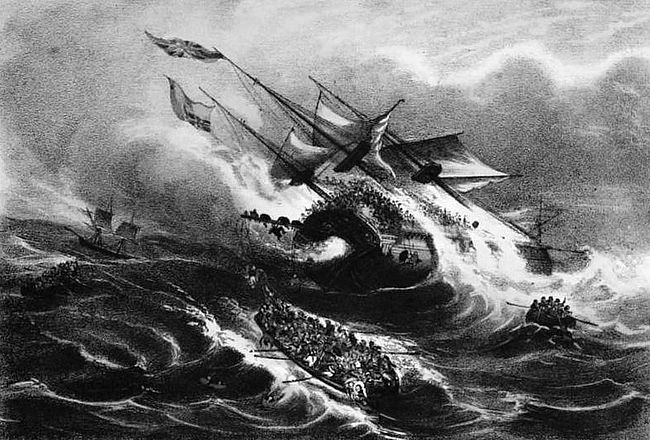
Madeley lith. 3 Wellington St Strand.
THE KENT EAST INDIAMAN.
ON FIRE DURING A STORM IN THE BAY OF BISCAY, HAVING THE HEAD QUARTERS AND 5 COMPANIES OF THE 31
ST
REG
T
ON BOARD, THE BRIG CAMBRIA, OPPORTUNELY APPEARS IN SIGHT, & 553 OUT OF A TOTAL OF 637 SOULS ARE RESCUED. 1
ST
MARCH, 1825.
For Cannon’s Military Records.
The voyage of the right wing of the regiment from England was interrupted very early in its progress by one of the most unhappy events that could befall a ship at sea. The Kent took fire on the 1st of March, in the Bay of Biscay, and was totally destroyed: the accident was first perceived about ten o’clock A.M., towards the end of a violent gale of wind, when the sea was disturbed, and the ship rolling heavily.
“It was a little before this period that one of the officers of the ship, with the well-meant intention of ascertaining that all was fast below, descended with two of the sailors into the hold, where they carried with them, for safety, a light in a patent lantern, and seeing that the lamp burned dimly, took the precaution to hand it up to the orlop deck to be trimmed. Having afterwards discovered one of the spirit casks to be adrift, he sent the sailors for some billets of wood to secure it, but the ship in their absence having made a heavy lurch, the officer unfortunately dropped the light, and letting go his hold of the cask, in his eagerness to recover the lantern, it suddenly stove, and the spirits communicating with the lamp, the whole place was instantly in a blaze.”[25]
When all hopes of saving the ship vanished, exertions were made to rescue the troops and the crew. Encouraged by the noble example of their officers, the soldiers preserved the utmost order and firmness in their perilous situation.
During the long and honorable services of the regiment, no opportunity had occurred to put its discipline and conduct to such a severe trial, but it brought from the ordeal a reputation even more distinguished than it had previously gained. In the field, when the spirits of men are excited by the animating circumstances of the contest, where honor is sure and death uncertain, valour and good order may be expected; but in the midst of dangers against which it appeared hopeless to struggle,—at a time when no aid appeared, and passively to die was all that remained,—the manly resignation, the ready obedience, and the unfailing discipline—characteristics of a good soldier—evinced by the THIRTY-FIRST, entitle the regiment to dwell at some length, in its Record, upon the events that called forth those admirable qualities. Although Lieut.-Colonel Fearon and Major M‘Gregor were most conspicuous, yet all who were on board deserve that their names should be recorded.
In the following statement is shown the number of officers and men of the THIRTY-FIRST embarked in the “Kent,” specifying also the number saved:—
Officers. Men. Women. Children. Total.
Embarked in the Kent 20 344 47 73 484
Saved by the Cambria 20 276 46 52 394
Saved by the Caroline — 14 — — 14
Total lost 54 1 21 76
Names of the Officers saved.
Lieut.-Colonel Robert Bryce Fearon.
Major Duncan M‘Gregor.
Captains.
Sir Charles Farrington, Bart. Edward Wm. Bray.
Robert Thomas Greene. James Spence.
Lieutenants.
Charles Shaw (Adjutant.) William Booth.
George Baldwin. Alexander Douglas.
D. B. T. Dodgin. Ronald Campbell.
—— Ruxton. Edmund Gennys.
Ensign Thomas Tait. Paymaster Richard Monk.
” Asaph Shaw. Quarter-Master John Waters.
” Henry Evans. Ass.-Surgeon Edward Graham.
The following letters will explain the providential means of escape afforded by the brig Cambria, and do justice to the humanity and gallantry of Captain Cook, who commanded it, as well as of his officers and crew. The name of this gallant officer must ever be held in great estimation by the THIRTY-FIRST regiment, to him, under Providence, it owes the power of being enabled to record the many high qualities shown by its members in the extremity from which he rescued them.
“Brig Cambria, Falmouth, March 4, 1825.
“Gentlemen,
“You are aware of my leaving this port on the 24th ultimo, with passengers and goods for Mexico, and I beg to acquaint you of my return here this morning at one o’clock, under the following circumstances:—
“On Tuesday last, the 1st instant, being then in latitude 47° 30′ and longitude 9° 45′, laying-to, with a strong gale from the westward, under a close-reefed main-topsail, we discovered a large sail to the westward, and on approaching found her to have a signal of distress flying, which induced me immediately to render every assistance in my power, and on nearing, found her to be on fire.
“About three P.M., being then on her bow, we succeeded in getting the first boat from the vessel, which proved to be the Hon. Company’s ship ‘Kent’ (Captain Cobb), of 1400 tons, for Bengal and China, with troops and passengers amounting, with the crew, to 637 souls. From three to eight P.M. the boats were constantly employed in bringing the people to the ‘Cambria,’ and succeeded in saving 296 officers, non-commissioned officers, and privates of the THIRTY-FIRST regiment, 46 women and 52 children appertaining to ditto, 19 male and female private passengers, and Captain Cobb and 139 of the crew, amounting in all to 553. The flames now becoming exceedingly fierce, I could not urge the sailors again to return to the ship, nor deem it at all prudent for the preservation of the lives already on board my vessel to remain longer near the ‘Kent,’ expecting her instantly to blow up. By accounts since made it is supposed that 68 soldiers, 1 woman and 21 children, and 4 of the crew were left when Captain Cobb quitted the vessel, whose conduct during the trying occasion is beyond my humble praise, displaying the greatest coolness and intrepidity, and by his exertions, and those of Colonel Fearon, the commander of the troops, who were the last to quit, the women, children, and passengers were got into the boats; and they did not leave themselves until their influence to induce any more to go into them was useless.
“At two A.M. the ‘Kent’ blew up, after being completely enveloped in flames for four hours previously. The fire originated in the after-hold, where the spirits were stowed for the use of the troops; a cask of which breaking adrift, and bursting, the contents were unfortunately ignited by a candle in a lantern. I feel the greatest gratification in stating that the gentlemen and their Cornish miners, in all 36, with my own crew, 11 more, behaved throughout the trying period with the greatest kindness in getting the people from the boats, soothing their sufferings, giving up their own clothes and beds to the women and children, volunteering to go into the boats (which I had good reason to prevent), and leaving nothing undone to make them as comfortable as the limited size of my brig would allow (only 200 tons). It would be pleasing also could I speak as highly of the crew of the ‘Kent,’ but I cannot refrain from expressing my disappointment of their conduct (in which I am borne out by Captain Cobb) derogatory in every respect to the generally received character of a British seaman,—by refusing to return to the ‘Kent’ for the people, after the first trip, and requiring my utmost exertions and determination to compel them to renew their endeavours to get out the soldiers, passengers, and the remainder of their own shipmates, who were left behind; and it was only by coercive measures, in conjunction with my own crew and passengers, and telling them I would not receive them on board unless they did so, that they proceeded, though reluctantly, in their duty. I must, however, except the officers, particularly Mr. Thomson, fourth mate, and Mr. Phillips, the boatswain, whose conduct and behaviour, in every respect, justify my warmest praise.
“It may not be amiss to state that, two hours after the ship blew up, a soldier’s wife was delivered of a fine boy on board the ‘Cambria,’ and both mother and child are doing well.
“I remain, Gentlemen, “Your most obedient servant, (Signed) “W. Cook.
“To Messrs. Wm. Broad and Sons, “Agents to Lloyd’s.”
“Falmouth, 4th March, 1825.
“Sir,
“It is with feelings of the deepest regret I have to report, for the information of His Royal Highness the Commander-in-Chief, the melancholy calamity which has befallen that portion of the THIRTY-FIRST regiment under my command, embarked on board the Honorable Company’s ship ‘Kent,’ for conveyance to Bengal, owing to her loss, she having taken fire towards the close of a heavy gale of wind on the 1st instant, about noon, in the Bay of Biscay. The moment it was discovered bursting from the after-hold of the vessel every possible effort was made to get it under, and by the immediate application of wet blankets, soldiers’ great-coats, and other woollen articles that could be obtained on the emergency, we had for a short period every reason to hope these efforts would have proved successful; but, unhappily, having communicated to the spirits, the hope of extinguishing it was soon dispelled, and all further exertion to save the vessel appeared evidently vain; the conflagration, owing to the state of the weather, gaining ground so rapidly. Under these circumstances it became the imperative duty of Captain Cobb and myself to endeavour to save the lives of as many of the people as possible, for which purpose the boats were hoisted out, and some rafts hastily constructed, and as many of the women and children put into the former as we could at the moment assemble. At this instant, by the Divine interposition of Providence, a sail hove in sight, which, discerning our perilous situation, came promptly down to our relief; and, owing to the persevering heroism of the commander, at the evident risk of losing his own vessel, and by the cool and intrepid conduct of Captain Cobb, whose attentions were unremitting, a larger portion of the troops than could even have been anticipated under so unforeseen a calamity were preserved, though, I lament to add, sixty-eight men, one woman, and twenty-one children appear to have perished, exclusive of five seamen.
“It is some alleviation to our afflictions to be enabled to state, that the origin of the fire is in no way attributable to the troops; a pleasing part of my duty to bear testimony to the cool and subordinate conduct of both officers and men under my command,—the former affording me every aid which so critical and trying an occasion demanded, and none more so than Major M‘Gregor, to whose collected counsel and manly example, throughout this agonizing scene of distress, I feel greatly indebted.
“I have, &c. (Signed) “R. B. Fearon, “Lieut.-Colonel comdg 31st Foot.
“To the Adjutant-General, “Horse-Guards, London.”
“Horse-Guards, 7th March, 1825.
“Sir,
“His Royal Highness the Commander-in-Chief has received, with sentiments of the deepest concern, your letter of the 4th instant, communicating the awful and afflicting calamity which has befallen the right wing of the THIRTY-FIRST regiment, embarked on board the Honorable Company’s ship ‘Kent.’
“I am at the same time to observe, that if anything could alleviate the measure of His Royal Highness’s regret at the loss of the many valuable lives which have perished on this melancholy occasion, it would be the satisfaction experienced by the Commander-in-Chief at the safety of so large a proportion of the detachment, and which, by the happy interposition of Divine Providence, aided by your own collected firmness, and the united discipline and courage of Major M‘Gregor and the officers and men under your command, have been preserved for the future service of their country.
“His Royal Highness commands me to add, that he appreciates in the fullest manner the heroic and humane assistance afforded to you by the master of the ‘Cambria’ brig; and that it will afford His Royal Highness the greatest satisfaction to bear testimony to it in any manner most calculated to advance the interests, or to do credit to the conduct, of this individual.
“Arrangements have been made by the Quarter-Master-General for the transport of the detachment under your command by sea to Chatham, as soon as it is possible to obtain the necessary vessels from the Navy Board for that purpose; and I have further to acquaint you, that immediate measures will be taken for sending down to you, by the quickest inland carriage, the most essential articles of supply and equipment; and that the Commander-in-Chief will contribute, by every means in his power, to the restoration of your comforts, and the remuneration for the losses sustained by your officers and men, consistently with the regulations of the service.
“I have the honor to be, &c. (Signed) “Henry Torrens, “Adjutant-General.
“Lieut.-Colonel Fearon, “Thirty-first Regiment, Falmouth.”
It was two hours after midnight when the ‘Kent’ blew up; all the individuals of the regiment and of the crew that it had been possible to save were now on board the “Cambria;” their number, however, was diminished by sixty-eight men, one woman, and twenty-one children:—about twenty of the former were left on the poop of the vessel, when it became unsafe for a vessel to approach her; whence, abandoning themselves to despair, they would make no exertion to escape; it was absolutely necessary therefore to leave them: others had thrown themselves into the sea, and were drowned before help could be extended to them, or had come in contact with part of the wreck and had been killed; while the anxiety of some few to board the “Cambria” lost them their lives;—they were jammed to death between the brig and the boats. The only woman lost was suffocated in the orlop deck, with her three children; she was not able to escape. Among the children lost there were four, three girls and a boy, the family of Serjeant Jack, an old and deserving soldier, who had seen much service with the second battalion in the Peninsula. While the women and children were being lowered into the boats, Mrs. Jack fell overboard; the serjeant leaped into the sea to save his wife, and was not able to return to the ship. In the confusion unavoidable on board, the children were overlooked; missing their parents, they had sought refuge, it is supposed, in the Colonel’s cabin, and no one knew, until it was too late, that they were still on board; for the soldiers were not backward in giving their aid to save the families of their comrades; there were instances of men who tied the children of their brother soldiers on their backs, and, leaping overboard, swam with their burdens to the boats. There were indeed proofs among the non-commissioned officers and soldiers of a fortitude, courage, and good-feeling that would have done honor to the highest station. It happened, however, that fourteen of the men, who had remained on the wreck, were picked up the following morning, clinging to some portions of it, by the “Caroline,” a vessel bound from the Mediterranean to Liverpool, and carried by her into that port. The lives lost amounted, therefore, to seventy-six, being two serjeants, two corporals, one drummer, forty-nine privates, one woman, and twenty-one children, as specified at page 82. The “Cambria” was of 200 tons only; notwithstanding her crowded state, she providentially reached Falmouth on the third day (the 4th March), when the regiment landed.
It is needless to observe that nothing was saved from the wreck, and many had found it difficult to preserve even the clothes they happened to have on at the time; the motley and forlorn appearance the corps presented on its landing, was never equalled,—at any rate, in the British army. The kind exertions of the gentry and residents generally in Falmouth, to soften the sufferings of the women and children, must ever be remembered with gratitude by the regiment; the officers are more particularly indebted to this calamity for the brotherly attention and friendship it procured for them from the officers who then belonged to the Division of Royal Marines at Chatham, where on the 26th of March it arrived, having sailed on the 16th of that month in the “Diadem” transport from Falmouth.
The following letter from the Military Secretary, Major-General Sir Herbert Taylor, conveying the sentiments of his Royal Highness the Duke of York of the conduct of the officers and men of the regiment, will show that the discipline received approbation from the quarter from which it was most valuable:—
“Horse-Guards, March 9, 1825.
“Sir,
“The Court of Directors of the East India Company having transmitted to the Commander-in-Chief the report made to them by Captain Cobb of the circumstances attending the destruction of the ship ‘Kent’ by fire, on the 1st instant, I have received his Royal Highness’s commands to assure you of the high sense his Royal Highness entertains of the admirable conduct of the detachment of the THIRTY-FIRST regiment embarked in that ship under your command, and, more particularly, of the steadiness and coolness which you evinced, under circumstances so critical and trying. His Royal Highness is well aware that no occasion could offer in which the effects of a well-established system of discipline and subordination would be more apparent, or in which they would in a more important degree tend to assist the efforts of those who so nobly afforded their aid towards preserving the lives of all concerned;—and he desires that you will convey his thanks to the officers and soldiers forming the detachment embarked, under your orders, in the ship ‘Kent,’ and assure them that he gives them due credit for their orderly and meritorious conduct. He considers his thanks to be due more especially to yourself, for the example which you set them, and for the persevering and gallant exertions which contributed so essentially to lessen the sad result of the catastrophe.
“His Royal Highness orders me to add, that he shall deem it his duty to report to his Majesty a conduct, on your part and that of the officers and men committed to your charge, which so well deserves his Majesty’s approbation.
“I have, &c. (Signed) “H. Taylor.
“Lieut.-Colonel Fearon, 31st Regt.”
His Majesty was graciously pleased to confer upon Lieut.-Colonel Fearon the distinction of a Companion of the Bath, for his conduct on the 1st of March.
On the 10th of April a detachment, from the head-quarters at Chatham, marched to Gravesend, and embarked on board the “Charles Grant,” under the command of Lieut.-Colonel Cassidy, who had, a short time before, been appointed to the regiment. After a good passage the “Charles Grant” reached Calcutta on the 16th of August, when the detachment was ordered to Berhampore; it joined the left wing in that cantonment on the 12th of September, when, immediately on its landing, orders were received to return to Fort William. On the 21st of the same month, the left wing, with the detachment,—all under the command of Lieut.-Colonel Cassidy,—were again embarked, and dropping down the river, in a few days reached Fort William, and disembarking, marched into barracks in the fort on the 27th of September.
On the 17th of November the head-quarters marched into Fort William, and the regiment was once more together. This portion had embarked on board the “Lord Hungerford” on the 21st of June, under the command of Major Eagar.
The cholera broke out among the men of the regiment towards the end of November, and not abating, the regiment moved into camp on the south glacis of the fort. The ground was occupied on the 20th of December, and the change was soon attended with advantage.
1826
On the 18th of January 1826, another detachment, consisting of the grenadier company, and part of No. 1, joined, and the strength of the regiment was 39 officers, 50 serjeants, 17 drummers, 48 corporals, and 812 privates.
On the 13th of February the regiment embarked on the river Hoogley, and left the ghaut below the fort for the Sunderbunds, on its route to Dinapore, the Bhagaritty river, by which branch of the Ganges it would have entered the main stream, being at this season of the year too shallow for boats of such a size as composed the fleet. The cholera unfortunately made its appearance during the voyage, and carried off a great number of men. The disease was so sudden in its attacks, and so quick in its effects, that the men scarcely survived till assistance could reach them from the hospital, which being always in the rear, the boat in which a sick man might be, was ordered to drop down to it,—it therefore became necessary to supply officers with a mixture to be given immediately to the person seized: the sick man thus received aid from the nearest boat to his own, and was saved until the more necessary treatment could be used upon him. It was the 2nd of May before the regiment reached Dinapore;—this cantonment is within a few miles of Patna, midway between it and the junction of the Soane with the Ganges; it is composed of two quadrangles, a larger and a smaller one, the southern side of the former being occupied by two long buildings, with a road dividing them in the centre; these formed the barracks, each for a wing of a regiment, the remaining sides of the square being the quarters of the officers;—the centre area is a smooth greensward, used as a parade-ground; the river flows on the north of the whole, and within a few yards of the quarters on that side.
At the end of the hot season of the year, the regiment was ordered to Meerut, and commenced its first march in India, before daylight on the morning of the 8th of November, under Lieut.-Colonel James Cassidy, who had succeeded to the command of the THIRTY-FIRST, Lieut.-Colonel Fearon having been appointed to the sixty-fourth regiment on the 12th of January, 1826. The sick with the women and children had been previously sent by water under Captain Bolton.
1827
The route of the regiment lay across the Soane, which it passed at Quilwur Ghaut, through the Shahabad district to Buxar, beneath the fort of which place it crossed the Ganges by ferry, and marched towards the military station of Ghazeepore, then occupied by the forty-fourth regiment. After passing this post, the regiment crossed the Goomtee by a bridge of boats, where it falls into the Ganges, near the village of Kitee; then to the cantonment of Seerole, near the city of Benares; again reached the banks of the Ganges, at the little village of Joosey, and recrossed it to Allahabad; thence the route lay through Kurrah, Futtehpore, and Korah to Etawah, a city on the Jumna. From Etawah through Shekohabad and Jellasir, in the province of Agra; passing the dilapidated fort of Shasnee, the road led through the city of Coel, to the celebrated fortress of Allyghur; thence by Khorjah Bolundshuhur and Haupper to Meerut, where the regiment arrived on the morning of Saturday, January 13th, 1827, after a march of sixty-seven days, during which time the men continued very healthy;—the number in hospital never exceeded thirty, many for trifling cases, and but two men died.
On the same day the THIRTY-FIRST occupied the lines vacated by the fourteenth regiment. Meerut was the head-quarters of a division of the Bengal Army, commanded by Major-General Reynell; and a considerable force was assembled, as a check upon Delhi, thirty-six miles from Meerut, as well as upon the province of Rohilcund, on the opposite shore of the Ganges.
The THIRTY-FIRST had been without colours since the destruction of the “Kent,” but a new stand, which, for want of an opportunity, had not yet been presented, was in possession of the regiment; and the Governor-General of India, the Right Honorable Lord Amherst, being at Delhi, in the course of a tour of the upper provinces, his Lady was solicited to present the new colours to the regiment. They were presented by her Ladyship on the 7th of March, 1827, and the Governor-General addressed the following speech to Lieut.-Colonel Cassidy on the occasion:—
“I am persuaded that Lady Amherst will consider herself fortunate in having been selected to bear so distinguished a part in the ceremony of this day. It will be her earnest prayer that so dire a calamity as that which befell your former colours may never occur to these which she has had the honor to present to you. From the ordinary perils of war they are safe in your hands, and she confidently trusts that Her Majesty’s THIRTY-FIRST will ever march to victory under the colours now consigned to your charge.”
To celebrate the event, the officers of the regiment entertained a large party at a ball and supper in their Mess-house.
1828
During the years 1828 and 1829 the regiment continued at Meerut.
1829
In 1829 orders were received to reduce the establishment of the regiment to 736 rank and file.
The THIRTY-FIRST regiment was at this time stronger than it had ever been; its effective strength amounted to 1086. The men were young and in high health; the climate good, and the barracks excellent, different from those at Dinapore; they consisted of a certain number of detached buildings, each calculated for a subdivision only: they were thatched, and had at the angles good rooms for non-commissioned officers. New buildings were erected of even a superior description, each company having four houses allotted to it, with its proportion of non-commissioned officers’ rooms at the angles, as in the old buildings.
1831
In the commencement of the year 1831 the north-west frontier of India was reinforced, and the THIRTY-FIRST marched to Kurnaul, the head-quarters of the Sirhind division. The regiment left Meerut on the 27th of January, and halted that day at Sardhanna, the capital of an independent state, under the celebrated Begum Sumroo. She had been its ruler for a period of sixty years; and, a Mahometan in her youth, she had adopted Christianity. The officers of the regiment dined with her Highness.
It is five days’ march from Meerut to Kurnaul. On the 30th of January the river Hinden was crossed by ferry, and on the following day the river Jumna, when the regiment encamped in its new quarters. The barracks had not then been built, Kurnaul never having been occupied by a British regiment. The Native cantonment was situated in front of the city, facing to the north.
The new lines marked out for the regiment were in front of the right of the old lines facing the west, in which quarter an extensive plain extends, without one tree to shade it, as far as the eye can reach; in the rear flows the canal of Merdan Ali Khan, a lively stream drawn from the Jumna at Rajghaut, fifty miles above, and running to Delhi, eighty miles below. On the right are long tracts of jungle, with a few villages and some cultivated land near the bank of the canal, a little to the rear. The barracks were detached buildings, two to each company.
General Sir Henry Warde, G.C.B., was appointed from the sixty-eighth regiment to the Colonelcy of the THIRTY-FIRST regiment on the 13th of April, 1831, in succession to General the Earl of Mulgrave, G.C.B., deceased.
It was the month of June before the barracks were ready to receive the men, until which time the regiment remained in camp. The officers’ houses in rear of the barracks were built at their own expense, it being the custom in the upper provinces of India to possess property of this description; the inconvenience and expense of establishing a cantonment are very severe at the time on many, particularly on the junior officers. It is only, however, when a cantonment is altogether abandoned that this custom can be attended with loss. Kurnaul was likely to be permanent from its position with regard to the Punjaub and the dominions of the Ameers of Scinde, besides the great importance acquired every year by the country beyond the Indus.
In October, 1831, the regiment marched to Roopur on the river Sutlej, as part of the escort attached to the Governor-General, Lord William Bentinck, who had arranged to have an interview at that place with his Highness Runjeet Singh, the Ruler of the Punjaub.
Having left Kurnaul on the 10th of October, the regiment reached the ground allotted for the escort on the 22nd of that month; the route lay through the Sikh territories, on the British side of the Sutlej. Thennaiser, a spot of celebrated sanctity, and Umballa, a populous city, were the only places of consequence, however, on the march. The escort assembled at Roopur, to do honor to the interview, was composed of two squadrons of the sixteenth Lancers, with the band of that regiment, the THIRTY-FIRST regiment, two battalions of native infantry (the 14th and 32nd), eight guns of horse artillery, with two squadrons of irregular cavalry from Colonel Skinner’s regiment.
The force Runjeet Singh had brought with him encamped, on the morning of the 25th of October, on the opposite bank of the river, and consisted of ten thousand of his best horse and six thousand disciplined infantry. A bridge of boats had been thrown across the river, and on the morning of the 26th of October the meeting took place; the Chief of the Punjaub, accompanied by a deputation of British officers that had gone to meet him, with a detachment of 3800 horse, 800 being disciplined dragoons, under General Allard, a French officer in Runjeet’s service, crossed the river. All the Sikh chiefs were in attendance on their Sovereign, and the train passed through a street to the Governor-General’s camp, formed by the sixteenth Lancers and the THIRTY-FIRST regiment. This is not the place in which to dwell on the splendour or chivalrous appearance of the scene, on the glitter of the polished armour of some, and the gaiety of the yellow silk in which all were dressed. The British troops were infinitely greater objects of interest and curiosity to the Sikhs, than even the variety of the arms, and the figures of the men of the latter, were to the former. Runjeet Singh inquired into every thing connected with the arming and disciplining of the THIRTY-FIRST with the keenest eye. During a review of the corps, on a second visit, he rode close into the line, and examined every movement, pointing out with great intelligence to the Sirdars, or leaders, about him the evolutions that he thought useful, or sending them to observe particularly how they were performed. The THIRTY-FIRST regiment was not under arms on the return visit. The farewell interview took place on the last day of the month, with the same ceremony as that observed at the first meeting.
The next morning (November 1st) the camps broke up; the THIRTY-FIRST regiment returned, by the route it had come, to Kurnaul, and arrived there on the 16th of November.
1832
In the spring of the year 1832, Lieut.-Colonel Cassidy returned to England in ill health, after having commanded the regiment seven years. He was succeeded by Major Eagar, who died in December following, when for nearly three years the command of the regiment devolved upon the two senior Captains alternately.
1834
On the 10th of October, 1834, Lieut.-General Sir Edward Barnes, G.C.B., was appointed from the seventy-eighth regiment to the Colonelcy of the THIRTY-FIRST regiment, in succession to General Sir Henry Warde, G.C.B., deceased.
1835
In December, 1834, Major Bolton joined the regiment, and was promoted, in November of the following year, to the rank of Lieut.-Colonel, by purchase, Colonel Cassidy having been removed to the charge of a recruiting district.
1836
On the 20th of January, 1836, the regiment left Kurnaul on its march to Dinapore, and, halting a day near Delhi, crossed the Jumna below the city; thence, continuing through the Doab (land between two rivers), to Allahabad, crossed the Ganges by a bridge of boats above the fort. Having halted at Benares and Ghazeepore, it recrossed the Ganges at Buxar, and arriving on the 26th of March at Dinapore, again took up its quarters in the barracks it had occupied ten years before;—although the weather was very hot, and the regiment had marched without a day’s halt from Cawnpore (thirty-one marches), there were only fifteen sick. From Kurnaul to Dinapore the change of climate is very great, while the confinement of the latter place, with the close and crowded state of the barracks, after the open scene, the comfortable thatched buildings, and the cold bracing winter air of the former station, were severely felt. In Kurnaul the hospital list never exceeded seventy, while it occasionally continued, during the hot weather, so low as thirty, and in the cold season eight or nine, for months together.
1837
During the summer of the year 1837, the thermometer remained at 115 degrees in the barracks for several days, and many deaths occurred from apoplexy, produced by the great heat.
1838
Lieut.-General Sir Colin Halkett, K.C.B. and G.C.H., was appointed from the seventy-first regiment to the Colonelcy of the THIRTY-FIRST regiment, on the 28th of March, 1838, in succession to General Sir Edward Barnes, G.C.B., deceased.
On the 16th of November the THIRTY-FIRST marched towards Ghazeepore, to relieve the forty-fourth regiment, and occupied the barracks at that station on the 27th of that month. Ghazeepore stands at the edge of a fine plain on the left bank of the Ganges, close to the river. It is one of the frontier posts towards Nepaul, is forty-six miles from Benares, and four hundred and six miles from Calcutta.
1839
The strength of the regiment had been reduced to six hundred and thirty-two rank and file; it had at this period been fourteen years in India, during which time the casualties by death amounted to fourteen officers, and six hundred and seventy-seven men.
During this year the regiment remained cantoned at Ghazeepore, under the command of Lieut.-Colonel Bolton; and was constantly on the alert in expectation to march towards Nepaul to repel the incursions of the Nepaulese.
On the 3rd of April, 1839, the regiment was augmented to an establishment of ten companies, consisting of one colonel, two lieut.-colonels, two majors, ten captains, thirty subalterns, six staff, fifty-seven serjeants, nineteen drummers, and nine hundred and seventy-six rank and file.
On the 13th of May, 1839, the regiment was inspected by Major-General Cocks, of the Honorable East India Company’s Service, who expressed, in high terms, his approbation of its appearance.
Ghazeepore was found very unhealthy during the rains, and the regiment suffered severely, both in officers and men, from fever and dysentery.
1840
The regiment remained at Ghazeepore until the 12th of October, 1840, when orders were received to march to Agra, to relieve the ninth foot. It arrived at Agra on the 30th of November, and its effectives amounted to forty-one serjeants, and seven hundred rank and file.
At Agra the regiment was more healthy than at the two former stations, and its strength was increased during the year by a large detachment of recruits from England.
1841
In March, 1841, a large party of recruits joined the regiment under the command of Major Skinner, through whose able management they arrived in the highest possible order.
Owing to the indefatigable exertions of Lieut.-Colonel Bolton, the commanding officer, little time elapsed before the regiment formed a highly disciplined and most efficient battalion of 992 bayonets.
At this period the government of Shah Shoojah became so unpopular, that the Affghans appeared determined to effect the expulsion of the British, by whose aid he had been reinstated in the sovereignty of Cabool in 1839, and whose presence was rendered necessary to support his authority.
Towards the close of the year 1841, the Affghans broke out into open insurrection; the British Envoy, Sir William McNaghten, and Sir Alexander Burnes were treacherously murdered; and the British troops, including the forty-fourth regiment, which occupied Cabool, being compelled to evacuate and retreat towards Jellalabad, were cut to pieces on the march.
Jellalabad was soon beleaguered by the Affghans, and every exertion was made to send succour from India to its little garrison, commanded by Lieut.-Colonel Sir Robert Sale, of the thirteenth light infantry, who was serving with the rank of Major-General in Affghanistan. Upon the breaking out of the insurrection, the Major-General had been detached from Cabool with a force, in order to reduce the insurgents, and, after much hard fighting in the passes, had taken possession of Jellalabad, the successful defence of which, by his small garrison, forms so interesting a feature in the Affghan campaign.
1842
The regiment was ordered to join a force collected at Peshawur, in the north of the Punjaub, under Major-General Pollock; and on the 15th of January, 1842, it marched from Agra, mustering 996 bayonets, in the highest state of discipline and efficiency.
On the 10th of March the Sutlej was crossed by means of a bridge of boats (which had been constructed for the accommodation of the British troops by the Sikh government) by the force under the command of Lieut.-Colonel Bolton, of the THIRTY-FIRST regiment. The force, which consisted of the THIRTY-FIRST regiment, the sixth native infantry, some troops of Tait’s irregular horse, and Delafosse’s troop of horse artillery, arrived at Peshawur on the 21st of April, and was most hospitably entertained by General Avitabile,[26] by order of the Maharajah Shere Singh.
Before the corps could join the army, Major-General Pollock forced the Khyber Pass, and marched on to Jellalabad, at which place he arrived on the 16th of April; the Affghans had, on the 7th of April, been attacked, and defeated, by Major-General Sir Robert Sale; Mahomed Akbar Khan was consequently obliged to abandon the siege of Jellalabad, which he had blockaded since February, 1842.
The THIRTY-FIRST regiment, which had followed Major-General Pollock by forced marches, joined at Jellalabad on the 5th of May,—after making a halt for about five days at Peshawur,—having undergone much privation on the way by the desertion of the camel-drivers: several deaths occurred from famine and fatigue.
The army was halted in wretched tents at Jellalabad, the climate of which is known to be so unhealthy during the summer as to cause it to be used by the natives as a winter residence only. Soon the effects of this displayed itself; the days became so oppressive that both officers and men were obliged to dig deep holes underground in which to shield themselves, in some slight measure, from the burning heat of the sun. The thermometer rose as high as 126° in the tents, and man and beast fell stricken by the extreme heat.
Neither was it in men alone that the army was daily losing its efficiency. From the valley of Jellalabad having been so long the seat of war, the fertile land had become a desert,—the wretched half-starved camels could find no forage on the bare face of the sand, and they died by hundreds; their dead bodies lying about in all directions, swollen with the sun, and emitting the most horrid exhalations, together with the filth and dirt of a standing camp of 50,000 men, added to the disease which raged among the troops. The army suffered a loss which the most sanguinary encounter with the enemy could not have exceeded.
At last, it was found necessary to divide the force, and the fourth brigade, in which was the THIRTY-FIRST regiment, was ordered to march under Brigadier Monteath to Peshbolak, in the Shinwaree country, to punish some refractory tribes, which had behaved with great treachery to a party of Jezailchees, who had been at the former place, and to bring to submission the unruly Shinwarees, who had attacked several convoys, and been guilty of many acts of murder and plunder.
For the first month the regiment met with little opposition, and the camel-thorn, a wild bush, on the leaves of which camels feed, being found in great quantities, and large supplies of grain being taken, the condition of the camels, horses, and other baggage animals was much improved; the half-starved emaciated animals, which had marched from Jellalabad, quickly recovered their wonted vigour and efficiency. The warlike and turbulent Shinwaree tribes retired before Brigadier Monteath’s brigade, until they sheltered themselves in their strongholds, which were formed in a narrow valley, strengthened by many forts and stockaded enclosures, while the heights on either side were defended by numerous sunghas, or breastworks of large stones, which were so constructed as to enable them to dispute every inch of ground with an advancing force.
The brigade having arrived, and encamped about two miles from this formidable position, a reconnoitring party was sent out, under the command of Captain Willes, of the THIRTY-FIRST regiment, to examine the strength of the enemy’s preparations, and determine his exact position. It was composed of two companies of the thirty-third Native Infantry, with a few Jezailchees, or Native Light Infantry, so named from the Jezail, or short rifle, with which they are armed. This party, having proceeded some four or five miles from the camp, was furiously attacked by a large force of Shinwarees, and suffered severely from their fire, which was very effective from the position they had taken up, and from which it required a very considerable force to drive them: nevertheless the object sought was fully obtained; the enemy’s position was correctly ascertained, together with every requisite information for the attack in force, after which the reconnoitring party returned to the camp, sustaining a smart action the whole way back.
On the 26th of July Brigadier Monteath prepared to attack the enemy near Mazeena with his whole force; and accordingly, leaving the camp standing under an efficient guard, he moved towards the position occupied by the Affghans, who were prepared, and nothing loth to meet him. Little time elapsed before the engagement was commenced by the THIRTY-FIRST regiment, seconded by the thirty-third and fifty-third Native Infantry, ascending the heights, and driving the Shinwarees from their breastworks, and along the ridges of the hills, while the tenth Light Cavalry, in the valley below, charged them whenever they showed front on level ground. The camp followers and pioneers had been furnished with combustibles to burn the forts, as the Shinwarees were driven out of them, which service was very efficiently performed. Meanwhile, on the heights, the enemy disputed every foot of ground until taken at the point of the bayonet, and Lieut. M‘Ilween, of the THIRTY-FIRST regiment, was killed while gallantly leading an attack of this kind against a vastly superior force.
The Affghans being driven from their defences, the artillery, under the command of Captain Abbott, played upon them with great effect; and after contesting the day until every fort and place of defence had been taken and destroyed, they fled, dispersing themselves among the neighbouring hills, where it was impossible to pursue them. Their loss was very great, including most of their leaders.
The THIRTY-FIRST regiment had Lieut. Dalway M‘Ilveen killed, and seven rank and file wounded; several men of the regiment died suddenly from apoplexy, caused by the heat of the sun and want of water. Thus ended the action of Mazeena, in which the behaviour of the THIRTY-FIRST regiment elicited the highest commendation from Brigadier Monteath, who stated, in his despatch of the 27th of July, that
“at one time the interiors of five-and-thirty forts were in a blaze along the valley, the enemy contemplating the scene from the heights in the vicinity of Secunder Khan’s fort, where they had taken up positions, and from whence they were driven in gallant style by the advance, consisting of the light and two battalion companies of Her Majesty’s THIRTY-FIRST regiment, the light companies of the thirty-third and fifty-third regiments of Native Infantry, and the corps of Jezailchees under Major Skinner, of Her Majesty’s THIRTY-FIRST regiment.
“It gives me great pleasure to record the zealous conduct of the troops generally, and the cheerful and praiseworthy manner in which the soldiers of Her Majesty’s THIRTY-FIRST regiment laboured to drag the guns up such places as the horses, notwithstanding their unequalled qualities, were incapable of doing.
“My thanks are very justly due to Lieut.-Colonel Bolton, of Her Majesty’s THIRTY-FIRST regiment, for the able manner in which he conducted the duties of covering the retirement of the force; and particularly so to Major Skinner for the zealous and gallant manner in which he led the advance against the enemy.”
The Brigadier also acknowledged the services of other officers belonging to the force under his command, in which number was included Lieutenant and Adjutant Lugard, of the THIRTY-FIRST regiment, who acted as Major of Brigade.
The brigade of Brigadier-General Monteath, having thus performed most successfully the service for which it had been detached, now marched to join the main army at Jellalabad, and arriving there took up its old ground. On the 22nd of August the army marched in two divisions, and proceeded without opposition, but suffering intense fatigue from the labour of dragging the artillery and stores over the almost inaccessible paths, until it arrived at Soorkhab, distant four marches from Jellalabad.
On the British leaving Soorkhab, the Affghans showed themselves in force, and the rear-guard, under the command of Lieut.-Colonel Bolton, was so hard-pressed by thousands of the irregular troops of the enemy, that Brigadier Monteath thought it necessary to halt the brigade at the entrance of the Jugdulluck pass, to enable it to form a junction with the main column, which it did after suffering considerable loss. The Ghilzees hotly contested the passage of the pass, but after a sharp engagement they were driven off with much slaughter.
In this action Lieut.-Colonel Bolton had his horse shot under him in two places, and Lieutenant Shaw, of the regiment, was wounded.
The next day (9th September) the Affghans were so much dispirited by their defeat, that the division marched to Jugdulluck without further opposition than a little skirmishing with the rear-guard, and Lieutenant Brooke, of the THIRTY-FIRST regiment, was wounded.
On the 10th of September, it having been ascertained that Akbar Khan with 20,000 men had established himself in the Khoord Cabool pass, in order to cover the capital and fight a pitched battle with the British, the second division was ordered to join the first by a forced march to Tezeen, where Major-General Pollock was encamped. This junction was effected on the 11th of September, with little loss, although a running fight was kept up the greater part of the way. In fact, the advance to Cabool was a succession of skirmishes, oftentimes by night as well as by day.
The camp was attacked on the night of the 12th of September, but the enemy made no impression, and little loss occurred, although all the piquets of the THIRTY-FIRST regiment were engaged until daybreak.
Shortly after daybreak on the 13th of September the army moved off its ground towards the Tezeen Pass, the advanced guard, commanded by Sir Robert Sale, being composed of three companies of the ninth regiment, three companies of the thirteenth or Prince Albert’s Light Infantry, together with two companies of the THIRTY-FIRST regiment, under Captain Baldwin and Lieutenant Greenwood.
After moving carefully along the pass for about two miles, the Affghans were discovered, in great force, occupying strong positions on the heights on either side, while their artillery and cavalry were formed some distance farther on in the pass itself. The action commenced by a heavy fire from the enemy on the advanced guard of the British; and the distance being too great for musketry, from the effect of which also the Affghans were covered by extensive sunghas, or intrenchments formed of large blocks of stone, for the whole length of their position, it was judged necessary for the troops to ascend the heights, and drive them from their posts at the point of the bayonet.
This service was most brilliantly performed on the left heights by the ninth and THIRTY-FIRST regiments, and on the right by the thirteenth light infantry.
The companies ascended the face of the mountain under a most galling fire, from the effects of which many casualties occurred, and not returning a shot until the ledge was gained: a combined volley within ten yards of the enemy, followed by an immediate charge of bayonets, drove him from his defences with great slaughter, and the heights were gained. For this service Captain Baldwin received the brevet rank of Major.
The Affghans’ advanced posts being driven in and pursued as far as the broken and difficult nature of the country would admit, they retired upon their supports, which were, with great judgment, defended by endless sunghas, erected in every position from which a fire could be brought on advancing troops.
The British, having gained the heights, and being reinforced by fresh troops, pushed on, and, storming one intrenchment after another, threw the Affghans into great confusion. The artillery, having been brought up, played upon them with terrific effect, while the British cavalry, having charged and overthrown their horse, posted in the pass, and taken their guns, together with the state tent of Akbar Khan, the fortune of the day at this early period evidently smiled on the British arms; but the warlike mountaineers, who composed the Affghan army, fought with desperate valour to retrieve the day. Attack after attack was made upon the troops occupying the posts from which the enemy had first been driven. Reckless of life, the stern fanatics came on to be shot down from the defences which they had themselves thrown up. In a series of desultory attacks the day declined, and the British, having obtained possession of every height commanding the pass, the remains of the Affghan army made a détour among the hills, falling with great fury upon the British rear-guard, commanded by Colonel Richmond, of the thirty-third regiment of Native Infantry. Here they were so warmly received that their discomfiture was completed, and the day was won. The victorious British encamped for the night in the valley of Khoord (Little) Cabool, a village distant about sixteen miles from Cabool.
In this action Lieutenant Pollard received a severe contusion from a large block of stone while attempting to take a standard. Major Skinner, of the THIRTY-FIRST regiment, highly distinguished himself with the force which was detached under his command, and which proceeded, in the afternoon of the 12th of September, across the hills towards the valley of Khoord Cabool by a route different from that of the main army. On the march, Major Skinner came suddenly in presence of a greatly superior number of Affghans. Notwithstanding that the country was difficult and imperfectly known, by a series of skilful manœuvres he extricated his troops from the perilous situation in which they were placed, and defeated the Affghans, who exceeded five times his force, with great slaughter, on the 13th of September.
So complete was the defeat of the Affghan army on the 13th of September, that Akbar Khan escaped from the field accompanied only by a solitary horseman.
The enemy acknowledged to have lost fifty-three chiefs and persons of consequence, and 700 men. The casualties on the part of the British amounted to 185.
Major-General Pollock, in his despatch dated 14th of September, again acknowledged the services of Lieut.-Colonel Bolton and Major Skinner, of the THIRTY-FIRST regiment.
No impediments now existed to the advance of the British on the city of Cabool. On the 15th of September the army arrived at Cabool, and encamped on the race-course. On the following day the place was occupied and the standard of England hoisted on the highest pinnacle of the battlements of the Bala Hissar (Upper Fort), on which occasion the flank companies of the THIRTY-FIRST formed part of the guard which garrisoned the citadel. The British colours were hoisted daily as long as the army remained at Cabool.
All the objects of the campaign having been gained, and the rescue of the prisoners effected,—among whom were several officers and ladies (Lady Sale, the partner of the gallant defender of Jellalabad being among the number), also three serjeants, three drummers, and thirty rank and file of Her Majesty’s forty-fourth regiment,—the Anglo-Indian army commenced its march towards Hindoostan on the 12th of October, after having destroyed the grand bazaar of Cabool, named the Chahar Chuttah, where the remains of the British Envoy had been exposed to public insult by the infuriated Affghans.
The THIRTY-FIRST regiment was again constantly engaged in desultory skirmishes with the Ghilzees and Afreedee tribes which infested the passes.
At the Jugdulluck Pass the Affghans again made head, and a severe action occurred on the 18th of October, in which the THIRTY-FIRST regiment sustained some loss, but the Ghilzees were put to flight with great slaughter. Lieutenant Thomas Pender, of the THIRTY-FIRST regiment, received a severe wound near Seh Baba, from the effects of which he died on the 18th of November.
Major-General McCaskill, in his despatch dated 20th of October, 1842, recording the attacks on his division by the predatory tribes of the mountains between Tezeen and Gundamuck, stated that,
“Throughout these affairs the conduct of the troops employed, including the second and sixteenth Native infantry, temporarily attached to me, has deserved my highest approbation, and I feel it to be my duty to record, that in the advance to Cabool, and in retiring from it, the bravery of that portion of the fourth brigade which took part in the active operations, namely, Her Majesty’s THIRTY-FIRST regiment, and a wing of the thirty-third Native infantry,—the remaining wing and the sixth Native infantry having been detained to garrison Jellalabad and Gundamuck,—as well as their endurance of privations and fatigue, have been beyond all praise. No troops could, in every respect, have behaved better; and I feel myself to be deeply indebted to Brigadier Monteath, C.B., and to Lieut.-Colonel Bolton, of Her Majesty’s THIRTY-FIRST, and to Lieut.-Colonel Richmond, of the thirty-third Native infantry, for the able and gallant manner in which they have been led.”
The THIRTY-FIRST regiment arrived at Jellalabad on the 23rd of October, and, after destroying the fortifications, proceeded thence on the 27th to Peshawur, where it arrived in the beginning of November.
The campaign having now been brought to a close, the THIRTY-FIRST reached Ferozepore on the 19th of December, having been in the field for eleven months during this arduous campaign.
On arrival at Ferozepore the THIRTY-FIRST regiment joined the “Army of Reserve,” which had been assembled on the frontier, and where the Governor-General, Lord Ellenborough, and General Sir Jasper Nicolls, the commander-in-chief in India, had proceeded to receive the army of Affghanistan.
For his services connected with the command of the THIRTY-FIRST regiment, Lieut.-Colonel Bolton was made a Companion of the Bath, and appointed aide-de-camp to the Queen, with the rank of colonel.
In testimony of the services of the THIRTY-FIRST during the campaign in Affghanistan, Her Majesty was graciously pleased to authorize the regiment to bear the word “Cabool, 1842,” on the regimental colour and appointments.
1843
On the breaking up of the army at Ferozepore, the THIRTY-FIRST, commanded by Colonel Bolton, was ordered to Umballa, a place about 170 miles to the south, and which had never been previously occupied by troops. Here the regiment arrived on the 27th of January, 1843, and, cantonments having been marked out, barracks were commenced for the men, and ground allotted for the erection of bungalows for the officers.
On the 5th of May the THIRTY-FIRST sustained a severe loss by the death of Major and Brevet Lieut.-Colonel Skinner, a zealous and talented officer, whose services are frequently alluded to in the historical record of the regiment.[27]
In May, 1843, the regiment was ordered to Khytul, and formed part of a force under Major-General Fast, which was sent to reduce the city and state of Khytul to British subjection. The force arrived at Khytul after about a week’s march, and the enemy, after a slight show of resistance, evacuated the city, which was occupied by the British troops. All the objects of the expedition having been fulfilled, the regiment returned to its cantonments at Umballa. All, however, remained under canvas, exposed to most intense heat, until July, 1843, when the men were housed, and a few of the officers got shelter. In October, 1843, an outbreak occurred at Lahore, and the Maharajah, Shere Singh, was shot at a review by his brother-in-law, Ajeet Singh; after this event the youthful Dhuleep Singh, a reputed son of the late Runjeet Singh, was placed on the throne.
The THIRTY-FIRST regiment was in consequence ordered to the frontier, and marched for Ferozepore on the 16th of November, where it arrived on the 1st of December, 1843, and remained as a corps of observation.
1844
The THIRTY-FIRST, commanded by Colonel Bolton, C.B., continued at Ferozepore, where the regiment was joined by ninety-three recruits from England. On the 16th of January, 1844, the regiment was inspected, and elicited great praise from Major-General Hunter of the Company’s Service, and again on the 16th of February, by Major-General Sir Robert Dick, K.C.B., who expressed great praise as well of the soldierlike and gallant bearing as of the high state of discipline of the regiment.
The weather becoming extremely hot, the regiment marched from Ferozepore on the 19th of April, 1844, en route to Umballa, where it arrived on the 2nd of May.
On the 30th of December, 1844, his Excellency General Sir Hugh Gough, Bart., Commander-in-Chief in India, inspected the THIRTY-FIRST, in review order, on which occasion he expressed himself highly satisfied with the soldierlike appearance of the regiment.
1845
On the 12th of March, 1845, a detachment of recruits and volunteers, consisting of one major, one captain, three lieutenants, two ensigns, one assistant-surgeon, with four hundred and seventy-one rank and file, joined the regiment from the lower provinces, under the command of Major Spence.
Many men continued to die from the effects of the Cabool campaign, but the station in itself proved healthy until July, when it was visited by cholera in a most fearful manner. On the 26th of July the regiment was ordered into camp, about two miles from the barracks, at a few hours’ notice, with orders for one officer per company, as well as the medical officers, constantly to remain in camp under Major Spence, where they continued until the 5th of August. In one month the regiment lost by cholera eighty-nine men, women, and children.
After the death of Maha Shere Singh, the Punjaub was in a state of anarchy; the juvenile sovereign, Dhuleep Singh, under the tutelage of his mother and uncle, was unable to control the turbulent Sikh chieftains, and open hostility soon manifested itself against the British Government in India.
In the beginning of December, 1845, the inclination of the Sikh Sirdars to invade the British territories appeared to increase, and about the 11th of that month, with a large army and a well-appointed artillery, they actually crossed the Sutlej, the boundary river which separates the Punjaub from the British dominions.[28]
The Commander-in-Chief in India, General Sir Hugh Gough, sent immediate orders for the Umballa division of the army, which had lately been considerably increased in strength, to be pushed on towards the invaded frontier.
Previous to its march, this force had been formed into divisions and brigades. The first brigade of the first division was composed of the THIRTY-FIRST regiment, and two regiments of Native infantry, viz., the twenty-fourth and forty-seventh regiments. The first division was commanded by Major-General Sir Henry Smith; Colonel Bolton, C.B., of the THIRTY-FIRST regiment, was appointed Brigadier to command the first brigade. Lieut.-Colonel Byrne, the next senior officer, assumed the command of the regiment. Captain Garvock was appointed Brigade-Major to the first brigade, and Captain Lugard, Assistant-Adjutant-General to the first division.
It being of the utmost importance to aid the division of the army in the defence of Ferozepore, a fort on the left bank of the Sutlej, where the British Government had large magazines containing munitions of war, a park of artillery, military stores, and equipments for the field army, which protected the frontier, it was necessary to push on the Umballa division, with all possible speed, by rapid and forced marches, towards the point near which the Sikhs, after having crossed the Sutlej, were assembled in large force, emboldened by numbers, and their army composed of well-disciplined troops, with a numerous and well-appointed artillery. This army had been instructed and trained in European tactics and discipline by French and Italian officers; it was confident in its own strength and in the powerful aid of its formidable artillery.
It was evidently the object of the enemy to prevent the junction of the Umballa division with the Ferozepore field force, to cut off the latter division, and to capture the fort and magazines of Ferozepore, before the Umballa division could arrive at the scene of action. The enemy hoped also to have a rich booty in the plunder of the large town of Ferozepore. The Sikhs knew and calculated the distance the Umballa troops had to march before they could reach the vicinity of Ferozepore, one hundred and fifty miles, and the nature of the country through which they had to march; but they did not calculate on the energy, patient endurance of hardships, and privation, which the British soldier would cheerfully undergo, when he knew, that his brave and heroic Commander-in-Chief was leading him in person against the foe, who had dared to invade the British possessions.
On the 10th of December the THIRTY-FIRST received the order to march, and the morning of the 12th saw the regiment leave Umballa, mustering 30 officers and 844 men.
After long and harassing marches of twenty-five to thirty miles a day, the severe nature of which it is impossible to describe, the regiment arrived at the village of Moodkee about two o’clock in the afternoon of the 18th of December, having on that day performed a march of not less than twenty-five miles: some idea may be formed of the sufferings which the men endured from fatigue on this eventful day, when it is known that at the last halt, about two miles from Moodkee, scarcely fifty men were left with the colours; and for miles to the rear they might be seen staggering forward through the soft sand in an exhausted state from want of water and rest.
The soldiers were in the act of pitching their tents, and had eaten nothing, when the alarm was given that the enemy was close upon them in force. The THIRTY-FIRST rushed to arms, and forming the right of the first brigade of the first division, under Major-General Sir Henry Smith, formed in quarter-distance column, left in front, advanced two or three miles, deployed on the grenadier company, and so continued the line formed by the regiments on their right.
The THIRTY-FIRST were now on ploughed land in front of a thick jungle of thorny bushes, and moving forward under a heavy fire of round and grape-shot, entered the jungle, through which it was impossible to move in anything like a correct line, and beyond which the Sikhs were formed. It was here that the gallant Colonel Bolton received his death-wound;—his last emphatic words to the men were, “Steady, THIRTY-FIRST, and fire low,”—when man and horse came down together; but he did not allow himself to be removed from the field until the action was over. The regiment now found itself in front of a battery of fourteen or fifteen guns. By this time the men were falling quickly under severe discharges of grape from the guns, a few yards only distant, which were also protected by a battalion of infantry, from which withering volleys were sent into the ranks of the THIRTY-FIRST, who, however, returned it with interest, and the intrepid valour of the men bore down all opposition. One continued fire from the regiment laid low nearly the whole of the enemy’s artillery-men opposed to its part of the line, while the bayonet disposed of such of the remainder of the foe as had not time to save themselves by flight. The opposition of the Sikhs was desperate; but nothing could resist the bravery of the British troops, who drove them from one position after another with great slaughter: all their advanced guns remained in the hands of the British.
It was not till an hour and a half after sunset that this hand to hand conflict was over, when the rolling of musketry gradually died away, and the British found themselves undisputed masters of the field. Soon after the commencement of the action, Lieut.-Colonel Byrne being severely wounded, the command of the regiment devolved upon Major Spence, the senior major.
The regiment, being much broken and scattered over the field in pursuit of the enemy, was re-formed in quarter-distance column, and marched back to within about a mile of Moodkee, where it bivouacked on the sand until daylight, and then returned to camp.
In this short but hard-fought action the regiment suffered severely. Of 30 officers and 814 men, who went into action, 9 officers and 155 rank and file were killed or wounded.
The following officers were killed or wounded in the action at Moodkee:—
Colonel Bolton C.B., commanding first brigade } Mortally wounded.
Lieut.-Colonel Byrne Severely ”
Captain Willes Mortally ”
” Bulkeley Dangerously ”
” Young Dangerously ”
” Lugard Slightly ”
Lieut. Pollard Slightly ”
” H. W. Hart Killed.
” Brenchley Mortally ”
[29] Assistant-Surgeon Gahan, 9th foot, doing duty } Mortally ”
In this action Lieutenant Bolton, of the twenty-first Fusiliers, acted as aide-de-camp to his father Brigadier Bolton.
The army was commanded in the action by General Sir Hugh Gough, the Commander-in-Chief, aided by the counsel and military experience of the Governor-General, Sir Henry Hardinge. The following extract is taken from the despatch of the Commander-in-Chief, dated 19th of December, 1845:—
“The opposition of the enemy was such as might have been expected from troops who had everything at stake, and who had long vaunted of being irresistible. Their ample and extended line, from their great superiority of numbers, far out-flanked ours; but this was counteracted by the flank movements of our cavalry. The attack of the infantry now commenced; and the roll of fire from this powerful arm soon convinced the Sikh army that they had met with a foe they little expected; and their whole force was driven from position after position with great slaughter, and the loss of seventeen pieces of artillery, some of them of heavy calibre; our infantry using that never-failing weapon, the bayonet, whenever the enemy stood. Night only saved them from worse disaster, for this stout conflict was maintained during an hour and a half of dim starlight, amidst a cloud of dust from the sandy plain, which yet more obscured every object.
“I regret to say, this gallant and successful attack was attended with considerable loss. The force bivouacked upon the field for some hours, and only returned to its encampment after ascertaining that it had no enemy before it, and that night prevented the possibility of a regular advance in pursuit. * * *
“I have every reason to be proud of, and gratified with, the exertions of the whole of the officers and troops of this army on this arduous occasion.”
It appears from the list of killed and wounded, that the first or Major-General Sir Henry Smith’s division bore the brunt of the action at Moodkee, as the casualties in that division out-numbered those of the other two infantry divisions united, as will be seen by the following published list:—
First Division of Infantry.
Officers. Native Officers. Serjeants. Rank & File.
Killed 4 1 4 69
Wounded 18 2 20 299
— — — —–
Total 22 3 24 368
Second Division of Infantry.
Killed .. 1 .. 17
Wounded 4 5 10 81
— — — —
Total 4 6 10 98
Third Division of Infantry.
Killed 1 .. 1 6
Wounded 1 .. 4 73
— — — —
Total 2 .. 5 79
The army of the Sikhs amounted, it is said, to upwards of 32,000 men of all arms. The British force did not amount to more than one-third of that number.
Thus terminated the battle of Moodkee, the first action in which the Sikhs measured their strength with British troops in the field.
The following extracts are taken from an account of the battle of Moodkee:—
“Between the 11th and 18th the army had marched over a distance of 160 miles, along roads of heavy sand; the incessant toil scarcely leaving them leisure to cook their food. Hardly an hour of repose was allowed them when they were summoned to renewed exertion. On the 18th the army took up their encamping ground in front of Moodkee. Our troops had scarcely time to prepare their food, when intelligence was brought that the enemy, 30,000 strong, was close at hand. It was about three o’clock P.M.; the men were tired with incessant work, suffering from scarcity of water, and exhausted for want of nourishment and rest. The instant the order was given, however, they turned out with the utmost alacrity, as if fresh from their lines.”
After describing the preliminary movements of the cavalry and artillery, the narrator proceeds:—
“The afternoon was by this time far spent, and the evening at hand. The infantry, under Generals Smith, Gilbert, and McCaskill, pushed on in echellon right for the enemy’s line, now nearly invisible from the wood and approaching darkness. We were out-flanked and fearfully out-numbered. The struggle was tremendous. The Sikhs fought with the fury of desperate men. Nothing could resist the dauntless courage of our troops, and fearful was the storm of musketry poured forth by them as they rushed. The bayonet,—the never-failing resource of British soldiers,—completed the confusion and havoc the musketry had begun. Every position was forced; the enemy driven from the ground they had so well selected, and for a time so obstinately maintained; and night found eighteen pieces of artillery in our possession. Darkness only saved them from extreme disaster; and so fierce and unrelenting had been the fray, that it was maintained through an hour of dim starlight, while the dust of the sandy plain added to the obscurity of the advancing night. Pursuit was impossible, and the troops bivouacked on the field.”
The following officers were present with the regiment at the battle of Moodkee on the 18th of December:—
Colonel S. Bolton, C.B. (Commanding Lieut. W. F. Atty.
the first brigade). ” J. L. R. Pollard.
Lt.-Col. John Byrne (commanding the ” H. W. Hart.
regiment). ” Robert Law.
Major James Spence. ” J. P. Robertson.
” G. Baldwin. ” Graham Elmslie.
Capt. W. G. Willes. ” Poole Gabbett.
” T. Bulkeley. ” S. J. Timbrell.
” G. D. Young. ” John Brenchley.
” G. F. White (Acting ” A. Pilkington.
Paymaster). ” E. A. Noel.
” J. Garvock. Ensign James Paul.
” D. F. Longworth. ” H. P. Hutton.
” E. Lugard. ” C. H. G. Tritton.
Lieut. T. H. Plasket. Adjt. William Bernard.
Q. M. Samuel Benison. Lieut. A. S. Bolton (H. M. 21st
A. Surg. G. W. Macready. Fusiliers, doing duty).
” David Stewart. Surg. R. B. Gahan (H. M. 9th Foot,
in medical charge).
It being expected that the Sikhs, notwithstanding their defeat on the previous evening, would make a second attack, the troops were ordered under arms early on the following morning, the 19th, and remained so till evening, when, no enemy appearing, they returned to their tents.