THE HUNTINGDONSHIRE REGIMENT OF FOOT.
Reading edition
CONTENTS OF THE HISTORICAL RECORD.
Year Page
1701 Introduction 1
1702 Decease of King William III., and accession of Her Majesty Queen Anne 2
—— Certain Regiments of Marines raised —
—— Formation of the Thirty-first as a Regiment of Marines —
—— Colonel George Villiers appointed Colonel of the Regiment —
—— Names of the Officers 3
—— War of the Spanish Succession —
—— The Earl of Marlborough appointed to the command of the troops in Flanders —
—— Expedition to the coast of Spain under the Duke of Ormond 4
—— The Thirty-first and other regiments embarked for Cadiz —
—— Capture of the combined French and Spanish fleets at Vigo 5
—— The troops under the Duke of Ormond returned to England 6
1703 The Thirty-first Regiment stationed at Plymouth 7
—— Decease of Colonel Villiers —
—— Lieut.-Colonel Alexander Lutterell appointed Colonel of the Regiment —
1704 Services of the Thirty-first Regiment on board the fleet under Admiral Sir George Rooke —
—— Unsuccessful attempt on Barcelona —
—— Capture of Gibraltar —
—— The Spanish and French armaments defeated in their attempts to retake Gibraltar 8
1705 Operations against Barcelona —
—— Capture of Fort Montjuich —
—— The Prince of Hesse-Darmstadt killed —
—— Surrender of the Garrison of Barcelona —
1706 Decease of Colonel Lutterell —
—— Lieut.-Colonel Josiah Churchill appointed Colonel of the Regiment —
—— Barcelona besieged by the French 9
—— Barcelona relieved by the English and Dutch fleet —
—— The allied fleet proceeded to the coast of Valencia —
—— Capture of Carthagena and Alicant —
—— Surrender of Iviça and Majorca —
1707 Attack upon Toulon —
—— The siege of Toulon raised 10
1708 Capture of Sardinia —
—— —— —— Minorca 11
1709 Capture of Port Royal, in Nova Scotia —
—— The Fortress named Anna-polis Royal, in honor of Queen Anne 12
—— Alicant recovered by the enemy 13
1710 The Isle of Cette taken by the British, and afterwards recaptured by the French —
1711 Retirement of Colonel Churchill 14
—— Lieut.-Colonel Sir Harry Goring, Bart., promoted Colonel of the Regiment —
—— Charles III., the claimant to the Spanish throne, elected Emperor of Germany, and its effect upon the war —
1712 Negociations for Peace —
1713 Treaty of Utrecht —
—— Reductions in the Army and Navy 15
1714 Decease of Queen Anne —
—— Accession of King George I. —
—— Augmentation of the Army, to counteract the designs of the Pretender —
—— The Thirtieth, Thirty-first, and Thirty-second Regiments, which had been ordered to be disbanded, retained on the establishment, and incorporated with the regiments of the line —
—— Authorized to take rank in the Army from the date of original formation in 1702 —
1715 Disaffection of the Earl of Mar 16
—— Rebellion in Scotland in favor of the Pretender —
—— Battle of Sheriffmuir —
—— Surrender of the Rebels at Preston —
—— Arrival in Scotland of the Pretender 17
1716 His flight to France —
—— Suppression of the Rebellion 18
—— The Thirty-first embarked for Ireland —
—— Retirement of Colonel Sir Harry Goring —
—— Lord John Kerr appointed Colonel of the Regiment —
1727 Decease of King George I. —
—— Accession of King George II. —
1728 Decease of Major-General Lord John Kerr —
—— Colonel the Honorable Charles Cathcart appointed Colonel of the Regiment —
1731 Colonel the Honorable Charles Cathcart removed to the Eighth Dragoons 18
—— Colonel William Hargrave appointed Colonel of the Thirty-first Regiment —
1737 Colonel Hargrave removed to the Ninth Regiment —
—— Colonel William Handasyd appointed Colonel of the Thirty-first Regiment —
1739 Removal of the Regiment from Ireland to Great Britain 19
—— Spanish depredations in America —
—— War declared against Spain —
1740 War of the Austrian Succession —
1741 The Regiment encamped at Windsor and on Lexden Heath 21
1742 Embarked for Flanders as Auxiliaries —
1743 Marched towards the Rhine 22
—— Battle of Dettingen 23
—— The Battle compared with other victories 24
1744 Declaration of War against France 25
1745 Decease of Colonel Handasyd —
—— Colonel Lord Henry Beauclerk appointed Colonel of the Regiment —
—— Investment of Tournay by Marshal Saxe —
—— Battle of Fontenoy 26
—— Surrender of Tournay to the French 27
—— Skirmish at La Mésle, near Ghent 28
—— Rebellion in Scotland, headed by Prince Charles Edward —
—— Return of the Thirty-first and other Regiments to England —
—— The Regiment stationed in the vicinity of London 29
1746 Battle of Culloden —
—— Escape of Prince Charles Edward to France —
1747 Battle of Laffeld, or Val 29
1748 Peace of Aix-la-Chapelle —
1749 Retirement of Colonel Lord Henry Beauclerk 30
—— Colonel Henry Holmes appointed Colonel of the Regiment —
—— The Regiment embarked for Minorca 30
1751 Regulations prescribed by Royal Warrant for establishing uniformity in the clothing, standards, and colours of regiments, &c. —
1752 The Regiment returned from Minorca to England —
1755 Proceeded to Scotland —
1756 The Seven Years’ War —
—— War declared against France 30
—— Capture of Minorca by the French 31
—— Augmentations in the Army and Navy —
—— The Second Battalion of the Thirty-first constituted the Seventieth Regiment —
1759 Summary of the occurrences of the War —
1762 War declared against Spain 32
—— Capture of Martinique, Grenada, St. Vincent, and other West India Islands, by the British —
—— Peace of Fontainebleau —
—— The Regiment removed from Scotland to England —
—— Decease of Lieut.-General Holmes —
—— Colonel James Adolphus Oughton appointed Colonel of the Regiment —
1765 The Regiment embarked for Florida 33
—— Suffered severely from yellow fever —
1772 Embarked for St. Vincent 34
—— Engaged in reducing the Caribs —
1774 Termination of the Carib War 35
—— The Regiment returned to England —
1775 Stationed in North Britain —
1775 War of American Independence 35
1776 The Regiment embarked for Canada with the
—— Troops under Major-General Burgoyne —
—— Defence of Quebec against the American Army —
—— Defence of the British Post at Trois Rivières —
—— Declaration of Independence by the American Congress 36
—— Operations on Lake Champlain —
1777 The flank companies of the Thirty-first and other regiments proceed on an expedition under Major-General Burgoyne 37
—— Capture of Ticonderago —
—— Action at Skenesborough —
—— Action near Castleton —
—— Pursuit of the Americans to Fort Anne and Fort Edward 38
—— Action at Stillwater 39
—— Lieut.-General Burgoyne is compelled to capitulate to General Gates 40
—— Convention of Saratoga —
1778 Aid rendered by France to the Americans 41
1780 Decease of Lieut.-General Sir James Oughton —
—— Major-General Thomas Clarke appointed Colonel of the Regiment —
1781 The battalion companies, which remained in Canada, joined by the flank companies —
—— The light company engaged in effecting the destruction of military stores at Ticonderago —
1782 The Independence of the United States acknowledged by King George III. 42
—— The Thirty-first styled the Huntingdonshire Regiment —
1783 Treaty of Peace between England, France, and Spain 43
—— Peace concluded with Holland —
1787 The Regiment embarked at Quebec for England 43
—— Stationed in Great Britain —
1789 Commencement of the French Revolution —
—— Preparations for War with Spain 44
1790 The Thirty-first embarked on board the fleet to perform its original service of Marines —
—— Convention with Spain —
1791 Disturbances in the Manufacturing Districts 45
1792 Lieut.-General Thomas Clarke removed to the Thirtieth Regiment —
—— Major-General James Stuart appointed Colonel of the Regiment —
—— The Regiment embarked for Ireland —
1793 Decease of Major-General Stuart —
—— Colonel Lord Mulgrave appointed Colonel of the Regiment —
—— Progress of events in France —
—— War with France —
—— The flank companies embarked for Barbadoes —
1794 Capture of Martinique, St. Lucia, and Guadaloupe 46
—— A French Armament sent to retake Guadaloupe 47
—— Gallant defence of Guadaloupe by the British —
—— The Garrison of Berville Camp surrendered to the French —
—— Return of the Troops at Guadaloupe 48
—— Evacuation of Fort Matilda by the British 49
—— The Regiment proceeded from Ireland to England —
—— Embarked for Holland —
1795 Returned to England —
—— Joined the Camp formed at Nursling, near Southampton —
—— Embarked for the West Indies —
—— Delayed by storms and contrary winds 50
1796 Disembarked at Gosport 51
—— Embarked for St. Lucia —
—— Engaged in the capture of that Island 52
—— Employed against the Caribs in St. Lucia 53
1797 Returned to England 54
1799 Augmented by volunteers from the Militia 55
—— Embarked for Holland, as part of the Army under the Duke of York 56
—— Engaged in the Action at Alkmaar —
—— Attack on the French position between Bergen and Egmont-op-Zee 58
—— Occupation of Alkmaar by the British Troops 59
—— Action near Alkmaar —
—— Withdrawal of the British Troops from Holland 60
—— Regiment arrived in England —
1800 Embarked for Ireland —
—— Expedition to the coast of France under Brigadier the Honorable Sir Thomas Maitland —
—— Joined the expedition under Lieut.-General Sir James Pulteney destined for the coast of Spain —
—— Landed at Ferrol —
—— Sailed to Vigo 61
—— Proceeded to Cadiz —
—— Embarked for Gibraltar —
—— Expedition to Egypt —
1801 The Thirty-first proceeded to Lisbon, and subsequently to Minorca —
1802 Deliverance of Egypt from the French Troops 62
—— Peace of Amiens —
—— The Regiment embarked at Minorca for England —
1803 Removed to Jersey —
—— Gallant conduct of a Private Soldier of the Thirty-first Regiment —
1803 Renewal of the War with France 63
—— Preparations for the defence of England from the menace of French Invasion —
1804 A second battalion added to the Regiment 64
—— The Regiment embarked for England —
—— War declared by Spain against Great Britain —
1805 The second battalion proceeded from Chester, and joined the first battalion at Winchester —
1806 Employed on the occasion of the Funeral of Admiral Viscount Nelson 65
—— The first battalion embarked for Sicily —
1807 Proceeded on the Expedition to Egypt under Major-General Fraser 66
—— Attacked by the Turks at Rosetta 67
—— Egypt evacuated by the British 68
—— Return of the troops to Sicily —
1808 The first battalion embarked for Malta —
1810 Returned to Sicily —
1811 Proceeded to Malta 69
—— Returned to Sicily —
1812 The grenadier company embarked for the east coast of Spain —
1813 Returned to Sicily —
1814 The first battalion proceeded on an expedition to Italy 70
—— Disembarked at Leghorn —
—— Actions at Sestri and Recco —
—— Action at La Sturla, on the heights of Albaro 71
—— Gallantry of the first battalion 72
—— Occupation of Genoa 73
—— The first battalion embarked for Corsica —
—— Returned to Sicily 74
—— Treaty of Peace with France —
—— The second battalion disbanded —
—— Honorary Distinctions acquired by the Regiment —
1815 Return of Napoleon Bonaparte to France, and Renewal of the War 75
—— The Regiment embarked for Naples —
—— Battle of Waterloo 76
—— Termination of the War —
—— The Regiment embarked for Genoa —
1816 Embarked for Malta —
1818 Returned to England —
1819 Disturbed state of the Manufacturing Districts —
—— The Thanks of the Sovereign and of the Magistrates conveyed to the Thirty-first and other Corps employed at Manchester 77
1821 The Regiment embarked for Ireland 78
1824 Returned to England 79
1825 Embarked for Calcutta —
—— Destruction of the “Kent” East Indiaman by fire in the Bay of Biscay 80
—— Gallant conduct of the right wing, embarked in the “Kent” during the conflagration 81
—— Names of the Officers, and the number of the men, women, and children, saved by the ships “Cambria” and “Caroline” 82
—— Letter from the Adjutant-General to Lieut.-Colonel Fearon, commanding the Thirty-first, expressive of the Commander-in-Chief’s approbation of the courage and discipline displayed by the right wing of the regiment during the burning of the “Kent” 88
—— Further particulars relating to this calamity 89
—— Part of the right wing re-embarked for India 92
—— Joined the left wing at Berhampore —
1826 Another detachment embarked for India 93
—— The Regiment marched to Meerut 94
—— Presentation of New Colours to the Regiment by Lady Amherst 95
1831 Marched to Kurna 96
—— Decease of General the Earl of Mulgrave 97
—— General Sir Henry Warde, G.C.B., appointed Colonel of the Regiment —
—— Interview between the Governor-General of India, Lord William Bentinck, and Runjeet Singh, the Sovereign of the Punjaub 98
—— The Regiment formed part of the Governor-General’s Escort —
—— Detail of the Proceedings on the Sutlej 99
—— The Regiment returned to Kurnaul
1834 Decease of General Sir Henry Warde 100
—— Lieut.-General Sir Edward Barnes, G.C.B., appointed Colonel of the Regiment —
1836 The Regiment marched to Dinapore —
1838 Decease of General Sir Edward Barnes 101
—— Lieut.-General Sir Colin Halkett, K.C.B., appointed Colonel of the Regiment —
—— The Regiment marched to Ghazeepore —
1840 Marched to Agra 102
1841 Insurrection at Cabool 103
1842 The Regiment marched to Peshawur to join the army under Major-General Pollock, destined to proceed to Cabool —
—— Arrival of the army at Jellalabad 104
—— The Regiment marched to Peshbolak to attack the Shinwarees 105
—— Action at Mazeena 107
—— Passage of the Jugdulluck Pass 109
—— Action at Tezeen 110
—— Advance on Cabool 112
—— Occupation of the Bala Hissar 113
—— Release of the Officers, Ladies, and Soldiers, taken prisoners by the Affghans, at the commencement of the insurrection —
1842 Return of the Army to India 113
—— Action at the Jugdulluck Pass 114
—— Skirmishes in the Passes between Tezeen and Gundamuck —
—— Arrival of the troops at Jellalabad 115
—— Marched to Peshawur —
—— Honors rendered to the troops on arrival at Ferozepore —
—— Authorized to bear the word “Cabool, 1842,” on the Regimental Colour and Appointments —
—— The Regiment marched to Umballa —
—— Expedition to Khytul 116
—— Outbreak at Lahore —
1843 The Regiment marched to Ferozepore —
1844 Returned to Umballa 117
1845 Disturbed state of the Punjaub —
—— Sikh invasion of the British Territories in India 118
—— The Regiment marched from Umballa to join the Ferozepore Field force 119
—— Battle of Moodkee 120
—— —— —— Ferozeshah 126
1846 The Regiment marched towards Loodiana with the troops under Major-General Sir Henry Smith 136
—— The Fort of Dhurrumkote captured from the Sikhs 137
—— Action at Buddiwal —
—— Battle of Aliwal 138
—— Return of the troops under Major-General Sir Henry Smith to the head-quarters of the Army 145
—— Battle of Sobraon —
—— Advance of the Army on Lahore 156
—— Occupation of the City 158
1846 Orders received for the Regiment to return to Europe 159
—— Embarked for Calcutta 163
—— Review of the Punjaub Campaign 165
—— Honors conferred on the “Army of the Sutlej” 167
—— General Lord Gough’s farewell order to the Regiment 172
—— Embarked for England 174
—— Reception on arrival 175
—— Letter to Lieut.-Colonel Spence, from General Sir Colin Halkett, reviewing the services of the Regiment 177
—— Stationed at Walmer 182
1847 Authorized to bear on the Regimental Colour and Appointments the words “Moodkee,” “Ferozeshah,” “Aliwal,” and “Sobraon” 183
—— General Sir Colin Halkett G.C.B., removed to the forty-fifth Regiment —
—— Lieut.-General the Honorable Henry Otway Trevor appointed Colonel of the Thirty-first Regiment —
—— The Regiment removed to Manchester —
1848 Embarked for Ireland —
—— Presentation of New Colours by Major-General His Royal Highness the Prince George of Cambridge 184
1849 Stationed at Athlone 186
1850 Removed to Dublin —
—— Presentation of a Testimonial to Lieut.-Colonel Spence on his retirement —
—— Conclusion —
CONTENTS OF THE HISTORICAL RECORD OF THE SECOND BATTALION
OF
THE THIRTY-FIRST REGIMENT.
Year Page
1804 Projected French invasion of England 187
1805 Formation of the Second Battalion of the Thirty-first Regiment at Chester —
—— Marched from Chester to Winchester —
1806 Proceeded to Gosport 188
1807 Embarked for Guernsey —
—— Proceeded to Ireland —
1808 Joined the force assembled at Falmouth under the command of Lieut.-General Sir David Baird —
—— Sailed for Portugal 189
—— Marched to reinforce the army in Spain under Lieut.-General Sir John Moore —
1809 The intended advance countermanded —
—— Battle of Corunna 190
—— Arrival of Lieut.-General Sir Arthur Wellesley at Lisbon, and his appointment to the command of the army in the Peninsula —
—— The second battalion of the Thirty-first marched towards Oporto 191
—— Passage of the Douro —
1809 Arrived at Oropesa 191
—— Battle of Talavera 192
—— Authorized to bear the word “Talavera” on the Regimental Colour and Appointments 193
—— Stationed at Abrantes 194
1810 Marched to Portalegre —
—— Encamped between the Estrella and the Tagus 195
—— Battle of Busaco —
—— Marched on Thomar —
—— Skirmishes near Alhandra 196
1811 Pursuit of Marshal Massena —
—— Siege of Olivenza and Badajoz —
—— Battle of Albuhera 197
—— Authorized to bear the word “Albuhera” on the Regimental Colour and Appointments 199
—— Second siege of Badajoz —
—— Affair at Arroyo dos Molinos 200
—— Stationed at Merida —
1812 Siege of Ciudad Rodrigo —
—— Third siege of Badajoz —
—— Capture of Badajoz 201
—— Attack on the French works at Almaraz —
—— Operations against General Drouet 202
—— Siege of the Castle of Burgos 203
—— Lieut.-General Sir Rowland Hill’s division, of which the second battalion of the Thirty-first formed part, cantoned at Coria and Placentia 204
1813 Advance upon Burgos and Vittoria —
—— Battle of Vittoria —
—— Authorized to bear the word “Vittoria” on the Regimental Colour and Appointments 205
—— Siege of Pampeluna 206
—— The French dislodged from the valley of Bastan —
—— Action in the Pass of Roncesvalles —
1813 Engaged on the heights at Pampeluna 206
—— Authorized to bear the word “Pyrenees” on the Regimental Colour and Appointments 207
—— Capture of a French convoy at Elizondo —
—— Capture of St. Sebastian and Pampeluna —
—— March of the Allied Army to the French side of the Pyrenees —-
—— Engaged in the Pass of Maya —
—— Passage of the Nivelle —
—— Authorized to bear the word “Nivelle” on the Regimental Colour and Appointments 208
—— Passage of the Nive —
—— Action at St. Pierre, near Bayonne 209
—— Authorized to bear the word “Nive” on the Regimental Colour and Appointments 210
1814 Action on the heights of Garris —
—— Battle of Orthes 211
—— Authorized to bear the word “Orthes” on the Regimental Colour and Appointments —
—— Action at Aire —
—— Battle of Toulouse —
—— Sortie from Bayonne 212
—— Termination of the Peninsular War —
—— The second battalion of the Thirty-first Regiment marched to Bourdeaux —
—— Embarked for Ireland —
—— Authorized to bear the word “Peninsula” on the Regimental Colour and Appointments —
—— Proceeded to Portsmouth 213
—— Disbanded —
SUCCESSION OF COLONELS
OF
THE THIRTY-FIRST REGIMENT.
Page
1702 George Villiers 215
1703 Alexander Lutterell —
1706 Josiah Churchill —
1711 Sir Harry Goring, Bart. 216
1716 Lord John Kerr —
1728 The Honorable Charles Cathcart —
1731 William Hargrave 217
1737 William Handasyd —
1745 Lord Henry Beauclerk 218
1749 Henry Holmes —
1762 Sir James Adolphus Oughton —
1780 Thomas Clarke —
1792 James Stuart 219
1793 Henry, Earl of Mulgrave, G.C.B. —
1831 Sir Henry Warde, G.C.B. 220
1834 Sir Edward Barnes, G.C.B. 221
1838 Sir Colin Halkett, G.C.B. 222
1847 Honorable Henry Otway Trevor, C.B. —
APPENDIX.
Page
List of Battles, Sieges, &c., in Germany and the Netherlands, from 1743 to 1748, during the “War of the Austrian Succession” 223
List of British Regiments which served in Flanders and Germany, between the years 1742 and 1748, during the “War of the Austrian Succession” 224
Memoir of the services of Colonel Bolton, C.B. 225
Memoir of the services of Lieut.-Colonel Skinner, C.B. 226
Memoir of the services of Major Baldwin 230
PLATES.
Present Colours of the Regiment to face page 1
Wreck of the Kent East India Ship 80
Battle of Ferozeshah 128
Battle of Sobraon 152
Monument erected in Canterbury Cathedral, to the memory of the Officers and Soldiers of the Thirty-first Regiment, who were killed during the campaign on the banks of the Sutlej from December 1845 to February 1846 214
THIRTY-FIRST REGIMENT.
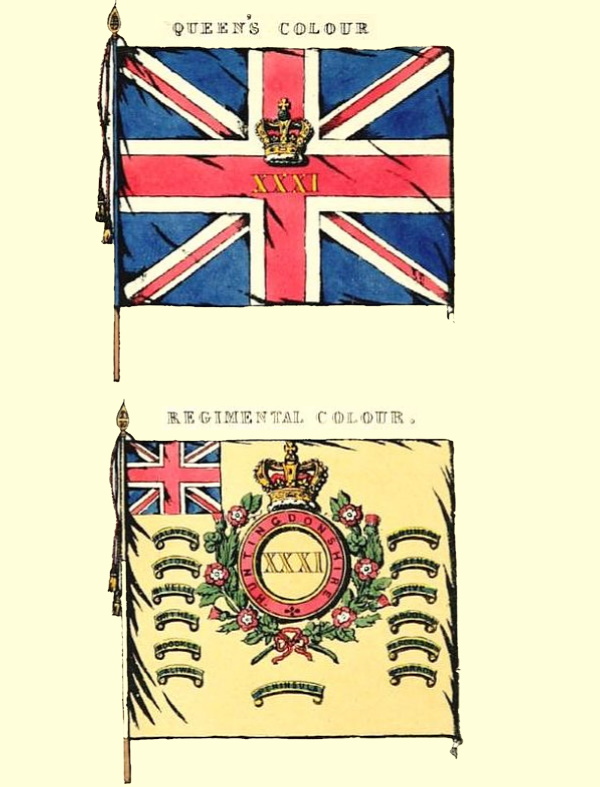
QUEEN’S COLOUR.
REGIMENTAL COLOUR.
FOR CANNON’S MILITARY RECORDS,
Madeley lith. 3 Wellington St Strand.