REVESBY.
Reading edition
Revesby is situated at the distance of six miles south from Horncastle, on the road from that place to Boston, and is included in the soke of Bolingbroke.
What now constitutes the parish of Revesby, appears formerly to have been three distinct manors, Revesby, Thoresby, and Seithesby; the greater part of which was the property of William de Romara, Earl of Lincoln. In the year 1142 he founded a Cistertian monastery at this place, and previous to endowing it with the whole of his possessions here, he negotiated exchanges with the other proprietors, by which he was enabled to give the entirety of the three manors to his new monastery. [74]
To add to the solemnity of the ceremony of foundation, the Earl on this occasion manumitted several slaves, who had petitioned for their liberty. One of them, called Wilhelmus Medicus, was doubtless a physician; another, Rogerus Barkarius, probably a shepherd: the surnames of persons at that time being derived from their professions. A person named Roger Barker resided until lately at a place called Stickney Wydale. This place belongs to the parish of Revesby, though about four miles distant, and is supposed to have been given to the monks, on condition of their keeping Nordyke Causeway, formerly a dangerous pass, in repair.
Beside the endowment of William de Romara, the monastery was enriched by numerous other benefactions. At the dissolution of religious houses, its possessions with all its rights were granted to Charles Brandon, Duke of Suffolk; and on the death of his two infant sons, who survived him only a short time, their extensive possessions were divided among the heirs general. On this division, Revesby fell to the lot of the Carsey family, who resided here several years, and afterwards sold it to the Lord Treasurer Burleigh, from whom it descended to the first and second Earls of Exeter; the latter of whom settled it on his grandson, Henry Howard, the third son of the Earl of Berkshire. About a century ago it was sold by the descendants of Henry Howard, to Joseph Banks, Esquire, the great grandfather of the late Right Honorable Sir Joseph Banks, Baronet, whose widow is the present possessor.
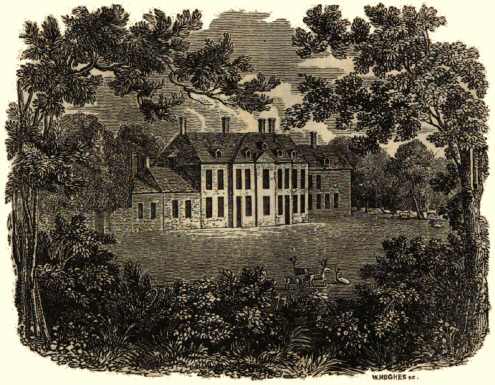
The seat of the proprietor was built by Craven Howard, nephew and heir of Henry Howard; but has been much enlarged by the family of Banks. Part of an ancient mansion, formerly the residence of the abbots, now forms the offices. The monastery, which stood at a considerable distance, has long been entirely demolished.
The church, which is a small neat structure, was re-built by the before mentioned Joseph Banks, Esquire. It is a donative of exempt jurisdiction.
At the east end of the chancel is a tablet containing this inscription:
“Dedicated to the Memmorie of NEHEMIAH RAWSON, Esq. A Member of this Common Wealth, and a Justice of Peace. Hee Married Frances the Daughter of Thomas Knightley of Brough Hall in the County of Stafford, Esq. By Whoome hee had Issue Six Daughters, Elizabeth Married to Richard Parkes of Lutton, Gent. Hanna to Theophilus Hartt of Birkwood Esq. Abigal to Daniell Hartt of London Grocer, Sarah, Rebecca and Mary, Dyed Younge, he Departed this Life in January 1657. Aged 80 Yeares.”
At the same end is another tablet, with the following inscription, and a shield containing a bend, in the sinister chief three crosses fitchy:
“To the perpetual Memorie of HENRY HOWARD third Son of Thomas Howard Earle of Barkshire by Elizabeth Daughter and heiresse to William Cecill Earle of Exeter his Wife who departed this Life in the XLIIII Yeare of his age in December MDCLXIII.
“This Monument was Dedicated and Erected by his Nephew whom hee made his heir and successor to this Mannor of Revesby and his Lands in Lincolnshire, Craven Howard Son of William Howard who was 4th Son of the Earle and Countesse of Barkshire (before mentioned) in the yeare 1691.”
On the north side of the chancel is a large marble monument, surmounted by the bust of the individual whose memory it perpetuates, and ornamented with a shield containing the arms of Banks, Sable, a cross or, between four flowers de luce argent. This monument contains the following inscription:
“H. S. E.
“JOSEPHUS BANKS Armiger ex antiqua familia apud Bank-Newton, in agro Eborac Oriundus. Juris prudentiæ studio operam dedit illamq. feliciter exercuit.
“In honorem Dei Ecclesiam hanc vetustate collahentem, a solo restituit Vicinium Ptochotrophium in X Senum aut Mancorum subsidium a fundamentis extruxit.
“Bis ad suprema Regni Comitia Senator Grimsbeiæ in Lincolnia, et Totenesiæ in Devonia. Electus, Regi suo et Patriæ utriamque vicem fideliter inservivit.
“Maritus et Pater benignus Amicus sine fuco Pacti et Promissi sui observantissimus Annos LXII. vixit XXVII Septemb. A.D. MDCCXXVII obiit.
“Liberos vidit adultos Josephum et Mariam Quorum hanc Dno Francisco Whichcote Barnto. nuptam, Patre superstite præpropera mors abripuit; Optimo Parenti superstes Ille.
M. H. P. C.”
Near to the church are ten alms-houses, on the centre of the front of which is the following inscription:
“Joseph Banks Esq. Lord of Revesby by his Will Directed the Building of these Almshouses for Ten poor People & Endowed the Same with Fifty pounds a year. He Departed this Life the 27th of Sept. 1727 Leaving Joseph Banks Esq. his only Son Heir who in Pursuance of his Father’s Will erected this Anno 1728.”
In this parish are two tumuli, each about one hundred feet diameter, and about one hundred feet apart, which have been formerly surrounded by a fosse. Dr. Stukeley supposes them to have been either the places of sepulture of two British kings, or places of religious worship. [76]
A fair is held at Revesby on the second Monday after old Michaelmas day annually.
In 1821, the parish contained 113 houses, and 572 inhabitants.
THE RIGHT HONORABLE SIR JOSEPH BANKS, BARONET.
The subject of this memoir was born in London on the 13th of December, 1743. He was the only son of William Banks, Esquire, of Revesby, who died in 1761, leaving him, at the age of eighteen, possessed of an ample fortune. He was at that time a member of the University of Oxford; and it was in the retirement of collegiate studies that he acquired his taste for natural history.
Immediately on his leaving the University, in 1763, he made a voyage to the coasts of Newfoundland and Labrador, and returned with those habits of investigation which are induced by a contemplation of rare and novel objects.
Having become a member of the Royal Society, his desire for further investigation of new worlds was again excited by the plan proposed by that learned body, for observing the expected transit of Venus, from one of the South Sea islands. No sooner did Mr. Banks understand that the Endeavour, commanded by Captain (then Lieutenant) Cook, was equipping for her voyage, and intended to prosecute further discovery after the observation of the transit, than he determined to embark in the expedition. Mr. Banks entered upon his preparations with a most generous spirit; providing himself with two draughtsmen, a secretary, and four servants, together with all the necessary books, and instruments. He was also accompanied by Dr. Solander, a Swedish gentleman, who had been the pupil of Linnæus.
On the 26th of August, 1768, the Endeavour sailed from Plymouth, on this great expedition. In the passage to Madeira, Mr. Banks and his companions discovered many marine animals, which no naturalist had described. At Madeira, and as they sailed on to Rio Janeiro, their vigilance was still eagerly awake, and sufficiently gratified by observations and specimens new to science. The jealousy of the Portuguese greatly disappointed their curiosity, by forbidding their researches at Rio Janeiro.
On Wednesday, April 12, 1769, the Endeavour arrived at Otaheite. For three months the voyagers continued at this and the contiguous isles, making the astronomical observations, for the sake chiefly of which Lieutenant Cook was sent out; surveying, as navigators, the coasts of the different isles; collecting specimens of the natural productions peculiar to them; and studying the language, manners, and arts of the islanders.
In August, 1769, the Endeavour sailed from the last isle of the group. In October they made New Zealand, which had not been visited since Tasman’s voyage. They next sailed to New Holland, chiefly along the East coast, and gave the name of New South Wales to the adjacent territory. The ship here struck upon a rock, and was saved only by extraordinary skill. In laying her down for repairs the sea broke in, and spoiled the greater part of Mr. Banks’s specimens of natural history: but he was recompensed by the discovery of the kangaroo. In August, 1770, they sailed for New Guinea. On their homeward voyage, their short stay at Batavia was nearly fatal to the expedition. Mr. Banks and Dr. Solander caught the fever. Tupia, a priest, and a boy named Tayeto, both from Otaheite, who were proceeding to England, died. Every person of the crew but one was taken ill. Seven died at Batavia, and twenty-three more within six weeks after. On the 12th of June, 1771, the vessel anchored in the downs.
Early in 1772 an expedition was prepared under the command of Captain Cook, to proceed in search of the so much talked of Southern Continent, in which Mr. Banks most anxiously took a part, intending to perform the voyage; and he accordingly prepared his establishment upon the most extensive scale. On this account orders were given by the Admiralty for fitting the ships out with every possible accommodation that Mr. Banks could desire; but when the Resolution sailed from Long Reach for Plymouth, she was found so very crank, from the additional upper works, that she was obliged to be carried into Sheerness to have the additional cabins cut away, with such other alterations as were necessary to make her sea-worthy. This of course struck at the very root of Mr. Banks’s project, in curtailing him of the space and accommodation absolutely necessary for the establishment which he had formed; and he was reluctantly compelled to give up his plans.
Disappointed in this expedition, Mr. Banks was prompted to engage in some other active research, and accordingly determined on a voyage to Iceland and the western islands of Scotland; partly for the purpose of scientific observation, and, as Van Troil states, who accompanied him, in order to keep together and employ the draughtsmen, and other persons, who had been engaged for the South Sea expedition.
They sailed from the river in July, and called at Portsmouth, thence to Plymouth, and proceeded up St. George’s Channel, to the Western Islands, visiting Oransay, Columbkill, Scarba, and Staffa, so remarkable for its basaltic columns, but until then comparatively unknown. They passed the Orkneys and Shetland islands without any particular investigation; and on the 28th of August, 1772, arrived off the coast of Iceland. After completely investigating every thing curious, they left Iceland, and arrived at Edinburgh in November, from whence they set off by land for London.
After his return Mr. Banks passed his time principally in London, or at his paternal seat at Revesby, surrounded by men of letters, and by persons of the first rank and fortune; and dedicating his time and fortune to scientific pursuits.
Sir John Pringle having retired from the office of President of the Royal Society in 1777, Mr. Banks was called to fill the vacant chair, when his ample fortune enabled him to commence a system by which his house became, through a long series of years, a scene of hospitality, to genius of every country, and of every rank in society.
The close attention which the President now paid to the duties of his station, induced him to select a rural retirement nearer to London than his seat at Revesby; he therefore, in the year 1779, took a lease of the premises, which he afterwards purchased, at Spring Grove, in the parish of Heston, in Middlesex; and on the 29th of March in the same year, he married Dorothea, daughter and co-heiress of William Weston Hugeson, Esquire, of Provender, in the parish of Norton, county of Kent.
In 1781, Mr. Banks was honored by his Sovereign with a baronetcy; as he was some years afterwards, by being created a Knight of the Bath, and sworn one of his Majesty’s Honorable Privy Counsel.
Sir Joseph was re-elected to the Presidency of the Royal Society, for several years, with an unanimous feeling; but the jealousies of some members of splendid and commanding talents began to be developed. It was charged against him, that in the recommendation of candidates, he bowed rather to the pretensions of rank, than to the unobtrusive, but undoubted claims of eminent ability. This feeling so far extended itself, that in 1784, a dignitary of the church, distinguished for his mathematical learning, threatened a secession in the following terms:—“If other remedies fail, we can at least secede. When the hour of secession comes, the President will be left with his train of feeble amateurs, and that toy upon the table, the ghost of that society in which Philosophy once reigned, and Newton presided as her minister.” The very temper of this burst of eloquence is a proof of the causes of the schism. The pride of genius was opposed to the pride of rank, and the conflict was as obstinate as it was violent. The President maintained his position firmly, and he lived to behold that intimate union which ought ever to exist between the patrons and the votaries of learning.
Beside devoting his attention to the duties of the chair of the Royal Society, Sir Joseph became an active member of all the public societies of the day; and to his care in a great degree the African Association owes its origin. He also liberally encouraged and assisted those who undertook voyages or travels of discovery. In his attentions to the breeding of sheep and cattle, and to the improvements in husbandry, he gave many instances of scientific patriotism; and to his exertions may be attributed the drainage of the Fens in the immediate vicinity of Revesby. To the Horticultural society, which he assisted in forming, he was a contributor of several papers. In politics he took no ostensible part, and had not even a seat in parliament.
During the latter years of his life, Sir Joseph was so severely afflicted with the gout, as to be deprived of the use of his lower extremities, and consequently unable to take his accustomed exercise. In 1817 he was by death deprived of his sister, a loss which he severely felt. In April, 1820, in consequence of increasing debility, he expressed a wish to resign his office of President of the Royal Society, but this resignation the society were unwilling to accept of, and he continued to hold the office until his death, which took place on the 19th of the following month. His remains were interred in the church yard at Heston. Having no issue, his title is extinct. After the death of his widow, his estates in Lincolnshire go to the Honorable James Hamilton Stanhope, and Sir Henry Hawley, Baronet; the remainder of his estates to Sir Edward Knatchbull, Baronet. His valuable and extensive library he bequeathed to the British Museum.