GEOLOGY AND NATURAL HISTORY OF THE SOKE AND NEIGHBOURHOOD OF HORNCASTLE.
Reading edition
GEOLOGY.
Although the Soke of Horncastle does not possess much variety in its geological structure, yet a considerable diversity is to be found in the formation of the adjacent elevated country, called the wolds. On the annexed map the denudations of the various strata in this district are traced out, and distinguished by different colours: the order of stratification is also exemplified by a section, of imaginary elevation, but on the same scale as the map with respect to horizontal distance. The section too shows a greater extent than the map to the east, where, on account of the dip of the strata towards that quarter, it is necessary to commence the description; although in point of distance it cannot be properly considered within the prescribed limits of this work.
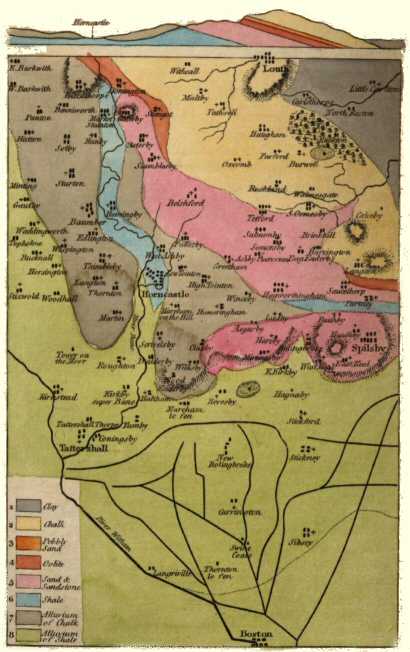
The tract of marsh land between the sea and the wolds, (No. 1.) consists principally of unstratified clay, with admixtures of sand, and various marine depositions. These circumstances, together with the old sea banks, evidence that this mass of earth has been left by the gradual receding of the ocean.
On the west of these marshes is the rough elevated denudation of chalk, (No. 2.) which forms the highest stratum of the wolds, and gently dips underneath the marshes; for in boring in them for water the chalk is always found. The chalk is of two colours, white and red, each lying in regular strata, which alternate frequently, the red bearing but a small proportion to the white. In the white, compact seams of flint, of a light grey color, from two to six inches thick, are often met with. In the chalk several extraneous fossils are found.
The stratum immediately below the chalk, (No. 3.) is a coarse, brown, pebbly sand, consisting of quartz and oxyd of iron, varying in thickness from six to ten yards, and of uncertain appearance at its denudation. While the different strata in these parts were exposed to the action of the water, the sand would naturally be more affected by that element than the superincumbent stratum of chalk; and the latter being thus left projecting, would from the decomposing effects of the atmosphere, crumble down, and form those various declivities which now present themselves to view.
Beneath the sand is a bed, about fourteen yards in thickness, (No. 4.) containing equal proportions of oolite limestone and calcareous clay of a light grey colour. In some parts the stone is divided by the clay into regular strata, whilst in others it occurs in large detached pieces imbedded in the clay. Fossil shells, and lumps of pyrites, or sulphuret of iron, are frequently met with in the stone.
The next stratum (No. 5.) consists of grains of quartz, for the most part agglutinated into sandstone of different degrees of induration, and varying in colour from a light grey to a dark brown, whilst in some parts loose sand predominates. In the grey variety of this stone, marine shells of different kinds, are found in great abundance: in the brown they occur very seldom, and not at all in the sand. This stratum is considerably thicker than the two incumbent ones.
Beneath this is the shale, [98] (No. 6.) which generally makes its appearance in vallies; but it no where exhibits a denudated termination. On sinking a shaft in the parish of Woodhall, about six miles south-west of Horncastle, it was found to be one hundred and fifty yards in thickness. A great variety of organic remains are also found in this stratum.
Under the shale is a stratum of forest marble, which denudates about sixteen miles westward of Horncastle.
The last division to be considered is an alluvial collection of earth, almost entirely consisting of the spoils of the neighbouring strata in a state of decomposition, wherein however detached pieces of the different strata are to be found unaltered. From this it appears that when these parts were deluged by the water, the current set in from east to west. As the chalk and the shale would present the largest surfaces to the erosion of the water, they would be more extensively acted upon than the other strata: hence the greatest part of the alluvial deposition consists of white marle and blue; the former (No. 7.) being of the least specific gravity, has covered the hills, while the latter with sand and gravel (No. 8.) occupies the lower parts.
NATURAL HISTORY.
In the department of Natural History, this district possesses but little which is deserving of particular notice.
Of Birds there are none which can now be considered peculiar to this part, the drainage of the fen lands having entirely banished the great variety of aquatic birds which used, previous to that event, to be found here.
The Plants, indigenous to this district, are very numerous. From a list of several hundreds which are to be found in the neighbourhood, the following interesting ones are selected.
Botanical Names. English Names. Where found.
Arabis thaliana Codded mouse-ear Horncastle
Asplenium adiantum nigrum Black maiden-hair Tattershall
Asplenium ruta muraria Wall-rue Somersby Church
Atropa belladonna Deadly nightshade Miningsby
Borago officinalis Borage West Ashby
Butomus umbellatus Flowering rush Horncastle, Thornton
Carduus marianus Milk thistle Stovin Wood, Kirkstead
Chlora perfoliata Yellow centaury Edlington
Chironia pulchella Small chironia Horncastle
Cistus helianthemum Little sunflower Scrivelsby
Comarum palustre Purple marsh-cinquefoil West Ashby furze-hill
Convallaria majalis fl. pl. May-lily (double flower) Highall Wood
Daphne laureola Spurge laurel Poolham
Digitalis purpurea Purple fox-glove Holbeck, Salmonby,
Drosera longifolia Long leaved sun-dew Tattershall
Drosera rotundifolia Round-leaved sun-dew Tattershall
Empetrum nigrum Blackberried heath Moor
Erica cinerea Fine-leaved heath Ditto
Erica tetralix Cross-leaved heath Ditto
Galeobdolon luteum Yellow nettle Tetford Wood
Gentiana amarella Autumnal gentian Greetham, Hemingby
Gentiana pneumonanthe Calathian violet Tattershall-park, Moor
Malaxis paludosa Marsh tway-blade Moor
Nuphar lutea Yellow water-lily West Ashby
Nymphæa alba White water-lily Ditto
Ophrys apifera Bee orchis Mareham-le-fen
Orchis conopsea Aromatic orchis Thimbleby, Edlington
Orobus tuberosus Wood peas Daw Wood
Oxalis acetosella Wood sorrel Tetford Wood
Paris quadrifolia Herb Paris Ditto
Parnassia palustris Grass of Parnassus Horncastle
Pinguicula vulgaris Butterwort Ditto
Polygonum bistorta Greater bistort Horncastle
Sanicula Europea Sanicle Stovin & Tetford Woods
Saponaria officinalis Soapwort Baumber, Horncastle
Spirea filipendula Dropwort Bridle road to Hemingby
Turritis hirsuta Hairy tower mustard High Tointon
Vaccinium oxycoccus Cranberry plant Moor
Minerals occur rarely in this part, and in very small quantities. Lumps of sulphuret of iron in the oolite stratum; earthy oxide of iron and a singular blue pulverulent mineral, which is a carbonate of iron containing some earthy impurities, in a valley at Salmonby; and a stalactitic oxide of iron in the ferruginous gravel; comprise all the varieties which have yet been found.
Although Organic Remains are to be found in some parts of this district in considerable quantities, yet they do not include many varieties. The following list of those now in the possession of the author, comprises one of almost every species which has yet been found.
From the Chalk Stratum. No 2.
Teeth of the Squalus or Shark.
An Impression of a Vertebræ.
A Terebratula subundata.
A Terebratula subrotunda.
A cast within some bivalve Venus.
A cast within a Terebratula semigloboso. Sowerby’s Mineral Conchology, 15.
An Inoceramus Cuvierii.
An Echinus.
From the Oolite Stratum. No. 4.
An Ostrea, curious and not named.
A bivalve, not named.
A piece composed of the Serpula auricula.
From the Sand Stone Stratum. No. 5.
Ad Ammonites, curious and not named. It is without a keel; else like Ammonites inflatus.
A Cardita. Sowerby’s Mineral Conchology, 197.
An Inoceramus.
An Unio.
A Terebratula approaching glaber.
A Terebratula approaching acerminatus.
A Lucina concentrica.
A cast within a bivalve, not named.
A cast within a Trochus.
A cast within a Trigonia.
A cast within a Venus.
A cast within a Pecten.
A cast within a Cardium.
Several Bellemnitæ.
From the Shale or Clunch Clay. No. 6.
An Os Femoris of the Ichthyosaurus or Giant Lizard.
Several Vertebræ of the same animal.
An Ammonites, not named.
A Venus equales. Sowerby’s Mineral Conchology, 21.
A Cardita.
An Ostrea crista galli. Linnæus.
An Ostrea under valve, with a cast of the inside of the upper valve.
A Gryphæa bullata
A Gryphites incurva. Sowerby’s Mineral Conchology, 112, 1 and 2.
An Ammonites seratus. Sowerby’s Mineral Conchology, 24.
An Inoceramus Cuvierii hinge.
An Unio hybrida. Sowerby’s Mineral Conchology, 154, fig. 2.
Several Unios.
A piece composed entirely of shells, the chief part of which are the Serpula auricula. It also contains an inside cast of a small turretted shell.
A Tellina.
A Pentacrinite.
A Mytilus.
Several Bellemnitæ.
From the beds of Ferruginous Gravel in Alluvium of Shale. No. 3.
A Tooth of the Elephant or Mastodon.
An Inoceramus Cuvierii.
An Ostrea, with a cast of the upper valve.
A cast of an Unio indistinct.
A chama.
A cast of Shell, not named.
An Echinus.
Several bellemnitæ.
A Madrepore.
An Alcyonium.
An Astarte.
A part of a Spongites.
An impression of a Cactus, or an Euphorbia, or some other Oriental plant. Sowerby’s Mineral Conchology, 40.
A piece of Wood similar to the Fossil Wood of Wooburn, Bedfordshire.
In the valley at Salmonby, near to the spot where the earthy oxide of iron is found, is a chalybeate spring, the water of which is of the same nature as that of Tunbridge, but much stronger.
Printed by Weir and Son, Horncastle.