WILMINGTON
Reading edition
“Her mingled streams of Swedish, Dutch and English blood.”
By E. N. VALLANDIGHAM
When the adventurous William Usselinx, native of Antwerp and merchant of Stockholm, was growing old, he proposed to King Gustavus Adolphus that Sweden organize a trading company to operate in Asia, Africa, America, and Terra Magellanica. The King lent ear to Usselinx, and Usselinx was able to picture to the Swedish people the beauty and fertility of the region bordering on the Delaware, “a fine land, in which all the necessaries and comforts of life are to be enjoyed in overflowing abundance.” The proposed plans sped well for a time; the King pledged a great sum from the royal treasury in aid of the new company, and the Swedish people, nobles and commons, subscribed to the stock. But the King was shortly to be busied in the wars of Germany, and when he died at his great victory of Lützen, the plans of Usselinx were yet unexecuted. One biographer of Gustavus, indeed, says that the little fleet intended for America was seized by the Spaniards, but it is by no means certain that such a fleet ever set sail.
Queen Christina, the daughter of Gustavus, permitted her able chancellor, Oxenstiern, to revive the charter of Usselinx, and Oxenstiern employed to take out a Swedish colony to the Delaware probably the fittest man in all the world for that task, Peter Minuet, sometime Governor of New Netherlands, driven from his post by the jealous factors that they might put in his place the more pliant Walter Van Twiller, surnamed the Doubter. The exact date of Minuet’s expedition is unknown, but Kieft, who succeeded Van Twiller in the Governorship of New Netherlands, made protest in May, 1638, against the presence upon the Delaware of Peter Minuet, “who stylest thyself commander in the service of her Majesty the Queen of Sweden.” Kieft warned Peter “that the whole South River [the Delaware] of the New Netherlands, both the upper and the lower, has been our property for many years, occupied by our forts, and sealed by our blood.”
When Kieft’s protest reached the newly arrived Swedes, they were already in snug quarters on the edge of the River Minquas, as the Indians called it, or Christina, as the newcomers named it (set down on modern maps as Christiana, but in the mouths of those that navigate its waters, called Christeen); for they had sailed up the Delaware in the Bird Grip, or Griffin, and the Key of Calmar, and entering the Minquas, had come to anchor in deep water close against a natural wharf of rock, well within the present limits of Wilmington. Thus was made the true beginning of the city, though no part of the region it now occupies bore the name of Wilmington until a full century later.
The newcomers built close to their original place of anchorage a little fort, and behind it a little village. Hudde, the Dutch commander at Fort Nassau, thirty miles up the Delaware, describing the Swedish fortification seven years later, says that it was “nearly encircled by a marsh, except on the northwest side, where it can be approached by land.” The fort was then and for years afterward, the only place of worship in the immediate region, and here from the founding of the colony the Rev. Reorus Torkillius, a Swedish clergyman of Latinized name, conducted the Lutheran service in the Swedish language. Thus church and state were planted together. Pastor Campanius, who came five years after Torkillius, found that beside Fort Christina had sprung up the village of Christina Harbor, or Christinaham, and Engineer Lindstrom, who came when the settlement was not yet twenty years old, has left us a map of this earliest Wilmington.
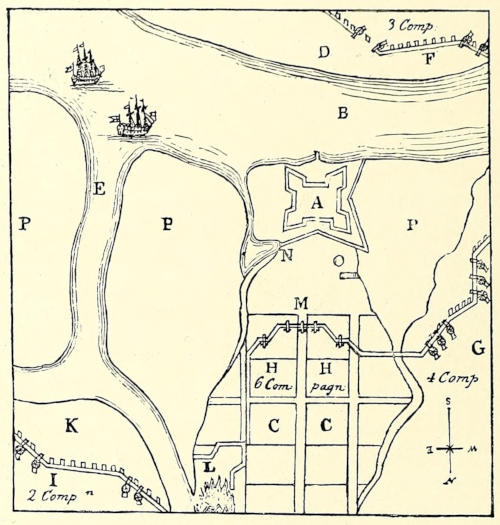
PLAN OF CHRISTINA FORT, 1655.
Before the Dutch had time to call the Swedish intruders to a reckoning Minuet died, and John Prinz was sent out as Governor. There had been the short intervening reign of Peter Hollendare. Prinz came under a cloud, having lost his rank as First Lieutenant by his over-hasty surrender of Chemnitz. Probably this fact may account for his restless energy as Governor of New Sweden. He sought to regain in the new world repute lost in the old. Prinz came with two ships, an armed transport, munitions of war, troops, and many immigrants, and with instructions to maintain and promote piety and education, to develop the resources of the colony, agricultural and mineral, to make friends with the Indians, and to live at peace with all neighboring Europeans. But he was to resent by force of arms, if need be, the pretensions of the Dutch to any territorial or other rights upon the west side of the Delaware.
Prinz built at Tinicum, or Tenacong as the Indians called it, near the present city of Chester, Pennsylvania, a fort to threaten the Dutch Fort Nassau, above; and likewise at the mouth of Salem Creek, on the Jersey shore, where the English had a small settlement, he built Fort Elfsborg, or Elsinborough. Both were promptly armed and garrisoned. He built still another fort, this time on the Schuylkill, within gunshot of its mouth, and in 1646 he ordered a Dutch trading-vessel from that river. Furthermore, he caused to be torn down with despiteful words the arms of the Dutch, set up in sign of possession upon the present site of Philadelphia, and when reminded of the Dutch West India Company’s prior claim, he profanely answered that although Satan was the earliest possessor of hell, doubtless he sometimes welcomed new comers.
But a day of reckoning was speedily to come, for Peter Stuyvesant, Governor of the New Netherlands, moved by the amazing activity of Prinz, bought from the Indians all the west side of the Delaware from Minquas Creek to Bompties (or Bombay) Hook, and in 1651, as some say,—before the building of Elfsborg as others say,—built Fort Casimir at Sand Huken, now Newcastle, on the Delaware, five miles below Fort Christina, and within sight of Elfsborg. Whichever fort was built first, it is pretty certain that the Swedes soon deserted Elfsborg, after naming it in disgust Myggenborg, which means Fort Mosquito. The excuse for the desertion was the insupportable insect pests of the region; so early did the New Jersey mosquito earn the reputation that clings to him even to this day. As for Prinz, alarmed at the activity of the Dutch, he vainly petitioned the home government for aid, and at length went off to Europe, leaving as deputy his son-in-law, John Pappegoja.
And now the comedy of outflanking was to be followed by the comedy of bloodless capture and recapture, for Prinz had not been long gone when there arrived in the Delaware from Sweden, in the man-of-war Eagle, John Claudius Rising, as commissary and counsellor to the Governor, and Peter Lindstrom, military engineer, together with arms and soldiers. The Dutch at Fort Casimir were living in unsuspicious peace when the Eagle suddenly appeared before the fort and demanded that the place surrender, as occupying Swedish ground. Rising enforced his demand by landing thirty soldiers, and the Dutch yielded upon favorable terms which secured to them all their property, public and private, and granted as well the honors of war. As the capture was made on Trinity Sunday, the name of the place was changed by the Swedes to Trefalldigheet, or Fort Trinity. This incident, which befell in the year 1655, is notable as the first passage at arms, if such it may be called, between rival European claimants to the western shore of the Delaware.
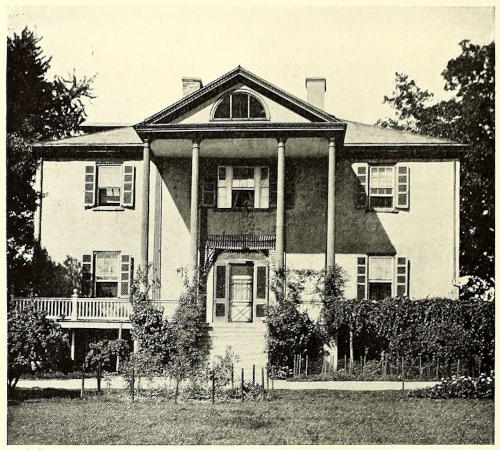
RESIDENCE OF THE LATE THOMAS F. BAYARD.
But Rising’s prompt policy of aggression was a mistake, for it left the Dutch no alternative but counter-aggression; and accordingly Peter Stuyvesant, with seven ships and six hundred or seven hundred men, appeared before the deserted Elfsborg late in August, 1655, captured a few straggling Swedes ashore, endured the mosquitoes for one night only, and next day, having landed a force north of Fort Trinity to cut it off from Fort Christina, demanded that the garrison surrender. Swen Schute, the Swedish commander, despite a name that ought to have been formidable in war, was as obligingly prompt in compliance as the Dutch commander had been a few months earlier. There was, as before, a friendly arrangement as to the guaranty of property, public and private, but Swen Schute never dared return to Sweden lest he be brought to book for his alacrity in surrendering.
Now came the taking of Fort Christina, immortalized by Washington Irving’s genius of burlesque. Rising, aware of his weakness, professed to believe that the Dutch had no further hostile intent, but when they invested Fort Christina on three sides, planted cannon, and called for the surrender of the place in forty-eight hours, he first temporized, then put on a bold face, and finally, without striking a blow, surrendered. So ended Swedish rule in Delaware, and so began the short-lived Dutch supremacy.
The Dutch guaranteed to the vanquished religious liberty and all other reasonable privileges, so that few Swedes took the chance afforded of selling their property and removing out of the jurisdiction. The Swedes, indeed, were soon reconciled to Dutch rule, and in fact the colony remained, in all save politics, as truly Swedish as it had been before. The Dutch children learned the Swedish tongue, and as the Swedes far outnumbered the Dutch, the latter were soon lost in the mass of the former. When a nephew of Prinz visited the country, late in the seventeenth century, he found that the people “used the old Swedish way in all things.” Pastor Rudman wrote home to Sweden that the mother tongue was still spoken in all its purity by the colonists at Christinaham, and as a matter of fact it did not entirely cease to be used in the services of the Swedish church until more than a century and a quarter had elapsed.
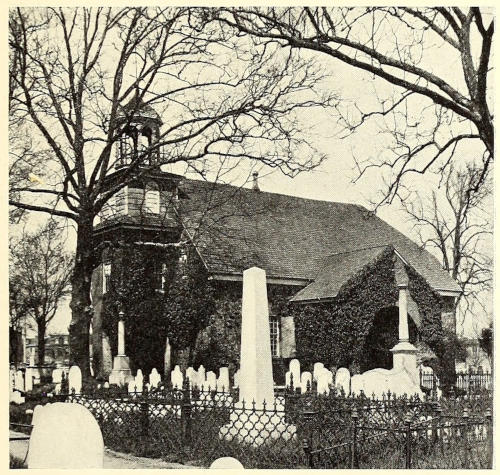
OLD SWEDES CHURCH.
Luckily for the Swedes they were too busy to trouble themselves about a change of masters, and when the agents of James, Duke of York, having possessed themselves of New Amsterdam in 1664, after Charles I. had magnificently given to James all the country between the Connecticut and the east bank of the Delaware, also seized New Sweden as a dependency of New Netherlands, the good folk at Christinaham accepted the new situation and went about their business. The attempted rebellion of Königsmark, “the Long Finn,” who called himself a son of General Count William Von Königsmark, and the historical interlude of the Dutch occupation in 1673 and 1674, when the forts changed hands, in the usual bloodless fashion, twice in a few months, did not profoundly shake the community on the Minquas. The second surrender left the English in secure possession.
In the midst of this apparent indifference to governmental changes, one thing did move the Swedes, and was doubtless in part responsible for the welcome they gave the return of the Dutch: this was a tariff imposed by the English rulers upon all inward-bound merchandise passing the capes of the Delaware. At this juncture there came to the rescue the best friend the Swedes had yet found in the new world, a man so wise and just in his dealing with civilized man and savage on this side the Atlantic, so generous, tolerant, large-minded and large-hearted in all that concerned the great powers entrusted to him, that one can hardly understand how even so audacious an iconoclast as Macaulay had the hardihood to assail his memory. This man was William Penn, who, having recently become trustee for Quaker estates in West Jersey, made prompt protest against the tariff and had it revoked—an early triumph for the principle of no taxation without representation.
When, soon after, he became proprietor of the “Three Counties on the Delaware,” the Swedes of Christinaham and the region round about knew him and were glad. Penn had an equally good opinion of the Swedes, for he says:
“As they are a proper people, and strong of body, so they have fine children, and almost every house full. It is rare to find one of them without three or four boys and as many girls, some six, seven and eight sons. And I must do them that right to say I see few young men more sober and laborious.”
A Swedish writer of about the same period notes that the Swedish farmers are as well clad as the residents of cities. Penn describes the houses in his new possessions as of a single story and divided into three apartments. A house and a barn suitable to a colonist might be built for seventy-five dollars.
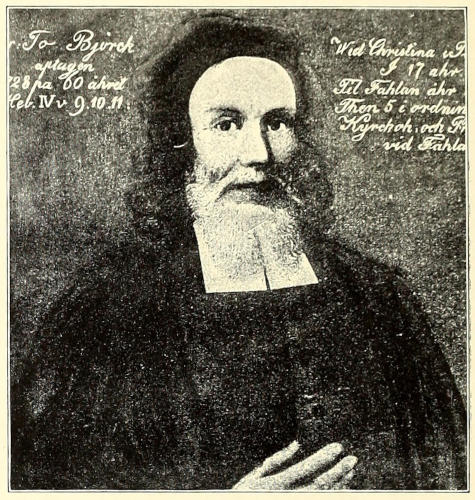
REV. ERIC BJORK.
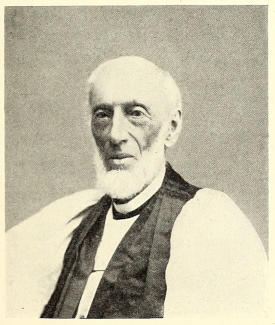
BISHOP LEE.
Penn noted, however, that the Swedes were not so well educated as they should have been, and a few years later they were in such need of religious instruction, although they had but recently lost their pastor, that, partly through the representations of the proprietor and partly through the importunities of the Swedes themselves, the King of Sweden was induced to send out to Delaware the Rev. Eric Bjork. This good and energetic man, finding inconveniently situated the Swedish Lutheran church erected in 1667 at Crane Hook, or Tran Hook, near the mouth of the Christiana, conceived and executed the plan of building a new church near the scene of the original Swedish landing at the Rocks. The new edifice was the Old Swedes of to-day, which celebrated the two hundredth anniversary of its dedication on the 28th of last May. This venerable church, now Holy Trinity of the Protestant Episcopal Diocese of Delaware, is revered and cherished as the one visible link which joins the city of Wilmington to her earliest past. In the churchyard lie the dead of many generations, and of almost all denominations. Here, side by side with the Swedish colonists of the early eighteenth century, lies the late Bishop Alfred Lee of the Episcopal Church, who in life, as learned as he was modest, was one of the American Committee for the Revision of the King James Bible. Here, too, was recently laid to rest, amid many of his kinsfolk, the late Ambassador Thomas F. Bayard, worn with long and honorable public service.
Thanks to the late Dr. Horace Burr we have an English translation of the earliest records of Old Swedes. In these records is contained a curious account of the difficulties attendant upon the building of the new church. There were quarrels over the glebe, the usual troubles with the contractor, and the inevitable changes of plan after the work was under way. Hired sawyers were paid so much per foot, and “drink.” In order to save wages the men of the parish came as they found leisure and hewed the timbers. Masons and other skilled mechanics came from Philadelphia, then “a clever little town,” and with them came Dick, a negro mortar-mixer.
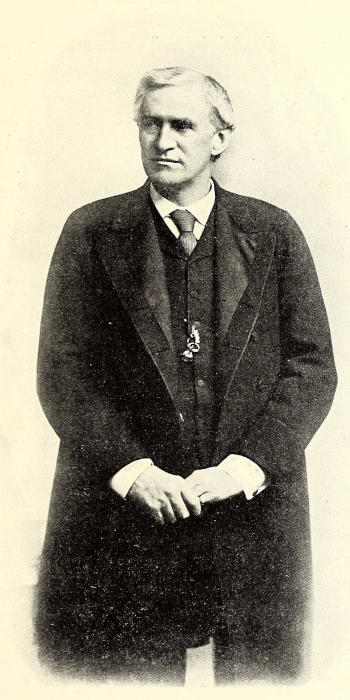
THOMAS F. BAYARD.
Notwithstanding the erection of the new church, the community seems to have grown away from the scene of the original landing, until in 1731 Thomas Willing, son-in-law of Andrew Justison, of Swedish blood, laid out upon the Christiana front, half a mile from the Rocks, a new town modelled upon the rectangular plan of Philadelphia. The first house in Willingstown, built at the corner of Front and Market streets, bore in its brick gable a stone with the inscription, “J. W. S., 1732.” Three years later the place was only a small hamlet, but in that year Willingstown had a new birth, for then William Shipley, a wealthy, well educated and energetic English Friend of Ridley in Pennsylvania, came to the place and made himself, so to speak, its second founder. He came through the influence of his second wife, Elizabeth Lewis, a preacher of his own sect, who saw in a vision a goodly land lying at the foot of a hill and traversed by two rivers, one wild and dashing, the other sluggish and serpentine, and visiting by accident the region of the Swedish settlement on the Christiana, recognized the landscape of her vision.
William Shipley built his house—an admirable example of eighteenth-century brickwork—at the corner of Fourth and Shipley streets, where it recently gave place to a modern business building. He built, also, a market-house for the town at the corner of Fourth and Market streets, and in doing so, paved the way for a quarrel with the partisans of the Second Street market-house, a body of citizens including many Swedes.
So potent was the magic of William Shipley’s presence that in four years the town had reached six hundred inhabitants. Next year it received a borough charter from Penn, and its name was changed to Wilmington, in honor of Lord Wilmington, says Ebeling, the German historian. It was a tight little borough, the Wilmington of that day and of fifteen or twenty years later. The burgesses, who at first met about in taverns, at length were comfortably housed in a neat little Town Hall built upon arches over one end of the Second Street market. There were fairs during most of the eighteenth century; fairs to which hundreds came in holiday attire and dancing shoes to make merry to the sound of bagpipe, flute, fiddle and trombone. It is significant of grave Quaker austerity, perhaps, that the fairs were suppressed by act of Legislature in 1785, as nurseries of vice, a scandal to religion, and an offence to well ordered persons. There may have been some excuse for this severity, for indeed with the coming of the English had come something of the brutality of eighteenth-century English manners. Bullies fought naked to the waist in the market-place, and hired ruffians nearly cut down the posts that supported William Shipley’s market-house. The most picturesque modern survival of Wilmington in the eighteenth century is the King Street open-air market, and with it remains the statute against forestalling, made to meet the case of some early monopolist.
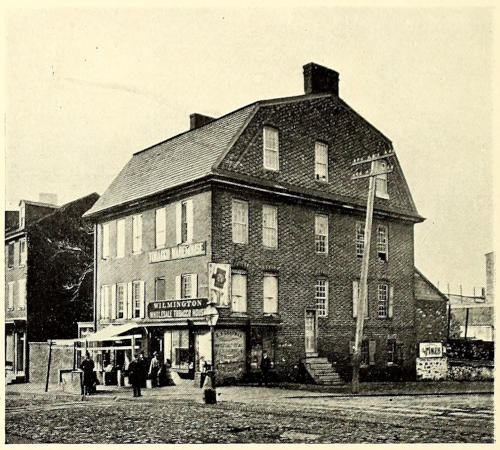
SHIPLEY BUILDING.
Wilmington’s Quaker peace was little disturbed by echoes of European wars in the eighteenth century, though in 1741 the Christiana was fortified against possible Spanish pirates; but when the war of the Revolution came, Wilmington was loyal and ready. Old folk still preserve the tradition of Washington’s presence in the city just before the battle of the Brandywine, of his gay French officers in the sober house of a Quaker citizen, of President John McKinly’s capture at midnight by a detachment of British sent in after the battle, of the British wounded crowding the houses of citizens and probably saving the town from bombardment by British ships of war in the Delaware. Tradition recalls, too, the visit of Washington in his hour of victory, when he journeyed homeward to Mount Vernon, of his other visit on his journey northward to be inaugurated as President at New York, and of still another visit in 1791, when he made his famous progress through the country. On that last visit, riding in his chariot of state through little Brandywine village, opposite Wilmington, on the left bank of the Brandywine, he stopped at the house of miller Joseph Tatnall, to learn that he was at the mill, and then, with those great strides of his, walked through the village street to the edge of the stream, entered the mill, and talked with the courageous patriot Quaker of his services to the army during the war.
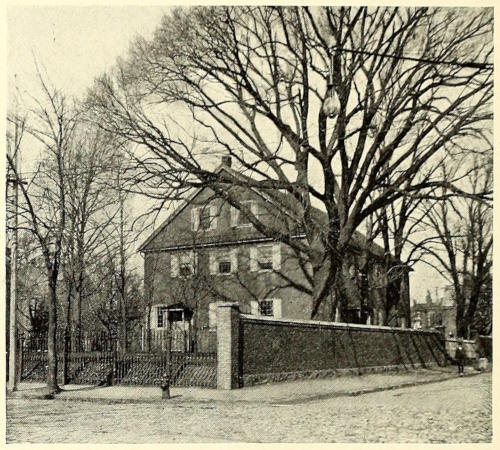
OLD FRIENDS’ MEETING-HOUSE.
By this time the borough had travelled far from the crudity of Swedish days and had even departed somewhat from the severity of Quaker tradition. There were French emigrants from the black terror in Santo Domingo, and from the red terror in France. There were soon to be other French immigrants,—Du Ponts, bringing a mingled flavor of aristocracy, learning and benevolence, destined to found great factories and to give patriot soldiers and sailors to the land of their adoption, and yet to retain even to the fifth generation the Gallic face, and air, and manner.
Wealth and elegance were come to the little community on the Minquas. Had not Robert Montgomery made the tour of Europe, and did he not for four months during the plague of yellow fever at Philadelphia entertain Governor McKean of Pennsylvania? Did not another wealthy citizen entertain one hundred refugees of the same period? And there was Gunning Bedford, Jr., aide-de-camp and friend to Washington, inheritor of his crimson satin Masonic sash, his appointee as first Federal Judge for the District of Delaware. He and his wife, a Read of distinguished colonial stock, entertained friend and stranger with splendid hospitality in the very house in Market Street that had been the headquarters of Washington’s French officers. The Bedfords were Presbyterians. Gunning Bedford, Jr., worshipped in the quaint little First Presbyterian Church in Market Street near Tenth, now reverently preserved and occupied by the Delaware Historical Society. Hard by in the churchyard you may see Judge Bedford’s tomb, a low but graceful domed shaft facing the public street, so that all may read the lesson of civic virtue, and bearing an inscription that closes thus:
“His form was goodly, his temper amiable, His manners winning, and his discharge Of private duties exemplary.
“Reader, may his example stimulate you to improve the talents—be they five, or two, or one—with which God has entrusted you.”
Wilmington built her new Town Hall just a century ago last year, and Friend Joseph Tatnall gave the clock that shone in its tower and told the hours. The clock went out of use more than thirty years ago, but the building remains, not altogether spoiled by modern additions, sacred because of its associations, and testifying to the solidity with which the city fathers built in the last century.
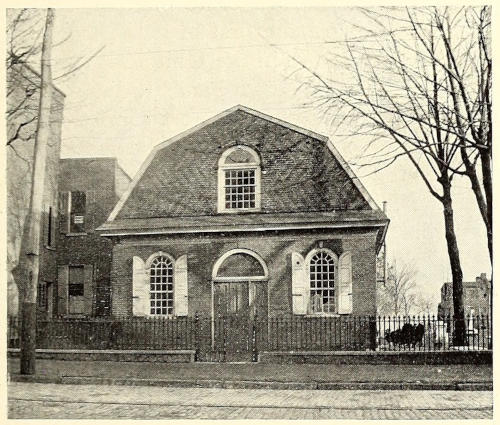
HOUSE OF THE HISTORICAL SOCIETY.
When the City Hall was built Penn’s charter, unamended, still served the community, and continued to serve until 1809, when it was amended and the borough limits were enlarged. The town was yet merely a borough when the War of 1812 came on, and Senator James A. Bayard, the first of four Bayards to represent Delaware in the United States Senate, helped with his own hands to build a fort almost upon the site of Fort Christina. A city charter came in 1832. The mayor was elected for three years by the city council, and the first mayor chosen was Richard H. Bayard.
Wilmington as the intellectual centre of the State was naturally also the home of radical thought. Quaker sentiment had sunk deep into the community. An anti-slavery society was organized early. A great meeting at the Town Hall in 1820 adopted resolutions against the extension of slavery into the territories. Sam Townsend, a picturesque and characteristic figure in the mid-century politics of the State, was amazed and horrified to find that his brother, home after a week’s visit to Wilmington, had returned with a tincture of abolitionism. Sam and his neighbors labored with the erring one, but could not meet his arguments against holding one’s fellow-men in bondage until Sam bethought him to deny the humanity of the negro, and thus snatched the brother as a brand from the burning.
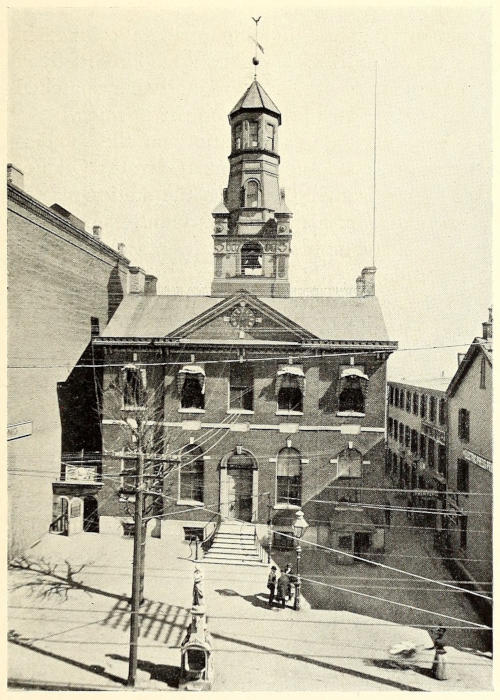
CITY HALL.
Wilmington was a station on the “underground railroad,” and Thomas Garrett, a Quaker of Pennsylvanian birth, was the station-master—a man of prudence but of dauntless courage, who, left penniless at sixty by reason of a fine imposed upon him for violation of the Fugitive Slave Law, declared upon the court-house steps in his peculiar lisp: “I did it; I’m glad I did it; and I’d do it again.” The Civil War came too soon for him, he said, for he had hoped to help away three thousand slaves, and had stopped at two thousand seven hundred.
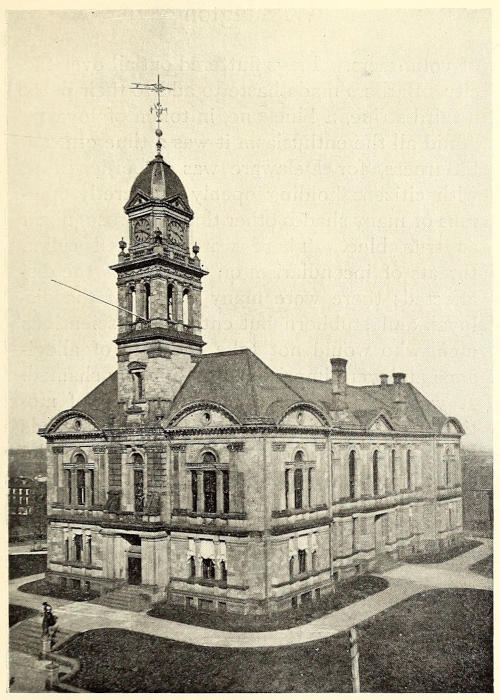
NEWCASTLE COUNTY COURT HOUSE.
The conflict found Wilmington a little city of rough-cobbled streets, the metropolis of a small surrounding territory, visited daily by country folk, who drove twelve or fifteen miles,—came “to town,” as the phrase went,—and having made their purchases, drove home, whipping in dread past “Folly Woods,” since the days of Sandy Flash a place of evil reputation. The firing upon Fort Sumter stirred the community to its depths, and the city lost no time in sending to the front more than her quota of volunteers. Flags fluttered out all over the city. Barbers made haste to add to their poles a third stripe, a blue one, in token of loyalty. Amid all the enthusiasm it was a time of acrid bitterness, for Delaware was a border State with citizens holding openly or secretly opinions of many shades other than that recognized as true blue. There were reported sullen threats of incendiarism on the part of the disaffected; there were many arrests of the disloyal, and stubborn but entirely conscientious men, who would not take the oath of allegiance and were imprisoned or publicly shamed. It was no time for a nice weighing of motives, and the fires of the war-time hatreds were nearly a generation in cooling. The city came out of the war chastened by sorrow and pained by bitter contention, but ready for a newer and broader life. She has since grown to 70,000 people. Her boundaries have been extended to the Delaware; her factories have vastly increased in volume and variety. Miles of territory have been covered with new homes. Water-works, sewers and parks have been created. New Castle, the old Dutch capital of New Amstel, has yielded up the court-house to Wilmington, but has held on to the whipping-post, as perhaps not quite in keeping with the modern mood of the city. But in spite of growth and change the old Quaker spirit, the ineradicable instinct of sobriety and decency, remains along with the Swedish and Dutch names two and a half centuries ago. When the hush of evening falls upon the city and the crowds have melted from the sidewalks, then in the dusk of the deserted streets one may easily imagine the distinguished William Shipley and the gracious Elizabeth, the grin of broad-faced Dutchmen fresh from the harrowing of Swen Schute, the spectral figures of tow-haired Swedish farmers, or the grave, black-clad form of Pastor Torkillius with solemn eyes bent upon wondering peasant lads and lasses.
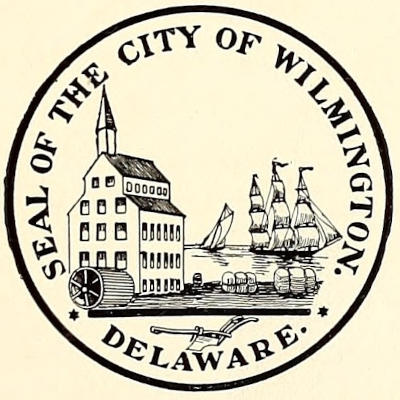
SEAL OF THE CITY OF WILMINGTON.