ALBANY
Reading edition
“This antient and respectable city.”—(Washington, 1782.)
By WALTON W. BATTERSHALL
Albany, unlike the proverbial happy woman, has not only age but a history. Its age is indicated in its claim to be the second oldest existing settlement in the original thirteen colonies. The claim is fairly sustained, but we must remember that the alleged discoveries and settlements of those nomadic times are a trifle equivocal. On the other hand, the historical significance of Albany is based on two unquestioned facts: for a century it guarded the imperilled north and west frontiers of Anglo-Saxon civilization on the continent; for another century it has been the legislative seat of the most powerful State in the Republic.
On the 19th of September, 1609, old style, the yacht De Halve Maen, six months from Amsterdam, in command of Henry Hudson, dropped anchor a few miles below the present site of Albany. Four days spent in the exchange of civilities with the Indians and the taking of soundings from the ship’s boat farther up the stream, convinced the speculative explorer that the beautiful river among the hills gave no promise of a water path to China, and the Half-Moon, freighted with wild fruits, peltries and pleasant impressions, turned her prow homeward.
From the Dutch and also the English point of view, the English skipper of the Dutch ship had discovered the river. It appears however that in 1524 Verrazzano put a French keel, La Dauphine, far up the same stream, to which he gave the name La Grande, and, some time after, French fur traders built a rude château, or, as we would say, fortified trading-post, on Castle Island, just off the hills of Albany. But the France of Francis I. had no colonizing grip, and La Nouvelle France was simply a name which stretched along the Atlantic seaboard on the French charts of the sixteenth century.
On the return of Henry Hudson, his discovery was claimed by his patrons, the Dutch East India Company. They named the river the Mauritius[13] (Prince Maurice’s River), and the outlying country, known as Nieu Nederlandt, had good report in Holland for its furs and friendly savages.
The Amsterdam merchants were alert, and other Dutch vessels, following in the wake of the Half-Moon, pushed up the river to the head of navigation. There they found on the west bank the Maquaas, or Mohawks, and on the east bank the Mahicans, or Mohegans, with whom they had profitable transactions.
To consolidate and protect their ventures, a group of merchants petitioned the States-General of Holland for the exclusive privilege of traffic with the aborigines on the river. The elaborate map of Nieu Nederlandt which they presented with their petition was discovered in 1841 in the royal archives at the Hague, and a facsimile is now in the State Library at Albany.[14] A license for three years was granted. Thereupon, in 1615, the ruined château on Castle Island was rebuilt, equipped with two cannon and garrisoned with a dozen Dutch soldiers. In compliment to the Stadtholder, it received the name of Fort Nassau.
This occupancy in force of Castle Island (now called Van Rensselaer Island) was brief, for the spring freshets proved too much for even the amphibious Dutch musketeers and traders, and it hardly can be called a settlement.
It is an interesting fact, that the valley of the Hudson narrowly missed the honor of being settled by the passengers of the Mayflower. Under the November skies of 1620, that historic vessel, with its valuable cargo of religious and political seed-corn, for several days had been beating about the point of Cape Cod. Old Governor Bradford, with quaint spelling and phrasing, tells the story of the mishap:
“After some deliberation had amongst them selves and with yᵉ mʳ of yᵉ ship, they tacked aboute and resolved to stande for yᵉ southward (yᵉ wind and weather being faire) to finde some place aboute Hudsons river for their habitation. But after they had sailed yᵗ course aboute halfe yᵉ day, they fell amongst dangerous shoulds and roring breakers, and they were so farr intangled ther with as they conceived them selves in great danger; & yᵉ wind shrinking upon them withall they resolved to bear up again for the Cape.”[15]
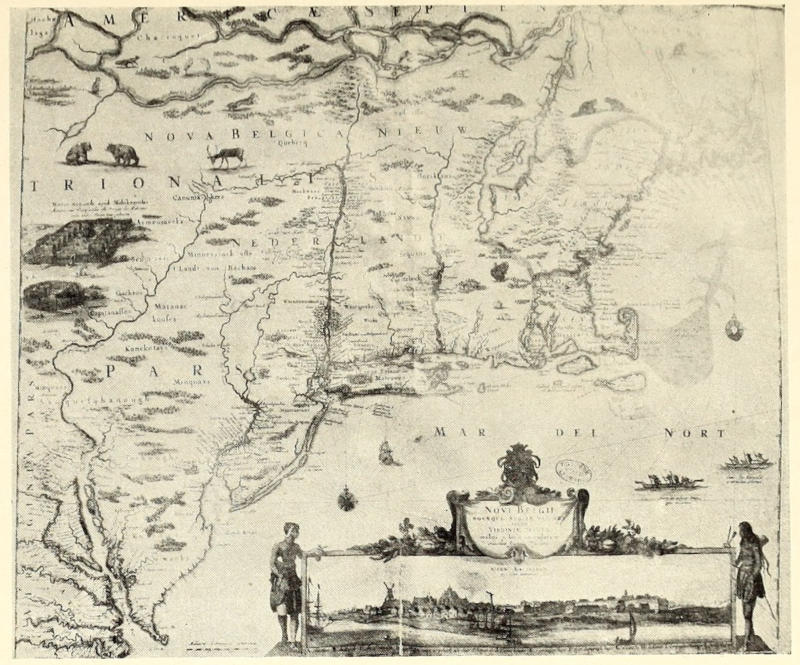
OLD CHART OF NIEU NEDERLANDT.
Thus Plymouth Rock became the intellectual door-stone of the New World, and the banks of the Hudson inherited one of the sad “might-have-beens” of history. However, Douglas Campbell, in his trenchant and disturbing book, The Puritan in Holland, England and America, has told us that the distinctive principles of our American social and political life show, on critical inspection, the Dutch hall-mark.
The America of 1621 was much more of a “dark continent” than the Africa of fifty years ago. The adjective applies both to the skin of the autochthons and the mind of the explorers. In the commercial circles of Amsterdam, Nieu Nederlandt was supposed to be a part of the West Indies. Therefore it was that the new company which was devised for its exploitation and chartered in the year mentioned, took the name of The Dutch West India Company.
Under its auspices, in March, 1624, the ship Nieu Nederlandt sailed from Amsterdam by the accustomed route of the Canary Islands for the Mauritius River. She carried thirty families, chiefly Walloons, refugees from Belgium who had settled in Holland, and a few Dutch freemen. Some of the families were landed on Manhattan Island, but the majority proceeded up the river and selected for their settlement the fat meadow on the west shore above Castle Island. Under the shadow of the clay hill on which the Capitol now lifts its masses of sculptured granite, they built rude huts sheathed in bark, and a little log fort which they named Fort Orange. The Indians were friendly and eager to barter, and enthusiastic reports were at once sent over to Holland, with corroborative otter and beaver skins.
Two years after this settlement at Fort Orange, the Dutch West India Company purchased Manhattan Island from the Indians for sixty guilders in high-priced goods and, planting a colony and fort on the south end of the island, brought up the population of Nieu Nederlandt to two hundred souls. The Company, desiring to stimulate colonization, in 1629 projected the manorial or patroon system; a combination of feudal idea and Latin name, patronus. Killiaen Van Rensselaer, one of the directors and a rich merchant of Amsterdam, at once obtained an extensive grant of land south of Fort Orange and, by the purchase of the land from the Indians and the planting of a colony, became the patroon of Rensselaerswyck. He never visited his “colonie,” but before his death in 1646, he had sent from Holland over two hundred artisans and farmers, and included in his manor a territory forty-eight by twenty-four miles, and also another tract of sixty-two thousand acres.
Thus Albany began with a Dutch imprint, which to this day has given to the city its distinctive mark. Forty years of Dutch sagacity and thrift rapidly developed the colony. It was on the whole a prosperous period, enlivened by chronic disputes between the garrison and the manor, and disquieting rumors regarding belligerent Indians and the French. It throws on a small canvas sturdy personages and stirring events. Brandt Van Slechtenhorst, the stiff upholder of the manor claims against the doughty Pieter Stuyvesant, the last Dutch Director-General; Domine Megapolensis, the first Dutch minister; and the flitting figure of the Jesuit missionary, Father Jogues with his hands mangled by the Mohawks and kissed by the Queen of France, would make any canvas picturesque. To take Washington Irving’s delicious bit of humor too seriously shows a melancholy lack of humor.
Certainly the Dutch burghers of Albany did not take very seriously the English occupation of Nieu Nederlandt in 1664. The seizure was colored by an old claim of uncertain dimensions based upon the Cabot discoveries, which for a long time had strained the relations between England and Holland concerning colonial matters. The capitulation was bloodless, and to Albany it brought little change, save that the English flag, in place of the Dutch, fluttered over the ramparts of Fort Orange, which took the name of Fort Albany in commemoration of the Scotch title of the Duke of York, the new lord of the province. The great manorial grant was confirmed, and in all its habits of thought and life the colony remained Dutch. The happiest change and perhaps the most startling shock came from the fact that the Duke of York, bigot as he was, broke the tradition of the period and introduced in his province religious toleration.
The English came, but the Dutch remained. The old Holland stock on the bank of the Hudson kept its root in the soil and has made vital contributions to the American hybrid, which have had scant recognition in our popular histories. The fact is, the Dutch were not given to writing books. They had fought for their religion and motherland, and had held them both against the assault of a powerful foe, but the recital of the story they left to the more expert tongues and more eloquent pens of Englishmen. Their type of character and social usage has proved its vigor and worth by its quiet persistence and dominance in New York life of to-day. In old Albany, even under English rule, ideas and customs which had their birth behind the dykes of Holland were conspicuously in the ascendant.
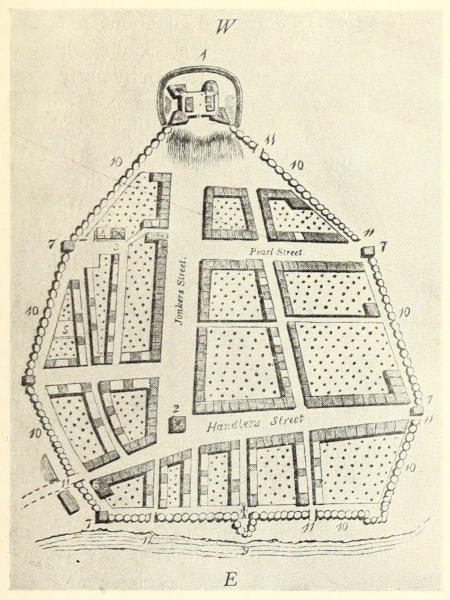
PLAN OF ALBANY, 1695.
Albany became a city in 1686 by a judicious charter granted by Governor Dongan. A diagram in the Rev. John Miller’s Description of the Province and City of New York, published in London, 1695, gives us an idea of the new-born city. It consisted of about a hundred houses surrounded by a stockade, which was pierced to the north and south by narrow gateways. Above the stockade the most conspicuous objects were the pyramidal roof of the Dutch church at the foot of Jonker Street (now State Street), surmounted by three small cannon, and, on the eminence at the upper end of the street, the bastions of Fort Frederick, which had inherited the responsibilities and honors of the dismantled Fort Orange.
For about forty years after the peaceful seizure by the English, the old Dutch church, where the prosperous burghers worshipped, and a Lutheran church of somewhat intermittent life but hospitable to outsiders sufficed for the religious needs of the city. The officers of the garrison, however, and probably most of the soldiers were Church of England men. There was much in the service of the Dutch Church of that day which must have suggested pleasant reminiscence. Christmas, Easter and Whitsunday were festivals brought from Holland, and were duly celebrated in the church and at the fireside. Queerly enough, in the accounts of Pieter Schuyler, the deacon of the Dutch church in 1683 and the first mayor of the city, we read that “the 13th of January was observed as a day of fasting and prayer, to divert God’s heavy judgment from falling on the English nation for the murder of King Charles, martyr of blessed memory,” and that the expenses therefor were seventeen guilders.
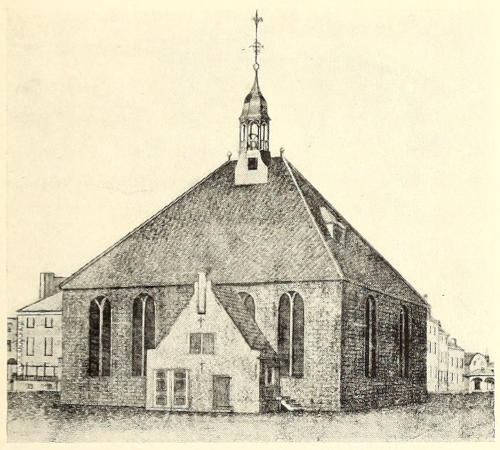
OLD DUTCH CHURCH, ERECTED IN 1715 ON SITE OF ORIGINAL CHURCH ERECTED IN 1656.
But the theological coin of the Synod of Dort, whether acceptable or not to the English, was more or less inaccessible, being hid in the napkin of the Dutch language. Evidently there was need of an English house of worship in Albany. In 1714, therefore, Governor Hunter issued letters patent granting a plot of ground in Jonker Street below the fort for a church and cemetery. The Common Council made protest. The point at issue was a question, not of doctrine, but of municipal rights. They issued notice to suspend the laying of the foundations. They arrested the workmen. They petitioned the Governor. They sent a messenger by express in a canoe to New York,—a journey in those days of such magnitude that the church was well under way by the time the return voyage was accomplished. Despite all obstacles, the work went on and in the course of a year the first English church west of the Hudson was built. The two churches, the Dutch at the foot and the English at the head of State Street, were the chief ecclesiastical landmarks of eighteenth-century Albany. Like rocks in a stream, they stood in the broad thoroughfare and preserved the magnificent approach to the future Capitol.
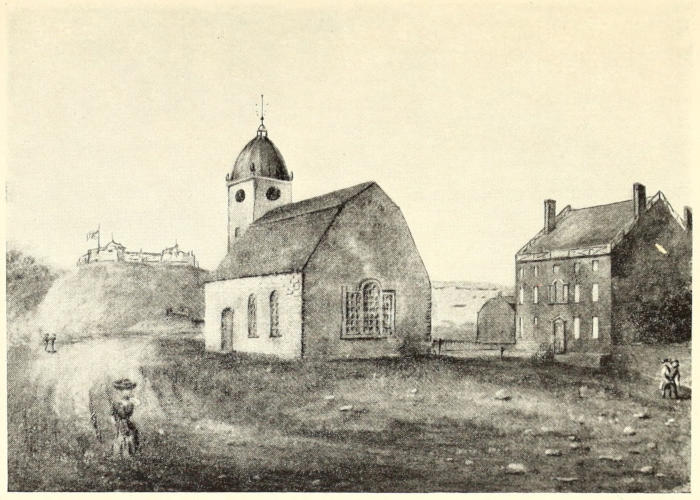
ST. PETER’S CHURCH, ERECTED IN 1715, FORT FREDERICK IN THE BACKGROUND.
(FROM A WATER-COLOR SKETCH IN THE BRITISH MUSEUM.)
Little as it was, Albany was the nest of important events and a maker of history in those troublous days. Second to New York in size and resources, it served as a wary sentinel and tremulous alarm-bell to the exposed province. For well-nigh a century, all beyond it to the west and north, except the hamlet of Schenectady and the French settlements on the St. Lawrence, was wilderness and savages. It occupied a post of the gravest peril and responsibility. We get a glimpse of the situation and of the current history in the scene on that Sunday morning, the 9th of February, four years after the granting of the charter, when Symon Schermerhoorn, shot through the thigh, told at the north gate of the stockade his breathless story of the night attack and the horrible massacre at Schenectady.
Between the hostile French in Canada and the little frontier city on the Hudson roamed the tribes of the Iroquois confederacy, upon whose friendship and fealty in large measure hung the destiny of the English possessions. The stockade, thirteen feet high, would have been of little account if that living bulwark of savage allies had yielded to the arms or the bribes of the French. That the bulwark did not yield, that the fealty of the Indians was won and, through every peril, kept unbroken, was owing to the sagacity and honorable dealing of the government and burghers of Albany. The House of Peace—this is the name which the Mohawk sachem, at one of the council-fires, gave to the Albany of those olden days, and, in the graphic phrase of his Indian oratory, he pictured at a stroke its political value and place in history; for there, by repeated formal treaties and habitual friendly intercourse, were riveted the “Covenant Chains” which made the confederation of the Six Nations the guardians of the feeble province.
There is a scene in The History of New York, by William Dunlap, which is illustrative. The date is 1746 and the central figure is the celebrated Col. William Johnson, Indian agent, whom George II. made a “baronet of Great Britain.”
“When the Indians came near the town of Albany on the 8th of August, Mr. Johnson put himself at the head of the Mohawks, dressed and painted as an Indian war-captain. The Indians followed him painted for war. As they passed the fort, they saluted by a running fire, which the governor answered by cannon. The chiefs were afterwards received in the fort-hall and treated to wine. A good deal of private manœuvring with the individual sachems was found necessary to make them declare for war with France before a public council was held. The Iroquois took to the 23d of the month for deliberation, and then answered, the governor being present.”
During the French wars, Albany, from a military point of view, was probably the most animated spot on the continent. It was the storehouse for munitions of war and the rendezvous for the troops. English regulars and provincial militia swarmed in and about the city. After the unsuccessful campaigns of 1756 and 1757, the town was filled with refugees, reciting the slaughter of the garrison at Fort William Henry, and the murder and havoc wrought by the Indians in pay of the French. Hundreds of loyal Indians, with their squaws and papooses, encamped under the stockade. The houses and barns were filled with wounded soldiers brought from the seat of war. In the pauses of the campaigns, notwithstanding the horrible rumors and actual disasters, the “dangerously accomplished” English officers made merry life in old Albany, picturesque details of which are given in that charming chronicle of colonial days, Memoirs of an American Lady (Mrs. Philip Schuyler), by Mrs. Grant of Laggan.
In the opening of the campaign of 1758 there was grief and consternation in the province. Tidings came that Lord Viscount Howe had been killed in a skirmish on the march against Fort Ticonderoga. The body of the brilliant soldier was brought to Albany by his friend, Captain Philip Schuyler, and was buried beneath the chancel of the English church. The stone recently unearthed in the village of Ticonderoga, which bears the inscription, evidently scratched by a knife or bayonet, Mem of Lo Howe killed Trout Brook, probably marked the spot where Lord Howe fell. There is abundant evidence that his body now lies beneath the vestibule of St. Peter’s Church. The Church Book of the parish contains the following entry: 1758, Sept. 5th. To cash Rt for ground to lay the Body of Lord how & Pall £5. 6. 0.
In the following year, the fateful victory of Wolfe on the Plains of Abraham gave Canada to England and ended the hard-fought duel between the Latin and the Anglo-Saxon for the sovereignty of the continent.
Some years before this, the Stadt Huys, the old City Hall of Albany, was the scene of a significant event which was the prelude of one still more momentous. There in 1754 Commissioners from the several provinces convened to renew the “Covenant Chain” with the Six Nations, and to discuss the best methods for uniting and defending the colonial interests. The foremost spirits and political prophets of the colonies composed the assembly. Numerous Indian sachems, with their stately bearing and barbaric splendor, decorated the scene of the deliberations. The “Plan” adopted by the convention was not accepted by the Crown, but it was the first attempt to articulate the idea of a colonial union, and it bore two names, Benjamin Franklin and Stephen Hopkins, which in due time were affixed to the Declaration of Independence.
Before the lightning flashed in the volley at Lexington, there were centres of influence throughout the colonies breeding storm. Albany was one of them. The heart of the old Dutch town was fired with the indignations and enthusiasms of the time. There were tories of course, but the temper of the city and the attitude of those who controlled the situation are indicated by the fact that, when the Province of New York had fairly opened the fight, the old fort on the hill was extemporized into a tory jail.
As early as November, 1774, the freeholders of the city appointed a Committee of Safety and Correspondence, which proved a vigorous agent in propagating the war spirit and furnishing men and money for the Continental army. The following names appear on its lists: John Barclay, Chairman, Jacob C. Ten Eyck, Henry I. Bogert, Peter Silvester, Henry Wendell, Volkert P. Douw, John Bay, Gysbert Marselis, John R. Bleecker, Robert Yates, Stephen De Lancey, Abraham Cuyler, John H. Ten Eyck, Abraham Ten Broeck, Gerret Lansingh, Jr., Anthony E. Bratt, Samuel Stringer, Abraham Yates, Jr., and Cornelis van Santvoordt. In the records of the committee occurs this significant minute: “Pursuant to a resolution of yesterday, the Declaration of Independence was this day read and published at the City Hall to a large Concourse of the Inhabitants of this City and the Continental Troops in this City and received with applause and satisfaction.”
At the beginning of, and all through the struggle for independence, Albany was a strategic point of the utmost importance. The war-office in London and the British commanders in the field recognized that it was the key to the situation in the north. There is a passage in the oration of Governor Seymour at the Centennial Commemoration at Schuylerville, the actual scene of Burgoyne’s surrender, which condenses and interprets one of the most important chapters in the history of the Revolution.
“It was the design of the British government in the campaign of 1777 to capture the centre and stronghold of this commanding system of mountains and valleys. It aimed at its very heart,—the confluence of the Hudson and the Mohawk. The fleets, the armies, and the savage allies of Britain were to follow their converging lines to Albany, and there strike the decisive blow.”
As sometimes happens, the blow struck the striker. Col. Philip Schuyler, the young officer who brought the body of Lord Howe to its burial, was an ardent patriot and the most distinguished citizen of Albany. On the recommendation of the Provincial Congress of New York, he had been appointed by the Continental Congress a major-general in the armies of the United Colonies and had assumed command of the Northern Department. He was displaced in favor of General Gates, but he retained the confidence of Washington, and it was he who planned and conducted the campaign which resulted in the victory of Bemis Heights and the surrender of Burgoyne. This event broke the formidable menace that hung over the province and the colonial cause. The defeated British general found himself in the hands of a courteous foe, and for several months he meditated and mitigated his disaster amid the elegant hospitalities of the Schuyler mansion in Albany.
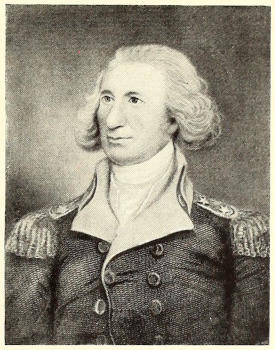
MAJOR-GENERAL PHILIP SCHUYLER.
(FROM A PAINTING BY COL. TRUMBULL.)
In 1797, “this antient and respectable city of Albany” (to quote the courtly compliment of Washington) became the capital of the State. At the close of the Revolution, New York had not yet determined its seat of government. From 1777 to 1796 it peregrinated between Kingston, Poughkeepsie, Albany and the city of New York. Not until the twentieth session of the Legislature was the long dispute settled. The geographical advantages of Albany finally carried the day, and for the last hundred years the site of the frontier fort has been a political arena and an illustrious seat of legislative and judicial power.
The Albany of “modern times,” as the phrase is understood in our American life in which everything is new except human nature, has preserved few of the ancient landmarks. The only souvenirs are the bronze tablets which were devised at the Bicentennial in 1886, and which now designate the historic sites in the city. If one, reverent of ancient and vanished things, make pilgrimage to the tablet near the curb on the lower edge of the Capitol Park (a block above the site of Fort Frederick), to the one on the corner of Broadway and Steuben Street (the site of the northeast gate), and to the one near the curb on lower Broadway two blocks from State Street (the site of the southeast gate), he will define quite accurately the girdle of the palisadoes which protected old Albany.
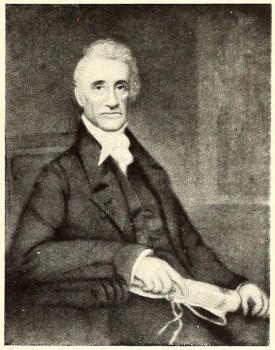
STEPHEN VAN RENSSELAER.
(FROM A PAINTING BY EZRA AMES.)
If he pass the memorial of the northeast gateway, a place of memorable outgoings and incomings, and continue up Broadway about three quarters of a mile, he will find a bronze tablet bearing the inscription: “Opposite Van Rensselaer Manor-House. Erected 1765. Residence of the Patroons. This spot is the site of the First Manor-House.” It was an unpretentious one-story building of Holland brick, half fortress and half dwelling. The final Manor-House, on the other side of the road, was a structure of another fashion. At the time of its erection, 1765, it was considered the handsomest residence in the colonies. Thither Stephen Van Rensselaer brought his young bride, Catherine, daughter of Philip Livingston, and his babe, who became General Van Rensselaer. It stood amid the drooping elms of a large park and was decorated with a taste and luxury startling to the period. In 1843 the building was enlarged and enriched by the elder Upjohn. Once a stately mansion, the scene of splendid hospitalities, it has shared the American fate of obstructive antiquities in thriving towns. The railroad and the “lumber district” crowded and finally strangled it. For several years it stood empty and dismantled, and obviously had outlived both its beauty and its use. In 1893 the stone and timbers were transported to the Campus of Williams College, where they were reconstructed into the Sigma Phi Society building, which perpetuates a remote suggestion of the famous Manor-House.
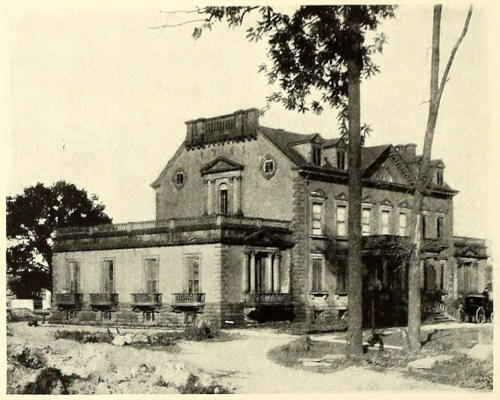
VAN RENSSELAER MANOR-HOUSE, 1765.
In the southern part of the city, on Clinton Street, is a bronze tablet which designates the sister of the Manor-House, the Schuyler mansion, built by the wife of General Philip Schuyler while he was in England in 1760. This historic relic stands on a plateau above the street, surrounded by a remnant of the original garden, but the broad avenue, shaded by elms, which once gave approach to the mansion from the river, is overgrown with houses. Though used at present as an orphan asylum under the charge of the Order of St. Francis de Sales, it retains substantially its original features. It is a dignified and spacious house; not remarkable architecturally, but fragrant with history. Here Burgoyne enjoyed his imprisonment. Here Washington, Lafayette, Count de Rochambeau, Baron Steuben, Benjamin Franklin, Charles Carroll of Carrollton, Aaron Burr, and other notable men of old were entertained. Here Alexander Hamilton and Elizabeth Schuyler were married, December 14, 1780. Besides famous guests and weddings, its chief feature of historic interest is the staircase, apropos of which, we quote from Mr. Marcus Reynolds’s article on The Colonial Buildings of Rensselaerswyck in The Architectural Record of 1895.
“Here is shown the famous tomahawk mark. In 1781 a plan was made to capture General Schuyler and take him to Canada. A party of tories, Canadians and Indians surrounded the house for several days, and at length forced an entrance. The family took refuge in the upper story, leaving behind in their haste the youngest member of the family, Margaret Schuyler, afterward the wife of the patroon. An elder sister going to rescue the infant, was pursued by an Indian, who threw his tomahawk at her as she fled up the stairs. The weapon entered the hand-rail near the newel, and the mark is still shown, which would be conclusive evidence if the same story were not told of the Glen house in Schenectady, the only house unburnt in the massacre of 1690.”
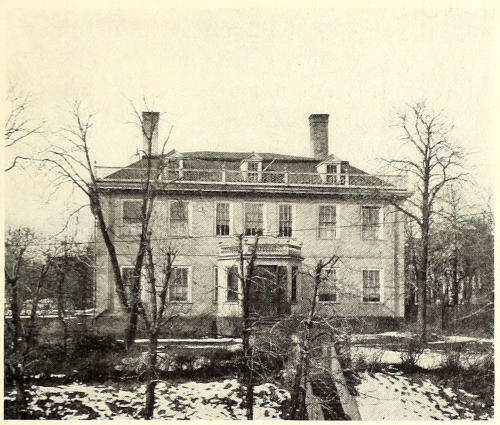
SCHUYLER MANSION, 1760.
With all its historic associations, Albany is not conspicuous for the scenery it has furnished for the enchantments of poetry and romance; still it is not altogether destitute of literary honors. Its colonial life figures in the Satanstoe of the great Fenimore Cooper and in Harold Frederick’s In the Valley. The Normanskill, which tumbles into the Hudson at the south end of the city, flows through the Vale of Tawasentha, the scene of Longfellow’s Hiawatha. The hills and forests about the city suggested many a delicate detail in the woodland rhythms of Alfred Street, who made his home and burial-place in Albany. Its old Dutch life with its sedate charm has been pictured by a living Albanian, Leonard Kip; and probably the house still stands on Pearl Street or Broadway, in which Henry James found the charming girl who stood for his Portrait of a Lady.
On the east bank of the Hudson, in old Greene Bosch, opposite the city, decays the dishonored ruin of Fort Crailo. The date, more or less mythical, is 1642. It was the headquarters of General Abercrombie, and in the garden back of the house a derisive British surgeon, Dr. Stackpole, composed the immortal jingle of Yankee Doodle. If, in 1800, one stood on the southeast corner of State and North Pearl Streets, opposite the famous elm which Philip Livingston planted in 1735, his eye glancing up the street to the north would be arrested by a picturesque relic of Dutch Albany, the Vanderheyden Palace. Of course it has joined the departed, but its ghost appears in Washington Irving’s Bracebridge Hall, and its old weather-vane now swings above the porch of Sunnyside.
Some of the colonial structures were fine and famous in their day, but in truth, in our American towns, imposing architecture is a thing of recent date. Few cities give more favorable sites for architectural effects than the three hills of Albany. It is not too much to say that the wealth and taste of its citizens have conspired with its peculiar advantages of position. The architecture of Albany has an exceptional value. The City Hall, with its Romanesque doorways and majestic campanile, is a fine specimen of the great Richardson. The Albany City Savings Bank, recently constructed, is a classical gem, inadequately set, but cut by a master hand. Its Corinthian monoliths and graceful dome satisfy the eye, and the whole structure is a suggestive instance of what trade can do in the interests of art.
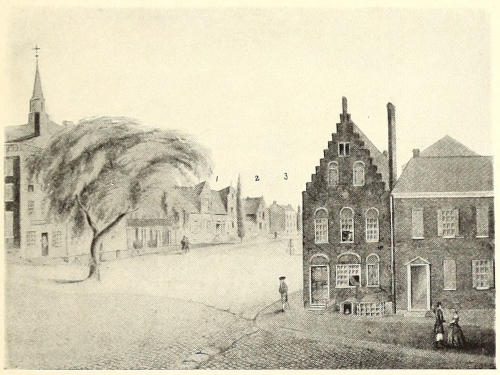
WEST SIDE OF PEARL ST. FROM STATE ST. TO MAIDEN LANE, 1814.
1. VANDERHEYDEN HOUSE. 2. PRUYN HOUSE. 3. DR. WOODRUFF’S HOUSE.
(FROM A WATER-COLOR SKETCH BY JAMES EIGHTS.)
The four examples of ecclesiastical architecture of more than local interest are the North Dutch Church, an exceptionally good specimen of the style which obtained in the beginning of the century; the Cathedral of the Immaculate Conception, with its lofty double spires emphasized by the site, and its spacious interior treated with taste and dignity; St. Peter’s Church, with its noble lines, artistic windows and finely detailed tower,—“one of the richest specimens of French Gothic in this country”; and the Cathedral of All Saints, whose unfinished exterior encloses columnar effects and a choir-vista which remind one of an impressive mediæval interior and give the edifice a distinctive place among the churches of America.
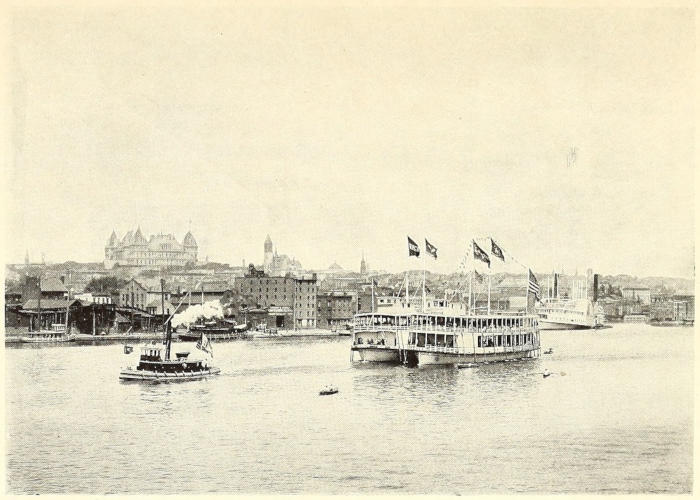
VIEW OF ALBANY, 1899.
These architectural monuments, however, and the city itself are overshadowed by the new Capitol. This massive structure, since its corner-stone was laid on the 24th of June, 1871, has absorbed over twenty millions of dollars. The enormous bulk, the difficult foundations, the obdurate granite, the elaborate sculptures, the mistakes and afterthoughts, sufficiently account for the money. The old Capitol, which stood in front of the southeast corner, well-nigh could be tucked into one of its great pavilions. The edifice is of such cost, size, and architectural importance, that one discusses it as he might discuss Strasburg Cathedral or the weather. Claiming simply the freedom of personal impression, one may say that its weakest feature is the eastern façade, which gives an inadequate suggestion of the size of the building and moreover is dwarfed by the projecting mass and lofty ascent of the gigantic stairway. He may also say that the Capitol declares its highest points of architectural interest in the constructive and decorative treatment of the interior.
The edifice has been built with the advantage of large ideas and limitless resources, and the disadvantage of fluctuating ideas and a succession of architects. These facts have left their imprint on the structure but, with all that can be said in criticism of details and of unused possibilities, it can fairly be ranked among the great buildings of modern times.
As one approaches Albany, the colossal bulk of the Capitol thrust against the sky seems to dominate the city as the great cathedrals of Europe dominate the towns that have grown or decayed under their shadow. But there are other structures and artistic things, representing the local life, that are worthy of remark.
The State Museum of Natural History, in Geological Hall, a block below the Capitol, vies with the State Library as a credit to the State and the haunt of the student. It is one of the largest and best arranged museums in the country, and its collection of the paleozoic rocks of New York, which figure so largely in the nomenclature of geology, is a monument to an eminent name in the scientific world, James Hall, late State Geologist.
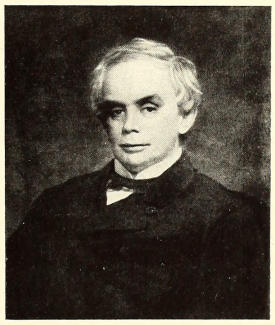
JOHN V. L. PRUYN.
Near the Capitol Park is the Albany Academy, in whose upper rooms Henry and Ten Eyck demonstrated the electrical facts which were applied by Morse. Up the hill, on the southwest corner of the city, stand the pavilions of the new Hospital, built in 1899, and the Dudley Observatory, of note in the stellar world. On Washington Avenue is Harmanus Bleecker Hall, built from the fund held in trust for more than half a century by Chancellor Pruyn and Judge Parker. On State Street opposite the Capitol is the building of the Historical and Art Society, which, though new-born, has already done valuable work in collecting sequestered relics of history.
Under the elms in Washington Park are two fine bronzes: Caverley’s statue of Robert Burns and Rhind’s statue of Moses at the Rock of Horeb. Fortunately one of the earliest and two of the noblest creations of the sculptor Palmer are in the city of his home: his Faith at the Cross, his Livingston, and his Angel of the Resurrection.
Albany the Old has become Albany the New. In many ways the new is more energetic and more splendid than the old. The town is large enough to show the characteristic features of our American life in its more sensitive and vigorous centres, and small enough to retain local color and distinctive traits. It is self-centred, believes in itself, and has the instinct to discern and the habit of demanding the best things. It is a place where the finest flavors of the old life linger in and temper the broader spirit and more robust movement of the new life; a place that perpetuates its traditions of social elegance and hospitality; a place, too, that has been the cradle and home of men of commanding force, who have contributed to the highest life of the nation and have left their names on enduring structures of thought and art and economic organization.
The city lies at the intersection of the great thoroughfares of traffic and travel in the richest and most densely populated portion of the republic. Its facilities for production and distribution may give it in the future an enormous industrial development. This fortune is not unlikely, but, to those who estimate in large ways the values of life, it cannot heighten the beauty or deepen the charm of the Albany of to-day.
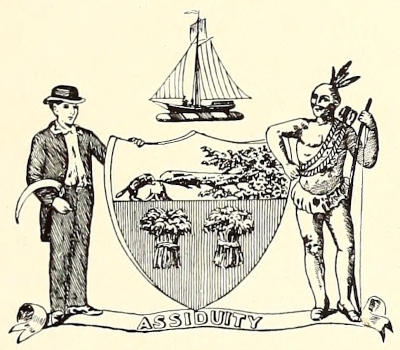
SEAL OF ALBANY.