PHILADELPHIA
Reading edition
THE CITY PENN FOUNDED AND TO WHICH FRANKLIN GAVE DISTINCTION
By TALCOTT WILLIAMS
Cities are of nature. Their long life flows in ways she has made longer than the changing rule of which they are part. Nations and boundaries are of man and his laws. Artificial creations all. Cities and their sites are of the same forces as form the rivers and ports, the passes and pathways on which they stand and last as long. Rome outlives its empire, and Damascus the shock of massacre from Chedorlaomer to Timur. The cities of Europe are still where they were twenty centuries ago. The civil structure into which they fit has changed until nothing is left of what once was. These things are missed in the general. They come to be seen in the particular.
Philadelphia stands, and necessarily stands on the straight, ruler-like “Falls line” which passes through every city site from New York to Montgomery, because this prodigious slip changes river navigation wherever it crosses a river valley. Where marine navigation stopped to-day and then, Penn put his city, its site a peninsula about which two rivers joined, a rich alluvial plain, covered with glacial clay, with schistose rocks cropping out across it, the palæozoic marble of the Atlantic coast hard by, and a strip of green serpentine crossing the country from the highest points in the future limits of the city to Chester County, its first granary and feeding ground. These things—the half-sunken Lower Delaware River spreading into Delaware Bay, the term of navigation at the junction of two rivers, and the abrupt approach to the sea of a formation elsewhere miles from the ocean—make Philadelphia all it is in outer look, a flat city built of its own clay, garnished with its own marble, a seaport knowing the sea only in its rivers.
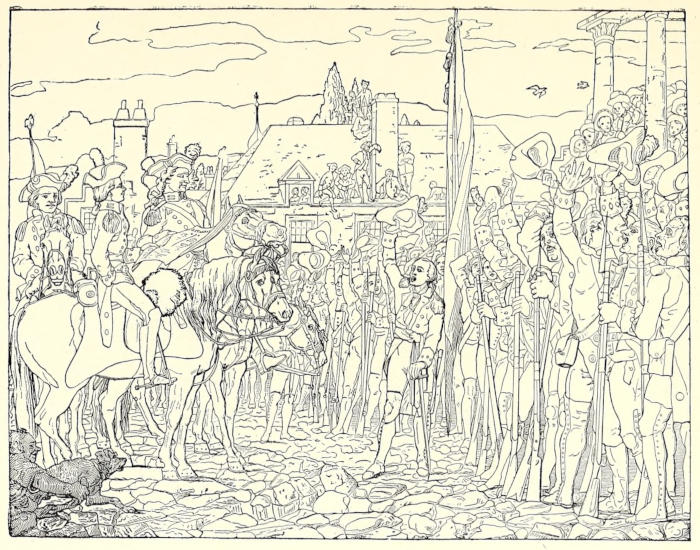
READING THE DECLARATION OF INDEPENDENCE.
FROM AN OLD FRENCH PRINT.
In this inland port, as you float in either river, seafaring masts and main rigging, black and tarred, silhouette against the tender green of growing fields. The early houses were brick of the glacier’s leaving, matching London in color; for both are ground out of the same earth mill. Its early stone houses were of the narrow contorted gray schists, and marble quarries had been opened, exhausted and closed to trim the brick before the Revolution. Later these were varied by the green serpentine, a hideous, dull color, the red sandstone of the fertile inland plains, and at last, as railroads made it easy to seek a door-step 1,000 miles away, the marble of Vermont built the City Hall, the granites of Cape Ann the Post Office, and Ohio ashlar a growing number of private homes, matching London once more as a close congener of the Portland stone Penn saw builded into St. Paul’s. The outer resemblance to London noted by Matthew Arnold and many an one besides, rests, as such things do, on concrete fact.
William Penn in 1682 came into no empty Western world. The Dutch and Swede had been entering these waters for near a century. They were charted, tracked and known. Uneasy frontier alarms were over. Farms dotted all the region. For the first time, in Fox’s Journal, a decade before Penn, we catch the accent and atmosphere of the American settler living lonely and safe. He was as yet neither of these in New England, New York or the Southern States. The Swedes had left their work in Swedes’ Church, with its timber, roof and tower recalling North Europe, as its carved angels do the wood sculpture of the pine forest. There was a tavern, the Blue Anchor, possibly (not probably) still standing, waiting for Penn at the little boat harbor, now Dock Street. A thriving commerce of a ship a week was already busying the river with its boats. On the crest of the low hill that rose from this boat-haven, Penn planted the house which now stands in the Park. On this crest ran Market, and where the land began to dip to the Schuylkill, Broad Street crossed, the first streets to be run by the prospector and real-estate speculator, on a plan by whose geometrical extensions both are still guided, in these days of new boulevards in old cities the oldest and least changed of any city plan in civilized lands. On this background of growing farms and frequent vessels, Penn sketched the Commonwealth. He and his were fortunate in his bringings. He came from Central England, that central mark and beach line from which so large a portion of the worthier of the race spring. He drew his settlers in the north of the kingdom from the line of Fox’s trips, whose Cumberland and Lancashire converts dotted the region about Philadelphia with names familiar in his Journal, Lancaster, Swarthmore, Merion, and Haverford. All South England had been stirred by Monmouth’s Rebellion and the Revolution, the work of the South as the Commonwealth had its leader in the North. Philadelphia, therefore, drew chiefly from Saxon, and less from Danish or Celtic England, than had New England. Its leaders came from the thrifty business classes of London, “city” people, instead of from the gentry as had Virginia’s. Ten years later, Louis was harrying the Palatinate, and a German population, skilled in the mechanic arts, came and gave Philadelphia its manufacturing foundation. Penn was pietistic, his mother was from Holland, and this gave him continental acquaintance and sympathy with continental dissent, which later brought the Moravians and gave the colony relations with Central Europe, an early and prolific press, and patience with political oppression, a dubious virtue still surviving.
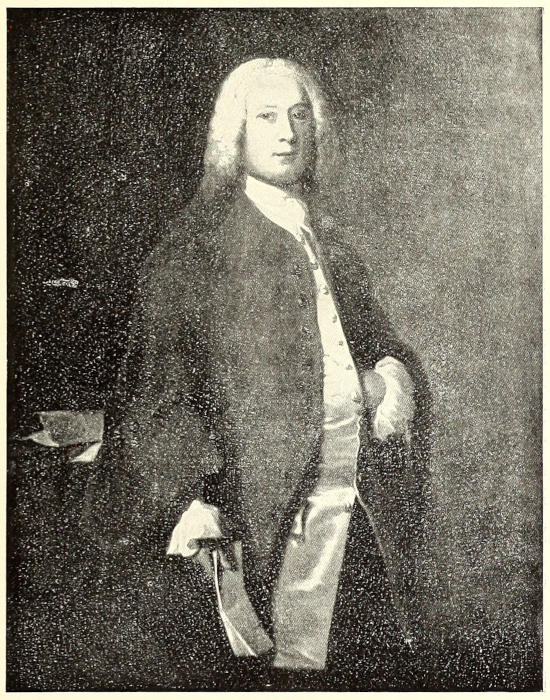
THOMAS PENN.
FROM A PAINTING OWNED BY THE HISTORICAL SOCIETY OF PENNSYLVANIA, AND COPIED BY M. I. NAYLOR FROM THE PORTRAIT IN POSSESSION OF MAJOR DUGALD STUART.
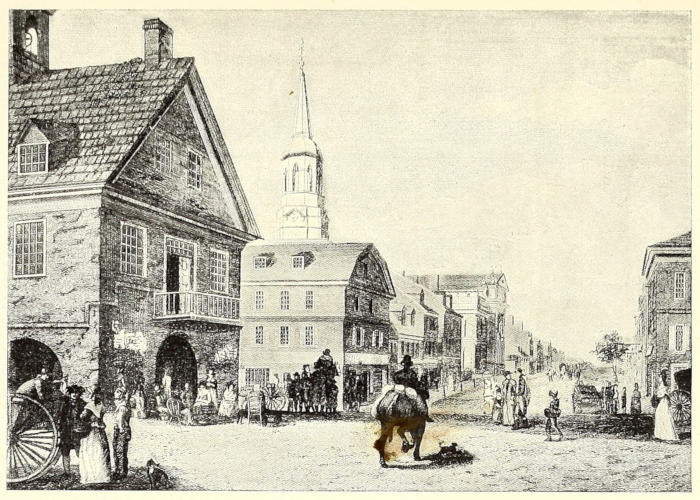
SECOND STREET, PHILADELPHIA, SHOWING THE OLD COURTHOUSE ON THE LEFT.
FROM AN ENGRAVING MADE BY BIRCH & SON.
The town grew like a weed and as rank. Grain was cheap, thanks to the limestone plain just beyond the low primitive rocks. Trade flowed in from the West Indies and Europe. In thirty years the place was bigger than any in the provinces. The Proprietor’s square house set the fashion, built from imported brick. Farmsteads on the road out to the German town of the new immigrants were built of the gray schists of the region. Ship-building began. Pirates lurked in the river below. The Proprietor’s official residence, now gone, fronted on the fouling pool where boats came, and matched the English country-house of South England. A little State House, which closely resembled in outer look the market-house of the same period on Second Street to the south, was built on Market Street, near the open rising ground on which Letitia Penn’s dwelling stood. Merchants’ homes were on its low hill; some of those still there are probably of this period when of imported brick. There is a row of houses on Swanson Street recalling the mechanics’ homes. In green quiet still held, the Friends’ meeting-house was erected—the present building far later. Low houses and warehouses clustered about what is now Dock Street—probably not one left. The swarm of some two thousand houses stretched along the river for what is now a square or two. Beyond were a few fields. Dense forests stood to the Schuylkill, and crowned all the little hills about, save that Fairmount stood bare, as is indeed the fashion of the sterile, rocky height. Schools were opened, of which one survives in the “Penn charter” school on Twelfth and Market. The city began its chartered existence, and the portraits of its first mayors, whose descendants are still part of the active life of the city, recall those of Guildhall, not as with like New England iconography, the Puritan remonstrants of James and Charles. An almanac was issued from the press of Bradford, whose solitary copy in the Historical Society begins printing for the State. A polyglot literature was in progress, apparent in more than one collection. The long, low, brick-built town left its image in 1720 in the picture in the entrance of the Philadelphia Library. Market stalls filled the river end of the street to which they gave a name, and these the civic organization, the peak-towered State House, the courts, the brick houses, the Proprietor’s residence, the city ordinances, the entire machinery of life, followed and imitated as closely as might be, on the edge of the wilderness, the market borough of an English shire. The town had had its first big boom and was near wallowing in its first reaction,—houses empty, more money in demand, debts oppressive, and all hope gone, when (1723) the great genius, Benjamin Franklin, who was to be its second founder and save it from Friend and Precisian, Palatinate Dutch, German, and Pietist, walked up Market Street and turned down Fourth in early morning. He was to give Philadelphia its better civilization. For near seventy years, he was to be, so far as the civilized world was concerned, the city and all in it worth knowing. By supreme good fortune all his past, or at least as much as it is desirable to know, is laid bare to the visitor. The houses in which he is said to have had his lodging as apprentice—old enough for this, at least—look down from Lodge Street on Dock Square. His old home on Market, between Third and Fourth, is long since gone, but it stood back from the street and was doubtless of the type of the roomy old houses now on Third south of Walnut, or the house of Hamilton in Woodlawn Cemetery. The letter-books of Franklin, with his correspondence for over twenty years, are at the American Philosophical Society which he founded, which first commemorated his death, and, a century later, the centenary of his obsequies. The best of his portraits is there, Houdon’s bust of the old man, and the roomy-seated chair of “Dr. Heavysides.” His dress buckles are in the Historical Society, and the teacups over which he bowed his compliments, and some speeches which Madame Helvetius rightly held more dearer than compliments, frowsy as Mrs. Adams found her. There, too, is the dubious portrait, which, whether it is Franklin in his youth or no, looks the youth of his male descendants. Part of his electric machine, and his printing-press, are in the Franklin Institute, part in the Philadelphia Library, which he also founded, and a Leyden jar, perhaps of the great experiment, at the American Philosophical Society. The fire-bucket of his company, and the sword he wore in his brief but not inglorious military service, are in the Historical Society. One probable site of the field in which he flew his kite is filled by the present Record building. His statue is on the front of the library at Juniper and Locust; another—worthy—is to the right on Chestnut Street, looking on the flow of men and women in the city life he loved, for in the country he never willingly spent a day. Not a stage of his life but can still be followed by the historical pilgrim in Philadelphia. He can follow in Franklin’s steps,—the steep slope up which he walked to enter—with old landing-stairs still in place south of Market—the Fourth Street corner, the site of his job office, the purlieus of Dock Street, from whence came the mire that never quite left his garments, the lots of the Market Street home where his better years were passed, his pew at Christ’s Church, the State House he entered for a half-century in so many capacities—King’s officer, contractor, colonial legislator, rebellious congressman, signer of the Declaration and Constitution,—his eye through all the years on the gilded sun one can yet trace on the back of the President’s chair—and last, when his own sun was at its setting, as member of the Constitutional Convention of his own State, and his modest grave at Fifth and Arch, where one may still uncover at the last memory of the most human of all Americans. Most of us, least of other lands, prefiguring in life, work, and character our invincible patience, our good humor, our quenchless curiosity, our careless disorder in trifles, our easy success in serious affairs, our sluttish phrase, our high spirit, the even equality of our manners, our perpetual relish for the simple environment and the homelier joys of our life, our neglect of means and detail, our perseverance and achievement in the final end, our self-consciousness and our easy conviction that neither fate itself, nor our own careless disregard of a less wise past, can rob us of our appointed place in the advancing files of time.
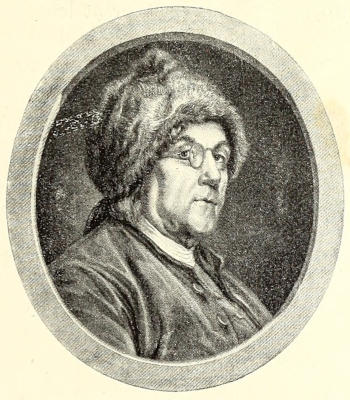
FRANKLIN IN 1777.
AFTER THE PRINT REPRODUCED FROM THE DRAWING OF COHIN.
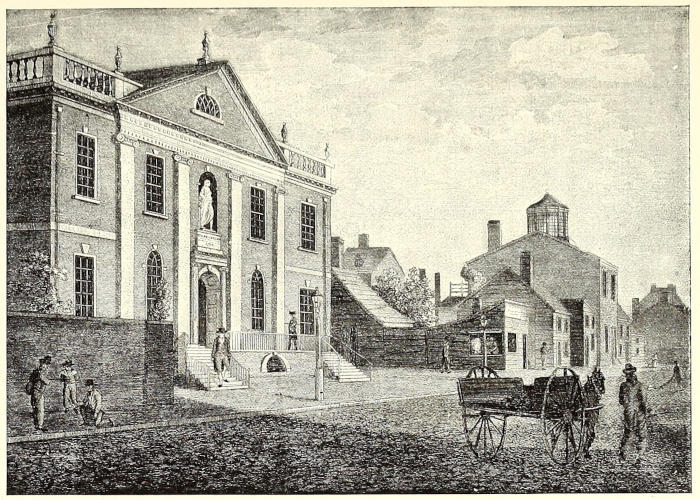
THE PHILADELPHIA LIBRARY.
THE OLD BUILDING ON FIFTH STREET, NOW DEMOLISHED. FROM THE ENGRAVING BY W. BIRCH & SON.
Franklin’s busy march through these streets bridged two great periods. His half-century before the Revolution, fifty-two years from his landing to Lexington, was a season of prodigious material expansion whose signs are all about the city. Then were built those pleasant places in the Park, and homes like that of John Penn’s in the Zoölogical Garden, ending in the privateer’s house which was later to be Arnold’s headquarters, to-day Mt. Pleasant. John Bartram built his stone house, set up its pillars and laid out his Botanical Garden, both happily standing and city property, his cypress alone dead,—slow failing through the years in which one lover has each spring sought it,—but much of his sylvan wealth remains, still a record of his science and of the economic conditions which gave him means for his long and costly trips. For when there were neither roads nor railroads the “distance-rent” of farm land near a city was enormous. The farm hard by swept in all the profit of days of teaming of which the railroad has long since robbed it and diffused it over a wide area, levelling up, as is our American way. The home, the life, the leisure, the acquaintance and the society possible 150 years ago to a man who farmed suburban acres are all attested when you stand in Bartram’s garden by the river on the gray rock of the only rock wine-press this side of the Atlantic, and remember that on this curving path Washington, Franklin, Hancock, Rittenhouse, Morris, and Kalm, and a score more of the century’s great, supped in the cool, open evening with a host whom the first two found at a sudden coming bare-headed, barefooted and plowing. The Revolutionary houses of the environs tell of the farm-profits of this period; so do the “clasped hands” and the “green tree” on the fronts of the olden homes—few or none dating back of the Revolution—which record the organization of rival insurance companies; the earliest building of the Pennsylvania Hospital on Pine with quaint old-world aspect, the little strip of wall at Tenth and Spruce, once part of the almshouse which Longfellow blended with the hospital in Evangeline; Carpenters’ Hall, the only Guild house in the colonies; the bit of wall still standing of the brewery at Fifth and Wharton; of the first play-house in the city and, most important of all, the two chief colonial monuments of the city, Christ Church and Independence Hall.
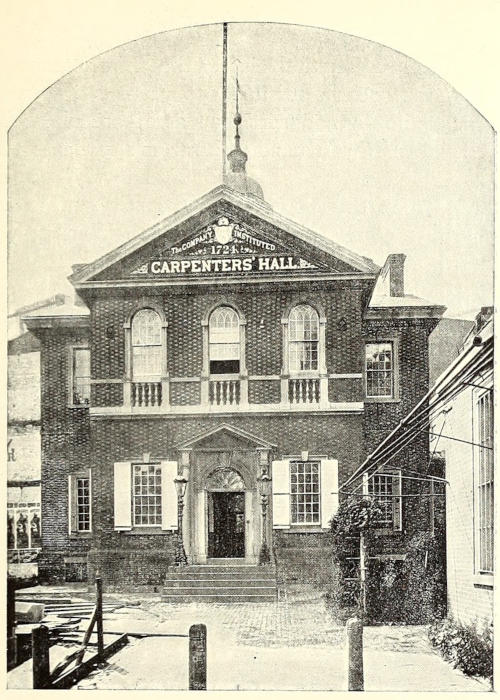
CARPENTERS’ HALL, PHILADELPHIA.
WHEREIN MET THE FIRST CONTINENTAL CONGRESS, 1774.
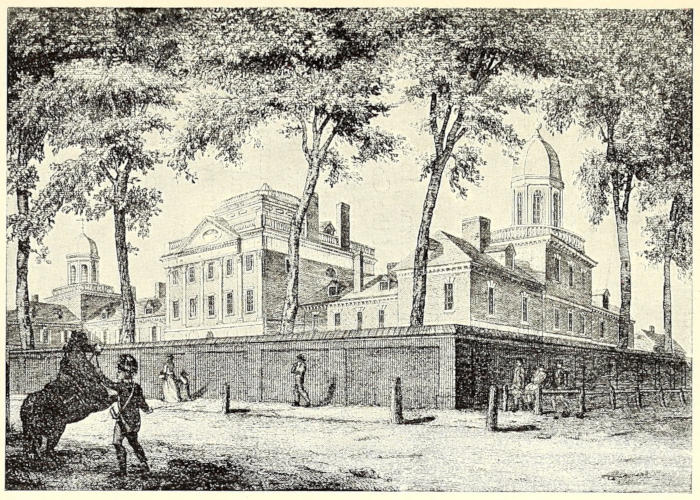
THE PENNSYLVANIA HOSPITAL.
FROM AN OLD ENGRAVING BY W. BIRCH & SON.
These buildings mark much. The city from a mere “Front” Street on the river, and two behind it, had grown up to Seventh and Eighth in a half ellipse which ran in thriving homes from Kensington, grew thronged about Chestnut, now passing Market in the race,—so that Market and Arch have the oldest house-fronts to-day,—and then thinned out again towards the scene of the Mischienza. In this area are scattered the mansions of the Colonial and immediate post-Revolutionary period, with Mrs. Ross’s house on Arch Street as type of the mechanic’s dwelling of the day, happily preserved and now bought as a memorial of the flag first made there. Beyond them begins the modern city of this century, of machine-made brick, of lumber sawed by steam, and house plans fitted to the growing value of the city lot. The growth which thus expanded the city of Penn into the city of Franklin was no mere accretion of population. It came of a profitable trade, of a share in adventures by sea and land, not always legal, and always dangerous, and of a close connection between the merchants of this city and those of London, from which the ancestors of more than one Philadelphia Friend were drawn, for Penn had borne his testimony in the Grace Church and Wheeler Street meeting-houses in London. When the richer men of the city came to erect its chief church, it was Gibbs’s St. Martin in the Fields which suggested the interior of the building on Second Street, and it was London brick architecture which was followed in Independence Hall and its open arches,—now restored,—despoiling the record of recent history to decorate and sometimes disfigure an earlier period, as is the manner and method of restoration the world over. These buildings in their size, their grace, their Georgian flavor, their cost,—for both were extravagant as times then went,—stood for an opulent mercantile connection between the metropolis of colonial and of royal England, a connection never quite lost, as the resemblance of the younger city to the older has never quite vanished. New York suggests Paris in spots, but no Philadelphian in his wildest flight ever thought that Philadelphia did.
When the Revolution came, Philadelphia sacrificed its English trade as promptly as ninety years later the city, loyal to its principles, sacrificed its Southern trade, and in both times and both sacrifices New York lagged to the rear in action and came to the front in assertion. Independence Hall still looked out on green fields to the west, and Rittenhouse’s little observatory—earliest of American star-gazing spots, whose telescope, earliest of our astronomical instruments, is in the American Philosophical Society—still stood in the square where Howe’s artillery was to be parked. The jail of “Hugh Wynne” was on the southeast corner of Sixth and Chestnut, on whose site Binney’s home was to stand later, the hero of another struggle for freedom. In the northeast corner of Washington Square was the potter’s field, last opened a century ago for yellow-fever victims. The house, Dutch built, and hence close to the street edge, in which Jefferson was to write the draft of the Declaration, preserved by the American Philosophical Society, was on Seventh and Market, its commemoration tablet on the wrong lot. A tavern fronted the Hall, and its stables ran opposite to the main door, its flies worrying the Continental Congress on a hot historic afternoon. The sharp rise which still ascends between Callowhill and Spring Garden was crested by the British works, of which the first was at Second and Poplar. From the Market Street Bridge it is still possible to make out the hill on which Hamilton planted his field-pieces to engage the British tête-du-pont, held by the 72d Highlanders. The Hessians camped in the open space at Gray’s Ferry, as the bridge of many years is still called. The stately house which held the Mischienza has disappeared only within a few years. The houses on the main street of Germantown still bear the mark of the battle, and look unchanged on the street whose fogs still veil it as on the day of conflict. The city now had from the river the sky-line which it substantially retained up to twenty years ago, when the steeples and the towers the Revolutionary period knew were dwarfed by the many-storied steel frames of to-day.
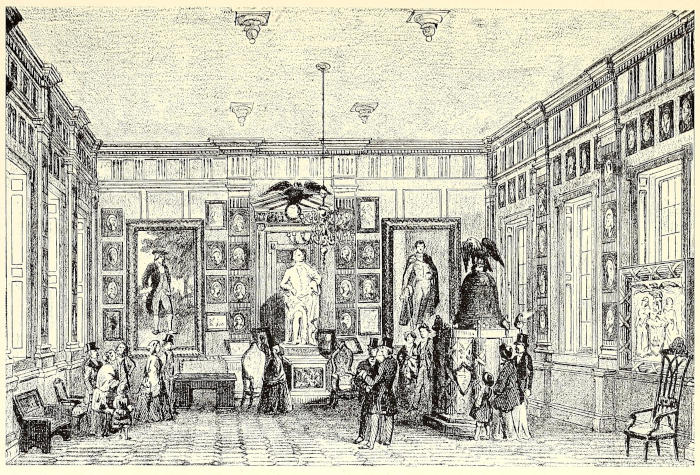
INDEPENDENCE HALL, PHILADELPHIA, BEFORE 1876.
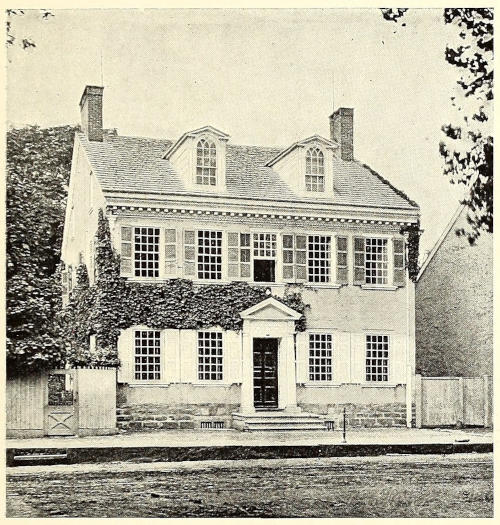
THE MORRIS HOUSE, GERMANTOWN, PHILADELPHIA.
The returning tide of prosperity after the Revolution has left one mark in the Morris dwelling on the south side of Eighth, between Locust and Walnut, type of the wealthy home of the day. The biggest of the period was Robert Morris’s, on the site of the Press Building, left as his “folly.” The peak-roofed house in roomy squares now gave way for thirty years to the house built flush to the street, which in the generation between 1790 and 1820 spread the growing city up to Tenth Street or so, and of which many are left. With this growth dwellings pushed beyond South on one side and beyond Vine on the other, the fringe of the city limits becoming an Alsatia still apparent, mechanics’ homes crowding just beyond as they still do, until met north and even south by more pretentious dwellings. In this thirty years the city grew from 42,000 to 108,000, and it faced first the problem to which only the American and Australian city has proved fully equal in all the round of semitropical summers north or south of the equator. The city, as it inherited from England its city government, had also inherited from there its well-water supply, its surface drainage, its slovenly streets, its practice of crowding the homes of the poor on back lots, so as to fill the area on which they stood with unsavory wynds, and its habit of intramural interment and intramural slaughter-houses, all which, even the Latin cities of two thousand years ago, taught by hotter summers, had outgrown. In the tepid temperature and light but even rain-fall in England these worked few ills until the middle of this century. Under our torrid summer, our tropical rain-fall, and our swift changes, all these things meant disease and death, and the unconscious problem which faced the city a century ago and left its mark on the map was recorded in yellow fever, born of water-supply and filth together with overcrowding, and all the evils of bad water and overcrowding.
Water-works were at last built, the most considerable then known, their site where the Public Buildings stand and their picture in the Historical Society; a systematic street scavenging began, building on the back of lots was prohibited, years before New York, and two generations before the European city; a fixed yardage, small, but sufficient to transform the city map, was required of each dwelling; paving and sewerage commenced, the almshouse was moved, a city hospital was established, and a most important legal decision made easy the purchase of house lots by the poor and frugal. The solution was not complete. Typhoid lurks where yellow fever once raged, but crowding was prevented and the city has no slums in the region outside of the area which has been built over since the ordinances of the first twenty to thirty years of this century stopped overcrowding and saved its poorer citizens from the awful fate inflicted by the titled avarice and civic mislegislation of London and Glasgow. Nor ought any one to look across the Schuylkill from the Zoölogical Garden at the lovely and related group which houses the Fairmount Water-works without a thrill of pride that this was the beginning of the problem of preserving health in heat and rain, which since the world began had meant pestilence to the city in like climes. As is the American habit, the supply looked first to quantity, and later to quality; and as is also the American habit, both will be secured in the end. So the large provision for the almshouse of seventy years ago has given the space for the University and its buildings, its cognate institutions, hospitals and museums, taken collectively, one of the most liberal grants made by any modern city to the work of higher education not under its own control, a grant which owed its initiative and early success to Dr. William Pepper, whose statue overlooks the site he secured to learning and to science. There the University has grown, covered its site with a score of buildings, added department to department, doubled its students in a decade, received more in gifts under its present Provost, Mr. Charles C. Harrison, than had come to it in all the century and a half of its history, knit the community to it and given it intellectual leadership by a group of affiliated societies, linked itself to the public schools by municipal scholarships supported by the city, opened courses for teachers, spread its lectures over the State and in all ways made itself not only an institution of learning for students, but of teaching for the community.
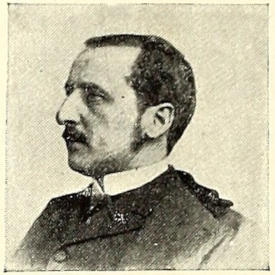
DR. WILLIAM PEPPER.
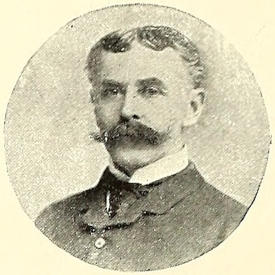
FRANK THOMSON.
The development of civic institutions in the first quarter of the century was accompanied by the founding, each to-day housed in conspicuous recent edifices of the past decade, of State-aided institutions for the Deaf and Dumb, 1820, for the Blind, 1833, and the House of Refuge, 1828. This philanthropic impulse came, as such generally does, as part of a rapid material development which, in a score of years ending with the commercial crash of 1837-39, had laid the foundations of the manufacturing activity and the internal commerce of Philadelphia. It was in this period that the Music Fund Hall (1824), Eighth above South, was built. The Exchange, 1832, the most pretentious building of its day, was erected near the close of the period, and the pillared row, following a London model, was built on Spruce between Ninth and Tenth, the largest and most costly private dwellings of its day. The next Colonnade row, nearly twenty years later, occupied the site, and gave the name to the Colonnade Hotel, Fifteenth and Chestnut. St. Mark’s and St. Luke’s stood for opposite extremes of the church edifices of the forties. The taste of the Federalists and Whigs of the day filled the city with the pseudo-classic, from which Europe was just departing—the United States bank, now the Custom-house, the Mint, the building in which Girard had his bank, back of the Exchange, and lastly Girard College, not easily forgot, however unfit for its purpose, if once seen from St. George’s hill on its airy height. The ship-building firm of Cramps was established 1830, and Baldwin’s Locomotive Works 1837, both products of the same period of activity. Ten years later began the Pennsylvania railroad comparable to a kingdom in revenue power and the ability of chiefs like Frank Thomson. The city flowed across Broad Street, and solid blocks pushed their way in brick and white marble, turning later to New York’s brown-stone, up each flank of the city on Pine and on Arch, spreading out in an area beyond Broad Street, which the crash of credit, and the failure of the State for a season to pay the interest on its bonds, left tenantless, often roofless, covered with mortgages and the prediction, heard first under Governor Keith, 1725, repeated within this decade, that the city would never need the houses which a boom had erected.
The city of the period before the war had now been built and the suburbs had grown close to the consolidation of 1854. Railroad access had created, across the Schuylkill, the village of Mantua, which was to become West Philadelphia as it extended southward and was reached by new bridges and street-car lines. To the north, just beyond the old British redoubts, factory owners, managers and foremen, mechanics and operatives, with the retailers they required, had built their homes on the higher ground, north of the great industries growing on the low and lightly taxed land, easily accessible by railroads from the coal-fields, beyond the old city limits at Vine, and extending to Callowhill and beyond. This created the city of Spring Garden. The river settlements, the Northern Liberties, Kensington, Richmond, grew under the triple influence of manufacturers and cheap coal, out of the villages whose farm-houses, taverns and mechanics’ dwellings of the early years of the century still dot the raw newer dwellings of the past forty years. Like settlements had grown in Southwark and Manayunk. The gaps and sutures still remain to mark the old divisions. The squalid stretches of South Street from river to river, for nearly a century the resort of cheap stores which sought city trade, and avoided city taxes. The like ragged selvedge along Vine, influenced, too, along much of the line by low, open ground. The gap fringing both banks of the Schuylkill, marking days when the railroad and the Market Street bridge made the more distant uprise of Fortieth Street more accessible than the lower region nearer. The bare and vacant patches about Germantown Junction, over which the old village has never quite grown down to meet the approaching city, where for various reasons of grade, access was not easy, and where institutions like Girard College and the Penitentiary, with a cemetery or two, like rocks in a moving stream, have stopped and divided the glacier-like spread of the city. These things have made Philadelphia, like London, a city of accretions from divers centres, and not, like Paris or New York, a steady, symmetrical and continuous growth from one organic centre.
The war found a city which, united, had more than the area of London (Philadelphia, 82,807 acres; London, 74,692), and at almost every stage of the growth of the two a quarter of the population of the vaster metropolis. Since room is the chief factor in civic comfort, there has never been a year in which the average man has not been just about four times as comfortable in Philadelphia as in London, and he has always had higher wages by a quarter to a half, paid less for food and lodgings, and paid more for clothing, light and coal. He has lived here, a family to a house, where a quarter of London has been a family to two rooms. Most of all, for twenty years past has this growth of the small houses of labor gone on, their number swelling faster than the tale of families seeking them. These conditions, secured by a wise civic policy early in the century, had reached the full development, which they have since maintained, at the opening of the war. Inexpressibly dull was the extension the city now made, the dreary reaches of homes, which oppress the stranger west of Eleventh Street, and appear in unvarying blocks on the North and South Streets, the building operations of the ’40s and ’50s, in whose even rows were the last, worst expression of the dull, utilitarian spirit of the pre-war, pre-centennial period. Napoleon LeBrun built the Cathedral and the Academy of Music, a brick shell holding a shapely and grandiose interior, and Walton and McArthur added to the pseudo-classic. When the Jayne Block went up on Chestnut, east of Third, it was believed to be the largest single business building yet erected on the continent. The Girard, 1852, was one of its largest hotels, and echoed the Italian palace front which Barry had taught London in his Reform Club.
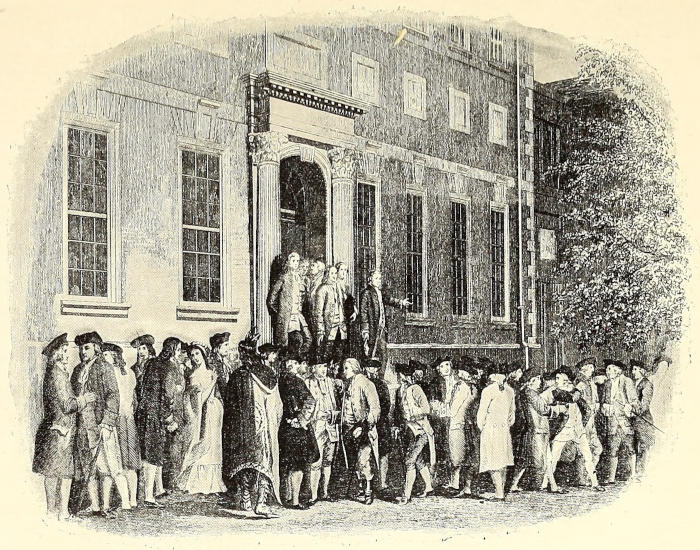
THE ANNOUNCEMENT OF THE DECLARATION OF INDEPENDENCE.
STATE HOUSE, PHILADELPHIA.
The development in manufactures after the war, railroad expansion and the somewhat deceptive prosperity of the Centennial gave the city the same sudden burst which Chicago had in 1893, and Philadelphia took on the aspect in the next twenty years, 1876 to 1896, which the great city will always hold. Cheap freights poured in new building-stones, and the easily worked green serpentine was used in the University buildings and the Academy of Natural Science on Logan Square. It was employed in the Academy of Fine Arts, less agreeable than the earlier front of the same institution, now a theatre on Chestnut. The architectural impulse first felt at the Centennial broke up the traditions of a century, and building of the last twenty-five years, often bizarre, always shows, even in the humblest row, intent, design and recognition, however uncouth, of the just claim of decoration.
The seeing eye and loving can still trace all these changes of a century. The very kernel of the city, and its warehouses about Dock Square, and the river front, the expansion before the Revolution, the pause just after, the growth in the period after 1787, the addition early in the century and the great growth before and after the war and for twenty years past. Each has its character and quality, its message and purport, and these as they extended have met a growth as distinct and recognizable, north, west and south. The marks of these things and their metes and bounds, the current and course of population, the monuments of the past, the changing fashion of each decade and the desire of the present, these are all written in this moving tide of houses which has flooded all the wood-grown fields of two centuries ago. Generation by generation has seen a wider comfort, a higher level of life, an improving education and more abundant resource for the Many for whom this city has always existed. Dull, sordid, narrow, much of this life has been. From its dawn, it has had its seasons of stagnant corruption, and Penn but wrote the despair of all who have served it since, yet no man has labored and lived in it but has come to know its charm, to feel its life, to trust to the sure tides of its being, welling always towards a more complete comfort, and to love this vast amorphous city which broods over its children with a perpetual home nurture.
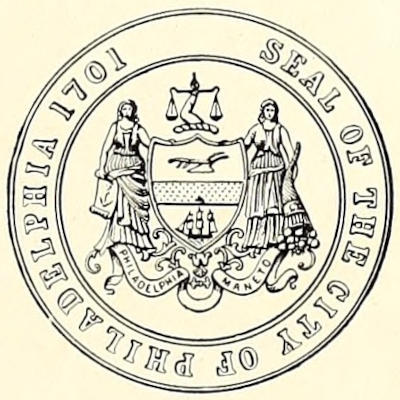
SEAL OF THE CITY OF PHILADELPHIA.