PITTSBURGH
Reading edition
THE INDUSTRIAL CITY
By SAMUEL HARDEN CHURCH
George Washington, the Father of his Country, is equally the Father of Pittsburgh, for he came thither in November, 1753, and established the location of the now imperial city by choosing it as the best place for a fort. Washington was then twenty-one years old. He had by that time written his precocious one hundred and ten maxims of civility and good behavior; had declined to be a midshipman in the British Navy; had made his only sea-voyage to Barbadoes; had surveyed the estates of Lord Fairfax, going for months into the forest without fear of savage Indians or wild beasts, and was now a major of Virginia militia. In pursuance of the claim of Virginia that she owned that part of Pennsylvania in which Pittsburgh is situated, Washington came there as the agent of Governor Dinwiddie to treat with the Indians. With an eye alert for the dangers of the wilderness, and with Christopher Gist beside him, the young Virginian pushed his cautious way to “The Point” of land where the confluence of the Monongahela and Allegheny rivers forms the Ohio. That, he declared, with clear military instinct, was the best site for a fort; and he rejected the promontory two miles below, which the Indians had recommended for that purpose.
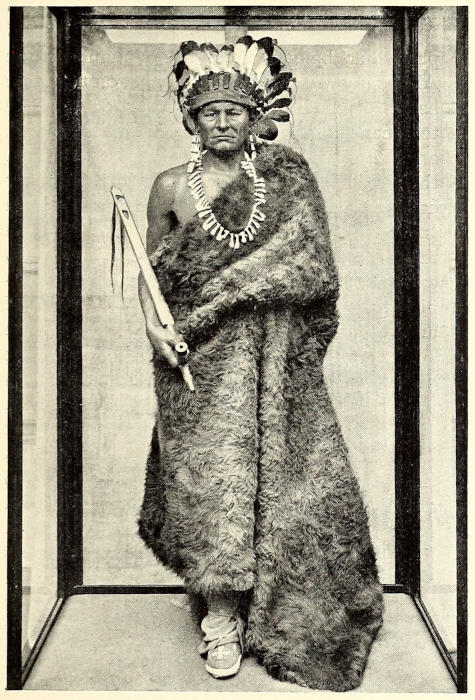
AN EARLY RESIDENT OF PITTSBURGH.
(FROM A STATUE BY T. A. MILLS IN THE CARNEGIE MUSEUM.)
As early as 1728 a daring hunter or trader found the Indians at the head waters of the Ohio,—among them the Delawares, Shawanese, Mohicans and Iroquois,—whither they tracked the bear from their village of Logstown, seventeen miles down the river. They also employed the country roundabout as a highway for their march to battle against other tribes, and against each other. At that time France and England were disputing for the new continent. France, by right of her discovery of the Mississippi, claimed all the lands drained by that river and its tributaries,—a contention which would naturally plant her banner upon the summit of the Alleghany Mountains.[26] England, on the other hand, claimed everything from ocean-shore to ocean-shore. This situation produced war, and Pittsburgh became the strategic key of the great Middle West. The French made early endeavors to win the allegiance of the Indians, and they felt encouraged to press their friendly overtures because they usually came among the red men for trading or exploration, while the English invariably seized and occupied their lands. In 1731 some French settlers did attempt to build a group of houses at Pittsburgh, but the Indians compelled them to go away. The next year the Governor of Pennsylvania summoned two Indian chiefs from Pittsburgh to say why they had been going to see the French Governor at Montreal; and they gave answer that he had sent for them only to express the hope that both English and French traders might meet at Pittsburgh and carry on trade amicably. The Governor of Pennsylvania sought to induce the tribes to draw themselves farther east, where they might be made to feel the hand of authority, but Sassoonan, their chief, forbade them to stir. An Iroquois chief who joined his entreaties to those of the Governor was soon afterward killed by some Shawanese braves, but they were forced to flee into Virginia to escape the vengeance of his tribe.
Louis Celeron, a French officer, made an exploration of the country contiguous to Pittsburgh in 1747, and formally enjoined the Governor of Pennsylvania not to occupy the ground, as France claimed its sovereignty. A year later the Ohio Company was formed, with a charter ceding an immense tract of land for sale and development, including Pittsburgh. This corporation built some storehouses at Logstown to facilitate their trade with the Indians, which were captured by the French, together with skins and commodities valued at £20,000; and the purposes of the Company were never accomplished.
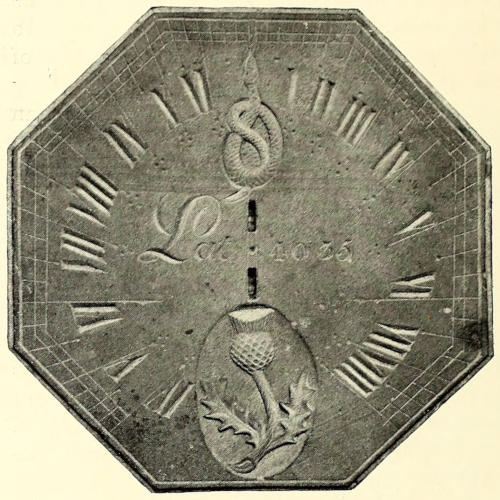
SUN-DIAL USED AT FORT DUQUESNE.
As soon as Washington’s advice as to the location of the fort was received, Captain William Trent was dispatched to Pittsburgh with a force of soldiers and workmen, packhorses and materials, and he began in all haste to erect a stronghold. The French had already built forts on the northern lakes, and they now sent Captain Contrecœur down the Allegheny with one thousand French, Canadians and Indians, and eighteen pieces of cannon, in a flotilla of sixty bateaux and three hundred canoes. Trent had planted himself in Pittsburgh on February 17, 1754,—a date important because it marks the first permanent white settlement there. But his work had been retarded alike by the small number of his men and the severity of the winter; and when Contrecœur arrived in April, the young subaltern who commanded in Trent’s absence surrendered the unfinished works, and was permitted to march away with his thirty-three men. The French completed the fort and named it Duquesne, in honor of the Governor of Canada; and they held possession of it for four years.
Immediately on the loss of this fort, Virginia sent a force under Washington to retake it. Washington surprised a French detachment near Great Meadows, and killed their commander, Jumonville. When a larger expedition came against him, he put up a stockade near the site of Uniontown, naming it Fort Necessity, which he was compelled to yield on terms of marching away with the honors of war.
The next year (1755) General Edward Braddock came over with two regiments of British soldiers, and, after augmenting his force with Colonial troops and a few Indians, began his fatal march upon Fort Duquesne. Braddock’s testy disposition, his consuming egotism, his contempt for the Colonial soldiers and his stubborn adherence to military maxims that were inapplicable to the warfare of the wilderness alienated the respect and confidence of the American contingent, robbed him of an easy victory and cost him his life. Benjamin Franklin had warned him against the imminent risk of Indian ambuscades, but he had contemptuously replied: “These savages may indeed be a formidable enemy to your raw American militia; but upon the King’s regular and disciplined troops, sir, it is impossible they should make any impression.” Some of his English staff-officers urged him to send the rangers in advance and to deploy his Indians as scouts, but he rejected their prudent suggestions with a sneer. On July 9th his army, comprising twenty-two hundred soldiers and one hundred and fifty Indians, was marching down the south bank of the Monongahela. The variant color and fashion of the expedition,—the red-coated regulars, the blue-coated Americans, the naval detachment, the rangers in deerskin shirts and leggings, the savages half-naked and befeathered, the glint of sword and gun in the hot daylight, the long wagon train, the lumbering cannon, the drove of bullocks, the royal banner and the Colonial gonfalon,—the pomp and puissance of it all composed a spectacle of martial splendor unseen in that country before. On the right was the tranquil river, and on the left the trackless wilderness whence the startled deer sprang away into a deeper solitude. At noon the expedition crossed the river and pressed on toward Fort Duquesne, ten miles below, expectant of victory. What need to send out scouts when the King’s troops are here? Let young George Washington and the rest urge it all they may; the thing is beneath the dignity of his Majesty’s General.
But here, when they have crossed, is a level plain, elevated but a few feet above the surface of the river, extending nearly half a mile landwards, and then gradually ascending into thickly wooded hills, with Fort Duquesne beyond. The troops in front had crossed the plain and plunged into the road through the forest for a hundred feet, when a heavy discharge of musketry and arrows was poured upon them, which wrought in them a consternation all the greater because they could see no foe anywhere. They shot at random, but without effect, while the hidden enemy kept up an incessant and destructive fire. In this distressing situation their courage forsook them, and they fell back into the plain. Braddock rode in among them, and he and his officers persistently endeavored to rally them, but without success. The Colonial troops adopted the Indian method, and each man fought for himself behind a tree. This was forbidden by Braddock, who attempted to form his men in platoons and columns, making their slaughter inevitable. The French and Indians, concealed in the ravines and behind trees, kept up a cruel and deadly fire, until the British soldiers lost all presence of mind and began to shoot each other and their own officers, and hundreds were thus slain. The Virginia companies charged gallantly up a hill with a loss of but three men, but when they reached the summit the British soldiery, mistaking them for the enemy, fired upon them, killing fifty out of eighty men. The Colonial troops then resumed the Indian fashion of fighting from behind trees, which provoked Braddock, who had had five horses killed under him in three hours, to storm at them and strike them with his sword. At this moment he was fatally wounded, and many of his men now fled away from the hopeless action. Washington had had two horses killed and received three bullets through his coat. Being the only mounted officer who was not disabled, he drew up the troops still on the field, directed their retreat, maintaining himself at the rear with great coolness and courage, and brought away his wounded general. Sixty-four British and American officers, and nearly one thousand privates, were killed or wounded in this battle, while the total French and Indian loss was not over sixty. A few prisoners captured by the Indians were brought to Pittsburgh and burnt at the stake. Four days after the fight Braddock died, exclaiming to the last, “Who would have thought it!”
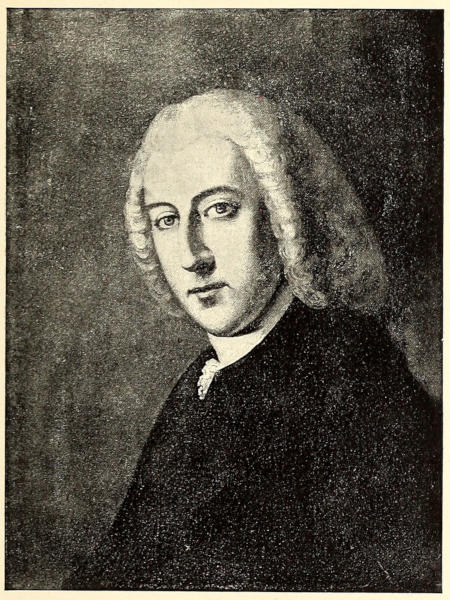
THE EARL OF CHATHAM.
FROM AN OIL PAINTING IN THE POSSESSION OF THE HISTORICAL SOCIETY OF PENNSYLVANIA.
Despondency seized the English settlers after Braddock’s defeat. But two years afterward William Pitt became Prime Minister, and he thrilled the nation with his appeal to protect the Colonies against France and the savages. His letters inspired the Americans with new hope, and he promised to send them British troops and to supply their own militia with arms, ammunition, tents and provisions at the King’s charge. He sent twelve thousand soldiers from England, which were joined to a Colonial force aggregating fifty thousand men,—the most formidable army yet seen in the new world. The plan of campaign embraced three expeditions: the first against Louisburg, in the island of Cape Breton, which was successful; the second against Ticonderoga, which succeeded after a defeat; and the third against Fort Duquesne. General Forbes commanded this expedition, comprising about seven thousand men. The militia from Virginia, North Carolina and Maryland was led by Washington. On September 12, 1758, Major Grant, a Highlander, led an advance-guard of 850 men to a point two miles from the fort, which is still called Grant’s Hill, where he rashly permitted himself to be surrounded and attacked by the French and Indians, half his force being killed or wounded, and himself slain. Washington followed soon after, and opened a road for the advance of the main body under Forbes. Fort Frontenac, on Lake Ontario, had just been taken by General Amherst, with the result that supplies for Fort Duquesne were cut off. When, therefore, the French commandant learned of the advance of a superior force, having no hope of reinforcements, he blew up the fort, set fire to the adjacent buildings and drew his garrison away.
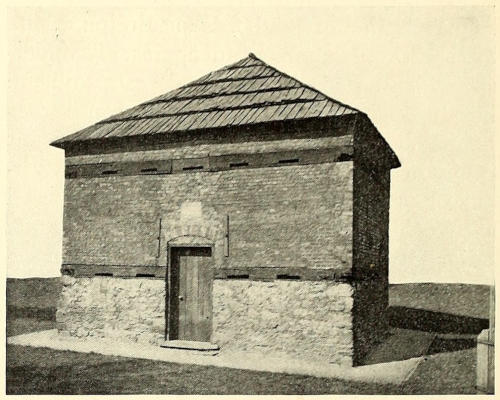
BLOCKHOUSE OF FORT PITT. BUILT IN 1764.
On Saturday, November 25, 1758, the English took possession of the place, and on the next day General Forbes wrote to Governor Denny from “Fort Duquesne, now Pittsburgh, the 26th of November, 1758,” and this was the first use of that name. On this same Sunday the Rev. Mr. Beatty, a Presbyterian chaplain, preached a sermon in thanksgiving for the superiority of British arms,—the first Protestant service in Pittsburgh. The French had had a Roman Catholic chaplain, Father Baron, during their occupancy.
The English proceeded to build a new fort about two hundred yards from the site of Fort Duquesne, which they called Fort Pitt. This stronghold at Pittsburgh cut off French transportation to the Mississippi by way of the Ohio River, and the only remaining route, by way of the Great Lakes, was soon afterward closed by the fall of Fort Niagara. The fall of Quebec, with the death of the two opposing Generals, Montcalm and Wolfe, and the capture of Montreal, ended the claims of France to sovereignty in the new world.
The new fort being found too small, General Stanwix built a second Fort Pitt, much larger and stronger, designed for a garrison of one thousand men. The Indians viewed the newcomers with suspicion, but Colonel Henry Bouquet assured them, with diplomatic tergiversation, that, “We have not come here to take possession of your country in a hostile manner, as the French did when they came among you, but to open a large and extensive trade with you and all other nations of Indians to the westward.” A redoubt (the “Block-House”) built by Colonel Bouquet in 1764 still stands, in a very good state of preservation, being cared for by the Daughters of the American Revolution. The protection of the garrison naturally attracted a few traders, merchants and pioneers to Pittsburgh, and a permanent population began to grow.
But the indigenous race continued to resent the extension of white encroachment; and they formed a secret confederacy under Pontiac, the renowned Ottawa chief, who planned a simultaneous attack on all the white frontier posts. This uprising was attended by atrocious cruelties at many of the points attacked, but we may take note here of the movement only as it affected Pittsburgh. At the grand council held by the tribes, a bundle of sticks had been given to every tribe, each bundle containing as many sticks as there were days intervening before the deadly assault should begin. One stick was to be drawn from the bundle every day until but one remained, which was to signal the outbreak for that day. This was the best calendar the barbarian could devise. At Pittsburgh, a Delaware squaw who was friendly to the whites had stealthily taken out three of the sticks, thus precipitating the attack on Fort Pitt three days in advance of the time appointed.
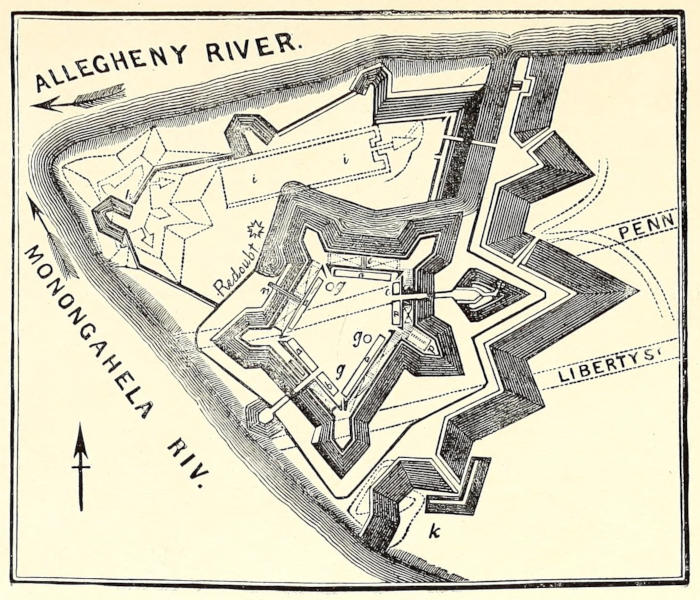
PLAN OF FORT PITT.
The last stick was reached on June 22, 1763, and the Delawares and Shawanese began the assault in the afternoon, under Simon Ecuyer. The people of Pittsburgh took shelter in the fort, and held out while waiting for reinforcements. Colonel Bouquet hurried forward a force of five hundred men, but they were intercepted at Bushy Run, where a bloody battle was fought. Bouquet had fifty men killed and sixty wounded, but inflicted a much greater loss on his savage foes, and gained the fort, relieving the siege. As soon as Bouquet could recruit his command, he moved down the Ohio, attacked the Indians, liberated some of their prisoners and taught the red men to respect the power that controlled at Pittsburgh.
In 1768 the Indians ceded their lands about Pittsburgh to the Colonies, and civilization was then free to spread over them. In 1774 a land office was opened in Pittsburgh by Governor Dunmore, and land-warrants were granted on payment of two shillings and sixpence purchase money, at the rate of ten pounds per one hundred acres.
With the French out of the country, the Colonies began to feel the oppression of a British policy which British statesmen and historians to-day most bitterly denounce. Their opposition to tyranny found its natural expression in the battle of Lexington, April 19, 1775. The fires of patriotism leapt through the continent, and the little settlement at Pittsburgh was quickly aflame with the national spirit. On May 16th a convention was held at Pittsburgh, which resolved that
“This committee have the highest sense of the spirited behavior of their brethren in New England, and do most cordially approve of their opposing the invaders of American rights and privileges to the utmost extreme, and that each member of this committee, respectively, will animate and encourage their neighborhood to follow the brave example.”
No foreign soldiers were sent over the mountains to Pittsburgh, but a more merciless foe, who would attack and harass with remorseless cruelty, was impressed into the English service, despite the horrified protests of some of her wisest statesmen. American treaties with the Indians had no force against the allurements of foreign gold, and under this unholy alliance men were burnt at the stake, women were carried away, and cabins were destroyed.
With the aim of regaining the friendship of the Indians, Congress appointed commissioners who met the tribes at Pittsburgh; and Colonel George Morgan, Indian agent, writes to John Hancock, November 8, 1776:
“I have the happiness to inform you that the cloud that threatened to break over us is likely to disperse. The Six Nations, with the Muncies, Delawares, Shawanese and Mohicans, who have been assembled here with their principal chiefs and warriors to the number of 644, have given the strongest assurance of their determination to preserve inviolate the peace and neutrality with the United States.”
These amicable expectations were not realized, and General Edward Hand came to Pittsburgh the next year and planned an expedition against the Indians. Colonel Broadhead took out Hand’s expedition in the summer and burnt the Indian towns.
The depreciation of paper currency, or Continental money, had by this time brought the serious burden of high prices upon the people. The traders, who demanded apparently exorbitant rates for their goods, were denounced in public meetings at Pittsburgh as being “now commonly known by the disgraceful epithet of speculators, of more malignant natures than the savage Mingoes in the wilderness.” This hardship grew in severity until the finances were put upon a more stable basis.
By 1781, there were demoralization and mutiny at Fort Pitt, and General William Irvine was put in command. His firm hand soon restored the garrison to obedience. The close of the war with Great Britain was celebrated by the issue of a general order at the fort, November 6, 1781, requiring all, as a sailor would say, “to splice the main-brace.”[27]
Up to this time the Penn family had held the charter to Pennsylvania; but as they had maintained a steadfast allegiance to the mother country, the General Assembly annulled their title, except to allow them to retain the ownership of various manors throughout the State, embracing half a million acres.
In order to relieve the people of Pittsburgh from going to Greensburg to the court-house in their sacred right of suing and being sued, the General Assembly erected Allegheny County out of parts of Westmoreland and Washington counties, September 24, 1788. This county originally comprised, in addition to its present limits, what are now Armstrong, Beaver, Butler, Crawford, Erie, Mercer, Venango and Warren counties. The act required that the court-house and jail should be located in Allegheny (just across the river from Pittsburgh), but as there was no protection against Indians there, an amendment established Pittsburgh as the county-seat. The first court was held at Fort Pitt; and the next day a ducking-stool was erected for the district, at “The Point” in the three rivers.
In 1785, the dispute between Virginia and Pennsylvania for the possession of Pittsburgh was settled by the award of a joint commission in favor of Pennsylvania.
A writer says that in 1786 Pittsburgh contained thirty-six log houses, one stone and one frame house and five small stores. Another records that the population “is almost entirely Scots and Irish, who live in log houses.” A third says of these log houses, “Now and then one had assumed the appearance of neatness and comfort.”
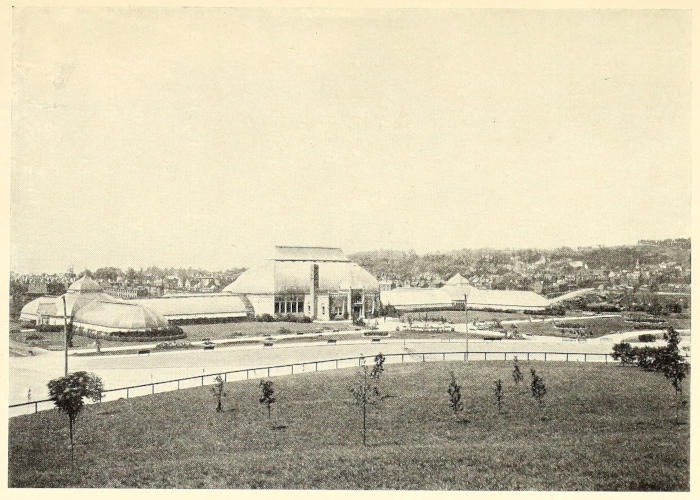
PHIPPS CONSERVATORY.
The first newspaper, the Pittsburgh Gazette, was established July 29, 1786. A mail route to Philadelphia, by horseback, was adopted in the same year. On September 29, 1787, the Legislature granted a charter to the Pittsburgh Academy, a school that has grown steadily in usefulness and power, and is now the Western University of Pennsylvania.
In 1791, the Indians became vindictive and dangerous, and General Arthur St. Clair, with a force of twenty-three hundred men, was sent down the river to punish them. Neglecting President Washington’s imperative injunction to avoid a surprise, he led his command into an ambush and lost half of it in the most disastrous battle with the redskins since the time of Braddock. In the general alarm that ensued, Fort Pitt being in a state of decay a new fort was built in Pittsburgh at Ninth and Tenth streets and Penn Avenue,—a stronghold that included bastions, blockhouses, barracks, etc., and was named Fort Lafayette. General Anthony Wayne was then selected to command another expedition against the savages, and he arrived in Pittsburgh in June, 1792. After drilling his troops and making preparations for two years, in the course of which he erected several forts in the West, including Fort Defiance and Fort Wayne, he fought the Indians and crushed their strength and spirit. On his return a lasting peace was made with them, and there were no further raids about Pittsburgh.
The Whiskey Insurrection demands a brief reference. Whiskey is a steady concomitant of civilization. As soon as the white settlers had planted themselves securely at Pittsburgh, they made requisition on Philadelphia for six thousand kegs of flour and three thousand kegs of whiskey—a disproportion as startling as Falstaff’s intolerable deal of sack to one half-pennyworth of bread. Congress, in 1791, passed an excise law to assist in paying the war debt. The measure was very unpopular, and its operation was forcibly resisted, particularly in Pittsburgh, which was noted then, as now, for the quantity and quality of its whiskey. There were distilleries on nearly every stream emptying into the Monongahela. The time and circumstances made the tax odious. The Revolutionary War had just closed, the pioneers were in the midst of great Indian troubles, and money was scarce, of low value and very hard to obtain. The people of the new country were unused to the exercise of stringent laws. The progress of the French Revolution encouraged the settlers to account themselves oppressed by similar tyrannies, against which some of them persuaded themselves similar resistance should be made. Genêt, the French demagogue, was sowing sedition everywhere. Lafayette’s participation in the French Revolution gave it in America, where he was deservedly beloved, a prestige which it could never have gained for itself. Distillers who paid the tax were assaulted; some of them were tarred and feathered; others were taken into the forest and tied to trees; their houses and barns were burned; their property was carried away or destroyed. Several thousand insurgents assembled at Braddock’s Field, and marched on Pittsburgh, where the citizens gave them food and submitted to a reign of terror. Then President Washington sent an army of fifteen thousand troops against them, and they melted away, as a mob will ever do when the strong arm of Government smites it without fear or respect.
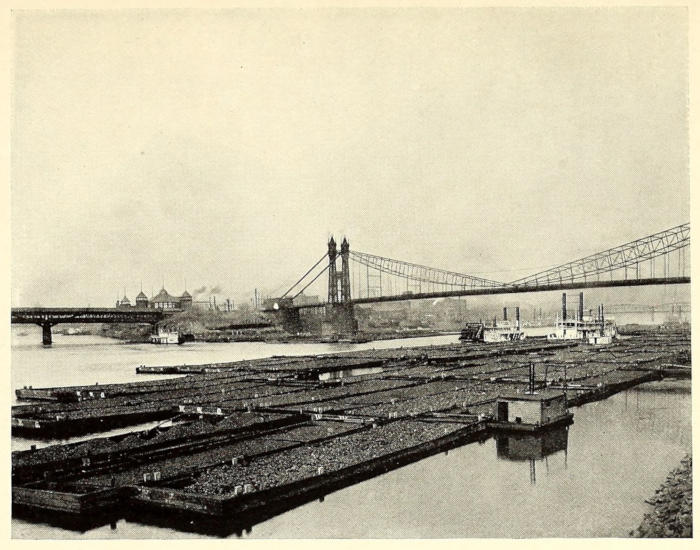
THE COAL FLEET.
Pittsburgh was incorporated a borough in 1794. Her first glassworks was built in 1797; and both her population and her industries multiplied until she was made a city in 1816. In 1845 (April 10th), a great fire destroyed about one third of the total area of the city, including most of the large business houses and factories, the bridge over the Monongahela, the large hotel known as the Monongahela House and several churches;—in all about eleven hundred buildings. The Legislature appropriated $50,000 for the relief of the sufferers.
In 1877, the municipal government, being, in its personnel, at the moment incompetent to preserve the fundamental principles on which it was established, permitted a strike of railroad employees to grow without restriction as to the observance of law and order until it became an insurrection. Three million dollars’ worth of property was destroyed by riot and incendiarism in a few hours. When at last outraged authority was properly shifted from the supine city chieftains to the indomitable State itself, it became necessary, before order could be restored, for troops to fire, with a sacrifice of human life. The lesson was worth all it cost, and anarchy has never dared to raise its head in the corporation limits since that time.
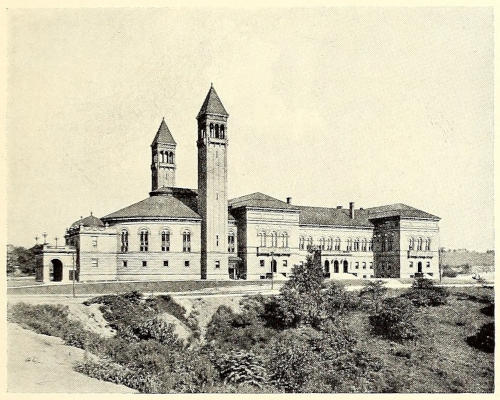
CARNEGIE INSTITUTE.
In 1889, the great flood at Johnstown, accompanied by a frightful loss of life and destruction of property, touched the common heart of humanity all over the world. The closeness of Johnstown geographically made the sorrow at Pittsburgh most poignant and profound. In a few hours almost the whole population had brought its offerings for the stricken community, and besides clothing, provisions and every conceivable thing necessary for relief and comfort, the people of Pittsburgh contributed $250,000 to restore so far as possible the material portion of the loss.
Pittsburgh has thus passed through many battles, trials, afflictions and adversities, and has grown in the strength of giants until it now embraces in the limits of the county a population of over one million. The tax valuation of her property is $554,000,000. Her share is more than one half of the whole production in the United States of steel, steel rails, coke, oil, plate glass, glassware, harness-leather and iron pipe. She mines one quarter of the bituminous coal of the United States. She has 2500 mills and factories, with an annual product worth $250,000,000, and a pay-roll of $75,000,000. Her electric street-railway system multiplies itself through her streets for 250 miles. Natural-gas fuel is conveyed into her mills and houses through 1000 miles of iron pipe. Her output of coke makes one train ten miles long every day throughout the year. Her tonnage by river and rail exceeds the tonnage by river and rail of any other city in the world; it is equal to one half the combined tonnage of the Atlantic and Pacific coasts. Her rail tonnage is three times as large as that of New York or Chicago, double that of London, four times that of Paris, and greater than the combined tonnage of New York, Boston and Chicago. Two hundred and fifty passenger trains and six thousand loaded freight-cars run to and from her terminals every day. Nowhere else in the world is there so large a Bessemer-steel plant, crucible-steel plant, plate-glass plant, chimney-glass plant, table-glass plant, air-brake plant, steel-rail plant, cork works, tube works or steel freight-car works. Her armor sheathes our battleships, as well as those of Russia and Japan. She equips the navies of the world with projectiles and range-finders. Her bridges span the rivers of India, China, Egypt and the Argentine Republic; and her locomotives, rails and bridges are used on the Siberian railroad. She builds electric railways for Great Britain and Brazil, and telescopes for Germany and Denmark. Indeed, she distributes her varied manufactures into the channels of trade all over the earth.
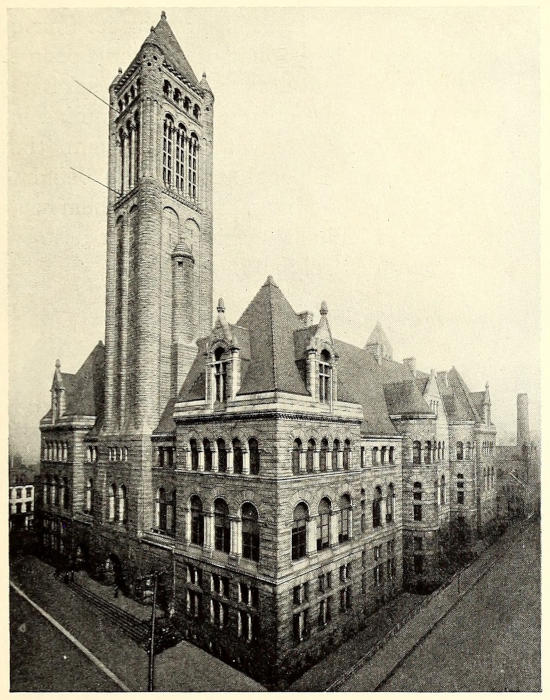
COURT HOUSE.
But while these surpassing industries have given Pittsburgh her wealth, population, supremacy and power, commercial materialism is not the ultima thule of her people. She has the largest and handsomest court-house in the world, the crowning architectural triumph of H. H. Richardson. Her churches and schoolhouses are found in nearly every block. She spends a quarter of a million annually on her parks,—Schenley and Highland. She maintains by popular support one of the three symphony orchestras in America. She has given many famous names to Science, Literature and Art. Her astronomical observatory is known throughout the world. Her rich men are often liberal beyond their own needs—particularly so William Thaw, who spent millions for education and benevolence; Mrs. Mary Schenley, who has given the city a great park, four hundred picturesque acres in the very heart of its boundaries; and Henry Phipps, who erected the largest conservatory for plants and flowers in our country. There is one other, Andrew Carnegie, whose wise and continuous use of vast wealth for the public good is nearly beyond human precedent. Mr. Carnegie has spent many millions on libraries, art galleries and scientific museums in Pittsburgh alone, and millions more for similar institutions in other parts of the world. The Carnegie Institute at Pittsburgh, comprising Art Galleries, Library, Museum and Music Hall, now in its fourth year, is the rallying-ground of the whole people in their growing love of æsthetic and spiritual life. Its doors are open all day, from nine in the morning until ten at night, free to the people. And the people use it with delight, more than five hundred thousand of them having thronged its halls in this past year.
Pittsburgh is truly an imperial city.
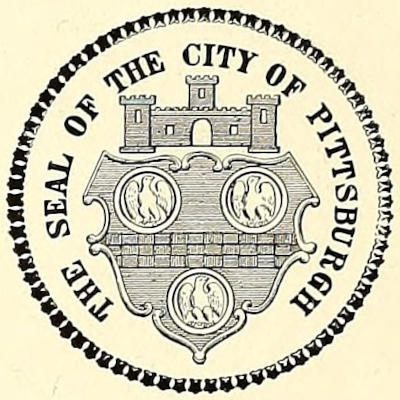
SEAL OF THE CITY.