M Y T H O L O G Y : (continued 6)
Reading edition
PHILEMON AND BAUCIS.
Philemon and Baucis were an aged couple, of Phrygia, who, unblessed by the goods of fortune, found in their mutual and deep affection, a happiness, which nothing could overwhelm.
———————————"There Had lived long married and a happy pair Now old in love, tho' little was their store, Inured to want, their poverty they bore, Nor aimed at wealth, professing to be poor."
As they were sitting together, enjoying the sweets of mutual affection, two travellers, with a melancholy and impoverished appearance, after having asked hospitality, and been refused by the inhabitants of the village, sought refuge under their humble roof. Unaccustomed to visitors, they were, however, received by them with kindness, and invited to partake of a modest repast.
As they sate in kind communion, the forms of those whom they entertained suddenly changed, and they beheld Jupiter and Mercury in the place of the miserable beings they had received; the ancient couple throwing themselves on their knees, offered to their guests the deep homage of their hearts.
The Gods were pleased with their entertainment; but could not forget the inhospitality with which they had been received by their countrymen, and let loose the waves, and sent the thunderbolt to consume the town and its inhabitants. Philemon and Baucis, were, however, saved, and a superb temple replaced their lowly dwelling, of which they were made the priests.
They lived long and happily, and having entreated Jupiter that neither might outlive the other, they both died on the same day, and their bodies were changed into trees, and placed before the door of the Temple which had arisen on the ruins of their lowly cottage.
"Lost in a lake the floated level lies; A watery desert covers all the plains, Their cot alone, as on an isle, remains Wond'ring with weeping eyes, while they deplore Their neighbours' fate, and country now no more, Their little shed, scarce large enough for two, Seems, from the ground, in height and bulk to grow A stately temple shoots within the skies, The crotchets of their cot in columns rise, The pavement polished marble they behold, The gates with sculpture graced, the spires and roof of gold!" Ovid.
PYRAMUS AND THISBE.
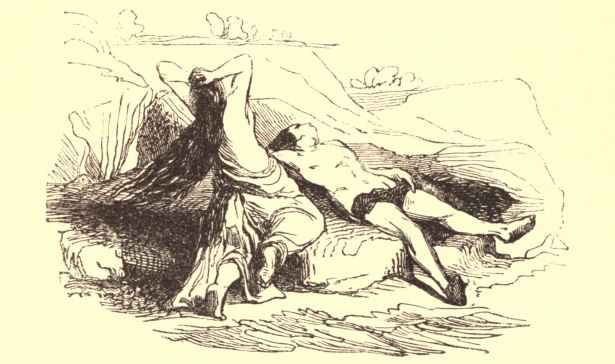
Pyramus and Thisbe were two young Thebans, who, being greatly enamoured of one another, had their union opposed by their friends, between the families of whom there had been a variance for many years.
"But to prevent their wandering in the dark, They both agree to fix upon a mark; A mark that could not their designs expose: The tomb of Venus was the mark they chose; There they might rest secure beneath the shade, Which boughs, with snowy fruit encumbered, made. A wide spread mulberry tree its rise had took Just in the margin of a gurgling brook." Ovid.
They determined, however, if possible, to elude the vigilance of their persecutors, and agreed to meet outside the walls of the city, under the mulberry tree which grew there, and then to celebrate their union. Thisbe was the first who arrived at the place appointed, when the sudden arrival of a lioness so frightened her, that she fled away, dropping her veil in her flight. This the lioness smeared with blood, and then disappeared, leaving it under the trysting tree.
In a short time Pyramus arrived, but found that she, for whom he looked, was absent: the bloody veil alone met his anxious gaze, which he instantly recognized, and concluded that she had been torn to pieces by wild beasts. In his despair he drew his sword and killed himself.
When the fears of Thisbe were passed away, she returned to the mulberry tree, but found only the lifeless remains of her lover. In the agony which overcame her, she fell upon the weapon with which Pyramus had destroyed himself, and joined him in his endless rest.
"But when her view the bleeding love confessed, She shrieked, she tore her hair, she beat her breast, She raised the body, and embraced it round, And bathed with tears unfeigned, the gaping wound, Then her warm lips to the cold face applied— 'And is it thus, ah! thus we meet,' she cried My Pyramus, whence sprang thy cruel fate? My Pyramus; ah! speak, ere 'tis too late: I, thy own Thisbe; but one word implore, One word thy Thisbe never asked before! Fate, though it conquers, shall no triumph gain, Fate, that divides us, still divides in vain. Now, both our cruel parents, hear my prayer, My prayer to offer for us both I dare, O see our ashes in one urn confined, Whom love at first, and fate at last, has joined. Thou tree, where now one lifeless lump is laid, Ere long o'er two shall cast a friendly shade, Still let our loves from thee be understood, Still witness, in thy purple fruit our blood— She spoke, and in her bosom plunged the sword All warm, and reeking from its slaughtered Lord." Ovid.
A C I S A N D G A L A T E A.
Polyphemus, the most dreadful and hideous of the Cyclops, loved Galatea, one of the beautiful race of the sea-nymphs. Day by day, did the giant sit by the side of a fountain, neglecting his flocks, and murmuring love songs the most touching and impassioned; while he adorned his person and endeavoured to render himself as agreeable, by these and other means, to his nymph as possible.
Galatea treated all his attentions with disrespect, and bestowed her affections upon Acis; meeting him in secret in a grotto, there enjoying the sweet society of one another, unsuspicious of the danger which threatened them.
—————————"Acis knelt At Galatea's feet. She gazed awhile, One delicate hand was pressed against her cheek, That flushed with pleasure, and her dark hair streamed Shadowing the brightness of her fixed eye, Which on the young Sicilian shepherd's face Shone like a star— 'Twas strange that she, a high sea-nymph should leave, Her watery palaces, and coral caves, Her home, and all immortal company, To dwell with him, a simple shepherd boy." Barry Cornwall.
Polyphemus, however, discovered their retreat, and with it, the cause of all the scorn and indifference, with which he had been treated.
————————"At once he saw His rival, and the nymph he loved so well, Twined in each other's arms. 'Away,' he cried, 'Away thou wanton nymph, and thou, my slave. Earth born and base, thou—thou whom I could shake To atoms, as the tempest scatters abroad The sea-sand tow'rd the skies, away, away!'"
Acis came forth from his retreat, and Polyphemus threw an enormous rock upon him, which crushed him beneath its weight.
————————"The shepherd boy, He felt the Cyclop's wrath, for on his head The mighty weight descended: not a limb, Or bone, or fragment, or a glossy hair, Remained of all his beauty."
Galatea was in despair, and as she could not restore him to life, she changed him into a river, on the banks of which, she could still sport at even time, and sing to her beautiful, but lost love.
——————————"She changed, As Grecian fables say, the shepherd boy Into a stream, and on its banks would lie, And utter her laments in such a tone, As might have moved the rocks, and then would call Upon the murdered Acis. He the while Ran to the sea, but oft on summer nights Noises were heard, and plaintive music like, The songs you hear in Sicily—shepherd swains For many an age would lie by that lone stream, And from its watery melodies catch an air, And tune it to their simple instruments." Barry Cornwall.
HERO AND LEANDER.
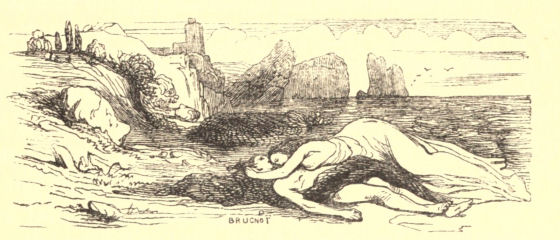
Hero was a priestess of Venus, at Sestos, whom Leander met during one of the festivals held annually at the fane of the goddess, in honour of Adonis.
"As thro' the temple passed the Sestian maid, Her face a softened dignity displayed; And as she shone superior to the rest, In the sweet bloom of youth and beauty dress'd, Such softness, tempered with majestic mien, The earthly priestess matched the heavenly queen."
The appearance of Hero inflamed the bosom of Leander, nor was he long in expressing his love to the beautiful being who had won it. In the very temple of the goddess, whose priestess she was, and while warmed with the rites at which she had been assisting, Leander avowed his passion.
"Her lily hand he seized, and gently pressed, And softly sighed the passion of his breast, Then to the temples last recess conveyed The unreluctant, unresisting maid, Silent she stood, and wrapt in thought profound, Her modest eyes were fixed upon the ground, Her cheeks she hid, in rosy blushes drest, And veiled her lily shoulders with her vest." Musæus.
The earnest wooing of Leander was assisted by the boy-god, and Hero, won by his passionate pleading, and by a love as strong as it was sudden, consented to become his bride.
—————————"How more than sweet, That moment, as he knelt at Hero's feet, Breathing his passion in each thrilling word, Only by lovers said, and lovers heard." L. E. L.
Before they parted, she told him of her place of abode over the broad Hellespont, which he must cross, ere he could enjoy her society, and pointed out the spot to which he should look at night for a torch to guide his way.
"Dimly and slowly the hours passed by, until Leander saw day's bright orb disappear: He thought of Hero and the lost delight, Her last embracings, and the space between; He thought of Hero, and the future night, Her speechless rapture, and enamoured mien." Keats.
At last the twilight came, followed by the darkness of night, and the bright star of Venus alone looked down on the expectant lover. He saw not the dark rush of Helle's wave, he heard not the fierce sweep of its waters; he thought only of the beautiful bride, who had sate watching, and waiting for the weary sun to go down; when, lo
"Her turret torch was blazing high, Though rising gale and breaking foam, And shrieking sea birds warned him home; And clouds aloft, and tides below, With sighs, and sounds, forbade to go; He could not see, he would not hear, Or sound or sign foreboding fear; His eye but saw that light of love, The only star it hailed above; His ear but rang with Hero's song, 'Ye waves divide not lovers long!'"
With a strong hand and anxious heart, the husband-lover dashed aside the impetuous waves; and sought and gained in safety the shore which the blazing light had signalled. And, oh! the tenderness of that meeting; the obstacles which intervened added an additional zest, and the waves seemed to have nerved the youth to a higher excitement, as he gazed on Hero. But the sorrowful morning came, and
—————————"They parted, but they met again— The blue sea rolled between them—but in vain! Leander had no fear, he cleft the wave, What is the peril fond hearts will not brave! Delicious were their moonlight wanderings, Delicious were the kind, the gentle things Each to the other breathed; a starry sky, Music and flowers, this is earth's luxury. The measure of its happiness is full, When all around, like it, is beautiful. There were sweet birds to count the hours, and roses, Like those on which a blushing cheek reposes, Violets as fresh as violets could be; Stars over head, with each a history Of love told by its light; and waving trees And perfumed breathings upon every breeze." L. E. L.
But their intercourse was soon stopped, it seemed too beautiful for earth; Leander, however, thought not of this, but with the enthusiastic ardour of youth, looked forward to a long life of delights. The day to him was a dull blank, and was employed in watching the spot, where at night he saw the beacon which cheered his way. But alas! the change came too soon.
——————————"One night the sky, As if with passion, darkened angrily, And gusts of wind swept o'er the troubled main Like hasty threats, and then were calm again; That night, young Hero by her beacon kept Her silent watch, and blamed the night and wept, And scarcely dared to look upon the sky; Yet lulling still her fond anxiety." L. E. L.
Morning came, and came after a night of such terror, as but rarely is known to mortals; for the first time Leander had not sought her bower, and an indistinct shadow brooded over her mind, of some vague, uncertain dread, as she wandered down to the sea shore.
"Her heart sick with its terror, and her eye, Roving in tearful, dim uncertainty. Not long uncertain,—she marked something glide, Shadowy and indistinct upon the tide; On rushed she in that desperate energy, Which only has to know, and knowing, die— —It was Leander!" L. E. L.
The melancholy tale is told; storm nor tempest had power to keep the husband from his wife, and in the wildness of his struggles for life, when hope was gone and despair succeeded, his last glance sought the watch light in Abydos, and his last sigh was given to the fond being who looked in vain from its rocky strand.
P Y G M A L I O N
was a statuary, celebrated in Cyprus for the exquisite skill of his statues. He became disgusted to such a degree with the debauchery of the females of Amathus, that he resolved never to marry, but to devote himself to his art.
In this he became so proficient, that his marble busts seemed almost like life—and one, the figure of a female, was regarded by him with such affection that he grew deeply enamoured of it, worshipping it with all the devotion which mortals usually pay to woman.
The passion increased, and the gods, pitying his despair, changed the statue into that of a beautiful female, whom he married, and had by her a son called Paphos, who founded the town of the same name in Cyprus.
"There was a statuary, one who loved And worshipped the white marble that he shaped; Till, as the story goes, the Cyprus' queen, Or some such fine, kind hearted deity, Touched the pale stone with life, and it became At last Pygmalion's bride." Barry Cornwall.
SAPPHO AND PHAON.
The story of Sappho and of Phaon has become almost, if not quite as well known, as that of Hero and Leander. Sappho was celebrated for her beauty and her poetical talents, all of which she bestowed in love on Phaon.
"A youth so shaped, with such a mien, A form like that of Jove serene, With sparkling eyes, and flowing hair, And wit, that ever charms the fair."
He gave himself up for a time to the pleasure of her society, but man was as fickle then as now, and he grew tired, even conceiving a disdain for her who had so quickly given herself to his arms.
To a mind like Sappho's, finely wrought, as that of poets usually are, this became insupportable; life was a burthen; song, now that the one had gone whose praise she valued more than all beside, became neglected; and in a fit of insupportable madness she threw herself into the sea.
"From Leucadia's promontory Flung herself headlong for the Lesbian boy, (Ungrateful he to work her such annoy;) But time hath as in sad requital, given A branch of laurel to her, and some bard Swears that a heathen God or Goddess gave Her swan-like wings wherewith to fly to heaven. And now, at times, when gloomy tempests roar Along the Adriatic, in the waves She dips her plumes, and on the watery shore Sings as the love-crazed Sappho sung of yore." Barry Cornwall.
Of all her compositions, but two now remain; which, fragments as they are, shew by their uncommon sweetness and beauty, how worthily the praises of the ancients were bestowed upon a poet, whom they even ventured to call the tenth muse.
"Then came a dark browed spirit, on whose head Laurel and withering roses loosely hung: She held a harp, amongst whose chords her hand Wandered for music—and it came. She sang A song despairing, and the whispering winds Seemed envious of her melody and streamed Amidst the wires to rival her, in vain. Short was the strain but sweet: methought it spoke Of broken hearts, and still and moonlight seas, Of love, and loneliness, and fancy gone, And hopes decayed for ever: and my ear Caught well remembered names, 'Leucadia's rock,' At times, and 'faithless Phaon:' then the form Passed not, but seemed to melt in air away: This was the Lesbian Sappho." Barry Cornwall.
The Lesbians were so enraptured with her strains, that they raised her to divine honours, and erected a temple to her, and even stamped their money with her image.
"Thou! whose impassioned face The poet loves to trace, Theme of the sculptor's art, and poet's story, How many a wandering thought Thy loveliness hath brought, Warming the heart with its imagined glory! Yet, was it History's truth. That tale of wasted youth, Of endless grief, and love forsaken, pining? What wert thou, thou whose woe The old traditions show, With Fame's cold light around thee vainly shining! Did'st thou indeed sit there In languid lone despair? Thy harp neglected by thee idly lying? Thy soft and earnest gaze, Watching the lingering rays, In the far west, where Summer-day was dying? Did'st thou, as day by day, Rolled heavily away, And left thee anxious, nerveless and dejected, Wandering thro' bowers beloved, Roving where he had roved, Yearn for his presence, as for one expected? Did'st thou, with fond wild eyes Fix'd on the starry skies, Wait feverishly for each new day to waken? Trusting some glorious morn Might witness his return, Unwilling to believe thyself forsaken? And when contrition came, Chilling that heart of flame, Did'st thou, O saddest of Earth's grieving daughters, From the Lucadian steep, Dash, with a desperate leap, And hide thyself within the whelming waters? Such is the tale they tell, Vain was thy beauty's spell— Vain all the praise thy song could still inspire, Though many a happy band, Rung with less skilful hand, The borrowed love notes of thy echoing lyre. Fame, to thy breaking heart, No comfort could impart, In vain thy brow the laurel wreath was wearing; One grief and one alone Could bow thy bright head down, —Thou wert a woman, and wert left despairing!" Mrs. Norton.
NUMA POMPILIUS.
This hero was born on the very day that Romulus laid the foundation of the Roman city: he married Tatia, the daughter of the Sabine king, whom however he had the misfortune to lose; owing to which, he retired into the country that he might devote his time more uninterruptedly to study.
When, upon the death of Romulus, he was chosen by the senators to be their sovereign, it was with great difficulty that he could be persuaded to undertake the onerous task, which, however, he filled to the satisfaction of his subjects, dismissing the body guards who usually attended upon the Roman Emperor, thus showing he had no distrust of his subjects.
His great object was to quell the spirit of war and conquest which he found in the people, and to inculcate the love of peace, with a reverence for the deity, whose worship by images he forbade, and established a priesthood for it, the effect of which was to prevent any graven images or statues from appearing in their sanctuaries for upwards of one hundred and thirty years.
This wise monarch, aware that superstition is one of the greatest engines in governing a people, encouraged a report that he regularly visited the nymph Egeria, who indeed, according to Ovid, became his wife.
In her name he introduced all his laws and regulations into the state, and solemly declared in the presence of his people, that they were sanctified by the approval of that being, an approval, which gave them additional favour in the eyes of this superstitious people.
At his death, which took place after a reign of forty-three years, not only the Romans, but the neighbouring nations were anxious to pay their testimony of reverence to a monarch, whom they could not help respecting no less for his abilities, than for his moderation in the application of them.
He forbade the Romans to burn his body, after their usual custom, but ordered them to bury it near Mount Jerusalem, with some of the books which he had written, which being accidentally found four hundred years after his death, were burned by order of the senate.
They are stated merely to have contained the reasons why he had made the innovations into the ceremonies of their religion.
"Egeria! sweet creation of some heart, Which found no mortal resting place so fair As thine ideal breast; whate'er thou art Or wert,—a young Aurora of the air, The nympholepsy of some fond despair; Or it might be, a beauty of the earth, Who found a more than common votary there Too much adoring; whatso'er thy birth, Thou wert a beautiful thought, and softly bodied forth Here did'st thou dwell, in this enchanted cover, Egeria! thy all heavenly bosom beating For the far footsteps of thy mortal lover; The purple midnight veiled that mystic meeting With her most starry canopy, and seating Thyself by thine adorer, what befel? This cave was surely shaped out for the greeting Of an enamoured goddess, and the cell Haunted by holy love—the earliest oracle! And did'st thou not, thy breast to his replying, Blend a celestial with a human heart; And love, which dies as it was born, in sighing, Share with immortal transports? could thine art Make them indeed immortal, and impart The purity of heaven to earthly joys, Expel the venom and not blunt the dart— The dull satiety which all destroys— And root from out the soul the deadly weed which cloys?" Byron.
CADMUS.
Cadmus was the son of Agenor, and brother of Europa, who was carried away by Jupiter in the likeness of a bull; this prince being ordered by his father never to return if he was unable to find and bring back his sister; he at last consulted the oracle of Delphos, to obtain its assistance in accomplishing his mission.
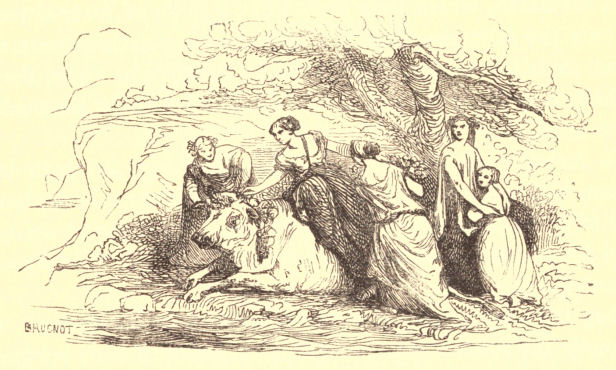
"Look no longer for thy sister," replied Apollo, "but follow the first cow which presents itself to thy sight, and wherever that shall stop, build a city for thee and thy successors." Cadmus obeyed and was guided in this manner towards Bœotia, which he founded.
Previous to this, wishing to thank the gods by a sacrifice, he sent his companions to fetch some water from a neighbouring grove; becoming alarmed at their delay, he went in search of them, and found they had desecrated a fountain sacred to Mars, and that the dragon which presided over it had slain them. He arrived but just in time to witness him finishing the meal, which had followed their destruction.
In fierce despair Cadmus attacked, and by the aid of Minerva overcame the monster, he then sowed the teeth of the dragon in the plain, upon which armed men rose suddenly from the ground.
In his alarm he threw a stone at them, and they instantly attacked one another, leaving only five, who assisted him in building the city.
He soon after married Hermione, the daughter of Venus; and had by her four sons and four daughters, whom Juno, out of hatred to Venus, cruelly persecuted.
Cadmus was the first who introduced the use of letters into Greece, though others maintain that the alphabet brought by him from Phœnicia, was only different from that used by the ancient inhabitants of Greece.
It was composed of seventeen letters, and to these were added some time after, by Palamedes, an additional four, and by Simonides of Melos, also, the same number.
In addition to the alphabet, by which the name of Cadmus has become renowned, he introduced likewise, the worship of many of the Egyptian and Phœnician deities, to the inhabitants of Greece, into which country, he is believed to have come about one thousand four hundred and ninety years before the christian era.
In stories so remote, it is difficult to separate the true from the false, and still more so to give a plausible explanation of apparent incongruities: it has, however, been suggested, that the dragon's fable, arose from some country which Cadmus conquered; that the armed men who are stated to have arisen from the field, were men armed with brass, a crop very likely to arise from the attempted subjection of a free country.
We have now related the most celebrated fables in the Mythology of the Greeks and Romans, without asserting that we have given all of them, some of which would be out of keeping in a work meant to be placed in the hands of youth, while others are not sufficiently authenticated, or do not bear sufficient interest, to induce us to present them to our readers.
B E L L E R O P H O N
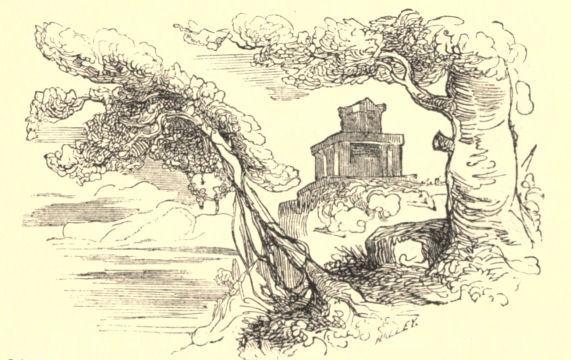
was son of Glaucus, King of Corinth, and named at first Hipponous. The murder of Beller, his brother, by him, procured his second name of Bellerophon or the murderer of Beller; after he had committed which, he fled to the court of Prœtus, King of Argos, where being of a noble and fine person, he won the affections of the wife of the king; he refused to listen to her passion, and in revenge he was accused by her to her husband, of attempting her virtue.
Prœtus, was very unwilling to trespass upon the laws of hospitality by punishing him, but sent him with a letter to Jobates the father of his queen, entreating him to put to death the man who would have insulted the honour of his daughter.
Jobates to satisfy his son-in-law, sent Beller to attack a monster called Chimæra, in the full expectation that he would be destroyed. By the assistance of Minerva, however, who lent him Pegasus the winged horse, he succeeded in conquering the monster, and returned victorious to the court of Jobates.
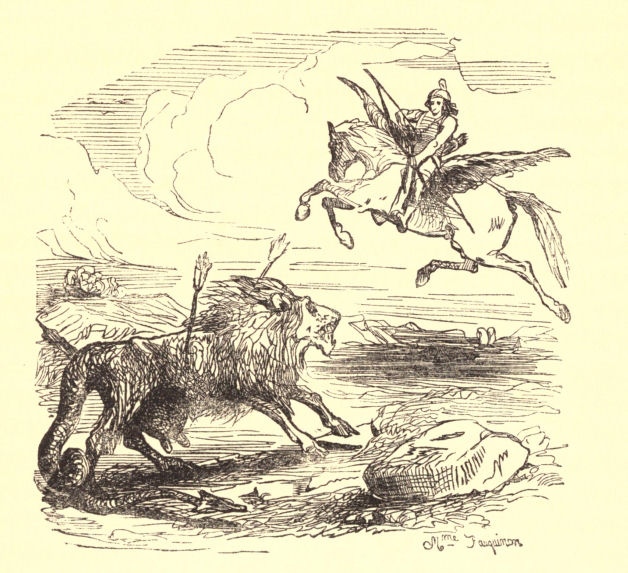
After this he was sent on various expeditions of great danger, in all of which he was so successful, that Jobates imagined he was under the protection of the gods, and gave him the hand of his daughter Cassandra in marriage, naming him as his successor to the throne.
It has been asserted by some that he attempted to fly to Olympus upon Pegasus, but that Jupiter sent an insect which stung the horse, who threw his rider headlong to the earth; and that for many years he remained melancholy, languishing, and full of pain and weakness.
M I L O
was one of the most celebrated of the Greek wrestlers, who having early accustomed himself to carry great burthens, became so strong, that nothing seemed too much for his vast efforts. It is recorded of him that he carried on his shoulders a young bullock, four years old, for more than forty yards, that he then killed it with a blow of his fist, and to crown the feat, afterwards eat it up.
This man was one of the disciples of Pythagoras, whose life he had saved, by supporting the whole weight of the building on his shoulders, when the roof of the school in which he was teaching gave way.
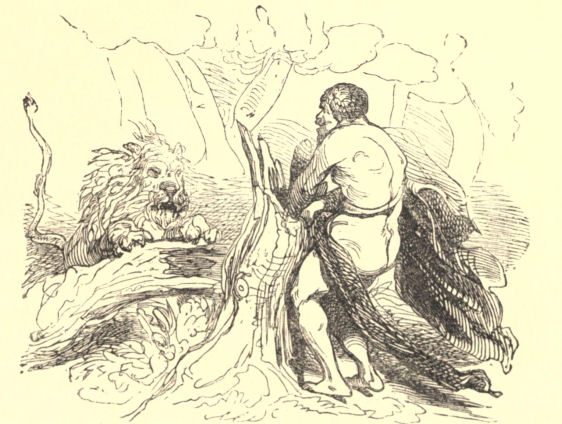
In his old age a melancholy fate awaited him; for failing in an attempt to pull up a tree by the roots, his hands remained fast pinched in the tree, when a lion suddenly sprang upon him, which he was unable to escape, and fell beneath the fury of the beast.
T H E P R I N C I P A L D I V I N I T I E S O F I N D I A N M Y T H O L O G Y.
It is scarcely possible for any religion to possess a more metaphysical and abstract character, than the creeds of the various sects which distinguish India. They present, however, too much interest to enable us to dispense with a few of the leading ones among them, this work not having for its object a deep research into obscure mysteries, but is meant to excite useful and pleasing ideas, without entering into elaborate explanations.
BRAHMA!
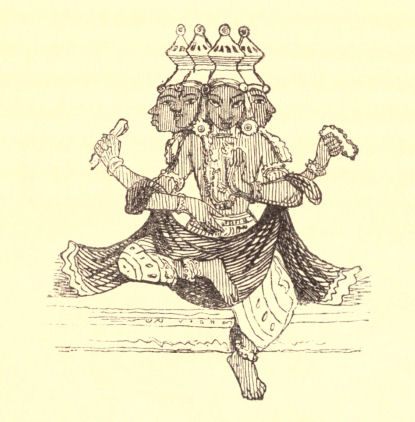
This deity, according to the Hindoos, is the Eternal, the Creator! and is one of the three members of the Indian Trinity.
Previous to his commencing the grand work of creating the world, and all that it contains, he passed thirty six millions of years contemplating the panorama of Chaos, which was spread out before him.
He then produced seven starry spheres, the Earth, and its two luminaries, with seven inferior regions, lit by the sparkling light of eight Carbuncles, placed on the heads of the same number of Serpents. He next proceeded to the creation of the beings who were to people it, in the accomplishment of which, he was aided by the pure spirits who surrounded him.
The earth, being yet uninhabited, he made the first man and the first woman wherewith to people it.
Brahma is the object of the most ancient adoration of the Brahmins; he is considered the intelligence who existed before time, and will continue throughout eternity: he watches over the events of each age and revolution of the universe; he is the power by which everything was created, and everything is sustained; he is the invisible head of the Brahmins, and as such, is worshipped by them with devoted respect.
The Hindoos invoke him regularly morning and evening, and throw water from the palms of their hands upon the ground, and towards the sun, which they adore as the likeness of the Eternal, while at mid-day, they renew their homage by the offer of a flower.
The Hindoo painters always represent Brahma with four heads and four faces, analagous to the four cardinal points, and long beards descending from his four chins. In his four hands he holds the mysterious chain, to which are suspended the worlds, and the book of the law; the pencil to write it, and the fire of sacrifice.
VISHNU.
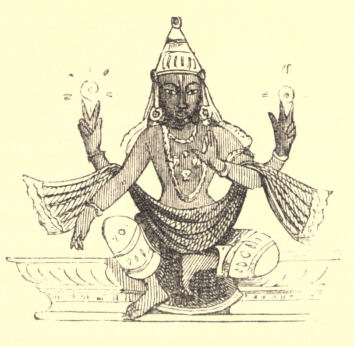
Vishnu, the second deity of the Indian Trinity, is considered as the preserver of the world, which Brahma has created out of nothingness. He descended on the earth by a sacrifice of which he alone was capable, and to save it from certain ruin, submitted to all the weaknesses of humanity.
He became teacher, warrior, and prophet, that he might leave to the world on his quitting it, the model of a man. He resided in the centre of the worlds, and all the worlds were in him.
Vishnu is usually represented near his wife, whom he enfolds in his arms. His complexion is blue, his eyes are like the flowers of the lotos, and his visage burns with an eternal youth. He is strong and vigorous in appearance, his four hands are sometimes raised, as if in the act of blessing the human race, while on his head is placed a triple storied crown.
In the middle of his side sparkles the magnificent diamond in which all things are reflected; while garments of a costly price clothe his noble form.
To him are consecrated the eagle, the hawk, and the bee; at his side is placed a fantastic kind of bird, a beautiful mixture of the man and of the eagle.
The faith of Vishnu is spread over all India.
SIVA
is the third person of the Indian Trinity, and is the destroyer, as opposed to Brahma, who creates, and to Vishnu, who preserves.
According to the Hindoos, who believe in the doctrine of metempsychosis, the spirit passes from one form to another. To be born, is to appear under a new shape; to die, is to appear no longer under the same form.
But, as it is impossible to disown destruction, as regards material things, they admit the existence of a god, whose power was of a double nature, and who could destroy and produce at the same time.
Siva is drawn with five heads, four hands, and three eyes in his principal head. He is carried by a bull, and holds in his hands a trident and a dwarf stag.
When they would paint him menacing and terrible, his sharp teeth start from his gums; fire breathes from his lips; and human sculls form his diadem. Serpents are entwining round his waist; the sword and the lance sparkle in his hands, and the tiger has taken the place of the bull; while his body assumes the appearance of a white cinder, a terrible symbol of his implacable rage.
BUDDH.
This is the being from whom the enormous number of followers take their stand, under the title of Bouddhism, and with whom christianity alone has the power of claiming an equal number of followers.
The books of his priests signalize twelve great epochs in his career, classed and entitled as follows:—
1. The celestial origin of Buddh. 2. His miraculous and divine conception in the bosom of a mortal mother. 3. His birth. 4. His progress in wisdom. 5. His marriage and royal splendour. 6. His retreat from the world. 7. His life as a hermit. 8. His appearance, whereby he is known as a saint. 9. His predictions. 10. His victory over the six chiefs of the earth. 11. The end of his career. 12. His burial.
The doctrine of this deity is founded on the principle that the universe is animated by one spirit, and recommends ten precepts, which are,—
1. Not to kill. 2. Not to steal. 3. To be chaste. 4. Not to bear false testimony. 5. Not to speak untruly. 6. Not to swear. 7. To avoid all impure words. 8. To be disinterested. 9. To forgive injuries. 10. Not to be superstitious.
This religion, all peace and all love, prescribes gentleness and pity, abolishing the brutalizing and tyrannical distinction of castes, and invites the world to peace, life eternal, and to the identification of spirits with the supreme essence.
The grand lama is the Supreme priest of one of the great parties of this church, which has its principal home in Thibet; and the veneration of his votaries for this human representative of their god, is celebrated over Europe.
Below this sovereign pontiff, are patriarchs charged with the spiritual government of the provinces; a council of lamas who assemble in conclave, and whose insignia answer to those of the cardinals of the Roman church. They admit oral confession, and make prayers for the dead.
The images of Buddh are multiplied in great numbers in all the pagodas of India, of Tartary, of China, and the countries of Asia. He is represented on a mat, his limbs crossed, his bust stiff, and his head elevated in an imposing attitude, announcing both instruction and education.
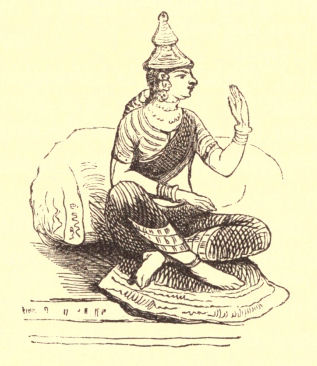
In ordinary cases he is naked and of a black colour, and with the bosom of a female.
Near him are groups of domestic animals, in allusion to the gentleness of the worship of this deity, which forbids the shedding of blood.
Beside the superior gods whom we have described, the numerous populations of India recognize a crowd of secondary divinities, whose history approaches in many instances to those of the Greek and Roman deities, and if their legends offer an interest by their singularity, they prove at the same time, that the founders of these various faiths have sought to give them a character of obscurity, that they may agree with the general mysticism of the East.
The fables of India, essentially metaphysical and philosophical, are less agreeable than those of the people of the West, who indulge their sensual ideas to a considerable extent.
Below the Supreme being, whose belief is spread among all nations, are placed the embodyings of the principal god: then, (of an order still less important,) are placed idols of all kinds, and of all forms, adored by these ignorant and credulous people.
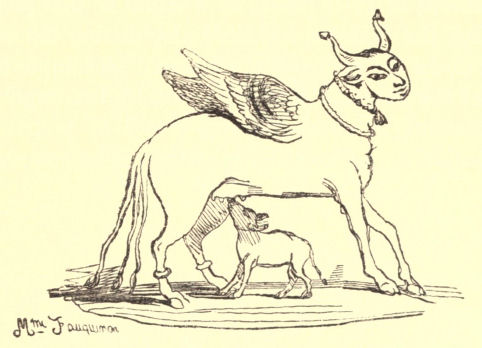
Of the many deities of the second category, the most remarkable is Ganga, who is the river Ganges personified, a river sacred alone to the Hindoos.
"A stream descends in Meru mountain, None hath seen its secret fountain; It had its birth, so sages say, Upon the memorable day When Parvati presumed to lay, In wanton play, Her hands, too venturous goddess, in her mirth, On Seeva's eyes, the light and life of earth. Thereat the heart of the Universe stood still; The elements ceased their influences; the hours Stopt in the eternal round; motion and breath, Time, change, and life, and death, In sudden trance opprest, forgot their powers. A moment and the dread eclipse was ended, But, at the thought of nature thus suspended, The sweat on Seeva's forehead stood, And Ganges thence upon the world descended, The holy river, the redeeming flood. None hath seen its secret fountain, But on the top of Meru mountain Which rises o'er the hills of earth, In light and clouds, it hath its mortal birth: Earth seems that pinnacle to rear, Sublime above this worldly sphere, Its cradle, and its altar, and its throne: And there the new born river lies, Outspread beneath its native skies, As if it there would love to dwell, Alone and unapproachable." Southey.
To perform their ablutions in its waters, to die on its brink, to be thrown after death into its waves, are the supreme happiness of the disciples of Vishnu and of Brahma. The dying carcasses are generally abandoned to the current of the wave.
The most famous of their places of worship is that point of the peninsula, where the Ganges, suddenly abandoning the mountains, is precipitated down the plains of Hindostan. A temple is elevated in the middle of the waters, and surmounted by two cupolas.
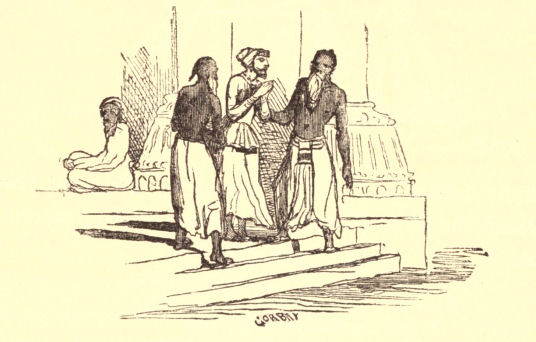
Here are constantly assembled a large crowd of pilgrims, and a willing contribution is paid to the Brahmins. The two sexes bathe together, while the most rigid of the devotees walk to the bath escorted by two Brahmins.
"How sweetly Ganga smiles and glides Luxuriant o'er her broad Autumnal bed! Her waves perpetual verdure spread, Whilst health and plenty deck her golden sides: As when an eagle, child of light, O'er her eyry proudly reared, Sits brooding and her plumage vast expands, Thus Ganga o'er her cherished lands, To Brahma's grateful race endeared, Throws wide her fostering arms, and on her banks divine, Sees temples, groves, and glittering towers, that in her crystal shine. "What name, sweet bride, will best allure, Thy sacred ear, and give the honour due? Vishnupedi? mild Bhishmasu? Smooth Suranimnaga? Trisrota pure? By that I call; its power confess: With growing gifts thy suppliants bless, Who with full sails in many a light-oared boat, On thy jasper bosom float; Nor frown, dread goddess, on a peerless race, With liberal heart and martial grace, Wafted from colder isles remote: As they preserve our laws and bid our terror cease, So be their darling laws preserved, in wealth, in joy, in peace!" Sir W. Jones.
The elephant plays a prominent part in the Hindoo tales. They pretend that the world is sustained by four of these animals, who are placed at the four cardinal points. In most of their temples one of them is sure to be seen.
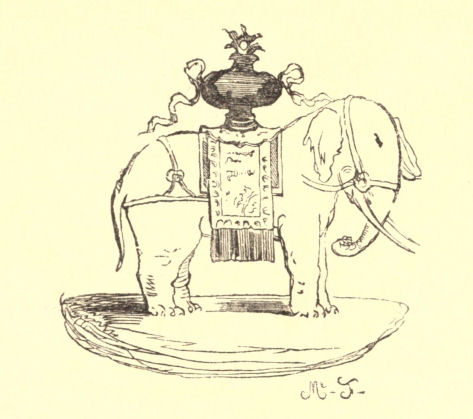
His colour is white, his tusks are sometimes four in number, and all his body is covered with carpet, sparkling in the light of diamonds and precious stones.
The Hindoos revere also a large serpent as a god:
"'The god! the very god!' he cried, and howled One long, shrill, piercing, modulated cry; Whereat from that dark temple issued forth A serpent, huge and hideous. On he came, Straight to the sound, and curled around the priest His mighty folds innocuous, overtopping His human height, and arching down his head, Sought in their hands for food. Then quitting, reared, and stretched and waved his neck And glanced his forky tongue." Southey.
A cow, of whom the gods disputed the possession, is also worshipped by them; she was obtained by one of them through a stratagem very like that employed by Jupiter with Europa.
They pay homage also to peculiar divinities, such as the goddess of pleasure, and the god of war.
The former was fabled, like Venus, to have arisen from the sea when agitated by the gods.
The poetry of the East frequently alludes to fairies of great and exquisite beauty, who people the air, the earth, the rivers, and the woods, and are placed by them among the inferior divinities.
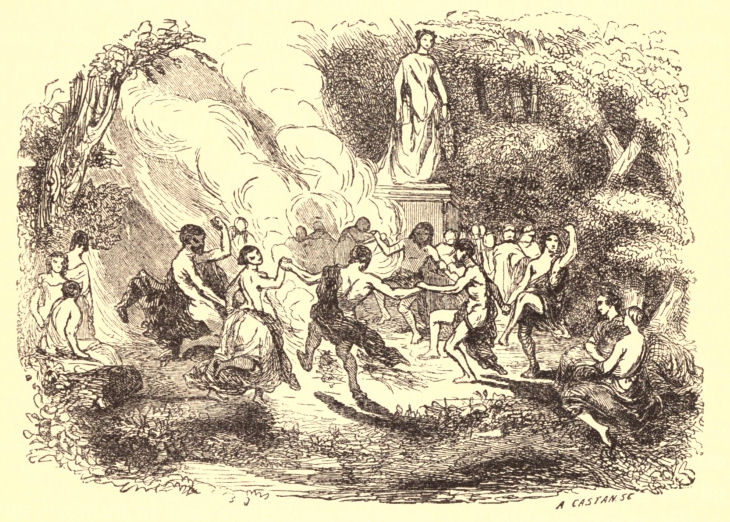
Camdeo, the god of love, takes the same standing in the East, as Cupid in the mythology of which we have already treated; though the Indian description of his person and his arms, his family, attendants and attributes, has new and peculiar characteristics.
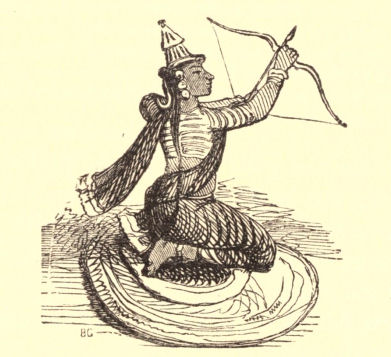
He is represented as a beautiful youth, sometimes conversing with his mother and consort, in the midst of his gardens and temples. His bow of sugar-cane or flowers, with a string of bees, and his five arrows, each pointed with an Indian blossom of a heating quality, are allegories equally new and beautiful.
This deity is adored in India, under a great number of names, Camdeo, however, being the one by which he is best known, and under which he is most worshipped.
"What potent god from Agra's orient bowers, Floats through the lucid air while living flowers, With sunny twine the vocal arbours wreathe, And gales enamoured, heavenly fragrance breathe? Hail power unknown! for at thy beck Vales and groves their bosoms deck, And every laughing blossom dresses With gems of dew, his musky tresses. I feel, I feel thy genial flame divine, And hallow thee and kiss thy shrine. "'Knowest thou not me?' celestial sounds I hear! 'Knowest thou not me? Ah! spare a mortal ear! Behold—' my swimming eyes entranced I raise, But oh! they sink before the excessive blaze. Yes, son of Maya, yes, I know Thy bloomy shafts and cany bow, Cheeks with youthful glory beaming, Locks in braids ethereal streaming, Thy scaly standards, thy mysterious arms, And all thy pains, and all thy charms. 'O thou for ages born, yet ever young, For ages may thy Brahmins' lay be sung! And when thy glory spreads his emerald wings To waft thee high above the tower of kings, Whilst o'er thy throne the moon's pale light Pours her soft radiance through the night, And to each floating cloud discovers, The haunts of blessed or joyless lovers, Thy mildest influence to thy bard impart, To warm, but not consume his heart." Sir W. Jones.
S C A N D I N A V I A.
The Edda, forming the mythological history of the ancient people of the North, is a complete receptacle of poetry no less than of history: and forms of itself a work of great interest.
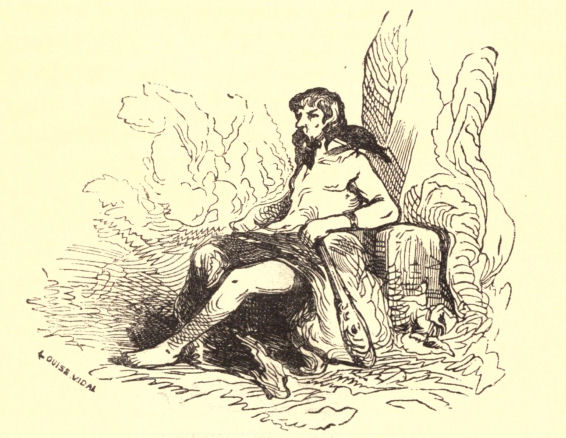
The most important of the gods of Scandinavia is Odin, who was in all probability one of their kings, and whose amours, as numerous as those of Jupiter, are perpetuated in a thousand legends. Like Jupiter too, he married his sister Frea, and in the sacred books of the priesthood, he is known by upwards of a hundred names, all of them high sounding and magnificent.
His adventures, which are numberless, are interwoven with the whole of the Scandinavian history.
Frigga or Frea, his wife, was the most powerful of the goddesses, and by many supposed to be identical with Ceres, or the Earth; the future was as familiar to her as to Odin, with whom she is seated upon his throne, and whose government of the remaining deities she shared.
When the warriors of the land seek glory in battle, she sends an inferior goddess to watch over the safety of those whom she favours, while they who fall, are honoured by the mighty mother Frigga, herself mourning over their fate, not indeed for their sake, but for the sake of the country they would have adorned and the land for which they fought.
One of the children of Frigga and Odin, by name Thor, presided over the works of creation, and over the variations of the atmosphere. The tempests and the apparent strife of nature, is caused by the struggle which Thor constantly has with a famous serpent, whose vast folds embrace the whole circumference of the earth.
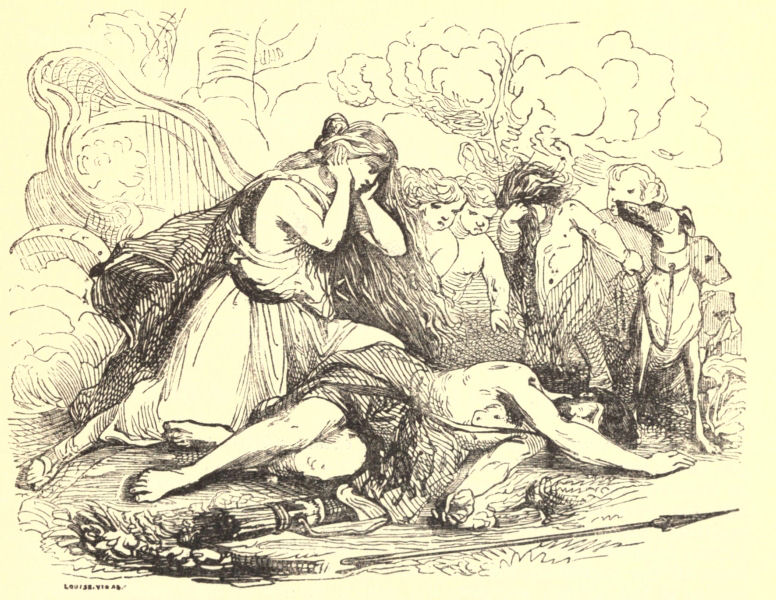
Balder, another son of Odin and Frigga, is described as the finest and the best of their race. He was distinguished no less for his eloquence than for his kindness and wisdom. It was his doom to meet with a premature death. Aware, from her knowledge of the future, of the destiny which awaited him, Frigga yet sought to avert it: and administered an oath to all the objects of nature, not to injure her beautiful and beloved Balder. The stones, the trees, the fish, the very diseases were sworn to respect his life.
No sooner had this been done, than his brothers determined to see, if indeed, he had a charmed life, and essayed successively the various means of death on the unhappy Balder, who fell a victim to their folly; aided by the cunning of Loke, who, through a stratagem which proved successful, showed how impossible it is to avert destiny.[1]
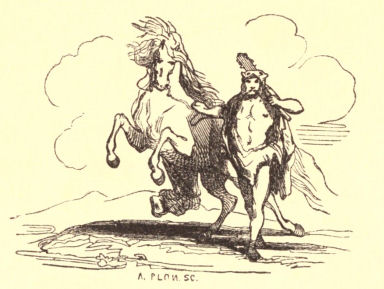
His body was placed upon a funeral pile, and his wife was burned with him. No sooner was the funeral terminated, than a fellow-god, leading a fleet steed, went to demand the body of Balder from the dark goddess Hel, who replied that he should be returned if all created beings would shed a tear for him. One only refused, and Balder was doomed, to the great grief of his mother, to rest in the infernal regions.
Among the amusements of Odin, hunting forms a very important and prominent part; when the bows, arrows, and javelins were prepared by one deity; while another gilded the heavens with stars; a third protected and guided the steps of the hunters in the sacred wood; and the most successful of them received from Odin the gift of immortality.
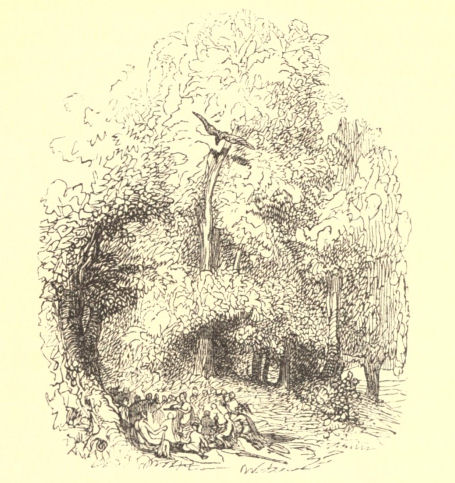
Each of the three superior deities had their respective priests, who exercised absolute authority over all that was connected with their religion, as well as presided over their sacrifices. Nor was it unusual to blend the priestly and the princely character, as in the case of Odin.
Frigga was attended upon by king's daughters, who were entitled goddesses and prophetesses. They uttered oracles, devoted themselves to a lasting virginity, and like the vestals of the Greek and Roman mythology, kept a perpetual fire in the temple of their goddess.
"The power of inflicting pains and penalties," says Mr. Howitt, "of striking and binding a criminal, was vested in the priests alone; and men so haughty that they thought themselves dishonoured if they did not revenge the slightest offence, would tremblingly submit to blows, and even death itself, from the hand of a pontiff, whom they took for the instrument of an angry deity."
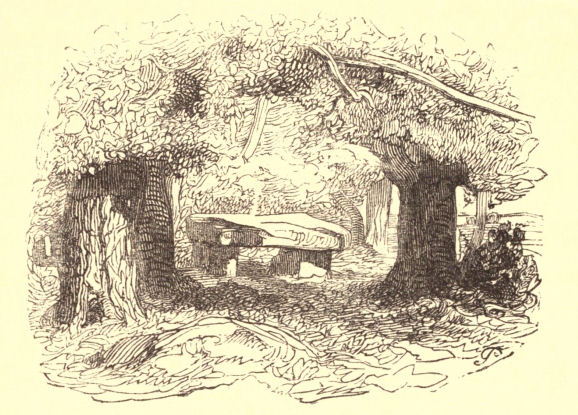
The councils of the divinities were held beneath the branches of an ancient oak, whose roots spread below over a fountain of water, remarkable for the number of serpents which it harboured.
Teutates, the most celebrated of their minor deities, was the vital and acting principle of the world; to whom was attributed many of the functions which were supposed to belong to Mars, to Hercules, and to Mercury. They worshipped him under the form of a dart, when they sought his aid in battle, and under that of an oak, when they endeavoured to inspire themselves with his advice; and his fétes were kept at the hour of night, in high places, or in solemn forests, by the rays of the moon, and the flashing of torches. The field where his holy ceremonies had been celebrated, was sown with stones, and from thenceforth doomed to know no more the voice of the sower, the song of the reaper, or the gladness of harvest time.
Under very important circumstances, it was by no means unusual to sacrifice human victims to this god, which were accompanied by flashing eyes, wild cries, and fierce gestures.
The Sacrifice to Teutates.
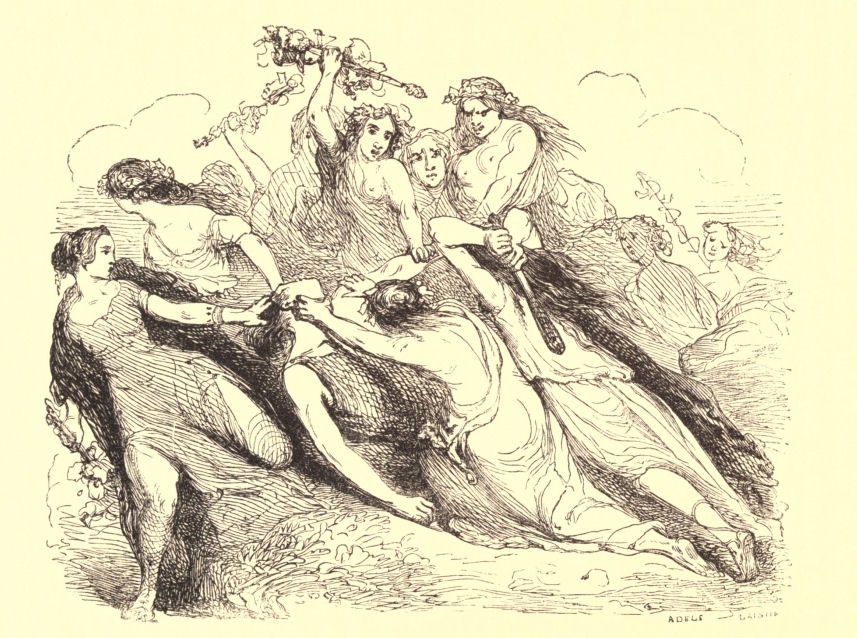
"But the general cause which regulated these sacrifices," says Mr. Howitt, (again to quote from his admiral work on priestcraft) "was a superstitious opinion, which made the Northern nations regard the number three as sacred and peculiarly dear to the gods. Thus every ninth month they renewed this bloody ceremony, which was to last nine days, and every day they offered up nine victims, whether men or animals. But the most solemn sacrifices were those which were offered at Upsal, in Sweden, every ninth year. Then they chose from among the captives, in time of war, and amongst the slaves in time of peace, nine persons to be sacrificed. The choice was partly regulated by the opinion of bystanders, and partly by lot. The wretches upon whom it fell were then treated with such honours by all the assembly; they were so overwhelmed with caresses for the present, and promises for the life to come, that they sometimes congratulated themselves in their destiny. But they did not always sacrifice such mean persons. In great calamities, in oppressive famine, for instance, if the people thought they had a sure pretext to impute the cause of it to the king, they sacrificed him without hesitation, as the highest price they could pay for the divine favour. In this manner the first King of Vermland was burned in honour of Odin, to put away a great dearth. The ancient history of the North abounds in similar examples.
"These abominable sacrifices were accompanied with various ceremonies. When the victim was chosen, they conducted him towards the altar on which the sacred fire was kept burning night and day. It was surrounded by all sorts of iron and brazen vessels. Among them was one distinguished by its superior size; in this they received the blood of their victim.
"When they offered up animals, they speedily killed them at the foot of the altar; then they opened their entrails, and drew auguries from them, as among the Romans: but when they sacrificed men, those they pitched on were laid upon a large stone, and quickly strangled or knocked on the head."
Irminsul was another, and not the least celebrated of the gods adored by the Germans; he had a magnificent temple, and a statue, which represented him in the figure of a warrior, was placed upon a column of marble. A great number of priests of both sexes served in the temple. Women acted as prophetesses, while the men employed themselves in sacrifices, and the choice of victims. The priests of this God possessed great importance in public affairs. During certain solemnities, armed warriors performed their evolutions around the idol, and in his sanctuary was placed immense treasure, both in arms and in precious stones.
The temple was however destroyed by Charlemagne, who broke the statue, and with poetical justice, slaughtered the priests on the threshold of the very place which they had so often deluged with human blood.
One column however remained standing, which was to the eyes of the Saxons, holier and dearer in its melancholy reminiscences, than if it had still possessed the statue of the god, which the emperor threw in the depths of the sea.
The sacrifices to these deities were sometimes varied; there was a deep well in the neighbourhood of the temple at Upsal, where the chosen person was thrown in headlong, in honour of the deity representing the earth. If the body fell to the bottom, the goddess was supposed to accept it; if not, she refused it, and it was hung up in a sacred place. Near this place was a forest, named Odin's grove, every leaf of which was regarded as sacred, and was filled with the bodies of those who had been sacrificed.
Occasionally the blood of their children was not spared even by the monarchs of the land—Hacon of Norway, shed the blood of his son on the altar to secure a viceroy; and Aune of Sweden, in an attempt to obtain a continuance of life, sacrificed the lives of nine of his offspring; examples which could not fail to produce an effect upon their people.
But not only did they delight in the sacrifices of human life, they also gave way in their orgies to unbounded licentiousness. While at Uulel, at the feast of Thor, the license was carried to such a pitch as to become merely bacchanalian meetings, where, amidst shouts, dancing, and indecent gestures, so many unseemly actions were committed, as to disgust the wiser part of the community.
A M E R I C A.
The greater part of the American nations were abandoned to Polytheism, and allowed a crowd of divinities: and nearly all adored the Sun, as the best representation of the Eternal.
In Peru, at the time of its discovery by Pizarro, Viracocha was supposed to be the creator of the gods, and below him, they believed in two triads; the first was Chuquilla, Catuilla, and Intyllapa; and the second Apomti, Churunti, and Inti-quaoqui.
The creator of the world, according to the Mexicans, was Mexitli, who was seated on an azure coloured stool, placed on a litter; his hand grasped an azure staff, in the shape of a serpent, and to crown all, he was of an azure complexion. Tlaloc was their second, and Tezcallipuca their third deity. This last was considered the god of repentance: and it was by the direction of the first, that they built the magnificent city of Mexico in the midst of a lake.
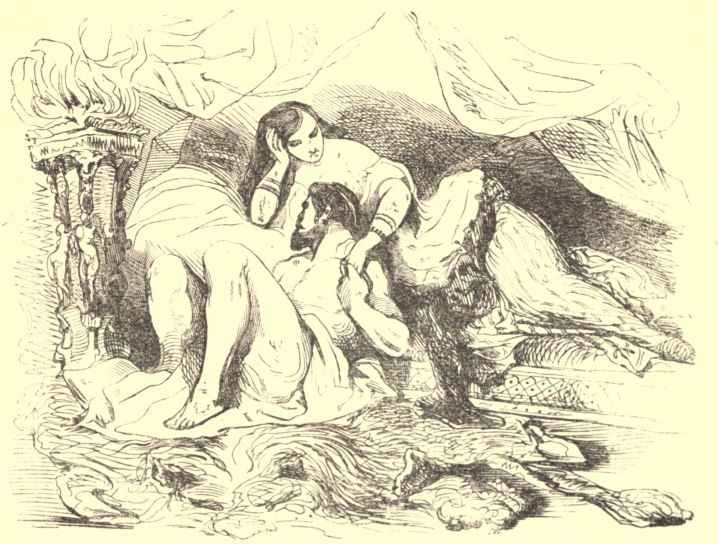
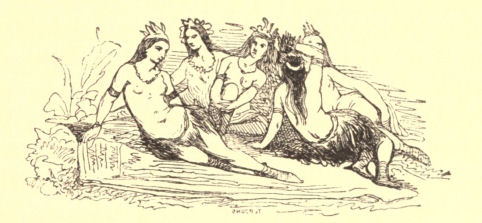
They had, besides these, Tangatanga, an idol which was, according to them, three-in-one and one-in-three. They possessed also a Venus, who, with her three sisters, presided over love. It is not unusual to represent her reclining on a couch, while the favoured lover is shewn sitting by her side, hand in hand, as an emblem of mutual affection.
The Mexicans also had a goddess of old age, to whom they rendered honours of the highest character. They immolated on her altar once every year a female, whom they forced to dance in presence of the idol to whom she was to be sacrificed: while in the evening, the priests ran wildly in the streets, striking children and females with small bundles of hay.
When any solemn feast was in preparation, they made choice of a young and beautiful slave, whom, after bathing in the lake dedicated to their Gods, they clothed in the richest costume, offering to him the highest honour for a space of forty days; all that could tend to allure the mind to earth, or render life desirable, was showered upon the victim, his wishes were anticipated, and his desires fulfilled. Nine days, however, before the sacrifice took place, the priest, prostrating himself, uttered this brief sentence,
"You have yet nine days to live!"
Intoxicating liquors were then given him, to sustain his courage until the day of the solemnity arrived, when he paid the penalty, by death; his heart was torn from his body, which was afterwards precipitated from the platform of the temple, mid the wild cries of the priests, and the yet more savage greetings of the multitude.
The religious orgies of the Mexicans were of a gloomy and frightful character; to enable them to go through which, their priests anointed themselves with a particular ointment, and used various fantastic ceremonies to deprive themselves of timidity. They then would rush forth to celebrate their rites, during which their vestal-virgins, and the priests were wont frantically to cut themselves with knives.
Quetsalocatl was the deity to whom the highest honours were paid in the valley of Cholula.
The air, commerce, war, and divination were under his control; and it was through him that the remarkable prophecy was supposed to originate, which prepared the Mexicans for the coming of the Spaniards into their territory.
The ceremonials attached to his faith were of an inhuman nature, they sacrificed to him an enormous number of human victims. Cholula, was, indeed, the Mecca of this false divinity, and in order to receive the crowd of pilgrims, who day by day assembled, it was found necessary to maintain as many temples as there are days in the year.
The principal one of these was an immense pyramid of thirteen hundred and fifty-five feet round its base, and about one hundred and seventy in height.
Of all the offerings which could be given to their god, human sacrifices were considered most acceptable: a belief, which, with a superstitious and warlike people, necessarily produced an enormous number of victims; as every prisoner taken in war soon came to be considered a fitting subject for the cruelties of the temple, and the worship of their gods.
It has been suggested, that some navigators of Phœnicia might have been thrown upon the then unknown shore of America, from which place they did not return, but gave to their descendants their religion, which in the lapse of ages became lost; because in some things it bears a resemblance that cannot fail to bring that of Egypt to the mind, an idea, which the vestiges of monuments of gigantic proportions, with forms and hieroglyphics, strongly tend to aid.
"Pyramids," says an able writer of the present day, "not inferior to the Egyptian, exist in many parts of the Mexican Territories and of new Spain. Some of these pyramids are of larger base than the Egyptian, and composed of equally durable materials; vestiges of noble architecture are visible at Cholula, Otumba, Oaxica, Mitlan, and Tlascola.
"The ancient town of Palenque, exhibits not only excellent workmanship in the temples, palaces, private houses, and baths, but a boldness of design in the architect, as well as skill in the execution, which will not shrink from a comparison with the works, at least, of the earlier ages of Egyptian power. In the sanctuaries of Palenque, are found sculptured representations of Idols, which resemble the most ancient gods of Egypt and Syria; Planispheres and Zodiacs exist, which exhibit a superior astronomical and chronological system to that which was possessed by the Egyptians.
"Statues, sculptured in a purely classical style, have been found; and vases, agreeing both in shape and ornament with the earliest specimens of Egyptian and Etruscan pottery, have been found in their sepulchral excavations.
"Evidences also exist in Mexico, of two great branches of hieroglyphical language, both having striking affinities with the Egyptians, and yet distinguished from it by characteristics perfectly American."
The same authority says, "The gods of the Tultecans, appear sculptured in bas relief, in the dark inner rooms of extant temples.
We will take one, as an instance of the analogy to which we allude. Pourtrayed on the inner wall of the Adytum of one of the sanctuaries belonging to the great temple of Palenque, appears the chief god of the Tultecan people. Our opinion is, that he is strongly identifiable with the Osiris of Egypt, and the Adonis of Syria; or rather, that he is the ancient god, called Adoni-Siris, a well known classical combination, therefore an identification, of both divinities.
In the first place he is enthroned on a couch, perfectly Egyptian in its model; it is constructed somewhat in the form of a modern couch, a cushioned plinth, resting on the claws, and four limbs of the American lion: we may at once emphatically say that there is no real difference between the above couch, and that peculiarly designated as Egyptian, and which is observable in all the tombs and palaces of Egypt; on his head he wears a conical cap, not differing much from that which the Osiris of Egypt wears. Two additional symbols, the one Egyptian, the other not, but equally intelligible, namely the lotus and the column affixed to the cap, clearly indicate the same tri-une divinity?"
The following description of one of their gods, we think, also affords additional ground for this opinion. "In the midst of an enclosure, which does not yield in size or grandeur to the proudest monuments of Egypt, and on the top of an immense pyramid stands the image.
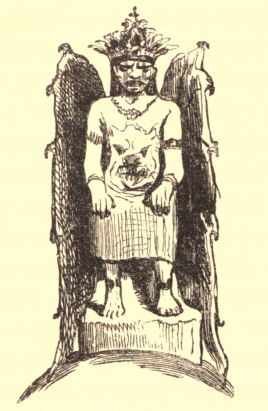
It is placed on a throne upheld by an azure globe; and on its head are plumes of divers colours. His face, severe and frightful, is marked with two blue lines. He has two vast wings formed like a bat, and the feet of a goat; while in his middle is drawn the head of a lion.
As a proof of the bloody nature of the religion of the Mexicans, we may mention, that on solemnizing the building of their principal temple, sixty thousand prisoners were sacrificed. Cortez found in an enormous edifice the skulls of those who had been slain, the number of which amounted to upwards of one hundred and fifty thousand.
A F R I C A.
The supreme deity of the Hottentots, is supposed by them to possess a human form, and his residence is believed to be in the moon. When he renders himself visible to mortals, he appears in the shape and form of a Hottentot, and is, according to their ideas, possessed of exquisite beauty; they never worship him, and their reason for this absence of homage is stated by them to be, that the god has uttered a curse upon those who shall attempt to serve him; one thing is certain, that this people hold sorcery in great esteem.
Ovisara is the supreme being of another part of Africa. Invisible, everywhere present, omniscient, and infinitely good, he is never invoked. "The better he is" say the Negroes, "the more useless it is to pray to him," and as a natural consequence, their minds have recourse to, and believe implicitly in demons, in shadows and in divination. A pot pierced through the bottom in three places, is the organ used by the priests to give their oracles to the people; and from the sound which issues from the vessel, is drawn the good or evil augury: this sound is explained by jugglers, who, perfect masters of their trade, never find their address at fault.
The priests take but a small part in the public affairs; and it is forbidden to them, under very severe penalties, to enter the capital. On great occasions, when a sacrifice of prisoners is to be made, recourse however is had to them, to give an additional solemnity to the proceedings.
These ceremonies take place before the greater idols, who, according to the negroes, represent the evil spirits; and the number of victims should be five and twenty: unlike most other lands, who in the same circumstances are too eager for blood, they are allowed to ransom their lives, should it be in their power.
The negroes of Senegal adore a river, trees, and serpents, with a crowd of shapeless idols, the legends of whom neither amuse by their incident, or excite the imagination by the beauty of their poetry.
In parts of Africa, they worship the soul of the dead, and a being named Molongo, upon whom they are most prodigal in bestowing titles; such as sovereign of nature, and of the Sun and Moon, and king of the earth and sea; while on others, they pay deep reverence to monkeys, who are brought up with care, and covered with honours.
Among the nations of Congo, and in the Caffre-land, the people are abandoned to the grossest superstitions. In the middle and to south of Africa, the worship of idols is universal; while in Abyssinia and at the Cape, are some faint gleams of Christianity mingled with impure legends, which have doubtless been derived from the mythologies of Greece and India.
P O L Y N E S I A.
The inhabitants of Polynesia, are, like all those whose faith is primitive and simple, devoted to the worship of the Sun, which they regard as a divinity; and which they imagine at one time to have been a human being: they believe he married his sister, who, when all the rest of her family came upon earth, remained by herself in the skies, and from their union sprang the months.
The Otaheitians, more advanced in civilization, have also more extended ideas of the divinity. They worship a supreme deity whose wife is material and corporeal, and of a nature therefore entirely different from his own.
They gave birth to a class of supernatural beings, which correspond with the inferior divinities of other Mythologies, from one of whom, sprang the three persons, forming the Trinity peculiar to this people; of these one is the creator, and lord of the starry hemisphere; another is the Neptune of their seas, the next watches over the hurricanes which sweep along the Pacific Ocean, and presides over the winds.
But the mode in which they account for the formation of the numerous islands for which the place is remarkable, is not the least curious of their beliefs.
One of their divinities, they say, took his wife, and threw her with so strong an arm into the Sea, that she fell to the bottom, and by the force of the concussion was broken into pieces. As she rebounded, lacerated, and divided into myriads of fragments of all sizes, they turned into the rocks, the shoals, and the numerous isles of Polynesia. An enormous fragment floated to the East, and formed America.
The principal goddess of the Sandwich islands, is remarkable chiefly for her hideous appearance. The face is tatooed, the nostrils are enormous, and her eyes, which are so small they are scarcely to be seen, resemble a leaf of laurel. Along her mouth are spread rows of teeth, which from the sharpness of their appearance, might belong to a wild beast, the neck is of an immense thickness; and the whole appearance is one which may vie in frightfulness with any deity or demon of this idolatrous people.
Our task is now closed; the religions of those who have gone before us, have been given with as much accuracy as the lapse of ages has permitted. We have sought the hidden beauties of poetry, to aid us in our endeavours, and to render them palatable to our readers; to those who have accompanied us in our wanderings; to those who have been with us among the elegant reminiscences of the Greek mythology, and followed us to the more painful and revolting creed of the American, we can only say, that we hope to them, as to us, the subject has excited interest, and that a perusal of the fables we have been able to lay before them, may induce them to take a greater interest, and place a higher value on that faith, and on those truths which are set before them in the word of the One Great God.
With the following lines of the lamented L. E. L. we shall close our work, not doubting that our readers will perceive and appreciate their beauty.
————————"The days Of visible poetry have long been past!— No fear that the young hunter may profane The haunt of some immortal,—but there still— For the heart clings to old idolatry, If not with true belief with tenderness— Lingers a spirit in the woods and flowers Which have a Grecian memory,—Some tale Of olden love, or grief, linked with their bloom, Seem beautiful beyond all other ones. The marble pillars are laid in the dust, The golden shrine and its perfume are gone But there are natural temples still for those Eternal, tho' dethroned deities, Where from green altars, flowers send up their incense." L. E. L.
INDEX. Preface, v Introduction, 1 Achilles, 234 Acis, 255 Acteon, 49 Æneas, 244 Æolus, 143 Ætes, 169 Ægeus, 197 Admetus, 212 Adonis, 67 Adrastus, 220 Agamemnon, 228 Age of Gold, 10 Age of Steel, 23 Agenor, 27 Alcestis, 212 Alcyone, 146 Alcmeon, 221 Alphisibaus, 221 Amphion, 214 Amphitrite, 100 Amphiaraus, 221 Anadyomine Venus, 71 Anchises, 68 Andromeda, 192 Antigone, 219 Apollo, 33 Arachne, 88 Arion, 100 Ariadne, 98 Argo, 170 Astræa, 166 Athena Pallas, 88 Atlas, 191 Atreus, 233 Atropos, 149 Autumn, 136 Aurora, 44 Auster, 145 Balder, 280 Bacchus, 55 Bacchantes, the, 61 Battle of the Centaurs, 130 Baucis, 253 Bellerophon, 266 Boreas, 145 Brahma, 268 Buddh, 270 Cadmeo, 276 Cadmus, 264 Calista, 50 Calumny, 251 Callirhoe, 63 Cassandra, 40-230 Castalia, 40 Castor, 167 Centaurs, the, 128 Cerberus, 105 Ceres, 29 Cepheus, 194 Chaos, 6 Charybdis, 147 Charon, 105 Chiron, 130 Chrysaor, 190 Circe, 39 Clotho, 149 Colchis, 170 Comus, 160 Clytie, 37 Clytemnestra, 229 Clymene, 40 Cupid, 78 Cyclops, the, 74 Cybele, 10 Cyparissus, 39 Danaides, the, 108 Daphne, 36 Death of Hercules, 188 Destiny, 32 Dejanira, 183 Diana, 49 Dido, 245 Discord, 252 Divinities of Fables, 5 Echo, 118 Egisthus, 226 Endymion, 51 Envy, 251 Erigone, 58 Erostatus, 53 Eteocles, 220 Europa, 27 Eurus, 145 Eurydice, 207 Eurystheus, 179 Famine, 252 Fates, the, 149 Fauns, 123 Fidelity, 240 Flora, 139 Fortuna, 164 Friendship, 249 Frigga, 279 Ganga, 273 Galatea, 255 Genius, 158 Glaucus, 143-173 Golden Apple, 68 Golden Fleece, the, 170 Gorgons, the, 190 Graces, the, 158 Harpies, the, 148 Harpocrates, 165 Hebe, 127 Hecate, 170 Hector, 236 Helen, 228 Heliades, the, 44 Hercules, 177 Hermaphrodite, 112 Hermes, 110 Hesione, 182 Hero and Leander, 257 Hippodamia, 224 Hippolytus, 202 Honour, 248 Hope, 22 Hyacinth, 38 Hymen, 161 Icarius, 59 Io, 26 Iphigenia, 229 Irminsul, 283 Ixion, 107 Janus, 10 Jason, 161 Jocasta, 214 Judgment of Paris, 69 Juno, 25 Jupiter, 16 Jupiter Ammon, 18 Labours of Hercules, 179 Laius, 214 Laocoon, 238 Laomedon, 182 Lares, the, 156 Latona, 33 Lacheses, 149 L'Amore Dominatore, 87 Leander, 70 Leucothoe, 37 Liberty, 250 Lychas, 186 Manes, the, 155 Marathon, 205 Marriage of Hercules, 183 Mars, 76 Marsyas, 41 Medea, 170 Medusa, 90-190 Memnon, 44 Menelaus, 228 Mercury, 110 Midas, 42-124 Milo, 267 Minerva, 88 Minos, 27-107 Minotaur, the, 198 Mologno, 290 Momus, 161 Morpheus, 154 Mount Helicon, 41 Narcissus, 119 Nemesis, 156 Neptune, 99 Nessus, 184 Nerieds, the, 114 Night, 150 Nine Muses, the, 40-47 Niobe, 34 Nox, 150 Numa Pompilius, 262 Oceanus, 138 Œdipus, 214 Odin, 278 Olympus, 24 Omphale, 117-183 Orpheus, 105-207 Ovisara, 289 Pan, 42-115 Pandora, 20 Paris, 235 Peace, 248 Pegasus, 41 Pelops, 224 Pelias, 168 Penetates, the, 157 Perestere, 78 Perseus, 189 Peribæa, 215 Phæton, 43 Phaon, 260 Phœbus, 35 Phædra, 201 Philemon, 253 Philoctetes, 188 Phineus, 193 Pluto, 30-103 Plutus, 164 Polydectes, 189 Polyphemus, 242-255 Poisoned Scarf, the, 185 Pomona, 131 Prometheus, 18 Proserpine, 104 Proteus, 141 Psyche, 78 Pygmalion, 259 Pyramus, 254 Python, the Serpent, 44 Pythian Games, the, 44 Quetsalocatl, 286 Salmaeis, 112 Sappho, 266 Saturn, 8 Saturnalia, the, 11 Satyrs, 125 Scylla, 147 Silenus, 61 Siva, 270 Somnus, 155 Songs of the Winds, 145 Song of Night, 151 Sphynx, the, 217 Spring, 133 Summer, 135 Sylvans, 124 Syrens, the, 146 Syrinx, 116 Sisyphus, 107 Tangatanta, 235 Tantalus, 107-223 Tartarus, 107 Temple of Apollo, 47 Temple of Diana, 53 Terminus, 126 Teutates, 282 Themis, 166 Theseus, 57-197 Thetis, 139 Thisbe, 254 Thor, 279 Titans, the, 17 Thyestes, 223 Tityus, 108 Trojan War, the, 233 Truth, 248 Ulysses, 234 Uranus, 7 Venus, 66 Venus Aeræa, 70 Venus Cytheræa, 71 Vesta, 13 Vestals, the, 14 Victory, 250 Viracocha, 285 Virtue, 247 Vishnu, 269 Voluptuousness, 251 Vulcan, 73 Vulcanalia, the, 77 Winter, 137 Wise Men of Greece, 46 Zepherus, 145
LIST OF ENGRAVINGS. Frontispiece, to face title The Dance of the Corybantes, 9 The Feast of Bacchus, 61 Jason and Medea, 173 Hercules delivering Hesione, 182 The Death of Nessus, 184 The anger of Priam, 239 Pyrrha seizing the Sword before Achilles, 234 The Sacrifice to Teutates, 283
LONDON:—PRINTED AND PUBLISHED BY WILLOUGHBY AND CO., 26, SMITHFIELD.