M Y T H O L O G Y : (continued 5)
Reading edition
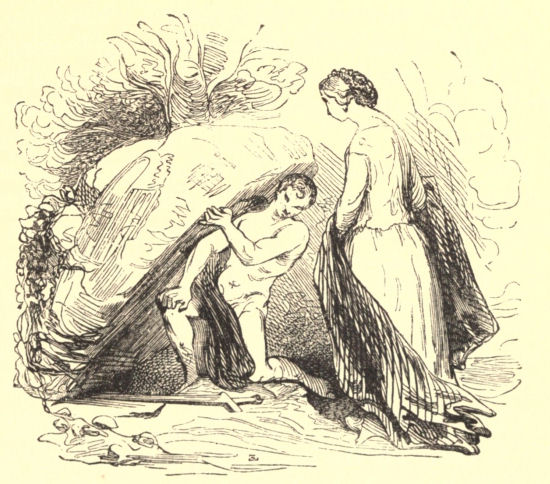
This hero, one of the most celebrated of antiquity, was the son of Ægeus, by Æthra, daughter of Pittheus, though not publicly acknowledged to be the King of Athens, being educated at Træzene, in the house of Pittheus. When he came to maturity, he was sent by his mother to Ægeus, and a sword which had been hidden beneath a stone until he became of age, and by which he was to make himself known to his parent, was shown to him, and ordered to be taken. The usual journey for travellers to his father's court, at Athens, was by sea, but Theseus determined to signalise himself by encountering the dangers which attended the journey on land, and which consisted in robbers and wild beasts, rendering the road almost impassable: however, these obstacles were all met, and destroyed by his courage. He arrived at Athens in safety, where his reception was not so cordial as he hoped, for Medea, who resided with Ægeus, felt that her influence with this monarch would be destroyed, if once Theseus gained his proper footing in his father's house, and she tried to poison him before his return was known to the Athenians. With a refinement of cruelty, she endeavoured to make Ægeus give a cup of poison to him, as an unknown stranger at a feast; but the sword at his side saved Theseus, for his father recognised it, and introduced him to the people of Athens as his son, all of whom gladly hailed the illustrious man, who had cleansed them of robbers and pirates, as the offspring of their monarch.
The Pallantides, however, who expected to succeed their uncle on his throne, were enraged at the reception of Theseus, and attempted to assassinate him; their barbarous intent recoiled upon themselves, for they were all slain by young Theseus.
The bull of Marathon which ravaged the neighbouring country, next engaged his attention, and taking the animal alive, he led it through the streets of Athens, previously to sacrificing it on the altar of Minerva.
At this time, the Minotaur was receiving the annual tribute of seven of the noblest youth of Athens, and Theseus could not fail of being ranked among them, to be devoured by the monster.
——————"The Minotaur was fed, With human victims for Androgeos dead. The flower of Athens were compelled to bleed, For thus the cruel oracle decreed, Till Theseus; to preserve his country's blood, Himself devoted for the public good." Ovid.
The wish to deliver his native land from this danger, induced him voluntarily to undertake the expedition; and before his departure, he promised his father, if he should be successful, to hoist a white sail on his return.
Ariadne, the daughter of Minos, became enamoured of him and by assisting him in the enterprise, he was successful and killed the Minotaur.
On his return from his victory there, he was driven by contrary winds on the Isle of Naxos, where he had the meanness to desert Ariadne, whose conduct had been the means of his glorious triumph, and to whom he was even indebted for his life.
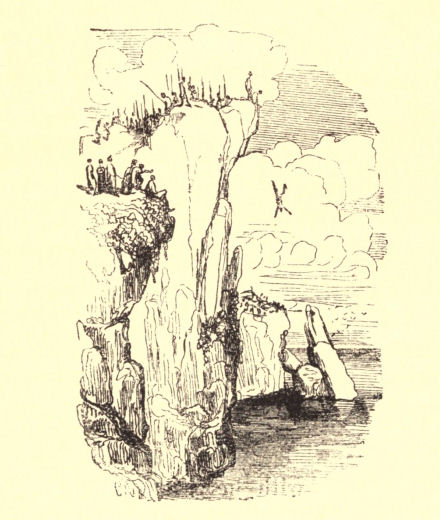
When he came in sight of Athens, he forgot, in the height of his success, to hoist the white sail he had promised his father, who, seeing a black sail upon his son's ship, despairingly threw himself into the sea.
"On a high rock that beetles o'er the flood, With daily care the pensive father stood; And when he saw impatient from afar? The fatal signal floating in the air, Thinking his Theseus was untimely slain, He rashly plunged himself beneath the main!"
His ascension to his father's throne was received with much pleasure, the country was governed with mildness, new reputation acquired and new laws enacted.
The renown he gained by his victory and policy, made his alliance courted in general; but Pirithous king of the Lapithæ, sought the more singular mode of gaining it by meeting him in fight.
He invaded the territories of Theseus, and when the latter assembled his forces to meet him, the two foes as they gazed on each other, were seized with a sudden and mutual friendship, and rushed into each others arms: from that time, their affection became proverbial.
Theseus was present at the nuptials of his friend, and when the brutal Centaurs attempted to insult the bride, was one of the most forward to defend: and when Pirithous, after this, had lost Hippodamia, he agreed with Theseus to carry away one of the daughters of the gods.
They first attempted their scheme upon Helen, the beautiful daughter of Leda, and when they had obtained their victim, cast lots for her: Theseus was successful, and she became his prize. Shortly after, he assisted his friend in his attempt to descend into the infernal regions and carry away Proserpine, but Cerberus was too watchful, and Pluto apprised of their intentions, stopped them: Pirithous was placed on Ixion's wheel, and Theseus secured to a large stone on which he had seated himself to rest.
By the assistance of Hercules, however, in his descent into hell, the two heroes were released from their captivity, and when Theseus returned to Athens, he found that Mnestheus had usurped the crown which should have fallen upon his children. In vain did Theseus attempt to eject the usurper, the Athenians remained faithful to their new choice, and Theseus retired in disgust to the court of Lycomedes, King of Scyros.
Here he met with apparent sympathy, but Lycomedes soon showed his true character, for enticing his guest to the top of a high mountain, he took an opportunity of throwing Theseus over a deep precipice.
The children of this hero at the death of the usurper, regained the throne of Athens: and that the memory of their father might not be without honour, sent for his remains from Scyros, and gave them a magnificent burial.
They also raised to him statues and a temple; festivals and games were also instituted in his honour, to commemorate the actions of a hero who had rendered such signal services to the Athenian people.
Leonarde. "'Tis one of those bright fictions that have made The name of Greece only another word, For love and poetry: with a green earth, Groves of the graceful myrtle, summer skies, Whose stars are mirrored in ten thousand streams, With winds that move in perfume and in music, And more than all, the gift of woman's beauty. What marvel that the earth, the sky, the sea, Were filled with all those fine imaginings That love creates, and that the lyre preserves! Alvine. But for the history of that pale girl Who stands so desolate on the sea-shore? Leonarde. She was the daughter of a Cretan king— A Tyrant. Hidden in the dark recess Of a wide labyrinth, a monster dwelt, And every year was human tribute paid By the Athenians. They had bowed in war; And every spring the flowers of all the city, Young maids in their first beauty, stately youths, Were sacrificed to the fierce king! They died In the unfathomable den of want, Or served the Minotaur for food. At length There came a royal youth, who vowed to slay The monster or to perish! Look, Alvine, That statue is young Theseus! Alvine. Glorious! How like a god he stands, one haughty hand Raised in defiance! I have often looked Upon the marble, wondering it could give Such truth to life and majesty. Leonarde. You will not marvel Ariadne loved. She gave the secret clue that led him safe Throughout the labyrinth, and she fled with him. Alvine. Ah! now I know your tale: he proved untrue— This ever has been woman's fate, to love, To know one summer day of happiness, And then to be most wretched! Leonarde. She was left By her so heartless lover while she slept. She woke from pleasant dreams—she dreamt of him— Love's power is left in slumber—woke and found Herself deserted on the lonely shore. The bark of the false Theseus was a speck Scarce seen upon the waters, less and less, Like hope diminishing, till wholly past. I will not say, for you can fancy well, Her desolate feelings as she roamed the beach, Hurled from the highest heaven of happy love! But evening crimsoned the blue sea, a sound Of music and of mirth, came on the wind, And radiant shapes and laughing nymphs danced by, And he the Theban god, looked on the maid, And looked and loved, and was beloved again. He has just flung her starry crown on high, And bade it there, a long memorial shine, How a god loved a mortal—He is springing From out his golden car, another bound, Bacchus is by his Ariadne's side." L. E. L.
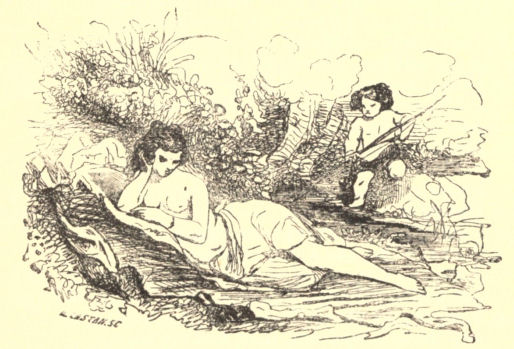
Theseus married Phædra, daughter of Minos, sister of the unfortunate Ariadne whom he had left to perish. Phædra, however, unhappily, felt a guilty love for Hippolytus, son of Theseus by a previous union. Venus, having a dislike to Minos, the father of Phædra, sent Cupid to pierce her with his shafts.
For a long time she struggled with the pangs which raged within her, but they grew too fierce to be endured, and she revealed to him her love.
Phæ. "'My lord, 'tis said you soon will part from us. Hip. Madam! Phæ. I pray you do not leave us! Hip. My duty, lady!— Phæ. Would that that duty, were in pleasing me; Hip. To please you, lady, were my highest wish, To gain your love, my highest privilege. Phæ. To gain my love? Hip. Aye, madam! Phæ. Hippolytus! the fearful truth will out, My love is gained! Hip. I hope, indeed so,—as a mother. Phæ. aside—(How coldly doth he speak, while thro' my veins The hot blood bounds in fierce convulsive starts.) Not as a mother do I love thee, But—as a woman—now my breast is free Of the stern secret which so long hath burned And given a fever to my very looks. Hip. Madam! I do not understand you; Phæ. You must! fierce, burning love is mine, For you, Hippolytus, the son of Theseus! Hip. And you his wife? Phæ. Aye, boy, 'tis even so; Nay, look not so:—I say Hippolytus, That from the very hour I saw, I loved thee; That from the very moment that thy voice Rang in my ears, it entered in my heart, That from the hour I was Theseus' wife, Even at the altar, where my plight was vowed, My thoughts were all of thee. Speak, speak, and say Thou dost not hate me. Hip. Some sudden frenzy hath upset thy brain— Thou knowest not what thou speakest. Phæ. I am not mad! would to the gods I were— Think not that I have yielded willingly, Unto the passion which I now avow, Daily, and hourly, have I striven against it: And night by night, when visions and when dreams Pressed on my brain in many a confused shape, All bearing one image, and that image thine, I have striven, wrestled, fought against this love, But all in vain. Hip. I scarcely dare believe mine ears, a dream Seems on me, like a man in sleep, A mass of dim confusion gathers round me; Am I indeed Hippolytus, and art thou Phædra? Phæ. I am thy Phædra! Theseus has my hand, But thou, Hippolytus, thou hast my heart. Hip. Theseus—my father—
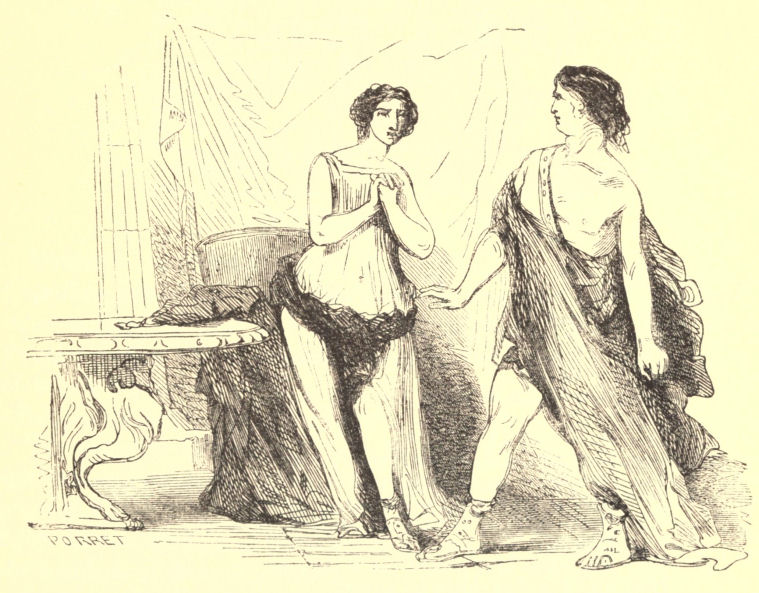
Phæ. Thy father and my husband, what of that? Love knows no ties save those he makes himself, Speak to me— Say that I yet may hope to lay my head On that dear bosom, say thou wilt not spurn The heart that rests its only hope on thee. Say, or, but look, a clear return of love, And I will fall upon my knees adoring thee! Hip. Madam, I would not, could not wrong my father; And thou, how canst thou meet his face? Shame, shame, upon the wanton love that leaves The marriage bed, even were it but in thought: And thou above thy compeers raised afar, In that thy name is mated with my father's, Shouldst pray the gods to scourge this passion from thee. Phæ. Oh! by thine hopes of heaven I pray thee peace! Hip. Peace, thou! adultress! peace, thou, shameless one, Away, lest I should change a husband's love, Into a husband's hate. Phæ. Thou canst not do it! Hip. What if I did proclaim to him thy guilt? What if I said—father! thy wife, my mother, Hath offered me the love due but to thee, Hath with a shameless love, and wanton's insolence, Deemed she could win me to her bed— Woman, I tell thee— Phæ. And I tell thee, that he would not believe thee. Yet—say it not, Hippolytus! for I Do love thee as— Hip. I'll hear no more! Mother! I leave thee, and I pray the gods To visit not on thee, this awful crime!'" Racine.
Fearful lest Hippolytus should betray her, when she found he would not return her sinful passion, Phædra accused his son to Theseus of the very crime of which she had herself been guilty, and excited the father's ire against his son in a terrible degree.
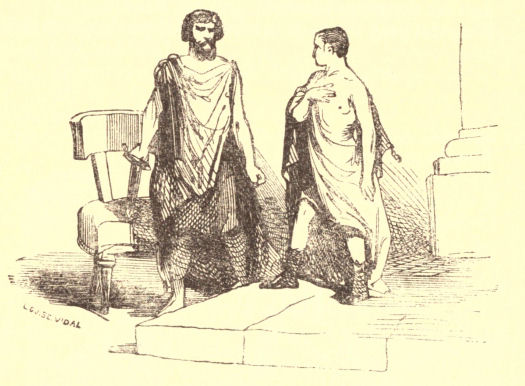
The. "'Dost thou dare look upon me boy? Hip. My father? The. Dost see this sword? Hip. Aye! The. Dost dread it? Hip. No; the innocent have nought to fear; The. Now by my crown, this is most base effrontery, But 'tis in vain, thy mother hath told all, Hath told how, with an impious love, thy heart Hath turned to her's; how with an impure lip, Thy words have pierced her to the soul. Hip. And dost thou doubt me father? The. Perfidious wretch! can'st stand before me thus? Monster too long escaped Jove's fearful thunder, After a love filled with an awful horror And transports of affection fiercely urged, That would pollute thy father's marriage bed, Thou darest present to me thy traitor brow, And vow thine innocence. Away from these scenes of thine infamy, Away and seek beneath a sky unknown, A land where Theseus' name hath never sounded; Fly, traitor! brave no longer here, my hate! Within a court that I shall hold with dread, For ever will the curse cling to my name, And endless infamy my memory, That, having given birth to one so shameless, I dared not take the life I gave to him! Wretch that thou art, dost thou not answer me? Hip. Sire, I am not the wretch that thou would'st make me. Horror—astonishment—have kept me silent— The. Darest thou add falsehood to thine infamy? Hip. Thy words are most unjust! The. And there thou standest with a brow as calm As innocence itself. Hip. In this I am most innocent!— Nay, interrupt me not, for I will speak— Thou hast accused me of an awful crime, Thou hast accursed me with a father's curse, And I must vindicate myself or die? Phædra, my mother, and thy wife, avowed In accents shameless as the wish she breathed, A most incestuous passion for my person: With fierce disdain I spurned her offered love, Implored her to remember that I stood Before her as thy son, and did entreat her To come back to the straight path of her duty. The. And dost thou think that thou canst thus deceive me? Away, away, no more pollute my court; Wert thou not called my son, thy time were short.'" Racine.
Banished thus from the court of his father, the only consolation for a long time that Hippolytus possessed, was the consciousness of innocence. Remorse, however, at last preyed upon the bosom of Phædra; after taking poison she confessed to Theseus the crime of which she had been guilty, and Hippolytus was restored to the affections of his father.
The name of Theseus had been rendered by his bravery so conspicuous and so dreaded by his enemies, that a tradition became popular, to the effect that he appeared at the battle of Marathon to fight for the Greeks, who seemed likely to be overwhelmed by the numbers of their opponents.
"Know ye not when our dead From sleep to battle sprung? When the Persian charger's tread On their covering greensward rung! When the trampling march of foes Had crushed our vines and flowers, When jewelled crests arose Through the holy laurel bowers, When banners caught the breeze, When helms in sunlight shone, When masts were on the seas, And spears in Marathon. "There was one a leader crowned, And armed for Greece that day; But the falchions made no sound On his gleaming war array. In the battle's front he stood, With his tall and shadowy crest; But the arrows drew no blood, Though their path was thro' his breast. When banners caught the breeze, &c. "His sword was seen to flash Where the boldest deeds were done; But it smote without a clash; The stroke was heard by none! His voice was not of those That swelled the rolling blast, And his steps fell hushed like snows,— 'Twas the shade of Theseus passed! When banners caught the breeze, &c. "Far sweeping thro' the foe, With a furious charge he bore, And the Mede left many a bow On the sounding ocean shore, And the foaming waves grew red, And the sails were crowded fast, When the sons of Asia fled As the shade of Theseus passed! When banners caught the breeze, When helms in sunlight shone, When masts were on the seas, And spears in Marathon!" Hemans.
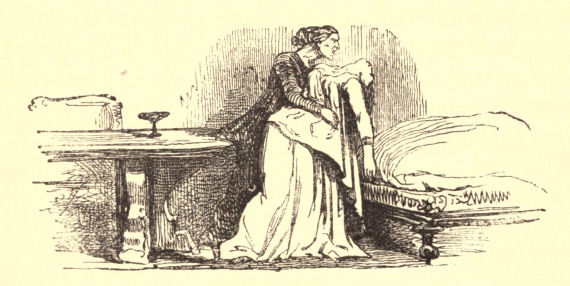
O R P H E U S.
The distinguished honour which the ancients rendered to Orpheus, appears to have been an homage paid by the refinement of the age to music and poetry, of which he was so distinguished an ornament. He was the son of Œager by the muse Calliope, though some assert him to have been the son of Apollo, because the god, owing to the genius he showed for music, presented him with a lyre, to the improvement of which Orpheus added two cords,—and upon which he played with so masterly a hand, that the river in its rapid current ceased to flow, the wild beasts of the forest forgot their nature, and gazed on him in mute admiration, while the very rocks moved towards him to express their joy.
"The rocks re-echo shrill, the beasts of forest wild Stand at the cavern's mouth, in listening trance beguiled. The birds surround the den, and, as in weary rest, They drop their fluttering wings, forgetful of the rest, Amazed the Centaur saw; his clapping hands he beat, And stamped in ecstacy the rock with hoofed and horny feet."
But though this beautiful art was his master passion, he did not forget the charms of theology and philosophy, in both of which he was a proficient, and in Egypt, to which place he made a voyage, he was admitted to the sacred mysteries of Isis and Osiris. On his return he was the originator of many changes in the religious ceremonials of his country, and was received as the minister and interpreter of the will of the gods.
Nature itself seemed charmed and animated by his presence, and the nymphs made his company their chief desire. It was not long before the winged deity pierced him with his arrows, and Orpheus loved the nymph Eurydice, the only one whose charms touched the melodious musician; with her his happiness was made perfect by an union, at which Hymen presided.
This happiness, however, was not destined to last very long, for Aristæus became enamoured of the musician's bride, and with all the violence of an illicit passion, sought to win her from the bridegroom's affections. Eurydice resisted and fled; but as she fled from him, a serpent stung her with so deadly a bite, that she died on the field.
Deep was the despair felt by Orpheus at his unexpected loss, and the daring determination was formed by him to recover her, or perish in the attempt.
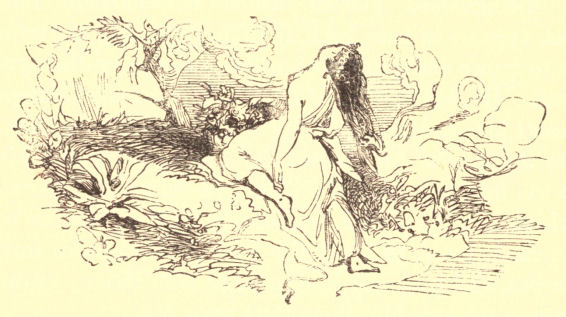
"His own despair the very stones admire And rolling follow his melodious lyre, He forced the heart of hardest oak to groan, And made fierce tigers leave their rage and moan."
With his resistless lyre in his hands, he crossed the Styx, penetrated into the infernal regions, and gained admission to the presence of Pluto! Here the power of his genius was yet more eminently exhibited; for even the tortures of Hell gave way to it.
"At his powerful song the very seats Of Erebus were moved; the retreats Of all the ghosts were opened, and they swarm Like bees in clusters, when the sun grows warm!"
Not only was the god of the infernal regions delighted, but the very wheel of Ixion paused; the stone of Sisyphus rested, as they listened to its sounds: the cooling water reached Tantalus' burning mouth, and even the Furies relented.
"Already had he passed the courts of Death, And charmed with sacred verse the powers beneath; While Hell with silent admiration hung, On the soft music of his harp and tongue; No longer Tantalus essayed to sip The springs that fled from his deluded lip; Their urn the fifty maids no longer fill, Ixion leant and listened on his wheel, And Sysiphus' stone for once stood still; The ravenous vulture had forsook his meal, And Titius felt his growing liver heal; Relenting fiends to torture souls forbore, And Furies wept who never wept before. All Hell in harmony was heard to move, With equal sweetness as the spheres above. The wondrous numbers softened all beneath Hell, and the inmost flinty seats of death: Snakes round the Furies heads did upward rear, And seemed to listen to the pleasing air, While fiery Styx in milder streams did roll, And Cerberus gaped, but yet forbore to howl, No longer was the charming prayer denied, All Hell consented to release his bride." Ovid.
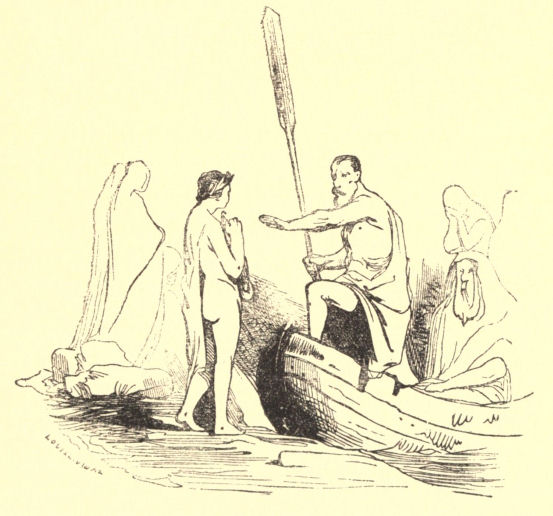
The sorrow and love of Orpheus penetrated the hearts of Pluto and Proserpine; they consented to restore him to the arms of Eurydice, if he could forbear to look behind him before he reached the borders of hell. Gladly were these conditions accepted by Orpheus, and already was he by the river Styx, eager to be conveyed across by the infernal boatman, when a touching thought of Eurydice and her love crossed his mind, and he looked back.
"Near the confines of ethereal air, Unmindful and unable to forbear, Mistrusting also lest her steps might stray, And gladsome of the glimpse of dawning day, He stopped—looked back—(what cannot love persuade?) To take one view of the unhappy maid. His longing eyes impatient backward cast, To catch a lover's look—but looked his last: Here all his pains were lost, one greedy look, Defeats his hopes, and Hell's conditions broke, A fatal messenger from Pluto flew, And snatched the forfeit from a second view, For instant dying, she again descends, While he to empty air his arms extends!" Ovid.
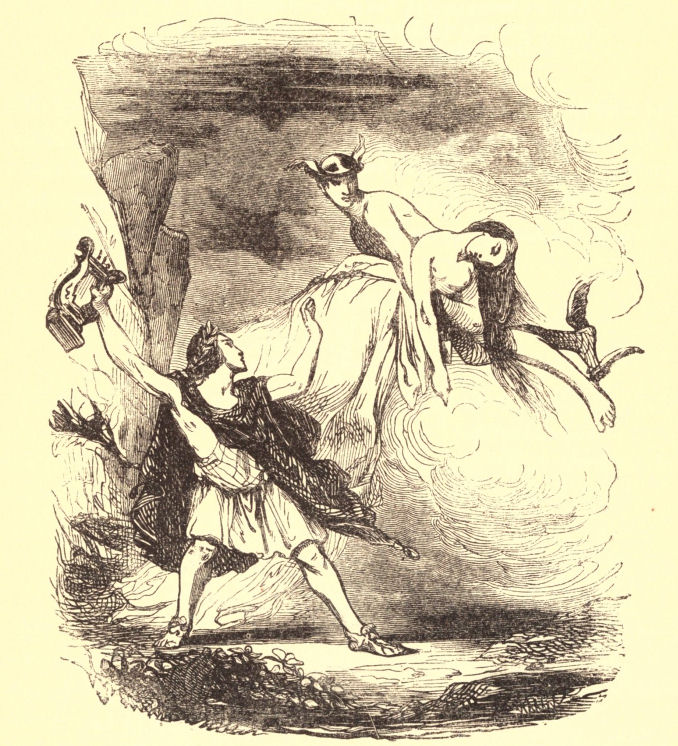
The condition being thus broken, he saw her, but at the same moment she was turned into a shadow.
"And fainting cries, 'What fury thee possest? What frenzy, Orpheus, seized upon thy breast? Once more my eyes are seized with endless sleep, And now farewell, I sink into the deep.' Oblivious cells surrounded all with night. No longer thine: in vain to stop my flight I stretch my arms, in vain thou stretchest thine, In vain thou grievest, I in vain repine.'" Virgil.
He returned to the upper world, where the only solace which he could find, was to soothe his grief with the tones of his musical instrument, to the sound of which, the mountains and caves of his native land bore a melancholy echo. He secluded himself entirely from the company of mankind; in vain was his society sought by the Thracian women; he rejected their overtures with coldness, until enraged at his behaviour, they attacked him while celebrating the Bacchanalian orgies.
"Here while the Thracian bard's enchanting strain, Sooths beasts and woods, and all the listening plain: The female Bacchanals devoutly mad, In shaggy skins, like savage creatures clad, Warbling in air perceived his lovely lay, And from a rising ground beheld him play: When one, the wildest, with dishevelled hair That loosely streamed, and ruffled in the air: Soon as her frantic eye the lyrist spied 'See, see, the hater of our sex,' she cried, Then at his face her missive javelin sent, Which whizzed along, and brushed him as it went; But the soft wreaths of Ivy twisted round, Prevent a deep impression of the wound, Next their fierce hands the bard himself assail, Nor can his song against their wrath prevail; In vain he lifts his suppliant hands, in vain He tries, before his never failing strain; And, from those sacred lips, whose thrilling sound Fierce tigers and insensate rocks could wound, Ah Gods! how moving was the mournful sight, To see the fleeting soul now take its flight!" Dryden.
After tearing his body to pieces, they threw his head into the Hebrus, which, as it rolled down the current, ejaculated with touching tenderness, 'Eurydice! Eurydice!' until it reached the Ægean sea.
The inhabitants of Dian asserted that his tomb was in their city, but the people of Mount Libethrus, in Thrace, claimed the same honour, remarking that the nightingales which formed their nests near it, excelled all others in melody and beauty. After his death, he is reported by some to have received divine honours, the muses rendering the rites of sepulture to his remains, and his lyre becoming one of the constellations.
A D M E T U S
was the king of Thessaly, whose flocks were tended by Apollo for nine years, when banished from heaven. During his servitude to this monarch he obtained a promise from the Fates, that Admetus should never die if another person would lay down his life for him.
Being one of the Argonauts, he was at the hunt of the Calydonian boar, when Pelias promised his daughter in marriage to him only, who could bring him a chariot drawn by a lion and wild boar. With the aid of Apollo, Admetus effected this, and obtained the hand of Alcestis.
By the fortune of war, he became a prisoner, and was condemned to death; Alcestis, with a beautiful display of conjugal affection, laid down her life to save her husband from the cruel death prepared for him.
DEATH-SONG OF ALCESTIS. "She came forth in her bridal robes arrayed, And midst the graceful statues round the hall Shedding the calm of their celestial mien, Stood pale, yet proudly beautiful as they: Flowers in her bosom, and the star-like gleam Of jewels trembling from her braided hair And death upon her brow! but glorious death! Her own heart's choice, the token of the seal Of love, o'ermastering love; which till that hour, Almost an anguish in the brooding weight Of its unutterable tenderness, Had burdened her full soul. But now, oh! now, Its time was come—and from the spirit's depths The passion and the melody Of its immortal voice, in triumph broke Like a strong rushing wind! The soft pure air Came floating through that hall—the Grecian air, Laden with music—flute notes from the vales, Echoes of song—the last sweet sounds of life And the glad sunshine of the golden clime Streamed, as a royal mantle, round her form— The glorified of love! But she—she look'd Only on him for whom 'twas joy to die, Deep—deepest, holiest joy!—or if a thought Of the warm sunlight, and the scented breeze, And the sweet Dorian songs, o'erswept the tide Of her unswerving soul—'twas but a thought That owned the summer loveliness of life To him a worthy offering—so she stood Wrapt in bright silence, as entranced awhile, Till her eye kindled, and her quivering frame With the swift breeze of inspiration shook, As the pale priestess trembles to the breath Of unborn oracles! then flushed her cheek, And all the triumph, all the agony, Born on the battling waves of love and death All from her woman's heart, in sudden song Burst like a fount of fire, 'I go, I go, Thou sun, thou golden sun, I go Far from thy light to dwell: Thou shalt not find my place below, Dim is that world—bright sun of Greece, farewell! The laurel and the glorious rose Thy glad beam yet may see, But where no purple summer glows O'er the dark wave I haste from them and thee. Yet doth my spirit faint to part, I mourn thee not, O sun! Joy, solemn joy, o'erflows my heart, Sing me triumphant songs! my crown is won. Let not a voice of weeping rise—, My heart is girt with power Let the green earth and festal skies Laugh, as to grace a conqueror's closing hour! For thee, for thee, my bosom's lord! Thee, my soul's loved! I die; Thine is the torch of life restored, Mine, mine the rapture, mine the victory. Now may the boundless love, that lay Unfathomed still before In one consuming burst find way, In one bright flood all, all its riches pour. Thou knowest—thou knowest what love is now! Its glory and its might— Are they not written on my brow? And will that image ever quit thy sight? No! deathless in thy faithful breast, There shall my memory keep Its own bright altar place of rest, While o'er my grave the cypress branches weep. Oh, the glad light! the light is fair, The soft breeze warm and free; And rich notes fill the scented air, And all are gifts, my love's last gifts to thee! Take me to thy warm heart once more! Night falls, my pulse beats low; Seek not to quicken, to restore— Joy is in every pang,—I go, I go! I feel thy tears, I feel thy breath, I meet thy fond look, still Keen is the strife of love and death; Faint and yet frantic grows my bosom's thrill. Yet swells the tide of rapture strong, Though mists o'ershade mine eye! Sing Pæans! sing a Conqueror's song! For thee, for thee, my spirit's lord, I die!'" Hemans.
A M P H I O N A N D N I O B E.
Amphion was king of Thebes, the favourite of Apollo and rival of the celebrated Orpheus in the science of music. It is related of him, that in order to build the walls which surrounded his capital, he played upon his lyre, and by its divine power, the stones came and ranged themselves in order.
He married Niobe, by whom he had seven sons and seven daughters; the trials of this princess have been given in the history of Apollo, leaving a touching memorial of the sorrows of maternal love and tenderness.
ΠD I P U S ,
K I N G O F T H E B E S.
Œdipus was the son of Laius and Jocasta; and being descended from Venus, was compelled to endure all the troubles which Juno might choose to inflict on him, from the hatred she bore to the goddess of beauty.
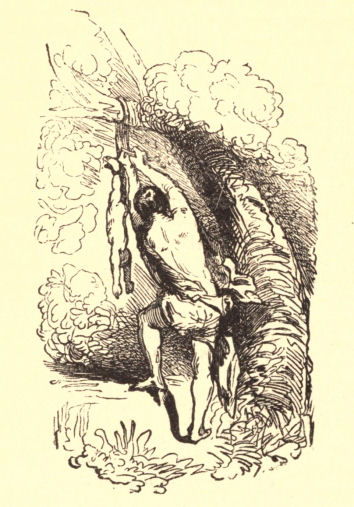
No sooner had the marriage of Laius taken place with Jocasta, than it was foretold by the oracle, that he would fall by the hands of his son. Alarmed at so fearful a prediction, he resolved not to approach his wife. Having broken this wise resolution, however, he became the father of Œdipus, but to avert the oracle, he ordered Jocasta to destroy the infant immediately he was born. The mother was unable to obey this cruel command, but gave him in charge to one of her domestics, with directions to leave him on the mountains. Instead of obeying this order, the servant bored a hole in the feet of the child, and hung him on a tree on Mount Cithæron, where he was soon found by one of the shepherds of Polybus, King of Corinth.
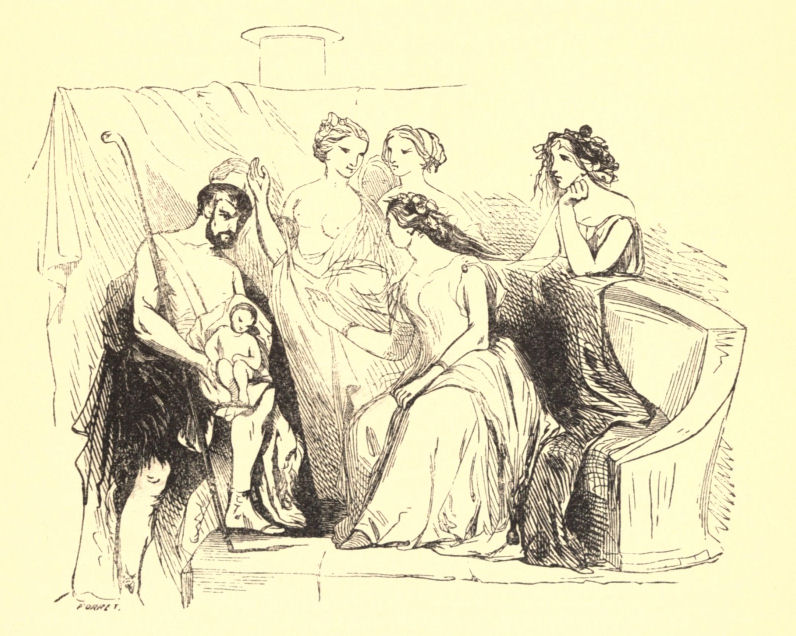
The shepherd took him and presented him to Peribæa, the wife of Polybus, who conceived a maternal tenderness for the deserted child, and adopted him as her own.
The accomplishments of the boy, who was named Œdipus, soon became the admiration of the age; he was informed that he was illegitimate, though Peribæa, when he appealed to her, told him, out of kindness, that his suspicions were unfounded. He remained dissatisfied however, and consulted the Delphian oracle, by which he was told not to return home, or he must inevitably become the murderer of his father, and the husband of his mother.
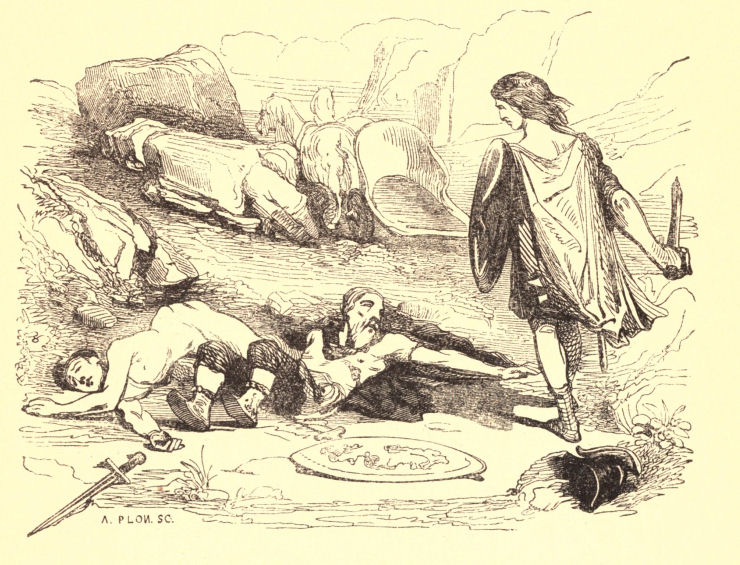
As he travelled towards Phocis, he met, in a narrow passage, Laius, his father, in a chariot with his arm bearer. Laius insolently ordered the youth to move out of his way, which Œdipus, not knowing him, and irritated at his tone and language, refused. A conflict ensued, and Laius with his companion was slain.
———————————"'His demeanour bold, Imperative, and arrogant: from far He waved his hand, that I should quit the path. Most narrow was the place, and scarce allowed To one, free passage. I was incensed At his deportment, free myself by birth, Hence I advanced with an undaunted step: He, with a terrible accent, cried, "Make way." I, on the other hand, exclaimed with rage, Returned his menace, and bade him retire. Already had we met: he from his side, Unsheathed a dagger, and upon me leap'd. I had no dagger, but I lacked not courage. Me he assailed. I combated his onset, Grasp'd him, and in less time than I relate it; Flung him upon the earth: in vain he strove; When to the contest he perceived himself Inadequate, insidiously he feigned Terms of submission: I consented to them: Quitted my grasp, when treacherously a blow, Such as thou sees't here, he aimed at me, And pierced my clothes. The weapon grazed my flesh The wound is slight, but boundless was my rage. Blind with revenge I snatched the dagger from him, And weltering in his blood he lay transfixed.'" Alfieri.
Ignorant of the rank of the man he had killed, he continued his way to Thebes, attracted thither by the noise which had been vented about of the Sphynx, a frightful monster then laying waste the country around Thebes, and devouring all who could not expound the enigma it proposed, which was—"What animal in the morning walks upon four legs, in the afternoon upon two, and in the evening upon three legs." The answer of Œdipus was "That in infancy man goes upon his hands and feet; in manhood he walks upright, and in old age with the assistance of a staff." Enraged at this solution, the monster dashed its head against a rock, and delivered Thebes from his unwelcome presence.
The prediction, partly fulfilled, was now entirely brought to pass, for Œdipus mounted the throne, and married Jocasta, his mother, by whom he had two sons, Polynice and Eteocles, and two daughters, Ismene and Antigone.
Some years after, a plague visited his territories, and the oracle was consulted, which stated that it would only cease when the murderer of King Laius was banished from the country. The slayer of this king had never been discovered, and the whole of Thebes was in violent excitement, anxious to discover the murderer, to avert the plague which raged; Œdipus himself instituted all possible inquiry, resolved to overcome every difficulty. What was his sorrow at learning as the result of his unwearied zeal, that he himself was the unhappy parricide, and still more, that he was the husband of his own mother.
Œdipus. "'Why speak you not according to my charge? Bring forth the rack, since mildness cannot win you Torment shall force. Phorbas. Hold, hold, Oh! dreadful sir, You will not rack an innocent man. Œd. Speak, then. Phor. Alas! what would you have me say? Œd. Did this old man take from your arms an infant? Phor. He did, and oh! I wish to all the gods, Phorbas had perished in that very moment. Œd. Moment! thou shalt be hours, days, years undying, Here, bind his hands, he dallies with my fury, But I shall find a way— Phor. By the gods, I do conjure you to enquire no more. Œd. Furies and Hell! Hæmon bring forth the rack, Fetch hither cords and knives, and sulphurous flames. He shall be bound and gashed, his skin flead off And burned alive. Phor. O spare my age. Œd. Who gave that infant to thee? Phor. O wretched state! I die, unless I speak; And if I speak most certain death attends me. Œd. Thou shalt not die; speak then, who was it? Speak, While I have sense to understand the horror, For I grow cold. Phor. The Queen, Jocasta told me It was her son by Laius. Œd. O you gods—break, break not yet my heart, Though my eyes burst, no matter, wilt thou tell me, Or must I ask for ever? For what end? Why gave she thee her child? Phor. To murder it. Œd. O more than savage! murder her own bowels Without a cause. Phor. There was a dreadful one Which had foretold that most unhappy son Should kill his father, and enjoy his mother. Œd. 'Tis well! I thank you gods! 'tis wondrous well! Dagger and poison—O there is no need For my dispatch; and you, ye merciless powers, Hoard up your thunder stones; keep, keep your bolts For crimes of little note. Adrastus. Help—and bow him gently forward, Chafe, chafe his temples—He breathes again, And vigorous nature breaks through opposition. How fares my royal friend? Œd. The worse for you. O barbarous men, and oh! the hated light, What did you force me back to curse the day, To curse my friends, to blast with this dark breath The yet untainted earth and circling air? To raise new plagues and call new vengeance down, Why did you tempt the gods, and dare to touch me? Methinks there's not a hand that grasps thy hell, But should run up like flax, all blazing fire. Stand from this spot, I wish you as my friends, And come not near me, lest the gaping earth Swallow you too.'" Sophocles.
In the depth of his anguish he deprived himself of sight, as unworthy ever more to behold the light, and banished himself from Thebes for the good of his country; or as many assert, he was banished from thence by his sons.
He retired towards Attica, led by his daughter Antigone, and came to a place sacred to the Furies. Here the remembrance flashed across his mind, that he was to die in a place like this, that such had been the decree of the oracle, and that he was to become the great source of prosperity to the country in which his bones should be laid. He sent therefore to Theseus, king of the place, to inform him, that on his arrival he would make known to him the resolution which he had made. Theseus came, and found Œdipus with his face covered by a black veil, a knife in one hand, and a vessel containing the blood of a sacrifice in the other. With a prophetic voice he exclaimed:—
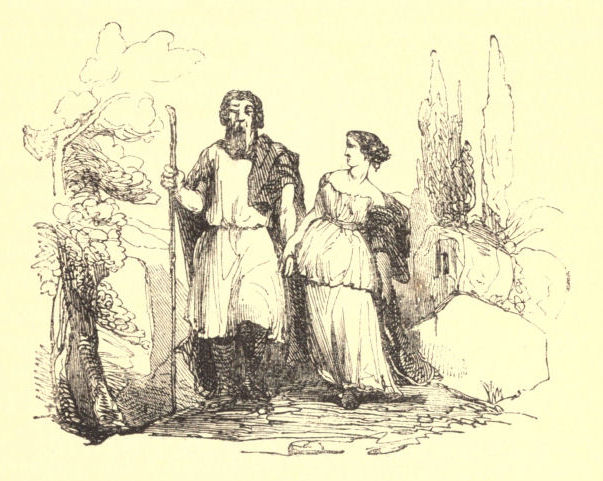
"Lo! the immortal gods have called—the ground on which we stand, shall be my grave!"
As he spoke, he walked without a guide to the appointed spot of earth, which in token of approval, opened, and received the victim to its bosom.
The tomb of Œdipus was near the Areopagus in the age of Pausanias, and some of the ancient poets have represented him in hell, as the place, which crimes like his, would seem to deserve.
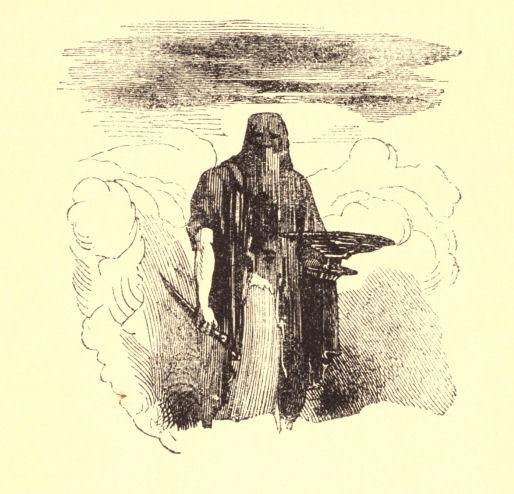
E T E O C L E S A N D P O L Y N I C E.
From the unhappy union of Œdipus with Jocasta sprung Eteocles and Polynice; when they came to manhood an arrangement was made between them, by which it was agreed, that they should exercise the kingly authority for one year alternately. Eteocles was the eldest, and took to himself the first period of government; but when his year had past, the throne had proved so agreeable, that he refused to keep his promise of abdicating.
Polynice disgusted at such conduct retired to Argos, where Adrastus, king of the place, gave him his daughter in marriage, and attempted to persuade Eteocles into some feeling of justice; but not only did the latter persist in his conduct, but sought to slay the famous Tydius, the ambassador of Adrastus, who however escaped this danger with increased renown; and on his return to his king was appointed by him to join a numerous army, selected to trench against the walls of Thebes; nor was this an ungrateful task to the warrior who had been so treacherously assaulted.
———————"Frowning he speaks, and shakes The dark crest, streaming o'er his shaded helm In triple wave; whilst dreadful ring around The brazen bosses of his shield; he stands Close to the river's margin, and with shouts Demands the war, like an impatient steed, That pants upon the foaming curb."
Amphiaraus, who was famous for his knowledge of futurity, and a warrior of great renown: knew from his power of divination, that he was sure to perish if he accompanied the expedition, and therefore secreted himself so successfully, that his wife only, knew the the place of his concealment; she however consented to betray him, bribed by an offer of a bracelet of great worth from Polynice, who was desirous of gaining so important an auxiliary. Previous to Amphiaraus quitting Argos for Thebes, he told his son Alcmeon to slay his mother, if news of his death should reach him; and when Alcmeon heard that his father's chariot had been swallowed by the earth, which opened to receive its victim, he sacrificed Euriphyle to the vengeance of his dead sire. But so execrable a crime could not pass unpunished, and he was tortured by the Furies until he retired to Arcadia, where he married Alphisibaus. To fill up the measure of his crimes, he repudiated her, and took for his spouse Callirhoe. The brothers of his deserted wife however, assassinated him in revenge; and Callirhoe in the extremity of her anguish, devoted her two sons in the presence of their dead father, to revenge his death.
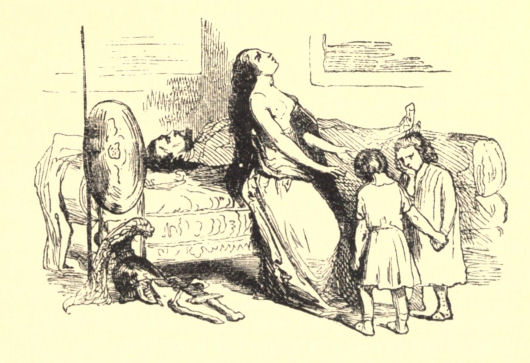
Her wishes were fulfilled, they slew the murderers of Alcmeon, but to appease the gods, the fatal bracelet was sacrificed upon the altar of Apollo.
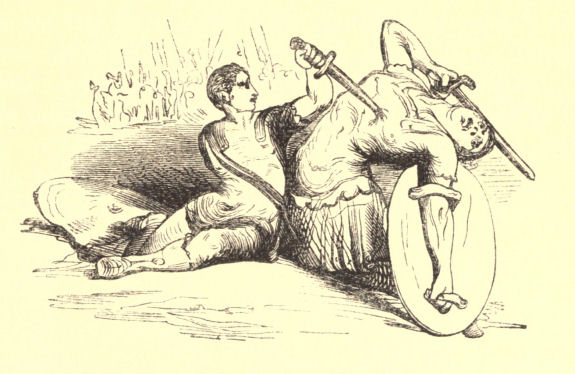
Meanwhile the war beneath the the walls of Thebes was conducted with fierce and vigorous bravery, by the chiefs who had assembled for its attack, until Eteocles and Polynice perceiving that the combat was unlikely soon to terminate, offered to finish the battle by a single combat, on which the crown should depend.
——————————"From the flying troops Eteocles leaps forth in furious guise, And with a terrible accent he exclaims, 'To Polynice.' With presumptuous rage, His steps he traces, and at last he finds him. 'Thebans,' he cried, with a tremendous voice, 'Thebans and Argives, cease your guilty rage! Ye have descended to the field of battle In our contention, prodigal of life Ours is the strife, be ours the forfeiture. Let us ourselves, to a conclusion bring This unjust waste of blood, within your presence, And on this field of death—And thou, whom I Should call no more my brother, do thou spare The blood of Thebes: thy hate, thy rage, thy sword, All, all, on me let fall, on me alone!' To speak and leap with fury to the charge Were actions of one instant. Drunk with blood, And fury, of his own life quite regardless, Provided his antagonist he slew, Eteocles upon his wretched brother Falls with his sword, and all his strength collects. For a long time, intent to ward his blows Stands Polynice. But at length he cries 'I call to witness Heaven and Thebes Thou will'st it!' While to heaven his eyes he raised, And thus exclaimed, his sword he onward thrust: The hovering furies guide the reckless blow To pierce the bosom of Eteocles. He falls—upon his brother spouts his blood!"
This unnatural combat was brief, though fierce, Eteocles the king was the first who fell, and Polynice regarding him with ill-disguised pleasure; and although the blood was flowing fast and free from his own mortal wounds, exclaimed:
————————"'Thou diest, and I am king, Within these hands, red with a brother's blood, Shall dwell the sceptre thou didst wrest from me. Thy brow on which doth rest the same bright drop, Shall bear the crown thou did'st usurp from me. And that thy soul may fly with more regret Know traitor that thy last blow comes from me.'" Racine.
He approached the fallen monarch, and striking him once more with his sword, Eteocles expired beneath the blow, while Polynice himself exhausted with his efforts to subdue his pain, and the death struggle which tore his bosom, fell in the very act of striking him.
Their implacable hatred manifested itself even after death, for when their bodies were placed on the bier, their ashes refused to mingle, and the very flames separated as they arose in bright columns from the funeral pile.
TANTALUS, PELOPS, ATREUS, AND THYESTES.
Tantalus, son of Jupiter, reigned in Phrygia. Wishing to test the divinity of the gods who were visiting him, he murdered his son Pelops, and served up to them his limbs, demanding of them to name what the new meat was. The faithless cruelty of Tantalus was discovered, and the Gods refused to touch the horrible repast, with the exception of Ceres, who, thinking only on her lost Proserpine, eat one of his shoulders, with her accustomed appetite. Jupiter enraged at this atrocious conduct of Tantalus, destroyed his palace with a thunderbolt, and ordered Mercury to precipitate him to the bottom of hell. Here he is represented as punished with an insatiable thirst, and placed up to the chin in the midst of a pool of water, that passes around, yet never touches his lips; while, above his head, hangs a bough, laden with delicious fruit, which, when his hand would grasp it, is borne away by a sudden blast of wind.
Pelops was restored to life by Jupiter, and supplied with an ivory shoulder, in place of that which had been devoured by Ceres, and to which was granted the power of healing, by its touch, every complaint. He succeeded to the throne of his father, and maintained the war against the King of Troy for a long time, but was at last forced to leave Phrygia and seek a retreat in Pisa, where he married Hippodamia, the daughter of the king, that monarch having declared that she should only wed the man who would run on foot as fast as he could proceed in his chariot. This difficulty was overcome by Pelops, who bribed the charioteer to give his master an old chariot which broke down in the middle of the course, and killed Œnomaus; and when the charioteer would have claimed the reward of his infamy, he threw him into the sea, under pretext of punishing his negligence.
Thus master of the kingdom of Pisa, and the hand of Hippodamia, he made bold war upon his neighbour, and conquered their land, which he named Peloponnessus, or the isle of Pelops.
In the family of the Pelopides murder and assassination seem never to have ceased their fearful course. Atreus and Thyestes, the sons of Pelops, having been counselled by Hippodamia to kill Chrysippus, who was an illegitimate son of Pelops, they refused to obey, which so exasperated her, that she stabbed the child with her own hands.
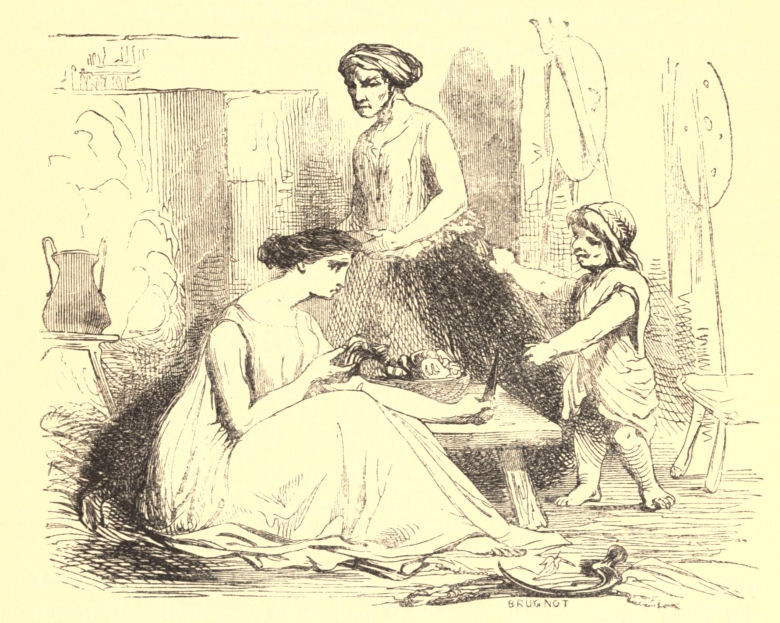
Pelops, suspecting his two sons of the crime, banished them from his court. Atreus sought the kingdom of Eurystheus, King of Argos, and succeeded him on his throne, after marrying his daughter. Here he treated his brother Thyestes, who had followed him to the court, with great kindness, but he was recompensed with ingratitude, for his brother succeeded in winning the affections of his wife.
Irritated at so unlooked for a crime, Atreus took a fearful vengeance. Having been banished from the city for some time, Thyestes was again recalled, and invited to a sumptuous feast, at which was served up the children born to him by the connexion with his brother's wife, all of whom had been sacrificed to his vengeance.
When the repast was over he showed to him the heads of the children, a sight which struck Thyestes with horror. The deed was so cruel and impious, that the very sun is said to have started back in amazement; and the unhappy Thyestes slew himself with his sword.
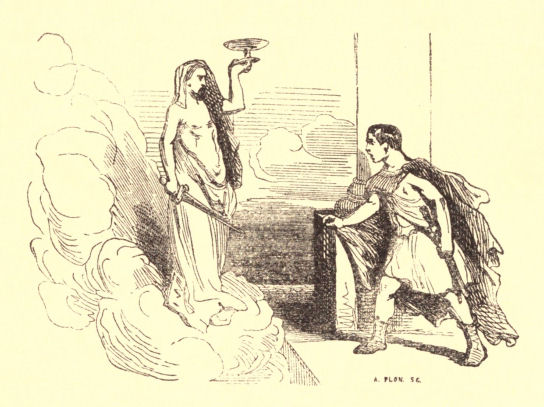
There was now one son left, named Egisthus, who, himself the fruit of a great crime, had been brought up by Agamemnon, and to him did the spectre of Thyestes appear, to exhort him to revenge upon his brother the cruel act he had performed; nor were the fates satisfied until the deed had been accomplished, which revenged upon Atreus the infamous and atrocious conduct at which the very sun itself had started.
"Asked by his wife to his inhuman feast, Tereus, unknowingly, is made a guest: While she, her plot the better to disguise Styles it some unknown mystic sacrifice: And such the nature of the hallowed rite, The wife her husband only could invite, The slaves must all withdraw, and be debarred the sight. Tereus on a throne of antique state, Loftily raised, before the banquet sate; And, glutton-like, luxuriously pleased With his own flesh, his hungry maw appeased. Nay, such a blindness o'er his senses falls, That he for Itys to the table calls. When Procne, now impatient to disclose The joy that from her full revenge arose, Cries out, in transports of a cruel mind, 'Within yourself, your Itys you may find.' Still at this puzzling answer with surprise, Around the room he winds his curious eyes; And, as he still enquired, and called aloud; Fierce Philomela, all besmeared with blood, Her hand with murder stained, her spreading hair Hanging dishevelled, with a ghastly air, Stepped forth, and flung full in the tyrant's face The head of Itys, gory as it was: Nor ever longed so much to use her tongue, And, with a just reproach, to vindicate her wrong. The Thracian monarch from the table flings While with his cries the vaulted parlour rings; His imprecations echo down to hell, And rouse the snaky furies from their Stygian cell. One while, he labours to disgorge his breast, And free his stomach from the cursed feast; Then, weeping o'er his lamentable doom, He styles himself his son's sepulchral tomb, Now, with drawn sabre, and impetuous speed, In close pursuit he drives Pandion's breed; Whose nimble feet spring with so swift a force Across the fields, they seem to wing their course: And now, on real wings themselves they raise, And steer their airy flight by different ways: One to the woodland's shady covert hies, Around the smoky roof the other flies; Whose feathers yet the marks of murder stain, Where, stampt upon her breast, the crimson spots remain. Tereus, through grief, and haste to be revenged, Shares the like fate, and to a bird is changed: Fixed on his head, the crested plumes appear; Long is his beak, and sharpened like a spear; Thus armed, his looks his inward mind display, And, to a lapwing turned, he fans his way." Ovid.
A G A M E M N O N A N D M E N E L A U S.
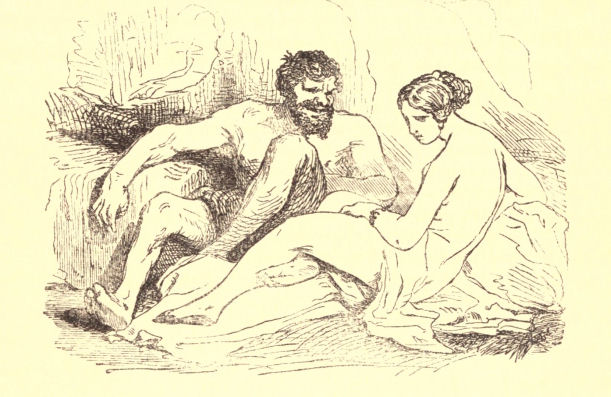
Agamemnon and Menelaus were educated with Atreus, until banished the kingdom by Thyestes, they went to Calydonia, and they were treated with great kindness, and from thence to Sparta, where, like the remainder of the Greek princes, they sought the hand of Helen. By the advice and artifice of Ulysses, Menelaus became her husband, Agamemnon marrying Clytemnestra; and Tyndarus, their father, monarch of Sparta, assisted in recovering for them their father's kingdom.
Menelaus succeeded to his father in law's throne, and became King of Sparta, and Paris, son of Priam, King of Troy, was one of the numerous visitors at his court. To this prince Venus had promised the possession of the finest woman in Greece. The absence of Menelaus in Crete gave to Paris every opportunity, and he succeeded in corrupting the fidelity of Helen, who abandoned herself to her seducer, and followed him to his palace at Troy. Vainly were ambassadors sent to Priam, to make known to him the infamous conduct of his son. Not only did he refuse all reparation, but he embittered the interview by recalling all the ancient grievances of the two kingdoms.
This unjust conduct gave birth to a terrible war; Agamemnon embraced the cause of his brother with fervour, awoke all Greece to the wrongs of Menelaus, and was proclaimed the chief of the kings, who united their armies beneath the walls of Argos; and showed his personal zeal by furnishing one hundred ships, and lending sixty more for her assistance.
The Greek army amounted to sixty thousand soldiers, and their fleet to twelve hundred vessels, but at the very moment that they reckoned on starting, a deep calm settled on the waters.
The oracle was consulted, which declared that nothing less than the sacrifice of Iphigenia, the daughter of Agamemnon, could suffice, as the latter had excited the wrath of Diana, by killing a favourite stag. The father heard the decree with the greatest horror and indignation, and, as chief of the forces, ordered his herald to command them all to retire to their separate homes.
Ulysses and the other generals interfered; and at last Agamemnon was persuaded to sacrifice a daughter so tenderly beloved but as she was a great favourite with Clytemnestra, her mother, the Greeks sent for Iphigenia, pretending that they sought her hand in marriage for Achills.
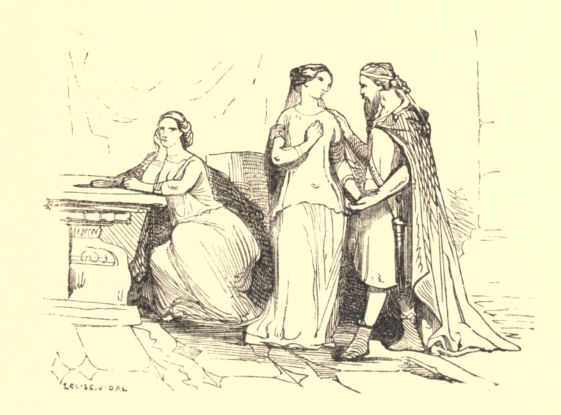
Clytemnestra gladly gave her consent; but when they came to Aulis, Iphigenia saw the bloody preparation for her sacrifice. In vain did she implore the protection of her father: tears and entreaties were alike unavailing, but as the fatal blow was about to be struck, a goat of great beauty was found in her place for the sacrifice. The supernatural change animated the Greeks, the wind suddenly became favourable, and the combined fleet set sail.
"Fair Iphigenia, the devoted maid, Was by the weeping priests in linen robes arrayed, All mourn her fate; but no relief appeared: The royal victim bound, the knife already reared When that offended power who caused their woe, Relenting, ceased her wrath, and stopped the coming blow. A mist before the ministers she cast, And in the virgin's room a hind she placed."
After the fall of Troy the beautiful Cassandra came to the share of Agamemnon, and she foretold that his wife Clytemnestra would put him to death. He, however, returned with Cassandra to Argos, where the sad prediction was fulfilled. One day as he came from the bath, Clytemnestra gave him a tunic, the sleeves of which were sewn together, and as he was embarrassed with the folds, she brought him to the ground with the stroke of a hatchet, while Egisthus, with whom she had dishonoured herself during Agamemnon's absence, gave him the finishing blow.
"Clytemnestra. What have I done?— Where am I? Egisthus. Hast thou slain the tyrant? Now At length thou art worthy of me. Cly. See with blood The dagger drops:—my hands—my face—my garment, All, all are blood. Ah! for a deed like this What vengeance shall be wreaked? I see already, Already to my breast that very sword I see hurled back—and by what hand! I freeze, I faint, I shudder, I dissolve with horror! My strength, my utterance fail me. Where am I, What have I done? Alas! Egis. Tremendous cries Resound on every side throughout the palace. Cly. He had no power to escape, or to resist, Entangled in the gorgeous robe that shone Fatally rich. I struck him twice, and twice He groaned, then died. A third time as he lay I gored him with a wound; a grateful present To the stern god that in the realms below Reigns o'er the dead. There let him take his seat, He lay, and spouting from his wounds a stream Of blood, bedewed me with these crimson drops." Æschylus.
The tradition of the meeting of Iphigenia with her father in the lower regions, after his death, when the latter was ignorant of the infamy of her mother, and the cause of her father's death, is thus beautifully described:—
"Iphigenia. Father! I now may lean upon your breast, And you with unreverted eyes will grasp Iphigenia's hand. We are not shades Surely! for yours throbs yet, And did my blood Win Troy for Greece? Ah! 'twas ill done to shrink; But the sword gleamed so sharp; and the good priest Trembled, and Pallas frowned above, severe. Agamemnon. Daughter! Iphig. Beloved father! is the blade Again to pierce a bosom now unfit For sacrifice? no blood is in its veins, No God requires it here; here are no wrongs To vindicate, no realms to overthrow. You standing as at Aulis in the fane, With face averted, holding (as before) My hand; but yours burns not, as then it burned. This alone shews me we are with the blest, Nor subject to the sufferings we have borne. I will win back past kindness. Tell me then, Tell how my mother fares who loved me so, And grieved, as 'twere for you, to see me part. Frown not, but pardon me for tarrying Amid too idle words, nor asking how She praised us both (which most?) for what we did. Aga. Ye Gods who govern here! do human pangs Reach the pure soul thus far below? do tears Spring in these meadows? Iphig. No, sweet father, no. I could have answered that; why ask the Gods? Aga. Iphigenia! O my child! the Earth Has gendered crimes unheard of heretofore, And nature may have changed in her last depths, Together with the Gods and all their laws. Iphig. Father! we must not let you here condemn; Not, were the day less joyful: recollect We have no wicked here; no king to judge. Poseidon, we have heard, with bitter rage Lashes his foaming steeds against the skies, And, laughing with loud yell at winged fire, Innoxious to his fields and palaces Affrights the eagle from the sceptred hand; While Pluto, gentlest brother of the three And happiest in obedience, views sedate His tranquil realm, nor envies their's above. No change have we, not even day for night, Nor spring for summer, All things are serene, Serene too be your spirit! none on earth Ever was half so kindly in his house, And so compliant, even to a child. Never was snatched your robe away from me, Though going to the council. The blind man Knew his good king was leading him in doors, Before he heard the voice that marshal'd Greece. Therefore all praised you. Proudest men themselves In others praise humility, and most Admire it in the sceptre and the sword. What then can make you speak thus rapidly And briefly? in your step thus hesitate? Are you afraid to meet among the good Incestuous Helen here? Aga. Oh! Gods of Hell! Iphig. She hath not past the river. We may walk With our hands linked, nor feel our house's shame. Aga. Never may'st thou, Iphigenia! feel it! Aulis had no sharp sword, thou would'st exclaim, Greece no avenger—I, her chief so late, Through Erebus, through Elysium, writhe beneath it. Iphig. Come, I have better diadems than those Of Argos and Mycenai—come away, And I will weave them for you on the bank. You will not look so pale when you have walked A little in the grove, and have told all Those sweet fond words the widow sent her child. Aga. Oh Earth! I suffered less upon thy shores! (Aside) The bath that bubbled with my blood, the blows That spilt it (O worse torture) must she know? Ah! the first woman coming from Mycenai Will pine to pour this poison in her ear, Taunting sad Charon for his slow advance. Iphigenia! Iphig. Why thus turn away? Calling me with such fondness! I am here, Father! and where you are, will ever be. Aga. Thou art my child—yes, yes, thou art my child. All was not once what all now is! Come on, Idol of love and truth! my child! my child! (Alone) Fell woman! ever false! false was thy last Denunciation, as thy bridal vow; And yet even that found faith with me! the dirk Which severed flesh from flesh, where this hand rests, Severs not, as thou boasted'st in thy scoffs, Iphigenia's love from Agamemnon: The wife's a spark may light, a straw consume, The daughter's not her hearts whole fount hath quenched, 'Tis worthy of the Gods, and lives for ever. Iphig. What spake my father to the Gods above? Unworthy am I then to join in prayer? If, on the last, or any day before, Of my brief course on earth, I did amiss, Say it at once, and let me be unblest; But, O my faultless father! why should you? And shun so my embraces? Am I wild And wandering in my fondness? We are shades!! Groan not thus deeply; blight not thus the season Of full orbed gladness! Shades we are indeed, But mingled, let us feel it, with the blest. I knew it, but forgot it suddenly, Altho' I felt it all at your approach. Look on me; smile with me at my illusion— You are so like what you have ever been (Except in sorrow!) I might well forget I could not win you as I used to do. It was the first embrace since my descent I ever aimed at: those who love me live, Save one, who loves me most, and now would chide me. Aga. We want not O Iphigenia, we Want not embrace, nor kiss that cools the heart With purity, nor words that more and more Teach what we know, from those we know, and sink Often most deeply where they fall most light. Time was when for the faintest breath of thine Kingdom and life were little. Iphig. Value them As little now. Aga. Were life and kingdom all! Iphig. Ah! by our death many are sad who loved us. They will be happy too. Cheer! king of men! Cheer! there are voices, songs—Cheer! arms advance. Aga. Come to me, soul of peace! these, these alone, These are not false embraces." W. S. Landor.
T H E T R O J A N W A R.
The sails were spread, and the vessels destined to the attack of Troy advanced quickly towards its shores. Priam and his brave sons though they received the enemy with vigour, could not prevent them from landing, and the siege commenced by a blockade, which lasted for the space of nine years, and might have lasted much longer, as more than valour was necessary to take the city; for destiny had dictated the conditions to be fulfilled, ere its capture could be accomplished.
An ancient oracle had foretold that among the besiegers must be one of the descendants of Eachus, who had worked on the wall of of Ilion, and Achilles, son of Thetis, considered Eachus as his ancestor. This young hero had been hidden by his frightened mother in the isle of Cyros. Clothed in female garments, he there lived with the beautiful Deidomia, and enslaved by Love, forgot over the cradle of his offspring, the glory of his country, and the precepts of his tutor, Chiron, the centaur. But it was necessary that he should be discovered; and that he should be animated with higher thoughts and more exalted sentiments.
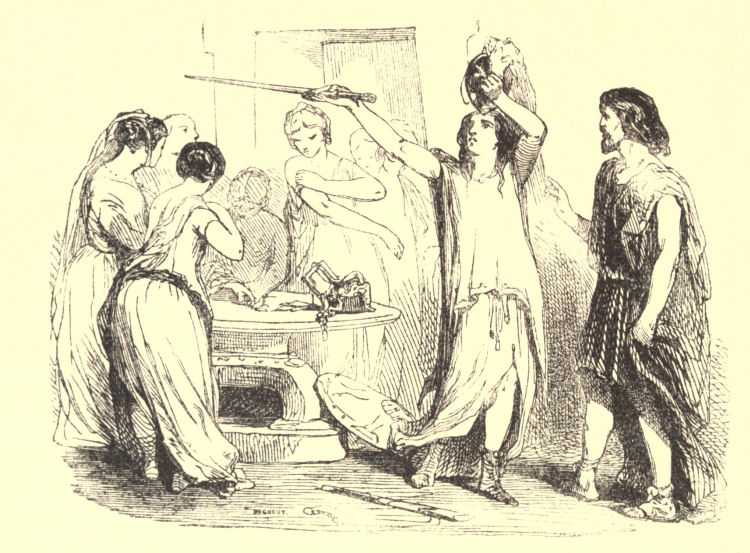
Ulysses, King of Ithaca, took upon himself the charge of bringing the young Achilles from his inglorious ease to the post which awaited him in the camp. Disguised as a merchant, Ulysses introduced himself into the palace of the future hero, and as he paraded himself before the women with jewels and arms, one of them disdained the gems, and seized a sword!—It was Achilles!—who thus betrayed his manly inclinations.
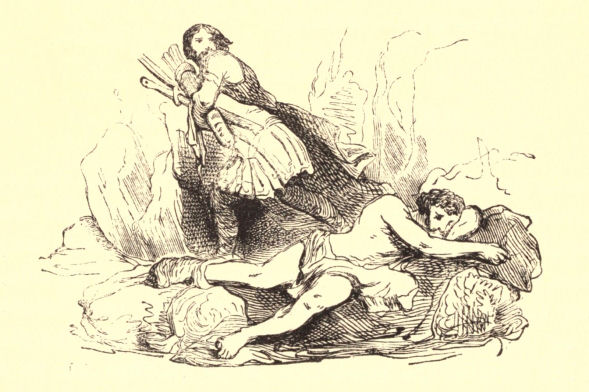
Thus discovered, the eloquence of Ulysses was exerted, and the youthful hero listened with astonishment to the King of Ithaca, as he told him of the dangers already overcome, and of the future conquests which awaited him. Ulysses departed, but not alone, for the spirit of glory was aroused in Achilles, and one more defender was added to the cause of Menelaus. But the besiegers were also to possess the arrows of Hercules, which this hero in dying had bequeathed to Philoctetes, who, however, would not give up the terrible arms that no mortal dared take from him. Ulysses presented himself to Philoctetes, who, at the command of the manes of Hercules, sought the Grecian camp with his terrible weapons to assist them against their enemies.
Pyrrha seizing the sword before Achilles.
But this was not enough. It was necessary to take from the Trojans the talismanic protector of their city, the Palladium.
Ulysses was also charged with this mission, and the intrepid Diomedes assisted him to triumph over the obstacles which would have resisted his single efforts, and they went forth to seek the statue of Pallas, in the very city of their intrepid foes.
It was necessary likewise that Rhesus, King of Thrace, should be prevented from allowing his horses to drink of the waters of the Xanthus, an ancient oracle having declared that if they drank of those waters or fed in the Trojan plain, that Troy would never be taken. In this too they succeeded; for Diomedes and Ulysses intercepted him on his journey to the Trojan camp, entered his tent at night and slew him; they then carried off the horses which had been the innocent causes of his melancholy fate.
All the oracles being now fulfilled, the siege was commenced with vigour, when an unforeseen quarrel stopped the operations of the Greeks. Achilles having been deprived by Agamemnon of his favourite mistress, retired into his tent. Reverses of fortune instantly signalised his absence. A general assault, however, was ordered, but directly the army displayed itself before the walls, Paris challenged Menelaus to single combat, and promised to return Helen if he was vanquished. The King of Sparta, protected by his bravery and the justice of his cause, accepted his challenge, and would have sacrificed the coward Trojan to his vengeance, when he took flight, and escaped by the aid of Venus.
————"Poised in air, the javelin sent, Through Paris' shield the fearful weapon went, His corslet pierces, and his garment rends, And, glancing downward, near his flank descends. The wary Trojan, bending from the blow, Eludes the death, and disappoints his foe: But fierce Atrides waved his sword, and struck Full on his casque, the crested helmet shook: The brittle steel, unfaithful to his hand, Broke short, the fragments glittered on the sand. The raging warrior to the spacious skies Raised his upbraiding voice and angry eyes. 'Then is it vain in Jove himself to trust? And is it thus the Gods assist the just? When crimes provoke us, Heaven success denies, The dart falls harmless, and the falchion flies.' Furious he said, and tow'rd the Grecian crew Seized by the crest, th' unhappy warrior drew; Struggling he followed, while th' embroidered throng, That tied his helmet dragged the chief along. Then had his ruin crowned Atrides' joy, But Venus trembled for the Prince of Troy; Unseen she came, and burst the golden band, And left an empty helmet in his hand." Homer.
The Greeks claimed the execution of the promise, and in return a Trojan archer sent an arrow which wounded Agamemnon. A general melée ensued, the formidable Diomedes dashed into the midst of the Trojans, wounded Venus, who protected Paris, and struck Mars himself; and Hector, the brave son of Priam was compelled to retire, exhorting the Trojans to supplicate Pallas to withdraw Diomedes from the combat.
After this bloody action, in which the Gods themselves had taken part, the two armies engaged in several skirmishes without much advantage on either side. The siege still continued, and the anger of Achilles remained, until his revenge was aroused by the death of Patroclus, his friend, who was slain in battle by Hector.
"Thus by an arm divine and mortal spear Wounded at once, Patroclus yields to fear, Retires for succour to his social train, And flies the fate which Heaven decreed, in vain. Stern Hector as the bleeding chief he views, Breaks through the ranks, and his retreat pursues: The lance arrests him with a mortal wound; He falls, earth shudders, and his arms resound. With him all Greece was sunk, that moment all Her yet surviving heroes seemed to fall. Patroclus thus, so many chiefs o'erthrown, So many lives effused, expires his own." Homer.
To avenge the death of his comrade in arms, Achilles conducted the Greeks to the attack. The Gods again mingled in the fight. Hector and Achilles met in fierce combat, and the first fell gloriously. The son of Peleus refused to the Trojans the last and only consolation of thinking that the remains should be given to the aged Priam. He had the cruelty to tie the body to his chariot, and in that way to drag it three times round the city, a sacrifice to the tomb of Patroclus, and the unfortunate Priam was obliged to give a large ransom for the remains of Hector.
"Then his fell soul a thought of vengeance bred, Unworthy of himself and of the dead, The nervous ancles bored, his feet he bound With thongs inserted through the double wound; These fixed up high behind the rolling wain, His graceful head was hauled along the plain. Proud on his car th' insulting victor stood, And bore aloft his arms distilling blood. He smites the steeds, the rapid chariot flies; The sudden clouds of circling dust arise. Now lost is all that formidable air, The face divine and long descending hair, Purple the ground, and streak the sable sand; Deformed, dishonoured, in his native land, Given to the rage of an insulting throng, And in his parents sight now dragged along. The mother first beheld with sad survey, She rent her tresses venerably gray: And cast far off the regal veils away. With piercing shriek his bitter fate she moans, While the sad father answers groans with groans; Tears after tears his mournful cheeks o'erflow, And the whole city wears one face of woe." Homer.
After this barbarous act, Achilles, led by Destiny, obtained sight of Polyxena, the daughter of Priam, in the temple of Apollo.
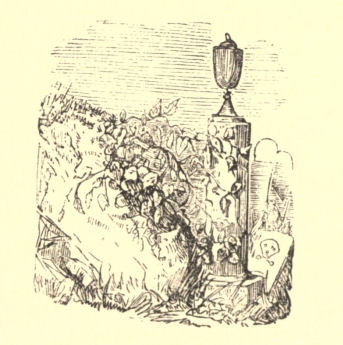
Availing himself of treachery, Paris basely slew him by shooting him in the heel, the only part not rendered invulnerable, by being washed in the river Styx. When Achilles died, the Greeks erected a superb tomb to his memory upon the shores of the Hellespont, and after the taking of Troy, Polyxena was sacrificed to the manes of Achilles. So glorious had been his arms, that Ajax and Ulysses disputed for them, and they were given to the King of Ithaca which so enraged Ajax that he slew himself, and the blood which flowed from him was turned into a hyacinth.
Æneas, son of Venus and Anchises, took part in all the battles which preceded the fall of his country, and relates the stratagem by which the Greeks gained possession of the city. Repulsed in many assaults, they constructed an enormous horse of wood, and shut up in it the best and bravest of their soldiers. Then pretending to raise the siege, they left it, and embarked, casting anchor near the isle of Tenedos. The Trojans, happy to see their sails retreating from their shores, left their walls to look at the immense machine which remained behind. Some proposed to destroy it. The most superstitious demanded on the contrary, that it should be conducted to the city, and offered to Minerva. Laocoon, grand priest of Neptune, in the spirit of prophecy, told them to destroy it, and to doubt the gift of an enemy. Vainly he cried, "fear the Greeks and their gifts!" They would not listen to him. At this moment a Greek named Sinon was brought before them. This perfidious man said that his brothers in arms, irritated against him, had abandoned him, and that this horse was an offering made by the Greeks, to moderate the anger of Minerva, and to obtain from her a happy return.
In vain did Laocoon persist in his assertion that danger was near, and in vain was he commissioned by the Trojans to offer a bullock to Neptune, to render him propitious.
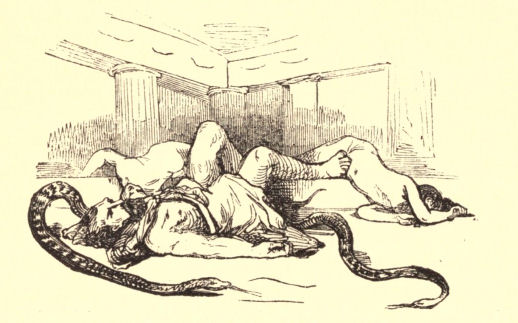
During the sacrifice, two enormous serpents issued from the sea, and attacked Laocoon's two sons, who stood next to the altar. The father immediately attempted to defend them, but the serpents coiling round him, squeezed him in their complicated wreaths, so that he died in the greatest torture.
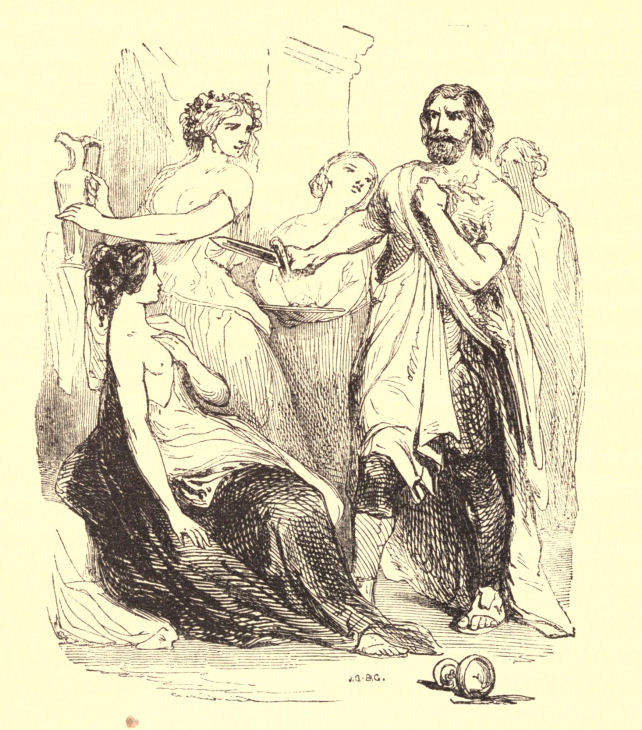
The Anger of Priam.
————"By Scamander when Laocoon stood, Where Troy's proud turrets glittered in the flood, Raised high his arm and with prophetic call To shrinking realms announced her fated fall; Whirled his fierce spear with more than mortal force, And pierced the thick ribs of the echoing horse; Two serpent forms incumbent on the main Lashing the white waves with their redundant train, Arched their blue necks, and shook their towering crests, And ploughed their foamy way with speckled breasts; Then, darting fierce amid the affrighted throngs, Rolled their red eyes, and shot their forked tongues.— —Two daring youths to guard the hoary sire, Thwart their dread progress, and provoke their ire, Round sire and sons the scaly monsters rolled, Ring above ring in many a tangled fold, Close and more close their writhing limbs surround, And fix with foamy teeth the envenomed wound. With brow upturned to Heaven the holy sage In silent agony sustains their rage; While each fond youth, in vain, with piercing cries Bends on the tortured Sire his dying eyes." Darwin.
"Laocoon's torture, dignifying pain— A father's love and mortal's agony With an immortal's patience blending:—vain The struggle; vain, against the coiling strain And gripe, and deepening of the dragon's grasp, The old man's clench; the long envenomed chain Rivets the living links,—the enormous asp Enforces pang on pang and stifles gasp on gasp." Byron.
The Trojans following the advice of Sinon, beat down part of the wall to make an entrance for the horse into the city; they then celebrated the deliverance of their country with feasts and festivals.
Aided by the darkness of night the Greek ships left Tenedos and set sail with all haste towards Troy. Their soldiers disembarked, and penetrated through the breach which had been made to admit the horse. At the same time the warriors that were hidden within the colossal structure appeared, spreading slaughter and devastation all over the city. Æneas awoke, put on his arms, and ran to the palace of Priam, in time to see, but not to save, the aged monarch, his daughters, and his sons, from falling beneath the edge of the sword.
He then sought to rally the Trojans, and make head against the enemy, but when he abandoned himself to feelings of grief and rage at not being able, his mother made known to him the uselessness of his efforts.
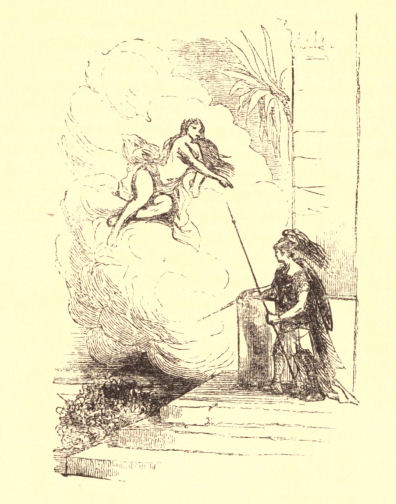
Æneas followed the council of Venus. He awoke his father Anchises, placed the old man on his shoulders, took the young Ascanius, his son, by the hand, and led him away from the tumult, giving him in charge to Creusa, his wife, telling her to follow closely, and not to leave him. The unfortunate woman, however, lost sight of him, and was put to death by the Greeks.
After a vain search to find Creusa, the hero joined the Trojans that survived, and all retired to mount Ida, where they constructed a fleet of twenty vessels, in which they set sail, endeavouring to find out a new country.
The conquerors razed Troy to the ground, and divided the plunder. The widows and daughters of the Trojan princes who were left behind, were obliged to remain in the country. Several of them, famed for beauty, inspired their masters with passions which manifested themselves in quarrels, finishing by many a bloody catastrophe. Among this number was Andromache, widow of Hector, and mother of Astyanax. She fell to the share of Neoptolemus, but though she conceived an aversion for him, the widow of Hector promised her hand to him, on condition that he would save the life of her son, which was menaced by the Greeks: and accompanied into Epirus the ambassadors sent to claim from Pyrrhus the last scion of a foeman's race; Orestes, the ambassador, explained to the king the object of his mission, he was met by a stern refusal, which so irritated the warrior, that he stabbed Pyrrhus for attempting that which he designated a base treason.
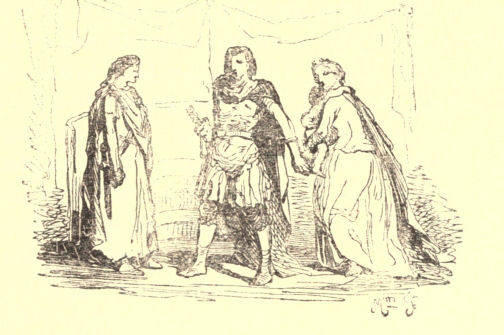
Following the fortunes of Ulysses—scarcely had he quitted the Phrygian shores, than he and his companions became the sport of Neptune and Juno, and a crowd of miseries beset them. At length, after a thousand reverses on the seas, a tempest precipitated his vessel on a rock, he saved himself on a floating wreck, and was driven by the waves towards the shores of the isle of the Phæacians. He saw on the shores the beautiful Nausica, who took him to King Alcinous, her father, from whom he received every hospitality. At the end of the repast to which he had been invited, he related his wonderful adventures.
He told of his arrival in the country of the Lotophagi, people who lived on lotos, and of the frightful dangers he encountered in the isle of Cyclops.
"The land of Cyclops first, a savage kind, Nor tamed by manner, nor by laws confined: Untaught to plant, to turn the glebe and sow; They all their products to free nature owe. The soil untill'd a ready harvest yields, With wheat and barley wave the golden fields, Spontaneous wines from weighty clusters pour, And Jove descends in each prolific shower. By these no statutes and no rights are known, No council held, no monarch fills the throne. But high on hills, or airy cliffs, they dwell, Or deep in caves whose entrance leads to hell. Each rules his race, his neighbour not his care, Heedless of others, to his own severe." Homer.
Polyphemus, whose one eye expressed a savage ferocity, shut up Ulysses and his companions in a cavern, where he kept his sheep. In the morning Polyphemus came, took two sailors and devoured them; at his repast in the evening he took two more. Ulysses, horrified at his danger, thought how he could avoid it. He amused the Cyclop by his recitals; and by giving him intoxicating drink, the monster slept; then, assisted by his companions, he put out his eye. Ulysses had provided for their escape, for fastening himself under the stomach of a sheep when it was going to the fields, and ordering his companions to follow his example, they escaped the rage of the Cyclop, who could only indulge his wrath by throwing at random large pieces of rock after their vessel, which was bearing them quickly away from the scene of their danger.
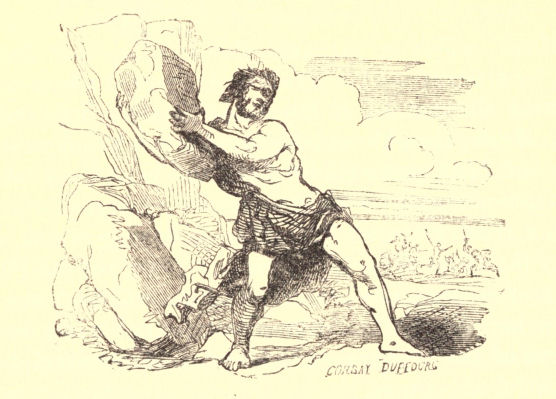
He arrived in the isle of Æolia, where reigned Æolus, king of the winds. This monarch treated him with much kindness, and to assure him a prosperous voyage, he gave him, enclosed in a leather bottle, all the dangerous winds. The vessels went first to the borders of Ithaca, when the companions of Ulysses opened the leather bottle, believing that a precious wine was contained in it, all the winds escaped, and a furious tempest convulsed the sea. The vessels were thrown upon the coast of the Lestrigones, who ate human flesh. Two Greeks were devoured by them. In alarm the vessels again put to sea, and they landed in an isle where abode Circe, a famous magician.
When he had anchored, he sent some of his men on shore, to discover what place it was, but Circe gave them drink under pretence of refreshing them, which transformed them into swine. One only tasted not of the enchanted drink, and escaped to acquaint Ulysses with the strange metamorphose. Ulysses was astonished and resolved to seek the witch in person: and, provided with a certain herb, to preserve himself from witchcraft, he went to her with his drawn sword, to compel her to restore his companions to their previous shapes. The fascinations of Circe proved more powerful than the sword of Ulysses, and he staid with her on the island, in the enjoyment of her society, for the space of a year.
After concluding his eventful history, he remained some time with Alcinous, who gave him a ship, which carried him safely to Ithaca.
It was now the twentieth year of the absence of Ulysses from his home, during which time his wife had held him in continual remembrance, and though she had been pressed by her numerous suitors to consider him as dead and make a second choice, yet she retained such faithful love for her husband, with such a full and prophetic assurance that she should once more see him, that all their efforts to influence her were vain.
In order to put them off more effectually, she undertook to make a piece of cloth, promising that when it was finished, she would choose one of her numerous suitors: but the better to deceive them, she undid at night that which she worked in the day, so that when Ulysses arrived, she was no nearer its completion than at first.
Meanwhile Ulysses scarcely knew how to discover himself with safety to his own person, fearing that he might be slain by those who were suitors to his wife. By the advice of Minerva, he disguised himself as a beggar, first making himself known to Telemachus, and one of the old officers of the kingdom.
In the same disguise he introduced himself to Penelope, by whom he was received with joy; and with the assistance of his friends, who flocked around him, he entered in possession of his throne.
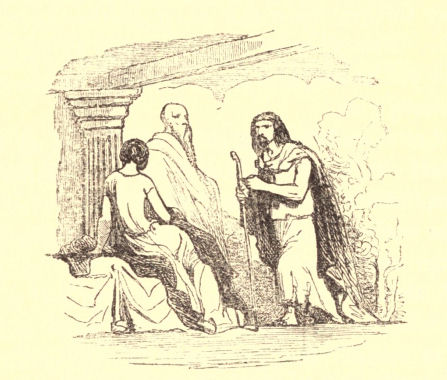
But still his mind was uneasy and disturbed, as Tyresias, the soothsayer, had informed him that he should be killed by one of his sons. To prevent this misery, he determined to forsake the world, and retire into some solitary place, to end his days in peace.
About that time, Telegonus, one of his sons by Circe, came to his city to pay unto him his respects; and, as he was striving to enter the palace, there arose a great tumult, the officers of the place refusing him admission; at this moment Ulysses stepped out, and Telegonus not knowing him, ran him through with his lance, thus fulfilling the prophecy of the soothsayer.
Æ N E A S.
Charged to save himself from the wreck of Troy, and to accomplish the decrees of fate, Æneas embarked with a small band in twenty vessels, which Juno however pursued with her wrath. Æolus obedient to the goddess, dispersed the fleet and menaced them with complete destruction. Neptune appeared, and the winds were silent. Æneas, however, found himself separated from the greater part of his companions, seven only of whom remained with him.
He landed on an unknown shore and Venus informed him, that the rest of his companions were in safety. Æneas, hidden in a cloud went to the palace of Dido, Queen of Carthage, a new town in which this queen had built the most gorgeous edifices; in one of which, where she gave to him a splendid entertainment, the hero related to her the history of the siege of Troy and his own adventures.
The glowing language and animating gestures of the young prince, together with the high deeds which he announced, won the heart of Dido. Nor was Æneas long in perceiving the love felt for him by the beautiful listener, and yielding himself to her charms, staid with her for a considerable time in the enjoyment of all that renders life desirable.
Jupiter, however, grew dissatisfied with Æneas, despatched Mercury to him to command him to leave Africa, to try the destiny which called him to Italy.
In vain Dido endeavoured to stop him, she saw in Æneas a man resolved to leave her, and she loaded him with the curses and reproaches of an infuriated and forsaken lover.
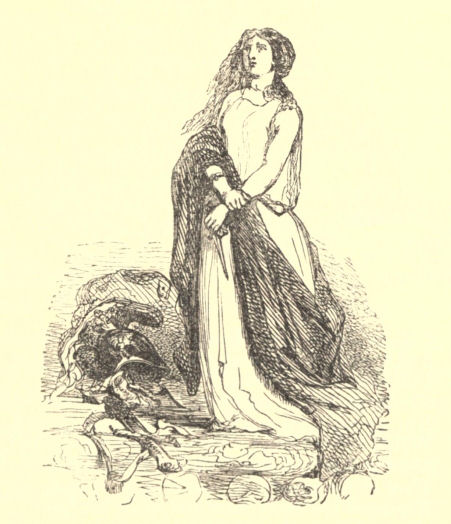
Unable to bear life in the prospect of a desertion so infamous, she prepared a funeral pile, determined to immolate herself; mounting with a calm resolution she gave way to her despair.
"What shall I do? what succour can I find? Shall I with this ungrateful Trojan go, Forsake an empire to attend a foe? Himself I refuged and his train relieved, 'Tis true, but am I sure to be received? Can gratitude in Trojan souls have place? Laomedon still lives in all his race! Then shall I seek alone the flying crew, Or with my fleet their flying souls pursue? Rather with steel thy guilty breast invade, And take the fortune thou thyself hast made!" Dryden.
With one strong blow she smote herself to the heart, and fell dead upon the pile she had erected.
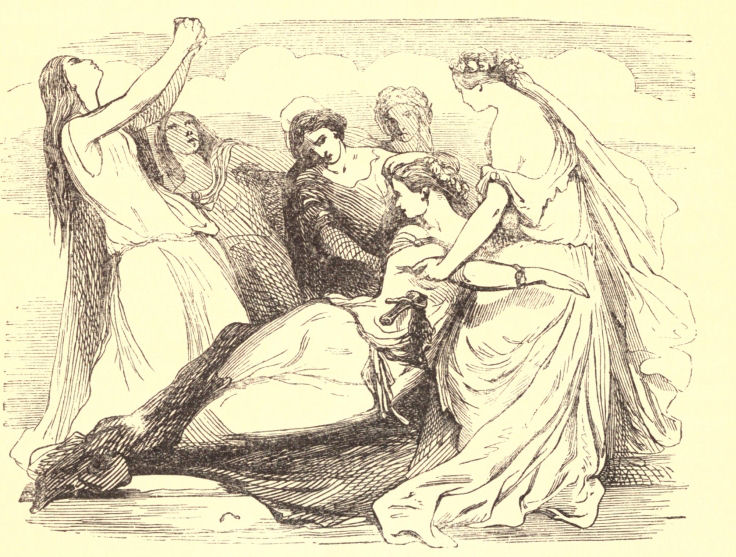
"Then swiftly to the fatal place she passed, And mounts the funeral pile with furious haste; Unsheathes the sword the Trojan left behind, Not for so dire an enterprize designed; But when she viewed the garb so loosely spread, Which once he wore, and saw the conscious bed, She saw and with a sigh the robes embraced, Then on the couch her trembling body cast, Repressed the ready tears and spoke her last; 'Dear pledges of my love, while heaven so pleased, Receive a soul of mortal anguish eased. My fatal course is finished, and I go, A glorious name among the ghosts below,' Then kissed the couch 'and must I die,' she said, 'And unrevenged, 'tis doubly to be dead; Yet even this death with pleasure I receive, On any terms 'tis better than to live; These flames from far, may the false Trojan view, These boding omens, his false flight pursue!' She said and struck; deep entered in her side, The piercing steel, with reeking purple dyed, Clogged in the wound, the cruel weapon stands; The spouting blood came streaming on her hands; Her sad attendants saw the deadly stroke And with loud cries, the sounding palace shook. Thrice Dido tried to raise her drooping head, And, panting, thrice fell grovelling on the bed. Thrice ope'd her heavy eyes, and saw the light, But having found it, sickened at the sight, And closed her lids at last in endless night." Dryden.
ALLEGORICAL DIVINITIES.
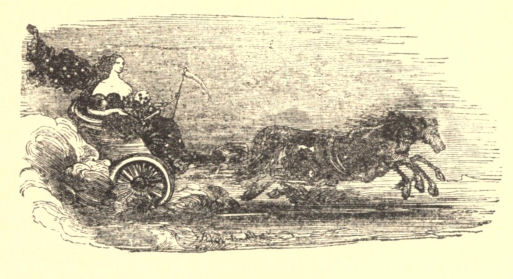
The ancients, following the inspirations of an undisciplined imagination, deified alike Virtues, Vices, and Evil principles. These divinities, the number of whom was constantly increasing, had both altars and temples consecrated to them: and from this kind of god, poets, painters, and sculptors have taken ideas, and have blended the deity and the virtue in beautiful unison, giving to them new and delightful charms.
VIRTUE
Daughter of Truth, is represented clothed in white, as an emblem of purity; sometimes holding a sceptre, at others crowned with laurel; while she is in many instances drawn with wings, and placed upon a block of marble, to intimate her immoveable firmness.
TRUTH
Daughter of Jupiter and Saturn, is the parent of Justice and of Virtue. The great Apelles has represented her, in his painting of Calumny, under the appearance of a modest female; in her hand is placed a round mirror.
Ancient writers say, that she was for a long time hidden from the world at the bottom of a well, but leaving its quiet on one occasion, she was scared at the reception she met with, and returned to her hiding place, which is intended to intimate, according to Democritus, the difficulty with which she is discovered.
HONOUR.
The emblems of this god are, the crown of laurel, the lance, and the horn of plenty; though he is sometimes represented, instead of arms, with the olive branch of peace, as the reward of bravery.
At Rome he had two temples; one founded by Marcellus, at the same time with the one to Virtue. An augur having warned Marcellus that these two divinities would not dwell in the circumference of the same temple, he built the two distinct edifices to which we have alluded; but, to arrive at the temple of Honour, it was necessary to pass through that of Virtue.
PEACE.
This daughter of Jupiter and Themis, wears a crown of laurel; in her hand is a branch of the olive-tree, and against her side the statue of Plutus, to intimate that peace gives rise to prosperity and opulence.
Venus and the Graces were her companions, and an altar was erected to her at Athens; but at Rome, the capital in which the God of War was also peculiarly honoured, several altars were dedicated to her, one of the most magnificent of which was raised by Vespasian, after the war of Judea, and contained all the treasures taken from the temple at Jerusalem, consisting of a splendid library, busts, statues and pictures; with an enormous quantity of natural curiosities.
This temple was however consumed in the reign of Commodus, previous to which it was customary for men of learning to assemble there, and even to deposit their most valuable writings as a place of peculiar safety; and, consequently the loss which took place when it was consumed, could scarcely be estimated.
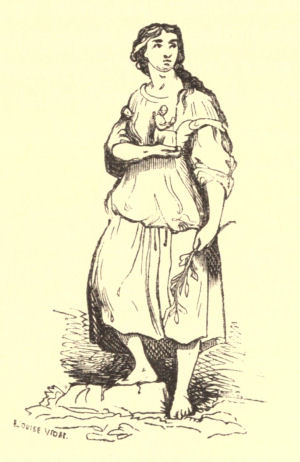
FIDELITY
was adored even before Romulus and Numa had given laws to their people; and the oath sworn in her name was regarded by them as inviolable. She is represented clothed in white, with clasped hands. Her priests were dressed in a white cloth during her public ceremonies; but victims were not sacrificed upon her altar, because she was deemed inflexible, and could not yield to prayers, however urgent.
Two hands, joined together, are the emblems of faith, given and received.
FRIENDSHIP
the Greeks represented clothed in a clasped garment, her head bare, her bosom revealed near the heart, holding in the left hand an elm, around which a vine, filled with grapes, is clinging.
At Rome, she was a young maiden with a white robe, her bosom half bare, her head adorned with myrtle and pomegranate flowers intermixed. On the border of her tunic was written "Death and Life,"—on her front "Summer and Winter."—Her side was opened, and the heart visible, bearing these words, "Far and near."
LIBERTY
wears sometimes a cap, with a rod in her hand, both signs of independence, as the latter was used by the magistrates in the manumission of slaves, and the cap was worn by those who were to be soon liberated, while at other times she appears in a chariot.
She is, however, more frequently represented holding the book of the laws, and in her hand a sword with which to defend them.
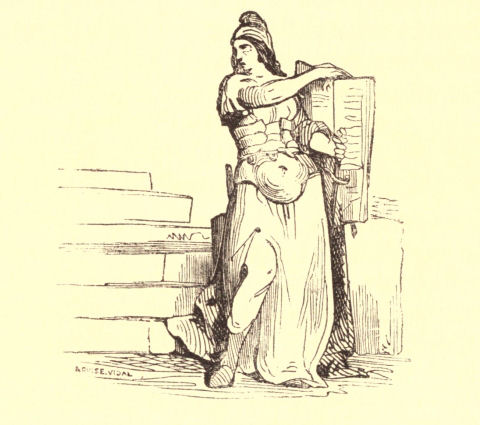
A temple was raised to her by Gracchus on Mount Aventine, adorned with elegant statues and brazen columns, with a gallery in which were deposited the public acts of the state.
VICTORY.
Styx, daughter of Ocean and Thetis, was the mother of Victory. This deity attended at the conquests of all countries and of all heroes. At Italy and Greece, temples were elevated to her; at Greece she was named Nice, and Sylla instituted festivals in her honour at the former place. In the temple of Jupiter, on the Capitoline hill, a golden statue of the goddess was placed, weighing three hundred and twenty pounds.
A thunderbolt having fallen on the statue and broken its wings, Pompey restored the courage of the people, who were dejected at the accident, by crying,
"Romans! the gods have broken the wings of Victory; henceforth she cannot escape from us."
Victory, by the commands of her mother, aided Jupiter in his battle with the Titans; and the monarch of Olympus to reward her powerful services, decreed that the Gods should swear by her, and that those who violated the oath, should be exiled ten years from the celestial court, and deprived of the nectar and ambrosia of Olympus.
VOLUPTUOUSNESS
is a female figure, nearly naked, her hair wreathed with roses, and her face and form, full, but exquisitely developed.
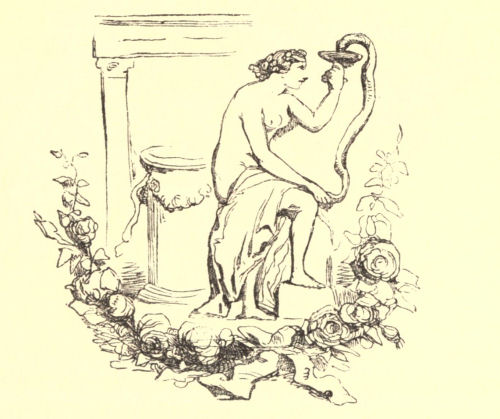
In her hand is a cup of gold, from which a serpent is drinking, while around her are supposed to exist all the luxuries which attend her reign.
She was the goddess of sensual pleasures, and had a temple at Rome, where she was worshipped under the title of Volupia.
CALUMNY AND ENVY
are the daughters of Night, and though poets have been peculiarly the victims of these evils, yet they have frequently celebrated them in their verses; nor could more important engines in the mischiefs which arose in the world be well chosen; for, from Calumny, which is the offspring of Falsehood, arises crushed hearts and broken friendships—while of Envy it has well been remarked, "Open your heart once to receive her as a guest, and farewell to joy, peace, and contentment."
FAMINE
is the daughter of Night, and inhabited the infernal regions, though the Lacedemonians dedicated to her an altar in the Temple of Minerva.
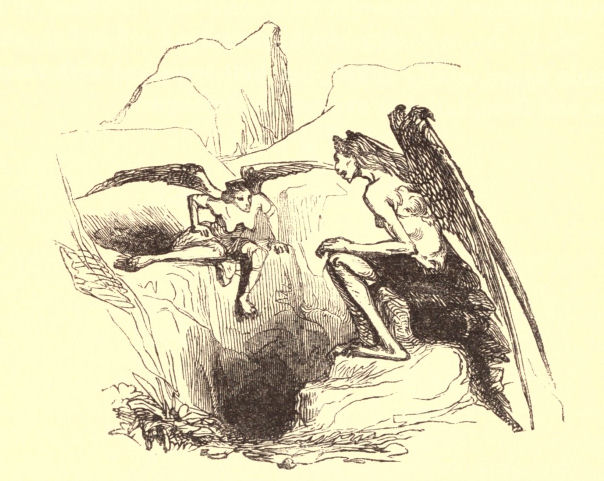
She is drawn miserable, pale, wan, meagre, and dejected: her eyes hollow and sunken, her complexion of a leaden hue, her teeth yellow, and her whole appearance worn and melancholy.
DISCORD,
daughter of Night, is the mother of a family of evils, almost too numerous to mention. Having been refused admission to the nuptials of Thetis and Peleus, it is said that it was she, who, to revenge herself, threw on the table among the festal company, the apple, with the inscription, "To the most beautiful."
This apple was the origin of the Trojan war, and of innumerable misfortunes to the Greeks.
The goddess is represented with a pale and ghastly look, her garments torn, her eyes sparkling with fire, holding a dagger concealed in her bosom. Her head is generally enwreathed with serpents, and she is imagined to be the cause of all the miseries, dissensions, and quarrels, which fall upon the inhabitants of the earth.
We have now enumerated the most remarkable of the Allegorical Divinities, the number being too great to mention all. For the same reason we must omit the crowd of Emperors, Kings, and Princes, who, having the folly to believe themselves gods, found mortals sufficiently weak to grant them faith, and to accord them homage.
In concluding the Greek Mythology, however, we must mention several fables, which are so intimately connected therewith, as almost to form part of its history.