M Y T H O L O G Y : (continued 4)
Reading edition
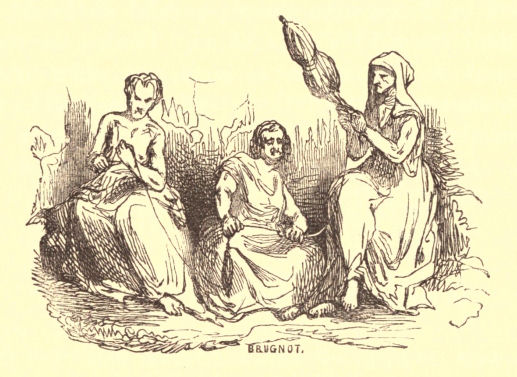
The worship of the Parcæ was well established in some parts of Greece, and though mankind knew they were inexorable, and that it was impossible to mitigate their decrees, yet they evinced a respect for their divinity, by raising statues to them.
N I G H T.
Nox, one of the most ancient deities among the heathens, was the daughter of Chaos. From her union with her brother Erebus, she gave birth to day and light: she is called by some of the poets, the mother of all things, of gods no less than of men, and was worshipped with great solemnity by the ancients, who erected to her a famous statue in Diana's temple at Ephesus. The cock was offered to her, as the bird which proclaims the coming of the day. She is drawn mounted on a chariot, and covered with a veil bespangled with stars, and the constellations preceded her as her messengers.
Sometimes she is seen holding two children under her arms, one of which is dark like night, and the other light like day.
"Night, when like perfumes that have slept All day within the wild flower's heart, Steal out the thoughts the soul has kept In silence and apart: And voices we have pined to hear, Through many a long and lonely day, Come back upon the dreaming ear, From grave lands far away, And gleams look forth of spirit eyes Like stars along the darkening skies!" Hervey.
She has been described by some of the modern writers, as a woman clothed in mourning, crowned with poppies, and drawn in a chariot by owls and bats.
SONG OF NIGHT. "I come to thee, O Earth! With all my gifts; for every flower, sweet dew In bell, and urn, and chalice, to renew The glory of its birth. I come with every star; Making thy streams, that on their noon-day track, Give but the moss, the reed, the lily back, Mirrors of world's afar. I come with peace; I shed Sleep through the wood walks, o'er the honey bee, The lark's triumphant voice, the fawn's young glee, The hyacinth's meek head. On my own heart I lay The weary babe; and sealing with a breath Its eyes of love, send fairy dreams, beneath The shadowing lids to play. I come with mightier things! Who calls me silent? I have many tones— The dark skies thrill with low mysterious moans, Borne on my sweeping wings. I waft them not alone From the deep organ of the forest shades, Or buried streams, unheard amidst their glades Till the bright day is done. But in the human breast, A thousand still, small voices I awake, Strong in their sweetness, from the soul to shake The mantle of its rest. I bring them from the past, From true hearts broken, gentle spirits torn, From crushed affections, which, though long o'erborne, Make their tones heard at last. I bring them from the tomb! O'er the sad couch of late repentant love They pass—though low as murmurs of a dove— Like trumpets through the gloom. I come with all my train; Who calls me lonely? Hosts around me tread, The intensely bright, the beautiful, the dead, Phantoms of heart and brain. Looks from departed eyes— These are my lightnings! fill'd with anguish vain, Or tenderness too precious to sustain, They smite with agonies. I that with soft control, Shut the dim violet, hush the woodland song, I am the avenging one! the arm'd, the strong, The searcher of the soul. I that shower dewy light Through slumbering leaves, bring storms!—the tempest birth Of memory, thought, remorse:—be holy, Earth! I am the solemn night!" Hemans.
D E A T H.
Poets have given to Death a heart of iron, bowels of steel, black wings, and a net with which she envelopes her victims. Statuaries carve her under the form of a large skeleton, armed with a scythe, and bearing wings. Sparta and Elis honoured her, but Phœnicia and Spain paid to her more particularly the homage of a divinity. She inhabits the infernal regions; and though, in more modern times, Death has been always addressed as a divinity of the masculine gender. The Lacedæmonians indeed, regarded her, not as an existing, but as an imaginary being.
"Mysterious power! whose dark and gloomy sway Extends o'er all creation, what art thou? They call thee 'King of Terrors!' drear dismay Followeth thy footsteps, and around thy brow Hovers a thick impenetrable cloud, Which, to some hearts, is Hope's sad funeral shroud. Beside the infant on its cradle bed, The mother watches thro' the hour of night; Hope hath not quite her lonely spirit fled, Tho' o'er her first-born babe hath passed the blight Of fell disease: wait, wait one moment more, Thy hand has touched it, Death, and hope is o'er. Thou turn'st the hall of revelry to gloom, The wedding garment to a garb of woe; Thou com'st in silence to the banquet room, Ceased is the noisy mirth, the red wine's flow, And men look pale at thee, and gasp for breath, Thou doest this, thou doest more, oh! Death Thou twin'st the cypress wreath round victory's brow, The brave have won the fight, but, fighting, fell; It was thine arm that laid the victor low, And toll'd amid the triumph, a lone knell For his departure: Death—thy gloomy power Can throw a sadness o'er the happiest hour. Thou comest to the monarch in his hour Of pomp, and pride, and royalty's array; And the next victim of thy reckless power May be the beggar in his hut of clay: Thy hand can lay the tattered vagrant down Beside the head that wore the kingly crown. Childhood is thine, its unexpanded bloom, Shrinks to decay beneath thy chilling breath; Gay Youth, thou witherest, with thy touch of doom, Stern Manhood shrinks beneath thy grasp, oh, death, And fragile Age by worldly cares opprest, Sinks, softly sinks, into those arms for rest. And then methought death's hollow voice replied, 'Rash mortal—would'st thou tempt the dangerous gloom, Launch thy frail bark upon the awful tide That leaves the lonely islands of the tomb; Darest thou, in thy vain impotence of pride Demand the knowledge to frail man denied? Call'st thou me reckless, when I place my hand Upon the earliest buddings of the spring? Had I allowed those sweet buds to expand, What would the skies of gloomy autumn bring? Darkness, dismay: those sweet buds, leaf by leaf, Had sadly faded, full of tears and grief. What though I slew the victor in his pride, 'Tis meet the brave on battle field should die, His name is echoed thro' the nations wide, Reared is the column where his ashes lie; He sought for fame, he won it, bravely won; He died for fame, when his great task was done. What tho' I turn the banquet room to grief, The wedding garment to a garb of woe, Do I not bring to wounded hearts relief? Do I not ease the wretched of his woe? Then taunt me not with wanton cruelty, Man knows 'tis written 'thou must surely die!' But at what hour, no mortal power may know, Whether at morn, at dewy eve, or night, When sinks the heart beneath its weight of woe, Or throb the pulses with supreme delight, Vain mortal! cease God's sovereign will to scan, Be thou prepared to meet the son of man!'" Clarke.
S L E E P.
Sleep, the accustomed companion of night, inhabits the lower regions, though Ovid has placed his palace in the cold Scythia.
————————"In his dark abode Deep in a cavern dwells the drowsy god, Whose gloomy mansion nor the rising sun Nor setting, visits, nor the lightsome noon; But lazy vapours round the region fly, Perpetual twilight and a doubtful sky; No crowing cock does there his wings display Nor with his horny bill provoke the day; Nor watchful dogs, nor the more wakeful geese, Disturb, with nightly noise, the sacred peace: Nor beast of nature nor the laws, are nigh, Nor trees with tempests rocked, nor human cry, But safe repose, without an air of breath, Dwells here, and a dumb quiet next to death, An arm of Lethe with a gentle flow, Arising upward from the rock below, The palace moats, and o'er the pebbles creeps, And with soft murmurs calls the coming sleeps. Around its entry nodding poppies grew, And all cool simples that sweet rest bestow; Night from the plants their sleepy virtue drains, And passing, sheds it on the silent plains: No door there was th' unguarded house to keep, On creaking hinges turned to break his sleep. But in the gloomy court was raised a bed, Stuffed with black plumes, and in an ebon stead; Black was the covering too where lay the god, And slept supine, his limbs displayed abroad." Ovid.
The principal minister of Sleep is Morpheus, son of Somnus, who was the presider over sleep; the former was the parent of dreams, of whom, by a beautiful idea, imagination was said to be the mother. The palace of Somnus was a dark cave, where the god lies asleep on a bed of feathers. The dreams stand by him, and Morpheus, as his principal minister, watches, to prevent any noise from awaking him.
"Oh lightly, lightly tread, A holy thing is sleep; On the worn spirit shed, And eyes that wake to weep. A holy thing from heaven, A gracious, dewy cloud, A covering mantle given, The weary to enshroud! Oh! lightly, lightly tread; Revere the pale, still brow, The meekly drooping head, The long hair's willowy flow. Ye know not what ye do, That call the slumberers back, From the world unseen by you Unto life's dim faded track. Her soul is far away, In her childhood's land, perchance, Where her young sisters play, Where shines her mother's glance. Some old sweet native sound Her spirit haply weaves; A harmony profound, Of woods with all their leaves. A murmur of the sea, A laughing tone of streams; Long may her sojourn be In the music land of dreams. Each voice of love is there, Each gleam of beauty fled, Each lost one still more fair— Oh! lightly, lightly tread!" Hemans.
By the Lacedæmonians, the image of Somnus was always placed near that of death on account of their apparent resemblance.
"How wonderful is death, Death and his brother Sleep! One, pale as yonder waning moon, With lips of lurid blue; The other rosy as the morn When throned in ocean's wave, It blushes o'er the world: Yet both so passing wonderful!" Shelley.
———————-"The one glides gentle o'er the space Of earth, and broad expanse of ocean waves, Placid to man. The other has a heart Of iron; yea, the heart within his breast Is brass, unpitying; whom of men he grasps Stern he retains." Hesiod
M A N E S.
The Manes was a name applied generally to the soul after it has separated from the body, and were among the infernal deities being supposed to preside over the grave, burial places, and monuments of the dead.
They were worshipped with great great solemnity, particularly by the Romans, and were always invoked by the Augurs before proceeding about their sacerdotal offices.
It was believed that these spirits quitted, during the hours of night, their melancholy dwelling-place, and "revisited the glimpses of the moon," to exercise their benevolence or their fury. They were allowed also to leave their tombs three times during the course of the year while their fêtes, which were the most pompous in Rome, were proceeding in their honour.
N E M E S I S.
Nemesis, Goddess of Justice and of Vengeance, was the daughter of Necessity. This divinity had wings, a fillet of serpents round her brow, and a sword to strike the unhappy criminals who merited its blow;—though always ready to punish the impious, she was equally liberal in rewarding the good and the virtuous. The people of Smyrna were the first who made her statue with wings, to show with what celerity she is prepared to punish the crimes of the wicked.
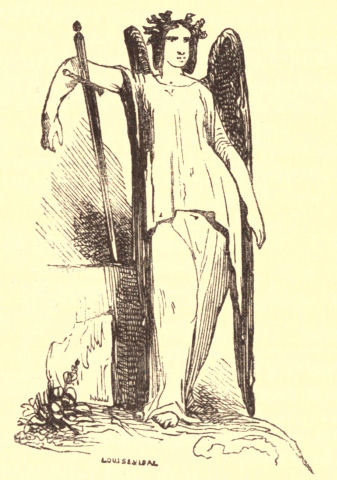
The Romans were particularly attentive in their adoration of this deity, whom they solemnly invoked, and to whom they offered sacrifices before declaring war, to evince to the world that they were commenced upon equitable grounds.
The Athenians instituted fêtes called Nemesia, in memory of deceased persons, as the goddess was supposed to defend the relics and the memory of the dead from insult.
D O M E S T I C D I V I N I T I E S.
THE LARES AND THE PENATES.
The Lares were the household divinities who presided over the interests of private families. Their worship is supposed to have arisen from the ancient custom among the Romans and other nations, of burying their dead within their houses, and the belief that the spirits of the departed continually hovered over their former dwellings, for the protection of the inhabitants. Their statues were placed in a niche behind the doors of the houses, or around the hearths; while at their feet was placed a dog barking, to intimate the watchfulness they exhibited. Their festivals were observed at Rome in the month of May, when their statues were crowned with garlands of flowers, and fruit offerings presented to them.
The Penates also closely resembled the Lares, and presided over houses and the domestic affairs of families. It was at the option of every master of a family to choose his Penates, and therefore Jupiter and some of the superior gods, are often invoked as domestic divinities.
They were originally the manes of the dead, but when mankind had been taught by superstition to pay deep reverence to the statues or images of their deceased friends, that reverence was soon changed for a more regular worship, and they were admitted by their votaries to share immortality and power, with the remainder or the Gods.
The statues of the Penates were generally formed of wax, silver, ivory, or earthenware, according to the poverty or riches of the worshipper.
When offerings were made to them, their shrines were crowned with garlands, and besides one day in every month set apart for their homage, their festivals were celebrated during the Saturnalia.
HYMN TO THE PENATES. "Yet one song more! one high and solemn strain, Ere, Phœbus! on thy temples ruined wall I hang the silent harp: one song more! Penates! hear me! for to you I hymn The votive lay. Venerable powers! Hearken your hymn of praise. Though from your rites Estranged, and exiled from your altars long, I have not ceased to love you, Household Gods! O ye whom youth has 'wildered on your way, Or vice with fair mask'd foulness, or the lure Of Fame that calls ye to her crowded path With folly's rattle, to your Household Gods Return: for not in Vice's gay abodes, Not in the unquiet, unsafe halls of Fame Doth Happiness abide!" ————————-"To your Household Gods Return, for by their altars, Virtue dwells, And Happiness with her; hearken your hymn of praise, Penates! to your shrines I come for rest,— There only to be found. Household Deities, There only shall be Happiness on earth When man shall feel your sacred power, and love Your tranquil joys; then shall the city stand A huge, void sepulchre, and rising fair Amid the ruins of the palace pile, The olive grow, there shall the tree of peace Strike its roots deep, and flourish." Southey.
G E N I U S.
The Genius was a kind of spirit which, as the ancients supposed, presided over the actions of mankind, gave them their private councils, and carefully watched over their most secret intentions. Some of the ancient philosophers maintained, that every man had two of these, the one bad, the other good. They had the power of changing themselves into whatever form they pleased, and of assuming whatever shapes were most subservient to their intentions. At the moment of death, they delivered up to judgment the person with whose care they had been entrusted; and according to the evidence he delivered, sentence was passed upon the body. The Genius of Socrates is famous in history. That great philosopher asserted that the Genius informed him when any of his friends were going to engage in some unfortunate enterprise, and stopped him from the commission of all crimes and impiety. The Genii, though at first reckoned only as the subordinate ministers of the superior deities, received divine honour for a length of time, and we find altars and statues erected to them.
PRINCIPAL DIVINITIES OF THE SECOND ORDER.
T H E G R A C E S.
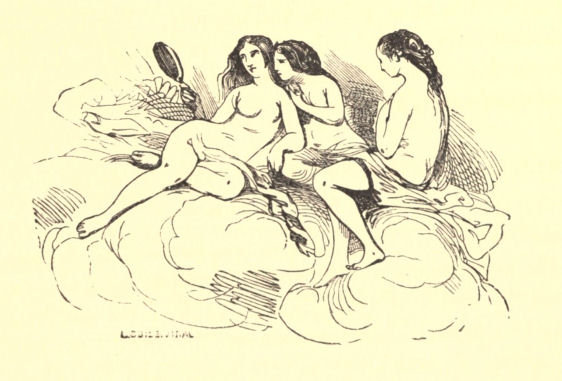
The Graces, who were daughters of Jupiter and of Venus, presided over the enjoyments of the mind, as well as over those of the heart. Thus the orator received from them the force and brilliancy of his ideas; the artist, his perception of the beautiful; the wise man, that spirit of amiability which appreciates the charms of virtue; the rich man, a love of beneficence and desire of giving; the poor gaiety and patience; the maiden, candour and modesty; and the warrior, bravery united with moderation.
The worship of the Graces appeals to have had birth in Samothracia; then Elis, Perinthia, Delphi, and Rome adopted the three sisters. By some it is asserted, that the beautiful trio remained unwedded; Homer, however, has given Sleep to the youngest as a husband.
During the many sacrifices which were instituted in the various cities, offerings to them were mingled with those to Bacchus, Mercury, the Muses, and Apollo.
The Spartan heroes before going to combat, sacrificed to Love and to the Graces. They were invoked at festivals, and three cups were drunk by those who feasted in honour of Euphrosyne, Aglaia, and Thalia.
Of them, the greatest statuaries have erected the most groups, and Socrates himself, before he joined the philosophy in which he ultimately became so eminent, had taken the chisel in his hand, and represented them of slight figure, pure countenance, smiling faces, small mouths, hair negligently tied over their head, and with their hands placed in a graceful attitude.
They sometimes bear with them a branch of myrtle and of roses, the flowers peculiarly consecrated to them.
C O M U S , M O M U S.
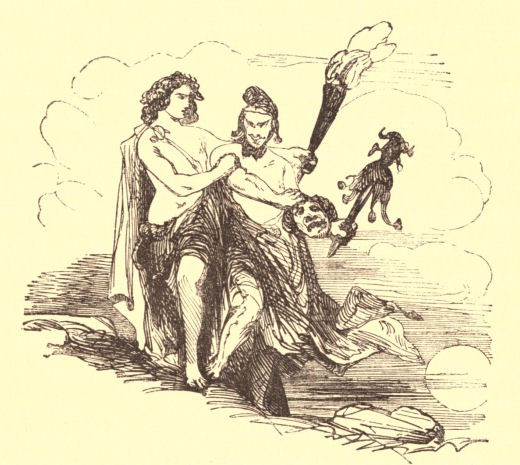
Comus, God of the pleasures of the table and of good living, was the presider over feasts and festivals, and was honoured most by the dissipated youth who, to do him reverence, wandered about at night in masks, dancing to the sound of musical instruments, and knocking at the doors of dwelling places. During his festivals, men and women exchanged each others dresses. He is represented as a young and drunken man, with a garland of flowers upon his head, his face lit up by the deity of wine, and with a flambeau in his hand which appears falling.
SONG OF COMUS. "Welcome joy, and feast, Midnight shout and revelry, Tipsy dance and jollity. Braid your locks with rosy twine, Dropping odours, dropping wine, Rigour now is gone to bed, And Advice with scrupulous head: Strict age and sour severity, With their grave saws, in slumber lie. We, that are of purer fire, Imitate the starry quire, Who, in their nightly watchful spheres, Lead in swift round the months and years. * * * * * * What hath night to do with sleep? Night hath better sweets to prove; Venus now wakes, and wakens love. Come, let us our rites begin; 'Tis only day-light that makes sin, Which these dim shades will ne'er report. Come, knot hands, and beat the ground In a light fantastic round." Milton.
Momus, his companion, is the god of joy and pleasantry, and was the buffoon and satirist of Olympus. He wears as head dress, a cap adorned with small bells, a mask in one hand, and on the other a bauble, the symbol of folly. He was constantly engaged in mocking the Gods, and whatever they did was freely turned into ridicule. He laughed at Minerva, who had made a house, because she had not formed it moveable, that the annoyance of a bad neighbourhood might be avoided. He sneered at Neptune's bull, because the eyes were not placed near enough to the horn, to render his blows surer. He irritated Vulcan, by observing that if he wished to make man perfect, he should have placed a window at his heart; and when he found the beauty of Venus was too perfect to allow of any truth to be mixed with his bitterness, he declared that the noise made by the goddess in walking was far too loud to be agreeable, and detracted from her beauty. At last these illiberal reflections were the cause of his being turned out of Olympus.
Momus has been sung many times by the choice spirits whom he inspired, as well as by the dissipated youth of the city, and occupies in poetry, a rank more elevated than that of Comus. He was greatly honoured during the more dissipated times of Rome, and it was the custom to pour libations to him, before commencing a nocturnal revel.
H Y M E N.
This child of Venus and Bacchus presided over marriages, and has the appearance of a beautiful youth, holding a torch in his hand, and in the other a purple garment, with his head ornamented by a crown of roses.
"Till Hymen brought his love-delighted hour. There dwelt no joy in Eden's rosy bower! In vain the viewless seraph lingering there, At starry midnight charmed the silent air; In vain the wild bird carolled on the steep To hail the sun, slow wheeling from the deep; In vain, to soothe the solitary shade, Aerial notes in mingling pleasure played; The Summer wind that shook the spangled trees, The whispering wave, the murmuring of the breeze; Still slowly passed the melancholy day, And still the stranger wist not where to stray. The world was sad; the garden was a wild! And man, the hermit, sighed,—till woman smiled!" Campbell.
According to the more received opinions of others, Hymenæus was a young Athenian of extraordinary beauty, but of low origin. Becoming enamoured of one of the richest and noblest of his countrywomen, he worshipped her at a distance, and followed her, though respectfully, wherever she went: and, on one occasion, joined the nations of Athens in a religious procession, disguising his sex by women's clothes. When they reached Eleusis, a great part of the procession were seized by a band of pirates, who suddenly appeared amongst them: Hymenæus shared the captivity of his mistress, and encouraging the captives, they slew their ravishers while they slept. Immediately after this, Hymenæus repaired to Athens, and promised to deliver them if he were allowed to marry the one he might choose from amongst them.
The Athenians consented; and the lover received so much happiness in the marriage state, that festivals were instituted in his honour, and he was solemnly invoked at their nuptials.
"Hail, wedded love, mysterious law, true source Of human offspring, sole propriety, In paradise of all things common else! By thee adulterous lust was driven from men Among the bestial herds to range; by thee Founded in reason, loyal, just, and pure, Relations dear, and all the charities Of father, son, and brother, first were known, Far be it that I should write thee sin or blame, Or think thee unbefitting holiest place; Perpetual fountain of domestic sweets, Whose bed is undefiled, and chaste pronounced, Present, or past, as saints and patriarchs used. Here love his golden shafts employs, here lights His constant lamp, and waves his purple wings, Reigns here and revels, not in the bought smile Of harlots, loveless, joyless, unendeared, Casual fruition; nor in court amours, Mixed dance or wanton mask, or midnight ball, Or serenade, which the starved lover sings To his proud fair, best quitted with disdain." Milton
It was supposed that he always attended at nuptials; if not, matrimonial connections were fatal, and ended unhappily, and therefore people ran about calling aloud, Hymen! Hymen!
"God of the torch, whose soul-illuming flame Beams brightest radiance o'er the human heart, Of many a woe the cure, Of many a joy the source. Friend to each better feeling of the soul, I sing to thee, for many a joy is thine, And many a virtue comes To join thy happy train. Parent of every bliss, the busy hand Of Fancy, oft will paint in brightest hues How calm, how clear thy torch Illumes the wintry hour. We'll paint the well-trimmed fire, the frugal meal, Prepared with good solicitude to please, The ruddy children round, Climbing the father's knee. And oft will fancy rise above the lot Of honest poverty, and dream how man Nor rich, nor poor, enjoys His best and happiest state. When toil no longer irksome, and restrained By hard necessity, but comes to please, To vary the still hour Of tranquil happiness, Lured by the splendour of thy sacred torch, The beacon light of bliss, young Love draws near, And leads his willing slaves To wear thy flowery chain." Southey.
"Hymen, late, his love-knots selling, Called at many a maiden's dwelling; None could doubt, who saw, or knew them, Hymen's call was welcome to them. 'Who'll buy my love-knots? Who'll buy my love knots?' Soon as that sweet cry resounded, How his baskets were surrounded! Maids, who now first dreamt of trying Those gay knots of Hymen's tying; Dames, who long had sat to watch him Passing by, but ne'er could catch him, 'Who'll buy my love-knots? Who'll buy my love-knots?' All at that sweet cry assembled; Some laughed, some blushed, and others trembled. 'Here are knots,' said Hymen, taking Some loose flowers of Love's own making; 'Here are good ones, you may trust 'em,' (These, of course, found ready custom,) 'Come buy my love-knots, Come buy my love-knots! Some are labelled-knots to tie men, Love, the maker—Bought of Hymen.' Scarce their bargains were completed, When the nymphs all cried, 'We're cheated; 'See these flowers, they're drooping sadly, This gold-knot, too, ties but badly'— 'Who'll buy my love-knots, Who'll buy my love-knots!' Even this tie, with Love's name round it, All a sham, he never bound it! Love, who saw the whole proceeding, Would have laughed, but for good breeding; While old Hymen, who was used to, Cries like that these dames gave loose to, 'Take back our love-knots, Take back our love-knots!' Coolly said, 'There's no returning Wares on Hymen's hands—Good morning!'" Moore.
P L U T U S
———————"All bountiful, who roams Earth, and the expanded surface of the sea; And him that meets him on his way, whose hands He grasps, him gifts he with abundant gold, And large felicity." Hesiod.
Plutus is the god of Riches, and as the minister of the deity of the dead, inhabits the court of Pluto, thereby indicating that the precious metals are in the bowels of the earth. He was brought up by the goddess of peace, and the Greeks spoke of him as a fickle divinity, because represented as blind, he spreads by chance in his rapid course, the gold, silver, and precious stones, which escape from a box he holds in his hands; as lame, because he came slow and gradually; and with wings, to intimate that he flew away with greater velocity than he approached mankind.
Fortuna was the goddess of Fortune, and from her hands were derived riches and poverty, pleasures and misfortunes, blessings and pains.
Governed by Destiny, she guides by Occasion; and before her marches Necessity, the inflexible goddess.
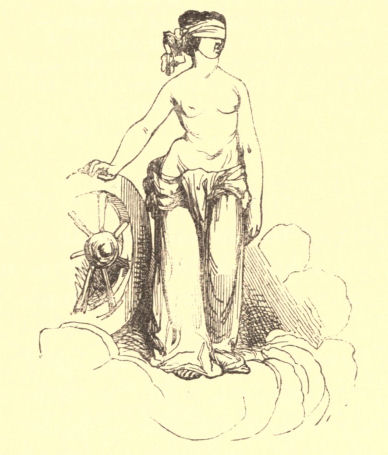
In Bœotia she had a statue, represented as holding Plutus in her arms, to intimate that fortune is the source whence wealth and honours flow. She is blind-folded, and her hand rests on a wheel, to intimate her inconstancy.
H A R P O C R A T E S.
Harpocrates, the son of Isis and Osiris, is the god of Silence. He is represented, in his statues as young, but with a countenance calm and severe, and on his brow a mitre, divided into two equal portions. His finger is placed upon his lip, to intimate the silence he maintains, and hence, all modern works of art adopt the same sign, when they wish to represent the quality over which Harpocrates is supposed to preside.
The Romans placed his statue at the entrance of their temples, to intimate that the mysteries of religion should never be revealed to the people.
"There is a lake that to the North Of Memphis, stretches grandly forth, Upon whose silent shore the dead Have a proud city of their own, With shrines and pyramids o'erspread— Where many an ancient, kingly head Slumbers, immortalized in stone; And where, through marble grots beneath, The lifeless, ranged like sacred things, Nor wanting aught of life, but breath, Lie in their painted loveliness, And in each new successive race, That visit their dim haunts below, Look with the same unwithering face, They wore three thousand years ago. There Silence, thoughtful god, who loves The neighbourhood of death, in groves Of Asphodel lies hid, and weaves His hushing spell among the leaves— Nor ever noise disturbs the air, Save the low, humming, mournful sound Of priests, within their shrines at prayer, For the fresh dead, entombed around." Moore.
T H E M I S , A S T R Æ A.
Themis, daughter of heaven and of earth, was the goddess of Justice, She wears a bandage over her eyes, and holds in her hands a sword, scales, and the mirror of truth. Her temple is always open.
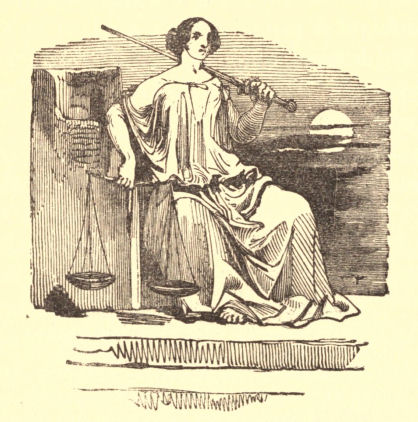
Astræa, with Law and Peace, are her children, the former of whom was worshipped as Justice on the earth during the golden age; but the wickedness of mankind drove her from the world, during the succeeding periods of brass and iron, and she was placed among the constellations of the Zodiac, under the name of Virgo. She is represented as a maiden, with a stern but majestic countenance, holding a pair of scales in one hand, and a sword in the other.
D E M I - G O D S.
The demi-gods are those, who, sprung from the union of a mortal with a divinity, have taken their place among the Immortals; and "Fabulous History" is the name given to the recital of their deeds.
CASTOR AND POLLUX.
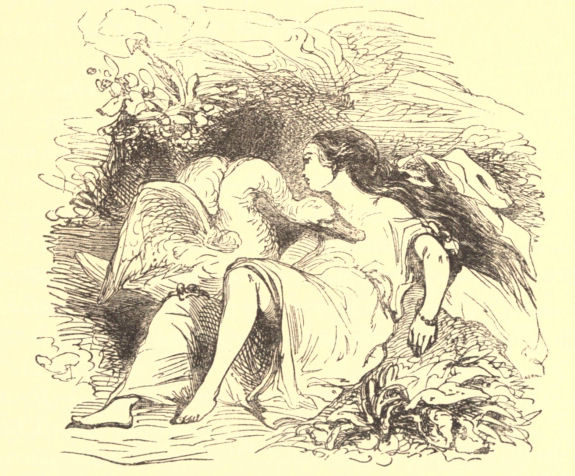
From the love of Jupiter for Leda, wife of Tyndarus, king of Sparta, sprang these twin-brothers. Under the form of a swan, pursued by Venus: in the shape of an eagle, the God sought refuge in Leda's arms, who in due time produced two eggs, from one of which came Pollux and Helena, and from the other, Castor and Clytemnestra.
Scarcely had Pollux emerged from childhood, when, being on an expedition with the Argonauts, they stopped in the domains of Amycus, (famous for his skill in the management of the cestus,) who challenged all strangers seeking his dominions to a trial of strength. Pollux accepted his challenge, and surpassed him in skill, on which Amycus attempting to conquer by fraud, Pollux slew him on the spot; and became the patron of athletic exercises.
Castor was skilful in the art of guiding chariots, and subduing the most fiery coursers. These brothers fought Theseus for outraging their sister Helena; they destroyed the pirates who infested Hellespont and the neighbouring seas, and from this have always been considered as gods favourable to sailors. During the Argonautic expedition, in which they had accompanied Jason, when a violent storm was raging, a couple of names were seen playing over their heads, and immediately the tempest was appeased, and the sea became calm.
They were invited to a marriage feast, in which Lynceus and Idas were to be wedded to Phœbe and Talaria the daughters of Leucippus, who was brother to Tyndarus. Becoming enamoured of the two women whose nuptials they had met to celebrate, they resolved to carry them off. This violence provoked the bridegrooms: a combat ensued, in which Castor killed Lynceus, and was slain in return by Idas—Pollux revenged the death of his brother, by slaying Idas, but was unable after this to support life, so devotedly was he attached to his brother: and implored Jupiter either to restore him to life, or that he might be deprived himself of his immortality. His prayers were granted, and the two brothers passed in turn six months in the infernal regions, and six months on earth. This fraternal affection Jupiter rewarded by turning the two brothers into constellations, under the name of Gemini.
Sparta, celebrated in honour of them, a fête called Dioscuria, which was observed with jovial festivity: and in which free use was made of the gifts of Bacchus, accompanied with sports, in which wrestling matches always formed an important part.
J A S O N.
This celebrated hero was the son of Alcemede, by Æson; the education of the youthful Jason, whose right of succession to the throne of Iolchos had been wrested from him by Pelias, was entrusted to the care of the centaur Chiron, and he was removed from the presence of the usurper of the kingdom of Iolchos, because the latter had been informed by an oracle that one of the descendants of Æolus, (from whom Jason had come) would dethrone him. After he had distinguished himself by the most rapid success in every branch of science, Jason left the country, and by the advice of his preceptor, went to consult the oracle. He was ordered to go to Iolchos, his native country, covered with the spoils of a leopard, and dressed in the garments of a Magnesian. In his journey he was stopped by the inundation of a river, over which, however, he was carried by Juno, in the character of an old woman. In crossing the stream, he lost one of his sandals, and on his arrival at Iolchos, the singularity of his dress, and the fairness of his complexion, attracted the notice of the people, and drew a crowd round him in the market place. Pelias came to see him with the others, and, as he had been warned by the oracle, to beware of a man who should appear at Iolchos with one foot bare, and the other shod, the appearance of Jason, who as we have seen, had lost one of his sandals, alarmed him, and his terrors were soon after augmented, as Jason, accompanied by his friends repaired to the palace of Pelias, and demanded the kingdom of which he had been unjustly deprived. The boldness of Jason intimidated Pelias; he was unwilling to abdicate the crown, yet he feared the resentment of his adversary.
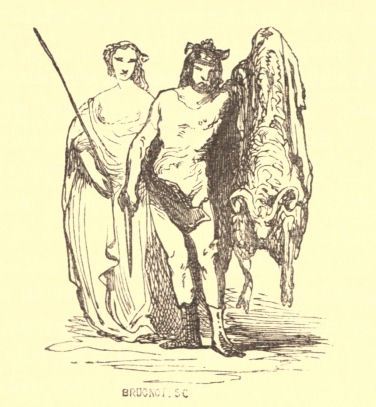
As Jason was young and desirous of glory, Pelias reminded him that their common relation, Phryxus, had been inhumanly murdered by Æetes, king of Colchis, in order to obtain possession of the golden fleece which belonged to the murdered man; observing, that, the deed merited punishment, and was one which would produce a crown of glory to him who should inflict it; adding, that if Jason, were to undertake it, he would resign his own crown and kingdom to him, immediately on his return. Burning with the desire of military fame, Jason readily undertook an expedition which seemed to promise so much glory. The expedition was bruited about all Greece, and the young and ardent of the nation were called upon to join him in the glory and the danger.
They set sail in a ship called Argo and after a series of adventures arrived at Colchis. Alarmed at an invasion which appeared so formidable, Æetes promised to restore the golden fleece for the possession of which he had slain Phryxus, provided the invaders consented to the conditions he should propose, and which were as follows: Jason was to tame bulls whose breath were fierce flames, with feet and horns of brass, and to plough with them, when subdued, a field sacred to Mars. He was then to sow in the ground the teeth of a serpent, from which armed men would spring up, whose rage would be directed against him who should be daring enough to plough the field; and as a conclusion to his arduous tasks, he was to kill a frightful dragon which remained ever on the watch at the tree where the golden fleece was suspended. All were in fear for the fate of the Argonauts, but Juno watched over their safety, and extricated them from their difficulties. Medea, the king's daughter, fell in love with Jason, and in an interview with her lover in the temple of Hecate, in which they swore a mutual fidelity, and bound themselves by the most solemn oaths, she pledged herself to deliver her lover from all his dangers. Her knowledge of herbs, enchantments and incantations, was uncommon, and he received from her whatever instruments and herbs could protect him against the coming dangers.
"She then retires to Hecate's shrine, that stood Far in the covert of a shady wood: She finds the fury of her flames assauged, But, seeing Jason there, again they raged. Blushes and paleness did by turns invade Her tender cheeks, and secret grief betrayed; As fire, that sleeping under ashes lies, Fresh blown and roused, does up in blazes rise, New kindled by her lover's sparkling eyes, So flamed the virgin's breast. For chance, that day, had with uncommon grace;, Adorned the lovely youth, and thro' his face Displayed an air so pleasing, as might charm A goddess, and a vestal's bosom warm. Her ravished eyes survey him o'er and o'er, As some gay wonder never seen before; Transported to the skies she seems to be And thinks she gazes on a deity, But when he spoke and pressed her trembling hand, And did with tender words her heart demand, With vows and oaths to make her soon his bride, She wept a flood of tears, and thus replied. 'I see my error, yet to ruin move, Nor owe my fate to ignorance, but love: Your life I'll guard, and only crave of you To swear once more—and to your oath be true.' He swears by Hecate, he would all fulfil, And by her grandfather's prophetic skill By everything that doubting love could press, His present danger and desired success. She credits him, and kindly does produce Enchanted herbs, and teaches him their use, Their mystic names, and virtues he admires. And with his booty joyfully retires." Ovid.
He made his appearance in the field of Mars, he tamed the fury of the oxen, he ploughed the earth, and he sowed the teeth of the dragon. Immediately a band of armed men arose and rushed towards Jason: nothing daunted, the hero threw a stone amongst them, and they fell one upon the other till they were entirely destroyed. He lulled to sleep the watchfulness of the dragon, by the power of herbs, and grasped in triumph the golden fleece which was the the object of his expedition.
"Impatient for the wonders of the day, Aurora drives the loitering stars away. Now Mars's mount the pressing people fill, The crowd below, the nobles crown the hill: The king himself, high throned above the rest, With ivory sceptre, and in purple drest. Forthwith the brass hoofed bulls are set at large, Whose furious nostrils sulphurous flames discharge, The blasted herbage by their breath expires, As forges rumble with excessive fires, And furnaces with fiercer fury glow, When water in the panting mass ye throw, With such a noise from their convulsive breast, Through bellowing throats the struggling vapour pressed. Yet Jason marches up without concern, While on the adventurous youth the monsters turn Their glaring eyes, and eager to engage, Brandish their steel-tipt horns in threatening rage: With brazen hoofs they beat the ground, and choke The ambient air, with clouds of dust and smoke. Each gazing Grecian for his champion shakes, While bold advances he securely makes Through singeing blasts: such wonders magic art Can work, when love conspires and plays his part. The passive savages like statues stand, While he their dewlap strokes with soothing hand; To unknown yokes their brawny necks they yield, And like tame oxen, plough the wondering field. The Colchians state, the Grecians shout, and raise Their champion's courage with inspiring praise. Emboldened now, in fresh attempts he goes, With serpent's teeth the fertile furrows sows; The glebe, fermenting with enchanted juice, Makes the snakes' teeth a human crop produce, And from the labouring earth, no single birth But a whole troop of lusty youths rush forth, And what's more strange, with martial fury warmed, And for encounter all completely armed; In rank and file, as they were sowed, they stand Impatient for the signal of command, No foe, but the Æmonian youth appears, As there they level their steep pointed spears. Wonders ensue, among his gazing foes The fragment of a massy rock he throws, This charm in civil war engaged them all, By mutual wounds these earth-born brothers fall. One labour more remains, and, though the last, In danger far surmounting all the past; That enterprize by fate in store was kept To make the dragon sleep, that never slept, Whose crest shoots dreadful lustre; from his jaws A triple tier of forked stings he draws, With fangs and wings of a prodigious size; Such was the guardian of the golden prize. Yet him besprinkled with Lethean dew The fair enchantress into slumber threw; While the soft guest his drowsy eyelids seals, Th' unguarded golden fleece the stranger steals; Proud to possess the purchase of his toil, Proud of his royal bride, the richer spoil, To sea both prize and patroness he bore, And lands triumphant on his native shore." Ovid.
All these deeds being performed in the presence of the monarch and his subjects, they were struck with surprise at the boldness and success of the young hero, who immediately embarked for Europe with Medea, the great instrument of his preservation. Enraged at the desertion of his daughter, Œetes sent his son Absyrtus to bring back the fugitives. Absyrtus overtook them, but was slain by Medea, who scattered his limbs upon the path of his father, trusting that Œetes' paternal affection, would make him anxious to render due homage to the remains of his son, and prevent him from following with success.
On the return of the expedition to Thessaly, they were received with unusual festivity; but Œson, Jason's father was unable to be there, owing to the infirmities of age, and Medea at her husband's desire, restored him to all the power and vigour of youth.
Jason and Medea.
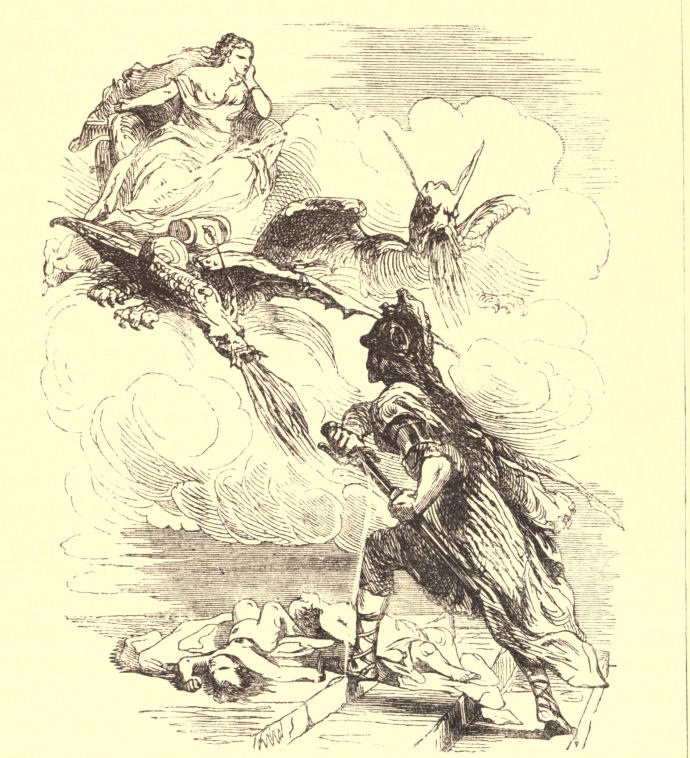
With looks averted backward they advance, Who strike and stab, and leave the blows to chance Waking in consternation, he essays, Weltering in blood, his feeble arms to raise; Environed by so many swords; 'From whence This barbarous usage? what is my offence? What fatal fury, what infernal charm, 'Gainst a kind father does his daughter arm?' Hearing his voice, as thunderstruck they stopped Their resolution, and their weapons dropped: Medea then the mortal blow bestows."
The subjects of the deceased king, when they were informed of the cause of his death, were anxious to avenge it, and Medea found herself compelled to fly with Jason to Corinth, in which place they resided forty years.
Unhappily their matrimonial happiness was disturbed by Jason's infidelity with Glaucus, the daughter of the King of the Country, for whom Medea was divorced, that he might follow his amour in comfort. This infidelity was severely avenged by Medea, who after destroying the children of Glaucus in her presence, presented to her a poisoned gown, and induced her to put it on; it immediately set her whole body on fire, and she died in the most painful torments.
This deed was followed by one still more revolting to the mind, for Medea slew two of her own children in their father's presence, and when the incensed Jason attempted to avenge their murder on the barbarous mother, she escaped by flying through the air in a chariot drawn by dragons.
"When Medea left her native soil, Unawed by danger, unsubdued by toil: Her weeping sire, and beckoning friends withstood, And launched enamoured in the boiling flood; One ruddy boy her gentle lips caressed, And one fair girl was pillowed on her breast; While high in air the golden treasure burns, And Love and Glory guide the prow by turns. But when Thessalia's inauspicious plain, Received the matron-heroine from the main; While hours of triumph sound, and altars burn. And shouting nations hail their Queen's return: Aghast, she saw new-decked the nuptial bed, And proud Creusa to the temple led; Saw her in Jason's mercenary arms. Deride her virtues and insult her charms: Saw her dear babes from fame and empire torn, In foreign realms deserted and forlorn: Her love rejected, and her vengeance braved By him, her beauties won, her virtues saved. To the stern King of Ghosts she next applied. And gentle Proserpine, his ravished bride, That for old Æson with the laws of fate; They would dispense, and lengthen his short date. Thus with repeated prayers she oft assails, The infernal tyrant, and at last prevails; Then calls to have decrepid Æson brought, And stupifies him with a sleeping draught; This done, th' enchantress, with her locks unbound About her altar trips a frantic round; Piecemeal the consecrated wood she splits, And dips the splinters in the gory pits, Then hurls them on the piles; the sleeping sire She lustrates thrice, with sulphur, water, fire. * * * * * * His feeble frame resumes a youthful air, A glossy brown his hoary head of hair, The meagre paleness from his aspect fled, And in its room sprung up a florid red: Through all his limbs a youthful vigour flies, His emptied arteries swell with fresh supplies. Gazing spectators scarce believe their eyes. But Æson is the most surprised to find A happy change in body and in mind, In sense and constitution the same man, As when his fortieth active year began." Ovid.
Pelias the usurper, was desirous of following so pleasant an example, and his daughters persuaded by Medea, who was anxious to avenge her husband's wrongs, destroyed him with their own hands. Their credulity met with a severe punishment, for Medea refused to restore him to life.
Meanwhile Pelias with his guards lay bound In magic sleep, scarce that of death so sound: The daughters now are by the Sorceress led, Into his chamber and surround his bed, 'Your fathers health's concerned and can ye stay? Unnatural nymphs, why this unkind delay? Unsheath your swords, dismiss his lifeless blood, And I'll recruit it with a vital flood: Your father's life and health are in your hand, And can ye thus, like idle gazers stand? Unless you are of common sense bereft, If yet one spark of piety is left, Dispatch a father's cure, and disengage The monarch from his loathsome load of age. Thus urged, the poor deluded maids proceed Betrayed by zeal to an inhuman deed, And in compassion, make a father bleed. Yes, she who has the kindest, tenderest heart, Is foremost to perform the bloody part. Yet, though to act the butchery betrayed, They could not bear to see the wounds they made, With stern regard she eyed the traitor king, And felt ingratitude, the keenest sting; "Nor Heaven" she cried, "nor earth, nor Hell can hold A heart abandoned to the thirst of gold! Stamped with wild foot and shook her torrent brow, And called the furies from their dens below!" Ovid.
When in Athens, to which place Medea came after leaving Corinth, she underwent the penance necessary to purify her from the crimes she had committed, after which she became the wife of King Ægeus, to whom she bore a son called Medus.
Before his intimacy with Medea, Ægeus had a son named Theseus, who had been sent to Athens with his father's sword, by the sight of which he was to introduce himself to his father's knowledge when he grew up; as Theseus attempted to make himself known to his father, Medea, who had grown jealous of the glory he had achieved, tried to poison him at an entertainment to which he had been invited. She failed in her purpose. The king, recognized by the sword he bore, his long lost son, and Medea had recourse to her dragons once more, to make her escape through the air, to Colchis, where, by some it is stated, she was re-united to Jason; while according to other authorities, Jason lived a melancholy and unhappy life; and, as he was reposing one day by the side of the ship which had borne him to Colchis, a large beam fell upon and crushed him to death. Medea also died at Colchis, and after her death is said to have been married to Achilles in Elysium.
It is asserted by some writers, that the murder of the two youngest of Jason's children, was not committed by Medea, but by the Corinthians themselves, in the Temple of Juno Acrea; and that to avoid the vengeance of heaven, and to free themselves from a plague which devoured the country after so frightful a massacre, they engaged the poet Euripides to write a tragedy which should tend to clear them of the murder, and throw the crime upon the guilty Medea. Festivals were also appointed, in which the mother was represented as destroying her own offspring, with all the attributes of a fury, and was regarded as a day of solemn mourning.
"O haggard queen! to Athens dost thou guide Thy glowing chariot, steeped in kindred gore; Or seek to hide thy foul infanticide Where peace and mercy dwell for evermore? The land where Heaven's own hallowed waters play, Where friendship binds the generous and the good, Say, shall it hail thee from thy frantic way, Unholy woman! with thy hands embrued. In thine own children's gore? Oh! ere they bleed, Let Nature's voice thy ruthless heart appal! Pause at the bold, irrevocable deed— The mother strikes—the guiltless babes shall fall! * * * * * * When o'er each babe you look a last adieu, And gaze on Innocence that smiles asleep, Shall no fond feeling beat to Nature true, Charm thee to pensive thought—and bid thee weep? When the young suppliants clasp their parent dear, Heave the deep sob, and pour the artless prayer, Ay! thou shalt melt; and many a heart-shed tear Gush o'er the hardened features of despair! Nature shall throb in every tender string,— Thy trembling heart the ruffian's task deny; Thy horror smitten hands afar shall fling The blade, undrenched in blood's eternal dye. CHORUS. Hallowed Earth! with indignation Mark, oh mark, the murderous deed. Radiant eye of wide creation, Watch th' accursed infanticide! Yet, ere Colchia's rugged daughter Perpetrate the dire design, And consign to kindred slaughter Children of the golden line! Shall mortal hand, with murder gory, Cause immortal blood to flow! Sun of Heaven!—array'd in glory Rise, forbid, avert the blow! In the vales of placid gladness Let no rueful maniac range; Chase afar the fiend of Madness, Wrest the dagger from Revenge! Say, hast thou, with kind protection, Reared thy smiling race in vain; Fostering Nature's fond affection, Tender cares, and pleasing pain? Hast thou, on the troubled ocean, Braved the tempest loud and strong, Where the waves, in wild commotion, Roar Cyanean rocks among? Didst thou roam the paths of danger, Hymenean joys to prove? Spare, O sanguinary stranger, Pledges of thy sacred love! Ask not Heaven's commiseration, After thou hast done the deed; Mercy, pardon, expiation, Perish when thy victims bleed" Euripides.
H E R C U L E S.
This celebrated hero was, after his death, as a reward for the many courageous deeds he had performed, placed among the gods, and rewarded with divine honours. It has been asserted that there were many of the same name, some writers extending the number to forty-three; though of these the son of Jupiter and Alcmena is the most celebrated, and as such, doubtless, many of their actions have been attributed to him. In order to gain the affections of Alcmena, Jupiter took the form of her husband, and from this union was born Hercules, who was brought up at Tirynthus; Juno, however, could not look upon him with pleasure, and before he was nine months old, sent two snakes intending them to devour him. Far from fearing these terrible enemies, the child grasped them boldly in both his hands, and strangled them, while his brother Iphielus shrieked aloud in terror.
He was early instructed in those arts in which he afterwards became so famous, for Castor taught him to fight, Eurytus to shoot with the bow and arrows, and Autolycus to drive a chariot; after this, he perfected himself under the tuition of the Centaur, Chiron. When in the eighteenth year of his age, a huge lion devastated the people, and preyed on the flocks of Amphitryon, laying waste also the adjacent country. From this monster Hercules relieved them, and when Erginus, King of Orchomedas, sent for his yearly tribute of one hundred crowns, Hercules mutilated the servants who came to raise it, and on Erginus coming to avenge their death, he slew him, and delivered his country from the inglorious tribute.
These heroic deeds soon became bruited abroad, and Creon, who reigned in Thebes, rewarded his courage by giving him his daughter in marriage, and entrusting him with the government of his people.
As Hercules was by the will of Jupiter, subjected to the power of Eurystheus, the latter, jealous of the fame he was achieving, ordered him to appear before him.
Proud of his strength and of his successes, the hero refused, and Juno to punish him, struck him with a sudden madness, in which he killed his own offspring, imagining them to be those of Eurystheus.
Hercules. "Hast thou beheld the carnage of my sons? Theseus. I heard, I saw the ills thou showest me. Hercules. Why hast thou then unveiled me to the Sun? Theseus. Why not? Can mortal man pollute the Gods? Hercules. Fly, thou unhappy, my polluting guilt! Theseus. Friends, from their friends, no stain of guilt contract. Hercules. This hath my thanks, indeed, I thought thee good. Theseus. And for that good deed, now I pity thee! Hercules. I want thy pity, I have slain my sons. Theseus. Thee, for thy grace, in other ills I mourn! Hercules. Whom hast thou known involved in ills like these? Theseus. Thy vast misfortunes reach from earth to heaven. Hercules. I therefore am prepared, and fixed to die. Theseus. And deemest thou the gods regard thy threats? Hercules. The gods regard not me, nor I the gods! Theseus. Forbear: lest thy proud words provoke worse ill. Hercules. I now am full, and can contain no more. Theseus. What dost thou? Whither doth thy rage transport thee? Hercules. From whence I came, to death's dark realms I go. Theseus. This is the language of a vulgar spirit. Hercules. Thou from misfortune free, canst counsel me; Theseus. Doth the much suffering Hercules say this? Hercules. He had not suffered this, had ills a mean. Theseus. The brave protector, the kind friend of men. Hercules. They nought avail me. Theseus. Greece will not suffer thee to die thus rashly. Hercules. Now hear me whilst my arguments refute All thy monitions. Whilst I yet Hung on the breast, two hideous serpents came, Sent by Juno to destroy me, rolled their spires Within my cradle. When my age advanced To youth's fresh bloom, why should I say what toils I then sustained? What lions—what dire forms Of Triple Typhons, or what giants, what Of monsters banded in the Centaur war, Did I not quell? The Hydra, raged around, With heads still spouting from the sword I slew. These and a thousand other toils endured, To the dark regions of the dead I went, To drag the triple headed dog to light, That guards the gate of Pluto;—the command Of stern Eurystheus. This last bloody deed, (Wretch that I am!) the murder of my sons Have I achieved, to crown my house with ills. I am reduced to this unhappiness, At my loved Thebes I cannot dwell, for here What temple, what assembly of my friends Can I approach? Pollutions rank as mine, Allow no converse. Should I go to Argos? How, since I fly my country, should I seek Refuge in other states, malignant eyes Would scowl on me when known, and bitter tongues Goad me with these reproaches:—Is not this The son of Jove, who slew his sons and wife? Then bid me thence with curses on my head. And to the man, whose former days were passed In happier fortune, mournful is the change; But him, that in distresses hath been trained, Naught grieves, as though lie were allied to ills. And to this misery shall I come, I ween. The earth will cry aloud, forbidding me To touch her soil, to pass its waves, the sea, And every fountain whence the rivers flow. Thus like Ixions, on the whirling wheel In chains, will be my stake: and this were best, That never Grecian might behold me more, With whom in better days I have been happy. Why therefore should I live? What blessing were it To gain a useless and unhallowed life?"
After his recovery he consulted the oracle of Apollo, and was told that he must act in compliance with the will of Jupiter, and be subservient to the commands of Eurystheus for twelve years, and that after he had been successful in the labours to be imposed upon him, he would be admitted amongst the gods. This answer determined him to bear with fortitude whatever gods or men might command, and Eurystheus, seeing so perfect a hero subjected to him, ordered him to perform the most terrible and dangerous deeds he could imagine, which are now generally known as the twelve labours of Hercules.
The favors of the gods had completely armed him when he undertook his labours. He had received a coat of arms and helmet from Minerva, a sword from Mercury, a horse from Apollo, and from Vulcan a golden cuirass and brazen buskin, with a celebrated club of brass, according to the opinion of some writers, but more generally supposed to be of wood, and cut by the hero himself in the forest of Nemæa. The first labour imposed upon Hercules by Eurystheus, was to kill the lion of Nemæa, which ravaged the country near Mycenæ. The hero, unable to destroy him with his arrow, boldly attacked him with his club, pursued him to his den, and after a close and sharp engagement, he choked him to death. He carried the dead beast on his shoulders to Mycenæ, and ever after clothed himself with the skin. Eurystheus was so astonished at the sight of the beast, and at the courage of Hercules, that he ordered him never to enter the gates of the city when he returned from his expeditions, but to wait for his orders without the walls. He even made himself a hiding place into which he retired whenever Hercules returned. The second labour of Hercules was to destroy the Lernæan hydra, which had seven heads. This celebrated monster he attacked with his arrows, and soon after he came to a close engagement, and by means of his heavy club, destroyed the heads of his enemy. But this was productive of no advantage, for as soon as one head was beaten to pieces by the club, immediately two sprang up, and the labour of Hercules would have remained unfinished, had he not commanded his friend Iolas, who accompanied him, to burn, with a hot iron, the root of the head which he had crushed to pieces. This succeeded, and Hercules became victorious, opened the belly of the monster, and dipped his arrow in the gall, to render the wounds which he gave, fatal and incurable. He was ordered in his third labour to bring alive and unhurt, into the presence of Eurystheus, a stag, famous for its incredible swiftness, its golden horns, and brazen feet. This celebrated animal frequented the neighbourhood of Œnoe, and Hercules was employed for a whole year in continually pursuing it; at last, he caught it in a trap, or when tired, or according to others by slightly wounding it, and lessening its swiftness. As he returned victorious, Diana snatched the stag from him, and severely reprimanded him for molesting an animal which was sacred to her. Hercules pleaded necessity, and by representing the commands of Eurystheus, he appeased the goddess and obtained the beast. The fourth labour was to bring alive to Eurystheus a wild boar which ravaged the neighbourhood of Erymanthus. In this expedition he destroyed the Centaurs, and caught the boar by closely pursuing him through the deep snow. Eurystheus was so frightened at the sight of the boar, that, according to Diodorus, he hid himself in a brazen vessel for some days. In his fifth labour Hercules was ordered to clean the stables of Augias, where three thousand oxen had been confined for many years. For the sixth, he was ordered to kill the carnivorous birds which ravaged the country near the lake Stymphalis, in Arcadia. In his seventh, he brought alive into Peloponnesus a prodigious wild bull, which laid waste the island of Crete. In his eighth, he was employed in obtaining the mares of Diomedes, which fed upon human flesh. He killed Diomedes, and gave him to be eaten by his mares, which he brought to Eurystheus. They were sent to Mount Olympus by the King of Mycenæ, where they were devoured by the wild beasts; or, according to others, consecrated to Jupiter, and their breed still existed in the age of Alexander the Great. For his ninth labour, he was commanded to obtain the girdle of the Queen of the Amazons. In his tenth, he killed the monster Geryon, King of Gades, and brought to Argos his numerous flocks which fed upon human flesh. The eleventh labour was to obtain apples from the garden of Hesperides, three celebrated daughters of Hesperus, who were appointed to guard some golden apples, given by Jupiter to Juno on the day of their marriage.
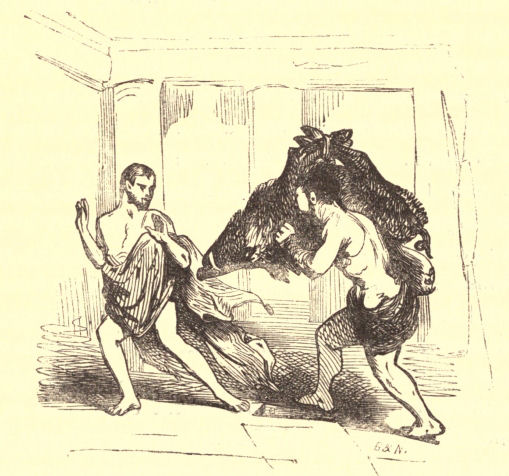
Ignorant of the precise situation of the beautiful garden containing them, Hercules applied to the nymphs in the neighbourhood of the Po for information, and was told that Nereus, if properly managed, would direct him in his pursuits. The hero seized Nereus while he slept, and the sea god, unable to escape from his grasp, answered all the questions he proposed, which led him to Atlas, in Africa, and of him, he demanded three of the golden apples. Atlas placed the burden of the heavens on the shoulders of Hercules, and went in quest of the apples. At his return, Hercules expressed a wish to ease his load by putting something on his head, and when Atlas assisted him to remove the inconvenience, he artfully left the burden, and seized the apples which Atlas had thrown on the ground. According to other accounts, Hercules gathered them without the assistance of Atlas, after killing a dragon which guarded the tree.
The twelfth and last, and most dangerous of his labours, was to bring upon earth the three-headed dog Cerberus. This was cheerfully undertaken by Hercules, and he descended into hell by a cave on Mount Tænarus. He was permitted by Pluto to carry away his friends Theseus and Pirithous, who were condemned to punishment in hell; and Cerberus also was granted to his prayers, provided he made use of no arms, but only force to drag him away. Hercules, as some report, carried him back to hell, after he had brought him before Eurystheus. Besides these arduous labours, which the jealousy of Eurystheus imposed upon him, he also achieved others of his own accord, equally great and celebrated.
He delivered Hesione, a daughter of Laomedon, King of Troy, from a sea monster, to whom the Trojans yearly presented a marriageable maiden; and when the hero had fulfilled his task, Laomedon refused to give him the tribute of six beautiful horses, which he had promised to him. Hercules, incensed at his treachery, besieged Troy, and put the king and his family to the sword.
"First, two dread snakes, at Juno's vengeful nod, Climbed round the cradle of the sleeping God; Waked by the shrilling hiss, and rustling sound, And shrieks of fair attendants trembling round, Their gasping throats with clenching hands he holds; Till death entwists their convoluted folds. And in red torrents from her seven gold heads Fell Hydra's blood in Lerna's lake he sheds; Grasps Achelous with resistless force, And drags the roaring river to his course: Binds with loud bellowing and with hideous yell The monster bull, and three-fold dog of hell." "Then, where Nemea's howling forests wave, He drives the Lion to his dusky cave; Seized by the throat the howling fiend disarms, And tears his gaping jaws with sinewy arms; Lifts proud Anteus from his mother-plains, And with strong grasp, the struggling giant strains; Back falls his fainting head, and clammy hair, Writhe his weak limbs, and flits his life in air;— By steps reverted o'er the blood-dropped fen He tracks huge Ceacus to his forest den! Where breathing flames through brazen lips, he fled, And shakes the rock-roofed cavern o'er his head! Last, with wide arms the solid earth he tears, Piles rock on rock, on mountain, mountain rears; Heaves up huge Abyla in Afric's sand, Crowns with huge Calpe Europe's salient strand, Crests with opposing towers the splendid scene, And pours from urns immense, the sea between. Loud o'er her whirling flood Charybdis roars Affrighted Scylla bellows round her shores, Vesuvius groans through all his echoing caves, And Etna thunders o'er the insurgent waves."
Hercules delivering Hesione.
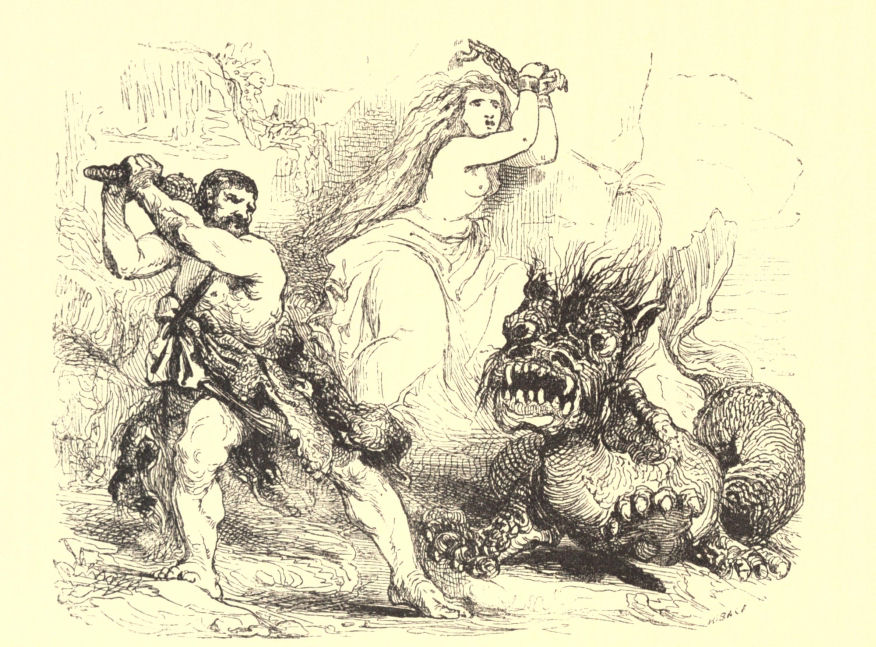
When these were performed, he became deeply enamoured of Iole, daughter of Eurystheus, but she, being refused to his entreaties, he became insane a second time, and murdered Iphitus, the only one of the sisters of Iole who was willing to assist him in obtaining her.
After some time had passed, he was purified from this murder, and his insanity was at an end. However, the gods were not satisfied, but persecuted him still further, for he was smitten with an indisposition which compelled him once more to consult the oracle of Delphi.
Not being pleased with the manner in which his application was received, he resolved, in the heat of passion, to desecrate the sacred temple by plundering it, and carrying away the holy tripod. Apollo opposed him, and a fierce conflict ensued, to put an end to which, however, Jupiter interfered with his Thunderbolts.
Indignant at the insult offered to the sacred edifice, the oracle declared that it could only be wiped away by the hero becoming a slave, and remaining in the most abject servitude for three years.
In compliance with the decree, Mercury, by the order of Jupiter, sold him to Omphale, Queen of Lydia, as a slave. But his services to this queen so astonished her, that she freed him from his servitude and married him. When the term for which he had been sold expired, Hercules left her, and returned to Peloponnessus, where he re-established Tyndaris on the throne of Sparta.
After this, he became one of the numerous suitors of Dejanira, who had been promised by her father in marriage to that one who should prove the strongest of all his competitors. The most dangerous foe to Hercules was Achelous, a river god, who, finding himself inferior in strength, changed himself into a serpent, and afterwards into an ox. Serpent strangling was, however, nothing new to Hercules, and he had but little trouble with his enemy as an ox, until at last Achelous retired in disgrace to his bed of waters.
After his marriage with Dejanira, he was compelled to leave his father-in-law's kingdom, from having accidentally slain one of the citizens.
On his way to Ceyx, accompanied by Dejanira, he was stopped by a swollen stream, and Nessus, the Centaur, offered to convey her safely on his back to the opposite side of the river. As the hero's only anxiety was for her, he accepted the offer with thanks, and when he saw them through the worst part of the water in safety, prepared to follow, but no sooner had the Centaur landed with Dejanira, than he attempted to offer violence to his beautiful burthen, and to carry her away in the very sight of her husband.
The extraordinary efforts of the enraged Hercules, brought him up in time to let fly a poisoned arrow at the ravisher, which mortally wounded him. In his anguish, and burning for vengeance on his slayer, he gave Dejanira his tunic, which was covered with his blood.
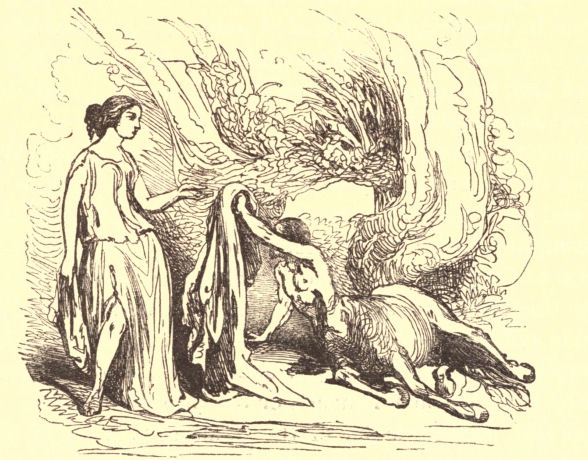
"Take this," he said, feigning a repentance, "if ever your husband prove unfaithful, it will recall him to your arms;" and with this he expired.
The Death of Nessus.
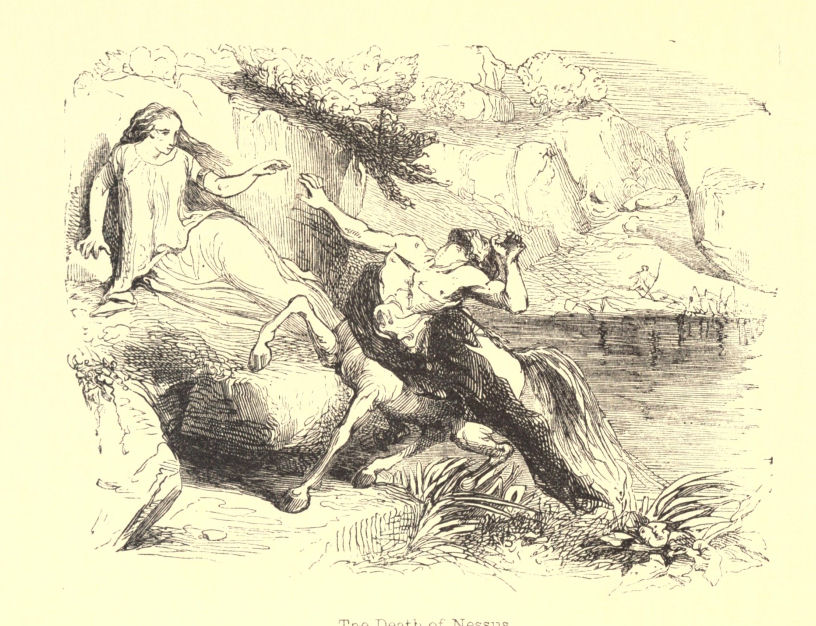
"For now his bridal charge employed his cares. The strong limbed Nessus thus officious cried, For he the shallows of the stream had tried, 'Swim thou, Alcides, all thy strength prepare, On yonder bank I'll lodge thy nuptial care.' Th' Aonian chief to Nessus trusts his wife. All pale, and trembling for her hero's life: Clothed as he stood in the fierce lion's hide, The laden quiver o'er his shoulder tied. Far cross the stream his bow and club were cast, Swift he plunged in, 'these billows shall be past,' He said, nor sought where smoother waters glide But stemmed the rapid dangers of the tide. The bank he reached, again the bow he bears, When, hark! his bride's known voice alarms his ears, 'Nessus, to thee I call,' aloud he cries,— 'Vain is thy trust in flight, be timely wise; Thou monster double shaped, my right set free, If thou no reverence owe my fame and me, Yet kindred should thy lawless lust deny, Think not perfidious wretch, from me to fly; Tho' winged with horse's speed, wounds shall pursue,' Swift as his words the fatal arrow flew, The Centaur's back admits the feathered wood, And thro' his breast the barbed arrow stood, Which when in anguish, thro' the flesh he tore From both the wounds gushed forth the spumy gore, Mixed with the Lernæan venom, this he took, Nor dire revenge his dying breast forsook, His garment, in the reeking purple dyed To rouse love's passion, he presents the bride." Ovid.
Ceyx received them both with great favour, but Hercules could not forget that he had been refused the hand of Iole, although in possession of the heart of Dejanira, and therefore made war against her father, killing him, with three of his sons, while his former lover, Iole, fell into his hands, and found that she still held no slight possession of his affections.
She accompanied him to Œta, where he was going to raise an altar, and offer a sacrifice to Jupiter. Dejanira, aware of his purpose, and of the affection he had manifested for her rival, sent to him the tunic given her by the Centaur, Nessus, but no sooner had he put it on, than the poison with which it was saturated, penetrated through his bones, and attaching itself to the flesh, eat into it like fire.
"She now resolves to send the fatal vest, Dyed with Lernæan gore, whose power might move His soul anew, and rouse declining love, Nor knew she what her sudden rage bestows, When she to Lychas trusts her future woes; With soft endearment she the boy commands, To bear the garment to her husband's hands. Th' unwilling hero takes the gift in haste, And o'er his shoulders Lerna's poison cast, At first the fire with frankincense he strews, And utters to the gods his holy vows; And on the marble altar's polished frame Pours forth the grapy stream; the rising flame Sudden dissolves the subtle poisoning juice Which taints his blood, and all his nerves bedews. With wonted fortitude he bore the smart, And not a groan confessed his burning heart, At length his patience was subdued by pain Œtes wide forests echo with his cries; Now to rip off the deathful robe he tries. Where'er he plucks the vest, the skin he tears The mangled muscles and huge bones he bares. (A ghastly sight!) or raging with his pain, To rend the sick'ning plague, he tugs in vain. As the red iron hisses in the flood, So boils the venom in his curdling blood. Now with the greedy flame his entrails glow, And livid sweats down all his body flow. The cracking nerves, burnt up, are burst in twain, The lurking venom melts his swimming brain." Ovid.
When Lychas, by the command of Dejanira, had brought the fatal scarf, and Hercules became aware of its dreadful power, he seized the messenger, and hurled him into the sea with fearful violence.
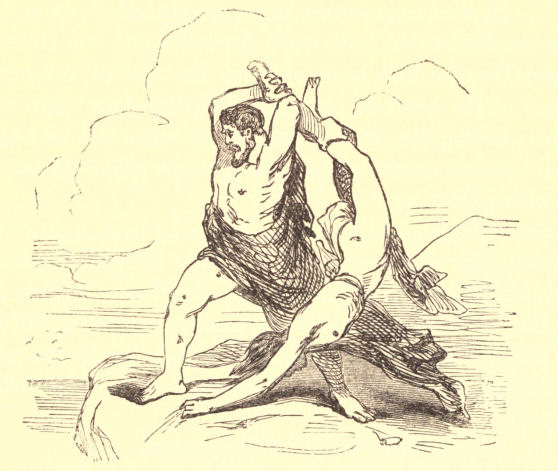
In vain did he attempt to pull it off, he only tore with it masses of flesh. In the midst of his miserable tortures, his groans of anguish were mixed with imprecations on the credulity of Dejanira, and the jealousy and hatred of Juno, to whom he attributed all his pains.
"Then lifting both his hands aloft, he cries, 'Glut thy revenge, dread empress of the skies; Sate with my death the rancour of thy heart, Look down with pleasure and enjoy my smart; Or, if e'er pity moved a hostile breast For here I stand thy enemy profest;' Meanwhile, whate'er was in the power of flame, Was all consumed; his body's nervous frame No more was known; of human form bereft— The eternal part of Jove alone was left. As an old serpent casts his scaly vest, Wreathes in the Sun, in youthful glory drest; So, when Alcides' mortal mould resigned, His better part enlarged, and grew refined: August his visage shone; almighty Jove, In his swift car his honoured offspring drove: High o'er the hollow clouds the coursers fly, And lodge the hero in the starry sky." Ovid.
If his fame had been universal, his worship soon became equally so, and Juno, once so inveterate, consented to his receiving her daughter Hebe in marriage.
Hercules is generally represented as gigantically proportioned, sometimes naked, sometimes covered with the skin of the Nemean lion; a thick and knotted club in his hands, on which he is often seen leaning.
Such are the most important parts of the life of Hercules, who is held out by the ancients as a complete pattern of virtue and piety, and is asserted by them to have been employed for the benefit of mankind, and for this was deservedly rewarded with immortality.
"O worthy end of his laborious life, The nectared cup, and Hebe for a wife! Her golden youth did with new transports play, And crowned his toils in empyrean day. Yet did he oft, though in her arms he lay, And tasted to the height immortal youth, Sigh for young Iole, who, soft as May, And rich as Summer, yielded up her truth; There by Euripus, ever fickle stream, He won a world in her immortal arms, And found his prized honour but a dream Lost in the Ocean of her gentle charms." Thurlow.
He has received many surnames and epithets, either from the place where his worship was established, or from the labours which he had achieved; his temples were numerous and magnificent. The Phœnicians offered Quails on his altars, and as it was supposed that he presided over dreams, the sick and infirm were sent to sleep in his temples, that they might receive in their visions the agreeable presages of their approaching recovery.
The children of Hercules are as numerous as the labours and difficulties which he underwent, and became so powerful after his death, that they alone had the bravery to invade the Peloponnessus.
"'Take hence this hateful life, with tortures torn, Inured to trouble, and to labours born. Death is the gift most welcome to my woe, And such a gift a stepdame may bestow. Was it for this Busiris was subdued, Whose barbarous temples reeked with stranger's blood? Pressed in these arms his fate Antæus found, Nor gained recruited vigour from the ground. Did I not triple-formed Geryon fell? Or, did I fear the triple dog of hell? Did not these hands the bull's armed forehead hold? Are not our mighty toils in Elis told? Did not Stymphalian lakes proclaim my fame? And fair Parthenian woods resound my name? Who seized the golden belt of Thermodon? And who the dragon-guarded apples won? Could the fair Centaur's strength my force withstand? Or the fell boar that spoiled the Arcadian land? Did not these arms the Hydra's rage subdue, Who from his wounds to double fury grew. What if the Thracian horses, fat with gore, Who human bodies in their manger tore, I saw, and with their barbarous lord, o'erthrew? What if these hands Nemæa's lion slew? Did not this neck the heavenly globe sustain? The female partner of the Thunderer's reign, Fatigued at length, suspends her harsh commands, Yet no fatigue has slacked these valiant hands; But now, new plagues consume me; neither force, Nor arms, nor darts can stop their raging course, Devouring flame through my racked entrails strays, And on my lungs and shrivelled muscles preys.'" Ovid.
As, however, the distemper was incurable, and death inevitable, he determined to die the hero he had lived, and giving his bow and arrow to Philoctetes, he erected a funeral pile on Mount Œta, and spreading upon it his lion's skin, lay down with dignity and composure, his head placed upon his club, to await his death. The pile was lighted, and the flames arose in volumes, but the hero gazed calmly upon them, unalarmed at his impending doom. His mind was resolved to meet his fate, when, suddenly, the burning pile was surrounded with dark smoke, the fire burned like a furnace, and when it had consumed the mortal portion of Hercules, a chariot and horses was seen awaiting, which carried his immortal part to heaven, there to be seated amongst the gods. Loud claps of thunder accompanied his exaltation, and when his friends sought his ashes to grant them burial, unable to find them, they erected an altar to his memory, upon the spot where the burning pile had been.
P E R S E U S.
This hero was the son of Jupiter and Danae, the daughter of Acresius. As the latter had confined his daughter in a brazen tower, to prevent her becoming a mother, because, according to the words of an oracle, he was to perish by the hands of his daughter's son, Perseus was no sooner born, than Acresius caused him to be thrown into the sea, with his mother, Danae. The hopes of the father were frustrated; for the slight bark which carried Danae and her son, was driven on the island of Seriphos, one of the Cyclades, where they were found by a fisherman named Dictys, and carried by him to Polydectes, the monarch of the place, by whom they were received with much kindness, and the priests of Minerva's temple had the charge of the youthful Perseus entrusted to them.
His rising genius and great courage fell under the displeasure of Polydectes, who feared, lest the love with which he soon became inspired towards Danae, and the intentions which he harboured towards her, should meet with the resentment of her son. The monarch, however, resolved to remove every obstacle out of his way, and made a sumptuous banquet, decreeing that all who came should present him with a beautiful horse. To this feast Perseus was invited, Polydectes being aware that he would not be able to procure the present which the wealth of the remaining guests could enable them to offer.
To a high spirited man this was unbearable, and unable to submit to the position of being the only one who had brought no present, and unwilling to appear inferior to the remainder of the guests in splendour, he told Polydectes, that though he was unable to give him a horse, he would bring him the head of one of the Gorgons, and Medusa being the only one subject to mortality, she must be the victim.
For more than one reason this was very agreeable to Polydectes, in the first place, as it would remove Perseus from the island, and the next that, from its seeming impossibility, the attempt might end in his ruin.
The gods, however, are the protectors of innocence, and that of Perseus was made their peculiar care. Pluto lent him his helmet, possessing the wonderful power of making the bearer invisible. The buckler of Minerva, as resplendent as glass, was given him by that goddess. Mercury gave him wings and the Calaria, with a short dagger formed of diamonds. With this assistance Perseus boldly commenced his expedition, traversing the air, conducted by Minerva. He went first to the Graces, the sisters of the Gorgons, who possessed but one eye and one tooth among the three; with the assistance of Pluto's helmet, which rendered him invisible, Perseus was able to steal their eye and their tooth while sleeping, and refused to return them until they had informed him where their sisters, the Gorgons resided.
When the necessary information had been received, Perseus sought the habitation of the Gorgons, whom he fortunately found asleep. Knowing that if he fixed his eyes upon them, he would be changed to stone, he used his shield, which was transparent, as a mirror to reflect the object he sought to destroy. Keeping his eyes thus fixed upon them, he approached, Minerva supporting his courage, and with one blow of his sword, cut off Medusa's head.
The noise of the blow awoke the two remaining sisters, who frantic with rage, looked around for the murderer of their sister, but in vain, for he had already put on the invisible helmet of Pluto, and the attempts of the Gorgons to avenge the death of the sister were fruitless.
The conqueror pursued his way through the air, and from the blood which dropped from the head of the slain Gorgon he carried with him, arose the innumerable serpents which have for ages infested the sandy deserts of Lybia.
"Where western waves on furthest Lybia beat, Dreadful Medusa fixed her horrid seat. 'Twas from this monster, to afflict mankind, That nature first produced the snaky kind: On her at first their forky tongues appeared, From her their dreadful hissings first were heard." Ovid
Chrysaor, who married Callirhoe, one of the Oceanides, sprung with his golden sword from those drops of blood, as well as the winged Pegasus, which flew directly through the air, and stopping on the Mount bearing the same name, became a favorite with the Muses.
In the meantime young Perseus pursued his flight through the air, across the deserts of Lybia. The approach of night compelled him to seek a brief shelter with Atlas, monarch of Mauritania.
"The victor Perseus, with the Gorgon head, O'er Lybian sands his airy journey sped. The gory drops distilled as swift he flew, And from each drop envenomed serpents grew. The mischiefs brooded on the barren plains, And still the unhappy fruitfulness remains. Thence Perseus, like a cloud, by storms was driv'n, Thro' all the expanse beneath the cope of heaven. The jarring winds unable to control, He saw the southern and the northern pole: And eastward thrice, and westward thrice was whirled, And from the skies surveyed the nether world. But when grey ev'ning showed the verge of night, He feared in darkness to pursue his flight. He poised his pinions, and forgot to soar, And sinking, closed them on th' Hesperian shore: Then begged to rest, till Lucifer begun To wake the morn, the morn to wake the sun. Here Atlas reigned of more than human size, And in his kingdom the world's limit lies. Here Titan bids his wearied coursers sleep, And cools the burning axle in the deep. The mighty monarch, uncontrolled, alone, His sceptre sways; no neighb'ring states are known. A thousand flocks on shady mountains fed, A thousand herds o'er grassy plains were spread: Her wondrous trees their shining stores unfold, Their shining stores too wondrous to be told; Their leaves, their branches, and their apples, gold. Then Perseus the gigantic prince addressed, Humbly implored a hospitable rest: If bold exploits thy admiration fire, (He said), I fancy, mine thou wilt admire: Or if the glory of a race can move, Not mean my glory, for I spring from Jove." Ovid.
He went to his palace, expecting to meet with an hospitable reception from Atlas, by announcing himself the son of Jupiter, but he found himself grievously deceived. It occurred to the recollection of Atlas, that an ancient tradition had announced that his gardens were to be plundered of their fruits by one of the sons of the King of Heaven; and not only did he rudely refuse to shelter him, but offered violence to his person, and attempted to slay him.
Finding himself unable to contend with so powerful a foe, Perseus was obliged to have recourse to the head of Medusa, and Atlas was instantly changed into a large mountain, which bore the same name in the deserts of Africa.
"At this confession Atlas ghastly stared, Mindful of what an oracle declared, That the dark womb of time concealed a day, Which should, disclosed, the gloomy gold betray: All should at once be ravished from his eyes, And Jove's own progeny enjoy the prize. For this, the fruit he loftily immured, And a fierce dragon the strait pass secured; For this, all strangers he forbade to land, And drove them from the inhospitable strand, To Perseus then: 'Fly quickly, fly this coast, Nor falsely dare thy acts and race to boast.' In vain the hero for one night entreats; Threat'ning he storms, and next adds force to threats. By strength not Perseus could himself defend, For who in strength with Atlas could contend?— 'But since short rest to me thou wilt not give, A gift of endless rest from me receive.—' He said, and backward turned, no more concealed The present, and Medusa's head reveal'd. Soon the high Atlas a high mountain stood; His locks, and beard, became a leafy wood: His hands and shoulders into ridges went, The summit head still crowned the deep ascent: His bones a solid, rocky hardness gained: He thus immensely grown (as fate ordained), The stars, the heavens, and all the gods sustained.
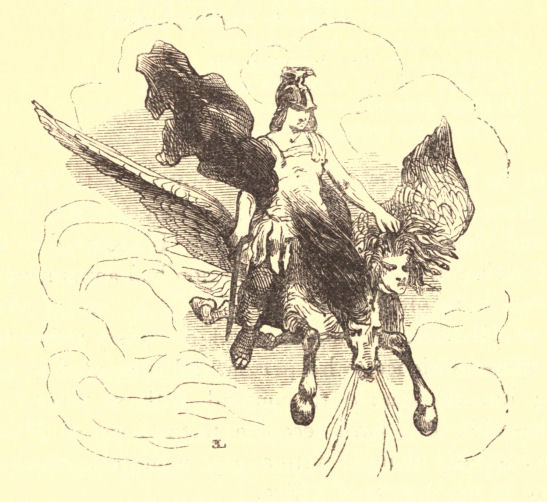
As Perseus pursued his journey, after inflicting this just punishment upon his foe, across the territories of Lybia, he discovered on the coast of Ethiopia, the beautiful Andromeda, exposed to the fury of a sea-monster, which for some time had ravaged the country, and to appease which, the oracle of Jupiter Ammon had declared, nothing could avail, excepting the exposure of the maiden to its anger. At this moment, when the monster was going to destroy her, Perseus saw, and was captivated with her beauty.
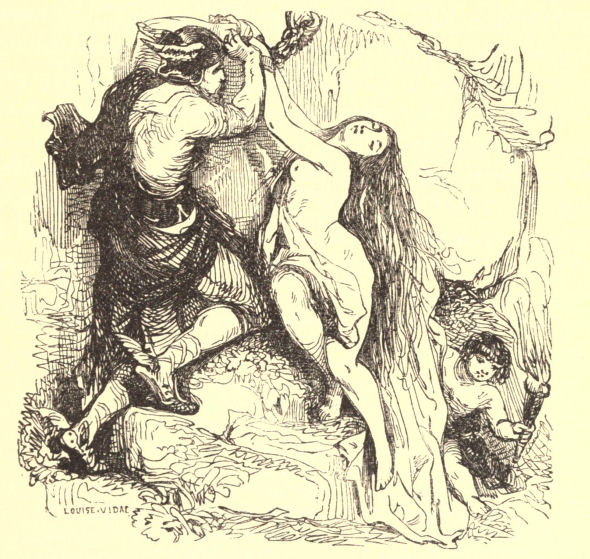
He offered Cepheus, her father, his aid in delivering her from danger, provided he would give the maiden to him in marriage, as a reward for his exertions.
"Chained to a rock she stood; young Perseus stayed His rapid flight, to view the beauteous maid. So sweet her form, so exquisitely fine, She seemed a statue by a hand divine, Had not the wind her waving tresses shewed And down her cheeks the melting sorrows flowed. Her faultless form the hero's bosom fires, The more he looks, the more he still admires. Th' admirer almost had forgot to fly, And swift descended, fluttering, from on high." Ovid.
This princess had been promised in marriage to Phineus, her uncle, when Neptune sent a sea-monster to ravage the country, because Cassiope, her mother, had boasted herself fairer than Juno and the Nereides.
"In me the son of thundering Jove behold, Got in a kindly shower of fruitful gold, Medusa's snaky head is now my prey, And through the clouds I boldly wing my way. If such desert be worthy of esteem, And, if your daughter I from death redeem. Shall she be mine? Shall it not then be thought, A bride, so lovely, was too cheaply bought? For her, my arms, I willingly employ, If I may beauties, which I save, enjoy." Ovid.
Cepheus consented to bestow his daughter upon Perseus, and immediately the hero raised himself in the air, flew towards the monster, as it advanced to devour Andromeda, and plunging his dagger in his right shoulder, destroyed it. This happy event was attended with great rejoicings, and the nuptials of Andromeda with Perseus, soon followed.
The universal joy, was, however, quickly interrupted: for Phineus, dissatisfied with thus losing his promised bride, entered the palace with a number of armed men, and attempted to carry her off. In vain did the father and mother of Andromeda interfere.
"Chief in the riot, Phineus first appeared, The rash ringleader of this boisterous herd, And brandishing his brazen pointed lance, 'Behold,' he said, 'an injured man advance,' Stung with resentment for his ravished wife, Nor shall thy wings O Perseus, save thy life; Nor Jove himself, tho' we've been often told He got thee in the form of tempting gold. His lance was aimed, when Cepheus ran and said; 'Hold, brother, hold, what brutal rage has made Your frantic mind so black a crime conceive? Are these the thanks that you to Perseus give? This the reward that to his worth you pay, Whose timely valour saved Andromeda? Nor was it he, if you would reason right, That forced her from you, but the jealous spite Of envious Nereids, and Jove's high degree, And that devouring monster of the sea, That, ready with his jaws wide gaping stood, To eat my child, the fairest of my blood. You lost her then when she seemed past relief, And wish'd, perhaps, her death, to ease your grief With my afflictions; not content to view Andromeda in chains, unhelped by you, Her spouse and uncle, will you grieve that he Exposed his life, the dying maid to free? And shall you claim his merit? Had you thought Her charms so great, you should have bravely sought, That blessing on the rocks where fixed she lay; But now let Perseus bear his prize away. By service gained, by promised faith possessed; To him I owe it, that my age is blest Still with a child: nor think that I prefer Perseus to thee, but to the loss of her." Ovid.
A fierce contest ensued, and Perseus must have fallen a victim to the fury of Phineus, had he not employed the same arms which had proved so successful against Atlas.
"Fierce Phineus now repents the wrongful fight, And views his varied friends, a dreadful sight; He knows their faces, for their help he sues, And thinks, not hearing him, that they refuse, By name lie begs their succour, one by one, Then doubts their life, and feels the friendly stone. Struck with remorse, and conscious of his pride, Convict of sin he turn'd his eyes aside; With suppliant mien to Perseus thus he prays, 'Hence with the head, as far as winds and seas Can bear thee: Hence; oh! quit the Cephan shore And never curse it with Medusa more; That horrid head which stiffens into stone, Those impious men who daring death, look on: I warred not with thee out of hate or strife, My honest cause was to defend my wife, First pledged to me; what crime could I suppose To arm my friends, and vindicate my spouse? 'Twas thine to conquer by Minerva's power, Favoured of heaven, thy mercy I implore, For life I sue, the rest to thee I yield: In pity from my sight remove the shield!' Phineus turned to shun the shield, Full in his face the staring head he held, As here and there he strove to turn aside, The wonder wrought, the man was petrified, All marble was his frame, his burned eyes, Dropped tears which hung upon the stone like ice; In suppliant posture, with uplifted hands And fearful look, the guilty statue stands." Ovid.
He but showed the head of the Gorgon to his adversaries, and they turned to stone in the very attitudes they were when they first beheld it. The friends of Cepheus, however, and those who assisted Perseus, were saved from the same fate by a previous warning of Perseus.
Soon after this memorable adventure, Perseus went to Seriphos, and arrived there at the very moment that his mother Danae sought the altar of Minerva, to save herself from the violence of Polydectes; Dictys, who had preserved her and Perseus from the sea, had attempted to defend her from her enemy, and Perseus therefore sensible of his merit and of his humanity, placed him on the throne of Seriphos, after he had employed Medusa's head to turn the wicked Polydectes into stone, with those of his court who were accomplices in his guilt.
When these celebrated exploits were finished, Perseus felt a desire to return to his native country, and arrived with his mother and Andromeda on the Peloponnesian coast, as some funeral games were being celebrated in honour of the deceased King of Larissa. Here he sought to signalise himself in throwing the quoit, but in this he was attended by an evil fate, and had the misfortune to kill a man with a quoit which he had thrown in the air: this proved to be Acresius, who thus met the fate the oracle had decreed, and to avoid which, he had been guilty of the barbarous act of throwing his daughter and her son into the sea.
This unfortunate murder preyed upon the spirit of Perseus, and though by the death of Acresius he was entitled to the throne of Argos, he refused to accept it, fearing it would constantly remind him of the parricide he had committed; and exchanged his kingdom for the maritime coast of Argolis.
The time of the death of Perseus is unknown, it is universally agreed however, that he received divine honours like the rest of the ancient heroes.
H E R O E S.
Heroes are mortals, who, by their glorious achievements, have excited the admiration of their kind, and received the respect due to those immortal spirits, who have distinguished themselves in the service of their country.
Homer represents a hero as a prince of the ancient time, loved and protected by the Gods: while in Hesiod, they are the early order of beings who preceded the frail human race.
T H E S E U S.
"Aye, this is he, A proud and mighty spirit: how fine his form, Gigantic! moulded like the race that strove To take Jove's heaven by storm, and scare him from Olympus. There he sits, a demi-god, Stern as when he of yore forsook the maid Who, doating saved him from the Cretan toil, Where he had slain the Minotaur. Alas! Fond Ariadne, thee did he desert, And heartless left thee on the Naiad's shore To languish. This is he who dared to roam The world infernal, and on Pluto's queen, Ceres' own lost Prosperina, did lay His hand: thence was he prisoned in the vaults Beneath, 'till freed by Hercules. Methinks (So perfect is the Phidian stone) his sire, The sea god Neptune, hath in anger stopped The current of life, and with his trident touch Hath struck him into marble." Barry Cornwall.