M Y T H O L O G Y : (continued 3)
Reading edition
Mars was the presider over gladiators, and was the god of all exercises, which have in them a manly or spirited character.
N E P T U N E ,
———
————"The God whose potent hand Shakes the tumultuous sea, and solid land: The Ocean Lord, o'er Helicon who reigns, O'er spacious Ægæ's wide extended plains; To whom the gods, with equal skill concede, To guide the bark and tame the fiery steed," Horace.
was the son of Saturn, and brother to Jupiter, Pluto, and Juno; being restored to life by the draught administered to Saturn, the portion of the kingdom allotted to him was that of the sea. This, however, did not seem equivalent to the empire of heaven and earth, which Jupiter had claimed; he therefore conspired with the other gods to dethrone his brother. The conspiracy was discovered, and Jupiter condemned Neptune to assist in building the walls of Troy, and to be subservient to his sceptre for a year. When the work was completed, Laomedon refused to reward the labours of the god, and in retribution, his territories were soon afterwards laid waste by the god of the sea, and his subjects visited with a pestilence sent by Apollo.
Besides the dispute this deity had with Minerva, related in her history, he claimed the isthmus of Corinth from Apollo; and Briareus, the Cyclops, who was mutually chosen umpire, gave the isthmus to Neptune, and the promontory to Apollo.
Neptune, as god of the sea, was entitled to more power than any of the other deities, except Jupiter. Not only the oceans, rivers, and fountains, were subjected to him, but he could also cause earthquakes at pleasure, and raise islands from the sea by a blow of his trident.
————————"King of the stormy sea! Brother of Jove, and co-inheritor Of elements Eternally before Thee, the waves awful bow. Fast, stubborn rock; At thy feared trident, shrinking, doth unlock Its deep foundations, hissing into foam. All mountain-rivers, lost, in the wide home Of thy capacious bosom, ever flow. Thou frownest, and old Æolus, thy foe, Skulks to his cavern, mid the gruff complaint Of all his rebel tempests. Dark clouds faint When, from thy diadem, a silver gleam Slants over blue dominion. Thy bright team Gulfs in the morning light, and scuds along To bring thee nearer to that golden song Apollo singeth, while his chariot Waits at the door of heaven. Thou art not For scenes like this; an empire stern hast thou; And it hath furrowed that large front: yet now, As newly come of heaven, dost thou sit, To blend and inter-knit Subdued majesty with this glad time. O shell born king sublime! We lay our hearts before thee evermore— We sing and we adore!" Keats.
He obtained Amphitrite, daughter of Ocean, in marriage, through the skill of a dolphin, although she had made to herself a vow of perpetual celibacy; and had by him, Triton, one of the sea deities. To the story of Neptune, may be attached the beautiful fable of Arion, the illustrious rival of Amphion and Orpheus.
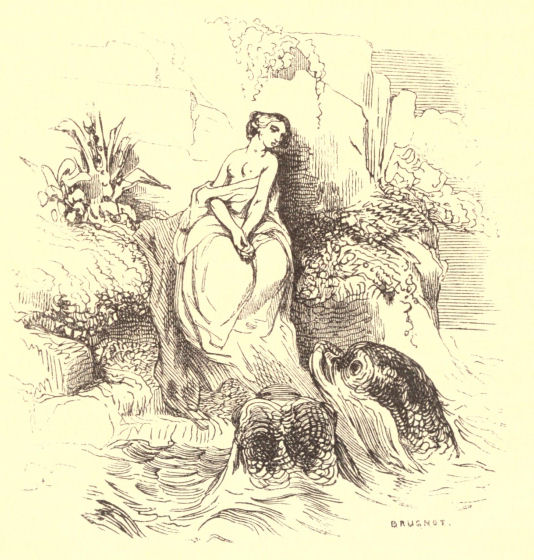
This famous lyric poet and musician, having gone into Italy, with Periander, tyrant of Corinth, he obtained immense treasures through his profession. On his return to his native country with his riches, the sailors of the vessel in which he had embarked, resolved to murder him, that they might obtain possession of his wealth; when the poet discovered their intention, he endeavoured to outwit them.
"Allow me," said Arion, with all the earnestness of an enthusiast. "Ere I leave this world, oh! allow me to touch once more, and for the last time, the strings of the lyre which has so often cheered me: let the last moments of my life, be soothed by its gentle influence."
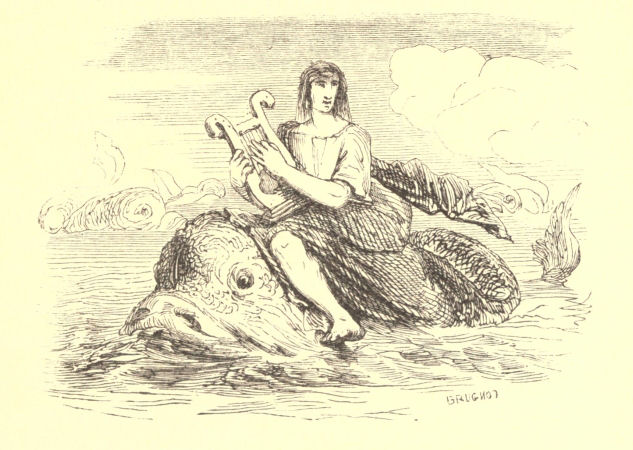
The boon was granted, and the divine strains of the master, issued in solemn beauty over the deep. At the sound, the traitors were struck silent, and hesitated in their course, but they had gone too far: it was too late to recede, and the poet was thrown into the deep. When lo! the dolphins, attracted by the sweet tones which they had heard, gathered round him; and Arion, mounted on the back of one, and accompanied by the remainder arrived safely at the end of his voyage. It is added, as an instance of the ingratitude of mortals, that the dolphin, having proceeded too far upon the sand, was unable to get back to the water, and the ungrateful Arion allowed his liberator to perish.
The worship of Neptune was established in almost every part of the earth, and the Libyans in particular, venerated him above all other Gods.
———"Great Neptune! I would be Advanced to the freedom of the main, And stand before your vast creation's plain, And roam your watery kingdom thro' and thro' And see your branching woods and palace blue, Spar-built and domed with crystal: aye and view The bedded wonders of the lonely deep; And see on coral banks, the sea-maids sleep, Children of ancient Nereus, and behold Their streaming dance about their father old, Beneath the blue Egean; where he sate, Wedded to prophecy, and full of fate! Or rather, as Arion harped, indeed, Would I go floating on my billow-steed, Over the billows, and triumphing there, Call the white syren from her cave to share My joy, and kiss her willing forehead fair." Keats.
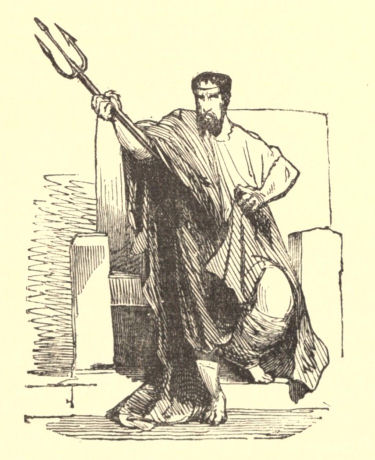
To him was consecrated the horse, and in his honour were celebrated the Isthmian games. His throne was a chariot drawn by four fiery steeds; his stature is grand, and his appearance imposing; he wears the look of an old man, his long beard and hair, wet with the vapour of the water.
In his hand he holds the trident, which bids the waves of ocean to rise, and causes the thunder of its tempests. With this trident also, he shakes the world, and bids the earth to tremble.
During the Consualia of the Romans, horses were led through the streets, finely equipped, and crowned with garlands, as the God in whose honour the festivals were instituted, had produced the horse, an animal so beneficial for the use of mankind.
As monarch of the sea, he is supposed to have had possession of the deep, and all the treasures which the stormy winds sent to his domain.
"What hid'st thou in thy treasure-caves and cells? Thou hollow-sounding, and mysterious main! Pale glistening pearls, and rainbow-coloured shells, Bright things which gleam unrecked of, and in vain; Keep, keep thy riches, melancholy sea. We ask not such from thee! "Yet more, the depths have more! what wealth untold, Far down, and shining thro' their stillness lies; Thou hast the starry gems, the burning gold, Won from ten thousand royal argosies; Sweep o'er thy spoils, thou wild and wrathful main; Earth claims not these again! "Yet more, the depths have more! thy waves have rolled, Above the cities of a world gone by! Sand hath filled up the palaces of old, Sea-weed o'er-grown the halls of revelry. Dash o'er them, ocean! in thy scornful play! Man yields them to decay Yet more! the billows and the depths have more! High hearts and brave are gathered to thy breast! They hear not now the booming waters roar, The battle thunders will not break their rest; Keep thy red gold and gems, thou stormy grave, Give back the true and brave! "Give back the lost and lovely! those for whom The place was kept at board and hearth so long; The prayer went up thro' midnight's breathless gloom, And the vain yearning woke midst festal song! Hold fast thy buried isles, thy towers o'erthrown, But all is not thine own! "To thee the love of woman hath gone down, Dark flow thy tides o'er manhood's noble head, O'er youth's bright locks, and beauty's flowery crown, Yet must thou hear a voice—restore the dead! Earth shall reclaim her precious things from thee! Restore the dead thou sea!" Hemans.
P L U T O.
———
The name of Pluto, as god of the kingdom of hell, and whatever is under the earth, where
"——————Cerberus, the cruel worm of death, Keeps watchful guard, and with his iron throat, Affrights the spirits in their pale sojourn," Thurlow.
is as well known to the readers of Mythology as that of his brother Jupiter.
The place of his residence being gloomy, and consequently unbearable to those goddesses whose hand he sought in marriage, and who looked for a gayer life than he could offer them, they all refused to become the sharer of his possessions. Pluto, however, was by no means willing to sit quietly down in single blessedness, thinking, perhaps, that the very reason which they assigned for their refusal, was an additional one in his favour for wishing a soother of his lot.
It was in his visit to the island of Sicily, that the God saw and became enamoured of Proserpine, as she gathered flowers in the plains of Enna.
———"He comes to us From the depths of Tartarus. For what of evil doth he roam From his red and gloomy home. In the centre of the world Where the sinful dead are hurled? Mark him as he moves along, Drawn by horses black and strong. Such as may belong to night, Ere she takes her morning flight, Now the chariot stops: the God On our grassy world hath trod, Like a Titan steppeth he, Yet full of his divinity. On his mighty shoulders lie Raven locks, and in his eye A cruel beauty, such as none Of us may wisely look upon." Barry Cornwall.
In vain she called upon her attendants for help, the God bore her off to his dominions, and she became his bride.
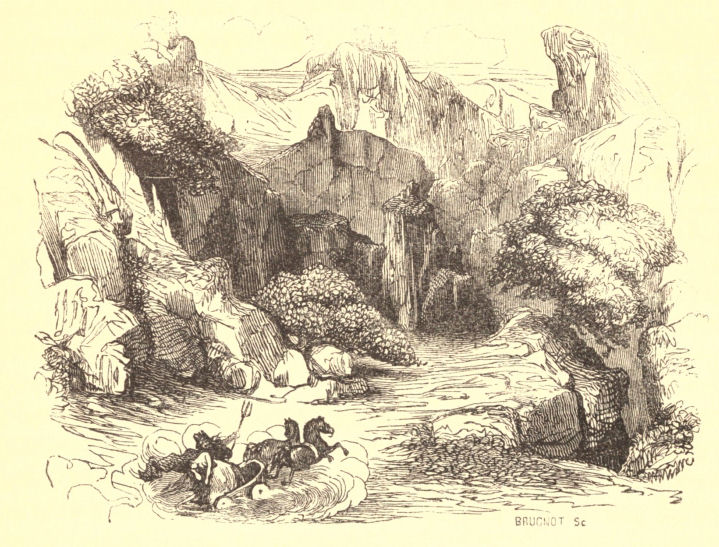
"So in Sicilia's ever blooming shade, The playful Proserpine from Ceres strayed. Led with unwary step her virgin trains O'er Etna's steeps, and Enna's golden plains; Plucked with fair hand the silver blossomed bower, And purpled mead,—herself a fairer flower; Sudden, unseen amid the twilight glade, Rushed gloomy Dis, and seized the trembling maid. Her startling damsels sprung from mossy seats, Dropped from their gauzy laps the gathered sweets, Clung round the struggling nymph, with piercing cries Pursued the chariot, and invoked the skies;— Pleased as he grasps her in his iron arms, Frights with soft sighs, with tender words alarms; The wheels descending, rolled in smoky rings, Infernal Cupids flapped their demon wings; Earth with deep yawn received the fair amazed, And far in night, celestial beauty blazed." Darwin.
At the entrance of the place of torments was an enormous vestibule, tenanted by black Anxieties, Regrets, Groans, Remorse, pale Malady, Decay, Fright, Hunger, Poverty, Death, Sleep, fierce Joy, Rage, and the Eumenides, or Furies, who were seated on a couch of iron, and crowned with blood-stained serpents. A deep and dark cavern led towards Tartarus, which was surrounded by the river Acheron; Charon conducted over this water the souls of those sent to him by Death, while any to whom the rites of sepulchre had not been granted, were for a hundred years allowed to solicit their passage in vain. If any living person presented himself to cross the lake, he could not be admitted before he showed Charon a golden bough; and Charon was once imprisoned for a year, because he had ferried Hercules over without this passport.
Cerberus, a dog with three heads, watched at the entrance to Tartarus.
"A horrid dog and grim, couched on the floor, Guards, with malicious art, the sounding door; On each, who in the entrance first appears, He fawning wags his tail, and cocks his ears; If any strive to measure back the way, Their steps he watches, and devours his prey." Hesiod.
Surrounded by an outer wall of iron, this terrible place was enclosed within a wall of adamant.
Pluto is generally represented as holding a trident with three prongs, and has a key in his hand, to intimate that whoever enters can never return. He is considered as a hard-hearted and inexorable deity, with a grim and dismal countenance, for which reason, temples were not raised to his honour, as to the remainder of the gods; though the story of Orpheus shews that he could be occasionally less severe.
"When ill-fated Orpheus tuned to woe His potent lyre, and sought the realms below; Charmed into life unreal forms respired, And list'ning shades the dulcet note admired. Love led the sage through Death's tremendous porch, Cheered with his smile, and lighted with his torch; Hell's triple dog his playful jaws expands, Fawns round the god, and licks his baby hands; In wondering groups the shadowy nations throng, And sigh or simper, as he steps along; Sad swains, and nymphs forlorn, on Lethe's brink, Hug their past sorrows, and refuse to drink; Night's dazzled empress feels the golden flame Play round her breast, and melt her frozen frame; Charms with soft words, and sooths with amorous wiles, Her iron-hearted lord, and Pluto smiles. His trembling bride the bard triumphant led From the pale mansions of the astonished dead; Gave the fair phantom to admiring light, Ah! soon again to tread irrevocable night!" Darwin.
Black victims, and particularly the bull, were the only sacrifices which were offered to him, and their blood was not sprinkled on the altars, but permitted to run down into the earth to penetrate the realms of the God.
The Syracusans paid yearly homage to him near the fountain of Cyane, into which one of the attendant maidens of Proserpine had been metamorphosed, and where he had, according to the received traditions, disappeared with the goddess.
————"On the ground, She sinks without a single sound, And all her garments float around; Again, again she rises light, Her head is like a fountain bright, And her glossy ringlets fall With a murmur musical, O'er her shoulders, like a river That rushes and escapes for ever. Is the fair Cyane gone? Is this fountain left alone For a sad remembrance, where We may in after times repair, With heavy heart and weeping eye, To sing songs to her memory?" Barry Cornwall.
From the functions, and the place he inhabited, he received different names, and became the god of the infernal regions, of death, and of funerals.
That he might govern with order and regularity, the spirits who were inhabitants of his vast dominions, he committed part of his power to three judges of the infernal regions, of whom Minos and Rhadamanthus were the most important. He sate in the middle, holding a sceptre in his hand. The dead pleaded their different causes before him, and the impartial judge shakes the fatal urn which is filled with the destinies of mankind. Rhadamanthus was employed in compelling the dead to confess their crimes, and in punishing them for their offences.
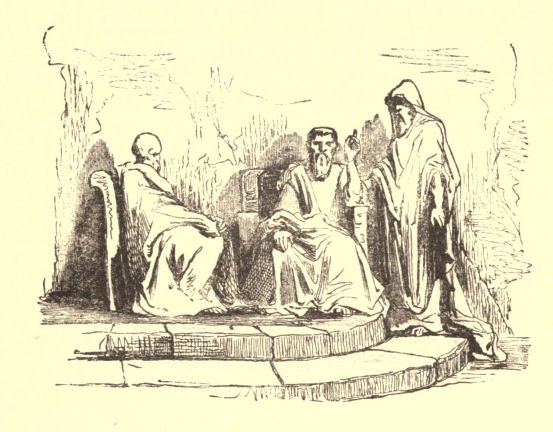
"Awful Rhadamanthus rules the state. He hears and judges each committed crime, Inquires into the manner, place, and time: The conscious wretch must all his acts reveal, Loth to confess, unable to conceal, From the first moment of his vital breath, To his last year of unrepenting death."
Amongst the most notorious criminals plunged in Tartarus, were the Titans; Sisyphus, a celebrated robber, condemned to roll an enormous stone to the summit of a high mountain, from which it fell again without ceasing, that he might be eternally employed in this punishment; Ixion who had dared to offer impure vows to Juno, and was affixed to a wheel which went constantly round, rendering his punishment also eternal; with Tantalus, condemned to a burning thirst, and surrounded by the grateful liquid which always vanished before his touch.
————"Tantalus condemned to hear The precious stream still purling in his ear; Lip-deep in what he longs for, and yet curst With prohibition and perpetual thirst." Cowper.
The Danaides, daughters of Danaus, king of Argos, were also there, who, in obedience to the cruel advice of their parent, had caused their husbands to perish; with Tityus, who having had the audacity to attempt the honour of Latona, was doomed to feel a vulture constantly gnawing his entrails.
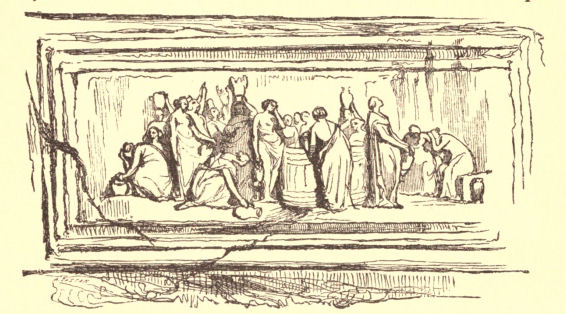
Ulysses sought the realm of Pluto, among his many adventures.
"When lo! appeared along the dusky coasts, Thin, airy shoals of visionary ghosts: Fair, pensive youths, and young enamoured maids; And withered elders, pale and wrinkled shades; Ghastly with wounds the forms of warriors slain, Stalked with majestic port, a martial train; These and a thousand more, swarmed o'er the ground, And all the dire assembly shrieked around. Astonished at the sight, aghast I stood, And a cold fear ran shivering through my blood."
While here he saw the ghosts of all those famed in story, who had descended to the infernal regions for punishment.
"High on a throne, tremendous to behold, Stern Minos waves a mace of burnished gold; Around, ten thousand, thousand spectres stand, Thro' the wide dome of Dis, a trembling band. Still as they plead, the fatal lot he rolls, Absolves the just, and dooms the guilty souls. There huge Orion, of portentous size, Swift thro' the gloom, a giant hunter flies; A ponderous mace of brass with direful sway Aloft he whirls to crush the savage prey! Stern beasts in trains that by his truncheon fell, Now grisly forms, shoot o'er the lawns of hell. There Tityus, large and long, in fetters bound, O'erspreads nine acres of infernal ground; Two ravenous vultures, furious for their food, Scream o'er the fiend, and riot in his blood, Incessant gore the liver in his breast, Th' immortal liver grows, and gives the immortal feast. There Tantalus along the Stygian bounds Pours out deep groans (with groans all hell resounds); Ev'n in the circling floods refreshment craves, And pines with thirst amidst a sea of waves; When to the water he his lip applies, Back from his lip the treacherous water flies, Above, beneath, around his hapless head, Trees of all kinds delicious fruitage spread; There figs sky-dy'd, a purple hue disclose, Green looks the olive, the pomegranate grows, There dangling pears exalting scents unfold, And yellow apples ripen into gold: The fruit he strives to seize, but blasts arise, Toss it on high, and whirl it to the skies. I turned my eye, and, as I turned, surveyed A mournful vision! the Sisyphian shade; With many a weary step, and many a groan, Up the high hill he heaves a huge round stone; The huge round stone, resulting with a bound, Thunders impetuous down and smokes along the ground, Again the restless orb his toil renews, Dust mounts in clouds, and sweat descends in dews."
M E R C U R Y.
———
Though according to Cicero, there were no less than five gods of this name; yet to the son of Jupiter and Maia, the actions of all the others have been probably attributed, as he is the most famous and the best known.
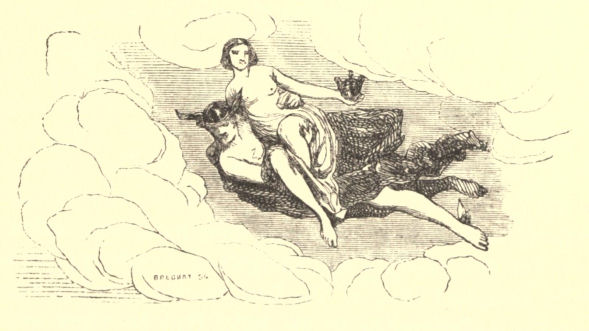
Mercury was the messenger of the gods and the patron of travellers and shepherds; he conducted the souls of the dead into the infernal regions, and not only presided over orators and merchants, but was also the god of thieves, pickpockets, and all dishonest persons.
————"A babe, all babes excelling, A schemer subtle beyond all belief, A shepherd of thin dreams, a cow stealing, A night watching and door waylaying thief." Shelley.
The day following his birth he offered an early proof of his dishonest propensities, by stealing away the oxen of Admetus which Apollo tended.
"The babe was born at the first peep of day, He began playing on the lyre at noon, And the same evening did he steal away Apollo's herds." Shelley.
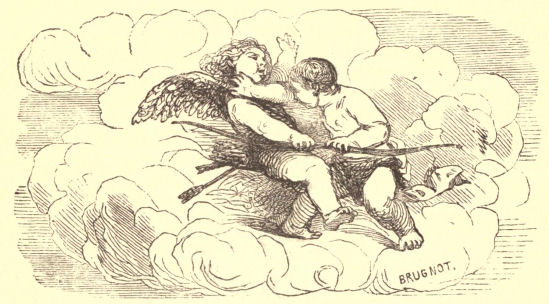
He gave another proof of this propensity, by throwing himself upon the timid Cupid, and wrestling from him his quivers; and increased his notoriety by robbing Venus of her girdle, Mars of his sword, Jupiter of his sceptre, and Vulcan of his mechanical instruments.
"Hermes with gods and men, even from that day Mingled and wrought the latter much annoy, And little profit, going far astray, Through the dun night." Shelley.
As the messenger of Jupiter, he was entrusted with all his secrets and permitted to make himself invisible whenever he pleased, or to assume any shape he chose.
The invention of the lyre and seven strings is ascribed to him, which he gave to Apollo, and received in exchange the celebrated caduceus, with which the God of poetry used to drive the flocks of King Admetus. This celebrated instrument was a rod entwined at one end by two serpents.
————————————"Come take The lyre—be mine the glory of giving it— Strike the sweet chords, and sing aloud and wake The joyous pleasure out of many a fit Of tranced sound—and with fleet fingers make Thy liquid voiced comrade talk with thee; It can talk measured music eloquently. Then bear it boldly to the revel loud, Love wakening dance, or feast of solemn state, A joy by night or day, for those endowed With art and wisdom, who interrogate! It teaches, bubbling in delightful mood All things which make the spirit most elate, Soothing the mind with sweet familiar play, Chasing the heavy shadows of dismay." Shelley.
"O Hermes, thou who couldst of yore Amphion's bosom warm, And breathe into his strains the power, The rugged rocks to charm; Breathe, breathe into my lyre's soft string, And bid its music sweet notes fling, For what O lyre, can thee withstand? Touched by an Orpheus' magic hand, Thou calm'st the tiger's wrath: The listening woods thou draw'st along, The rivers stay to hear thy song, And listen still as death. Tityos with pleasure heard thy strain, And Ixion smiled amid his pain." Horace.
Numerous were the modes of sacrifice to Mercury, and the places in which they were offered; among others, the Roman merchants yearly celebrated a festival in his honour. After the votaries had sprinkled themselves with water, they offered prayers to the divinity, and entreated him to be favourable to them, and to forgive any artful measures, perjuries, or falsehoods they had used in the pursuit of gain; and this may be considered to have been particularly necessary when it is remembered that the merchants, who had promised him all the incense in the world to obtain his protection, proved that they had profited by his principles, by offering him only a hundredth part, when they had secured his good offices.
Jupiter soon missed the services of his intelligent messenger, and recalled him to Olympus. Here, Mercury rendering some kindness to Venus, the goddess fell in love with him, and bore to him Hermaphrodite, a child which united the talents of his father with the graces of his mother; at the age of fifteen, he began to travel, and bathing one day in a fountain in Cana, excited the passion of Salmaeis, the nymph who presided over it.
"From both the illustrious authors of his race The child was named; nor was it hard to trace Both the bright parents through the infant's face. When fifteen years, in Ida's cool retreat, The boy had told, he left his native seat, And sought fresh fountains in a foreign soil: The pleasure lessened the attending toil. With eager steps the Lycian fields he crossed, And fields that border on the Lycian coast; A river here he viewed so lovely bright, It showed the bottom in a fairer light, Nor kept a sand concealed from human sight. The fruitful banks with cheerful verdure crowned, And kept the spring eternal on the ground. A nymph presides, nor practised in the chase, Nor skilful at the bow, nor at the race; Of all the blue-eyed daughters of the main, The only stranger to Diana's train; Her sisters often, as 'tis said, would cry 'Fye, Salmaeis, what always idle! fye; Or take the quiver, or the arrows seize And mix the toils of hunting with thy ease.' Nor quivers she, nor arrows e'er would seize, Nor mix the toils of hunting with her ease; But oft would bathe her in the crystal tide, Oft with a comb her dewy locks divide; Now in the limped streams she views her face, And dressed her image in the floating glass: On beds of leaves she now reposed her limbs, Now gathered flowers that grew about her streams, And there by chance was gathering as she stood To view the boy—" Ovid.
Hermaphroditus continued deaf to all entreaties and offers; and Salmaeis, throwing her arms around him, entreated the Gods to render her inseparable from him whom she adored. The Gods heard her prayer, and formed of the two, a being of perfect beauty, preserving the characteristics of both sexes.
Offerings were made to him of milk and honey, because he was the God of eloquence, whose powers were sweet and persuasive. Sometimes his statues represent him without arms, because the power of speech can prevail over everything.
The Greeks and Romans celebrated his festivals, principally in the month of May. They frequently placed on his back the statue of Minerva, and offered to him the tongues of the victims whom they immolated to the goddess.
"Who beareth the world on his shoulders so broad; Hear me, thou power, who, of yore, by thy words Couldst soften the hearts of the barbarous hordes, And by the Palæstia taught him of the wild To be gentle, and graceful, and meek as a child. Thou messenger fleet of the cloud-throned sire, 'Twas thou who inventedst the golden-stringed lyre; I hail thee the patron of craft and of guile, To laugh while you grieve, to deceive while you smile, When you chafed into wrath bright Apollo of old, His dun-coloured steers having stol'n from the fold, He laughed; for, while talking all fiercely he found That his quiver, alack! from his back was unbound. 'Twas thou, who old Priam didst guide on his way, When he passed unperceived thro' the hostile array, Of the proud sons of Atreus, who sought to destroy The towers of high Ilion, the city of Troy. O Hermes, 'tis thou who conductest the blest To the seats where their souls shall for ever exist, Who governest their shades by the power of thy spell, The favourite of Heaven, the favourite of Hell." Horace.
N E R E I D S
———
These divinities were children of Nereus and Dorus. As the Dryads and Hamadryads presided over forests—as the Naiads watched over fountains and the sources of rivers—as the Oreads were the peculiar guardians of the hills, so the Nereids guided and commanded the waves of the ocean, and were implored as its deities. They had altars chiefly on the coast of the sea, where the piety of mankind made offerings of milk, oil, and honey, and often of the flesh of goats. When they were on the sea shore, they generally resided in grottos and caves, adorned with shells.
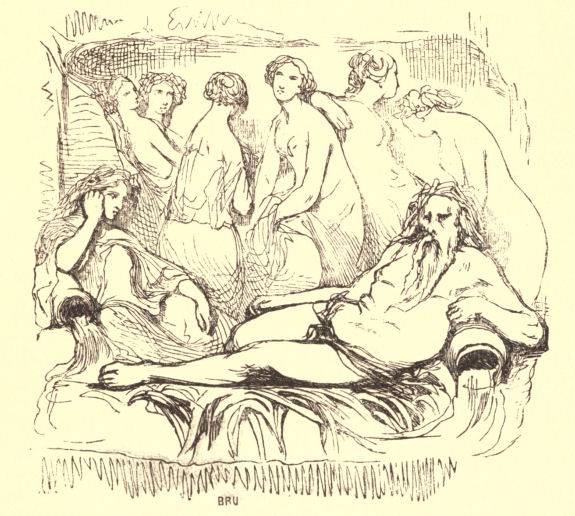
There were fifty of them, all children of Nereus, who is represented as an old man with a long flowing beard, and hair of an azure colour. The chief place of his residence was in the Egean Sea, where he was attended by his daughters, who often danced in chorus round him. He had the gift of prophecy, and informed those who consulted him, of the fate which awaited them, though such was the god's aversion to his task, that he often evaded the importunities of the inquirers, by assuming different shapes, and totally escaping from their grasp.
DIVINITIES OF THE SECOND CLASS.
———
The gods of the first order, were endowed by the writers of antiquity, with natures partly real, and partly imaginary. By their power, the government of the universe was carried on; but mortals in attributing to these gods their own passions and weaknesses, began to blend with them divinities of a secondary class, to preside over those less important affairs, which might be supposed unworthy the notice of the superior intelligences.
For the most part, therefore, these Immortals have no origin in history; but, as allusions are constantly made to them in the eloquent language of the orator, or in the beautiful metaphor of the poet, it is necessary to introduce those who are considered to be the most celebrated.
And for the future, the poetry offered will principally be that which relates rather to the attributes they were supposed to possess, than to the gods themselves. Thus, with such deities as Æolus and Mors, we shall introduce poems addressed to the Wind and Death, over which they presided, as suited to the modern character of our Mythology, and more generally appreciated by the readers of the nineteenth century.
D I V I N I T I E S O F T H E E A R T H.
P A N.
Pan was the god of shepherds, and of all inhabitants of the country; he was the son of Mercury by Driope, and is usually described as possessing two small horns on his head, his complexion ruddy, his nose flat, and his legs, thighs, tail and feet hairy, like those of a goat. When he was brought into the world, the nurse, terrified at sight of him, ran away in horror, and his father wrapping him up in the skins of beasts, carried him to Heaven, where Jupiter and the other Gods, entertained themselves with the oddity of his appearance; Bacchus was delighted with him, and gave him the name of Pan.
———————"Sprung the rude God to light; Of dreadful form, and horrible to sight; Goat-footed, horned, yet full of sport and joy, The nurse, astonished, fled the wondrous boy: His shaggy limbs, the trembling matron feared, His face distorted, and his rugged beard: But Hermes from her hands received the child, And on the infant god auspicious smiled. In the thick fur wrapped of a mountain hare, His arms the boy to steep Olympus bear; Proudly he shows him to imperial Jove, High seated 'mid the immortal powers above. With friendly joy and love, the race divine, But chiefly Bacchus, god of mirth and wine, Received the dauntless god, whom Pan they call, Pan, for his song delights the breast of all." Horace.
This god of the shepherds chiefly resided in Arcadia, where the woods and the mountains were his habitation.
——————"His mighty palace roof doth hang From jagged trunks, and overshadoweth Eternal whispers, glooms, the birth, life, death, Of unseen flowers in heavy peacefulness. Who loves to see the hamadryads dress Their ruffled locks, where meeting hazels darken, And through whole solemn hours, dost sit and harken The dreary melody of bedded reeds." Keats.
The flute was invented by Pan, and formed of seven reeds, which he called Syrinx, in honour of a beautiful nymph of the same name, who, refusing his addresses, was changed into a reed.
————————"A nymph of late there was, Whose heavenly form her fellows did surpass, The pride and joy of fair Arcadia's plains, Beloved by deities, adored by swains. Like Phœbe clad, e'en Phœbe's self she seems, So tall, so straight, such well proportioned limbs, The nicest eye did no distinction know But that the goddess bore a golden bow, Descending from Lycæus, Pan admires The matchless nymph, and burns with new desires. A crown of pine upon his head he wore, And then began her pity to implore. But ere he thus began, she took her flight, So swift she was already out of sight, Nor staid to hear the courtship of the god: But bent her course to Ladon's gentle flood: There by the river stopped, and tired before Relief from water-nymphs her prayers implore, Now while the rural god with speedy pace, Just thought to strain her in his strict embrace, He filled his arms with reeds, new rising in the place: And while he sighs his ill success to find, The tender canes were shaken by the wind, And breathed a mournful air unheard before, That much surprizing Pan, yet pleased him more, Admiring this new music, 'Thou' he said, 'Who cans't not be the partner of my bed, At least shall be the consort of my mind, And often, often to my lips be joined.' He formed the reeds, proportioned as they are, Unequal in their length and waxed with care, They still retain the name of his ungrateful fair." Ovid.
He was continually employed in deceiving the neighbouring nymphs, and often with success. Though deformed in shape and features, he had the good fortune to captivate Diana in the appearance of a beautiful white goat.
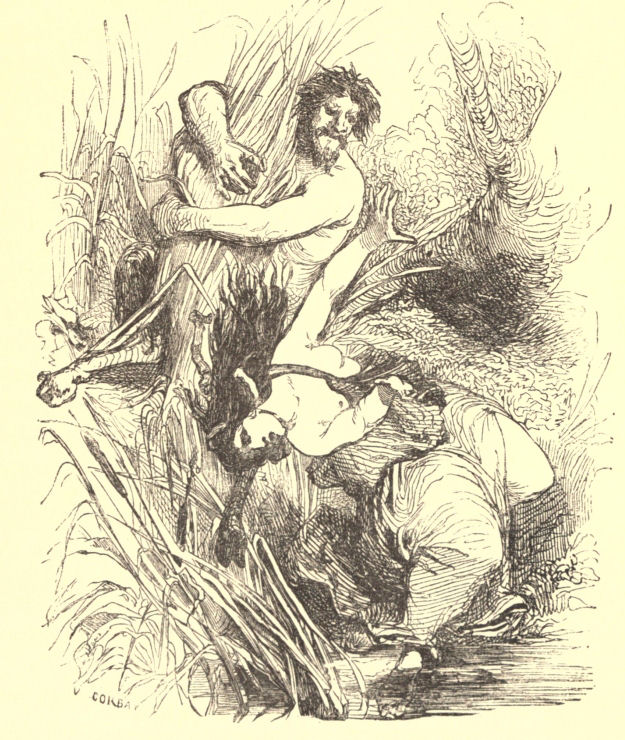
His adventure with Omphale is amusing; while the latter was travelling with Hercules, a sacrifice which was to take place on the following day, caused Omphale and the hero to seek separate apartments. In the night, Pan introduced himself, and went to the bed of the queen; but there seeing the lion's skin of Hercules, he fancied he had made a mistake, and repaired to that of the hero; where the female dress which the latter had adopted, deceived the rural God, and he laid himself down by his side. The hero awoke, and kicked the intruder into the middle of the room. The noise aroused Omphale, and Pan was discovered lying on the ground, greatly discomfited and ashamed.
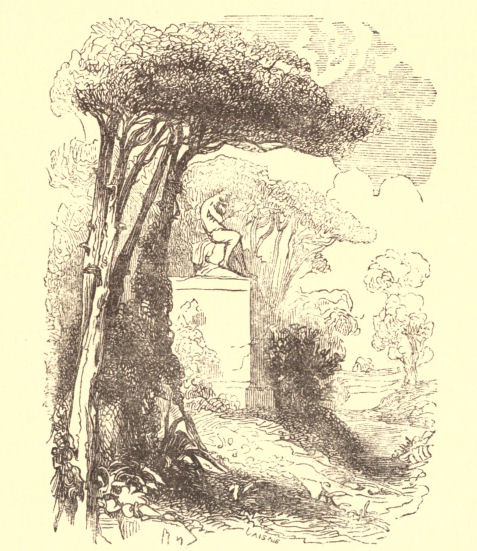
The worship of Pan was well established, particularly in Arcadia, and his statue was usually placed under the shadow of a pine-tree. Upon his altars were laid both honey and milk, fit offerings for a rural divinity.
"With cloven feet and horned front who roves With choirs of nymphs, amid the echoing groves; He joins in active dance the virgin throng, To Pan, the pastoral god, they raise the song. "To Pan, with tangled locks, whose footsteps tread Each snow-crowned hill, and mountain's lofty head; Or wander careless through the lowly brake, Or by the borders of the lucid lake." Horace.
He loved the nymph Echo, but in this instance was unsuccessful in his passion, for the latter adored the beautiful Narcissus, and wandered over hill and dale in search of the youth on whom she had lavished all her affections, but who unfortunately returned them not.
To whom is not the tale of the self-slain Narcissus known, though perhaps the exquisite story of Echo's love for him may be less familiar to the mind.
After Echo had been dismissed by Jupiter, for her loquacity in proclaiming his numerous amours, she fell in love with the beautiful Narcissus.
"And at the sight of the fair youth she glows, And follows silently where'er he goes."
Unable, however, to address him first, she waited the sound of his beloved voice.
"Now several ways his young companions gone, And for some time Narcissus left alone, 'Where are you all?' at last she hears him call, And she straight answers him, 'where are you all?' "'Speak yet again,' he cries, 'is any nigh?' Again the mournful Echo answers, 'I,' 'Why come not you,' he said, 'appear in view,' She hastily returns, 'why come not you?' "'Then let us join,' at last Narcissus said, 'Then let us join,' replied the ravished maid."
In vain had the wondering youth up to this moment looked for the frolic companions, whom he imagined had hid themselves in play. But Echo, charmed with his last exclamation, hastily appeared, and threw herself on the bosom of the astonished youth, who, far from submitting with pleasure to the intrusion,
"With all his strength unlocks her fold, And breaks unkindly from her feeble hold; Then proudly cries, 'life shall this breast forsake, Ere you, loose nymph, on me your pleasure take;' 'On me your pleasure take,' the nymph replies While from her the disdainful hunter flies."
As the youth wandered on, anxious only to escape from the society of Echo, he suddenly came upon a fountain, in which, as he reclined on the ground, he fancied he saw the figure of a beautiful nymph.
"Deep through the spring, his eye-balls dart their beams, Like midnight stars that twinkle in the streams, His ivory neck the crystal mirror shows, His waving hair, above the surface flows, His own perfections all his passions moved, He loves himself, who for himself was loved."
Half maddened by the appearance of a beauty, of which hitherto he had been unconscious, he made every possible effort to grasp what appeared to be the guardian spirit of the water.
"Oft with his down-thrust arms he thought to fold, About that neck that still deludes his hold, He gets no kisses from those cozening lips, His arms grasp nothing, from himself he slips; He knows not what he views, and yet pursues His desperate love, and burns for what he views."
Nothing could win the self-enamoured boy from his devoted passion; but bending over the lucid spring, he fed his eyes with the delusive shade which seemed to gaze on him from the depths. At last
"Streaming tears from his full eye-lids fell, And drop by drop, raised circles in the well, The several rings larger and larger spread, And by degrees dispersed the fleeting shade."
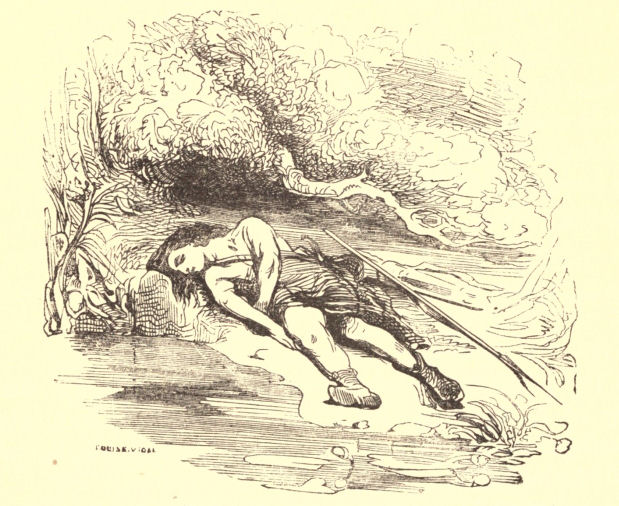
Narcissus fancied that the nymph upon whom he supposed he had been gazing, was deserting him, and unable to bear the misery which the thought occasioned, he wounded himself in his agony, deeming that life without her would be insupportable. Echo, however resentful she had felt for the scorn with which he had treated her, hovered near his footsteps and witnessed this last infatuation with redoubled sorrow.
"Now hanging o'er the spring his drooping head, With a sad sigh these dying words he said, 'Ah! boy beloved in vain,' thro' all the plain Echo resounds, 'Ah! boy beloved in vain!' 'Farewell,' he cries, and with that word he died, 'Farewell,' the miserable nymph replied. Now pale and breathless on the grass he lies, For death had shut his miserable eyes."
The Gods, however, taking pity upon his melancholy fate, changed him into the flower Narcissus.
Many morals have been attempted to be deduced from this beautiful fable, but in none of them have their authors been very successful, unless we may gather a warning of the fatal effects of self-love.
"What first inspired a bard of old to sing Narcissus pining o'er the mountain spring? In some delicious ramble, he had found A little space, with boughs all woven round, And in the midst of all a clearer pool Than ere reflected in its pleasant cool The blue sky, here and there divinely peeping Through tendril wreaths, fantastically creeping; And on the bank a lonely flower he spied, A meek and forlorn flower with nought of pride, Drooping its beauty o'er the watery clearness To woo its own sweet image unto nearness; Deaf to light Zephyrus, it would not move, But still would seem to droop, to pine, to love; So while the poet stood in this sweet spot; Some fainted dreamings o'er his fancy shot; Nor was it long ere he had told the tale Of young Narcissus, and sad Echo's vale." Keats.
Poor Pan, undeterred by the zealous passion of Echo for Narcissus, still continued to love her, and pleased himself by wandering in the woods and deserts, there calling upon her, for the pleasure of hearing her voice in reply.
"In thy cavern-hall, Echo! art thou sleeping? By the fountain's fall Dreamy silence keeping? Yet one soft note borne From the shepherd's horn, Wakes thee, Echo! into music leaping, Strange sweet Echo! into music leaping. "Then the woods rejoice, Then glad sounds are swelling, From each sister voice Round thy rocky dwelling; And their sweetness fills All the hollow hills, With a thousand notes of one life telling! Softly mingled notes, of one life telling. "Echo! in my heart Thus deep thoughts are lying, Silent and apart, Buried, yet undying, Till some gentle tone Wakening haply one, Calls a thousand forth, like thee replying! Strange sweet Echo, even like thee replying." Hemans.
This god, so adored and loved in the country, had the power of spreading terror and confusion when he pleased. The Gauls, who under Brennus, invaded Greece, when on the point of pillaging the Temple at Delphi, were seized with a sudden panic and took to flight. This terror was attributed to Pan, and they believed all panics, the cause of which was unknown, were produced by him.
It was by the counsel of Pan, that the Gods at the moment of the assault of Typhon, took the figures of various animals, changing himself into a goat, the skin of which was transported to Heaven, and formed the sign of Capricorn.
"From the forests and highlands, We come, we come! From the river-girt islands, Where the loud waves are dumb, Listening to my sweet pipings. The wind in the reeds and the rushes, The bees in the bells of the lime, The birds in the myrtle bushes, The cicale above in the thyme, And the lizard below in the grass, Were as silent as ever old Tmolus was, Listening to my sweet pipings. Liquid Peneus was flowing, And all dark Tempe lay In Pelion's shadow, outgrowing The light of the dying day, Speeded by my sweet pipings. The Sileni, and Sylvans, and Fauns, And the nymphs of woods, and waves, To the edge of the moist river lawns, And the brink of the dewy caves, And all that did there attendant follow, Were silent with love, as you now, Apollo, With envy of my sweet pipings. "I sang of the dancing stars, I sang of the dædal earth, And of heaven, and giant wars, And love, and death, and birth,— And then I changed my pipings. Singing how down the vale of Menalus, I pursued a maiden and clasped a reed; Gods and men were all deluded thus, It breaks in our bosom and then we bleed: All wept, as I think both ye now would, If envy or age had not frozen your blood, At the sorrow of my sweet pipings."
FAUNS, SYLVANS, AND SATYRS.
The Fauns were descended from Faunus, son of Picus King of Italy, who was changed by Circe into a woodpecker.
"Faunus who lov'st, thro' woodland glade, To pursue the Sylvan maid, Pass propitious now, I pray, Where my tender lambkins stray: Let each field and mountain high, Own thy genial presence nigh. Since with each returning year, In thy presence, I appear, With the victim's votive blood, Mighty monarch of the wood, And upon thy sacred shrine, Place the love inspiring wine, And, o'er all that hallowed ground, Make the incense breathe around, Hear O Faunus, hear my prayer, My lands to bless, my flocks to spare. When December's nones return Labour's yoke no more is borne, Sport the cattle in the meads, The blythesome dance the peasant leads, Even, 'mid that time of peace, Beasts of prey their fury cease, The lambkin roams all free and bold, Tho' feeds the wolf beside the fold, Knowing well thy potent arm Then protects from every harm. Lo, to hail the Sylvan king, Woods their leafy honours bring, Strewing in profusion gay, Verdant foliage all the way. Freed from toil, the labourer blythe Flings aside the spade and scythe, Glad to trip in nimble jig, The earth which he dislikes to dig." Horace.
They were the divinities of the woods and fields, and were represented as having the legs, feet, and ears of goats; the remainder of the body being human; the lamb and kid were offered to them by the peasants with great solemnity.
The Sylvans were the children of the foster father of God Bacchus, who accompanied the latter in all his travels. Bacchus having been well received and entertained at the court of Midas, King of Phrygia, he obtained from him the choice of whatever recompense he should name. Midas demanded the power of turning all that he touched into gold.
"'Give me,' says he, (nor thought he asked too much,) 'That with my body whatsoe'er I touch, Changed from the nature which it held of old, May be converted into yellow gold:' He had his wish: but yet the god repined, To think the fool no better wish could find. But the brave king departed from the place, With smiles of gladness, sparkling in his face: Nor could contain, but, as he took his way, Impatient longs to make the first essay; Down from a lowly branch a twig he drew, The twig strait glittered with a sparkling hue: He takes a stone, the stone was turned to gold, A clod he touches, and the crumbling mould Acknowledged soon the great transforming power, In weight and substance like a mass of ore. He plucked the corn, and straight his grasp appears, Filled with a bending tuft of golden ears. An apple next he takes, and seems to hold The bright, Hesperian, vegetable gold. His hand he careless on a pillar lays, With shining gold, the fluted pillars blaze. And while he wishes, as the servants pour, His touch converts the stream to Danae's shower." Ovid.
He was quickly brought however to repent his avarice, when the very meat which he attempted to eat, turned to gold in his mouth, and the wine to the same metal, as it passed down his throat. He was now as anxious to be delivered from this fatal gift, as he was before to receive it, and implored the god to revoke a present so fatal to the recipient.
"The ready slaves prepare a sumptuous board, Spread with rich dainties for their happy lord, Whose powerful hands the bread no sooner hold, But its whole substance is transformed to gold: Up to his mouth he lifts the savoury meat, Which turns to gold as he attempts to eat: His patron's noble juice, of purple hue, Touched by his lips a gilded cordial grew: Unfit for drink, and wondrous to behold, It trickles from his jaws a fluid gold. The rich, poor fool confounded with surprize, Staring on all his various plenty lies: Sick of his wish, he now detests the power For which he asked so earnestly before: Amidst his gold with pinching famine curst, And justly tortured with an equal thirst. At last his shining arms to heaven he rears And, in distress, for refuge flies to prayers. 'O father Bacchus, I have sinned,' he cried, 'And foolishly thy gracious gift applied, Thy pity now, repenting, I implore; Oh! may I feel the golden plague no more!'" Ovid.
He was told to wash himself in the river Pactolus; he performed the necessary ablution, and the very sands were turned into gold by the touch of Midas. Divine honours were given to Silenus in Arcadia, and from him the Fauns and Satyrs are often called Sileni.
The Satyrs, also gods of the Country, were considered as mischievous, and inspired by their appearance, great fright in the shepherds—although they bore with them a flute or tambourine, to make the nymphs dance, when they inflamed their senses by the burning nature of their harmony, and the rapid measure with which they trod to the music of these demi-gods.
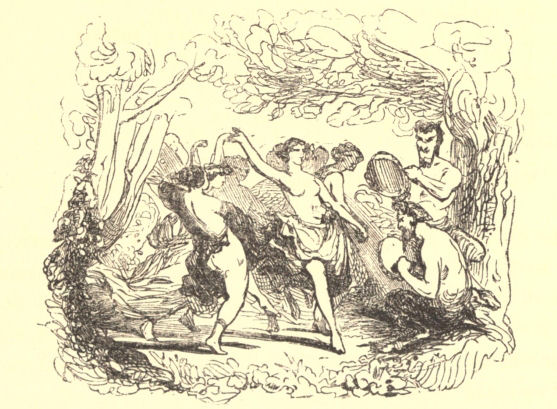
To them were offered the first fruits of everything, and they attended chiefly upon Bacchus, rendering themselves conspicuous in his orgies, by their riot and lasciviousness. It is said, that a Satyr was brought to Sylla, as that general returned from Thessaly; the monster had been surprised asleep in a cave; his voice was inarticulate, when brought into the presence of the Roman general, and Sylla was so disgusted with the sight, that he ordered it instantly to be removed. The creature is said to have answered the description which poets and painters have given of the Satyrs.
Priapus was the most celebrated among them, as the the son of Venus, who meeting Bacchus on his return from his Indian expedition, was enamoured of him, and with the assistance of Juno, became the mother of Priapus. Juno having vowed vengeance against the goddess of beauty, took that opportunity to deform her son in all his limbs; notwithstanding which, as he grew up, his inclinations and habits became so vicious, that he was known as the god of lewdness. His festivals took place principally at Lampsacus, where they consecrated the ass to him; and the people naturally indolent, gave themselves up to every impurity during the celebration. When however his worship was introduced into Rome, he became more the God of Orchards and Gardens, than the patron of licentiousness. He was there crowned with the leaves of the vine, and sometimes with laurel or rocket, the last of these plants, which is said to raise the passions and excite love, being sacred to him.
The Sylvans, were, like the Fauns and Satyrs, the guardian deities of the woods and wild places of the earth.
Terminus was a somewhat curious divinity, presiding over bounds and limits, and punishing all usurpation. His worship was first introduced by Numa Pompilius, who persuaded his subjects that the limits of their lands and states, were under the immediate inspection of heaven. His temple was on the Tarpeian rock, and he was represented with a human head, though without feet or arms, to intimate that he never moved, wherever he might be placed.
The people of the country assembled once a year with their families, and crowned with garlands and flowers, the stones which divided their different possessions. It is said that when Tarquin the proud, wished to build a temple on the Tarpeian rock to Jupiter, the God Terminus refused to give place, though the other gods resigned theirs with cheerfulness, and the oracles declared from this, that the extent of the Empire should never be lessened.
H E B E
was the daughter of Jupiter and Juno; though by many she is said to be the daughter of Juno only, who conceived her after eating lettuces.
Being fair, and always possessed of the bloom of beauty and youth, she was termed the Goddess of youth, and made by her mother the cup-bearer to all the Gods.
She was dismissed from her office by Jupiter, however, because she fell down as she was pouring nectar to the Gods, at a grand festival, and Ganymedes, a favourite of Jupiter, succeeded to her office.
"'Twas on a day When the immortals at their banquet lay, The bowl Sparkled with starry dew, The weeping of those myriad urns of light, Within whose orbs, the almighty Power At nature's dawning hour Stored the rich fluid of ethereal soul. * * * * * * But oh! Bright Hebe, what a tear, And what a blush were thine, When, as the breath of every Grace Wafted thy feet along the studded sphere With a bright cup, for Jove himself to drink, Some star, that shone beneath thy tread, Raising its amorous head To kiss those matchless feet, And all heaven's host of eyes. Checked thy career so fleet: Entranced, but fearful all, Saw thee, sweet Hebe, prostrate fall. * * * * * * But the bright cup? the nectared draught Which Jove himself was to have quaffed! Alas, alas, upturned it lay By the fallen Hebe's side; While in slow lingering drops, th' ethereal tide, As conscious of its own rich essence, ebbed away," Moore.
Her mother employed her to prepare her chariot, and to harness her peacocks, when required. To her was granted the power of restoring to age the vigour of youth; and after Hercules was elevated to the rank of a God, he became reconciled to Juno by marrying her daughter Hebe.
T H E C E N T A U R S.
After the creation of the Fauns and Sylvans by the poets, the imagination of the latter invented the Centaur, a monster, of which the superior part was that of a man, and the remainder that of the horse.
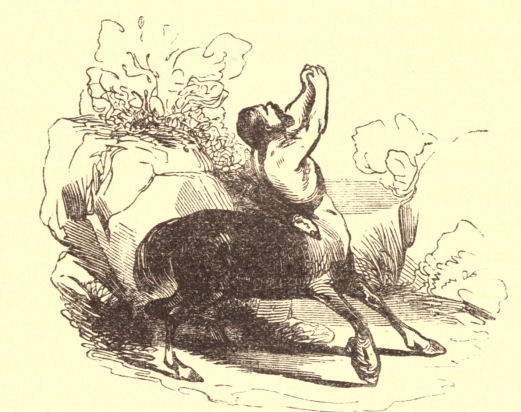
Lycus, a mortal, being detained by Circe in her magical dominion, was beloved by a water-nymph who desired to render him immortal; she had recourse to the sorceress, and Circe gave her an incantation to pronounce.
As Lycus walked sorrowfully in the enchanted place, astonished at the many wondrous things which met his eye, he beheld
———"The realized nymph of the stream, Rising up from the wave, with the bend and the gleam Of a fountain, and o'er her white arms she kept throwing Bright torrents of hair, that went flowing and flowing In falls to her feet, and the blue waters rolled Down her limbs like a garment, in many a fold." Hood.
Struck with each other's charms they loved, but unhappily the nymph, in her anxiety for her lover's immortality, and while calling upon her mistress to assist her, saw
—————————"The Witch Queen of that place, Even Circe the Cruel, that came like a death Which I feared, and yet fled not, for want of my breath, There was thought in her face, and her eyes were not raised From the grass at her foot, but I saw, as I gazed Her hate—"
This hate Lycus soon experienced; as the spell desired by the nymph, was in the act of being pronounced,
——————————"I felt with a start, The life blood rush back in one throb to my heart, And saw the pale lips where the rest of that spell Had perished in terror, and heard the farewell Of that voice that was drowned in the dash of the stream! How fain had I followed, and plunged with that scream Into death, but my being indignantly lagged Thro' the brutalized flesh that I painfully dragged Behind me—" Hood.
From this time his existence become a torture to him. Though there were none of his former beings to consort with, yet still he loved to haunt the places of his humanity, and with a beating heart and bursting frame, behold the various occupations and pleasures in which he had formerly joined.
"I once had a haunt near a cot. where a mother Daily sat in the shade with her child, and would smother Its eye-lids in kisses, and then in its sleep Sang dreams in its ears, of its manhood, while deep In a thicket of willows I gazed o'er the brooks That murmured between us, and kissed them with looks; But the willows unbosomed their secret, and never I returned to a spot I had startled for ever; Tho' I oft longed to know, but could ask it of none, Was the mother still fair, and how big was her son?" Hood.
Time brought no remedy, for still he was troubled by the absence of sympathy, and the repression of that human feeling which yet clung like a curse to him.
"For the haunters of fields, they all shunned me by flight, The men in their horror, the women in fright: None ever remained, save a child once that sported Among the wild blue bells, and playfully courted The breeze; and beside him a speckled snake lay Tight strangled, because it had hissed him away From the flower at his finger; he rose and drew near Like a son of immortals, one born to no fear, But with strength of black locks, and with eyes azure bright, To grow to large manhood of merciful might, He came, with his face of bold wonder, to feel The hair of my side and to lift up my heel, And questioned his face with wide eyes, but when under My lids he saw tears,—for I wept at his wonder, He stroked me, and uttered such kindliness then, That the once love of women, the friendship of men In past sorrow, no kindness, e'er came like a kiss On my heart in its desolate day, such as this And I yearned at his cheeks in my love, and down bent And lifted him up in my arms with intent To kiss him—but he cruel—kindly alas! Held out to my lips a plucked handful of grass! Then I dropped him in horror, but felt as I fled, The stone he indignantly hurled at my head, That dissevered my ear, but I felt not, whose fate, Was to meet more distress in his love his hate!" Hood.
The only mitigation of his sorrow, was that when in Thessaly
"He met with the same as himself,"
and obtained with them, if not sympathy, at least companionship.
Chiron was the wisest of the Centaurs. Music, divination, astronomy, and medicine, were equally familiar to him, and his name is blended with those of the principal sages of Greece, whom he instructed in the use of plants and medicinal herbs.
The battle of the Centaurs with the Lapithæ at the bridal of Perithous is famous in history, and was the cause of their destruction.
The Centaurs inflamed with wine, behaved with rudeness and even offered violence to the bride, and to the women that were present.
"Now brave Perithous, bold Ixion's son, The love of fair Hippodamé had won. The cloud begotten race, half men, half beast, Invited came to grace the nuptial feast: In a cool cave's recess the treat was made, Whose entrance, trees, with spreading boughs o'ershade, They sat; and summoned by the bridegroom, came, To mix with those, the Lapythæan name: ————————The roofs with joy resound, And Hymen, Iö Hymen, rung around. Raised altars shone with holy fires: the bride Lovely herself, (and lovely by her side A bevy of bright nymphs, with sober grace,) Came glittering like a star, and took her place. Her heavenly form beheld, all wished her joy; And little wanted, but in vain their wishes all employ. For one, most brutal of the brutal brood, Or whether wine or beauty fired his blood, Or both at once, beheld with lustful eyes The bride: at once resolved to make his prize. Down went the board, and fastening on her hair, He seized with sudden force the frighted fair. 'Twas Eurytus began; his bestial kind His crime pursued, and each as pleased his mind On her, whom chance presented, took. The feast An image of a taken town expressed." Ovid.
FLORA, POMONA, VERTUMNUS, THE SEASONS.
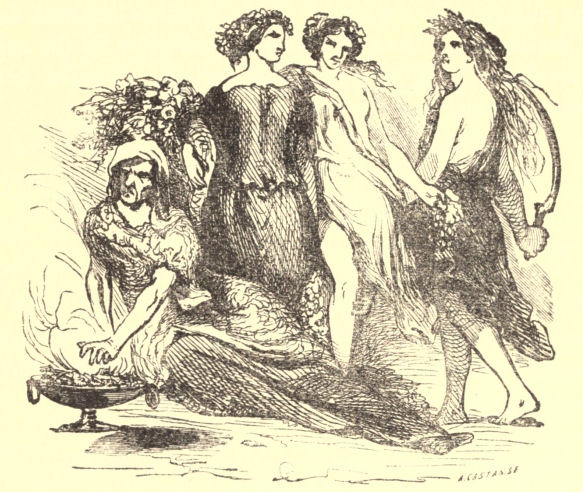
Flora was unknown among the Greeks, having her birth with the Romans. She was the Goddess of Flowers,
————————————————"which unveil Their breasts of beauty, and each delicate bud O' the Season, comes in turn to bloom and perish. But first of all the Violet, with an eye Blue as the midnight heavens, the frail snow-drop, Born of the breath of winter, and on his brow, Fixed like a pale and solitary star, The languid hyacinth, and wild primrose, And daisy, trodden down like modesty, The fox-glove, in whose drooping-bells the bee Makes her sweet music: the Narcissus, named From him who died for love, the tangled woodbine Lilacs and flowering limes, and scented thorns, And some from whom the voluptuous winds of June Catch their perfumery." Barry Cornwall.
She married Zephyrus, and received from him the privilege of presiding over flowers, and enjoying perpetual youth.
Pomona was the Goddess of Fruits and Fruit Trees, and supposed to be the Deity of Gardens.
"Her name Pomona, from her woodland race, In garden culture none could her excel, Or form the pliant souls of plants so well; Or to the fruit more generous flavours lend, Or teach the trees with nobler loads to bend."
Pleased with her office, and unwilling to take upon herself the troubles of marriage, she vowed perpetual celibacy. Numerous were the suitors who attempted to win her from her rash determination, but to all of them the answer was alike in the negative: tho' Vertumnus, one of the most zealous, pursued her with unchanging ardour.
"Long had she laboured to continue free From chains of love and nuptial tyranny; And in her orchard's small extent immured, Her vow'd virginity she still secured. Oft would loose Pan, and all the lustful train Of satyrs, tempt her innocence in vain. Vertumnus too pursued the maid no less, But with his rivals, shared a like success." Ovid.
Miserable, but not cast down, by the many refusals he met with, Vertumnus took a thousand shapes to influence the success of his suit.
"To gain access, a thousand ways he tries Oft in the hind, the lover would disguise, The heedless lout comes shambling on, and seems Just sweating from the labour of his teams. Then from the harvest, oft the mimic swain Seems bending with a load of bearded grain. Sometimes a dresser of the vine he feigns, And lawless tendrils to their boughs restrains. Sometimes his sword a soldier shews; his rod An angler; still so various is the God. Now, in a forehead cloth some crone he seems, A staff supplying the defect of limbs: Admittance thus he gains; admires the store Of fairest fruit; the fair possessor more; Then greets her with a kiss; th' unpractised dame Admired, a grandame kissed with such a flame. Now seated by her, he beholds a vine, Around an elm in amorous foldings twine, "If that fair elm," he cried, "alone should stand, No grapes would glow with gold, and tempt the hand; Or if that vine without her elm should grow, 'Twould creep a poor neglected shrub below. Be then, fair nymph, by these examples led, Nor shun for fancied fears, the nuptial bed." Ovid.
In this disguise, Vertumnus recommended himself and his virtues to Pomona.
"On my assurance well you may repose, Vertumnus scarce Vertumnus better knows, True to his choice all looser flames he flies, Nor for new faces fashionably dies. The charms of youth, and every smiling grace, Bloom in his features, and the god confess." Ovid.
The pertinacious wooing of the metamorphosed deity, had, at last its effect, in preparing Pomona for Vertumnus, when he should assume his natural shape.
"The story oft Vertumnus urged in vain, But then assumed his heavenly form again; Such looks and lustre the bright youth adorn, As when with rays glad Phœbus paints the morn. The sight so warms the fair admiring maid, Like snow she melts, so soon can youth persuade; Consent on eager wings succeeds desire, And both the lovers glow with mutual fire." Ovid.
Pomona had a temple at Rome, and a regular priest, who offered sacrifices to her divinity for the preservation of fruit: she is generally represented sitting on a basket, full of flowers and fruit, holding a bough in one hand, and apples in the other.
Vertumnus is represented under the figure of a young man, crowned with various plants, bearing in his left hand fruits, and in his right a horn of abundance.
The Goddess Pomona is often confounded with Autumn, Ceres with Summer, and Flora with Spring.
The four seasons have also been described with great distinctness, by poets, both ancient and modern, all of whom were delighted to pour forth tributes of praise in their honour; Spring is usually drawn as a nymph, with her head crowned by a wreath of flowers; and many are the strains attributed to her.
"I come, I come! ye have called me long, I come o'er the mountains with light and song! Ye may trace my step o'er the wakening earth, By the winds which tell of the violet's birth, By the primrose stars in the shadowy grass, By the green leaves opening as I pass. I have breathed in the south, and the chesnut flowers, By thousands have burst from the forest bowers, And the ancient graves, and the fallen fanes, Are veiled with wreaths on Italian plains: But it is not for me in my hour of bloom, To speak of the ruin or the tomb. I have looked o'er the hills of the stormy north, And the larch has hung all his tassels forth, The fisher is out in the stormy sea, And the rein-deer bounds o'er the pastures free, And the fence has a fringe of softer green, And the moss looks bright where my foot hath been. I have sent thro' the wood-paths a glowing sigh, And called out each voice of the deep blue sky; From the night bird's lay thro' the starry time, In the groves of the soft Hesperian clime, To the swan's wild note by the Iceland lakes, When the dark fir-branch into verdure breaks. From the streams and founts I have loosed the chain, They are sweeping on to the silvery main, They are flashing down from the mountain brows, They are flinging spray o'er the forest boughs, They are bursting fresh from their sparry caves, And the earth resounds with the joy of waves! Come forth, O ye children of gladness, come! Where the violets lie may be now your home. Ye of the rose-lip and dew-bright eye, And the bounding footstep to meet me fly! With the lyre, and the wreath, and the joyous lay, Come forth to the sunshine, I may not stay. Away from the dwellings of care-worn men, The waters are sparkling in grove and glen! Away from the chamber and sullen hearth, The young leaves are dancing in breezy mirth! Their light stems thrill to the wild wood strains. And youth is abroad in my green domains. But ye! ye are changed since ye met me last! There is something bright from your features past! There is something come over brow and eye, Which speaks of a world where the flowers must die! Ye smile!—but your smile hath a dimness yet— Oh! what have ye looked on since last we met? Ye are changed, ye are changed! and I see not here All whom I saw in the vanished year! There were graceful heads with their ringlets bright, Which tossed in the breeze with a play of light, There were eyes, in whose glistening laughter lay No faint remembrance of dull decay! There were steps that flew o'er the cowslip's head, As if for a banquet all earth were spread; There were voices that rung thro' the sapphire sky, And had not a sound of mortality! Are they gone? is their mirth from the mountains passed? Ye have looked on death since ye met me last! I know whence the shadow comes o'er you now, Ye have strewn the dust on the sunny brow! Ye have given the lovely to earth's embrace, She hath taken the fairest of beauty's race, With their laughing eyes and their festal crown, They are gone from amongst you in silence down! The Summer is coming, on soft winds borne, Ye may press the grape, ye may bind the corn! For me I depart to a brighter shore, Ye are marked by care, ye are mine no more, I go where the loved, who have left you, dwell, And the flowers are not death's—farewell, farewell!" Hemans.
Summer is drawn naked, bearing an ear of corn, just arriving at its fulness, to denote the harvest yielded by its light and heat; with a scythe in her hand, to intimate that it is the season of harvest.
A welcome to the summer's pleasant song, A welcome to the summer's golden hour, A welcome to the myriad joys that throng, With a deep loveliness, o'er tree and flower, The earth is glad with beauty, the sky Smiles in calm grandeur over vale and hill, And the breeze murmurs forth a gentle sigh, And the fish leap from out the smiling rill. The town's pale denizens come forth to breathe. The free, fresh air, and lave their fevered brows; And beauty loves young fairy flowers to wreathe Beneath some stately forest's antique boughs. Oh! art hath nought like this, the very air Breatheth of beauty, banishing despair." Francis.
At other times, she is represented surrounded by the flowers which blossom latest, mingled with the delicious fruits which are the offspring of the summer season.
"Come away! the sunny hours Woo thee far to founts and bowers! O'er the very waters now, In their play, Flowers are shedding beauty's glow— Come away! Where the lily's tender gleam Quivers on the glancing stream— Come away! All the air is filled with sound, Soft, and sultry, and profound; Murmurs through the shadowy grass Lightly stray; Faint winds whisper as they pass— Come away; Where the bee's deep music swells From the trembling fox-glove bells— Come away! In the skies the sapphire blue Now hath won its richest hue; In the woods the breath of song Night and day Floats with leafy scents along— Where the boughs with dewy gloom Come away! Darken each thick bed of bloom Come away! In the deep heart of the rose Now the crimson love-hue glows; Now the glow-worm's lamp by night Sheds a ray, Dreamy, starry, freely bright— Come away! Where the fairy cup-moss lies, With the wild-wood strawberries, Come away! Now each tree by summer crowned, Sheds its own night twilight round; Glancing there from sun to shade, Bright wings play; Here the deer its couch hath made— Come away! Where the smooth leaves of the lime Glisten in the honey time, Come away—away! Hemans.
Autumn appears clad in a robe red with the juice of the vintage, which he yields to gladden the heart of man: while a dog is placed at his feet to denote it as the season of the chase.
"I saw old Autumn in the misty morn, Stand shadowless like silence, listening To silence, for no lonely bird would sing Into his hollow ear from woods forlorn, Nor lowly hedge nor solitary thorn; Shaking his tangled locks all dewy bright With spangled gossamer that fell by night, Pearling his coronet of golden corn. Where are the songs of summer? with the sun, Opening the dusky eyelids of the south, Till shade and silence waken up alone, And morning sings with a warm odorous mouth. Where are the merry birds? Away, away On panting wings through the inclement skies, Lest owls should prey Undazzled at noon-day, And tear with horny beak their lustrous eyes. Where are the blooms of Summer? in the west, Blushing their last to the last sunny hours, When the mild eve by sudden night is prest Like tearful Proserpine, snatched from her flowers To a most gloomy breast. Where is the pride of Summer,—the green prime— The many, many leaves all twinkling?—There On the moss'd elm; three on the naked lime Trembling,—and one upon the old oak tree! Where is the Dryad's immortality? Gone into mournful cypress and dark yew, Or wearing the long, gloomy winter through In the smooth holly's green eternity. The squirrel gloats on his accomplished hoard, The Ants have trimm'd their garners with ripe grain, And honey bees have stored The sweets of summer in their luscious cells; The swallows all have winged across the main; But here the Autumn melancholy dwells, And sighs her tearful spells, Amongst the sunless shadows of the plain. Alone, alone, Upon a mossy stone, She sits and reckons up the dead and gone, With the last leaves for a love-rosary, Whilst all the withered world looks drearily, Like a dim picture of the drowned past In the hushed mind's mysterious far away, Doubtful what ghostly thing will steal the last Into that distance, grey upon the grey. O go and sit with her, and be o'ershaded Under the languid downfall of her hair; She wears a coronal of flowers faded, Upon her forehead, and a face of care;— There is enough of withered every where To make her bower,—and enough of gloom; There is enough of sadness to invite, If only for the rose that died—whose doom Is beauty's,—she that with the living bloom Of conscious cheeks, most beautifies the light; There is enough of sorrowing, and quite Enough of bitter fruits the earth doth bear, Enough of chilly droppings for her bowl, Enough of fear and shadowy despair, To frame her cloudy prison for the soul." Hood.
Winter, as the oldest season, is drawn with shrivelled limbs, and white and hoary locks, to represent the appearance of old age.
"When first the fiery mantled sun His heavenly race began to run; Round the earth, in ocean blue His children four the Seasons flew;— First, in the green apparel dancing, The young Spring smiled with angel grace; Rosy Summer next advancing, Rushed into her sire's embrace:— Her bright haired sire, who bade her keep For ever nearest to his smiles, On Calpe's olive shaded steep, On India's citron covered isles: Now remote and buxom brown, The queen of vintage bowed before his throne; A rich pomegranate gemmed her crown, A ripe sheaf bound her zone. But howling Winter fled afar, To hills that prop the polar star, And loves on deer-borne car to ride With barren Darkness by his side, Round the shore where loud Lofoden Whirls to death the roaring whale, Round the hall where Runic Oden Howls his war song to the gale; Save when a-down the ravaged globe He travels on his native storm, Deflowering Nature's grassy robe, And trampling on her faded form: Till light's returning lord assume The shaft that drives him to his polar field, Of power to pierce his raven plume, And chrystal covered shield. Oh, sire of storms, whose savage ear The Lapland drum delights to hear, When frenzy with her bloodshot eye Implores thy dreadful deity, Archangel! power of desolation! Fast descending as thou art, Say, hath mortal invocation Spells to touch thy stony heart? Then, sullen Winter, hear my prayer, And gently rule the ruined year; Nor chill the wanderer's bosom bare, Nor freeze the wretch's falling tear. To shuddering want's unmantled bed, Thy horror-breathing agues cease to lead, And gently on the orphan head Of innocence descend. But chiefly spare, O King of clouds, The sailor on his airy shrouds; When wrecks and beacons strew the steep, And spectres walk along the deep. Milder yet thy snowy breezes Pour on yonder tented shores, Where the Rhine's broad billow freezes, Or the dark brown Danube roars. Oh, winds of Winter! list ye there To many a deep and dying groan; Or start, ye demons of the midnight air, At shrieks and thunders louder than your own. Alas! e'en your unhallowed breath, May spare the victim fallen low; But man will ask no truce to death, No bounds to human woe." Campbell.
D I V I N I T I E S O F T H E S E A.
Oceanus and Thetis.
Oceanus, one of the most powerful deities of the sea, was, according to Homer, the parent of all the gods, and on that account received frequent visits from the remainder of the deities. He is represented as an old man, with a long, flowing beard, and sitting upon the waves of the sea. He often holds a pike in his hand, whilst ships under sail appear at a distance, or a sea monster stands near him.
Oceanus presided over every part of the sea, and even the rivers were subjected to his power. The ancients were very reverential in their homage to Oceanus, and worshipped with great solemnity a deity, to whose care they entrusted themselves when going on any voyage.
He was the father of the Oceanides to the number of three thousand.
"Three thousand graceful Oceanides Long-stepping, tread the earth, or far and wide Dispersed, they haunt the glassy depth of lakes, A glorious sisterhood of goddess birth." Hesiod.
Thetis, one of the sea deities, was daughter of Nereus and Doris and is often confounded with Tethys, her grandmother. She was loved by Neptune and Jupiter; but when the gods were informed that her son would become greater than his father, they ceased their addresses, and Peleus, the son of Æacus, was permitted to solicit her hand. Thetis refused him, but the lover had the artifice to catch her when asleep, and by binding her strongly, prevented her escaping from his grasp. When Thetis found she could not elude the vigilance of Peleus, she consented to marry him, though much against her inclination. Their nuptials were celebrated on Mount Peleon with great pomp, at which all the deities attended.
"Proteus thus to virgin Thetis said, 'Fair goddess of the waves, consent to wed, A son you'll have, the terror of the field, To whom, in fame and power, his sire shall yield.' Jove, who adored the nymph with boundless love, Did, from his breast, the dangerous flame remove; He knew the fates, nor cared to raise up one, Whose fame and greatness, should eclipse his own. On happy Peleus he bestowed her charms, And blessed his grandson in the goddess' arms: —A silent creek Thessalia's coast can show, Two arms project, and shape it like a bow; 'Twould make a bay, but the transparent tide Does scarce the yellow, gravel bottom hide; A grove of fragrant myrtle near it grows, Whose boughs, though thick, a beauteous grot disclose The well wrought fabric, to discerning eyes, Rather by art than nature seem to rise. A bridled dolphin, oft fair Thetis bore To this her loved retreat, her favourite shore: Here Peleus seized her slumbering where she lay, And urged his suit, with all that love could say: The nymph o'erpowered, to art for succour flies, And various shapes the eager youth surprize. A bird she seems, but plies her wings in vain, His hand the fleeting substance still detain: A branchy tree, high in the air she grew, About its bark, his nimble arms he threw: A tiger next she glares with flaming eyes, The frightened lover quits his hold and flies. The sea-gods he with sacred rites adores, Then a libation on the ocean pours; While the fat entrails crackle in the fire, And sheets of smoke in sweet perfume aspire: Till Proteus, rising from his oozy bed, Thus to the poor, desponding lover said, 'No more in anxious thoughts your mind employ, For yet you shall possess the dear, expected joy, You must once more the unwary nymph surprize, As in her cooly grot she slumbering lies: Then bind her fast with unrelenting hands, And strain her tender limbs with knotted bands; Still hold her under every distant shape, Till tired, she tries no longer to escape? Thus he then sunk beneath the glassy flood, And broken accents fluttered where he stood. Bright Sol had almost now his journey done, And down the steepy, western convex run; When the fair Nereid left the briny wave, And, as she used, retreated to her cave, He scarce had bound her fast, when she arose, And into various shapes her body throws; She went to move her arms, then found them tied, Then with a sigh 'Some god assists,' she cried, And in her proper shape stood blushing by his side." Dryden.
Thetis became mother of several children by Peleus, but all these she destroyed by fire in attempting to see whether they were immortal. Achilles would have shared the same fate, if Peleus had not snatched him from her hand, as she was going to repeat the cruel operation. She afterwards rendered his body invulnerable by plunging him in the waters of the Styx, excepting that part of the heel by which she held him. As Thetis well knew the future fate of her son, she attempted to remove him from the Trojan war, by concealing him in the court of Lycomedes. This, however, was useless, as he went with the rest of the Greeks. The mother, still anxious for his preservation, prevailed upon Vulcan to make him a suit of armour; but after it was done, she refused to fulfil the promise she had made to the god. When Achilles was killed by Paris, Thetis issued out of the sea with the Nereids to mourn his death, and after she had collected his ashes in a golden urn, raised a monument to his memory, and instituted festivals in his honour.
TRITON, PROTEUS, PORTUMNUS, GLAUCUS, ÆOLUS, THE SYRENS, CHARYBDIS AND SCYLLA, CIRCE AND THE HARPIES.
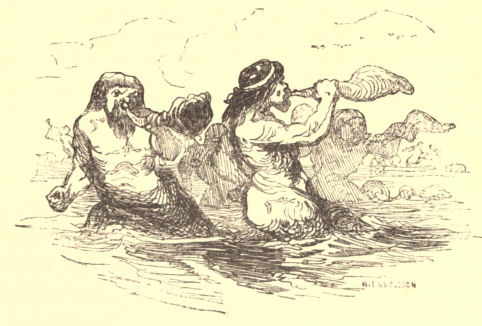
Triton was the son of Neptune and Amphitrite, and was reckoned of much importance among the sea deities, being able to raise or to calm storms at his pleasure. He is generally represented with a shell in his hand.
"Old Triton blowing his sea horn." Wordsworth.
His body above the waist, is that of a man, but below, a dolphin's, while by some he is shown with the fore feet of a horse. He usually precedes the chariot of the god of the sea, sounding his shell, and is resembled, in this, by his sons the Tritons.
Proteus, son of Oceanus and Thetis, was guardian of the subjects of Neptune, and had the power of looking into the future, from that God, because he had tended for him the monsters of the sea.
"The shepherd of the seas, a prophet, and a god, High o'er the main, in watery pomp he rides, His azure car and finny coursers guides. With sure foresight, and with unerring doom He sees what is, and was, and is to come." Virgil.
From his knowledge of futurity, mankind are said to have received the greatest benefits.
————————"Blue Proteus dwells, Great Neptune's prophet, who the ocean quells; He in a glittering chariot courses o'er The foaming waves, him all the nymphs adore, Old Nereus too, because he all things knows, The past, the present, and the future shows; So Neptune pleased who Proteus thus inspired, And with such wages to his service hired, Gave him the rule of all his briny flocks, That feed among a thousand ragged rocks."
The changes which this deity was able to make in his appearance, caused the name of Proteus to be synonimous with change. Thus
"The Proteus lover woos his playful bride, To win the fair he tries a thousand forms, Basks on the sands, or gambols in the storms. A dolphin now, his scaly sides he laves; And bears the sportive damsel on the waves; She strikes the cymbals as he moves along, And wondering Ocean listens to the song. And now a spotted pard the lover stalks, Plays round her steps, and guards her favoured walks; As with white teeth he prints her hand, caressed, And lays his velvet paw upon her breast, O'er his round face her snowy fingers strain The silken knots and fit the ribbon-rein. And now a swan he spreads his plumy sails, And proudly glides before the fanning gales; Pleased on the flowery brink with graceful hand She waves her floating lover to the land; Bright shines his sinuous neck with crimson beak, He prints fond kisses on her glowing cheek, Spreads his broad wings, elates his ebon crest, And clasps the beauty to his downy breast." Darwin.
He usually resided on the Carpathian sea, and like the rest of the sea gods, reposed upon the shore, where those resorted who wished to consult him to obtain any revelation; but it was necessary to secure him, lest by taking some unnatural shape, he should elude their vigilance.
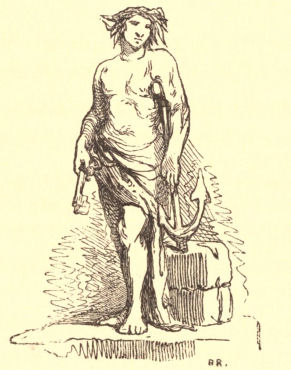
Portumnus, the guardian of doors, was at first known as Melicerta, and was the son of Athamas and Ino. He was saved by his mother from the fury of his father, Athamas, who became inflamed by such a sudden fury, that he took Ino for a Lioness, and her two children for whelps. In this fit of madness, he dashed one of them against a wall; Ino fled with Melicerta in her arms, and threw herself into the sea from a high rock, and was changed into a sea deity, by Neptune, who had compassion on her misfortunes. It is supposed by many, that the Isthmian games were in honour of Portumnus.
Glaucus was a fisher of Bœotia, and remarking, on one occasion, that the fish which he threw on the grass, seemed to receive fresh vigour from touching the ground, he attributed it to the grass, and tasting it, was seized with a sudden desire to live in the sea.
Upon this, he leapt into the water, and was made a sea deity by Oceanus, at the request of the marine gods.
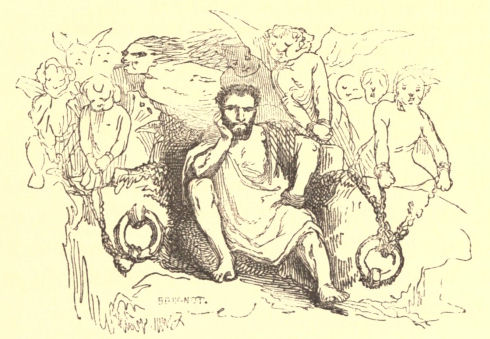
Æolus, god of the winds, reigned in the Vulcanean islands, and was under the power of Neptune, who allowed him to give liberty to the winds, or to recall them into their caverns at his pleasure.
"Oh many a voice is thine thou wind! Full many a voice is thine, From every scene thy wing o'ersweeps Thou bear'st a sound and sign; A minstrel wild and strong thou art, With a mastery all thine own, And the spirit is thy harp, O wind! That gives the answering tone. "Thou hast been across red fields of war, Where shivered helmets lie, And thou bringest thence the thrilling note Of a clarion in the sky: A rustling of proud banner folds, A peal of stormy drums,— All these are in thy music met, As when a leader comes. "Thou hast been o'er solitary seas, And from their wastes brought back Each noise of waters that awoke In the mystery of thy track; The chime of low, soft southern waves On some green palmy shore, The hollow roll of distant surge, The gathered billows roar. "Thou art come from forests dark and deep, Thou mighty, rushing wind! And thou bearest all their unisons In one, full swell combined; The restless pines, the moaning stream, All hidden things and free, Of the dim, old sounding wilderness, Have lent their soul to thee. "Thou art come from cities lighted up For the conqueror passing by, Thou art wafting from their streets, a sound Of haughty revelry: The rolling of triumphant wheels, The harpings in the hall, The far off shout of multitudes, Are in thy rise and fall. "Thou art come from kingly tombs and shrines, From ancient minsters vast, Through the dark aisles of a thousand years Thy lonely wing hath passed; Thou hast caught the anthem's billowy swell, The stately dirge's tone; For a chief, with sword and shield, and helm, To his place of slumber's gone. "Thou art come from long forsaken homes, Wherein our young days flew, Thou hast found sweet voices lingering there, The loved, the kind, the true! Thou callest back those melodies, Though now all changed and fled, Be still, be still, and haunt us not With music from the dead! "Are all these notes in thee, wild wind? These many notes in thee? Far in our own unfathomed souls Their fount must surely be; Yes! buried, but unsleeping, there; Thought watches, memory lies, From whose deep urn the tones are poured Through all earth's harmonies." Hemans.
The principal winds are Boreas, Auster, Eurus and Zephyrus. Boreas, God of the North, carried away Orithya, who refused to receive his addresses. By her he had Zetes and Calais, Cleopatra and Cheone. He once changed himself into a horse, to unite himself with the mare of Dardanus, by which he had a female progeny of twelve, so swift, that they ran or rather flew over the sea without wetting a foot. The Athenians dedicated altars to him when Xerxes invaded Europe.
Auster, God of the south wind, appeared generally as an old man with grey hair, a gloomy countenance, a head covered with clouds, a sable vesture and dusky wings. He is the dispenser of rain and of all heavy showers.
Eurus, God of the east, is represented as a young man, flying with great impetuosity, and often appearing in a playful and wanton humour.
Zephyrus, God of the West, the warmest of all the winds, married Flora, and was said to produce flowers and fruits, by the sweetness of his breath. Companion of love, he has the figure of a youth, and the wings of a butterfly.
SONGS OF THE WINDS. "We are free! we are free! in our home the skies, When we calmly sleep, or in tumult rise, When we smile on the vision-like realms below, Or vengefully utter the chords of woe. When we dance in the sunbeams, or laughingly play With the spring clouds that fly from our kisses away, When we grapple and fight with the bellowing foam, Or slumber and sleep in our shadowless home." NORTH WIND. "I've blastingly wandered Where nature doth pant; And gloomily pondered O'er sadness and want. An old man was sighing O'er angel lips gone, His cherub was dying, And he was alone. On his grey locks I clotted An ice-crown cold,— His sinews I knotted; His tale is told." SOUTH WIND. "I met two young lovers, And listed their vows, Where the woodbine covers The old oak boughs. Enhancing their pleasures I fluttered around. And joined with glad measures Their soft sighs' sound. They blessed me for bringing Sweet perfumes near, They blessed me for singing A cadence so dear." EAST WIND. "I've wafted through bowers Where angels might muse, And kiss their bright flowers Of loveliest hues. And maidens were singing Of beauty and love, Their symphonies ringing, Resounded above. I parted the tresses, From fairy-like brows, Where the lily impresses Its earliest vows." WEST WIND. "I've rolled o'er the regions Of earth and sea, And laughed at the legions That trembled at me. I've madly gambolled With clouds and waves; And closed, as I rambled, My victim's grave. I've roared and I've revelled, With fiend-like glee, Earth's palaces levelled, Wrecks dashed o'er the sea." CHORUS. "We are free, we are free, in our realms of air, We list to no sorrow, we own no care; We hold our carousals aloft with the stars, Where they glitter along in their golden cars, We frolic and bound with the playful wave, Which the prison-like confines of earth doth lave; We are glad, we are glad, and in breeze or in blast, We will sport round the world as long as 'twill last." Jennings.
Alcyone, the daughter of Æolus, married Ceyx, who was drowned as he was going to Claros to consult an oracle. Alcyone was apprized in a dream of her husband's fate, and finding on the morrow his body upon the shore, she threw herself into the sea. The Gods, touched by her fidelity, changed her and her husband into the birds of the same name, who keep the waters calm and serene while they build and sit on their nests in the surface of the sea.
"O, poor Alcyone! What were thy feelings on the stormy strand, When thou saw'st Ceyx borne a corse to land? O, I could weep with thee, And sit whole tides upon the pebbly shore, And listen to the waves lamenting roar, O, poor Alcyone! But now thy stormy passion past, Thou upon the wave at last, Buildest, from all tempest free, Thou and Ceyx, side by side, Charming the distempered tide, O, dear Alcyone!"
The Syrens were three in number, and were companions of Proserpine, at the time of her being carried off; they prayed for wings from the Gods, to unite their efforts with those of Ceres.
In despair at the uselessness of their search, they retired to the sea shore, where, in the midst of desolate rocks, they sang songs of the most enchanting and attractive nature, while those who were drawn by their beauty to listen to them, perished on the spot.
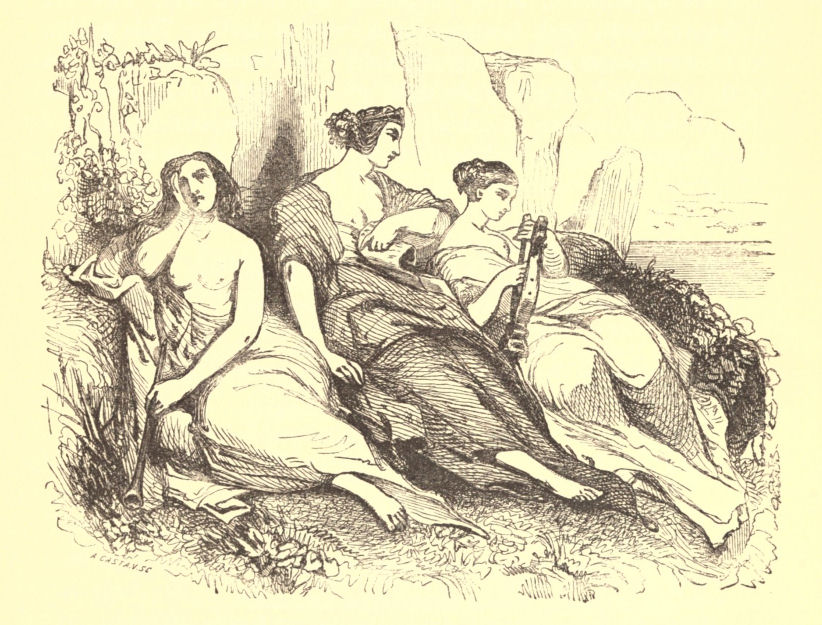
"Who, as they sung, would take the prisoned soul, And lap it in Elysium: Scylla wept And chid her barking waves into attention, And fell Charybdis murmured soft applause." Ovid.
Charybdis was an avaricious woman, who, stealing from Hercules, was slain by him, and became one of the divinities of the sea.
Scylla, daughter of Hecate and of Phorcys, was a beautiful nymph, greatly beloved by Glaucus, also one of the deities of the sea. Scylla scorned his addresses, and the God, to render her propitious, sought the aid of Circe, who no sooner saw him than she became enamoured, and, instead of assisting him, tried to win his love to herself tho' in vain. To punish her rival, Circe poured the juice of poisonous herbs into the waters of the fountain where Scylla bathed, and no sooner had the nymph entered, than her body, below the waist, was changed into frightful monsters, like dogs, which never ceased barking, while the remainder of her form assumed an equally hideous appearance, being supported by twelve feet, with six different heads, each bearing three rows of teeth. This sudden metamorphose so alarmed her, that she threw herself into that part of the sea which separates the coast of Italy and Sicily, where she was changed into rocks which continue to bear her name, and which were deemed as dangerous to sailors, as the whirlpool of Charybdis, on the coast of Sicily, and from which has arisen the proverb, "By avoiding Charybdis we fall upon Scylla!"
"Upon the beech a winding bay there lies, Sheltered from seas, and shaded from the skies; This station Scylla chose; a soft retreat From chilling winds and raging cancer's heat. The vengeful sorceress visits this recess, Her charm infuses, and infects the place. Soon as the nymph wades in, her nether parts Turn into dogs, then at herself she starts. A ghastly horror in her eyes appears But yet she knows not what it is she fears, In vain she offers from herself to run, And drag's about her what she strives to shun. "Oppressed with grief the pitying god appears, And swells the rising surges with his tears; From the detested sorceress he flies, Her art reviles, and her address denies, Whilst happless Scylla, changed to rocks, decrees Destruction to those barks that beat the seas." Garth.
The Harpies were monsters with the faces of old women, the wings and body of a vulture, the ears of a bear, having claws on their feet and hands, and spreading famine wherever they made their hideous appearance.
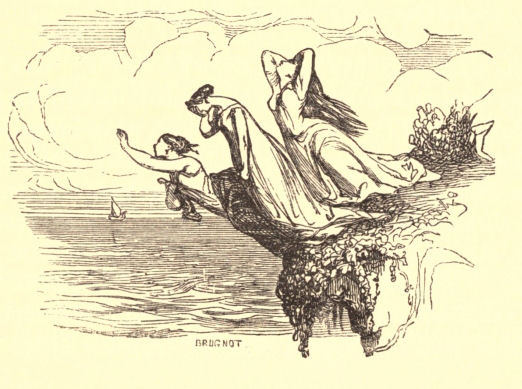
DIVINITIES OF THE INFERNAL REGIONS.
The Parcæ or Fates, were three powerful goddesses, who presided over the birth and life of mankind. Clotho, the youngest of the sisters, governed the moment of birth, and held a distaff in her hand: Lacheses spun out all the events and actions in the time; and Atropos, the eldest, cut the thread of humanity with her scissors.
———"The fates, in vengeance pitiless; Who at the birth of men dispense the lot Of good and evil. They of men and gods The crimes pursue, nor ever pause from wrath Tremendous, till destructive on the head Of him that sins the retribution falls." Hesiod.
Their powers were great and extensive, and they are represented by some as sitting at the foot of the throne of the King of Hell; while others make them appear on radiant seats amidst the celestial spheres, clothed in robes spangled with stars, and wearing crowns on their heads.
Their dresses are differently described by some authors.
Clotho has on a variegated robe, and on her head a crown of seven stars. She holds a distaff in her hand, reaching from heaven to earth. The garment which Lacheses wore was variegated with a great number of stars, and near her a variety of spindles. Atropos was clothed in black; she held scissors in her hand, with clues of threads of various sizes, according to the length or shortness of the lives whose destinies they were supposed to contain.
"The three Parcæ, Fates fair offspring born, The world's great spindle as its axle turn; Round which eight spheres in beauteous order run, And as they turn, revolving Time is spun, Whose motions all things upon earth ordain, Whence revolutions date their fickle reign. These robed in white, at equal distance throned, Sit o'er the spheres, and twirl the spindle round, On each of which a syren loudly sings, As from the wheel the fatal thread she flings; The Parcæ answer, in the choir agree And all those voices make one harmony."