THE VICTIMS OF THE ARCTIC SEAS.
Reading edition
BY SHERWOOD RYSE.
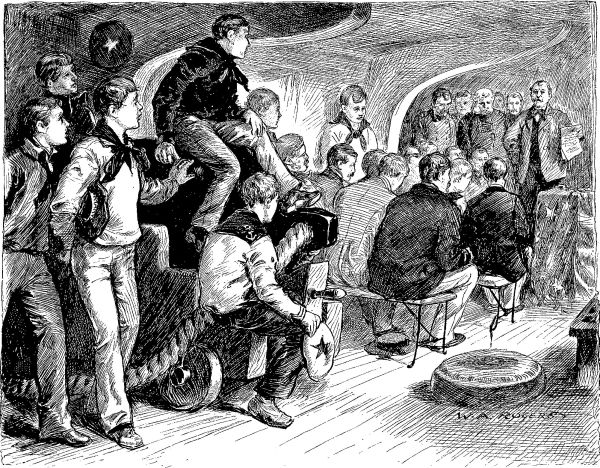
On the evening of the 9th of May, thirty graduates of the school-ship St. Marys, and one hundred of the present pupils, were gathered together on the gun-deck of that vessel. Finely built, robust-looking lads were these last, of the stuff that good sailors are made of; and as they lounged in easy and careless attitudes upon and about the guns, they made a picture that gave assurance that the rising generation of our sailors will be no disgrace to those who have gone before them. It was easy to see from the manner of the boys and their expectant looks that they had been called together for no ordinary purpose. They had met to do honor to a noble officer, who is among the latest and most lamented victims of those dread arctic seas, the mysteries of which so many gallant men have striven to solve.
During the years 1876, 1877, and 1878 Commander De Long had been executive officer of the school-ship, and his memory was revered as the memory of noble men always is. What wonder, then, that when the news, so long expected, yet so lovingly dreaded, reached them, his former pupils were anxious to do him such honor as their regard and affection suggested?
And who was this noble Commander, and what were his services?
George Washington De Long entered the navy in the year 1865, when he was twenty-one years old. In 1873 he was second in command on the Juniata, a ship that accompanied the Polaris arctic expedition, in which he performed distinguished services. When, therefore, the liberality of a private citizen fitted out another expedition for arctic exploration, this young officer was chosen to take the command of the perilous undertaking.
The Jeannette—a name that will never be forgotten while history records the deeds of brave men—sailed from San Francisco on July 8, 1879, with a crew of thirty-three men all told. About the end of September the party had really entered upon the dangers and difficulties of arctic exploration. They were in the midst of great fields of ice, which drifted with the varying winds and currents, so that, although the ship was itself inactive, it was carried over great distances. On November 10, daylight disappeared, and a long night—a night that was to last for nearly three months—set in. In spite of their desolate situation, the gallant crew kept up their spirits, engaging in theatrical performances, and trying to brighten the gloom of an arctic winter by their cheerfulness.
In January, however, the ship sprang a leak, and all hands were kept busy at the pumps to keep the water down, and for eighteen months the pumps never ceased working. At last, however, the fight could be kept up no longer. On June 13, the Jeannette sank, and the crew were left encamped upon the ice, with no other hope of return than that which their three boats afforded.
Thus left almost destitute, Commander De Long had no other course open to him than to retreat. And what a gallant movement that was!
The three boats were two cutters and a whale-boat. The first, commanded by De Long, was twenty feet in length, and carried fourteen persons; the second, under Lieutenant Chipp, measured sixteen feet, and carried eight persons, and the whale-boat, which was larger than either of the others, being twenty-five feet long, was accompanied by eleven persons, under command of Engineer Melville. But though they had the boats, the gallant party could not launch them. They were in the midst of a sea, indeed, but it was a sea of solid ice, and for weeks the boats did not touch water, except for a short ferriage here and there where a break in the ice left a narrow strip of open sea. The boats were placed upon rudely built sleds, and for fifty-three weary days the resolute men dragged them over the ice. Some days they would make a mile; on others scarcely more than half that distance. Great hillocks of ice were to be surmounted, and cracks to be crossed, nearly every one of these being so wide that the sleds had to be let down into them and then hauled up on the other side.
Nor were these the only hardships that the retreating band had to encounter. The cold was intense, as may be imagined. Short rations and their fearful labor had reduced the strength of the men, so that one-quarter of the whole party had to be carried helpless on sleds, while almost all were suffering either from frost-bite or from the effect of the glare of the ice upon their eyes.
At last the retreating company reached comparatively open water. The boats were launched, and the party set sail for what they hoped would be a milder climate and a more hospitable shore.
Now, however, the perils by which they had been beset were increased. The cold was still as great as that which they had previously encountered, and it made itself more intensely felt now that the men were confined within the limits of small boats, and deprived of the active exercise which alone had kept the warmth in their bodies. The food supply was running so short that but scanty fare could be allowed, and the danger of drowning was added to that of perishing by cold and hunger.
For a few days all went fairly well, but during a gale that arose in the night the boats became separated, and in the morning the company on board the whale-boat scanned the dreary waters in vain for the sails of the boats manned by the crews of Commander De Long and Lieutenant Chipp. Engineer Melville's boat touched land on the delta of the Lena—a river which, flowing northward through Siberia, discharges itself into the arctic seas. Here the boat's crew met with hospitable treatment by the natives of those bleak and barren shores, and were all saved.
Not so, however, the occupants of the two cutters. Lieutenant Chipp's boat has not since been heard of. It was a smaller boat than either of the others, and though commanded by a young officer who enjoyed in an unusual degree the confidence and love of his men, it is not probable that he was able to bring his crew to a place of safety, even though he succeeded in making the land.
THE BOYS OF THE "ST. MARYS" LISTENING TO THE STORY OF THEIR OLD COMMANDER'S DEATH.
The sad story of the fate of De Long and his companions was told several months later by two seamen, named Noros and Ninderman, both of whom had served on board the St. Marys school-ship.
On September 13, Captain De Long's boat, although its mast had been carried away, got within two miles of the Siberian coast, when it struck ground, and the Captain ordered the men to get into the water so as to lighten the load, and tow the boat ashore. Only half of the distance, however, had been traversed when it was found to be impossible to bring the boat nearer, and so they collected the food, arms, ammunition, and papers, and waded ashore.
Having rested for two days, the party started southward, each man carrying heavy burdens, though all but the most important articles had been abandoned. In the first ten days' march the travellers made no more than twenty miles, so difficult was the country; but during those days they enjoyed the luxury of a meal of deer's flesh, which, but for the crippled condition of several of the men, would have put new life into the whole party.
Then Captain De Long determined to send Ninderman and Noros ahead, for they were in better condition than any others of the party, and when they left on their perilous mission they bade a sad farewell to a gallant yet almost hopeless band of men, whom no one ever saw again until, nearly six months later, Mr. Melville found their dead bodies.
"The Captain," says Noros, "read divine service before we left. All the men shook hands with us, and Collins, as if knowing that their doom was sealed, said, simply, 'Noros, when you get to New York, remember me.' They seemed to have lost hope, but as we left, they gave us three cheers. That was the last we saw of them."
Wholly without food, for the supply they had saved from the boat was exhausted, and the fresh meat which had been procured was soon consumed, the two brave seamen pushed on. They supported life by chewing their leather moccasins and breeches, and after a few days they came upon two deserted huts, in which they found some mouldy fish, which they ate with relish. Here in these huts they rested for three days, when a native found them; but they were unable to make him understand that they had left eleven starving comrades behind.
At length the Governor of the Province, who lived at a town called Bulun, arrived, but he did not understand their sign-language, and so he sent no aid. He cared for the two seamen, however, and sent them to Bulun, and there it was that they fell in with Engineer Melville, whose boat's crew were by this time in safety. Melville at once started out in search of the ill-fated crew, and the result of his search was told briefly in a dispatch, dated March 24, and received in New York on May 6: "I have found De Long and his party: all dead."
Thus ends the first chapter of this melancholy story of arctic peril. The last chapter may never be told, and the fate of Lieutenant Chipp and his crew never revealed.
The names of De Long and his brave associates will live in history, and generations of sailors will be incited by the memorial tablet which is to be erected on board the St. Marys school-ship to follow in the path that these gallant men followed to their death; for that path, though stern and rugged, was the path of duty.
"IN A THOUSAND TERRORS."—From the Painting by L. Knaus.