"PETER."
Reading edition
BY EDWARD I. STEVENSON.
American boys and girls whose delight in looking at Jumbo and his celebrated legs may have been clouded by remembering how many of the little English cousins across the sea were lamenting the tall old elephant's absence will be glad to know that a new pet has already been found to take Jumbo's place.
PETER, THE BABOON, AT THE "ZOO."
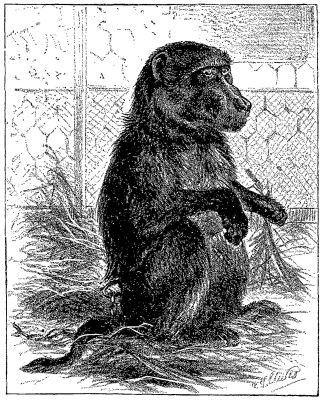
They are flocking by hundreds daily to the Zoological Gardens, where once Jumbo reigned and carried them trumpeting upon his broad back, to be introduced to Peter—a splendid specimen of the "Chacma" baboon, whose sparkling countenance and symmetrical shape our artist has here pictured for the benefit of the readers of the Young People.
Peter came originally from South Africa on a war ship with his master, a British officer, who lately turned his monkeyship over to the "Zoo." It is disagreeable to state that his owner did so to get rid of him—he was fast growing too mischievous to be endured on shipboard. I fear Peter is, in truth, no model for the other monkeys in the Gardens. He steals; he bites; he loves to tear up anything he can once fasten his fingers upon. All this is very sad to learn. Possibly Mr. Barnum will see that he ought to be taught to be a good and happy monkey, and feel bound to buy him for America next year. Travel is so improving to the manners.
Peter has recently had a curious experience. Did any of you ever hear of a monkey who had the toothache, and who took chloroform to get rid of it? Such was Peter's fortune. Day after day the poor fellow sat in one corner of his roomy cage holding his paw close to his cheek. His friends, the children with their mothers and fathers and nurses, stood around pitying him and longing to help him, but in vain.
Peter's jaw began to swell terribly. At length his sufferings came to the point where his keepers said that the cause of all his woe, an aching molar tooth, must be drawn, or the poor fellow would die, for he refused to eat, and seemed to become each day weaker and more dejected. Suddenly a London gentleman, Mr. Hammond, came to the conclusion that he could extract the ailing tooth and save the pet's life.
Peter's illness had made him exceedingly afraid of any strangers—quite as cross, in fact, as a good many of my small readers are when they have the toothache. Mr. Hammond and his assistants, however, entered the cage and politely presented Peter with a nice linen handkerchief well soaked in chloroform.
Peter warily took it, examined it attentively, and presently proceeded—not to smell of it at all, but to calmly lick off all the chloroform with much pleasure. Chloroform must be smelled to best take effect, not swallowed. The handkerchief was prepared again, and again offered. A second time did the red tongue make its appearance and spoil Mr. Hammond's kind designs, and indeed for nearly half an hour did Peter cunningly get the best of his friends by licking up the chloroform.
Finally, however, the liquid began to take effect upon him. Peter's bright eyes grew dim, his head drooped. The handkerchief was held tightly to his nose, and suddenly he tumbled over sound asleep, able to undergo any operation without feeling it.
Now was the time for Mr. Hammond. The forceps (ugh!) were produced, and after some quick but careful work the tooth was drawn from the unconscious sleeper's jaw, safely, and without rousing him. By-and-by its owner awoke. He seemed wonderfully relieved immediately, but also somewhat dazed and puzzled to find out what had been done to him. At length he settled down comfortably in a corner of his cage to think about it, and recover his spirits. He was quite too proud to ask questions. I doubt if he has discovered yet just what was done to him, although with that broad forehead of his he must be a monkey with a good deal of mind.
And really is he not a striking-looking stranger. Just notice his bold glance and the dignified position, which at once show him to be a monkey of great force of character, as well as easy manners. And how modest and retiring too, to judge from the graceful way in which he has tucked his handsome tail away in the straw.
Poor Peter, exiled from his hot South African jungles and woods, what strange scenes he might describe could he only succeed in acquiring a proper English accent!—of dense boundless forests, lashed into a sea of waving boughs at night by hurricanes and tornadoes; of calm moonlight evenings by blue lakes rippled with silver, where the lion comes down like a great stealthy cat to drink and meet a friend for a hunting excursion; and of Mrs. Peter (only that is not her married name), who may be wondering all this time why her husband ran away and left her. But there he is, safe in the great London Zoological Gardens, and there he is likely to remain as long as he lives, unless, as I have already suggested, Mr. Barnum buys him and brings him over to America.