BITS OF ADVICE.
Reading edition
BY AUNT MARJORIE PRECEPT.
PICNICS.
The first thing necessary to a successful picnic is a plan. You must know who are to compose the party, where you intend to go, and what you can do to amuse yourselves when you get there. Then, too, you must have what in armies is called a commissary department, which shall see about the provisions. A picnic without a dinner would be very dull.
Two or three days before the event, the boys and girls who wish to spend some long bright summer hours together in the woods or park should ask their parents' advice about a good place.
A place to be good should be safe, beautiful, and not too far from home. If not within walking distance, it is well to know whether it can be easily reached by boat or cars, or by stage or carriage. You should find out beforehand precisely how much it will cost to convey the party to the spot. Then select a treasurer, who shall pay all expenses, buy tickets, and take charge of the funds. The treasurer must keep an exact account of everything he or she may spend, putting it down in writing, that a report may be given at the proper time.
Your fathers or teachers will usually be able to warn you against dangerous places, or those which are too public to be pleasant for a little picnic party.
As a rule, you should not admit strangers or acquaintances picked up on the way to share your frolic. It is always best to keep the party strictly to its original numbers.
There are two ways of providing the luncheon. One is to decide in advance what each shall bring as his or her contribution, so that there may not be too large a quantity of one article, and too little of another. John may be told to bring lemons, Janie may furnish pound-cake, Alice biscuits and butter, Louis sugar, and Mabel sandwiches. Or each of the company may provide a nice basket of food, and when the time comes for the meal everything may be shared, and the table spread for the general feast. I think I like the latter way quite as well as the former.
Hard-boiled eggs, potted meats, thin slices of ham or tongue, cold chicken, and plenty of good bread and sweet butter, are among the must-haves. Picnic appetites are famous, and you need plenty of the "substantial." Jelly in little glasses, fruit, cake, and, if mother says so, a few of her delicious pickles or an apple-pie do not prove as indigestible when eaten out-doors as they do under other circumstances.
Do not forget the salt. Nor the pepper. Bottles of milk wrapped in cabbage leaves or set into a pan of ice for coolness are not to be overlooked.
Be sure there is a spring near your picnic ground, or an old well on some kind man's farm. If it have a long sweep and a deep moss-grown bucket, so much the better.
Do not trespass on anybody's private grounds. Always send a committee to the house to ask permission to help yourselves to water from the well, or to pass through fields and lanes not open to the public.
The girls must remember that so far as possible all picnic preparations should be made the day before. It is not well to leave cooking for the morning of the day when you are to go.
The boys, too, should have their fishing-tackle in readiness overnight. If swings are to be put up, a man should be engaged to see about them, or at least the oldest and most trustworthy boys of the party should see that the ropes are firm, and the tree branches stout. Nothing is more terrible in its consequences than a fall from a swing.
Always leave the grounds in time to reach home before dark. Take wraps for the cool of the day.
Be polite, unselfish, and very good-natured and kind.
I hope your picnic parties may be very delightful, and that nobody may do as I once did on such an occasion.
Five of us, Henry, Belle, Jennie, Nellie, and I, went to spend the day at a lovely spot a little way from the city. As the eldest of the number, the luncheon basket was committed to my care. I kept it by me, and with a charming book sat and read until the little steamboat stopped at its landing. Then we all rushed off, and the boat puffed away up the river. Presently said one of the group:
"Why, Marjorie Precept, what have you done with the basket?"
Sure enough! I had left it on the boat.
There is no use of trying to tell you what the rest of the party said to me. Imagine for yourselves five hungry boys and girls, with the appetites that are gained by a sail on a steamboat, defrauded of the delicious luncheon prepared for them by my carelessness.
We did not get that basket again for three days. Well, what I suffered has been a good lesson to me. Nowadays I know how to go picnicking, as I hope you will agree from the directions I have tried to give.

Robins in the tree-top, Blossoms in the grass, Green things a-growing Everywhere you pass; Sudden little breezes, Showers of silver dew, Black bough and bent twig Budding out anew. Pine-tree and willow-tree, Fringed elm and larch— Don't you think that May-time's Pleasanter than March?
South Norwalk, Connecticut.
I want to tell you how to make a little winter garden next fall. Fill a small box with earth, and in it plant ferns and mosses, put a small looking-glass in it for a lake, get your brother to make a glass frame to fit over the top, and you will have a lovely garden when the ground is covered with snow.
These warm sunny days make me think the wild flowers will soon be here. First the violets, blue and white, sweet-scented—the fields back of the school-house will be covered with them; then adder's-tongue, dandelions, anemones, and many others, with the bees humming among them. You ought to see what nice salads we make of the leaves of adder's-tongue and dandelions. How often I wish that I could send flowers to the sick children in the hospitals, if the express would only carry them free on the railroad!
Dear Young People, I have a brook near my school-house; it widens and narrows, and makes a great noise. By-and-by it will be full of tadpoles, or young frogs, and the apple-trees near it loaded with blossoms. I am glad I live in the country. It is all very well for you city people to have nice parks and picture-galleries; but I have the nicest pictures, a different one each way I look.
Jessie B.
Lowell, Massachusetts.
I am a boy eight years old. When I was up at Greenville, N. H., I was out in the meadow, and they were cutting the grass, and I had lots of rides on the team. The man that was mowing told me that there were some moles under a tree on a large rock, and I went and looked under every tree in the field, and I asked him again, and he went with me, and they were all around in the grass, and the man had to pick them out of the grass, and they were no bigger than my thumb. I put them in a little pail, and I filled the pail with soft thistle blows, and I kept the moles three days, and then I put them under a stone wall, and the next day my father and I took a walk, and I asked him to come and see if they were under it, and so we went down, and the bed that I fixed for them was all torn to pieces, and I suppose the mother did it.
Ralph P.
Harrisburg, Pennsylvania.
Perhaps some of the little girls who read the Young People would like to know something about a Cooking Club which seven little Harrisburg girls had last winter.
Two weeks before Christmas we met, and decided that we would have a lunch every two weeks, on Saturday afternoon, at the house of each in turn. Every girl was to bring some dish which she herself had cooked at home. Of course a great many of the dishes had to be superintended by the mammas or cooks.
The President always sat at the head of the table, and carved the meat, while two of the girls waited on the table. We wore large white aprons and muslin kerchiefs, and made our badges of red ribbon, with "R. S. C.," the initials of the club, worked on it.
We had seven lunches, but now that the pleasant spring weather has come, we have given up the club until next year.
I have taken Young People since it began, and I read it always with great pleasure. I think "Talking Leaves" was splendid, and I wish Mr. Stoddard would write some more stories.
Emma D. B.
Your little club not only gave you some happy hours, but I am sure you learned useful lessons while playing at cooking. If you resume the meetings next winter, you must write and tell us some of your bills of fare.
Utica, New York.
We take Harper's Young People, and read the stories in it every week. We are much interested in "Mr. Stubbs's Brother." We like the letters very much, and like to read about every one's pets. I will tell you about a cat I once had; his name was Nimpo Ganges. He was a very large gray and white cat. One day my sister had a little kitten given to her. At the sight of a strange kitten Nimpo was very indignant, and left his comfortable home here for another! One day I went to see my aunt, who lives a few doors above us, and she told me of such a beautiful cat that had come to live with her. On seeing it, imagine my surprise to find it Nimpo Ganges! He never came home again to live, for after calling on us two or three times, and finding the kitten still here, he went to live with auntie. He is a great pet with every one up there except the neighboring cats and dogs.
Laura J.
A very remarkable cat. He would not share his home with a stranger. Cats are said to be very strongly attached to places, and less fond of people than dogs are, but Sir Nimpo had a mind of his own, and chose his home for himself, did he not?
Bowling Green, Ohio.
In a recent number of Harper's Young People there was an article on "Marbles," and this week I am going to write about them. Almost every boy knows how to play marbles by making a trench about an inch deep and a foot long. The distance for the marble to roll should be nine or ten feet. As many boys as choose to can play at this game, and the one whose marble goes in the trench, or the nearest to it, takes the others' marbles. If there is a tie, of course they have to begin over again.
Span is another very interesting game. Only two can play this. The one who plays first throws his marble against something, like a wall, so that it bounds back again; then the other boy follows him, and if the marble falls near enough to the first one to span the difference, or distance between the two, both marbles are his; if he can not span the distance, each boy keeps his own marble, and they reverse the order in which they played before.
I am a little boy ten years old, and have taken Young People almost two years. I liked "Toby Tyler" very much, also almost all of the other stories, but I think Jimmy Brown's letters are best of all; it seems to me every boy must sympathize with him.
Eddy F.
I wish I could persuade Eddy and all the other boys to return whatever marbles they may win as soon as their games are finished. Then nobody's feelings will be hurt.
Brunswick, Mississippi.
We have only three pets, a dog named Cricket, a cat named Maxie, and a pigeon; I have not named the latter yet, for I want to ask some of the readers of this paper to please tell me some pretty name.
I want to tell you about the high water in the Mississippi Valley. It was not quite over our gallery, and it is nearly all gone out of our yard now. I felt so sorry for the poor people who were suffering so in the raging billows of our beautiful river. We have all been so thankful to God for saving us from a watery grave. There has been but one life lost here, and that was that of a man in a tricky dug-out. We have several boats, or dug-outs. I will tell you the names of them—the Arkansas Toothpick, the Box-toed Slipper, and the Bob Lee. We have a flat, but we do not think it requires a name. I can paddle a dug-out. The boys get many a "ducking."
Maggie Lela H.
Beech Island, South Carolina.
I am a little boy eight years old. I do not go to school, but I am taught at home. I can read, spell, and cipher very nicely. My mamma and nurse read Young People to me. When nurse read Georgie B.'s letter to me, in the Easter number, I could not keep still. I was thinking of him scrambling through Coral Cave. He must write again. Mamma is going to have all the numbers bound at the end of the year. I have three sisters and two brothers, and a father and mother, who love to read your paper. I have no pets. I have two vegetable gardens, one here and one at the plantation, eight miles off, and they keep me busy. Nurse is writing this for me. I love the poetry in Young People, and want to hear it all read. My sister reads it for herself, and soon I expect to do so too.
Edward E.
Killegney Parsonage, Enniscorthy, Ireland.
I like the paper very much. Our dog Quiz has three pups; we are going to give them away. My pony is being trained; it will soon be tame enough to ride. We are busy at our gardens. I put some primroses in mine yesterday. I am to get a larger garden soon. I like "Talking Leaves." Pappy reads it out to mother and us. Uncle William sends it to me, and St. Nicholas to Godfrey; he is my brother. I have three sisters—May, Ida, and Ella.
Ivan M.
Warrenton, Virginia.
There are a good many mocking-birds that sing around our house, and imitate all kinds of sounds. One time we thought one of our dogs had taken our play reins, and was shaking them about, making the bells ring. Another time we thought we heard a little chicken peeping, so I ran all over the yard looking for it, until I saw the mocking-bird up in a tree, and he was making the sound, and I believe he did it just for fun, to see me hunt for the little chick. I give names to all our little chickens. I named one Harper's because it was weakly; but it has grown strong now, and I hope next year it will have some little chicks of its own, and then we will call them Harper's Young People. I wish Mrs. California would tell some more about Carlie; he must be so cute.
Margie.
Washington, D. C.
I have four little brothers, named John, Billy, Harry, and Tom.
We have a dog which is very smart. He will turn a somersault backward, and stand on his head. We also have a little donkey three feet high, which we ride; but she will not let anybody else ride her, as she will stand up on her behind legs and jump, really. We have a pigeon that will eat meat and sweet-potatoes, and can sing. Don't you think that is queer?
I am seven years old, and I wrote this all by my own self. Please put it in the letter-box.
Your loving little reader,
Hic H. T.
You write so plainly and make such beautiful capital letters that you deserve ten good marks, dear.
Hammer away, Blithe and gay. Work whilst you work, Play whilst you play: And the rust must be moved And the shield kept bright, For the battle of life which we All have to fight.
Lockport, New York.
I have never seen any letters from this city, so I thought that I would write to you. I like the stories very much, especially "The Little Dolls' Dressmaker." Last evening we tried the game of Anagrams, and found it very amusing. My pet is a great big Newfoundland shepherd dog, and his name is Rob Roy. One day some one rang the front-door bell, and on going to the door we found it to be Rob. He does it quite often now. I am almost thirteen years of age. I send a puzzle to you. Good-by.
Ada M. F.
The puzzle is a clever one, and will duly appear. Thank you.
North Adams, Massachusetts.
I live in a small town two miles from North Adams; it is a nice place to live. The north branch of the Hoosac River runs behind my house, and in summer we fish there, and it is fine fun to catch trout and suckers. My father and uncle run a woollen mill, and sometimes I go down to the mill and pack the goods in boxes to be sent off. My sister Amy and I ride to school every morning, and home again every night. We have a nice place to slide in winter, but not a very nice place to skate. I go down on the south branch of the Hoosac, where all the boys of North Adams go.
Keller B.
The next time you catch a splendid big trout, you must send the Postmistress word. I am glad you work as well as play.
Reynoldsville, Pennsylvania.
I am a little girl nine years old. I have two sisters—Bessie the oldest, Tirzah the youngest. We used to live in Philadelphia, but we came to Reynoldsville last summer. We had no pets in the city, but we have a good many here. Bessie has a canary, Tirzah a cat, and I have a dog. I had a dove, but it flew away. There was a beautiful Maltese cat here when we came, and she has a darling little kitten. My papa is superintendent of a saw-mill, and he often takes us to the mill. We have ten horses, which we ride from the watering-trough to the stable almost every evening. A swing is put up for us in the barn. The other day we went to the woods for wild flowers, and we found violets, anemones, wild phlox, and a flower that looked just like mamma's dyletra, only it was white.
M. Louise N.
I think the three little sisters have a merry life. I hope they will study botany, and learn to what classes of plants the beautiful wild flowers they gather belong.
Oswego, New York.
I live in Oswego, which is on Lake Ontario, and in summer I go fishing on the Oswego River, and catch lots of fish. My papa has a yacht and row-boats, and is teaching me to row. I have a stamp album with over two thousand stamps. Last summer I went to the Thousand Islands, and had a lovely time. We reached Cape Vincent about six o'clock; there took a steamer to Alexandria Bay. The islands were beautifully illuminated. I went to the Indian camp, and saw them make canoes and baskets. I have two canary-birds, and a dog named Fritz. I have a large garden, with all kinds of flowers. I liked "Toby Tyler" and "Tim and Tip," and am glad Mr. Otis is going to write another story. I have been to New York twice, and like to ride on the elevated railroad.
L. W. M.
I do not wonder you enjoy riding on the elevated railroad. Sometimes, as I sit in one of the cars, and am whisked along so fast past the windows and over the roofs, I think of the old fairy stories. The enchanted carpet used to transport its owner from place to place in a moment; and these railroads, so high in the air, are very much like enchanted carpets in their effect; only the power which moves them is steam, and we might never have known the wonderful things steam can do if a bright-eyed boy named James Watt had not long ago sat and watched the spout of his mother's tea-kettle.
South Scitgate, Rhode Island.
I am a little girl nine years old. I live with my grandpa and grandma in the country. They are over seventy years old. I try and help grandma about the house. My papa and mamma live in Providence, which is thirteen miles from here. My papa is a photographer. I had a great many pretty things Christmas, but I think the most of my doll. Her name is Flossie. She has very light hair, and her eyes will shut. She is dressed in baby clothes, like a real live baby. I have six other dolls, but they are old ones. I had a canary-bird named Topsy, but the cat killed it one day. I put it in a box, and buried it in the yard. I have a stone at the head of the grave, and I keep it decorated with flowers.
Mamma has come out to see me, and is writing this letter for me. I can write some, but I live a mile from school, and only go in the summer. I have no brothers or sisters, so I have to get along with pets. I have two bantam hens; they lay little eggs, and I eat them all. Grandpa has a large farm, and we have hens, geese, cows, and a horse named Dan. I have been out to-day, and got a large bunch of trailing arbutus for mamma to take to the city with her. Mamma has sent me Harper's Young People over a year. I think "Toby Tyler," "Tim and Tip," and "Cruise of the 'Ghost'" are splendid, but the letters in Our Post-office Box from the little boys and girls I do love so much! I don't see many from Rhode Island, and I do hope our dear Postmistress will publish mine. I hope it is not too long. Good-by.
Eva T. P.
How glad I am that the dear old people have a bright little granddaughter to live with them, and be their sunbeam!
Rochelle, Illinois.
I am a little girl ten years old. I have a piano, and I take music lessons. I like "Mr. Stubbs's Brother." I always read the Post-office Box, and enjoy it. I have a large box full of advertising cards. I see that some of the children tell about their pets, so I will tell you about my cat. I keep his catnip in the table drawer, and when he wants it he goes on top of the table and smells in the drawer, so some one opens it for him, and he gets in, takes the catnip in his paws, jumps out, and goes over on the lounge and eats it.
I hope you will publish this, because I wrote one before, and it was not published. I have been in the grove, and I found some bloodroots and other flowers.
Grace G.
What a sensible cat! Do you take medicine as willingly as he does? But then a little girl who goes to the grove and gathers wild flowers, and lives out-doors in the fresh air as much as she can, does not often need catnip or any other herb.
I am a little girl eleven years old. I live in the city of Buffalo, which is on Lake Erie. There is a fort near the lake, and sometimes in summer I go out there and to the parks with some of my playmates, and have a nice time. There is a large hill at the fort too, and I think it is fun to run down it. I go to school, and am in the Third Reader, and study intellectual and practical arithmetic, spelling, geography, language lessons, and German. Can the editor speak German? If he can, and will write me a letter, I will answer it. My grandma sends me Harper's Young People, and I think it is a very nice paper for children, and my mamma and papa think so too. For pets we have a dog, a cat, and three little kittens, which are now trying to get out of the basket and run around. I am collecting picture cards, and have over nine hundred. If any little boy or girl would like to exchange with me, please address,
Helen M. Sisson, 183 Maryland St., Buffalo, N. Y.
Helen has so much more time than the editor of Young People, that the better way will be for her to send her German letter, and let us see how well she can write in that language, which we are very glad she is studying. What a number of lessons our little nine, ten, and eleven year old friends have to learn, to be sure! And the queerest thing about it, dears, is that, no matter how old we may grow, we shall still have lessons to learn, and some of them harder than those you find in your Third Readers and language lessons.
Away from Home.—Children, how would you like to have been passengers on the British steamer Glamorgan, which arrived in Boston Harbor on the morning of the 1st of May? She reported that on April 25, latitude 46° 20', longitude 42° 30', she passed an iceberg fully five hundred feet high. On the iceberg were a number of polar bears. Now please take your maps, and trace the route by which these travellers must have come from the arctic seas to reach the part of the Atlantic where the Glamorgan's passengers saw them. Where is latitude 46° 20', and longitude 42° 30'? Whose little finger will point to it first? But the Glamorgan's adventures were not ended. On April 26 she ran into a field of ice, and steaming along its southern edge, she passed one hundred large icebergs, on which were polar bears and seals, taking their ease quite comfortably. I wonder what the polar bears thought of the strange world into which they were drifting southward, poor things?
C. Y. P. R. U.
Our Little Poets' Corner.—We group together several bits of verse received from little poets. The first is written by a dear child who has only seen eight summers:
SUMMER.
Summer is near, O summer is near; Winter leaves with a good-by cheer; The grasses sprout, And the trees bloom out— Summer is near, O summer is near. The birdies do sing, O the birdies do sing! And so loud the merry bells ring! For summer brings Such beautiful things; Summer is near, O summer is near! Daisy Severance, Middlebury, Vt.
The author of "Thistle-Down" is only eleven, and her little poem is very sweet too:
THISTLE-DOWN.
Over the fields of waving corn, Over the hill-tops brown. Sailing along in fairy grace, Floateth the thistle-down. Flying past the meadows bare, Catching on grasses brown, Like airy films from cobwebs torn, Floateth the thistle-down. Drifting past the old oak-tree, Drifting past the town; Further than any eye can see, Floateth the thistle-down. On the blue of the sky afloat, A dainty craft is this seedling brown, Manned by the loveliest fairy crew, Guiding the thistle-down. Fairy forms in sunbeams dressed, With rainbow hues caught down. Sailing away in their elfin glee. They guide the thistle-down. Elizabeth Morton Boyce, Chicago, Ill.
Dora, whose rhyme about the streamlet is quite merry and musical, is also eleven:
THE STREAMLET.
How lovely is the little stream That babbles on and on Through many a field and woodland too This little stream has gone. There by the stream the sun looks down, And the many sunbeams play, Oh, happy are the breezy woods On that sweet summer day! And just before it joins the lake— Nor does it miss it ever— This little stream another meets, And they go on together. In its mossy bed the streamlet Glides on through valleys low, In sweet contentment flowing Where the lovely flowers blow. The glowing sun fades out of sight, The moon and stars appear, All is silent now, and quiet, For the shades of night are near. But the stream is onward gliding, Never does it pause to rest, Gliding onward, onward swiftly, To seek the lake's deep breast. Dora Cumming, Newport, Ky.
Who would like to perform this amusing trick, which is called Water Bewitched?
Take an ordinary dinner plate, and fill it with water; then produce a small empty phial, and assure the company that you are wizard enough to pour water through the solid bottom. Having declared that the phial must be perfectly dry when the experiment is performed (if you are asked why, you may say to open the pores of the glass), thrust a stick into it, and hold it to the fire until it is very hot—too hot to hold. Then stand it, without delay, mouth downward in the plate of water. Then pour a tea-spoonful of water on the bottom of the phial, as if you meant to fill it that way, and every time you do this the phial will become more and more filled with water; and as this apparently takes place every time you pour water on the bottom, it will have every appearance of having passed through the solid glass. Of course the water really rises from the plate by what is called capillary attraction.
We would call the attention of the C. Y. P. R. U. this week to "Some Diamond Stories," and to the account of Commander De Long and his terrible death among the ice-fields of the North, as told by Sherwood Ryse under the title of "The Victims of the Arctic Seas." Then Aunt Marjorie Precept has some wise advice to give about "Picnics."
PUZZLES FROM YOUNG CONTRIBUTORS.
No. 1.
CONUNDRUMS.
1. Why is the letter J like the end of spring?
2. What is the most useful letter to a deaf old lady?
3. When may a chair be said to dislike you?
4. When is a window like a star?
5. Why is corn like a rose-bush?
6. Why is an egg like a colt?
No. 2.
CHARADE.
When sharp and blustering is my first, And all are under cover, Before the cheerful fireside sit My second and her lover. Empire City.
No. 3.
FOUR DIAMONDS.
1.—1. A letter. 2. Fiery. 3. Virtuous. 4. To brown. 5. A letter.
2.—1. A letter. 2. Evening. 3. A happening. 4. Conclusion. 5. A letter.
3.—1. In pitch. 2. An adverb. 3. Ability. 4. A number. 5. In run.
Xyz.
4.—1. In salt. 2. To rise above. 3. Strength-giving. 4. A hollow. 5. In custard.
Helen S. H.
No. 4.
TWO WORD SQUARES.
1.—1. An arrow. 2. To respect. 3. A part of the body. 4. Sheep-pens. 5. A ringlet.
Empire City.
2.—1. A bird. 2. A bird. 3. To turn from. 4. Part of the body. 5. To come in.
Helen S. H.
ANSWERS TO PUZZLES IN No. 131.
No. 1.
LUXEMBURG
SIBERIA
SALEM
OBI
O
BUG
FAROE
ROANOKE
TENNESSEE
UCAIARY
MOCHA
LEE
L
TAY
CONGO
CORDOVA
No. 2.
Boston. Rhododendron. Nightingale.
No. 3.
CM
ARTMAY
CREAMMAYOR
TARYOU
MR
Correct answers to puzzles have been received from Annie J. Thomas, "Columbia," "American," Helen S. Herzig, Walter Morell, W. C., Frank Smith, Rogers Campe, Elsie O., Lulu Beck, Emily Dean, Maggie Walker, Florence Meserole, Jennie Strong, Claude Ramsay, McVey Grove, Kitty and Josie, E. H. D., Charles Morrison, Nelson Metcalf, Bessie T., "Lodestar," George P. Taggart, Florence H. Chambers, Florence, Mabel, and Annie, B. J. Lautz, Florence Cox, Willie Jones, Mary H. Hobart, William A. Lewis, and Edgar Seeman.
[For Exchanges, see 2d and 3d pages of cover.]
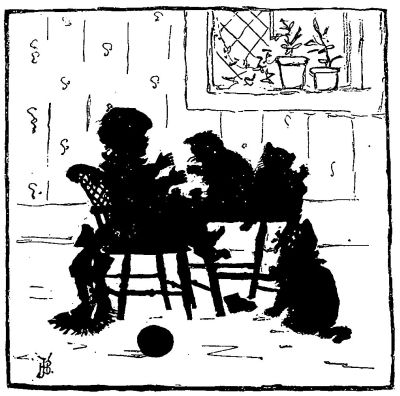
THE PLAYMATES.