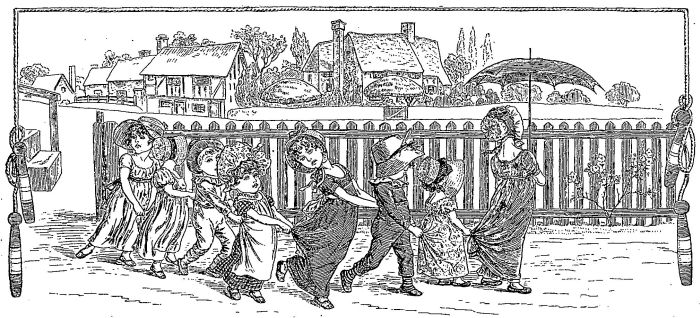
THE BOYS' TEA PARTY.
Reading edition
BY S. C. MORRISON.
When ten boys and girls live in one house, they can have a great deal of fun. This was the case at Mr. Stanley's, where there were six girls and four boys; only the boys sometimes felt a little injured that the girls should have the majority.
But next door, at Mr. Fleming's, there were seven boys and only one girl; so when the Stanley boys wanted a refuge from feminine oppression, they had only to climb the fence, and join forces with the Flemings, and at once they had a majority in their favor.
Not that they had any real cause of complaint. Everything that could make them comfortable and happy was provided for them by their father and Aunt Sue. Aunt Sue!—that name suggests their grievances. For two years before Aunt Sue came to take charge of the Stanley boys and girls they had had a housekeeper who let them do pretty much as they pleased. She allowed them to eat pies, puddings, cakes, and sweetmeats until they cared for nothing else.
Aunt Sue instituted a new state of affairs. They must learn to eat vegetables for the sake of their health.
Now don't suppose that they never had cake, or that Aunt Sue was at all unreasonable. But when boys make no distinction between cake and bread except to give the former the preference, it is difficult to fill their orders.
It is remarkable how boys always know when cake-baking is going on. They seem to scent it in the air. At first Aunt Sue tried to escape by springing baking day at odd times. But it was no use. One or other of them was sure to happen in, and then in some miraculous way the other boys would come trooping in like the Northern barbarians at a Roman harvest-time.
Then Aunt Sue tried a new plan. Wednesdays and Saturdays were announced as regular baking days, and each boy was to be entitled on the spot to one cake out of every pan of ginger-snaps or other small cakes that were baked. Four cakes to a panful was no light tax to levy, but the boys were rigorously exacting, and woe to the boy who failed to be present; His cake was confiscated, immediately, and gobbled up by the reigning powers, after the manner of the partition of Poland.
When a soft cake was to be cut at table it was an understood thing that those rapacious boys should have the "corner pieces." The only wonder was that no amount of cake ever seemed to make these boys sick. The fact was so amazing that Aunt Sue pronounced it "just miraculous."
It so happened that during the spring, just about house-cleaning time, the boys had been two weeks without cake. They had been out one day playing base-ball, and were coming home to supper cold and hungry. They discussed the afternoon's fun until there seemed nothing more to say about it, and after a little silence one of them revealed the subject of his thoughts by the grumbling remark:
"I hope Aunt Sue will manage to have some cake for supper. It is an age since we had any."
"She is getting awfully stingy with it, anyhow," said Bob. "The piece I had last night was hardly big enough to taste."
"I never get more than a taste except at Christmas," said John.
"See here, boys," cried Tom Fleming, "I have thought of something. Let's have a party, and bake the cake ourselves."
This brilliant idea was so new as to be somewhat startling; but after the first shock was over, most of them entered into the plan eagerly.
The older boys were dubious. "How can we? Aunt Sue would never consent, and your mother never lets us come near the kitchen."
"Have it in my room," said Tom, hospitably, "and keep dark about it."
That seemed feasible; for his out-of-the-way room in the top story had often been the scene of their revels.
"But the cooking?"
"I will make a fire in the fire-place. I have often done a little in the cooking line there; made bullets, and boiled paste, you know."
It was then arranged that the Flemings, being hosts, should provide fuel, lights, and utensils; and the Stanleys, who were posted in pastry, should provide materials for the cake.
"All right," said Tom. "We will do our share. But if we engage to get the milk and eggs, don't you think you fellows might scare up the flour and molasses?"
The Stanleys thought they could; and the time was set for the next night but one, to allow ample time for preparation.
"I tell you what, Dick," said Bob, suddenly sitting up in bed that night, "if I could only get a chance to speak to the milkman, I could order an extra lot of milk."
"Well, get up in time to take the milk to-morrow. It won't be any colder than sitting up in bed now, and there is no use in cooling us both off."
It seemed an important though painful step to take, so it was determined on. But, alas! the morning the milk was to be delivered, the boys both overslept the hour. Some one else took the milk, and refused to take the double quantity.
Dick waited until after tea to go up the street for his eggs, so as to carry them directly to the rendezvous. As the party was to be kept a profound secret from everybody, he thought best to put the eggs in his pockets. He did this very carefully, knowing the frail nature of eggs as well as any one.
But soon one of his school-mates spied him, and announced the fact by a stinging slap on the shoulder. Of course Dick returned fire, and the action soon became so lively that the forgotten eggs suffered considerable damage.
"Here I am, boys!" he shouted, as he dashed into Tom Fleming's room; "and here are the eggs."
Dick dived his hand into his pocket, and withdrew it in dismay. "I do believe every one of the old things is broken."
The boys all gathered round, and a dish was produced to receive the contents of Dick's pockets.
Dick regarded his possessions ruefully. It was not only the loss of the eggs, but there was his new Russia-leather pocket-book, a present only last Christmas. The knife and other things might be cleaned up, but the pocket-book was ruined. The thought of what Aunt Sue would say when she came to clean his pockets decided him to do what he could in that way himself.
The milk was now inquired for, and, to the consternation of several of the boys, was reported missing.
"Whew!" said Tom, "you Stanleys are getting off cheap. However, it is my treat, so I will say nothing. Can't you make a cake without milk, Bob?"
"Yes, just as easy. You can use water, but you ought to have had your kettle boiling."
Tom hastily emptied his bedroom pitcher into the kettle, and set it among the blazing logs.
"Now, Bob, fire away. Let us see what kind of a baker you will make."
Bob pulled off his coat, rolled up his sleeves, and pinned a towel round his waist. He then looked around for the flour, of which a large bowlful had been procured.
"I guess," he said, "since so many eggs are gone, I had better not venture on so much flour. Give me the bowl, Tom."
"Do you boil the eggs first, Bob?"
"I—guess—not. They mix up better raw;" and he began to break the eggs into the flour.
"Don't forget the molasses," said Tom, proudly displaying a heavy jug. "It was cheap; so I got a plenty."
"That is lucky. Cake can't be too sweet for me." And Bob stopped breaking eggs to pour a generous stream of strong black molasses into the bowl.
"I tell you what, boys," he added, "all our trouble would have gone for nothing if I hadn't just happened to remember the soda at the last minute, and bought a quarter of a pound. I think I will put it all in, to make up for the milk, you know."
"I've got something for the cake," said John Stanley, and he produced from his pocket a handful of raisins.
"Magnificent!" said all the boys, their mouths watering at this unexpected addition to the feast.
"Dash them in, John. Now where is the spoon to stir with?"
"A spoon! I did not think of that," said Tom. "You ought to have given me a list of all the things you would want, Bob."
"Well, we have got to have something to stir it with. A stick would be better than nothing." And he began to look among the logs.
"How would the handle of my tooth-brush do?" asked Tom, resolved to go to every length which hospitality demanded of him.
"Why don't you try your jackknife?" suggested Dick.
"Well, here goes," said Bob, and he began stirring vigorously; but it was stiff work, and made little impression.
"There is something wrong," said Bob, standing back to view his work, and think. "What else was I to put in? Oh! the water, of course."
Half a kettleful was put in, and the stirring now went on swimmingly, and Bob's mind became sufficiently free from present anxiety to strike forward into the future far enough to wonder what the cake was to be baked in. He asked Tom.
"A skillet," returned Tom, waving that article over his head triumphantly.
"All right."
In a few minutes the process of mixing was pronounced complete, the batter was poured in, the skillet set upon a bed of glowing coals, and its lid covered with another supply of them. But after the table was all arranged, and the boys had time to look about and think, it seemed as if they were going to have a very poor party after all. "Nothing but that cake! And it is not a large cake either."
"Why couldn't we make molasses candy?" suggested John.
The boys gave three cheers for John. "You are the fellow, John, to think of things."
So the kettle of boiling water was emptied back into the pitcher, and the molasses poured into the kettle and set over the roaring fire.
"How long is it going to take that cake to bake, Bob? I am as hungry as a bear," said Fred.
Bob cleared the coals off the skillet lid and peeped in. "It has puffed up beautifully, boys. I guess it is about done."
"Dish up, then. We are all ready."
The cake was turned out into a large plate in the centre of the table, and the boys seated themselves to enjoy their well-earned feast.
"What kind of a cake do you call it, Bob? It looks more like a plum-pudding than anything else. It rounds up so, and is stuck all over with raisins."
Bob plunged his knife in. Whew! It went in like the knife into the pie of which Tom Thumb had eaten out the contents. The beautifully rounded surface fell flat.
The boys were astonished.
"What makes it so hard to cut?"
"I don't know," said Bob, desperately, stopping to whet his knife on his shoe. "There, taste it;" and he pulled off some pieces of the leathery stuff.
"Ugh!" "Horrible!" "What stuff!" "Shoe-leather is nothing to it!" "It is as bitter as rhubarb!" "Why, he said he knew how to make cake!" "Where did you take your diploma?" were the exclamations that went round the table.
Then there was silence. Bob seemed particularly moody, and the others cast black looks at him as they pushed their chairs back from the Barmecide feast.
At that moment a loud hissing sound was heard from the fire. The molasses was boiling over.
Tom flew to the rescue; but too late. The kettle had tilted over on the unstable logs, and the molasses was pouring into the flames and rolling over the carpet like lava from a volcano. The room was filled with flying soot, ashes, smoke, and a horrible smell of burned molasses. The boys stood looking on in helpless consternation.
"Hi—yi!" screamed Dick, suddenly leaping upon a chair.
"What is the matter?" asked the frightened boys in chorus.
"My feet are burned with that boiling hot molasses."
Sure enough. A stream of molasses had found its way to Dick's shoeless feet.
"Open the windows, and let out this horrid smoke," cried Tom.
It was soon done, and the cold air came rushing in. The smoke began to clear; but a terrific roaring was heard in the chimney.
"Boys, I do believe the chimney is on fire," said Fred, in a hoarse whisper.
It was too true. The boys ran wildly about the room, picking up chairs and anything they could lay hold of to put the fire out with, and then discarding them as useless.
Just then the door opened, and Edward Fleming, the eldest of the ten, said, sternly, "Boys, what does all this mean?"
There was no need of answer. He comprehended the case at once. "Shut the door and windows," he cried. Then seizing a loose piece of carpet from the floor, he threw it upon the flames, and the danger was over in a moment.
The boys expected a first-class scolding after this, but they were agreeably surprised. Edward solemnly told the Stanleys that their aunt Sue had sent for them, and the boys slunk away to bed. But they spent all their play-time for the next week in cleaning up Tom's room and their own clothes, and in getting things to rights again.
"I never knew before how much trouble it is to make cake," said Bob. "It must be pretty hard on Aunt Sue and the girls to bake so much for us."
"Yes," said Dick, "and we are getting too big, anyhow, to care for such things."
And it was remarked in the family that the boys' old attachment to cake waned about the time of the private tea party in Tom Fleming's room.
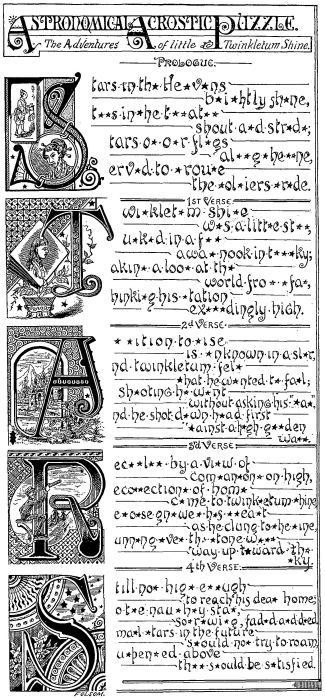
Here is a puzzle that will interest the boys and girls that are far enough advanced to know something of astronomy. The wee tots will not be able to make much out of it, for the stars and the astronomers seem to have been given hard names from the time of Tycho Brahe down to Sir John Herschel. There will be a large number of bright minds among the readers of Young People, however, whose exploits on examination days will make it an easy matter for them to transpose the "pi" into the right word every time. "Pi," it may be stated for the benefit of those who are not familiar with the term, is the name that printers give to type that somebody has knocked into complete disorder after it was all nicely set up and ready for printing.
To begin with, we have a little story in verse, containing twenty-two names. The stars in each line must be replaced by appropriate letters. When these letters are mixed together they will form the "pi." Then by transposing them we obtain the required name of planet, astronomer, or cluster. No other letters can be used. Each verse has but one large initial, every line of a verse beginning with the same letter. The small stars around the acrostic initials have no bearing on the puzzle whatever.
PROLOGUE.
First line, a planet; second line, two planets; third line, a term used in connection with the moon; fourth line, another term used in connection with the movements of the moon.
FIRST VERSE.
First line, a term used in speaking of an eclipse; second, third, and fourth lines combined, three planets, and the name of a foreign astronomer.
SECOND VERSE.
First line, a part of the moon; second line, a form of eclipse; third and fourth lines combined, a man who made a discovery of great value to astronomers, and secondly, a foreign astronomer.
THIRD VERSE.
First line, a cluster of stars; second line, an English discoverer of a satellite; third and fourth lines combined, a term applied to uncertain stars, a titled astronomer, and a planet.
FOURTH VERSE.
First line, the birth-place of a great astronomer; second and third lines combined, an astronomical phenomena; fourth line, a cluster of stars.
SCHOOL IS OUT!