THE SAILING AND RACING OF THE SMALL BOAT.
Reading edition
BY DUDLEY D. F. PARKER.
A great deal of real solid pleasure may be had from the handling and racing of the smaller classes of sailing-craft.
THE "TUCK-UP."
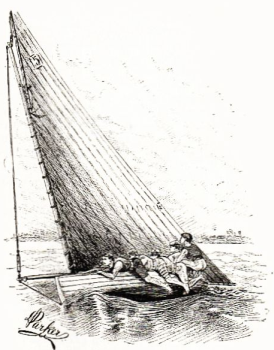
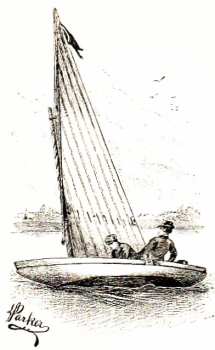
The boat possessing all the peculiarities of the small boat to the greatest extent is the "tuck-up," a type seemingly a cross between the ordinary cat and a "Whitehall" row-boat, and having an extremely easy under-water body. These little boats range from sixteen to nineteen feet, and have a very moderate beam as compared to the cat-boat, and are rather deeper. The entrance is sharp, and the stern lines are much cut away, making a hull that can be driven through the water at a high speed, though lacking in stability. It is frequently the case that the spars and sails of these boats are so large that they are top-heavy from this alone, and often the boat has to be run alongside a dock and a man hold it right side up whilst the crew clamber aboard. Ropes are frequently fastened at intervals to the centreboard trunk to assist the men in hanging on when the boat is away over. In the sketch the crew is represented as laying flat on the deck for windward work.
They are essentially a "racing-machine," their speed being developed by a large sail, big centreboard, and all the men and bags available to keep the whole right side up. The rig is the regular cat, and everything is very strong. On account of the small displacement of hull and the large sail and ballast, the motions of the boat are much intensified. A squall striking the large sail area will throw her down in an instant, and as soon as it is over she rights as quickly. It will be readily seen from the foregoing that the crew should watch the boat intently, and be prepared to hang out over the side or scramble inboard, as the occasion may require. The problems presented for racing these boats are about the same as those of the cat-boat (see article in Harper's Round Table No. 827), but there are several things that should always be kept in mind. These boats are quick in stays, obedient to the helm, and change course rapidly when gybed. On account of comparative lack of beam, the deck at the sides is narrow and the coaming is low, so as to permit the men to lay over the side, and in consequence the danger of taking water aboard is greatly increased. In fact, it is a frequent sight in a race to see a man busily engaged in bailing out the water that has dashed in over the bow or come in over the lee gunwale. The quick manner of heeling of these boats greatly increases the chances of getting the sail in the water, and you should keep a sharp lookout for this, as it is liable to result in an upset. At the same time you do not want to let the wind out of the sail, or the weight of the men on the upper side will dump the boat to windward. The principal duty of the crew will be to act as shifting ballast, and the greater the rapidity with which the motions of this important duty are performed, the more the boat's speed will be helped. When the boat starts to heel, it should be met quickly, so as to prevent her getting away over and wallowing through the seas, the men lying out or sliding in quickly, as the wind's force varies. The duties for each man are about the same as in the cat-boat, having a man at the tiller (captain), sheet-tender, centreboard and halyard man, and if the day is at all windy a light man had better be assigned to bail the boat when necessary.
THE ST. LAWRENCE BOAT.
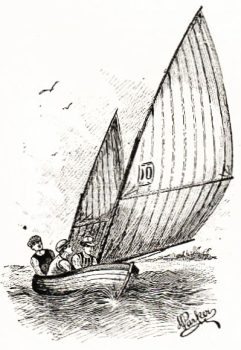
St. Lawrence skiff-racing is not general, though in some parts of the country it is indulged in. It will be sufficient, perhaps, to pass over it with a few words. The boat is in many respects a large canoe, and hence depends entirely on the crew to hold it up. The rigs employed are enlarged canoe rigs, i.e., two fore-and-aft sails of some character—"bats' wings," "Mohicans," etc., etc.
The sternmost sail, or "jigger" (sometimes called "dandy"), has a tendency to throw the boat's head up into the wind, and as there is no counteracting influence of a jib, these rigs sail very close to the wind.
In going about, the jigger is a great aid, and should be hauled in flat when rounding up, and trimmed properly again when on the other tack. In gybing, the jigger is more of a hinderance than an aid, as in making a gybe it is necessary for the boat's head to fall off the wind. To make a neat job, the wind pressure in the jigger should be reduced as much as possible as the mainsail is coming inboard. In running before the wind the sails should be placed "wing-an'-wing," that is, on opposite sides of the boat, so as to get full benefit of the wind and ease the steering. When running this way you should watch the boat carefully, lest some small change in wind or course would cause one of the sails to gybe over.
RACING BATEAU.
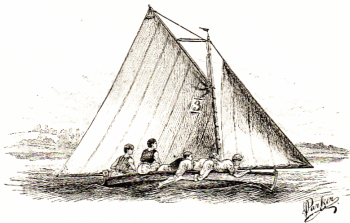
The racing small boat pre-eminent of this section of the coast is the "bateau"—a half-round-bottom type possessing some of the qualities of the flat-bottomed row-boat and the sea-skiff. They are usually in the neighborhood of eighteen feet, and rather narrow, with a sharp bow and long tapering stern-lines. The bottom board, or "keel," is about eighteen inches wide in the centre, tapering to a point at each end. From it the sides are built up out of two or three wide planks riveted together. The stern is really an overhang, but has a skag built on underneath, and terminates in a perpendicular stern-board. The rig generally employed on these boats is the "skiff rig," though occasionally the mainsail with gaff and halyards is used. The use of a jib presents many new problems in sailing, and will necessitate some thought and study on the part of a boy whose experience has been confined to the handling of a cat-boat. In the jib-and-mainsail rig there are two opposite forces at work. The mainsail, as in the cat-boat, throws the boat's head in the wind, only this is more pronounced, as the mast is stepped further aft. This can readily be seen.
Let us suppose our boat to be a lever pivoted on a fixed point, and free to swing on this point. The point in the boat that takes the place of the pivot of the lever is the centre of lateral resistance (resistance to sliding sideways). This centre will be somewhere amidships, and it is clear that whichever side of it the greatest wind pressure is exerted on the sails, that part of the boat will have a tendency to drift with the wind, so swinging the other end around. In the mainsail the greatest power is aft of this centre, hence the stern falls off and the bow goes up into the wind. In the jib the reverse is true. The power here is applied forward of the centre, and hence the bow falls off. These two neutralizing forces should be borne in mind when handling a jib and mainsail, and made judicious use of.
SEA-SKIFF.
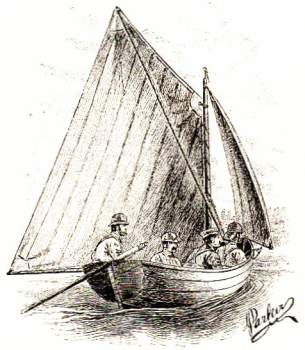
Moderate observation and some thought of this principle will enable a boy to analyze the behavior of his boat, and to trim his sails so as to correct errors and get their full benefit. The jib may be trimmed so that the boat will almost steer itself, though the sail should not be in so flat that the mainsail cannot cause the boat to luff up when you let go the tiller. When beating to windward or close-hauled the pressure on the head-sail must be lessened, and so the jib should be given considerably more sheet than the mainsail. When you wish to go about, the rudder and mainsail are handled in the same manner as in a cat-boat. (See Harper's Round Table No. 827.) After letting go of the tiller and starting to haul in the main-sheet, and when you notice the boat is rounding up, let slack the jib-sheets, and when the boat is on the other tack, trim it in tightly, so as to carry the boat's head over quickly, and then trim properly after the mainsail fills. In gybing the jib is of much assistance. The main-sheet and tiller are handled about the same manner as in the cat, but perhaps another caution should be given about not forgetting to haul the centreboard up. Never fail to see that the board is up before throwing the boat off with the rudder. When about to put the rudder over, after pulling the board up, trim the jib in flat, and it will aid greatly in swinging the bow off; at the same time, if kept trimmed in until the boat's course is settled, will check to a great extent the tendency of the boat to run up into the wind after the sail goes over. When running off the wind the jib should be in nearly as flat as the mainsail, but you should always remember not to have the jib in so tightly as to destroy the luffing power of the boat. If a sudden squall strikes the boat, let go the jib-sheet, and it will luff up quickly. When running before the wind the jib may be used as a spinnaker (see sketch of skiff) by placing the sails "wing-an'-wing," and if there is not enough wind to hold the jib out, a light pole or an oar may be used for that purpose. If the racing rules permit, a pole may be set over the side abreast of the mast, and the jib rigged as a regular spinnaker.
The crew should be disposed, when possible, so that the boat will set deeper in the stern than in the bow; that is, the bottom board at the bow should be about two or three inches under water, so that the cut-water will part the waves. If the bow is lifted out so as to bring the flat bottom board in contact with the waves the boat will "smash" its way through, and each wave will stop the headway. If the bow is too deeply in, a larger sea than usual is liable to come aboard, and in addition the rudder will be lifted out to a certain extent, and the boat will steer badly, on account of lack of rudder area and the increased lateral resistance of the bow.
RACING SNEAK-BOAT.
Sneak-boat racing is also popular in some sections. The sneak-boat is very much like the cat-boat, and is about as uncapsizable as a boat can be. Its lines are all full, mostly arcs of circles, the sides being "flaring." The long spoon-shaped bow and broad full stern overhang give great stability and displacement when heeled over. A fore-and-aft sail of some character is used, and the boats are handled much like a cat-boat. Under favorable conditions they develop good speed. They are unsurpassed as a boat for the beginner in sailing or racing.
Sea-skiff racing is indulged in by the fishermen, and these speedy boats afford some good sport.
But to leave these special types, and coming to small-boat racing in general: What qualities are essential to the successful racing skipper? I should link two together as outweighing all others—good judgment and spirit. They seem to stand together; one without the other is liable to lead to unsuccess. Judgment without the spirit to make best use of it will lead to over-caution. Spirit without judgment verges on rashness, and cannot but lead to disaster.
The racing-man must think quickly, and act immediately and decisively. He must train himself to take in situations at a glance and determine the policy he will pursue immediately.
The boat should be sailed with dash. Your main idea should be to get speed, and everything else should be subordinated. Injury to boat should not be considered, unless it is liable to cripple her permanently, and this risk is very often pardonable. No thought should be given to the crew's comfort; they should be regarded as machines, for the time being.
In short, the tuck-up, skiff, bateau, or small boat of any character should be sailed like a large toy boat. If a gust throws her down, get the crew out over the side if necessary, so that there is only enough inboard to keep them from falling off. Don't be afraid of taking water aboard; when there is enough in to be troublesome, bail it out.
A racing-man must be observant. He should notice where the tides are the strongest, and also which way the flow is at the time of the race. If possible, he should make himself familiar with all this before the race, and it should have some effect on the course of his boat. For instance, suppose one of the legs of the course takes you up a channel, as the outlet of a river or bay. If the tide is against you, you should hug the shore and avoid the deep water, as the tide always runs strongest in the centre. Now suppose you have rounded the mark, then the tide is in your favor, and it is clearly to your interest to get in the middle of the channel, so as to have its full benefit. It will easily be seen what might be lost by a skipper not knowing or observing which way the tide was flowing. I witnessed a very good example of this last year, in the Labor Day Races, in the Horseshoe, Lower Bay. The course was a thrash to windward out to the Sou'-west Spit and return, from a starting-line near the mouth of the Navesink River. There was a strong flood-tide and a light wind, causing the fleet to split into two sections, one tacking in under the Hook, and the other taking the straighter course for the mark. The latter got the full handicap of the incoming tide, and was left far behind the boats which had gone inshore to escape it.
At all times you must be on the lookout to take any little advantage an opportunity offers, and to interfere with an opponent's wind. If possible, when passing a boat, always go to windward, but do not enter into one of those senseless luffing matches, which will practically take the two boats engaged out of the race.
The price of success in racing is vigilance, observation, decision, and no set rule can be laid down for the racing captain. A great deal will depend on opportunities and the manner he makes use of them. There is some luck in boat-racing, but much that is ascribed to luck is due to the forethought of the captain. Very often you hear that such and such a boat, with her usual good luck, received the first advantage of the changing breeze. How is it that in these cases it is usually the same boat; can we entirely and justly ascribe it to luck?