A SMALL ELECTRIC-LIGHT OUTFIT.
Reading edition
HOW TO MAKE THE BATTERY AND HOW TO SET IT UP.
BY THOMAS R. TALTAVALL.
All young readers of Harper's Round Table are probably familiar with the appearance of the electric light—that wonderful little glass bulb that we see in stores, hotels, theatres, etc.—and no doubt many have wondered what causes the hairlike loop inside the bulb to become so brilliantly luminous. Electricity does it; but no one knows what electricity is, not even the most advanced scientific thinker of the day. We know how to produce it and how to handle it, but further than that we are still in ignorance.
The electricity necessary to light an incandescent lamp, such as we see in stores, etc., is generated in a machine called a dynamo. The dynamo is driven by a steam-engine, and produces electric current in large quantities for electric-lighting on a large scale. Electricity can also be produced by a battery, but in very small quantity as compared with that produced by a dynamo; and in order to light a house by electricity from a battery, so many cells would be required that it would be decidedly inconvenient and troublesome to keep them in order.
It may interest the boys among the readers of Harper's Round Table to know that with a little ingenuity a battery can be constructed by themselves which will give sufficient current to light a small electric lamp. Such an outfit is full of interest and instructive to young people, and its use creates a desire for a wider knowledge of this most fascinating subject.
Electric lamps are made of all sizes, from the size of a pea to that of the lamp we see every day and are most familiar with, and they are used for a great variety of purposes. The lamps referred to here are those having a pear-shaped glass bulb, and which are known as incandescent lamps. The kind we see in the streets, giving a very powerful light, are called arc-lights. With this class of lights, however, we will have nothing to do here. The object of this article is to give plain directions for the construction of a battery to light a small electric lamp. Some boys may think that because electricity is something mysterious it must be very difficult to produce; but that is not the case. A battery is easily made, and by following the directions here given we can produce just the same kind of light we see in stores and other public places, only on a smaller scale.
We must provide three things, namely, the battery, the lamp, and the wire to conduct the current from the battery to the lamp.
First, the battery. A cell of battery, such as we shall need, is made up of four constituent parts—the glass jar, a rod of zinc, a couple of carbon rods, and the solution in which the carbons and zincs are to be immersed. Two such cells will be needed to give a brilliant light.
For our purpose ordinary glass tumblers will answer very well for the jars. Tumblers are suggested, because almost every boy can obtain his mother's consent to use a couple for this purpose.
The next things to provide are the zincs and carbons. The zinc may be of any shape, flat, square, or round, but we have selected the round form for our battery because it is easily obtained, and more easily handled and prepared by the amateur for an experimental battery. All electrical-supply houses keep Leclanche zincs, which are rods of that metal about 3/8 of an inch in diameter and 9 inches long. One such zinc cut in two will give us two pieces each 4½ inches long, which will be ample for our battery.
Carbons, like zincs, are made in many forms, but for our purpose we have also selected the round shape because they are likewise more easily obtained. Such carbons as are used in electric-arc street lights will answer very well indeed. These carbons are usually plated with a thin coating of copper, which must be removed before we can use them for our battery. This can often be done by scraping the copper off. Should that fail to completely remove it, nitric acid will; but I would not advise using acid if the copper can be removed the other way. Nitric acid is dangerous stuff to have around on account of the fumes it gives off, and its corrosive propensities when it comes in contact with fabrics and almost every other substance.
Having procured your carbons, cut them off the same length as the zincs, which can be easily done with a scroll or any other small saw. Be careful, though, because carbon is rather brittle, and will break rather than bend. The zincs and carbons should be of the same length, and should be at least an inch higher than the top of the tumbler. Two carbons and one zinc will be required for each cell.
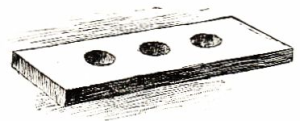
The next step in our work is to provide means for suspending the zincs and carbons in the tumblers. This will require a little carpenter-work. Get two pieces of well-seasoned and very dry wood (any kind will do), each about 1½ inches wide, 4 inches long, and 3/8 or ½ an inch thick, and bore three holes in each in the manner shown in Fig. 3. The holes should be, as nearly as possible, of the same diameter as the zincs and carbons, and the middle one should be midway between the ends of the wooden "hanger." The zincs and carbons are to be placed in these holes, and suspended in the tumblers as shown in Fig. 4, the zinc rod being placed in the centre, with one carbon rod on each side.
We are now ready to attach the wires to the zincs and carbons for the purpose of conveying the current from the battery to the lamp. Use No. 18 braided wire, which can be obtained of any dealer in electrical supplies. Any one caring to go to the extra expense, however, can get a silk-covered cord which is very neat and convenient, because two wires are twisted together, forming one cord. Each conductor of this cord is made up of several fine copper wires, instead of one solid wire, which makes it very flexible. But whether the cord or separate single wires are used, the connections with the zincs and carbons are the same. It is understood, of course, that it is necessary to have two wires to connect the battery and lamp. One end of each of the wires is connected with the lamp, and the other ends with the battery—one with the zincs and the other with the carbons.
FIG. 1.
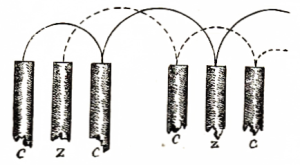
Fig. 1 shows how these battery connections must be made. One of the lamp wires is connected with the two carbons of cell No. 1 and the zinc of cell No. 2, and the other wire is connected with the zinc of cell No. 1 and the two carbons of cell No. 2.
To make these connections, have a sufficient length at one end of each of the wires to wrap four or five times around the carbons and zinc, allowing a little slack between them. Wrap as firmly as possible so as to insure a tight joint, as nothing is more wasteful of current than a loose connection. We need all the current for our lamp. Before wrapping the wire it should be well scraped and cleaned, in order to secure a good connection with the zinc and carbons. A dirty connection is as bad as a loose one.
Having connected the two wires with the carbons and zincs in the manner shown, in Fig. 1, we are now ready to connect the lamp. Remove the braid, or covering, of the free ends of the two wires for about two or three inches, and after scraping and cleaning the ends of the wire, twist them tightly with the two wires projecting from the lamp; then all the connections are made. If you now place the zincs and carbons in the solution (which I will presently refer to more particularly), your battery will produce a current which will make the little lamp give a light as sparkling as a diamond. The lamp is the most important part of the outfit, and cannot be made by amateurs. It must be bought of a dealer.
FIG. 2.
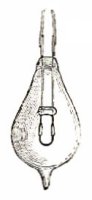
Fig. 2 is an illustration of a lamp that will give a light of ½ candle-power or more with the battery described above. This illustration is the actual size of a ½ candle-power lamp. The lamp is a small glass bulb, inside of which is a short length of carbon in the shape of a small arch. This carbon is connected with the wires running through and outside of the glass bulb, and when the current flows through the wires the carbon becomes "incandescent"—that is, white-hot. This carbon is in a vacuum, the air having been exhausted from the bulb in the process of manufacture. The vacuum is essential. Should there be none, and the space be filled with air, the carbon would be destroyed by the oxygen in the air the moment the current rendered it incandescent.
In handling the lamp while making connections with the battery wires, care must be taken that the lamp wires are not broken off close to the glass by too much twisting. Should this happen, the lamp would be rendered useless, because then we could not get a connection with the carbon filament.
All the connections having been made, everything is ready to charge the battery. Charging means to fill the cells with the proper chemical solutions which, in their action upon the zinc and carbons, produce the electric current. The chemicals necessary to make the solution for the battery can be bought at any drug-store, but those of our young friends who live in cities can buy the battery fluid all ready prepared at any electrical-supply house, if they do not care to bother with making it themselves. I would advise making it fresh, however, because it gives young experimenters some experience and something to think about. The fluid is called in the trade "electropoin fluid," and is sold by the pint, quart, gallon, or any other quantity, by the regular dealers. All batteries using this fluid are generally called "Electropoin" batteries.
To make this fluid the following ingredients are necessary: bichromate of potash, sulphuric acid, and water. Bichromate of potash comes in lumps, and is of a dark red or wine color; it can be bought at any drug-store. Sulphuric acid can also be bought at any drug-store; it must be handled very carefully, as it has a disagreeable habit of burning, and otherwise destroying almost everything it comes in contact with. Glass is one of the few substances it does not attack, therefore it is safe in a glass bottle.
FIG. 3.
The following is a receipt for preparing electropoin fluid: take 1½ lbs. of bichromate of potash, and after crushing the lumps as fine as possible, dissolve it in 2 quarts of boiling water. After this solution has become cold, add to it a solution composed of 1 quart of sulphuric acid and 3 quarts of water, and thoroughly mix the two. After the mixture is cool it is ready for use. This will be enough for several charges of the battery. A smaller quantity may be made by proportionate reduction in quantity of the several ingredients.
It is a very strange fact that pouring sulphuric acid into water produces no different effect than if the acid were so much water, but if the water is poured upon the acid a greatly different effect takes place. Heat is very rapidly developed, causing the liquids to boil violently, and sputtering and scattering in every direction. Care must be taken, therefore, to pour the acid into the water.
FIG. 4.
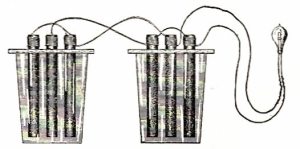
When the electropoin fluid is cool we can go ahead and set up our battery. Place the zincs and carbons in position in their wooden supports, Fig. 3, and suspend them in the tumblers, as shown in Fig. 4; pour the bichromate solution into the tumblers until it reaches within ¾ inch or 1 inch of the top. The wire connections should be made with the zinc and carbons before the battery is set up, because to attempt to make them after the solution is in the tumblers you cannot help spilling the fluid. And I might caution my young friends right here to be careful not to spill any of the solution on their clothes or on the carpet, as it eats holes in fabrics.
Now for the final touches. If we now connect the lamp to the battery wires it will give a brilliant light the moment we make the last connection, and continue to burn until the current is broken, which may be done by lifting the elements (as the zincs and carbons are called) out of the fluid. After a while, if the current is kept on for some time, the light will begin to diminish in brilliancy. This is due to exhaustion of the liquid in the tumblers, and when the light gets dim the solution should be renewed.
In connecting your lamp with the battery wires simply twist the lamp and battery wires together firmly but gently. All of the connections are shown very clearly in Fig. 2.
When the light is not desired it is best to remove the elements from the tumblers, so as to save the zinc. The acid in the solution dissolves the zinc.
An outfit of this sort costs about as follows: one Leclanche zinc (sawed in two), 8 cents; two plain electric-light carbons, 20 cents; one pound sulphuric acid (about one-half pint), 15 cents; one pound bichromate potash, 25 cents; twenty-five feet No. 18 wire, 15 cents; one-half candle-power lamp, $1; total cost, $1.83.
I have not included in this estimate the cost of the two tumblers or the wooden holders, because tumblers can always be had around the house, and no boy needs to be told where he can find wood. But to be on the safe side we will assume that tumblers and all have to be bought; then $2 will cover the cost easily.
Such an outfit as this is very interesting and instructive to every boy—and girl, too, for that matter—and what can be more fascinating than to be able to produce a beautiful electric light so easily?
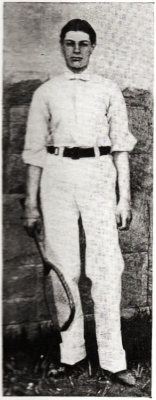
The sixth National Interscholastic Tennis Tournament was played last week at Newport, and resulted in a victory for Reginald Fincke, of the Hotchkiss School, winner of the Yale Interscholastic Tournament. His victory was more or less of a foregone conclusion on the form he had displayed in his early spring work; and the opponents he had to meet were none of them very formidable, the strongest, Beggs of Lawrenceville, not being present. This gave Walton of Colombia, the weakest man of the lot, a chance to get into the semi-finals, where he succumbed to the Harvard interscholastic representative in three straight and uninteresting sets.
INTERSCHOLASTIC TENNIS CHAMPIONSHIP SERIES.
Year.Played at.Winner.School.
1891.Cambridge.R. D. Wrenn.Cambridge Latin.
1892.Cambridge.M. G. Chace.Univ. Grammar, Prov.
1893.Newport.C. R. Budlong.High, Providence.
1894.Newport.W. G. Parker.Tutor, New York,
1895.Newport.L. E. Ware.Roxbury Latin.
1896.Newport.R. Fincke.Hotchkiss.
Fincke drew Turner of Chicago in the preliminaries, and defeated him, 6-4, 6-2, 6-8, 6-3. He then defeated Willing, the U. of P. interscholastic champion, 6-2, 6-1, 5-7, 6-4. His hardest match was with Edwards of English High-School. Edwards made a good brace in the third set, taking it 6-2, but he was unable to maintain this form, and although he did good work in the last set, he was unable to end better than 4-6. This gave the championship for 1896 to Fincke, 6-2, 6-4, 2-6, 6-4. A full summary of the play will be found on the next page; and the championship list now stands as shown in the table given above.
Sixth Annual National Interscholastic Tennis Tournament, Newport, August 20, 21, 22, 1896.
Preliminary Round.Semi-Final Round.Final Round.Interscholastic Champion.
J. K. Willing (U. of Pa.),}
R. Fincke (Yale),} Fincke, 6-4, 6-2, 6-8, 6-3.} Fincke, 6-2, 6-1, 5-7, 6-4.}
L. H. Turner (Univ. of Chicago).}}
} Fincke, 6-2, 6-4, 2-6, 6-4.
C. W. Beggs (Princeton),}}
J. McL. Walton (Columbia).} Walton, by default.} Edwards, 6-1, 6-0, 6-3.}
Y. M. Edwards (Harvard).}
REGINALD FINCKE. Interscholastic Tennis champion 1896.
It is sincerely to be hoped that the unfortunate differences between those stanch old rivals and worthy opponents, Exeter and Andover, will be brought to a friendly close this year. Since 1893 these two schools, who used to meet annually in football, baseball, and tennis, have not had any athletic intercourse whatever with one another, and all because, in their great rivalry and desire to beat one another, one of them certainly (and possibly both) overstepped the bounds of athletic ethics, and was guilty of practices which, by a little consideration and forethought, might have been avoided.
It is improbable that any good can be accomplished by going over the causes which brought about this rupture between the two schools, for stirring up mud and opening old wounds are of small benefit. Those who know what the causes were can do nothing better than to forget, and those who do not know what the trouble was will certainly find that here is a case where ignorance is bliss.
For the past year or more I have been in correspondence more or less actively with Exeter and Andover men, graduates and students and members of the two Faculties, and the general opinion among all seems to be that it would be a good thing to have the games renewed; and while both sides seem willing to meet again, neither side seems anxious to make the first advances. Both schools have, or think they have, grievances; and each thinks the other should lay aside its pride or stubbornness and make the friendly advances.
This situation might remain for an indefinite period if some strong-minded individual or individuals did not step in and say, "Let bygones be bygones, and let us start in on a new basis, wiping out all old scores, and henceforth sticking to the true spirit of amateur sport!" The difficult problem is to find the individual or individuals who may have enough influence in both camps to bring about this greatly to be desired termination. This might possibly be accomplished through the alumni associations of the two schools at Harvard and at Yale.
Andover and Exeter men, after they get to college, usually become great friends, because they feel, as graduates of these large schools, a sort of superiority over their less-fortunate classmates who did not get their schooling in such great and well-known institutions. This gives them a common ground to meet upon, and they soon forget the petty differences they may have had before they became college-men, and their reminiscences become bonds of friendship rather than sources of disturbance. But if the alumni in the colleges are to do anything, they must first find out definitely from the men in the two schools that the body scholastic is willing to wipe away old scores and go into a new era of interscholastic contest, otherwise the same unfortunate comedy will be played that was enacted a year or so ago, when some graduates arranged for a reunion of athletic interests.
These arrangements could not have been very well laid out, for, at the school meetings held the same hour, the same day, at Exeter and Andover, different votes were reached. One school voted to resume friendly relations, and the other school, unfortunately, voted to maintain the same attitude that had caused the unpleasantness for the past two or three years. The school that held out the hand of friendship naturally felt hurt at this, and also naturally vowed that it would never take any steps toward making up again. But that time has passed, and let us hope those who were at the meeting have forgotten how they felt, and let us also hope that the other school has seen by this time that it is not well to refuse to shake the hand that is held out in good-fellowship.
So much is to be gained by both Exeter and Andover from the contests as they used to be ten or fifteen years ago that it would seem that both schools must yearn for the old order of things. Andover now seeks Lawrenceville as its rival, and although Lawrenceville is decidedly a strong opponent, and Andover-Lawrenceville games should never be discontinued, yet Lawrenceville is not Andover's natural rival. Exeter has sought Worcester Academy, and tries to make itself believe that it holds a great interest in the Exeter-Worcester games; but there is no doubt that there is not half the enthusiasm in the school over a Worcester victory as there used to be, and would be now, over an Andover victory. The same might justly be said concerning Andover and Lawrenceville.
It is for this reason that I so sincerely hope that the graduates will take some steps this fall, and open the new era of friendship with a football game. Let each school be willing to make concessions, and in the end they will find that they have gained tenfold in self-respect and self-satisfaction for each concession they made.
The seniors at these schools, and the men who graduated from them last year and are now entering Freshman year at college, can combine in this movement, and I feel sure that if they are careful and thoughtful in their methods, they can heal this breach which has been a painful one for every Exeter and Andover graduate, and an unexplainable one for outsiders who have looked upon these two schools as strong exponents of the healthy spirit of scholastic sport in America.
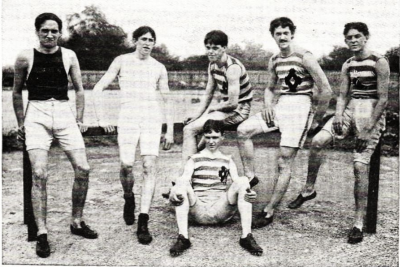
Beers. O'Rourke. Moore. Washburne. Hipple. Bedford. THE N.Y.I.S.A.A. TEAM AT THE NATIONAL GAMES.
The new football rules for 1896 have at last appeared in book form. It is pleasant to know that they are a great improvement on anything of the kind we have ever had before in America. The thanks of all sportsmen are due to the University Athletic Club's committee for the work they have performed, and, as the season grows older, every football-player will realize more and more how much the reform of the code was needed.
There probably never was a more critical period in the history of football than last year, when there were three sets of rules, and when a certain number of colleges were playing under one set, an equally large number were playing under another set, and perhaps a larger number still were using the rules of the year before or a compromise between the factional codes.
The principal changes to be observed in the 1896 code are in the rules governing the fair catch and the scrimmage. The committee have thought it wise to bring back the fair catch to the old ruling, which requires that a mark be made with the heel; the old penalty of fifteen yards for holding has been retained. There were those in the committee on revision who thought that there should be a penalty of twenty-five yards for holding a man who had made a fair catch, but the general opinion seemed to be that few umpires would have the courage to enforce this rule, and a compromise on fifteen yards was consequently adopted. Therefore, in so far as the fair catch is concerned, the situation is about the same as it was three years ago, except that the player making the catch is well protected by the severe penalty against interference or being thrown.
As to the scrimmage, the committee felt that there had been too great concentration of men in recent years, and they have attempted to hold in check the momentum plays. They have ruled that no player may take more than a single step before the ball is put in play—except one man, who may be in motion toward his own goal; this will bar out all forms of momentum play, and is a step in the right direction.
There is also a rule forbidding five men to bunch inside of tackles; this will serve to hold back mass plays, although, doubtless, the inventive minds of college football-players will be able to make up plays that can evade the spirit of this law. But the makers of the rules have hoped that the good judgment of captains and coaches may be relied upon to see that there is fully as much to be gained in open play as in the recently developed concentrated push work.
Among the minor changes to be noticed, in a cursory glance through the rules, is that on a fair catch the opponents must retire ten yards from the mark made by the catcher; this is a good ruling, for it places some value upon a fair catch. It is pleasant to note that the rule concerning interference with the centre rushers' snapping back of the ball has been made more stringent, and the officials must see that the ball is fairly put in play, and they must, according to the rule, insist that the opposing team do not interfere either with the ball or the man.
A number of years ago it used to be a favorite trick of the opposing centre to do all he could, by kicking or toeing or fingering the ball, to annoy the man who was snapping back. This was then put a stop to, and the opposing centres and guards began to shove and jostle their opponents, much to the delay of the game. These new rules concerning interference with centre play will prevent all of this nonsense, and will tend toward making scrimmage play more rapid and snappy.
On account of the development of quarter-back kicking, it has been found necessary to establish some rule that would make clear what kind of a kick must be made to give the opponents a fair chance at the ball. The rule has it that the ball when kicked by the quarter-back must pass beyond the line of the scrimmage.
One of the most complete and noticeable changes in the rules, however, although it is one that does not affect the game itself, is the common-sense arrangement of the paragraphs. The code begins by stating that "the game shall be played upon a rectangular field," etc. The old rules began with the statement that "a drop kick is made by letting the ball fall from the hands, and kicking it at the very instant it rises from the ground."
There is nothing in the old rules to show on what kind of a field the game should be played, or what the game was, or what kind of a ball it should be played with. There was nothing in the old rules forbidding a man to play the game with a cocked hat or a rubber boot if he chose; and if a team had come on a field with a baseball, and had insisted on running with that, there was absolutely no provision in the old rules by which the referee could forbid the playing of the game with a baseball.
Now, however, this absurd defect has been entirely done away with, and the new regulations, after describing the field and the teams, state that "the football used shall be of heavy leather, enclosing an inflated rubber bladder, and the ball shall have the shape of a prolate spheroid." Furthermore, no term is used in the new rules which has not first been fully defined. The first part of the code, therefore, is made up largely of definitions, and this is of great assistance, for it will prevent many a discussion and dispute on the field.
A few more remarks in conclusion of what was said in the Department last week concerning preliminary football work: Remember that by practice alone can a team perfect itself; and consequently every manager should try to arrange as many practice games as possible for the eleven under his care. After the school season has fairly begun, and the neighboring schools have their elevens somewhat organized, it is always possible to arrange games with outsiders. Thus when the championship contests come along the players will be accustomed to games with strangers. Too much practice with a scrub team breeds slack play and indifference. If it is possible to schedule practice games with other schools for Wednesdays and Saturdays—playing some teams two or three times, perhaps, in one season—the manager should make such arrangements. In or near large cities this is almost always possible, and perhaps that is why the football elevens of New York and Boston are usually so well trained and developed.
The reason is very clear. When you play a team from a distance, you are bound to learn something of that team's methods, and it usually has some points which had not yet occurred to you. If you play that same team again two or three weeks later, it has learned from others, and puts its newly acquired knowledge in practice against you, and you again have the advantage of the other fellows' work. Of course your opponents are benefited in the same way through playing with you; but that is only right, and is much to be desired.
If it is possible for a school team to have the services of a coach—some graduate or some ex-football-player living in the neighborhood—it should avail itself greedily of the privilege, for it is too much to expect a young captain to handle his men well and do all the coaching besides. And when an older player has been invited to coach, his commands should be obeyed to the letter; for if the players had enough confidence in him in the beginning to desire or accept his services, they can do no less than carry out his instructions if he gives up his time to coach them in their sport.
Furthermore, it should be remembered that the coach has had greater experience than any of the players, and he can also—as an outsider—tell much better what the proper course of action for a team is than any member of that team, who may be influenced by a great many conditions that do not affect the coach, and so do not weaken his judgment.
"TRACK ATHLETICS IN DETAIL."—Illustrated.—8vo, Cloth, Ornamental, $1.25.
The Graduate.

This Department is conducted in the interest of stamp and coin collectors, and the Editor will be pleased to answer any question on these subjects so far as possible. Correspondents should address Editor Stamp Department.
I was misled by the telegraphic report of the A.P.A. convention. The annual dues are $1.80, not $1.08, as mentioned in last week's paper.
One of the weaknesses of human nature is a desire to get something for nothing. Many stamp-collectors are constantly on the lookout for a "big bargain" in rare stamps. Now bargains of this kind are never offered by first-class dealers, as they know the real value of their wares, but unprincipled persons take advantage of this weakness of humanity, and many a new collector finds reason to repent of having bought such "bargains."
A French journal, Le Collectionneur des Timbres-Poste, in a late number gives an amusing instance. Baron de M—— purchased a collection of rare stamps for 25,000 francs, which would have been a big bargain if appearances had not been deceitful. With the assistance of a well-known collector, the Baron discovered his stamps to be a marvellous collection of counterfeit, fake, and patched-up stamps.
The following are some of the varieties of tricks practised by unscrupulous persons:
1. Ordinary perforated stamps with exceptionally wide margins have their perforations trimmed off, and such stamps are offered as rare unperforated stamps.
2. Ordinary perforated stamps with wide margins are re-perforated with the rare perforations. This is frequently done by means of an ordinary hand punch.
3. Where stamps are printed in the same color with slight changes in lettering, the rare varieties are made by piecing. For instance, the one-franc French Empire is made by taking the 80 centimes, dark carmine, with the bottom label from the one franc of the Republic.
4. Bicolored stamps with the centre reversed, which are extremely rare, are made by cutting out the centre and reversing it on another copy of the same stamp. For instance, the 1869 U.S. 15c., 24c., and 90c. have been made by this process.
5. By chemical means the color is changed. For instance, the 10r. blue of Brazil is changed into the 10r. black.
6. Stamps which have been cancelled by pen and ink have their cancellation marks removed by chemical means, and these stamps are then sold as unused.
7. Counterfeit cancellations are frequently made on genuine stamps which have been surcharged "reprint" or "specimen."
8. Counterfeit surcharges are extremely common. They can be made on an ordinary printing press.
9. False water-marks are sometimes made by printing the stamps with wood-cuts, using a certain kind of oil, or they are made by pressing the design of the water-mark on the stamp, and then removing a portion of the paper by rubbing with pumice stone.
10. Very rare stamps of which a portion has disappeared have had these portions added.
11. Are the ordinary counterfeits. Sometimes these counterfeits are of a higher order of work than the originals. One of the great European houses made fac-simile copies of all the U.S. periodical stamps, and advertised the same as fac-similes. Each stamp bore the word "fac-simile" or "falsch." These copies have frequently had a heavy cancellation applied to them immediately over the word "fac-simile" or "falsch." These stamps were then sold as genuine cancelled stamps.
The moral is a very simple one. Rare stamps should be bought from responsible dealers or responsible persons only.
Miss Cecile G. Rogers, 118 B Bluff, Yokohama, Japan, wishes to exchange Japanese stamps for those of other countries.
H. W. K.—No special value.
Philatus.