ADVERTISEMENTS.
Reading edition
A cream-of-tartar baking powder. Highest of all in leavening strength.—Latest United States Government Food Report.
Royal Baking Powder Co., New York.


This Department is conducted in the interest of Bicyclers, and the Editor will be pleased to answer any question on the subject. Our maps and tours contain many valuable data kindly supplied from the official maps and road-books of the League of American Wheelmen. Recognizing the value of the work being done by the L.A.W., the Editor will be pleased to furnish subscribers with membership blanks and information so far as possible.
Copyright, 1896, by Harper & Brothers.
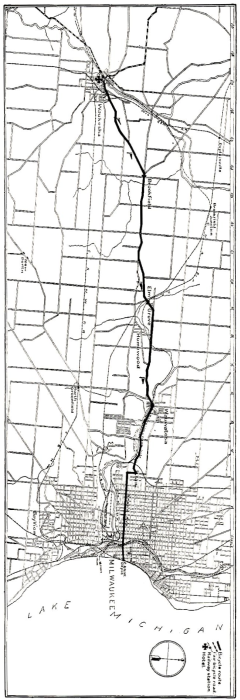
Several weeks ago we mentioned in this column another way of getting from Chicago to Waukesha. This was by taking steamer from Chicago to Milwaukee, and riding thence to Waukesha. The sail is a beautiful one, and makes one of the most interesting and varied pleasure trips near Chicago. On arrival in Milwaukee you will find yourself near the C. and N. W. Railroad depot, and the start awheel should be made from this point. Ride out Grand Avenue direct, crossing the river. This is a run of two and three-quarter miles, and when you are within about half a mile of the toll-house at the end of Grand Avenue, turn to the right and run up to it, keeping to the left on reaching it, and running thence out over the Watertown Plank-road. It is two and a half miles to Wauwatosa, and on entering the centre of the town turn left and cross the track. Thence run out up a steep hill, leaving Homewood on the south, and running into Elm Grove. On crossing the two tracks at Elm Grove, the road is clear to Brookfield, four and three-quarter miles away, and in good condition, except just as you leave Elm Grove, where there is a bit of hilly country. At Brookfield take the left hand of the three roads, and run thence direct to Waukesha. This three miles or more of road is in parts hilly, though at no point in the whole run is there any very bad hilly road. The road-bed itself is in very good condition for the whole sixteen or seventeen miles.
We have now covered this particular vicinity of Illinois pretty thoroughly. It is by far the best for bicycling on account not only of the good roads, but of the variety of scenery that presents itself to the wheelman. He can either ride by train from Chicago to Waukesha, or by boat and wheel, or by wheel. A very good week's trip would be to make the two days' bicycle trip from Chicago to Waukesha, as already described, stopping the night at Lippencott's. On the third day, or after a day's rest, to make the run to Oconomowoc and return to Waukesha, and then, with another day in the vicinity, to finally ride by wheel to Milwaukee over the road described this week, and return to Chicago from the latter place by boat. Or the trip could be reversed, and begun with the sail to Milwaukee, thence proceeding to Waukesha, and returning by the two days' trip to Chicago.
Note.—Map of New York city asphalted streets in No. 809. Map of route from New York to Tarrytown in No. 810. New York to Stamford, Connecticut, in No. 811. New York to Staten Island in No. 812. New Jersey from Hoboken to Pine Brook in No. 813. Brooklyn in No. 814. Brooklyn to Babylon in No. 815. Brooklyn to Northport in No. 816. Tarrytown to Poughkeepsie in No. 817. Poughkeepsie to Hudson in No. 818. Hudson to Albany in No. 819. Tottenville to Trenton in No. 820. Trenton to Philadelphia in No. 821. Philadelphia in No. 822. Philadelphia-Wissahickon Route in No. 823. Philadelphia to West Chester in No. 824. Philadelphia to Atlantic City—First Stage in No. 825; Second Stage in No. 826. Philadelphia to Vineland—First Stage in No. 827; Second Stage in No. 828. New York to Boston—Second Stage in No. 829; Third Stage in No. 830; Fourth Stage in No. 831; Fifth Stage in No. 832; Sixth Stage in No. 833. Boston to Concord in No. 834. Boston in No. 835. Boston to Gloucester in No. 836. Boston to Newburyport in No. 837. Boston to New Bedford in No. 838. Boston to South Framingham in No. 839. Boston to Nahant in No. 840. Boston to Lowell in No. 841. Boston to Nantasket Beach in No. 842. Boston Circuit Ride in No. 843. Philadelphia to Washington—First Stage in No. 844; Second Stage in No. 845; Third Stage in No. 846; Fourth Stage in No. 847; Fifth Stage in No. 848. City of Washington in No. 849. City of Albany in No. 854; Albany to Fonda in No 855; Fonda to Utica in No. 856; Utica to Syracuse in No. 857; Syracuse to Lyons in No. 858; Lyons to Rochester in No. 859; Rochester to Batavia in No. 860; Batavia to Buffalo in No. 861; Poughkeepsie to Newtown in No. 864; Newtown to Hartford in No. 865; New Haven to Hartford in No, 866; Hartford to Springfield in No. 867; Hartford to Canaan in No. 868; Canaan to Pittsfield in No. 869; Hudson to Pittsfield in No. 870. City of Chicago in No. 874. Waukesha to Oconomowoc in No. 875; Chicago to Wheeling in No. 876; Wheeling to Lippencott's in No. 877; Lippencott's to Waukeska in No. 878.
The sheriff of the village had been annoyed with complaints from the farmers about the loss of their chickens. He suspected a couple of colored gentlemen, and catching sight of them among the usual congregation at the village store one afternoon, he strolled in.
"Well, boys," he said, "there's a powerful rain-storm brewing in the west. I tell you that when that rain comes it will bring things above ground mighty lively."
In a short time the two colored men left the store. The sheriff chuckled to himself, and going after them, found them both busily burying chicken bones deeper in the earth.
Any questions in regard to photograph matters will be willingly answered by the Editor of this column, and we should be glad to hear from any of our club who can make helpful suggestions.
PRINTING ON COTTON, SILK, OR LINEN.
Photographic printing may be done on almost any textile fabric if it is properly sized and sensitized. Linen and silk may be obtained already sensitized, but it may be prepared very easily by the skilful amateur.
To size the fabric make a solution of
Boiling water8oz.
Chloride of ammonium10grs.
Iceland moss6grs.
When nearly cold filter through two thicknesses of blotting-paper, and soak the fabric in it for a quarter of an hour. Tack it at the corners to a smooth board so as to stretch out the wrinkles, and dry in a place free from dust.
Another sizing solution is made as follows:
Ammonium chloride1part
Water125parts
White of one egg.
After the fabric has been sized and dried it may be sensitized in any good sensitizing silver bath. A bath which is always reliable is made from
Nitrate of silver60grs.
Water1oz.
Dissolve the silver in the water, and add strong ammonia water drop by drop. A brownish precipitate will be formed, but keep on adding the ammonia till the liquid clears again. The mixture should be stirred all the while during the process, using a glass rod for the purpose. If the solution does not clear after the addition of twenty-five drops of ammonia, clear by filtering.
The fabric may be either immersed in this solution, or it may be stretched on a flat smooth board or sheet of glass, and the solution applied with a brush. The fabric should be stretched while drying, and if one uses the small-sized artist's thumb-tacks, there will be no danger of holes remaining in the fabric after it is taken from the board. It is almost needless to say that the sensitizing must be done in a room lighted by gas or lamp, and the fabric dried in the dark.
For printing one must make a special back for the printing-frame. For this take wood the same thickness of the back, and instead of making the two pieces which are hinged together of the same size, make one of them two inches, and the other six inches across—if the frame is a 5 by 8 printing-frame. A 5 by 8 printing-frame is a good size to use; the 4 by 5 is too small.
In the larger half of the printing-frame cut a round hole of two or three inches in diameter, and fit it with a smooth tapering cork. This cork should be of fine grain, and made to fit snugly into the hole.
To print, draw the fabric over the cork and push it up through the hole in the printing-frame far enough to come in close contact with the negative without pressing too hard against it. Fasten the springs and print as if on sensitive paper. Any boy or girl who is handy with tools can make one of these backs for a printing-frame.
One can make prints on the corners of silk handkerchiefs, on silks for cushion covers, on linen for doilies, or on linen for photograph-frames. The process is simple and inexpensive.
Sir Knight Ralph B. Rood, Cleveland, Ohio, asks if the radial energy of light is greater when the snow is on the ground than on clear days in summer; how dust can be kept from collecting on films during the drying; what makes the corners of a negative come out in some pictures with no detail, making heavy shadows when primed. The light is much stronger in the winter when the sun is shining on the snow than it is in a clear day in summer, owing to the intense white glare reflected from the snow. A shorter exposure should be made for snow pictures, and a small diaphragm used. To keep dust from films when drying, pin the films by the corners to a flat board—the editor uses grape-basket covers for this purpose—and set the board in a slanting position against the wall, with films on the under side. The reason of the defective corners in the negative may be either from the film not being evenly coated, or from a shadow falling across the lens during the exposure. Sir Ralph has a No. 1 Kodak for sale, which is in good repair, and has a leather carrying-case. Sir Ralph's address is No. 23 Dunham Place, Cleveland, Ohio. Any member of the club wishing a Kodak cheap is requested to correspond with Sir Ralph.
Sir Knight Hugo Kretschmar, N. Y., asks if chloride of ammonia is the same as sal-ammoniac; if red prussiate of potash can be made of yellow prussiate potash; and if artists' gold-leaf could be used to make chloride of gold; and if an amateur could make nitrate of silver. Sal-ammoniac and chloride of ammonia are the same. Red prussiate of potash cannot be made from yellow prussiate of potash. If blue-print paper is made of yellow prussiate of potash (potassium ferrocyanide) instead of red prussiate of potash (potassium ferricyanide), the result will be a negative print, instead of a positive. The gold used by china-painters may be used for chloride of gold. Do not put the gold into muriatic acid, but into nitro-muriatic acid, made by mixing one part nitric and two parts muriatic acid, diluting with an equal quantity of water. This liquid is known as "aqua-regia." An amateur could make nitrate of silver, but it would not pay for the trouble, nitrate of silver being very cheap.
FEED THEM PROPERLY
and carefully; reduce the painfully large percentage of infant mortality. Take no chances and make no experiments in this very important matter. The Gail Borden Eagle Brand Condensed Milk has saved thousands of little lives.—[Adv.]