OLD HAMMER-THE-ROCKS.
Reading edition
BY WILLIAM DRYSDALE.
Down in Brooks County, in southern Georgia, people are still laughing over the great joke on Dick Weston. Dick is rather a favorite, too, though he is a Northerner; but people always laugh at a fellow who tries to play a sharp game and is tripped up.
"Now don't you be like Dick Weston," they tell their boys, "and waste your time waiting for dead-men's shoes. I want to see you like his cousin Larry—able to show that you amount to something."
There would not have been any joke on Dick Weston, and perhaps Larry Weston would not have made his great strike, if it had not been for the civil war. Major Weston, of Massachusetts, went down to Georgia in the Union army, and after the war he bought a big plantation in Brooks County, and made a heap of money. Then years afterward his brother Henry, a merchant in Boston, went down and bought half the plantation; and there the two lived, and still live, with every comfort in the world, except the comfort of good wives; for they are both old bachelors.
Of course it was common talk in Dick's family, and in Larry's family, too, that the two bachelor uncles were very rich, and that the two nephews would most likely be their heirs. Larry never paid any attention to this talk, for his head was full of other things. But it was very different with Dick.
"Your nose is out of joint, young man," Larry's father said one day, giving him a poke in the ribs; "I have a letter from your uncle George, and he says Dick is going to make his home with them."
"Why shouldn't he, if they want him?" Larry answered. "I'm sure I don't envy him. For my part, I'd rather make my own way than depend upon somebody else."
That was two years before Larry's visit to Georgia, and Dick put in two years of faithful work trying to make himself agreeable to his rich uncles. Ho was so sweet around the house that his old school-mates would hardly have known him. His uncles' slippers were always warmed before the fire on cold mornings; and whatever they liked, Dick liked. If they had said that cotton grew on chestnut-trees, Dick would have said so too.
Uncle George and Uncle Henry laughed in their sleeves at Dick's wonderful affection, for they had been in the world a good while and knew a thing or two. But they liked him, nevertheless, for he had pleasant ways and was a handsome fellow; and the neighbors liked him, though they said, "he's playing for big stakes, and he'll likely win."
All this time Larry was attending strictly to his own business, and learning a heap about the rocks that lie in the ground. That was his hobby. Other things he learned because he knew they were necessary; but mineralogy he studied because he loved it. His ambition was to go out into the Southwest when he was old enough, and find gold or silver or some other valuable stuff where nobody suspected its existence. His room was full of cases of broken rock, and he rarely went out without his little hammer. It was a standing joke in the house that the police were looking for him for breaking corners off the curb-stones.
The two uncles evidently kept an eye upon Larry, for as soon as he was done with school they invited him to spend a month on the plantation. That was when he was just past eighteen.
"No, sir!" he said to his father. "I wouldn't go for a farm. There's no meaner business in the world than trying to curry favor with rich relations."
"But think what a chance you'd have to geologize, or metallurgize, or whatever you call it!" his father suggested. "There must be rocks in that country, and you could break them by the ton."
That put a new face on the matter. Larry had nicked specimens from the rocks of Harlem and Manhattanville and the Palisades, but the Georgia rocks would give him a new field; and for strictly professional reasons he decided to go.
As Larry had never seen a plantation before, he found everything very different, of course, from what he expected. It was much larger, to begin with—more than 4000 acres—and he could roam about all day without going off his uncles' land. One big cotton-field contained more than 2000 acres, and one morning he counted eighty-five men, women, and children at work on it hoeing cotton. At the same time twenty men, with mules, were cultivating corn on the other side of the place; and the rows of cabins for the workmen looked like a village. Still he was rather disappointed. He expected to see beautiful green lawns shaded by fine old oaks, and beds of brilliant flowers, and everything as smooth and clean as a rich man's place in the North. There were plenty of oaks and flowers, to be sure, but there was no skilful gardener to keep them trimmed smooth. The house was old, and as there was no mistress, the negro women had their own way, and everything was in disorder.
But the plantation was no more of a disappointment to Larry than Larry was to the plantation—at first. He was so quiet and thoughtful, not at all such a "hail-fellow-well-met" with everybody as Cousin Dick. There were horses to ride and birds to shoot and fish to catch, but he took no interest in such things. When he could have a bit of rare rock to examine, and some acids to test it with, he liked that better than the plantation sports.
"Come, Larry," Uncle Henry said one morning, "and take a gallop with us. We are just half-way between Quitman and Thomasville here, and we'll go whichever way you like."
"I don't know much about horses, Uncle Henry," Larry answered, "and don't want to break my neck. Besides, I have some queer specimens here that I want to test; so I guess I'll keep house while the rest of you go."
Dick was suspicious of his cousin, and always ready to make him the butt of his jokes. Before Larry had been on the plantation a week he had nicknamed him Post-Pliocene, Alluvium, Kill-Sport, and a dozen other things; but Old Hammer-the-Rocks was the favorite title, and it was so appropriate that it always made Larry smile. And Dick's love for his cousin did not increase at all when he found, after a few days, that the uncles had discovered that Larry was full of information about many things, and liked to talk with him on subjects that Dick knew nothing whatever about.
On the morning of the day when Dick unwittingly played the great joke on himself, Larry was sitting in the library just after breakfast, looking over the State Geologist's Report. Dick soon joined him, and burst out with:
"Come on, Old Hammer-the-Rocks! We're going after birds. Shake yourself up once and come along."
"I never killed a bird in my life, Dick," Larry answered, "and I'm not going to begin to-day."
"Ah, indeed!" Dick sneered. "Don't approve of such sport, I suppose."
"No, I can't say that I do," Larry replied, very good-naturedly. "It may be sport for you, but what must the birds think about it?"
Uncle George, the Major, bustled into the library after his cartridge-belt just in time to hear this conversation.
"Who's that don't approve of killing birds?" he asked, pretending to be very angry.
"I don't, Uncle George," Larry replied, "It's a heap more pleasure to hear them sing in the trees than it can be to kill and eat them."
As he spoke he could hardly keep from laughing outright at the expression on Dick's face. Dick seemed perfectly horror-stricken to hear one of his rich uncles reproved in such a fashion.
"Well, there are more important things in the world, that's a fact," the Major laughed. "You go ahead with your uncle Henry, Dick, and I'll join you later. I want to have a little talk with Larry."
"This is a nice state of affairs!" Dick said to himself, as he went out. "I never contradicted Uncle George in my life, but he never keeps me in the library for a private talk!" and he began to wonder whether a little independence, after all, could be better than his own way.
"You mustn't let us bore you with our country sports, Larry," the Major said, when they were alone. "We have nothing else to amuse ourselves with, but you have. I am glad to see you so much interested in geology and mineralogy; the knowledge may be useful to you some day. That is all I wanted to say; I want you to enjoy yourself while you are here, and enjoy yourself in your own way, whether it's shooting birds or hammering rocks. Now I'll go and murder a few birds, as I know nothing about rocks myself."
Left to himself for the whole morning, Larry determined to follow the little creek that ran southward, and see what its banks had to offer. Besides, he knew that by following it for three or four miles he would come to the Florida line, and he wanted to be able to say that he had been in Florida. So, with his hammer and his little black bag, he set out.
The Weston place, like most of the big plantations, has its own gin-house, where the cotton is passed through a machine that separates the fibre from the seed; and the gin-house is always built over a running stream, so that the water will turn the big wheel.
He did not imagine, as he followed the gin-house stream, how fate was arranging everything for him that morning. He had not gone a mile before the sky began to grow black.
"No matter," he said to himself; "if it should rain hard, there is the gin-house a mile further on. I can find shelter there."
The rain came in due course, a real Southern downpour, and he hurried along to the gin-house and went in.
It is a ghostly old place, that Weston gin-house, built of solid timbers many years ago. The floor is on a level with the ground, and a big double door lets in light for the machine. But beneath the floor is a deep gully washed out by the stream, dark and damp. From a trap in the floor, steps lead down into that black hole, where the big wheel turns, and a maze of great timbers support the wheel and the building.
Just as Larry stepped into the gin-house and closed the door, Dick emerged from the woods beyond, hurrying home out of the rain.
"There's Old Hammer-the-Rocks gone into the gin-house," he said to himself, "and I believe I'll get a little wetter for the sake of giving him a scare. Instead of going in myself, I'll put the prop against the door and fasten him in."
The rain made so much noise that there was little danger of his being heard, and he went boldly up and fastened the doors.
"Now he'll have a time of it," Dick said to himself. "The only way he can get out is to go down past the wheel, then climb down the timbers to the bank of the stream, and crawl under the siding and climb up the rocks. Those timbers are slippery, too; but if he breaks his neck that's his lookout, not mine."
Up to a certain point everything worked precisely as Dick had foreseen; but who in the world could have imagined what was to happen afterward?
When the rain let up a little Larry tried to open the doors, but they would not open. He pushed and pulled, but the heavy doors would not budge. Then he began to investigate. It was very dark inside, but through the trap he saw that down below the wheel there was more light. Though the house was weather-boarded all the way down, there was an open space at the bottom for the water to run through. That was the only way to get out.
He felt his way cautiously down the dark stairs to the platform by the wheel, expecting every minute to put his hand on a lizard or a centipede or some other unpleasant creature. The wilderness of thick timbers down there reminded him of some church belfries he had been in, but the belfry timbers were not so soft and slimy to the touch. From the side of the wheel he started to walk across a short timber to the wall, so that he could climb down to the bottom of the gully. But the timber was worse than he thought—half rotten, slippery with moss and slime. His foot slipped, and he fell, not into the shallow water, but upon the rocks by the side of the little stream.
That was just as Dick had more than half wished. Larry lay stunned upon the rocks beneath the old gin-house.
But then the great joke on Dick Weston that all of Brooks County is still laughing about began to develop.
LARRY'S DISCOVERY UNDER THE MILL.
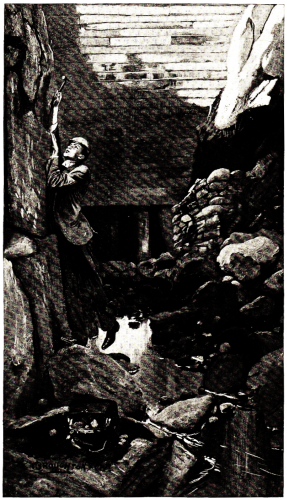
Instead of lying there mangled and bleeding, Larry got up and found that he had no hurts beyond a few bruises. He was in a spooky place, but he forgot all about the fall and the mystery of the closed door when he saw that there were more rocks all around him than he had found before on the whole plantation. The stream had cut its way between walls of rock, and the ledge was littered with loose bowlders, large and small.
He picked up some small specimens to put into his black bag, and something in the feel of them startled him. It was a curious combination of roughness and smoothness that his fingers touched. He knew he had felt that species of rock before, but where? Certainly not often. It must be something uncommon. He picked up as many specimens as the little satchel would hold, and crawled out into the daylight.
He was twenty feet below the surface, between two walls of rock that extended as far up the gully as he could see. He touched one of the rocky walls, and felt again that curious sensation of roughness and smoothness.
He chipped off a small piece with his hammer, and sat down on a big bowlder to examine it.
"Now I have it!" he exclaimed. "It was in the Museum of Natural History that I saw and felt this stuff. But it can't be that this is a great deposit of—"
He was almost afraid to speak the word, for perhaps he was mistaken, after all. He took the hammer again and pounded part of his specimen into powder, felt it, studied of it, and tasted it with his tongue.
Ten minutes later he was hurrying across the wet fields towards the house, his pockets bulging with specimens broken from a dozen different places. When he reached home he went straight to his room, and soon filled the air with the unpleasant odor of acids poured upon pounded rock.
The Major and Uncle Henry and Dick were in the library when he went down stairs, talking over their morning's sport.
"Oh, you missed it, Hammer-the-Rocks!" Dick exclaimed. "We had a royal time."
"I had a pretty good time too," Larry answered. "I explored the cellar of the old gin-house, and found some very interesting specimens." And he unloaded his pockets and the satchel upon the library table.
"Specimens!" the Major exclaimed, picking up one of the pieces. "Why, this is just our common rock. I'm afraid you have fooled yourself this time, Larry. The whole place is underlaid with this stuff—more's the pity!"
"Is it?" Larry asked, very coolly; "that's good. What name do you give it?"
"Oh, we don't give it any particular name," the Major replied, tossing the specimen back to the table; "just ordinary rock."
"Then you won't mind my giving it a name, Uncle George," Larry went on. "I call it wavellite; it is worth about eight dollars a ton, just as it lies."
"What?" both the uncles exclaimed together, springing to their feet. "Eight dollars a ton!" And Cousin Dick began to look uncomfortable.
"Fully that; perhaps more," Larry continued. "I consider it a better find than a vein of gold, for it is safer. It is the most valuable phosphoric rock known to commerce, and has never been found anywhere but on one little island in the West Indies. Wavellite, or Redondo mineral, is the commercial name of it. But you must not depend solely on my opinion. Have the specimens examined by an expert."
The bird pie received little attention that day. Uncle Henry took an afternoon train to Savannah with half a pack of specimens, and returned two days later with the expert's verdict: "Wavellite beyond doubt." Soon acres of growing cotton were turned into big holes in the ground where the mining was done. The beauty of the plantation was spoiled by the heaps of rock thrown up, but its value was increased many times over.
It was only last week that the Major wrote to Larry's father:
"Of course you will not think of calling Larry home. He has charge of all our mining operations, with a ten-per-cent. interest in the output that will make him a rich man in two or three years. Dick, I am glad to say, is making himself useful too; he is Larry's clerk. I suppose we should never have known of the wealth under our feet if it had not been for Larry."
It was Dick's own fault that the story of the gin-house leaked out. He told one of his intimate friends about his "bad luck," and it was soon all over Brooks County. As the planters ride past and see him keeping tally in his little book, they often call to him:
"Hello, Dick! What will you take to fasten somebody in my gin-house?"