THE EAST-SIDE BOY AND HIS GAMES.
Reading edition
BY REV. JOHN T. WILDS, D.D.
Being a boy in a crowded city and being a boy in a village are two different things, though boys the world over are always boys. The balance of fun and sport is, after all, in favor of the city lad, the offspring of the tenement-house.
WAR.
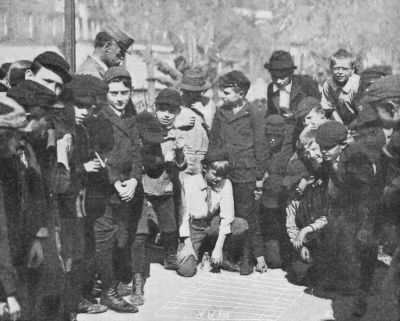
After spending my boyhood in a delightful mountain village, and after being much of a boy, although a man, for years in the crowded tenement section of the East Side of New York, I am inclined to believe that pity is greatly misplaced when a youthful reader of the Round Table spreads himself in summer days under a great tree, feels sorry for the poor East-sider of New York, and says, "It's too bad he can't be here with me." Right now, my delightful friend under the tree, shouts of merriment ring in my ears from boys who last night slept in a close room, or possibly on the fire-escape, whose breakfast was most meagre because their parents are poor and honest. They are as happy as the day is long. They are happier longer than the day, because they never go to bed until ten o'clock, and they only go then because the hall light is turned out at that hour, and they don't like to climb up to the top story, or go through a long alleyway in the dark any more than you enjoy going through a graveyard in the night-time.
Necessity keeps the East-sider active. If he lolls on the street the police stir him; if he hangs about a store the keeper chases him away; but they tolerate him when he is playing. Necessity also make him inventive. They make their games and have them in season. They would as soon think of wearing an ulster in summer-time as play top in July. I don't know but that they have a code quite as reasonable as the high-classed youth who patterns after the dude.
Our happy lad of the tenement, until he is fourteen when he leaves school and goes to work, is compelled to play in crowded streets where hundreds of children swarm like bees, and necessarily within a narrow space. But he has broad ideas, and insists upon doing, accommodating the space in some way, whatever others do. The asphalt pavements are of the greatest blessing—far better than roof-gardens, and since we cannot have many parks, they are of greater importance to all concerned than the little squares that dot our city. At evening-time, when the street-organs have not gathered all the girls of the block for a dance and during the day on the sunny side of the street one may find a most energetic crowd of boys, eager, and intensely excited over a game. The streets and pavements are all marked over with strange diagrams, each one of which tells of a conflict. "Tip Cat" is always popular, but played, as a rule, in the morning; so also is "Kicking the Stick or Can." When the sun is hot they get on the shady side and play "Long Branch" and "War." Later on they have the "Hopping Game" and "Spread the Woman." Then when night comes—and it is not night, for the streets are as light as day because of the electric-light or gas—they dart about as detectives and robbers playing "Relievio."
BASEBALL.
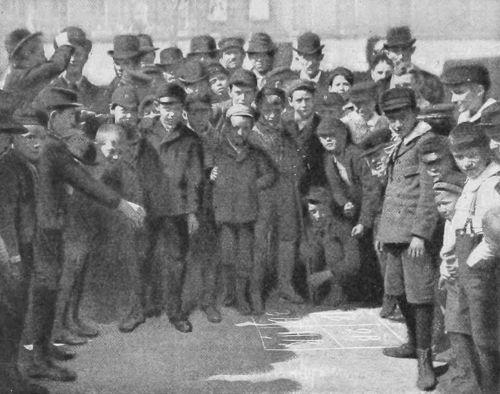
It will be observed that they play what men do. You may often hear an imitation of the fire-gong, and see boys rush out before an imaginary wagon and engine, and go through the motion of having a fire. Children are rescued, the dead are laid out, medals are awarded for bravery. When the Ludlow Street Jail robbers escaped, the boys devised a jail, and the three noted robbers were impersonated, and escaped. The jailer was in dismay. Detectives and police went forth, climbing on tops of houses, over fences, eagerly searching for the men. And they were successful, be it said to the honor of the boys.
Of course they play baseball. What boy does not? These East-siders have not the green diamond—if they had they would roll over the grass, pat it in love, sit down and look at it a long time before they would play ball upon it. I have taken children to the Park, far up to the Bronx, where everything is delightfully free, and they have sat down and rubbed the grass, and petted it as a child will a tender animal. But they have their ball games and get excited over them, although the diamond is on stone, and not two feet square.
They are always at something, and less frequently in mischief than one would think. They are divided into crowds, each street or block has its gang, and woe be to him who dares encroach. They have chosen leaders whose command they obey. There is a vast deal of honor among them, and I am not sure but that he is somewhat better than the lad that hangs around the country store or goes swimming, in the mill-pond of the village.
The following are some of the summer games that engage his attention and keep him out of mischief:
BASEBALL.
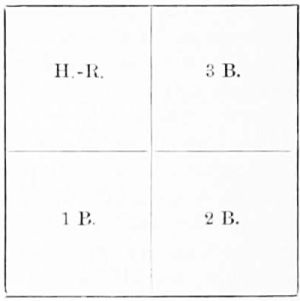
Construct a square having four squares within, each marked as in the illustration. Then construct your score-card after the usual manner. Stand ten or more feet off and toss a penny or piece of lead, which the boys call the lead digger, into the squares. If it touches a line or falls outside he is out. If it falls within one of the squares it counts for so many base hits as the square indicates. For example, if it is on H.-R., it is a score, that being a home-run. If on 2 B., that means two-base hit, which puts him on second base. The rest of the game is like baseball.
H. R.—Home-run. 3 B.—Three-Base Hit. 2 B.—Two-Base Hit. 1 B.—One-Base Hit.
TIP CAT.
A two-foot circle is made, or more commonly with the lad of these parts the manhole or steam-escape tap selected. On the side of it is drawn a mark which is called the measuring spot. In the centre of the circle is placed a stick about four or six inches long, tapered to one end. This is called the cat. The batter strikes this tapered end so that it will fly up, and then bats it as in baseball. The one in the field returns it. If he throws it within the distance measured by the bat from the measuring spot the batter is out. If that is not done the batter measures to the cat, and the number of times it takes the stick to reach it counts so many tallies. The game is limited by a number from one hundred and up.
RELIEVIO.
Make a boundary-line embracing such territory as is wise or as your space allows, across which no player can go. If he does he is captured. Then make a den by drawing a square 3 x 4 feet.
Divide the players into two equal parts, each side appointing a captain and den-keeper. The two sides are called detectives and robbers. The side being out are the robbers.
The robbers then hide in any place within the boundary. When hid the captain of the robbers cries "relievio!" meaning "ready." The captain of the detectives then sends out his men to search for the robbers. When a robber is found and caught he must not struggle until within six feet of the den, when he can try to get away. The work of the detective is to get the robber within touch of the keeper. If the keeper touches the robber he yields and enters the den. It is necessary for the keeper to stand with one foot in the den. If both feet are placed in the den, or both outside, the prisoners are free. If at any time a robber, not captured, can place his foot in the den and cries "relievio!" he sets the prisoners free. If in his attempt to free the prisoners the keeper simply touches him he is captured. Only one detective at a time can take a robber.
When all the robbers are captured, the sides change.
"SPREAD THE WOMAN."
A hat or tin-can is placed on the ground between a player's feet, whose name is "It." All the other players gather near him for the purpose of kicking the object. If a player kicks the object, and is touched by It, he becomes It. If It chases the one who touched the object, the others may kick it, and then It has to return.
The game has time limit. Each one plays for himself.
LONG BRANCH.
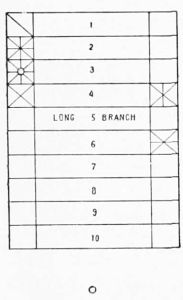
Construct a diagram like the illustration; place a penny on a spot about six inches from lower line, and shove it with the finger for one of the numbered spaces. If it touches a line it is out. If it is on a space, that space is marked by a line first drawn across, as seen on first line. If first line is touched four times a star is made, as seen in second space. If again it falls on that space a bullet is made, as seen on third space. If the digger is on "Long Branch," it gives a mark to each space. The side that has the most bullets on the stars, as in the third space, wins. The players alternate in playing. The players are equally divided. Two or more may play.
HOPPING GAME.
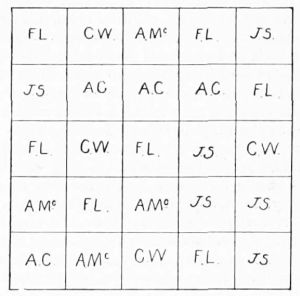
Make a diagram like the illustration, each square about six inches square, and five for each player. The first player hops around in each space, commencing with "start" and finishing at "end." If he touches the line he is out for that turn. If he goes round successfully, he is permitted to put his initial or number on the space he may choose. When he is hopping he may rest on both feet at such spaces, but all other players must hop over them. The game is finished when all the spaces are filled, and the one whose name is most numerous is winner. "F. L." has won in the illustration.
WAR.
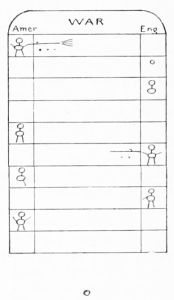
Construct a diagram like the illustration; place a penny on a spot six or more inches from the last line, and shove or shoot it with the finger. If it touches a line the play is a failure, and the next player takes his turn, but if it stops on a space, you make a round mark in imitation of a man's head. If it falls on the part marked "War," it entitles you to a mark in each space. After the head are formed the body, the legs (one at a time), then the arms (one at a time), then a gun is placed in the soldiers' hands; each play in that space then gives a bullet, so marked by little balls, until there are three; then the next successful play on that space fires the gun, and, of course, kills the enemy. Thus the game continues until one side has all its soldiers killed by the men of the other.
During the war between Japan and China, those two countries were at war every day on the sidewalks of the city. Often I have heard shouts that called me to my window, when I would see the triumphant party rejoicing over their victory.