THE BUILDING OF MODERN WONDERS.
Reading edition
AN ELECTRIC TROLLEY-CAR.
BY HERBERT LAWS WEBB.
One day, not very long ago, when electric cars were something of a novelty, a city official was talking about them to one of the electrical engineers in charge of a certain electric railway.
"It seems to me," said he, "that those trolley-poles on top of the cars ought to be very much stronger than they are."
"Why so?" asked the electrical man. "We very seldom have any accident with them. They almost never break."
"Don't they!" queried the other, with some astonishment. "Well, they don't look to me half strong enough to push those heavy cars along."
I suppose very few readers of the Round Table have such very foggy ideas about electric cars as that man had. But still it is something of a mystery to many people how the slender wire stretched along the street takes the place of the hundreds of tugging horses or of the rattling, whirring cable that glides ceaselessly through the long iron trough under the pavement.
Many years ago one of those famous scientific men who were always making experiments to discover new things about electricity, so as to enable practical men in these days to invent machines to do useful work, discovered that when he moved a wire about in front of a magnet an electric current appeared in the wire. This was a great discovery, because it brought to light the wonderful sympathy between magnetism and electricity. It made no difference whether the wire or the magnet were moved; as long as they were close enough together any movement of either caused a current to appear in the wire.
Then another famous discoverer found that by winding a wire round a bar of iron and sending a current of electricity through the wire he turned the bar of iron into a magnet. As long as the current was passing through the wire the iron bar acted just like a permanent steel magnet; it would attract pieces of iron and hold up nails, but the moment the current was stopped the bar lost its magnetism, the nails or pieces of iron dropped off, and it became just an ordinary bar of iron again. This invention is called the electro-magnet, and the electro-magnet is used in some form or other in every electrical industry.
The electric dynamo owes its being to those two discoveries. It consists of coils of copper wire wound on a shaft, and that shaft is revolved close to a powerful magnet. The influence of the magnet causes electric currents to be produced in the coils of copper wire, and these currents are delivered by the coils into suitable conductors or wires by means of which the currents are led to the place where they have to do their work. One very interesting thing about the modern dynamo machine is that it is what electrical men call "self-exciting." That does not mean that it gets into a state of excitement about itself. It means that the dynamo provides its own magnetism. At first dynamos were made with great big steel magnets, but those were very expensive and unsatisfactory. Then a clever inventor hit upon the plan of using electro-magnets, and sending part of the current of the dynamo through their coils to give them magnetism. This is the action of the self-exciting dynamo. When the collection of coils wound on the revolving shaft first begins to turn, very little current is produced, because there is very little magnetism in the iron magnets. Part of this current goes through the magnet coils and increases the magnetism; this strengthens the current in the coils, and this process goes on until, after a few minutes, the magnets are fully magnetized and the coils are giving their full strength of current.
Diagram showing the electric circuit through each car, and illustrating the method of sending more than one car along the same wire.

Some time after this was discovered, it became known that if the two wires from a dynamo were joined to a second dynamo instead of to an electric lamp, this second dynamo would revolve, and could be used to drive a machine, such as a sewing-machine or a printing-press.
At first this electric motor, as it was called, was used only for turning wheels that were stationary, but it was soon seen that there was good work for it to do in turning wheels that should travel along over the ground. Then began the electric railway.
Having got your electric motor it would seem a comparatively easy job to mount it on a car, to fix up a moving connection with an electric wire, and to make the motor turn the car-wheels. It looks easy enough to-day in places where hundreds of horseless cars are running about in all directions as if by magic. In the beginning it was not such an easy job, and those who led the way in the building and running of electric cars had many difficulties to contend with and many obstacles to overcome before they made the electric street-car the practical everyday affair that it is now.
Just look first at your electric motor. It is, like all electrical instruments and machines, a pretty delicate affair, very likely to suffer serious injury from hard usage or exposure to bad weather.
To place such a machine underneath a jolting car close to the surface of the street, and make it work properly at all times and in all weathers, is no small feat. One great difficulty was to keep the wire coils of the motor properly insulated. If two neighboring coils get connected with each other the motor goes wrong, and as water is a powerful conductor of electricity such accidents often happened at first through parts of the motor getting wet from splashings from the street. Now motors are made water-proof, and the cars go along merrily, even though there may be an inch or two of water in the streets, or several inches of snow or slush.
The motor is attached to the frame of the car-truck, and the power is transmitted to the axle of the car by means of gearing. In some electric locomotives that have been made the armature of the motor is wound on the axle itself, but for ordinary street cars it is found best to keep the motor separate from the axle, and to transmit the power by geared wheels.
THE TROLLEY-CAR.
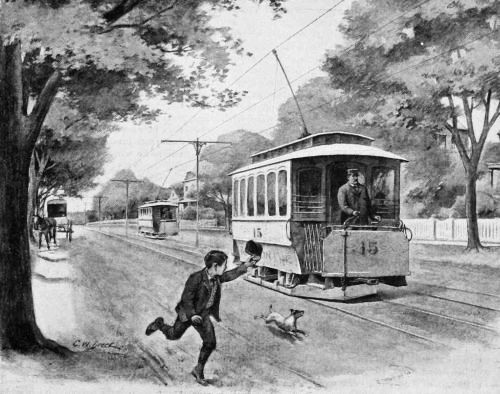
The current reaches the motor under the car by means of the trolley-wheel and pole. The trolley-wheel is a solid copper wheel, deeply grooved, which is pressed upward against the bare copper wire stretched over the middle of the track; the long flexible pole which carries the trolley-wheel has a strong spring which tends to press it forward, and so keeps the wheel always firmly pressed against the wire however much the car may jump about in rough places. An insulated wire connected with the trolley-wheel is led down the pole and through the car to the switches and regulating boxes placed at either end of the car, just against the dash-board. No current can reach the motor without passing through the switch and regulating box under control of the motorman. With the switch the motorman can turn the current on or off completely, he can regulate the amount of current that reaches the motor so as to start gradually or go slowly in crowded places, or fast in quiet ones, and he can even reverse the motor and make the car go backwards, a thing that neither the driver of the horse-car nor the gripman of the cable-car can do.
Perhaps it is not quite clear how so many motors can work from a single line. As a rule electric railways are provided with but a single wire from which the motors obtain their supply of current, and this system has come to be called the single trolley system in distinction to the double trolley, or double wire system, which was tried in the early days but has been abandoned in all but one or two places. The single wire hung over the centre of the track carries the current out from the station where the dynamos are placed, and the rails and the earth carry it back to the dynamos after it has passed through the motors and has done its work. The trolley wire is kept constantly charged with electricity, which the dynamos at the power station pump into it, much as if they were pumping-engines forcing water into a long pipe. If any connection is made, by means of an electrical conductor, between the trolley-wire and the ground, the current will flow down into the ground. The only connections made with it are those made by the cars, and then the current has to pass through the motors and turn the wheels.
The trolley-wire has to be carefully put up so as to be just the right height, and exactly in the middle of the track. It must be properly insulated so as to prevent the escape of the current down the poles or along the suspension wires, so at every point where it is attached to a pole or a suspension wire it is hung from an insulator of some material that will not conduct electricity. Every here and there you will notice that heavy electric wires or cables are connected with the trolley-wires. These-wires are called "feeders"; they are run out from the dynamos at the power-house, and connect on to the trolley-wire to force fresh supplies of current into it. When an electric current travels along a wire it loses a certain amount of power by reason of the resistance or electrical friction of the wire itself, so in order to keep the supply of current up to the proper pitch required for working the motors at all points of the line, these "feeders" are run out from the power-house, and they literally feed the trolley-wire with the current that the cars are always demanding from it.
It is often said in the newspapers that the trolley-wire is very dangerous to human life. This is not really so. Nobody has ever been killed by a shock from a trolley-wire. The current used for electric railways, although great power is conveyed by it, has not the property of giving a fatal shock to the human system. There are just as great differences between the electric currents used for different purposes as there are between streams of water. Some streams have great volume, but very slow flow, others fly out of a half-inch nozzle with sufficient velocity to drill a hole through a man's body as cleanly as a rifle bullet. It is the same with an electric current. You may have a current capable of fusing bars of iron, yet you could not feel it pass through your body, and another kind of current that can be carried by a fine wire will give a shock strong enough to kill. Therefore, believe me, there is a great deal of nonsense written in the newspapers about the "deadly trolley."
Where the "deadliness" of the trolley certainly comes in is in the extreme handiness of the cars. The horse-car driver has hard work to get much speed out of his team; the gripman of the cable-car can go no faster than the cable will drag him; but the motorman of the trolley-car can with a twirl of his wrist send his heavy car bounding on like a thing of life. The temptation to "speed up" when it is so easily done is too much for human nature. This accounts for the many accidents that occur, though it is only fair to say that the fault is partly with the mothers who allow their little ones to play in streets where there are car tracks, for the victims of the trolley-cars seem to be nearly always young children.