"A PIECE OF WORK."
Reading edition
BY JAMES BARNES.
The train-despatcher's window at the Jimtown crossing commanded a good view of the yards. It was a wet night, with a penetrating drizzle so fine that it almost led one to believe that the earth was steaming from the heat of the forenoon. The ray of light that shot over the train-despatcher's shoulder as he looked out into the darkness showed, however, that it was rain drifting downwards in the minutest drops.
It was almost time for the night despatcher, Rollins, to put in an appearance, and Mr. Mingle looked at his watch and drummed with his fingers on the pane of glass.
The light of the switchmen's lanterns occasionally gleamed from the shining slippery rails. A noisy little engine that had been drilling freight cars about the yard stopped on the siding just beneath the window, and commenced to roar angrily with a burst of feathery vapor. The despatcher watched the fireman open the door of the furnace and stand for an instant silhouetted against the red glare that was reflected by the dampness all around. Suddenly as he glanced up he saw a man on the top of a freight car across the yards swing his lantern about his head and make a jump clear to the ground into a pile of cinders.
"That was a foolish thing to do," said Mr. Mingle to himself. "He might have broken his legs; then he'd have sued the company."
The man was not injured, however, for he skipped across the tracks and approached the tower-house on a run. He stopped and shouted to the fireman of the engine that was raising such a row beneath the window. The glow from the rosy coals made everything quite plain.
Never in his life had Mr. Mingle seen a face wear such a look as that.
The fireman closed the furnace door with a slam, and the engineer, who had been out on the foot-board, hurried back at a gesture. Two words, and he dropped the bundle of waste in his hand and pulled wide the throttle. At the same time the engine shrieked for open switches. What could it mean? As the despatcher turned to the door of the staircase, he ran into the man whose face he had seen in the glare from the fire-box. It was the assistant yard-master.
"Lord, Mr. Mingle!" he exclaimed, "is No. 44 on time? Hurry and find out! Has she passed the junction yet?"
The despatcher in one stride stepped to the instrument on the desk. With his fingers on the key-board, he paused. "Tell me, quickly," he said, "what has happened. Talk, man!"
"The ore train!" exclaimed the yard-master, sinking back into the worn arm-chair and dropping his hands helplessly to either side of him. "Some one left the switch open, and the brakes slipped or something. She pulled out by herself down the grade on the main track. I saw her going from the top of the freight. How she started, Lord knows. She slipped out like a ghost, sir."
Mr. Mingle had caught only the first few words. His nervous hand was jumping as he sounded the call for the operator at Selina Junction, twenty-five miles down the road. At last he stopped, and suddenly switched off for the return.
"Tick! Tick! Tick-a-tick!" the answer came; the yard-master watched the despatcher's face as a condemned man might look at the face of a judge—and Mr. Mingle had grown paler.
"Forty-four has just passed the junction," he said, in a high strained voice. Then his teeth chattered as if he had felt a blast of icy wind. There was nothing to do.
Fifteen of that twenty-five miles was all down grade on a single track—a bad grade that necessitated an extra engine to help its brother puff and tug the heavy trains up out of the valley. Between Jimtown and the junction there was no station, and only one siding that ran out to the Fetterolf quarries, ten miles below.
"The switch engine has gone after her," said the yard-master. "If she can catch up before they reach the steep grade near the pine woods they may be able to make a flying couple."
"She will never catch them now," said Mr. Mingle. "Heaven help all in 44!" A great sob like a shiver shook him. "Quick, hurry, Tomes!" he said, shaking the yard-master violently. "Make up a wrecking train, and send one of the boys to gather all the doctors. There are three of them up near the hotel. I'll telegraph headquarters. They will be safe for twenty minutes yet. Hurry, man. Don't sit there like a fool!"
The yard-master slipped his hat on his head and plunged down the steep stairway.
The despatcher rubbed his forehead.
It was a hard thing to do! Sixty miles away they would know of the accident before it occurred, simply by his touching the little instrument that his trembling hand reached forward for. How could he begin the message? The idea of that load of ore gathering frightful headway every minute, whirling along through the darkness toward that slowly approaching train, made him sick and faint. There was going to be a wreck, and nothing in the whole world could stop it. In his mind's eye he could see the crash. He could see what that fireman and engineer of 44 would see through the rain-drops in the glare from the head-light. Old Jack Lane, he knew him well. It would be Jack's last trip. There would not be time to think; no time to press the throttle. It would be on them all at once.
The despatcher called up headquarters. Would they never answer? It seemed already half an hour since the yard-master had left him.
Somebody thumped up the stairway.
"Hello, Mixer!" said a cheerful voice. "Fine night for ducks, eh?" The speaker, a young man with a slight athletic frame, dashed his hat on the table. "What's up, cully?" he asked; as Mr. Mingle turned from the instrument, and the other caught a glimpse of his scared white face.
Mr. Mingle's voice was hoarse, as if he had been shouting, but he spoke slowly and distinctly. The young man he had been addressing had thrown off his rubber coat. The tails had been pinned up, and his back was covered with a streak of mud. When the despatcher had finished, his companion reached the head of the stairs in a jump.
"I'll try for it!" he said. "There's just one chance. I'll try to make the quarries!"
Despite the fact that headquarters was now calling back, Mingle ran to the door. He was just in time to see the night despatcher lifting something down the steps outside.
"Try for it, Rollie!" he shouted, and ran out into the rain. As he stood there he caught a glimpse of a figure fast leaving the yards. It was a man bent low over the handle-bars of a bicycle, his feet rising and falling with the quickness and ease of the trained racer. Mingle caught a flash of the steel spokes as the night despatcher turned the corner under the lamp-post into the road. Then he pulled himself up the stairs as if his feet were made of lead, and telegraphed the message to headquarters as slowly as if he had been a beginner, and not one of the best operators on the line.
The road that led outside of Jimtown stretched along through a bit of woods, and then plunged down the side of the mountain so steeply that loaded teams would halt every hundred feet or so to rest in the ascent.
A year before Rollins had coasted down Coon Hill, on a wager, but that was in broad daylight, with his club-mates stationed at every curve, and the roadway was cleared for him as far as the sandy stretch before the railroad crossing. Every stone had been picked out, and the water-bars evened up at the left-hand side. At one place, he remembered, his speed had been reckoned, in a measured one hundred yards, at forty miles an hour.
The railroad, to avoid the grade, followed the course of the Coponie, and circled about to the northward. Rollins had only to ride four miles to the ore-cars eleven—but such a night for coasting!
The rain made it hard for him to follow the little circle of light that his lantern threw before him as he scorched along the level stretch.
Before he reached the hill-top it seemed to him that he was standing still, and the road coming up at him like the surface of a great wheel.
At last, he felt that he had reached down-grade. How he longed now for the brake that he had so disdained! He determined to keep his feet going as long as he safely could, and he back-pedalled gently to keep them in place.
Thud! he struck the first water-bar, and his cap came forward over his eyes. He threw it off with a backward toss of his head.
Another jolt! He was too much in the middle of the road. He must keep more to the left. He was flying now. The rain poured down his face and stung him in a thousand prickling points.
The wind roared frightfully in his ears, and he straightened up as far as his crooked racing-handles would allow. He was at the first turn. He swirled about it, and his feet came off the ratchets. He lifted up his knees, and placed his legs on the rests. He was riding a runaway.
"Hard to the left!" he kept saying to himself, with his arms braced straight like iron rods. The front wheel wriggled, and he knew he had struck the bit of sandy road above the second angle, and the worst. It warned him just in time. He remembered the huge rock with the advertisements on it, and a ray from the lantern caught it as he flashed by and then swooped off to the right. A sharp jingle as a stone flew up against the spokes; he was once more in the straight shoot for the last turn of all.
With wide-staring eyes he prayed; his tongue formed the words behind his closely shut teeth. "Bear to the left now!" He knew the path was better on that side.
Again the front wheel wriggled fiercely. It was by nothing but luck this time that he had chosen the right moment. There was a hollow thump as he crossed a wooden culvert and bounded for a moment clear into the air. The greatest danger was passed. Below him stretched a straight decline, and then the sandy patch before he reached the crossing.
How could he stop? He could never catch those flying pedals. But stop he must or he would overshoot his mark a half-mile before he found the level.
It was no easy thing to do to hold that struggling front wheel steady. He straightened up, and bending his right knee, placed the sole of his foot against the tire of the front wheel. He could feel it warming through the leather, but he had partly checked the speed. Then there was a ringing sound, a twist of both his arms, and over he went with a sickening momentary cry of fear.
He rolled up on his hands and knees. To save his life he could not help that choking, whimpering sound. His mouth was full of sand, and he felt as though his breast had been crushed in against his lungs. A sharp pain ran through his left leg; but at last he caught his breath.
There was the track within thirty feet of where he had fallen. He could only tell this by seeing the ghostlike danger-post that stretched above the roadway like a white warning gallows. There, a few rods down the track, was the switch that turned through the sharp cut to the quarries.
Rollins gave a cry. "The key!" The switch was locked. Would he have to stand there and see the ore-cars rush by him? He twisted with both hands at the guard chain to the lock. It wouldn't move. But what was that standing close on the siding?
A hand-car is a good lift for two men at any time, but it seemed as if made of pine wood instead of heavy iron wheels and bars. He rolled it to the track, and up-ended it as easily as a laborer would throw over a wheel-barrow.
Then he heard a roaring sound above him along the grade. The sharp staccato tooting of the drilling engine he heard also. Then far below him, four miles away, the long confident whistle of No. 44 at a grade crossing. The rails were slippery, and he knew that the train was coming slowly up the grade. As the hand-car toppled across the track he threw upon the heap two heavy ties, and scrambled up the opposite bank. Now the roaring was upon him! Crash! A snap and a whirl, and the wheels of the foremost ore-car caught the obstruction. The load piled forward, and the flats behind reared up and threw their heavy freight in all directions. He had wrecked her just in time.
He hurried back to the crossing. A tangle of wire and frame-work, the bicycle lay at the road-side. He must have missed striking that huge rock by nothing short of a miracle. The lamp, twisted and broken, was attached to the front fork. He could smell the oil, and he sopped it with his handkerchief. His hands were sticky, and the match refused to light. At last he struck a handful of them; they flashed feebly, then sputtered and went out. In the brief space Rollins had seen that his hands were dripping red.
A great white eye and the tinkling of the rails told that the little switch engine would strike the obstruction first.
It was alongside now! The young man saw that the wheels were reversing furiously. Then he heard a second crash and a screeching, long continued, that went through and through his dizzy brain.
"Safe! safe!" he said, and fell limp in the sand.
"Are you hurted, Bill, lad?" said the engineer of the switch engine, rubbing his bruised sides and letting up for a minute his pull on the whistle rope. "Them ore-cars jumped the track."
"No; all O K," came the answer from the opposite side of the cab. "Jest bumped a bit. Listen! There's old Jack whistling for brakes."
The shrieking of the switch engine was warning No. 44 in time. They could make-out her head-light through the leaves of the trees just at the tangent of the curve a quarter of a mile below. Some figures were running up the track, for they could see a lantern bobbing up and down, and soon the voices were quite close.
"What has happened here?" inquired a man with brass buttons, as he caught a glimpse of the engineer swinging himself painfully off the step to the ground behind the wreckage.
"The Lord's finger, I reckon," said the engineer. "I swear I saw a light!" and in a few words he told the story.
"I SAY, YOU PEOPLE, THERE'S A DEAD MAN OR SOMETHING HERE IN THE ROAD."
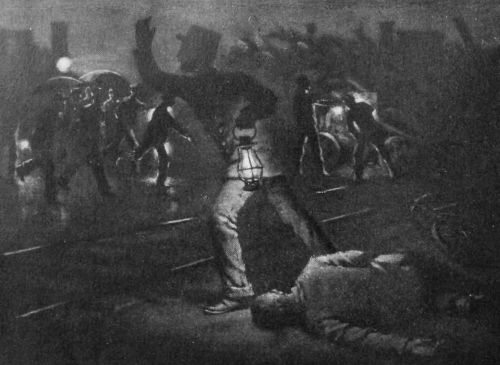
A group of passengers had surrounded the heap of boards, ore, iron wheels, and axles. The head-light of the switch engine had gone out in the jar, and there was not a face shown in the dim rays from the lantern that did not pale.
A drummer in a silk travelling-cap struck a match to light a paper cigarette, but his hand trembled so that he gave up, and sat down on the ties, and mechanically brushed off his shoes with his pocket-handkerchief as if it were dusty and broad daylight.
Another whistle sounded up the grade.
"There's no train due," said the curly-headed young brakeman who had come up with another lantern on his arm. A large crowd of the passengers of No. 44 accompanied him.
"I presume likely that's the wrecking-train," said the engineer, "come down to pick you fellows up."
"Get up the track and flag her, Billy! Jump quick!" ordered the conductor.
The brakeman started on a run. As he passed the grade crossing he shouted back,
"I say, you people, there's a dead man or something here in the road," and, without a pause, he hurried on.
Rollins opened his eyes and felt the familiar motion of a moving train, but for an instant he could not call back his wits to think. He was lying on a mattress on the floor and his head and shoulders were propped up comfortably. There was a crowd standing about him.
"You're all right, my lad," said a voice. "There are four of us here to look out for you." The doctor arose from his knees and laughed.
Rollins faintly smiled. "Oh, I'm kind of comfortable," he said.
"The company ought to give him a gold bicycle set with diamonds," said the conductor.
"I'd rather have a trip to Europe," said Rollins.
A quiet-looking man standing in a corner of the car heard this remark and made a note of it.
The whistle hallooed exultantly at the entrance of the Jimtown yards.
The sound reached the ears of Mr. Mingle as he sat with his forehead resting on the edge of his desk. The three sharp toots that were being given so often in succession could be nothing else than cheers.
"Headquarters there! O. K. My side partner saved the train. Hurrah! Forty-four is safe!"
He twitched the dots and dashes out with his nervous fingers. Then he drew his sleeve across his eyes and dashed down the steps to meet the train.
"Rollie's a piece of work," he said to himself.