TURKEY, "THE SICK MAN."
Reading edition
BY V. GRIBAYÉDOFF.
It is now forty-three years since Czar Nicholas I., in conversation with the British ambassador at St. Petersburg, referred to Turkey as the "Sick Man," and suggested that Great Britain and Russia deal him his death-blow and divide up his heritage. We all know that Great Britain not only rejected the proposition, but, with France and Turkey as allies, not long after declared war on the Russian Empire. This Crimean war cost the great powers engaged in it thousands and thousands of men and millions and millions of money, and when peace was signed in 1856, Russia found herself deprived of some territory on the Roumanian frontier and of the right to maintain a fleet in the Black Sea.
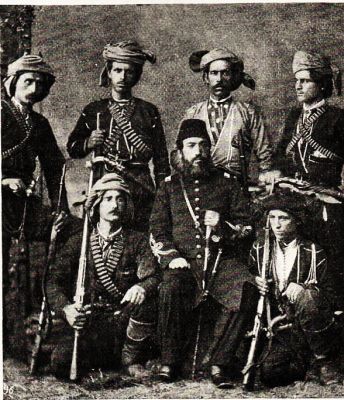
SOME OF THE "IRREGULARS."
The result acted as medicine on the "Sick Man." Propped up on each side by the western powers, he raised his head and endeavored to feel himself again. He has had several relapses since that period, one notably in 1877-8, when the Russian troops encamped within view of Constantinople. Great Britain again came to his rescue, and prevented some of the amputations planned by the Muscovite—amputations which would surely have led to his demise from sheer loss of blood. For this good service England did a little amputating on her own account, and added to her dominions the fertile island of Cyprus, in the Mediterranean. The "Sick Man" thus obtained another lease of life, but recent events would indicate that his end is at last approaching—as one writer has put it, from sheer inner putrition; and this time there is no sympathizing friend to stretch a helping hand, none to ward off his well-merited fate!
Even those Englishmen who have been most bitterly opposed in the past to a conciliatory policy toward Russia are beginning to recognize the mistake of upholding Turkish rule in Europe. As one English religious journal recently remarked, while advocating the substitution of the Russian for the Turkish flag in Constantinople, "The Czar's rule is bad enough, but there is in the hearts of the Russian people the seed of better things." And it really seems an anomaly that England, of all countries—England, the land of John Howard, of William Wilberforce, of David Livingstone—should have been instrumental in maintaining that pestiferous charnel-house on the banks of the Bosporus! Better a thousand times that the Turkish government should be abolished!
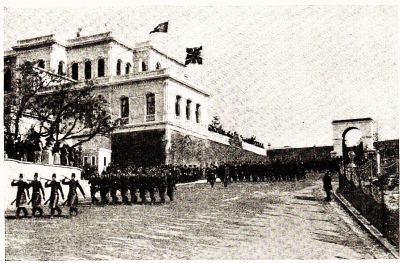
YILDIZ KIOSK, THE SULTAN'S PALACE.
The recent massacres in Armenia and Constantinople are but repetitions of the events of former years. When the Russian troops crossed the Danube in 1853 they found many Bulgarian villages pillaged and their inhabitants massacred by the irregular Turkish troops. The horrible stories that are being told to us daily from Armenia are the same as those told in 1853 from Bulgaria. Towns were burned to ashes, and the inhabitants were burned with them or were killed in attempting to escape from them. Nevertheless, the innate barbarity of the Turk did not prevent the western powers from coming to his help in those days!
In 1861 there were other terrible massacres in the Ottoman Empire, the Christian Maronites of the Lebanon being the victims this time. In the course of a few days five thousand men, women, and children were slaughtered in and around Damascus. This pill was even too much for the Sultan's complacent western friends, and that potentate was obliged to submit to the landing of a French army of intervention in Syria. The many thousands of murders in the Lebanon district were avenged by the execution of about fifty Mussulman ringleaders, after which the French withdrew, with colors flying, to the time of "Partant pour la Syrie."
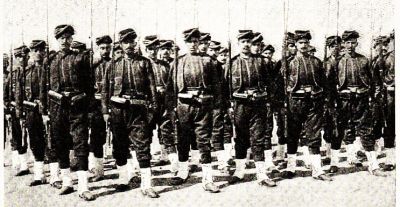
TURKISH ZOUAVES.
In 1876 the barbarities of the Turks in Bulgaria aroused, as we know, the indignation of the whole civilized world. Here was a brilliant opportunity for putting an end, once and for all, to Mussulman authority over a Christian population, and yet such was the jealousy of the great European powers, one for another, that they could not agree, and at the eleventh hour, as the Russians were about to grasp the prize—Constantinople—a British fleet was sent to the Sea of Marmora, and the Turk was saved once more, as above stated, to perpetrate further atrocities in the name of law and order!
It is a long lane that has no turning, and let us trust, therefore, that the symptoms pointing to the Porte's approaching dissolution are not deceptive. When the end does come it will come with a crash. A glance at the photographs on these pages will convey an idea of the kind of men still at the Sultan's beck and call. They certainly do not look as if they would give up to the Giaour without a struggle. Indeed, if the lessons of history count for anything, the unspeakable Turk will fight tooth and nail to maintain his supremacy. Since the days of Osman, founder of the present dynasty, nay, even as far back as the first century of the Christian era, the ancestors of the modern Turk were redoubtable warriors and conquerors. Even in the present century, although usually unfortunate in the outcome of their wars, they have given evidence of the old fearlessness and disregard for death. The defense of Plevna furnishes a brilliant example of Turkish bravery and obstinacy.
TROOP OF THE SULTAN'S BODY-GUARD.
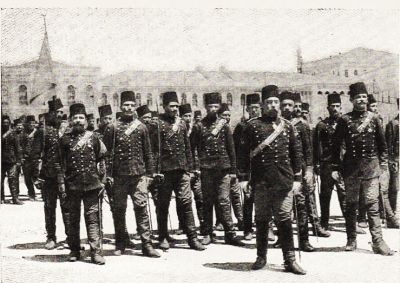
The pictures here presented have a peculiar interest at this moment. They represent the regiments garrisoned in Constantinople upon whom the Sultan can count in any emergency. These men are well clothed, well fed, and receive their pay with regularity, unlike the troops in the provinces, who have been wretchedly neglected of late years. These crack regiments are the regular imperial guard, line infantry, zouaves, and marines. They are picked men of Turkish race, and are decidedly more respectable than the irregulars shown in another group. It is the latter who, after the Sultan himself, are to be held accountable for the recent horrible massacres. It is they who organized themselves into marauding bands and spread death and devastation among the unhappy Armenians, with the cognizance of the camarilla at the Yildiz Kiosk, or Sultan's palace.
When the final day of reckoning arrives, it is sincerely to be hoped that this gentry will come in for some attention. The civilized world has an old score against them. May it speak in no uncertain tone—in the same voice that thundered ten thousand Turkish assassins to their doom at the sea-fight at Navarino of blessed memory! Those were the days of noble impulses and lofty aspirations, when international jealousies were powerless to sway the councils of nations and stifle the cry of the oppressed. Those were the days of Canning and of Byron. Would that some such men were alive to-day to teach Europe her sacred duty.