STAMPS
Reading edition
10 stamps and large list FREE!
L. Dover & Co., 1469 Hodiamont, St. Louis. Mo.
STAMPS on Approval! 50% disct. List free.
W. C. Shields, 30 Sorauren Ave., Toronto, Canada.

the best things in Prose and Poetry, always including good Songs and Hymns. It is surprising how little good work of this kind seems to be done in the Schools, if one must judge from the small number of people who can repeat, without mistake or omission, as many as Three good songs or hymns.

and accurate Memory work is a most excellent thing, whether in School or out of it, among all ages and all classes. But let that which is so learned be worth learning and worth retaining. The Franklin Square Song Collection presents a large number of

and Hymns, in great variety and very carefully selected, comprising Sixteen Hundred in the Eight Numbers thus far issued, together with much choice and profitable Reading Matter relating to Music and Musicians. In the complete and varied

which is sent free on application to the Publishers, there are found dozens of the best things in the World, which are well worth committing to memory; and they who know most of such good things, and appreciate and enjoy them most, are really among the best educated people in any country. They have the best result of Education. For above Contents, with sample pages of Music, address
Harper & Brothers, New York.
The Importance of Care.
Not infrequently has the Table urged upon its readers the desirability of good penmanship and careful selection of words in letter-writing. Here are three stories, all vouched for as true, which emphasize the points anew:
A Cincinnati grocer's house found that cranberries had risen to $6 per bushel. The purchasing clerk immediately sent this note by the firm's teamster, "One hundred bushels per Simmons." (Simmons was the driver's name.) The well-meaning correspondent thought the scrawl read, "One hundred bushels persimmons," and boys were straightway set to work, for persimmons were plentiful. The wagon made its appearance next day loaded down with eighty bushels. The remaining twenty bushels were to follow next day, and when the correspondent found out his mistake he angrily demanded why the order did not read by Simmons?
A New England clergyman wrote a letter to the General Court. The clerk came to a sentence which he read, "I address you not as magistrates, but as Indian devils." The Court was wroth until the "Indian devils" were found to be "individuals."
An English gentleman, in writing to a Lincolnshire friend, mentioned the latter's kindness to him, and said he should soon send him a suitable "equivalent." The friend read the word "elephant," and immediately built a handsome barn for the reception of his elephantine majesty. But much to his surprise a barrel of oysters was the "equivalent."
Minimized Writing.
Mention was made in the Table, not long since, of the microscopic ring presented to Queen Elizabeth, consisting of a silver penny on which Bales "put more things than would fill several duodecimo pages." For a long time, Pliny's remark that Cicero had once seen Homer's Iliad in a nutshell was considered an exaggeration, at least. But an old French writer named Huet proves the statement to be true. A sheet of sheep-skin 10x8 can be neatly folded up so as to fit the shell of a large walnut. In its breadth the strip will contain one line of thirty verses, and in its length, 250 lines. Each side of the page would, then, contain 7500 verses, or the whole of the Iliad! Huet proved this fact in the presence of the Dauphin, using a sheet of paper and a crow-quill pen.
In the library of St. John's College, Oxford, is a head of Charles I. made up of minute lines of script which at a little distance resemble common engraving lines. The lines of the head and ruff form the Psalms, the Creed, and the Lord's Prayer. There is a portrait of Queen Anne in the British Museum "not much above the size of the hand." This drawing, too, is made up of microscopic lines and scratches which form the contents of an entire folio!
Elizabeth's silver penny ring was surpassed by the farthing of Peter Almunus, an Italian monk. On the coin were engrossed the Acts of the Apostles and the Gospel according to St. John. Another example of microscopic writing was presented to Elizabeth in the shape of a piece of parchment the size of a finger, containing the Decalogue, the Creed, the Lord's Prayer, the name of the giver, and the date. A pair of spectacles accompanied this Lilliputian manuscript.
Ælian tells us of an artist who wrote a "distich in letters of gold, which he enclosed in the rind of a grain of corn," while Menage writes of microscopic sentences, pictures, and portraits. He mentions reading an Italian poem in praise of the Princess, "written by an officer in the space of a foot and a half."
With Pope we would say:
"Why has not man a microscopic eye? For this plain reason—man is not a fly." Maurice Maxwell.
A Story about Holland's Young Queen.
Queen Wilhelmina, of Holland, who once applied for membership in the Order of the Round Table, and purchased a set of Columbian stamps through the Editor of the Round Table Stamp Department, has become betrothed to her second cousin, although yet in her early teens. When the German Emperor paid a visit to The Hague, in 1893, the Queen desired to be present at the banquet given in his honor. This, of course, was out of the question. To all the pleadings of her daughter the Queen Regent turned a deaf ear. "You are too young and must go to bed." As, however, the child Queen persisted in her demands, there remained for the Regent but one alternative—to herself conduct the young lady to her bedroom. This she did, but not without one final energetic protest from the disappointed Queen. "I will go to the balcony and tell the Dutch people how you abuse their Queen."
Of course the young lady did nothing of the kind, but sobbed herself to sleep instead, and next day dutifully begged her mother's pardon.
Kinks.
No. 41.—A Prose Charade.
I am a combination of the animal and vegetable kingdom, generally made by boys, and carried in their pockets. Part of me once belonged to a two-legged farm animal, and helped to do what Maxim, Langley, and Lielenthal have as yet failed in. The next important part grew in the forest and was shaped by a jack-knife. The third and last part grew in the ground. Many a fly has met death at my hands, but my chief merit is noise. What am I?
No. 42.—Political Questions.
1. What legislature is known as the "House of Keys"?
2. What early American hero boasted of having killed, while in Austria, thirty men merely to prove to a party of ladies that he was brave?
3. Who burned up the "copy" of the first Congressional Record?
4. Who made the principal address at Gettysburg, now forgotten, on the day that Lincoln made his famous impromptu one?
No. 43.—A Star.
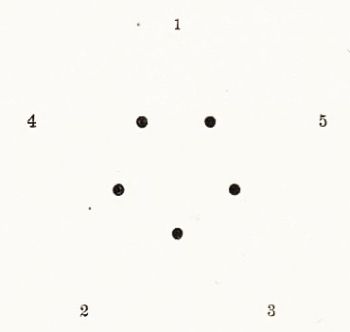
1 to 2, part of a woman's cap; 1 to 3, an explosion of thunder; 4 to 5, a soothing ointment; 4 to 3, a soft mass; 5 to 2, a wooden mallet.
B.
NO. 44.—Single Acrostic.
The following words, all the same length, give for their initials, when, read downward, the full name of a President of the United States: To attempt; firmness; something that comes to us all; to answer; to succeed; value; to varnish; keen; to dance; dexterity; to toil; to command; a recess in a wall.
F. X. M.
No. 45.—Numerical Enigma.
I am composed of three words and nineteen letters.
1. My 11, 6, 3, 19, 5, is to mount.
2. My 10, 11, 12, 18, is a low place between hills.
3. My 13, 11, 10, 12, 5, is a dipper with a handle.
4. My 19, 1, 2, 4, 18, is to clear up.
5. My 14, 15, 17, 8, is the dearest place on earth.
6. My 7, 3, 18, 13, 10, to sway.
Answers to Kinks.
No 37.
2803 miles—found by taking all the letters in the lines that are employed in the Roman notation, setting down their common value in figures, and adding all together. Count i as figure 1.
No. 38.
R
WAR
WAVES
RAVAGES
REGET
SET
S
No. 39.—Niagara.
No. 40.
1.—1. Baret. 2. Abode. 3. Rosin. 4. Edict. 5. Tents.
2.—1. Prong. 2. Racer. 3. Ochre. 4. Nerve. 5. Green.
3.—1. Sharp. 2. Honor. 3. Angle. 4. Rolls. 5. Press.