THE REBELS DID NOT RUN.
Reading edition
A CUBAN WAR PICTURE.
BY THOMAS R. DAWLEY, JR.
Darkness turned to the gray of dawn and revealed the hazy outline of the Cuban camp. An expanse of wood and bush and swamp, dotted here and there with lofty palms. A labyrinth of winding paths guarded by impenetrable thickets. Within an open space, far within, scattered with the palm-leaf tents of the Cuban patriots, smouldered the camp-fires.
A GAUNT PEASANT MOUNTED ON A SHAGGY PONY.
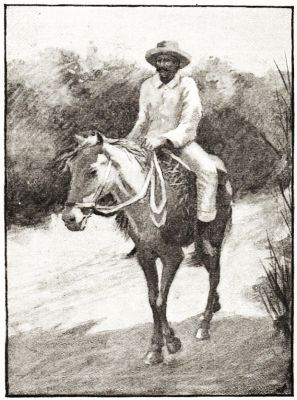
Maceo had crossed the Trocha! The word spread through the rebel camp, and the camp bestirred itself. A gaunt peasant, mounted on a shag-headed pony, brought the news, and it was voiced from mouth to mouth. The gray fog lifted slowly. Through the dim haze the rebels saw the gaunt peasant on his shag-headed pony as though fastened there.
Maceo had crossed the Trocha! The camp was impatient to hear the rest. Nearly two months had passed since the rebel general had gone with his army down into Pinar del Rio to fulfil his promise of marching from one end of Cuba to the other. The Spaniards drew a line across a narrow part of the island, and put their soldiers there, and called it the Trocha. They said they had Maceo entrapped. He never could pass the Trocha.
The rebels had waited patiently, longingly, for the chief's return. Morning after morning they had huddled over their fires, or those who had blankets remained swathed in them until the sun came out and warmed the steaming earth. Then the rebels foraged. They chewed sugar-cane for breakfast, and stewed beef and sweet-potatoes for dinner. They begged cigarettes from their comrades, and there were many who went without. The Spaniards had not been after them for days, for they had gone off to hold the Trocha or chase Maceo down in Pinar del Rio.
Occasionally the Havana papers found their way into the camp. They brought news always discouraging. Maceo was continually fleeing before the valor of Spanish arms. He would certainly be forced to throw himself against the Trocha, where disastrous defeat awaited him. Once a battle was fought, and, according to the papers, Maceo had left six hundred of their comrades on the field. The camp doubted. A giant mulatto, who had seen eight years' service in the last war, said the Spaniards lied! They always lied!
Thus down the labyrinth of winding paths, through wood and bush and swamp, the rebel camp had waited. And now Maceo had crossed the Trocha! The peasant brought the news, and the peasant did not lie.
The morning mists rolled up and away. The camp-fires crackled with a new vigor as their smoke followed the mists. The air was cool and crisp, for Cuban winters know cold nights and mornings. Ill-clad rebels gathered around the fires, while others refused to unwind themselves from tattered blankets captured in the last raid. They looked over the fires and through the smoke. The gaunt peasant was still there. He was big and bony. He looked like a giant on the little dingy horse; his bones were so big, and the horse was so little. And it seemed that his bones swung on hinges, well oiled. He gesticulated wildly. His arms went up and down, and his body turned from side to side. A rebel chief, tall and dignified, with grizzled mustaches, stood by his brown tent and listened carefully to every word he said.
Maceo had crossed the Trocha! The peasant did not lie. Once more he threw out his arms wildly. Then he brought both palms down upon the pommel of his saddle, and straightening his long arms, hunched his shoulders upon them and rested there. He had finished.
The chief's whistle sounded through the camp. The rebel band was happy. It had been in the swamp so long. It was impatient. It longed for a move; anything for a move, and the chief's whistle meant that it was going to move now.
The sun warmed the earth, and the camp rose. There was a hurrying to and fro, a sound of cracking twigs and numerous voices. Sorry-looking nags were pulled away from scattered heaps of cane-top fodder bordering the camp, over which they had been chewing and dreaming all night.
A mule which did not propose to budge was called a rude name. Cubans are not violent. They are not addicted to using harsh words. The Cuban simply tugged at the mule's long halter-rope, called him by his wrong name, turned and tugged again. The mule was obdurate. A half-naked black spanked the animal suddenly. The mule relented and stepped quickly forward, and the Cuban fell headlong. The half-naked black grinned with a scared expression; another roared. The fallen rebel picked himself up, and laughed too.
There was a jingling of bridle-bits and a rustling of saddle-gear; a cry of impatience as a girth broke in the attempt to tighten it. A little Major yelled an order to a distant subaltern. A Captain demanded his spurs from an orderly; another his gun. The negro element worked mechanically and said little.
The last rope was coiled, the last buckle tightened, and the men flung themselves astride their saddles.
The rebel band was moving.
Two scouts with long machetes at their sides and carbines ready resting upon their thighs galloped down the path. Others followed. They wound in and around and through the wooded expanse. The path forked and twined and forked again, leaving little islands of dense brush and scrubby trees. The scouts followed these twining paths, each in his own way, and the rebel band came scurrying on behind.
The many twining paths merged into a grove of guava-trees, and were lost in the dry matted grass. Out came the scouts from between the islands of brush. Into the guava grove they spurred their horses, bending here and dodging there to escape the low branches, and out upon the open they halted.
A long savanna spread before them. A scout urged his horse out upon the plain, and he was followed by another. The two galloped to the right and rose on a ridge overlooking a stretch of country beyond. There they paused; and as one, bending in his saddle, peered into the distance, the other shielded his eyes and looked too. Then they wheeled and rode up and down the ridge. Nothing! Nothing but cane-fields, palm-trees, and a tall chimney in the distance.
The halted ones advanced. In a reeling, waving line they came sweeping over the plain. They wheeled to the left and they wheeled to the right, and as the plain narrowed they wheeled together again, and plunged into a road through a broad field of cane bearing the marks of repeated forages.
Led by the tall grizzly chief, the rank and file emerged from the guava grove and scurried into one long, ragged, irregular column aiming straight for the road.
The road aimed for the tall chimney.
The grizzly chief could see his advance galloping on ahead, and his rank and file came swinging on behind. The cane-field changed from green to brown and black. It had been burned. Beneath the tall chimney could be discerned rootless walls, charred riblike rafters, and broken sheds grinning between dark green mango-trees.
Suddenly, where the road seemed to end between the mango-trees and a gray wall, appeared two horsemen. The gallop of the advance changed to a walk. It moved cautiously. Two little puffs of smoke and the crack of distant rifles told that the enemy was there. The rebel band halted, and the advance-guard came swinging back down the road.
A Lieutenant touched his hat and said, "Orders, my chief?"
"Tell them to spread out and reconnoitre! Maceo has crossed the Trocha, and we must advance to meet him."
The Lieutenant spurred ahead and met the flying guard. It stopped. The men looked over their shoulders worriedly as the Lieutenant delivered his message.
"Maceo has crossed the Trocha." The words were like magic, and the men turned and urged their horses into the burned field. The charred and rotten cane broke beneath the horses' hoofs as they made a wide circle, with the tall chimney for a centre. The horsemen at the end of the road disappeared.
The rebel band advanced. Again the horsemen appeared at the top of the road—two, four, six, eight, dozens of them. In rapid succession they rode out from the gray walls and dark mango-trees. There was another crack of rifles and puffs of blue smoke.
"Remingtons!" exclaimed the chief, as the advance-guard cautiously halted in the wide circle which it had mapped out for itself. "A local guerilla force!" And raising himself in his stirrups, the grizzly chief turned to his men, and flourishing his long blade, shouted: "Scatter out! Advance, and let them have it!"
To the sound of thumping hoofs and snapping canes the rank and file of the rebel band went plunging through the field.
The guerrilleros drew up in one serried rank just where the ground sloped into the cane-fields. They would meet the on-coming storm. They knew the rebels would run; they always ran. And they raised their loaded carbines and fired. As the smoke cleared away they saw a wide circle of yelling rebels and their horses dashing through the cane. They stuffed cartridges into their carbines and fired again.
Their shots were answered. They saw the puffs of smoke, they heard the "ping! ping!" of rebel Winchesters, and they saw the circle growing smaller as the horses grew larger. It seemed that they were monsters as they reared above the cane, crushing it down with their heavy hoofs and breasts. They saw gleaming steel flashing high in the sunlight, and they heard the rebel cry, "Á la machete!"
"Crack! crack!" rang out the Spanish Remingtons. "Ping! ping!" answered the rebel Winchesters, and a Spaniard cried, "I'm hurt!" as he swayed from his saddle. A comrade caught him and swung him back, and the serried rank could stand it no longer. It gave way—broke and ran. Helter-skelter by the ruined buildings, through the yard, scampered the frightened ponies. Down by a gaping broken wall the road commenced again. With loose rein and unguiding bridle the horses reared and plunged into one another, jolting the wounded man terribly. His carbine clanked on the ground, and he knew his only chance was to hang on.
The fleeing Spaniards heard the rebel yells close behind them, and the "ping! ping!" of their Winchesters. "Tack! tack!" the bullets struck the gaping corner wall, and a long stretch of road lay before them.
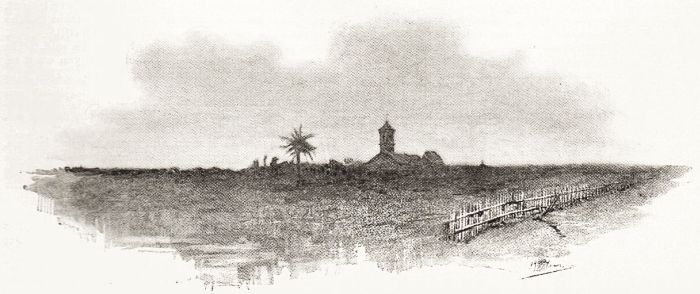
In the distance a church tower, and red tile roofs spread beneath it. The sunlight glinted upon them as it never had done before, and to the fleeing Spaniards they seemed as though made of gold and silver. Would they ever reach the sheltering cover?
And now rang out a fierce, exultant yell. The guerilleros knew that the rebels had reached the corner wall. They dug their spurs frantically into their horses' sides as they clung closer to their necks.
Again the rebel cry of victory rang out. But the distance was greater, and the Spaniards knew that the band was not pursuing.
Maceo had crossed the Trocha! And that was the time the rebels did not run.