THE VOYAGE OF THE "RATTLETRAP."
Reading edition
BY HAYDEN CARRUTH.
X.
After we got back to the Rattletrap we promised ourselves plenty of sport the next day watching the freighters with their long teams and wagon trains. Jack could not recover from his first glimpse of Henderson.
"Rather a neat little turnout to take a young lady out driving with," he said, after we had gone to bed. "Twenty-two oxen and four wagons. Plenty of room. Take along her father and mother. And the rest of the family. And her school-mates. And the whole town. Good team to go after the doctor with if somebody was sick—mile and a half an hour. That trotting-cow man at Yankton ought to come up here and show Henderson a little speed. Still, I dare say Henderson could best Old Browny, on a good day for sleeping, and when he didn't have Blacky to pull him along."
But we got small sight of the trail the next day, as the rain we had left behind came upon us again in greater force than ever. It began toward morning, and when we looked out, just as it was becoming light, we found it coming down in sheets—"cold, wet sheets," as Ollie said, too.
We could watch the road from the front of the wagon, and saw a number of freighters go by, usually with empty wagons, as it soon became too muddy for those with loads. We saw one fourteen-ox team with four wagons, and another man with twelve oxen and three wagons. There were also a number of mule teams, and we noticed one of twelve mules and five wagons, and several of ten mules and three or four wagons. With these the driver always rode the nigh-wheel animal—that is, the left-hand rear one.
"I'm going to put a saddle on Old Blacky and ride him after this," said Jack. "Bound to be in the fashion. Wonder how Henderson is getting along in the mud? A mile in two hours, I suppose. Must be impossible for him to see the head oxen through this rain."
The downpour never stopped all day. We tried letter-writing, but it was too cold to hold the pen; and Jack's efforts at playing the banjo proved equally unsuccessful. We fell back on reading, but even this did not seem to be very satisfactory. So we finally settled down to watching the rain and listening to the wind.
When evening came we shut down the front of the cover and tried to warm up the cabin a little by leaving the oil-stove burning, but it didn't seem to make much difference. So we soon went to bed, rather damp, somewhat cold, and a little dispirited. I think we all staid awake for a long time listening to the beating of the rain on the cover, and wondering about the weather of the morrow.
When we awoke in the morning it did not take long to find out about the weather. The rain had ceased and the sky was clear, but it was colder. Outside we found ice on the little pools of water in the footprints of the horses. We were stiff and cold. Some of us may have thought of the comforts of home, but none of us said anything about them.
"This is what I like," said Jack. "Don't feel I'm living unless I find my shoes frozen in the morning. Like to break the ice when I go to wash my face and hands, and to have my hair freeze before I can comb it."
But we observed that he kept as close to the camp-fire which we started as any of us. We went up to Smith's to look after the horses. While Jack and I were at the sheds Ollie staid in the road watching the freight teams. A big swarthy man, over six feet in height, came along, and after looking over the fence at Smith's house some time, said to Ollie,
"Do you s'pose Smith's at home?"
"Oh, I guess so," answered Ollie.
"I'd like to see him," went on the man, with an uneasy air.
"Probably you'll find him eating breakfast," said Ollie.
"I don't like to go in," said the man.
"Why not?"
"I'M AFRAID OF THE DOG."
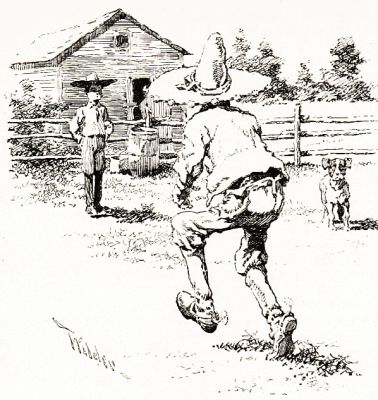
"I'm—I'm afraid of the dog."
"Oh!" replied Ollie. "Well, I'm not. Come on," and he stalked ahead very bravely, while the man followed cautiously behind.
"He's a Mexican," said Smith in explanation afterwards. "All Mexicans are afraid of dogs."
"That's a pretty broad statement," said Jack, after Smith had gone. "I believe, if there was a good reward offered, that I could find a Mexican who isn't afraid of dogs. Though perhaps it's the hair they're afraid of; Mexican dogs don't have any, you know."
"Don't any of them have hair?" asked Ollie.
"Not a hair," answered his truthful uncle. "I don't suppose a Mexican dog would know a hair if he saw it."
"I think that's a bigger story than Smith's," said Ollie.
It was Sunday, and we spent most of the day in the wagon, though we took a long walk up the valley in the afternoon. The first thing Ollie said the next morning was, "When are we going to see the buffaloes?"
Smith had been telling us about them the evening before. They were down town, and belonged to a Dr. McGillicuddie. They had been brought in recently from the Rosebud Indian Agency, and had been captured some time before in the Bad Lands.
We followed the trail, now as deep with mud as it had been with dust, meeting many freighters on the way, and found the buffaloes near the Deadwood stage barn.
"See!" exclaimed Ollie; "there they are in the yard."
"Don't say 'yard,'" returned Jack; "say 'corral,' with a good, strong accent on the last syllable. A yard is a corral, and a farm a ranch, and a revolver a six-shooter—and a lot more. Don't be green, Oliver."
"Oh, bother!" replied Ollie. "There's ten of 'em. See the big fellow!"
"They're nice ones, that's so," answered Jack. "I'd like to see the Yankton man we heard about try to milk that cow over in the corner."
SOME SAID IT WAS A GRIZZLY, AND OTHERS A SILVER-TIP.
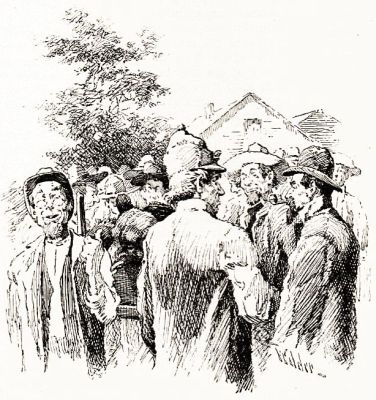
After we had seen the buffaloes we wandered about town and jingled our spurs, which were quite in the fashion. We encountered a big crowd in front of one of the markets, and found that a hunter had just come in from the mountains to the west with the carcass of the biggest bear ever brought into Rapid City. Some said it was a grizzly, and others a silver-tip, and one man tried to settle the difficulty by saying that there wasn't any difference between them. But it was certainly a big bear, and filled the whole wagon-box. Ollie sidled through the crowd, and asked so many questions of the man, who was named Reynolds, that he good-naturedly gave Ollie one of the largest of the claws. It was five inches long.
At noon we went down to the camp of the freighters on the outskirts of town, near Rapid Creek. There must have been fifty "outfits"—Jack said that was the right word—and several hundred mules as many oxen, and a few horses. The animals were, most of them, wandering about wherever they pleased, the mules and horses taking their dinner out of nose-bags, and the mules keeping up a gentle exercise by kicking at one another. It seemed a hopeless confusion, but the men were sitting about on the ground, calmly cooking their dinners over little camp-fires. One man, whom we had got acquainted with in the morning at Smith's, asked us to have dinner with him, and made the invitation so pressing that we accepted. He had several gallons of coffee and plenty of bacon and canned fruit, and a peculiar kind of bread, which he had baked himself.
"I'm a-thinking," he said, "there ain't enough sal'ratus in that there bread; but I'm a poor cook, anyhow."
THE RECEIPT FOR THE SAL'RATUS BREAD.
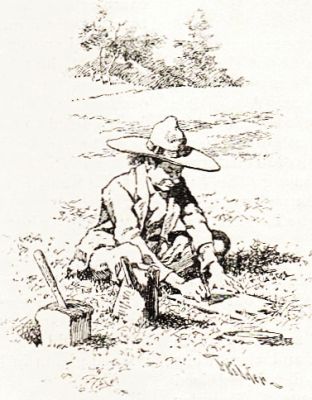
The bread seemed to us to be already composed chiefly of saleratus, so his apology struck us as unnecessary. He very kindly wrote out the receipt on a shingle for Jack, but I stole it away from him after we got home and burned it in the camp-fire; so we escaped that.
"Your pancakes are bad enough," I said to him. "We don't care to try your saleratus bread."
Jack was a good deal worked up about the loss of his receipt, and experimented a long time to produce something like the freighter's bread without it, but as Snoozer wouldn't try the stuff he made, and he was afraid to do so himself, nothing came of it.
We enjoyed our dinner with the man, however, and Jack added further to his vocabulary in finding that the drivers of the ox teams were called "bullwhackers," and those of the mules and horses "muleskinners."
In the afternoon we climbed the hill above our camp. It gave us a long view off to the east across the level country, while away to the west were the mountain-peaks rising higher and higher. It was still cold, and the raw northeast wind moaned through the pines in a way which made us think of winter.
We went to bed early that night, so as to get a good start for Deadwood the next day. We brought the horses down from the ranch in the evening, blanketed them, and stood them out of the wind among some trees.
"Four o'clock must see us rolling out of our comfortable beds and getting ready to start," said Jack, as we turned in. "We must play we are freighters."
Jack planned better than he knew; we really "rolled out" in an exceedingly lively manner at three o'clock. We were sleeping soundly at that hour, when we were awakened by the motion of the wagon. Jack and I sat up. It was swaying from side to side, and we could hear the wheels bumping on the stones. The back end was considerably lower than the front.
"It's running down the bank!" I cried, and we both plunged through the darkness for the brake-handle. We fell over Ollie and Snoozer, and were instantly hopelessly tangled. It seemed an age, with the wagon swaying more and more, before we found the handle. Jack pushed it up hard, we heard the brake grind on the wheels outside; then there was a great bump and splash, and the wagon tilted half over and stopped. We found ourselves lying on the side of the cover, with cold water rising about us. We were not long in getting out, and discovered that the Rattletrap was capsized in the mill-race.
"Old Blacky did it!" cried Jack, as he danced around and shook his wet clothes. "I know he did. The old sinner!"
We got out the lantern and lit it. Only the hind end of the wagon was really in the race; one front wheel still clung to the bank, and the other was up in the air. Ollie got in and began to pass things out to Jack, while I went up the hill after the horses. Jack was right. Old Blacky was evidently the author of our misfortune. He had broken loose in some manner, and probably begun his favorite operation of making his toilet on the corner of the wagon by rubbing against it. The brake had carelessly been left off, he had pushed the wagon back a few feet, and it had gone over the bank. I soon had the harness on the horses, and got them down the hill. We hitched them to the hind wheel with a long rope, Jack wading in the water to his waist, and pulled the wagon upright. Then we attached them to the end of the tongue, and after hard work drew it out of the race. By this time we were chilled through and through. Our beds and nearly everything we had were soaking with water.
"How do you like it, Uncle Jack?" inquired Ollie. "Do you feel that you are living now?"
Jack's teeth were chattering. "Y—yes," he said; "but I won't be if we don't get a fire started pretty quick."
There were some timbers from an old bridge near by, and we soon had a good fire, around which we tramped in a procession till our clothes were fairly dry. The wind was chilly, and it was a dark cloudy morning. The unfortunate Snoozer had gone down with the rest of us, and was the picture of despair, till Ollie rubbed him with a dry corner of a blanket, and gave him a good place beside the fire.
By the time two or three hours had elapsed we began to feel partially dry, and decided to start on, relying on exercise to keep ourselves warm. We had had breakfast in the mean time, and, on the whole, were feeling rather cheerful again. We opened the cover and spread out the bedding, inside and outside, and hung some of it on a long pole which we stuck into the wagon from the rear. Altogether we presented a rather funny appearance as we started out along the trail, but no one paid much attention to us. The freighters were already astir, and we were constantly passing or meeting their long trains. Among others we passed Eugene Brooks, the man with whom we had taken dinner. We told him of our mishap, and he laughed, and said:
"That's nothing in this country. Something's always happening here which would kill folks anywhere else. You stay here awhile and you'll be as tough as your old black horse."
Brooks had an outfit of five spans of mules and two wagons. We staid with him a half-hour, and then went on. As we could not reach Deadwood that day, he advised us to camp that night where the trail crossed Thunder Butte Creek, a branch of La Belle Fourche.
The trail led for the most part through valleys or along the sides of hills, and was generally not far from level, though there was, of course, a constant though hardly perceptible rise as we got farther into the mountains. We camped at noon at Elk Creek, and made further progress at drying our household effects. We pressed on during the afternoon, and passed through the town of Sturgis, where we laid in some stores of provisions to take the place of those spoiled by the water, and also a quantity of horse-feed. We congratulated ourselves later on our good luck in doing this.
As the afternoon wore away we found ourselves getting up above the timber-line. The mountains began to shut in our view in all directions, and the valleys were narrowing. As night drew nearer, Jack said:
"Seems to me it's about time we got to this Thunder Butte Creek. He said that if we passed Sturgis we'd have to go on to that if we wanted water."
We soon met a man, and inquired of him the distance to the desired stream. "Two miles," he replied, promptly. We went on as much as a mile and met another man, to whom we put the same question. "Three miles," he answered, with great decision.
"That creek seems to be retreating," said Jack, after the man had gone on. "We've got to hurry and catch it, or it will run clean into Deadwood and crawl down a gold-mine."
It was growing dark. We forged ahead for another mile, and by this time it was quite as dark as it was going to be, with a cloudy sky, and mountains and pines shutting out half of that. I was walking ahead with the lantern, and came to a place where the trail divided.
"The road forks here," I called. "Which do you suppose is right?"
"Which seems to be the most travelled?" asked Jack.
"Can't see any difference," I replied. "We'll have to leave it to the instinct of the horses."
"Yes, I'd like to put myself in the grasp of Old Blacky's instinct. The old scoundrel would go wrong if he knew which was right."
"Well," I returned, "come on and see which way he turns, and then go the other way." (Jack always declared that the old fellow understood what I said.)
He drove up to the forks, and Blacky turned to the right. Jack drew over to the left, and we went up that road. We continued to go up it for fully three miles, though we soon became convinced that it was wrong. It constantly grew narrower and apparently less travelled. We were soon winding along a mountain-side among the pines, and around and above and below great rocks.
"We'll go till we find a decent place to camp, and then stop for the night," said Jack.
We finally came to a little level bench covered with giant pines, and we could hear water beyond. I went on with the lantern, and found a small stream leaping down a gulch.
"This is the place to stop," I said, and we soon had our camp established, and a good fire roaring up into the tree-tops. Ollie found plenty of dry pine wood, and we blanketed the horses and stood under a protecting ledge. It was cold, and the wind roared down the gulch and moaned in the pines, but we scarcely felt it blow. We finished drying our bedding and had a good supper. Jack got out his banjo and tried to compete with the brook and the pines. We went to bed feeling that we were glad we had missed the road, since it had brought so delightful a camping-place.
Ollie was the first to wake in the morning. It was quite light.
"What makes the cover sag down so?" he asked.
Jack opened his eyes, reached up with the whipstock and raised it. Something slid off the outside with a rush.
"Open the front and you'll see," answered Jack.
Ollie did so, and we all looked out. The ground was deep with snow, and it was still falling in great feathery flakes. Old Blacky was loose, and looked in at us with a wicked gleam in his eyes.
[to be continued.]
The championship season in football is now fairly under way in almost every section of the country, and the reports that come in from all sides are of a most promising nature for the welfare of the sport. More players in a greater number of schools spread over a broader area of the country are at work on the gridiron this year than ever before, and the colleges may feel confident of receiving a higher grade of raw material in the future than has ever come in with any previous Freshman class.
In the Boston Association the number of schools in the Junior League has become so large as to make it necessary to divide it into two sections, the winners of each to play off to decide the championship; and then, of course, the champion of the Juniors must play the tail-ender in the Senior League to determine whether or not they exchange places. Newton, Somerville, Chelsea, and Medford form one division of the Junior League; Roxbury Latin, Dedham, Hyde Park, and Dorchester the other. Dorchester and Medford are new-comers, and thus, to a certain extent, unknown quantities. Somerville High, having won the championship of the Junior League last year, will now move up into the Senior ranks, and from present appearances the team ought to make a good showing. In the game with Tufts College, Somerville held the collegians down to one touch-down in a twenty-minute half. They developed good team-work in their aggressive play, but when on the defence they were not so strong. This is the natural result of practice work against a weaker team, such as a second eleven usually is. The only way to develop a strong defence is to practise against stronger opponents, hence the advisability of as many matches with outsiders as possible.
The weak spots in the Somerville team are the guards. They are somewhat light, but with training and careful coaching should develop well, Almeida, the captain, is a good man, and is playing an unusually strong game at quarter for a captain. If he can manage his men as well as they were managed last season, Somerville need have no fears of losing its position in the Senior League. The backs, Pipe and Cuddy, are doing as well as can be expected so early in the season, and if Hanlon, at full-back, can keep on improving in his kicking, the team will be well taken care of back of the line.
From present appearances it looks as if English High would have fully as good a team as last year, and the eleven is certainly as strong as any other in the League to-day. Five of the old champions are back, and they form an excellent nucleus for an exceptionally good lot of new material. Kimball, who will probably hold centre, is pretty green, but will improve. He will doubtless be guarded by Walker, who is a new man, and by Carroll, who was last year's substitute centre. If these three men are finally selected, they will make as heavy a centre as there is on any team in the association. The position of quarter-back is still open, as it is not known yet definitely whether Sherlock will return to school. If he does not, however, Mansfield and Mann will make good substitutes, and can be trained into excellent players. Mann is a fast runner, and will make a good running quarter if he takes the place.
The Boston Latin School loses a good many of last year's team, but is fortunate in having an unusually large number of men anxious for positions on the eleven. The practice work so far has been of the first order, and the number of candidates has made it possible for the old men to get good practice. Those who are trying are not all by any means new to the game. Some were substitutes to the team which won the championship in 1895.
The men of last tear's team who are left to represent Boston Latin this year are Lowe, who played left guard; Teevens, who was substitute tackle in 1894, but who played back of the line last year; Daly, last year's right half-back, who, however, will doubtless make a try for full-back this fall; and Brayton, who is a candidate for guard. The new men, besides being a promising lot, are all pretty heavy, and so we may expect to see the Latin School represented by a heavy team in the coming championship.
The schedule for the championship series in the Senior League was made up at a recent meeting of the football committee as follows:
Boston Latin.—Oct. 30, Brookline High at South End; Nov. 6, Hopkinson at South End; Nov. 13, Cambridge High and Latin at South End; Nov. 26, English High at South End.
Cambridge Manual.—Oct. 30, Boston Latin or Cambridge High and Latin, Soldiers' Field; Nov. 6, Brookline High at Soldiers' Field; Nov. 13, Hopkinson at Soldiers' Field; Nov. 20, English High at Soldiers' Field.
English High.—Nov. 6, Cambridge High and Latin at South End; Nov. 12, Brookline High at South End; Nov. 17, Hopkinson at South End; Nov. 20, Cambridge Manual at Soldiers' Field; Nov. 26, Boston Latin at South End.
Cambridge High and Latin.—Oct. 31, Hopkinson (undecided); Nov. 6, English High at South End; Nov. 13, Boston Latin at South End; Nov. 18, Brookline (undecided).
Brookline High.—Oct. 30, Boston Latin at South End; Nov. 6, Cambridge Manual at Soldiers' Field; Nov. 12, English High at South End; Nov. 18, Cambridge High and Latin at Soldiers' Field or South End; Nov. 24, Hopkinson at Soldiers' Field.
Hopkinson.—Oct. 31, Cambridge High and Latin at South End (?); Nov. 6, Boston Latin at South End; Nov. 13, Cambridge Manual at Soldiers' Field; Nov. 17, English High at South End; Nov. 24, Brookline High at Soldiers' Field.
The schools of Maine are beginning to practise for their championship season, and several minor games have already been played. Portland High ought to have a fairly strong team, although it is perhaps too early yet to form any idea of what the new material will develop into. Bangor High is practising hard, and of last year's team there are again in school Connors, McCann, Snow, Hall, Hunt, Knaide, and Crowley. The Cony High-School, of Augusta, is looking forward confidently to winning the championship, and the eleven is practising hard every day. Several of last year's team are back, notably Savage and Sawyer, the guard and tackle. The regular League schedule, however, has not yet been arranged.
The Cook County High-School League, of Chicago, had a little trouble over its elections recently, but it is to be hoped that if any ill feeling resulted, it has all been smoothed over by this time. It seems to be a natural desire among a great many of us to go ahead regardless of rules sometimes, and this always results in trouble afterwards. When it comes to an election, nothing should ever be attempted that is not strictly in conformity with the regulations of the association. The desire for office or the enthusiasm of supporters should not be allowed to influence any candidate. A man elected under any circumstances except those of absolute regularity can never feel satisfied with his position, and will always suffer the loss of a certain amount of self-respect.
At the last meeting of the League's committee this trouble over the election was satisfactorily arranged, and a schedule for the championship series was laid out as follows:
Oct. 10.—West Division at North Division, Lake View at Oak Park, English High at Hyde Park, Northwest at Englewood, Chicago Manual at Evanston.
Oct. 17.—Hyde Park at West Division, Englewood at Lake View, North Division at English High, Evanston at Northwest, Oak Park at Chicago Manual.
Oct. 21.—West Division at Englewood, Chicago Manual at Hyde Park, Northwest at North Division, Lake View at Evanston, English High at Oak Park.
Oct. 24.—Evanston at West Division, Chicago Manual at Lake View, Oak Park at Englewood, Hyde Park at North Division, Northwest at English High.
Oct. 31.—Northwest at Oak Park, North Division at Chicago Manual, Englewood at Evanston, West Division at Oak Park, English High at Lake View.
Nov. 4.—North Division at Lake View, Evanston at English High, Hyde Park at Oak Park, West Division at Northwest, Englewood at Chicago Manual.
Nov. 7.—Lake View at Hyde Park, Oak Park at Evanston, Englewood at North Division, Northwest at Chicago Manual, English High at West Division.
Nov. 14.—Hyde Park at Evanston, English High at Englewood, Chicago Manual at West Division, North Division at Oak Park, Lake View at Northwest.
Nov. 21.—Hyde Park at Englewood, Northwest at Oak Park, Evanston at North Division, Chicago Manual at English High, West Division at Lake View.
The home grounds of the different teams are: Englewood, Hyde Park, and Chicago Manual, Washington Park; Lake View and North Division, Lincoln Park; English High and West Division, Douglas Park; Northwest Division, Humboldt Park; Evanston, Evanston; and Oak Park on the Oak Park Club baseball-grounds.
The New Jersey Interscholastic A.A. has arranged its football schedule, and the games will be played in the following order:
Oct. 10.—Newark Academy vs. Pingry, at Newark.
Oct. 15.—Stevens Prep. vs. Montclair H.-S. at Montclair.
Oct. 24.—Pingry vs. Stevens Prep. at Elizabeth.
Oct. 24.—Newark vs. Montclair at Montclair.
Oct. 31.—Stevens vs. Newark at Hoboken.
Nov. 7.—Pingry vs. Montclair at Elizabeth.
It is probable that the Wisconsin Interscholastic League will soon fall to pieces, inasmuch as three of the strongest members have withdrawn from it. The reason given for this action on their part is that the high-schools in the State are so widely separated, that the time and expense incurred in travelling to and from games are so great, that these contests must be abandoned. The Milwaukee schools, however, have decided to keep up interscholastic sport so far as they are themselves concerned, and have adopted a constitution and drawn up a set of rules to govern their own games, which shall take the place of the old League regulations. These rules were made by delegates representing three schools. They debar all undesirable persons from taking part in any of the contests, and a committee has been appointed to see that athletics are kept pure not only in Milwaukee, but to enforce the Milwaukee standard against all out-of-town teams that desire to hold contests with members of this new association.
From all accounts it would seem that athletics in Wisconsin must have been about as impure and un-amateur and shamefacedly semi-professional as could possibly be. The trouble all came about, as it usually does, gradually. One school committed some small offence, and then another school committed a larger one, excusing itself on the ground that its neighbor was the first sinner. Madison High-School, so far as I am able to learn, seems to have been the worst transgressor. It is a great boaster of championships, and it is true that the Madison High-School football team has never been defeated. It has seemed to many, however, that the authorities of that school ought to take some steps to prevent men who are students at the University of Wisconsin from playing on the High-School team. Such men actually did play on the school teams while members of the university, by taking some single subject in the High-School. With university men on the school teams, victory naturally came to Madison very frequently when it met other schools, and this afforded a bad example.
The contagion reached Milwaukee, and the High-Schools there did a great many things which are doubtless now regretted by the better element. To such a point have they come in Wisconsin that the Mercury, which is the paper of the Milwaukee East-Side High-School, says, in a leading editorial: "There must be an entire revolution in the High-School athletics of this State. Otherwise Wisconsin will have a league professing purity in athletics, but really composed of professionals and 'ringers' and some unquestioned amateurs.... Numerous charges have been wafted to our ears, but we will deal only with those which we can substantiate." So long as the Mercury can substantiate the charges, it may be interesting to the readers of this Department to hear what those charges are.
It would seem that the first case of irregularity occurred in last year's football season, when, according to the Mercury, the Madison eleven had two players who were regular members of the University of Wisconsin. The next case was in the Milwaukee East Side High-School itself. Members of that institution had the rules of the League suspended until after the date of the field meeting in order to allow one of their men, who had not been regularly enrolled since December, as the rules required, to enter and compete. "The next irregularity," says the Mercury, "was the entrance of a professional from the interior of the State, but that resulted satisfactorily. He was ruled out." The editorial then goes on to tell another story of professionalism in which two schools, holding a majority vote, refused to obey the rules of the Association, and legislated so as to allow certain individuals to represent their schools in a track-athletic meeting who had no more right to do so than any professional performers that they might have called on for similar work. It is to be hoped that the new spirit which seems to be awakening in Milwaukee will have sufficient influence and power to root out these evils in the future, or the sports of that State will get into a sad condition, where the young are so crafty and bold in their adoption of unfair methods.
With the awakening spirit of purity in athletics the prospects for football in Wisconsin seem to be brighter than ever before. The Madison High and the East Side and South Side high-schools at Milwaukee will undoubtedly be the strongest three high-school teams in the State. Madison has more old players back than the others, and thus has a slight advantage to start with; and it has the additional advantage of good coachers from the neighboring university. The Milwaukee schools, however, will put heavier men into the field.
The St. John's Military Academy will be stronger on the gridiron this year than it has been for some time, and ought to come out pretty well in interscholastic contests. The amateur spirit has had some pretty hard rubs at St. John's, as has been told of before in this Department, but I understand that this year no instructors will be permitted to play on the team, and none but students of the institution will be allowed to wear the school colors. It has not always been possible to say this of St. John's teams.
LINE-UP OF THE BROOKLYN HIGH-SCHOOL ELEVEN.
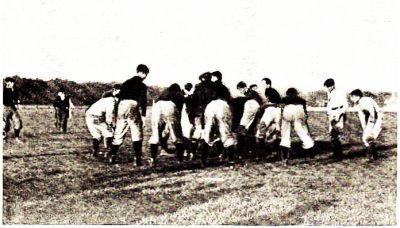
All the schools of the Long Island League are working hard at football this year, much harder than they have worked for the past few seasons, and we may therefore expect to see a better general average across the river. St. Paul's School always has had a strong team, and expects to have the best that ever represented the school this year. The Boys' High-School of Brooklyn has an energetic captain, Dickson, and promises to put a strong eleven into the field.
The trouble with last year's High-School team was that the men were too light, and became discouraged early in the season, and did not work with that determination which alone can insure success on the football field. A number of the old men are back, however, this fall, and the new material seems to be heavier than any which has before been available.
The unusually large number of students at the Buffalo High-School this year seems to have bred a lively interest in football. The first team the High-School ever put into the field was in 1892, but so little interest was taken in its work by the students at large and the players themselves, that they were able to accomplish but little. This year, however, a change seems to have come over the spirit of B.H.-S., and large crowds watch the practice every afternoon. The eleven is light when compared with some of the teams which it will meet during the season, but the men play well together, and the new rules are so arranged that a light eleven is not under such a disadvantage as it used to be in years past. Vayers, the captain, knows the game thoroughly, and has the ability of imparting knowledge to those under him.
THE BERKELEY OVAL FOOTBALL FIELD.
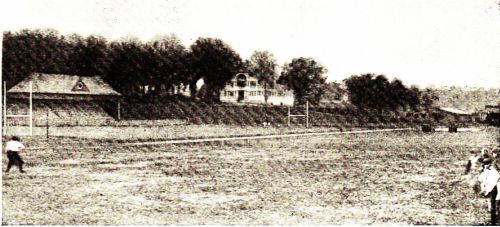
The Andover football team this year seems to be rich in candidates for positions behind the line, whereas very few good men can be found for the rush-line itself. Nevertheless, Captain Barker is working hard with such material as he has, and no doubt by the close of the season he will have developed an eleven of the usual Andover calibre. It seems very improbable that a game with Exeter will be arranged this year, although there has been a renewal of interest in the subject lately, and considerable thought and some activity among the graduates of the two schools.
The papers on the "Science of Football" which have been appearing in this Department during the past few weeks, written by Mr. W. H. Lewis, of the Harvard football team of 1893, are published now in book form, with much additional material, and many more illustrations and diagrams than were given originally in the Round Table. The book will be found especially valuable to beginners, for whom it is intended rather than for the more experienced player, and the chapter on training will be found especially serviceable to the captains of school teams.
"TRACK ATHLETICS IN DETAIL."—Illustrated.—8vo, Cloth, Ornamental, $1.25.
The Graduate.
A little boy who had been very well and carefully brought up was overlooked one evening at dinner in the serving of the roast. Presently he said,
"Papa, will you pass me the salt, please?"
This was an unusual request, and the father said: "Certainly. Have you none at your end of the table?"
"Not enough for all the meat you are going to give me," replied the little boy. And he was served at once.

A cream-of-tartar baking powder. Highest of all in leavening strength.—Latest United States Government Food Report.